Workshop Friday, June 19, 2009  Multi Purpose Room , US Embassy, 142 Old Hope Road , Kingston 6  10:00 am – 12 noon
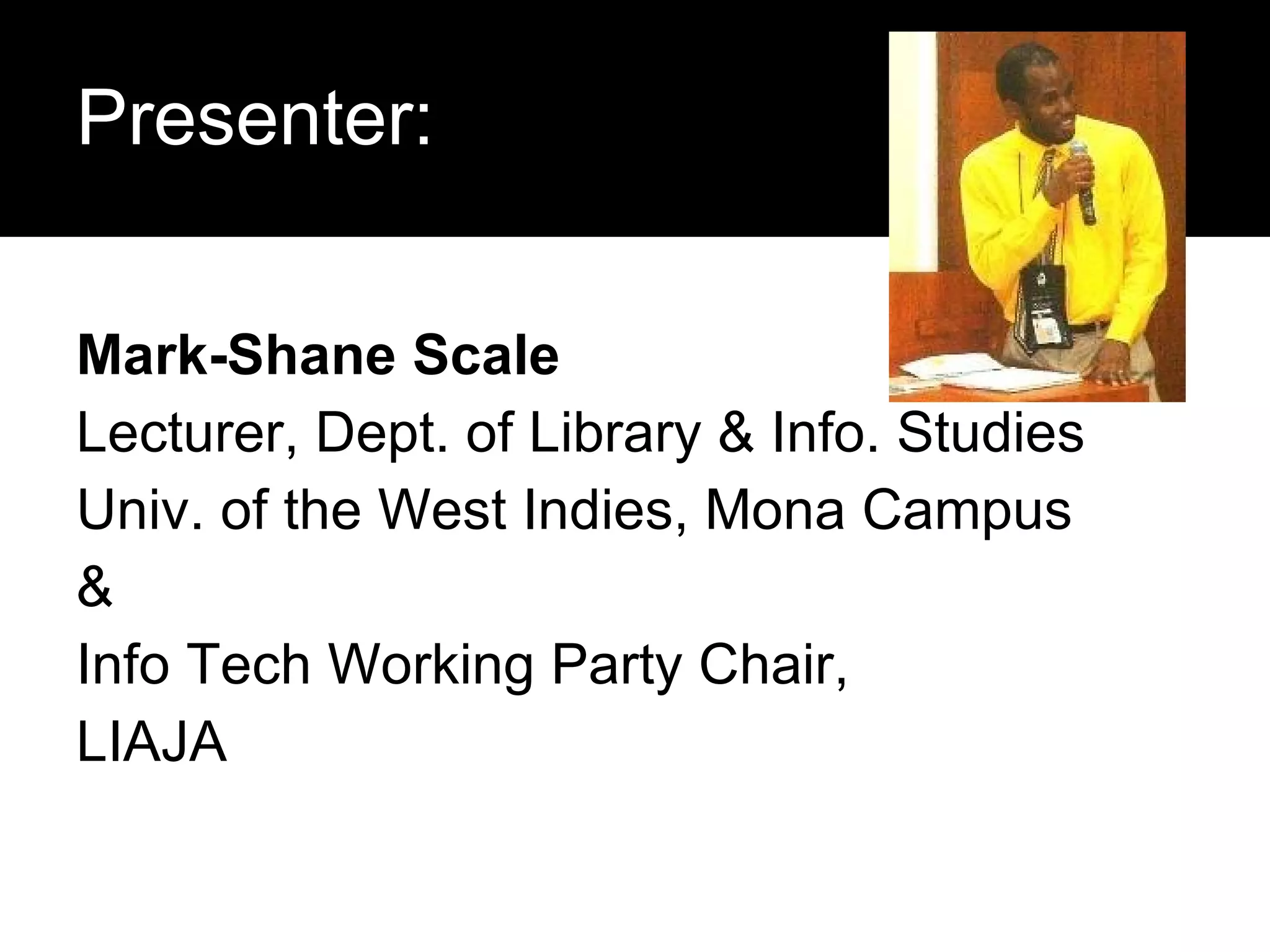
Presenter: Mark-Shane Scale Lecturer, Dept. of Library & Info. Studies Univ. of the West Indies, Mona Campus & Info Tech Working Party Chair, LIAJA
Introduction Today's technologies permit us to integrate and relate content, and to create and publish new content easily on the Web.
This presentation identifies the converging trends that: are giving a broader and richer context to information and to knowledge &  are having an important impact on library services.
Topics include: Web 2.0 and librarians mobile technologies,  blogs,  user trends, technologies used by users, & widgets.
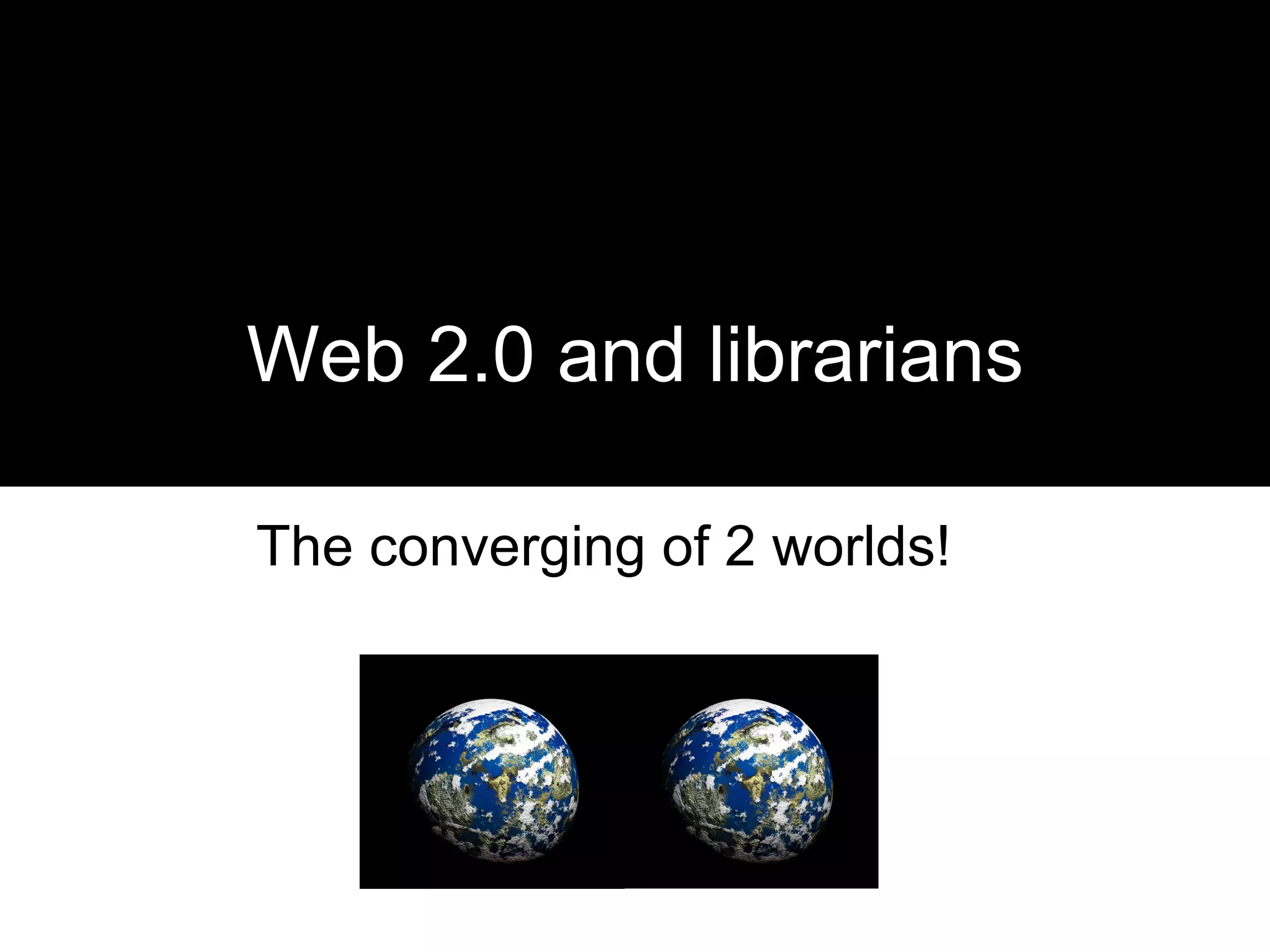
Web 2.0 and librarians The converging of 2 worlds!
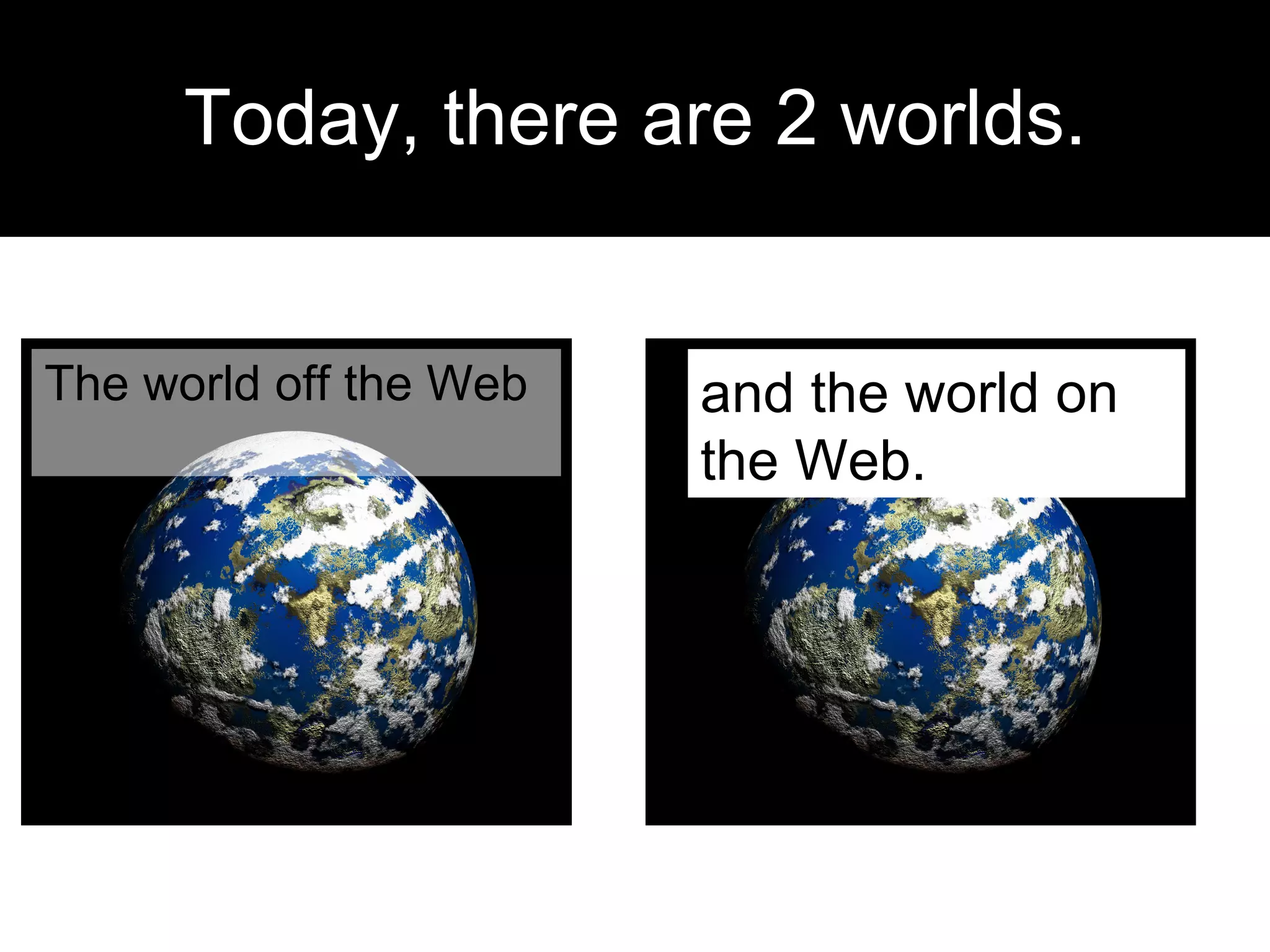
Today, there are 2 worlds. The world off the Web  and the world on the Web.
Do you hang out in 2 worlds? The Offline  world The Online world
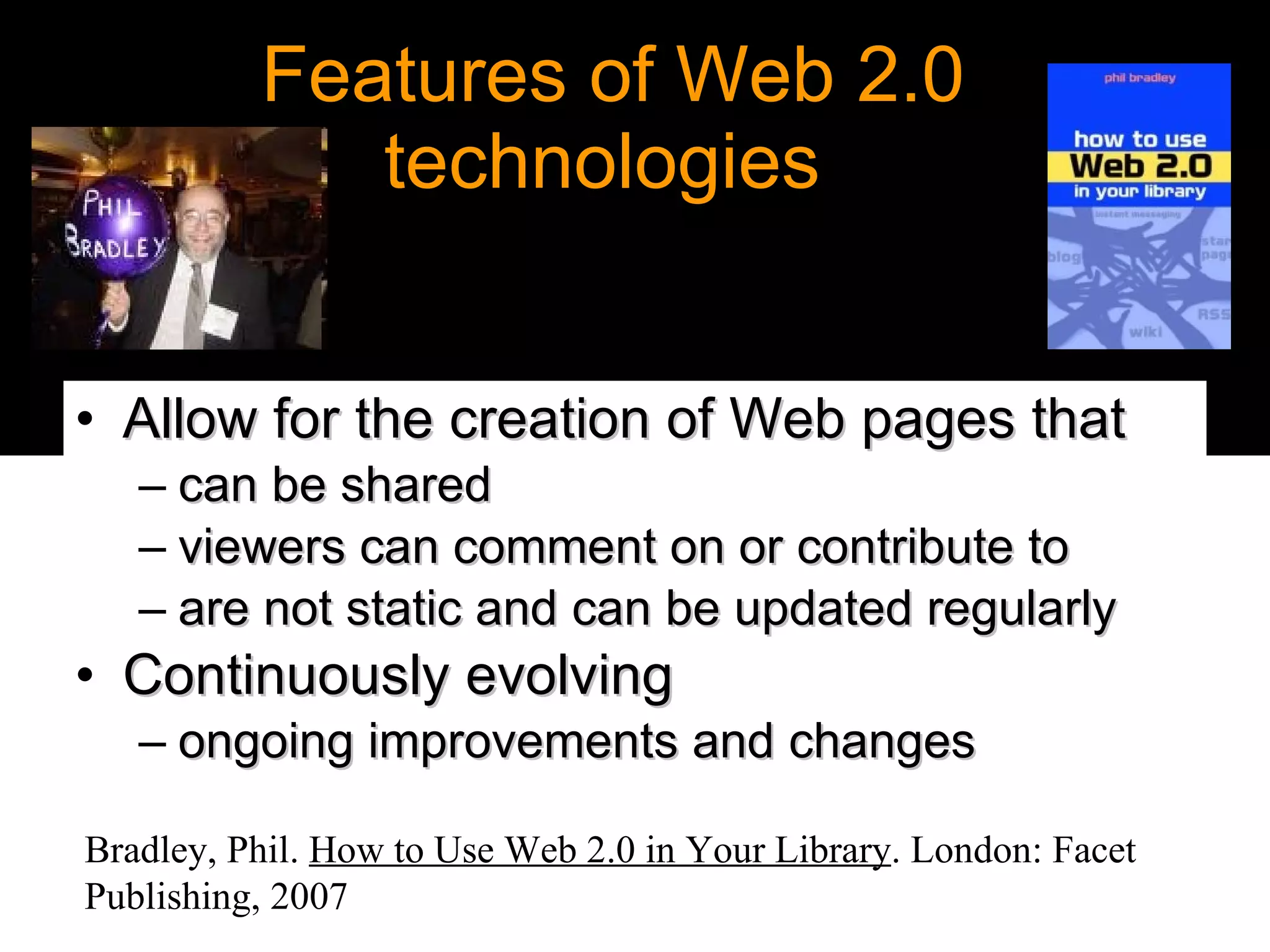
Features of Web 2.0 technologies  Allow for the creation of Web pages that  can be shared  viewers can comment on or contribute to are not static and can be updated regularly  Continuously evolving   ongoing improvements and changes Bradley, Phil.  How to Use Web 2.0 in Your Library . London: Facet Publishing, 2007 
Web 2.0 technologies   Social bookmarking sites -   Social networking sites - Online video sharing sites -  Online photo sharing sites -
Web 2.0 technologies Wikis -  Blogs -    Document sharing sites - 
http:// wikis.ala.org/iwa/index.php/Main_Page "The online environment has become an important and growing part of economic, cultural, civic, and social life, and  the use of new Internet-based applications for collaboration and learning  - including "social networking" sites -  is becoming increasingly prevalent ."
Publishers are going Web 2.0 ON
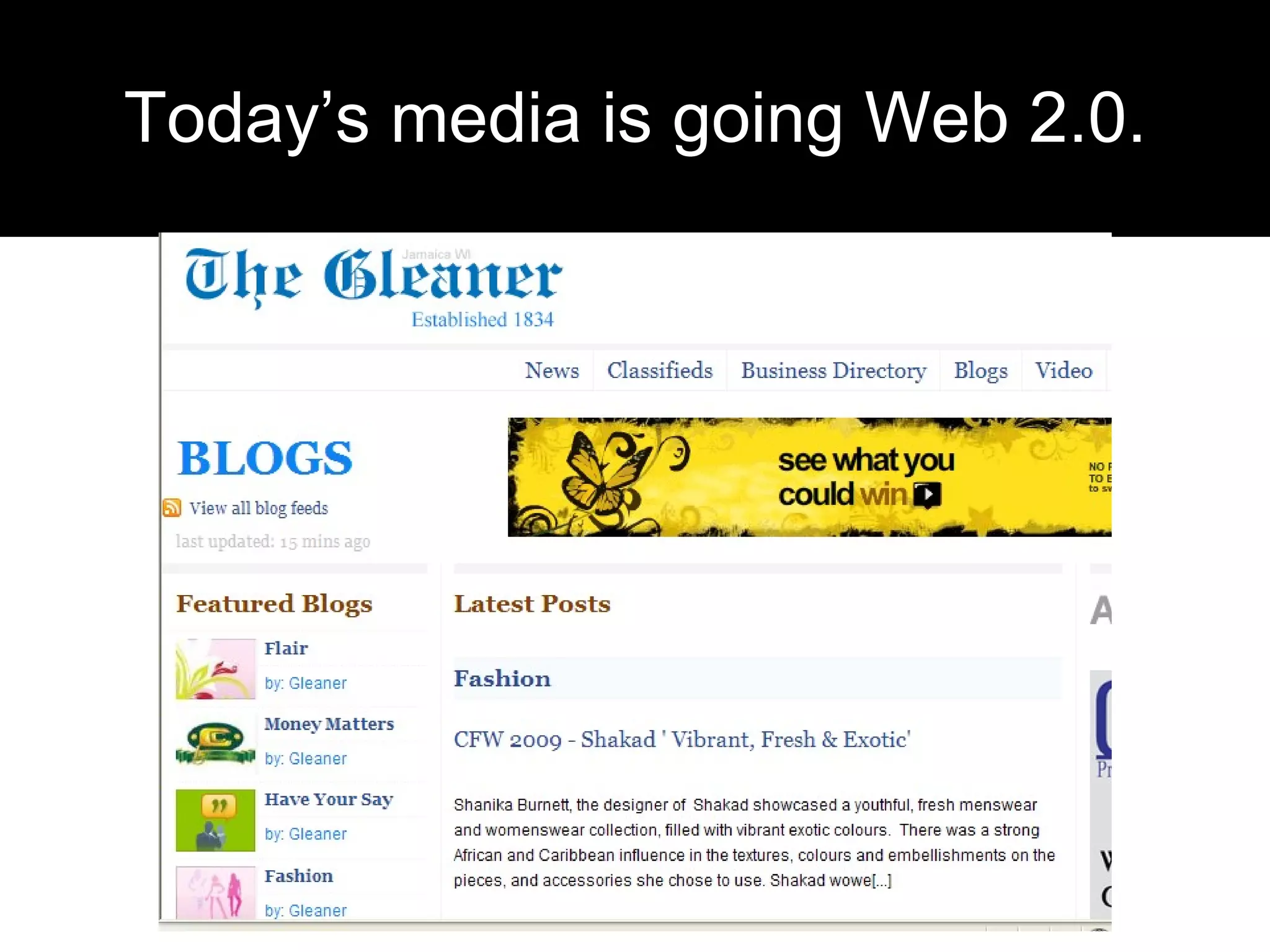
Today’s media is going Web 2.0.
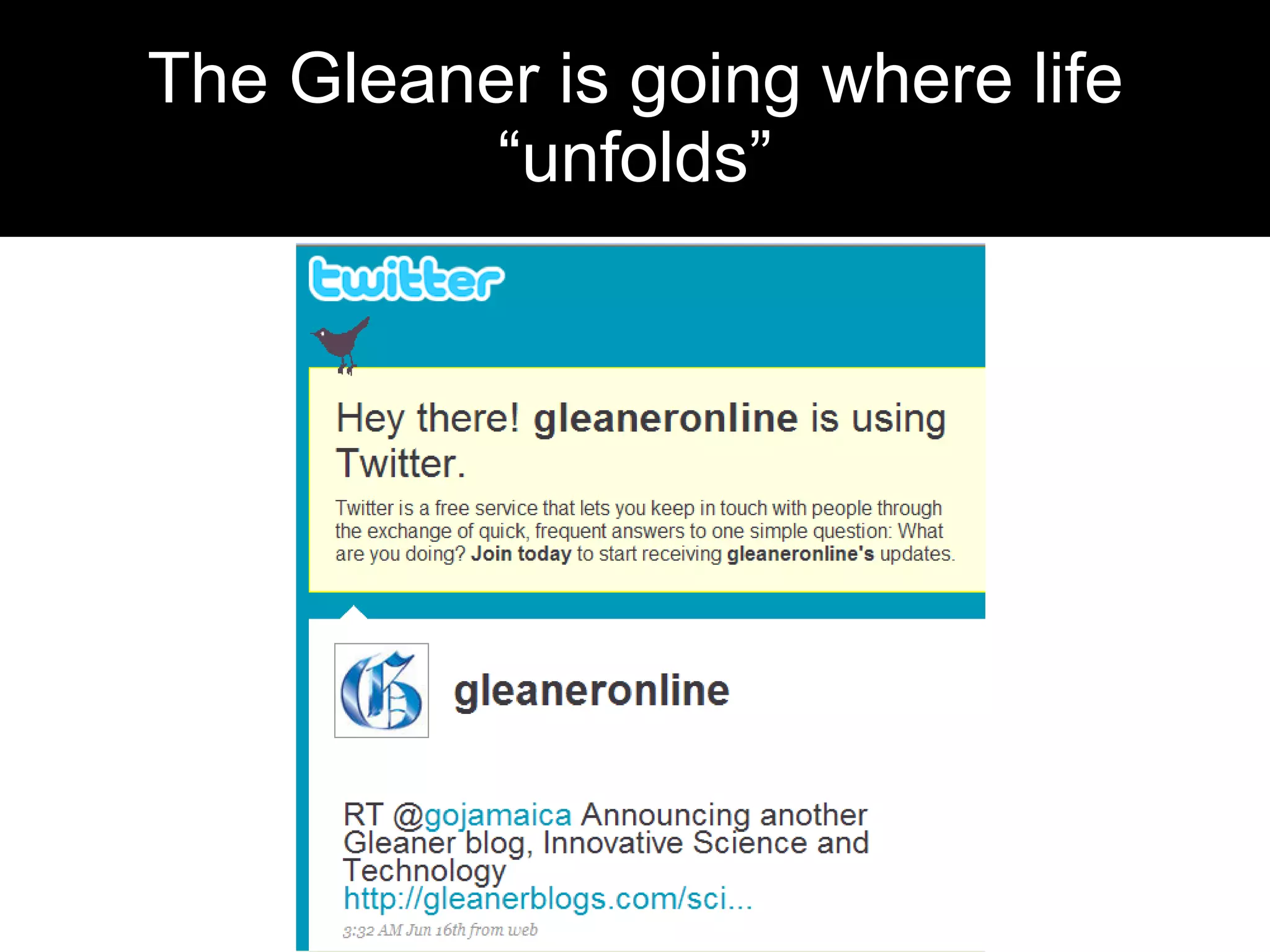
The Gleaner is going where life “unfolds”
Even CXC is going Web 2.0 CXC Channel on  http://www.youtube.com/user/caribbeanexams
With the rising content on the Web the librarian’s mandate is the same:  to provide access to information in all formats or media.
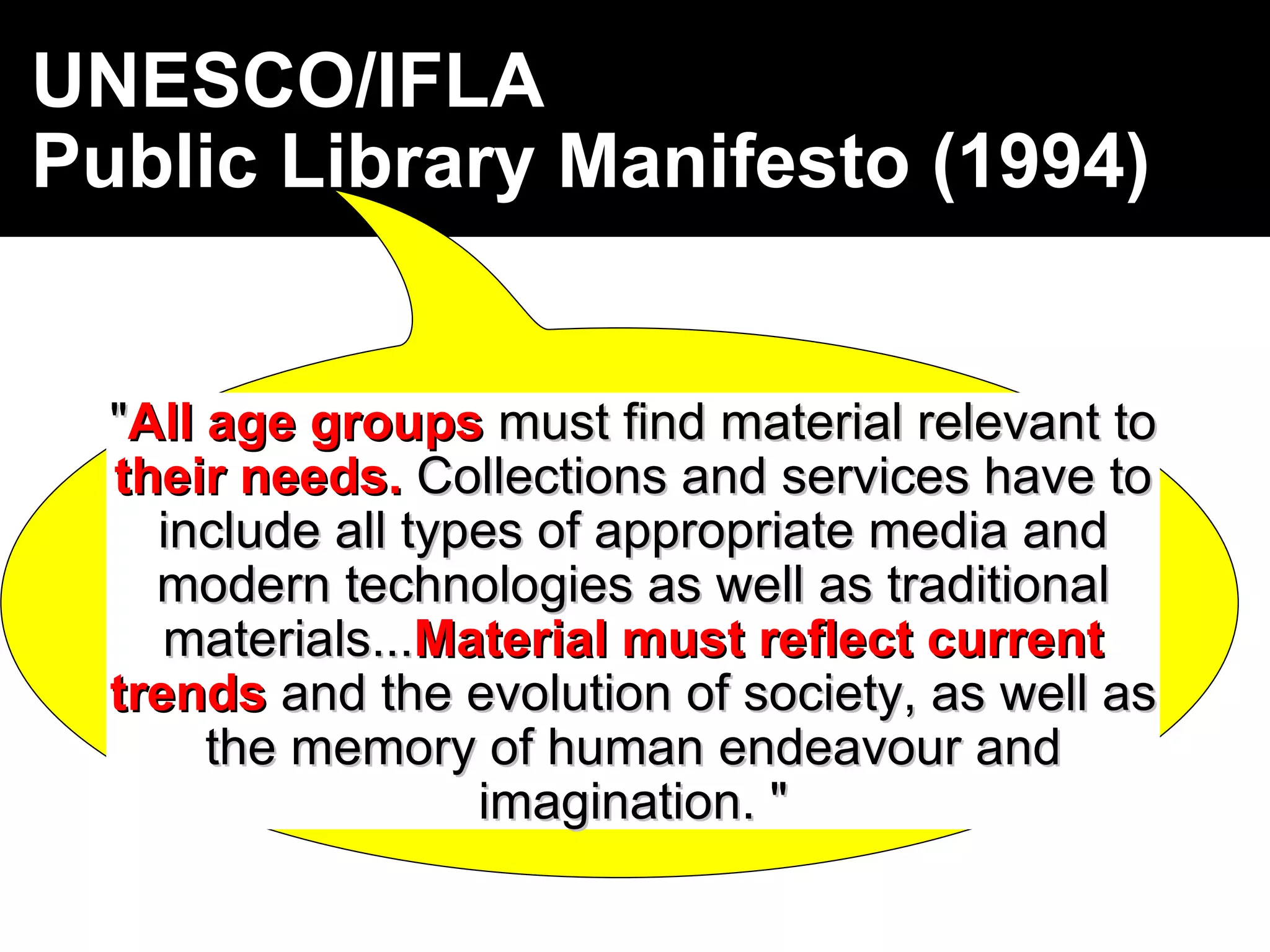
UNESCO/IFLA  Public Library Manifesto   (1994) " All   age groups  must find material relevant to  their needs.  Collections and services have to include all types of appropriate media and modern technologies as well as traditional materials... Material must reflect current trends  and the evolution of society, as well as the memory of human endeavour and imagination. "
Is your library providing collections    and services that include   modern technologies & media?    
The materials and services that    your library provide needs to   reflect    the evolution of    society & human endeavour.
Librarians Need to be able to navigate Web 2.0 content to provide users with access to information that may be found in this area.
Mobile technologies SMS Reference  Text Message Reference Mobile search applications
Blogs Spaces where public opinion is shaped and current affairs discussed
Blog Search engines Technorati   http:// technorati.com /  -  Search engine for blogs –  where one can access public opinion and discussion of current affairs.
User Trends:  A Generation with new Information needs
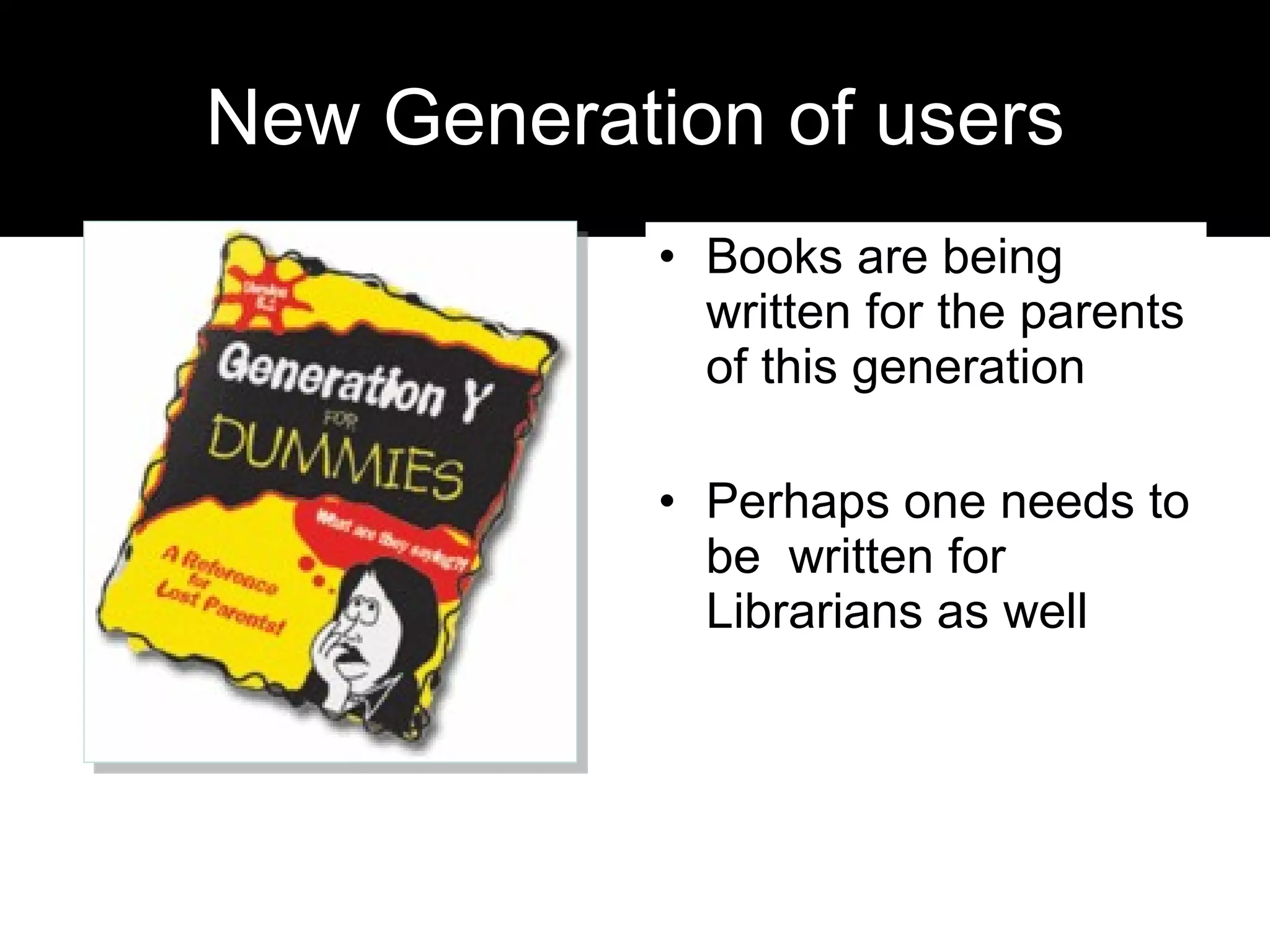
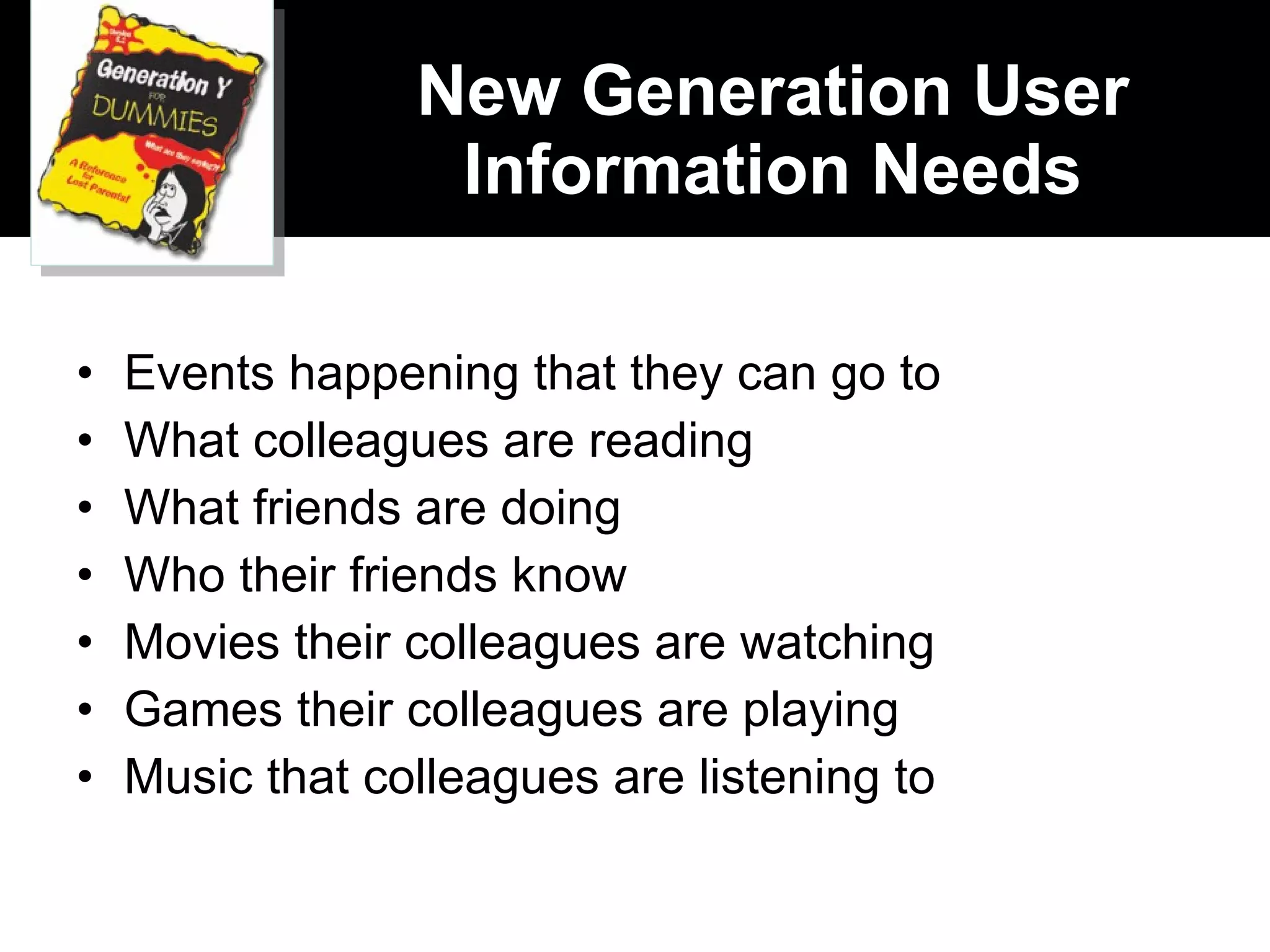
New Generation of users Books are being written for the parents of this generation Perhaps one needs to be  written for Librarians as well
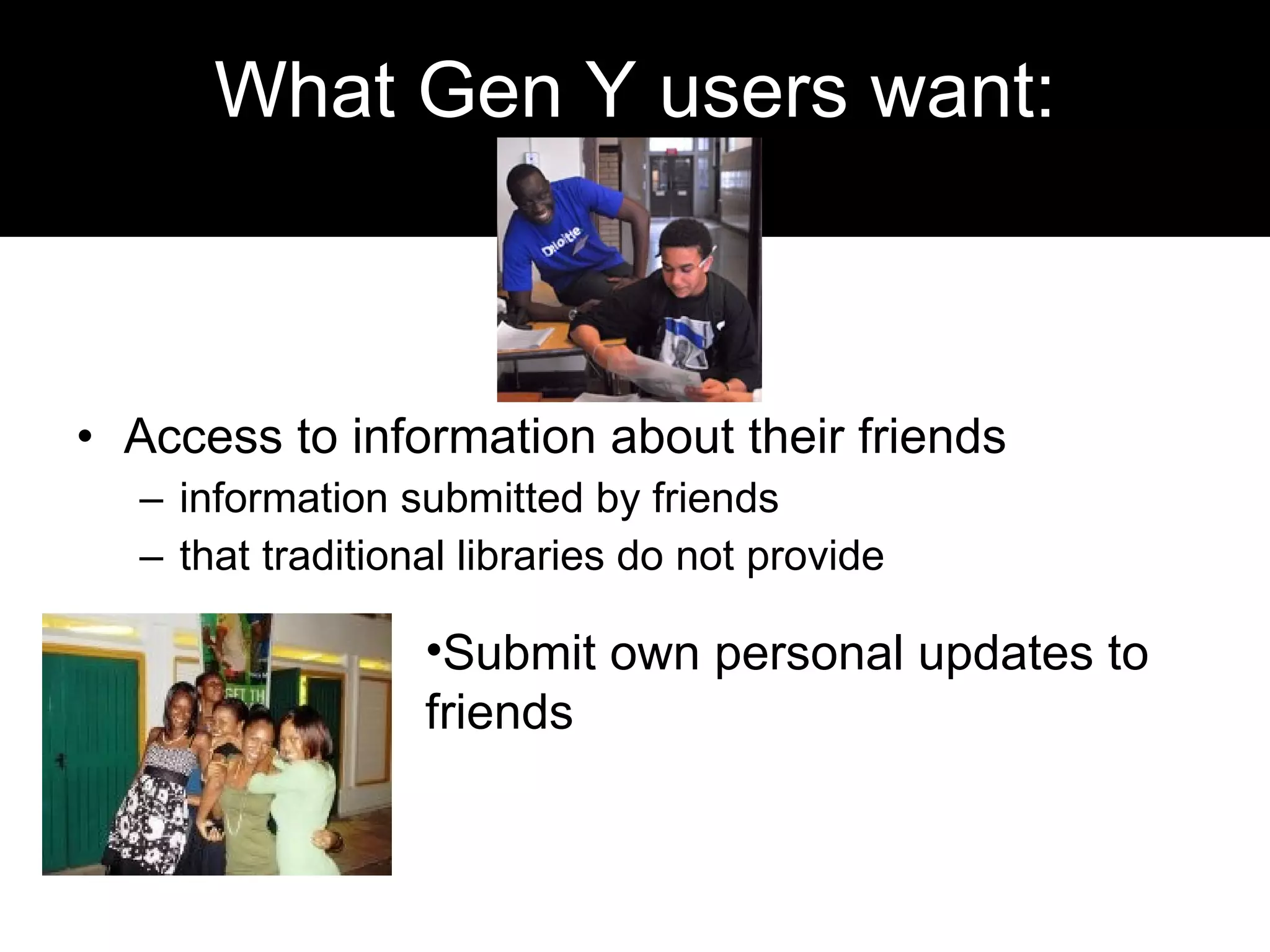
What Gen Y users want: Access to information about their friends information submitted by friends that traditional libraries do not provide Submit own personal updates to friends
New Generation User Information Needs Events happening that they can go to What colleagues are reading What friends are doing Who their friends know Movies their colleagues are watching Games their colleagues are playing Music that colleagues are listening to
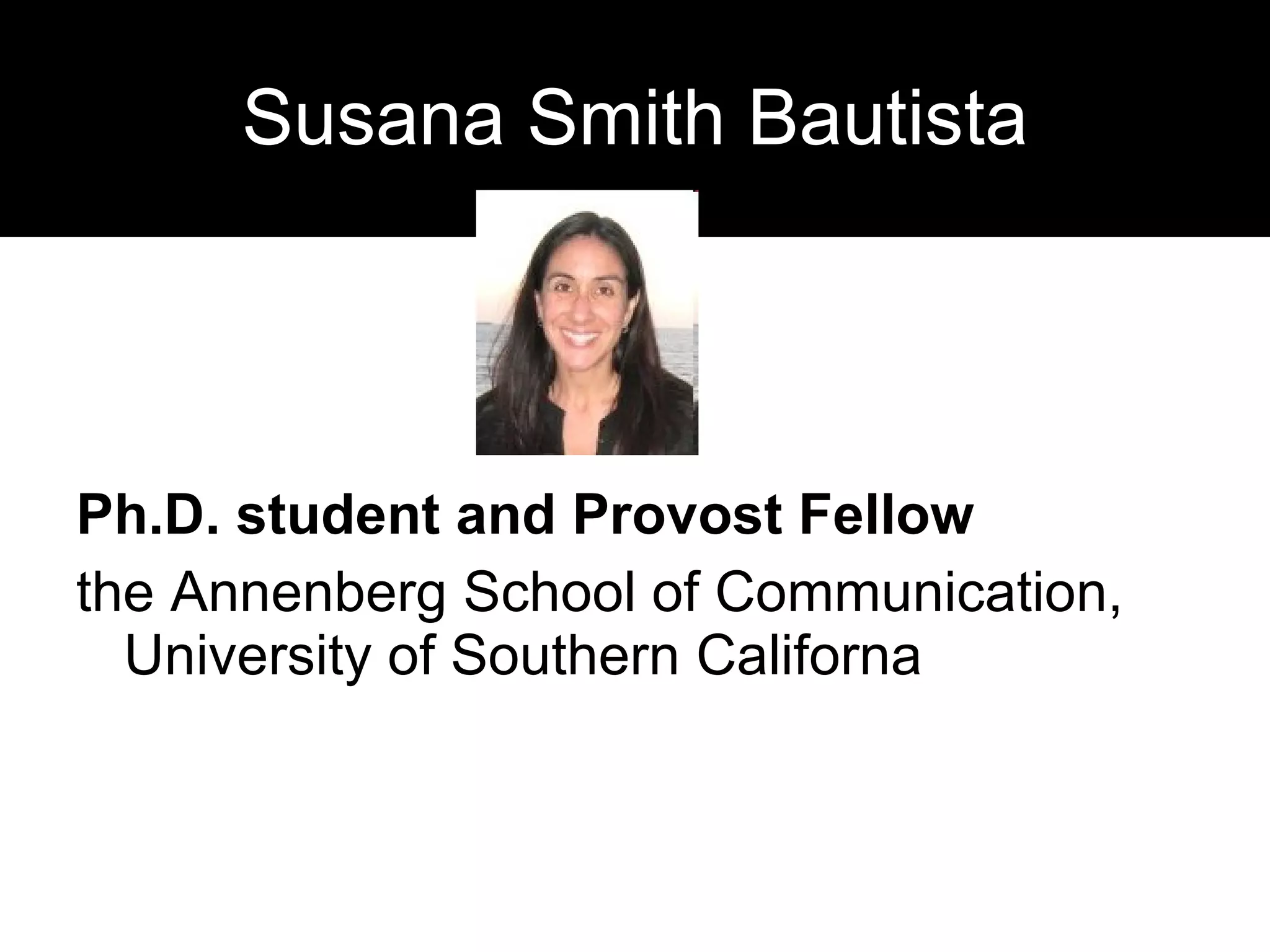
Susana Smith Bautista Ph.D. student and Provost Fellow   the Annenberg School of Communication, University of Southern Californa
In  “ Digital Media in Community Libraries, Part 2: Teen Websites” Futures of Learning http://futuresoflearning.org/ Published:  Thursday, May 28, 2009
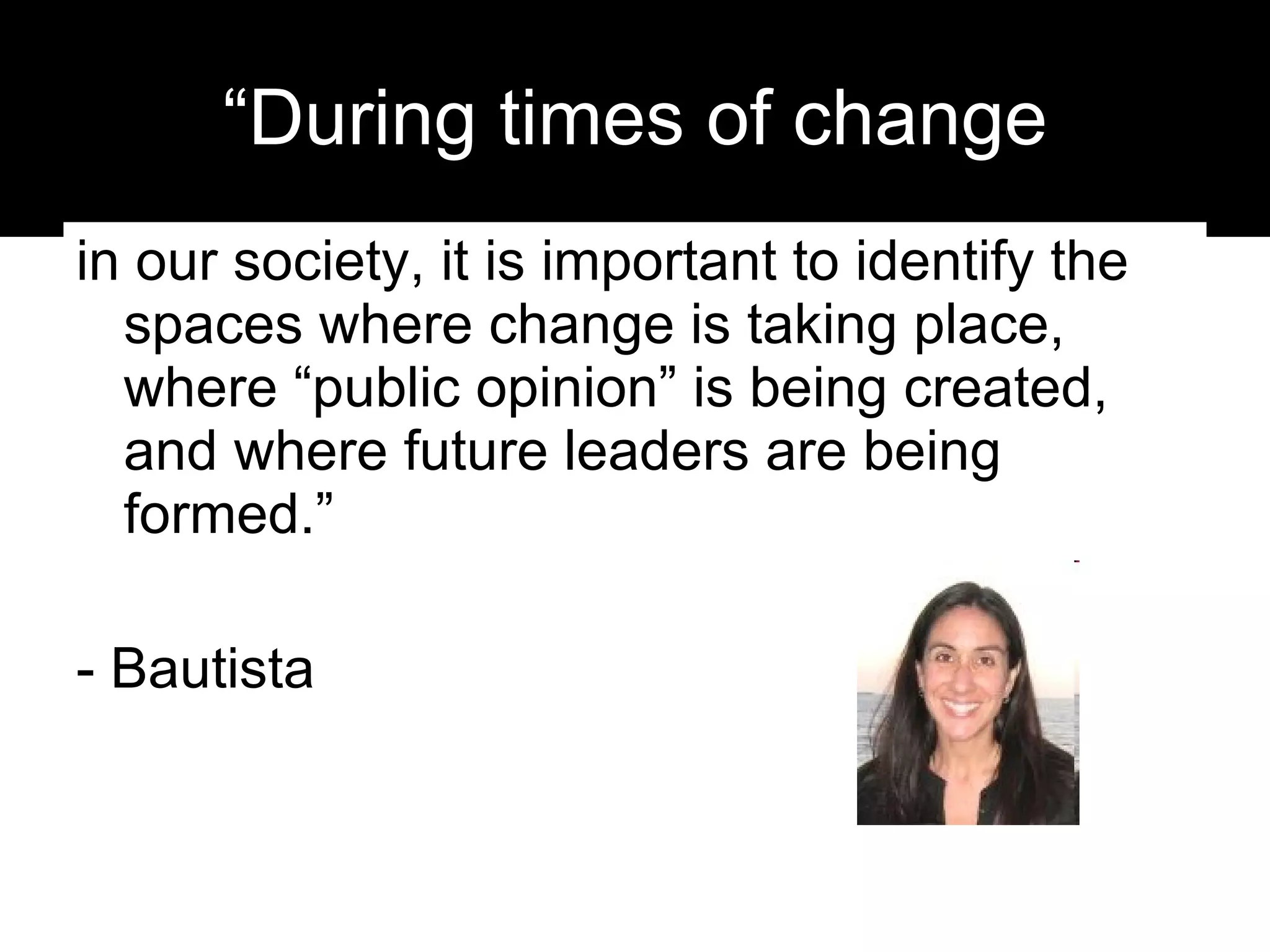
“During times of change in our society, it is important to identify the spaces where change is taking place, where “public opinion” is being created, and where future leaders are being formed.”  - Bautista
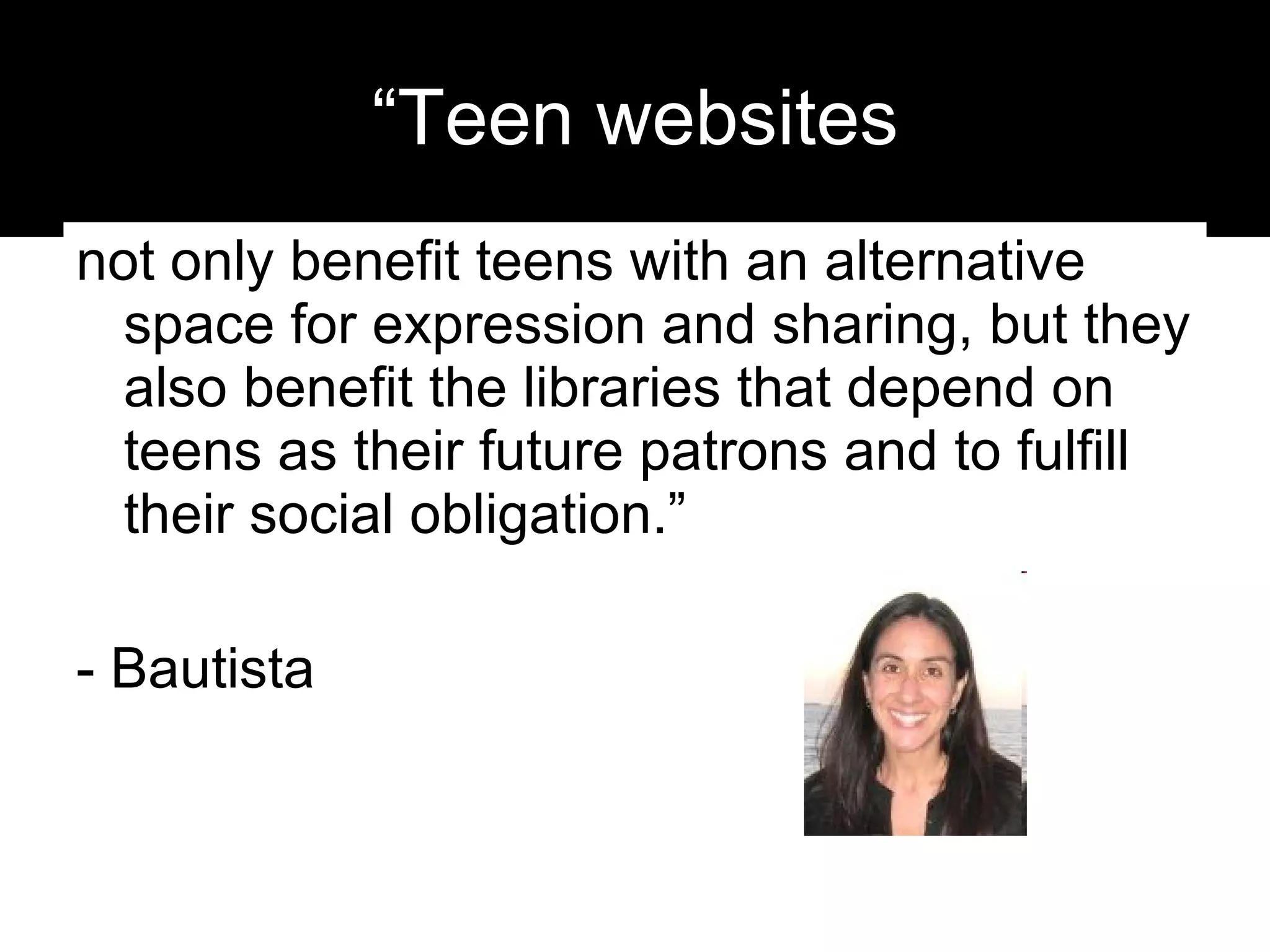
“Teen websites not only benefit teens with an alternative space for expression and sharing, but they also benefit the libraries that depend on teens as their future patrons and to fulfill their social obligation.”  - Bautista
New technologies & How our users are using them
Social bookmarks Del.icio.us  http:// del.icio.us /   What users are using to store Web content for future retrieval and access. Also used to share content with others and discover what others of similar interest are finding on the Web.
Photo sharing sites Flickr  http:// www.flickr.com /   Where users share their photos with others and view the photos of others.
Online E-book publishers Lulu   http:// www.lulu.com /   Allow for any user to self-publish e-books and other content online.
Slidecasting Slideshare  http:// www.slideshare.net /  -  Uploading of presentation slides for sharing with others. Also able to retrieve information from these slides.
Web Citation management Zotero   http:// www.zotero.org /  -  A free, easy-to-use Firefox extension to help you collect, manage, and cite your research sources. Where users can store the bibliographic details of web content for future citation purposes and to review.
Online knowledge sharing Where you can get a general overview of topics, concepts, people, places and things. Information on nouns and proper nouns How-to-information Information that is usually more current than printed sources.
Examples The people's  encyclopaedia The people's instructional manual for how-to information
Online Knowledge sharing Knol.com Where users get well written articles  written by experts who share ideas or thoughts on topics of interest.
Widgets “portable chunk of code that can be installed and executed within any separate HTML-based web page by an end user without requiring additional compilation.” Source:
Widgets Yahoo Widgets   http://widgets.yahoo.com/ Can be used to create or locate widgets.
Workshop activity Identify and locate any of the services mentioned in the presentation Conduct a 1 minute oral presentation illustrating how any of the services mentioned could benefit: Your library users You as a librarian Your library

Convergence in the digital world: Web 2.0, content, the librarian and the community of users

  • 1.
  • 2.
    Workshop Friday, June19, 2009 Multi Purpose Room , US Embassy, 142 Old Hope Road , Kingston 6 10:00 am – 12 noon
  • 3.
    Presenter: Mark-Shane ScaleLecturer, Dept. of Library & Info. Studies Univ. of the West Indies, Mona Campus & Info Tech Working Party Chair, LIAJA
  • 4.
    Introduction Today's technologiespermit us to integrate and relate content, and to create and publish new content easily on the Web.
  • 5.
    This presentation identifiesthe converging trends that: are giving a broader and richer context to information and to knowledge & are having an important impact on library services.
  • 6.
    Topics include: Web2.0 and librarians mobile technologies, blogs, user trends, technologies used by users, & widgets.
  • 7.
    Web 2.0 andlibrarians The converging of 2 worlds!
  • 8.
    Today, there are2 worlds. The world off the Web and the world on the Web.
  • 9.
    Do you hangout in 2 worlds? The Offline world The Online world
  • 10.
    Features of Web2.0 technologies Allow for the creation of Web pages that  can be shared  viewers can comment on or contribute to are not static and can be updated regularly Continuously evolving  ongoing improvements and changes Bradley, Phil. How to Use Web 2.0 in Your Library . London: Facet Publishing, 2007 
  • 11.
    Web 2.0 technologies  Social bookmarking sites -   Social networking sites - Online video sharing sites - Online photo sharing sites -
  • 12.
    Web 2.0 technologiesWikis - Blogs -   Document sharing sites - 
  • 13.
    http:// wikis.ala.org/iwa/index.php/Main_Page "Theonline environment has become an important and growing part of economic, cultural, civic, and social life, and the use of new Internet-based applications for collaboration and learning - including "social networking" sites - is becoming increasingly prevalent ."
  • 14.
  • 15.
    Today’s media isgoing Web 2.0.
  • 16.
    The Gleaner isgoing where life “unfolds”
  • 17.
    Even CXC isgoing Web 2.0 CXC Channel on http://www.youtube.com/user/caribbeanexams
  • 18.
    With the risingcontent on the Web the librarian’s mandate is the same: to provide access to information in all formats or media.
  • 19.
    UNESCO/IFLA  Public LibraryManifesto (1994) " All age groups must find material relevant to their needs. Collections and services have to include all types of appropriate media and modern technologies as well as traditional materials... Material must reflect current trends and the evolution of society, as well as the memory of human endeavour and imagination. "
  • 20.
    Is your libraryproviding collections    and services that include   modern technologies & media?  
  • 21.
    The materials andservices that    your library provide needs to   reflect    the evolution of    society & human endeavour.
  • 22.
    Librarians Need tobe able to navigate Web 2.0 content to provide users with access to information that may be found in this area.
  • 23.
    Mobile technologies SMSReference Text Message Reference Mobile search applications
  • 24.
    Blogs Spaces wherepublic opinion is shaped and current affairs discussed
  • 25.
    Blog Search enginesTechnorati http:// technorati.com / - Search engine for blogs – where one can access public opinion and discussion of current affairs.
  • 26.
    User Trends: A Generation with new Information needs
  • 27.
    New Generation ofusers Books are being written for the parents of this generation Perhaps one needs to be written for Librarians as well
  • 28.
    What Gen Yusers want: Access to information about their friends information submitted by friends that traditional libraries do not provide Submit own personal updates to friends
  • 29.
    New Generation UserInformation Needs Events happening that they can go to What colleagues are reading What friends are doing Who their friends know Movies their colleagues are watching Games their colleagues are playing Music that colleagues are listening to
  • 30.
    Susana Smith BautistaPh.D. student and Provost Fellow the Annenberg School of Communication, University of Southern Californa
  • 31.
    In “Digital Media in Community Libraries, Part 2: Teen Websites” Futures of Learning http://futuresoflearning.org/ Published: Thursday, May 28, 2009
  • 32.
    “During times ofchange in our society, it is important to identify the spaces where change is taking place, where “public opinion” is being created, and where future leaders are being formed.” - Bautista
  • 33.
    “Teen websites notonly benefit teens with an alternative space for expression and sharing, but they also benefit the libraries that depend on teens as their future patrons and to fulfill their social obligation.” - Bautista
  • 34.
    New technologies &How our users are using them
  • 35.
    Social bookmarks Del.icio.us http:// del.icio.us / What users are using to store Web content for future retrieval and access. Also used to share content with others and discover what others of similar interest are finding on the Web.
  • 36.
    Photo sharing sitesFlickr http:// www.flickr.com / Where users share their photos with others and view the photos of others.
  • 37.
    Online E-book publishersLulu http:// www.lulu.com / Allow for any user to self-publish e-books and other content online.
  • 38.
    Slidecasting Slideshare http:// www.slideshare.net / - Uploading of presentation slides for sharing with others. Also able to retrieve information from these slides.
  • 39.
    Web Citation managementZotero http:// www.zotero.org / - A free, easy-to-use Firefox extension to help you collect, manage, and cite your research sources. Where users can store the bibliographic details of web content for future citation purposes and to review.
  • 40.
    Online knowledge sharingWhere you can get a general overview of topics, concepts, people, places and things. Information on nouns and proper nouns How-to-information Information that is usually more current than printed sources.
  • 41.
    Examples The people's encyclopaedia The people's instructional manual for how-to information
  • 42.
    Online Knowledge sharingKnol.com Where users get well written articles written by experts who share ideas or thoughts on topics of interest.
  • 43.
    Widgets “portable chunkof code that can be installed and executed within any separate HTML-based web page by an end user without requiring additional compilation.” Source:
  • 44.
    Widgets Yahoo Widgets http://widgets.yahoo.com/ Can be used to create or locate widgets.
  • 45.
    Workshop activity Identifyand locate any of the services mentioned in the presentation Conduct a 1 minute oral presentation illustrating how any of the services mentioned could benefit: Your library users You as a librarian Your library