Reimagining Information Literacy as a
Empowering Learners for Participation,
Collaboration, and Reflection
1
Trudi Jacobson & Tom Mackey
#metaliteracy
New England Library Instruction Group (NELIG)

Libraries, Librarians & Literacies:
Information Literacy in Context
June 21, 2013, Dartmouth College
Setting the Context
2
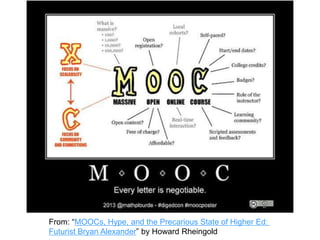
From: “MOOCs, Hype, and the Precarious State of Higher Ed:
Futurist Bryan Alexander” by Howard Rheingold
4
2012 Paris OER Declaration
“Bridge the digital divide by developing
adequate infrastructure, in particular,
affordable broadband connectivity,
widespread mobile technology and
reliable electrical power supply.”
“Improve media and information literacy
and encourage the development and use
of OER in open standard digital formats.”
http://www.unesco.org/new/fileadmin/MULTIMEDIA/HQ/CI/CI/pdf/
Events/Paris%20OER%20Declaration_01.pdf
5
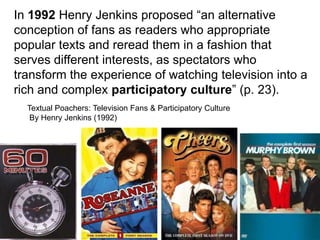
In 1992 Henry Jenkins proposed “an alternative
conception of fans as readers who appropriate
popular texts and reread them in a fashion that
serves different interests, as spectators who
transform the experience of watching television into a
rich and complex participatory culture” (p. 23).
Textual Poachers: Television Fans & Participatory Culture
By Henry Jenkins (1992)
6
“Participatory culture
shifts the focus of literacy
from one of individual
expression to community
involvement” (p. xiii).
Confronting the Challenges
of Participatory Culture
Media Education for the 21st Century
Henry Jenkins
2009
7
“The new literacies almost
all involve social skills
developed through
collaboration and
networking.” (p. xiii).
Confronting the Challenges
of Participatory Culture
Media Education for the 21st Century
Henry Jenkins
2009
What is participatory learning?
• Active
• Interactive
• Networked
• Connected
• Collaborative
• Community
• Global
• Team-based
• Engaging
• Social
• Convergent
• Emergent
• Adaptable
• Evolving
• Transformative
• Multi-modal
• Shared
• Empowering
8
ACRL Standard Definition of
Information Literacy (2000)
• Determine the extent of information needed
• Access the needed information effectively and
efficiently
• Evaluate information and its sources critically
• Incorporate selected information into one’s knowledge
base
• Use information effectively to accomplish a specific
purpose
• Understand the economic, legal, and social issues
surrounding the use of information, and access and use
information ethically and legally
9
http://www.ala.org/ala/mgrps/divs/acrl/standards/informationliteracycompetency.cfm
10
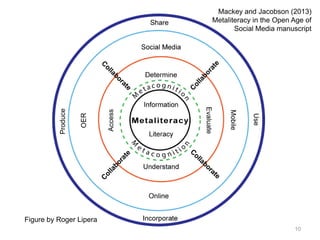
Figure by Roger Lipera
Mackey and Jacobson (2013)
Metaliteracy in the Open Age of
Social Media manuscript
• “promotes critical thinking and collaboration in
a digital age.”
• “comprehensive framework to effectively
participate in social media and online
communities”
• “unified construct that supports the acquisition,
production, and sharing of knowledge in
collaborative online communities.”
11
Thomas P. Mackey and Trudi E. Jacobson “Reframing Information Literacy as a Metaliteracy”
College & Research Libraries. January 2011 72:62-78. http://crl.acrl.org/content/72/1/62.full.pdf
• “is more than descriptive; it identifies how
learners critically evaluate and understand
their knowledge as individuals and
participants in social learning environments. ”
12
Mackey and Jacobson (2013) Metaliteracy in the Open Age of Social Media manuscript
• “Information literacy is central to this
redefinition because information takes many
forms online and is produced and
communicated through multiple modalities. ”
13
Thomas P. Mackey and Trudi E. Jacobson “Reframing Information Literacy as a Metaliteracy”
College & Research Libraries. January 2011 72:62-78. http://crl.acrl.org/content/72/1/62.full.pdf
The meta in metaliteracy
14
15
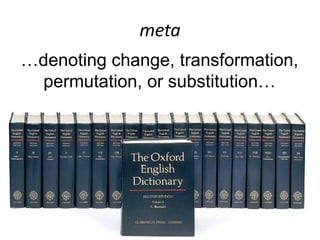
…denoting change, transformation,
permutation, or substitution…
meta
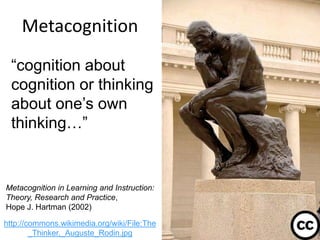
Metacognition
16
http://commons.wikimedia.org/wiki/File:The
_Thinker,_Auguste_Rodin.jpg
“cognition about
cognition or thinking
about one’s own
thinking…”
Metacognition in Learning and Instruction:
Theory, Research and Practice,
Hope J. Hartman (2002)
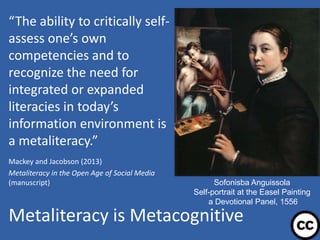
Metaliteracy is Metacognitive
“The ability to critically self-
assess one’s own
competencies and to
recognize the need for
integrated or expanded
literacies in today’s
information environment is
a metaliteracy.”
Mackey and Jacobson (2013)
Metaliteracy in the Open Age of Social Media
(manuscript)
17
Sofonisba Anguissola
Self-portrait at the Easel Painting
a Devotional Panel, 1556
Metaliteracy is Metacognitive
“This metacognitive
approach challenges a
reliance on skills-based
information literacy
instruction only and shifts
the focus to knowledge
acquisition in collaboration
with others.”
Mackey and Jacobson (2013)
Metaliteracy in the Open Age of Social Media
(manuscript)
18
Judith Leyster
Self-portrait, 1630
Metaliteracy In Practice
19
20
Understand Format Type and Delivery Mode
Evaluate User Feedback as Active Researcher
Create a Context for User-generated Information
Evaluate Dynamic Content Critically
Thomas P. Mackey and Trudi E. Jacobson “Reframing Information Literacy as a Metaliteracy” College &
Research Libraries. January 2011 72:62-78. http://crl.acrl.org/content/72/1/62.full.pdf
21
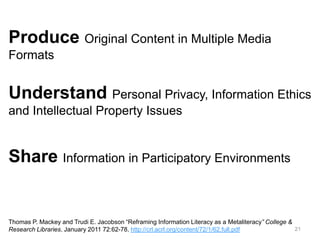
Produce Original Content in Multiple Media
Formats
Understand Personal Privacy, Information Ethics
and Intellectual Property Issues
Share Information in Participatory Environments
Thomas P. Mackey and Trudi E. Jacobson “Reframing Information Literacy as a Metaliteracy” College &
Research Libraries. January 2011 72:62-78. http://crl.acrl.org/content/72/1/62.full.pdf
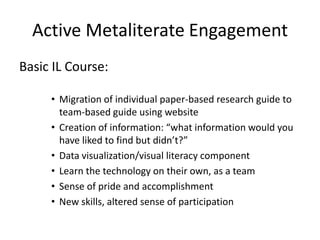
Active Metaliterate Engagement
Basic IL Course:
• Migration of individual paper-based research guide to
team-based guide using website
• Creation of information: “what information would you
have liked to find but didn’t?”
• Data visualization/visual literacy component
• Learn the technology on their own, as a team
• Sense of pride and accomplishment
• New skills, altered sense of participation
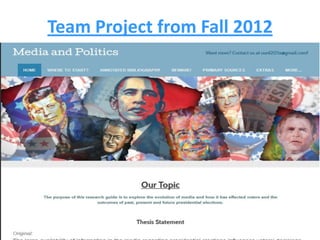
Team Project from Fall 2012
24
Metacognitive Practice
– Understand the process of creating and
sharing information
– Recognize gaps in knowledge
– Seek new knowledge to adjust to
challenging situations
– Adapt to changing technologies
– Continuously self-reflect
– Demonstrate empowerment through
interaction, communication, and
presentation
– Reflect on production and participation
SUNY Innovative Instruction
Technology Grant (IITG)
25
Grant Goals
• Develop robust conversations between
librarians and faculty members
• Develop metaliteracy learning objectives
• Investigate a badge system for metaliteracy
competencies for SUNY students (and others,
we hope)
• Develop or provide access to OERs related to
metaliteracy
26
27http://metaliteracy.org/
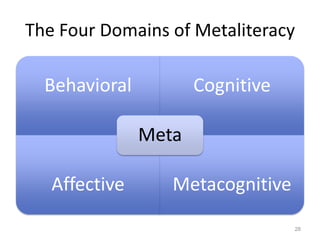
The Four Domains of Metaliteracy
Behavioral Cognitive
Affective Metacognitive
Meta
28
Metaliteracy meets Info Literacy at
UAlbany
New major-based general education learning objectives
2. “Demonstrate the ability to evaluate content,
including dynamic, online content if
appropriate”
4. “Produce, share, and evaluate information in a
variety of participatory environments”
5. “Integrate learning and research strategies with
lifelong learning processes and personal,
academic, and professional goals”
29
30
DEMO
Metaliteracy Badging Scheme
Information Producer/Community Collaborator
Badge examples
• Contributor
• Creator
– Grow with the tools
– Make it personal
– Value collaboration
• International Participant
31
We welcome participation:
• Comments/suggestions on the learning
objectives
• Examples of metaliteracy in practice
assignments and exercises to share on
Metaliteracy.org
• Ideas on the badges and badge content (we
can provide more information)
32
New MOOC for Fall 2013:
Metaliteracy
(a connectivist MOOC blended with an inter-
institutional course)
MOOC
QUESTIONS?
34
35
Trudi E. Jacobson, M.L.S., M.A.
Distinguished Librarian
Head, Information Literacy Department
University Libraries
University at Albany, SUNY
Tom Mackey, Ph.D.
Dean
Center for Distance Learning
Empire State College, SUNY
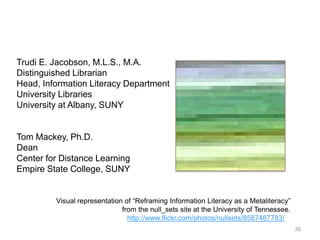
Visual representation of “Reframing Information Literacy as a Metaliteracy”
from the null_sets site at the University of Tennessee.
http://www.flickr.com/photos/nullsets/8587487783/

Metaliteracy Presentation at Dartmouth College

  • 1.
    Reimagining Information Literacyas a Empowering Learners for Participation, Collaboration, and Reflection 1 Trudi Jacobson & Tom Mackey #metaliteracy New England Library Instruction Group (NELIG)
 Libraries, Librarians & Literacies: Information Literacy in Context June 21, 2013, Dartmouth College
  • 2.
  • 3.
    From: “MOOCs, Hype,and the Precarious State of Higher Ed: Futurist Bryan Alexander” by Howard Rheingold
  • 4.
    4 2012 Paris OERDeclaration “Bridge the digital divide by developing adequate infrastructure, in particular, affordable broadband connectivity, widespread mobile technology and reliable electrical power supply.” “Improve media and information literacy and encourage the development and use of OER in open standard digital formats.” http://www.unesco.org/new/fileadmin/MULTIMEDIA/HQ/CI/CI/pdf/ Events/Paris%20OER%20Declaration_01.pdf
  • 5.
    5 In 1992 HenryJenkins proposed “an alternative conception of fans as readers who appropriate popular texts and reread them in a fashion that serves different interests, as spectators who transform the experience of watching television into a rich and complex participatory culture” (p. 23). Textual Poachers: Television Fans & Participatory Culture By Henry Jenkins (1992)
  • 6.
    6 “Participatory culture shifts thefocus of literacy from one of individual expression to community involvement” (p. xiii). Confronting the Challenges of Participatory Culture Media Education for the 21st Century Henry Jenkins 2009
  • 7.
    7 “The new literaciesalmost all involve social skills developed through collaboration and networking.” (p. xiii). Confronting the Challenges of Participatory Culture Media Education for the 21st Century Henry Jenkins 2009
  • 8.
    What is participatorylearning? • Active • Interactive • Networked • Connected • Collaborative • Community • Global • Team-based • Engaging • Social • Convergent • Emergent • Adaptable • Evolving • Transformative • Multi-modal • Shared • Empowering 8
  • 9.
    ACRL Standard Definitionof Information Literacy (2000) • Determine the extent of information needed • Access the needed information effectively and efficiently • Evaluate information and its sources critically • Incorporate selected information into one’s knowledge base • Use information effectively to accomplish a specific purpose • Understand the economic, legal, and social issues surrounding the use of information, and access and use information ethically and legally 9 http://www.ala.org/ala/mgrps/divs/acrl/standards/informationliteracycompetency.cfm
  • 10.
    10 Figure by RogerLipera Mackey and Jacobson (2013) Metaliteracy in the Open Age of Social Media manuscript
  • 11.
    • “promotes criticalthinking and collaboration in a digital age.” • “comprehensive framework to effectively participate in social media and online communities” • “unified construct that supports the acquisition, production, and sharing of knowledge in collaborative online communities.” 11 Thomas P. Mackey and Trudi E. Jacobson “Reframing Information Literacy as a Metaliteracy” College & Research Libraries. January 2011 72:62-78. http://crl.acrl.org/content/72/1/62.full.pdf
  • 12.
    • “is morethan descriptive; it identifies how learners critically evaluate and understand their knowledge as individuals and participants in social learning environments. ” 12 Mackey and Jacobson (2013) Metaliteracy in the Open Age of Social Media manuscript
  • 13.
    • “Information literacyis central to this redefinition because information takes many forms online and is produced and communicated through multiple modalities. ” 13 Thomas P. Mackey and Trudi E. Jacobson “Reframing Information Literacy as a Metaliteracy” College & Research Libraries. January 2011 72:62-78. http://crl.acrl.org/content/72/1/62.full.pdf
  • 14.
    The meta inmetaliteracy 14
  • 15.
  • 16.
    Metacognition 16 http://commons.wikimedia.org/wiki/File:The _Thinker,_Auguste_Rodin.jpg “cognition about cognition orthinking about one’s own thinking…” Metacognition in Learning and Instruction: Theory, Research and Practice, Hope J. Hartman (2002)
  • 17.
    Metaliteracy is Metacognitive “Theability to critically self- assess one’s own competencies and to recognize the need for integrated or expanded literacies in today’s information environment is a metaliteracy.” Mackey and Jacobson (2013) Metaliteracy in the Open Age of Social Media (manuscript) 17 Sofonisba Anguissola Self-portrait at the Easel Painting a Devotional Panel, 1556
  • 18.
    Metaliteracy is Metacognitive “Thismetacognitive approach challenges a reliance on skills-based information literacy instruction only and shifts the focus to knowledge acquisition in collaboration with others.” Mackey and Jacobson (2013) Metaliteracy in the Open Age of Social Media (manuscript) 18 Judith Leyster Self-portrait, 1630
  • 19.
  • 20.
    20 Understand Format Typeand Delivery Mode Evaluate User Feedback as Active Researcher Create a Context for User-generated Information Evaluate Dynamic Content Critically Thomas P. Mackey and Trudi E. Jacobson “Reframing Information Literacy as a Metaliteracy” College & Research Libraries. January 2011 72:62-78. http://crl.acrl.org/content/72/1/62.full.pdf
  • 21.
    21 Produce Original Contentin Multiple Media Formats Understand Personal Privacy, Information Ethics and Intellectual Property Issues Share Information in Participatory Environments Thomas P. Mackey and Trudi E. Jacobson “Reframing Information Literacy as a Metaliteracy” College & Research Libraries. January 2011 72:62-78. http://crl.acrl.org/content/72/1/62.full.pdf
  • 22.
    Active Metaliterate Engagement BasicIL Course: • Migration of individual paper-based research guide to team-based guide using website • Creation of information: “what information would you have liked to find but didn’t?” • Data visualization/visual literacy component • Learn the technology on their own, as a team • Sense of pride and accomplishment • New skills, altered sense of participation
  • 23.
  • 24.
    24 Metacognitive Practice – Understandthe process of creating and sharing information – Recognize gaps in knowledge – Seek new knowledge to adjust to challenging situations – Adapt to changing technologies – Continuously self-reflect – Demonstrate empowerment through interaction, communication, and presentation – Reflect on production and participation
  • 25.
  • 26.
    Grant Goals • Developrobust conversations between librarians and faculty members • Develop metaliteracy learning objectives • Investigate a badge system for metaliteracy competencies for SUNY students (and others, we hope) • Develop or provide access to OERs related to metaliteracy 26
  • 27.
  • 28.
    The Four Domainsof Metaliteracy Behavioral Cognitive Affective Metacognitive Meta 28
  • 29.
    Metaliteracy meets InfoLiteracy at UAlbany New major-based general education learning objectives 2. “Demonstrate the ability to evaluate content, including dynamic, online content if appropriate” 4. “Produce, share, and evaluate information in a variety of participatory environments” 5. “Integrate learning and research strategies with lifelong learning processes and personal, academic, and professional goals” 29
  • 30.
  • 31.
    Metaliteracy Badging Scheme InformationProducer/Community Collaborator Badge examples • Contributor • Creator – Grow with the tools – Make it personal – Value collaboration • International Participant 31
  • 32.
    We welcome participation: •Comments/suggestions on the learning objectives • Examples of metaliteracy in practice assignments and exercises to share on Metaliteracy.org • Ideas on the badges and badge content (we can provide more information) 32
  • 33.
    New MOOC forFall 2013: Metaliteracy (a connectivist MOOC blended with an inter- institutional course) MOOC
  • 34.
  • 35.
    35 Trudi E. Jacobson,M.L.S., M.A. Distinguished Librarian Head, Information Literacy Department University Libraries University at Albany, SUNY Tom Mackey, Ph.D. Dean Center for Distance Learning Empire State College, SUNY Visual representation of “Reframing Information Literacy as a Metaliteracy” from the null_sets site at the University of Tennessee. http://www.flickr.com/photos/nullsets/8587487783/

Editor's Notes

  • #2 TrudiThrilled to be doing a collaborative keynote, embodies our work, thank you for inviting usHope you will be as excitedRemind you about Twitter
  • #3 Tom
  • #5 From 2012 Paris OER Declaration: Emphasizing that the term Open Educational Resources (OER) was coined at UNESCO’s 2002 Forum on Open Courseware and designates “teaching, learning and research materials in any medium, digital or otherwise, that reside in the public domain or have been released under an open license that permits no-cost access, use, adaptation and redistribution by others with no or limited restrictions. Open licensing is built within the existing framework of intellectual property rights as defined by relevant international conventions and respects the authorship of the work”;
  • #6 Tom
  • #7 Tom
  • #8 Tom
  • #9 TrudiAsk for terms they think define participatory learning, while only question appears on slide.Tom has been talking about online learning, including MOOCs. This would be considered a form of participatory learning. This slide gives characteristics of this type of learning, and you will note that Web 2.0 is responsible for a number of these items. Participatory learning has become an important mechanism for increasing information literacy related competencies, while at the same time, being a responsible, engaged not just participant but creator, provides evidence of these competencies.
  • #10 TrudiI am sure you are familiar with the ACRL IL Standards. Given their date of conception, it is not surprising that many of the key Web 2.0-related components we will be talking about this afternoon are not included. Indeed, an ACRL task force, which I am co-chairing, has been formed to update the standards (and I quote in part from the charge) “to reflect current thinking on such things as the creation and dissemination of knowledge and the changing global higher education and learning environment”
  • #11 TomThis is our visual model to explain Metaliteracy (pause)We see this as a flexible, circular model that builds on information literacy with new technologies and competencies (pause)Metaliteracy expands information literacy to include the ability to produce, share, and collaborate in open learning and social media environments (pause)Metaliteracy also includes a central focus on metacognition, or the ability to think about one’s thinking.Today’s learner moves through these spheres from any direction rather than a traditional linear manner
  • #15 Tom
  • #16 Tom
  • #17 Tom
  • #18 TomTo be metaliterate requires one to understand existing literacy strengths and areas for improvement, and to make decisions about one’s learning.
  • #19 Tom: Need to be on this slide by 10:50
  • #20 Trudi
  • #21 FT:The value of information does not correspond to its packaging or “wrapper”: for example, some blogs may provide the highest quality information, while others do notAlso mixes signals students may be receivingUser Feedback:just as information production and publication has been democratized, so too has critiquing information. No longer does one have to be an expert to be able to share one’s opinion widely. Plus constantly changingContext:information appears as discrete units, no longer tethered to once-recognizable cohesive entities, this issue has become increasingly obvious. Need to understand & contextualize the info,Eval Dynamic: fluidity info environment requires critical assessment abilities on a variety of fronts, from recognizing the value of less formal methods of communication, to understanding how to synthesize and reconcile conflicting information or viewpoints that may shift before one’s eyes, to determining how to separate opinion from fact. Not new, but more nuanced. And new layer: now possible for individuals to actively engage in conversations
  • #22 TrudiOriginal: can now create and share—important to be able to do so effectively, using appropriate venues and formatsPrivacy, etc: importance has become magnified in today’s de-centered information environment. Thoughtful reflection is needed, but this only happens when people are aware of these issues and have gained the knowledge and critical thinking perspective to tackle such complex concernsShare: abillity to reach global audience brings responsibility differs greatly from the traditional situation of producing information for small, very localized group of readers. must understand: most appropriate ways share content,particularized nature of various venues, the rights issues, and the continuing responsibilities authorship on this scale entails.
  • #23 TrudiThe information literacy course I am going to briefly describe has both in-person and online sections. I teach only in-person ones, though there is a great deal of overlap with what is happening in the oniinesecitons.In this course, I try to incorporate the metaliteracy learning objectives in a number of waysStudents, working in teams, create their own information sources, research guides, using a website. Let me add that most haven’t actually ever created a website. I don’t teach them how to do it, either. They learn together.Not only do they create the website, which provides citations for and critical annotations of resources on a topic, they each have to create their own information source using a web applicationThis source is supposed to fill in gaps in the information that they have found, and might take the form of a short movie, or a timeline about their topic, or a Prezi presentationIn this source they have created, they often address the issue of visual literacy, and how that information has a different impact than traditional text. They often question their abilities and knowledge, not feeling they are qualified to add to the conversation about the topic, but end up feeling rather empowered and proud.
  • #24 TrudiWill show full site here: http://mediapolitics.weebly.com/index.htmlHere is the landing page of one team’s website. This team of 5 students created this entire resource. I should mention that this course is only 14 hours long, and the students do all the work on the website in classGo through what they put together here
  • #25 Tom
  • #26 Trudi
  • #27 Trudi
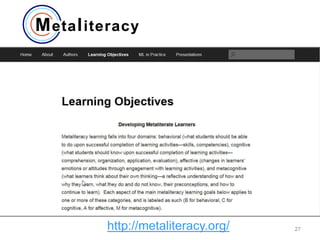
  • #28 TrudiDescribe genesis, connection to 7 items in the article. Our notion of metaliteracy has been developing. We appreciate the feedback we receive after we have spoken about it, and hope you might be interested in commenting on the site, or contacting one of us if you would like to be more involved.
  • #29 Trudi
  • #31 Trudi replace with our badge
  • #34 Tom: year Empire State College offered two Massive Open Online Courses or MOOCs (pause)Next fall we will offer a new MOOC on the topic of Literacies for Lifelong Learning (pause)This will be a Metaliteracy MOOC that explores many of today’s emerging literacy frameworks (pause)Our MOOC will be free and open to everyone. We invite you to attend our MOOC next year.