Ajinkya D. Patil
F. Y. M.Tech
Mechanical –Production
Roll no 1622011
RAJARAMBAPU INSTITUTE OF TECHNOLOGY,
RAJARAMNAGAR, ISLAMPUR
CONTENT
 Introduction and types of MMC’s
 Important metal matrices
 Processing
 Interfaces in MMC’s ,Discontinuities and Bonding
 Properties of MMC’s
 Application of MMC’s
 Conclusion
 References
Introduction and types of MMC’s
 Why Composites are better than the Metals?
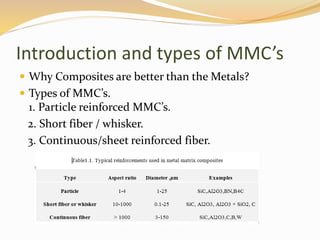
 Types of MMC’s.
1. Particle reinforced MMC’s.
2. Short fiber / whisker.
3. Continuous/sheet reinforced fiber.
Important metal matrices
 Al alloy: low density, excellent strength, toughness and
resistance to corrosion
Al-Cu-Mg/-Cu, Aerospace Industry-Al-Li alloys
 Ti alloy: High M.P. up to 1672 0C and stability and
High C.R.
jet engines turbines and compressors, fuselage.
 Mg alloy: light material casting of gearbox of airplanes
,chain saw housing and electronic equip.
 Copper alloy: High T.C. e.g. Niobium-based
superconductor.
 Inter- metallic compounds:
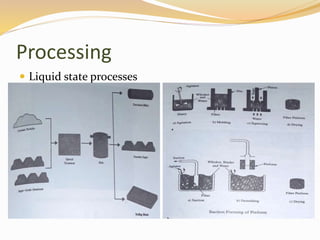
Processing
 Liquid state processes
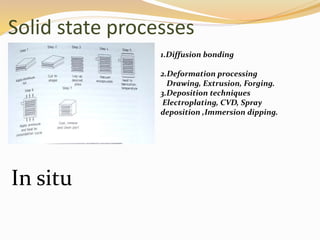
Solid state processes
1.Diffusion bonding
2.Deformation processing
Drawing, Extrusion, Forging.
3.Deposition techniques
Electroplating, CVD, Spray
deposition ,Immersion dipping.
In situ
Interfaces in MMC’s
,Discontinuities and Bonding
 Interfaces as a major influencer
 Major discontinuities at MMC’s
 Interfacial bonding in MMC’s
Mechanical
Chemical
Properties of MMC’s
 Modulus
 Toughness
 Aging
 Fatigue and creep
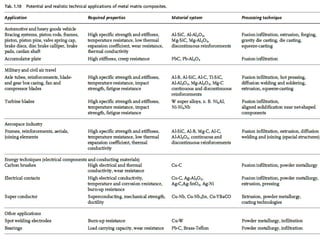
Application of MMC’s
 Aerospace applications
 Non-aerospace applications
Automotive applications
Military tanks
Electrical applications
Conclusion
 Over the period MMC’s proved their importance and are
contributing the progress and evolution of mankind.
 The MMCs have satisfied the designer conceptions, in such a
way that act as functional materials for advanced
applications. These composites can solve the major problems
associated with many applications only if these are designed
to achieve the standards.
 The high cost of MMCs is attributed to the cost of reinforced
materials and matrix metals and the processing expenses. At
present, several vapor deposition processes are being
employed in the fraction of MMCs, but still the cost factor is
keeping them away from day-to-day applications. Novel, cost-
effective methods have to be accomplished in order to achieve
the market for MMCs.
References
 “Composite materials science and engineering”, by ‘Krishnan K. Chawla’ , 2nd edition, p.g. no. 3-132,
164-211, Springer international edition.
 “Mechanics of composite materials” by, ‘Robert M. Jones.’ 2nd edition, p.g. no. 37-56, Taylor and
Francis Indian edition.
 “Fiber reinforced composites, materials, manufacturing and design” 3rd edition, by ‘P. K. Mallik’, CRC
press of Taylor and Francis Indian edition.
 “Principles of composite material mechanics” pg no 13-22, second edition by ‘Ronald F. Gibson’, CRC
press of Taylor and Francis Indian edition.
 “Basics of Metal matrix composites” by ‘Karl Ulrich Kainer’ from research gate publication of chapter
June 2006
 “An overview of metal matrix composite: processing and SiC based mechanical properties” by ‘Hartaj
Singh, Sarabjit, Nrip Jit, Anand K Tyagi ’, published in Journal of Engineering Research and Studies.
 “Metal matrix composites: theory techniques and Applications” by ‘Sumit Pramanik, Jayesh
Cherusseri, Navajit Sing Baban, L. Sowntharya, Kamal K. Kar’ from “Composite Materials: Processing,
Applications, Characterizations “source “Google scholar” page no 371-408.

Metal Matrix Composites

  • 1.
    Ajinkya D. Patil F.Y. M.Tech Mechanical –Production Roll no 1622011 RAJARAMBAPU INSTITUTE OF TECHNOLOGY, RAJARAMNAGAR, ISLAMPUR
  • 2.
    CONTENT  Introduction andtypes of MMC’s  Important metal matrices  Processing  Interfaces in MMC’s ,Discontinuities and Bonding  Properties of MMC’s  Application of MMC’s  Conclusion  References
  • 3.
    Introduction and typesof MMC’s  Why Composites are better than the Metals?  Types of MMC’s. 1. Particle reinforced MMC’s. 2. Short fiber / whisker. 3. Continuous/sheet reinforced fiber.
  • 4.
    Important metal matrices Al alloy: low density, excellent strength, toughness and resistance to corrosion Al-Cu-Mg/-Cu, Aerospace Industry-Al-Li alloys  Ti alloy: High M.P. up to 1672 0C and stability and High C.R. jet engines turbines and compressors, fuselage.  Mg alloy: light material casting of gearbox of airplanes ,chain saw housing and electronic equip.  Copper alloy: High T.C. e.g. Niobium-based superconductor.  Inter- metallic compounds:
  • 5.
  • 7.
    Solid state processes 1.Diffusionbonding 2.Deformation processing Drawing, Extrusion, Forging. 3.Deposition techniques Electroplating, CVD, Spray deposition ,Immersion dipping. In situ
  • 8.
    Interfaces in MMC’s ,Discontinuitiesand Bonding  Interfaces as a major influencer  Major discontinuities at MMC’s  Interfacial bonding in MMC’s Mechanical Chemical
  • 9.
    Properties of MMC’s Modulus  Toughness  Aging  Fatigue and creep
  • 10.
    Application of MMC’s Aerospace applications  Non-aerospace applications Automotive applications Military tanks Electrical applications
  • 12.
    Conclusion  Over theperiod MMC’s proved their importance and are contributing the progress and evolution of mankind.  The MMCs have satisfied the designer conceptions, in such a way that act as functional materials for advanced applications. These composites can solve the major problems associated with many applications only if these are designed to achieve the standards.  The high cost of MMCs is attributed to the cost of reinforced materials and matrix metals and the processing expenses. At present, several vapor deposition processes are being employed in the fraction of MMCs, but still the cost factor is keeping them away from day-to-day applications. Novel, cost- effective methods have to be accomplished in order to achieve the market for MMCs.
  • 13.
    References  “Composite materialsscience and engineering”, by ‘Krishnan K. Chawla’ , 2nd edition, p.g. no. 3-132, 164-211, Springer international edition.  “Mechanics of composite materials” by, ‘Robert M. Jones.’ 2nd edition, p.g. no. 37-56, Taylor and Francis Indian edition.  “Fiber reinforced composites, materials, manufacturing and design” 3rd edition, by ‘P. K. Mallik’, CRC press of Taylor and Francis Indian edition.  “Principles of composite material mechanics” pg no 13-22, second edition by ‘Ronald F. Gibson’, CRC press of Taylor and Francis Indian edition.  “Basics of Metal matrix composites” by ‘Karl Ulrich Kainer’ from research gate publication of chapter June 2006  “An overview of metal matrix composite: processing and SiC based mechanical properties” by ‘Hartaj Singh, Sarabjit, Nrip Jit, Anand K Tyagi ’, published in Journal of Engineering Research and Studies.  “Metal matrix composites: theory techniques and Applications” by ‘Sumit Pramanik, Jayesh Cherusseri, Navajit Sing Baban, L. Sowntharya, Kamal K. Kar’ from “Composite Materials: Processing, Applications, Characterizations “source “Google scholar” page no 371-408.