Presented by:-
VIRENDRA KUMARSHARMA
M.Tech (ME)
Roll. No.- 139511
KNIT, SULTANPUR
A
Dissertation
ON
CASTING AND CHARACTERIZATION OF
AL ALLOY BASED HYBRID MMC
Guided By :-
Mr. ANIL KUMAR
( Assistant Professor )
Deptt. Of Mechanical Engg.
KNIT, SULTANPUR
2.
OVERVIEW OF SEMINAR
Composite material
Phases of composite material
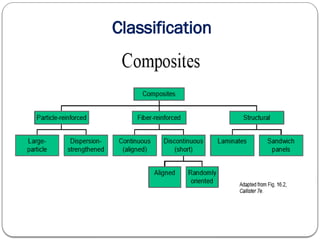
Classification of composite
Why composites are important
Objective of composite material
Disadvantages and limitation
Selection ofAlAlloy
Selection of Reinforcing Materials
Different Casting Process
Characterization for MMC
Literature Review
Outcomes of the Literature Review
A vision for the future
References
3.
A materials systemcomposed of two or more
physically distinct phases whose combination produces
aggregate properties that are different from those of
its constituents .
•Examples:
Cemented carbides
Plastic molding compounds containing fillers
Rubber mixed with carbon black
Wood (a natural composite as distinguished from a
synthesized composite)
Composite Material Defined
4.
A composite materialconsists of two
phases
Primary
• Forms the matrix within which the secondary phase is imbedded
• Any of three basic material types: polymers, metals, or
ceramics
Secondary
• Referred to as the imbedded phase or called the reinforcing agent
• Serves to strengthen the composite. (fibers, particles, flake etc.)
5.
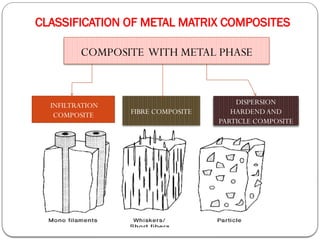
CLASSIFICATION OF METALMATRIX COMPOSITES
COMPOSITE WITH METAL PHASE
INFILTRATION
COMPOSITE FIBRE COMPOSITE
DISPERSION
HARDENDAND
PARTICLE COMPOSITE
Why Composites areImportant
Composites can be very strong and stiff, yet very light in weight,
so ratios of strength to weight and stiffness-to weight are several
‑ ‑ ‑
times greater than steel or aluminum
Fatigue properties are generally better than for common
engineering metals
Toughness is often greater too
Composites can be designed that do not corrode like steel
Possible to achieve combinations of properties not attainable
with metals, ceramics, or polymers alone
8.
OBJECTIVE OF COMPOSITEMATERIAL
Increase in yield strength and tensile strength at room temperature and above while
maintaining the minimum ductility or rather toughness,
Increase in creep resistance at higher temperatures compared to that of conventional
alloys,
Increase in fatigue strength, especially at higher temperatures,
Improvement of thermal shock resistance,
Improvement of corrosion resistance,
Increase inYoung’s modulus,
Reduction of thermal elongation.
Low Weight Considerations
High Strength Considerations
High Impact Resistance
High Stiffness Considerations
Low Cost Considerations
Toughness is often greater too
Composites can be designed that do not corrode like steel
9.
DISADVANTAGES AND LIMITATIONSOF COMPOSITE
MATERIALS
Properties of many important composites are anisotropic the
‑
properties differ depending on the direction in which they are
measured – this may be an advantage or a disadvantage
Composite materials are generally expensive
Manufacturing methods for shaping composite materials are
often slow and costly
DESIRABLE PROPERTIES OFREINFORCING MATERIAL
Low density,
Mechanical compatibility (a thermal expansion coefficient
which is low but adapted to the matrix),
Chemical compatibility,
Thermal stability,
HighYoung’s modulus,
High compression and tensile strength,
Good process ability,
Economic efficiency.
12.
PRODUCTION OF METALMATRIX COMPOSITES
Metal Matrix Composite materials can be produced by many different
techniques. Such as
Melting metallurgical processes (Liquid state methods)
Infiltration of short fiber, particle or hybrid performs by squeeze casting, vacuum
infiltration or pressure infiltration
Processing of precursor material by stirring the particles in metallic melts, followed
by sand casting, permanent mold casting or high pressure die casting
Powder metallurgical processes (Solid state methods)
Pressing and sintering and/or forging of powder mixtures and composite
powders
Extrusion or forging of metal-powder particle mixtures
Physical vapor deposition: (Vapor Deposition)
The fiber is passed through a thick cloud of vaporized metal, coating it.
13.
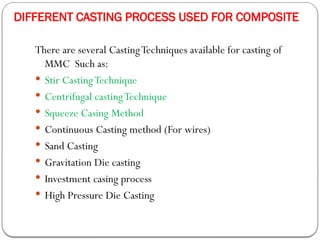
DIFFERENT CASTING PROCESSUSED FOR COMPOSITE
There are several CastingTechniques available for casting of
MMC Such as:
Stir CastingTechnique
Centrifugal castingTechnique
Squeeze Casing Method
Continuous Casting method (For wires)
Sand Casting
Gravitation Die casting
Investment casing process
High Pressure Die Casting
14.
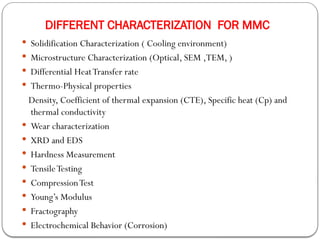
DIFFERENT CHARACTERIZATION FORMMC
Solidification Characterization ( Cooling environment)
Microstructure Characterization (Optical, SEM ,TEM, )
Differential HeatTransfer rate
Thermo-Physical properties
Density, Coefficient of thermal expansion (CTE), Specific heat (Cp) and
thermal conductivity
Wear characterization
XRD and EDS
Hardness Measurement
TensileTesting
CompressionTest
Young’s Modulus
Fractography
Electrochemical Behavior (Corrosion)
15.
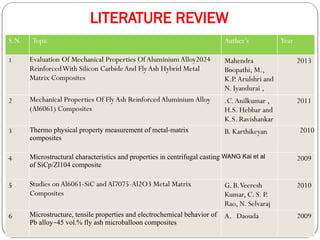
LITERATURE REVIEW
S.N. TopicAuther’s Year
1 Evaluation Of Mechanical Properties Of AluminiumAlloy2024
ReinforcedWith Silicon CarbideAnd FlyAsh Hybrid Metal
Matrix Composites
Mahendra
Boopathi, M.,
K.P.Arulshri and
N. Iyandurai ,
2013
2 Mechanical Properties Of FlyAsh Reinforced Aluminium Alloy
(Al6061) Composites
.C.Anilkumar ,
H.S. Hebbar and
K.S. Ravishankar
2011
3 Thermo physical property measurement of metal-matrix
composites
B. Karthikeyan 2010
4 Microstructural characteristics and properties in centrifugal casting
of SiCp/Zl104 composite
WANG Kai et al 2009
5 Studies on Al6061-SiC andAl7075-Al2O3 Metal Matrix
Composites
G. B.Veeresh
Kumar, C. S. P.
Rao, N. Selvaraj
2010
6 Microstructure, tensile properties and electrochemical behavior of
Pb alloy–45 vol.% fly ash microballoon composites
A. Daouda 2009
16.
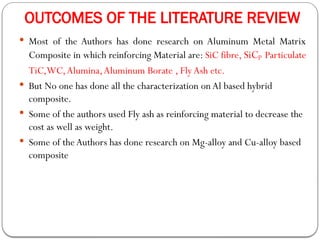
OUTCOMES OF THELITERATURE REVIEW
Most of the Authors has done research on Aluminum Metal Matrix
Composite in which reinforcing Material are: SiC fibre, SiCp Particulate
TiC,WC,Alumina,Aluminum Borate , FlyAsh etc.
But No one has done all the characterization on Al based hybrid
composite.
Some of the authors used Fly ash as reinforcing material to decrease the
cost as well as weight.
Some of theAuthors has done research on Mg-alloy and Cu-alloy based
composite
17.
COMPOSITES: A VISIONFOR THE FUTURE
Transportation sector:-
Automobiles- clutch plates, brakes, wheel, spring etc.
Aerospace manufacturing.
Marine- fans & blowers, propellers vanes, condenser shells etc.
Bicycles- forks, handle bars, seat posts etc.
Chemical Industry- underground storage tanks, racked bottle for
fire service etc.
Electrical & Electronic- power line insulators, lighting poles,
switchgear frames etc.
18.
COMPOSITES: A VISIONFOR THE FUTURE
Sports Goods- golf & polo rods, hand glinders, protective sports
wear etc.
Future Business Opportunites- short & long term R & D,
application development, fabrication & testing support, quality
improvement etc.
19.
References
Material science& engg.an introduction william D.callister,jr.David G.Rethwisch
Engg.Composite materials Bryan Harris the institute of materials,london 1999
Fiber Composites,3rd edition,Wiley,Hoboken,
TIFAC 2009 deptt. Of science & tech. Gov. of India
Ashbee, K. H., Fundamental Principles of Fiber Reinforced
Composites,2nd edition,CRC Press,
Boca Raton, FL, 1993.
ASM Handbook,Vol.21,Composites,ASM International,
Materials Park, OH, 2001.
Chawla, K. K., Composite Materials Science and
Engineering,3rd edition,Springer,NewYork,
2009.
Gerdeen, J.C., H.W. Lord, and R.A. L. Rorrer, Engineering
Design with Polymers and Composites,
20.
References
METAL-MATRIX COMPOSITESK.K. CHAWLA ,University of
Alabama at Birmingham and N. CHAWLAArizona State University
Hull, D. and T.W. Clyne, An Introduction to Composite
Materials, 2nd edition, Cambridge University
Press, New York, 1996.
Mallick, P. K., Composites Engineering Handbook,
CRC Press, Boca Raton, FL, 1997.
Mallick, P. K., Fiber-Reinforced Composites, Materials,
Manufacturing, and Design, 3rd edition.
Strong, A. B., Fundamentals of Composites: Materials,
Methods, and Applications, 2nd edition,
Society of Manufacturing Engineers, Dearborn, etc.




![[IJET V2I5P16] Authors: R. Kasilingam, R.Narayanan and T.R.Vijayram](https://cdn.slidesharecdn.com/ss_thumbnails/ijet-v2i5p16-161107143638-thumbnail.jpg?width=640&height=640&fit=bounds)


