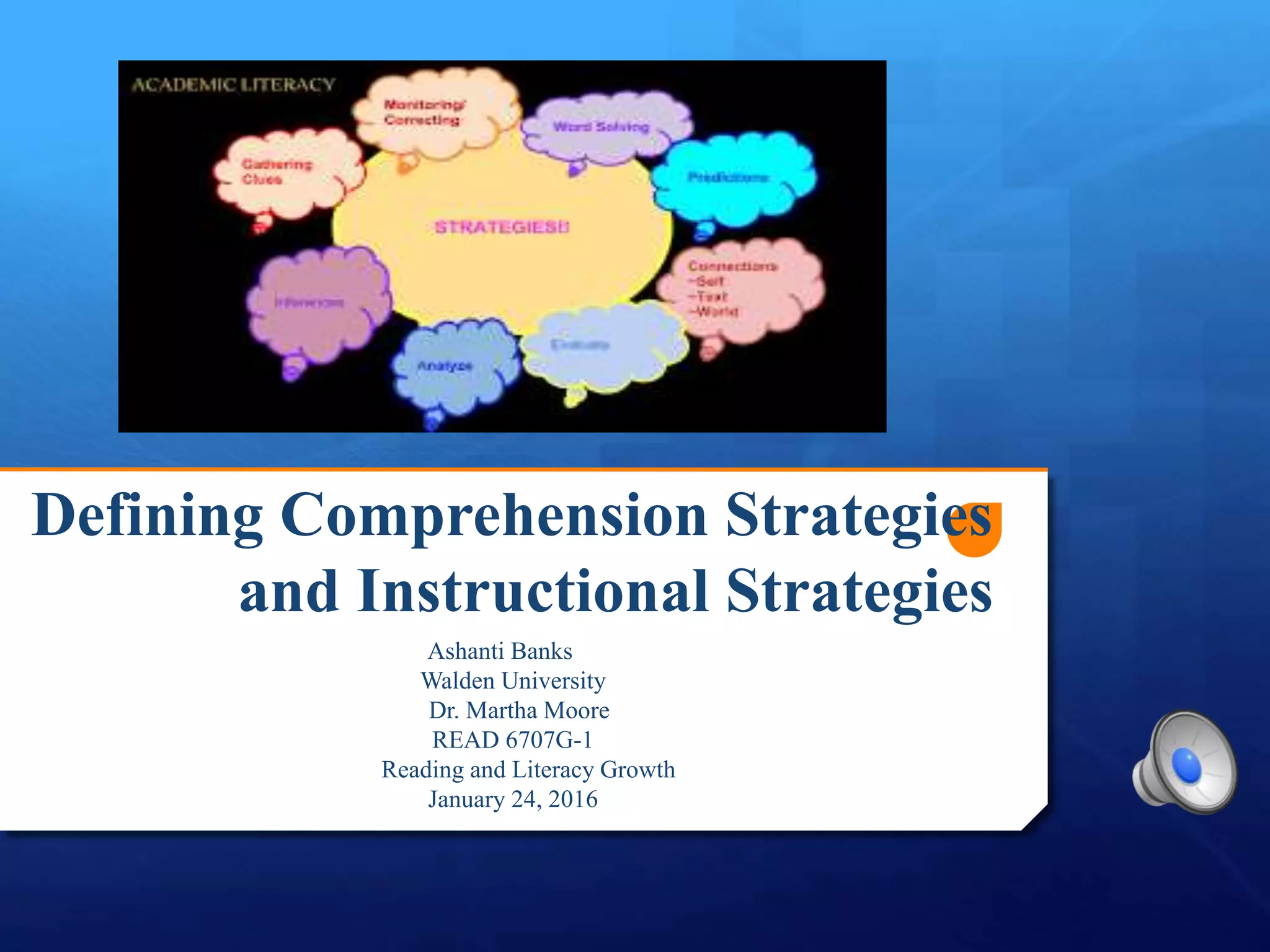
Defining Comprehension Strategies
and Instructional Strategies
Ashanti Banks
Walden University
Dr. Martha Moore
READ 6707G-1
Reading and Literacy Growth
January 24, 2016
How does Reading Comprehension affect
Intermediate Literacy Learners?
Reading is a multifaceted process that develops with practice.
Reading comprehension derives an understanding of what the writer is trying
to convey and makes use of that information whether it’s for fact gathering,
learning a new skill, or for pleasure.
Without comprehension, reading is a frustrating, pointless exercise in word
calling. Reading comprehension helps students develop the skills to become
better readers.
Without reading comprehension skills, the reader wouldn’t be able to use the
tools to gather any information or use the tools effectively as a successful
literacy learner.
Comprehension Strategies
Comprehension strategies are sets of steps that good readers use to make sense of
text (Adler 2001). Those strategies are:
 Monitoring Comprehension
 Metacognition
 Graphic/Semantic organizers
 Answering Questions
 Generating Questions
 Recognizing Story Structure
 Summarizing
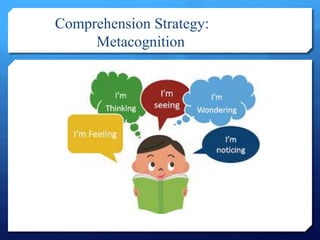
Comprehension Strategy:
Metacognition
Comprehension Strategy:
Metacognition
Metacognitive practices help students become aware of their strengths and
weaknesses as learners, writers, readers (Chick 2009).
Metacognition is critical for reading success: It contributes to reading
comprehension and it promotes academic learning (Afflerbach 2013)
The metacognitive comprehension strategy is used by the intermediate literacy
learner to assess their awareness of many comprehension strategies used before,
during, and after reading the text (Reutzel & Cooter, 2016).
It can be used before a lesson through the practice of making predictions. It could
be used during a lesson by allowing the students to summarize what has been read
and identify main events. Metacognition can be used after a reading lesson through
activities that assess their new level of understanding of what they read.
Comprehension Strategy:
Graphic Organizing
Comprehension Strategy:
Graphic Organizers
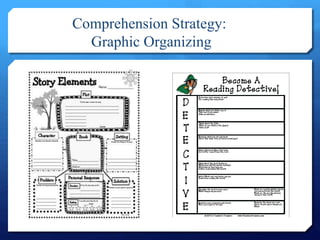
Graphic organizers illustrate concepts and relationships between concepts in a text
using diagrams. They assist literacy learners in reading and understanding
textbooks and picture books.
Graphic organizing is a great comprehension strategy that assist intermediate
literacy learners in comprehending the differences between fictional and non-
fiction text.
Graphic organizers also assist intermediate literacy learners in developing better
summaries regarding various texts that they are reading.
Instructional Strategies
Instructional strategies are various methods used in teaching in order to help
activate students' curiosity, engage them in learning, probe critical thinking skills,
to keep them on task, create useful classroom interaction, and enhance their
learning of specific content.
Students learn best when they are truly engaged in what they are learning. Those
learners are more successful when the lessons are:
 Appropriately Challenging
 Based on Real-World Problems/Situations
 Purposeful
 Meaningful/Interesting
Instructional Strategies:
Think Aloud Strategy
Instructional Strategies:
Think Aloud Strategy
The think aloud strategy is utilized by the teacher to model reading
comprehension to literacy learners .
This instructional strategy allows literacy learners to verbalize what they are
thinking as they are reading a specific text.
The think aloud strategy is used be teachers to access a literacy learner’s prior
knowledge before reading a new passage as well as monitor comprehension as
they progress and begin reading more difficult text.
Instructional Strategies:
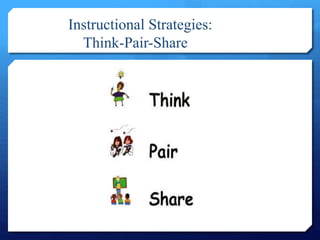
Think-Pair-Share
Instructional Strategies:
Think-Pair-Share
Think-pair-share (TPS) is a collaborative instructional strategy focuses
attention and engage students in comprehending the reading material.
Think-Pair-Share helps students to think individually about a topic or
answer to a question. After thinking, the students collaborate and share
their ideas and build upon their oral communication skills.
With this instructional strategy, intermediate literacy learner’s learn
through reflection and verbalization of the text.
Gunter, M. A., Estes, T. H., & Schwab, J. H. (1999). Instruction: A Models
Approach, 3rd edition. Boston: Allyn & Bacon.
Comprehension strategies and instructional strategies are the
most effective to support transitional, intermediate, and
advanced literacy learners
Both the comprehension and instructional strategies are effective to
support transitional, intermediate, and advanced literacy learners
because they align with my states SOL standards. They also provide
engaging activities to promote further learning and better understanding
of various genres of text. These strategies also allow the literacy
learners to use metacognition practices while reading, whether it is an
independent or collaborative reading activity.
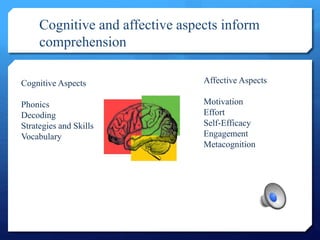
Cognitive and affective aspects inform
comprehension
Cognitive Aspects
Phonics
Decoding
Strategies and Skills
Vocabulary
Affective Aspects
Motivation
Effort
Self-Efficacy
Engagement
Metacognition
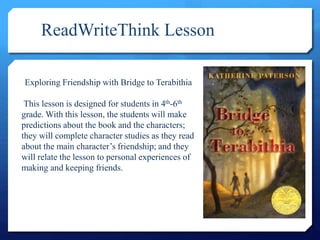
ReadWriteThink Lesson
Exploring Friendship with Bridge to Terabithia
This lesson is designed for students in 4th-6th
grade. With this lesson, the students will make
predictions about the book and the characters;
they will complete character studies as they read
about the main character’s friendship; and they
will relate the lesson to personal experiences of
making and keeping friends.
ReadWriteThink Lesson
Comprehension Strategy
The comprehension strategy used in the lesson was metacognition. With the
metacognition the students were responsible for their own reading as they were
assigned specific chapters for homework. The students used metacognition to
make predictions of what would happen in the text.
Instructional Strategy
The instructional strategy the teacher used in the lesson was Character Trading
Cards. The teacher introduced this technology to the literacy learners to allow the
students to create trading cards for the characters to assure that the students were
able to identify similarities and differences between the main characters.
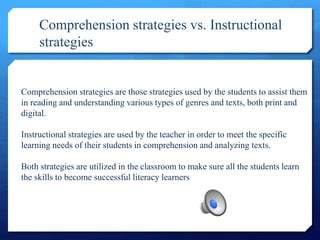
Comprehension strategies vs. Instructional
strategies
Comprehension strategies are those strategies used by the students to assist them
in reading and understanding various types of genres and texts, both print and
digital.
Instructional strategies are used by the teacher in order to meet the specific
learning needs of their students in comprehension and analyzing texts.
Both strategies are utilized in the classroom to make sure all the students learn
the skills to become successful literacy learners
References
 Adler, C.R. (Ed). 2001. Put Reading First: The Research Building Blocks for
Teaching Children to Read, pp. 49-54. National Institute for Literacy. Retrieved
Nov. 1, 2007, from
http://www.nifl.gov/partnershipforreading/publications/reading_first1text.html.
 Afflerbach, P., Cho, B.-Y., Kim, J.-Y., Crassas, M. E., & Doyle, B. (2013).
Reading: What else matters besides strategies and skills? The Reading Teacher,
66(6), 440–448.
 Chick, Nancy, Karis, Terri, and Kernahan, Cyndi. (2009). Learning from their
own learning: how metacognitive and meta-affective reflections enhance
learning in race-related courses. International Journal for the Scholarship of
Teaching and Learning, 3(1). 1-28.
References
 Gunter, M. A., Estes, T. H., & Schwab, J. H. (1999). Instruction: A Models
Approach, 3rd edition. Boston: Allyn & Bacon.
 International Literacy Association (ILA) and National Council of Teachers of
English. (2014a). ReadWriteThink. Retrieved from
http://www.readwritethink.org/search/?grade=13&resource_type=6&learning_ob
jective=8
 Reutzel, D. R., & Cooter, R. B., Jr. (2016). Strategies for reading assessment and
instruction in an era of common core standards: Helping every child succeed
(5th ed.). Boston, MA: Pearson.

WK 3 Assgn Banks A

  • 1.
    Defining Comprehension Strategies andInstructional Strategies Ashanti Banks Walden University Dr. Martha Moore READ 6707G-1 Reading and Literacy Growth January 24, 2016
  • 2.
    How does ReadingComprehension affect Intermediate Literacy Learners? Reading is a multifaceted process that develops with practice. Reading comprehension derives an understanding of what the writer is trying to convey and makes use of that information whether it’s for fact gathering, learning a new skill, or for pleasure. Without comprehension, reading is a frustrating, pointless exercise in word calling. Reading comprehension helps students develop the skills to become better readers. Without reading comprehension skills, the reader wouldn’t be able to use the tools to gather any information or use the tools effectively as a successful literacy learner.
  • 3.
    Comprehension Strategies Comprehension strategiesare sets of steps that good readers use to make sense of text (Adler 2001). Those strategies are:  Monitoring Comprehension  Metacognition  Graphic/Semantic organizers  Answering Questions  Generating Questions  Recognizing Story Structure  Summarizing
  • 4.
  • 5.
    Comprehension Strategy: Metacognition Metacognitive practiceshelp students become aware of their strengths and weaknesses as learners, writers, readers (Chick 2009). Metacognition is critical for reading success: It contributes to reading comprehension and it promotes academic learning (Afflerbach 2013) The metacognitive comprehension strategy is used by the intermediate literacy learner to assess their awareness of many comprehension strategies used before, during, and after reading the text (Reutzel & Cooter, 2016). It can be used before a lesson through the practice of making predictions. It could be used during a lesson by allowing the students to summarize what has been read and identify main events. Metacognition can be used after a reading lesson through activities that assess their new level of understanding of what they read.
  • 6.
  • 7.
    Comprehension Strategy: Graphic Organizers Graphicorganizers illustrate concepts and relationships between concepts in a text using diagrams. They assist literacy learners in reading and understanding textbooks and picture books. Graphic organizing is a great comprehension strategy that assist intermediate literacy learners in comprehending the differences between fictional and non- fiction text. Graphic organizers also assist intermediate literacy learners in developing better summaries regarding various texts that they are reading.
  • 8.
    Instructional Strategies Instructional strategiesare various methods used in teaching in order to help activate students' curiosity, engage them in learning, probe critical thinking skills, to keep them on task, create useful classroom interaction, and enhance their learning of specific content. Students learn best when they are truly engaged in what they are learning. Those learners are more successful when the lessons are:  Appropriately Challenging  Based on Real-World Problems/Situations  Purposeful  Meaningful/Interesting
  • 9.
  • 10.
    Instructional Strategies: Think AloudStrategy The think aloud strategy is utilized by the teacher to model reading comprehension to literacy learners . This instructional strategy allows literacy learners to verbalize what they are thinking as they are reading a specific text. The think aloud strategy is used be teachers to access a literacy learner’s prior knowledge before reading a new passage as well as monitor comprehension as they progress and begin reading more difficult text.
  • 11.
  • 12.
    Instructional Strategies: Think-Pair-Share Think-pair-share (TPS)is a collaborative instructional strategy focuses attention and engage students in comprehending the reading material. Think-Pair-Share helps students to think individually about a topic or answer to a question. After thinking, the students collaborate and share their ideas and build upon their oral communication skills. With this instructional strategy, intermediate literacy learner’s learn through reflection and verbalization of the text. Gunter, M. A., Estes, T. H., & Schwab, J. H. (1999). Instruction: A Models Approach, 3rd edition. Boston: Allyn & Bacon.
  • 13.
    Comprehension strategies andinstructional strategies are the most effective to support transitional, intermediate, and advanced literacy learners Both the comprehension and instructional strategies are effective to support transitional, intermediate, and advanced literacy learners because they align with my states SOL standards. They also provide engaging activities to promote further learning and better understanding of various genres of text. These strategies also allow the literacy learners to use metacognition practices while reading, whether it is an independent or collaborative reading activity.
  • 14.
    Cognitive and affectiveaspects inform comprehension Cognitive Aspects Phonics Decoding Strategies and Skills Vocabulary Affective Aspects Motivation Effort Self-Efficacy Engagement Metacognition
  • 15.
    ReadWriteThink Lesson Exploring Friendshipwith Bridge to Terabithia This lesson is designed for students in 4th-6th grade. With this lesson, the students will make predictions about the book and the characters; they will complete character studies as they read about the main character’s friendship; and they will relate the lesson to personal experiences of making and keeping friends.
  • 16.
    ReadWriteThink Lesson Comprehension Strategy Thecomprehension strategy used in the lesson was metacognition. With the metacognition the students were responsible for their own reading as they were assigned specific chapters for homework. The students used metacognition to make predictions of what would happen in the text. Instructional Strategy The instructional strategy the teacher used in the lesson was Character Trading Cards. The teacher introduced this technology to the literacy learners to allow the students to create trading cards for the characters to assure that the students were able to identify similarities and differences between the main characters.
  • 17.
    Comprehension strategies vs.Instructional strategies Comprehension strategies are those strategies used by the students to assist them in reading and understanding various types of genres and texts, both print and digital. Instructional strategies are used by the teacher in order to meet the specific learning needs of their students in comprehension and analyzing texts. Both strategies are utilized in the classroom to make sure all the students learn the skills to become successful literacy learners
  • 18.
    References  Adler, C.R.(Ed). 2001. Put Reading First: The Research Building Blocks for Teaching Children to Read, pp. 49-54. National Institute for Literacy. Retrieved Nov. 1, 2007, from http://www.nifl.gov/partnershipforreading/publications/reading_first1text.html.  Afflerbach, P., Cho, B.-Y., Kim, J.-Y., Crassas, M. E., & Doyle, B. (2013). Reading: What else matters besides strategies and skills? The Reading Teacher, 66(6), 440–448.  Chick, Nancy, Karis, Terri, and Kernahan, Cyndi. (2009). Learning from their own learning: how metacognitive and meta-affective reflections enhance learning in race-related courses. International Journal for the Scholarship of Teaching and Learning, 3(1). 1-28.
  • 19.
    References  Gunter, M.A., Estes, T. H., & Schwab, J. H. (1999). Instruction: A Models Approach, 3rd edition. Boston: Allyn & Bacon.  International Literacy Association (ILA) and National Council of Teachers of English. (2014a). ReadWriteThink. Retrieved from http://www.readwritethink.org/search/?grade=13&resource_type=6&learning_ob jective=8  Reutzel, D. R., & Cooter, R. B., Jr. (2016). Strategies for reading assessment and instruction in an era of common core standards: Helping every child succeed (5th ed.). Boston, MA: Pearson.