Strategies For
Teaching Reading
a presentation by
Hendrik A (180611029)
Agung Prayoga (180611028)
Fikri Fauzi Toha (181611001)
Objectives
To establish the importance ofteaching
reading to students
To recognize the differencebetween
teaching reading and text analysis
To explore reading strategies andtheir
use in the second language classroom
To apply the reading strategies toa
reading passage
To analyze the importance ofreading
aloud in the classroom.
Introduction
Why do we teach reading?
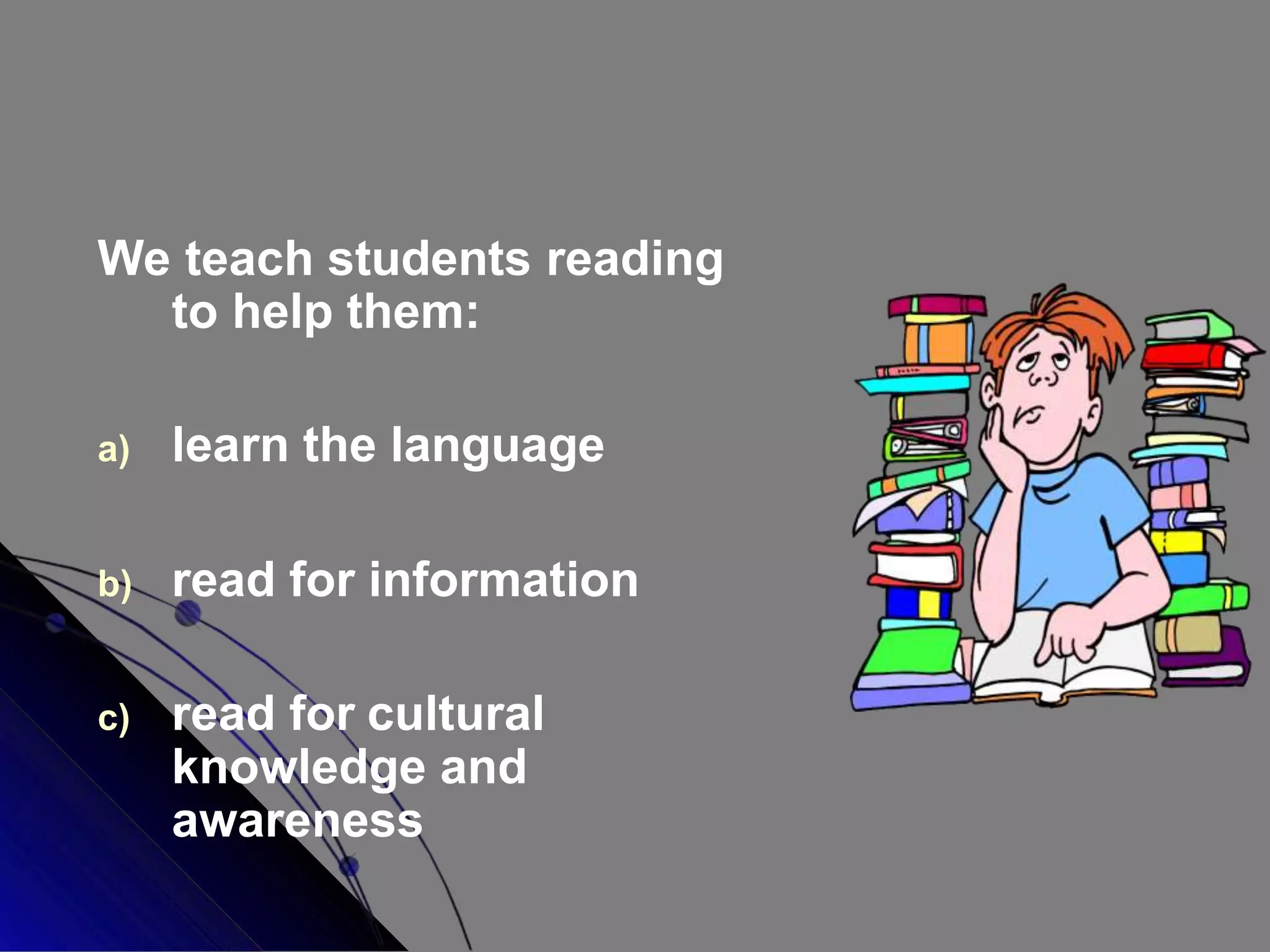
We teach students reading
to help them:
a) learn the language
b) read for information
c) read for cultural
knowledge and
awareness
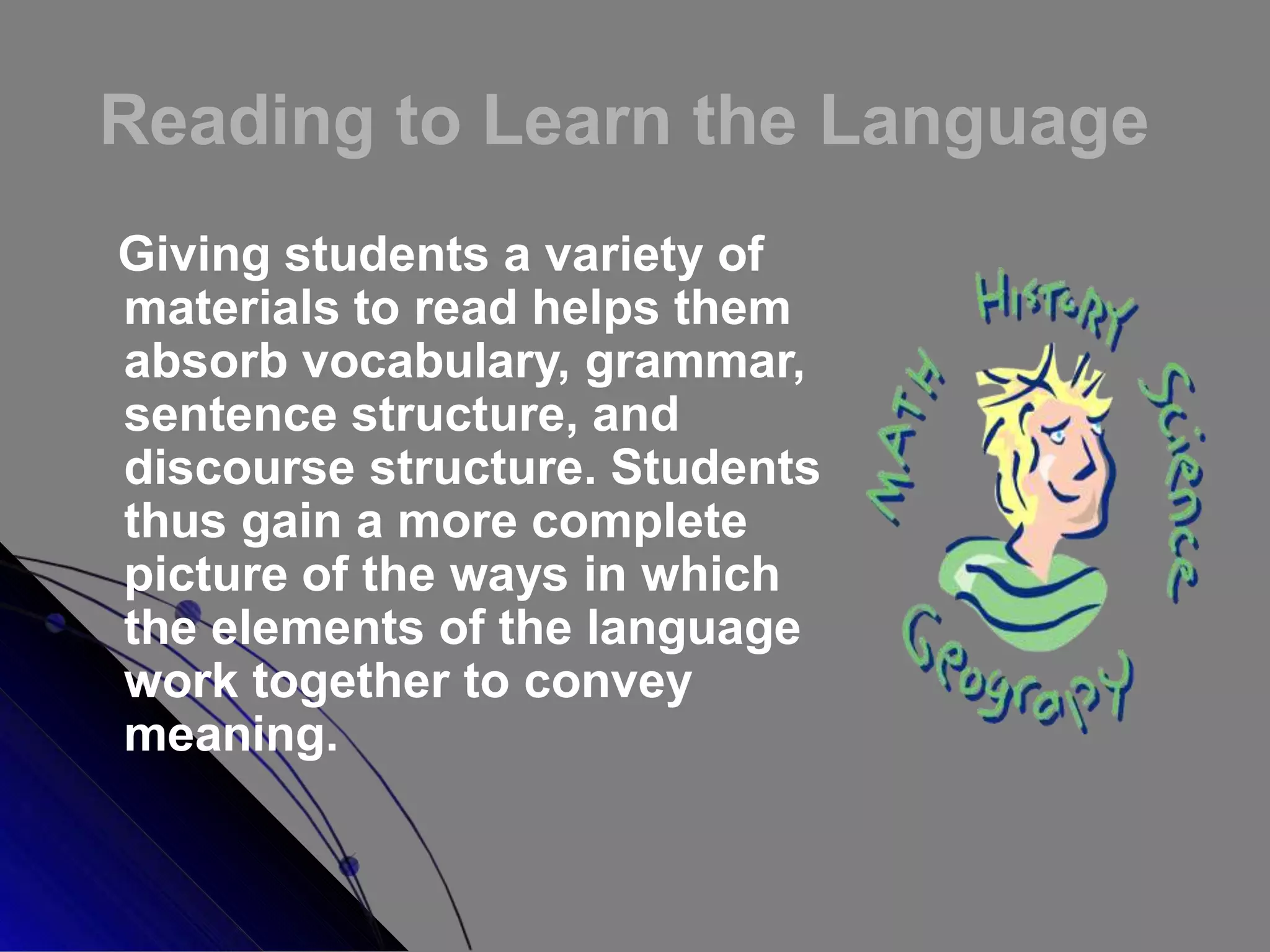
Reading to Learn the Language
Giving students a variety of
materials to read helps them
absorb vocabulary, grammar,
sentence structure, and
discourse structure. Students
thus gain a more complete
picture of the ways in which
the elements of the language
work together to convey
meaning.
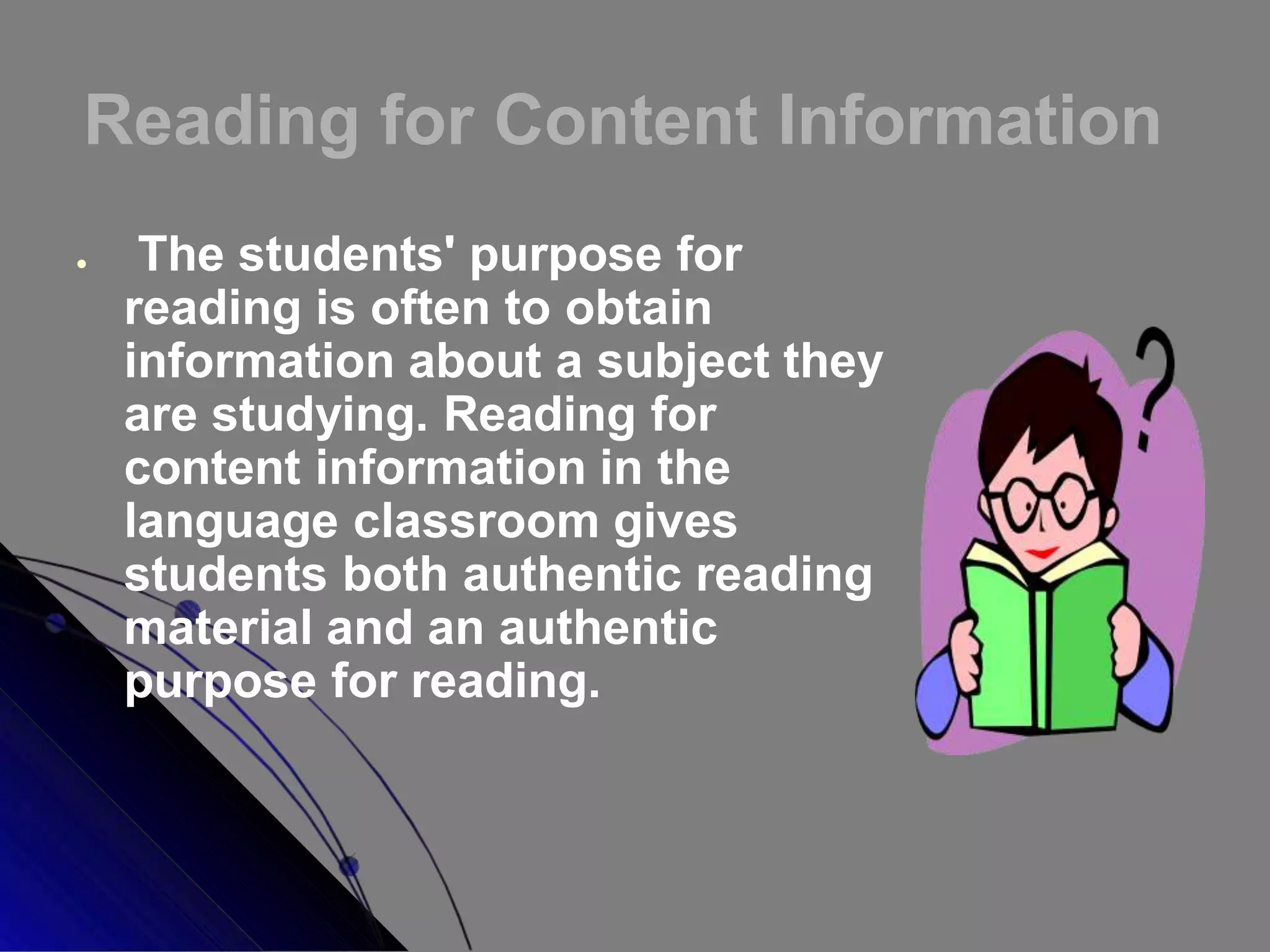
Reading for Content Information
 The students' purpose for
reading is often to obtain
information about a subject they
are studying. Reading for
content information in the
language classroom gives
students both authentic reading
material and an authentic
purpose for reading.
Reading for Cultural Knowledge
and Awareness
 Reading everyday materials
that are designed for native
speakers can give students
insight into the lifestyles and
worldviews of the people
whose language they are
studying.
Reading Strategies
What are the reading
strategies that the teacher
can use while teaching
reading?
Strategies that can help students
read more quickly and effectively
:include
1. previewing
2. predicting
3. skimming and
scanning
4. guessing from context
5. paraphrasing
As a group, try to show the
role of the teacher in each
strategy.
Previewing
 Reviewing titles, section
headings, and photo
captions to get a sense of
the structure and content
of a reading selection
Predicting
 Using knowledge of the
subject matter to make
predictions about
content and vocabulary
and check
comprehension.
Skimming and Scanning
 Using a quick survey of the
text to get the main idea,
identify text structure and
confirm or question
predictions
Guessing from Context
 Using prior knowledge
of the subject and the
ideas in the text as
clues to the meanings
of unknown words,
instead of stopping to
look them up
Paraphrasing
 Stopping at the end of
a section to check
comprehension by
restating the
information and ideas
in the text
Incorporating Effective Reading
Strategies into the Second
Language Classroom
To encourage students to use effective
strategies when reading, the teacher
can develop simple exercises to elicit
information via targeted strategies.
These exercises can be divided by the
stage of reading at which they occur
into:
(a) Pre-reading Activities,
(b) While Reading Activities and
(c) Post-reading Activities
With the rest of your colleagues,
try to decide which reading
strategy can best be used in
.each stage
Pre- reading Activities
Pre-reading activities:
Introduce students to a a particular text
Elicit or provide appropriate background
knowledge
arouse their interest
Pre-reading activities include:
brainstorming
considering illustrations and titles
skimming and scanning (for structure, main
points, etc.)
While-reading Exercises
While reading exercises:
1. help students develop reading strategies
2. improve their control of the second language
3. decode problematic text passages
Such exercises might include
1. guessing word meanings from context clues
2. considering syntax and sentence structure
and analyzing reference words
3. reading for specific pieces of information
4. learning to use the dictionary effectively
Post-reading Exercises
Post-reading exercises:
1. Check students’ comprehension
2. Lead them to a deeper analysis of the
text
Because the goals of most real world
reading are not to memorize an
author's point of view or to summarize
text content, second language reading
must go beyond detail-eliciting
comprehension drills.
The End
Thank You for Your Participation
‫دهشأ‬
‫كدمحبو‬
‫مهلال‬
‫كناحبس‬
‫كرفغتسا‬
‫تنأ‬
‫إل‬
‫هإل‬
‫ل‬
‫أ‬‫ن‬
‫كيإل‬
‫بوت‬
‫أو‬

Strategies For Teaching Reading.pptx

  • 2.
    Strategies For Teaching Reading apresentation by Hendrik A (180611029) Agung Prayoga (180611028) Fikri Fauzi Toha (181611001)
  • 3.
    Objectives To establish theimportance ofteaching reading to students To recognize the differencebetween teaching reading and text analysis To explore reading strategies andtheir use in the second language classroom To apply the reading strategies toa reading passage To analyze the importance ofreading aloud in the classroom.
  • 4.
    Introduction Why do weteach reading?
  • 5.
    We teach studentsreading to help them: a) learn the language b) read for information c) read for cultural knowledge and awareness
  • 6.
    Reading to Learnthe Language Giving students a variety of materials to read helps them absorb vocabulary, grammar, sentence structure, and discourse structure. Students thus gain a more complete picture of the ways in which the elements of the language work together to convey meaning.
  • 7.
    Reading for ContentInformation  The students' purpose for reading is often to obtain information about a subject they are studying. Reading for content information in the language classroom gives students both authentic reading material and an authentic purpose for reading.
  • 8.
    Reading for CulturalKnowledge and Awareness  Reading everyday materials that are designed for native speakers can give students insight into the lifestyles and worldviews of the people whose language they are studying.
  • 9.
  • 10.
    What are thereading strategies that the teacher can use while teaching reading?
  • 11.
    Strategies that canhelp students read more quickly and effectively :include 1. previewing 2. predicting 3. skimming and scanning 4. guessing from context 5. paraphrasing
  • 12.
    As a group,try to show the role of the teacher in each strategy.
  • 13.
    Previewing  Reviewing titles,section headings, and photo captions to get a sense of the structure and content of a reading selection
  • 14.
    Predicting  Using knowledgeof the subject matter to make predictions about content and vocabulary and check comprehension.
  • 15.
    Skimming and Scanning Using a quick survey of the text to get the main idea, identify text structure and confirm or question predictions
  • 16.
    Guessing from Context Using prior knowledge of the subject and the ideas in the text as clues to the meanings of unknown words, instead of stopping to look them up
  • 17.
    Paraphrasing  Stopping atthe end of a section to check comprehension by restating the information and ideas in the text
  • 18.
    Incorporating Effective Reading Strategiesinto the Second Language Classroom
  • 19.
    To encourage studentsto use effective strategies when reading, the teacher can develop simple exercises to elicit information via targeted strategies. These exercises can be divided by the stage of reading at which they occur into: (a) Pre-reading Activities, (b) While Reading Activities and (c) Post-reading Activities
  • 20.
    With the restof your colleagues, try to decide which reading strategy can best be used in .each stage
  • 21.
    Pre- reading Activities Pre-readingactivities: Introduce students to a a particular text Elicit or provide appropriate background knowledge arouse their interest Pre-reading activities include: brainstorming considering illustrations and titles skimming and scanning (for structure, main points, etc.)
  • 22.
    While-reading Exercises While readingexercises: 1. help students develop reading strategies 2. improve their control of the second language 3. decode problematic text passages Such exercises might include 1. guessing word meanings from context clues 2. considering syntax and sentence structure and analyzing reference words 3. reading for specific pieces of information 4. learning to use the dictionary effectively
  • 23.
    Post-reading Exercises Post-reading exercises: 1.Check students’ comprehension 2. Lead them to a deeper analysis of the text Because the goals of most real world reading are not to memorize an author's point of view or to summarize text content, second language reading must go beyond detail-eliciting comprehension drills.
  • 24.
    The End Thank Youfor Your Participation ‫دهشأ‬ ‫كدمحبو‬ ‫مهلال‬ ‫كناحبس‬ ‫كرفغتسا‬ ‫تنأ‬ ‫إل‬ ‫هإل‬ ‫ل‬ ‫أ‬‫ن‬ ‫كيإل‬ ‫بوت‬ ‫أو‬