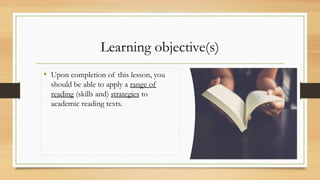
Learning objective(s)
• Uponcompletion of this lesson, you
should be able to apply a range of
reading (skills and) strategies to
academic reading texts.
3.
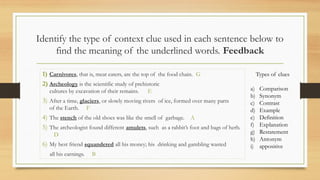
Identify the typeof context clue used in each sentence below to
find the meaning of the underlined words. Feedback
1) Carnivores, that is, meat eaters, are the top of the food chain. G
2) Archeology is the scientific study of prehistoric
cultures by excavation of their remains. E
3) After a time, glaciers, or slowly moving rivers of ice, formed over many parts
of the Earth. F
4) The stench of the old shoes was like the smell of garbage. A
5) The archeologist found different amulets, such as a rabbit’s foot and bags of herb.
D
6) My best friend squandered all his money; his drinking and gambling wasted
all his earnings. B
Types of clues
a) Comparison
b) Synonym
c) Contrast
d) Example
e) Definition
f) Explanation
g) Restatement
h) Antonym
i) appositive
4.
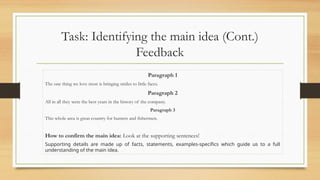
Task: Identifying themain idea (Cont.)
Feedback
Paragraph 1
The one thing we love most is bringing smiles to little faces.
Paragraph 2
All in all they were the best years in the history of the company.
Paragraph 3
This whole area is great country for hunters and fishermen.
How to confirm the main idea: Look at the supporting sentences!
Supporting details are made up of facts, statements, examples-specifics which guide us to a full
understanding of the main idea.
5.
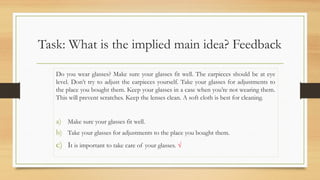
Task: What isthe implied main idea? Feedback
Do you wear glasses? Make sure your glasses fit well. The earpieces should be at eye
level. Don’t try to adjust the earpieces yourself. Take your glasses for adjustments to
the place you bought them. Keep your glasses in a case when you’re not wearing them.
This will prevent scratches. Keep the lenses clean. A soft cloth is best for cleaning.
a) Make sure your glasses fit well.
b) Take your glasses for adjustments to the place you bought them.
c) It is important to take care of your glasses. √
6.
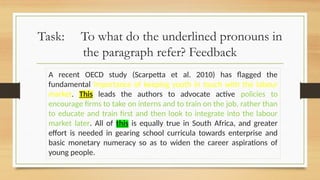
Task: To whatdo the underlined pronouns in
the paragraph refer? Feedback
A recent OECD study (Scarpetta et al. 2010) has flagged the
fundamental importance of keeping youth in touch with the labour
market. This leads the authors to advocate active policies to
encourage firms to take on interns and to train on the job, rather than
to educate and train first and then look to integrate into the labour
market later. All of this is equally true in South Africa, and greater
effort is needed in gearing school curricula towards enterprise and
basic monetary numeracy so as to widen the career aspirations of
young people.
7.
What are readingstrategies?
• Reading strategies are deliberate actions and plans adopted by the
reader to achieve a goal.
• This means that strategies imply awareness on the part of the reader.
What does this mean?
• As a reader you need to be aware of whether you understand what
you read or not.
8.
What are readingstrategies? (Cont.)
• When a text is difficult to understand, the next step is to try and
find what has caused this comprehension breakdown and
remedy it.
• Once you establish why you do not understand, you should take
conscious action and apply the proper strategy (action or plan) to
solve the problem.
• Strategies can become automatic through practice and repetition.
9.
What is thedifference between reading strategies and
reading skills?
• A strategy is when you consciously choose to use contextual guessing to
address comprehension difficulties experienced while reading a challenging
text.
• Therefore, reading strategies are reader oriented.
• A skill is when you use contextual guessing automatically and effortlessly in
a less challenging text.
10.
List of readingcomprehension strategies
1) Monitoring comprehension
2) Metacognition
3) Graphic and semantic organizers
4) Answering questions
5) Generating questions
6) Recognizing text structure
7) Summarising
We will look at four of these strategies.
11.
1. Monitoring comprehension
•Monitoring comprehension is a process in which readers determine
whether they understand what they are reading or not.
• If readers recognise that comprehension has broken down or is
interrupted, they identify the source of the breakdown or interruption
and take steps to repair their comprehension before continuing to read.
12.
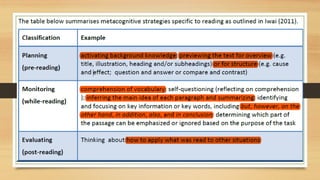
2. Metacognition
• Metacognitionrefers to consciousness and understanding of one's own
thought processes. [I struggle to understand numbers.]
• Metacognitive reading strategies, therefore, are ‘strategies designed to
increase readers’ knowledge of awareness and control, to improve their
reading comprehension, and to evaluate whether their attempt at
comprehension has been achieved’ (Zhang & Seepo, 2013, p. 55).
13.
2. Metacognition (cont.)
Strategiesspecific to reading are classified into three groups of metacognition:
1) planning (pre-reading)
2) monitoring (while-reading)
3) evaluating (post-reading)
• ‘Good readers use metacognitive strategies to think about and have control over
their reading.
• They implement diverse strategies in the three stages of the process of reading
comprehension.
14.
2. Metacognition (cont.)
Exampleof strategies in the three stages of the process of reading
• Before reading, define the reading purpose and preview the text.
• During reading, monitor understanding and adjust reading speed to the
difficulty of the text.
• After reading, check understanding of the read text’ (Olszak, 2014, p. 29).
16.
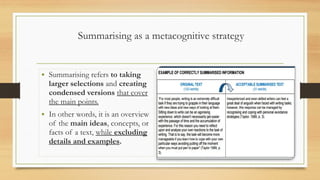
Summarising as ametacognitive strategy
• Summarising refers to taking
larger selections and creating
condensed versions that cover
the main points.
• In other words, it is an overview
of the main ideas, concepts, or
facts of a text, while excluding
details and examples.
17.
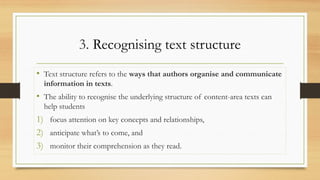
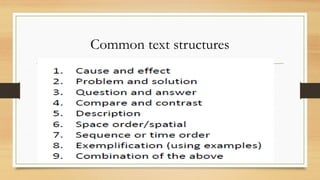
3. Recognising textstructure
• Text structure refers to the ways that authors organise and communicate
information in texts.
• The ability to recognise the underlying structure of content-area texts can
help students
1) focus attention on key concepts and relationships,
2) anticipate what’s to come, and
3) monitor their comprehension as they read.
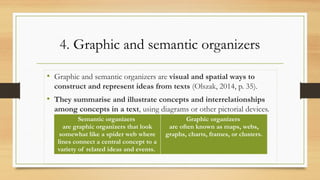
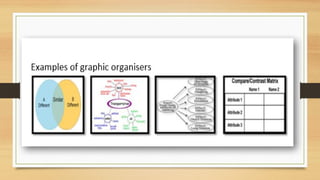
4. Graphic andsemantic organizers
• Graphic and semantic organizers are visual and spatial ways to
construct and represent ideas from texts (Olszak, 2014, p. 35).
• They summarise and illustrate concepts and interrelationships
among concepts in a text, using diagrams or other pictorial devices.
Semantic organizers
are graphic organizers that look
somewhat like a spider web where
lines connect a central concept to a
variety of related ideas and events.
Graphic organizers
are often known as maps, webs,
graphs, charts, frames, or clusters.

![2. Metacognition
• Metacognition refers to consciousness and understanding of one's own
thought processes. [I struggle to understand numbers.]
• Metacognitive reading strategies, therefore, are ‘strategies designed to
increase readers’ knowledge of awareness and control, to improve their
reading comprehension, and to evaluate whether their attempt at
comprehension has been achieved’ (Zhang & Seepo, 2013, p. 55).](https://image.slidesharecdn.com/lesson5readingstrategies-250404103421-c13263c1/85/Lesson-5_-Reading-strategies-ppbbbbbbbbtx-12-320.jpg)