Download to read offline
![Types of mutants
A] Mutants with altered cell permeability.
B] Auxotrophic mutant.
C] Analogue resistant mutant.
D] Revertant mutant.](https://image.slidesharecdn.com/strainimprovementpartii-201012121823/75/Strain-improvement-Part-II-Generation-of-mutants-producing-high-level-of-primary-metabolites-3-2048.jpg)
![A] Mutants with altered cell permeability
Biosynthesis of glutamate by C. glutamicum. Heavy
lines indicate the route to glutamate and the light lines
indicate the route in the regeneration of oxaloacetate via
the glyoxylate cycle.](https://image.slidesharecdn.com/strainimprovementpartii-201012121823/75/Strain-improvement-Part-II-Generation-of-mutants-producing-high-level-of-primary-metabolites-4-2048.jpg)
![A] Mutants with altered cell permeability
• Such mutants have leaky cell membrane, therefore end product synthesized
within the cell are constantly secreted outside keeping concentration of end
product very low in the cytoplasm.
• End product at such low concentration cannot exert FBI/FBR and metabolic
pathway become free of regulation to give very high yield of product.
E.g. Corynebacterium glutamicum used for production of glutamic acid.
The metabolic pathway leading to synthesis of glutamic acid.
• These mutants lack α-ketoglutarate (α-KG)dehydrogenase that converts α-KGA to
succinic acid in TCA cycle.
• Thus a metabolic block results in the accumulation of large concentration of α-
KGA which is then converted to glutamic acid.
• To complete TCA cycle OAA is generated by the activity of glyoxylate pathway.](https://image.slidesharecdn.com/strainimprovementpartii-201012121823/75/Strain-improvement-Part-II-Generation-of-mutants-producing-high-level-of-primary-metabolites-5-2048.jpg)
![A] Mutants with altered cell permeability
• Corynebacterium glutamicum auxotrophic mutant(biotin-) is used for
production of glutamic acid.
• Mutant when grown in sub-optimal concentration of Biotin, leads to
formation of leaky cell membrane.
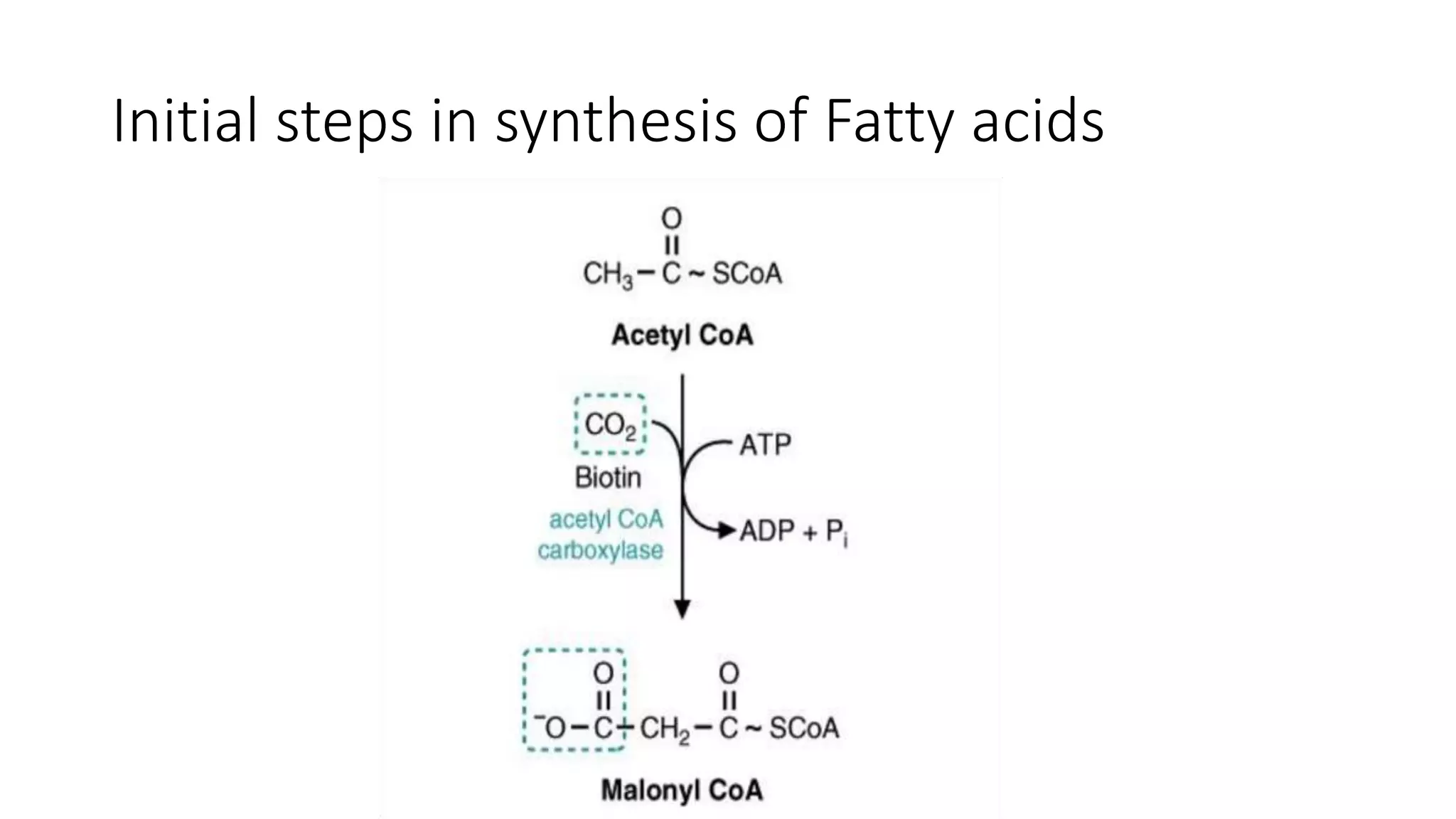
• Cell membrane are made of phospholipids and biotin serves as
precursor for synthesis of fatty acids. If fatty acids are not synthesized
in enough amount, then lipids won’t be formed in enough
amount,thus the membrane formed would be leaky.](https://image.slidesharecdn.com/strainimprovementpartii-201012121823/75/Strain-improvement-Part-II-Generation-of-mutants-producing-high-level-of-primary-metabolites-6-2048.jpg)
![B] Auxotrophic mutant
• In these mutants key enzyme, catalysing conversion of second last
intermediate product to final end product is not synthesized or synthesized
in inactive form. Thus metabolic pathway and production becomes free of
regulation by the end product. Instead of end product there is accumulation
of intermediate product at very high concentration in the cell.
E.g. Corynebacterium glutamicum auxotrophic for lysin is used in lysin
production.
• Auxotrophic mutant of Corynebacterium glutamicum ( auxotrophic for
methionine, threonine, isoleucine) lacking homoserine dehydrogenase can
be obtained to get higher yield of lysine since all aspartyl semialdehyde
synthesized will get converted solely to Diaminopimellic acid.](https://image.slidesharecdn.com/strainimprovementpartii-201012121823/75/Strain-improvement-Part-II-Generation-of-mutants-producing-high-level-of-primary-metabolites-8-2048.jpg)
![B] Auxotrophic mutant
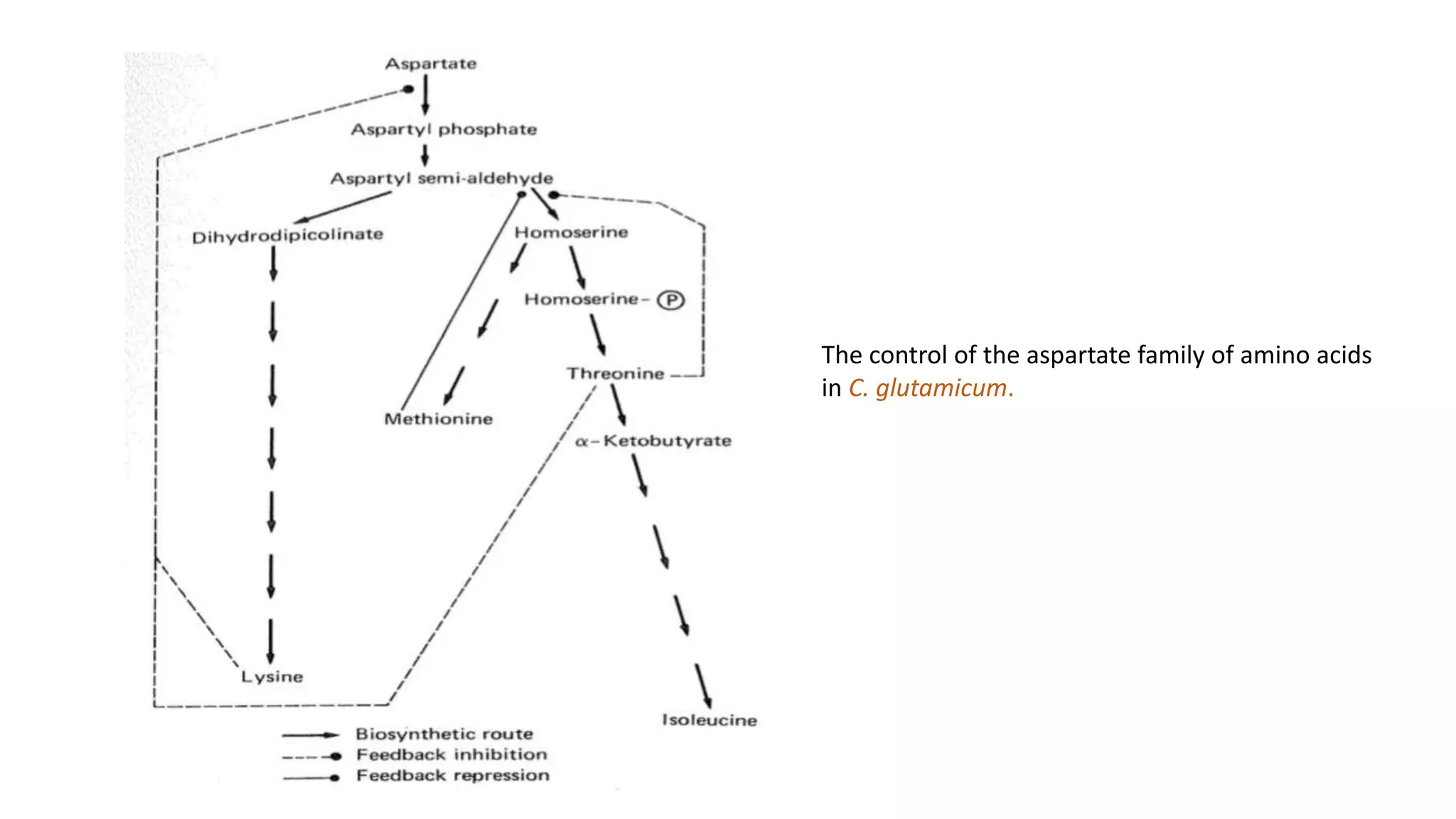
a) Aspartyl kinase the 1st enzyme of pathway is controlled by lysine and
threonine together through FBI.
b) Homoserine dehydrogenase is controlled by threonine through FBI
and Methionine through FBR. Similarly auxotrophic mutant of
Corynebacterium glutamicum, auxotrophic for lysin is free of FBI by end
product lysin and such mutant if grown on medium with limited lysin
with accumulation of Diaminopimellic acid in large quantity. It can be
converted to lysin using another organism or protrophic
Corynebacterium glutamicum. Dual fermentation is carried out to get
high yield](https://image.slidesharecdn.com/strainimprovementpartii-201012121823/75/Strain-improvement-Part-II-Generation-of-mutants-producing-high-level-of-primary-metabolites-10-2048.jpg)
![C]Analogue Resistant Mutant :
• These mutants do not recognize the presence of inhibitory or
repressing levels of the end product or enzyme produced by mutant
is altered at regulatory site so that it fails to interact with inhibitor.
Thus mutant becomes free of regulation and can give excess of end
product.](https://image.slidesharecdn.com/strainimprovementpartii-201012121823/75/Strain-improvement-Part-II-Generation-of-mutants-producing-high-level-of-primary-metabolites-11-2048.jpg)
![C]Analogue Resistant Mutant :
Definition of analogue: Analogue is a compound which is very similar in
structure to another compound but toxic in nature.
Analogue of amino acid, nucleotide are mostly growth inhibitory may
be because :
When used in biosynthetic pathway of macromolecule results into
production of defective, inactive cellular component which may
interfere with its biosynthesis.](https://image.slidesharecdn.com/strainimprovementpartii-201012121823/75/Strain-improvement-Part-II-Generation-of-mutants-producing-high-level-of-primary-metabolites-12-2048.jpg)
![C]Analogue Resistant Mutant :
• From biosynthesis pathway it is clear that lysine production is
regulated by concerted FBI(feedback inhibition) by lysine & threonine
by inactivating key enzyme aspartyl kinase .
• Mutant of B. flavum, resistant to analogue of lysine ie. ( 2amino ethyl
cysteine )gives very high yield, since aspartyl kinase the key enzyme is
more sensitive to high concentration of lysin. It is mainly because site
of mutation in resistant mutant is ‘aspartyl kinase ‘which is also site of
control by an end product. By mutation aspartyl kinase changes
without loss of activity and becomes insensitive to end product
exerting FBI.](https://image.slidesharecdn.com/strainimprovementpartii-201012121823/75/Strain-improvement-Part-II-Generation-of-mutants-producing-high-level-of-primary-metabolites-13-2048.jpg)
![C]Analogue Resistant Mutant :
Eg. Product Analogue Organism
1) Phenylalanine β – thiethylamine E coli
2) Methionine Ethionine Candida utilis
3) Methionine Norleucine E coli
4) Arginine 2-thiazolealanine Coryn glutamicum
B flavum
5)Lysine 2- aminoethyl cysteine B flavum](https://image.slidesharecdn.com/strainimprovementpartii-201012121823/75/Strain-improvement-Part-II-Generation-of-mutants-producing-high-level-of-primary-metabolites-14-2048.jpg)
![D]Revertant Mutant :
Definition of Revertant Mutant:
Isolated auxotrophic mutants may get altered in recognition
of control factors and thus become free of regulation and
give high yield of desirable product , these are called
revertant.](https://image.slidesharecdn.com/strainimprovementpartii-201012121823/75/Strain-improvement-Part-II-Generation-of-mutants-producing-high-level-of-primary-metabolites-15-2048.jpg)
![D]Revertant Mutant :
• Let us take an hypothetical example
A B C D E F P
• Let ’A’ be the substrate getting converted to product ‘P’ through
series of intermediate products B, C, D&E .Let ’a’ be the key enzyme
controlled by high concentration of product ‘P’ i.e. FBI regulation.](https://image.slidesharecdn.com/strainimprovementpartii-201012121823/75/Strain-improvement-Part-II-Generation-of-mutants-producing-high-level-of-primary-metabolites-16-2048.jpg)
![D]Revertant Mutant :
• A mutant not producing enzyme “a” of pathway is auxotrophic
mutant requiring product ‘P’ for growth. If this auxotroph is exposed
to mutagenic agent for 2nd mutation to occur in locus concerned with
production of enzyme a, then Revertant Mutant may be obtained,
having ability to synthesize active enzyme “a” & thus revertant
becomes prototrophic in nature. Many times, the enzyme
“a”produced by revertant is functionally same as enzyme “a”
produced by wild type prototroph but structurally vary from it. Thus
enzyme “a” of revertant is not susceptible to control by product ‘P’ &
becomes free of regulation to synthesize excess of product.](https://image.slidesharecdn.com/strainimprovementpartii-201012121823/75/Strain-improvement-Part-II-Generation-of-mutants-producing-high-level-of-primary-metabolites-17-2048.jpg)


The document discusses the generation of mutants in microorganisms, specifically focusing on primary metabolites and their production through mutagenesis. It categorizes mutants into types including those with altered cell permeability, auxotrophic mutants, analogue resistant mutants, and revertant mutants, each having different mechanisms to enhance yield. Examples using Corynebacterium glutamicum are provided to illustrate how these mutants can be used in the production of amino acids like glutamic acid and lysine.


