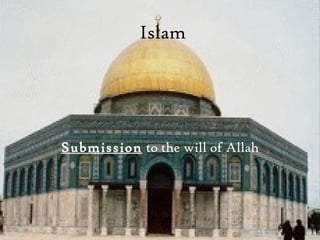
Islam
Submission to the will of Allah
I. The Rise and Spread of Islam
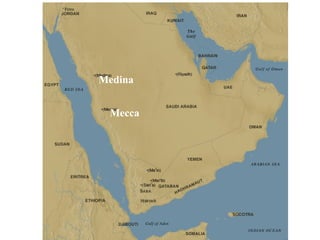
The Arabian Peninsula which is modern-day
Saudi Arabia was occupied by herders
called Bedouins. They were organized into
tribes headed by a sheik. In the interior, the
Bedouins raised livestock while people
along the coast became involved in trade.
Mecca
Medina
The Life of Muhammad
Muhammad is the Prophet of Islam.
He was born in the city of Mecca around
A.D. 590. At the age of 40, he had a vision
of the angel Gabriel to teach the word of
Allah, the Muslim god. Muhammad went
against the pagan polytheists who
worshiped idols in the Kaaba which was
originally a pagan temple.
The Kaaba
The pagans opposed the
monotheistic teachings of the Muhammad
and forced him to leave Mecca and to move
to Yathrib or Medina. This event is called
the hajj. Today, a hajj is a pilgrimage (a
holy trip) to one of the Islamic holy cities.
While in Medina, Muhammad’s support
grew and eventually he would return to
Mecca where in 630, he took over the city
and destroyed the pagan idols that were in
the Kaaba. He then issued a call to prayer
on the roof of the Kaaba.
The Islamic Faith
Islam is a monotheistic religion. Allah is
the one god. It has ties to two other
religions: Judaism and Christianity.
The holy book of Islam is the Quran also
spelled Koran, which was written in Arabic.
Allah
Muhammad
5 Pillars of Faith:
1. Making a profession of faith
• There is only one God, Allah, and
Muhammad is his prophet.
Praying 5 times a day, facing Mecca
• Mecca is the holy city of
Islam.
• Location of the Kaaba
Giving alms to the poor
Give food, clothing, money, or
assistance to the poor.
Fasting during the holy month of
Ramadan
• GoingGoing without foodwithout food oror drinkdrink from firstfrom first
light to sunset.light to sunset.
• This is the most sacred time in Islam, it isThis is the most sacred time in Islam, it is
when the Archangel Gabriel gave God’swhen the Archangel Gabriel gave God’s
message to Muhammad.message to Muhammad.
• 99thth
MonthMonth of the Islamic Calendarof the Islamic Calendar
5. Making a pilgrimage called the
hajj to one of the holy cities:
• Mecca or Medina
• Muslims should all go to Mecca at least
once in their lifetime. In Mecca, they go to
the Kaaba which is now
an altar to Allah
Islamic Beliefs
It is forbidden to drink alcohol and to
eat pork. Although polygamy was not part
of Muhammad’s teachings, it is practiced in
Islamic countries. Slavery was allowed but
Muhammad recommended that good
Muslims should let slaves go free.
Slavery was not based on race.
Muhammad taught that there would be a
struggle to protect the religion. This struggle is
called the jihad. He taught that if a Muslim died
fighting in a jihad, he would be considered a
martyr and would go to Paradise.
Muslims gather to worship in a
mosque. Four tall towers called minarets stand
around the mosque and with the central dome are
meant to represent the Five Pillars of the Faith.
The Spread of Islam
Caliph: successor, deputy – the title for the
person charged with spreading the message of
Islam. The Four Rightly Guided Caliphs:
Abu Bakr, Umar, Uthman, & Ali personally
knew Muhammad. These men spread Islam
through conquest.
The Islamic empire spread to the following
places: Arabian Peninsula, North Africa,
Fertile Crescent and Central Asia.
Muslim invasion of Europe was stopped at
the Battle of Tours in A.D. 732 by the Franks
led by Mayor of the Palace Charles Martel
(the Hammer). Europe would remain
Christian.
*Battle of Tours
732
Geographic influences on the spread of
Islam:
• Diffusion along the trade routes from
Mecca and Medina
• Expansion despite great distances,
desert environments & mountain barriers
• Spread was facilitated by weak Byzantine &
Persian empires.
• Arabic spread with Islam and facilitated
trade
Today Islam is in China
Sunni and Shi’a Split
Ali was the 4th
Rightly Guided Caliph and son-in-law
of Muhammad. After Ali’s death, Islam split into
two factions:
Shi’a Muslims: believe that the leader should be a
descendant of Ali. The leader is called an Imam.
Only about 10% of all Muslims are Shi’a
Sunni Muslims: believe that the leader could come
from any family. The leader is called a caliph.
Most Muslims are Sunni.
Turning Points
• Islam spread to Jerusalem in Palestine and
to Damascus in Syria.
• Islamic capital became Baghdad in Iraq.
• Caliphates were divisions of the Islamic
empire. There were caliphates in
Damascus, which is now the capital of
Syria, and in Cairo which is the capital of
Egypt.
Cultural Contributions &
Achievements
• Architecture: Dome of the Rock; Taj Mahal
• Mosaics
• Arabic Alphabet
• Universities
• Translations of Greek & Roman texts into Arabic
which helped to preserve classical writings
Inside Dome of the Rock
The Taj Mahal
Scientific Contributions &
Achievements
• Arabic numerals which were adapted from
India. 0-9 is used today in American math
classes.
• Medicine: Al Razi created an encyclopedia
of medicine
• Algebra was first used by Arabs
Science continued
• Expansion of geographic knowledge
through advanced cartography or map
making. Arab map making skills were
taught in European navigational schools
and were used by explorers such as
Christopher Columbus.

Islam Notes

  • 1.
  • 3.
    I. The Riseand Spread of Islam The Arabian Peninsula which is modern-day Saudi Arabia was occupied by herders called Bedouins. They were organized into tribes headed by a sheik. In the interior, the Bedouins raised livestock while people along the coast became involved in trade.
  • 4.
  • 5.
    The Life ofMuhammad Muhammad is the Prophet of Islam. He was born in the city of Mecca around A.D. 590. At the age of 40, he had a vision of the angel Gabriel to teach the word of Allah, the Muslim god. Muhammad went against the pagan polytheists who worshiped idols in the Kaaba which was originally a pagan temple.
  • 6.
  • 7.
    The pagans opposedthe monotheistic teachings of the Muhammad and forced him to leave Mecca and to move to Yathrib or Medina. This event is called the hajj. Today, a hajj is a pilgrimage (a holy trip) to one of the Islamic holy cities. While in Medina, Muhammad’s support grew and eventually he would return to Mecca where in 630, he took over the city and destroyed the pagan idols that were in the Kaaba. He then issued a call to prayer on the roof of the Kaaba.
  • 8.
    The Islamic Faith Islamis a monotheistic religion. Allah is the one god. It has ties to two other religions: Judaism and Christianity. The holy book of Islam is the Quran also spelled Koran, which was written in Arabic.
  • 9.
  • 13.
    1. Making aprofession of faith • There is only one God, Allah, and Muhammad is his prophet.
  • 14.
    Praying 5 timesa day, facing Mecca • Mecca is the holy city of Islam. • Location of the Kaaba
  • 15.
    Giving alms tothe poor Give food, clothing, money, or assistance to the poor.
  • 16.
    Fasting during theholy month of Ramadan • GoingGoing without foodwithout food oror drinkdrink from firstfrom first light to sunset.light to sunset. • This is the most sacred time in Islam, it isThis is the most sacred time in Islam, it is when the Archangel Gabriel gave God’swhen the Archangel Gabriel gave God’s message to Muhammad.message to Muhammad. • 99thth MonthMonth of the Islamic Calendarof the Islamic Calendar
  • 17.
    5. Making apilgrimage called the hajj to one of the holy cities: • Mecca or Medina • Muslims should all go to Mecca at least once in their lifetime. In Mecca, they go to the Kaaba which is now an altar to Allah
  • 18.
    Islamic Beliefs It isforbidden to drink alcohol and to eat pork. Although polygamy was not part of Muhammad’s teachings, it is practiced in Islamic countries. Slavery was allowed but Muhammad recommended that good Muslims should let slaves go free. Slavery was not based on race.
  • 19.
    Muhammad taught thatthere would be a struggle to protect the religion. This struggle is called the jihad. He taught that if a Muslim died fighting in a jihad, he would be considered a martyr and would go to Paradise. Muslims gather to worship in a mosque. Four tall towers called minarets stand around the mosque and with the central dome are meant to represent the Five Pillars of the Faith.
  • 20.
    The Spread ofIslam Caliph: successor, deputy – the title for the person charged with spreading the message of Islam. The Four Rightly Guided Caliphs: Abu Bakr, Umar, Uthman, & Ali personally knew Muhammad. These men spread Islam through conquest.
  • 21.
    The Islamic empirespread to the following places: Arabian Peninsula, North Africa, Fertile Crescent and Central Asia. Muslim invasion of Europe was stopped at the Battle of Tours in A.D. 732 by the Franks led by Mayor of the Palace Charles Martel (the Hammer). Europe would remain Christian.
  • 22.
  • 23.
    Geographic influences onthe spread of Islam: • Diffusion along the trade routes from Mecca and Medina • Expansion despite great distances, desert environments & mountain barriers • Spread was facilitated by weak Byzantine & Persian empires. • Arabic spread with Islam and facilitated trade
  • 24.
  • 26.
    Sunni and Shi’aSplit Ali was the 4th Rightly Guided Caliph and son-in-law of Muhammad. After Ali’s death, Islam split into two factions: Shi’a Muslims: believe that the leader should be a descendant of Ali. The leader is called an Imam. Only about 10% of all Muslims are Shi’a Sunni Muslims: believe that the leader could come from any family. The leader is called a caliph. Most Muslims are Sunni.
  • 27.
    Turning Points • Islamspread to Jerusalem in Palestine and to Damascus in Syria. • Islamic capital became Baghdad in Iraq. • Caliphates were divisions of the Islamic empire. There were caliphates in Damascus, which is now the capital of Syria, and in Cairo which is the capital of Egypt.
  • 28.
    Cultural Contributions & Achievements •Architecture: Dome of the Rock; Taj Mahal • Mosaics • Arabic Alphabet • Universities • Translations of Greek & Roman texts into Arabic which helped to preserve classical writings
  • 30.
  • 31.
  • 32.
    Scientific Contributions & Achievements •Arabic numerals which were adapted from India. 0-9 is used today in American math classes. • Medicine: Al Razi created an encyclopedia of medicine • Algebra was first used by Arabs
  • 33.
    Science continued • Expansionof geographic knowledge through advanced cartography or map making. Arab map making skills were taught in European navigational schools and were used by explorers such as Christopher Columbus.