EVOLUTION OF MOBILE
TECHNOLOGIES
SUBMITTED BY:
AKHIL BANSAL
(13/105)
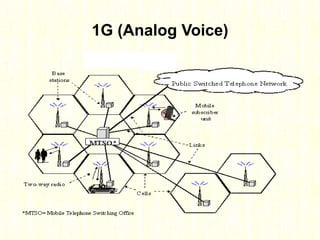
1G (Analog Voice)
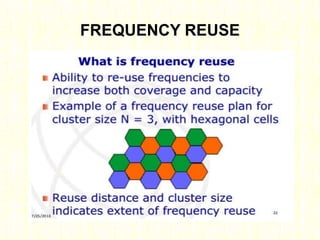
FREQUENCY REUSE
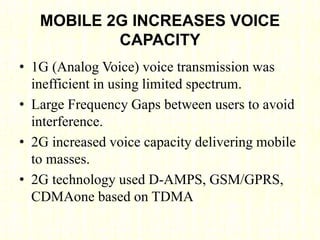
MOBILE 2G INCREASES VOICE
CAPACITY
• 1G (Analog Voice) voice transmission was
inefficient in using limited spectrum.
• Large Frequency Gaps between users to avoid
interference.
• 2G increased voice capacity delivering mobile
to masses.
• 2G technology used D-AMPS, GSM/GPRS,
CDMAone based on TDMA
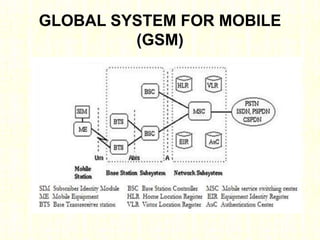
GLOBAL SYSTEM FOR MOBILE
(GSM)
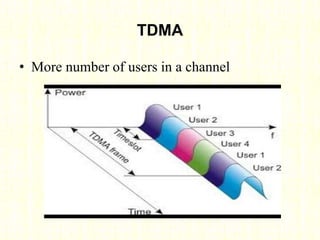
TDMA
• More number of users in a channel
3G Technology
• Delivered achievable throughput >2 Mbps
• Based on CDMA2000/EV-DO and WCDMA/HSPA
• Reduced operator cost for data services
• Continuous evolution for enhanced services.
• CDMA 2000 is a technology for evolution of 3G
services.
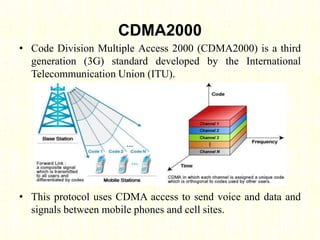
CDMA2000
• Code Division Multiple Access 2000 (CDMA2000) is a third
generation (3G) standard developed by the International
Telecommunication Union (ITU).
• This protocol uses CDMA access to send voice and data and
signals between mobile phones and cell sites.
HIGH SPEED PACKET ACCESS
(HSPA)
• Amalgamation of 2 mobile protocols
HSDPA (High Speed Downlink Packet Access)
HSUPA (High Speed Uplink Packet Access)
• Extends and improves the performance of 3G
mobile telecommunications.
• The newer standard allows bit-rates to reach as high
as 337 Mbit/s in the downlink and 34 Mbit/s in the
uplink.
4G LTE
• 4G integrates existing and future wireless
technologies like OFDM
• Provides freedom of movement and
uninterrupted roaming from one technology to
another.
• LTE (Long Term Evolution)and Wi-MAX (Wireless
Interoperability of Microwave Access) are
considered as 4G technologies.
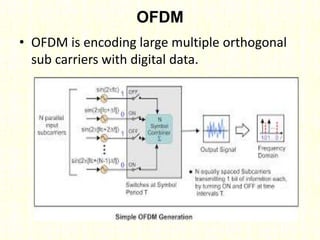
OFDM
• OFDM is encoding large multiple orthogonal
sub carriers with digital data.
LTE (LONG TERM EVOLUTION)
• LTE is a standard for high speed WC based on
GSM/EDGE and UMTS/HSPA technologies.
• Uses a different radio interface (E-UTRAN) with core
network improvements.
• Standard is developed by 3GPP (3rd Gen Partnership
Project)
• LTE is upgrade path for carriers with both GSM/UMTS
(Universal Mobile Telecommunication System).
• LTE is marketed as 4G LTE because of significant
advancement that WiMAX , Evolved HSPA and LTE
brought 3G technologies.
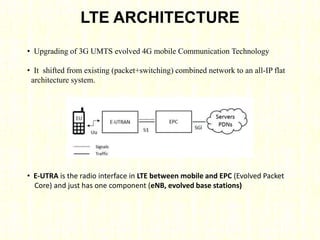
LTE ARCHITECTURE
• Upgrading of 3G UMTS evolved 4G mobile Communication Technology
• It shifted from existing (packet+switching) combined network to an all-IP flat
architecture system.
• E-UTRA is the radio interface in LTE between mobile and EPC (Evolved Packet
Core) and just has one component (eNB, evolved base stations)
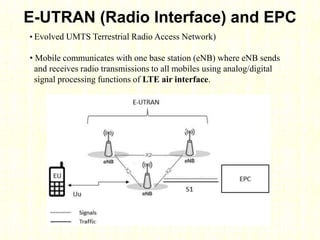
E-UTRAN (Radio Interface) and EPC
• Evolved UMTS Terrestrial Radio Access Network)
• Mobile communicates with one base station (eNB) where eNB sends
and receives radio transmissions to all mobiles using analog/digital
signal processing functions of LTE air interface.
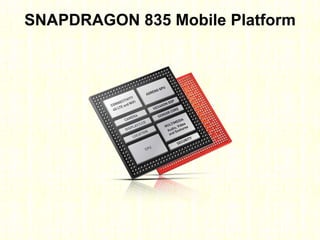
SNAPDRAGON 835 Mobile Platform
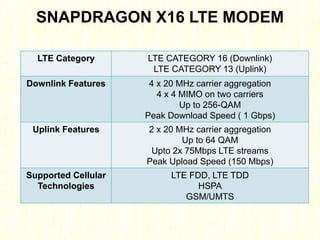
SNAPDRAGON X16 LTE MODEM
LTE Category LTE CATEGORY 16 (Downlink)
LTE CATEGORY 13 (Uplink)
Downlink Features 4 x 20 MHz carrier aggregation
4 x 4 MIMO on two carriers
Up to 256-QAM
Peak Download Speed ( 1 Gbps)
Uplink Features 2 x 20 MHz carrier aggregation
Up to 64 QAM
Upto 2x 75Mbps LTE streams
Peak Upload Speed (150 Mbps)
Supported Cellular
Technologies
LTE FDD, LTE TDD
HSPA
GSM/UMTS
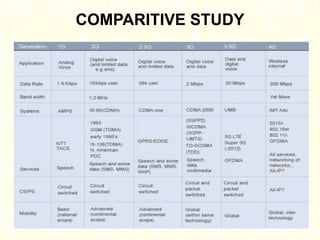
COMPARITIVE STUDY
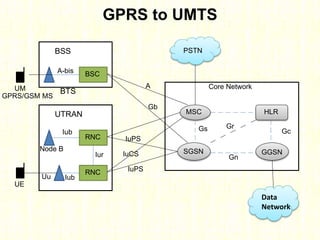
GPRS to UMTS
BSS
A-bis BSC
UTRAN
Iub
RNC
Iur
IubUu
UE
UM
RNC
PSTN
Core Network
MSC HLR
SGSN GGSN
Gs
Gn
Gc
Gr
Gb
A
IuCS
IuPS
IuPS
Data
Network
GPRS/GSM MS
Node B
BTS
GSM GPRS
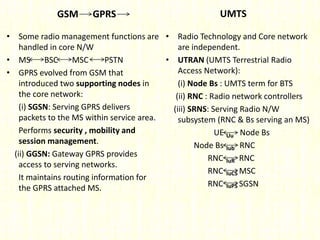
• Some radio management functions are
handled in core N/W
• MS BSC MSC PSTN
• GPRS evolved from GSM that
introduced two supporting nodes in
the core network:
(i) SGSN: Serving GPRS delivers
packets to the MS within service area.
Performs security , mobility and
session management.
(ii) GGSN: Gateway GPRS provides
access to serving networks.
It maintains routing information for
the GPRS attached MS.
UMTS
• Radio Technology and Core network
are independent.
• UTRAN (UMTS Terrestrial Radio
Access Network):
(i) Node Bs : UMTS term for BTS
(ii) RNC : Radio network controllers
(iii) SRNS: Serving Radio N/W
subsystem (RNC & Bs serving an MS)
UE Node Bs
Node Bs RNC
RNC RNC
RNC MSC
RNC SGSN
Uu
Iub
IuR
IuCS
IuPS
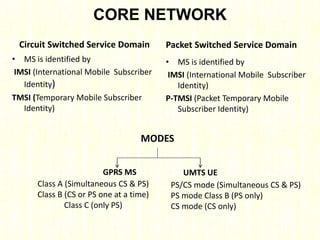
CORE NETWORK
Circuit Switched Service Domain
• MS is identified by
IMSI (International Mobile Subscriber
Identity)
TMSI (Temporary Mobile Subscriber
Identity)
Packet Switched Service Domain
• MS is identified by
IMSI (International Mobile Subscriber
Identity)
P-TMSI (Packet Temporary Mobile
Subscriber Identity)
MODES
GPRS MS UMTS UE
Class A (Simultaneous CS & PS)
Class B (CS or PS one at a time)
Class C (only PS)
PS/CS mode (Simultaneous CS & PS)
PS mode Class B (PS only)
CS mode (CS only)
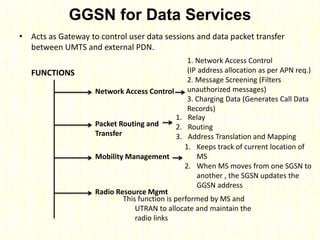
GGSN for Data Services
• Acts as Gateway to control user data sessions and data packet transfer
between UMTS and external PDN.
FUNCTIONS
Network Access Control
Packet Routing and
Transfer
Mobility Management
Radio Resource Mgmt
1. Network Access Control
(IP address allocation as per APN req.)
2. Message Screening (Filters
unauthorized messages)
3. Charging Data (Generates Call Data
Records)
1. Relay
2. Routing
3. Address Translation and Mapping
1. Keeps track of current location of
MS
2. When MS moves from one SGSN to
another , the SGSN updates the
GGSN address
This function is performed by MS and
UTRAN to allocate and maintain the
radio links
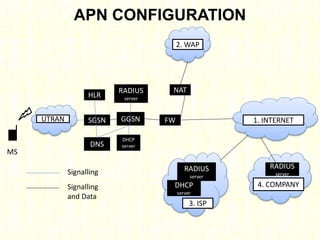
APN CONFIGURATION
SGSN
SGSN
HLR
DNS
GGSN
RADIUS
server
DHCP
server
FW
RADIUS
server
DHCP
server
RADIUS
server
NAT
UTRAN
2. WAP
1. INTERNET
4. COMPANY
3. ISP
Signalling
Signalling
and Data
MS

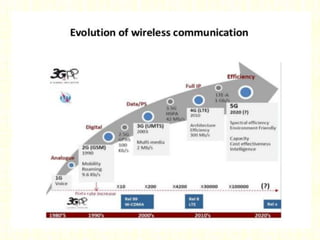
Evolution of Wireless Communication Technologies

  • 1.
  • 3.
  • 4.
  • 5.
    MOBILE 2G INCREASESVOICE CAPACITY • 1G (Analog Voice) voice transmission was inefficient in using limited spectrum. • Large Frequency Gaps between users to avoid interference. • 2G increased voice capacity delivering mobile to masses. • 2G technology used D-AMPS, GSM/GPRS, CDMAone based on TDMA
  • 6.
    GLOBAL SYSTEM FORMOBILE (GSM)
  • 7.
    TDMA • More numberof users in a channel
  • 8.
    3G Technology • Deliveredachievable throughput >2 Mbps • Based on CDMA2000/EV-DO and WCDMA/HSPA • Reduced operator cost for data services • Continuous evolution for enhanced services. • CDMA 2000 is a technology for evolution of 3G services.
  • 9.
    CDMA2000 • Code DivisionMultiple Access 2000 (CDMA2000) is a third generation (3G) standard developed by the International Telecommunication Union (ITU). • This protocol uses CDMA access to send voice and data and signals between mobile phones and cell sites.
  • 10.
    HIGH SPEED PACKETACCESS (HSPA) • Amalgamation of 2 mobile protocols HSDPA (High Speed Downlink Packet Access) HSUPA (High Speed Uplink Packet Access) • Extends and improves the performance of 3G mobile telecommunications. • The newer standard allows bit-rates to reach as high as 337 Mbit/s in the downlink and 34 Mbit/s in the uplink.
  • 11.
    4G LTE • 4Gintegrates existing and future wireless technologies like OFDM • Provides freedom of movement and uninterrupted roaming from one technology to another. • LTE (Long Term Evolution)and Wi-MAX (Wireless Interoperability of Microwave Access) are considered as 4G technologies.
  • 12.
    OFDM • OFDM isencoding large multiple orthogonal sub carriers with digital data.
  • 13.
    LTE (LONG TERMEVOLUTION) • LTE is a standard for high speed WC based on GSM/EDGE and UMTS/HSPA technologies. • Uses a different radio interface (E-UTRAN) with core network improvements. • Standard is developed by 3GPP (3rd Gen Partnership Project) • LTE is upgrade path for carriers with both GSM/UMTS (Universal Mobile Telecommunication System). • LTE is marketed as 4G LTE because of significant advancement that WiMAX , Evolved HSPA and LTE brought 3G technologies.
  • 14.
    LTE ARCHITECTURE • Upgradingof 3G UMTS evolved 4G mobile Communication Technology • It shifted from existing (packet+switching) combined network to an all-IP flat architecture system. • E-UTRA is the radio interface in LTE between mobile and EPC (Evolved Packet Core) and just has one component (eNB, evolved base stations)
  • 15.
    E-UTRAN (Radio Interface)and EPC • Evolved UMTS Terrestrial Radio Access Network) • Mobile communicates with one base station (eNB) where eNB sends and receives radio transmissions to all mobiles using analog/digital signal processing functions of LTE air interface.
  • 16.
  • 17.
    SNAPDRAGON X16 LTEMODEM LTE Category LTE CATEGORY 16 (Downlink) LTE CATEGORY 13 (Uplink) Downlink Features 4 x 20 MHz carrier aggregation 4 x 4 MIMO on two carriers Up to 256-QAM Peak Download Speed ( 1 Gbps) Uplink Features 2 x 20 MHz carrier aggregation Up to 64 QAM Upto 2x 75Mbps LTE streams Peak Upload Speed (150 Mbps) Supported Cellular Technologies LTE FDD, LTE TDD HSPA GSM/UMTS
  • 18.
  • 19.
    GPRS to UMTS BSS A-bisBSC UTRAN Iub RNC Iur IubUu UE UM RNC PSTN Core Network MSC HLR SGSN GGSN Gs Gn Gc Gr Gb A IuCS IuPS IuPS Data Network GPRS/GSM MS Node B BTS
  • 20.
    GSM GPRS • Someradio management functions are handled in core N/W • MS BSC MSC PSTN • GPRS evolved from GSM that introduced two supporting nodes in the core network: (i) SGSN: Serving GPRS delivers packets to the MS within service area. Performs security , mobility and session management. (ii) GGSN: Gateway GPRS provides access to serving networks. It maintains routing information for the GPRS attached MS. UMTS • Radio Technology and Core network are independent. • UTRAN (UMTS Terrestrial Radio Access Network): (i) Node Bs : UMTS term for BTS (ii) RNC : Radio network controllers (iii) SRNS: Serving Radio N/W subsystem (RNC & Bs serving an MS) UE Node Bs Node Bs RNC RNC RNC RNC MSC RNC SGSN Uu Iub IuR IuCS IuPS
  • 21.
    CORE NETWORK Circuit SwitchedService Domain • MS is identified by IMSI (International Mobile Subscriber Identity) TMSI (Temporary Mobile Subscriber Identity) Packet Switched Service Domain • MS is identified by IMSI (International Mobile Subscriber Identity) P-TMSI (Packet Temporary Mobile Subscriber Identity) MODES GPRS MS UMTS UE Class A (Simultaneous CS & PS) Class B (CS or PS one at a time) Class C (only PS) PS/CS mode (Simultaneous CS & PS) PS mode Class B (PS only) CS mode (CS only)
  • 22.
    GGSN for DataServices • Acts as Gateway to control user data sessions and data packet transfer between UMTS and external PDN. FUNCTIONS Network Access Control Packet Routing and Transfer Mobility Management Radio Resource Mgmt 1. Network Access Control (IP address allocation as per APN req.) 2. Message Screening (Filters unauthorized messages) 3. Charging Data (Generates Call Data Records) 1. Relay 2. Routing 3. Address Translation and Mapping 1. Keeps track of current location of MS 2. When MS moves from one SGSN to another , the SGSN updates the GGSN address This function is performed by MS and UTRAN to allocate and maintain the radio links
  • 23.