
DAS and small cells: A view from the leading edge
Josh Adelson, Director of Portfolio Marketing
White paper
commscope.com 2
Contents
Executive summary	 2
Rising indoor traffic calls for better indoor solutions	 2
DAS and small cells: different advantages for different environments	 2
C-RAN small cells	 3
On one hand: What you need to know about DAS	 3
On the other hand: What you need to know about small cells	 3
Moving target	 5
C-RAN for DAS?	 5
The question of funding	 6
In conclusion, be prepared	 7
commscope.com 3
Executive summary
As wireless operators race to keep up with exploding demand for mobile voice and data connectivity, in-
building wireless solutions are assuming an increasingly important role as a part of the broader network.
Two of the most prevalent in-building technologies, distributed antenna systems (DAS) and small cells,
have provided a way for operators to supplement coverage and capacity for indoor spaces that are not
adequately served by the outdoor macro network.
Wireless Operators continue to invest on upgrading in-building wireless solutions for large Public Venues
but they cannot scale the investment to provide similar capacity density in Enterprise venues.
Increasingly, the addition of in-building solutions is falling to the enterprise side. More than ever, the
building owner or facilities manager is under pressure to provide in-building coverage and capacity for
tenants, visitors and customers who increasingly expect total, reliable and seamless connectivity wherever
they go.
The challenge is in the inherent complexity that has traditionally been part of deploying in-building
solutions. On an enterprise level, the implementation of these solutions has always been seen as difficult
due to the complexity of the process (in-building radio planning, the need to coordinate with the outdoor
macro network, physical installations creating disruption to the building) and due to the architecture of
the solutions being very different from the typical IT infrastructure that building managers are normally
used to deal with.
Now, however, new solutions—and innovative improvements to existing solutions—are simplifying the
deployments reducing or eliminating much of the complexity and deployment cost. Likewise, there are
new ways to maintain, support and finance the deployment of such in-building solutions. These may
include working with a wireless operator, a third-party neutral host, or complete in-house funding and
control. Within these options, further combinations are possible that increase the ways an effective
in-building wireless solution can satisfy requirements for both wireless operators as well as enterprise
owners and managers.
Rising indoor traffic calls for better
indoor solutions
Cellular telephony was originally conceived as an outdoor
technology, with base stations and antenna equipment designed
to operate at high power over long distances. Now, the intrinsic
benefits of mobility and the advent of smartphones have
combined to make mobile phones the preferred medium for
indoor communications as well. It’s generally held that up to
80 percent of cellular traffic occurs indoors, where the outdoor
network has difficulty reaching.1
With the continued proliferation of wireless devices, the explosion
of mobile applications plus new ones falling under the broader label
of the Internet of Things (IoT), and the forthcoming evolution to 5G,
the amount of traffic originating indoors is positioned to grow even
further, as a percentage of all traffic as well as in absolute terms.
DAS and small cells are two technologies designed to supplement
the macro network with indoor coverage. Typically, active DAS
distributes standard base station signals across a network of
antennas spread throughout the coverage area. Small cells, on
the other hand, are self-contained devices that include low power
miniature base stations, radios and antennas that can likewise be
deployed around a building where coverage is needed.
A new small cell architecture known as cloud radio access network
(C-RAN) small cells has emerged as a hybrid of the two solutions.
In C-RAN small cells, multiple distributed radio/antenna devices are
connected to a centralized baseband unit. The baseband processing
and LTE scheduling are centralized in the baseband unit, while the
coverage is distributed via the radios.
DAS and small cells: different advantages
for different environments
DAS is suited to high-profile, multiband, multi-operator
environments and therefore has been used extensively in large
stadiums, airports and other public buildings such as convention
centers and shopping malls. DAS environments are characterized
by a high density of users, each with their own devices and their
own mobile network operators. Recent advances in DAS have
made it more practical for smaller locations. CommScope’s ION-E
is an example. Its compact headend equipment and an all-digital
fronthaul on standard IT cabling infrastructure have earned its
designation as an enterprise DAS.
1 	
For the purposes of this paper, we define “indoors” broadly to mean within a venue, even when portions of the venue are outdoors. For example, a hotel courtyard, or outdoor seating at a
stadium, are associated with the building and therefore we classify it as indoor usage. Likewise, usage in an automobile, while sheltered, is not associated with a building and therefore it’s
classified as outdoor usage.
commscope.com 4
Small cells, on the other hand, have typically been used in small-
and medium-size office buildings and other commercial venues
characterized by lower (but still significant) usage volume and fewer
operators or frequency bands, offering a limited but cost-effective
alternative to DAS.
C-RAN small cells
C-RAN small cells bridge the functionality and cost gaps between
these two technologies. Since C-RAN creates a single physical cell,
border interference and handovers are eliminated, dramatically
improving user experience. RF planning is simplified relative to
standalone small cells in which each access point risks interfering
with its neighbors.
C-RAN enables cell virtualization, a method of creating
multiple virtual sectors of capacity within a single physical cell
without introducing border interference, by tightly coordinating
transmissions between radios and users. This represents a
significant step forward in network capacity and user experience.
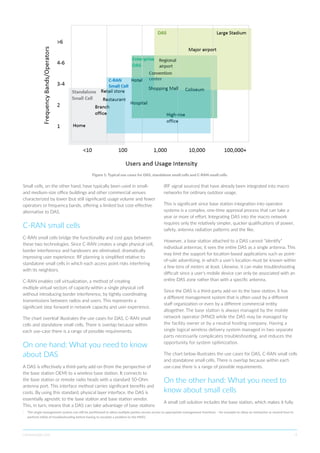
The chart overleaf illustrates the use cases for DAS, C-RAN small
cells and standalone small cells. There is overlap because within
each use-case there is a range of possible requirements.
On one hand: What you need to know
about DAS
A DAS is effectively a third-party add-on (from the perspective of
the base station OEM) to a wireless base station. It connects to
the base station or remote radio heads with a standard 50-Ohm
antenna port. This interface method carries significant benefits and
costs. By using this standard, physical layer interface, the DAS is
essentially agnostic to the base station and base station vendor.
This, in turn, means that a DAS can take advantage of base stations
(RF signal sources) that have already been integrated into macro
networks for ordinary outdoor usage.
This is significant since base station integration into operator
systems is a complex, one-time approval process that can take a
year or more of effort. Integrating DAS into the macro network
requires only the relatively simpler, quicker qualifications of power,
safety, antenna radiation patterns and the like.
However, a base station attached to a DAS cannot “identify”
individual antennas; it sees the entire DAS as a single antenna. This
may limit the support for location-based applications such as point-
of-sale advertising, in which a user’s location must be known within
a few tens of meters at least. Likewise, it can make troubleshooting
difficult since a user’s mobile device can only be associated with an
entire DAS zone rather than with a specific antenna.
Since the DAS is a third-party add-on to the base station, it has
a different management system that is often used by a different
staff organization or even by a different commercial entity
altogether. The base station is always managed by the mobile
network operator (MNO) while the DAS may be managed by
the facility owner or by a neutral hosting company. Having a
single logical wireless delivery system managed in two separate
parts necessarily complicates troubleshooting, and reduces the
opportunity for system optimization.
The chart below illustrates the use cases for DAS, C-RAN small cells
and standalone small cells. There is overlap because within each
use-case there is a range of possible requirements.
On the other hand: What you need to
know about small cells
A small cell solution includes the base station, which makes it fully
Figure 1: Typical use cases for DAS, standalone small cells and C-RAN small cells.
2
	 The single management system can still be partitioned to allow multiple parties secure access to appropriate management functions – for example to allow an enterprise or neutral host to
perform initial of troubleshooting before having to escalate a problem to the MNO.
commscope.com 5
part of the operator’s radio access network (RAN). LTE small cells
use the standard S1 interface to the operator’s evolved packet
core (EPC) network which carries user and session information, for
better support of location services, and more granular visibility for
performance optimization and troubleshooting.
The small cell has no inherent split between operator and non-
operator domains, meaning that it can be controlled via a single
unified management system. This improves performance and
operating efficiencies.2
S1 is a digital, data- and control-plane interface that can operate
over standard broadband connections such as fiber, cable, DSL and
metro Ethernet. Likewise, the fronthaul infrastructure (between the
baseband controller and radio points) of a C-RAN small cell can be
standard Ethernet switches and cabling, something that is already
familiar to enterprise IT organizations and property managers, and is
present in most buildings.
The main cost of this approach is its more complex one-time
integration with the MNO core network systems. Also, the small
cell approach is technology-specific. S1 is an LTE interface; it does
not support 3G or 2G technologies. In practice this is becoming
less of an issue as operators are discontinuing new investments in
legacy technologies.
Moving target
These are the pros and cons of DAS and small cell in the context of
today’s LTE networks, but what about tomorrows? 3GPP is defining
new capabilities under the umbrella of LTE-Advanced (LTE-A) and
this path will ultimately lead to 5G. There is also a significant move
toward using LTE in unlicensed spectrum bands with technologies
like LTE-unlicensed (LTE-U) and licensed access authorization (LAA),
topics each worth their own, separate examinations.
Other architectures within the building
Industry efforts to tackle the challenges of in-building wireless
service delivery have led to several architectures in addition to DAS
and C-RAN small cells. Here we will briefly cover three of them:
networked small cells, distributed radio systems and Wi-Fi.
•	Networked small cells are a series of access points and a
centralized controller, superficially like C-RAN small cells. But
with networked small cells, the baseband scheduling takes place
in each access point; the controller mainly manages handovers3
and backhaul aggregation. 4
By coordinating these functions,
networked small cells provide an incremental benefit over
pure standalone small cells, but because they still create many
individual cells, they do not address the fundamental issues of
border interference as C-RAN small cells do.
•	Distributed radio systems consist of a macro base station
connected to distributed antennas over a CPRI interface and
intermediate radio distribution units. The chief advantage
over networked small cells is that they reduce the number of
cell borders because the baseband processing is centralized.
However, they still have more borders than DAS or C-RAN small
cells due to the way the radio distribution architecture “fans out”
into multiple sectors. The use of expensive fiber fronthaul and
proprietary intermediate nodes makes distributed radio systems
more expensive than C-RAN running on standard Ethernet
cabling and switches.
•	Wi-Fi is the dominant form of in-building wireless technology.
We believe that Wi-Fi and cellular technologies are
complementary rather than substitutes for one another. Wi-Fi
provides secure access to the corporate data network with
no service charges. No network operator is required to install
or run the system. DAS or small cell supports mobile voice as
well as data—without the manual authentication required by
Wi-Fi networks.5
C-RAN for DAS?
C-RAN small cells are a forward-looking architecture with headroom
for advanced LTE capabilities. In the immediate future, DAS is a
superior solution for multi-operator, multiband, large deployments.
Furthermore, operators, neutral hosts, venue owners and property
managers have significant investments in DAS6
and need a path to
fully leverage them.
As it happens, many of the advantages of C-RAN small cells can be
achieved while preserving the investment and scalability of the DAS
by using C-RAN small cells as an alternative to legacy macro base
stations for a DAS signal source. This can be achieved leveraging
CommScope’s OneCell®
C-RAN small cell solution.
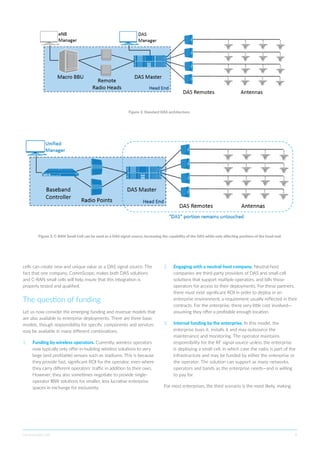
In a traditional DAS headend, a macro base station and its remote
radio heads (RRHs) connect to a DAS master unit, which fans out to
various DAS remotes and antennas.
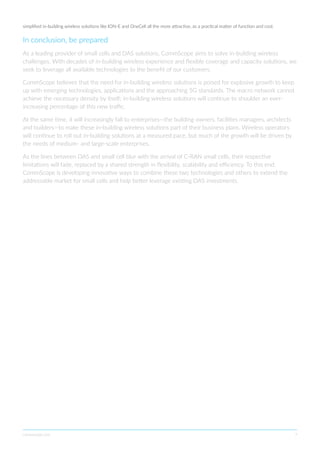
The RF output of a CommScope OneCell baseband controller and
radio points is equivalent to that of the RRH, so the OneCell system
can be substituted for the macro base station and RRHs.
Using the C-RAN small cell system as a signal source for the DAS
provides significant advantages over legacy architecture:
•	Greater capacity through cell virtualization. Since the C-RAN
small cell system is capable of cell virtualization, it can deliver
multiple sectors of capacity without having to physically re-
sectorize the system. Physical sectors create borders and border
interference, whereas virtual sectors create no border interference.
Therefore, the total system capacity is increased without having to
incur an interference penalty—a huge advantage.
•	Headend cost reduction. The OneCell baseband controller
consumes only half of a 1U shelf, and the radio points are
approximately 1.5 liters in volume (similar to a paperback book
or Wi-Fi access point). They use far less space and power at the
headend than traditional macro base station equipment.
To date, efforts at using small cells as a DAS signal source have
focused on standalone small cells and motivated purely by
equipment cost reduction. However, since standalone small cells
have limited power and capacity, and often lack macro-parity in
feature sets, adoption has been minimal. By contrast, C-RAN small
4
	 For this reason, networked small cells are sometimes called “controller-assisted” small cells. small cells.
5
	 For more information, refer to CommScope’s point-of-view document “The Need for Wi-Fi and Cellular in the Enterprise,” December 2016.
6
	 There are 632,000 DAS deployments worldwide as of 2016. Source: ABI Research, In-Building Wireless Forecast, September 2016
commscope.com 6
cells can create new and unique value as a DAS signal source. The
fact that one company, CommScope, makes both DAS solutions
and C-RAN small cells will help insure that this integration is
properly tested and qualified.
The question of funding
Let us now consider the emerging funding and revenue models that
are also available to enterprise deployments. There are three basic
models, though responsibility for specific components and services
may be available in many different combinations.
1.	 Funding by wireless operators. Currently, wireless operators
now typically only offer in-building wireless solutions to very
large (and profitable) venues such as stadiums. This is because
they provide fast, significant ROI for the operator, even where
they carry different operators’ traffic in addition to their own.
However, they also sometimes negotiate to provide single-
operator IBW solutions for smaller, less lucrative enterprise
spaces in exchange for exclusivity.
2.	 Engaging with a neutral-host company. Neutral-host
companies are third-party providers of DAS and small cell
solutions that support multiple operators, and bills those
operators for access to their deployments. For these partners,
there must exist significant ROI in order to deploy in an
enterprise environment, a requirement usually reflected in their
contracts. For the enterprise, there very little cost involved—
assuming they offer a profitable enough location.
3.	 Internal funding by the enterprise. In this model, the
enterprise buys it, installs it and may outsource the
maintenance and monitoring. The operator maintains
responsibility for the RF signal source unless the enterprise
is deploying a small cell, in which case the radio is part of the
infrastructure and may be funded by either the enterprise or
the operator. The solution can support as many networks,
operators and bands as the enterprise needs—and is willing
to pay for.
For most enterprises, the third scenario is the most likely, making
Figure 3: C-RAN Small Cell can be used as a DAS signal source, increasing the capability of the DAS while only affecting portions of the head end.
Figure 2: Standard DAS architecture.
commscope.com 7
simplified in-building wireless solutions like ION-E and OneCell all the more attractive, as a practical matter of function and cost.
In conclusion, be prepared
As a leading provider of small cells and DAS solutions, CommScope aims to solve in-building wireless
challenges. With decades of in-building wireless experience and flexible coverage and capacity solutions, we
seek to leverage all available technologies to the benefit of our customers.
CommScope believes that the need for in-building wireless solutions is poised for explosive growth to keep
up with emerging technologies, applications and the approaching 5G standards. The macro network cannot
achieve the necessary density by itself; in-building wireless solutions will continue to shoulder an ever-
increasing percentage of this new traffic.
At the same time, it will increasingly fall to enterprises—the building owners, facilities managers, architects
and builders—to make these in-building wireless solutions part of their business plans. Wireless operators
will continue to roll out in-building solutions at a measured pace, but much of the growth will be driven by
the needs of medium- and large-scale enterprises.
As the lines between DAS and small cell blur with the arrival of C-RAN small cells, their respective
limitations will fade, replaced by a shared strength in flexibility, scalability and efficiency. To this end,
CommScope is developing innovative ways to combine these two technologies and others to extend the
addressable market for small cells and help better leverage existing DAS investments.
Everyone communicates. It’s the essence of the
human experience. How we communicate is evolving.
Technology is reshaping the way we live, learn and thrive.
The epicenter of this transformation is the network—our
passion. Our experts are rethinking the purpose, role
and usage of networks to help our customers increase
bandwidth, expand capacity, enhance efficiency, speed
deployment and simplify migration. From remote cell
sites to massive sports arenas, from busy airports to
state-of-the-art data centers—we provide the essential
expertise and vital infrastructure your business needs to
succeed. The world’s most advanced networks rely on
CommScope connectivity.
commscope.com
Visit our website or contact your local CommScope representative for more information.
© 2017 CommScope, Inc. All rights reserved.
All trademarks identified by ® or ™ are registered trademarks or trademarks, respectively, of CommScope, Inc. This document is for planning purposes only and is not intended to modify or
supplement any specifications or warranties relating to CommScope products or services. CommScope is committed to the highest standards of business integrity and environmental sustainability
with a number of CommScope’s facilities across the globe certified in accordance with international standards, including ISO 9001, TL 9000, and ISO 14001. Further information regarding
CommScope’s commitment can be found at www.commscope.com/About-Us/Corporate-Responsibility-and-Sustainability.
WP-111425-EN (01/17)

Das small cells_view_leading_edge_wp-111425-en

  • 1.
    DAS and smallcells: A view from the leading edge Josh Adelson, Director of Portfolio Marketing White paper
  • 2.
    commscope.com 2 Contents Executive summary 2 Rising indoor traffic calls for better indoor solutions 2 DAS and small cells: different advantages for different environments 2 C-RAN small cells 3 On one hand: What you need to know about DAS 3 On the other hand: What you need to know about small cells 3 Moving target 5 C-RAN for DAS? 5 The question of funding 6 In conclusion, be prepared 7
  • 3.
    commscope.com 3 Executive summary Aswireless operators race to keep up with exploding demand for mobile voice and data connectivity, in- building wireless solutions are assuming an increasingly important role as a part of the broader network. Two of the most prevalent in-building technologies, distributed antenna systems (DAS) and small cells, have provided a way for operators to supplement coverage and capacity for indoor spaces that are not adequately served by the outdoor macro network. Wireless Operators continue to invest on upgrading in-building wireless solutions for large Public Venues but they cannot scale the investment to provide similar capacity density in Enterprise venues. Increasingly, the addition of in-building solutions is falling to the enterprise side. More than ever, the building owner or facilities manager is under pressure to provide in-building coverage and capacity for tenants, visitors and customers who increasingly expect total, reliable and seamless connectivity wherever they go. The challenge is in the inherent complexity that has traditionally been part of deploying in-building solutions. On an enterprise level, the implementation of these solutions has always been seen as difficult due to the complexity of the process (in-building radio planning, the need to coordinate with the outdoor macro network, physical installations creating disruption to the building) and due to the architecture of the solutions being very different from the typical IT infrastructure that building managers are normally used to deal with. Now, however, new solutions—and innovative improvements to existing solutions—are simplifying the deployments reducing or eliminating much of the complexity and deployment cost. Likewise, there are new ways to maintain, support and finance the deployment of such in-building solutions. These may include working with a wireless operator, a third-party neutral host, or complete in-house funding and control. Within these options, further combinations are possible that increase the ways an effective in-building wireless solution can satisfy requirements for both wireless operators as well as enterprise owners and managers. Rising indoor traffic calls for better indoor solutions Cellular telephony was originally conceived as an outdoor technology, with base stations and antenna equipment designed to operate at high power over long distances. Now, the intrinsic benefits of mobility and the advent of smartphones have combined to make mobile phones the preferred medium for indoor communications as well. It’s generally held that up to 80 percent of cellular traffic occurs indoors, where the outdoor network has difficulty reaching.1 With the continued proliferation of wireless devices, the explosion of mobile applications plus new ones falling under the broader label of the Internet of Things (IoT), and the forthcoming evolution to 5G, the amount of traffic originating indoors is positioned to grow even further, as a percentage of all traffic as well as in absolute terms. DAS and small cells are two technologies designed to supplement the macro network with indoor coverage. Typically, active DAS distributes standard base station signals across a network of antennas spread throughout the coverage area. Small cells, on the other hand, are self-contained devices that include low power miniature base stations, radios and antennas that can likewise be deployed around a building where coverage is needed. A new small cell architecture known as cloud radio access network (C-RAN) small cells has emerged as a hybrid of the two solutions. In C-RAN small cells, multiple distributed radio/antenna devices are connected to a centralized baseband unit. The baseband processing and LTE scheduling are centralized in the baseband unit, while the coverage is distributed via the radios. DAS and small cells: different advantages for different environments DAS is suited to high-profile, multiband, multi-operator environments and therefore has been used extensively in large stadiums, airports and other public buildings such as convention centers and shopping malls. DAS environments are characterized by a high density of users, each with their own devices and their own mobile network operators. Recent advances in DAS have made it more practical for smaller locations. CommScope’s ION-E is an example. Its compact headend equipment and an all-digital fronthaul on standard IT cabling infrastructure have earned its designation as an enterprise DAS. 1 For the purposes of this paper, we define “indoors” broadly to mean within a venue, even when portions of the venue are outdoors. For example, a hotel courtyard, or outdoor seating at a stadium, are associated with the building and therefore we classify it as indoor usage. Likewise, usage in an automobile, while sheltered, is not associated with a building and therefore it’s classified as outdoor usage.
  • 4.
    commscope.com 4 Small cells,on the other hand, have typically been used in small- and medium-size office buildings and other commercial venues characterized by lower (but still significant) usage volume and fewer operators or frequency bands, offering a limited but cost-effective alternative to DAS. C-RAN small cells C-RAN small cells bridge the functionality and cost gaps between these two technologies. Since C-RAN creates a single physical cell, border interference and handovers are eliminated, dramatically improving user experience. RF planning is simplified relative to standalone small cells in which each access point risks interfering with its neighbors. C-RAN enables cell virtualization, a method of creating multiple virtual sectors of capacity within a single physical cell without introducing border interference, by tightly coordinating transmissions between radios and users. This represents a significant step forward in network capacity and user experience. The chart overleaf illustrates the use cases for DAS, C-RAN small cells and standalone small cells. There is overlap because within each use-case there is a range of possible requirements. On one hand: What you need to know about DAS A DAS is effectively a third-party add-on (from the perspective of the base station OEM) to a wireless base station. It connects to the base station or remote radio heads with a standard 50-Ohm antenna port. This interface method carries significant benefits and costs. By using this standard, physical layer interface, the DAS is essentially agnostic to the base station and base station vendor. This, in turn, means that a DAS can take advantage of base stations (RF signal sources) that have already been integrated into macro networks for ordinary outdoor usage. This is significant since base station integration into operator systems is a complex, one-time approval process that can take a year or more of effort. Integrating DAS into the macro network requires only the relatively simpler, quicker qualifications of power, safety, antenna radiation patterns and the like. However, a base station attached to a DAS cannot “identify” individual antennas; it sees the entire DAS as a single antenna. This may limit the support for location-based applications such as point- of-sale advertising, in which a user’s location must be known within a few tens of meters at least. Likewise, it can make troubleshooting difficult since a user’s mobile device can only be associated with an entire DAS zone rather than with a specific antenna. Since the DAS is a third-party add-on to the base station, it has a different management system that is often used by a different staff organization or even by a different commercial entity altogether. The base station is always managed by the mobile network operator (MNO) while the DAS may be managed by the facility owner or by a neutral hosting company. Having a single logical wireless delivery system managed in two separate parts necessarily complicates troubleshooting, and reduces the opportunity for system optimization. The chart below illustrates the use cases for DAS, C-RAN small cells and standalone small cells. There is overlap because within each use-case there is a range of possible requirements. On the other hand: What you need to know about small cells A small cell solution includes the base station, which makes it fully Figure 1: Typical use cases for DAS, standalone small cells and C-RAN small cells. 2 The single management system can still be partitioned to allow multiple parties secure access to appropriate management functions – for example to allow an enterprise or neutral host to perform initial of troubleshooting before having to escalate a problem to the MNO.
  • 5.
    commscope.com 5 part ofthe operator’s radio access network (RAN). LTE small cells use the standard S1 interface to the operator’s evolved packet core (EPC) network which carries user and session information, for better support of location services, and more granular visibility for performance optimization and troubleshooting. The small cell has no inherent split between operator and non- operator domains, meaning that it can be controlled via a single unified management system. This improves performance and operating efficiencies.2 S1 is a digital, data- and control-plane interface that can operate over standard broadband connections such as fiber, cable, DSL and metro Ethernet. Likewise, the fronthaul infrastructure (between the baseband controller and radio points) of a C-RAN small cell can be standard Ethernet switches and cabling, something that is already familiar to enterprise IT organizations and property managers, and is present in most buildings. The main cost of this approach is its more complex one-time integration with the MNO core network systems. Also, the small cell approach is technology-specific. S1 is an LTE interface; it does not support 3G or 2G technologies. In practice this is becoming less of an issue as operators are discontinuing new investments in legacy technologies. Moving target These are the pros and cons of DAS and small cell in the context of today’s LTE networks, but what about tomorrows? 3GPP is defining new capabilities under the umbrella of LTE-Advanced (LTE-A) and this path will ultimately lead to 5G. There is also a significant move toward using LTE in unlicensed spectrum bands with technologies like LTE-unlicensed (LTE-U) and licensed access authorization (LAA), topics each worth their own, separate examinations. Other architectures within the building Industry efforts to tackle the challenges of in-building wireless service delivery have led to several architectures in addition to DAS and C-RAN small cells. Here we will briefly cover three of them: networked small cells, distributed radio systems and Wi-Fi. • Networked small cells are a series of access points and a centralized controller, superficially like C-RAN small cells. But with networked small cells, the baseband scheduling takes place in each access point; the controller mainly manages handovers3 and backhaul aggregation. 4 By coordinating these functions, networked small cells provide an incremental benefit over pure standalone small cells, but because they still create many individual cells, they do not address the fundamental issues of border interference as C-RAN small cells do. • Distributed radio systems consist of a macro base station connected to distributed antennas over a CPRI interface and intermediate radio distribution units. The chief advantage over networked small cells is that they reduce the number of cell borders because the baseband processing is centralized. However, they still have more borders than DAS or C-RAN small cells due to the way the radio distribution architecture “fans out” into multiple sectors. The use of expensive fiber fronthaul and proprietary intermediate nodes makes distributed radio systems more expensive than C-RAN running on standard Ethernet cabling and switches. • Wi-Fi is the dominant form of in-building wireless technology. We believe that Wi-Fi and cellular technologies are complementary rather than substitutes for one another. Wi-Fi provides secure access to the corporate data network with no service charges. No network operator is required to install or run the system. DAS or small cell supports mobile voice as well as data—without the manual authentication required by Wi-Fi networks.5 C-RAN for DAS? C-RAN small cells are a forward-looking architecture with headroom for advanced LTE capabilities. In the immediate future, DAS is a superior solution for multi-operator, multiband, large deployments. Furthermore, operators, neutral hosts, venue owners and property managers have significant investments in DAS6 and need a path to fully leverage them. As it happens, many of the advantages of C-RAN small cells can be achieved while preserving the investment and scalability of the DAS by using C-RAN small cells as an alternative to legacy macro base stations for a DAS signal source. This can be achieved leveraging CommScope’s OneCell® C-RAN small cell solution. In a traditional DAS headend, a macro base station and its remote radio heads (RRHs) connect to a DAS master unit, which fans out to various DAS remotes and antennas. The RF output of a CommScope OneCell baseband controller and radio points is equivalent to that of the RRH, so the OneCell system can be substituted for the macro base station and RRHs. Using the C-RAN small cell system as a signal source for the DAS provides significant advantages over legacy architecture: • Greater capacity through cell virtualization. Since the C-RAN small cell system is capable of cell virtualization, it can deliver multiple sectors of capacity without having to physically re- sectorize the system. Physical sectors create borders and border interference, whereas virtual sectors create no border interference. Therefore, the total system capacity is increased without having to incur an interference penalty—a huge advantage. • Headend cost reduction. The OneCell baseband controller consumes only half of a 1U shelf, and the radio points are approximately 1.5 liters in volume (similar to a paperback book or Wi-Fi access point). They use far less space and power at the headend than traditional macro base station equipment. To date, efforts at using small cells as a DAS signal source have focused on standalone small cells and motivated purely by equipment cost reduction. However, since standalone small cells have limited power and capacity, and often lack macro-parity in feature sets, adoption has been minimal. By contrast, C-RAN small 4 For this reason, networked small cells are sometimes called “controller-assisted” small cells. small cells. 5 For more information, refer to CommScope’s point-of-view document “The Need for Wi-Fi and Cellular in the Enterprise,” December 2016. 6 There are 632,000 DAS deployments worldwide as of 2016. Source: ABI Research, In-Building Wireless Forecast, September 2016
  • 6.
    commscope.com 6 cells cancreate new and unique value as a DAS signal source. The fact that one company, CommScope, makes both DAS solutions and C-RAN small cells will help insure that this integration is properly tested and qualified. The question of funding Let us now consider the emerging funding and revenue models that are also available to enterprise deployments. There are three basic models, though responsibility for specific components and services may be available in many different combinations. 1. Funding by wireless operators. Currently, wireless operators now typically only offer in-building wireless solutions to very large (and profitable) venues such as stadiums. This is because they provide fast, significant ROI for the operator, even where they carry different operators’ traffic in addition to their own. However, they also sometimes negotiate to provide single- operator IBW solutions for smaller, less lucrative enterprise spaces in exchange for exclusivity. 2. Engaging with a neutral-host company. Neutral-host companies are third-party providers of DAS and small cell solutions that support multiple operators, and bills those operators for access to their deployments. For these partners, there must exist significant ROI in order to deploy in an enterprise environment, a requirement usually reflected in their contracts. For the enterprise, there very little cost involved— assuming they offer a profitable enough location. 3. Internal funding by the enterprise. In this model, the enterprise buys it, installs it and may outsource the maintenance and monitoring. The operator maintains responsibility for the RF signal source unless the enterprise is deploying a small cell, in which case the radio is part of the infrastructure and may be funded by either the enterprise or the operator. The solution can support as many networks, operators and bands as the enterprise needs—and is willing to pay for. For most enterprises, the third scenario is the most likely, making Figure 3: C-RAN Small Cell can be used as a DAS signal source, increasing the capability of the DAS while only affecting portions of the head end. Figure 2: Standard DAS architecture.
  • 7.
    commscope.com 7 simplified in-buildingwireless solutions like ION-E and OneCell all the more attractive, as a practical matter of function and cost. In conclusion, be prepared As a leading provider of small cells and DAS solutions, CommScope aims to solve in-building wireless challenges. With decades of in-building wireless experience and flexible coverage and capacity solutions, we seek to leverage all available technologies to the benefit of our customers. CommScope believes that the need for in-building wireless solutions is poised for explosive growth to keep up with emerging technologies, applications and the approaching 5G standards. The macro network cannot achieve the necessary density by itself; in-building wireless solutions will continue to shoulder an ever- increasing percentage of this new traffic. At the same time, it will increasingly fall to enterprises—the building owners, facilities managers, architects and builders—to make these in-building wireless solutions part of their business plans. Wireless operators will continue to roll out in-building solutions at a measured pace, but much of the growth will be driven by the needs of medium- and large-scale enterprises. As the lines between DAS and small cell blur with the arrival of C-RAN small cells, their respective limitations will fade, replaced by a shared strength in flexibility, scalability and efficiency. To this end, CommScope is developing innovative ways to combine these two technologies and others to extend the addressable market for small cells and help better leverage existing DAS investments.
  • 8.
    Everyone communicates. It’sthe essence of the human experience. How we communicate is evolving. Technology is reshaping the way we live, learn and thrive. The epicenter of this transformation is the network—our passion. Our experts are rethinking the purpose, role and usage of networks to help our customers increase bandwidth, expand capacity, enhance efficiency, speed deployment and simplify migration. From remote cell sites to massive sports arenas, from busy airports to state-of-the-art data centers—we provide the essential expertise and vital infrastructure your business needs to succeed. The world’s most advanced networks rely on CommScope connectivity. commscope.com Visit our website or contact your local CommScope representative for more information. © 2017 CommScope, Inc. All rights reserved. All trademarks identified by ® or ™ are registered trademarks or trademarks, respectively, of CommScope, Inc. This document is for planning purposes only and is not intended to modify or supplement any specifications or warranties relating to CommScope products or services. CommScope is committed to the highest standards of business integrity and environmental sustainability with a number of CommScope’s facilities across the globe certified in accordance with international standards, including ISO 9001, TL 9000, and ISO 14001. Further information regarding CommScope’s commitment can be found at www.commscope.com/About-Us/Corporate-Responsibility-and-Sustainability. WP-111425-EN (01/17)