Anbr Cama
Presents
Mercury Spill CleanupMercury Spill Cleanup
ProceduresProcedures
www.anbrcama.com
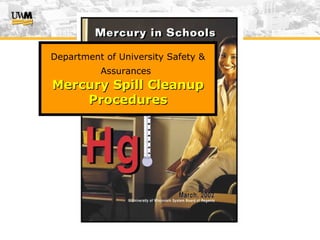
Department of University Safety &
Assurances
Mercury Spill CleanupMercury Spill Cleanup
ProceduresProcedures
US&A (v. 2/07)
Mercury is a Hazardous Material
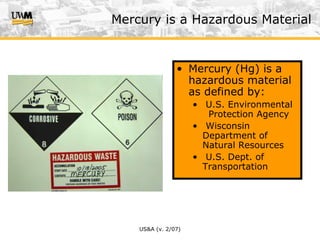
• Mercury (Hg) is a
hazardous material
as defined by:
• U.S. Environmental
Protection Agency
• Wisconsin
Department of
Natural Resources
• U.S. Dept. of
Transportation
US&A (v. 2/07)
• Mercury poisoning can result in
severe health problems affecting
the nervous system and other
organs.
• Tremors
• Changes in vision or hearing
• Insomnia
• Weakness
• Difficulty with memory
• Headaches
• Irritability
• Shyness and nervousness
• Acrodynia (painful extremities), a
condition caused by chronic exposure to
mercury
Mercury is a Toxic Substance
US&A (v. 2/07)
Mercury Exposure & Prevention
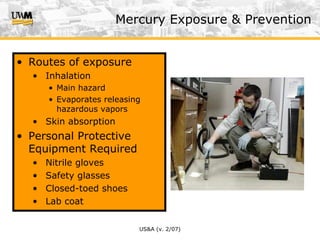
• Routes of exposure
• Inhalation
• Main hazard
• Evaporates releasing
hazardous vapors
• Skin absorption
• Personal Protective
Equipment Required
• Nitrile gloves
• Safety glasses
• Closed-toed shoes
• Lab coat
US&A (v. 2/07)
• Questions regarding mercury or
spill procedures should directed to:
• Professor
• Laboratory supervisor
• Own supervisor
• UWM Department of Safety &
Assurances at x6339
• Note: Any release greater than one
pound (two tablespoons) to the
environment is a Reportable
Quantity.
Who do you Contact?
US&A (v. 2/07)
Spills
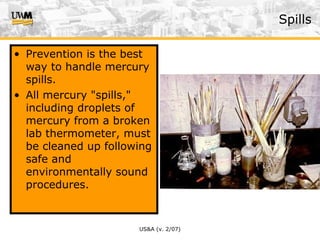
• Prevention is the best
way to handle mercury
spills.
• All mercury "spills,"
including droplets of
mercury from a broken
lab thermometer, must
be cleaned up following
safe and
environmentally sound
procedures.
US&A (v. 2/07)
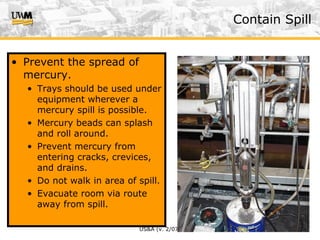
• Prevent the spread of
mercury.
• Trays should be used under
equipment wherever a
mercury spill is possible.
• Mercury beads can splash
and roll around.
• Prevent mercury from
entering cracks, crevices,
and drains.
• Do not walk in area of spill.
• Evacuate room via route
away from spill.
Contain Spill
US&A (v. 2/07)
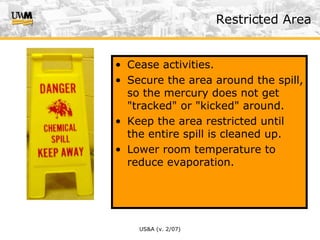
• Cease activities.
• Secure the area around the spill,
so the mercury does not get
"tracked" or "kicked" around.
• Keep the area restricted until
the entire spill is cleaned up.
• Lower room temperature to
reduce evaporation.
Restricted Area
US&A (v. 2/07)
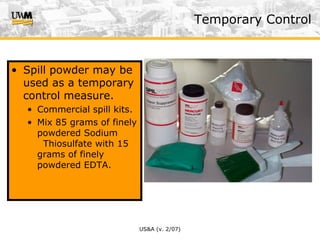
• Spill powder may be
used as a temporary
control measure.
• Commercial spill kits.
• Mix 85 grams of finely
powdered Sodium
Thiosulfate with 15
grams of finely
powdered EDTA.
Temporary Control
US&A (v. 2/07)
Temporary Control
• Cover from the perimeter of the spill
toward the center.
• Do not walk through the spill or spill
powder.
• Pick-up glass and other large debris,
then clean up mercury.
• All debris must be disposed of as hazardous
waste.
US&A (v. 2/07)
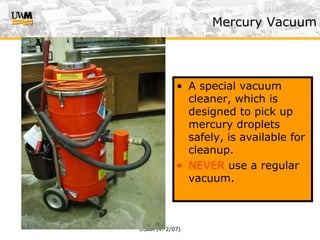
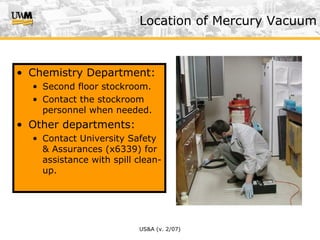
• A special vacuum
cleaner, which is
designed to pick up
mercury droplets
safely, is available for
cleanup.
• NEVER use a regular
vacuum.
Mercury Vacuum
US&A (v. 2/07)
• Chemistry Department:
• Second floor stockroom.
• Contact the stockroom
personnel when needed.
• Other departments:
• Contact University Safety
& Assurances (x6339) for
assistance with spill clean-
up.
Location of Mercury Vacuum
US&A (v. 2/07)
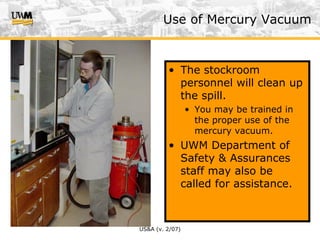
• The stockroom
personnel will clean up
the spill.
• You may be trained in
the proper use of the
mercury vacuum.
• UWM Department of
Safety & Assurances
staff may also be
called for assistance.
Use of Mercury Vacuum
US&A (v. 2/07)
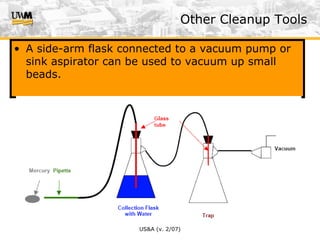
Other Cleanup Tools
• A side-arm flask connected to a vacuum pump or
sink aspirator can be used to vacuum up small
beads.
US&A (v. 2/07)
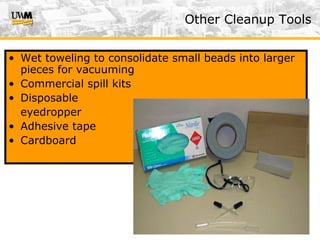
Other Cleanup Tools
• Wet toweling to consolidate small beads into larger
pieces for vacuuming
• Commercial spill kits
• Disposable
eyedropper
• Adhesive tape
• Cardboard
US&A (v. 2/07)
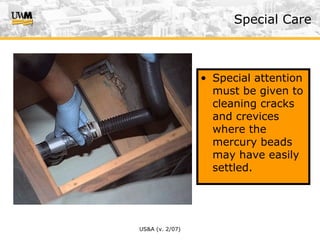
• Special attention
must be given to
cleaning cracks
and crevices
where the
mercury beads
may have easily
settled.
Special Care
US&A (v. 2/07)
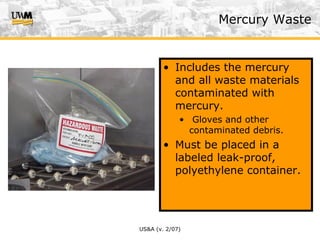
• Includes the mercury
and all waste materials
contaminated with
mercury.
• Gloves and other
contaminated debris.
• Must be placed in a
labeled leak-proof,
polyethylene container.
Mercury Waste
US&A (v. 2/07)
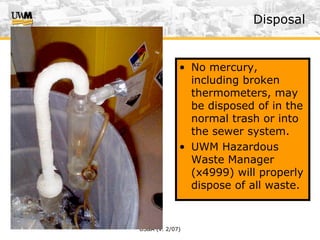
• No mercury,
including broken
thermometers, may
be disposed of in the
normal trash or into
the sewer system.
• UWM Hazardous
Waste Manager
(x4999) will properly
dispose of all waste.
Disposal
US&A (v. 2/07)
After Hours:After Hours:
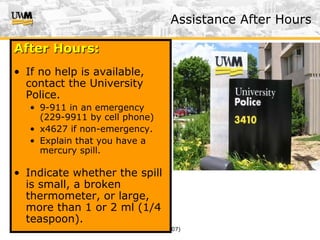
• If no help is available,
contact the University
Police.
• 9-911 in an emergency
(229-9911 by cell phone)
• x4627 if non-emergency.
• Explain that you have a
mercury spill.
• Indicate whether the spill
is small, a broken
thermometer, or large,
more than 1 or 2 ml (1/4
teaspoon).
Assistance After Hours
US&A (v. 2/07)
Assistance After Hours
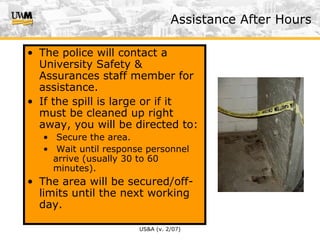
• The police will contact a
University Safety &
Assurances staff member for
assistance.
• If the spill is large or if it
must be cleaned up right
away, you will be directed to:
• Secure the area.
• Wait until response personnel
arrive (usually 30 to 60
minutes).
• The area will be secured/off-
limits until the next working
day.
US&A (v. 2/07)
Special Consideration
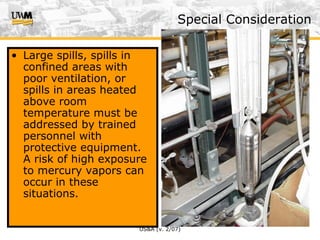
• Large spills, spills in
confined areas with
poor ventilation, or
spills in areas heated
above room
temperature must be
addressed by trained
personnel with
protective equipment.
A risk of high exposure
to mercury vapors can
occur in these
situations.
US&A (v. 2/07)
• Mercury spills are very disruptive.
• Lab personnel are encouraged to use
extreme caution when using mercury or
mercury-containing apparatus.
• Thorough decontamination is essential
to ensure both personal safety and
protection of the environment.
Summary
www.anbrcama.com

Mercury clean up

  • 1.
    Anbr Cama Presents Mercury SpillCleanupMercury Spill Cleanup ProceduresProcedures www.anbrcama.com
  • 2.
    Department of UniversitySafety & Assurances Mercury Spill CleanupMercury Spill Cleanup ProceduresProcedures
  • 3.
    US&A (v. 2/07) Mercuryis a Hazardous Material • Mercury (Hg) is a hazardous material as defined by: • U.S. Environmental Protection Agency • Wisconsin Department of Natural Resources • U.S. Dept. of Transportation
  • 4.
    US&A (v. 2/07) •Mercury poisoning can result in severe health problems affecting the nervous system and other organs. • Tremors • Changes in vision or hearing • Insomnia • Weakness • Difficulty with memory • Headaches • Irritability • Shyness and nervousness • Acrodynia (painful extremities), a condition caused by chronic exposure to mercury Mercury is a Toxic Substance
  • 5.
    US&A (v. 2/07) MercuryExposure & Prevention • Routes of exposure • Inhalation • Main hazard • Evaporates releasing hazardous vapors • Skin absorption • Personal Protective Equipment Required • Nitrile gloves • Safety glasses • Closed-toed shoes • Lab coat
  • 6.
    US&A (v. 2/07) •Questions regarding mercury or spill procedures should directed to: • Professor • Laboratory supervisor • Own supervisor • UWM Department of Safety & Assurances at x6339 • Note: Any release greater than one pound (two tablespoons) to the environment is a Reportable Quantity. Who do you Contact?
  • 7.
    US&A (v. 2/07) Spills •Prevention is the best way to handle mercury spills. • All mercury "spills," including droplets of mercury from a broken lab thermometer, must be cleaned up following safe and environmentally sound procedures.
  • 8.
    US&A (v. 2/07) •Prevent the spread of mercury. • Trays should be used under equipment wherever a mercury spill is possible. • Mercury beads can splash and roll around. • Prevent mercury from entering cracks, crevices, and drains. • Do not walk in area of spill. • Evacuate room via route away from spill. Contain Spill
  • 9.
    US&A (v. 2/07) •Cease activities. • Secure the area around the spill, so the mercury does not get "tracked" or "kicked" around. • Keep the area restricted until the entire spill is cleaned up. • Lower room temperature to reduce evaporation. Restricted Area
  • 10.
    US&A (v. 2/07) •Spill powder may be used as a temporary control measure. • Commercial spill kits. • Mix 85 grams of finely powdered Sodium Thiosulfate with 15 grams of finely powdered EDTA. Temporary Control
  • 11.
    US&A (v. 2/07) TemporaryControl • Cover from the perimeter of the spill toward the center. • Do not walk through the spill or spill powder. • Pick-up glass and other large debris, then clean up mercury. • All debris must be disposed of as hazardous waste.
  • 12.
    US&A (v. 2/07) •A special vacuum cleaner, which is designed to pick up mercury droplets safely, is available for cleanup. • NEVER use a regular vacuum. Mercury Vacuum
  • 13.
    US&A (v. 2/07) •Chemistry Department: • Second floor stockroom. • Contact the stockroom personnel when needed. • Other departments: • Contact University Safety & Assurances (x6339) for assistance with spill clean- up. Location of Mercury Vacuum
  • 14.
    US&A (v. 2/07) •The stockroom personnel will clean up the spill. • You may be trained in the proper use of the mercury vacuum. • UWM Department of Safety & Assurances staff may also be called for assistance. Use of Mercury Vacuum
  • 15.
    US&A (v. 2/07) OtherCleanup Tools • A side-arm flask connected to a vacuum pump or sink aspirator can be used to vacuum up small beads.
  • 16.
    US&A (v. 2/07) OtherCleanup Tools • Wet toweling to consolidate small beads into larger pieces for vacuuming • Commercial spill kits • Disposable eyedropper • Adhesive tape • Cardboard
  • 17.
    US&A (v. 2/07) •Special attention must be given to cleaning cracks and crevices where the mercury beads may have easily settled. Special Care
  • 18.
    US&A (v. 2/07) •Includes the mercury and all waste materials contaminated with mercury. • Gloves and other contaminated debris. • Must be placed in a labeled leak-proof, polyethylene container. Mercury Waste
  • 19.
    US&A (v. 2/07) •No mercury, including broken thermometers, may be disposed of in the normal trash or into the sewer system. • UWM Hazardous Waste Manager (x4999) will properly dispose of all waste. Disposal
  • 20.
    US&A (v. 2/07) AfterHours:After Hours: • If no help is available, contact the University Police. • 9-911 in an emergency (229-9911 by cell phone) • x4627 if non-emergency. • Explain that you have a mercury spill. • Indicate whether the spill is small, a broken thermometer, or large, more than 1 or 2 ml (1/4 teaspoon). Assistance After Hours
  • 21.
    US&A (v. 2/07) AssistanceAfter Hours • The police will contact a University Safety & Assurances staff member for assistance. • If the spill is large or if it must be cleaned up right away, you will be directed to: • Secure the area. • Wait until response personnel arrive (usually 30 to 60 minutes). • The area will be secured/off- limits until the next working day.
  • 22.
    US&A (v. 2/07) SpecialConsideration • Large spills, spills in confined areas with poor ventilation, or spills in areas heated above room temperature must be addressed by trained personnel with protective equipment. A risk of high exposure to mercury vapors can occur in these situations.
  • 23.
    US&A (v. 2/07) •Mercury spills are very disruptive. • Lab personnel are encouraged to use extreme caution when using mercury or mercury-containing apparatus. • Thorough decontamination is essential to ensure both personal safety and protection of the environment. Summary
  • 24.