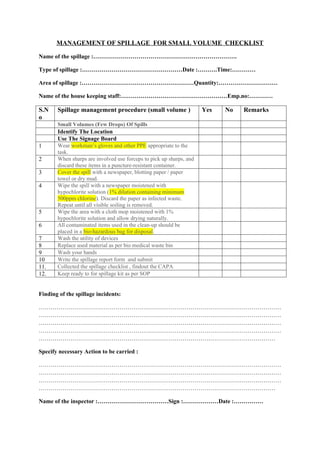
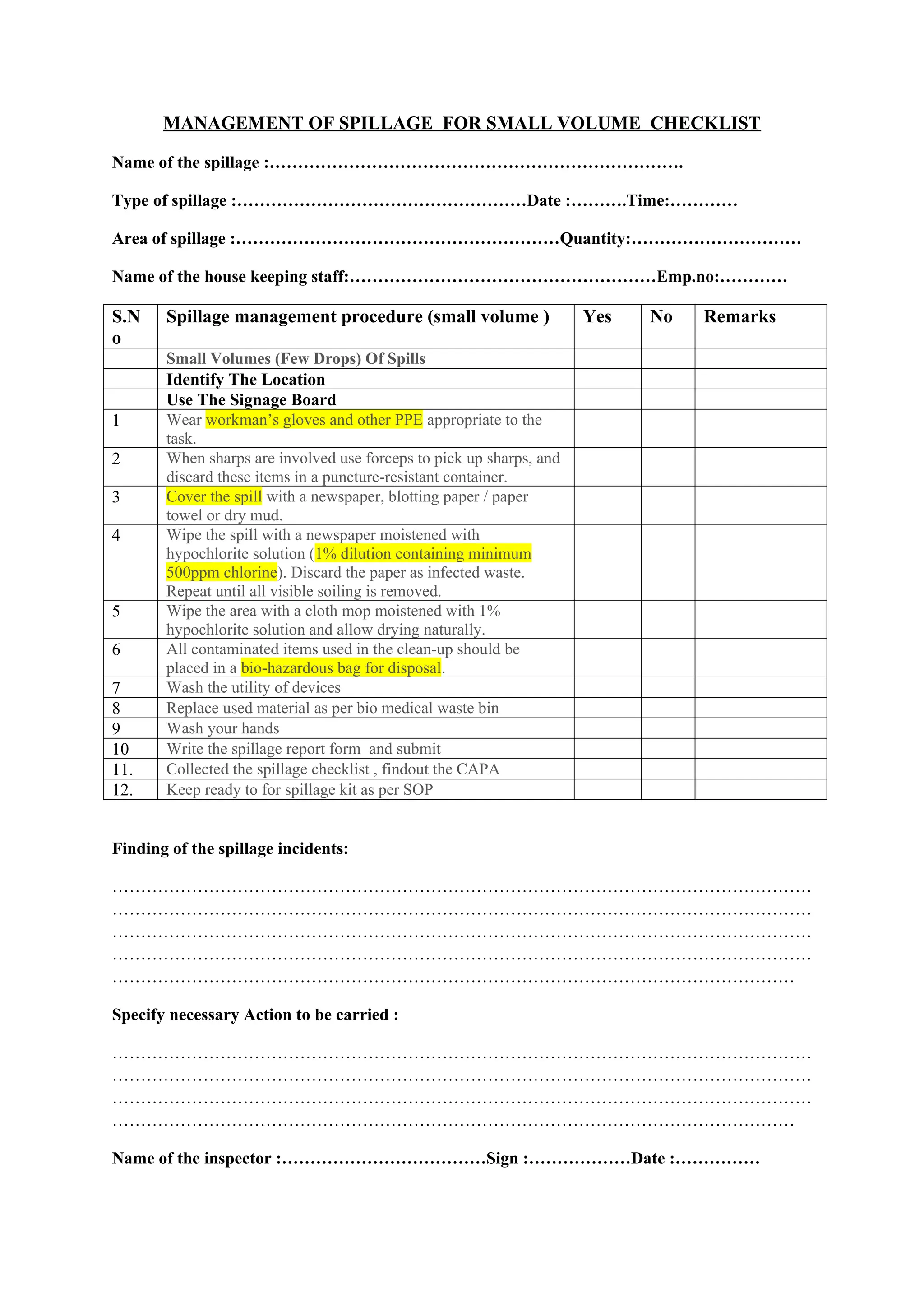
MANAGEMENT OF SPILLAGE FOR SMALL VOLUME CHECKLIST
Name of the spillage :……………………………………………………………….
Type of spillage :……………………………………………Date :……….Time:…………
Area of spillage :…………………………………………………Quantity:…………………………
Name of the house keeping staff:………………………………………………Emp.no:…………
S.N
o
Spillage management procedure (small volume ) Yes No Remarks
Small Volumes (Few Drops) Of Spills
Identify The Location
Use The Signage Board
1 Wear workman’s gloves and other PPE appropriate to the
task.
2 When sharps are involved use forceps to pick up sharps, and
discard these items in a puncture-resistant container.
3 Cover the spill with a newspaper, blotting paper / paper
towel or dry mud.
4 Wipe the spill with a newspaper moistened with
hypochlorite solution (1% dilution containing minimum
500ppm chlorine). Discard the paper as infected waste.
Repeat until all visible soiling is removed.
5 Wipe the area with a cloth mop moistened with 1%
hypochlorite solution and allow drying naturally.
6 All contaminated items used in the clean-up should be
placed in a bio-hazardous bag for disposal.
7 Wash the utility of devices
8 Replace used material as per bio medical waste bin
9 Wash your hands
10 Write the spillage report form and submit
11. Collected the spillage checklist , findout the CAPA
12. Keep ready to for spillage kit as per SOP
Finding of the spillage incidents:
……………………………………………………………………………………………………………
……………………………………………………………………………………………………………
……………………………………………………………………………………………………………
……………………………………………………………………………………………………………
…………………………………………………………………………………………………………
Specify necessary Action to be carried :
……………………………………………………………………………………………………………
……………………………………………………………………………………………………………
……………………………………………………………………………………………………………
…………………………………………………………………………………………………………
Name of the inspector :………………………………Sign :………………Date :……………
Supervisor sign :…………………………………………Date :……………………………….
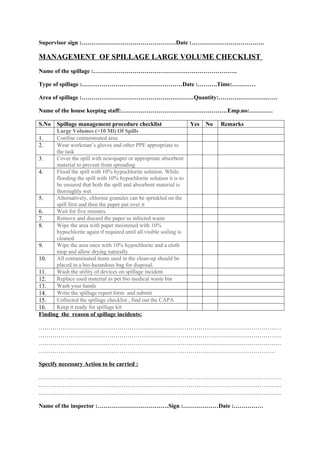
MANAGEMENT OF SPILLAGE LARGE VOLUME CHECKLIST
Name of the spillage :……………………………………………………………….
Type of spillage :……………………………………………Date :……….Time:…………
Area of spillage :…………………………………………………Quantity:…………………………
Name of the house keeping staff:………………………………………………Emp.no:…………
S.No Spillage management procedure checklist Yes No Remarks
Large Volumes (>10 Ml) Of Spills
1. Confine contaminated area
2. Wear workman’s gloves and other PPE appropriate to
the task
3. Cover the spill with newspaper or appropriate absorbent
material to prevent from spreading
4. Flood the spill with 10% hypochlorite solution. While
flooding the spill with 10% hypochlorite solution it is to
be ensured that both the spill and absorbent material is
thoroughly wet
5. Alternatively, chlorine granules can be sprinkled on the
spill first and then the paper put over it
6. Wait for five minutes.
7. Remove and discard the paper as infected waste
8. Wipe the area with paper moistened with 10%
hypochlorite again if required until all visible soiling is
cleaned
9. Wipe the area once with 10% hypochlorite and a cloth
mop and allow drying naturally
10. All contaminated items used in the clean-up should be
placed in a bio-hazardous bag for disposal.
11. Wash the utility of devices on spillage incident
12. Replace used material as per bio medical waste bin
13. Wash your hands
14. Write the spillage report form and submit
15. Collected the spillage checklist , find out the CAPA
16. Keep it ready for spillage kit
Finding the reason of spillage incidents:
……………………………………………………………………………………………………………
……………………………………………………………………………………………………………
……………………………………………………………………………………………………………
…………………………………………………………………………………………………………
Specify necessary Action to be carried :
……………………………………………………………………………………………………………
……………………………………………………………………………………………………………
……………………………………………………………………………………………………………
Name of the inspector :………………………………Sign :………………Date :……………
Supervisor sign :…………………………………………Date :……………………………….
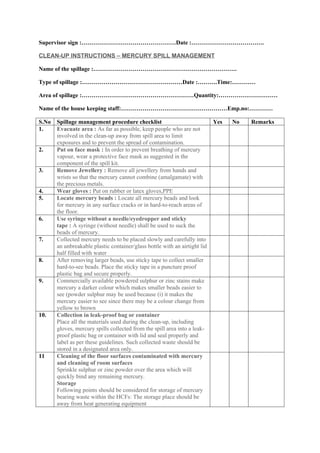
CLEAN-UP INSTRUCTIONS – MERCURY SPILL MANAGEMENT
Name of the spillage :……………………………………………………………….
Type of spillage :……………………………………………Date :……….Time:…………
Area of spillage :…………………………………………………Quantity:…………………………
Name of the house keeping staff:………………………………………………Emp.no:…………
S.No Spillage management procedure checklist Yes No Remarks
1. Evacuate area : As far as possible, keep people who are not
involved in the clean-up away from spill area to limit
exposures and to prevent the spread of contamination.
2. Put on face mask : In order to prevent breathing of mercury
vapour, wear a protective face mask as suggested in the
component of the spill kit.
3. Remove Jewellery : Remove all jewellery from hands and
wrists so that the mercury cannot combine (amalgamate) with
the precious metals.
4. Wear gloves : Put on rubber or latex gloves,PPE
5. Locate mercury beads : Locate all mercury beads and look
for mercury in any surface cracks or in hard-to-reach areas of
the floor.
6. Use syringe without a needle/eyedropper and sticky
tape : A syringe (without needle) shall be used to suck the
beads of mercury.
7. Collected mercury needs to be placed slowly and carefully into
an unbreakable plastic container/glass bottle with an airtight lid
half filled with water
8. After removing larger beads, use sticky tape to collect smaller
hard-to-see beads. Place the sticky tape in a puncture proof
plastic bag and secure properly.
9. Commercially available powdered sulphur or zinc stains make
mercury a darker colour which makes smaller beads easier to
see (powder sulphur may be used because (i) it makes the
mercury easier to see since there may be a colour change from
yellow to brown
10. Collection in leak-proof bag or container
Place all the materials used during the clean-up, including
gloves, mercury spills collected from the spill area into a leak-
proof plastic bag or container with lid and seal properly and
label as per these guidelines. Such collected waste should be
stored in a designated area only.
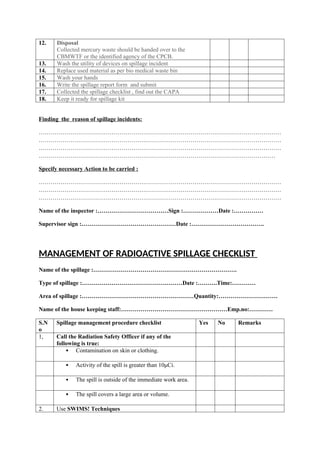
11 Cleaning of the floor surfaces contaminated with mercury
and cleaning of room surfaces
Sprinkle sulphur or zinc powder over the area which will
quickly bind any remaining mercury.
Storage
Following points should be considered for storage of mercury
bearing waste within the HCFs: The storage place should be
away from heat generating equipment
12. Disposal
Collected mercury waste should be handed over to the
CBMWTF or the identified agency of the CPCB.
13. Wash the utility of devices on spillage incident
14. Replace used material as per bio medical waste bin
15. Wash your hands
16. Write the spillage report form and submit
17. Collected the spillage checklist , find out the CAPA
18. Keep it ready for spillage kit
Finding the reason of spillage incidents:
……………………………………………………………………………………………………………
……………………………………………………………………………………………………………
……………………………………………………………………………………………………………
…………………………………………………………………………………………………………
Specify necessary Action to be carried :
……………………………………………………………………………………………………………
……………………………………………………………………………………………………………
……………………………………………………………………………………………………………
Name of the inspector :………………………………Sign :………………Date :……………
Supervisor sign :…………………………………………Date :……………………………….
MANAGEMENT OF RADIOACTIVE SPILLAGE CHECKLIST
Name of the spillage :……………………………………………………………….
Type of spillage :……………………………………………Date :……….Time:…………
Area of spillage :…………………………………………………Quantity:…………………………
Name of the house keeping staff:………………………………………………Emp.no:…………
S.N
o
Spillage management procedure checklist Yes No Remarks
1, Call the Radiation Safety Officer if any of the
following is true:
 Contamination on skin or clothing.
 Activity of the spill is greater than 10μCi.
 The spill is outside of the immediate work area.
 The spill covers a large area or volume.
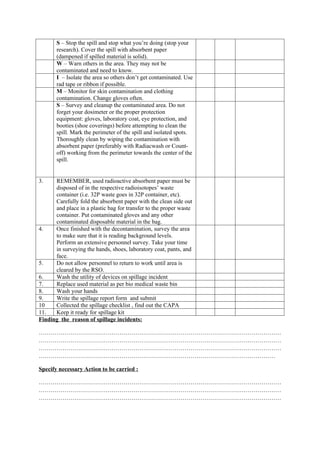
2. Use SWIMS! Techniques
S – Stop the spill and stop what you’re doing (stop your
research). Cover the spill with absorbent paper
(dampened if spilled material is solid).
W – Warn others in the area. They may not be
contaminated and need to know.
I – Isolate the area so others don’t get contaminated. Use
rad tape or ribbon if possible.
M – Monitor for skin contamination and clothing
contamination. Change gloves often.
S – Survey and cleanup the contaminated area. Do not
forget your dosimeter or the proper protection
equipment: gloves, laboratory coat, eye protection, and
booties (shoe coverings) before attempting to clean the
spill. Mark the perimeter of the spill and isolated spots.
Thoroughly clean by wiping the contamination with
absorbent paper (preferably with Radiacwash or Count-
off) working from the perimeter towards the center of the
spill.
3. REMEMBER, used radioactive absorbent paper must be
disposed of in the respective radioisotopes’ waste
container (i.e. 32P waste goes in 32P container, etc).
Carefully fold the absorbent paper with the clean side out
and place in a plastic bag for transfer to the proper waste
container. Put contaminated gloves and any other
contaminated disposable material in the bag.
4. Once finished with the decontamination, survey the area
to make sure that it is reading background levels.
Perform an extensive personnel survey. Take your time
in surveying the hands, shoes, laboratory coat, pants, and
face.
5. Do not allow personnel to return to work until area is
cleared by the RSO.
6. Wash the utility of devices on spillage incident
7. Replace used material as per bio medical waste bin
8. Wash your hands
9. Write the spillage report form and submit
10 Collected the spillage checklist , find out the CAPA
11. Keep it ready for spillage kit
Finding the reason of spillage incidents:
……………………………………………………………………………………………………………
……………………………………………………………………………………………………………
……………………………………………………………………………………………………………
…………………………………………………………………………………………………………
Specify necessary Action to be carried :
……………………………………………………………………………………………………………
……………………………………………………………………………………………………………
……………………………………………………………………………………………………………
Name of the inspector :………………………………Sign :………………Date :……………
Supervisor sign :…………………………………………Date :……………………………….

Spillage management checklist 8..10.24.docx

  • 1.
    MANAGEMENT OF SPILLAGEFOR SMALL VOLUME CHECKLIST Name of the spillage :………………………………………………………………. Type of spillage :……………………………………………Date :……….Time:………… Area of spillage :…………………………………………………Quantity:………………………… Name of the house keeping staff:………………………………………………Emp.no:………… S.N o Spillage management procedure (small volume ) Yes No Remarks Small Volumes (Few Drops) Of Spills Identify The Location Use The Signage Board 1 Wear workman’s gloves and other PPE appropriate to the task. 2 When sharps are involved use forceps to pick up sharps, and discard these items in a puncture-resistant container. 3 Cover the spill with a newspaper, blotting paper / paper towel or dry mud. 4 Wipe the spill with a newspaper moistened with hypochlorite solution (1% dilution containing minimum 500ppm chlorine). Discard the paper as infected waste. Repeat until all visible soiling is removed. 5 Wipe the area with a cloth mop moistened with 1% hypochlorite solution and allow drying naturally. 6 All contaminated items used in the clean-up should be placed in a bio-hazardous bag for disposal. 7 Wash the utility of devices 8 Replace used material as per bio medical waste bin 9 Wash your hands 10 Write the spillage report form and submit 11. Collected the spillage checklist , findout the CAPA 12. Keep ready to for spillage kit as per SOP Finding of the spillage incidents: …………………………………………………………………………………………………………… …………………………………………………………………………………………………………… …………………………………………………………………………………………………………… …………………………………………………………………………………………………………… ………………………………………………………………………………………………………… Specify necessary Action to be carried : …………………………………………………………………………………………………………… …………………………………………………………………………………………………………… …………………………………………………………………………………………………………… ………………………………………………………………………………………………………… Name of the inspector :………………………………Sign :………………Date :……………
  • 2.
    Supervisor sign :…………………………………………Date:………………………………. MANAGEMENT OF SPILLAGE LARGE VOLUME CHECKLIST Name of the spillage :………………………………………………………………. Type of spillage :……………………………………………Date :……….Time:………… Area of spillage :…………………………………………………Quantity:………………………… Name of the house keeping staff:………………………………………………Emp.no:………… S.No Spillage management procedure checklist Yes No Remarks Large Volumes (>10 Ml) Of Spills 1. Confine contaminated area 2. Wear workman’s gloves and other PPE appropriate to the task 3. Cover the spill with newspaper or appropriate absorbent material to prevent from spreading 4. Flood the spill with 10% hypochlorite solution. While flooding the spill with 10% hypochlorite solution it is to be ensured that both the spill and absorbent material is thoroughly wet 5. Alternatively, chlorine granules can be sprinkled on the spill first and then the paper put over it 6. Wait for five minutes. 7. Remove and discard the paper as infected waste 8. Wipe the area with paper moistened with 10% hypochlorite again if required until all visible soiling is cleaned 9. Wipe the area once with 10% hypochlorite and a cloth mop and allow drying naturally 10. All contaminated items used in the clean-up should be placed in a bio-hazardous bag for disposal. 11. Wash the utility of devices on spillage incident 12. Replace used material as per bio medical waste bin 13. Wash your hands 14. Write the spillage report form and submit 15. Collected the spillage checklist , find out the CAPA 16. Keep it ready for spillage kit Finding the reason of spillage incidents: …………………………………………………………………………………………………………… …………………………………………………………………………………………………………… …………………………………………………………………………………………………………… ………………………………………………………………………………………………………… Specify necessary Action to be carried : …………………………………………………………………………………………………………… …………………………………………………………………………………………………………… …………………………………………………………………………………………………………… Name of the inspector :………………………………Sign :………………Date :……………
  • 3.
    Supervisor sign :…………………………………………Date:………………………………. CLEAN-UP INSTRUCTIONS – MERCURY SPILL MANAGEMENT Name of the spillage :………………………………………………………………. Type of spillage :……………………………………………Date :……….Time:………… Area of spillage :…………………………………………………Quantity:………………………… Name of the house keeping staff:………………………………………………Emp.no:………… S.No Spillage management procedure checklist Yes No Remarks 1. Evacuate area : As far as possible, keep people who are not involved in the clean-up away from spill area to limit exposures and to prevent the spread of contamination. 2. Put on face mask : In order to prevent breathing of mercury vapour, wear a protective face mask as suggested in the component of the spill kit. 3. Remove Jewellery : Remove all jewellery from hands and wrists so that the mercury cannot combine (amalgamate) with the precious metals. 4. Wear gloves : Put on rubber or latex gloves,PPE 5. Locate mercury beads : Locate all mercury beads and look for mercury in any surface cracks or in hard-to-reach areas of the floor. 6. Use syringe without a needle/eyedropper and sticky tape : A syringe (without needle) shall be used to suck the beads of mercury. 7. Collected mercury needs to be placed slowly and carefully into an unbreakable plastic container/glass bottle with an airtight lid half filled with water 8. After removing larger beads, use sticky tape to collect smaller hard-to-see beads. Place the sticky tape in a puncture proof plastic bag and secure properly. 9. Commercially available powdered sulphur or zinc stains make mercury a darker colour which makes smaller beads easier to see (powder sulphur may be used because (i) it makes the mercury easier to see since there may be a colour change from yellow to brown 10. Collection in leak-proof bag or container Place all the materials used during the clean-up, including gloves, mercury spills collected from the spill area into a leak- proof plastic bag or container with lid and seal properly and label as per these guidelines. Such collected waste should be stored in a designated area only. 11 Cleaning of the floor surfaces contaminated with mercury and cleaning of room surfaces Sprinkle sulphur or zinc powder over the area which will quickly bind any remaining mercury. Storage Following points should be considered for storage of mercury bearing waste within the HCFs: The storage place should be away from heat generating equipment
  • 4.
    12. Disposal Collected mercurywaste should be handed over to the CBMWTF or the identified agency of the CPCB. 13. Wash the utility of devices on spillage incident 14. Replace used material as per bio medical waste bin 15. Wash your hands 16. Write the spillage report form and submit 17. Collected the spillage checklist , find out the CAPA 18. Keep it ready for spillage kit Finding the reason of spillage incidents: …………………………………………………………………………………………………………… …………………………………………………………………………………………………………… …………………………………………………………………………………………………………… ………………………………………………………………………………………………………… Specify necessary Action to be carried : …………………………………………………………………………………………………………… …………………………………………………………………………………………………………… …………………………………………………………………………………………………………… Name of the inspector :………………………………Sign :………………Date :…………… Supervisor sign :…………………………………………Date :………………………………. MANAGEMENT OF RADIOACTIVE SPILLAGE CHECKLIST Name of the spillage :………………………………………………………………. Type of spillage :……………………………………………Date :……….Time:………… Area of spillage :…………………………………………………Quantity:………………………… Name of the house keeping staff:………………………………………………Emp.no:………… S.N o Spillage management procedure checklist Yes No Remarks 1, Call the Radiation Safety Officer if any of the following is true:  Contamination on skin or clothing.  Activity of the spill is greater than 10μCi.  The spill is outside of the immediate work area.  The spill covers a large area or volume. 2. Use SWIMS! Techniques
  • 5.
    S – Stopthe spill and stop what you’re doing (stop your research). Cover the spill with absorbent paper (dampened if spilled material is solid). W – Warn others in the area. They may not be contaminated and need to know. I – Isolate the area so others don’t get contaminated. Use rad tape or ribbon if possible. M – Monitor for skin contamination and clothing contamination. Change gloves often. S – Survey and cleanup the contaminated area. Do not forget your dosimeter or the proper protection equipment: gloves, laboratory coat, eye protection, and booties (shoe coverings) before attempting to clean the spill. Mark the perimeter of the spill and isolated spots. Thoroughly clean by wiping the contamination with absorbent paper (preferably with Radiacwash or Count- off) working from the perimeter towards the center of the spill. 3. REMEMBER, used radioactive absorbent paper must be disposed of in the respective radioisotopes’ waste container (i.e. 32P waste goes in 32P container, etc). Carefully fold the absorbent paper with the clean side out and place in a plastic bag for transfer to the proper waste container. Put contaminated gloves and any other contaminated disposable material in the bag. 4. Once finished with the decontamination, survey the area to make sure that it is reading background levels. Perform an extensive personnel survey. Take your time in surveying the hands, shoes, laboratory coat, pants, and face. 5. Do not allow personnel to return to work until area is cleared by the RSO. 6. Wash the utility of devices on spillage incident 7. Replace used material as per bio medical waste bin 8. Wash your hands 9. Write the spillage report form and submit 10 Collected the spillage checklist , find out the CAPA 11. Keep it ready for spillage kit Finding the reason of spillage incidents: …………………………………………………………………………………………………………… …………………………………………………………………………………………………………… …………………………………………………………………………………………………………… ………………………………………………………………………………………………………… Specify necessary Action to be carried : …………………………………………………………………………………………………………… …………………………………………………………………………………………………………… ……………………………………………………………………………………………………………
  • 6.
    Name of theinspector :………………………………Sign :………………Date :…………… Supervisor sign :…………………………………………Date :……………………………….