Welcome       to the   BEST Consulting
                       Successful Consulting, Level II
                                Workshop Series
 Team
  Oriented
    Coaching
      and
       Mentoring                    Presentation by
                                       Rick Sell
Facilities
Location of:
 – Restrooms
 – Telephones and Messages
 – FAX Machines
 – Smoking Areas
 – Water and Sodas
 – Snacks
Workshop Groundrules
This is a workshop and is designed to
be informal, however:
– Respect others and their opinions; give them
  the space to successfully learn and grow.
– Turn those phones off and put your beepers
  on vibrate - PLEASE?
– Resist those that are trying to summon you
  until the break.
Workshop Overview
                                     Caveat
   We will not severely differentiate between coaching and mentoring due to the
    reasonable assumption that there are no overriding major fundamental
    differences between the two.
   For the purposes of this workshop the following semantic rules will apply:
    Synonymous words:
      –   Performer, worker, co-worker, employee, team member, individual
      –   Project team leader, team leader, supervisor, manager, management
Introductions
Who am I?
 – Rick Sell


 – Now it’s your turn!
Introductions
…and you are?
– How long with BEST Consulting, how
     long in consulting in general?
–   Current assignment and skill sets
–   Hobbies/outside activities or interests
–   Last movie seen;would you recommend?
–   Important: What are your expectations of
    this course?
Workshop Agenda
Work, Learn, Have Fun!
 –   Session: 4 hours
 –   Introductions
 –   Course Overview
 –   Discuss Topics
 –   Breaks - What Breaks!!!
Workshop Overview
What this workshop is:
 – A practical and pragmatic approach to
  coaching and mentoring team members in a
  performance environment .

What this workshop is not:
 – This workshop will not make you an expert
  coach/mentor, although it will lay a foundation
  for continued improvement.
Workshop Objectives
                   Workshop
                            Overview
Upon completion, you will be able to:
    Define a workplace performance environment.
    Explain the need for coaching and/or mentoring in a variety of organizational
     settings.
    List a variety of situations where coaching and/or mentoring can be effective.
    Apply strategies to improve interpersonal communication in the workplace.
    Implement techniques to improve your success when giving and receiving
     performance feedback.
Workshop Overview
            Workshop Objectives          (con’t)
Upon completion, you will be able to:
   Define the steps of an effective Coaching and Mentoring
    Model that can be used in hierarchical and team-driven
    environments.
   Execute strategies for dealing both with substandard
    performers.
   Develop or improve a system for accurately documenting all
    team member coaching and mentoring activities.
Instructional Materials
Student Manual is provided as a valuable desk-top
reference.
Case Studies and Student Exercises are an integral
part of this course, and essential events in your
learning process - Please Participate?
Student Activity: Self-Assessment

     Goal:
    To provide you with an idea of how well you
     perform in each area.
    An opportunity to define your style
    Provide a baseline for improvement.
Why Coach/Mentor?
                Learning Objectives
After completing this subject, you will be able to:
  – Define the performance environment
  – Define performance coaching and mentoring
  – Describe the characteristics of an effective
    coach/mentor.
  – Explain the importance of coaching/mentoring in
    improving workplace effectiveness.
  – Identify and eliminate excuses for not coaching or
    mentoring.
Examining The
       Performance Environment
   Formal evaluated, defined, and documented
    organizational program containing:
     – Project Management Plan
           Project performance goals (expected outcomes)
           Performance baseline criteria
     – Continued Performance Improvement Plan
     – Individual (Team Member) Performance Plan:
           Performance behavior expectations
           Education and Training plan
Why Coach/Mentor?
      Shifts in Behavioral Expectations
                      Axiom
Change is inevitable; people are adverse to change
 Rolesand behavior are changing to match new
  demands in the workplace.
 Organizationsare moving from Hierarchical to
  Team Structure.
Why Coach/Mentor?
         What is Coaching and Mentoring?
 It’swhat we do all the time - we just don’t put
  a name to it!
 Influencing,   helping, instructing, motivating,
  leading.
Why Coach/Mentor?
   What does Coaching and Mentoring Involve?
 Any  activity in which a coach/mentor and an
  individual work toward individual performance
  improvement.
 Influencing,   helping, instructing, motivating,
  leading.
 What  are some other skills practiced by
  successful coaches and mentors?
Why Coach/Mentor?
Characteristics of an Effective Coach/Mentor
  –   Excellent communication skills
  –   Motivated
  –   Enthusiastic
  –   Goal oriented
  –   Creative
  –   Patient
 What are some other characteristics of
 successful coaches and mentors?
Why Coach/Mentor?
        Benefits of Coaching/Mentoring?
 Success,   Success, Success
 Win-win    situation
 Improved   perception of the consultants who take
  on active roles of coach and/or mentor.
 Increased   business opportunities through success.
Why Coach/Mentor?
             Excuses for Failing to Coach/Mentor
   Excuses are used by “others”, not consultants.
   Excuses are nothing more than internal roadblocks.
   Excuses are a roadmap for failure.
Opportunities for
         Coaching/Mentoring
                 Learning Objectives
Upon completion of this subject, you will be able to:
  – Realize the cost of failing to coach/mentor.
  – Recognize opportunities for coaching and/or
    mentoring team members.
  – Develop a strategy for orienting new team members.
  – Explain the importance of developing team members
    performance.
Opportunities for
 When:
           Coaching/Mentoring
  – Anytime a new team member comes on board.
  – You (team leader) are off-site
  – The individual appears to be too dependent on you
    and other team members.
  – When changes take place in the workplace.

  – New processes, policies, procedures implemented.

  – A team member is failing, or is displaying the
    behavior to potentially to fail.
Opportunities for
 Goal:    Coaching/Mentoring
  – Build teams.
  – Coach/mentor yourself “out of a job”.
  – Empower team members; allowing them to be
    independent.
  – Minimize impact of changes in the workplace.
  – Smooth implementation of new processes, policies and
    procedures.
  – Eliminate the need for formal counseling and
    retraining.
Opportunities for
          Coaching/Mentoring
  Develop and Document an Orientation Process

 The program has to be used to be effective.
 Show genuine personal interest in new people.
 Publish the Orientation Procedures.
 Develop and Use an Orientation Checklist.
 Evaluate, Train, and Assign “buddies”, then
  continually re-evaluate.
Opportunities for
             Coaching/Mentoring
           The Cost of Failing to Coach/Mentor

   Failure, Failure, Failure
   Lost team members
   Lost revenues
   Lost time
   Lost confidence in your credibility by management and
    other team members
Coaching/Mentoring Process
          Learning Objectives
Upon completion, you will be able to:
   Develop a systematic approach to coaching and mentoring,
    using the formal eight-phase model.
   Set effective goals and objectives with your team members.
   Identify resources for individual development.
   Construct an Action Plan for individual development.
Coaching/Mentoring Process
             The Model: Eight-Phased Approach
   Phase 1 - Establish Goals
   Phase 2 - Collect Performance Data
   Phase 3 - Analyze Performance
   Phase 4 - Review and Modify Performance Goals
                 as Needed
   Phase 5 - Identify Developmental Resources
   Phase 6 - Develop an Action Plan
   Phase 7 - Implement Strategies
   Phase 8 - Evaluate Performance
Coaching and Mentoring for
        Better Relationships
          Learning Objectives
After completing this subject, you will be able to:
    Apply the Communication Process.
    Explain how coaching and mentoring can aid in building
     better relationships.
    Use your knowledge of communication to improve
     interpersonal relationships in the workplace.
    Learn to avoid the “Nine Deadly Sins” that affect
     relationships.
    Build stronger relationships with your team members, peers,
     and boss.
Coaching and Mentoring for
      Better Relationships
    The Communication Process
 Communication   is the transmission of
 information and meaning from one
 individual or group to another.
 Contains   the Communication Model.
 Buildingsolid two-way communications in
 your team cannot be overemphasized.
Communication Model


Sender
has idea
Sender     Sender
has idea   encodes
           message

 How may the sender encode a message?
 Verbally or nonverbally
 By speaking, writing, gesturing
Sender     Sender  Channel
has idea   encodes carries
           message message


  What kinds of channels carry messages?
  Letter, memo, telephone, TV, report,
  computer picture, voice, body--Others?
Noise

Sender      Sender  Channel        Receiver
has idea    encodes carries        decodes
            message message        message

                              Noise

  How does a receiver decode a message?
  Hearing, reading, observing
Noise

Sender      Sender  Channel             Receiver
has idea    encodes carries             decodes
            message message             message

                                Noise

  What is noise?
  Anything that disrupts the process
?
                Noise

Sender     Sender  Channel   Receiver   Receiver
has idea   encodes carries   decodes    understands
           message message   message    message

                         Noise
Feedback
                           travels to
                           sender


                   Noise

 Sender      Sender  Channel            Receiver   Receiver
 has idea    encodes carries            decodes    understands
             message message            message    message

                                 Noise

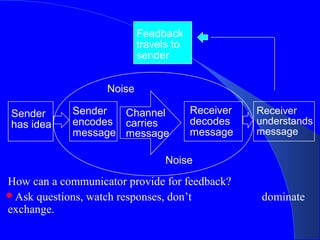
How can a communicator provide for feedback?
Ask questions, watch responses, don’t              dominate
exchange.
Feedback
                            travels to
                            sender


                    Noise

Sender      Sender  Channel              Receiver   Receiver
has idea    encodes carries              decodes    understands
            message message              message    message

                                  Noise


  What kind of feedback is better?
  Descriptive rather than evaluative.
Feedback
                        travels to
                        sender


                Noise

Sender     Sender  Channel           Receiver   Receiver
has idea   encodes carries           decodes    understands
           message message           message    message

                              Noise

                Possible additional
                     feedback
                 travels     to
                 receiver
Feedback
                        travels to
                        sender


                Noise

Sender     Sender  Channel           Receiver   Receiver
has idea   encodes carries           decodes    understands
           message message           message    message

                              Noise

                Possible additional
                     feedback
                 travels     to
                 receiver
Feedback
                   travels to
                   sender


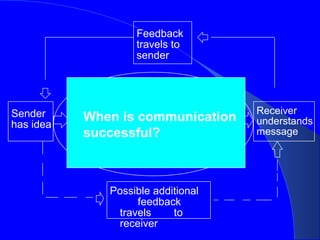
Sender                              Receiver
           When is communication    understands
has idea
           successful?              message


              Possible additional
                   feedback
               travels     to
               receiver
Feedback
                    travels to
                    sender


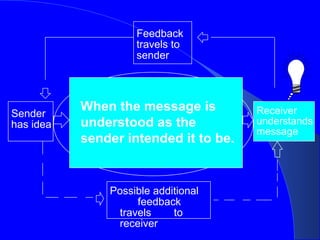
Sender
           When the message is         Receiver
has idea   understood as the           understands
                                       message
           sender intended it to be.


               Possible additional
                    feedback
                travels     to
                receiver
Try your skill ...
Select the definition or explanation of the
following parts of the communica-tion process.
1. Encoding is the process of:           a.
Creating a meaningful dialogue.
   b. Selecting and organizing symbols to
   represent a message.                       c.
   Understanding the meaning of a
message.
Try your skill ...
Select the definition or explanation of the
following parts of the communica-tion process.
1. Encoding is the process of:              a.
   Creating a meaningful dialogue.
   b. Selecting and organizing symbols to
   represent a message.                     c.
   Understanding the meaning of a
message.
Try your skill ...

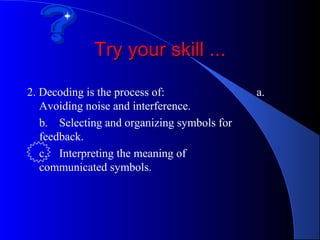
2. Decoding is the process of:               a.
   Avoiding noise and interference.
   b. Selecting and organizing symbols for
   feedback.
   c. Interpreting the meaning of
   communicated symbols.
Try your skill ...

2. Decoding is the process of:               a.
   Avoiding noise and interference.
   b. Selecting and organizing symbols for
   feedback.
   c. Interpreting the meaning of
   communicated symbols.
Coaching and Mentoring for
        Better Relationships
          Learning Objectives
After completing this subject, you will be able to:
    Apply the Communication Process.
    Explain how coaching and mentoring can aid in building
     better relationships.
    Use your knowledge of communication to improve
     interpersonal relationships in the workplace.
    Learn to avoid the “Nine Deadly Sins” that affect
     relationships.
    Build stronger relationships with your team members, peers,
     and boss.
Coaching and Mentoring for
         Better Relationships
    Nine Deadly Sins that Affect Relationships
   Failing to Communiciate Effectively.
   Playing Games.
   Playing Favorites.
   Getting Involved with Individuals Personal Problems.
   Becoming Personally Involved with Team Members.
   Ignoring Performance Gaps.
   Treating Team Members Unfairly.
   Failing to build a Sound Foundation.
   Displaying a Lackadaisical Attitude.
Coaching and Mentoring for
       Better Relationships
            Peer Relationships
   Do:
     – Be very sensitive to the individual and their needs.
     – Allow an individual to correct their own mistakes, but monitor
          closely.
   Do Not:
     – Stand idly by while an individual is making a mistake.
     – Jump in and try to help too quickly, but don’t allow the
       problem get out of hand.
     – Set yourself up as a “know it all”.

   Reminder: An individual does not necessarily have to be on
    your immediate team for you to help.
Effective Feedback Strategies
             Learning Objectives

Upon completing this subject, you will be able to:
 Recognize various types of feedback.
 Identify strategies for giving and receiving feedback.
 Give praise effectively.
 Give criticism constructively.
 Develop an environment that encourages the use of
   feedback.
Effective Feedback Strategies
           Importance of Feedback?
   Positive communication; review the
    communication model.
   An effective tool for building relationships.
   Potentially destructive if not used carefully.
   Team members must be coached and
    mentored in feedback strategies.
   Know what message you are trying to send.
   All important: Timing, Timing, Timing!
EffectiveHow to Give Feedback
              Feedback Strategies
   Written correspondence. Write it and then live with it
    for a period.
   Verbal communication. Practice before you deliver!
   Nonverbal communication. Watch that body language!
   Actions/Inactions. Timing, Timing, Timing!
   Trappings. Think about how do you present yourself?
Effective Feedback Strategies
                   Approaches to Feedback
   Focus on the individual’s behavior, not the person’s
    personality.
   Avoid globalizing behavior. (always,never)
   Use “I” instead of “you” language.
Effective Feedback Strategies
      Using Feedback Effectively - Ask yourself:
    Is this the right time?
    Is this the right place?
    Is this the appropriate person?
    What is the best way to communicate my message?
    Is the feedback well thought out and valid?
    What problems might feedback create?
    Will my feedback damage the relationship? If yes, how?
Effective Feedback (Praise)
            Positive Feedback
                              Strategies
   Giving:
     – Team members require positive motivation.
     – Be specific about what you liked.
     – Feedback should be given right after the
       performance. (Timing,Timing,Timing)
   Receiving:
     – Be courteous, say “thank you”.
     – Ask for clarification if you need it.
Effective Feedback Strategies
              Giving Negative Feedback (Criticism)
   Tell the person exactly what you observed.
   Explain exactly how you feel about the behavior and the impact.
   Solicit feedback.
   Show support and solicit possible solutions from the individual.
   Get a commitment to improve behavior.
   Reaffirm the individual’s worth.
Effective Feedback Strategies
                   Approaches to Feedback
   Focus on the individual’s behavior, not the person’s
    personality.
   Avoid globalizing behavior. (always,never)
   Use “I” instead of “you” language.
Effective Feedback Strategies
            Receiving Negative Feedback
   Listen, do not interrupt.
   Ask for clarification or more information.
   Try to be objective. (Yes, it is hard!!!)
   Decide if the comments are valid.
   Now its your turn: Be polite and provide
    appropriate feedback. Say “thank you”.
Effective Feedback Strategies
               Encouraging Feedback
   Build a system which encourages feedback.
   Feedback empowers team members. Gives them
    buy-in to the process.
   Allow team members to fail.
   Remember: Feedback (communication) is a two-
    way street!
Managing Team
             Members Performance
                Learning Objectives

After completing this subject, you will be able to:
    Determine what motivates performers.
    Recognize signs of negative behavior.
    Define strategies for dealing with substandard performers.
    Identify techniques to assist and reward above-average
     performers.
Managing Team
          Members Performance
              What motivates performers?
   Coach/Mentor = Motivator
   You are the motivator, its your responsibility to find
    out.
   Simplest method? Ask!
   Remember the individual, they all have separate
    needs, wants, and desires.
Managing Team
       Members Performance
             Performance Level
 Know what the performance gap is.
 Address performance gaps after determining

  what factors affect team members.
 Allocate your resources to address each

  group of performers separately: poor,
  average, superstar.
Managing Team
        Members Performance
          Indicators of Performance
   Does the individual meet established standards and
    goals?
   Are there complaints from other workers about this
    individual?
   What are the current quality and quantity levels?
   How much initiative and enthusiasm does the
    individual exhibit?
Managing Team
         Members Performance
         Behavioral Performance Indicators
   “They Won’t”
     – They are not motivated.
   “They Can’t”
     – They lack the ability.
     – Outside factors impede them.
     – Inadequate team leader guidance.

   “They Don’t Know How”
     – Lack of technical or job knowledge.
Managing Team
         Members Performance
                          80/20 rule
   Having 80% of your time taken up by the 20% of poor
    performers.
   You must be very careful not to neglect other performers
    while trying to “fix” a broken one.
Managing Team
         Members Performance
           Managing Substandard Performers
   Identify substandard performers early.
   Develop an Action Plan for improved performance.
   Superstars are potentially poor performers because they can
    be extremely disruptive to the team.
   You must be proactive in your approach to managing all
    performers, but especially substandard individuals.
Summary
Where your expectations met, if not, why not?
Do you have any further questions? Now is the
time.
Your suggestions, comments, and constructive
feedback are honestly solicited.

Coaching mentoring

  • 1.
    Welcome to the BEST Consulting Successful Consulting, Level II Workshop Series Team Oriented Coaching and Mentoring Presentation by Rick Sell
  • 2.
    Facilities Location of: –Restrooms – Telephones and Messages – FAX Machines – Smoking Areas – Water and Sodas – Snacks
  • 3.
    Workshop Groundrules This isa workshop and is designed to be informal, however: – Respect others and their opinions; give them the space to successfully learn and grow. – Turn those phones off and put your beepers on vibrate - PLEASE? – Resist those that are trying to summon you until the break.
  • 4.
    Workshop Overview Caveat  We will not severely differentiate between coaching and mentoring due to the reasonable assumption that there are no overriding major fundamental differences between the two.  For the purposes of this workshop the following semantic rules will apply: Synonymous words: – Performer, worker, co-worker, employee, team member, individual – Project team leader, team leader, supervisor, manager, management
  • 5.
    Introductions Who am I? – Rick Sell – Now it’s your turn!
  • 6.
    Introductions …and you are? –How long with BEST Consulting, how long in consulting in general? – Current assignment and skill sets – Hobbies/outside activities or interests – Last movie seen;would you recommend? – Important: What are your expectations of this course?
  • 7.
    Workshop Agenda Work, Learn,Have Fun! – Session: 4 hours – Introductions – Course Overview – Discuss Topics – Breaks - What Breaks!!!
  • 8.
    Workshop Overview What thisworkshop is: – A practical and pragmatic approach to coaching and mentoring team members in a performance environment . What this workshop is not: – This workshop will not make you an expert coach/mentor, although it will lay a foundation for continued improvement.
  • 9.
    Workshop Objectives Workshop Overview Upon completion, you will be able to:  Define a workplace performance environment.  Explain the need for coaching and/or mentoring in a variety of organizational settings.  List a variety of situations where coaching and/or mentoring can be effective.  Apply strategies to improve interpersonal communication in the workplace.  Implement techniques to improve your success when giving and receiving performance feedback.
  • 10.
    Workshop Overview Workshop Objectives (con’t) Upon completion, you will be able to:  Define the steps of an effective Coaching and Mentoring Model that can be used in hierarchical and team-driven environments.  Execute strategies for dealing both with substandard performers.  Develop or improve a system for accurately documenting all team member coaching and mentoring activities.
  • 11.
    Instructional Materials Student Manualis provided as a valuable desk-top reference. Case Studies and Student Exercises are an integral part of this course, and essential events in your learning process - Please Participate?
  • 12.
    Student Activity: Self-Assessment Goal:  To provide you with an idea of how well you perform in each area.  An opportunity to define your style  Provide a baseline for improvement.
  • 13.
    Why Coach/Mentor? Learning Objectives After completing this subject, you will be able to: – Define the performance environment – Define performance coaching and mentoring – Describe the characteristics of an effective coach/mentor. – Explain the importance of coaching/mentoring in improving workplace effectiveness. – Identify and eliminate excuses for not coaching or mentoring.
  • 14.
    Examining The Performance Environment  Formal evaluated, defined, and documented organizational program containing: – Project Management Plan  Project performance goals (expected outcomes)  Performance baseline criteria – Continued Performance Improvement Plan – Individual (Team Member) Performance Plan:  Performance behavior expectations  Education and Training plan
  • 15.
    Why Coach/Mentor? Shifts in Behavioral Expectations Axiom Change is inevitable; people are adverse to change  Rolesand behavior are changing to match new demands in the workplace.  Organizationsare moving from Hierarchical to Team Structure.
  • 16.
    Why Coach/Mentor? What is Coaching and Mentoring?  It’swhat we do all the time - we just don’t put a name to it!  Influencing, helping, instructing, motivating, leading.
  • 17.
    Why Coach/Mentor? What does Coaching and Mentoring Involve?  Any activity in which a coach/mentor and an individual work toward individual performance improvement.  Influencing, helping, instructing, motivating, leading.  What are some other skills practiced by successful coaches and mentors?
  • 18.
    Why Coach/Mentor? Characteristics ofan Effective Coach/Mentor – Excellent communication skills – Motivated – Enthusiastic – Goal oriented – Creative – Patient  What are some other characteristics of successful coaches and mentors?
  • 19.
    Why Coach/Mentor? Benefits of Coaching/Mentoring?  Success, Success, Success  Win-win situation  Improved perception of the consultants who take on active roles of coach and/or mentor.  Increased business opportunities through success.
  • 20.
    Why Coach/Mentor? Excuses for Failing to Coach/Mentor  Excuses are used by “others”, not consultants.  Excuses are nothing more than internal roadblocks.  Excuses are a roadmap for failure.
  • 21.
    Opportunities for Coaching/Mentoring Learning Objectives Upon completion of this subject, you will be able to: – Realize the cost of failing to coach/mentor. – Recognize opportunities for coaching and/or mentoring team members. – Develop a strategy for orienting new team members. – Explain the importance of developing team members performance.
  • 22.
    Opportunities for  When: Coaching/Mentoring – Anytime a new team member comes on board. – You (team leader) are off-site – The individual appears to be too dependent on you and other team members. – When changes take place in the workplace. – New processes, policies, procedures implemented. – A team member is failing, or is displaying the behavior to potentially to fail.
  • 23.
    Opportunities for  Goal: Coaching/Mentoring – Build teams. – Coach/mentor yourself “out of a job”. – Empower team members; allowing them to be independent. – Minimize impact of changes in the workplace. – Smooth implementation of new processes, policies and procedures. – Eliminate the need for formal counseling and retraining.
  • 24.
    Opportunities for Coaching/Mentoring Develop and Document an Orientation Process  The program has to be used to be effective.  Show genuine personal interest in new people.  Publish the Orientation Procedures.  Develop and Use an Orientation Checklist.  Evaluate, Train, and Assign “buddies”, then continually re-evaluate.
  • 25.
    Opportunities for Coaching/Mentoring The Cost of Failing to Coach/Mentor  Failure, Failure, Failure  Lost team members  Lost revenues  Lost time  Lost confidence in your credibility by management and other team members
  • 26.
    Coaching/Mentoring Process Learning Objectives Upon completion, you will be able to:  Develop a systematic approach to coaching and mentoring, using the formal eight-phase model.  Set effective goals and objectives with your team members.  Identify resources for individual development.  Construct an Action Plan for individual development.
  • 27.
    Coaching/Mentoring Process The Model: Eight-Phased Approach  Phase 1 - Establish Goals  Phase 2 - Collect Performance Data  Phase 3 - Analyze Performance  Phase 4 - Review and Modify Performance Goals as Needed  Phase 5 - Identify Developmental Resources  Phase 6 - Develop an Action Plan  Phase 7 - Implement Strategies  Phase 8 - Evaluate Performance
  • 28.
    Coaching and Mentoringfor Better Relationships Learning Objectives After completing this subject, you will be able to:  Apply the Communication Process.  Explain how coaching and mentoring can aid in building better relationships.  Use your knowledge of communication to improve interpersonal relationships in the workplace.  Learn to avoid the “Nine Deadly Sins” that affect relationships.  Build stronger relationships with your team members, peers, and boss.
  • 29.
    Coaching and Mentoringfor Better Relationships The Communication Process  Communication is the transmission of information and meaning from one individual or group to another.  Contains the Communication Model.  Buildingsolid two-way communications in your team cannot be overemphasized.
  • 30.
  • 31.
    Sender Sender has idea encodes message How may the sender encode a message? Verbally or nonverbally By speaking, writing, gesturing
  • 32.
    Sender Sender Channel has idea encodes carries message message What kinds of channels carry messages? Letter, memo, telephone, TV, report, computer picture, voice, body--Others?
  • 33.
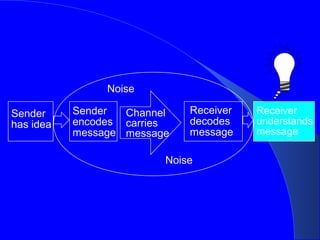
    Noise Sender Sender Channel Receiver has idea encodes carries decodes message message message Noise How does a receiver decode a message? Hearing, reading, observing
  • 34.
    Noise Sender Sender Channel Receiver has idea encodes carries decodes message message message Noise What is noise? Anything that disrupts the process
  • 35.
    ? Noise Sender Sender Channel Receiver Receiver has idea encodes carries decodes understands message message message message Noise
  • 36.
    Feedback travels to sender Noise Sender Sender Channel Receiver Receiver has idea encodes carries decodes understands message message message message Noise How can a communicator provide for feedback? Ask questions, watch responses, don’t dominate exchange.
  • 37.
    Feedback travels to sender Noise Sender Sender Channel Receiver Receiver has idea encodes carries decodes understands message message message message Noise What kind of feedback is better? Descriptive rather than evaluative.
  • 38.
    Feedback travels to sender Noise Sender Sender Channel Receiver Receiver has idea encodes carries decodes understands message message message message Noise Possible additional feedback travels to receiver
  • 39.
    Feedback travels to sender Noise Sender Sender Channel Receiver Receiver has idea encodes carries decodes understands message message message message Noise Possible additional feedback travels to receiver
  • 40.
    Feedback travels to sender Sender Receiver When is communication understands has idea successful? message Possible additional feedback travels to receiver
  • 41.
    Feedback travels to sender Sender When the message is Receiver has idea understood as the understands message sender intended it to be. Possible additional feedback travels to receiver
  • 42.
    Try your skill... Select the definition or explanation of the following parts of the communica-tion process. 1. Encoding is the process of: a. Creating a meaningful dialogue. b. Selecting and organizing symbols to represent a message. c. Understanding the meaning of a message.
  • 43.
    Try your skill... Select the definition or explanation of the following parts of the communica-tion process. 1. Encoding is the process of: a. Creating a meaningful dialogue. b. Selecting and organizing symbols to represent a message. c. Understanding the meaning of a message.
  • 44.
    Try your skill... 2. Decoding is the process of: a. Avoiding noise and interference. b. Selecting and organizing symbols for feedback. c. Interpreting the meaning of communicated symbols.
  • 45.
    Try your skill... 2. Decoding is the process of: a. Avoiding noise and interference. b. Selecting and organizing symbols for feedback. c. Interpreting the meaning of communicated symbols.
  • 46.
    Coaching and Mentoringfor Better Relationships Learning Objectives After completing this subject, you will be able to:  Apply the Communication Process.  Explain how coaching and mentoring can aid in building better relationships.  Use your knowledge of communication to improve interpersonal relationships in the workplace.  Learn to avoid the “Nine Deadly Sins” that affect relationships.  Build stronger relationships with your team members, peers, and boss.
  • 47.
    Coaching and Mentoringfor Better Relationships Nine Deadly Sins that Affect Relationships  Failing to Communiciate Effectively.  Playing Games.  Playing Favorites.  Getting Involved with Individuals Personal Problems.  Becoming Personally Involved with Team Members.  Ignoring Performance Gaps.  Treating Team Members Unfairly.  Failing to build a Sound Foundation.  Displaying a Lackadaisical Attitude.
  • 48.
    Coaching and Mentoringfor Better Relationships Peer Relationships  Do: – Be very sensitive to the individual and their needs. – Allow an individual to correct their own mistakes, but monitor closely.  Do Not: – Stand idly by while an individual is making a mistake. – Jump in and try to help too quickly, but don’t allow the problem get out of hand. – Set yourself up as a “know it all”.  Reminder: An individual does not necessarily have to be on your immediate team for you to help.
  • 49.
    Effective Feedback Strategies Learning Objectives Upon completing this subject, you will be able to:  Recognize various types of feedback.  Identify strategies for giving and receiving feedback.  Give praise effectively.  Give criticism constructively.  Develop an environment that encourages the use of feedback.
  • 50.
    Effective Feedback Strategies Importance of Feedback?  Positive communication; review the communication model.  An effective tool for building relationships.  Potentially destructive if not used carefully.  Team members must be coached and mentored in feedback strategies.  Know what message you are trying to send.  All important: Timing, Timing, Timing!
  • 51.
    EffectiveHow to GiveFeedback Feedback Strategies  Written correspondence. Write it and then live with it for a period.  Verbal communication. Practice before you deliver!  Nonverbal communication. Watch that body language!  Actions/Inactions. Timing, Timing, Timing!  Trappings. Think about how do you present yourself?
  • 52.
    Effective Feedback Strategies Approaches to Feedback  Focus on the individual’s behavior, not the person’s personality.  Avoid globalizing behavior. (always,never)  Use “I” instead of “you” language.
  • 53.
    Effective Feedback Strategies Using Feedback Effectively - Ask yourself:  Is this the right time?  Is this the right place?  Is this the appropriate person?  What is the best way to communicate my message?  Is the feedback well thought out and valid?  What problems might feedback create?  Will my feedback damage the relationship? If yes, how?
  • 54.
    Effective Feedback (Praise) Positive Feedback Strategies  Giving: – Team members require positive motivation. – Be specific about what you liked. – Feedback should be given right after the performance. (Timing,Timing,Timing)  Receiving: – Be courteous, say “thank you”. – Ask for clarification if you need it.
  • 55.
    Effective Feedback Strategies Giving Negative Feedback (Criticism)  Tell the person exactly what you observed.  Explain exactly how you feel about the behavior and the impact.  Solicit feedback.  Show support and solicit possible solutions from the individual.  Get a commitment to improve behavior.  Reaffirm the individual’s worth.
  • 56.
    Effective Feedback Strategies Approaches to Feedback  Focus on the individual’s behavior, not the person’s personality.  Avoid globalizing behavior. (always,never)  Use “I” instead of “you” language.
  • 57.
    Effective Feedback Strategies Receiving Negative Feedback  Listen, do not interrupt.  Ask for clarification or more information.  Try to be objective. (Yes, it is hard!!!)  Decide if the comments are valid.  Now its your turn: Be polite and provide appropriate feedback. Say “thank you”.
  • 58.
    Effective Feedback Strategies Encouraging Feedback  Build a system which encourages feedback.  Feedback empowers team members. Gives them buy-in to the process.  Allow team members to fail.  Remember: Feedback (communication) is a two- way street!
  • 59.
    Managing Team Members Performance Learning Objectives After completing this subject, you will be able to:  Determine what motivates performers.  Recognize signs of negative behavior.  Define strategies for dealing with substandard performers.  Identify techniques to assist and reward above-average performers.
  • 60.
    Managing Team Members Performance What motivates performers?  Coach/Mentor = Motivator  You are the motivator, its your responsibility to find out.  Simplest method? Ask!  Remember the individual, they all have separate needs, wants, and desires.
  • 61.
    Managing Team Members Performance Performance Level  Know what the performance gap is.  Address performance gaps after determining what factors affect team members.  Allocate your resources to address each group of performers separately: poor, average, superstar.
  • 62.
    Managing Team Members Performance Indicators of Performance  Does the individual meet established standards and goals?  Are there complaints from other workers about this individual?  What are the current quality and quantity levels?  How much initiative and enthusiasm does the individual exhibit?
  • 63.
    Managing Team Members Performance Behavioral Performance Indicators  “They Won’t” – They are not motivated.  “They Can’t” – They lack the ability. – Outside factors impede them. – Inadequate team leader guidance.  “They Don’t Know How” – Lack of technical or job knowledge.
  • 64.
    Managing Team Members Performance 80/20 rule  Having 80% of your time taken up by the 20% of poor performers.  You must be very careful not to neglect other performers while trying to “fix” a broken one.
  • 65.
    Managing Team Members Performance Managing Substandard Performers  Identify substandard performers early.  Develop an Action Plan for improved performance.  Superstars are potentially poor performers because they can be extremely disruptive to the team.  You must be proactive in your approach to managing all performers, but especially substandard individuals.
  • 66.
    Summary Where your expectationsmet, if not, why not? Do you have any further questions? Now is the time. Your suggestions, comments, and constructive feedback are honestly solicited.

Editor's Notes

  • #7 1. Make sure that you write down each student’s expectations - by name - on the paper chart so that you can come back to them during your end-of-course summary. 2. Explain that it is each student’s responsibility to ensure that their expectations are met. 3. Encourage the students to ask questions in support of their learning experience, and to ensure that their expectations are being met. 4. Ask the students open and closed questions to monitor and measure their learning as checkpoints throughout the course.
  • #13 Student Exercise: Self-Assessment Have the students perform the exercise before you begin delivering material. This will get them motivated; thinking, and doing early in their learning process. Review the exercise as a group activity. Student Handout: Questioning Techniques It is up to instructor discretion where in the course you feel is the most appropriate place to pass out this sheet to the students.
  • #14 Case Study #1 Note: It is up to instructor discretion where you have the students do this case study during this subject.
  • #15 Case Study #1
  • #22 Case Study #2 Note: It is up to instructor discretion where you have the students do this case study during this subject.
  • #27 Case Study #3 Note: It is up to instructor discretion where you have the students do this case study.
  • #47 Case Study #4 Note: It is up to instructor discretion where you have the students do this case study.
  • #50 Case Study #5 Note: It is up to instructor discretion where you have the students do this case study.
  • #60 Case Study #6 Note: It is up to instructor discretion where you have the students do this case study.