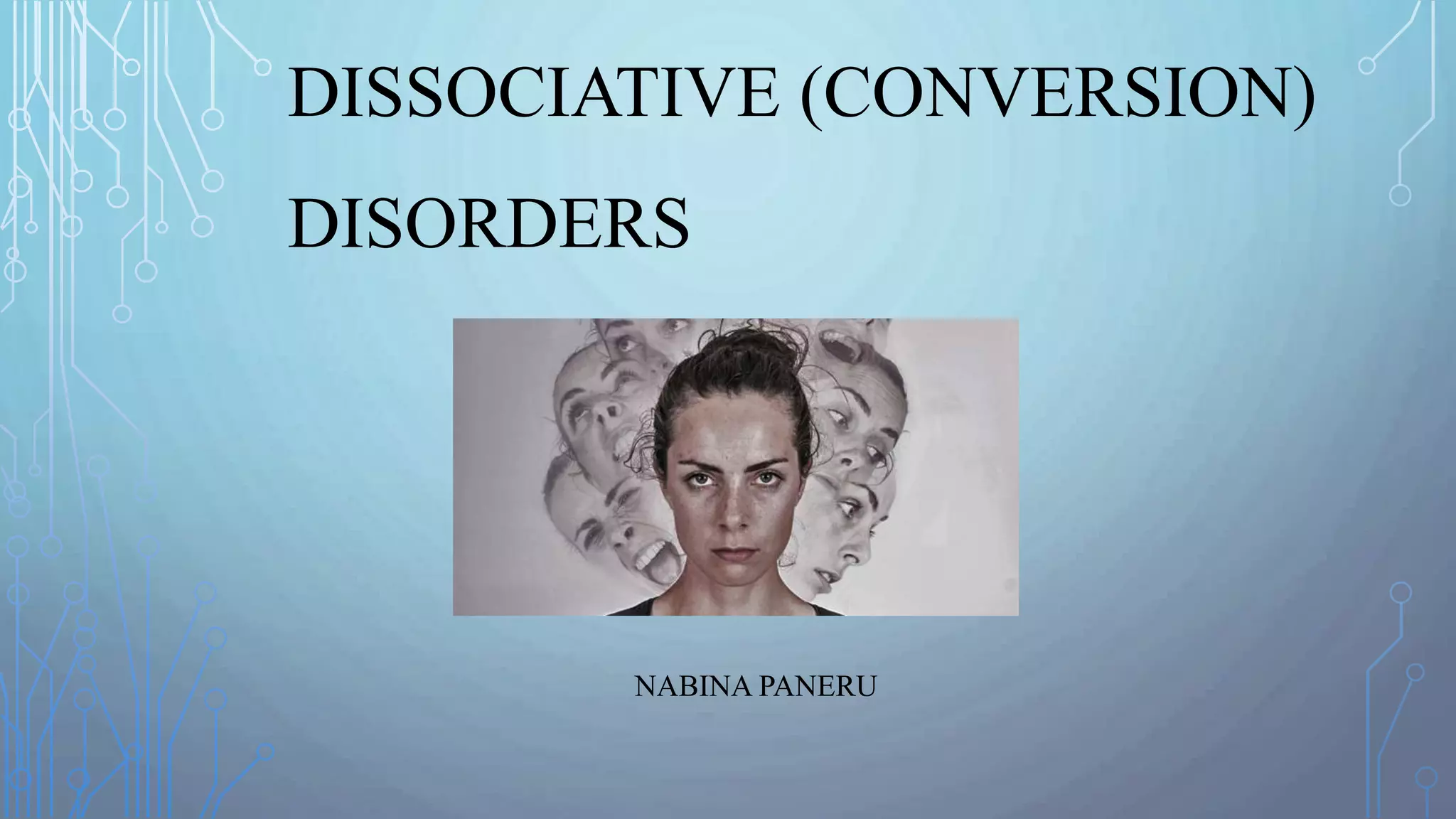
DISSOCIATIVE (CONVERSION)
DISORDERS
NABINA PANERU
INTRODUCTION
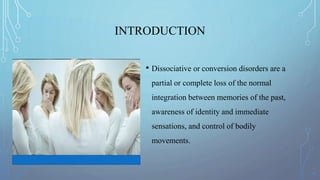
• Dissociative or conversion disorders are a
partial or complete loss of the normal
integration between memories of the past,
awareness of identity and immediate
sensations, and control of bodily
movements.
CLASSIFICATION
• F44.0 Dissociative amnesia
• F44.1 Dissociative fugue
• F44.2 Dissociative stupor
• F44.3 Trance and possession disorders
• F44.4 Dissociative motor disorders
• F44.5 Dissociative convulsions
• F44.6 Dissociative anesthesia and sensory loss
• F44.7 Mixed dissociative [conversion] disorders
CONTD.
• F44.8 Other dissociative [conversion] disorders
• .80 Ganser's syndrome
• .81 Multiple personality disorder
• .82 Transient dissociative [conversion] disorders occurring in childhood and
adolescence
• .88 Other specified dissociative [conversion] disorders
• F44.9 Dissociative [conversion] disorder, unspecified
DISSOCIATIVE AMNESIA
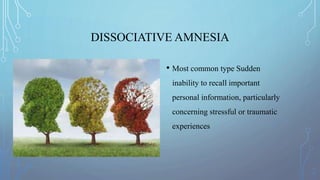
• Most common type Sudden
inability to recall important
personal information, particularly
concerning stressful or traumatic
experiences
TYPES OF DISSOCIATIVE AMNESIA
1. Localized amnesia: Inability to recall events related to a circumscribed period of
time.
2. Selective amnesia: Ability to remember some, but not all, of the events occurring
during a circumscribed period of time.
3. Generalized amnesia: Failure to recall one’s entire life.
4. Continuous amnesia: Failure to recall successive events as they occur.
5. Systematized amnesia: Amnesia for certain categories of memory, such as all
memories relating to one’s family or a particular person.
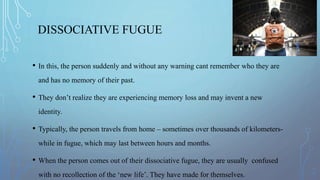
DISSOCIATIVE FUGUE
• In this, the person suddenly and without any warning cant remember who they are
and has no memory of their past.
• They don’t realize they are experiencing memory loss and may invent a new
identity.
• Typically, the person travels from home – sometimes over thousands of kilometers-
while in fugue, which may last between hours and months.
• When the person comes out of their dissociative fugue, they are usually confused
with no recollection of the ‘new life’. They have made for themselves.
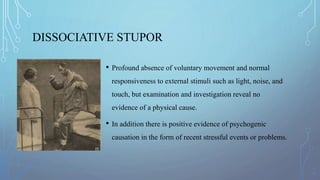
DISSOCIATIVE STUPOR
• Profound absence of voluntary movement and normal
responsiveness to external stimuli such as light, noise, and
touch, but examination and investigation reveal no
evidence of a physical cause.
• In addition there is positive evidence of psychogenic
causation in the form of recent stressful events or problems.
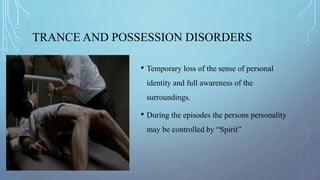
TRANCE AND POSSESSION DISORDERS
• Temporary loss of the sense of personal
identity and full awareness of the
surroundings.
• During the episodes the persons personality
may be controlled by “Spirit”
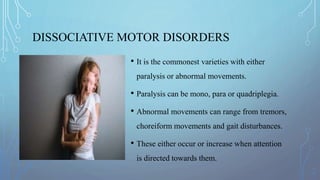
DISSOCIATIVE MOTOR DISORDERS
• It is the commonest varieties with either
paralysis or abnormal movements.
• Paralysis can be mono, para or quadriplegia.
• Abnormal movements can range from tremors,
choreiform movements and gait disturbances.
• These either occur or increase when attention
is directed towards them.
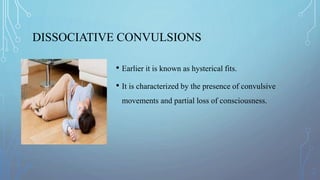
DISSOCIATIVE CONVULSIONS
• Earlier it is known as hysterical fits.
• It is characterized by the presence of convulsive
movements and partial loss of consciousness.
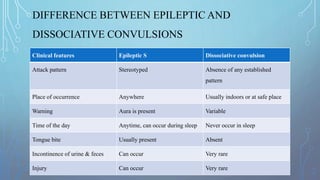
DIFFERENCE BETWEEN EPILEPTIC AND
DISSOCIATIVE CONVULSIONS
Clinical features Epileptic S Dissociative convulsion
Attack pattern Stereotyped Absence of any established
pattern
Place of occurrence Anywhere Usually indoors or at safe place
Warning Aura is present Variable
Time of the day Anytime, can occur during sleep Never occur in sleep
Tongue bite Usually present Absent
Incontinence of urine & feces Can occur Very rare
Injury Can occur Very rare
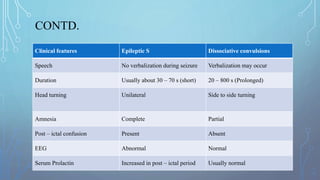
CONTD.
Clinical features Epileptic S Dissociative convulsions
Speech No verbalization during seizure Verbalization may occur
Duration Usually about 30 – 70 s (short) 20 – 800 s (Prolonged)
Head turning Unilateral Side to side turning
Amnesia Complete Partial
Post – ictal confusion Present Absent
EEG Abnormal Normal
Serum Prolactin Increased in post – ictal period Usually normal
DISSOCIATIVE ANESTHESIAAND SENSORY LOSS
• Characterized by sensory disturbances like glove & stocking anesthesia,
blindness or contracted visual fields and deafness.
OTHER DISSOCIATIVE DISORDERS
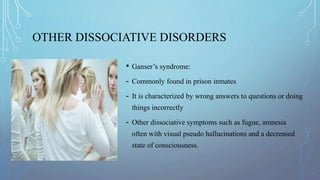
• Ganser’s syndrome:
- Commonly found in prison inmates
- It is characterized by wrong answers to questions or doing
things incorrectly
- Other dissociative symptoms such as fugue, amnesia
often with visual pseudo hallucinations and a decreased
state of consciousness.
CONTD.
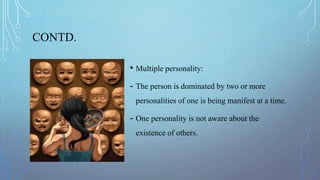
• Multiple personality:
- The person is dominated by two or more
personalities of one is being manifest at a time.
- One personality is not aware about the
existence of others.
CONTD.
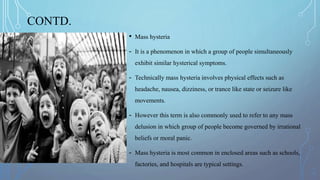
• Mass hysteria
- It is a phenomenon in which a group of people simultaneously
exhibit similar hysterical symptoms.
- Technically mass hysteria involves physical effects such as
headache, nausea, dizziness, or trance like state or seizure like
movements.
- However this term is also commonly used to refer to any mass
delusion in which group of people become governed by irrational
beliefs or moral panic.
- Mass hysteria is most common in enclosed areas such as schools,
factories, and hospitals are typical settings.
EPIDEMIOLOGY
• Lifetime risk of 33% for either transient or longer – term disorder
• Range in general population of 11-33/100,000
• 25 – 30% of admissions to hospitals
• Onset at any age but most common in late childhood to early adulthood
• Man: women = 1:2 to 1:10
ETIOLOGY
1. Biologic theory
- Genetic theory: There is increased likelihood of conversion disorder in the
first – degree relatives of patients of conversion disorder. Increase risk in
monozygotic twins.
- Physical illness, brain damage etc.
CONTD.
2. Psychodynamic theory:
- Primary defense mechanism (Repression): Repression of unconscious
intrapsychic conflicts (instinctual impulse, e.g. aggression/sexuality, and
prohibitions of expression)
- the primary defense mechanism fails use of secondary mechanism like
dissociation & conversion
CONTD.
3. Behavioral theory:
- Symptoms are learned response in the face of stress
- Classically conditioned learned behavior
CLINICAL FEATURES
• Anesthesia and paresthesia is common, especially in extremities (although all
sensory modalities can be involved)
• Possible involvement of organs of special sense (deafness, blindness, tunnel vision)
• Abnormal movements (gait disturbance, weakness/paralysis)
• Movements generally worsen with calling of attention
CONTD.
• Possible gross rhythmical tremors, chorea, tics and jerks
• Paralysis/paresis involving one, two or all four limbs
• Normal electromyography
• Pseudo seizures
DIAGNOSTIC CRITERIA
• The clinical features as specified for the individual disorders
• No evidence of a physical disorder that might explain the symptoms
• Evidence for psychological causation, in the form of clear association in time
with stressful events.
• And problems or disturbed relationships (even if denied by the individual).
INVESTIGATIONS
• Laboratory studies i.e. electrolyte disturbances, hypo/hyper glycemia, renal
function test, system infection, toxins, other drugs
• Imaging studied i.e CXR, CT scan or MRI
• Electroencephalography
• Lumbar puncture
* Note: Avoid unnecessary, painful or invasive test if possible as they can
results in reinforcement and fixation of symptoms
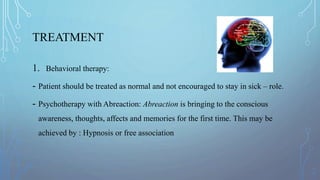
TREATMENT
1. Behavioral therapy:
- Patient should be treated as normal and not encouraged to stay in sick – role.
- Psychotherapy with Abreaction: Abreaction is bringing to the conscious
awareness, thoughts, affects and memories for the first time. This may be
achieved by : Hypnosis or free association
CONTD.
2. Other therapy: Cognitive behavioral therapy, family therapy
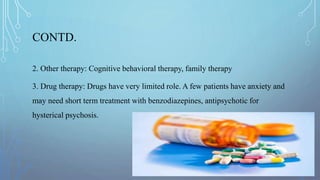
3. Drug therapy: Drugs have very limited role. A few patients have anxiety and
may need short term treatment with benzodiazepines, antipsychotic for
hysterical psychosis.
NURSING MANAGEMENT
From book
Dissociative disorder

Dissociative disorder

  • 1.
  • 2.
    INTRODUCTION • Dissociative orconversion disorders are a partial or complete loss of the normal integration between memories of the past, awareness of identity and immediate sensations, and control of bodily movements.
  • 3.
    CLASSIFICATION • F44.0 Dissociativeamnesia • F44.1 Dissociative fugue • F44.2 Dissociative stupor • F44.3 Trance and possession disorders • F44.4 Dissociative motor disorders • F44.5 Dissociative convulsions • F44.6 Dissociative anesthesia and sensory loss • F44.7 Mixed dissociative [conversion] disorders
  • 4.
    CONTD. • F44.8 Otherdissociative [conversion] disorders • .80 Ganser's syndrome • .81 Multiple personality disorder • .82 Transient dissociative [conversion] disorders occurring in childhood and adolescence • .88 Other specified dissociative [conversion] disorders • F44.9 Dissociative [conversion] disorder, unspecified
  • 5.
    DISSOCIATIVE AMNESIA • Mostcommon type Sudden inability to recall important personal information, particularly concerning stressful or traumatic experiences
  • 6.
    TYPES OF DISSOCIATIVEAMNESIA 1. Localized amnesia: Inability to recall events related to a circumscribed period of time. 2. Selective amnesia: Ability to remember some, but not all, of the events occurring during a circumscribed period of time. 3. Generalized amnesia: Failure to recall one’s entire life. 4. Continuous amnesia: Failure to recall successive events as they occur. 5. Systematized amnesia: Amnesia for certain categories of memory, such as all memories relating to one’s family or a particular person.
  • 7.
    DISSOCIATIVE FUGUE • Inthis, the person suddenly and without any warning cant remember who they are and has no memory of their past. • They don’t realize they are experiencing memory loss and may invent a new identity. • Typically, the person travels from home – sometimes over thousands of kilometers- while in fugue, which may last between hours and months. • When the person comes out of their dissociative fugue, they are usually confused with no recollection of the ‘new life’. They have made for themselves.
  • 8.
    DISSOCIATIVE STUPOR • Profoundabsence of voluntary movement and normal responsiveness to external stimuli such as light, noise, and touch, but examination and investigation reveal no evidence of a physical cause. • In addition there is positive evidence of psychogenic causation in the form of recent stressful events or problems.
  • 9.
    TRANCE AND POSSESSIONDISORDERS • Temporary loss of the sense of personal identity and full awareness of the surroundings. • During the episodes the persons personality may be controlled by “Spirit”
  • 10.
    DISSOCIATIVE MOTOR DISORDERS •It is the commonest varieties with either paralysis or abnormal movements. • Paralysis can be mono, para or quadriplegia. • Abnormal movements can range from tremors, choreiform movements and gait disturbances. • These either occur or increase when attention is directed towards them.
  • 11.
    DISSOCIATIVE CONVULSIONS • Earlierit is known as hysterical fits. • It is characterized by the presence of convulsive movements and partial loss of consciousness.
  • 12.
    DIFFERENCE BETWEEN EPILEPTICAND DISSOCIATIVE CONVULSIONS Clinical features Epileptic S Dissociative convulsion Attack pattern Stereotyped Absence of any established pattern Place of occurrence Anywhere Usually indoors or at safe place Warning Aura is present Variable Time of the day Anytime, can occur during sleep Never occur in sleep Tongue bite Usually present Absent Incontinence of urine & feces Can occur Very rare Injury Can occur Very rare
  • 13.
    CONTD. Clinical features EpilepticS Dissociative convulsions Speech No verbalization during seizure Verbalization may occur Duration Usually about 30 – 70 s (short) 20 – 800 s (Prolonged) Head turning Unilateral Side to side turning Amnesia Complete Partial Post – ictal confusion Present Absent EEG Abnormal Normal Serum Prolactin Increased in post – ictal period Usually normal
  • 14.
    DISSOCIATIVE ANESTHESIAAND SENSORYLOSS • Characterized by sensory disturbances like glove & stocking anesthesia, blindness or contracted visual fields and deafness.
  • 15.
    OTHER DISSOCIATIVE DISORDERS •Ganser’s syndrome: - Commonly found in prison inmates - It is characterized by wrong answers to questions or doing things incorrectly - Other dissociative symptoms such as fugue, amnesia often with visual pseudo hallucinations and a decreased state of consciousness.
  • 16.
    CONTD. • Multiple personality: -The person is dominated by two or more personalities of one is being manifest at a time. - One personality is not aware about the existence of others.
  • 17.
    CONTD. • Mass hysteria -It is a phenomenon in which a group of people simultaneously exhibit similar hysterical symptoms. - Technically mass hysteria involves physical effects such as headache, nausea, dizziness, or trance like state or seizure like movements. - However this term is also commonly used to refer to any mass delusion in which group of people become governed by irrational beliefs or moral panic. - Mass hysteria is most common in enclosed areas such as schools, factories, and hospitals are typical settings.
  • 18.
    EPIDEMIOLOGY • Lifetime riskof 33% for either transient or longer – term disorder • Range in general population of 11-33/100,000 • 25 – 30% of admissions to hospitals • Onset at any age but most common in late childhood to early adulthood • Man: women = 1:2 to 1:10
  • 19.
    ETIOLOGY 1. Biologic theory -Genetic theory: There is increased likelihood of conversion disorder in the first – degree relatives of patients of conversion disorder. Increase risk in monozygotic twins. - Physical illness, brain damage etc.
  • 20.
    CONTD. 2. Psychodynamic theory: -Primary defense mechanism (Repression): Repression of unconscious intrapsychic conflicts (instinctual impulse, e.g. aggression/sexuality, and prohibitions of expression) - the primary defense mechanism fails use of secondary mechanism like dissociation & conversion
  • 21.
    CONTD. 3. Behavioral theory: -Symptoms are learned response in the face of stress - Classically conditioned learned behavior
  • 22.
    CLINICAL FEATURES • Anesthesiaand paresthesia is common, especially in extremities (although all sensory modalities can be involved) • Possible involvement of organs of special sense (deafness, blindness, tunnel vision) • Abnormal movements (gait disturbance, weakness/paralysis) • Movements generally worsen with calling of attention
  • 23.
    CONTD. • Possible grossrhythmical tremors, chorea, tics and jerks • Paralysis/paresis involving one, two or all four limbs • Normal electromyography • Pseudo seizures
  • 24.
    DIAGNOSTIC CRITERIA • Theclinical features as specified for the individual disorders • No evidence of a physical disorder that might explain the symptoms • Evidence for psychological causation, in the form of clear association in time with stressful events. • And problems or disturbed relationships (even if denied by the individual).
  • 25.
    INVESTIGATIONS • Laboratory studiesi.e. electrolyte disturbances, hypo/hyper glycemia, renal function test, system infection, toxins, other drugs • Imaging studied i.e CXR, CT scan or MRI • Electroencephalography • Lumbar puncture * Note: Avoid unnecessary, painful or invasive test if possible as they can results in reinforcement and fixation of symptoms
  • 26.
    TREATMENT 1. Behavioral therapy: -Patient should be treated as normal and not encouraged to stay in sick – role. - Psychotherapy with Abreaction: Abreaction is bringing to the conscious awareness, thoughts, affects and memories for the first time. This may be achieved by : Hypnosis or free association
  • 27.
    CONTD. 2. Other therapy:Cognitive behavioral therapy, family therapy 3. Drug therapy: Drugs have very limited role. A few patients have anxiety and may need short term treatment with benzodiazepines, antipsychotic for hysterical psychosis.
  • 28.