MEMS Pressure Sensor Packaging Design
Solution Consideration: Overcoming
Environmental Challenges from Harsh
Environment
Tom Nguyen, Founder & CEO of DunAn Sensing
Date: 10/16/2018
May-2014
● Entered Joint Venture Contract Agreement with DunAn Environmental Company – a leading HVAC
global supplier
● Established DunAn Sensing Technology Company in Hangzhou, China. Company will be mainly
augment design, and manufacturing of MEMS pressure sensors, transducers and transmitters for
industrial, HVAC/R and automotive applications
April 2013
● Silicon Valley startup led by a group of highly experienced
MEMS & Sensors industry veterans
● R&D team established to develop DURAsense® MEMS
pressure sensor die and package for harsh environment,
mainly focus on industrial, HVAC/R and automotive industries
Company Profile
Sensor solutions for everyday life
Lead the development and manufacturing of reliable,
accurate, and affordable sensors that contribute to the
success of our customers.
MISSION
VISION
Award Winning
DURASenseR
Tom Nguyen, Founder and Chief Executive Officer, has over 30 plus years of engineering, operations, and
business development experience in the MEMS and semiconductor industry. Before the founding of DunAn
Sensing, Mr. Nguyen is also the founder and CEO of Microlux Technology. He is also served as an Executive
Director of Engineering and Operations at S3C, Inc. a subsidiary of Nagano Keiki group companies a leading
manufacturer in industrial and automotive pressure sensors.
Prior to that, Mr. Nguyen held a variety of business development and technical management positions
over at Celerity Research, ICSensors, GE Novasensor, Integrated Sensor Solutions, Merit Sensor Systems, S3C
and Invensense. Where he designed, and developed many of the pressure sensors, accelerometer and
transducers products. Mr. Nguyen has published several technical papers relating to the testing and probing
of high density and high pin counts semiconductor devices using MEMS technology, and reliability testing of
MEMS pressure sensors for automotive industry. He is an author and co-author of more than 12 patents in
the wafer probe test and MEMS pressure sensor packaging technology.
Currently, Mr. Nguyen serves as Chief Executive Officer for DunAn Sensing, an advanced MEMS pressure
sensor packaging technology for harsh environment, and his goal and vision is to bring together both of his
MEMS & semiconductor expertise to bring the MEMS packaging technology roadmap to Lower Cost!
Contents
History of MEMS & Sensors Packaging Design
The Challenge and Important of MEMS Pressure Sensor Packaging Design for Harsh Environment
The Traditional MEMS Pressure Sensor Packaging Design
 MEMS die with Oil Filled
 Micro fuse, Bonded strain gauge
 Thin film deposition on strain gauge
 Ceramic Thick film
New Approach for MEMS Pressure Sensors Packaging Design for Harsh Environment
 MEMS base with No oil filled, No O-ring, No Welding and low cost
Advantage and Disadvantage
Conclusion
History of MEMS & Sensors
Packaging Design
MEMS & Sensor Products History
 Historically, packaging has been (and in many cases) overlooked in the overall design of the
“sensor-based system” solution
Sensors are only a part of the “solution”….
Packaging is a critical element frequently consuming from 50-75% of the total bill of materials
”BOM” based on the application.
 Harsh media applications have the tendency to drive packaging cost up
 Packaging (and testing) have been an afterthought…but rather…need to be considered in the early
part of the design process to optimize design for Manufacturing and Test (DoM&T) Principles
Sensor Packaging : Situational Analysis
In the courtesy of Roger Grace Associates
The Challenge and Important of MEMS & Sensor
Packaging Design for Harsh Environment
The Challenge and Important of MEMS Pressure Sensor Design
& Packaging for Harsh Environment
• In hash environment, quality and reliability of the pressure sensors are keys and required.
• The sensors operate in extremely hostile environments. The high temperature ranging
from -40°C to 150°C and the pressure sensors devices are exposed to
 Fuel, oil, gas
 Coolant & transmission fluid
 Walter, Salt water
 Chemically compatible with refrigerant fluids (R-410A, R-404A, refrigerant oils, acids
formed due to moisture contamination)
• All of the above media can clog the sensors and potentially degrade the performance, or
even defeat or worsen the performance of the pressure sensors.
 Accuracy, Reliability and Affordability are important!
The 4 Key Important Factors
• Media Compatibility: MEMS pressure sensor must be able to withstand the media,
such as: refrigeration, transmission oil, engine oil, gasoline, water, etc…
• Thermal stress: Severe temperature could cause damage, instability, drift and shift to
the sensor due to the effect of materials thermal coefficient of expansion.
• Mechanical stress: The mechanical instability, vibration and shock could cause damage
and reliability of MEMS pressure sensor and its components.
• ESD & EMI: Due to noisy environment, the pressure sensor must withstand the ESD and
EMI (electromagnetic interference)…
 High dielectric withstand voltage (1.8kV)
 High ESD immunity (+/-2kV, +/-8kV, +/-15kV)
Hostile Media Compatibility
• It is very important that the sensors must survive conditions below :
 Fuel, oil, gas, & transmission fluid
 Refrigeration, Coolant
 Walter, Salt water
 Corrosive media..
• For the test conditions: The pressure sensors must be tested with the above media at
extreme temperature range with a long duration typically about 3 to 6 months
• The devices must have passed the environmental test. No damage or anomalies are
found by visual inspection
• After environmental testing, the sensors must pass functional/parametric tests on all
required electrical and mechanical parameters .
The Traditional MEMS & Sensor
Packaging Design
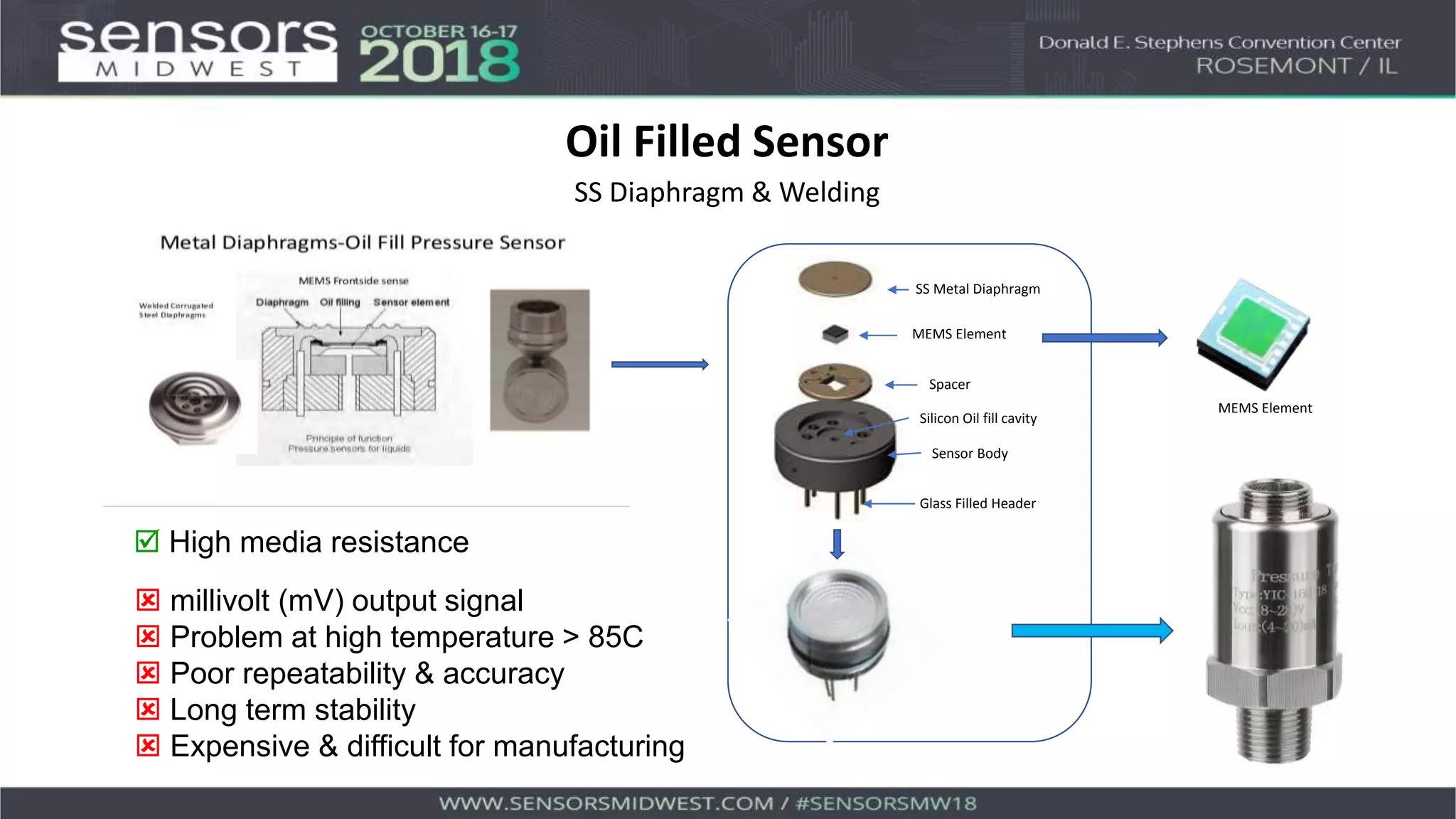
SS Metal Diaphragm
MEMS Element
Spacer
Sensor Body
Silicon Oil fill cavity
Glass Filled Header
Oil Filled Sensor
SS Diaphragm & Welding
 millivolt (mV) output signal
 Problem at high temperature > 85C
 Poor repeatability & accuracy
 Long term stability
 Expensive & difficult for manufacturing
 High media resistance
MEMS Element
Microfuse Sensor
Metal diaphragm with strain gauges bonded to it.
 High media resistance
 Simple design / Assembly (welding)
 Low output signal
 Expensive & difficult for manufacturing
 Only high pressure ranges only
Poor repeatability & accuracy
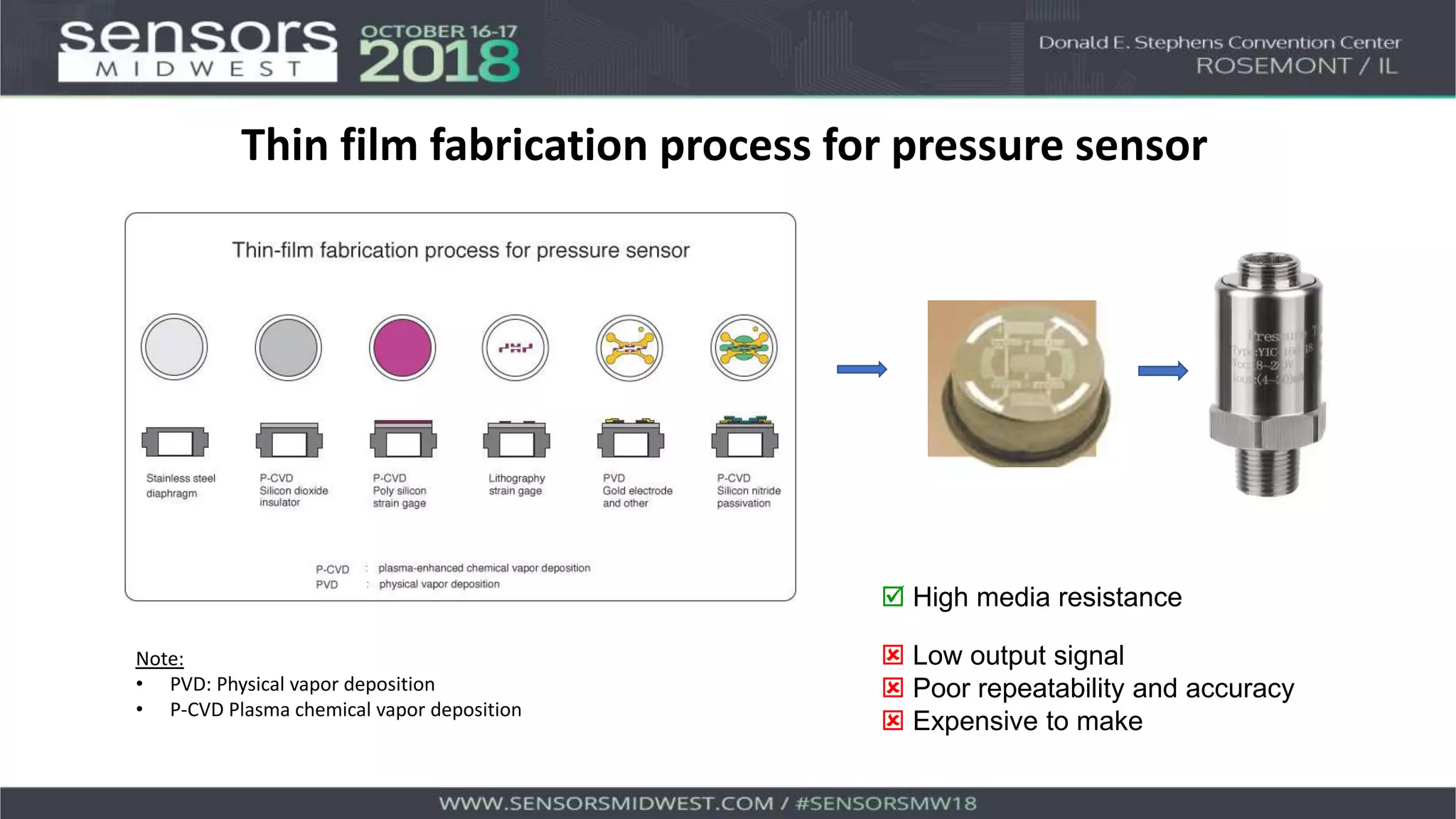
 High media resistance
 Low output signal
 Poor repeatability and accuracy
 Expensive to make
Thin film fabrication process for pressure sensor
Note:
• PVD: Physical vapor deposition
• P-CVD Plasma chemical vapor deposition
Ceramic Thick Film Pressure Sensor
 Low output signal
 Low performance & limited pressure range
 Poor repeatability and accuracy
 Poor long term stability
 High media resistance
 Simple design
 Low Cost
Ceramic
Housing
Print thin
conductor
Print Solder
pads
Print Sensing
Resistors
Print Protective
Glass
New Approach for MEMS Pressure Sensor
Packaging Design for Harsh Environment
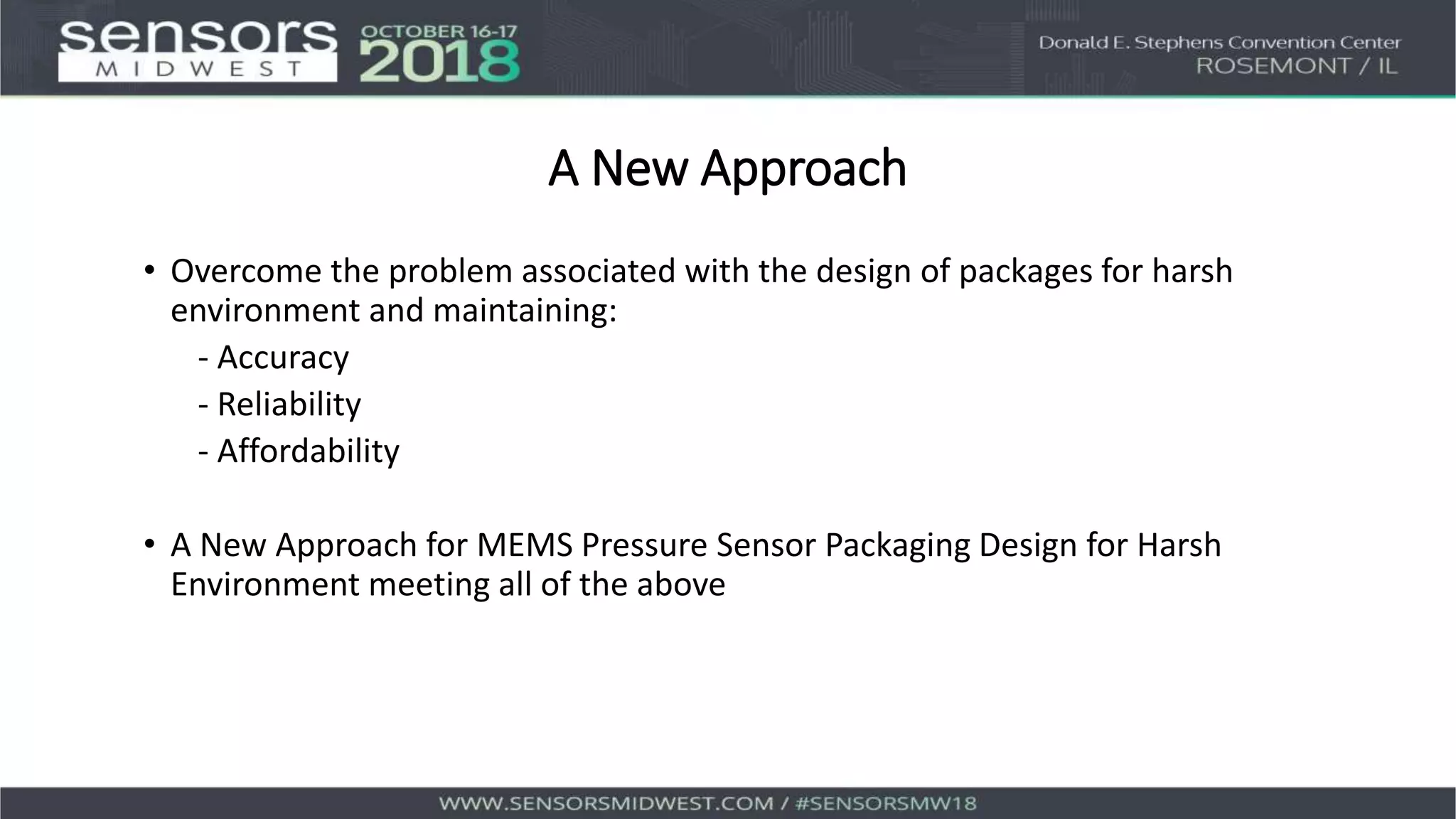
A New Approach
• Overcome the problem associated with the design of packages for harsh
environment and maintaining:
- Accuracy
- Reliability
- Affordability
• A New Approach for MEMS Pressure Sensor Packaging Design for Harsh
Environment meeting all of the above
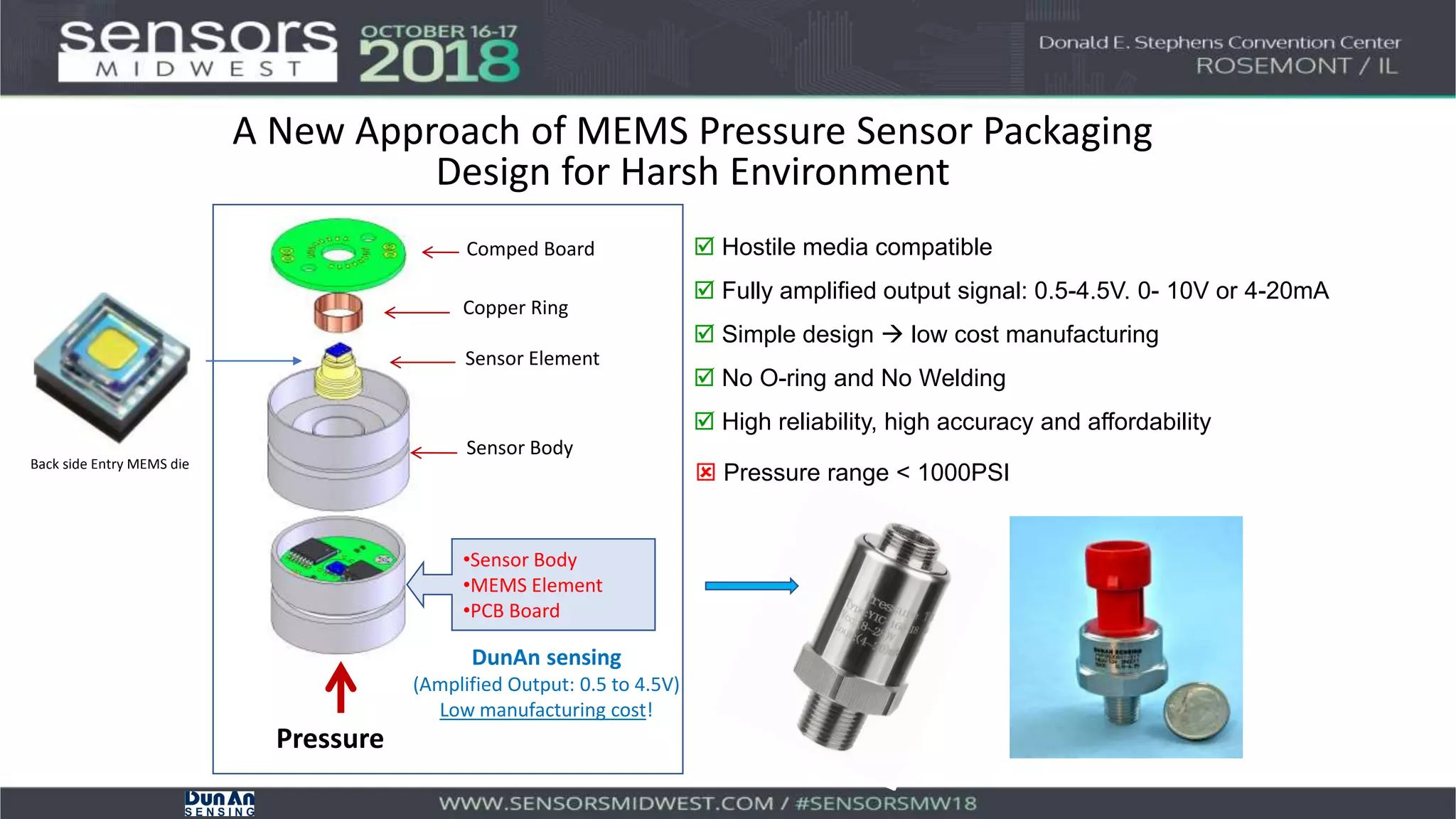
Comped Board
Sensor Body
Sensor Element
•Sensor Body
•MEMS Element
•PCB Board
DunAn sensing
(Amplified Output: 0.5 to 4.5V)
Low manufacturing cost!
Copper Ring
Pressure
A New Approach of MEMS Pressure Sensor Packaging
Design for Harsh Environment
 Hostile media compatible
 Fully amplified output signal: 0.5-4.5V. 0- 10V or 4-20mA
 Simple design  low cost manufacturing
 No O-ring and No Welding
 High reliability, high accuracy and affordability
 Pressure range < 1000PSIBack side Entry MEMS die
A New Approach of MEMS Pressure Sensor Packaging
Design for Harsh Environment
Mold plastic
package
Housing
Color coded
plastic cap
Wires /
connector
DURAsense® Core
DURAsense® MEMS Sensor
 DURAsense® MEMS Sensorand DURAsense® Core
 Small size and light weight
 High volume production  low cost !
 Media compatible; Housing:Coppertube,Aluminum,StainlessSteelorBrass
 Electricalinterconnect: wireandsleeveorplasticmoldedconnector
 Fully amplified output signal: 0.5-4.5V. 0- 10V or 4-20mA
 No O-ring, high reliability, high accuracy and affordability
Temp
Press. (MPa) 0 0.5 1 1.5 2 0 0.5 1 1.5 2 0 0.5 1 1.5 2 0 0.5 1 1.5 2 0 0.5 1 1.5 2
Min 0.01% -0.07% -0.20% -0.33% -0.54% 0.01% -0.10% -0.23% -0.34% -0.56% -0.04% -0.08% -0.19% -0.31% -0.51% -0.13% -0.10% -0.17% -0.25% -0.38% -0.27% -0.24% -0.33% -0.45% -0.66%
Max 0.22% 0.23% 0.16% 0.03% -0.16% 0.21% 0.18% 0.08% -0.05% -0.28% 0.18% 0.19% 0.08% -0.03% -0.24% 0.17% 0.18% 0.15% 0.07% -0.04% 0.14% 0.10% 0.04% -0.09% -0.28%
Average 0.12% 0.07% 0.00% -0.12% -0.28% 0.09% 0.02% -0.08% -0.21% -0.40% 0.07% 0.03% -0.07% -0.18% -0.37% 0.01% 0.04% 0.00% -0.08% -0.20% -0.10% -0.11% -0.18% -0.31% -0.48%
StDev 0.06% 0.08% 0.09% 0.09% 0.08% 0.05% 0.08% 0.08% 0.07% 0.06% 0.05% 0.07% 0.07% 0.07% 0.06% 0.07% 0.07% 0.08% 0.08% 0.09% 0.09% 0.08% 0.09% 0.08% 0.08%
UL 1.5% 1.5% 1.5% 1.5% 1.5% 1.0% 1.0% 1.0% 1.0% 1.0% 1.0% 1.0% 1.0% 1.0% 1.0% 1.0% 1.0% 1.0% 1.0% 1.0% 1.5% 1.5% 1.5% 1.5% 1.5%
LL -1.5% -1.5% -1.5% -1.5% -1.5% -1.0% -1.0% -1.0% -1.0% -1.0% -1.0% -1.0% -1.0% -1.0% -1.0% -1.0% -1.0% -1.0% -1.0% -1.0% -1.5% -1.5% -1.5% -1.5% -1.5%
Cpk 8.07 6.01 5.50 5.19 5.14 5.67 4.32 3.75 3.53 3.25 5.64 4.62 4.21 3.88 3.44 4.54 4.35 4.17 3.73 3.09 5.48 5.88 5.17 4.83 3.98
8.07 6.01 5.53 6.07 7.54 5.67 4.32 4.42 5.37 7.62 5.64 4.62 4.86 5.59 7.42 4.54 4.35 4.17 4.38 4.67 6.26 6.81 6.58 7.35 7.79
9.48 6.63 5.50 5.19 5.14 6.78 4.47 3.75 3.53 3.25 6.52 4.91 4.21 3.88 3.44 4.63 4.71 4.18 3.73 3.09 5.48 5.88 5.17 4.83 3.98
Typical Accuracy Performance (%FS)
-20°C 0°C 25°C 80°C 120°C
-3.00%
-2.50%
-2.00%
-1.50%
-1.00%
-0.50%
0.00%
0.50%
1.00%
1.50%
2.00%
2.50%
3.00%
0 0.5 1 1.5 2 0 0.5 1 1.5 2 0 0.5 1 1.5 2 0 0.5 1 1.5 2 0 0.5 1 1.5 2
-20°C 0°C 25°C 80°C 120°C
ERROR(%FS)
PRESSURE (MPA)
TEMPERATURE (° C)
Accuracy Performance Typical Industry Limits DunAn Sensing Limits
Accuracy Results
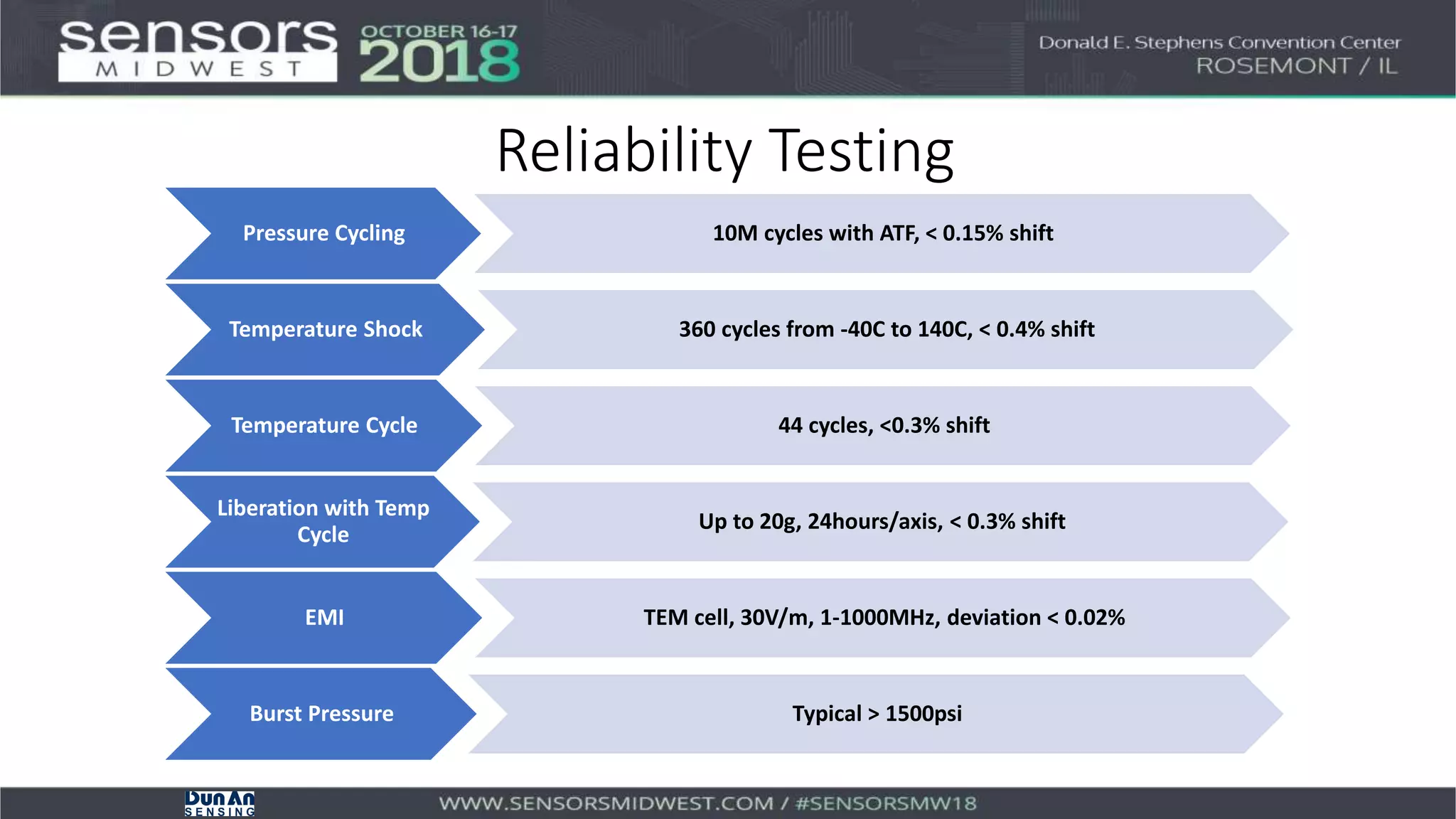
Reliability Testing
Pressure Cycling 10M cycles with ATF, < 0.15% shift
Temperature Shock 360 cycles from -40C to 140C, < 0.4% shift
Temperature Cycle 44 cycles, <0.3% shift
Liberation with Temp
Cycle
Up to 20g, 24hours/axis, < 0.3% shift
EMI TEM cell, 30V/m, 1-1000MHz, deviation < 0.02%
Burst Pressure Typical > 1500psi
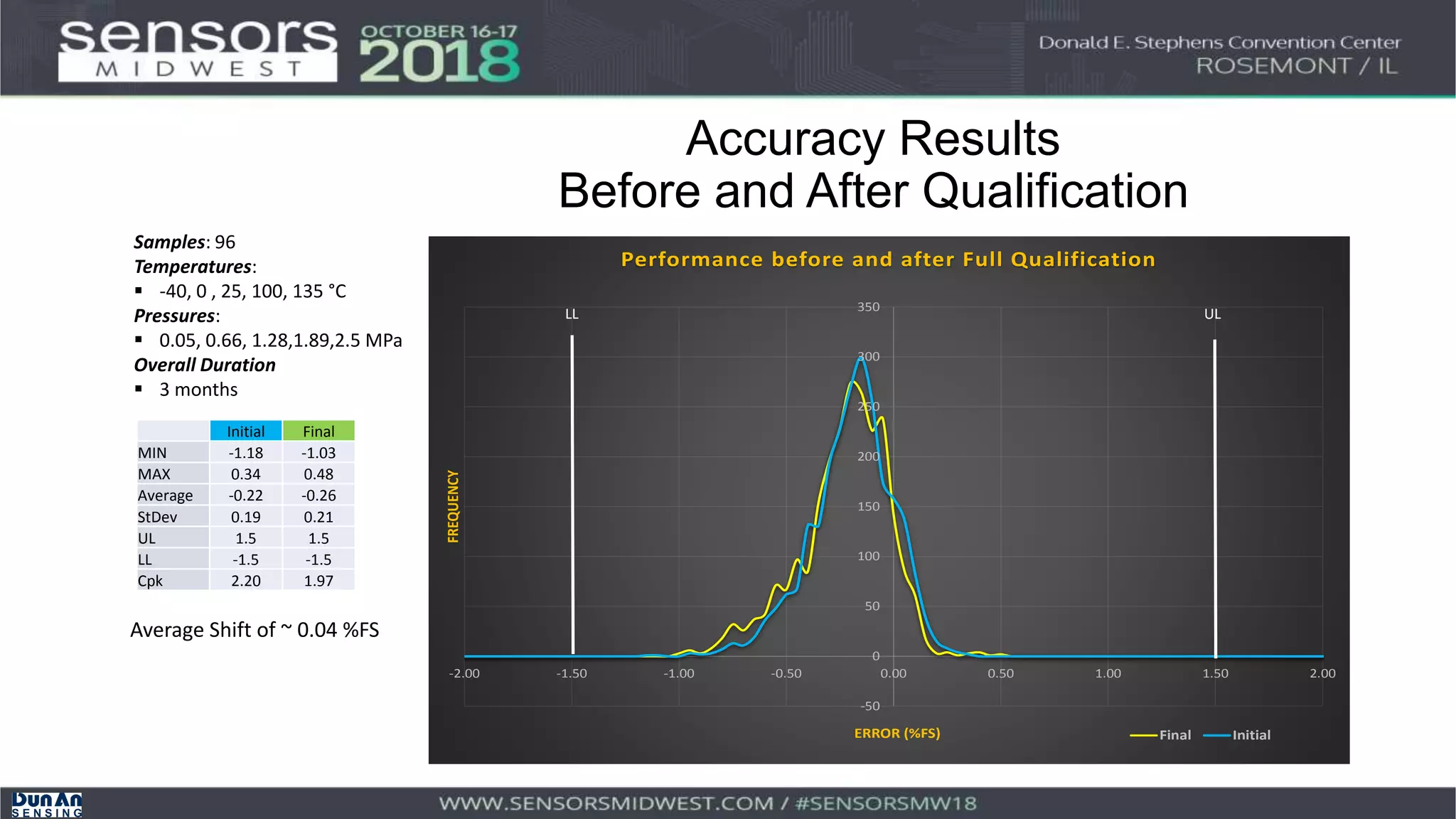
Samples: 96
Temperatures:
 -40, 0 , 25, 100, 135 °C
Pressures:
 0.05, 0.66, 1.28,1.89,2.5 MPa
Overall Duration
 3 months
Initial Final
MIN -1.18 -1.03
MAX 0.34 0.48
Average -0.22 -0.26
StDev 0.19 0.21
UL 1.5 1.5
LL -1.5 -1.5
Cpk 2.20 1.97
Average Shift of ~ 0.04 %FS
-50
0
50
100
150
200
250
300
350
-2.00 -1.50 -1.00 -0.50 0.00 0.50 1.00 1.50 2.00
FREQUENCY
ERROR (%FS)
Performance before and after Full Qualification
Final Initial
LL UL
Accuracy Results
Before and After Qualification
CHARACTERISTICS/CAPABILITIES OF CURRENT
TECHNOLOGIES FOR HARSH MEDIUM
Thin-film on Strain
Gauge Sensor
Micro fuse
Sensor
Oil Filled
MEMS Sensor
Ceramic
capacitive Sensor
Ceramic
piezoresistive
Sensor
DURAsense®
MEMS Sensor
Measure Absolute Pressure NO NO YES YES OK YES
Measure Gauge Pressure YES YES YES YES YES YES
Very Low Pressure Range NO NO YES OK NO OK
Very High Pressure Range YES YES YES OK NO OK
Long Term Stability YES YES OK YES OK YES
High temperature > 100ºC OK OK NO YES OK YES
Repeatability OK OK YES OK OK YES
Accuracy OK OK YES OK OK YES
COST High High High Medium Medium LOW
Requirement fulfilled
YES /
Good
Requirement partly
fulfilled
OK /
Maybe
Requirement not
fulfilled
No /
Bad
DURAsense®
CORE
Conclusion
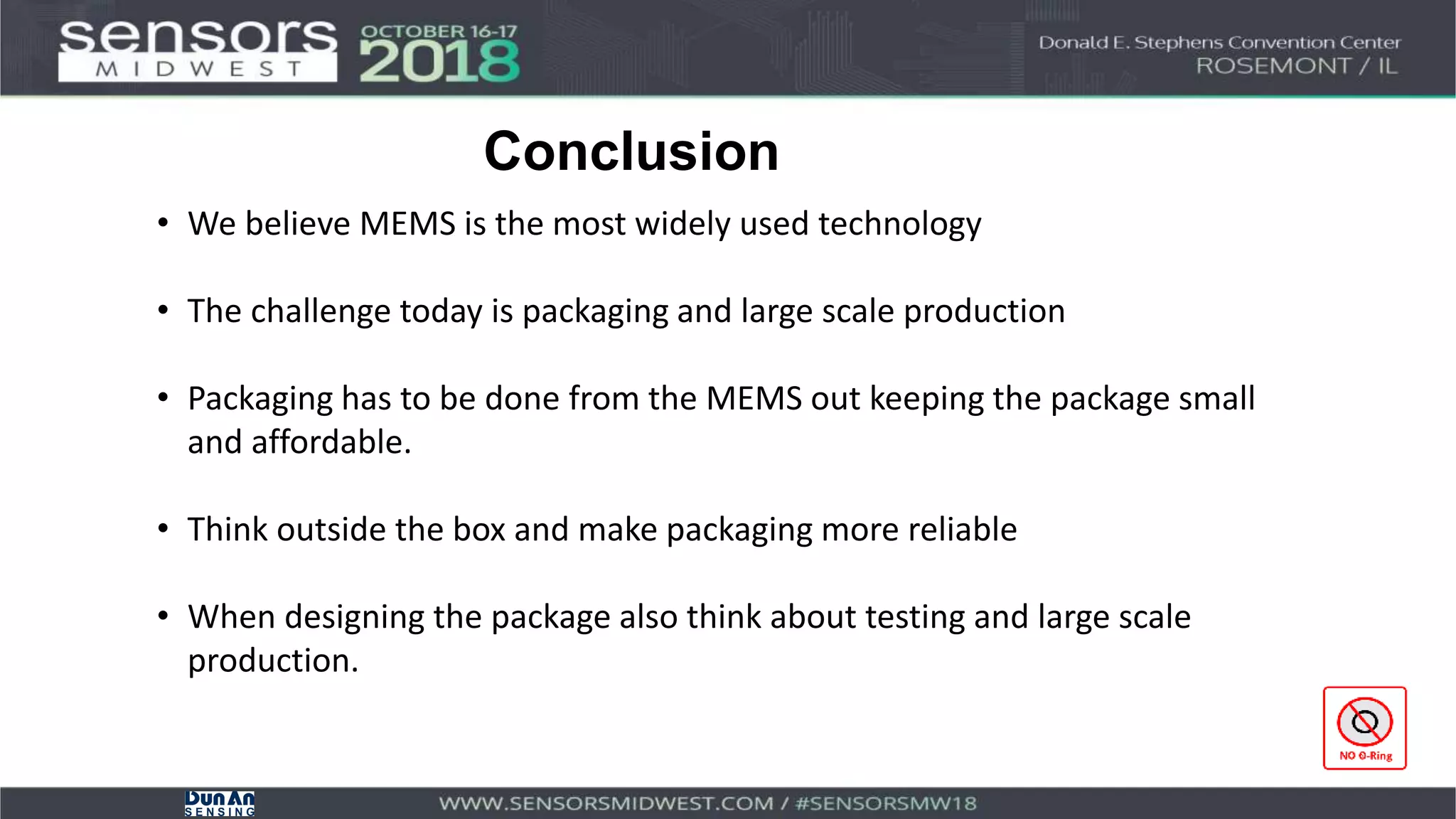
• We believe MEMS is the most widely used technology
• The challenge today is packaging and large scale production
• Packaging has to be done from the MEMS out keeping the package small
and affordable.
• Think outside the box and make packaging more reliable
• When designing the package also think about testing and large scale
production.
Thanks
Name: Tom Nguyen
email: tomnguyen@dunansensing.com
And please visit us at booth #419

MEMS Pressure Sensor Packaging Considerations

  • 1.
    MEMS Pressure SensorPackaging Design Solution Consideration: Overcoming Environmental Challenges from Harsh Environment Tom Nguyen, Founder & CEO of DunAn Sensing Date: 10/16/2018
  • 2.
    May-2014 ● Entered JointVenture Contract Agreement with DunAn Environmental Company – a leading HVAC global supplier ● Established DunAn Sensing Technology Company in Hangzhou, China. Company will be mainly augment design, and manufacturing of MEMS pressure sensors, transducers and transmitters for industrial, HVAC/R and automotive applications April 2013 ● Silicon Valley startup led by a group of highly experienced MEMS & Sensors industry veterans ● R&D team established to develop DURAsense® MEMS pressure sensor die and package for harsh environment, mainly focus on industrial, HVAC/R and automotive industries Company Profile
  • 3.
    Sensor solutions foreveryday life Lead the development and manufacturing of reliable, accurate, and affordable sensors that contribute to the success of our customers. MISSION VISION Award Winning DURASenseR
  • 4.
    Tom Nguyen, Founderand Chief Executive Officer, has over 30 plus years of engineering, operations, and business development experience in the MEMS and semiconductor industry. Before the founding of DunAn Sensing, Mr. Nguyen is also the founder and CEO of Microlux Technology. He is also served as an Executive Director of Engineering and Operations at S3C, Inc. a subsidiary of Nagano Keiki group companies a leading manufacturer in industrial and automotive pressure sensors. Prior to that, Mr. Nguyen held a variety of business development and technical management positions over at Celerity Research, ICSensors, GE Novasensor, Integrated Sensor Solutions, Merit Sensor Systems, S3C and Invensense. Where he designed, and developed many of the pressure sensors, accelerometer and transducers products. Mr. Nguyen has published several technical papers relating to the testing and probing of high density and high pin counts semiconductor devices using MEMS technology, and reliability testing of MEMS pressure sensors for automotive industry. He is an author and co-author of more than 12 patents in the wafer probe test and MEMS pressure sensor packaging technology. Currently, Mr. Nguyen serves as Chief Executive Officer for DunAn Sensing, an advanced MEMS pressure sensor packaging technology for harsh environment, and his goal and vision is to bring together both of his MEMS & semiconductor expertise to bring the MEMS packaging technology roadmap to Lower Cost!
  • 5.
    Contents History of MEMS& Sensors Packaging Design The Challenge and Important of MEMS Pressure Sensor Packaging Design for Harsh Environment The Traditional MEMS Pressure Sensor Packaging Design  MEMS die with Oil Filled  Micro fuse, Bonded strain gauge  Thin film deposition on strain gauge  Ceramic Thick film New Approach for MEMS Pressure Sensors Packaging Design for Harsh Environment  MEMS base with No oil filled, No O-ring, No Welding and low cost Advantage and Disadvantage Conclusion
  • 6.
    History of MEMS& Sensors Packaging Design
  • 7.
    MEMS & SensorProducts History
  • 8.
     Historically, packaginghas been (and in many cases) overlooked in the overall design of the “sensor-based system” solution Sensors are only a part of the “solution”…. Packaging is a critical element frequently consuming from 50-75% of the total bill of materials ”BOM” based on the application.  Harsh media applications have the tendency to drive packaging cost up  Packaging (and testing) have been an afterthought…but rather…need to be considered in the early part of the design process to optimize design for Manufacturing and Test (DoM&T) Principles Sensor Packaging : Situational Analysis In the courtesy of Roger Grace Associates
  • 9.
    The Challenge andImportant of MEMS & Sensor Packaging Design for Harsh Environment
  • 10.
    The Challenge andImportant of MEMS Pressure Sensor Design & Packaging for Harsh Environment • In hash environment, quality and reliability of the pressure sensors are keys and required. • The sensors operate in extremely hostile environments. The high temperature ranging from -40°C to 150°C and the pressure sensors devices are exposed to  Fuel, oil, gas  Coolant & transmission fluid  Walter, Salt water  Chemically compatible with refrigerant fluids (R-410A, R-404A, refrigerant oils, acids formed due to moisture contamination) • All of the above media can clog the sensors and potentially degrade the performance, or even defeat or worsen the performance of the pressure sensors.  Accuracy, Reliability and Affordability are important!
  • 11.
    The 4 KeyImportant Factors • Media Compatibility: MEMS pressure sensor must be able to withstand the media, such as: refrigeration, transmission oil, engine oil, gasoline, water, etc… • Thermal stress: Severe temperature could cause damage, instability, drift and shift to the sensor due to the effect of materials thermal coefficient of expansion. • Mechanical stress: The mechanical instability, vibration and shock could cause damage and reliability of MEMS pressure sensor and its components. • ESD & EMI: Due to noisy environment, the pressure sensor must withstand the ESD and EMI (electromagnetic interference)…  High dielectric withstand voltage (1.8kV)  High ESD immunity (+/-2kV, +/-8kV, +/-15kV)
  • 12.
    Hostile Media Compatibility •It is very important that the sensors must survive conditions below :  Fuel, oil, gas, & transmission fluid  Refrigeration, Coolant  Walter, Salt water  Corrosive media.. • For the test conditions: The pressure sensors must be tested with the above media at extreme temperature range with a long duration typically about 3 to 6 months • The devices must have passed the environmental test. No damage or anomalies are found by visual inspection • After environmental testing, the sensors must pass functional/parametric tests on all required electrical and mechanical parameters .
  • 13.
    The Traditional MEMS& Sensor Packaging Design
  • 14.
    SS Metal Diaphragm MEMSElement Spacer Sensor Body Silicon Oil fill cavity Glass Filled Header Oil Filled Sensor SS Diaphragm & Welding  millivolt (mV) output signal  Problem at high temperature > 85C  Poor repeatability & accuracy  Long term stability  Expensive & difficult for manufacturing  High media resistance MEMS Element
  • 15.
    Microfuse Sensor Metal diaphragmwith strain gauges bonded to it.  High media resistance  Simple design / Assembly (welding)  Low output signal  Expensive & difficult for manufacturing  Only high pressure ranges only Poor repeatability & accuracy
  • 16.
     High mediaresistance  Low output signal  Poor repeatability and accuracy  Expensive to make Thin film fabrication process for pressure sensor Note: • PVD: Physical vapor deposition • P-CVD Plasma chemical vapor deposition
  • 17.
    Ceramic Thick FilmPressure Sensor  Low output signal  Low performance & limited pressure range  Poor repeatability and accuracy  Poor long term stability  High media resistance  Simple design  Low Cost Ceramic Housing Print thin conductor Print Solder pads Print Sensing Resistors Print Protective Glass
  • 18.
    New Approach forMEMS Pressure Sensor Packaging Design for Harsh Environment
  • 19.
    A New Approach •Overcome the problem associated with the design of packages for harsh environment and maintaining: - Accuracy - Reliability - Affordability • A New Approach for MEMS Pressure Sensor Packaging Design for Harsh Environment meeting all of the above
  • 20.
    Comped Board Sensor Body SensorElement •Sensor Body •MEMS Element •PCB Board DunAn sensing (Amplified Output: 0.5 to 4.5V) Low manufacturing cost! Copper Ring Pressure A New Approach of MEMS Pressure Sensor Packaging Design for Harsh Environment  Hostile media compatible  Fully amplified output signal: 0.5-4.5V. 0- 10V or 4-20mA  Simple design  low cost manufacturing  No O-ring and No Welding  High reliability, high accuracy and affordability  Pressure range < 1000PSIBack side Entry MEMS die
  • 21.
    A New Approachof MEMS Pressure Sensor Packaging Design for Harsh Environment Mold plastic package Housing Color coded plastic cap Wires / connector DURAsense® Core DURAsense® MEMS Sensor  DURAsense® MEMS Sensorand DURAsense® Core  Small size and light weight  High volume production  low cost !  Media compatible; Housing:Coppertube,Aluminum,StainlessSteelorBrass  Electricalinterconnect: wireandsleeveorplasticmoldedconnector  Fully amplified output signal: 0.5-4.5V. 0- 10V or 4-20mA  No O-ring, high reliability, high accuracy and affordability
  • 22.
    Temp Press. (MPa) 00.5 1 1.5 2 0 0.5 1 1.5 2 0 0.5 1 1.5 2 0 0.5 1 1.5 2 0 0.5 1 1.5 2 Min 0.01% -0.07% -0.20% -0.33% -0.54% 0.01% -0.10% -0.23% -0.34% -0.56% -0.04% -0.08% -0.19% -0.31% -0.51% -0.13% -0.10% -0.17% -0.25% -0.38% -0.27% -0.24% -0.33% -0.45% -0.66% Max 0.22% 0.23% 0.16% 0.03% -0.16% 0.21% 0.18% 0.08% -0.05% -0.28% 0.18% 0.19% 0.08% -0.03% -0.24% 0.17% 0.18% 0.15% 0.07% -0.04% 0.14% 0.10% 0.04% -0.09% -0.28% Average 0.12% 0.07% 0.00% -0.12% -0.28% 0.09% 0.02% -0.08% -0.21% -0.40% 0.07% 0.03% -0.07% -0.18% -0.37% 0.01% 0.04% 0.00% -0.08% -0.20% -0.10% -0.11% -0.18% -0.31% -0.48% StDev 0.06% 0.08% 0.09% 0.09% 0.08% 0.05% 0.08% 0.08% 0.07% 0.06% 0.05% 0.07% 0.07% 0.07% 0.06% 0.07% 0.07% 0.08% 0.08% 0.09% 0.09% 0.08% 0.09% 0.08% 0.08% UL 1.5% 1.5% 1.5% 1.5% 1.5% 1.0% 1.0% 1.0% 1.0% 1.0% 1.0% 1.0% 1.0% 1.0% 1.0% 1.0% 1.0% 1.0% 1.0% 1.0% 1.5% 1.5% 1.5% 1.5% 1.5% LL -1.5% -1.5% -1.5% -1.5% -1.5% -1.0% -1.0% -1.0% -1.0% -1.0% -1.0% -1.0% -1.0% -1.0% -1.0% -1.0% -1.0% -1.0% -1.0% -1.0% -1.5% -1.5% -1.5% -1.5% -1.5% Cpk 8.07 6.01 5.50 5.19 5.14 5.67 4.32 3.75 3.53 3.25 5.64 4.62 4.21 3.88 3.44 4.54 4.35 4.17 3.73 3.09 5.48 5.88 5.17 4.83 3.98 8.07 6.01 5.53 6.07 7.54 5.67 4.32 4.42 5.37 7.62 5.64 4.62 4.86 5.59 7.42 4.54 4.35 4.17 4.38 4.67 6.26 6.81 6.58 7.35 7.79 9.48 6.63 5.50 5.19 5.14 6.78 4.47 3.75 3.53 3.25 6.52 4.91 4.21 3.88 3.44 4.63 4.71 4.18 3.73 3.09 5.48 5.88 5.17 4.83 3.98 Typical Accuracy Performance (%FS) -20°C 0°C 25°C 80°C 120°C -3.00% -2.50% -2.00% -1.50% -1.00% -0.50% 0.00% 0.50% 1.00% 1.50% 2.00% 2.50% 3.00% 0 0.5 1 1.5 2 0 0.5 1 1.5 2 0 0.5 1 1.5 2 0 0.5 1 1.5 2 0 0.5 1 1.5 2 -20°C 0°C 25°C 80°C 120°C ERROR(%FS) PRESSURE (MPA) TEMPERATURE (° C) Accuracy Performance Typical Industry Limits DunAn Sensing Limits Accuracy Results
  • 23.
    Reliability Testing Pressure Cycling10M cycles with ATF, < 0.15% shift Temperature Shock 360 cycles from -40C to 140C, < 0.4% shift Temperature Cycle 44 cycles, <0.3% shift Liberation with Temp Cycle Up to 20g, 24hours/axis, < 0.3% shift EMI TEM cell, 30V/m, 1-1000MHz, deviation < 0.02% Burst Pressure Typical > 1500psi
  • 24.
    Samples: 96 Temperatures:  -40,0 , 25, 100, 135 °C Pressures:  0.05, 0.66, 1.28,1.89,2.5 MPa Overall Duration  3 months Initial Final MIN -1.18 -1.03 MAX 0.34 0.48 Average -0.22 -0.26 StDev 0.19 0.21 UL 1.5 1.5 LL -1.5 -1.5 Cpk 2.20 1.97 Average Shift of ~ 0.04 %FS -50 0 50 100 150 200 250 300 350 -2.00 -1.50 -1.00 -0.50 0.00 0.50 1.00 1.50 2.00 FREQUENCY ERROR (%FS) Performance before and after Full Qualification Final Initial LL UL Accuracy Results Before and After Qualification
  • 25.
    CHARACTERISTICS/CAPABILITIES OF CURRENT TECHNOLOGIESFOR HARSH MEDIUM Thin-film on Strain Gauge Sensor Micro fuse Sensor Oil Filled MEMS Sensor Ceramic capacitive Sensor Ceramic piezoresistive Sensor DURAsense® MEMS Sensor Measure Absolute Pressure NO NO YES YES OK YES Measure Gauge Pressure YES YES YES YES YES YES Very Low Pressure Range NO NO YES OK NO OK Very High Pressure Range YES YES YES OK NO OK Long Term Stability YES YES OK YES OK YES High temperature > 100ºC OK OK NO YES OK YES Repeatability OK OK YES OK OK YES Accuracy OK OK YES OK OK YES COST High High High Medium Medium LOW Requirement fulfilled YES / Good Requirement partly fulfilled OK / Maybe Requirement not fulfilled No / Bad DURAsense® CORE
  • 26.
    Conclusion • We believeMEMS is the most widely used technology • The challenge today is packaging and large scale production • Packaging has to be done from the MEMS out keeping the package small and affordable. • Think outside the box and make packaging more reliable • When designing the package also think about testing and large scale production.
  • 27.
    Thanks Name: Tom Nguyen email:tomnguyen@dunansensing.com And please visit us at booth #419

Editor's Notes

  • #11 Although in recent years the silicon piezoresistive pressure sensor has been a matured technology in industry, the general problem of packaging still remains a major challenge in order to accommodate various applications. Avoiding moisture is important to prevent corrosion during the lifetime of the device, especially in the presence of contaminants. It is especially important to protect the structure from moisture, as the presence of moisture in combination with ionic contamination might lead to corrosion-related degradation. Under extreme conditions of temperature and vibration, the ultrasonic agitation used to form the ball bonds causes abrasion to take place during the welding process and allows microscopic holes to develop in the platinum metallization through which, at high temperatures, the gold can migrate and form a gold-silicon eutectic which causes the leads to fail. In addition, the pressure media is in direct contact with the stress-sensing network, leadouts and interconnects which at high temperatures and in the presence of aggressive chemical can fail. The key elements in the design of a ruggedized pressure sensor are the elimination of the gold bond wires and the protection of the sensing elements from harsh environments at high temperatures, hence the reference to the new sensor capsule as the “leadless” design 4. 960×10-6/°C 304 steel 0.2% 1MPA
  • #28 DunAn Sensing LLC is a Silicon Valley, Calif., based company founded in 2014.  Our leadership and many members of our engineering staff have a long track record in the MEMS pressure sensor industry.  We offer high-performance OEM pressure sensors, transducers, and transmitters, which are hermetically sealed and compatible with harsh media.