• Micro(small)
• Electro(electriccomponents/functionality)
• Mechanical(mechanical components/functionality)
• Systems(integrated, system-like functionality)
What are MEMS?
http://eed.gsfc.nasa.gov/562/SA_MEMs.htm
http://www.memx.com/
http://www.memx.com/
http://www.forbes.com/2008/04/22/mems-apple-nintendo_leadership_clayton_in_jw_0421claytonchristensen_inl_slide.html
4.
Where do youfind MEMs?
• Printers
– High DPI inkjets
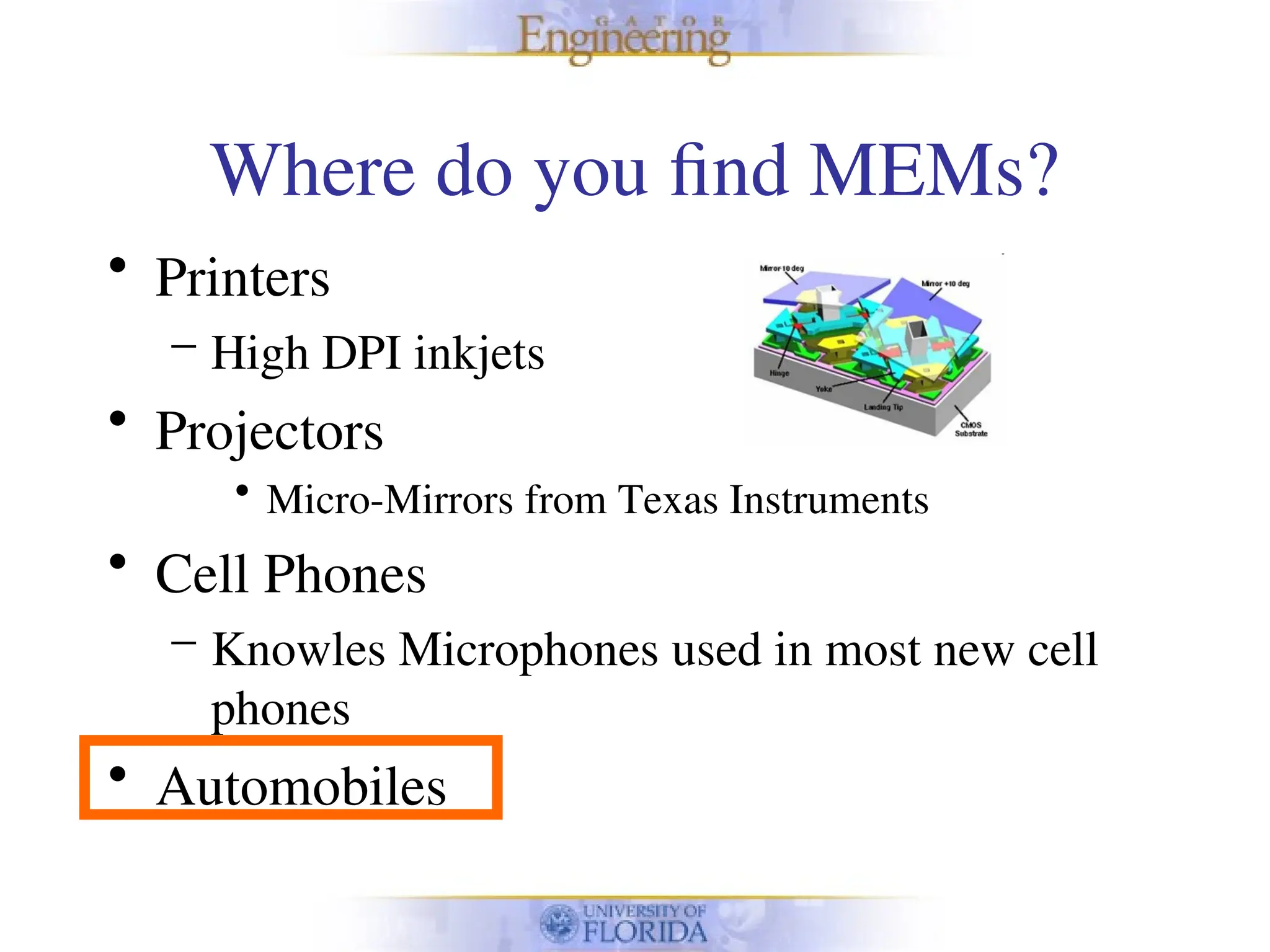
• Projectors
• Micro-Mirrors from Texas Instruments
• Cell Phones
– Knowles Microphones used in most new cell
phones
• Automobiles
5.
Why MEMS
• Small
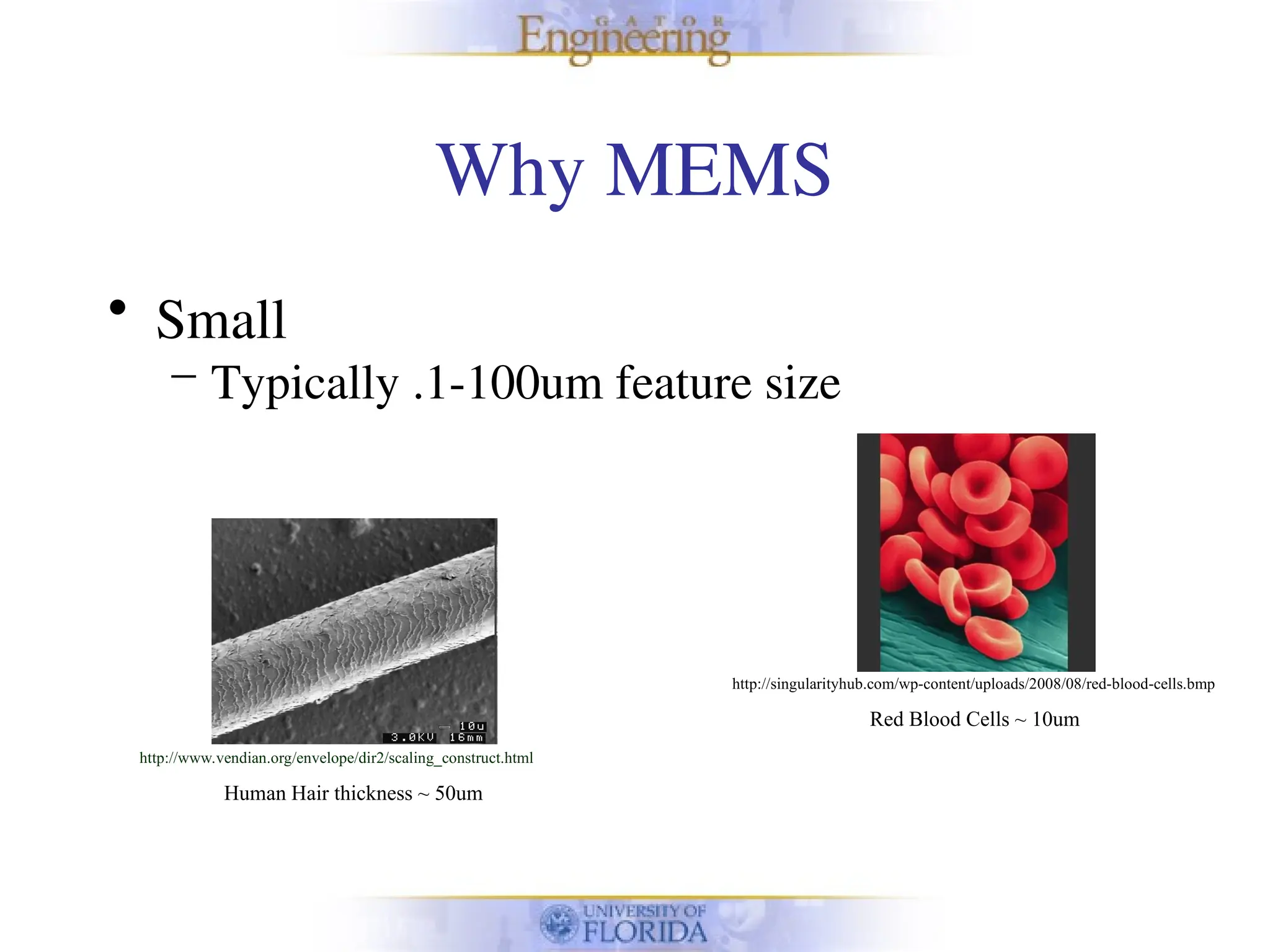
–Typically .1-100um feature size
Human Hair thickness ~ 50um
http://www.vendian.org/envelope/dir2/scaling_construct.html
http://singularityhub.com/wp-content/uploads/2008/08/red-blood-cells.bmp
Red Blood Cells ~ 10um
6.
Why MEMS
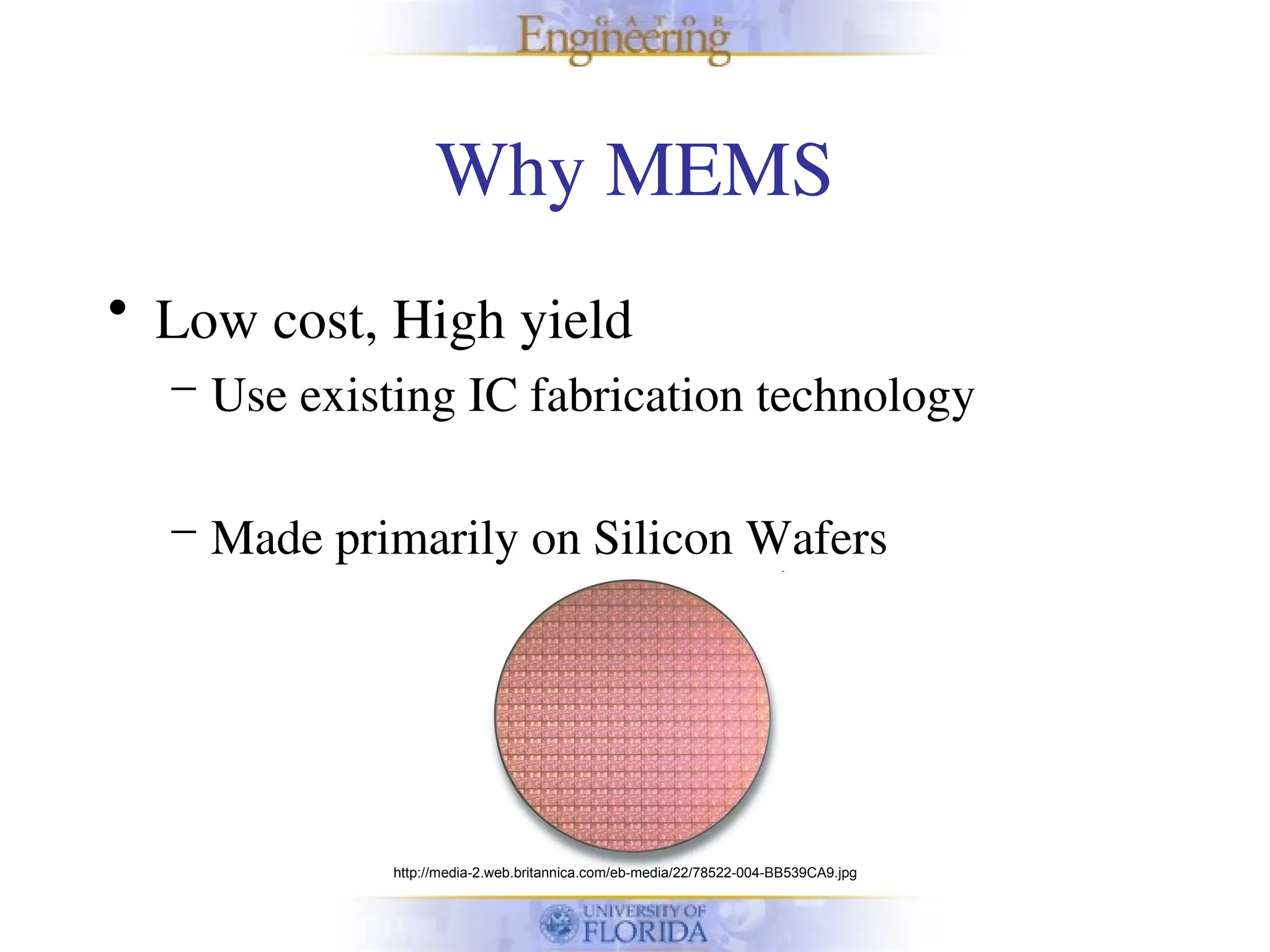
• Lowcost, High yield
– Use existing IC fabrication technology
– Made primarily on Silicon Wafers
http://media-2.web.britannica.com/eb-media/22/78522-004-BB539CA9.jpg
7.
Why MEMS
• Favorablescaling for a lot of applications
– Flow-rate sensors
– Electrostatics
– Magnetism
– Many others
• Not all applications
– Solar Power
– Turbulent Boundary Energy Harvesting
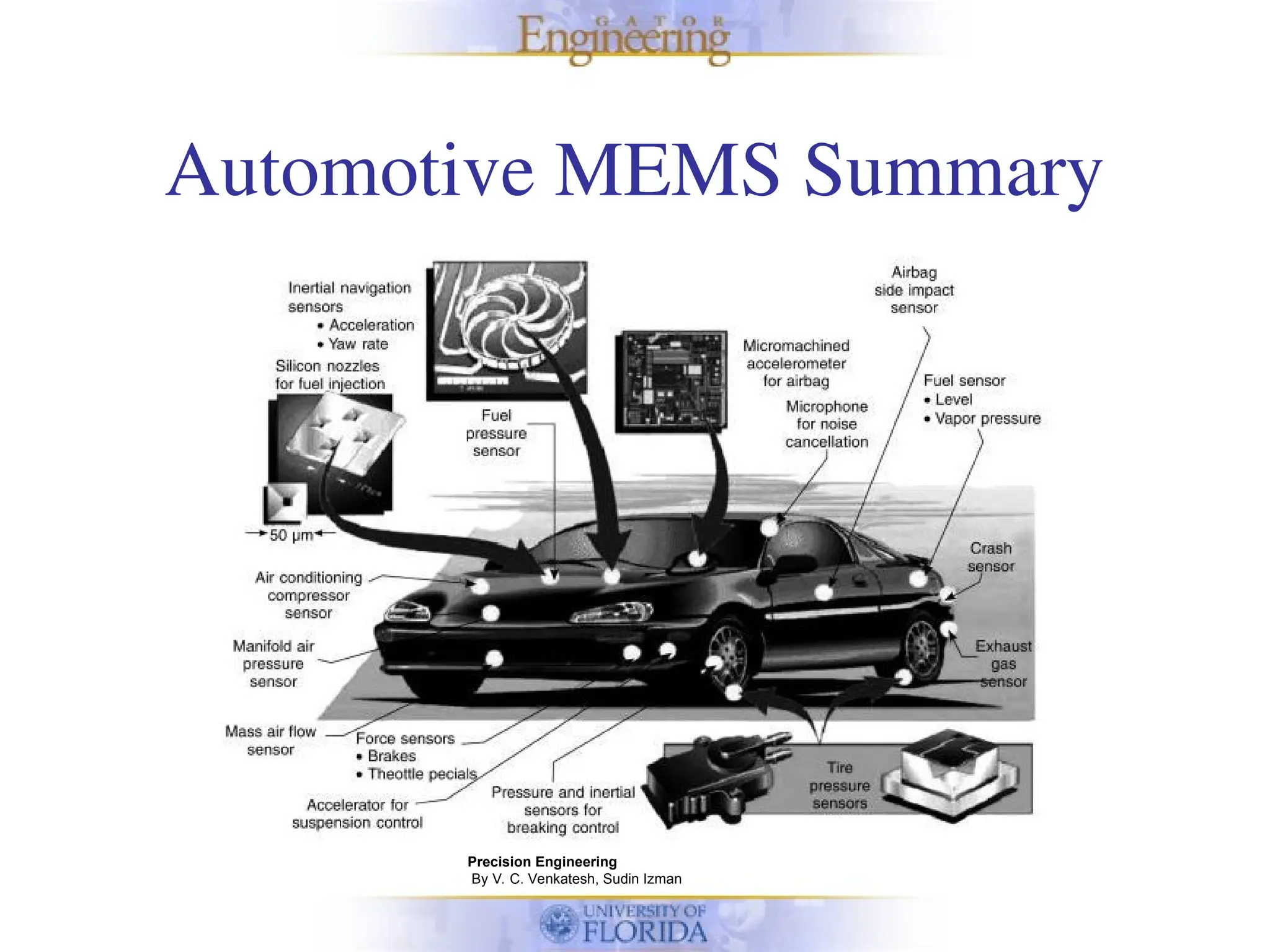
Automotive MEMS
• MEMSSensors and Actuators used to
control various elements of the automobile
– Powertrain and Chassis control
• Ex: Manifold Air Temperature
– Comfort and Convenience
• Ex: Air-Temperature Control
– Communications
• Ex: Wireless
10.
Where it Began
•1979 - First recorded use of MEMs in automobiles
• Federal emission standards required monitoring the air-to-
fuel ratio of the engine
– Density of air value was needed
• Many different sensor technologies were introduced to
solve this problem
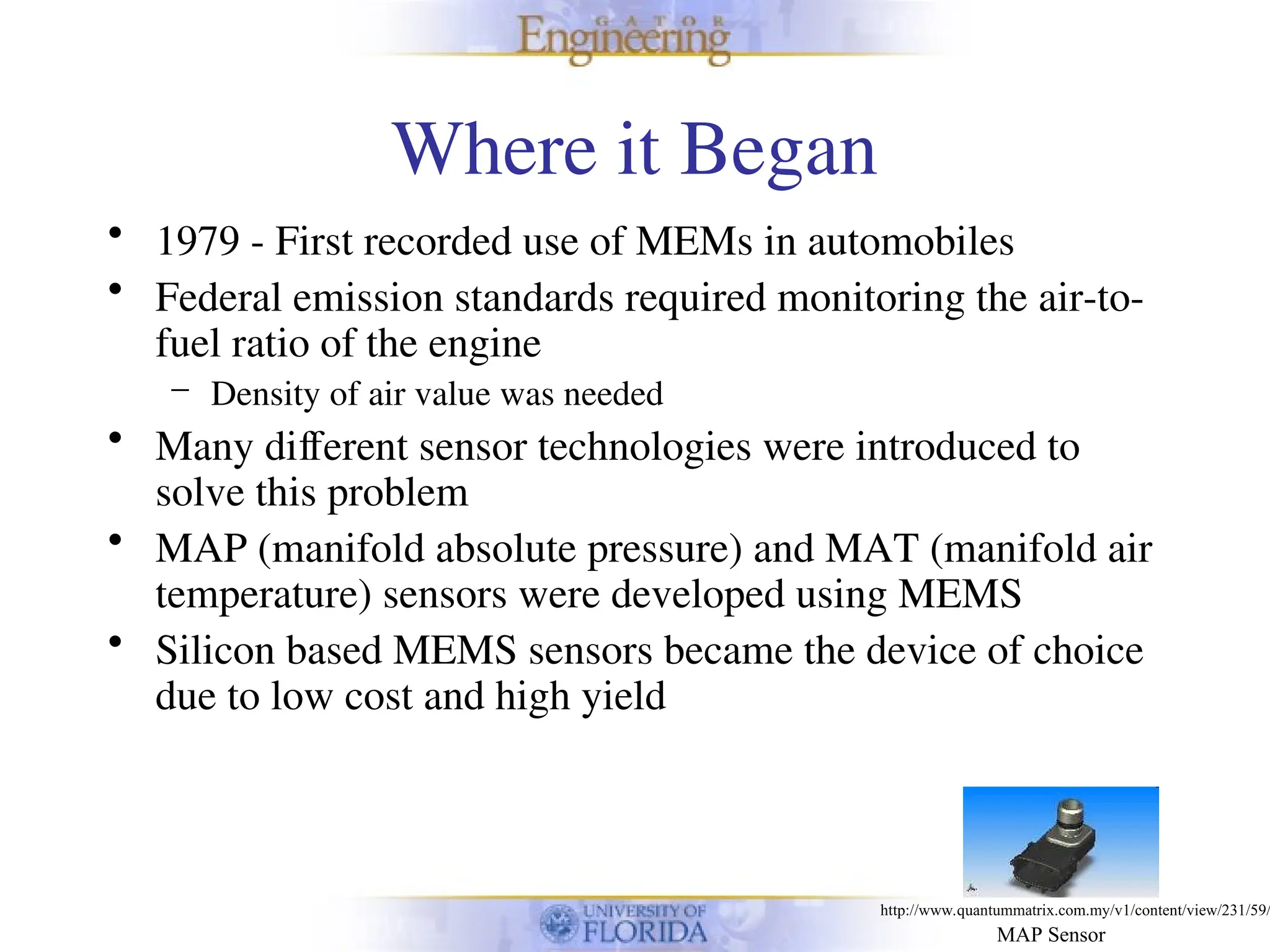
• MAP (manifold absolute pressure) and MAT (manifold air
temperature) sensors were developed using MEMS
• Silicon based MEMS sensors became the device of choice
due to low cost and high yield
MAP Sensor
http://www.quantummatrix.com.my/v1/content/view/231/59/
11.
Who Developed It
•Two groups
– Delco Electronics Group(General Motors)
• Used piezoresistive sensing
– Ford
• Used capacitive sensing
12.
Piezoresistive Sensors
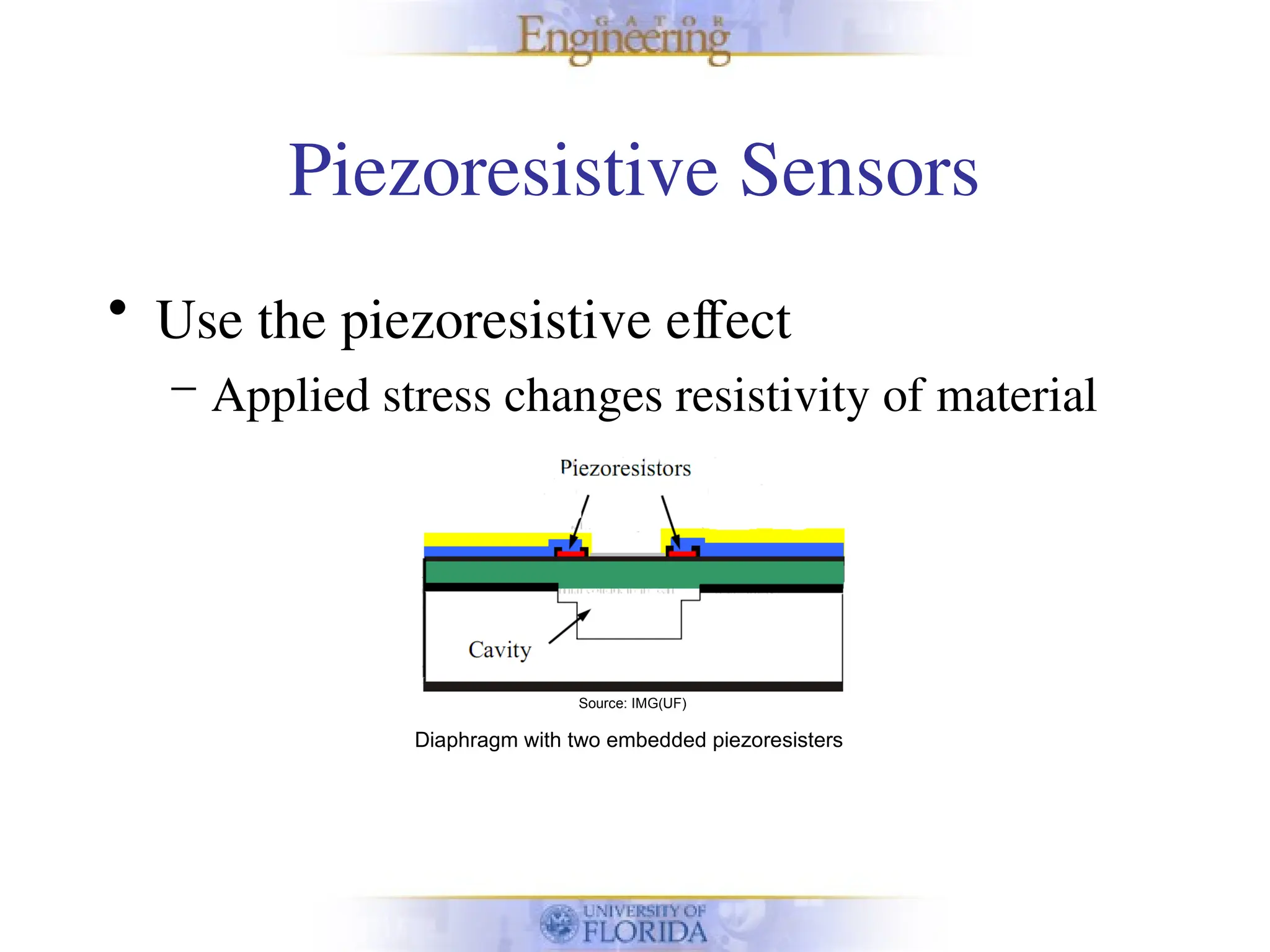
• Usethe piezoresistive effect
– Applied stress changes resistivity of material
Diaphragm with two embedded piezoresisters
Source: IMG(UF)
13.
Capacitive Sensors
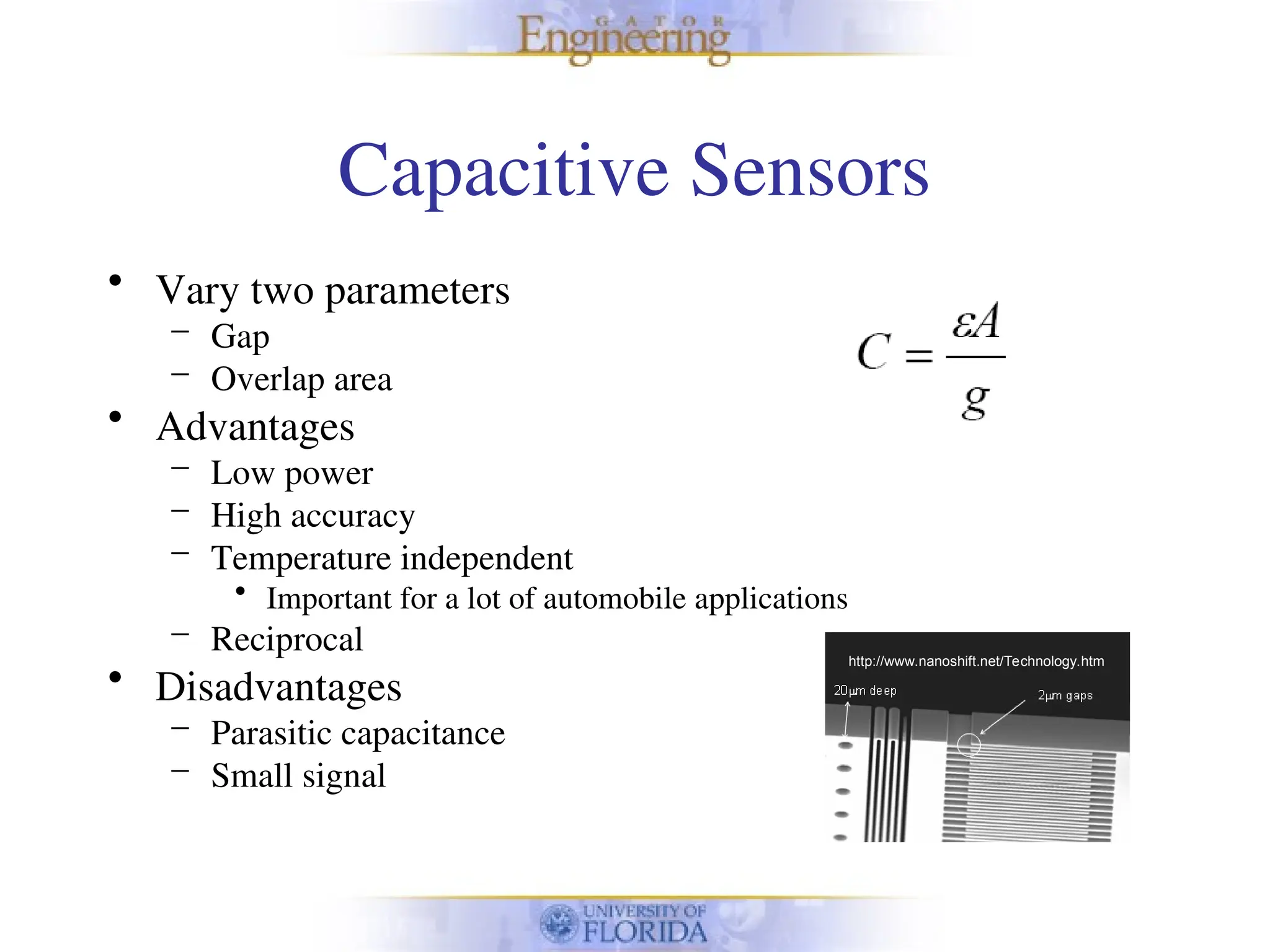
• Varytwo parameters
– Gap
– Overlap area
• Advantages
– Low power
– High accuracy
– Temperature independent
• Important for a lot of automobile applications
– Reciprocal
• Disadvantages
– Parasitic capacitance
– Small signal
http://www.nanoshift.net/Technology.htm
14.
What about Actuators?
•Traditionally only sensors were developed
for automobiles
• Actuators started to become popular as
MEMs development costs decreased
• Popular actuators include
– Microphones
– Fuel injection nozzles
15.
Fabrication
• Use basicIC fabrication
– Masks/layers/CVD/oxidation/etc
• MEMS specific fabrication
– DRIE (Deep reactive ion etch)
– SOI (silicon on insulator)
16.
General MEMS Packaging
•The most important and expensive part of a
MEMS sensor/actuator
– ~45% of the cost of designing a MEMS device is spent
on packaging
• Often times packaging constraints will prevent a
design from being produced
– May require too complex of a package design for
realistic implementation
• Package can greatly change the response of a
device
– Sensitivity/Dynamic Range/etc all effected by package
17.
Automotive MEMS Packaging
•Automotive sensors generally only allowed
to have 3 wires connected to them
– Minimizes cost
• Environment concerns are especially
important in automotive applications
– Engine heat
– High acceleration/deceleration
– Humidity
References
• Application ofMEMS Technology in
Automotive Sensors and Actuators,
David Eddy and Douglas Spanks
• http://www.img.ufl.edu/ms/eel5225/html/
assignments.htm