Microprocessor & its Applications
Module 4
Memory & I/O Interfacing
Dr. Girisha G S
Dept. of CSE
SoE, DSU, Bengaluru 1
Memory Interfacing in 8086
- Every microprocessor-based system has a memory system
- Almost all systems contain two main types of memory:
- read-only memory (ROM) and
- random access memory (RAM) or read/write memory.
MEMORY DEVICES
- Memory is simply a device that can used to store information
- Semi conductor memories are extensively used
- Each bit of binary data is stored in a tiny circuit called a memory cell consisting of one
to several transistors.
Memory capacity
The number of bits that a semiconductor memory chip can store is called a chip capacity
Memory Organization
- Each memory chip contains 2N locations, where N is the no of address pins on the chip
- Each location contains M bits, where M is the no of data pins on the chip
- The entire chip will contain 2N × M bits
E.g For 4K × 4 , 212= 4096 memory locations, each location holds 4 its
So, N=12 , M=4
Two major types
– RAM (Random-access memory): Read + Write
– ROM (Read-only memory): perform only read operation
Types of ROM
- PROM
- EPROM
- EEPROM
Types of RAM
- SRAM
- DRAM
Memory Pin Connections
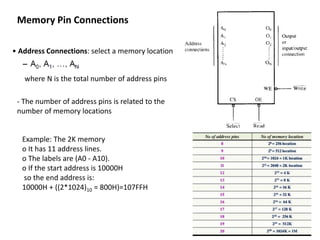
• Address Connections: select a memory location
where N is the total number of address pins
- The number of address pins is related to the
number of memory locations
Example: The 2K memory
o It has 11 address lines.
o The labels are (A0 - A10).
o If the start address is 10000H
so the end address is:
10000H + ((2*1024)10 = 800H)=107FFH
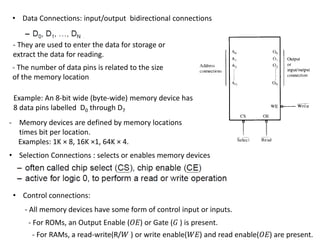
• Data Connections: input/output bidirectional connections
• Selection Connections : selects or enables memory devices
- The number of data pins is related to the size
of the memory location
- They are used to enter the data for storage or
extract the data for reading.
Example: An 8-bit wide (byte-wide) memory device has
8 data pins labelled D0 through D7
- Memory devices are defined by memory locations
times bit per location.
Examples: 1K × 8, 16K ×1, 64K × 4.
• Control connections:
- All memory devices have some form of control input or inputs.
- For ROMs, an Output Enable (𝑂𝐸) or Gate (𝐺 ) is present.
- For RAMs, a read-write(R/𝑊 ) or write enable(𝑊𝐸) and read enable(𝑂𝐸) are present.
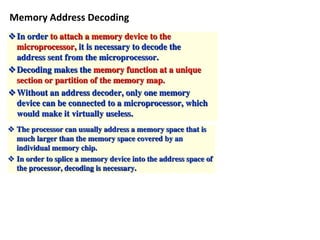
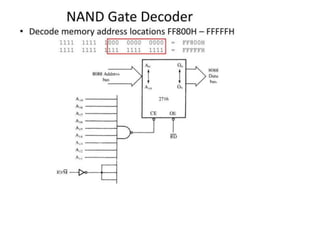
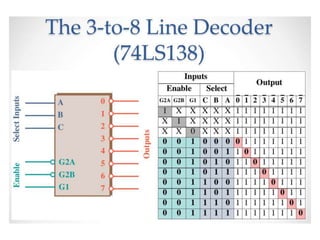
Memory Address Decoding
Memory interface
Memory interface

Memory interface

  • 1.
    Microprocessor & itsApplications Module 4 Memory & I/O Interfacing Dr. Girisha G S Dept. of CSE SoE, DSU, Bengaluru 1
  • 2.
    Memory Interfacing in8086 - Every microprocessor-based system has a memory system - Almost all systems contain two main types of memory: - read-only memory (ROM) and - random access memory (RAM) or read/write memory. MEMORY DEVICES - Memory is simply a device that can used to store information - Semi conductor memories are extensively used - Each bit of binary data is stored in a tiny circuit called a memory cell consisting of one to several transistors. Memory capacity The number of bits that a semiconductor memory chip can store is called a chip capacity
  • 3.
    Memory Organization - Eachmemory chip contains 2N locations, where N is the no of address pins on the chip - Each location contains M bits, where M is the no of data pins on the chip - The entire chip will contain 2N × M bits E.g For 4K × 4 , 212= 4096 memory locations, each location holds 4 its So, N=12 , M=4 Two major types – RAM (Random-access memory): Read + Write – ROM (Read-only memory): perform only read operation Types of ROM - PROM - EPROM - EEPROM Types of RAM - SRAM - DRAM
  • 4.
    Memory Pin Connections •Address Connections: select a memory location where N is the total number of address pins - The number of address pins is related to the number of memory locations Example: The 2K memory o It has 11 address lines. o The labels are (A0 - A10). o If the start address is 10000H so the end address is: 10000H + ((2*1024)10 = 800H)=107FFH
  • 5.
    • Data Connections:input/output bidirectional connections • Selection Connections : selects or enables memory devices - The number of data pins is related to the size of the memory location - They are used to enter the data for storage or extract the data for reading. Example: An 8-bit wide (byte-wide) memory device has 8 data pins labelled D0 through D7 - Memory devices are defined by memory locations times bit per location. Examples: 1K × 8, 16K ×1, 64K × 4. • Control connections: - All memory devices have some form of control input or inputs. - For ROMs, an Output Enable (𝑂𝐸) or Gate (𝐺 ) is present. - For RAMs, a read-write(R/𝑊 ) or write enable(𝑊𝐸) and read enable(𝑂𝐸) are present.
  • 6.

Editor's Notes

  • #3 The memory interfacing circuit is used to access memory quit frequently to read instruction codes and data stored in the memory. The read / write operations are monitored by control  The memory cells are laid out in rectangular arrays on the surface of the chip. The 1-bit memory cells are grouped in small units called words which are accessed together as a single memory address. signals Read-only memory contains system software and permanent system data, while RAM contains temporary data and application software. This chapter explains how to interface both memory types to the Intel family of microprocessors
  • #5 Address inputs are labeled from A0 to An. Each memory device has an input, that selects or enables the memory device. This kind of input is most often called a chip select (CS), chip enable (CE) or simply select (S ) input