Ch 5: Membrane Dynamics, Part 2 Cell membrane structures and functions Membranes form fluid body compartments Membranes as barriers and gatekeepers How products move across membranes i.e., methods of transport Vesicular Transepithelial Osmosis Distribution of water and solutes in cells & the body Chemical and electrical imbalances Resting Membrane Potential Membrane permeability and changes
Membrane Dynamics, Part 1  Review Law of Mass Balance Ins = outs Diffusion Too slow for many processes Facilitated Diffusion Carrier proteins Protein-mediated Transport Very selective Active Transport uses ATP Na +  - K +  ATPase pump
Vesicular Transport Movement of  macromolecules  across cell membrane: Phagocytosis (specialized cells only) Endocytosis Pinocytosis Receptor mediated endocytosis (Caveolae) Potocytosis Exocytosis
1.  Phagocytosis Requires energy  Cell engulfs particle into vesicle via  pseudopod  formation E.g.:  some WBCs  engulf bacteria Vesicles formed are much larger than those formed by endocytosis Phagosome fuses with lysosomes    ?  (see Fig. 5-23 )
2.  Endocytosis Requires energy  No pseudopodia - Membrane surface indents Smaller vesicles Nonselective:  Pinocytosis  for fluids & dissolved substances Selective: Receptor Mediated Endocytosis   via clathrin-coated pits  -  Example: LDL cholesterol and  Familial Hypercholesterolemia  Potocytosis  via caveolae Fig 5-24
Receptor Mediated Endocytosis and Membrane Recycling Fig 5-28
3.  Exocytosis Intracellular vesicle fuses with membrane     Requires energy (ATP) and Ca 2+ Uses:   large lipophobic molecule secretion; receptor insertion;  waste removal
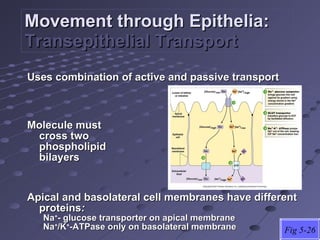
Movement through Epithelia:  Transepithelial Transport Uses combination of active and passive transport Molecule must    cross two    phospholipid    bilayers Apical and basolateral cell membranes have different proteins : Na + - glucose transporter on apical membrane Na + /K + -ATPase only on basolateral membrane Fig 5-26
Transepithelial Transport of Glucose Na + /Glucose  symporter only found on apical side Na + /K + -ATPase  only found on basolateral side Facilitated diffusion
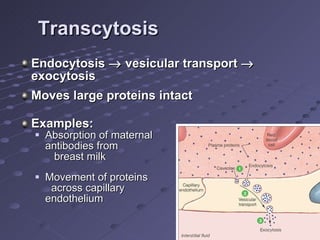
Transcytosis Endocytosis    vesicular transport    exocytosis  Moves large proteins intact Examples:  Absorption of maternal     antibodies from  breast milk Movement of proteins  across capillary  endothelium
Distribution of Solutes in Body Depends on selective permeability of cell membrane transport mechanisms available Water is in osmotic equilibrium (free movement across membranes) Ions and most solutes are in chemical disequilibrium (e.g., Na-K ATPase Pump) Electrical disequilibrium  between ECF and ICF Fig 5-33
Distribution of Solutes in Body Fluid Compartments Compare to Fig 5-33
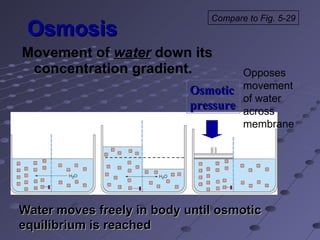
Osmosis Movement of  water  down its concentration gradient. Water   moves freely in body until osmotic equilibrium is reached Compare to Fig. 5-29 Osmotic pressure Opposes movement  of water across membrane
Molarity vs. Osmolarity In chemistry: Mole / L Avogadro’s # / L In Physiology Important is not # of molecules / L but # of particles / L: osmol/L or OsM Why? Osmolarity takes into account dissociation (solubility) of molecules in solution Osmolality = OsM/Kg of sol’n
Convert Molarity to Osmolarity Osmolarity = # of particles / L of solution 1 M glucose = 1 OsM glucose 1 M NaCl = 2 OsM NaCl 1 M MgCl 2  = 3 OsM MgCl 2 Osmolarity of human body ~ 300 mOsM Compare isosmotic, hyperosmotic, hyposmotic (p 156)
Tonicity Physiological term describing how cell volume changes if cell placed in the solution Always comparative.  Has no units. Isotonic sol’n = No change in cell Hypertonic sol’n = cell shrinks Hypotonic = cell expands   Depends not just on osmolarity but on  nature of solutes and permeability of membrane
Penetrating vs. Nonpenetrating Solutes Penetrating solute: can enter cell (glucose, urea) Nonpenetrating solutes: cannot enter cell (sucrose, NaCl*) Determine relative conc. of nonpenetrating solutes in solution and in cell to determine tonicity. Water will move to dilute nonpenetrating solutes Penetrating solutes will distribute to equilibrium Fig 5-30
Osmolarity and Tonicity Comparison Compare to Fig 5-35 A is  isosmotic  to B A is  hypotonic  to B
IV Fluid Therapy 2 different purposes: Get fluid into dehydrated cells or Keep fluid in extra-cellular compartment
the end Electrical Disequilibrium and Resting Membrane Potential (pp.156-163) will be covered at the beginning of  Ch 8
 
Which of the following is a way for solutes in a aqueous solution to move from an area of high solute concentration to an area of low solute concentration? Facilitated diffusion Osmosis Active transport A and B None of these
Which of the following defines the term specificity? movement of molecules by the use of vesicles the energy required to move molecules a group of carrier proteins operating at their maximum rate carrier transport of a group of closely related molecules none of these
Water will always move from ___________ situations to _______ situations. Hyperosmotic, hyposmotic Hyposmotic, hyperosmotic Hyposmotic, isosmotic Hyperosmotic, isosmotic
Which of the following pairs of molecular characteristics favors diffusion through the cell membrane? Large, polar Large, non-polar Small, polar Small, non-polar
Which of the following is a way for solutes in a aqueous solution to move from an area of high solute concentration to an area of low solute concentration? Facilitated diffusion Osmosis Active transport A and B None of these

Membrane Dynamics, Part 2

  • 1.
    Ch 5: MembraneDynamics, Part 2 Cell membrane structures and functions Membranes form fluid body compartments Membranes as barriers and gatekeepers How products move across membranes i.e., methods of transport Vesicular Transepithelial Osmosis Distribution of water and solutes in cells & the body Chemical and electrical imbalances Resting Membrane Potential Membrane permeability and changes
  • 2.
    Membrane Dynamics, Part1 Review Law of Mass Balance Ins = outs Diffusion Too slow for many processes Facilitated Diffusion Carrier proteins Protein-mediated Transport Very selective Active Transport uses ATP Na + - K + ATPase pump
  • 3.
    Vesicular Transport Movementof macromolecules across cell membrane: Phagocytosis (specialized cells only) Endocytosis Pinocytosis Receptor mediated endocytosis (Caveolae) Potocytosis Exocytosis
  • 4.
    1. PhagocytosisRequires energy Cell engulfs particle into vesicle via pseudopod formation E.g.: some WBCs engulf bacteria Vesicles formed are much larger than those formed by endocytosis Phagosome fuses with lysosomes  ? (see Fig. 5-23 )
  • 5.
    2. EndocytosisRequires energy No pseudopodia - Membrane surface indents Smaller vesicles Nonselective: Pinocytosis for fluids & dissolved substances Selective: Receptor Mediated Endocytosis via clathrin-coated pits - Example: LDL cholesterol and Familial Hypercholesterolemia Potocytosis via caveolae Fig 5-24
  • 6.
    Receptor Mediated Endocytosisand Membrane Recycling Fig 5-28
  • 7.
    3. ExocytosisIntracellular vesicle fuses with membrane  Requires energy (ATP) and Ca 2+ Uses: large lipophobic molecule secretion; receptor insertion; waste removal
  • 8.
    Movement through Epithelia: Transepithelial Transport Uses combination of active and passive transport Molecule must cross two phospholipid bilayers Apical and basolateral cell membranes have different proteins : Na + - glucose transporter on apical membrane Na + /K + -ATPase only on basolateral membrane Fig 5-26
  • 9.
    Transepithelial Transport ofGlucose Na + /Glucose symporter only found on apical side Na + /K + -ATPase only found on basolateral side Facilitated diffusion
  • 10.
    Transcytosis Endocytosis  vesicular transport  exocytosis Moves large proteins intact Examples: Absorption of maternal antibodies from breast milk Movement of proteins across capillary endothelium
  • 11.
    Distribution of Solutesin Body Depends on selective permeability of cell membrane transport mechanisms available Water is in osmotic equilibrium (free movement across membranes) Ions and most solutes are in chemical disequilibrium (e.g., Na-K ATPase Pump) Electrical disequilibrium between ECF and ICF Fig 5-33
  • 12.
    Distribution of Solutesin Body Fluid Compartments Compare to Fig 5-33
  • 13.
    Osmosis Movement of water down its concentration gradient. Water moves freely in body until osmotic equilibrium is reached Compare to Fig. 5-29 Osmotic pressure Opposes movement of water across membrane
  • 14.
    Molarity vs. OsmolarityIn chemistry: Mole / L Avogadro’s # / L In Physiology Important is not # of molecules / L but # of particles / L: osmol/L or OsM Why? Osmolarity takes into account dissociation (solubility) of molecules in solution Osmolality = OsM/Kg of sol’n
  • 15.
    Convert Molarity toOsmolarity Osmolarity = # of particles / L of solution 1 M glucose = 1 OsM glucose 1 M NaCl = 2 OsM NaCl 1 M MgCl 2 = 3 OsM MgCl 2 Osmolarity of human body ~ 300 mOsM Compare isosmotic, hyperosmotic, hyposmotic (p 156)
  • 16.
    Tonicity Physiological termdescribing how cell volume changes if cell placed in the solution Always comparative. Has no units. Isotonic sol’n = No change in cell Hypertonic sol’n = cell shrinks Hypotonic = cell expands Depends not just on osmolarity but on nature of solutes and permeability of membrane
  • 17.
    Penetrating vs. NonpenetratingSolutes Penetrating solute: can enter cell (glucose, urea) Nonpenetrating solutes: cannot enter cell (sucrose, NaCl*) Determine relative conc. of nonpenetrating solutes in solution and in cell to determine tonicity. Water will move to dilute nonpenetrating solutes Penetrating solutes will distribute to equilibrium Fig 5-30
  • 18.
    Osmolarity and TonicityComparison Compare to Fig 5-35 A is isosmotic to B A is hypotonic to B
  • 19.
    IV Fluid Therapy2 different purposes: Get fluid into dehydrated cells or Keep fluid in extra-cellular compartment
  • 20.
    the end ElectricalDisequilibrium and Resting Membrane Potential (pp.156-163) will be covered at the beginning of Ch 8
  • 21.
  • 22.
    Which of thefollowing is a way for solutes in a aqueous solution to move from an area of high solute concentration to an area of low solute concentration? Facilitated diffusion Osmosis Active transport A and B None of these
  • 23.
    Which of thefollowing defines the term specificity? movement of molecules by the use of vesicles the energy required to move molecules a group of carrier proteins operating at their maximum rate carrier transport of a group of closely related molecules none of these
  • 24.
    Water will alwaysmove from ___________ situations to _______ situations. Hyperosmotic, hyposmotic Hyposmotic, hyperosmotic Hyposmotic, isosmotic Hyperosmotic, isosmotic
  • 25.
    Which of thefollowing pairs of molecular characteristics favors diffusion through the cell membrane? Large, polar Large, non-polar Small, polar Small, non-polar
  • 26.
    Which of thefollowing is a way for solutes in a aqueous solution to move from an area of high solute concentration to an area of low solute concentration? Facilitated diffusion Osmosis Active transport A and B None of these

Editor's Notes

  • #6 Familial Hypercholesterolemia is an autosomal dominate disease which occurs about 1 in every 500 people . The homozygous FH is more rare, occuring with the frequency of about 1 in a million. The statistics for the homozygous FH is not surprising though, since patients suffering from two alleles of this gene usually do not survive pass their teens. The condition of hypercholesterolemia in FH patients are detectable at birth or shortly thereafter. The cholesterol levels in heterozygous patients are between350 to 500 mg/dL, and in homozygous, the levels are between 700 to 1,200 mg/dL (see NCEP table for comparison).
  • #8 large lipophobic molecule secretion: mucus and protein hormones
  • #10 Ouabain = Na + /K + -ATPase inhibitor – cannot penetrate through cell membrane.
  • #14 Is osmosis the same as the diffusion of water? Almost but not exactly. -volume change Force (such as pressure) can oppose osmosis not diffusion
  • #18 NaCl is considered to be functionally nonpenetrating, as it gets pumped out of cell as soon as it enters.
  • #23 A
  • #24 A
  • #25 B
  • #26 D
  • #27 A