Observations on Mega Multisite, Multitenant Management and Implementation
Some Context Before After
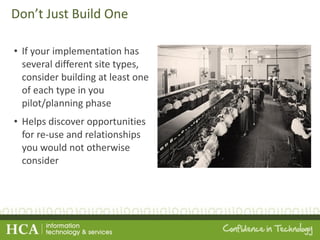
Don’t Just Build One If your implementation has several different site types, consider building at least one of each type in you pilot/planning phase Helps discover opportunities for re-use and relationships you would not otherwise consider
Testing 1, 2, 3… If you have an implementation of significant scale can you really manage without a test environment? Developers and site builders need practice and then a process to move/ deploy code & product
Think Roles Not Permissions dotCMS has a super granular and powerful content permissions scheme…  Don ’t use it, as much as possible Set up roles early, establish them and battle test them with your user base The work of  “Content Management” is similar no matter the industry – identify the ways certain people/roles will use the system.
Share Up, Share Down, Share All Around Town Regardless of hierarchy or relationship of sites to one another, work to make content flow and be available across all sites  Preferably, do this without managing permissions Globalinc, Shared Content Host Be sure to facilitate content sharing across the entire network of sites
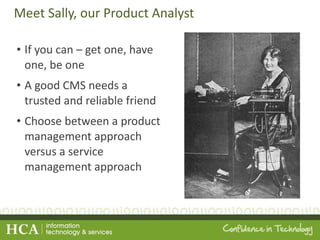
Meet Sally, our Product Analyst If you can – get one, have one, be one A good CMS needs a trusted and reliable friend Choose between a product management approach versus a service management approach
Code Globally – Style Locally An almost philosophical approach, you probably can ’t think this way too much Is this supportable if I do this for 700 websites?  Globalinc, Local CSS Go ahead! Manage the code when you can (and should)
Ownership Has Rights and Privileges Insist on clear lines of ownership Decide what is  “global” code and own it - Decide what is “local” code and  do not own it Insist that site owners, own their sites and local code… then just avert your eyes Understand what code your CMS vendor will own, manage, warranty and understand what is your  “implementation” code
Decentralized (multi-team) Development  Coordination is the key – local, other team, corporate development Process & routine upgrades Integration Guidelines – when to integrate when you won ’t  It paid off… documented our standards and process even before we knew how it would work – take a best guess, change as you go. DRAFT!
Love Your Data Structures The path to consistency The way to speed and scale What about schema.org and micro tags? Think ahead Provides ability to  “use properties” for presentation
Go Ahead! Manage the Data… control freak! Be vigilant to reduce variations in structures and structured data, really you must resist temptation to compromise and customize NO ONE (except the content gods) change structures… and the gods better have a &^@!$ good reason to do so Is this supportable if I do this for 700 websites? Scalable? If you own the CMS, you own the structures Managing structures well ensures your system will play well with other systems
Mobile Really – you built that site and it looks like that on an iPhone?  Consider a Mobile First approach to website building No Mobile = FAIL
Governance - When in the course of human events…. Governance and bureaucracy How long can you wait to keep doing nothing?
Some Will Some Won ’t  -  non-technology aspects of your project The People and Change-Management aspects could make or break your implementation project Face the facts – the system is good and can be learned by most, avoid too much accommodation It ’s not necessarily all about training but it is all about who will and who won’t learn the new system  People use systems. People decide if they are willing or not to learn something new…
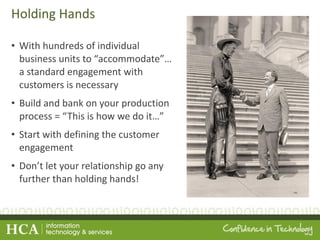
Holding Hands With hundreds of individual business units to  “accommodate”… a standard engagement with customers is necessary Build and bank on your production process =  “This is how we do it…” Start with defining the customer engagement Don ’t let your relationship go any further than holding hands!
Embrace Your New BFF Along the way you ’ll discover some new BFF’s – when you’ve identified them  and  they have proven themselves, embrace and support them, give ‘em extra love… Early adopters Build community, teach these customers to fly…
Thank You contact me: [email_address]

How Does an Organization Manage Hundreds of Sites?

  • 1.
    Observations on MegaMultisite, Multitenant Management and Implementation
  • 2.
  • 3.
    Don’t Just BuildOne If your implementation has several different site types, consider building at least one of each type in you pilot/planning phase Helps discover opportunities for re-use and relationships you would not otherwise consider
  • 4.
    Testing 1, 2,3… If you have an implementation of significant scale can you really manage without a test environment? Developers and site builders need practice and then a process to move/ deploy code & product
  • 5.
    Think Roles NotPermissions dotCMS has a super granular and powerful content permissions scheme… Don ’t use it, as much as possible Set up roles early, establish them and battle test them with your user base The work of “Content Management” is similar no matter the industry – identify the ways certain people/roles will use the system.
  • 6.
    Share Up, ShareDown, Share All Around Town Regardless of hierarchy or relationship of sites to one another, work to make content flow and be available across all sites Preferably, do this without managing permissions Globalinc, Shared Content Host Be sure to facilitate content sharing across the entire network of sites
  • 7.
    Meet Sally, ourProduct Analyst If you can – get one, have one, be one A good CMS needs a trusted and reliable friend Choose between a product management approach versus a service management approach
  • 8.
    Code Globally –Style Locally An almost philosophical approach, you probably can ’t think this way too much Is this supportable if I do this for 700 websites? Globalinc, Local CSS Go ahead! Manage the code when you can (and should)
  • 9.
    Ownership Has Rightsand Privileges Insist on clear lines of ownership Decide what is “global” code and own it - Decide what is “local” code and do not own it Insist that site owners, own their sites and local code… then just avert your eyes Understand what code your CMS vendor will own, manage, warranty and understand what is your “implementation” code
  • 10.
    Decentralized (multi-team) Development Coordination is the key – local, other team, corporate development Process & routine upgrades Integration Guidelines – when to integrate when you won ’t It paid off… documented our standards and process even before we knew how it would work – take a best guess, change as you go. DRAFT!
  • 11.
    Love Your DataStructures The path to consistency The way to speed and scale What about schema.org and micro tags? Think ahead Provides ability to “use properties” for presentation
  • 12.
    Go Ahead! Managethe Data… control freak! Be vigilant to reduce variations in structures and structured data, really you must resist temptation to compromise and customize NO ONE (except the content gods) change structures… and the gods better have a &^@!$ good reason to do so Is this supportable if I do this for 700 websites? Scalable? If you own the CMS, you own the structures Managing structures well ensures your system will play well with other systems
  • 13.
    Mobile Really –you built that site and it looks like that on an iPhone? Consider a Mobile First approach to website building No Mobile = FAIL
  • 14.
    Governance - Whenin the course of human events…. Governance and bureaucracy How long can you wait to keep doing nothing?
  • 15.
    Some Will SomeWon ’t - non-technology aspects of your project The People and Change-Management aspects could make or break your implementation project Face the facts – the system is good and can be learned by most, avoid too much accommodation It ’s not necessarily all about training but it is all about who will and who won’t learn the new system People use systems. People decide if they are willing or not to learn something new…
  • 16.
    Holding Hands Withhundreds of individual business units to “accommodate”… a standard engagement with customers is necessary Build and bank on your production process = “This is how we do it…” Start with defining the customer engagement Don ’t let your relationship go any further than holding hands!
  • 17.
    Embrace Your NewBFF Along the way you ’ll discover some new BFF’s – when you’ve identified them and they have proven themselves, embrace and support them, give ‘em extra love… Early adopters Build community, teach these customers to fly…
  • 18.
    Thank You contactme: [email_address]