Things to do before writing
a single line of code
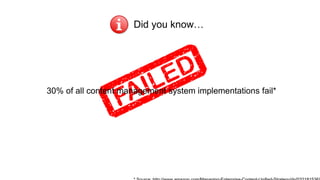
Did you know…
30% of all content management system implementations fail*
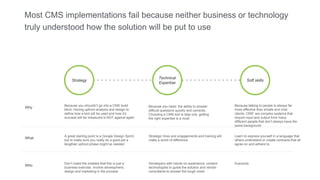
Most CMS implementations fail because neither business or technology
truly understood how the solution will be put to use
Strategy Soft skills
Technical
Expertise
What
A great starting point is a Google Design Sprint
but to make sure you really do a good job a
lengthier upfront phase might be needed
Strategic hires and engagements and training will
make a world of difference
Learn to express yourself in a language that
others understand or create contracts that all
agree on and adhere to.
Because you shouldn’t go into a CMS build
blind. Having upfront analysis and design to
define how a tool will be used and how it’s
success will be measured is NOT against agile!
Why Because you need the ability to answer
difficult questions quickly and correctly.
Choosing a CMS tool is step one, getting
the right expertise is a must
Because talking to people is always far
more effective than emails and chat
clients. CMS’ are complex systems that
require input and output from many
different people that don’t always have the
same background
Who
Don’t make the mistake that this is just a
business exercise. Involve development,
design and marketing in the process
Developers with hands-on experience, content
technologists to guide the solution and vendor
consultants to answer the tough ones!
Everyone
What can be done to ensure a
successful CMS experience?
If nothing more do these three things
Establish a strong
content strategy that
ties in with your
overall brand strategy
Chose your
technology wisely as
not everything
bleeding-edge is the
right tool for the job.
Wherever possible
select ‘boring’
technologies
Deliver a great
experience but not
just for your end-
users but also your
content authors -
they will be the ones
that will judge your
work
Deliver
Chose
Think
The path to CMS success starts with a good content
strategy
User
Insights
Content
Types
Content
Relationship
s
Content
Models
Taxonomy
and
Metadata
Content
Strategy
What do we need to do?
- Identify the scope of your analysis
- Customer needs analysis
- Understand business objectives
- Identify all the content types and their relationships
- Identify current publication processes
- Identify success criteria
What are we going to get?
- Content Model - a collection of content patterns (not only design) that will form the basis of a contract between
designers, developers and marketeers. Think of this as the what that goes inside a component
- Content Taxonomy - in order for your content to be useful and easily discoverable you need to define it’s taxonomy
(hierarchical structure)
- Content Lifecycle - a process that defines the governance around content management from the inception of creating a
content instance (based on a content model) all the way to it’s archiving
Chose your technology wisely
Assuming you opted in the Adobe Marketing Cloud
- Chose ‘boring’* technologies and designs where possible
- Don’t go on developer quests*
- When things hit a snag (and they will) don’t fall back on your ‘default’ knowledge
* Boring technologies and methodologies are tried and tested in the real world and work well with your tool of
choice
What do we need to do?
- Learn to love Sling - it will be your new best friend in no time
- Plan your client libraries structure and hierarchy
- Prefer etc mapping over custom link rewriters
- Plan your markup for targeting and A/B testing
- Consider your integration patterns
What are we going to get?
- A flexible platform that enables and empowers users NOT developers
- A blueprint for system interoperability
- A common set of guidelines for current and new developers
- A multi-tenant ready system
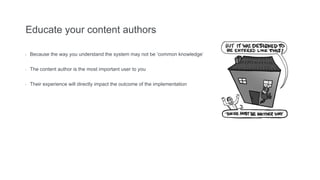
Educate your content authors
- Because the way you understand the system may not be ‘common knowledge’
- The content author is the most important user to you
- Their experience will directly impact the outcome of the implementation
What do we need to do?
- Include the content authors in the analysis and design phase to inform your solution design
- Make author sign-off part of your ‘done’ criteria
- Be prepared for the requirements to change (refer to the ‘boring’ technologies)
- Educate the content authors on the platform and ways to use it
What are we going to get?
- Greater author buy-in - if they are comfortable about the tool they need to use they will actually use it rather than look
for reasons not to
- More consistence author experience - when the user interface is tailored* to the people that interact with it, common
patterns emerge
- A better platform to communicate a consistent message to the end users - this involves enabling content authors to not
only create and present the right content but also to present it to the right individual at the right time
* Tailored to the best of the platforms abilities. Don’t push the platform to it’s breaking point, educate the authors
In conclusion
- Having a content strategy will establish a contract between design, development and content management that will
provide consistent means of communication of ideas, requirements and solutions
- Making decisions about your technical approach before you start delivering is a great way to ensure consistency in your
technical approach and mitigate against situations where developers fall back to ‘safe’ knowledge
- POCing and validating by experimenting with code is still very much encouraged practice
- Work with your content authors and data analysts to understand their needs and challenges promotes buy-in and usage
uptake resulting in higher chances of project success
Questions?
Thanks!
Get in touch
Email: znikolovski@odecee.com.au
Linkedin: https://au.linkedin.com/in/zorannikolovski

CMS Implementation: Things to do before writing a single line of code

  • 2.
    Things to dobefore writing a single line of code
  • 3.
    Did you know… 30%of all content management system implementations fail*
  • 4.
    Most CMS implementationsfail because neither business or technology truly understood how the solution will be put to use Strategy Soft skills Technical Expertise What A great starting point is a Google Design Sprint but to make sure you really do a good job a lengthier upfront phase might be needed Strategic hires and engagements and training will make a world of difference Learn to express yourself in a language that others understand or create contracts that all agree on and adhere to. Because you shouldn’t go into a CMS build blind. Having upfront analysis and design to define how a tool will be used and how it’s success will be measured is NOT against agile! Why Because you need the ability to answer difficult questions quickly and correctly. Choosing a CMS tool is step one, getting the right expertise is a must Because talking to people is always far more effective than emails and chat clients. CMS’ are complex systems that require input and output from many different people that don’t always have the same background Who Don’t make the mistake that this is just a business exercise. Involve development, design and marketing in the process Developers with hands-on experience, content technologists to guide the solution and vendor consultants to answer the tough ones! Everyone
  • 5.
    What can bedone to ensure a successful CMS experience?
  • 6.
    If nothing moredo these three things Establish a strong content strategy that ties in with your overall brand strategy Chose your technology wisely as not everything bleeding-edge is the right tool for the job. Wherever possible select ‘boring’ technologies Deliver a great experience but not just for your end- users but also your content authors - they will be the ones that will judge your work Deliver Chose Think
  • 7.
    The path toCMS success starts with a good content strategy User Insights Content Types Content Relationship s Content Models Taxonomy and Metadata Content Strategy
  • 8.
    What do weneed to do? - Identify the scope of your analysis - Customer needs analysis - Understand business objectives - Identify all the content types and their relationships - Identify current publication processes - Identify success criteria
  • 9.
    What are wegoing to get? - Content Model - a collection of content patterns (not only design) that will form the basis of a contract between designers, developers and marketeers. Think of this as the what that goes inside a component - Content Taxonomy - in order for your content to be useful and easily discoverable you need to define it’s taxonomy (hierarchical structure) - Content Lifecycle - a process that defines the governance around content management from the inception of creating a content instance (based on a content model) all the way to it’s archiving
  • 10.
    Chose your technologywisely Assuming you opted in the Adobe Marketing Cloud - Chose ‘boring’* technologies and designs where possible - Don’t go on developer quests* - When things hit a snag (and they will) don’t fall back on your ‘default’ knowledge * Boring technologies and methodologies are tried and tested in the real world and work well with your tool of choice
  • 11.
    What do weneed to do? - Learn to love Sling - it will be your new best friend in no time - Plan your client libraries structure and hierarchy - Prefer etc mapping over custom link rewriters - Plan your markup for targeting and A/B testing - Consider your integration patterns
  • 12.
    What are wegoing to get? - A flexible platform that enables and empowers users NOT developers - A blueprint for system interoperability - A common set of guidelines for current and new developers - A multi-tenant ready system
  • 13.
    Educate your contentauthors - Because the way you understand the system may not be ‘common knowledge’ - The content author is the most important user to you - Their experience will directly impact the outcome of the implementation
  • 14.
    What do weneed to do? - Include the content authors in the analysis and design phase to inform your solution design - Make author sign-off part of your ‘done’ criteria - Be prepared for the requirements to change (refer to the ‘boring’ technologies) - Educate the content authors on the platform and ways to use it
  • 15.
    What are wegoing to get? - Greater author buy-in - if they are comfortable about the tool they need to use they will actually use it rather than look for reasons not to - More consistence author experience - when the user interface is tailored* to the people that interact with it, common patterns emerge - A better platform to communicate a consistent message to the end users - this involves enabling content authors to not only create and present the right content but also to present it to the right individual at the right time * Tailored to the best of the platforms abilities. Don’t push the platform to it’s breaking point, educate the authors
  • 16.
    In conclusion - Havinga content strategy will establish a contract between design, development and content management that will provide consistent means of communication of ideas, requirements and solutions - Making decisions about your technical approach before you start delivering is a great way to ensure consistency in your technical approach and mitigate against situations where developers fall back to ‘safe’ knowledge - POCing and validating by experimenting with code is still very much encouraged practice - Work with your content authors and data analysts to understand their needs and challenges promotes buy-in and usage uptake resulting in higher chances of project success
  • 17.
  • 18.
    Thanks! Get in touch Email:znikolovski@odecee.com.au Linkedin: https://au.linkedin.com/in/zorannikolovski