Mehedi Hasan Roni(191-29-1472)
MD.Rakibul Islam(C) (191-29-1474)
Sajib Chandra Biswas(191-29-1476)
Mustafizur Rahman(191-29-1504)
From this presentation we are
able to know that:
Components of medical gas.
Containers of medical gas.
Process of medical gas.
Packaging and labeling .
Definition:
A medicinal gas is defined as one
that is manufactured, packaged and
intended for administration to a
patient in neutralization, therapy
and diagnosis.
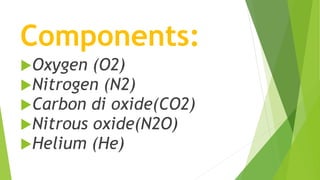
Components:
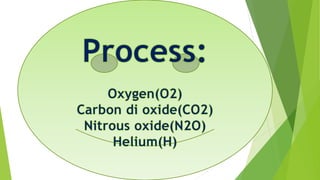
Oxygen (O2)
Nitrogen (N2)
Carbon di oxide(CO2)
Nitrous oxide(N2O)
Helium (He)
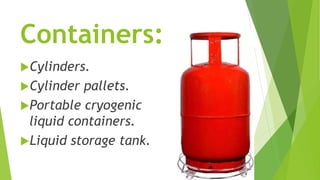
Containers:
Cylinders.
Cylinder pallets.
Portable cryogenic
liquid containers.
Liquid storage tank.
Cylinder and pallets
A cylinder is a closed solid
that has two parallel (usually
circular) bases connected by a
curved surface.
Pallets is a container where
keep cylinder for moving one
place from other.
Portable cryogenic liquid containers
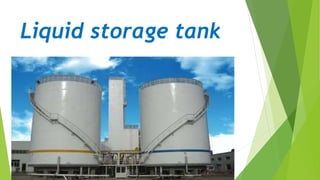
Liquid storage tank
Process of oxygen
Fractionation of liquid air:
It is prepared by fractional distillation of
liquid water. First of all the air is purified by
removing moisture, carbon di oxide and dust.
Then it is compressed into liquid air. The
liquid water fractioned by distillation to get
oxygen.
Electrolysis of water
 In this method , a direct
current passed through 1-25%
KOH and NaOH solution which
contain electrodes due to
electrolysis of the alkaline
solution. Oxygen gets liberated
at anode and hydrogen at
cathode. The liberated oxygen
is then filled under pressure in
metallic cylinder.
Nitrous oxide
 Thermal decomposition of ammonium nitrate is explosive if
temperature is allowed to rise too high. The gas obtained is
purified by washing with sodium dichromate, sodium
hydroxide and water finally, it is filled in cylinder under
pressure at 100 atmosphere pressure.
NH4NO3 N2O + 2H2O
170*C
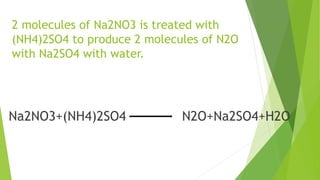
2 molecules of Na2NO3 is treated with
(NH4)2SO4 to produce 2 molecules of N2O
with Na2SO4 with water.
Na2NO3+(NH4)2SO4 N2O+Na2SO4+H2O
Carbon di oxide
By fermentation process:
Fermentation of sugar produces alcohol
and CO2 as byproduct.
C6H12O6 2C2H5OH+CO2
COMMERCIAL
 CO2 from fuel gas which is passed under pressure over
potassium bicarbonate, which yields potassium bicarbonate
and CO2 is liberated. Then it should be compressed into
metallic cylinder.
K2CO3 + CO2 + H20 KHCO3
2KHCO3 K2CO3 + CO2 + H2O
CaCO3 CaO + CO2
Helium
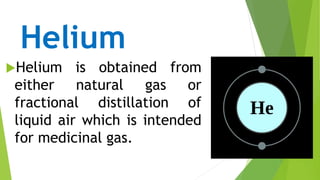
Helium is obtained from
either natural gas or
fractional distillation of
liquid air which is intended
for medicinal gas.
Packaging and labeling
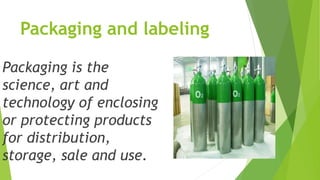
Packaging is the
science, art and
technology of enclosing
or protecting products
for distribution,
storage, sale and use.
Types of labelling
Batch label
Product identification label
Patient information leaflate
Batch label
Batch number
Production and fill date
Expiry date
Quantity
Product identification label
Product identifier
 Hazard label or pictogram,
 Hazard statement
 Precautionary statement
 Supplier information
 Label design change or revision
information
Label control
 Medical gas container labels are current and correct.
 Medical gas container labels are not inadvertently mixed with
industrial labels.
 Medical gas container labels are inventoried and the quantity of
labels used is reconciled against the quantity removed from
inventory.
 Refer to AIGA 023 GMP ‘Guide for Medicinal Gases’ for the
appropriate actions needed for the receipt, storage, issue, fitting
and control of labels supplied with the medical gas containers.
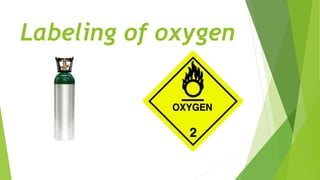
Labeling of oxygen
Medicinal gas

Medicinal gas

  • 1.
    Mehedi Hasan Roni(191-29-1472) MD.RakibulIslam(C) (191-29-1474) Sajib Chandra Biswas(191-29-1476) Mustafizur Rahman(191-29-1504)
  • 3.
    From this presentationwe are able to know that: Components of medical gas. Containers of medical gas. Process of medical gas. Packaging and labeling .
  • 4.
    Definition: A medicinal gasis defined as one that is manufactured, packaged and intended for administration to a patient in neutralization, therapy and diagnosis.
  • 5.
    Components: Oxygen (O2) Nitrogen (N2) Carbondi oxide(CO2) Nitrous oxide(N2O) Helium (He)
  • 7.
  • 8.
    Cylinder and pallets Acylinder is a closed solid that has two parallel (usually circular) bases connected by a curved surface. Pallets is a container where keep cylinder for moving one place from other.
  • 9.
  • 10.
  • 12.
    Process of oxygen Fractionationof liquid air: It is prepared by fractional distillation of liquid water. First of all the air is purified by removing moisture, carbon di oxide and dust. Then it is compressed into liquid air. The liquid water fractioned by distillation to get oxygen.
  • 13.
    Electrolysis of water In this method , a direct current passed through 1-25% KOH and NaOH solution which contain electrodes due to electrolysis of the alkaline solution. Oxygen gets liberated at anode and hydrogen at cathode. The liberated oxygen is then filled under pressure in metallic cylinder.
  • 14.
    Nitrous oxide  Thermaldecomposition of ammonium nitrate is explosive if temperature is allowed to rise too high. The gas obtained is purified by washing with sodium dichromate, sodium hydroxide and water finally, it is filled in cylinder under pressure at 100 atmosphere pressure. NH4NO3 N2O + 2H2O 170*C
  • 15.
    2 molecules ofNa2NO3 is treated with (NH4)2SO4 to produce 2 molecules of N2O with Na2SO4 with water. Na2NO3+(NH4)2SO4 N2O+Na2SO4+H2O
  • 16.
    Carbon di oxide Byfermentation process: Fermentation of sugar produces alcohol and CO2 as byproduct. C6H12O6 2C2H5OH+CO2
  • 17.
    COMMERCIAL  CO2 fromfuel gas which is passed under pressure over potassium bicarbonate, which yields potassium bicarbonate and CO2 is liberated. Then it should be compressed into metallic cylinder. K2CO3 + CO2 + H20 KHCO3 2KHCO3 K2CO3 + CO2 + H2O CaCO3 CaO + CO2
  • 18.
    Helium Helium is obtainedfrom either natural gas or fractional distillation of liquid air which is intended for medicinal gas.
  • 19.
    Packaging and labeling Packagingis the science, art and technology of enclosing or protecting products for distribution, storage, sale and use.
  • 20.
    Types of labelling Batchlabel Product identification label Patient information leaflate
  • 21.
    Batch label Batch number Productionand fill date Expiry date Quantity
  • 22.
    Product identification label Productidentifier  Hazard label or pictogram,  Hazard statement  Precautionary statement  Supplier information  Label design change or revision information
  • 23.
    Label control  Medicalgas container labels are current and correct.  Medical gas container labels are not inadvertently mixed with industrial labels.  Medical gas container labels are inventoried and the quantity of labels used is reconciled against the quantity removed from inventory.  Refer to AIGA 023 GMP ‘Guide for Medicinal Gases’ for the appropriate actions needed for the receipt, storage, issue, fitting and control of labels supplied with the medical gas containers.
  • 24.