Miscellaneous agents.for the pharmacy about organogram
1.
MISCELLANEOUS AGENTS
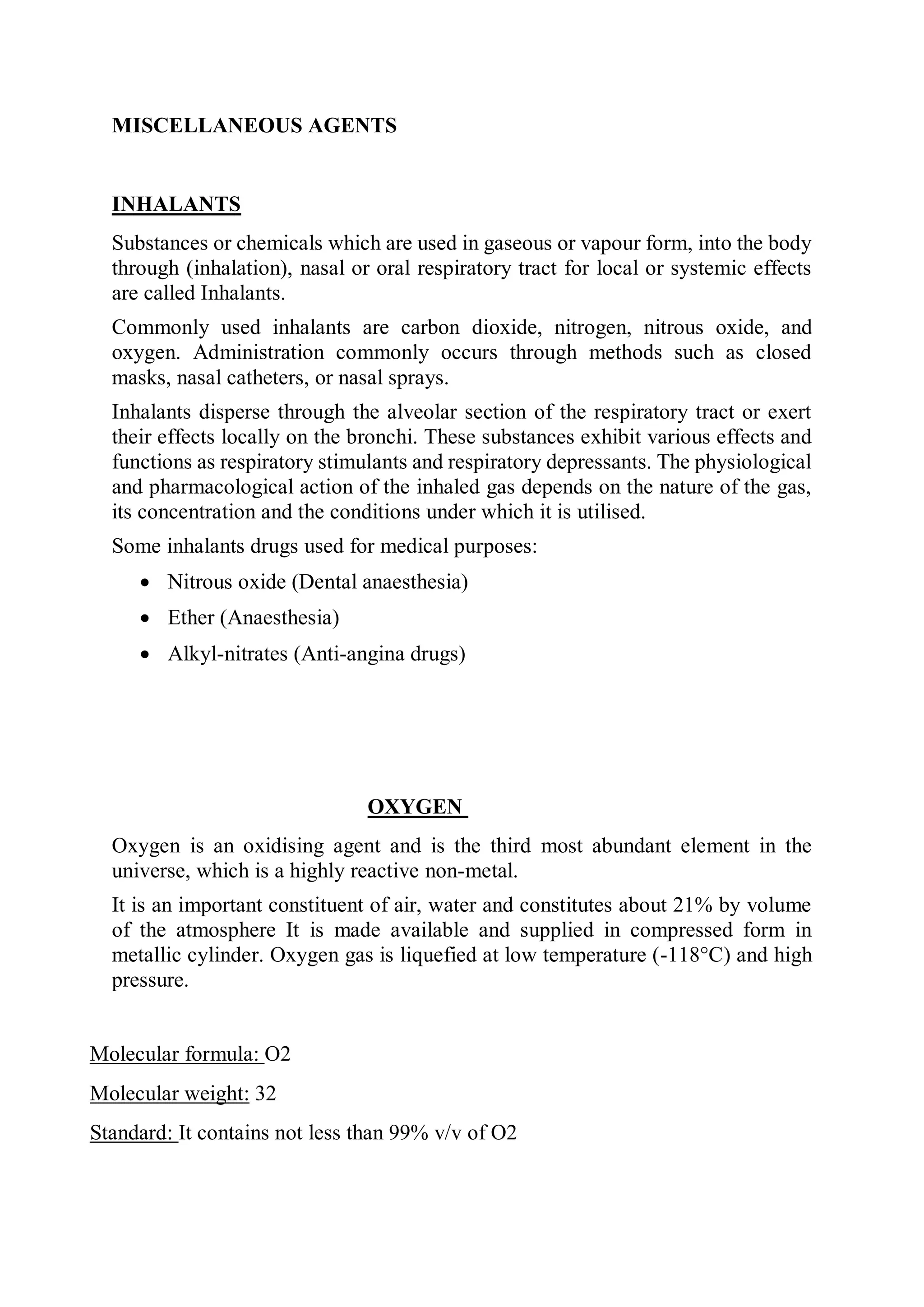
INHALANTS
Substances orchemicals which are used in gaseous or vapour form, into the body
through (inhalation), nasal or oral respiratory tract for local or systemic effects
are called Inhalants.
Commonly used inhalants are carbon dioxide, nitrogen, nitrous oxide, and
oxygen. Administration commonly occurs through methods such as closed
masks, nasal catheters, or nasal sprays.
Inhalants disperse through the alveolar section of the respiratory tract or exert
their effects locally on the bronchi. These substances exhibit various effects and
functions as respiratory stimulants and respiratory depressants. The physiological
and pharmacological action of the inhaled gas depends on the nature of the gas,
its concentration and the conditions under which it is utilised.
Some inhalants drugs used for medical purposes:
Nitrous oxide (Dental anaesthesia)
Ether (Anaesthesia)
Alkyl-nitrates (Anti-angina drugs)
OXYGEN
Oxygen is an oxidising agent and is the third most abundant element in the
universe, which is a highly reactive non-metal.
It is an important constituent of air, water and constitutes about 21% by volume
of the atmosphere It is made available and supplied in compressed form in
metallic cylinder. Oxygen gas is liquefied at low temperature (-118°C) and high
pressure.
Molecular formula: O2
Molecular weight: 32
Standard: It contains not less than 99% v/v of O2
2.
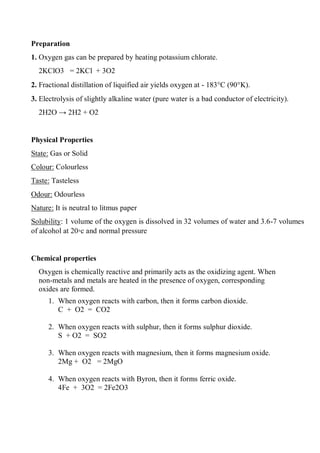
Preparation
1. Oxygen gascan be prepared by heating potassium chlorate.
2KClO3 = 2KCl + 3O2
2. Fractional distillation of liquified air yields oxygen at - 183C (90K).
3. Electrolysis of slightly alkaline water (pure water is a bad conductor of electricity).
2H2O → 2H2 + O2
Physical Properties
State: Gas or Solid
Colour: Colourless
Taste: Tasteless
Odour: Odourless
Nature: It is neutral to litmus paper
Solubility: 1 volume of the oxygen is dissolved in 32 volumes of water and 3.6-7 volumes
of alcohol at 20◦c and normal pressure
Chemical properties
Oxygen is chemically reactive and primarily acts as the oxidizing agent. When
non-metals and metals are heated in the presence of oxygen, corresponding
oxides are formed.
1. When oxygen reacts with carbon, then it forms carbon dioxide.
C + O2 = CO2
2. When oxygen reacts with sulphur, then it forms sulphur dioxide.
S + O2 = SO2
3. When oxygen reacts with magnesium, then it forms magnesium oxide.
2Mg + O2 = 2MgO
4. When oxygen reacts with Byron, then it forms ferric oxide.
4Fe + 3O2 = 2Fe2O3
3.
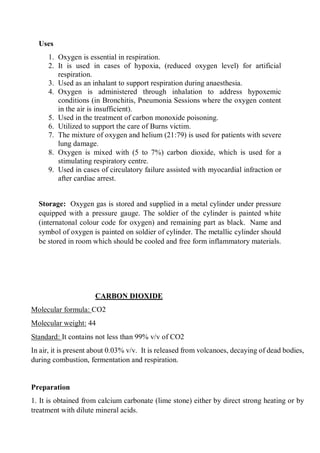
Uses
1. Oxygen isessential in respiration.
2. It is used in cases of hypoxia, (reduced oxygen level) for artificial
respiration.
3. Used as an inhalant to support respiration during anaesthesia.
4. Oxygen is administered through inhalation to address hypoxemic
conditions (in Bronchitis, Pneumonia Sessions where the oxygen content
in the air is insufficient).
5. Used in the treatment of carbon monoxide poisoning.
6. Utilized to support the care of Burns victim.
7. The mixture of oxygen and helium (21:79) is used for patients with severe
lung damage.
8. Oxygen is mixed with (5 to 7%) carbon dioxide, which is used for a
stimulating respiratory centre.
9. Used in cases of circulatory failure assisted with myocardial infraction or
after cardiac arrest.
Storage: Oxygen gas is stored and supplied in a metal cylinder under pressure
equipped with a pressure gauge. The soldier of the cylinder is painted white
(internatonal colour code for oxygen) and remaining part as black. Name and
symbol of oxygen is painted on soldier of cylinder. The metallic cylinder should
be stored in room which should be cooled and free form inflammatory materials.
CARBON DIOXIDE
Molecular formula: CO2
Molecular weight: 44
Standard: It contains not less than 99% v/v of CO2
In air, it is present about 0.03% v/v. It is released from volcanoes, decaying of dead bodies,
during combustion, fermentation and respiration.
Preparation
1. It is obtained from calcium carbonate (lime stone) either by direct strong heating or by
treatment with dilute mineral acids.
4.
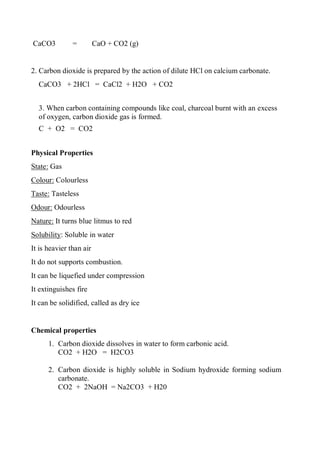
CaCO3 = CaO+ CO2 (g)
2. Carbon dioxide is prepared by the action of dilute HCl on calcium carbonate.
CaCO3 + 2HCl = CaCl2 + H2O + CO2
3. When carbon containing compounds like coal, charcoal burnt with an excess
of oxygen, carbon dioxide gas is formed.
C + O2 = CO2
Physical Properties
State: Gas
Colour: Colourless
Taste: Tasteless
Odour: Odourless
Nature: It turns blue litmus to red
Solubility: Soluble in water
It is heavier than air
It do not supports combustion.
It can be liquefied under compression
It extinguishes fire
It can be solidified, called as dry ice
Chemical properties
1. Carbon dioxide dissolves in water to form carbonic acid.
CO2 + H2O = H2CO3
2. Carbon dioxide is highly soluble in Sodium hydroxide forming sodium
carbonate.
CO2 + 2NaOH = Na2CO3 + H20
5.
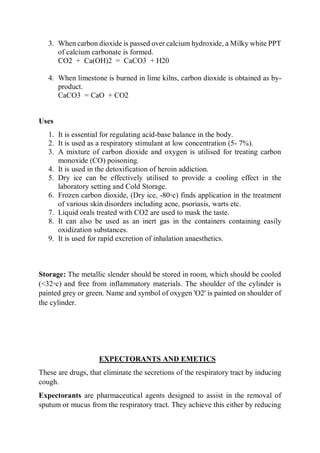
3. When carbondioxide is passed over calcium hydroxide, a Milky white PPT
of calcium carbonate is formed.
CO2 + Ca(OH)2 = CaCO3 + H20
4. When limestone is burned in lime kilns, carbon dioxide is obtained as by-
product.
CaCO3 = CaO + CO2
Uses
1. It is essential for regulating acid-base balance in the body.
2. It is used as a respiratory stimulant at low concentration (5- 7%).
3. A mixture of carbon dioxide and oxygen is utilised for treating carbon
monoxide (CO) poisoning.
4. It is used in the detoxification of heroin addiction.
5. Dry ice can be effectively utilised to provide a cooling effect in the
laboratory setting and Cold Storage.
6. Frozen carbon dioxide, (Dry ice, -80◦c) finds application in the treatment
of various skin disorders including acne, psoriasis, warts etc.
7. Liquid orals treated with CO2 are used to mask the taste.
8. It can also be used as an inert gas in the containers containing easily
oxidization substances.
9. It is used for rapid excretion of inhalation anaesthetics.
Storage: The metallic slender should be stored in room, which should be cooled
(<32◦c) and free from inflammatory materials. The shoulder of the cylinder is
painted grey or green. Name and symbol of oxygen 'O2' is painted on shoulder of
the cylinder.
EXPECTORANTS AND EMETICS
These are drugs, that eliminate the secretions of the respiratory tract by inducing
cough.
Expectorants are pharmaceutical agents designed to assist in the removal of
sputum or mucus from the respiratory tract. They achieve this either by reducing
6.
the viscosity ofsputum or by increasing the volume of fluids expelled through
coughing. Examples include Ammonium Chloride, Ammonium carbonate,
Potassium iodide, etc.
Emetics are the drugs that induce forced regurgitation (emesis), either by
stimulating or irritating the gastric mucosa locally or by directly affecting the
vomiting centre (CTZ) in the central nervous system. Emetics are valuable in
treating acute oral poisoning or drug overdoses. For instance, a 1.6% NaCl
solution is used as an emitting for oral poisoning.
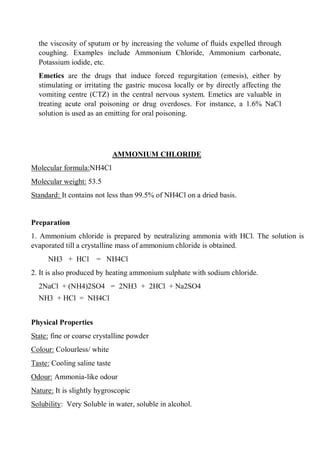
AMMONIUM CHLORIDE
Molecular formula:NH4Cl
Molecular weight: 53.5
Standard: It contains not less than 99.5% of NH4Cl on a dried basis.
Preparation
1. Ammonium chloride is prepared by neutralizing ammonia with HCl. The solution is
evaporated till a crystalline mass of ammonium chloride is obtained.
NH3 + HCl = NH4Cl
2. It is also produced by heating ammonium sulphate with sodium chloride.
2NaCl + (NH4)2SO4 = 2NH3 + 2HCl + Na2SO4
NH3 + HCl = NH4Cl
Physical Properties
State: fine or coarse crystalline powder
Colour: Colourless/ white
Taste: Cooling saline taste
Odour: Ammonia-like odour
Nature: It is slightly hygroscopic
Solubility: Very Soluble in water, soluble in alcohol.
7.
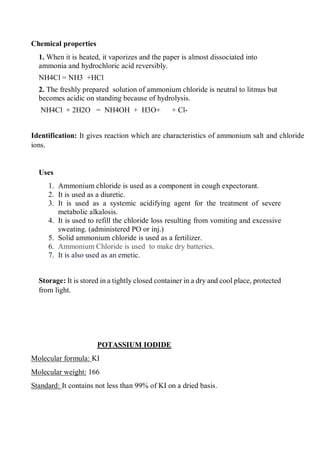
Chemical properties
1. Whenit is heated, it vaporizes and the paper is almost dissociated into
ammonia and hydrochloric acid reversibly.
NH4Cl = NH3 +HCl
2. The freshly prepared solution of ammonium chloride is neutral to litmus but
becomes acidic on standing because of hydrolysis.
NH4Cl + 2H2O = NH4OH + H3O+ + Cl-
Identification: It gives reaction which are characteristics of ammonium salt and chloride
ions.
Uses
1. Ammonium chloride is used as a component in cough expectorant.
2. It is used as a diuretic.
3. It is used as a systemic acidifying agent for the treatment of severe
metabolic alkalosis.
4. It is used to refill the chloride loss resulting from vomiting and excessive
sweating. (administered PO or inj.)
5. Solid ammonium chloride is used as a fertilizer.
6. Ammonium Chloride is used to make dry batteries.
7. It is also used as an emetic.
Storage: It is stored in a tightly closed container in a dry and cool place, protected
from light.
POTASSIUM IODIDE
Molecular formula: KI
Molecular weight: 166
Standard: It contains not less than 99% of KI on a dried basis.
8.
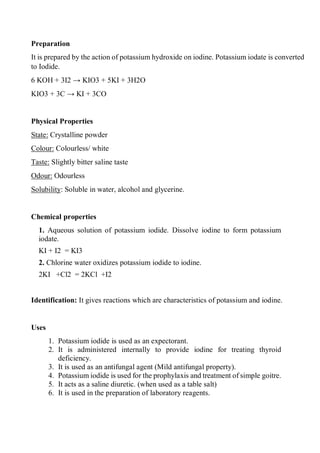
Preparation
It is preparedby the action of potassium hydroxide on iodine. Potassium iodate is converted
to Iodide.
6 KOH + 3I2 → KIO3 + 5KI + 3H2O
KIO3 + 3C → KI + 3CO
Physical Properties
State: Crystalline powder
Colour: Colourless/ white
Taste: Slightly bitter saline taste
Odour: Odourless
Solubility: Soluble in water, alcohol and glycerine.
Chemical properties
1. Aqueous solution of potassium iodide. Dissolve iodine to form potassium
iodate.
KI + I2 = KI3
2. Chlorine water oxidizes potassium iodide to iodine.
2KI +Cl2 = 2KCl +I2
Identification: It gives reactions which are characteristics of potassium and iodine.
Uses
1. Potassium iodide is used as an expectorant.
2. It is administered internally to provide iodine for treating thyroid
deficiency.
3. It is used as an antifungal agent (Mild antifungal property).
4. Potassium iodide is used for the prophylaxis and treatment of simple goitre.
5. It acts as a saline diuretic. (when used as a table salt)
6. It is used in the preparation of laboratory reagents.
9.
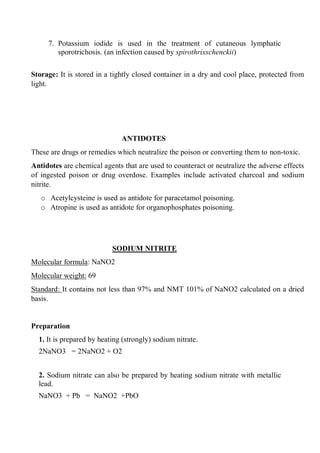
7. Potassium iodideis used in the treatment of cutaneous lymphatic
sporotrichosis. (an infection caused by spirothrixschenckii)
Storage: It is stored in a tightly closed container in a dry and cool place, protected from
light.
ANTIDOTES
These are drugs or remedies which neutralize the poison or converting them to non-toxic.
Antidotes are chemical agents that are used to counteract or neutralize the adverse effects
of ingested poison or drug overdose. Examples include activated charcoal and sodium
nitrite.
o Acetylcysteine is used as antidote for paracetamol poisoning.
o Atropine is used as antidote for organophosphates poisoning.
SODIUM NITRITE
Molecular formula: NaNO2
Molecular weight: 69
Standard: It contains not less than 97% and NMT 101% of NaNO2 calculated on a dried
basis.
Preparation
1. It is prepared by heating (strongly) sodium nitrate.
2NaNO3 = 2NaNO2 + O2
2. Sodium nitrate can also be prepared by heating sodium nitrate with metallic
lead.
NaNO3 + Pb = NaNO2 +PbO
10.
3. When nitricoxide is passed on sodium carbonate, in presence of oxygen,
sodium nitrite is formed. The solution is then concentrated and recrystallized.
2Na2CO3 + 4NO + O2 = NaNO2 + CO2
Physical Properties
State: Crystals or granular powder
Colour: Slightly yellowish
Taste: Mild saline taste
Odour: Odourless
Solubility: Soluble in water, and sparingly soluble in alcohol.
Chemical properties
1. Sodium nitrite decomposes in the presence of air to sodium hydroxide and
nitrogen dioxide above 300°C temperature.
2NaNO2 = Na2O + NO + NO2
2. Sodium nitrite acts as an oxidizing agent.
2HNO3 +2KI +H2SO4 = I2 + 2NO + 2H2O + K2SO4
3. Sodium nitrite is decomposed on acidification with dilute sulphuric acid.
2NaNO2 + dil. H2SO4 = Na2SO4 + 2HNO2 (Nitrous acid)
4. Sodium nitrite is a reducing agent and gets oxidized to nitrate in an acidic
medium.
HNO2 + O = HNO3
Identification: It gives characteristic reactions of sodium and nitrate.
11.
Uses
1. Sodium nitriteis used as a antidote in cyanide poisoning.
2. It serves as a smooth muscle relaxant, exhibiting vasodilation and hypotensive
effects.
3. The aqueous solution of sodium nitrite is used as a disinfectant to prevent the
rusting of surgical instruments.
4. It can also be used as a food preservative.
5. It is used for the industrial production of organonitrogen compounds,
commonly used in pesticides.
Storage: It is stored in an airtight container.
ACTIVATED CHARCOL
Molecular formula: C
Molecular weight: 12
Category: Antidotes, adsorbent, decolorizing agent
Preparation
The preparation of activated charcoal involves a process known as activation,
which is typically done using high temperature and specific gases to create a
porous structure. The different steps involves
1. Raw material selection: It is the first step where a material rich in carbon source
is selected. Wood, sawdust, peat, coconut shells and other organic materials are
rich source of carbon.
2. Carbonization: In this step, the volatile chemicals are removed, leaving behind
the carbon. The raw material is heated in an inert atmosphere without air, This
process is called as carbonization. Without air, it is done at temperature between
600 to 900°C.
3. Activation: Activation is the process that gives the carbonized material more
surface area and porous structure. There are two different ways to get activated:
12.
Chemical activation method-In this process, the carbonized material is treated
with chemicals, typically strong acids or bases, to create pores. This method is
often used for small-scale production.
Physical activation method- In this process, the carbonized material is exposed
to high temperatures (800 to 1200°C) and an activating gas such as steam or
carbon dioxide in the absence of air. This process causes the material to puff up
and develop a porous structure.
4. Washing: The activated charcoal is then thoroughly washed to remove any
remaining impurities or chemicals from the activation process.
5. Drying: The washed activated charcoal is then dried to remove moisture. This
step is crucial for maintaining its adsorption properties.
6. Sizing and packaging: The final product is then sized or ground to achieve the
desired particle size for specific applications. It is then packed for distribution.
Physical Properties
State: Fine smooth powder
Colour: Black
Taste: Tasteless
Odour: Odourless
Solubility: Insoluble in water, and all other organic solvents.
Uses
1. Activated charcoal is used in case of poisoning or drug overdose. It is
administered orally and prevent toxin from being absorbed by the body.
2. Activated charcoal is used as a remedy for excessive gas in the
gastrointestinal tract. It can adsorb gas molecules, reducing bloating and
discomfort.
3. Activate charcoal may be used in certain medical procedures such as
hemoperfusion, to remove toxins from the bloodstream in case of acute
poisoning.
4. It is widely used in water filtration system.
5. In some cases, it may be used in wound dressings to help absorb toxins and
promote the healing of certain types of wounds.
13.
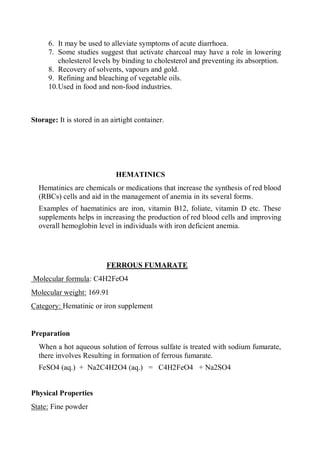
6. It maybe used to alleviate symptoms of acute diarrhoea.
7. Some studies suggest that activate charcoal may have a role in lowering
cholesterol levels by binding to cholesterol and preventing its absorption.
8. Recovery of solvents, vapours and gold.
9. Refining and bleaching of vegetable oils.
10.Used in food and non-food industries.
Storage: It is stored in an airtight container.
HEMATINICS
Hematinics are chemicals or medications that increase the synthesis of red blood
(RBCs) cells and aid in the management of anemia in its several forms.
Examples of haematinics are iron, vitamin B12, foliate, vitamin D etc. These
supplements helps in increasing the production of red blood cells and improving
overall hemoglobin level in individuals with iron deficient anemia.
FERROUS FUMARATE
Molecular formula: C4H2FeO4
Molecular weight: 169.91
Category: Hematinic or iron supplement
Preparation
When a hot aqueous solution of ferrous sulfate is treated with sodium fumarate,
there involves Resulting in formation of ferrous fumarate.
FeSO4 (aq.) + Na2C4H2O4 (aq.) = C4H2FeO4 + Na2SO4
Physical Properties
State: Fine powder
14.
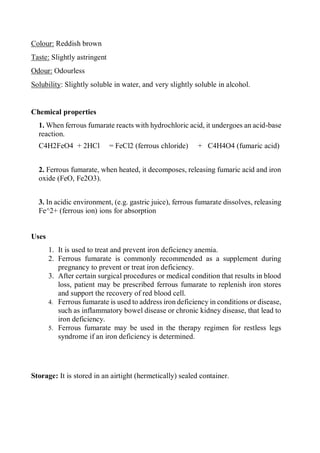
Colour: Reddish brown
Taste:Slightly astringent
Odour: Odourless
Solubility: Slightly soluble in water, and very slightly soluble in alcohol.
Chemical properties
1. When ferrous fumarate reacts with hydrochloric acid, it undergoes an acid-base
reaction.
C4H2FeO4 + 2HCl = FeCl2 (ferrous chloride) + C4H4O4 (fumaric acid)
2. Ferrous fumarate, when heated, it decomposes, releasing fumaric acid and iron
oxide (FeO, Fe2O3).
3. In acidic environment, (e.g. gastric juice), ferrous fumarate dissolves, releasing
Fe^2+ (ferrous ion) ions for absorption
Uses
1. It is used to treat and prevent iron deficiency anemia.
2. Ferrous fumarate is commonly recommended as a supplement during
pregnancy to prevent or treat iron deficiency.
3. After certain surgical procedures or medical condition that results in blood
loss, patient may be prescribed ferrous fumarate to replenish iron stores
and support the recovery of red blood cell.
4. Ferrous fumarate is used to address iron deficiency in conditions or disease,
such as inflammatory bowel disease or chronic kidney disease, that lead to
iron deficiency.
5. Ferrous fumarate may be used in the therapy regimen for restless legs
syndrome if an iron deficiency is determined.
Storage: It is stored in an airtight (hermetically) sealed container.