Quality Education Affordable Cost Safe Environment Trusted Human Beings
IOT BASED SMART SECURITY AND HOME AUTOMATION SYSTEM
Presented by
Md. Abu Sayed
Roll: 15101435003
Supervised by
Md. Rakibul Hasan
Lecturer
Department of Electrical & Electronic Engineering
North Bengal International University, Rajshahi
20th February, 2019
1
Department of Electrical & Electronic Engineering
North Bengal International University, Rajshahi
Outline
 Introduction
 Basic of IoT Based Smart Security and Home Automation System.
 Literature Survey.
 Open Problem.
 Objectives.
 Experimental Model.
 Experimental Result.
 Contribution.
 Limitation & Conclusion.
 Further Research.
2
3
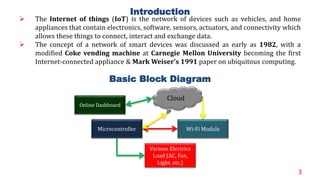
Basic Block Diagram
Online Dashboard
Microcontroller Wi-Fi Module
Various Electrics
Load (AC, Fan,
Light, etc.)
Cloud
Introduction
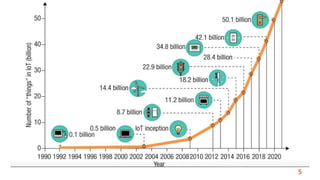
 The Internet of things (IoT) is the network of devices such as vehicles, and home
appliances that contain electronics, software, sensors, actuators, and connectivity which
allows these things to connect, interact and exchange data.
 The concept of a network of smart devices was discussed as early as 1982, with a
modified Coke vending machine at Carnegie Mellon University becoming the first
Internet-connected appliance & Mark Weiser's 1991 paper on ubiquitous computing.
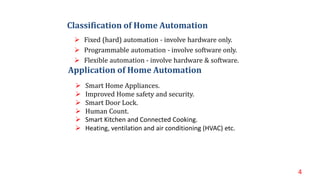
 Fixed (hard) automation - involve hardware only.
 Programmable automation - involve software only.
 Flexible automation - involve hardware & software.
4
 Smart Home Appliances.
 Improved Home safety and security.
 Smart Door Lock.
 Human Count.
 Smart Kitchen and Connected Cooking.
 Heating, ventilation and air conditioning (HVAC) etc.
Application of Home Automation
Classification of Home Automation
5
6
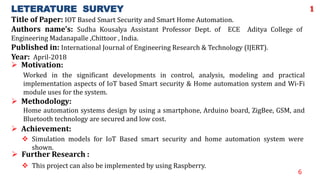
LETERATURE SURVEY
 This project can also be implemented by using Raspberry.
 Further Research :
 Simulation models for IoT Based smart security and home automation system were
shown.
 Achievement:
Home automation systems design by using a smartphone, Arduino board, ZigBee, GSM, and
Bluetooth technology are secured and low cost.
 Methodology:
Worked in the significant developments in control, analysis, modeling and practical
implementation aspects of IoT based Smart security & Home automation system and Wi-Fi
module uses for the system.
 Motivation:
Title of Paper: IOT Based Smart Security and Smart Home Automation.
Authors name’s: Sudha Kousalya Assistant Professor Dept. of ECE Aditya College of
Engineering Madanapalle ,Chittoor , India.
Published in: International Journal of Engineering Research & Technology (IJERT).
Year: April-2018
1
7
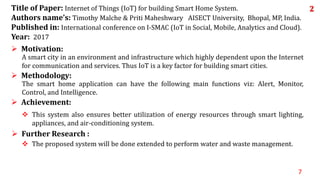
 The proposed system will be done extended to perform water and waste management.
 Further Research :
 This system also ensures better utilization of energy resources through smart lighting,
appliances, and air-conditioning system.
 Achievement:
The smart home application can have the following main functions viz: Alert, Monitor,
Control, and Intelligence.
 Methodology:
A smart city in an environment and infrastructure which highly dependent upon the Internet
for communication and services. Thus IoT is a key factor for building smart cities.
 Motivation:
Title of Paper: Internet of Things (IoT) for building Smart Home System.
Authors name’s: Timothy Malche & Priti Maheshwary AISECT University, Bhopal, MP, India.
Published in: International conference on I-SMAC (IoT in Social, Mobile, Analytics and Cloud).
Year: 2017
2
8
 machine-driven fireplace exit systems.
 Industrial automation & improvement of security problems.
 Further Research :
 The control and monitor of the devices have done by using the technology Internet of
Things (IoT).
 Achievement:
This work is designed in such a way to avoid the disadvantages of the existing system. The
proposed system supports more elasticity, comfort capacity, and safety.
 Methodology:
IoT technology is used with the innovative idea and great growth for smart homes to
improve the living standards of life.
 Motivation:
Title of Paper: IoT based Monitoring and Control System for Home Automation.
Authors name’s: Pavithra.D, M.E, Embedded System Technologies and Ranjith Balakrishnan,
TIFAC-CORE in Pervasive Computing Technologies Velammal Engineering College, Surapet
Chennai - 600066, India.
Published in: Proceedings of 2015 Global Conference on Communication Technologies(GCCT).
Year: 2015
3
9
 The user can control his home appliances any voice calling triggered to his smartphone.
 Further Research :
 The use of the camera connected to the microcontroller might help.
 The finding has done whether to activate the security system or welcome guest.
 Achievement:
There is an Intruder in the House’, to turn ON the lights and alarm in the house so that the
intruder will be warned.
 Methodology:
It is not necessary for the mobile phone to be connected to the internet only board is
required to have access to Wi-Fi.
 Motivation:
Title of Paper: IoT Based Smart Security and Home Automation System.
Authors name’s: Ravi Kishore Kodali, Vishal Jain, Suvadeep Bose and Lakshmi Boppana
Department of Electronics and Communications Engineering National Institute of Technology,
Warangal.
Published in: International Conference on Computing, Communication and Automation.
Year: 2016
4
10
 The will be upgraded AI technology into the chatbot.
 Further Research :
 Home environment monitoring.
 Home control functions.
 Achievement:
The widespread mobile devices, smart homes with the Internet of Thing (IoT) technologies
can be established by connecting wireless base stations through wireless transmission
methods such as Wi-Fi, Bluetooth, and ZigBee.
 Methodology:
In the modern smart home, the applications are often used to control home devices and
electric load.
 Motivation:
Title of Paper: An IoT-based Home Automation System Using Wi-Fi Wireless Sensor Networks .
Authors name’s: Chwan-Lu Tseng, Che-Shen Cheng, Yu- Hsien Hsu and Bing-Hung Yang
Department Electrical Engineering National Taipei University Taipei, Taiwan.
Published in: IEEE International Conference on Systems, Man, and Cybernetics.
Year: 2018
5
11
Open Problem (Outcome of Literature Survey)
The studied literature survey gives a proper idea and motivation to design & implement an
IoT based home automation system that has the following specifications over the
conventional ones.
 Low-cost IoT based Smart security & home automation system using Arduino mega2560
and ESP8266 WI-FI module.
 Just not only for High-level, rather need for middle and lower level home application.
 Better & reliable electricity service.
 To Low the cost of electricity.
With later described methodology & algorithm an IoT based smart security and home
automation system of above-mentioned properties can be designed & implemented properly.
12
Objectives
 To save energy proper management of electricity distribution.
 To show the effective way for power utilization and conservation.
 To control and monitor any operating system.
 To make power usage low and conservation more effective.
 To make smart and intelligent usage of energy and its conservation in home appliances.
13
Working Principle
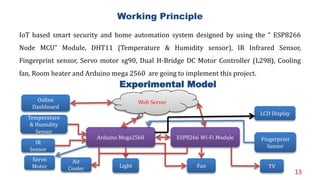
IoT based smart security and home automation system designed by using the “ ESP8266
Node MCU” Module, DHT11 (Temperature & Humidity sensor), IR Infrared Sensor,
Fingerprint sensor, Servo motor sg90, Dual H-Bridge DC Motor Controller (L298), Cooling
fan, Room heater and Arduino mega 2560 are going to implement this project.
LCD Display
ESP8266 Wi-Fi Module
Air
Cooler
Web ServerOnline
Dashboard
Fingerprint
Sensor
Arduino Mega2560
TVLight Fan
IR
Sensor
Temperature
& Humidity
Sensor
Servo
Motor
Experimental Model
14
Experimental Circuit Diagram
15
Flowchart
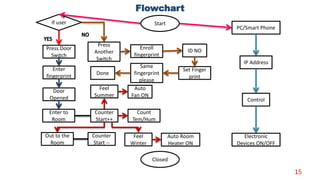
If user
Press Door
Switch
Enter
fingerprint
Door
Opened
Same
fingerprint
please
ID NO
Set Finger
print
Press
Another
Switch
Feel
Summer
Count
Tem/Hum
Auto
Fan ON
Auto Room
Heater ON
IP Address
Control
Done
Enter to
Room
Out to the
Room
Counter
Start++
Counter
Start --
Feel
Winter
Electronic
Devices ON/OFF
PC/Smart Phone
Enroll
fingerprint
Start
Closed
16
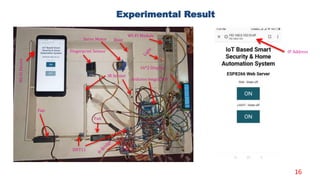
Experimental Result
Wi-FiDevice
Fingerprint Sensor
Servo Motor Door
WI-FI Module
16*2 Display
Arduino mega2560
IR Sensor
Fan
Fan
DHT11
IP Address
17
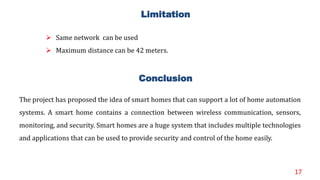
Limitation
Conclusion
 Same network can be used
 Maximum distance can be 42 meters.
The project has proposed the idea of smart homes that can support a lot of home automation
systems. A smart home contains a connection between wireless communication, sensors,
monitoring, and security. Smart homes are a huge system that includes multiple technologies
and applications that can be used to provide security and control of the home easily.
18
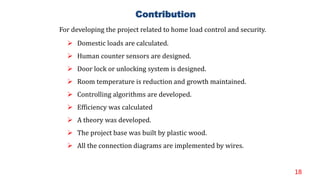
 Domestic loads are calculated.
 Human counter sensors are designed.
 Door lock or unlocking system is designed.
 Room temperature is reduction and growth maintained.
 Controlling algorithms are developed.
 Efficiency was calculated
 A theory was developed.
 The project base was built by plastic wood.
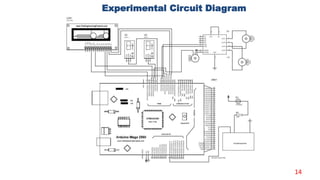
 All the connection diagrams are implemented by wires.
Contribution
For developing the project related to home load control and security.
19
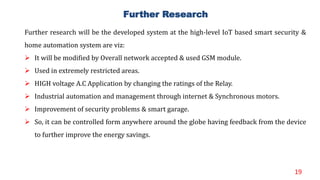
Further Research
Further research will be the developed system at the high-level IoT based smart security &
home automation system are viz:
 It will be modified by Overall network accepted & used GSM module.
 Used in extremely restricted areas.
 HIGH voltage A.C Application by changing the ratings of the Relay.
 Industrial automation and management through internet & Synchronous motors.
 Improvement of security problems & smart garage.
 So, it can be controlled form anywhere around the globe having feedback from the device
to further improve the energy savings.
20
THANK YOU
21
ANY QUESTION ?
22

Internet of Things (IoT) Based Smart Security & Home Automation System.

  • 1.
    Quality Education AffordableCost Safe Environment Trusted Human Beings IOT BASED SMART SECURITY AND HOME AUTOMATION SYSTEM Presented by Md. Abu Sayed Roll: 15101435003 Supervised by Md. Rakibul Hasan Lecturer Department of Electrical & Electronic Engineering North Bengal International University, Rajshahi 20th February, 2019 1 Department of Electrical & Electronic Engineering North Bengal International University, Rajshahi
  • 2.
    Outline  Introduction  Basicof IoT Based Smart Security and Home Automation System.  Literature Survey.  Open Problem.  Objectives.  Experimental Model.  Experimental Result.  Contribution.  Limitation & Conclusion.  Further Research. 2
  • 3.
    3 Basic Block Diagram OnlineDashboard Microcontroller Wi-Fi Module Various Electrics Load (AC, Fan, Light, etc.) Cloud Introduction  The Internet of things (IoT) is the network of devices such as vehicles, and home appliances that contain electronics, software, sensors, actuators, and connectivity which allows these things to connect, interact and exchange data.  The concept of a network of smart devices was discussed as early as 1982, with a modified Coke vending machine at Carnegie Mellon University becoming the first Internet-connected appliance & Mark Weiser's 1991 paper on ubiquitous computing.
  • 4.
     Fixed (hard)automation - involve hardware only.  Programmable automation - involve software only.  Flexible automation - involve hardware & software. 4  Smart Home Appliances.  Improved Home safety and security.  Smart Door Lock.  Human Count.  Smart Kitchen and Connected Cooking.  Heating, ventilation and air conditioning (HVAC) etc. Application of Home Automation Classification of Home Automation
  • 5.
  • 6.
    6 LETERATURE SURVEY  Thisproject can also be implemented by using Raspberry.  Further Research :  Simulation models for IoT Based smart security and home automation system were shown.  Achievement: Home automation systems design by using a smartphone, Arduino board, ZigBee, GSM, and Bluetooth technology are secured and low cost.  Methodology: Worked in the significant developments in control, analysis, modeling and practical implementation aspects of IoT based Smart security & Home automation system and Wi-Fi module uses for the system.  Motivation: Title of Paper: IOT Based Smart Security and Smart Home Automation. Authors name’s: Sudha Kousalya Assistant Professor Dept. of ECE Aditya College of Engineering Madanapalle ,Chittoor , India. Published in: International Journal of Engineering Research & Technology (IJERT). Year: April-2018 1
  • 7.
    7  The proposedsystem will be done extended to perform water and waste management.  Further Research :  This system also ensures better utilization of energy resources through smart lighting, appliances, and air-conditioning system.  Achievement: The smart home application can have the following main functions viz: Alert, Monitor, Control, and Intelligence.  Methodology: A smart city in an environment and infrastructure which highly dependent upon the Internet for communication and services. Thus IoT is a key factor for building smart cities.  Motivation: Title of Paper: Internet of Things (IoT) for building Smart Home System. Authors name’s: Timothy Malche & Priti Maheshwary AISECT University, Bhopal, MP, India. Published in: International conference on I-SMAC (IoT in Social, Mobile, Analytics and Cloud). Year: 2017 2
  • 8.
    8  machine-driven fireplaceexit systems.  Industrial automation & improvement of security problems.  Further Research :  The control and monitor of the devices have done by using the technology Internet of Things (IoT).  Achievement: This work is designed in such a way to avoid the disadvantages of the existing system. The proposed system supports more elasticity, comfort capacity, and safety.  Methodology: IoT technology is used with the innovative idea and great growth for smart homes to improve the living standards of life.  Motivation: Title of Paper: IoT based Monitoring and Control System for Home Automation. Authors name’s: Pavithra.D, M.E, Embedded System Technologies and Ranjith Balakrishnan, TIFAC-CORE in Pervasive Computing Technologies Velammal Engineering College, Surapet Chennai - 600066, India. Published in: Proceedings of 2015 Global Conference on Communication Technologies(GCCT). Year: 2015 3
  • 9.
    9  The usercan control his home appliances any voice calling triggered to his smartphone.  Further Research :  The use of the camera connected to the microcontroller might help.  The finding has done whether to activate the security system or welcome guest.  Achievement: There is an Intruder in the House’, to turn ON the lights and alarm in the house so that the intruder will be warned.  Methodology: It is not necessary for the mobile phone to be connected to the internet only board is required to have access to Wi-Fi.  Motivation: Title of Paper: IoT Based Smart Security and Home Automation System. Authors name’s: Ravi Kishore Kodali, Vishal Jain, Suvadeep Bose and Lakshmi Boppana Department of Electronics and Communications Engineering National Institute of Technology, Warangal. Published in: International Conference on Computing, Communication and Automation. Year: 2016 4
  • 10.
    10  The willbe upgraded AI technology into the chatbot.  Further Research :  Home environment monitoring.  Home control functions.  Achievement: The widespread mobile devices, smart homes with the Internet of Thing (IoT) technologies can be established by connecting wireless base stations through wireless transmission methods such as Wi-Fi, Bluetooth, and ZigBee.  Methodology: In the modern smart home, the applications are often used to control home devices and electric load.  Motivation: Title of Paper: An IoT-based Home Automation System Using Wi-Fi Wireless Sensor Networks . Authors name’s: Chwan-Lu Tseng, Che-Shen Cheng, Yu- Hsien Hsu and Bing-Hung Yang Department Electrical Engineering National Taipei University Taipei, Taiwan. Published in: IEEE International Conference on Systems, Man, and Cybernetics. Year: 2018 5
  • 11.
    11 Open Problem (Outcomeof Literature Survey) The studied literature survey gives a proper idea and motivation to design & implement an IoT based home automation system that has the following specifications over the conventional ones.  Low-cost IoT based Smart security & home automation system using Arduino mega2560 and ESP8266 WI-FI module.  Just not only for High-level, rather need for middle and lower level home application.  Better & reliable electricity service.  To Low the cost of electricity. With later described methodology & algorithm an IoT based smart security and home automation system of above-mentioned properties can be designed & implemented properly.
  • 12.
    12 Objectives  To saveenergy proper management of electricity distribution.  To show the effective way for power utilization and conservation.  To control and monitor any operating system.  To make power usage low and conservation more effective.  To make smart and intelligent usage of energy and its conservation in home appliances.
  • 13.
    13 Working Principle IoT basedsmart security and home automation system designed by using the “ ESP8266 Node MCU” Module, DHT11 (Temperature & Humidity sensor), IR Infrared Sensor, Fingerprint sensor, Servo motor sg90, Dual H-Bridge DC Motor Controller (L298), Cooling fan, Room heater and Arduino mega 2560 are going to implement this project. LCD Display ESP8266 Wi-Fi Module Air Cooler Web ServerOnline Dashboard Fingerprint Sensor Arduino Mega2560 TVLight Fan IR Sensor Temperature & Humidity Sensor Servo Motor Experimental Model
  • 14.
  • 15.
    15 Flowchart If user Press Door Switch Enter fingerprint Door Opened Same fingerprint please IDNO Set Finger print Press Another Switch Feel Summer Count Tem/Hum Auto Fan ON Auto Room Heater ON IP Address Control Done Enter to Room Out to the Room Counter Start++ Counter Start -- Feel Winter Electronic Devices ON/OFF PC/Smart Phone Enroll fingerprint Start Closed
  • 16.
    16 Experimental Result Wi-FiDevice Fingerprint Sensor ServoMotor Door WI-FI Module 16*2 Display Arduino mega2560 IR Sensor Fan Fan DHT11 IP Address
  • 17.
    17 Limitation Conclusion  Same networkcan be used  Maximum distance can be 42 meters. The project has proposed the idea of smart homes that can support a lot of home automation systems. A smart home contains a connection between wireless communication, sensors, monitoring, and security. Smart homes are a huge system that includes multiple technologies and applications that can be used to provide security and control of the home easily.
  • 18.
    18  Domestic loadsare calculated.  Human counter sensors are designed.  Door lock or unlocking system is designed.  Room temperature is reduction and growth maintained.  Controlling algorithms are developed.  Efficiency was calculated  A theory was developed.  The project base was built by plastic wood.  All the connection diagrams are implemented by wires. Contribution For developing the project related to home load control and security.
  • 19.
    19 Further Research Further researchwill be the developed system at the high-level IoT based smart security & home automation system are viz:  It will be modified by Overall network accepted & used GSM module.  Used in extremely restricted areas.  HIGH voltage A.C Application by changing the ratings of the Relay.  Industrial automation and management through internet & Synchronous motors.  Improvement of security problems & smart garage.  So, it can be controlled form anywhere around the globe having feedback from the device to further improve the energy savings.
  • 20.
  • 21.
  • 22.