III  MEDIEVAL ERA  500 – 1500 AD ( The ‘servant image’ of the nurse)
EARLY MIDDLE AGE (= THE DARK AGES!) 500 – 1000 AD Began with the fall of the Roman Empire Barbaric tribes invaded Rome Homes and bridges destroyed Romans turned to monasteries for help 3 protective units developed – Monasticism Feudalism Guilds
MONASTICISM For a time everything was in confusion But the nuns and priests were good organizers & administrators Monasteries increased in size St Benedict built a large monastery By Benedictian rule –  All must work.  Follow poverty, chastity & obedience Men and women had equal rights Thus arts & crafts developed Right methods of agriculture Monasteries became the place for education of medicine and nursing.  But.. Too strict >> Diminished interest in work >> decline of monasteries between 9 th  and 10 th   centuries
FEUDALISM & CHIVALRY Feudalism  – The Kings owned all the land.  He gave portions of it to his favourite subjects  >> Barons, Earls, Knights Land = Fief/ Feud (in Europe), Manor (in England) The Barons divided land among many ‘Serfs’ who worked on the land in return for food, shelter and protection The Serfs also served in the Army.  This lead to famine and disease Chivalry –  An accepted code of living a good life The church developed youth in ideals of solidarity of conduct and ambitions as necessary A system of training given to the knights >> Chivalry Service to God = Service to others, protection and defense of the weak
GUILDS An organization of people not attached to monastic/ feudal groups Stressed on apprenticeship method of learning a skill, high work standards and insurance of selves This followed in medical and nursing teaching This is the fore-runner of labour unions and professional organizations
MEDIEVAL HOSPITALS Hotel Dieu of Lyons in France (542 AD) Hotel Dieu of Paris (651 AD) Santo Spurito Hospital in Rome (717 AD) Here, pilgrims, poor, sick and infirm got shelter Under lay management and penitants for 600 years 12 th  – 16 th  century – Ruled by religious order Nursing done by dedicated women, who took vows, but could not leave or get married.  Also nursing brothers.  Age – Bet 16 – 24 yrs
ISLAM & ARABIC MEDICINE 570 AD – Mohammad Moslem – ‘One who submits’ They learnt from other cultures about medicine Did not allow surgery and dissection – So medicine did not progress Introduced ‘catgut’ Females kept in ‘purdah’
Nursing had at last  developed  roots, purpose, direction and leadership !
LATE MIDDLE AGES  (1000 – 1500 AD) Medicine was under two influences – Lay medicine – followed after then Roman tradition and Religious medicine – as existed in the monasteries The ‘Crusades’ stimulated the Military nursing orders
CRUSADES = Religious war between Moslems and Christians (for almost 200 yrs). A pilgrimage undertaken to Jerusalem to rescue Christ’s tomb from the Moslems Many died on the way Two great Military Nursing orders came into being to care for the sick and injured – Order of Knight hospitallers of St John of Jerusalem Order of Knights of St Lazarus (Care of leprosy  patients)
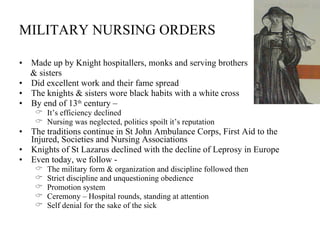
MILITARY NURSING ORDERS Made up by Knight hospitallers, monks and serving brothers  & sisters Did excellent work and their fame spread The knights & sisters wore black habits with a white cross By end of 13 th  century –  It’s efficiency declined Nursing was neglected, politics spoilt it’s reputation The traditions continue in St John Ambulance Corps, First Aid to the Injured, Societies and Nursing Associations Knights of St Lazarus declined with the decline of Leprosy in Europe Even today, we follow - The military form & organization and discipline followed then Strict discipline and unquestioning obedience Promotion system Ceremony – Hospital rounds, standing at attention Self denial for the sake of the sick
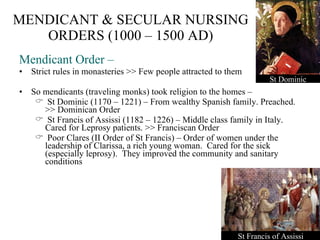
MENDICANT & SECULAR NURSING ORDERS (1000 – 1500 AD) Mendicant Order –   Strict rules in monasteries >> Few people attracted to them So mendicants (traveling monks) took religion to the homes – St Dominic (1170 – 1221) – From wealthy Spanish family. Preached.  >> Dominican Order  St Francis of Assissi (1182 – 1226) – Middle class family in Italy.  Cared for Leprosy patients. >> Franciscan Order  Poor Clares (II Order of St Francis) – Order of women under the leadership of Clarissa, a rich young woman.  Cared for the sick (especially leprosy).  They improved the community and sanitary conditions St Dominic St Francis of Assissi
Secular nursing orders (Tertiary/ Non religious Order) – A third order started by St Francis as many men and women came to join his Order They lived in their homes and took no vows.  Could leave at any time Other Secular Orders – Arose, but did not last long.  One – the Beguines of Flanders did private hospital and visiting nursing in Germany, Belgium, France and Switzerland
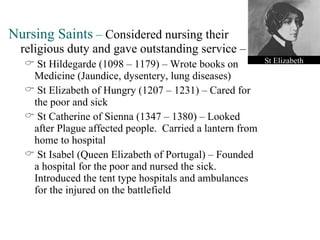
Nursing Saints  –  Considered nursing their religious duty and gave outstanding service – St Hildegarde (1098 – 1179) – Wrote books on Medicine (Jaundice, dysentery, lung diseases) St Elizabeth of Hungry (1207 – 1231) – Cared for the poor and sick St Catherine of Sienna (1347 – 1380) – Looked after Plague affected people.  Carried a lantern from home to hospital St Isabel (Queen Elizabeth of Portugal) – Founded a hospital for the poor and nursed the sick.  Introduced the tent type hospitals and ambulances for the injured on the battlefield St Elizabeth

History of Nursing - Midieval Era

  • 1.
    III MEDIEVAL ERA 500 – 1500 AD ( The ‘servant image’ of the nurse)
  • 2.
    EARLY MIDDLE AGE(= THE DARK AGES!) 500 – 1000 AD Began with the fall of the Roman Empire Barbaric tribes invaded Rome Homes and bridges destroyed Romans turned to monasteries for help 3 protective units developed – Monasticism Feudalism Guilds
  • 3.
    MONASTICISM For atime everything was in confusion But the nuns and priests were good organizers & administrators Monasteries increased in size St Benedict built a large monastery By Benedictian rule – All must work. Follow poverty, chastity & obedience Men and women had equal rights Thus arts & crafts developed Right methods of agriculture Monasteries became the place for education of medicine and nursing. But.. Too strict >> Diminished interest in work >> decline of monasteries between 9 th and 10 th centuries
  • 4.
    FEUDALISM & CHIVALRYFeudalism – The Kings owned all the land. He gave portions of it to his favourite subjects >> Barons, Earls, Knights Land = Fief/ Feud (in Europe), Manor (in England) The Barons divided land among many ‘Serfs’ who worked on the land in return for food, shelter and protection The Serfs also served in the Army. This lead to famine and disease Chivalry – An accepted code of living a good life The church developed youth in ideals of solidarity of conduct and ambitions as necessary A system of training given to the knights >> Chivalry Service to God = Service to others, protection and defense of the weak
  • 5.
    GUILDS An organizationof people not attached to monastic/ feudal groups Stressed on apprenticeship method of learning a skill, high work standards and insurance of selves This followed in medical and nursing teaching This is the fore-runner of labour unions and professional organizations
  • 6.
    MEDIEVAL HOSPITALS HotelDieu of Lyons in France (542 AD) Hotel Dieu of Paris (651 AD) Santo Spurito Hospital in Rome (717 AD) Here, pilgrims, poor, sick and infirm got shelter Under lay management and penitants for 600 years 12 th – 16 th century – Ruled by religious order Nursing done by dedicated women, who took vows, but could not leave or get married. Also nursing brothers. Age – Bet 16 – 24 yrs
  • 7.
    ISLAM & ARABICMEDICINE 570 AD – Mohammad Moslem – ‘One who submits’ They learnt from other cultures about medicine Did not allow surgery and dissection – So medicine did not progress Introduced ‘catgut’ Females kept in ‘purdah’
  • 8.
    Nursing had atlast developed roots, purpose, direction and leadership !
  • 9.
    LATE MIDDLE AGES (1000 – 1500 AD) Medicine was under two influences – Lay medicine – followed after then Roman tradition and Religious medicine – as existed in the monasteries The ‘Crusades’ stimulated the Military nursing orders
  • 10.
    CRUSADES = Religiouswar between Moslems and Christians (for almost 200 yrs). A pilgrimage undertaken to Jerusalem to rescue Christ’s tomb from the Moslems Many died on the way Two great Military Nursing orders came into being to care for the sick and injured – Order of Knight hospitallers of St John of Jerusalem Order of Knights of St Lazarus (Care of leprosy patients)
  • 11.
    MILITARY NURSING ORDERSMade up by Knight hospitallers, monks and serving brothers & sisters Did excellent work and their fame spread The knights & sisters wore black habits with a white cross By end of 13 th century – It’s efficiency declined Nursing was neglected, politics spoilt it’s reputation The traditions continue in St John Ambulance Corps, First Aid to the Injured, Societies and Nursing Associations Knights of St Lazarus declined with the decline of Leprosy in Europe Even today, we follow - The military form & organization and discipline followed then Strict discipline and unquestioning obedience Promotion system Ceremony – Hospital rounds, standing at attention Self denial for the sake of the sick
  • 12.
    MENDICANT & SECULARNURSING ORDERS (1000 – 1500 AD) Mendicant Order – Strict rules in monasteries >> Few people attracted to them So mendicants (traveling monks) took religion to the homes – St Dominic (1170 – 1221) – From wealthy Spanish family. Preached. >> Dominican Order St Francis of Assissi (1182 – 1226) – Middle class family in Italy. Cared for Leprosy patients. >> Franciscan Order Poor Clares (II Order of St Francis) – Order of women under the leadership of Clarissa, a rich young woman. Cared for the sick (especially leprosy). They improved the community and sanitary conditions St Dominic St Francis of Assissi
  • 13.
    Secular nursing orders(Tertiary/ Non religious Order) – A third order started by St Francis as many men and women came to join his Order They lived in their homes and took no vows. Could leave at any time Other Secular Orders – Arose, but did not last long. One – the Beguines of Flanders did private hospital and visiting nursing in Germany, Belgium, France and Switzerland
  • 14.
    Nursing Saints – Considered nursing their religious duty and gave outstanding service – St Hildegarde (1098 – 1179) – Wrote books on Medicine (Jaundice, dysentery, lung diseases) St Elizabeth of Hungry (1207 – 1231) – Cared for the poor and sick St Catherine of Sienna (1347 – 1380) – Looked after Plague affected people. Carried a lantern from home to hospital St Isabel (Queen Elizabeth of Portugal) – Founded a hospital for the poor and nursed the sick. Introduced the tent type hospitals and ambulances for the injured on the battlefield St Elizabeth