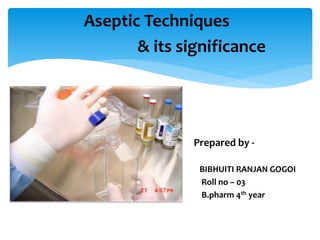
Aseptic Techniques
& its significance
Prepared by -
BIBHUITI RANJAN GOGOI
Roll no – 03
B.pharm 4th year
INTRODUCTION
The methods which are used to prevent the access of
microorganism during the preparation of parenteral products
and their testing are called ‘ Aseptic Techniques’.
Aseptic techniques are used to reduce the risk of post-
procedure infections and to minimize the exposure of health
care providers to potentially infectious microorganisms.
Aseptic techniques include practices performed just
before, during, or after any invasive procedures.
Good aseptic techniques can only be applied if one knows the
possible sources contamination. The various sources of
contamination are –
 Atmosphere, which is contaminated with dust, droplet and droplet nuclei
becomes the breeding ground of microorganism.
 The hands are a major means of transmitting infection.
 Coughing, sneezing and spitting can cause contamination at a considerable
distance.
 The cloths which absorb dust particles are also a source of contamination.
A handkerchief is the richest source of contamination.
 The hair, which is constantly exposed to atmospheric dust is source of
contamination. These dust particles are liberated from the hair during
brushing and shaking of the head.
 The unsterile equipment.
 The working surface.
GMPs REQUIREMENTS FOR THE MANUFACTURING OF
PARENTERAL PRODUCTS ARE
 CLEAN AREA CLASSIFICATION
Production of sterile products should be carried out in a clean environment
with a limit for the environmental quality of particulate and microbial
contamination. Clean areas for the production of sterile products are
classified into different grades discussed below –
GRADE CLASS ≥ 0.5 μm particles/m3
A 100 3,520
B 1000 35,200
C 10,000 352,000
D 100,000 35,20,000
 BUILDINGS & PREMISES
 The building shall be built on proper foundation with
standardized materials to avoid cracks in critical areas like
aseptic solution preparation, filling and sealing rooms.
 Walls, floors and ceiling should be impervious, non-shedding,
non-flaking and non-cracking.
 Flooring should be unbroken and provided with a cove both at
the junction between the wall and the floor as well as the wall
and ceiling.
 EQUIPMENT
The special equipment required for manufacturing parenteral
products includes -
 Component washing machines,
 Steam sterilizers,
 Dry heat sterilizers,
 Membrane filter assemblies,
 Manufacturing vessels,
 Blenders,
 Liquid filling machines,
 Powder filling machines,
 Sealing and labeling machines,
 Vacuum testing chambers,
 Inspection machines etc.
 FILTRATION (MEMBRANE)
 Solutions for Large Volume Parenterals shall be filtered
through a non-fibre releasing, sterilizing grade
cartridge/membrane filter of nominal pore size of 0.22 μ.
 A second filtration using another 0.22 μ sterilizing grade
cartridge/membrane filter shall be performed immediately
prior to filling.
 Gases coming in contact with the sterile product shall be
filtered through two 0.22 μ hydrophobic filters connected in-
series.
 CONCLUSION
All the aspects mentioned have to be taken into consideration
to avoid false positive results and during the comparison it has
been found that, all the guidelines focused on high quality
requirements for the manufacturing process for sterile
pharmaceutical products. All the guidelines were broadly similar
except for environmental factors & water system.
 REFERENCES
 Schedule M, Part I-A, Specific Requirements for Manufacture of Sterile Products,
Parenteral Preparations and Sterile Ophthalmic Preparations
(http://cdsco.nic.in/html/GMP/ScheduleM(GMP).pdf). Accessed 26 September 2013.
 Guidance for Industry for Sterile Drug Products Produced by Aseptic Processing -
Current Good Manufacturing Practice
(http://www.fda.gov/downloads/Drugs/.../Guidance's/ucm070342.pdf). Accessed 1
November 2013.
 Indian Pharmacopoeia 2010.
Aseptic technique

Aseptic technique

  • 1.
    Aseptic Techniques & itssignificance Prepared by - BIBHUITI RANJAN GOGOI Roll no – 03 B.pharm 4th year
  • 2.
    INTRODUCTION The methods whichare used to prevent the access of microorganism during the preparation of parenteral products and their testing are called ‘ Aseptic Techniques’. Aseptic techniques are used to reduce the risk of post- procedure infections and to minimize the exposure of health care providers to potentially infectious microorganisms. Aseptic techniques include practices performed just before, during, or after any invasive procedures.
  • 3.
    Good aseptic techniquescan only be applied if one knows the possible sources contamination. The various sources of contamination are –  Atmosphere, which is contaminated with dust, droplet and droplet nuclei becomes the breeding ground of microorganism.  The hands are a major means of transmitting infection.  Coughing, sneezing and spitting can cause contamination at a considerable distance.  The cloths which absorb dust particles are also a source of contamination. A handkerchief is the richest source of contamination.  The hair, which is constantly exposed to atmospheric dust is source of contamination. These dust particles are liberated from the hair during brushing and shaking of the head.  The unsterile equipment.  The working surface.
  • 4.
    GMPs REQUIREMENTS FORTHE MANUFACTURING OF PARENTERAL PRODUCTS ARE  CLEAN AREA CLASSIFICATION Production of sterile products should be carried out in a clean environment with a limit for the environmental quality of particulate and microbial contamination. Clean areas for the production of sterile products are classified into different grades discussed below – GRADE CLASS ≥ 0.5 μm particles/m3 A 100 3,520 B 1000 35,200 C 10,000 352,000 D 100,000 35,20,000
  • 5.
     BUILDINGS &PREMISES  The building shall be built on proper foundation with standardized materials to avoid cracks in critical areas like aseptic solution preparation, filling and sealing rooms.  Walls, floors and ceiling should be impervious, non-shedding, non-flaking and non-cracking.  Flooring should be unbroken and provided with a cove both at the junction between the wall and the floor as well as the wall and ceiling.
  • 6.
     EQUIPMENT The specialequipment required for manufacturing parenteral products includes -  Component washing machines,  Steam sterilizers,  Dry heat sterilizers,  Membrane filter assemblies,  Manufacturing vessels,  Blenders,  Liquid filling machines,  Powder filling machines,  Sealing and labeling machines,  Vacuum testing chambers,  Inspection machines etc.
  • 7.
     FILTRATION (MEMBRANE) Solutions for Large Volume Parenterals shall be filtered through a non-fibre releasing, sterilizing grade cartridge/membrane filter of nominal pore size of 0.22 μ.  A second filtration using another 0.22 μ sterilizing grade cartridge/membrane filter shall be performed immediately prior to filling.  Gases coming in contact with the sterile product shall be filtered through two 0.22 μ hydrophobic filters connected in- series.
  • 8.
     CONCLUSION All theaspects mentioned have to be taken into consideration to avoid false positive results and during the comparison it has been found that, all the guidelines focused on high quality requirements for the manufacturing process for sterile pharmaceutical products. All the guidelines were broadly similar except for environmental factors & water system.
  • 9.
     REFERENCES  ScheduleM, Part I-A, Specific Requirements for Manufacture of Sterile Products, Parenteral Preparations and Sterile Ophthalmic Preparations (http://cdsco.nic.in/html/GMP/ScheduleM(GMP).pdf). Accessed 26 September 2013.  Guidance for Industry for Sterile Drug Products Produced by Aseptic Processing - Current Good Manufacturing Practice (http://www.fda.gov/downloads/Drugs/.../Guidance's/ucm070342.pdf). Accessed 1 November 2013.  Indian Pharmacopoeia 2010.