Asepsis- Types
Mrs. Royce Mathew
• Asepsis is the condition of being free from
disease-producing microorganisms.
• Aseptic technique implies all those procedures
that reduce or eliminate pathogens and their
actions or minimize their areas of existence.
• Confusion sometimes results from
erroneously thinking that medical asepsis and
surgical asepsis are the same except one is
used on a medical ward and the other is used
in a surgical ward. This is not so.
1) Medical asepsis. All of the procedures used to
protect the patient and his environment from
the spread of infectious organisms.
(2) Surgical asepsis. All of the procedures used
to sterilize and to keep sterile any objects or
articles that are to be introduced into a wound
or body cavity or that is to penetrate the skin.
b. Emphasis.
(1) Medical asepsis. Cleanliness (freedom from
most pathogenic organisms).
(2) Surgical asepsis. Sterility (freedom from all
microorganisms).
c. Purpose.
(1) Medical asepsis. To reduce the transmission
of pathogenic organisms from patient to
another person.
(2) Surgical asepsis. To prevent introduction of
any organism into an open wound on the
patient or into a body cavity.
d. Isolation.
(1) Medical asepsis. Patients with a
communicable disease are separated from the
rest of the patients by room, ward, or unit.
(2) Surgical asepsis. Patients requiring surgery
are taken to the operating room of the
hospital.
e. Zone.
• (1) Medical asepsis. A zone about the isolation
unit is established as contaminated.
Everything within the zone of isolation is
contaminated. Nothing goes out of the zone
without being disinfected or wrapped in a
clean cover to permit handling in a clean zone.
• (2) Surgical asepsis. A zone about the site of
operation or wound is established as a sterile
field. Once a sterile article touches an
unsterile article, it is contaminated (unsterile).
Only sterile articles are brought into the sterile
field.
f. Hand washing.
• (1) Medical asepsis. Hands and forearms are
washed for 1 to 2 minutes to remove surface
contaminants and soil. Hands and arms are
dried with paper towels.
• (2) Surgical asepsis. Hands and forearms are
scrubbed for 10 minutes to reduce the
bacterial count on the skin surface. Hands and
arms are dried with a sterile towel.
Gowns.
• (1) Medical asepsis. Clean gowns are worn to
protect the worker. Inside of gown is clean;
outside of gown in contact with patient and
his environment is contaminated.
•
• (2) Surgical asepsis. Sterile gowns are worn to
protect the patient from the worker. Outside
of gown that is in contact with the sterile field
must be kept sterile.
h. Status of Patient.
• (1) Medical asepsis. Reservoir of infection.
• (2) Surgical asepsis. Potential host (other people
and environment are reservoirs of infection).
i. Goals.
• (1) Medical asepsis. Confine disease organisms
and prevent spread to others.
• (2) Surgical asepsis. Reduce number of organisms
and prevent spread of infection to others.
• Principles of Asepsis
1.Only sterile items are used within sterile
fields. All articles used in an operation have been
sterilized previously.
2.Persons who are sterile touch only sterile
items/ areas; persons who are not sterile touch
only unsterile items/ areas.
3.If in doubt about sterility of anything,
consider it unsterile.
4.Nonsterile persons avoid reaching over a
sterile field; sterile persons avoid leaning over
unsterile area.
5.Tables are sterile only at table levels.
6.Gowns are considered sterile only from
waist to shoulder level in front, and the minimum
sleeves
7.The edge of anything that encloses sterile
contents is unsterile.
8.Sterile persons keep well within sterile areas.
9.Nonsterile persons keep away from sterile
areas.
10.Sterile field is created as close as possible to
the time of use.
11.Sterile areas are continuously kept in view.
12.Destruction of integrity of microbial barriers
results in contamination. Moisture can cause
contamination.
13.When microorganisms cannot be eliminated,
they must be kept to an irreducible minimum.
ASEPTIC TECHNIQUE
a. Aseptic technique is a discipline that consists of a series
of events to guard the patient against infection. This
procedure is used to reduce the direct or indirect
transfer of germs to any surface, article, or person.
• (1) With traumatic wounds, which are assumed to be
contaminated beforehand, aseptic technique refers to
applying a dressing in a manner so that additional
contamination is not induced.
• (2) In administration of preparations by injection or
infusion, it refers to measures designed to prevent or
minimize introduction of pathogens beneath the skin.
• (3) In surgery, it normally implies sterile conditions in
and around the patient area.
b. Treatment personnel can carry out aseptic technique
by:
(1) Keeping their hands clean and as free from
contamination as possible.
(2) Ensuring that all sterile items are kept free from all
organisms. (Dressings that are to be applied to
wounds, needles, and instruments to be inserted
through the skin, and syringes to be filled for injection
into the body must not touch anything unsterile before
being used.)
(3) Keeping from breathing, coughing, or sneezing on
wounds or sterile items.
Medical Asepsis
• During daily routine care, the nurse uses basic
medical aseptic techniques to break the
infection chain.
• Eg.of medical asepsis are changing client’s bed
linen daily, handwashing, barrier techniques,
& routine environmental cleaning.
Cont…
• Follow Isolation technique as appropriate.
• Clients with high susceptibility to infection
require special precautions to prevent
exposure to pathogens.
Cont…
• Effectiveness of aseptic practices depends on
the nurse’s conscientiousness & consistency in
using effective aseptic techniques.
• Hand hygiene- It is important in every setting,
including hospitals.
• It is considered one of the most effective
infection control measures.
• Any client may harbour microorganisms that are
currently harmless to the client yet potentially
harmful to another person or same client if they
find a portal of entry .
• It is important that both the nurses’ and clients’
hands be cleansed at the following times to
prevent the spread of microorganisms:
– before eating, after using the bedpan or toilet, and
after the hands come in contact with any body
substances
• For routine client care WHO
recommends hand washing under a
stream of water for at least 20 seconds
using plain granule soap, soap filled
sheet or liquid soap when the hands are
visibly soiled, after using rest room, after
removing gloves, before handling
invasive devices and after contact with
medical equipment or furniture.
• How ever soap and water are
inadequate to sufficiently remove
pathogens.
• The CDC recommends use of alcohol
based anti septic hand rubs ( Rinse,
gels or foams) for use before and
after direct client contact.
• Anti microbial agents are usually
provided in high risk areas, such as
newborn nursery.
• Hand washing
–Purposes
•To reduce the number of
microorganisms on the hands
•To reduce the risk of transmission of
microorganisms to the clients
•To reduce the risk of cross
contamination among the clients
•To reduce the risk of transmission of
infectious organisms to one self
• Assessment
– Presence of factors increasing susceptibility to infection and
possibility of undiagnosed infection
– Use of immunosuppressive medications
– Recent diagnostic procedures ot treatments that penetrated
the skin or a body cavity
– Current nutritional status
– Signs and symptoms indicating the presence of an infection
– Localized signs, such as swelling, redness, pain or
tenderness with palpation or movement, palpable heat at
the site, loss of function of affected part, presence of
exudate
– Systemic indications, such as fever, increased pulse and
respiratory rates, lack of energy, anorexia and enlarged
lymph nodes
• Equipment
– Soap
– Warm running water
– Disposable or sanitary towels
• Preparation
– Nails should be kept short- short, natural nails are
less likely to harbor microorganisms, scratch a
client, or puncture the gloves.
– Remove all the jewelry- microorganisms can lodge
in the settings of the jewelry and under rings
– Check the hands for breaks in the skin- a nurse
who has open sores may require a work
assignment with decreased risk for transmission
of infectious organisms due to chance of acquiring
or passing on an infection
• Performance
– Turn on the water and adjust the flow
• There are 5 types faucet controls
– Hand operated handles
– Knee levers. Move these with the knee to regulate flow and
temperature
– Foot pedals. Press these with the foot to regulate flow and
temperature
– Elbow controls. Move these with the elbows instead of the
hands
– Infra red controls. Motion in front of these sensors cause,
water to start and soap flow automatically
– Adjust the flow so that the water is warm- warm
water removes less of protective oil of the skin
than hot water.
• Wet the hands thoroughly by holding them
under the running water and apply soap to
the hands
– Hold the hands lower than the elbows from the
arms to fingertips- rationale- the water should
flow from the least contaminated to the most
contaminated to the most contaminated area.;
the hands are generally considered more
contaminated than lower arms
– If the soap is liquid, apply 2-4 ml, if soap bar rub
them firmly between the hands.
• Thoroughly wash and rinse the hands
– Use firm, rubbing and circular movements to wash
the palm, back and wrist and of each hand. Be
sure to include the heel of the hand . Interlace the
fingers and thumbs and move the hands back and
forth.
• Continue this motion at least 15 sec.- rational- the
circular action creates friction that helps remove
microorganisms mechanically, interlacing the fingers
and thumbs cleans the inter digital spaces
– Rub the fingertips aginst the palm of the opposite
hand- rationale- the nails and fingertips are
commonly missed during hand washing.
– Rinse the hands
• Thoroughly pat dry the hands and arms
– Dry hands and arms thoroughly with a paper
towel without surbbing. Rational- moist skin
becomes chapped readily as does dry skin that is
rubbed vigorously; chapping produces lesion
– Discard the paper towel in the appropriate
container.
• Turn off the water
– Use a new paper towel to grasp a hand operated
control- rationale – this prevents the nurse from
picking up microorganisms from the faucet
handles.
• Thoroughly pat dry the hands and arms
– Dry hands and arms thoroughly with a paper
towel without scrubbing. Rationale- moist skin
becomes chapped readily as does dry skin that is
rubbed vigorously; chapping produces lesion
– Discard the paper towel in the appropriate
container.
• Turn off the water
– Use a new paper towel to grasp a hand operated
control- rationale – this prevents the nurse from
picking up microorganisms from the faucet
handles.
• Surgical hand washing
– Apply the soap and wash as directed, but hold the
hands higher than the elbows during this wash. Wet
the hands and forearms under the running water,
letting it run from the finger tips to the elbows so that
the hands become cleaner than elbows. Rationale- in
this way, the water runs from the area that now has
the fewest microorganisms to areas with a relatively
greater number.
– After washing and rinsing, use a towel to dry one
hand thoroughly in a rotating motion from the fingers
to the elbow. Use a new towel to dry the other hand
and arm. Rationale- a clean towel prevents the
transfer of microorganisms from one elbow ( least
clean area ) to the other hand ( cleanest area.)
• Supporting defenses of a susceptible host-
people are in contact with microorganisms in
the environment. Normally a person’s natural
defenses enough to prevent the development
of infection. Susceptibility is the degree to
which an individual can be affected, that is,
likelihood of an organism causing an infection
in that person.
• The following measures can reduce a person’s
susceptibility. Hygiene- intact skin and mucus
membrane are on barrier against
microorganism entering in the body. Nutrition-
a balance diet enhances the health of all body
tissues, help the skin intact and promotes the
skin’s ability to repel microorganism. Fluid- fluid
intake permits fluid output that flushes out the
bladder and urethra, removing microorganism
that could cause an infection.
• Sleep- adequate sleep is essential to health
and to renewing energy. Stress- excessive
stress predisposes people to infection.
Immunization- the use of immunization has
decreased the incidence of infectious
diseases. It is recommended that
immunizations begin shortly after birth and
completed in early childhood except for
boosters
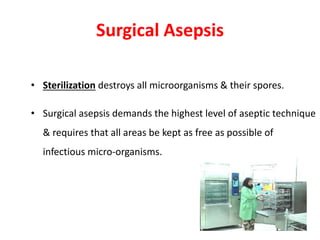
Surgical Asepsis
• Sterilization destroys all microorganisms & their spores.
• Surgical asepsis demands the highest level of aseptic technique
& requires that all areas be kept as free as possible of
infectious micro-organisms.
Cont…
• In surgical asepsis, an area or object may be
considered contaminated if touched by an
object that is not sterile (e.g., a tear in a
surgical glove during a procedure, a sterile
instrument placed on an unsterile surface).
Cont…
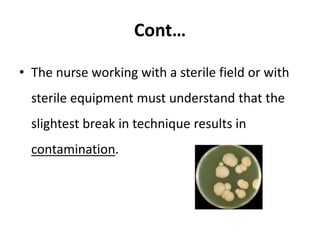
• The nurse working with a sterile field or with
sterile equipment must understand that the
slightest break in technique results in
contamination.
Cont…
• A nurse in an operating room follows a series of steps to
maintain sterile techniques, including applying a mask,
protective eyewear, and a cap; performing a surgical hand
washing; & applying a sterile gown & gloves.
Cont…
• These techniques can be practiced by nurses
in the OR (surgical incision) or at the bedside
(e.g, inserting IV or urinary catheter &
reapplying sterile dressings) where sterile
instruments & supplies are used.
CONTROL OR ELIMINATION OF INFECTIOUS
AGENTS
Cleansing
• It is the removal of all foreign materials such as soil & organic
material from objects.
• Generally, cleansing involves use of water & mechanical action with
or without detergents.
- Disposable object has to be discarded.
- Reusable objects must be cleansed thoroughly before disinfection
& sterilization.
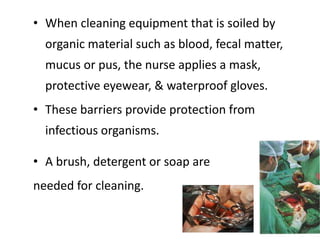
• When cleaning equipment that is soiled by
organic material such as blood, fecal matter,
mucus or pus, the nurse applies a mask,
protective eyewear, & waterproof gloves.
• These barriers provide protection from
infectious organisms.
• A brush, detergent or soap are
needed for cleaning.
• Disinfection – eliminates pathogenic
organisms on inanimate objects with the
exception of bacterial spore. Noninfectious
microorganisms may or may not be killed.
Disinfection & Sterilization
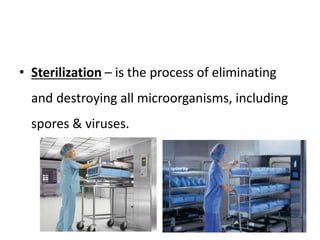
• Sterilization – is the process of eliminating
and destroying all microorganisms, including
spores & viruses.
DISINFECTION
• The first links in the chain of infection, the etiologic agent
and the reservoir, are interrupted by the use of antiseptics (
agents that inhibit the growth of some microorganism) and
disinfectants ( agents that destroy pathogens other than
spores) and by sterilization
• The principle of disinfection is that of denaturation of the
bacterial cell protein.
• This process can be carried out by two methods:
1. Physical - boiling
2. Chemical - disinfectants
• Disinfecting- A disinfectant is a chemical
preparation, such as phenol or iodine
compounds, used on inanimate objects.
Disinfects are frequently caustic and toxic to
tissues.
• An antiseptic is a chemical preparation used
on the skin or tissue.
• They both often similar chemical components,
but the disinfectant is a more concentrated
solution.
• Both the antiseptics and disinfectants are said
to have bactericidal or bacteriostatic
properties. A bactericidal preparation destroys
bacteria, where as bacteriostatic preparation
prevents the growth and reproduction of
some bacteria. An agent known to be effective
against it should be selected.
• When disinfecting articles, nurses need to follow
the agency protocol and consider the following.
– The type and number of infectious agent. Some
microorganisms are readily destroyed, whereas others
require longer contact with disinfectant.
– The recommended concentration of the disinfectant
and duration of contact.
– The presence of soap. Some disinfectants are
ineffective in presence of soap or detergent.
– The presence of organic materials like blood, saliva,
pus or excretions can readily inactivate disinfectants.
– The surface areas to be treated. The disinfectant agent
must come in contact with all surfaces and areas.
Choice of method depends on:
A) Types of microorganisms
Certain strains of bacteria are more resistant to destruction
than vegetative forms.
B) Number of microorganisms present on articles
The more heavily contaminated the articles are, the harder for
destruction.
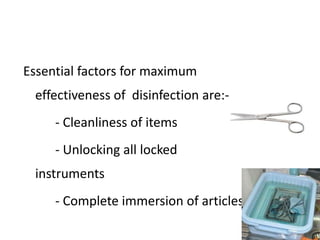
Essential factors for maximum
effectiveness of disinfection are:-
- Cleanliness of items
- Unlocking all locked
instruments
- Complete immersion of articles
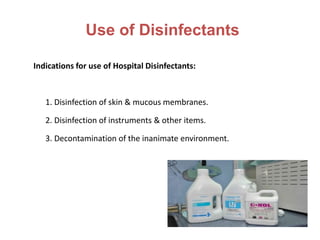
Use of Disinfectants
Indications for use of Hospital Disinfectants:
1. Disinfection of skin & mucous membranes.
2. Disinfection of instruments & other items.
3. Decontamination of the inanimate environment.
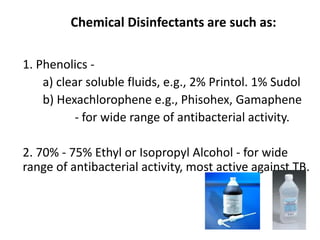
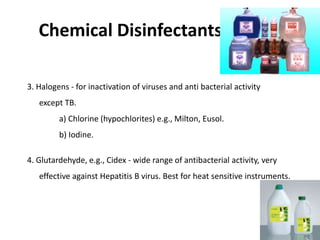
Chemical Disinfectants are such as:
1. Phenolics -
a) clear soluble fluids, e.g., 2% Printol. 1% Sudol
b) Hexachlorophene e.g., Phisohex, Gamaphene
- for wide range of antibacterial activity.
2. 70% - 75% Ethyl or Isopropyl Alcohol - for wide
range of antibacterial activity, most active against TB.
Chemical Disinfectants cont….
3. Halogens - for inactivation of viruses and anti bacterial activity
except TB.
a) Chlorine (hypochlorites) e.g., Milton, Eusol.
b) Iodine.
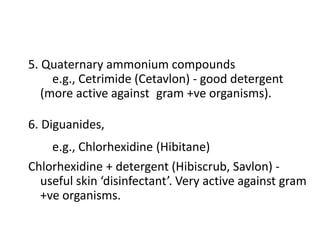
4. Glutardehyde, e.g., Cidex - wide range of antibacterial activity, very
effective against Hepatitis B virus. Best for heat sensitive instruments.
5. Quaternary ammonium compounds
e.g., Cetrimide (Cetavlon) - good detergent
(more active against gram +ve organisms).
6. Diguanides,
e.g., Chlorhexidine (Hibitane)
Chlorhexidine + detergent (Hibiscrub, Savlon) -
useful skin ‘disinfectant’. Very active against gram
+ve organisms.
STERILIZATION
This process can be carried out by 4 methods:-
• HEAT
- moist heat (Autoclave)
- dry heat (Hot Air Oven)
• CHEMICAL
- in solution, e.g., Ethicon
Fluid, Glutaraldehyde
- vapour, e.g.,
Formaldehyde
- gas, e.g., Ethylene
Oxide
• IRRADIATION
- ultra violet light
- gamma rays/cobalt 60
• Boiling
- It is the most practical and
inexpensive method for
sterilizing in the home. The
main disadvantage is that
spores and some viruses are
not killed by this method.
(Boiling a minimum of 15
minutes advised at home
setting)
THE PRINCIPLES OF ASEPTIC TECHNIQUE IN
WOUND CARE
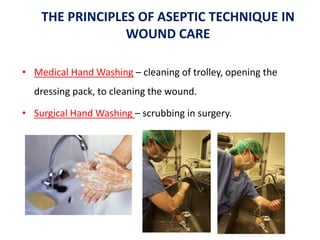
• Medical Hand Washing – cleaning of trolley, opening the
dressing pack, to cleaning the wound.
• Surgical Hand Washing – scrubbing in surgery.
• Isolation precautions- isolation refers to
measures designed to prevent the spread of
infections or potentially infectious
microorganisms to health personnel, clients and
visitors. Several sets of guidelines have been used
in hospitals and other health care settings.
• Category –Specific isolation precautions use
seven categories- Strict isolation, contact
isolation, respiratory isolation, tuberculosis
isolation, enteric isolation, draingae/ secretions
precautions and blood/ body fluid precautions.
• Disease Specific isolation precautions provide
precautions for specific diseases.
• Universal precautions- are techniques to be
used with all clients to decrease the risk of
transmitting unidentified pathogens.
• UP obstruct the spread of blood borne
pathogens, those microorganisms carried in
blood and body fluids that are capable of
infecting other persons with serious and
difficult to treat viral infections
• Standard precautions- these precautions used
in the care of all hospitalized persons
regardless of their diagnosis, or possible
infection status.
– These precautions apply to (a) blood, (b) body
fluids, excretions and secretions except sweat
© non intact( broken) skin; and (d) mucous
membrane.
– Designed to reduce the risk of transmission of
microorganism from recognized and unrecognized
sources.
1. perform proper hand hygiene after contact
with blood, body fluids, secretions, excretions
and contaminated objects whether or not
gloves are worn.
– (a) perform proper hand hygiene immediately
after removing gloves.
– (b) use non antimicrobial product for routine hand
cleansing
– © use an antimicrobial agent or an antiseptic
agent for the control of specific outbreaks of
infection.
• 2. wear clean gloves when touching blood,
body fluids, secretions, excretions and
contaminated items.( soiled linen)
– Clean gloves can be unsterile unless their use is
intended to prevent the entrance of
microorganisms into the body.
– Remove the gloves before touching non
contaminated items and surfaces.
– Perform proper hand hygiene immediately
3. wear a mask, eye protection or face shield if
splashes or sprays of blood, body fluids,
secretions or excretions can be expected.
4. wear a clean non sterile gown if the client
care is likely to result in splashes or sprays of
blood, body fluids, secretions or excretions.
– The gown intended to protect clothing
– A. remove soiled gown carefully to avoid the
transfer of microorganisms to others.
– B. cleanse the hand after removing the gown.
5. handle the client care equipment is that is
soiled with blood, body fluids, secretions or
excretions carefully to prevent the transfer of
microorganism to others and to the
environment.
• a. make sure reusable equipment is cleaned
and reprocessed correctly.
• b. dispose of single use equipment correctly.
6. Handle, transport, and process linen that is
soiled with blood, body fluids, secretions or
excretions in a manner to prevent
contamination of clothing and transfer of
microorganism to others and to the
environment.
7. prevent injuries from used scalpels, needles
or other equipment and place in puncture
resistant containers.
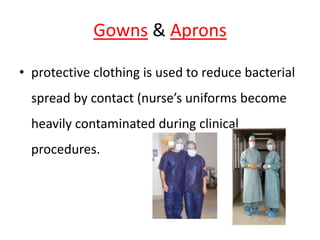
Gowns & Aprons
• protective clothing is used to reduce bacterial
spread by contact (nurse’s uniforms become
heavily contaminated during clinical
procedures.
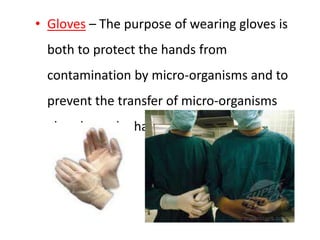
• Gloves – The purpose of wearing gloves is
both to protect the hands from
contamination by micro-organisms and to
prevent the transfer of micro-organisms
already on the hands.
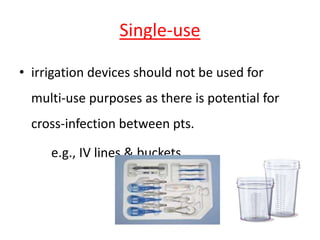
Single-use
• irrigation devices should not be used for
multi-use purposes as there is potential for
cross-infection between pts.
e.g., IV lines & buckets.
BLOOD TRANSMISSABLE DISEASES &
SEXUALLY TRANSMITTED DISEASES (STDs)
• HIV Infection/AIDS
• Hepatitis B (HBV)
• Hepatitis C (HCV)
• Syphilis
• Gonorrhoea
• Chlamydia
• Herpes Simplex
• Cytomegalovirus
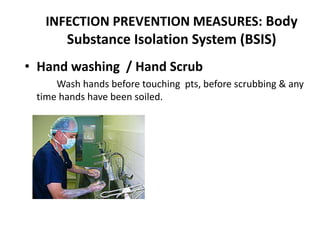
INFECTION PREVENTION MEASURES: Body
Substance Isolation System (BSIS)
• Hand washing / Hand Scrub
Wash hands before touching pts, before scrubbing & any
time hands have been soiled.

Microbiology Series 2- Asepsis.pptx

  • 1.
  • 2.
    • Asepsis isthe condition of being free from disease-producing microorganisms. • Aseptic technique implies all those procedures that reduce or eliminate pathogens and their actions or minimize their areas of existence. • Confusion sometimes results from erroneously thinking that medical asepsis and surgical asepsis are the same except one is used on a medical ward and the other is used in a surgical ward. This is not so.
  • 3.
    1) Medical asepsis.All of the procedures used to protect the patient and his environment from the spread of infectious organisms. (2) Surgical asepsis. All of the procedures used to sterilize and to keep sterile any objects or articles that are to be introduced into a wound or body cavity or that is to penetrate the skin.
  • 4.
    b. Emphasis. (1) Medicalasepsis. Cleanliness (freedom from most pathogenic organisms). (2) Surgical asepsis. Sterility (freedom from all microorganisms).
  • 5.
    c. Purpose. (1) Medicalasepsis. To reduce the transmission of pathogenic organisms from patient to another person. (2) Surgical asepsis. To prevent introduction of any organism into an open wound on the patient or into a body cavity.
  • 6.
    d. Isolation. (1) Medicalasepsis. Patients with a communicable disease are separated from the rest of the patients by room, ward, or unit. (2) Surgical asepsis. Patients requiring surgery are taken to the operating room of the hospital.
  • 7.
    e. Zone. • (1)Medical asepsis. A zone about the isolation unit is established as contaminated. Everything within the zone of isolation is contaminated. Nothing goes out of the zone without being disinfected or wrapped in a clean cover to permit handling in a clean zone. • (2) Surgical asepsis. A zone about the site of operation or wound is established as a sterile field. Once a sterile article touches an unsterile article, it is contaminated (unsterile). Only sterile articles are brought into the sterile field.
  • 8.
    f. Hand washing. •(1) Medical asepsis. Hands and forearms are washed for 1 to 2 minutes to remove surface contaminants and soil. Hands and arms are dried with paper towels. • (2) Surgical asepsis. Hands and forearms are scrubbed for 10 minutes to reduce the bacterial count on the skin surface. Hands and arms are dried with a sterile towel.
  • 9.
    Gowns. • (1) Medicalasepsis. Clean gowns are worn to protect the worker. Inside of gown is clean; outside of gown in contact with patient and his environment is contaminated. • • (2) Surgical asepsis. Sterile gowns are worn to protect the patient from the worker. Outside of gown that is in contact with the sterile field must be kept sterile.
  • 10.
    h. Status ofPatient. • (1) Medical asepsis. Reservoir of infection. • (2) Surgical asepsis. Potential host (other people and environment are reservoirs of infection). i. Goals. • (1) Medical asepsis. Confine disease organisms and prevent spread to others. • (2) Surgical asepsis. Reduce number of organisms and prevent spread of infection to others.
  • 11.
    • Principles ofAsepsis 1.Only sterile items are used within sterile fields. All articles used in an operation have been sterilized previously. 2.Persons who are sterile touch only sterile items/ areas; persons who are not sterile touch only unsterile items/ areas. 3.If in doubt about sterility of anything, consider it unsterile. 4.Nonsterile persons avoid reaching over a sterile field; sterile persons avoid leaning over unsterile area. 5.Tables are sterile only at table levels. 6.Gowns are considered sterile only from waist to shoulder level in front, and the minimum sleeves
  • 12.
    7.The edge ofanything that encloses sterile contents is unsterile. 8.Sterile persons keep well within sterile areas. 9.Nonsterile persons keep away from sterile areas. 10.Sterile field is created as close as possible to the time of use. 11.Sterile areas are continuously kept in view. 12.Destruction of integrity of microbial barriers results in contamination. Moisture can cause contamination. 13.When microorganisms cannot be eliminated, they must be kept to an irreducible minimum.
  • 13.
    ASEPTIC TECHNIQUE a. Aseptictechnique is a discipline that consists of a series of events to guard the patient against infection. This procedure is used to reduce the direct or indirect transfer of germs to any surface, article, or person. • (1) With traumatic wounds, which are assumed to be contaminated beforehand, aseptic technique refers to applying a dressing in a manner so that additional contamination is not induced. • (2) In administration of preparations by injection or infusion, it refers to measures designed to prevent or minimize introduction of pathogens beneath the skin. • (3) In surgery, it normally implies sterile conditions in and around the patient area.
  • 14.
    b. Treatment personnelcan carry out aseptic technique by: (1) Keeping their hands clean and as free from contamination as possible. (2) Ensuring that all sterile items are kept free from all organisms. (Dressings that are to be applied to wounds, needles, and instruments to be inserted through the skin, and syringes to be filled for injection into the body must not touch anything unsterile before being used.) (3) Keeping from breathing, coughing, or sneezing on wounds or sterile items.
  • 15.
    Medical Asepsis • Duringdaily routine care, the nurse uses basic medical aseptic techniques to break the infection chain. • Eg.of medical asepsis are changing client’s bed linen daily, handwashing, barrier techniques, & routine environmental cleaning.
  • 16.
    Cont… • Follow Isolationtechnique as appropriate. • Clients with high susceptibility to infection require special precautions to prevent exposure to pathogens.
  • 17.
    Cont… • Effectiveness ofaseptic practices depends on the nurse’s conscientiousness & consistency in using effective aseptic techniques.
  • 18.
    • Hand hygiene-It is important in every setting, including hospitals. • It is considered one of the most effective infection control measures. • Any client may harbour microorganisms that are currently harmless to the client yet potentially harmful to another person or same client if they find a portal of entry . • It is important that both the nurses’ and clients’ hands be cleansed at the following times to prevent the spread of microorganisms: – before eating, after using the bedpan or toilet, and after the hands come in contact with any body substances
  • 19.
    • For routineclient care WHO recommends hand washing under a stream of water for at least 20 seconds using plain granule soap, soap filled sheet or liquid soap when the hands are visibly soiled, after using rest room, after removing gloves, before handling invasive devices and after contact with medical equipment or furniture.
  • 20.
    • How eversoap and water are inadequate to sufficiently remove pathogens. • The CDC recommends use of alcohol based anti septic hand rubs ( Rinse, gels or foams) for use before and after direct client contact. • Anti microbial agents are usually provided in high risk areas, such as newborn nursery.
  • 21.
    • Hand washing –Purposes •Toreduce the number of microorganisms on the hands •To reduce the risk of transmission of microorganisms to the clients •To reduce the risk of cross contamination among the clients •To reduce the risk of transmission of infectious organisms to one self
  • 22.
    • Assessment – Presenceof factors increasing susceptibility to infection and possibility of undiagnosed infection – Use of immunosuppressive medications – Recent diagnostic procedures ot treatments that penetrated the skin or a body cavity – Current nutritional status – Signs and symptoms indicating the presence of an infection – Localized signs, such as swelling, redness, pain or tenderness with palpation or movement, palpable heat at the site, loss of function of affected part, presence of exudate – Systemic indications, such as fever, increased pulse and respiratory rates, lack of energy, anorexia and enlarged lymph nodes
  • 23.
    • Equipment – Soap –Warm running water – Disposable or sanitary towels
  • 24.
    • Preparation – Nailsshould be kept short- short, natural nails are less likely to harbor microorganisms, scratch a client, or puncture the gloves. – Remove all the jewelry- microorganisms can lodge in the settings of the jewelry and under rings – Check the hands for breaks in the skin- a nurse who has open sores may require a work assignment with decreased risk for transmission of infectious organisms due to chance of acquiring or passing on an infection
  • 25.
    • Performance – Turnon the water and adjust the flow • There are 5 types faucet controls – Hand operated handles – Knee levers. Move these with the knee to regulate flow and temperature – Foot pedals. Press these with the foot to regulate flow and temperature – Elbow controls. Move these with the elbows instead of the hands – Infra red controls. Motion in front of these sensors cause, water to start and soap flow automatically – Adjust the flow so that the water is warm- warm water removes less of protective oil of the skin than hot water.
  • 26.
    • Wet thehands thoroughly by holding them under the running water and apply soap to the hands – Hold the hands lower than the elbows from the arms to fingertips- rationale- the water should flow from the least contaminated to the most contaminated to the most contaminated area.; the hands are generally considered more contaminated than lower arms – If the soap is liquid, apply 2-4 ml, if soap bar rub them firmly between the hands.
  • 27.
    • Thoroughly washand rinse the hands – Use firm, rubbing and circular movements to wash the palm, back and wrist and of each hand. Be sure to include the heel of the hand . Interlace the fingers and thumbs and move the hands back and forth. • Continue this motion at least 15 sec.- rational- the circular action creates friction that helps remove microorganisms mechanically, interlacing the fingers and thumbs cleans the inter digital spaces – Rub the fingertips aginst the palm of the opposite hand- rationale- the nails and fingertips are commonly missed during hand washing. – Rinse the hands
  • 28.
    • Thoroughly patdry the hands and arms – Dry hands and arms thoroughly with a paper towel without surbbing. Rational- moist skin becomes chapped readily as does dry skin that is rubbed vigorously; chapping produces lesion – Discard the paper towel in the appropriate container. • Turn off the water – Use a new paper towel to grasp a hand operated control- rationale – this prevents the nurse from picking up microorganisms from the faucet handles.
  • 29.
    • Thoroughly patdry the hands and arms – Dry hands and arms thoroughly with a paper towel without scrubbing. Rationale- moist skin becomes chapped readily as does dry skin that is rubbed vigorously; chapping produces lesion – Discard the paper towel in the appropriate container. • Turn off the water – Use a new paper towel to grasp a hand operated control- rationale – this prevents the nurse from picking up microorganisms from the faucet handles.
  • 30.
    • Surgical handwashing – Apply the soap and wash as directed, but hold the hands higher than the elbows during this wash. Wet the hands and forearms under the running water, letting it run from the finger tips to the elbows so that the hands become cleaner than elbows. Rationale- in this way, the water runs from the area that now has the fewest microorganisms to areas with a relatively greater number. – After washing and rinsing, use a towel to dry one hand thoroughly in a rotating motion from the fingers to the elbow. Use a new towel to dry the other hand and arm. Rationale- a clean towel prevents the transfer of microorganisms from one elbow ( least clean area ) to the other hand ( cleanest area.)
  • 31.
    • Supporting defensesof a susceptible host- people are in contact with microorganisms in the environment. Normally a person’s natural defenses enough to prevent the development of infection. Susceptibility is the degree to which an individual can be affected, that is, likelihood of an organism causing an infection in that person.
  • 32.
    • The followingmeasures can reduce a person’s susceptibility. Hygiene- intact skin and mucus membrane are on barrier against microorganism entering in the body. Nutrition- a balance diet enhances the health of all body tissues, help the skin intact and promotes the skin’s ability to repel microorganism. Fluid- fluid intake permits fluid output that flushes out the bladder and urethra, removing microorganism that could cause an infection.
  • 33.
    • Sleep- adequatesleep is essential to health and to renewing energy. Stress- excessive stress predisposes people to infection. Immunization- the use of immunization has decreased the incidence of infectious diseases. It is recommended that immunizations begin shortly after birth and completed in early childhood except for boosters
  • 34.
    Surgical Asepsis • Sterilizationdestroys all microorganisms & their spores. • Surgical asepsis demands the highest level of aseptic technique & requires that all areas be kept as free as possible of infectious micro-organisms.
  • 35.
    Cont… • In surgicalasepsis, an area or object may be considered contaminated if touched by an object that is not sterile (e.g., a tear in a surgical glove during a procedure, a sterile instrument placed on an unsterile surface).
  • 36.
    Cont… • The nurseworking with a sterile field or with sterile equipment must understand that the slightest break in technique results in contamination.
  • 37.
    Cont… • A nursein an operating room follows a series of steps to maintain sterile techniques, including applying a mask, protective eyewear, and a cap; performing a surgical hand washing; & applying a sterile gown & gloves.
  • 38.
    Cont… • These techniquescan be practiced by nurses in the OR (surgical incision) or at the bedside (e.g, inserting IV or urinary catheter & reapplying sterile dressings) where sterile instruments & supplies are used.
  • 39.
    CONTROL OR ELIMINATIONOF INFECTIOUS AGENTS Cleansing • It is the removal of all foreign materials such as soil & organic material from objects. • Generally, cleansing involves use of water & mechanical action with or without detergents. - Disposable object has to be discarded. - Reusable objects must be cleansed thoroughly before disinfection & sterilization.
  • 40.
    • When cleaningequipment that is soiled by organic material such as blood, fecal matter, mucus or pus, the nurse applies a mask, protective eyewear, & waterproof gloves. • These barriers provide protection from infectious organisms. • A brush, detergent or soap are needed for cleaning.
  • 42.
    • Disinfection –eliminates pathogenic organisms on inanimate objects with the exception of bacterial spore. Noninfectious microorganisms may or may not be killed. Disinfection & Sterilization
  • 43.
    • Sterilization –is the process of eliminating and destroying all microorganisms, including spores & viruses.
  • 44.
    DISINFECTION • The firstlinks in the chain of infection, the etiologic agent and the reservoir, are interrupted by the use of antiseptics ( agents that inhibit the growth of some microorganism) and disinfectants ( agents that destroy pathogens other than spores) and by sterilization • The principle of disinfection is that of denaturation of the bacterial cell protein. • This process can be carried out by two methods: 1. Physical - boiling 2. Chemical - disinfectants
  • 45.
    • Disinfecting- Adisinfectant is a chemical preparation, such as phenol or iodine compounds, used on inanimate objects. Disinfects are frequently caustic and toxic to tissues. • An antiseptic is a chemical preparation used on the skin or tissue. • They both often similar chemical components, but the disinfectant is a more concentrated solution.
  • 46.
    • Both theantiseptics and disinfectants are said to have bactericidal or bacteriostatic properties. A bactericidal preparation destroys bacteria, where as bacteriostatic preparation prevents the growth and reproduction of some bacteria. An agent known to be effective against it should be selected.
  • 47.
    • When disinfectingarticles, nurses need to follow the agency protocol and consider the following. – The type and number of infectious agent. Some microorganisms are readily destroyed, whereas others require longer contact with disinfectant. – The recommended concentration of the disinfectant and duration of contact. – The presence of soap. Some disinfectants are ineffective in presence of soap or detergent. – The presence of organic materials like blood, saliva, pus or excretions can readily inactivate disinfectants. – The surface areas to be treated. The disinfectant agent must come in contact with all surfaces and areas.
  • 48.
    Choice of methoddepends on: A) Types of microorganisms Certain strains of bacteria are more resistant to destruction than vegetative forms. B) Number of microorganisms present on articles The more heavily contaminated the articles are, the harder for destruction.
  • 49.
    Essential factors formaximum effectiveness of disinfection are:- - Cleanliness of items - Unlocking all locked instruments - Complete immersion of articles
  • 50.
    Use of Disinfectants Indicationsfor use of Hospital Disinfectants: 1. Disinfection of skin & mucous membranes. 2. Disinfection of instruments & other items. 3. Decontamination of the inanimate environment.
  • 51.
    Chemical Disinfectants aresuch as: 1. Phenolics - a) clear soluble fluids, e.g., 2% Printol. 1% Sudol b) Hexachlorophene e.g., Phisohex, Gamaphene - for wide range of antibacterial activity. 2. 70% - 75% Ethyl or Isopropyl Alcohol - for wide range of antibacterial activity, most active against TB.
  • 52.
    Chemical Disinfectants cont…. 3.Halogens - for inactivation of viruses and anti bacterial activity except TB. a) Chlorine (hypochlorites) e.g., Milton, Eusol. b) Iodine. 4. Glutardehyde, e.g., Cidex - wide range of antibacterial activity, very effective against Hepatitis B virus. Best for heat sensitive instruments.
  • 53.
    5. Quaternary ammoniumcompounds e.g., Cetrimide (Cetavlon) - good detergent (more active against gram +ve organisms). 6. Diguanides, e.g., Chlorhexidine (Hibitane) Chlorhexidine + detergent (Hibiscrub, Savlon) - useful skin ‘disinfectant’. Very active against gram +ve organisms.
  • 54.
    STERILIZATION This process canbe carried out by 4 methods:- • HEAT - moist heat (Autoclave) - dry heat (Hot Air Oven) • CHEMICAL - in solution, e.g., Ethicon Fluid, Glutaraldehyde - vapour, e.g., Formaldehyde - gas, e.g., Ethylene Oxide • IRRADIATION - ultra violet light - gamma rays/cobalt 60 • Boiling - It is the most practical and inexpensive method for sterilizing in the home. The main disadvantage is that spores and some viruses are not killed by this method. (Boiling a minimum of 15 minutes advised at home setting)
  • 55.
    THE PRINCIPLES OFASEPTIC TECHNIQUE IN WOUND CARE • Medical Hand Washing – cleaning of trolley, opening the dressing pack, to cleaning the wound. • Surgical Hand Washing – scrubbing in surgery.
  • 56.
    • Isolation precautions-isolation refers to measures designed to prevent the spread of infections or potentially infectious microorganisms to health personnel, clients and visitors. Several sets of guidelines have been used in hospitals and other health care settings. • Category –Specific isolation precautions use seven categories- Strict isolation, contact isolation, respiratory isolation, tuberculosis isolation, enteric isolation, draingae/ secretions precautions and blood/ body fluid precautions. • Disease Specific isolation precautions provide precautions for specific diseases.
  • 57.
    • Universal precautions-are techniques to be used with all clients to decrease the risk of transmitting unidentified pathogens. • UP obstruct the spread of blood borne pathogens, those microorganisms carried in blood and body fluids that are capable of infecting other persons with serious and difficult to treat viral infections
  • 58.
    • Standard precautions-these precautions used in the care of all hospitalized persons regardless of their diagnosis, or possible infection status. – These precautions apply to (a) blood, (b) body fluids, excretions and secretions except sweat © non intact( broken) skin; and (d) mucous membrane. – Designed to reduce the risk of transmission of microorganism from recognized and unrecognized sources.
  • 59.
    1. perform properhand hygiene after contact with blood, body fluids, secretions, excretions and contaminated objects whether or not gloves are worn. – (a) perform proper hand hygiene immediately after removing gloves. – (b) use non antimicrobial product for routine hand cleansing – © use an antimicrobial agent or an antiseptic agent for the control of specific outbreaks of infection.
  • 60.
    • 2. wearclean gloves when touching blood, body fluids, secretions, excretions and contaminated items.( soiled linen) – Clean gloves can be unsterile unless their use is intended to prevent the entrance of microorganisms into the body. – Remove the gloves before touching non contaminated items and surfaces. – Perform proper hand hygiene immediately
  • 61.
    3. wear amask, eye protection or face shield if splashes or sprays of blood, body fluids, secretions or excretions can be expected. 4. wear a clean non sterile gown if the client care is likely to result in splashes or sprays of blood, body fluids, secretions or excretions. – The gown intended to protect clothing – A. remove soiled gown carefully to avoid the transfer of microorganisms to others. – B. cleanse the hand after removing the gown.
  • 62.
    5. handle theclient care equipment is that is soiled with blood, body fluids, secretions or excretions carefully to prevent the transfer of microorganism to others and to the environment. • a. make sure reusable equipment is cleaned and reprocessed correctly. • b. dispose of single use equipment correctly.
  • 63.
    6. Handle, transport,and process linen that is soiled with blood, body fluids, secretions or excretions in a manner to prevent contamination of clothing and transfer of microorganism to others and to the environment. 7. prevent injuries from used scalpels, needles or other equipment and place in puncture resistant containers.
  • 64.
    Gowns & Aprons •protective clothing is used to reduce bacterial spread by contact (nurse’s uniforms become heavily contaminated during clinical procedures.
  • 65.
    • Gloves –The purpose of wearing gloves is both to protect the hands from contamination by micro-organisms and to prevent the transfer of micro-organisms already on the hands.
  • 66.
    Single-use • irrigation devicesshould not be used for multi-use purposes as there is potential for cross-infection between pts. e.g., IV lines & buckets.
  • 67.
    BLOOD TRANSMISSABLE DISEASES& SEXUALLY TRANSMITTED DISEASES (STDs) • HIV Infection/AIDS • Hepatitis B (HBV) • Hepatitis C (HCV) • Syphilis • Gonorrhoea • Chlamydia • Herpes Simplex • Cytomegalovirus
  • 68.
    INFECTION PREVENTION MEASURES:Body Substance Isolation System (BSIS) • Hand washing / Hand Scrub Wash hands before touching pts, before scrubbing & any time hands have been soiled.