IV MODERN ERA  1500 – 1850 AD ( Dark age in nursing)
THE RENAISSANCE Expansion of trade and travel Art, architecture, literature, printing Contributions to medicine –  Leonardo da Vinci (Anatomical studies & drawing) Andreas Vesalius (Founder of Anatomy as a Science) Ambroisa Pari (Outstanding work in surgery) William Harvey (Circulation of blood) Self sacrifice and self denial cast aside.  More worldly under Pagan influence General attitude towards charitable works Focus of medicine and nursing
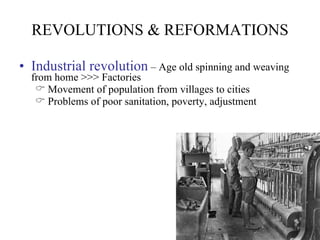
REVOLUTIONS & REFORMATIONS Industrial revolution  – Age old spinning and weaving from home >>> Factories Movement of population from villages to cities Problems of poor sanitation, poverty, adjustment
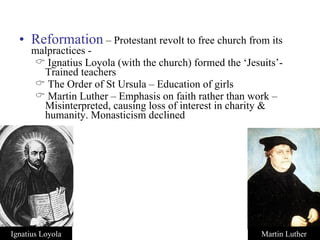
Reformation   – Protestant revolt to free church from its malpractices - Ignatius Loyola (with the church) formed the ‘Jesuits’- Trained teachers The Order of St Ursula – Education of girls Martin Luther – Emphasis on faith rather than work – Misinterpreted, causing loss of interest in charity & humanity. Monasticism declined Ignatius Loyola Martin Luther
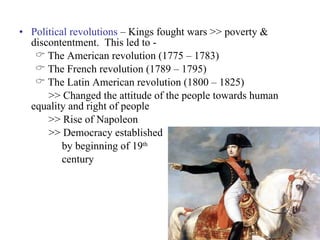
Political revolutions  – Kings fought wars >> poverty & discontentment.  This led to - The American revolution (1775 – 1783) The French revolution (1789 – 1795) The Latin American revolution (1800 – 1825) >> Changed the attitude of the people towards human equality and right of people >> Rise of Napoleon >> Democracy established  by beginning of 19 th   century
HOSPITALS & NURSING Darkest period in history of nursing (17 th  to mid 19 th  century) Secular nursing societies  (of 12 th  and 13 th  centuries) were gaining strength But the older, more conventional ones became stagnant 1212 – Bishops drew up regulations for French hospitals –  Nursing orders to take a vow of poverty, chastity and obedience Number of nurses reduced to  smallest possible number  (to economize) Remain cloistered Thus women’s freedom limited
The Beguines refused to be  enclosed and continued their visiting nursing The nurses of France did not resist and their professional standards retrograded The Protestant revolt broke up the religious organizations >> Problems of care of the sick and the poor >> Municipal hospitals built ..But there were no nuns and monks to work
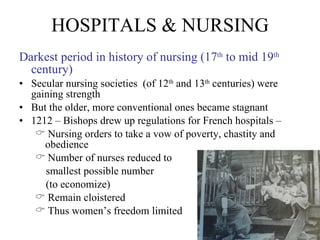
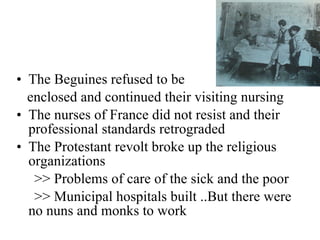
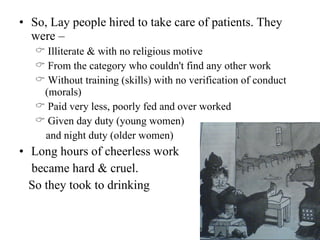
So, Lay people hired to take care of patients. They were – Illiterate & with no religious motive From the category who couldn't find any other work Without training (skills) with no verification of conduct (morals) Paid very less, poorly fed and over worked  Given day duty (young women)  and night duty (older women) Long hours of cheerless work  became hard & cruel.  So they took to drinking
Doctors did most of the nursing jobs Nurses did mostly cleaning, laundry and  scrubbing Such unsanitary conditions  >>> hospitals a source of outbreak of many epidemics No isolation of patients, no visiting Nurses did day and night duty Patients were poor and friendless Under such conditions, women of refinement and intelligence would not take up nursing An average family dreaded and avoided the nurse and the hospital Religious orders and other humanitarians re-opened and tried to revive the tradition.
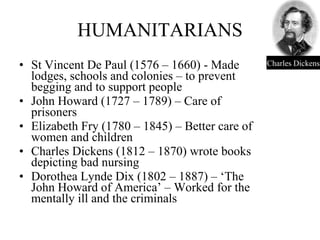
HUMANITARIANS St Vincent De Paul (1576 – 1660) - Made lodges, schools and colonies – to prevent begging and to support people John Howard (1727 – 1789) – Care of prisoners Elizabeth Fry (1780 – 1845) – Better care of women and children Charles Dickens (1812 – 1870) wrote books depicting bad nursing Dorothea Lynde Dix (1802 – 1887) – ‘The John Howard of America’ – Worked for the mentally ill and the criminals Charles Dickens
REVIVAL OF DEACONESSES By Pastor Theodor Fliedner at a parish in  Kaiserwerth, Germany Rented a large house for hospital and deaconess home Mrs Fliedner taught Nursing to deaconesses Later Elizabeth Fry and Florence Nightingale also visited here Modern School of Nursing has adopted their principles – Nurses should be certified healthy and of good conduct Follow probationary system Have regular classes Be given stipend Have a women i/c of nursing Must follow the doctor’s orders
V MODERN NURSING
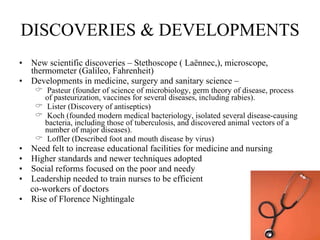
DISCOVERIES & DEVELOPMENTS New scientific discoveries – Stethoscope ( Laënnec,), microscope, thermometer (Galileo, Fahrenheit) Developments in medicine, surgery and sanitary science –  Pasteur (founder of science of microbiology, germ theory of disease, process of pasteurization, vaccines for several diseases, including rabies). Lister (Discovery of antiseptics) Koch (founded modern medical bacteriology, isolated several disease-causing  bacteria, including those of tuberculosis, and discovered animal vectors of a number of major diseases). Loffler (Described foot and mouth disease by virus) Need felt to increase educational facilities for medicine and nursing  Higher standards and newer techniques adopted Social reforms focused on the poor and needy Leadership needed to train nurses to be efficient  co-workers of doctors Rise of Florence Nightingale
And then…. Nursing did a crucial spin  all over the globe….

History of Nursing - Modern Era

  • 1.
    IV MODERN ERA 1500 – 1850 AD ( Dark age in nursing)
  • 2.
    THE RENAISSANCE Expansionof trade and travel Art, architecture, literature, printing Contributions to medicine – Leonardo da Vinci (Anatomical studies & drawing) Andreas Vesalius (Founder of Anatomy as a Science) Ambroisa Pari (Outstanding work in surgery) William Harvey (Circulation of blood) Self sacrifice and self denial cast aside. More worldly under Pagan influence General attitude towards charitable works Focus of medicine and nursing
  • 3.
    REVOLUTIONS & REFORMATIONSIndustrial revolution – Age old spinning and weaving from home >>> Factories Movement of population from villages to cities Problems of poor sanitation, poverty, adjustment
  • 4.
    Reformation – Protestant revolt to free church from its malpractices - Ignatius Loyola (with the church) formed the ‘Jesuits’- Trained teachers The Order of St Ursula – Education of girls Martin Luther – Emphasis on faith rather than work – Misinterpreted, causing loss of interest in charity & humanity. Monasticism declined Ignatius Loyola Martin Luther
  • 5.
    Political revolutions – Kings fought wars >> poverty & discontentment. This led to - The American revolution (1775 – 1783) The French revolution (1789 – 1795) The Latin American revolution (1800 – 1825) >> Changed the attitude of the people towards human equality and right of people >> Rise of Napoleon >> Democracy established by beginning of 19 th century
  • 6.
    HOSPITALS & NURSINGDarkest period in history of nursing (17 th to mid 19 th century) Secular nursing societies (of 12 th and 13 th centuries) were gaining strength But the older, more conventional ones became stagnant 1212 – Bishops drew up regulations for French hospitals – Nursing orders to take a vow of poverty, chastity and obedience Number of nurses reduced to smallest possible number (to economize) Remain cloistered Thus women’s freedom limited
  • 7.
    The Beguines refusedto be enclosed and continued their visiting nursing The nurses of France did not resist and their professional standards retrograded The Protestant revolt broke up the religious organizations >> Problems of care of the sick and the poor >> Municipal hospitals built ..But there were no nuns and monks to work
  • 8.
    So, Lay peoplehired to take care of patients. They were – Illiterate & with no religious motive From the category who couldn't find any other work Without training (skills) with no verification of conduct (morals) Paid very less, poorly fed and over worked Given day duty (young women) and night duty (older women) Long hours of cheerless work became hard & cruel. So they took to drinking
  • 9.
    Doctors did mostof the nursing jobs Nurses did mostly cleaning, laundry and scrubbing Such unsanitary conditions >>> hospitals a source of outbreak of many epidemics No isolation of patients, no visiting Nurses did day and night duty Patients were poor and friendless Under such conditions, women of refinement and intelligence would not take up nursing An average family dreaded and avoided the nurse and the hospital Religious orders and other humanitarians re-opened and tried to revive the tradition.
  • 10.
    HUMANITARIANS St VincentDe Paul (1576 – 1660) - Made lodges, schools and colonies – to prevent begging and to support people John Howard (1727 – 1789) – Care of prisoners Elizabeth Fry (1780 – 1845) – Better care of women and children Charles Dickens (1812 – 1870) wrote books depicting bad nursing Dorothea Lynde Dix (1802 – 1887) – ‘The John Howard of America’ – Worked for the mentally ill and the criminals Charles Dickens
  • 11.
    REVIVAL OF DEACONESSESBy Pastor Theodor Fliedner at a parish in Kaiserwerth, Germany Rented a large house for hospital and deaconess home Mrs Fliedner taught Nursing to deaconesses Later Elizabeth Fry and Florence Nightingale also visited here Modern School of Nursing has adopted their principles – Nurses should be certified healthy and of good conduct Follow probationary system Have regular classes Be given stipend Have a women i/c of nursing Must follow the doctor’s orders
  • 12.
  • 13.
    DISCOVERIES & DEVELOPMENTSNew scientific discoveries – Stethoscope ( Laënnec,), microscope, thermometer (Galileo, Fahrenheit) Developments in medicine, surgery and sanitary science – Pasteur (founder of science of microbiology, germ theory of disease, process of pasteurization, vaccines for several diseases, including rabies). Lister (Discovery of antiseptics) Koch (founded modern medical bacteriology, isolated several disease-causing bacteria, including those of tuberculosis, and discovered animal vectors of a number of major diseases). Loffler (Described foot and mouth disease by virus) Need felt to increase educational facilities for medicine and nursing Higher standards and newer techniques adopted Social reforms focused on the poor and needy Leadership needed to train nurses to be efficient co-workers of doctors Rise of Florence Nightingale
  • 14.
    And then…. Nursingdid a crucial spin all over the globe….