SURGICAL ASEPSIS
 Prepared by,
 Jerenett Joy Mahinay
 Lalaine Solis
 Aldrin Bangcal
 Kristel Angela Pilongo
 Susanne Vincoy
SURGICAL ASEPSIS
 REFERS TO THE PROCEDURES USED TO KEEP THE OBJECT OR AREAS
STERILE OR COMPLETELY FREE FROM MICROORGANISM.
 IN SURGICAL ASEPSIS ALL PRACTICES ARE DIRECTED TO THE
ELIMINATION OF BOTH PATHOGENIC AND NONPATHOGENIC
MICROORGANISMS.
STANDARD PRECAUTION
Standard precautions
 Standard precautions are a set of infection control practices that healthcare
personnel use to reduce transmission of microorganisms in healthcare settings.
 Standard precautions protect both healthcare personnel and patients from contact
with infectious agents.
Standard precautions include:
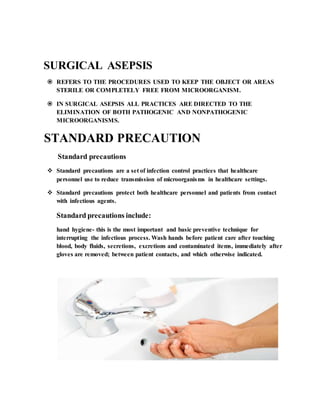
hand hygiene- this is the most important and basic preventive technique for
interrupting the infectious process. Wash hands before patient care after touching
blood, body fluids, secretions, excretions and contaminated items, immediately after
gloves are removed; between patient contacts, and which otherwise indicated.
Personalprotective equipment
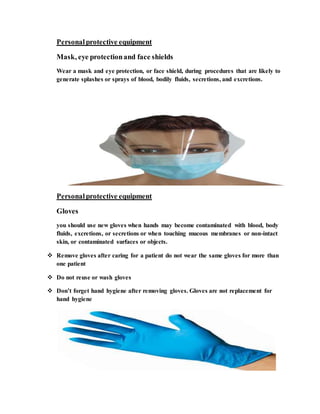
Mask, eye protectionand face shields
Wear a mask and eye protection, or face shield, during procedures that are likely to
generate splashes or sprays of blood, bodily fluids, secretions, and excretions.
Personalprotective equipment
Gloves
you should use new gloves when hands may become contaminated with blood, body
fluids, excretions, or secretions or when touching mucous membranes or non-intact
skin, or contaminated surfaces or objects.
 Remove gloves after caring for a patient do not wear the same gloves for more than
one patient
 Do not reuse or wash gloves
 Don’t forget hand hygiene after removing gloves. Gloves are not replacement for
hand hygiene
Personalprotective equipment
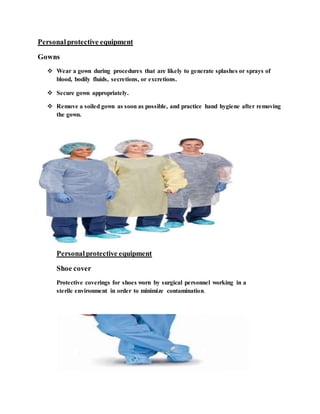
Gowns
 Wear a gown during procedures that are likely to generate splashes or sprays of
blood, bodily fluids, secretions, or excretions.
 Secure gown appropriately.
 Remove a soiled gown as soon as possible, and practice hand hygiene after removing
the gown.
Personalprotective equipment
Shoe cover
Protective coverings for shoes worn by surgical personnel working in a
sterile environment in order to minimize contamination.
Personalprotective equipment
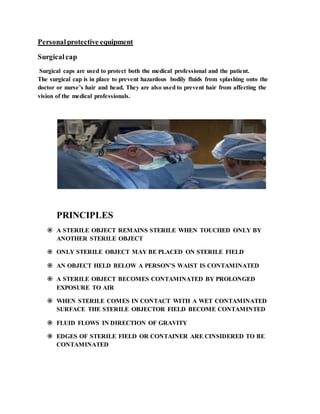
Surgicalcap
Surgical caps are used to protect both the medical professional and the patient.
The surgical cap is in place to prevent hazardous bodily fluids from splashing onto the
doctor or nurse’s hair and head. They are also used to prevent hair from affecting the
vision of the medical professionals.
PRINCIPLES
 A STERILE OBJECT REMAINS STERILE WHEN TOUCHED ONLY BY
ANOTHER STERILE OBJECT
 ONLY STERILE OBJECT MAY BE PLACED ON STERILE FIELD
 AN OBJECT HELD BELOW A PERSON’S WAIST IS CONTAMINATED
 A STERILE OBJECT BECOMES CONTAMINATED BY PROLONGED
EXPOSURE TO AIR
 WHEN STERILE COMES IN CONTACT WITH A WET CONTAMINATED
SURFACE THE STERILE OBJECTOR FIELD BECOME CONTAMINTED
 FLUID FLOWS IN DIRECTION OF GRAVITY
 EDGES OF STERILE FIELD OR CONTAINER ARE CINSIDERED TO BE
CONTAMINATED
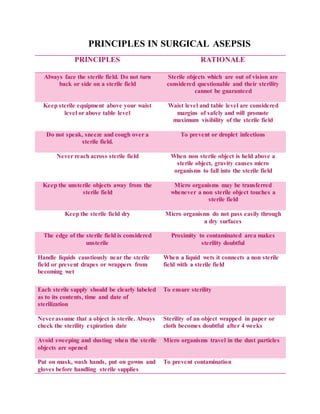
PRINCIPLES IN SURGICAL ASEPSIS
PRINCIPLES RATIONALE
Always face the sterile field. Do not turn
back or side on a sterile field
Sterile objects which are out of vision are
considered questionable and their sterility
cannot be guaranteed
Keep sterile equipment above your waist
level or above table level
Waist level and table level are considered
margins of safely and will promote
maximum visibility of the sterile field
Do not speak, sneeze and cough over a
sterile field.
To prevent or droplet infections
Never reach across sterile field When non sterile object is held above a
sterile object, gravity causes micro
organisms to fall into the sterile field
Keep the unsterile objects away from the
sterile field
Micro organisms may be transferred
whenever a non sterile object touches a
sterile field
Keep the sterile field dry Micro organisms do not pass easily through
a dry surfaces
The edge of the sterile field is considered
unsterile
Proximity to contaminated area makes
sterility doubtful
Handle liquids caustiously near the sterile
field or prevent drapes or wrappers from
becoming wet
When a liquid wets it connects a non sterile
field with a sterile field
Each sterile supply should be clearly labeled
as to its contents, time and date of
sterilization
To ensure sterility
Neverassume that a object is sterile. Always
check the sterility expiration date
Sterility of an object wrapped in paper or
cloth becomes doubtful after 4 weeks
Avoid sweeping and dusting when the sterile
objects are opened
Micro organisms travel in the dust particles
Put on mask, wash hands, put on gowns and
gloves before handling sterile supplies
To prevent contamination
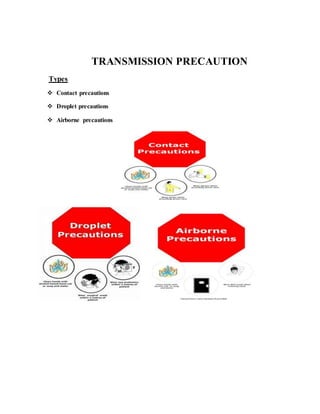
TRANSMISSION PRECAUTION
Types
 Contact precautions
 Droplet precautions
 Airborne precautions
Contactprecautions
Apply to patients with any of the following conditions and/or disease
 Presence of stool incontinence (may include patients with norovirus, rotavirus, or
clostridium difficile)
 Draining wounds
 Uncontrolled secretions
 Pressure ulcers or presence of ostomy tubes and/or bags draining body fluids
 methicillin-resistant staphylococcus aureus(MRSA)
 Presence of generalized rash or exanthems
 Perform hand hygiene before touching patient and prior to wearing gloves
 Personal protective equipment (PPE) use:
 Wear a gown if substantial contact with the patient or their environment is
anticipated
 Perform hand hygiene after removal of PPE; note: use soap and water when hands
are visibly soiled (e.g. blood, body fluids), or after caring for patients with known or
suspected infectious diarrhea (clostridium difficile, norovirus)
 Clean/disinfect the room and surroundings
 Donning e upon room entry and discarding before exiting the patient room is done
to contain pathogens, especially those that have been implicated in transmission
through environmental contamination (e.g. vancomycin resistant enterococci
Clostridium difficile, noroviruses, and other intestinal tract pathogens; Respiratory
synctial virus)
 Provide a private room- if possible otherwise in multi-patient rooms, 3 feet spatial
separation between beds is advised to reduced the opportunities for inadvertent
sharing items between the infected/colonized patient and other patients
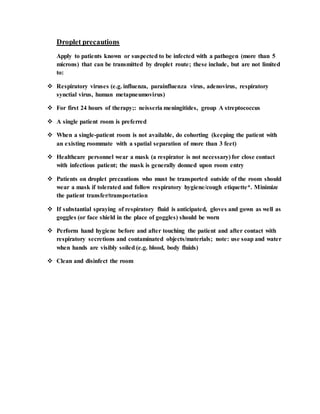
Droplet precautions
Apply to patients known or suspected to be infected with a pathogen (more than 5
microns) that can be transmitted by droplet route; these include, but are not limited
to:
 Respiratory viruses (e.g. influenza, parainfluenza virus, adenovirus, respiratory
synctial virus, human metapneumovirus)
 For first 24 hours of therapy;: neisseria meningitides, group A streptococcus
 A single patient room is preferred
 When a single-patient room is not available, do cohorting (keeping the patient with
an existing roommate with a spatial separation of more than 3 feet)
 Healthcare personnel wear a mask (a respirator is not necessary) for close contact
with infectious patient; the mask is generally donned upon room entry
 Patients on droplet precautions who must be transported outside of the room should
wear a mask if tolerated and follow respiratory hygiene/cough etiquette*. Minimize
the patient transfer/transportation
 If substantial spraying of respiratory fluid is anticipated, gloves and gown as well as
goggles (or face shield in the place of goggles) should be worn
 Perform hand hygiene before and after touching the patient and after contact with
respiratory secretions and contaminated objects/materials; note: use soap and water
when hands are visibly soiled (e.g. blood, body fluids)
 Clean and disinfect the room
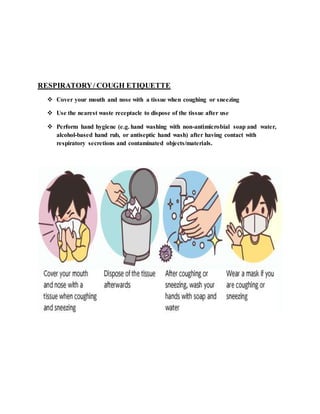
RESPIRATORY/ COUGH ETIQUETTE
 Cover your mouth and nose with a tissue when coughing or sneezing
 Use the nearest waste receptacle to dispose of the tissue after use
 Perform hand hygiene (e.g. hand washing with non-antimicrobial soap and water,
alcohol-based hand rub, or antiseptic hand wash) after having contact with
respiratory secretions and contaminated objects/materials.
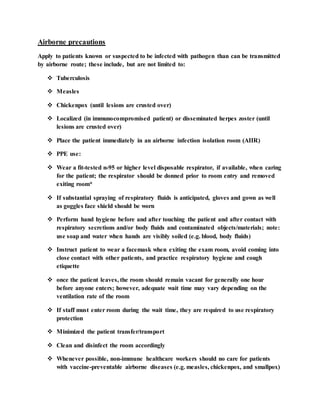
Airborne precautions
Apply to patients known or suspected to be infected with pathogen than can be transmitted
by airborne route; these include, but are not limited to:
 Tuberculosis
 Measles
 Chickenpox (until lesions are crusted over)
 Localized (in immunocompromised patient) or disseminated herpes zoster (until
lesions are crusted over)
 Place the patient immediately in an airborne infection isolation room (AIIR)
 PPE use:
 Wear a fit-tested n-95 or higher level disposable respirator, if available, when caring
for the patient; the respirator should be donned prior to room entry and removed
exiting room*
 If substantial spraying of respiratory fluids is anticipated, gloves and gown as well
as goggles face shield should be worn
 Perform hand hygiene before and after touching the patient and after contact with
respiratory secretions and/or body fluids and contaminated objects/materials; note:
use soap and water when hands are visibly soiled (e.g. blood, body fluids)
 Instruct patient to wear a facemask when exiting the exam room, avoid coming into
close contact with other patients, and practice respiratory hygiene and cough
etiquette
 once the patient leaves, the room should remain vacant for generally one hour
before anyone enters; however, adequate wait time may vary depending on the
ventilation rate of the room
 If staff must enter room during the wait time, they are required to use respiratory
protection
 Minimized the patient transfer/transport
 Clean and disinfect the room accordingly
 Whenever possible, non-immune healthcare workers should no care for patients
with vaccine-preventable airborne diseases (e.g. measles, chickenpox, and smallpox)
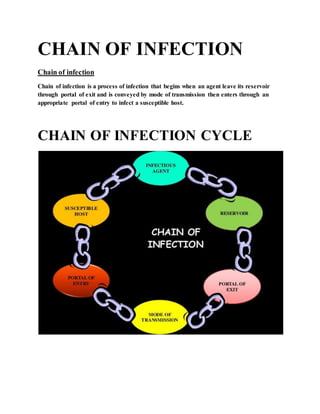
CHAIN OF INFECTION
Chain of infection
Chain of infection is a process of infection that begins when an agent leave its reservoir
through portal of exit and is conveyed by mode of transmission then enters through an
appropriate portal of entry to infect a susceptible host.
CHAIN OF INFECTION CYCLE
INFECTIOUS AGENT OR CAUSATIVE AGENT
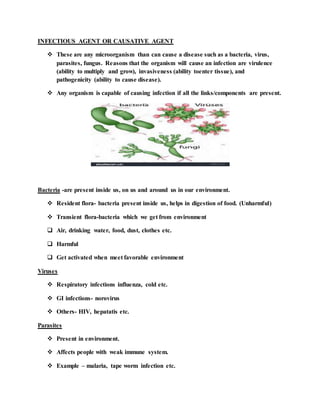
 These are any microorganism than can cause a disease such as a bacteria, virus,
parasites, fungus. Reasons that the organism will cause an infection are virulence
(ability to multiply and grow), invasiveness (ability toenter tissue), and
pathogenicity (ability to cause disease).
 Any organism is capable of causing infection if all the links/components are present.
Bacteria -are present inside us, on us and around us in our environment.
 Resident flora- bacteria present inside us, helps in digestion of food. (Unharmful)
 Transient flora-bacteria which we get from environment
 Air, drinking water, food, dust, clothes etc.
 Harmful
 Get activated when meet favorable environment
Viruses
 Respiratory infections influenza, cold etc.
 GI infections- norovirus
 Others- HIV, hepatatis etc.
Parasites
 Present in environment.
 Affects people with weak immune system.
 Example – malaria, tape worm infection etc.
Reservoir
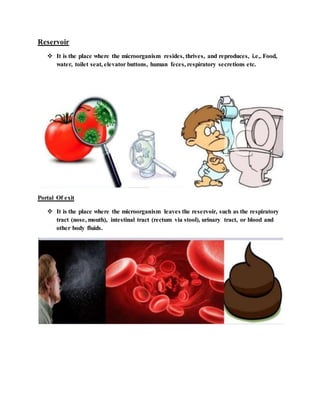
 It is the place where the microorganism resides, thrives, and reproduces, i.e,. Food,
water, toilet seat, elevator buttons, human feces, respiratory secretions etc.
Portal Of exit
 It is the place where the microorganism leaves the reservoir, such as the respiratory
tract (nose, mouth), intestinal tract (rectum via stool), urinary tract, or blood and
other body fluids.
Mode of transmission
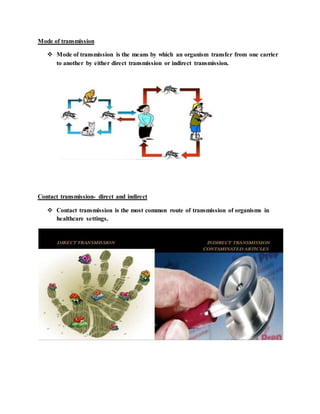
 Mode of transmission is the means by which an organism transfer from one carrier
to another by either direct transmission or indirect transmission.
Contact transmission- direct and indirect
 Contact transmission is the most common route of transmission of organisms in
healthcare settings.
Droplet transmission
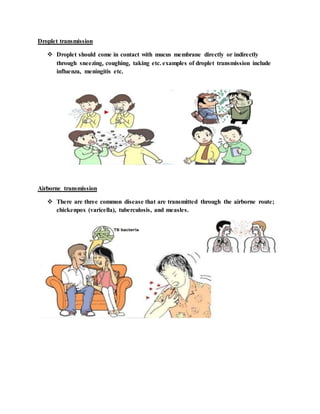
 Droplet should come in contact with mucus membrane directly or indirectly
through sneezing, coughing, taking etc. examples of droplet transmission include
influenza, meningitis etc.
Airborne transmission
 There are three common disease that are transmitted through the airborne route;
chickenpox (varicella), tuberculosis, and measles.
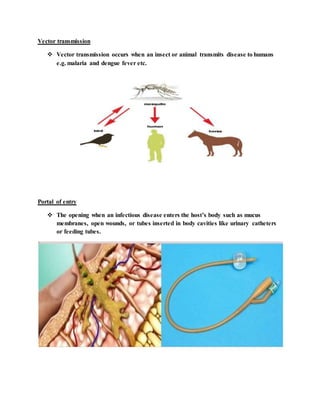
Vector transmission
 Vector transmission occurs when an insect or animal transmits disease to humans
e.g. malaria and dengue fever etc.
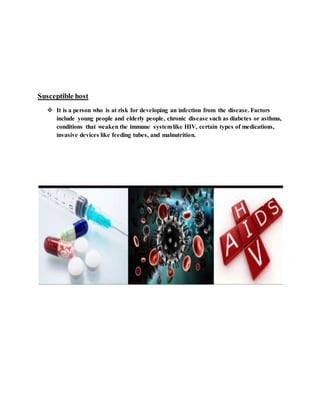
Portal of entry
 The opening when an infectious disease enters the host’s body such as mucus
membranes, open wounds, or tubes inserted in body cavities like urinary catheters
or feeding tubes.
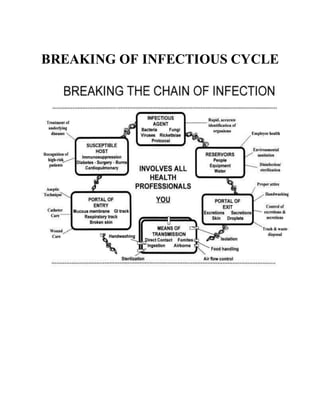
Susceptible host
 It is a person who is at risk for developing an infection from the disease. Factors
include young people and elderly people, chronic disease such as diabetes or asthma,
conditions that weaken the immune systemlike HIV, certain types of medications,
invasive devices like feeding tubes, and malnutrition.
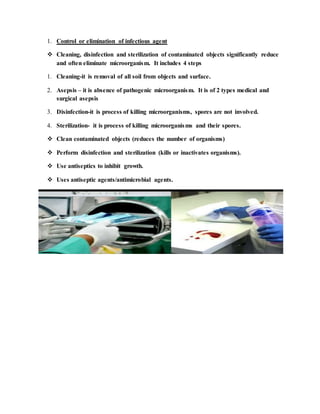
BREAKING OF INFECTIOUS CYCLE
1. Control or elimination of infectious agent
 Cleaning, disinfection and sterilization of contaminated objects significantly reduce
and often eliminate microorganism. It includes 4 steps
1. Cleaning-it is removal of all soil from objects and surface.
2. Asepsis – it is absence of pathogenic microorganism. It is of 2 types medical and
surgical asepsis
3. Disinfection-it is process of killing microorganisms, spores are not involved.
4. Sterilization- it is process of killing microorganisms and their spores.
 Clean contaminated objects (reduces the number of organisms)
 Perform disinfection and sterilization (kills or inactivates organisms).
 Use antiseptics to inhibit growth.
 Uses antiseptic agents/antimicrobial agents.
Control or elimination of reservoir
 Eliminate source of body fluids and drainage
 Bathe with soap and water
 Change soiled dressings
 Remove standing water on bedside tables.
 Cover bottles of used solutions
 Maintain patency of surgical wound drains
 Empty and rinse suction bottles
 Empty drainage bags every shift
 Place syringe and uncapped needles in moisture-resistant, puncture-proof
containers
 Limit contact with persons with infection or exposedto infection
3. Control of portal of exit
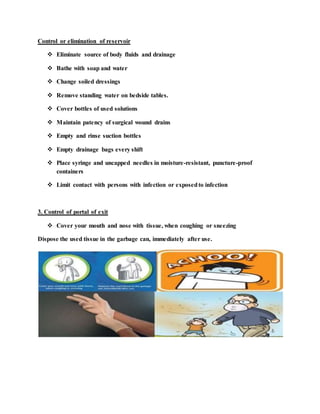
 Cover your mouth and nose with tissue, when coughing or sneezing
Dispose the used tissue in the garbage can, immediately after use.
4. Control of transmission
 Reduce microorganisms spread
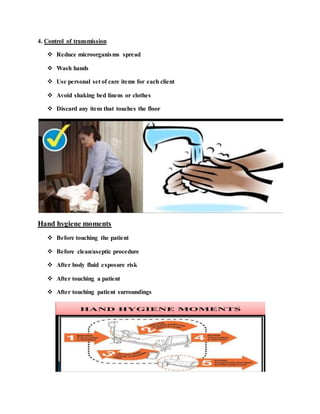
 Wash hands
 Use personal set of care items for each client
 Avoid shaking bed linens or clothes
 Discard any item that touches the floor
Hand hygiene moments
 Before touching the patient
 Before clean/aseptic procedure
 After body fluid exposure risk
 After touching a patient
 After touching patient surroundings
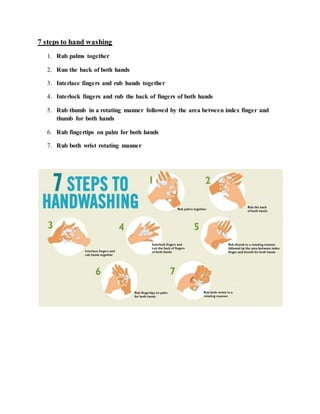
7 steps to hand washing
1. Rub palms together
2. Run the back of both hands
3. Interlace fingers and rub hands together
4. Interlock fingers and rub the back of fingers of both hands
5. Rub thumb in a rotating manner followed by the area between index finger and
thumb for both hands
6. Rub fingertips on palm for both hands
7. Rub both wrist rotating manner
Control of portal entry
 Skin mucous membrane- maintain skin and mucous membrane integrity, use
proper hygiene measures.
 Clean wound sites thoroughly. Disposed of used needles in proper receptacles.
 Urinary- keepall drainage systems closedand intact.
 Discard facial tissues, wound dressings, and other body excreta without touching
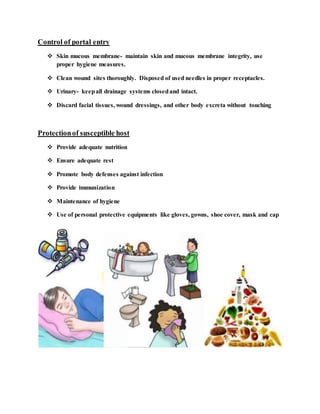
Protectionof susceptible host
 Provide adequate nutrition
 Ensure adequate rest
 Promote body defenses against infection
 Provide immunization
 Maintenance of hygiene
 Use of personal protective equipments like gloves, gowns, shoe cover, mask and cap
REFERNCES
http://www.slideshare.net
www://www.registerednursing.org
opentextbc.ca
THANK YOU

surgical asepsi

  • 1.
    SURGICAL ASEPSIS  Preparedby,  Jerenett Joy Mahinay  Lalaine Solis  Aldrin Bangcal  Kristel Angela Pilongo  Susanne Vincoy
  • 2.
    SURGICAL ASEPSIS  REFERSTO THE PROCEDURES USED TO KEEP THE OBJECT OR AREAS STERILE OR COMPLETELY FREE FROM MICROORGANISM.  IN SURGICAL ASEPSIS ALL PRACTICES ARE DIRECTED TO THE ELIMINATION OF BOTH PATHOGENIC AND NONPATHOGENIC MICROORGANISMS. STANDARD PRECAUTION Standard precautions  Standard precautions are a set of infection control practices that healthcare personnel use to reduce transmission of microorganisms in healthcare settings.  Standard precautions protect both healthcare personnel and patients from contact with infectious agents. Standard precautions include: hand hygiene- this is the most important and basic preventive technique for interrupting the infectious process. Wash hands before patient care after touching blood, body fluids, secretions, excretions and contaminated items, immediately after gloves are removed; between patient contacts, and which otherwise indicated.
  • 3.
    Personalprotective equipment Mask, eyeprotectionand face shields Wear a mask and eye protection, or face shield, during procedures that are likely to generate splashes or sprays of blood, bodily fluids, secretions, and excretions. Personalprotective equipment Gloves you should use new gloves when hands may become contaminated with blood, body fluids, excretions, or secretions or when touching mucous membranes or non-intact skin, or contaminated surfaces or objects.  Remove gloves after caring for a patient do not wear the same gloves for more than one patient  Do not reuse or wash gloves  Don’t forget hand hygiene after removing gloves. Gloves are not replacement for hand hygiene
  • 4.
    Personalprotective equipment Gowns  Weara gown during procedures that are likely to generate splashes or sprays of blood, bodily fluids, secretions, or excretions.  Secure gown appropriately.  Remove a soiled gown as soon as possible, and practice hand hygiene after removing the gown. Personalprotective equipment Shoe cover Protective coverings for shoes worn by surgical personnel working in a sterile environment in order to minimize contamination.
  • 5.
    Personalprotective equipment Surgicalcap Surgical capsare used to protect both the medical professional and the patient. The surgical cap is in place to prevent hazardous bodily fluids from splashing onto the doctor or nurse’s hair and head. They are also used to prevent hair from affecting the vision of the medical professionals. PRINCIPLES  A STERILE OBJECT REMAINS STERILE WHEN TOUCHED ONLY BY ANOTHER STERILE OBJECT  ONLY STERILE OBJECT MAY BE PLACED ON STERILE FIELD  AN OBJECT HELD BELOW A PERSON’S WAIST IS CONTAMINATED  A STERILE OBJECT BECOMES CONTAMINATED BY PROLONGED EXPOSURE TO AIR  WHEN STERILE COMES IN CONTACT WITH A WET CONTAMINATED SURFACE THE STERILE OBJECTOR FIELD BECOME CONTAMINTED  FLUID FLOWS IN DIRECTION OF GRAVITY  EDGES OF STERILE FIELD OR CONTAINER ARE CINSIDERED TO BE CONTAMINATED
  • 6.
    PRINCIPLES IN SURGICALASEPSIS PRINCIPLES RATIONALE Always face the sterile field. Do not turn back or side on a sterile field Sterile objects which are out of vision are considered questionable and their sterility cannot be guaranteed Keep sterile equipment above your waist level or above table level Waist level and table level are considered margins of safely and will promote maximum visibility of the sterile field Do not speak, sneeze and cough over a sterile field. To prevent or droplet infections Never reach across sterile field When non sterile object is held above a sterile object, gravity causes micro organisms to fall into the sterile field Keep the unsterile objects away from the sterile field Micro organisms may be transferred whenever a non sterile object touches a sterile field Keep the sterile field dry Micro organisms do not pass easily through a dry surfaces The edge of the sterile field is considered unsterile Proximity to contaminated area makes sterility doubtful Handle liquids caustiously near the sterile field or prevent drapes or wrappers from becoming wet When a liquid wets it connects a non sterile field with a sterile field Each sterile supply should be clearly labeled as to its contents, time and date of sterilization To ensure sterility Neverassume that a object is sterile. Always check the sterility expiration date Sterility of an object wrapped in paper or cloth becomes doubtful after 4 weeks Avoid sweeping and dusting when the sterile objects are opened Micro organisms travel in the dust particles Put on mask, wash hands, put on gowns and gloves before handling sterile supplies To prevent contamination
  • 7.
    TRANSMISSION PRECAUTION Types  Contactprecautions  Droplet precautions  Airborne precautions
  • 8.
    Contactprecautions Apply to patientswith any of the following conditions and/or disease  Presence of stool incontinence (may include patients with norovirus, rotavirus, or clostridium difficile)  Draining wounds  Uncontrolled secretions  Pressure ulcers or presence of ostomy tubes and/or bags draining body fluids  methicillin-resistant staphylococcus aureus(MRSA)  Presence of generalized rash or exanthems  Perform hand hygiene before touching patient and prior to wearing gloves  Personal protective equipment (PPE) use:  Wear a gown if substantial contact with the patient or their environment is anticipated  Perform hand hygiene after removal of PPE; note: use soap and water when hands are visibly soiled (e.g. blood, body fluids), or after caring for patients with known or suspected infectious diarrhea (clostridium difficile, norovirus)  Clean/disinfect the room and surroundings  Donning e upon room entry and discarding before exiting the patient room is done to contain pathogens, especially those that have been implicated in transmission through environmental contamination (e.g. vancomycin resistant enterococci Clostridium difficile, noroviruses, and other intestinal tract pathogens; Respiratory synctial virus)  Provide a private room- if possible otherwise in multi-patient rooms, 3 feet spatial separation between beds is advised to reduced the opportunities for inadvertent sharing items between the infected/colonized patient and other patients
  • 9.
    Droplet precautions Apply topatients known or suspected to be infected with a pathogen (more than 5 microns) that can be transmitted by droplet route; these include, but are not limited to:  Respiratory viruses (e.g. influenza, parainfluenza virus, adenovirus, respiratory synctial virus, human metapneumovirus)  For first 24 hours of therapy;: neisseria meningitides, group A streptococcus  A single patient room is preferred  When a single-patient room is not available, do cohorting (keeping the patient with an existing roommate with a spatial separation of more than 3 feet)  Healthcare personnel wear a mask (a respirator is not necessary) for close contact with infectious patient; the mask is generally donned upon room entry  Patients on droplet precautions who must be transported outside of the room should wear a mask if tolerated and follow respiratory hygiene/cough etiquette*. Minimize the patient transfer/transportation  If substantial spraying of respiratory fluid is anticipated, gloves and gown as well as goggles (or face shield in the place of goggles) should be worn  Perform hand hygiene before and after touching the patient and after contact with respiratory secretions and contaminated objects/materials; note: use soap and water when hands are visibly soiled (e.g. blood, body fluids)  Clean and disinfect the room
  • 10.
    RESPIRATORY/ COUGH ETIQUETTE Cover your mouth and nose with a tissue when coughing or sneezing  Use the nearest waste receptacle to dispose of the tissue after use  Perform hand hygiene (e.g. hand washing with non-antimicrobial soap and water, alcohol-based hand rub, or antiseptic hand wash) after having contact with respiratory secretions and contaminated objects/materials.
  • 11.
    Airborne precautions Apply topatients known or suspected to be infected with pathogen than can be transmitted by airborne route; these include, but are not limited to:  Tuberculosis  Measles  Chickenpox (until lesions are crusted over)  Localized (in immunocompromised patient) or disseminated herpes zoster (until lesions are crusted over)  Place the patient immediately in an airborne infection isolation room (AIIR)  PPE use:  Wear a fit-tested n-95 or higher level disposable respirator, if available, when caring for the patient; the respirator should be donned prior to room entry and removed exiting room*  If substantial spraying of respiratory fluids is anticipated, gloves and gown as well as goggles face shield should be worn  Perform hand hygiene before and after touching the patient and after contact with respiratory secretions and/or body fluids and contaminated objects/materials; note: use soap and water when hands are visibly soiled (e.g. blood, body fluids)  Instruct patient to wear a facemask when exiting the exam room, avoid coming into close contact with other patients, and practice respiratory hygiene and cough etiquette  once the patient leaves, the room should remain vacant for generally one hour before anyone enters; however, adequate wait time may vary depending on the ventilation rate of the room  If staff must enter room during the wait time, they are required to use respiratory protection  Minimized the patient transfer/transport  Clean and disinfect the room accordingly  Whenever possible, non-immune healthcare workers should no care for patients with vaccine-preventable airborne diseases (e.g. measles, chickenpox, and smallpox)
  • 12.
    CHAIN OF INFECTION Chainof infection Chain of infection is a process of infection that begins when an agent leave its reservoir through portal of exit and is conveyed by mode of transmission then enters through an appropriate portal of entry to infect a susceptible host. CHAIN OF INFECTION CYCLE
  • 13.
    INFECTIOUS AGENT ORCAUSATIVE AGENT  These are any microorganism than can cause a disease such as a bacteria, virus, parasites, fungus. Reasons that the organism will cause an infection are virulence (ability to multiply and grow), invasiveness (ability toenter tissue), and pathogenicity (ability to cause disease).  Any organism is capable of causing infection if all the links/components are present. Bacteria -are present inside us, on us and around us in our environment.  Resident flora- bacteria present inside us, helps in digestion of food. (Unharmful)  Transient flora-bacteria which we get from environment  Air, drinking water, food, dust, clothes etc.  Harmful  Get activated when meet favorable environment Viruses  Respiratory infections influenza, cold etc.  GI infections- norovirus  Others- HIV, hepatatis etc. Parasites  Present in environment.  Affects people with weak immune system.  Example – malaria, tape worm infection etc.
  • 14.
    Reservoir  It isthe place where the microorganism resides, thrives, and reproduces, i.e,. Food, water, toilet seat, elevator buttons, human feces, respiratory secretions etc. Portal Of exit  It is the place where the microorganism leaves the reservoir, such as the respiratory tract (nose, mouth), intestinal tract (rectum via stool), urinary tract, or blood and other body fluids.
  • 15.
    Mode of transmission Mode of transmission is the means by which an organism transfer from one carrier to another by either direct transmission or indirect transmission. Contact transmission- direct and indirect  Contact transmission is the most common route of transmission of organisms in healthcare settings.
  • 16.
    Droplet transmission  Dropletshould come in contact with mucus membrane directly or indirectly through sneezing, coughing, taking etc. examples of droplet transmission include influenza, meningitis etc. Airborne transmission  There are three common disease that are transmitted through the airborne route; chickenpox (varicella), tuberculosis, and measles.
  • 17.
    Vector transmission  Vectortransmission occurs when an insect or animal transmits disease to humans e.g. malaria and dengue fever etc. Portal of entry  The opening when an infectious disease enters the host’s body such as mucus membranes, open wounds, or tubes inserted in body cavities like urinary catheters or feeding tubes.
  • 18.
    Susceptible host  Itis a person who is at risk for developing an infection from the disease. Factors include young people and elderly people, chronic disease such as diabetes or asthma, conditions that weaken the immune systemlike HIV, certain types of medications, invasive devices like feeding tubes, and malnutrition.
  • 19.
  • 20.
    1. Control orelimination of infectious agent  Cleaning, disinfection and sterilization of contaminated objects significantly reduce and often eliminate microorganism. It includes 4 steps 1. Cleaning-it is removal of all soil from objects and surface. 2. Asepsis – it is absence of pathogenic microorganism. It is of 2 types medical and surgical asepsis 3. Disinfection-it is process of killing microorganisms, spores are not involved. 4. Sterilization- it is process of killing microorganisms and their spores.  Clean contaminated objects (reduces the number of organisms)  Perform disinfection and sterilization (kills or inactivates organisms).  Use antiseptics to inhibit growth.  Uses antiseptic agents/antimicrobial agents.
  • 21.
    Control or eliminationof reservoir  Eliminate source of body fluids and drainage  Bathe with soap and water  Change soiled dressings  Remove standing water on bedside tables.  Cover bottles of used solutions  Maintain patency of surgical wound drains  Empty and rinse suction bottles  Empty drainage bags every shift  Place syringe and uncapped needles in moisture-resistant, puncture-proof containers  Limit contact with persons with infection or exposedto infection 3. Control of portal of exit  Cover your mouth and nose with tissue, when coughing or sneezing Dispose the used tissue in the garbage can, immediately after use.
  • 22.
    4. Control oftransmission  Reduce microorganisms spread  Wash hands  Use personal set of care items for each client  Avoid shaking bed linens or clothes  Discard any item that touches the floor Hand hygiene moments  Before touching the patient  Before clean/aseptic procedure  After body fluid exposure risk  After touching a patient  After touching patient surroundings
  • 23.
    7 steps tohand washing 1. Rub palms together 2. Run the back of both hands 3. Interlace fingers and rub hands together 4. Interlock fingers and rub the back of fingers of both hands 5. Rub thumb in a rotating manner followed by the area between index finger and thumb for both hands 6. Rub fingertips on palm for both hands 7. Rub both wrist rotating manner
  • 24.
    Control of portalentry  Skin mucous membrane- maintain skin and mucous membrane integrity, use proper hygiene measures.  Clean wound sites thoroughly. Disposed of used needles in proper receptacles.  Urinary- keepall drainage systems closedand intact.  Discard facial tissues, wound dressings, and other body excreta without touching Protectionof susceptible host  Provide adequate nutrition  Ensure adequate rest  Promote body defenses against infection  Provide immunization  Maintenance of hygiene  Use of personal protective equipments like gloves, gowns, shoe cover, mask and cap
  • 25.