This multi-media product and its content are protected under copyright law. The following are prohibited by law:
Any public performance or display, including transmission of any image over a network;
Any preparation of any derivative work, including the extraction, in whole or in part, of any images;
Any rental, lease or lending of the program
Understanding Media in
the Digital Age, 1/e
Everette E. Dennis
Melvin L. DeFleur
Prepared by Todd
Chambers, Ph.D.
Texas Tech
University
Copyright © 2010 Pearson Education. All rights reserved.
SOCIAL FORCES:
ECONOMICS, TECHNOLOGY,
AND POLICY
Chapter 13
Copyright © 2010 Pearson Education. All rights reserved.
 
An Interplay of Forces
 Communication Policy
 government
 cultural values and traditions
 economic trends and patterns
 new technologies
Copyright © 2010 Pearson Education. All rights reserved.
Searching for the Public Interest
 Defining the Public Interest
 individual or institutional right?
Copyright © 2010 Pearson Education. All rights reserved.
Question to think about
 In your opinion, is the First
Amendment for individuals or
institutions or both?
Copyright © 2010 Pearson Education. All rights reserved.
Searching for the Public Interest
 Defining the Public Interest
 Print media: receive greater freedoms
 Electronic media: fewer First Amendment
freedoms; licensing
 Diversity of voices
 Marketplace of ideas
Copyright © 2010 Pearson Education. All rights reserved.
Denying the Business of Media
 Audiences as consumers?
 Concentration of ownership
 Monopoly power =/≠ diversity of ideas?
Copyright © 2010 Pearson Education. All rights reserved.
Enter Media Economics
 Who owns the media?
 Who supports the media?
 How are media companies financed?
 What are the financial drivers of media firms?
 What accounts for profits/losses?
 What inspires innovation?
 What is the role of technology?
Copyright © 2010 Pearson Education. All rights reserved.
Enter Media Economics
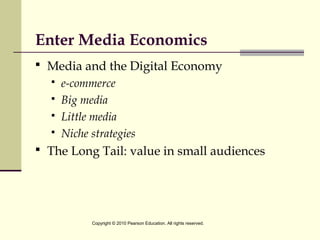
 Media and the Digital Economy
 e-commerce
 Big media
 Little media
 Niche strategies
 The Long Tail: value in small audiences
Copyright © 2010 Pearson Education. All rights reserved.
Enter Media Economics
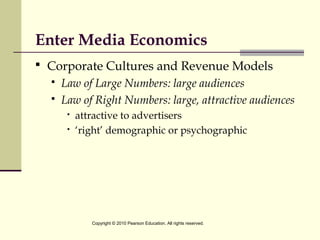
 Corporate Cultures and Revenue Models
 Law of Large Numbers: large audiences
 Law of Right Numbers: large, attractive audiences
 attractive to advertisers
 ‘right’ demographic or psychographic
Copyright © 2010 Pearson Education. All rights reserved.
Enter Media Economics
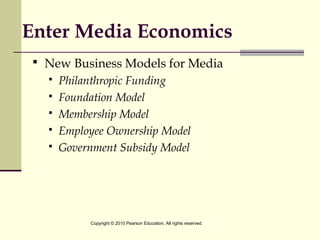
 New Business Models for Media
 Philanthropic Funding
 Foundation Model
 Membership Model
 Employee Ownership Model
 Government Subsidy Model
Copyright © 2010 Pearson Education. All rights reserved.
Enter Media Economics
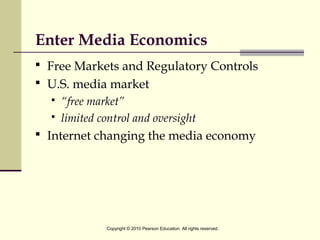
 Free Markets and Regulatory Controls
 U.S. media market
 “free market”
 limited control and oversight
 Internet changing the media economy
Copyright © 2010 Pearson Education. All rights reserved.
Independence with Controls
 Communication policy
is variously described as government interface
with media institutions on behalf of the public, to
a more complex formulation that involves the
private sector, other social institutions, and
interests.
Copyright © 2010 Pearson Education. All rights reserved.
Independence with Controls
 Controlling
Objectionable
Content
 American colonies –
did not want the crown
to control content
 Pornography
 Censorship v. Self-
Censorship
 Controlling Political
Communication
 government and media
are separate
 move into a global
system
 piracy
 government
standards
Copyright © 2010 Pearson Education. All rights reserved.
Independence with Controls
 Protecting the Public Interest
 News media = public trustees
 News media = Fourth Estate
Copyright © 2010 Pearson Education. All rights reserved.
Independence with Controls
 Covering Electoral Politics
 Commonality of interest
 Advocates and intermediaries for citizens
Copyright © 2010 Pearson Education. All rights reserved.
Political Protections: The
Constitutional Framework
 The Free Press – A Historical Legacy
 Prior Restraint
 English Law allowed prior restraint
 against the Crown? Punishable.
 John Zenger
 seditious libel
 separation of press and government
Copyright © 2010 Pearson Education. All rights reserved.
Political Protections: The
Constitutional Framework
 The First Amendment
“Congress shall make no law abridging the
freedom of speech, or of the press…”
Copyright © 2010 Pearson Education. All rights reserved.
Political Protections: The
Constitutional Framework
 Technology’s Place in Regulation: From
Printing to Cyberspace
 Broadcasters and the license
 Cable and the franchise
 Telecommunications Act 1996: allowed technology
to advance
 Indecency
 Communications Decency Act, struck down
Copyright © 2010 Pearson Education. All rights reserved.
Linchpins of Communication Law
 The Libel Conundrum
 False, defamatory statements about someone
 Ancient roots – Ten Commandments
 Today: protects individuals and corporations
Copyright © 2010 Pearson Education. All rights reserved.
Linchpins of Communication Law
 Libel Laws and the
Media
 Public figures and
public officials
 New York Times v.
Sullivan (1964)
 set precedent for free
press v. public officials
 US Supreme Court in
favor of press criticism
of public officials
 Multi-million Dollar
Libel Suits
 Legal costs for defense
 Chilling effect
Copyright © 2010 Pearson Education. All rights reserved.
Trial by Media
 1930s Lindbergh case
 Reardon rules related to prejudicial
information
 Cameras in the courtroom
 OJ Simpson trial
 Court TV
Copyright © 2010 Pearson Education. All rights reserved.
Moral Values: Obscenity and
Pornography
 Obscenity: government censorship or
provide freedom?
 Roth (1957): not protected under the
constitution
 Miller (1973): community standards
 Codes of ethics
Copyright © 2010 Pearson Education. All rights reserved.
The Government’s Secrets During
National Crises
 Direct Censorship During War
 1898, Spanish-American War
 1917, WWI Espionage Act
 fines and prison for interfering with war effort
 1918, WWI Sedition Act
 crime to publish anything that abused, scorned or
showed contempt for US
Copyright © 2010 Pearson Education. All rights reserved.
Political Constraints: The Agents of
Control
 Regulatory Agencies
 Federal Communications Commission
 radio, television, cable, telephone, satellites, mobile
phones
 licensing, political content, children’s
programming
 public interest, convenience and necessity
Copyright © 2010 Pearson Education. All rights reserved.
Political Constraints: The Agents of
Control
 Regulatory Agencies
 Federal Trade Commission
 established in 1914
 advertising, concentration of ownership, deceptive
advertising
Copyright © 2010 Pearson Education. All rights reserved.
Political Constraints: The Agents of
Control
 Regulatory Agencies
 Deregulation and Outside Pressures
 intermedia ownership
 intramedia ownership
 Media concentration = public interest?
Copyright © 2010 Pearson Education. All rights reserved.

Dennis and Defleur Ch. 13

  • 1.
    This multi-media productand its content are protected under copyright law. The following are prohibited by law: Any public performance or display, including transmission of any image over a network; Any preparation of any derivative work, including the extraction, in whole or in part, of any images; Any rental, lease or lending of the program Understanding Media in the Digital Age, 1/e Everette E. Dennis Melvin L. DeFleur Prepared by Todd Chambers, Ph.D. Texas Tech University Copyright © 2010 Pearson Education. All rights reserved.
  • 2.
    SOCIAL FORCES: ECONOMICS, TECHNOLOGY, ANDPOLICY Chapter 13 Copyright © 2010 Pearson Education. All rights reserved.
  • 3.
      An Interplay ofForces  Communication Policy  government  cultural values and traditions  economic trends and patterns  new technologies Copyright © 2010 Pearson Education. All rights reserved.
  • 4.
    Searching for thePublic Interest  Defining the Public Interest  individual or institutional right? Copyright © 2010 Pearson Education. All rights reserved.
  • 5.
    Question to thinkabout  In your opinion, is the First Amendment for individuals or institutions or both? Copyright © 2010 Pearson Education. All rights reserved.
  • 6.
    Searching for thePublic Interest  Defining the Public Interest  Print media: receive greater freedoms  Electronic media: fewer First Amendment freedoms; licensing  Diversity of voices  Marketplace of ideas Copyright © 2010 Pearson Education. All rights reserved.
  • 7.
    Denying the Businessof Media  Audiences as consumers?  Concentration of ownership  Monopoly power =/≠ diversity of ideas? Copyright © 2010 Pearson Education. All rights reserved.
  • 8.
    Enter Media Economics Who owns the media?  Who supports the media?  How are media companies financed?  What are the financial drivers of media firms?  What accounts for profits/losses?  What inspires innovation?  What is the role of technology? Copyright © 2010 Pearson Education. All rights reserved.
  • 9.
    Enter Media Economics Media and the Digital Economy  e-commerce  Big media  Little media  Niche strategies  The Long Tail: value in small audiences Copyright © 2010 Pearson Education. All rights reserved.
  • 10.
    Enter Media Economics Corporate Cultures and Revenue Models  Law of Large Numbers: large audiences  Law of Right Numbers: large, attractive audiences  attractive to advertisers  ‘right’ demographic or psychographic Copyright © 2010 Pearson Education. All rights reserved.
  • 11.
    Enter Media Economics New Business Models for Media  Philanthropic Funding  Foundation Model  Membership Model  Employee Ownership Model  Government Subsidy Model Copyright © 2010 Pearson Education. All rights reserved.
  • 12.
    Enter Media Economics Free Markets and Regulatory Controls  U.S. media market  “free market”  limited control and oversight  Internet changing the media economy Copyright © 2010 Pearson Education. All rights reserved.
  • 13.
    Independence with Controls Communication policy is variously described as government interface with media institutions on behalf of the public, to a more complex formulation that involves the private sector, other social institutions, and interests. Copyright © 2010 Pearson Education. All rights reserved.
  • 14.
    Independence with Controls Controlling Objectionable Content  American colonies – did not want the crown to control content  Pornography  Censorship v. Self- Censorship  Controlling Political Communication  government and media are separate  move into a global system  piracy  government standards Copyright © 2010 Pearson Education. All rights reserved.
  • 15.
    Independence with Controls Protecting the Public Interest  News media = public trustees  News media = Fourth Estate Copyright © 2010 Pearson Education. All rights reserved.
  • 16.
    Independence with Controls Covering Electoral Politics  Commonality of interest  Advocates and intermediaries for citizens Copyright © 2010 Pearson Education. All rights reserved.
  • 17.
    Political Protections: The ConstitutionalFramework  The Free Press – A Historical Legacy  Prior Restraint  English Law allowed prior restraint  against the Crown? Punishable.  John Zenger  seditious libel  separation of press and government Copyright © 2010 Pearson Education. All rights reserved.
  • 18.
    Political Protections: The ConstitutionalFramework  The First Amendment “Congress shall make no law abridging the freedom of speech, or of the press…” Copyright © 2010 Pearson Education. All rights reserved.
  • 19.
    Political Protections: The ConstitutionalFramework  Technology’s Place in Regulation: From Printing to Cyberspace  Broadcasters and the license  Cable and the franchise  Telecommunications Act 1996: allowed technology to advance  Indecency  Communications Decency Act, struck down Copyright © 2010 Pearson Education. All rights reserved.
  • 20.
    Linchpins of CommunicationLaw  The Libel Conundrum  False, defamatory statements about someone  Ancient roots – Ten Commandments  Today: protects individuals and corporations Copyright © 2010 Pearson Education. All rights reserved.
  • 21.
    Linchpins of CommunicationLaw  Libel Laws and the Media  Public figures and public officials  New York Times v. Sullivan (1964)  set precedent for free press v. public officials  US Supreme Court in favor of press criticism of public officials  Multi-million Dollar Libel Suits  Legal costs for defense  Chilling effect Copyright © 2010 Pearson Education. All rights reserved.
  • 22.
    Trial by Media 1930s Lindbergh case  Reardon rules related to prejudicial information  Cameras in the courtroom  OJ Simpson trial  Court TV Copyright © 2010 Pearson Education. All rights reserved.
  • 23.
    Moral Values: Obscenityand Pornography  Obscenity: government censorship or provide freedom?  Roth (1957): not protected under the constitution  Miller (1973): community standards  Codes of ethics Copyright © 2010 Pearson Education. All rights reserved.
  • 24.
    The Government’s SecretsDuring National Crises  Direct Censorship During War  1898, Spanish-American War  1917, WWI Espionage Act  fines and prison for interfering with war effort  1918, WWI Sedition Act  crime to publish anything that abused, scorned or showed contempt for US Copyright © 2010 Pearson Education. All rights reserved.
  • 25.
    Political Constraints: TheAgents of Control  Regulatory Agencies  Federal Communications Commission  radio, television, cable, telephone, satellites, mobile phones  licensing, political content, children’s programming  public interest, convenience and necessity Copyright © 2010 Pearson Education. All rights reserved.
  • 26.
    Political Constraints: TheAgents of Control  Regulatory Agencies  Federal Trade Commission  established in 1914  advertising, concentration of ownership, deceptive advertising Copyright © 2010 Pearson Education. All rights reserved.
  • 27.
    Political Constraints: TheAgents of Control  Regulatory Agencies  Deregulation and Outside Pressures  intermedia ownership  intramedia ownership  Media concentration = public interest? Copyright © 2010 Pearson Education. All rights reserved.

Editor's Notes

  • #6 This question is designed talk about the different contexts the First Amendment is considered under – are there different standards for a person v. a newspaper?
  • #10 e-commerce or electronic commerce shapes the media strategies for traditional and new media companies as more are placing and charging for online advertising, content and actual products. Electronic commerce is the exchange of goods and services electronically, generally over the Internet. Big media firms are large media companies such as Time Warner; little media firms are related to the small entrepreneurs and startup companies. Niche strategies are related to maximizing target audiences. One theory related to niche audiences is The Long Tail by Chris Anderson. Anderson argues that there is value in the niche or small audience segments.
  • #24 In all forms of media, there are concerns raised about the issue of obscenity. A common held belief is that child pornography is not protected speech under the US Constitution. On the other hand, other types of pornography have caused the US Supreme Court to tackle the issue in a variety of cases. Currently, obscenity rules are governed by the 1973 Miller v. California decision which introduced the Literary, Artistic, Political or Social value test (does it meet one); more importantly, the case set up the community standards principle that allows one community to judge something as obscene and another community as not obscene.