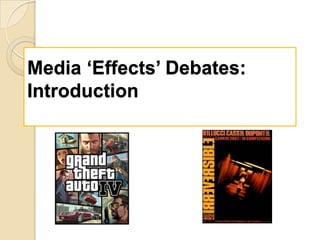
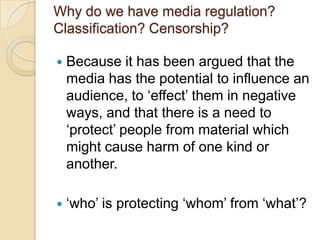
Media ‘Effects’ Debates: Introduction
Why do we have media regulation? Classification? Censorship?Because it has been argued that the media has the potential to influence an audience, to ‘effect’ them in negative ways, and that there is a need to ‘protect’ people from material which might cause harm of one kind or another.‘who’ is protecting ‘whom’ from ‘what’?
There tends to be three voices in this debate:Those who articulate their concerns about the effects of the media without any actual evidence (politicians, the media itself, campaigning groups etc);Those who have conducted research into media effects, whether the outcomes are positive of negative (academics in various fields)And those who are the subject of the debate, usually children or teenagers consuming new forms of media which the ‘adult culture’ are worrying about (slasher movies or videogames etc)Can you think of other examples of media that has been part of this debate?
Important to understand the distinction betweenRegulationClassificationCensorship
RegulationThe monitoring of and intervention in media production and consumption.  The media industries are subject to regulators of various types.  Some are government-appointed (state regulation or statutory regulation).  This means that the media can be controlled by laws set out in parliament. In film, one of the most important pieces of statutory regulation was the Video Recording Act 1984. There is also self-regulation, voluntary controls over a sector of the media industries, usually adopted out of fear that statutory control would be more severe. The PEGI age ratings on most video games are a good example.
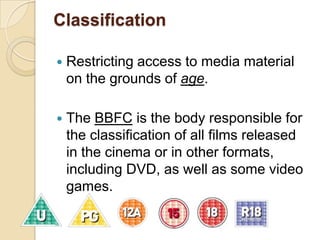
ClassificationRestricting access to media material on the grounds of age.  The BBFC is the body responsible for the classification of all films released in the cinema or in other formats, including DVD, as well as some video games.
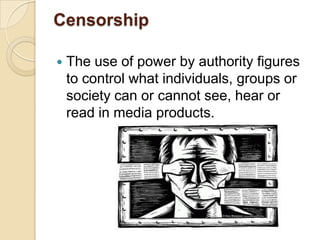
CensorshipThe use of power by authority figures to control what individuals, groups or society can or cannot see, hear or read in media products.
It would be useful firstly to distinguish between psychological and sociological approaches to effects and secondly, to bring them together for our purposes.Broadly speaking, psychological theories relate to what is going on in the mind of the individual human being when immersed in the video game or watching the film.Whilst sociological theories look at the broader impact of games/films on groups of people or society in general.In practice the two come together because a psychological effect on a human being that leads to a change in behaviour will lead to consequences for others, and if this effect is shared by a number of people, then the wider society may change
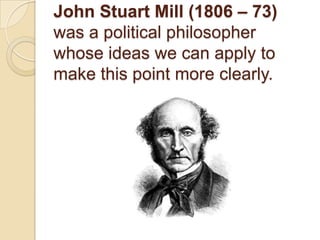
John Stuart Mill (1806 – 73) was a political philosopher whose ideas we can apply to make this point more clearly.
In trying to work out how to judge human behaviours (which ones should be allowed in a society based on liberty and freedom), Mill distinguished between self-regarding and other-regarding behaviours or practices. Mill said that human beings in a free society should be allowed to do anything they like as long as it does not affect others in a negative way.
But judging this is not as easy as it first seems.Consider the debate over the legislation (which has become statuary regulation) to ban smoking in public places.This law is based on the idea that smoking is other-regarding, as research has proven that passive smoking can contribute to cancer and heart disease. But many smokers argue that they are only harming themselves, so that it is self-regarding.
Driving while under the influence of alcohol, on the other hand, is clearly other-regarding.What about:‘There is nothing wrong with a drunken prostitute, smoking a cigarette, whist riding a motorbike without a helmet in the privacy of his/her own home’
What this extreme example illustrates is that it is never very easy to work out whether individual behaviour is limited to effects on the individual. Where does the individual end and society begin? For this reason, we can say that psychological approaches to gaming/films will always be connected to sociological ideas.
‘Classic’ effect theoriesHyperdermic syringe modelCultivation theoryDesensitisationCopycat theory
Criticisms?
More complex audience theories:Uses & gratificationsWhat people do with the media to satisfy various individual & social needs that we haveReception theoryShowing how we make different polysemic meanings from the same media

Media ‘Effects’ Debates

  • 1.
  • 2.
    Why do wehave media regulation? Classification? Censorship?Because it has been argued that the media has the potential to influence an audience, to ‘effect’ them in negative ways, and that there is a need to ‘protect’ people from material which might cause harm of one kind or another.‘who’ is protecting ‘whom’ from ‘what’?
  • 3.
    There tends tobe three voices in this debate:Those who articulate their concerns about the effects of the media without any actual evidence (politicians, the media itself, campaigning groups etc);Those who have conducted research into media effects, whether the outcomes are positive of negative (academics in various fields)And those who are the subject of the debate, usually children or teenagers consuming new forms of media which the ‘adult culture’ are worrying about (slasher movies or videogames etc)Can you think of other examples of media that has been part of this debate?
  • 4.
    Important to understandthe distinction betweenRegulationClassificationCensorship
  • 5.
    RegulationThe monitoring ofand intervention in media production and consumption. The media industries are subject to regulators of various types. Some are government-appointed (state regulation or statutory regulation). This means that the media can be controlled by laws set out in parliament. In film, one of the most important pieces of statutory regulation was the Video Recording Act 1984. There is also self-regulation, voluntary controls over a sector of the media industries, usually adopted out of fear that statutory control would be more severe. The PEGI age ratings on most video games are a good example.
  • 6.
    ClassificationRestricting access tomedia material on the grounds of age. The BBFC is the body responsible for the classification of all films released in the cinema or in other formats, including DVD, as well as some video games.
  • 7.
    CensorshipThe use ofpower by authority figures to control what individuals, groups or society can or cannot see, hear or read in media products.
  • 8.
    It would beuseful firstly to distinguish between psychological and sociological approaches to effects and secondly, to bring them together for our purposes.Broadly speaking, psychological theories relate to what is going on in the mind of the individual human being when immersed in the video game or watching the film.Whilst sociological theories look at the broader impact of games/films on groups of people or society in general.In practice the two come together because a psychological effect on a human being that leads to a change in behaviour will lead to consequences for others, and if this effect is shared by a number of people, then the wider society may change
  • 9.
    John Stuart Mill(1806 – 73) was a political philosopher whose ideas we can apply to make this point more clearly.
  • 10.
    In trying towork out how to judge human behaviours (which ones should be allowed in a society based on liberty and freedom), Mill distinguished between self-regarding and other-regarding behaviours or practices. Mill said that human beings in a free society should be allowed to do anything they like as long as it does not affect others in a negative way.
  • 11.
    But judging thisis not as easy as it first seems.Consider the debate over the legislation (which has become statuary regulation) to ban smoking in public places.This law is based on the idea that smoking is other-regarding, as research has proven that passive smoking can contribute to cancer and heart disease. But many smokers argue that they are only harming themselves, so that it is self-regarding.
  • 12.
    Driving while underthe influence of alcohol, on the other hand, is clearly other-regarding.What about:‘There is nothing wrong with a drunken prostitute, smoking a cigarette, whist riding a motorbike without a helmet in the privacy of his/her own home’
  • 13.
    What this extremeexample illustrates is that it is never very easy to work out whether individual behaviour is limited to effects on the individual. Where does the individual end and society begin? For this reason, we can say that psychological approaches to gaming/films will always be connected to sociological ideas.
  • 14.
    ‘Classic’ effect theoriesHyperdermicsyringe modelCultivation theoryDesensitisationCopycat theory
  • 15.
  • 16.
    More complex audiencetheories:Uses & gratificationsWhat people do with the media to satisfy various individual & social needs that we haveReception theoryShowing how we make different polysemic meanings from the same media