BHAGWANTI EDUCATION CENTRE
SHARDA NAGAR, KANPUR
By:
Rashmi Kumari
2nd
Semester
MEd
 Subject: IT
 Topic: DIGITAL
LEARNING OBJECTS
LEARNING OBJECT?
 Learning objects are elements of a new type
of computer-based instruction grounded in
the object-oriented paradigm of computer
science”.
 Learning objects: “Learning objects provides
better access to quality resources and
supports enhanced learning outcomes.”
(Muirhead) •
ESSENTIAL COMPONENTS OF A L
EARNING OBJECT
•
 They can be reused a number of times in
different learning contexts.
 Digital entities deliverable over the Internet
 Learning object aide in learning
 Provide instructional benefits
SOME EXAMPLE OF LEARNING O
BJECT
• Multime
dia
content
Instructio
nal
software
Live or
prerecord
ed video
Digital
images
or
photos
PowerPoint
presentatio
ns
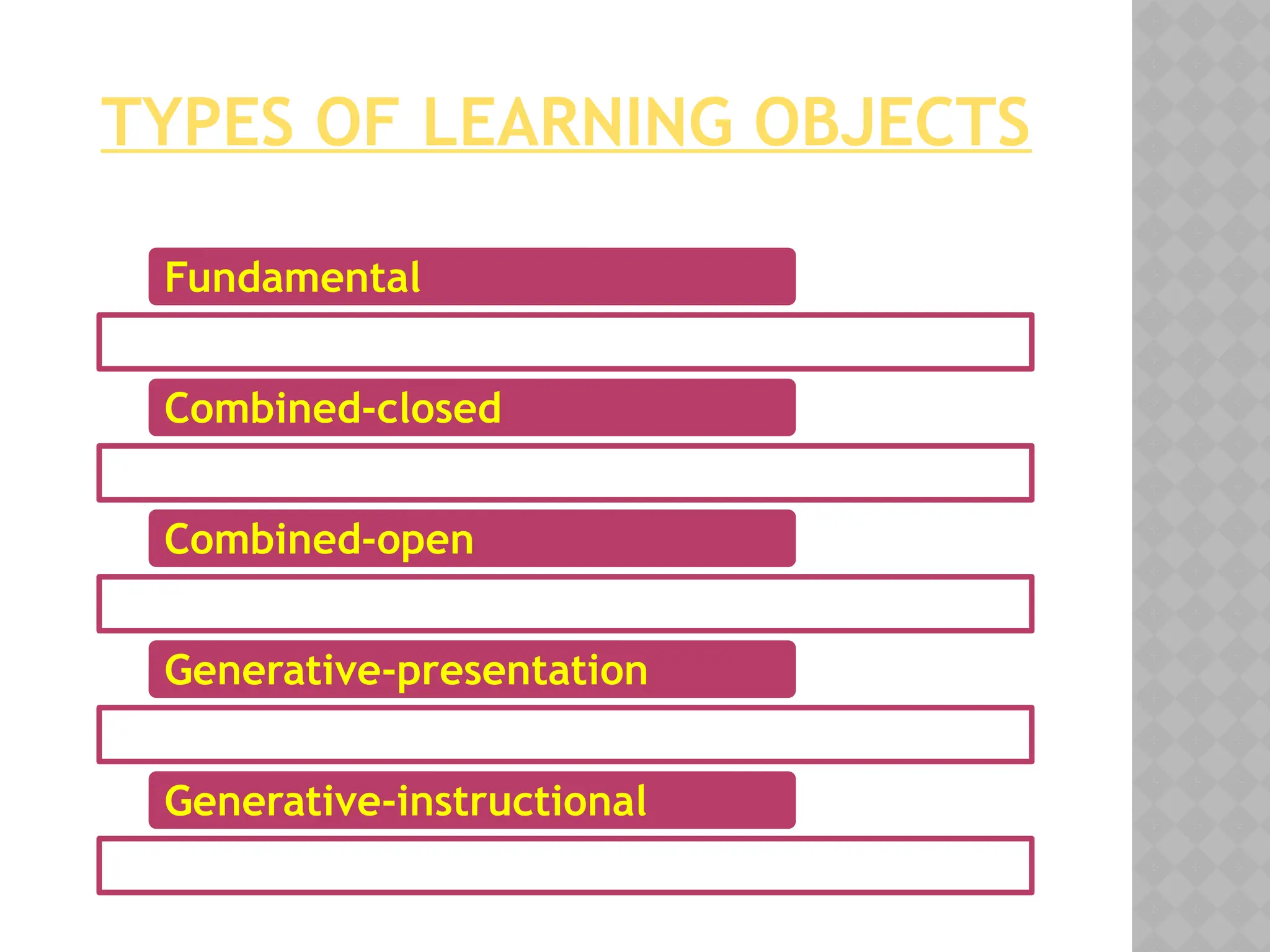
Fundamental
Combined-closed
Combined-open
Generative-presentation
Generative-instructional
TYPES OF LEARNING OBJECTS
• FUNDAMENTAL
 – An individual digital resource uncombined
with any other, the fundamental learning
object is generally a visual (or other) aid that
serves an exhibit or example function
COMBINED-CLOSED
 “A small number of digital resources
combined at design time by the learning
object's creator, whose constituent learning
objects are not individually accessible for
reuse (recoverable) from the Combined-
closed learning object itself. A video clip
exemplifies this definition, as still images
and an audio track are combined in a manner
which renders these constituent pieces
unrecoverable (or, at least difficult to
recover).”
• COMBINED-OPEN
 – “A larger number of digital resources
combined by a computer in real-time when a
request for the object is made, whose
constituent learning objects are directly
accessible for reuse (recoverable) from the
Combined-open object. A webpage
exemplifies this definition.”
GENERATIVE-PRESENTATION
 • –”learning objects can either draw on
network-accessible objects and combine
them, or generate (e.g., draw) objects and
combine them to create presentations for
use in reference, instruction, practice, and
testing.”
• GENERATIVE-INSTRUCTIONAL
 – “Logic and structure for combining learning
objects (Fundamental, Combined-closed
types, and Generative-presentation) and
evaluating student interactions with those
combinations, created to support the
instantiation of abstract instructional
strategies (such as "remember and perform a
series of steps").”
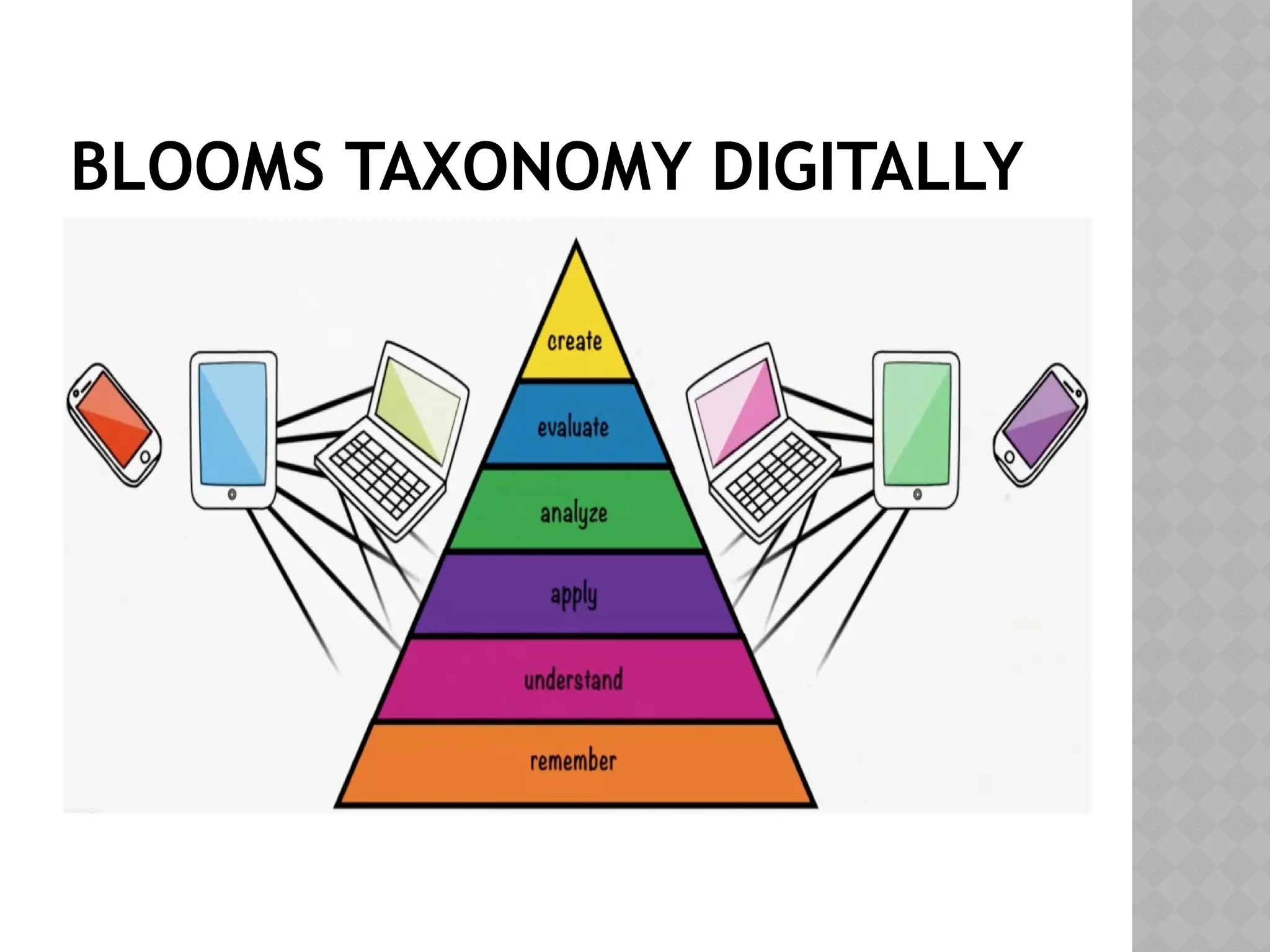
BLOOMS TAXONOMY DIGITALLY
WEB-BASED INSTRUCTION
 • Web-based instruction is teaching and
learning supported by the attributes and
resources of the Internet (Khan, 1997; Relan
& Gillami, 1997). • Web-based instruction
use the resource provided on the world wide
web to enhance learning.
WEB-ENHANCED INSTRUCTION
 . • Web-enhanced instruction refers to
instruction where online tools and web
resources are used to support the learning at
the conventional classroom. • It could be
interactive • Have Assessment to ensure
learning occurs.
INFORMATION DEFINITIONS
 a message received and understood
 data: a collection of facts from which
conclusions may be drawn; "statistical data“
 knowledge acquired through study or
experience or instruction
 (communication theory) a numerical
measure of the uncertainty of an outcome;
"the signal contained thousands of bits of
information“
INSTRUCTION DEFINITIONS
 direction: a message describing how something is
to be done; "he gave directions faster than she
could follow them" •
 education: the activities of educating or instructing;
activities that impart knowledge or skill; "he
received no formal education"; "our instruction was
carefully programmed"; "good classroom teaching is
seldom rewarded“
 teaching: the profession of a teacher; "he prepared
for teaching while still in college"; "pedagogy is
recognized as an important profession"
 • (computer science) a line of code written as part
of a computer program
LEARNING DEFINITIONS
 learning • A process that "builds on or
modifies understanding, capacities, abilities,
attitudes and propensities in the individual."
There are different theories about learning,
1 •Humanistic
•Behavioristic
2 •Cognitive
•Social Learning
LEARNING
 • Basically, from an educator’s perspective,
learning involves helping people along the
learning process, and learning includes all of
the things that we do to make it happen. As
an end result, we know that learning occurs
when people take newfound information and
incorporate it into their life. •
BIBILOGRAPHY
https://digitallschools.com/importance-of-us
ing-digital-tools-in-education
/
http://epembelajaran.edu.my/dloipg/konse
p/KDLO
/
https://pdf.usaid.gov/pdf_docs/PA00ZMWT.p
df
https://core.ac.uk/download/29199214.pdf

MEd Topics Digital Learning objects.pptx

  • 1.
    BHAGWANTI EDUCATION CENTRE SHARDANAGAR, KANPUR By: Rashmi Kumari 2nd Semester MEd  Subject: IT  Topic: DIGITAL LEARNING OBJECTS
  • 2.
    LEARNING OBJECT?  Learningobjects are elements of a new type of computer-based instruction grounded in the object-oriented paradigm of computer science”.  Learning objects: “Learning objects provides better access to quality resources and supports enhanced learning outcomes.” (Muirhead) •
  • 3.
    ESSENTIAL COMPONENTS OFA L EARNING OBJECT •  They can be reused a number of times in different learning contexts.  Digital entities deliverable over the Internet  Learning object aide in learning  Provide instructional benefits
  • 4.
    SOME EXAMPLE OFLEARNING O BJECT • Multime dia content Instructio nal software Live or prerecord ed video Digital images or photos PowerPoint presentatio ns
  • 5.
  • 6.
    • FUNDAMENTAL  –An individual digital resource uncombined with any other, the fundamental learning object is generally a visual (or other) aid that serves an exhibit or example function
  • 7.
    COMBINED-CLOSED  “A smallnumber of digital resources combined at design time by the learning object's creator, whose constituent learning objects are not individually accessible for reuse (recoverable) from the Combined- closed learning object itself. A video clip exemplifies this definition, as still images and an audio track are combined in a manner which renders these constituent pieces unrecoverable (or, at least difficult to recover).”
  • 8.
    • COMBINED-OPEN  –“A larger number of digital resources combined by a computer in real-time when a request for the object is made, whose constituent learning objects are directly accessible for reuse (recoverable) from the Combined-open object. A webpage exemplifies this definition.”
  • 9.
    GENERATIVE-PRESENTATION  • –”learningobjects can either draw on network-accessible objects and combine them, or generate (e.g., draw) objects and combine them to create presentations for use in reference, instruction, practice, and testing.”
  • 10.
    • GENERATIVE-INSTRUCTIONAL  –“Logic and structure for combining learning objects (Fundamental, Combined-closed types, and Generative-presentation) and evaluating student interactions with those combinations, created to support the instantiation of abstract instructional strategies (such as "remember and perform a series of steps").”
  • 11.
  • 12.
    WEB-BASED INSTRUCTION  •Web-based instruction is teaching and learning supported by the attributes and resources of the Internet (Khan, 1997; Relan & Gillami, 1997). • Web-based instruction use the resource provided on the world wide web to enhance learning.
  • 13.
    WEB-ENHANCED INSTRUCTION  .• Web-enhanced instruction refers to instruction where online tools and web resources are used to support the learning at the conventional classroom. • It could be interactive • Have Assessment to ensure learning occurs.
  • 14.
    INFORMATION DEFINITIONS  amessage received and understood  data: a collection of facts from which conclusions may be drawn; "statistical data“  knowledge acquired through study or experience or instruction  (communication theory) a numerical measure of the uncertainty of an outcome; "the signal contained thousands of bits of information“
  • 15.
    INSTRUCTION DEFINITIONS  direction:a message describing how something is to be done; "he gave directions faster than she could follow them" •  education: the activities of educating or instructing; activities that impart knowledge or skill; "he received no formal education"; "our instruction was carefully programmed"; "good classroom teaching is seldom rewarded“  teaching: the profession of a teacher; "he prepared for teaching while still in college"; "pedagogy is recognized as an important profession"  • (computer science) a line of code written as part of a computer program
  • 16.
    LEARNING DEFINITIONS  learning• A process that "builds on or modifies understanding, capacities, abilities, attitudes and propensities in the individual." There are different theories about learning, 1 •Humanistic •Behavioristic 2 •Cognitive •Social Learning
  • 17.
    LEARNING  • Basically,from an educator’s perspective, learning involves helping people along the learning process, and learning includes all of the things that we do to make it happen. As an end result, we know that learning occurs when people take newfound information and incorporate it into their life. •
  • 18.