ONLINE CLASSES
CHEMISTRY
CLASS X
CMCL VIDYA BHARATI SCHOOL, LUMSHNONG
BY
RAPELLY NAGARAJU
PGT CHEMISTRY
What is Chemical Reaction?
:Let us see some examples of chemical reactions of daily life:
• Milk is left at room temperature during
summer
• Rusting of Iron
• Food / Fruits damage
• Cooking of food
• Burning of paper
Chemical Reaction -Types of Changes
• From all the above sentences you may notice there is
some change of substance what we are taken
• The types of changes for a chemical reaction are as
follows
Change in state
Change in colour
 Change in temperature
Evolution of gases
Types of Changes -Examples
• Burning a paper
• Cooking food
• These are examples of Change in state
• Addition of turmeric powder with soap changes red colour
• Addition of lead nitrate , potassium iodide it produces
yellow colour
• These are examples of Change in colour
a
Types of Changes -Examples
• We learn in previous classes about Exothermic and
Endothermic reaction.
• What is that mean absorbing temperature or release of
temperature. Cooking Food
• Addition of water to acid
• These are examples of Change in temperature
• You can check at home addition of vinegar with Baking Soda,
you will observe bubbles
• You may notice addition of metal to any acid , bubbles inside
the solution
• These are examples of Evolution of gases
Chemical Reaction - Definition
• So the Chemical reaction is, the taken substances
undergoes some change(as mentioned above )to form
new substances.
• The taken substances are the Reactants and the formed
new substances are Products.
• Now simply the Chemical reaction is Conversion of
reactants to products.
• We will study variety of reactions in this chapter.
What is Chemical Equation?
• The simplest way to write the reaction:
• For example Magnesium ribbon burnt in the Oxygen to produce ash i.e.
Magnesium oxide: Word Equation:
• Magnesium + Oxygen -------> Magnesium Oxide
• The left hand side are the reactants and right hand side are the
products both are separated with arrow mark,if more number of
reactants or products are there that can be separated with plus(+)
symbol
• Writing a Chemical Equation :
• The word equation can be more simplified if we are replacing the words
with chemical symbols.
• For example : Mg + O ------> MgO
Why we need to balance a chemical equation?
What is balancing chemical equation / Balanced chemical
equation?
Answer:
• According to law of conservation of mass, Mass neither be
created nor be destroyed.
• So in chemical reaction how much the mass of the reactants is
thatmuch is the mass of the products.
• That we equalize with number of atoms in each element in the
reactants with products. For the same the reactants and
products multiplied with small integers.
Balancing Chemical Equation:
• Traditional Method:
• The steps of balancing chemical equation:
• Example: aluminium sulphate is reacting with barium
chloride to produce barium sulphate and aluminium
chloride.
• Step1: Write unbalanced equation for the chemical
reaction:
• Al2(SO4)3+BaCl2------> BaSO4+AlCl3
• Step2: Draw Boxes around each formula, nothing will
change inside the boxes.because the composition of
the compounds will never change.
+ ------> +
• Step3: List the number atoms of different elements
present in the unbalanced equation: (Note: Consider
poly atomic ion as single element)
Al2(SO4)3 BaCl2 BaSO4 AlCl3
Elements No of Atoms in
Reactants
No of atoms in
Products
SO4 3 1
Al 2 1
Ba 1 1
Cl 2 3
• Step4: If the number of atoms are equal in reactants and
products the equation is balanced. If not, has to balance
the no of atoms by multiplying it by simple integers.
• (Note: Firstly Balance the poly atomic ions, then metals
and lastly remaining elements.)
+ -----> 3 +
Elements No of Atoms in Reactants No of atoms in Products
SO4 3x1 1x3
Al 2 1
Ba 1 1
Cl 2 3
Al2(SO4)3 BaCl2 BaSO4 AlCl3
Repeat the step 3.
Elements No of Atoms in Reactants No of atoms in Products
SO4 3 3
Al 2 1
Ba 1 3
Cl 2 3
Repeat the step 4.
Elements No of Atoms in Reactants No of atoms in Products
SO4 3 3
Al 2x1 1x2
Ba 1 3
Cl 2 3
+ ------> 3 + 2
Al2(SO4)3 BaCl2 BaSO4 AlCl3
Repeat the Step 3 & 4
Elements No of Atoms in Reactants No of atoms in Products
SO4 3 3
Al 2 2
Ba 1x3 3
Cl 2 6
+ 3 ------> 3 + 2
Al2(SO4)3 BaCl2 BaSO4 AlCl3
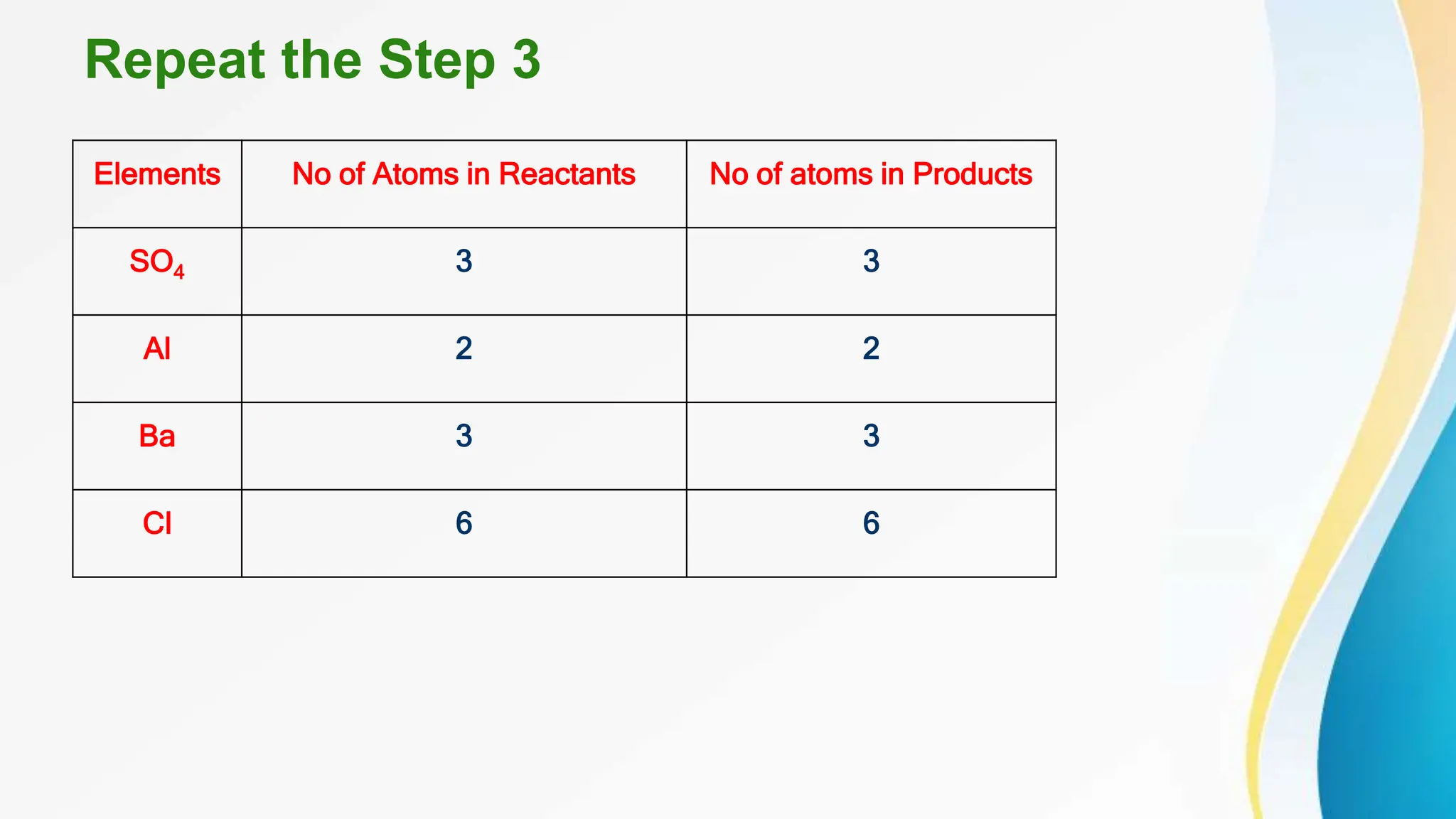
Repeat the Step 3
Elements No of Atoms in Reactants No of atoms in Products
SO4 3 3
Al 2 2
Ba 3 3
Cl 6 6
Final Equation is
• Al2(SO4)3 + 3 BaCl2 ------> 3BaSO4 + 2AlCl3
• The complete balanced equation is by putting the physical
states of reactants and products
• Al2(SO4)3 (aq) +3 BaCl2 (aq) ------> 3BaSO4 (s) + 2AlCl3 (aq)
Algebraic method
• Step1: Write unbalanced equation for the chemical reaction:
• Al2(SO4)3+BaCl2------> BaSO4+AlCl3
• Step 2 : Assign some coefficients to reactants and products;
• a Al2(SO4)3+ b BaCl2------> c BaSO4+ d AlCl3
• Step3: Write the algebraic equation of each element;
• (Note: Consider poly atomic ion as single element)
• Coefficient of SO4 is ‘a’ and 3 atoms in reactants ; coefficient of SO4 is ‘c’
and 1 atom in Products. Similarly for other elements:
• SO4 : 3a = c
• Al : 2a = d
• Ba : b = c
• Cl : 2b = 3d
• The four equations are solved by assuming any one of the
coefficients are equal to 1,
• For example; a=1 From 3a = c ; c=3
• From 2a = d; 2 =d
• From b=c ; b=3
• From 2b = 3d; d=2
Final Equation
• By substituting all the coefficients, the final Equation is
• Al2(SO4)3 + 3 BaCl2 ------> 3BaSO4 + 2AlCl3
• The complete balanced equation is by putting the physical
states of reactants and products
• Al2(SO4)3 (aq) + 3 BaCl2 (aq) ------> 3BaSO4 (s) + 2AlCl3 (aq)
Exercises
Balance the Following Chemical Reactions:
1.BaCl2(aq) + Na2SO4(aq) ------>BaSO4(s) + NaCl (aq)
2.NaOH (aq) + HCl (aq) NaCl (aq) + H2O
3.Potassium Bromide (aq) + Barium iodide (aq)------>
Potassium iodide (aq) + Barium Bromide(aq)
4. Zinc carbonate (s) Zinc oxide (s) + carbon dioxide (g)
5.Hydrogen (g) + chlorine (g) Hydrogen chloride
Exercises
Transfer the following into chemical equations and balance
them.
6.Hydrogen gas combines with nitrogen to from ammonia.
7.Hydrogen sulphide gas burns in air to give water and
sulphur dioxide.
8.Potassium metal reacts with water to give potassium
hydroxide and hydrogen gas
• Bibilography:
• NCERT text book
• Internet Images
THANK YOU

NCERT CLASS X according to CBSE CHEMICAL REACTIONS PPT.pptx

  • 1.
    ONLINE CLASSES CHEMISTRY CLASS X CMCLVIDYA BHARATI SCHOOL, LUMSHNONG BY RAPELLY NAGARAJU PGT CHEMISTRY
  • 3.
    What is ChemicalReaction? :Let us see some examples of chemical reactions of daily life: • Milk is left at room temperature during summer • Rusting of Iron • Food / Fruits damage • Cooking of food • Burning of paper
  • 4.
    Chemical Reaction -Typesof Changes • From all the above sentences you may notice there is some change of substance what we are taken • The types of changes for a chemical reaction are as follows Change in state Change in colour  Change in temperature Evolution of gases
  • 5.
    Types of Changes-Examples • Burning a paper • Cooking food • These are examples of Change in state • Addition of turmeric powder with soap changes red colour • Addition of lead nitrate , potassium iodide it produces yellow colour • These are examples of Change in colour
  • 6.
  • 7.
    Types of Changes-Examples • We learn in previous classes about Exothermic and Endothermic reaction. • What is that mean absorbing temperature or release of temperature. Cooking Food • Addition of water to acid • These are examples of Change in temperature • You can check at home addition of vinegar with Baking Soda, you will observe bubbles • You may notice addition of metal to any acid , bubbles inside the solution • These are examples of Evolution of gases
  • 9.
    Chemical Reaction -Definition • So the Chemical reaction is, the taken substances undergoes some change(as mentioned above )to form new substances. • The taken substances are the Reactants and the formed new substances are Products. • Now simply the Chemical reaction is Conversion of reactants to products. • We will study variety of reactions in this chapter.
  • 10.
    What is ChemicalEquation? • The simplest way to write the reaction: • For example Magnesium ribbon burnt in the Oxygen to produce ash i.e. Magnesium oxide: Word Equation: • Magnesium + Oxygen -------> Magnesium Oxide • The left hand side are the reactants and right hand side are the products both are separated with arrow mark,if more number of reactants or products are there that can be separated with plus(+) symbol • Writing a Chemical Equation : • The word equation can be more simplified if we are replacing the words with chemical symbols. • For example : Mg + O ------> MgO
  • 11.
    Why we needto balance a chemical equation? What is balancing chemical equation / Balanced chemical equation? Answer: • According to law of conservation of mass, Mass neither be created nor be destroyed. • So in chemical reaction how much the mass of the reactants is thatmuch is the mass of the products. • That we equalize with number of atoms in each element in the reactants with products. For the same the reactants and products multiplied with small integers.
  • 12.
    Balancing Chemical Equation: •Traditional Method: • The steps of balancing chemical equation: • Example: aluminium sulphate is reacting with barium chloride to produce barium sulphate and aluminium chloride. • Step1: Write unbalanced equation for the chemical reaction: • Al2(SO4)3+BaCl2------> BaSO4+AlCl3
  • 13.
    • Step2: DrawBoxes around each formula, nothing will change inside the boxes.because the composition of the compounds will never change. + ------> + • Step3: List the number atoms of different elements present in the unbalanced equation: (Note: Consider poly atomic ion as single element) Al2(SO4)3 BaCl2 BaSO4 AlCl3
  • 14.
    Elements No ofAtoms in Reactants No of atoms in Products SO4 3 1 Al 2 1 Ba 1 1 Cl 2 3
  • 15.
    • Step4: Ifthe number of atoms are equal in reactants and products the equation is balanced. If not, has to balance the no of atoms by multiplying it by simple integers. • (Note: Firstly Balance the poly atomic ions, then metals and lastly remaining elements.)
  • 16.
    + -----> 3+ Elements No of Atoms in Reactants No of atoms in Products SO4 3x1 1x3 Al 2 1 Ba 1 1 Cl 2 3 Al2(SO4)3 BaCl2 BaSO4 AlCl3
  • 17.
    Repeat the step3. Elements No of Atoms in Reactants No of atoms in Products SO4 3 3 Al 2 1 Ba 1 3 Cl 2 3
  • 18.
    Repeat the step4. Elements No of Atoms in Reactants No of atoms in Products SO4 3 3 Al 2x1 1x2 Ba 1 3 Cl 2 3
  • 19.
    + ------> 3+ 2 Al2(SO4)3 BaCl2 BaSO4 AlCl3
  • 20.
    Repeat the Step3 & 4 Elements No of Atoms in Reactants No of atoms in Products SO4 3 3 Al 2 2 Ba 1x3 3 Cl 2 6
  • 21.
    + 3 ------>3 + 2 Al2(SO4)3 BaCl2 BaSO4 AlCl3
  • 22.
    Repeat the Step3 Elements No of Atoms in Reactants No of atoms in Products SO4 3 3 Al 2 2 Ba 3 3 Cl 6 6
  • 23.
    Final Equation is •Al2(SO4)3 + 3 BaCl2 ------> 3BaSO4 + 2AlCl3 • The complete balanced equation is by putting the physical states of reactants and products • Al2(SO4)3 (aq) +3 BaCl2 (aq) ------> 3BaSO4 (s) + 2AlCl3 (aq)
  • 24.
    Algebraic method • Step1:Write unbalanced equation for the chemical reaction: • Al2(SO4)3+BaCl2------> BaSO4+AlCl3 • Step 2 : Assign some coefficients to reactants and products; • a Al2(SO4)3+ b BaCl2------> c BaSO4+ d AlCl3
  • 25.
    • Step3: Writethe algebraic equation of each element; • (Note: Consider poly atomic ion as single element) • Coefficient of SO4 is ‘a’ and 3 atoms in reactants ; coefficient of SO4 is ‘c’ and 1 atom in Products. Similarly for other elements: • SO4 : 3a = c • Al : 2a = d • Ba : b = c • Cl : 2b = 3d
  • 26.
    • The fourequations are solved by assuming any one of the coefficients are equal to 1, • For example; a=1 From 3a = c ; c=3 • From 2a = d; 2 =d • From b=c ; b=3 • From 2b = 3d; d=2
  • 27.
    Final Equation • Bysubstituting all the coefficients, the final Equation is • Al2(SO4)3 + 3 BaCl2 ------> 3BaSO4 + 2AlCl3 • The complete balanced equation is by putting the physical states of reactants and products • Al2(SO4)3 (aq) + 3 BaCl2 (aq) ------> 3BaSO4 (s) + 2AlCl3 (aq)
  • 28.
    Exercises Balance the FollowingChemical Reactions: 1.BaCl2(aq) + Na2SO4(aq) ------>BaSO4(s) + NaCl (aq) 2.NaOH (aq) + HCl (aq) NaCl (aq) + H2O 3.Potassium Bromide (aq) + Barium iodide (aq)------> Potassium iodide (aq) + Barium Bromide(aq) 4. Zinc carbonate (s) Zinc oxide (s) + carbon dioxide (g) 5.Hydrogen (g) + chlorine (g) Hydrogen chloride
  • 29.
    Exercises Transfer the followinginto chemical equations and balance them. 6.Hydrogen gas combines with nitrogen to from ammonia. 7.Hydrogen sulphide gas burns in air to give water and sulphur dioxide. 8.Potassium metal reacts with water to give potassium hydroxide and hydrogen gas
  • 30.
    • Bibilography: • NCERTtext book • Internet Images THANK YOU