Muskan Rastogi
Bpt
MRIIRS
faridabad
 AravaliBiodiversityPark,Gurgaon,(orAravalli
BiodiversityPark,Gurgaon)spreadsover153.7hectares,
neartheGuruDronacharyametr0
stationinGurgaon,Haryana,India.
 Thepark,containsecologicallyrestoreddesertandarid
landvegetation.Theparkwasopenedtothepublic
onWorldEnvironmentDay,5June2010.
 Theparkincludesanumberoftrailsandanativeplant
nurseryandinterpretivedisplaysattheentrance.
 Aravalli Biodiversity Park (ABDP), as its name
suggests is an endeavor to create a forest garden
that celebrates forest flora native to the Aravalli
range.
 We have lost a large part of Aravalli range, its
flora and fauna to rampant development and
urbanization.
 The Aravalli Biodiversity Park was once a
mining site. The land still has fresh scars of the
mining era. ‘iamgurgaon’ intends to restore this
scarred land into a biodiversity reserve and
celebrate the rich flora of the Aravalli Range.
The Aravalli Biodiversity Park was declared
open by Haryana Chief Minister Bhupinder
Singh Hooda on June 5th 2010, on World
Environment Day.
Once developed, the Aravalli Biodiversity
Park would give the citizens of Gurgaon
access to 600 acres of pristine space and
connect them to nature.
 It will be a place for leisure walks, jogging,
trekking, bird watching, gardening,
contemplation and cultural expression. A
pristine natural space where nature and
people merge into a beautiful natural
landscape…
 ABDP started taking baby steps towards the
nascent idea of a park. MCG, IAG, HFDC
and the NGO Uthaan came forward to plant
in this derelict landscape, bereft of any soil
cover and infested with an exotic invasive
plant, Prosopis juliflora. Indiscriminate, if
well-intentioned, planting began, without
sparing enough thought for the character of
the land.
 Unlike conventional landscaped parks, the Aravalli
Biodiversity Park is unique in that each aspect of
its infrastructure has been developed with
ecological sustainability as the primary focus – the
revival of the forest.
 In terms of facilities, it has a 3.5 kms walking and
4 kms cycling tracks that have been built along
natural contours and existing paths.
 The walking tracks are of porous concrete to allow
water percolation.
 Two developed seasonal wetlands and an
amphitheatre for cultural activities are other
features.
 The park has one of the most unique Parking lots
that demonstrates water conservation
 The stone gabion boundary wall was built using
small stones sourced from within the site within a
metal grid, that minimizes impact on the terrain.
 Purifies city’s air and recharges groundwater.
 This assessment report was made after
the Haryana government had
requested the IUCN to conduct a study
and suggest ways to conserve the
biodiversity of the area. The report said
that by 2050, more than 50% of Indian
population will be living in cities. As
more and more people inhabit urban
areas, it will become imperative to
bring nature back into urban areas to
ensure well-being of the residents, the
report said.
 As the region is in the ‘dark zone’ due
to over-exploitation of groundwater, it
is important to conserve and preserve
the green areas and plant more trees.
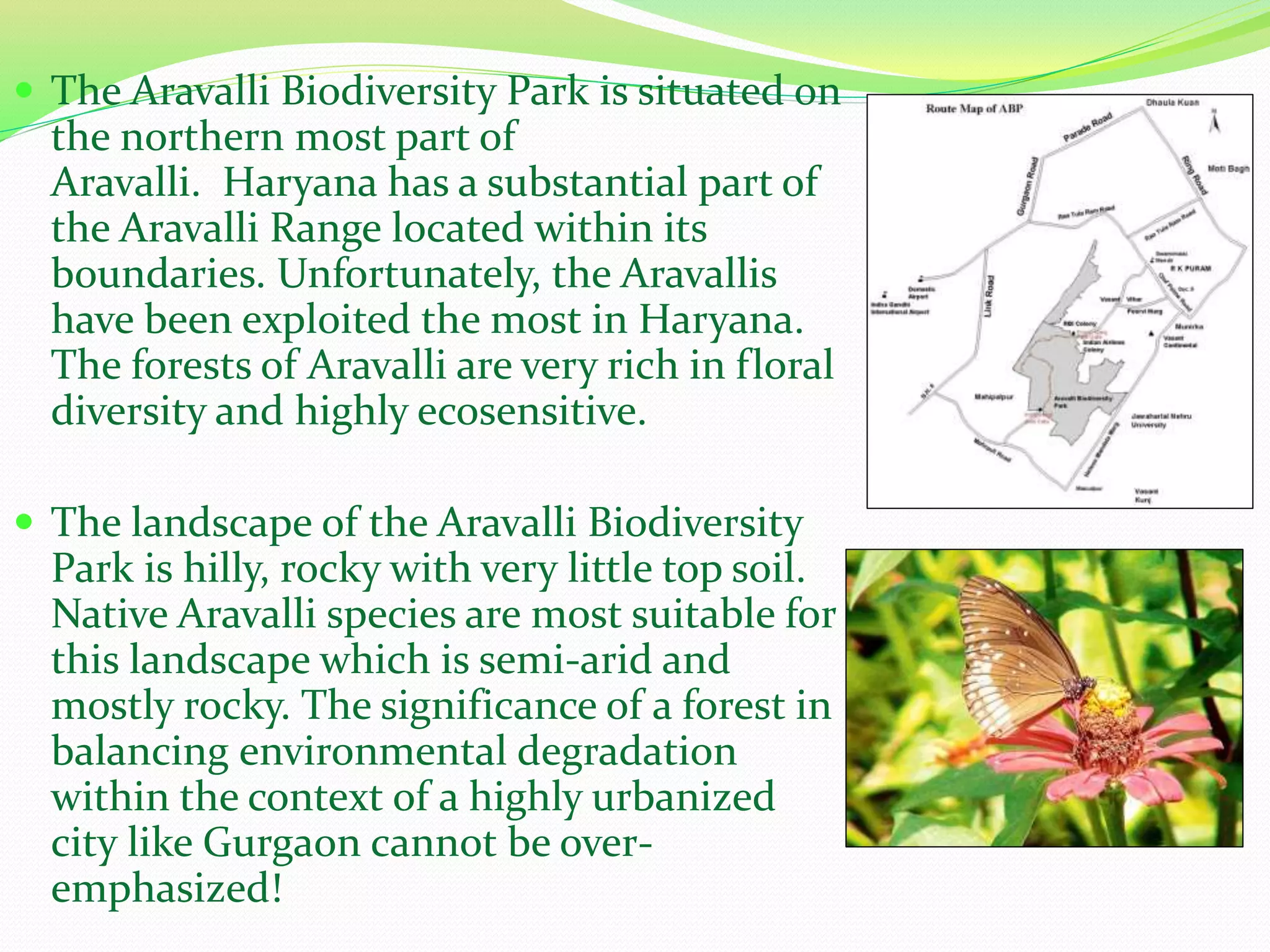
 The Aravalli Biodiversity Park is situated on
the northern most part of
Aravalli. Haryana has a substantial part of
the Aravalli Range located within its
boundaries. Unfortunately, the Aravallis
have been exploited the most in Haryana.
The forests of Aravalli are very rich in floral
diversity and highly ecosensitive.
 The landscape of the Aravalli Biodiversity
Park is hilly, rocky with very little top soil.
Native Aravalli species are most suitable for
this landscape which is semi-arid and
mostly rocky. The significance of a forest in
balancing environmental degradation
within the context of a highly urbanized
city like Gurgaon cannot be over-
emphasized!
S.NO NAME OF SPECIES FOUND SCIENTIFIC NAME
1 Indian Peafowl Pavo cristatus
2 Gray Francolin Francolinus pondicerianus
3 Shikra Accipiter badius
4 Black Kite Milvus migrans
5 Black-winged Stilt Himantopus himantopus
6 Red-wattled Lapwing Vanellus indicus
7 Green Sandpiper Tringa ochropus
8 Rock Pigeon Columba livia
9 Eurasian Collared-Dove Streptopelia decaocto
10 Laughing Dove Streptopelia senegalensis
11 Spotted Owlet Athene brama
12 Green Bee-eater Merops orientalis
13 Rose-ringed Parakeet Psittacula krameri
S.NO. NAME OF SPECIES FOUND SCIENTIFIC NAME
14 Red-vented Bulbul Pycnonotus cafer
15 White-eared Bulbul Pycnonotus leucotis
16 Rufous-fronted Prinia Prinia
17 Purple Sunbird Cinnyris asiaticus
18 Indian Silverbill Euodice malabarica
19 European Starling Sturnus vulgaris
20 Rosy Starling Pastor roseus
21 Kadamb Mitragyna parvifolia
22 Kulu Sterculia urens
23 Ati bala Abutilon indicum
24 Kardhai Anogeissus pendula
25 Indrajao Holarhena pubscens
26 Karayaja Wrightia tinctoria
27 Salai Boswellia serrata
S.NO
.
NAME OF SPECIES FOUND SCIENTIFIC NAME
28 Babool Vachellia nilotica
29 Guggul Commiphora wrightii
30 Maror phali Helicterius isora
31 Kala siris Albizia odorotissimia
32 Kamala Mallotus philippensis
33 Gangeti Grewia tenax
34 Alaya Mimosa hamata
35 Mohin Lannea coromendelica
36 Bistendu Diosypros cordifolia
37 Gondni Cordia gharaf
38 Katmauli Bauhinia racemosa
39 Neem Azadirachta indica
40 Mahua Madhuca longifolia
41 Tulsi Ocimum tenuiflorum
S.NO. NAME OF SPECIES FOUND
42 GECKOS
43 MOTHS
44 BEETLES
45 SKUNKS
46 SAW SCALED VIPER
47 RAT SNAKES COBRAS
48 DAMSELS
49 DRAGONFLIES
50 LIME BUTTERFLY
51 INDIAN FRITILLARY
52 STRIPED TIGER BUTTERFLY
53 GRASS JEWEL BUTTERFLY
54 STRIPPED PALM SQUIRREL
55 CORIDIUS JANUS
VILAYTEE KEEKAR: A CASE STUDY
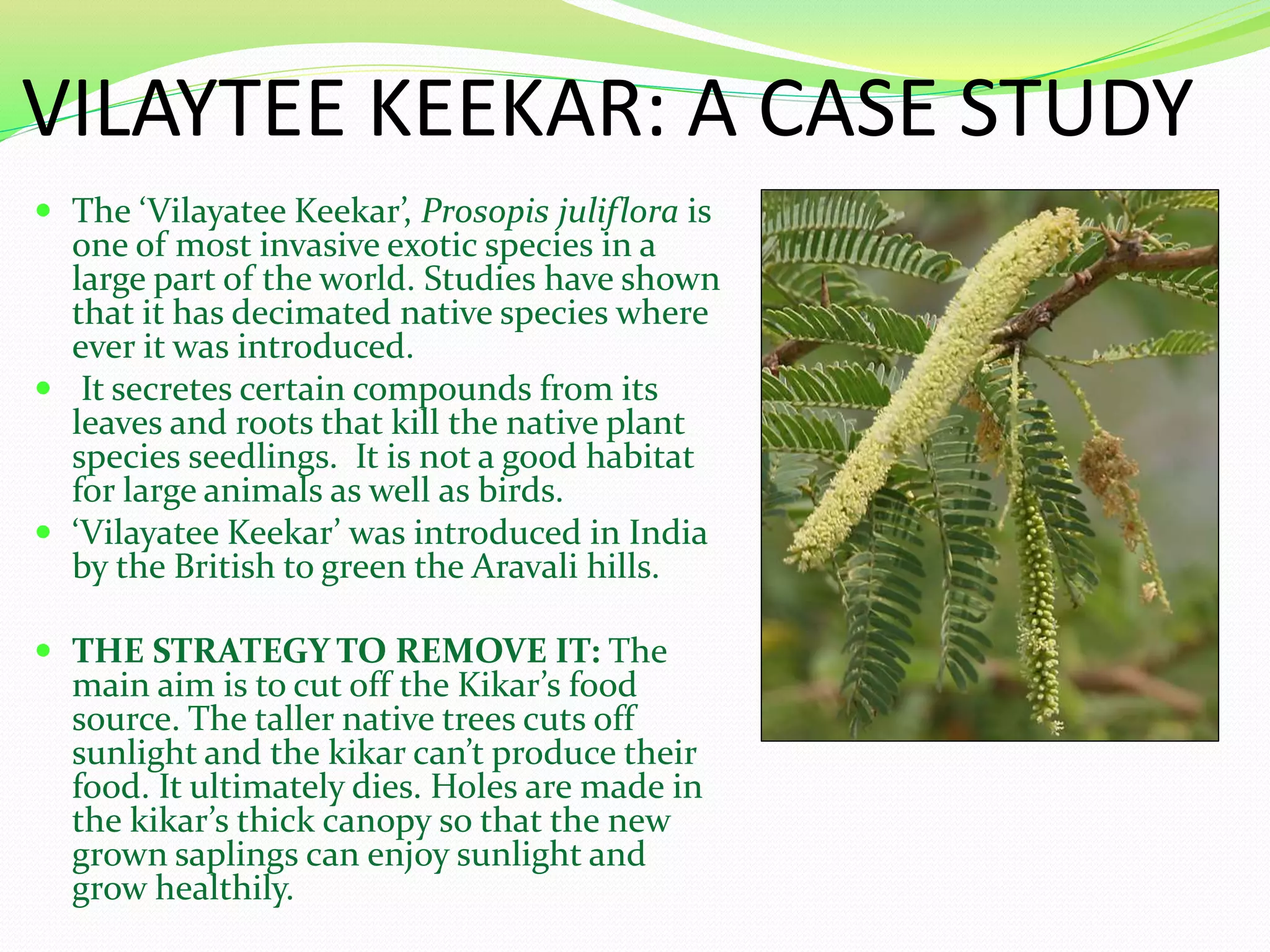
 The ‘Vilayatee Keekar’, Prosopis juliflora is
one of most invasive exotic species in a
large part of the world. Studies have shown
that it has decimated native species where
ever it was introduced.
 It secretes certain compounds from its
leaves and roots that kill the native plant
species seedlings. It is not a good habitat
for large animals as well as birds.
 ‘Vilayatee Keekar’ was introduced in India
by the British to green the Aravali hills.
 THE STRATEGY TO REMOVE IT: The
main aim is to cut off the Kikar’s food
source. The taller native trees cuts off
sunlight and the kikar can’t produce their
food. It ultimately dies. Holes are made in
the kikar’s thick canopy so that the new
grown saplings can enjoy sunlight and
grow healthily.
Invasion of species- vilaytee keekar and its removal
Over grazing
Fencing of whole area
Maintenance cost
Less recharge of underground water
Vandalism
Breaking of facilities
Stealing of resources
 Proper fencing
Security should be tightened
More rain water harvesting systems should be installed
Removal of invasive species
Public awareness
Nurseries should maintain genetic diversity
PUBLIC AWARENESS PROGRAMMES
Every year a plantation season is organized in the park and
200+ species of plants across 400 hectares of area are
planted. Citizens of Gurgaon, forest officials , schools and
colleges participate enthusiastically.
Various census in the park are also organized in which
people( generally the citizens are involved) help like bird
counts, butterflies, insects. Wildlife and plants diversity
People also help in monitoring the state of plants and
promote the ideas across the city.
All these activities are organized by NGO ‘iamgurgaon’ and
also funded by them.
Aravalli bio diversity park

Aravalli bio diversity park

  • 1.
  • 2.
     AravaliBiodiversityPark,Gurgaon,(orAravalli BiodiversityPark,Gurgaon)spreadsover153.7hectares, neartheGuruDronacharyametr0 stationinGurgaon,Haryana,India.  Thepark,containsecologicallyrestoreddesertandarid landvegetation.Theparkwasopenedtothepublic onWorldEnvironmentDay,5June2010. Theparkincludesanumberoftrailsandanativeplant nurseryandinterpretivedisplaysattheentrance.  Aravalli Biodiversity Park (ABDP), as its name suggests is an endeavor to create a forest garden that celebrates forest flora native to the Aravalli range.  We have lost a large part of Aravalli range, its flora and fauna to rampant development and urbanization.  The Aravalli Biodiversity Park was once a mining site. The land still has fresh scars of the mining era. ‘iamgurgaon’ intends to restore this scarred land into a biodiversity reserve and celebrate the rich flora of the Aravalli Range.
  • 3.
    The Aravalli BiodiversityPark was declared open by Haryana Chief Minister Bhupinder Singh Hooda on June 5th 2010, on World Environment Day. Once developed, the Aravalli Biodiversity Park would give the citizens of Gurgaon access to 600 acres of pristine space and connect them to nature.  It will be a place for leisure walks, jogging, trekking, bird watching, gardening, contemplation and cultural expression. A pristine natural space where nature and people merge into a beautiful natural landscape…  ABDP started taking baby steps towards the nascent idea of a park. MCG, IAG, HFDC and the NGO Uthaan came forward to plant in this derelict landscape, bereft of any soil cover and infested with an exotic invasive plant, Prosopis juliflora. Indiscriminate, if well-intentioned, planting began, without sparing enough thought for the character of the land.
  • 4.
     Unlike conventionallandscaped parks, the Aravalli Biodiversity Park is unique in that each aspect of its infrastructure has been developed with ecological sustainability as the primary focus – the revival of the forest.  In terms of facilities, it has a 3.5 kms walking and 4 kms cycling tracks that have been built along natural contours and existing paths.  The walking tracks are of porous concrete to allow water percolation.  Two developed seasonal wetlands and an amphitheatre for cultural activities are other features.  The park has one of the most unique Parking lots that demonstrates water conservation  The stone gabion boundary wall was built using small stones sourced from within the site within a metal grid, that minimizes impact on the terrain.  Purifies city’s air and recharges groundwater.
  • 5.
     This assessmentreport was made after the Haryana government had requested the IUCN to conduct a study and suggest ways to conserve the biodiversity of the area. The report said that by 2050, more than 50% of Indian population will be living in cities. As more and more people inhabit urban areas, it will become imperative to bring nature back into urban areas to ensure well-being of the residents, the report said.  As the region is in the ‘dark zone’ due to over-exploitation of groundwater, it is important to conserve and preserve the green areas and plant more trees.
  • 6.
     The AravalliBiodiversity Park is situated on the northern most part of Aravalli. Haryana has a substantial part of the Aravalli Range located within its boundaries. Unfortunately, the Aravallis have been exploited the most in Haryana. The forests of Aravalli are very rich in floral diversity and highly ecosensitive.  The landscape of the Aravalli Biodiversity Park is hilly, rocky with very little top soil. Native Aravalli species are most suitable for this landscape which is semi-arid and mostly rocky. The significance of a forest in balancing environmental degradation within the context of a highly urbanized city like Gurgaon cannot be over- emphasized!
  • 7.
    S.NO NAME OFSPECIES FOUND SCIENTIFIC NAME 1 Indian Peafowl Pavo cristatus 2 Gray Francolin Francolinus pondicerianus 3 Shikra Accipiter badius 4 Black Kite Milvus migrans 5 Black-winged Stilt Himantopus himantopus 6 Red-wattled Lapwing Vanellus indicus 7 Green Sandpiper Tringa ochropus 8 Rock Pigeon Columba livia 9 Eurasian Collared-Dove Streptopelia decaocto 10 Laughing Dove Streptopelia senegalensis 11 Spotted Owlet Athene brama 12 Green Bee-eater Merops orientalis 13 Rose-ringed Parakeet Psittacula krameri
  • 8.
    S.NO. NAME OFSPECIES FOUND SCIENTIFIC NAME 14 Red-vented Bulbul Pycnonotus cafer 15 White-eared Bulbul Pycnonotus leucotis 16 Rufous-fronted Prinia Prinia 17 Purple Sunbird Cinnyris asiaticus 18 Indian Silverbill Euodice malabarica 19 European Starling Sturnus vulgaris 20 Rosy Starling Pastor roseus 21 Kadamb Mitragyna parvifolia 22 Kulu Sterculia urens 23 Ati bala Abutilon indicum 24 Kardhai Anogeissus pendula 25 Indrajao Holarhena pubscens 26 Karayaja Wrightia tinctoria 27 Salai Boswellia serrata
  • 9.
    S.NO . NAME OF SPECIESFOUND SCIENTIFIC NAME 28 Babool Vachellia nilotica 29 Guggul Commiphora wrightii 30 Maror phali Helicterius isora 31 Kala siris Albizia odorotissimia 32 Kamala Mallotus philippensis 33 Gangeti Grewia tenax 34 Alaya Mimosa hamata 35 Mohin Lannea coromendelica 36 Bistendu Diosypros cordifolia 37 Gondni Cordia gharaf 38 Katmauli Bauhinia racemosa 39 Neem Azadirachta indica 40 Mahua Madhuca longifolia 41 Tulsi Ocimum tenuiflorum
  • 10.
    S.NO. NAME OFSPECIES FOUND 42 GECKOS 43 MOTHS 44 BEETLES 45 SKUNKS 46 SAW SCALED VIPER 47 RAT SNAKES COBRAS 48 DAMSELS 49 DRAGONFLIES 50 LIME BUTTERFLY 51 INDIAN FRITILLARY 52 STRIPED TIGER BUTTERFLY 53 GRASS JEWEL BUTTERFLY 54 STRIPPED PALM SQUIRREL 55 CORIDIUS JANUS
  • 11.
    VILAYTEE KEEKAR: ACASE STUDY  The ‘Vilayatee Keekar’, Prosopis juliflora is one of most invasive exotic species in a large part of the world. Studies have shown that it has decimated native species where ever it was introduced.  It secretes certain compounds from its leaves and roots that kill the native plant species seedlings. It is not a good habitat for large animals as well as birds.  ‘Vilayatee Keekar’ was introduced in India by the British to green the Aravali hills.  THE STRATEGY TO REMOVE IT: The main aim is to cut off the Kikar’s food source. The taller native trees cuts off sunlight and the kikar can’t produce their food. It ultimately dies. Holes are made in the kikar’s thick canopy so that the new grown saplings can enjoy sunlight and grow healthily.
  • 12.
    Invasion of species-vilaytee keekar and its removal Over grazing Fencing of whole area Maintenance cost Less recharge of underground water Vandalism Breaking of facilities Stealing of resources  Proper fencing Security should be tightened More rain water harvesting systems should be installed Removal of invasive species Public awareness Nurseries should maintain genetic diversity
  • 13.
    PUBLIC AWARENESS PROGRAMMES Everyyear a plantation season is organized in the park and 200+ species of plants across 400 hectares of area are planted. Citizens of Gurgaon, forest officials , schools and colleges participate enthusiastically. Various census in the park are also organized in which people( generally the citizens are involved) help like bird counts, butterflies, insects. Wildlife and plants diversity People also help in monitoring the state of plants and promote the ideas across the city. All these activities are organized by NGO ‘iamgurgaon’ and also funded by them.