Introduction
Centrifugation is aunit operation employed for separating the constituents present
in a dispersion with the aid of centrifugal force,
Centrifugal force provides the driving force for the separation. It replaces
gravitation forces operating during the sedimentation. Centrifugation is particularly
useful when separation by ordinary filtration is difficult, for example, separating
highly viscous mixtures and colloidal dispersions (particle size less than 5 mm), in
which difference in the densities is less. In short, centrifugation provides a
convenient method of separating either two immiscible liquids or a solid from a
liquid. The equipment used for the separation are known as centrifuges.
3.
Process of Centrifugation
Thecentrifuge consists of essentially a container in which a mixture of solid and
liquid or two liquids is placed and rotated at high speeds. The mixture is separated
into its constituent parts by the action of centrifugal force on their densities. A solid
or liquid of higher specific gravity is thrown outward with greater force. Therefore,
it is retained at the bottom of the container leaving a clear supernatant layer of
pure liquid.
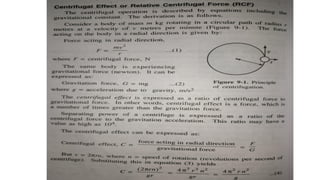
The speed of a centrifuge is commonly expressed in terms of the number of
revolutions per minute of the rotor.
4.
Applications
Production of bulkdrugs: Centrifugation technique is used to separate crystalline drugs
such as aspirin from the mother liquor. Free flowing product results due to the removal of
traces of mother liquor and avoidance of effervescence.
Production of biological products: Most of the proteinaceous drugs and macromolecules
are present as colloidal dispersion in water. By normal methods, it is difficult to produce
them in large scale. Centrifugal methods are used for the separation of these
constituents from water. Insulin can be obtained in pure form by selectively precipitating
other fractions of proteins and subsequently separating them by ultracentrifugation.
Centrifugation is employed for separating the blood cells from blood.
Biopharmaceutical analysis of drugs: Drugs present in the blood, tissue fluids and urine
are normally present in the form of colloidal dispersions. Centrifugation Centrifuge is
used for separating the drugs. This method is essential for the evaluation of
pharmacokinetic parameters and bioequivalence studies.
5.
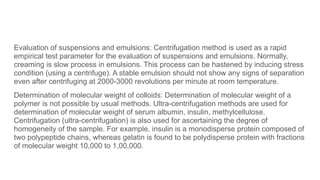
Evaluation of suspensionsand emulsions: Centrifugation method is used as a rapid
empirical test parameter for the evaluation of suspensions and emulsions. Normally,
creaming is slow process in emulsions. This process can be hastened by inducing stress
condition (using a centrifuge). A stable emulsion should not show any signs of separation
even after centrifuging at 2000-3000 revolutions per minute at room temperature.
Determination of molecular weight of colloids: Determination of molecular weight of a
polymer is not possible by usual methods. Ultra-centrifugation methods are used for
determination of molecular weight of serum albumin, insulin, methylcellulose.
Centrifugation (ultra-centrifugation) is also used for ascertaining the degree of
homogeneity of the sample. For example, insulin is a monodisperse protein composed of
two polypeptide chains, whereas gelatin is found to be polydisperse protein with fractions
of molecular weight 10,000 to 1,00,000.
6.
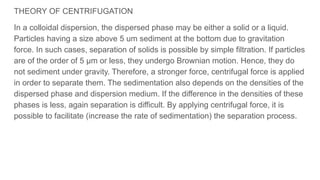
THEORY OF CENTRIFUGATION
Ina colloidal dispersion, the dispersed phase may be either a solid or a liquid.
Particles having a size above 5 um sediment at the bottom due to gravitation
force. In such cases, separation of solids is possible by simple filtration. If particles
are of the order of 5 µm or less, they undergo Brownian motion. Hence, they do
not sediment under gravity. Therefore, a stronger force, centrifugal force is applied
in order to separate them. The sedimentation also depends on the densities of the
dispersed phase and dispersion medium. If the difference in the densities of these
phases is less, again separation is difficult. By applying centrifugal force, it is
possible to facilitate (increase the rate of sedimentation) the separation process.
9.
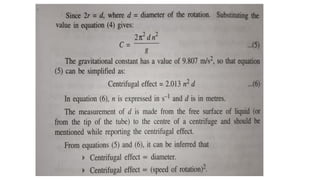
Equation (5) helpsin the selection of the type of centrifuge and other experimental
conditions.
▸ If it is required to increase the centrifugal effect, it is of greater advantage to use a
centrifuge of the same size at a higher speed rather than using a larger centrifuge at the
same speed of rotation.
▸ It is always better to use the smallest size of centrifuge that has the appropriate capacity,
since the centrifuge (equipment) is subjected to considerable stress in operation, largely due
to the pressure of the fluid on the walls. It can be shown that the pressure is directly
proportional to the square of the speed and the diameter. This principle is useful for the
separation of two liquids as in emulsions.
▸ The centrifuge is designed to suit the required purpose. If a large amount of material is to
be processed and a low centrifugal effect is sufficient to separate, then it is economical to
use a large centrifuge operating at a low speed.
▸ The centrifugal sedimentation of very small particles requires high centrifugal effect. For
this purpose, equipment of a small diameter is used, but operated at very high speed. For
example, tubular bowl centrifuge functions on this principle.
The centrifuge is comparable to a pressure vessel. Therefore, it must be handled with the
same care as that of a high-pressure autoclave.
10.
CLASSIFICATION OF CENTRIFUGES
Centrifugesare classified based on their mechanisms of separation.
Sedimentation Centrifuge
Sedimentation centrifuge is a centrifuge that produces sedimentation of solids based on the
difference in the densities of two or more phases of the mixture.
The efficiency depends on the velocity of rotation to which the mixture is subjected. Examples
are horizontal continuous centrifuge, super centrifuge and conical disc centrifuge.
Ultracentrifugation When extremely fine solid matter is to be separated from a liquid for example
in colloidal research, ultracentrifuge is used. In this instrument, a relatively small rotor is operated
at speeds exceeding 1,00,000 revolutions per minute and with forces up to one million times
gravity.
Centrifuges have replaced the gravity separators to a considerable extent in production
operations because of their effectiveness in separation.
11.
Uses:
(1) Suspensions containinglow concentration of solids can be separated quickly.
(2) Lanolin is recovered from the wool by scouring process.
(3) Olive and fish liver oils are purified by removing dirt and water.
(4) The liquid/liquid phases are separated in the extraction of drugs, for example,
manufacture of antibiotics.
(5) Bacterial enzymes are prepared by removing bacteria.
(6) Blood plasma is separated from whole blood.
(7) Starch is collected after washing and purification stages.
(8) In the manufacture of insulin, liquor is clarified so as to remove the precipitated
proteins.
12.
Advantages:
(1) Centrifuges arecompact and occupy a very small space.
(2) The separating efficiency is very high, so that the particles are deposited very rapidly. It is
suitable, if the sediment is a fluid deposit or sludge.
(3) Two immiscible liquids are easily separated on a continuous process.
(4) By controlling the speed of rotation and rate of flow, coarse particles are separated, while
finer particles remain in the suspension.
13.
Disadvantages:
(1) The constructionof sedimentation centrifuges is complicated.
(2) Its capacity is limited.
Filtration Centrifuge
Filtration centrifuge is a centrifuge in which solids pass are retained by porous
medium allowing liquid to rush out due to centrifugal effect. In this type the
container contains a porous wall through which the liquid phase may pass and on
which the solid phase is retained. Example are perforated basket centrifuge and
semi-continuous centrifuge. The solids that form a porous cake can be separated
in the filtration centrifuge. Normally perforated wall such as canvas or metal cloth
is covered with a filter medium.
14.
Advantages:
(1) It canhandle slurries with a high proportion of solids and even those having
paste like consistency.
(2) The final product has very low moisture content.
(3) In this method, the dissolved solids are separated from the cake.
Disadvantages:
(1) The entire cycle is complicated resulting in considerable labour costs.
(2) It is a batch process or semi-continuous type.
(3) The solids may form a hard cake, due to the centrifugal force, which is difficult
to remove.
15.
Classification Based onScale of Usage
Laboratory scale: Horizontal spinning arm type
Angle centrifuge (45 to 50 degree angle)
High speed centrifuge (10,000 revolutions per minute)
Ultracentrifuge (85,000 revolutions per minute)
Commercial scale
Batch type: Perforated basket centrifuge
Semi-continuous scale:Short-cycle batch centrifuge
Continuous centrifuge: Super Centrifuge
16.
LABORATORY CENTRIFUGES
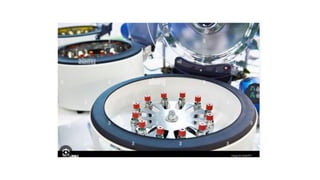
Centrifuges separatetwo substances of different densities by the application of centrifugal
forces which may be several times that of the gravity. Centrifuges used for the laboratory
work are described in the following sections.
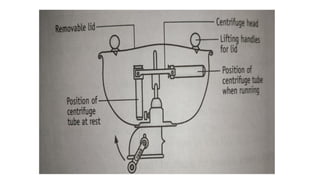
Horizontal Arm Type Centrifuge
The construction of a simple manually driven laboratory centrifuge is shown in Figure 9-2. It
consists of a rotating head carrying two or four freely swinging metal buckets. Glass
centrifuge tubes are filled with the material to be separated and placed into the metal
buckets. The head is driven manually using crank. When head starts rotating, the metal
buckets start swinging outwards and finally reach the horizontal position at maximum
working speed. During this process, the particles (which are normally denser than the
liquid) sediment along the side (length) of the tube and finally reaches the bottom of the
tube. The contents of centrifuge tubes (either suspension or emulsion) undergo separation
based on their densities. Once the crank is stopped, rotating head along with buckets
reach the resting position. Then, centrifuge tubes are removed and decanted to collect
supernatant liquid (low density phase). The sediment mass (high density phase) can then
be collected. This centrifuge is used for small volumes. This is also known as low speed
centrifuge. The RCF obtained in small centrifuges is at 2000 g at approximately 5000
revolutions per minute.
18.
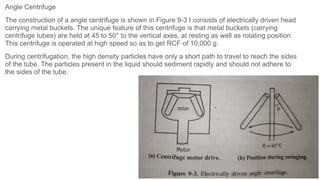
Angle Centrifuge
The constructionof a angle centrifuge is shown in Figure 9-3 t consists of electrically driven head
carrying metal buckets. The unique feature of this centrifuge is that metal buckets (carrying
centrifuge tubes) are held at 45 to 50° to the vertical axes, at resting as well as rotating position.
This centrifuge is operated at high speed so as to get RCF of 10,000 g.
During centrifugation, the high density particles have only a short path to travel to reach the sides
of the tube. The particles present in the liquid should sediment rapidly and should not adhere to
the sides of the tube.
22.
INDUSTRIAL EQUIPMENT
Centrifuges ofdifferent types are available to meet the specific requirements of the
slurry and the end product. In addition, experimental conditions are established by
considering the factors affecting the process. Some of them are:
▸ Nature of slurry
▸ Densities of the materials to be separated
▸Flow of feed or slurry
▸ Bottle (centrifuge) size
▸Centrifuge dimensions
▸ Centrifugation time
23.
Perforated Basket Centrifuge
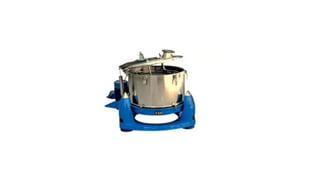
Inthis centrifuge, a basket is mounted above a driving shaft. Such an arrangement
is described as under-driven. Conversely, if the basket is suspended from a shaft,
it is described as over-driven. These are used for batch processes. An
under-driven bowl centrifuge is described below.
Principle: Perforated basket (bowl) centrifuge is a filtration centrifuge. The
separation is through a perforated wall based on the difference in the densities of
solid and liquid phases. The bowl contains a perforated side-wall. During
centrifugation, the liquid phase passes through the perforated wall, while solid
phase is retained in the bowl. The solid is removed after cutting the sediment by a
blade after stopping the centrifuge.
24.
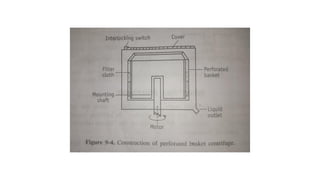
Construction: The constructionof a under-driven perforated basket centrifuge is
shown in Figure 9-4. It consists of a basket, made of steel (sometimes covered
with vulcanite or lead) or copper or monel or any other suitable metal. The basket
material of construction should be such that it offers the greatest resistance to
corrosion. The basket may have a diameter of 0.90 metres and a capacity of 0.085
metre cube. The diameter of the perforations should be selected based on the size
of crystals to be separated. In case, the size of perforations is bigger than that of
the particles, a filter cloth is employed. The basket is suspended on vertical shaft
and is driven by a motor using suitable power systems such as belt pulleys, water
turbines and electric motors. The basket may require about 5 kilowatt power for
starting and 2 kilowatt power for running. Sometimes, steel hoops are used
externally to strengthen the basket. Surrounding the basket, a casing (stationary)
is provided which collects the filtrate and discharges it at the outlet.
27.
Working: The material(feed) is kept in the basket when the basket is stationary.
The amount of material should be optimum, otherwise. during centrifugation it puts
a great strain on the basket. The loading of material must be done to give even
distribution. Power is applied to rotate the basket and maximum speed must be
attained quickly. The basket runs at 1000 revolutions per minute. The power
required for running is small compared to the power required for starting and
bringing it to the full speed.
During centrifugation, the liquid passes through the perforated wall, while the solid
phase retains in the basket. The liquid leaves the basket and is collected at the
outlet. The cake is then spun to dry as much as possible. Sometimes higher
speeds are used so that the cake will be completely dried. After a definite period of
time, the power is turned off. By applying a brake the centrifuge is stopped. The
basket is brought to rest. The solid cake is cut using a blade and then unloaded
manually
28.
Uses:
(1) Perforated basketcentrifuge is extensively used for separating crystalline drugs (such
as aspirin) from the mother liquor. Free lowing product can be obtained because mother
liquor is removed completely.
(2) It is also used for removing unwanted solids from a liquid. For example, precipitated
proteins are removed from insulin.
(3) Sugar crystals are separated using perforated basket centrifuge.
Advantages:
(1) The centrifuge is very compact and it occupies very little floor space
(2) It can handle slurries with a high proportion of solids and even those having paste like
consistency.
(3)The final product has very low moisture content.
(4) in this method, the dissolved solids are separated from the cake.
(5) The process is rapid.
29.
Disadvantages:
(1) The entirecycle is complicated resulting in considerable labour
(2) It is a batch process
(3) If the machine is adapted for prolonged operation, there is considerable wear
and tear of the equipment. On prolonged operation, the solids may form hard
cake, due to the centrifugal force, which is difficult to remove simultaneously.
Variants: For the separation of fine crystals, the perforations of 3 mm diameter are
sufficient. But for finely ground materials, the basket is lined with fine meshed
gauze or with a cloth supported on coarser gauge.
30.
Non-perforated Basket Centrifuge
Principle:This is a sedimentation centrifuge. The separation is based on the difference in
the densities of solid and liquid phases without a porous barrier. The bowl contains a
non-perforated side-wall During centrifugation, solid phase is retained on the sides of the
basket, while the liquid remains at the top, which is removed by a skimming tube.
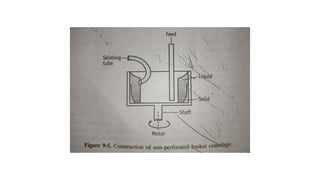
Construction: The construction of a under-driven non-perforated basket centrifuge is
shown in Figure 9-5. It consists of a basket, which may be made of steel or any other
suitable metal. The basket is suspended on vertical shaft and is driven by a motor using
a suitable power system.
32.
Working: The suspensionis fed continuously into the basket During centrifugation,
solid phase is retained on the sides of the basket, while liquid remains on the top.
The liquid is removed over a weir or through a skimming tube (Figure 9-5). When
a suitable depth of solids has been deposited on the walls of the basket, the
operation is stopped. The solids are then scraped off by hand or using a scraper
blade.
Uses: Non-perforated basket centrifuge is useful when the deposited solids offer
high resistance to the flow of liquid,
Variants: When a mixture of liquids is to be separated, the deser liquid is collected
near the walls and the lighter liquid forms an inter layer, Overflow weirs are
arranged so that the two constituents are continuously removed.
33.
Semi-continuous Centrifuge orShort Cycle Automatic Batch Centrifuge
Principle: Semi-continuous centrifuge is a filtration centrifuge. The separation is through a
perforated wall based on the difference in the densities of solid and liquid phases. The
bowl contains a perforated side-wall. During centrifugation, the liquid phase passes
through the perforated wall, while solid phase retains in the bowl. The solid is washed
and removed by cutting the sediment using a blade. It is a short cycle automatic batch
centrifuge.
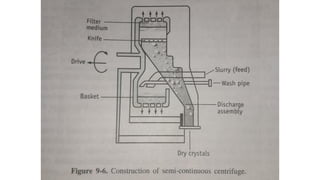
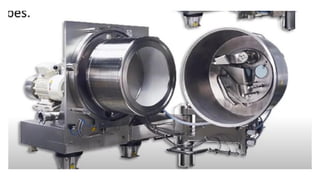
Construction: The construction of a semi-continuous centrifuge is
shown in Figure 9-6. It consists of a vertical perforated basket, which is supported from a
horizontal shaft driven by a motor. From the open side of the basket, provisions are made
at the centre to introduce feed and wash pipe through horizontal tubes. A feeler (not
shown) rides over the feed, which is connected to diaphragm valve through air supply.
The feeler controls the thickness of the feed. Hydraulic cylinder attachment is made in
such a manner that the discharge chute enters from the sides of basket, when discharge
of crystals is desirable.
36.
Working: The perforatedbasket is allowed to rotate and slurry is introduced from the side pipe.
During centrifugation, the slurry passes through the perforated wall. The solids are retained in the
basket, while Filtrate leaves the basket, which is collected at outlet. Further, the cake is washed
with water. The wash escapes from the basket through the filtrate outlet. After achieving the
desired thickness (50 to 70 millimetres), the feeler cuts off the air supply to a diaphragm valve
that automatically shuts off the entry of slurry. The hydraulic cylinder is actuated, which lifts the
knife along with the discharge chute. The knife does not cut the cake completely down to the
screen, but leaves a layer of crystals that acts as a filter medium for further separation in the next
cycle. The residual crystals may be given a brief wash before starting the next cycle.
Through a timer and air supply mechanisms, diaphragm valve controls all steps. Therefore, the
entire cycle is semi automatic. The discharged crystals may contain 2 to 4% of moisture.
Advantages: Short-cycle automatic batch centrifuge is used when solids can be drained fast from
the bowl.
Disadvantage: During discharge, considerable breakage of crystals is possible. Many moving
parts are involved making the construction and functioning more complicated.
37.
Super Centrifuge
Sharples supercentrifuge is a continuous centrifuge used for separating two
immiscible liquid phases.
Principle: Super Centrifuge is a sedimentation centrifuge. The separation is based
on the difference in the densities between two immiscible liquids. Centrifugation is
done in the bowl of small centrifuge. During centrifugation, the heavier liquid is
thrown against the wall, while the lighter liquid remains as an inner layer. The two
layers are simultaneously separated using modified weirs.
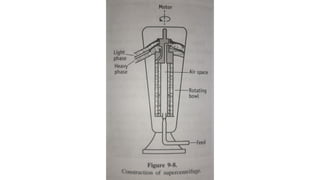
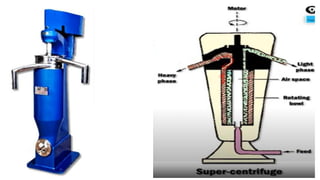
Construction: The construction of a super centrifuge is shown in Figure 9-8. It
consists of a long hollow cylindrical bowl of small diameter. It is suspended from a
flexible spindle at the top and guided at the bottom by loose-fit bushing. It can be
rotated on its longitudinal atis. Provision is made at the bottom for the feed inlet
using pressure system. Two liquid outlets are provided at different heights at the
top of the bowl, and modified weirs, are attached.
40.
Working: The centrifugeis allowed to rotate on its longitudinal axis at a high
speed, usually about 2000 revolutions per minute with the help of drive-assembly.
The feed is introduced from the bottom of the centrifuge using a pressure system.
During centrifugation, two liquid phases separate based on the difference in their
densities. The heavier liquid is thrown against the wall, while the lighter liquid
forms an inner layer. Both liquids rise to the top of the vertical bowl.
The liquid-liquid interface (the so-called neutral zone) is maintained by an
hydraulic balance. These two layers are simultaneously removed as two liquids
separately from different heights through modified weirs (as shown in Figure 9-8).
Thus the super centrifuge can work for continuous separation of immiscible liquid
phases.
Use: Super Centrifuge is used for separating liquid phases of emulsions in foods
and pharmaceuticals.