Measuring
Employee
PRODUCTIVITY
www.humanikaconsulting.com
Background
• If you haven’t checked your employees’ productivity yet, you could be
seriously damaging your business.
• Ensuring productivity in the workplace can be challenging. A 2013
Gallup survey revealed that 70 percent of U.S. workers are disengaged
from their workday. Distracted by smartphones, social media, personal
emails and the demands of their personal lives, most employees find it
hard to focus consistently and produce the best work they can.
• Measuring employee productivity is just as important as measuring your
finances. If you fail to keep track of your employees’ ability to meet
goals and tasks, there’s a good chance your business can go downhill
fast.
• Admit it. It’s the one thing you seriously dread.
• So, to make sure that doesn’t happen!
Creating High Expectations
• Taking accurate productivity measurements can mean more
than simply counting the number of products made or sold,
or services performed.
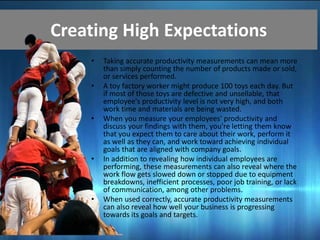
• A toy factory worker might produce 100 toys each day. But
if most of those toys are defective and unsellable, that
employee's productivity level is not very high, and both
work time and materials are being wasted.
• When you measure your employees' productivity and
discuss your findings with them, you're letting them know
that you expect them to care about their work, perform it
as well as they can, and work toward achieving individual
goals that are aligned with company goals.
• In addition to revealing how individual employees are
performing, these measurements can also reveal where the
work flow gets slowed down or stopped due to equipment
breakdowns, inefficient processes, poor job training, or lack
of communication, among other problems.
• When used correctly, accurate productivity measurements
can also reveal how well your business is progressing
towards its goals and targets.
What are Your Business Goals?
• What are your company's short- and long-term goals? Are you
looking to increase profits, innovation or efficiency? Tap into new
markets and find new customers? Increase customer retention
levels?
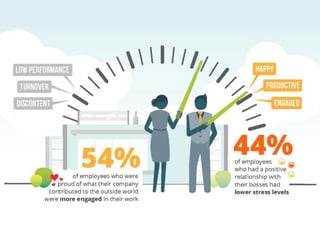
• Studies have shown that employees who are able to see a direct
connection between their productivity and company goals are far
happier-and therefore more productive-than those who don't see
how their work affects company goals.
• Yet 2014 statistics show that only 40 percent of workers know what
their employer's goals and strategies are.
• Whatever your business goals, it's important to make them clear to
employees. It's also important to find the methods of measurement
that reveal how well employee output is bringing you closer to your
business goals.
What Drives Your
Business?
• Before you can choose the most accurate productivity
methods for your business, identify your key
performance indicators (KPIs). These are your drivers-
the profit-making, reputation-making parts of your
organization.
• Your KPIs must spring directly from your business's
biggest goals, and must relate only to those aspects of
your business that you have some control over.
• If your store sells umbrellas in a very dry part of the
country, the weather is not a KPI for you, because you
have no control over it. Because you do have control
over your inventory, sales for items such as sunglasses
can be considered a KPI.
Choosing the Right Methods
• Most employees perform several tasks,
some of which will be easier to measure
than others. When determining how
profitable an employee's actions are,
include factors that affect those profits,
such as the cost of overtime, annual
turnover rates, and overall job
satisfaction.
• Be open to different approaches, and
be willing to try different methods at
different times, to see which reveal the
most accurate data, and reveal what's
most important in terms of your
business goals.
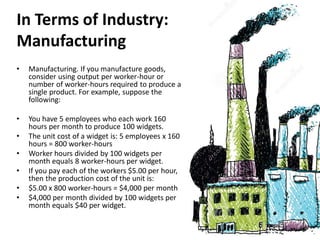
In Terms of Industry:
Manufacturing
• Manufacturing. If you manufacture goods,
consider using output per worker-hour or
number of worker-hours required to produce a
single product. For example, suppose the
following:
• You have 5 employees who each work 160
hours per month to produce 100 widgets.
• The unit cost of a widget is: 5 employees x 160
hours = 800 worker-hours
• Worker hours divided by 100 widgets per
month equals 8 worker-hours per widget.
• If you pay each of the workers $5.00 per hour,
then the production cost of the unit is:
• $5.00 x 800 worker-hours = $4,000 per month
• $4,000 per month divided by 100 widgets per
month equals $40 per widget.
In Terms of Industry : Services
• It can be a bit harder to measure productivity in
a service industry due to the somewhat
intangible nature of the product involved.
Service industries can measure productivity by
considering the number of tasks performed or
the number of customers served in a given time
period. Other measures might be whether the
service delivered measured up to company or
customer standards and whether performance
deadlines were met.
• Professional employees can keep personal time
sheets to indicate the number of hours spent on
a given task. Quantity of work is a possible
measure, such as number of service calls made
per day or number of contracts written. Clerical
workers can be given specific amounts of work
to determine the relative time it takes to
complete a given task.
Methods to Measure
Employee Productivity
Quantitative
• The quantitative method measures productivity by the
number of parts or products an employed produces in a
particular period of time, such as per hour, day or month.
• This method works very well for small businesses, but even
if you're managing large groups, this kind of performance
measurement is simple and time-saving.
• Productivity can be quickly calculated with productivity
software or on a spreadsheet, revealing the number of
products an employee produces or contributes to in a
given time period. Those numbers are then averaged out
to reveal productivity gains or losses over time.
• Output can be measured either by the volume or quantity
of products created, or by the financial value of the
product or service.
• First, create your baseline-the average number of
individual worker hours, days or weeks needed to create
that part or product under usual working conditions, when
the employee is working at optimal levels. Each employee
in the production line is then measured against that ideal
(but realistic) level of productivity.
• This type of measurement must also factor in the amount
of time that employees spend on activities such as job
training, time spent waiting for materials to arrive or
broken equipment to be fixed, and other factors not under
their control.
[http://smallbusiness.chron.com/measurements-
employee-productivity-1227.html]
Objectives
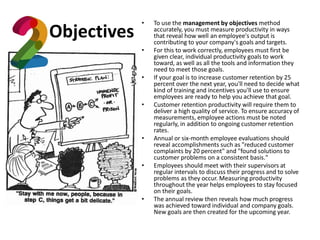
• To use the management by objectives method
accurately, you must measure productivity in ways
that reveal how well an employee's output is
contributing to your company's goals and targets.
• For this to work correctly, employees must first be
given clear, individual productivity goals to work
toward, as well as all the tools and information they
need to meet those goals.
• If your goal is to increase customer retention by 25
percent over the next year, you'll need to decide what
kind of training and incentives you'll use to ensure
employees are ready to help you achieve that goal.
• Customer retention productivity will require them to
deliver a high quality of service. To ensure accuracy of
measurements, employee actions must be noted
regularly, in addition to ongoing customer retention
rates.
• Annual or six-month employee evaluations should
reveal accomplishments such as "reduced customer
complaints by 20 percent" and "found solutions to
customer problems on a consistent basis."
• Employees should meet with their supervisors at
regular intervals to discuss their progress and to solve
problems as they occur. Measuring productivity
throughout the year helps employees to stay focused
on their goals.
• The annual review then reveals how much progress
was achieved toward individual and company goals.
New goals are then created for the upcoming year.
Time Management
• The time management method determines employee
productivity by recording how they use their work time.
Accurate measurement will reveal how much time is
spent on accomplishing work duties in a timely way, as
well as how much time is lost to illness or excessive time
off, non-work-related conversations, and distractions such
as texting and social media.
• Though this method can help employees and managers
set goals for reducing time losses, the bigger your
business gets, the harder it can be to accurately measure
the time management of individual employees.
[http://www.hrworld.com/features/16-ways-measure-
performance-021908/]
• There are helpful software programs that accurately
measure how much time employees actually spend (or
don't spend) being productive. Some programs require
daily updates from employees, which reveals their
progress on a particular task or project. This keeps
employees from procrastinating, and creates a record of
how long it took them to accomplish certain tasks and
projects.
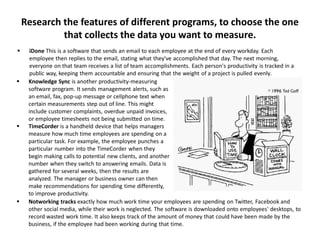
Research the features of different programs, to choose the one
that collects the data you want to measure.
 iDone This is a software that sends an email to each employee at the end of every workday. Each
employee then replies to the email, stating what they've accomplished that day. The next morning,
everyone on that team receives a list of team accomplishments. Each person's productivity is tracked in a
public way, keeping them accountable and ensuring that the weight of a project is pulled evenly.
 Knowledge Sync is another productivity-measuring
software program. It sends management alerts, such as
an email, fax, pop-up message or cellphone text when
certain measurements step out of line. This might
include customer complaints, overdue unpaid invoices,
or employee timesheets not being submitted on time.
 TimeCorder is a handheld device that helps managers
measure how much time employees are spending on a
particular task. For example, the employee punches a
particular number into the TimeCorder when they
begin making calls to potential new clients, and another
number when they switch to answering emails. Data is
gathered for several weeks, then the results are
analyzed. The manager or business owner can then
make recommendations for spending time differently,
to improve productivity.
 Notworking tracks exactly how much work time your employees are spending on Twitter, Facebook and
other social media, while their work is neglected. The software is downloaded onto employees' desktops, to
record wasted work time. It also keeps track of the amount of money that could have been made by the
business, if the employee had been working during that time.
Service Productivity
• Customer service productivity can be measured in many ways, including:
 How long it takes for a customer to be served (such as call waiting times or in-person waiting
times)
 How long it takes for a customer's order to be completed
 Customer retention rates-the percentage of customers who return at least once
 How long those customers are retained
 How often products are returned
 How many customer complaints are received in a given time period
• Whatever set of criteria you choose, first create your baseline-your business's best service level
under current conditions-and measure employee productivity against that.
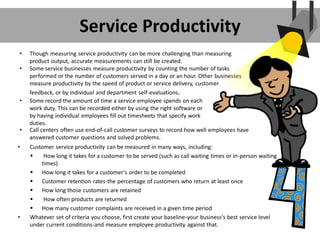
• Though measuring service productivity can be more challenging than measuring
product output, accurate measurements can still be created.
• Some service businesses measure productivity by counting the number of tasks
performed or the number of customers served in a day or an hour. Other businesses
measure productivity by the speed of product or service delivery, customer
feedback, or by individual and department self-evaluations.
• Some record the amount of time a service employee spends on each
work duty. This can be recorded either by using the right software or
by having individual employees fill out timesheets that specify work
duties.
• Call centers often use end-of-call customer surveys to record how well employees have
answered customer questions and solved problems.
Service Productivity (Cont’d)
• Factor in the problems that keep your
employees from delivering optimal service, and
keep in mind that some aspects of service are
performed more quickly than others. Decide
what factors of optimal service apply to your
business, such as quality, speed, politeness,
cost-effectiveness, or a combination of those.
• Note the situations under your control that can
slow service productivity, such as staff shortages
and equipment breakdowns. Your employees
may be also slowed down by having to fill out
orders by hand, if they don't have a touch
screen cash register to work with.
• Every six to 12 months, create a new baseline
that accurately takes into account your current
market and operating conditions, and re-
evaluate employees based on those new
standards.
[http://www.infoentrepreneurs.org/en/guides/
measure-performance-and-set-targets/]
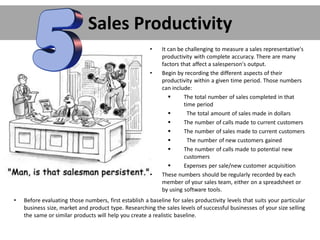
Sales Productivity
• It can be challenging to measure a sales representative's
productivity with complete accuracy. There are many
factors that affect a salesperson's output.
• Begin by recording the different aspects of their
productivity within a given time period. Those numbers
can include:
 The total number of sales completed in that
time period
 The total amount of sales made in dollars
 The number of calls made to current customers
 The number of sales made to current customers
 The number of new customers gained
 The number of calls made to potential new
customers
 Expenses per sale/new customer acquisition
• These numbers should be regularly recorded by each
member of your sales team, either on a spreadsheet or
by using software tools.
• Before evaluating those numbers, first establish a baseline for sales productivity levels that suits your particular
business size, market and product type. Researching the sales levels of successful businesses of your size selling
the same or similar products will help you create a realistic baseline.
Sales Productivity (Cont’d)
• Keep in mind that many factors will come into
play. If a sales rep's expenses per sale amount
to $3,000 when each sale only brings in
$5,000, their work is not providing a good
return on investment.
• Also factor in important elements such as
current growth trends and shifts in your
market. Note how much time your sales team
is spending in non-sales activities, such as
travel and internal meetings. They might also
be busy re-negotiating terms with existing
customers some weeks, leaving less time for
acquiring new customers.
• Take these and any other important factors into account, to ensure that salesperson
productivity levels are measured as accurately as possible.
[http://www.bizfilings.com/toolkit/news/office-hr/measuring-employee-
productivity.aspx and http://salesvue.com/how-do-you-measure-sales-productivity/]
Profit
• Profit can be used as an effective tool for measuring
team productivity. In fact, measuring productivity
purely in terms of profit gained is becoming the
preferred type of measurement for many small to
mid-size businesses.
• Rather than getting involved with data that tracks
individual employee movements, measuring by
profits involves watching only the bottom line. Only
higher level functions are closely watched.
• This method ensures that productivity
measurements don't keep employees from working
creatively or take a great deal of management's time.
As business consultant Roger Bryan of RCBryan &
Associates says, "Watch the money and everything
will fall in line."
• W. Michael Hsu, founder of DeepSky accounting firm,
agrees. "Results and value-add trump hours of work
any day of the week," he believes.
• "To measure results, one of the vital factors we rely
on is the team effectiveness ratio. It measures how
much gross profit the company gets for every dollar
spent on salary. It's better than measuring profit
against time [full-time equivalents], because we
want the team to work smarter, not longer."
[http://www.allbusiness.com/16-ways-to-measure-
employee-productivity/16799830-18.html]
Quality of Work
• Entrepreneur Doreen Bloch of Poshly Inc. prefers to measure productivity
only by whether the work assigned actually gets done.
• She believes that because personal and professional lives are increasingly
blending and overlapping, it's most accurate to base productivity
measurements on completion of tasks, "not minutes spent at the office."
• Bloch tracks productivity by breaking down projects down into individual
tasks. These are then assigned to employees best able to handle them.
This continues until the projects are complete.
• Megan Berry, founder of social media startup LiftFive, agrees that the
best productivity measurements are about "keeping an eye on outcomes"
and employee progress, instead of on-the-job habits and behavior.
• There are a number of productivity software tools, such
as Producteev and Atlassian , that aid managers in tracking projects and
task completion.
• Other project management software includes Asana and Basecamp .
These map out project goals, then delineate individual and group tasks.
They then track employee productivity on each project, noting time spent
on different tasks, and when each task is completed.
• Beyond reviewing an employee's job performance, productivity
measurements can be an important part of helping employees
understand how much they've done to help their company achieve its
goals.
• Accurate productivity measurements can be one more step to ensuring
not only greater profits, but increased employee motivation as well as job
satisfaction and recognition of team and individual accomplishments.
Customer Feedback
• In B2B business, reviewing customer feedback is one of the best ways to
measure employee productivity. Since there are no products or tangible
outputs you can use to assess, you can consider what your clients are
saying about your business to determine how well your employees are
doing their job.
• The same set of customer feedback you use to assess your employees can
also provide you insights on how to improve your business, products and
customer experience in general. This can help you boost customer
retention which translates to more profits for your business.
• The 360-degree feedback method uses the feedback and comments of co-
workers to measure productivity. This method can only be used if the
employees in your organization interact with one another a great deal.
• This measurement requires that the employee's productivity be evaluated
by everyone they work or interact with daily, including those on, above
and below their job level. All evaluators must know and understand their
co-worker's overall role and function, daily work duties, professional
credentials and communication skills.
• This method works best in smaller departments or organizations where
everyone knows and interacts with everyone else.
Customer Feedback (Cont’d)
• Everyone from managers to IT workers to receptionists give
feedback on an employee's levels of productivity in terms of how
well they have fulfilled their duties and contributed to overall
company productivity. In a team appraisal, only members of that
employee's team evaluate them, in terms of their contributions to
team productivity.
• To achieve best possible accuracy, employees must first receive
training on how to offer input that is well-balanced and impartial.
They must be trained to offer feedback that is based purely on their
co-worker's professional abilities, not on their personal feelings or
beliefs about that employee.
• The accuracy of this method is based on the fact that it involves a
good number of people, all of them trained in objective feedback,
and all weighing in on how well the employee's productivity meets
their team and company goals.
[http://smallbusiness.chron.com/examples-employee-performance-
measurement-10776.html]
Improving productivity
• Once you've figured out how to measure
your business's productivity, you need to
determine whether your productivity is
where it should be. This task can be tricky,
especially if you're getting this information
for the first time. Factors to take into
consideration are:
 the cost per unit compared with price
 your competitors' productivity levels,
cost per unit, and price.
• Some of this information may be available
from your trade or industry association, or
through networking with contacts in
similar businesses. Once you've
established a baseline measure, you can
assess your productivity periodically and
be able to spot trends and track your
progress over time.
How to improve
productivity?
Identify potential problem areas. The
quality of leadership in the business can
have an effect on productivity, so make
sure that you, as a leader, ensure that
your business isn't suffering from:
 poor planning or scheduling of
work
 unclear or untimely instructions to
employees
 an inability to adjust staff size and
duties during light or heavy work
load periods
 poor coordination of material flow
 the unavailability of needed tools
 excess travel time.
Conclusion
Ultimately, the key to improving productivity lies with the
employees themselves and the way that you work with
those employees. Studies have shown that most workers
think it's important to do their best at their jobs. Chances
are that most of your employees feel that way. People
want to do a good job, and you should provide them with
every opportunity to do so. It becomes your challenge to
tap into that desire to perform and make it work for your
business.
References
• 10 Shocking Statistics About Employee Engagement [infographic] - http://dailyinfographic.com/10-
shocking-statistics-about-employee-engagement-infographic
• Mood Tracker™ Fall 2012 - Revealing Key Practices for Effective Recognition -
• http://www.globoforce.com/resources/research-reports/mood-tracker-fall-2012-revealing-key-
practices-for-effective-recognition/
• Measure Performance and Set Targets - http://www.infoentrepreneurs.org/en/guides/measure-
performance-and-set-targets/
• Measurements of Employee Productivity - http://smallbusiness.chron.com/measurements-
employee-productivity-1227.html
• Examples of Employee Performance Measurement - http://smallbusiness.chron.com/examples-
employee-performance-measurement-10776.html
• How Do You Measure Sales Productivity - http://salesvue.com/how-do-you-measure-sales-
productivity/
• 16 Ways to Measure Employee Performance - http://www.hrworld.com/features/16-ways-
measure-performance-021908/
• Top Productivity-Enhancing Tools - http://www.forbes.com/2008/11/05/small-business-
productivity-ent-manage-cx_ml_1105productivitytools.html
• Measuring Employee Productivity - http://www.bizfilings.com/toolkit/news/office-hr/measuring-
employee-productivity.aspx
• 16 Simple Ways to Track and Measure Employee Productivity - http://www.allbusiness.com/16-
ways-to-measure-employee-productivity/16799830-18.html
Learning and Giving for …
Better Indonesia

Measuring Employee Productivity

  • 1.
  • 3.
    Background • If youhaven’t checked your employees’ productivity yet, you could be seriously damaging your business. • Ensuring productivity in the workplace can be challenging. A 2013 Gallup survey revealed that 70 percent of U.S. workers are disengaged from their workday. Distracted by smartphones, social media, personal emails and the demands of their personal lives, most employees find it hard to focus consistently and produce the best work they can. • Measuring employee productivity is just as important as measuring your finances. If you fail to keep track of your employees’ ability to meet goals and tasks, there’s a good chance your business can go downhill fast. • Admit it. It’s the one thing you seriously dread. • So, to make sure that doesn’t happen!
  • 4.
    Creating High Expectations •Taking accurate productivity measurements can mean more than simply counting the number of products made or sold, or services performed. • A toy factory worker might produce 100 toys each day. But if most of those toys are defective and unsellable, that employee's productivity level is not very high, and both work time and materials are being wasted. • When you measure your employees' productivity and discuss your findings with them, you're letting them know that you expect them to care about their work, perform it as well as they can, and work toward achieving individual goals that are aligned with company goals. • In addition to revealing how individual employees are performing, these measurements can also reveal where the work flow gets slowed down or stopped due to equipment breakdowns, inefficient processes, poor job training, or lack of communication, among other problems. • When used correctly, accurate productivity measurements can also reveal how well your business is progressing towards its goals and targets.
  • 5.
    What are YourBusiness Goals? • What are your company's short- and long-term goals? Are you looking to increase profits, innovation or efficiency? Tap into new markets and find new customers? Increase customer retention levels? • Studies have shown that employees who are able to see a direct connection between their productivity and company goals are far happier-and therefore more productive-than those who don't see how their work affects company goals. • Yet 2014 statistics show that only 40 percent of workers know what their employer's goals and strategies are. • Whatever your business goals, it's important to make them clear to employees. It's also important to find the methods of measurement that reveal how well employee output is bringing you closer to your business goals.
  • 6.
    What Drives Your Business? •Before you can choose the most accurate productivity methods for your business, identify your key performance indicators (KPIs). These are your drivers- the profit-making, reputation-making parts of your organization. • Your KPIs must spring directly from your business's biggest goals, and must relate only to those aspects of your business that you have some control over. • If your store sells umbrellas in a very dry part of the country, the weather is not a KPI for you, because you have no control over it. Because you do have control over your inventory, sales for items such as sunglasses can be considered a KPI.
  • 8.
    Choosing the RightMethods • Most employees perform several tasks, some of which will be easier to measure than others. When determining how profitable an employee's actions are, include factors that affect those profits, such as the cost of overtime, annual turnover rates, and overall job satisfaction. • Be open to different approaches, and be willing to try different methods at different times, to see which reveal the most accurate data, and reveal what's most important in terms of your business goals.
  • 9.
    In Terms ofIndustry: Manufacturing • Manufacturing. If you manufacture goods, consider using output per worker-hour or number of worker-hours required to produce a single product. For example, suppose the following: • You have 5 employees who each work 160 hours per month to produce 100 widgets. • The unit cost of a widget is: 5 employees x 160 hours = 800 worker-hours • Worker hours divided by 100 widgets per month equals 8 worker-hours per widget. • If you pay each of the workers $5.00 per hour, then the production cost of the unit is: • $5.00 x 800 worker-hours = $4,000 per month • $4,000 per month divided by 100 widgets per month equals $40 per widget.
  • 10.
    In Terms ofIndustry : Services • It can be a bit harder to measure productivity in a service industry due to the somewhat intangible nature of the product involved. Service industries can measure productivity by considering the number of tasks performed or the number of customers served in a given time period. Other measures might be whether the service delivered measured up to company or customer standards and whether performance deadlines were met. • Professional employees can keep personal time sheets to indicate the number of hours spent on a given task. Quantity of work is a possible measure, such as number of service calls made per day or number of contracts written. Clerical workers can be given specific amounts of work to determine the relative time it takes to complete a given task.
  • 11.
  • 12.
    Quantitative • The quantitativemethod measures productivity by the number of parts or products an employed produces in a particular period of time, such as per hour, day or month. • This method works very well for small businesses, but even if you're managing large groups, this kind of performance measurement is simple and time-saving. • Productivity can be quickly calculated with productivity software or on a spreadsheet, revealing the number of products an employee produces or contributes to in a given time period. Those numbers are then averaged out to reveal productivity gains or losses over time. • Output can be measured either by the volume or quantity of products created, or by the financial value of the product or service. • First, create your baseline-the average number of individual worker hours, days or weeks needed to create that part or product under usual working conditions, when the employee is working at optimal levels. Each employee in the production line is then measured against that ideal (but realistic) level of productivity. • This type of measurement must also factor in the amount of time that employees spend on activities such as job training, time spent waiting for materials to arrive or broken equipment to be fixed, and other factors not under their control. [http://smallbusiness.chron.com/measurements- employee-productivity-1227.html]
  • 13.
    Objectives • To usethe management by objectives method accurately, you must measure productivity in ways that reveal how well an employee's output is contributing to your company's goals and targets. • For this to work correctly, employees must first be given clear, individual productivity goals to work toward, as well as all the tools and information they need to meet those goals. • If your goal is to increase customer retention by 25 percent over the next year, you'll need to decide what kind of training and incentives you'll use to ensure employees are ready to help you achieve that goal. • Customer retention productivity will require them to deliver a high quality of service. To ensure accuracy of measurements, employee actions must be noted regularly, in addition to ongoing customer retention rates. • Annual or six-month employee evaluations should reveal accomplishments such as "reduced customer complaints by 20 percent" and "found solutions to customer problems on a consistent basis." • Employees should meet with their supervisors at regular intervals to discuss their progress and to solve problems as they occur. Measuring productivity throughout the year helps employees to stay focused on their goals. • The annual review then reveals how much progress was achieved toward individual and company goals. New goals are then created for the upcoming year.
  • 14.
    Time Management • Thetime management method determines employee productivity by recording how they use their work time. Accurate measurement will reveal how much time is spent on accomplishing work duties in a timely way, as well as how much time is lost to illness or excessive time off, non-work-related conversations, and distractions such as texting and social media. • Though this method can help employees and managers set goals for reducing time losses, the bigger your business gets, the harder it can be to accurately measure the time management of individual employees. [http://www.hrworld.com/features/16-ways-measure- performance-021908/] • There are helpful software programs that accurately measure how much time employees actually spend (or don't spend) being productive. Some programs require daily updates from employees, which reveals their progress on a particular task or project. This keeps employees from procrastinating, and creates a record of how long it took them to accomplish certain tasks and projects.
  • 15.
    Research the featuresof different programs, to choose the one that collects the data you want to measure.  iDone This is a software that sends an email to each employee at the end of every workday. Each employee then replies to the email, stating what they've accomplished that day. The next morning, everyone on that team receives a list of team accomplishments. Each person's productivity is tracked in a public way, keeping them accountable and ensuring that the weight of a project is pulled evenly.  Knowledge Sync is another productivity-measuring software program. It sends management alerts, such as an email, fax, pop-up message or cellphone text when certain measurements step out of line. This might include customer complaints, overdue unpaid invoices, or employee timesheets not being submitted on time.  TimeCorder is a handheld device that helps managers measure how much time employees are spending on a particular task. For example, the employee punches a particular number into the TimeCorder when they begin making calls to potential new clients, and another number when they switch to answering emails. Data is gathered for several weeks, then the results are analyzed. The manager or business owner can then make recommendations for spending time differently, to improve productivity.  Notworking tracks exactly how much work time your employees are spending on Twitter, Facebook and other social media, while their work is neglected. The software is downloaded onto employees' desktops, to record wasted work time. It also keeps track of the amount of money that could have been made by the business, if the employee had been working during that time.
  • 17.
    Service Productivity • Customerservice productivity can be measured in many ways, including:  How long it takes for a customer to be served (such as call waiting times or in-person waiting times)  How long it takes for a customer's order to be completed  Customer retention rates-the percentage of customers who return at least once  How long those customers are retained  How often products are returned  How many customer complaints are received in a given time period • Whatever set of criteria you choose, first create your baseline-your business's best service level under current conditions-and measure employee productivity against that. • Though measuring service productivity can be more challenging than measuring product output, accurate measurements can still be created. • Some service businesses measure productivity by counting the number of tasks performed or the number of customers served in a day or an hour. Other businesses measure productivity by the speed of product or service delivery, customer feedback, or by individual and department self-evaluations. • Some record the amount of time a service employee spends on each work duty. This can be recorded either by using the right software or by having individual employees fill out timesheets that specify work duties. • Call centers often use end-of-call customer surveys to record how well employees have answered customer questions and solved problems.
  • 18.
    Service Productivity (Cont’d) •Factor in the problems that keep your employees from delivering optimal service, and keep in mind that some aspects of service are performed more quickly than others. Decide what factors of optimal service apply to your business, such as quality, speed, politeness, cost-effectiveness, or a combination of those. • Note the situations under your control that can slow service productivity, such as staff shortages and equipment breakdowns. Your employees may be also slowed down by having to fill out orders by hand, if they don't have a touch screen cash register to work with. • Every six to 12 months, create a new baseline that accurately takes into account your current market and operating conditions, and re- evaluate employees based on those new standards. [http://www.infoentrepreneurs.org/en/guides/ measure-performance-and-set-targets/]
  • 20.
    Sales Productivity • Itcan be challenging to measure a sales representative's productivity with complete accuracy. There are many factors that affect a salesperson's output. • Begin by recording the different aspects of their productivity within a given time period. Those numbers can include:  The total number of sales completed in that time period  The total amount of sales made in dollars  The number of calls made to current customers  The number of sales made to current customers  The number of new customers gained  The number of calls made to potential new customers  Expenses per sale/new customer acquisition • These numbers should be regularly recorded by each member of your sales team, either on a spreadsheet or by using software tools. • Before evaluating those numbers, first establish a baseline for sales productivity levels that suits your particular business size, market and product type. Researching the sales levels of successful businesses of your size selling the same or similar products will help you create a realistic baseline.
  • 21.
    Sales Productivity (Cont’d) •Keep in mind that many factors will come into play. If a sales rep's expenses per sale amount to $3,000 when each sale only brings in $5,000, their work is not providing a good return on investment. • Also factor in important elements such as current growth trends and shifts in your market. Note how much time your sales team is spending in non-sales activities, such as travel and internal meetings. They might also be busy re-negotiating terms with existing customers some weeks, leaving less time for acquiring new customers. • Take these and any other important factors into account, to ensure that salesperson productivity levels are measured as accurately as possible. [http://www.bizfilings.com/toolkit/news/office-hr/measuring-employee- productivity.aspx and http://salesvue.com/how-do-you-measure-sales-productivity/]
  • 23.
    Profit • Profit canbe used as an effective tool for measuring team productivity. In fact, measuring productivity purely in terms of profit gained is becoming the preferred type of measurement for many small to mid-size businesses. • Rather than getting involved with data that tracks individual employee movements, measuring by profits involves watching only the bottom line. Only higher level functions are closely watched. • This method ensures that productivity measurements don't keep employees from working creatively or take a great deal of management's time. As business consultant Roger Bryan of RCBryan & Associates says, "Watch the money and everything will fall in line." • W. Michael Hsu, founder of DeepSky accounting firm, agrees. "Results and value-add trump hours of work any day of the week," he believes. • "To measure results, one of the vital factors we rely on is the team effectiveness ratio. It measures how much gross profit the company gets for every dollar spent on salary. It's better than measuring profit against time [full-time equivalents], because we want the team to work smarter, not longer." [http://www.allbusiness.com/16-ways-to-measure- employee-productivity/16799830-18.html]
  • 24.
    Quality of Work •Entrepreneur Doreen Bloch of Poshly Inc. prefers to measure productivity only by whether the work assigned actually gets done. • She believes that because personal and professional lives are increasingly blending and overlapping, it's most accurate to base productivity measurements on completion of tasks, "not minutes spent at the office." • Bloch tracks productivity by breaking down projects down into individual tasks. These are then assigned to employees best able to handle them. This continues until the projects are complete. • Megan Berry, founder of social media startup LiftFive, agrees that the best productivity measurements are about "keeping an eye on outcomes" and employee progress, instead of on-the-job habits and behavior. • There are a number of productivity software tools, such as Producteev and Atlassian , that aid managers in tracking projects and task completion. • Other project management software includes Asana and Basecamp . These map out project goals, then delineate individual and group tasks. They then track employee productivity on each project, noting time spent on different tasks, and when each task is completed. • Beyond reviewing an employee's job performance, productivity measurements can be an important part of helping employees understand how much they've done to help their company achieve its goals. • Accurate productivity measurements can be one more step to ensuring not only greater profits, but increased employee motivation as well as job satisfaction and recognition of team and individual accomplishments.
  • 26.
    Customer Feedback • InB2B business, reviewing customer feedback is one of the best ways to measure employee productivity. Since there are no products or tangible outputs you can use to assess, you can consider what your clients are saying about your business to determine how well your employees are doing their job. • The same set of customer feedback you use to assess your employees can also provide you insights on how to improve your business, products and customer experience in general. This can help you boost customer retention which translates to more profits for your business. • The 360-degree feedback method uses the feedback and comments of co- workers to measure productivity. This method can only be used if the employees in your organization interact with one another a great deal. • This measurement requires that the employee's productivity be evaluated by everyone they work or interact with daily, including those on, above and below their job level. All evaluators must know and understand their co-worker's overall role and function, daily work duties, professional credentials and communication skills. • This method works best in smaller departments or organizations where everyone knows and interacts with everyone else.
  • 27.
    Customer Feedback (Cont’d) •Everyone from managers to IT workers to receptionists give feedback on an employee's levels of productivity in terms of how well they have fulfilled their duties and contributed to overall company productivity. In a team appraisal, only members of that employee's team evaluate them, in terms of their contributions to team productivity. • To achieve best possible accuracy, employees must first receive training on how to offer input that is well-balanced and impartial. They must be trained to offer feedback that is based purely on their co-worker's professional abilities, not on their personal feelings or beliefs about that employee. • The accuracy of this method is based on the fact that it involves a good number of people, all of them trained in objective feedback, and all weighing in on how well the employee's productivity meets their team and company goals. [http://smallbusiness.chron.com/examples-employee-performance- measurement-10776.html]
  • 29.
    Improving productivity • Onceyou've figured out how to measure your business's productivity, you need to determine whether your productivity is where it should be. This task can be tricky, especially if you're getting this information for the first time. Factors to take into consideration are:  the cost per unit compared with price  your competitors' productivity levels, cost per unit, and price. • Some of this information may be available from your trade or industry association, or through networking with contacts in similar businesses. Once you've established a baseline measure, you can assess your productivity periodically and be able to spot trends and track your progress over time.
  • 30.
    How to improve productivity? Identifypotential problem areas. The quality of leadership in the business can have an effect on productivity, so make sure that you, as a leader, ensure that your business isn't suffering from:  poor planning or scheduling of work  unclear or untimely instructions to employees  an inability to adjust staff size and duties during light or heavy work load periods  poor coordination of material flow  the unavailability of needed tools  excess travel time.
  • 31.
    Conclusion Ultimately, the keyto improving productivity lies with the employees themselves and the way that you work with those employees. Studies have shown that most workers think it's important to do their best at their jobs. Chances are that most of your employees feel that way. People want to do a good job, and you should provide them with every opportunity to do so. It becomes your challenge to tap into that desire to perform and make it work for your business.
  • 33.
    References • 10 ShockingStatistics About Employee Engagement [infographic] - http://dailyinfographic.com/10- shocking-statistics-about-employee-engagement-infographic • Mood Tracker™ Fall 2012 - Revealing Key Practices for Effective Recognition - • http://www.globoforce.com/resources/research-reports/mood-tracker-fall-2012-revealing-key- practices-for-effective-recognition/ • Measure Performance and Set Targets - http://www.infoentrepreneurs.org/en/guides/measure- performance-and-set-targets/ • Measurements of Employee Productivity - http://smallbusiness.chron.com/measurements- employee-productivity-1227.html • Examples of Employee Performance Measurement - http://smallbusiness.chron.com/examples- employee-performance-measurement-10776.html • How Do You Measure Sales Productivity - http://salesvue.com/how-do-you-measure-sales- productivity/ • 16 Ways to Measure Employee Performance - http://www.hrworld.com/features/16-ways- measure-performance-021908/ • Top Productivity-Enhancing Tools - http://www.forbes.com/2008/11/05/small-business- productivity-ent-manage-cx_ml_1105productivitytools.html • Measuring Employee Productivity - http://www.bizfilings.com/toolkit/news/office-hr/measuring- employee-productivity.aspx • 16 Simple Ways to Track and Measure Employee Productivity - http://www.allbusiness.com/16- ways-to-measure-employee-productivity/16799830-18.html
  • 34.
    Learning and Givingfor … Better Indonesia