Business Functions and Business
Processes
Seta Ariawuri Wicaksana
Dr. Seta A. Wicaksana
S.Psi, M.Psi, Psikolog
0811 19 53 43
wicaksana@humanikaconsulting.com
• Pendiri dan Direktur Humanika Consulting dan hipotest.com
• Business Psychologist
• Certified of Assessor Talent Management
• Certified of Human Resources as a Business Partner
• Certified of Risk Professional
• Certified of HR Audit
• Dosen Tetap dan Peneliti di Fakultas Psikologi UP
• Penulis Buku: Sobat Way (2016), Industri dan Organisasi: Pendekatan
Integratif dalam menghadapi Perubahan (2020), Human Faktor
Engineering: Integratif Desain Manusia dan Lingkungan Kerja (2021),
Psikologi Industri dan Organisasi (2021), Psikologi Umum (2021),
Manajemen Pengembangan Talenta (2021), PIODiagnostik: Pengukuran
Psikologi di Lingkungan Kerja (2021), Transformasi Digital: Perspektif
Organisasi, Talenta dan Budaya Organisasi (2021), Psikologi Pelayanan
(2021) dan Psikologi Konsumen (2021).
• Dosen Tidak Tetap di: Program Pasca Sarjana Ekonomi di Univ. Pancasila,
STP TRISAKTI, Fakultas Psikologi Universitas Mercu Buana, STIKOM IMA
• Wakil Ketua Asosiasi Psikologi Forensik Indonesia wilayah DKI
• Pembina Yayasan Humanika Edukasi Indonesia
• Ilmu Ekonomi dan Manajemen (MSDM) S3 Universitas Pancasila
• Fakultas Psikologi S1 dan S2 Universitas Indonesia
• Sekolah ikatan dinas Akademi Sandi Negara
Objectives
Introduction
• Enterprise Resource Planning (ERP) programs: Core
software used by companies to coordinate information
in every area of business
– Help manage companywide business processes
– Use common database and shared management
reporting tools
• Business process: Collection of activities that takes
some input and creates an output that is of value to the
customer
Concepts in Enterprise Resource Planning, Fourth Edition 4
Functional Areas and Business
Processes
• To understand ERP, you must understand how a
business works
– Functional areas of operation
– Business processes
Concepts in Enterprise Resource Planning, Fourth Edition 5
Functional Areas of Operation
• Marketing and Sales (M/S)
• Supply Chain Management (SCM)
• Accounting and Finance (A/F)
• Human Resources (HR)
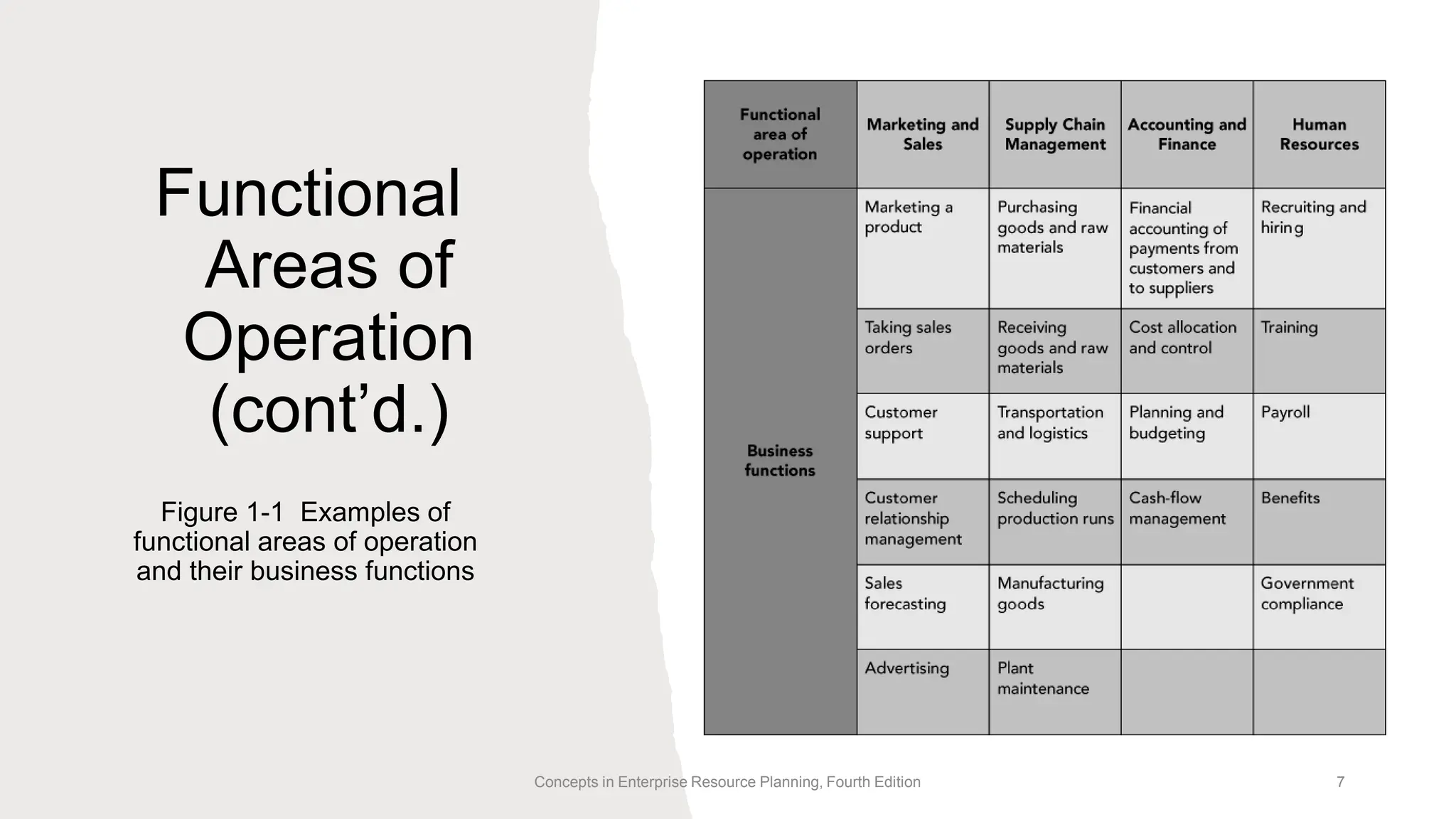
• Business functions: Activities specific to a
functional area of operation
Concepts in Enterprise Resource Planning, Fourth Edition 6
Functional
Areas of
Operation
(cont’d.)
Figure 1-1 Examples of
functional areas of operation
and their business functions
Concepts in Enterprise Resource Planning, Fourth Edition 7
Functional Areas of Operation
(cont’d.)
• Functional areas are interdependent
– Each requires data from the others
• Better integration of functional areas leads to
improvements in communication, workflow, and
success of company
• Information system (IS): Computers, people,
procedures, and software that store, organize, and
deliver information
Concepts in Enterprise Resource Planning, Fourth Edition 8
Business Processes
• Collection of activities that takes one or more kinds of
input and creates an output that is of value to customer
– Customer can be traditional external customer or
internal customer
• Thinking in terms of business processes helps
managers to look at their organization from the
customer’s perspective
Concepts in Enterprise Resource Planning, Fourth Edition 9
Business Processes
(cont’d.)
• Figure 1-2 Sample
business processes related
to the sale of a personal
smartphone
Concepts in Enterprise Resource Planning, Fourth Edition 10
Business Processes (cont’d.)
• Businesses must always consider customer’s viewpoint
in any transaction
• Successful customer interaction
– Customer (either internal or external) is not required
to interact with each business function involved in
the process
• Successful business managers view business
operations from the perspective of a satisfied customer
Concepts in Enterprise Resource Planning, Fourth Edition 11
Business Processes (cont’d.)
• Sharing data effectively and efficiently between and
within functional areas leads to more efficient business
processes
• Integrated information systems: Systems in which
functional areas share data
Concepts in Enterprise Resource Planning, Fourth Edition 12
Business
Processes
(cont’d.)
Figure 1-3 A process view of
business
Concepts in Enterprise Resource Planning, Fourth Edition 13
Business
Processes
(cont’d.)
• Businesses take inputs
(resources) and transform these
inputs into goods and services
for customers
– Inputs: Material, people,
equipment
• Managing inputs and business
processes effectively requires
accurate and up-to-date
information
Concepts in Enterprise Resource Planning, Fourth Edition
14
Functional Areas and
Business Processes of
a Very Small Business
• Example: A fictitious coffee shop
– Examine business processes of
the coffee shop
– See why coordination of
functional areas helps achieve
efficient and effective business
processes
– Look at how integration of the
information system improves the
business
Concepts in Enterprise Resource Planning, Fourth Edition
15
Marketing and
Sales
• Functions of Marketing and Sales
– Developing products
– Determining pricing
– Promoting products to
customers
– Taking customers’ orders
– Helping create a sales forecast
Concepts in Enterprise Resource Planning, Fourth Edition
16
Marketing and Sales
(cont’d.)
• Marketing and Sales tasks for the coffee
shop
– Formal recordkeeping not required
– Need to keep track of customers
– Product development can be done
informally
– Good repeat customers allowed to
charge purchases—up to a point
• Records must show how much
each customer owes and his or her
available credit
Concepts in Enterprise Resource Planning, Fourth Edition
17
Supply Chain
Management
• Functions within Supply Chain
Management
– Making the coffee
(manufacturing/production)
– Buying raw materials (purchasing)
• Production planning requires sales
forecasts from M/S functional area
– Sales forecasts: Analyses that
attempt to predict the future sales of a
product
Concepts in Enterprise Resource Planning, Fourth Edition
18
Supply Chain
Management (cont’d.)
• Production plans used to develop
requirements for raw materials and
packaging
– Raw materials: Bottled spring water,
fresh lemons, artificial sweetener, raw
sugar
– Packaging: Cups, straws, napkins
• SCM and M/S must choose a recipe for
each coffee product sold
Concepts in Enterprise Resource Planning, Fourth Edition
19
Accounting and
Finance
• Functions within Accounting and Finance
– Recording raw data about transactions
(including sales), raw material
purchases, payroll, and receipt of cash
from customers
• Raw data: Numbers collected from sales,
manufacturing and other operations,
without any manipulation, calculation, or
arrangement for presentation
Concepts in Enterprise Resource Planning, Fourth Edition
20
Accounting and
Finance (cont’d.)
• Data from Accounting and Finance used
by Marketing and Sales and Supply
Chain Management
– Sales records are important
component of sales forecast
– Sales forecast is used in making
staffing decisions and in production
planning
– Records from accounts receivable
used to monitor the overall credit-
granting policy of the coffee shop
Concepts in Enterprise Resource Planning, Fourth Edition
21
Human Resources
• Functions of Human Resources
– Recruit, train, evaluate, and
compensate employees
• HR uses sales forecasts developed by the
individual departments to plan personnel
needs
• Systems integrated using ERP software
provide the data sharing necessary
between functional areas
Concepts in Enterprise Resource Planning, Fourth Edition
22
Functional Area
Information Systems
• Potential inputs and outputs for each
functional area described next
• Note the kinds of data needed by each
area and how people use the data
• Information systems maintain relationships
between all functional areas and
processes
Concepts in Enterprise Resource Planning, Fourth Edition
23
Marketing and Sales
• Needs information from all other functional
areas
• Customers communicate orders to M/S in
person or by telephone, e-mail, fax, the Web,
etc.
• M/S has a role in determining product prices
– Pricing might be determined based on a
product’s unit cost, plus some percentage
markup
– Requires information from Accounting
and Finance, and Supply Chain
Management data
Concepts in Enterprise Resource Planning, Fourth Edition
24
Marketing and
Sales (cont’d.)
• Figure 1-4 The Marketing and
Sales functional area exchanges
data with customers and with the
Human Resources, Accounting
and Finance, and Supply Chain
Management functional areas
Concepts in Enterprise Resource Planning, Fourth Edition 25
Marketing and Sales
(cont’d.)
• M/S needs to interact with
Human Resources to exchange
information on hiring needs,
legal requirements, etc.
• Inputs for M/S
– Customer data
– Order data
– Sales trend data
– Per-unit cost
– Company travel expense
policy
Concepts in Enterprise Resource Planning, Fourth Edition
26
Marketing and
Sales (cont’d.)
• Outputs for M/S
– Sales strategies
– Product pricing
– Employment needs
Concepts in Enterprise Resource Planning, Fourth Edition
27
Supply Chain
Management
• Needs information from various functional
areas
• Production plans based on information
about product sales (actual and projected)
that comes from Marketing and Sales
• With accurate data about required
production levels:
– Raw material and packaging can be
ordered as needed
– Inventory levels can be kept low,
saving money
Concepts in Enterprise Resource Planning, Fourth Edition
28
Supply Chain
Management (cont’d.)
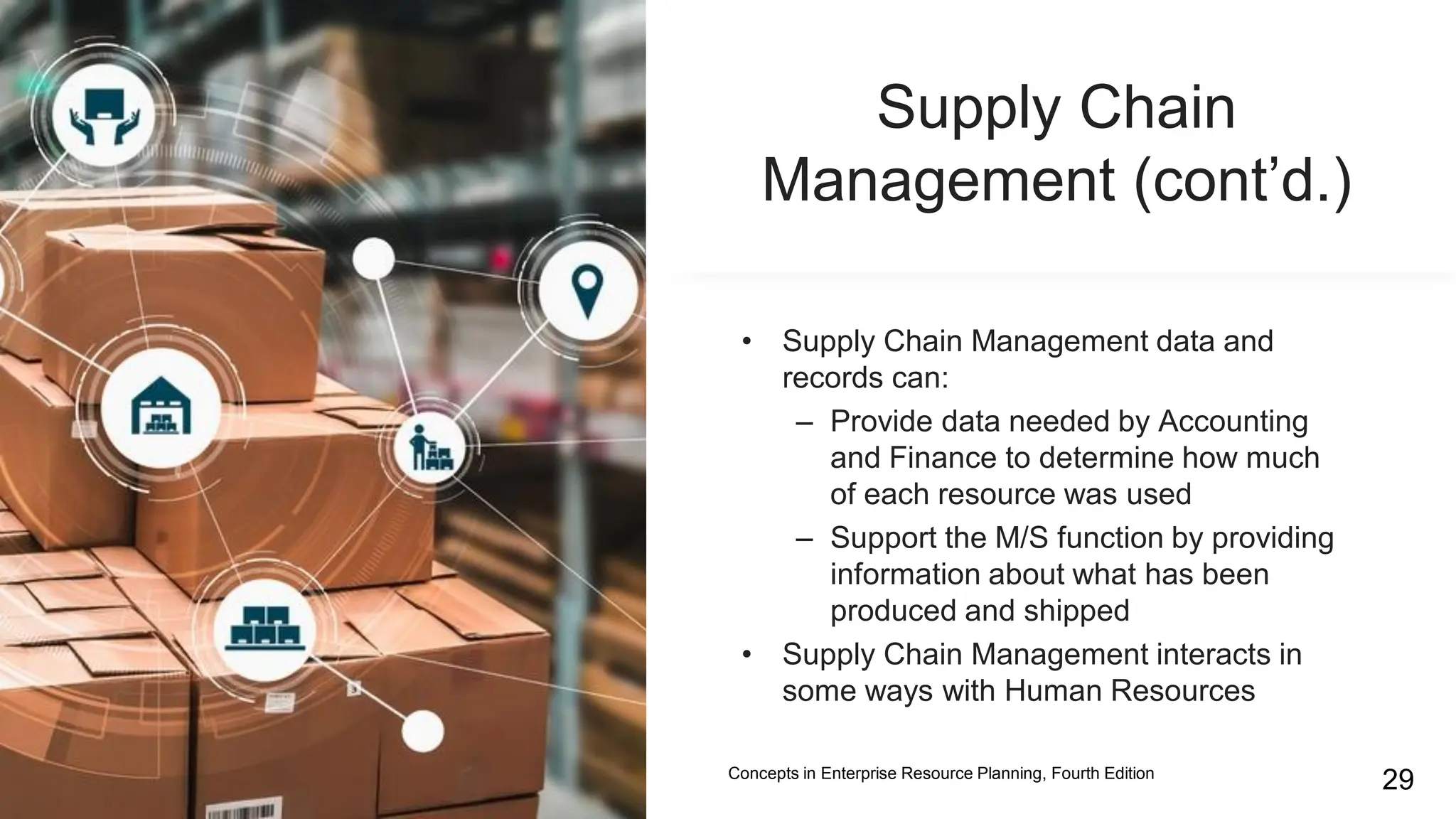
• Supply Chain Management data and
records can:
– Provide data needed by Accounting
and Finance to determine how much
of each resource was used
– Support the M/S function by providing
information about what has been
produced and shipped
• Supply Chain Management interacts in
some ways with Human Resources
Concepts in Enterprise Resource Planning, Fourth Edition
29
Supply Chain
Management
(cont’d.)
• Figure 1-5 The Supply
Chain Management
functional area exchanges
data with suppliers and with
the Human Resources,
Marketing and Sales, and
Accounting and Finance
functional areas
Concepts in Enterprise Resource Planning, Fourth
Edition 30
Supply Chain
Management (cont’d.)
• Inputs for SCM
– Product sales data
– Production plans
– Inventory levels
– Layoff and recall company
policy
Concepts in Enterprise Resource Planning, Fourth
Edition 31
Supply Chain
Management (cont’d.)
• Outputs for SCM
– Raw material orders
– Packaging orders
– Resource expenditure data
– Production and inventory
reports
– Hiring information
Concepts in Enterprise Resource Planning, Fourth Edition
32
Accounting and
Finance
• Needs information from all other
functional areas
• A/F personnel:
– Record company’s transactions
in the books of account
– Record accounts payable when
raw materials are purchased and
cash outflows when they pay for
materials
– Summarize transaction data to
prepare reports about company’s
financial position and profitability
Concepts in Enterprise Resource Planning, Fourth Edition
33
Accounting and
Finance (cont’d.)
• People in other functional areas
provide data to A/F
– M/S provides sales data
– SCM provides production and
inventory data
– HR provides payroll and benefit
expense data
• M/S personnel require data from
A/F to evaluate customer credit
Concepts in Enterprise Resource Planning, Fourth Edition
34
Accounting and
Finance (cont’d.)
• Figure 1-6 The
Accounting and Finance
functional area exchanges
data with customers and with
the Human Resources,
Marketing and Sales, and
Supply Chain Management
functional areas
Concepts in Enterprise Resource Planning, Fourth
Edition 35
Accounting and
Finance (cont’d.)
• Inputs for A/F
– Payments from customers
– Accounts receivable data
– Accounts payable data
– Sales data
– Production and inventory data
– Payroll and expense data
Concepts in Enterprise Resource Planning, Fourth
Edition 36
Accounting and
Finance (cont’d.)
• Outputs for A/F
– Payments to
suppliers
– Financial reports
– Customer credit data
Concepts in Enterprise Resource Planning, Fourth Edition
37
Human Resources
• HR needs information from the other
departments
• Tasks related to employee hiring, benefits,
training, and government compliance are
all responsibilities of HR
• HR needs accurate forecasts of personnel
needs from all functional units
• HR needs to know what skills are needed
to perform a particular job and how much
the company can afford to pay employees
Concepts in Enterprise Resource Planning, Fourth Edition
38
Human
Resources
(cont’d.)
• Figure 1-7 The Human
Resources functional area
exchanges data with the
Accounting and Finance,
Marketing and Sales, and
Supply Chain Management
functional areas
Concepts in Enterprise Resource Planning, Fourth
Edition 39
Human Resources
(cont’d.)
• Observing governmental regulations in
recruiting, training, compensating,
promoting, and terminating employees
• Inputs for HR
– Personnel forecasts
– Skills data
Concepts in Enterprise Resource Planning, Fourth Edition
40
Human Resources
(cont’d.)
• Outputs for HR
– Regulation compliance
– Employee training and
certification
– Skills database
– Employee evaluation and
compensation
Concepts in Enterprise Resource Planning, Fourth Edition
41
Human
Resources
(cont’d.)
• Significant amount of data is
maintained by and shared
among the functional areas
• Timeliness and accuracy of
these data critical to each area’s
success and to company’s
ability to make a profit and
generate future growth
• ERP software allows all
functional areas to share a
common database
– Allows accurate, real-time
information to be available
Concepts in Enterprise Resource Planning, Fourth Edition
42
Summary
• Basic functional areas: Marketing
and Sales, Supply Chain
Management, Accounting and
Finance, and Human Resources
• Marketing and Sales: Sets product
prices, promotes products through
advertising and marketing, takes
customer orders, supports
customers, and creates sales
forecasts
• Supply Chain Management:
Develops production plans, orders
raw materials from suppliers,
receives raw material, manufactures
products, maintains facilities, and
ships products to customers
Concepts in Enterprise Resource Planning, Fourth Edition
43
Summary (cont’d.)
• Accounting and Finance: Financial
accounting to provide summaries of
operational data in managerial reports,
controlling accounts, planning and
budgeting, and cash-flow management
• Human Resources: Recruits, hires, trains,
and compensates employees, ensures
compliance with government regulations,
and oversees the evaluation of employees
• Information systems capture, process, and
store data to provide information needed
for decision making
Concepts in Enterprise Resource Planning, Fourth Edition
44
Summary (cont’d.)
• Employees working in one functional area need
data from employees in other functional areas
– Functional area information systems should
be integrated, so shared data are accurate
and timely
• Managers think in terms of business processes
that integrate the functional areas
– Need to share information between
functions and functional areas
– ERP software provides this capability by
means of a single common database
Concepts in Enterprise Resource Planning, Fourth Edition
45
Learning and Giving for Better
Indonesia

Understanding Business Function and Business Process

  • 1.
    Business Functions andBusiness Processes Seta Ariawuri Wicaksana
  • 2.
    Dr. Seta A.Wicaksana S.Psi, M.Psi, Psikolog 0811 19 53 43 wicaksana@humanikaconsulting.com • Pendiri dan Direktur Humanika Consulting dan hipotest.com • Business Psychologist • Certified of Assessor Talent Management • Certified of Human Resources as a Business Partner • Certified of Risk Professional • Certified of HR Audit • Dosen Tetap dan Peneliti di Fakultas Psikologi UP • Penulis Buku: Sobat Way (2016), Industri dan Organisasi: Pendekatan Integratif dalam menghadapi Perubahan (2020), Human Faktor Engineering: Integratif Desain Manusia dan Lingkungan Kerja (2021), Psikologi Industri dan Organisasi (2021), Psikologi Umum (2021), Manajemen Pengembangan Talenta (2021), PIODiagnostik: Pengukuran Psikologi di Lingkungan Kerja (2021), Transformasi Digital: Perspektif Organisasi, Talenta dan Budaya Organisasi (2021), Psikologi Pelayanan (2021) dan Psikologi Konsumen (2021). • Dosen Tidak Tetap di: Program Pasca Sarjana Ekonomi di Univ. Pancasila, STP TRISAKTI, Fakultas Psikologi Universitas Mercu Buana, STIKOM IMA • Wakil Ketua Asosiasi Psikologi Forensik Indonesia wilayah DKI • Pembina Yayasan Humanika Edukasi Indonesia • Ilmu Ekonomi dan Manajemen (MSDM) S3 Universitas Pancasila • Fakultas Psikologi S1 dan S2 Universitas Indonesia • Sekolah ikatan dinas Akademi Sandi Negara
  • 3.
  • 4.
    Introduction • Enterprise ResourcePlanning (ERP) programs: Core software used by companies to coordinate information in every area of business – Help manage companywide business processes – Use common database and shared management reporting tools • Business process: Collection of activities that takes some input and creates an output that is of value to the customer Concepts in Enterprise Resource Planning, Fourth Edition 4
  • 5.
    Functional Areas andBusiness Processes • To understand ERP, you must understand how a business works – Functional areas of operation – Business processes Concepts in Enterprise Resource Planning, Fourth Edition 5
  • 6.
    Functional Areas ofOperation • Marketing and Sales (M/S) • Supply Chain Management (SCM) • Accounting and Finance (A/F) • Human Resources (HR) • Business functions: Activities specific to a functional area of operation Concepts in Enterprise Resource Planning, Fourth Edition 6
  • 7.
    Functional Areas of Operation (cont’d.) Figure 1-1Examples of functional areas of operation and their business functions Concepts in Enterprise Resource Planning, Fourth Edition 7
  • 8.
    Functional Areas ofOperation (cont’d.) • Functional areas are interdependent – Each requires data from the others • Better integration of functional areas leads to improvements in communication, workflow, and success of company • Information system (IS): Computers, people, procedures, and software that store, organize, and deliver information Concepts in Enterprise Resource Planning, Fourth Edition 8
  • 9.
    Business Processes • Collectionof activities that takes one or more kinds of input and creates an output that is of value to customer – Customer can be traditional external customer or internal customer • Thinking in terms of business processes helps managers to look at their organization from the customer’s perspective Concepts in Enterprise Resource Planning, Fourth Edition 9
  • 10.
    Business Processes (cont’d.) • Figure1-2 Sample business processes related to the sale of a personal smartphone Concepts in Enterprise Resource Planning, Fourth Edition 10
  • 11.
    Business Processes (cont’d.) •Businesses must always consider customer’s viewpoint in any transaction • Successful customer interaction – Customer (either internal or external) is not required to interact with each business function involved in the process • Successful business managers view business operations from the perspective of a satisfied customer Concepts in Enterprise Resource Planning, Fourth Edition 11
  • 12.
    Business Processes (cont’d.) •Sharing data effectively and efficiently between and within functional areas leads to more efficient business processes • Integrated information systems: Systems in which functional areas share data Concepts in Enterprise Resource Planning, Fourth Edition 12
  • 13.
    Business Processes (cont’d.) Figure 1-3 Aprocess view of business Concepts in Enterprise Resource Planning, Fourth Edition 13
  • 14.
    Business Processes (cont’d.) • Businesses takeinputs (resources) and transform these inputs into goods and services for customers – Inputs: Material, people, equipment • Managing inputs and business processes effectively requires accurate and up-to-date information Concepts in Enterprise Resource Planning, Fourth Edition 14
  • 15.
    Functional Areas and BusinessProcesses of a Very Small Business • Example: A fictitious coffee shop – Examine business processes of the coffee shop – See why coordination of functional areas helps achieve efficient and effective business processes – Look at how integration of the information system improves the business Concepts in Enterprise Resource Planning, Fourth Edition 15
  • 16.
    Marketing and Sales • Functionsof Marketing and Sales – Developing products – Determining pricing – Promoting products to customers – Taking customers’ orders – Helping create a sales forecast Concepts in Enterprise Resource Planning, Fourth Edition 16
  • 17.
    Marketing and Sales (cont’d.) •Marketing and Sales tasks for the coffee shop – Formal recordkeeping not required – Need to keep track of customers – Product development can be done informally – Good repeat customers allowed to charge purchases—up to a point • Records must show how much each customer owes and his or her available credit Concepts in Enterprise Resource Planning, Fourth Edition 17
  • 18.
    Supply Chain Management • Functionswithin Supply Chain Management – Making the coffee (manufacturing/production) – Buying raw materials (purchasing) • Production planning requires sales forecasts from M/S functional area – Sales forecasts: Analyses that attempt to predict the future sales of a product Concepts in Enterprise Resource Planning, Fourth Edition 18
  • 19.
    Supply Chain Management (cont’d.) •Production plans used to develop requirements for raw materials and packaging – Raw materials: Bottled spring water, fresh lemons, artificial sweetener, raw sugar – Packaging: Cups, straws, napkins • SCM and M/S must choose a recipe for each coffee product sold Concepts in Enterprise Resource Planning, Fourth Edition 19
  • 20.
    Accounting and Finance • Functionswithin Accounting and Finance – Recording raw data about transactions (including sales), raw material purchases, payroll, and receipt of cash from customers • Raw data: Numbers collected from sales, manufacturing and other operations, without any manipulation, calculation, or arrangement for presentation Concepts in Enterprise Resource Planning, Fourth Edition 20
  • 21.
    Accounting and Finance (cont’d.) •Data from Accounting and Finance used by Marketing and Sales and Supply Chain Management – Sales records are important component of sales forecast – Sales forecast is used in making staffing decisions and in production planning – Records from accounts receivable used to monitor the overall credit- granting policy of the coffee shop Concepts in Enterprise Resource Planning, Fourth Edition 21
  • 22.
    Human Resources • Functionsof Human Resources – Recruit, train, evaluate, and compensate employees • HR uses sales forecasts developed by the individual departments to plan personnel needs • Systems integrated using ERP software provide the data sharing necessary between functional areas Concepts in Enterprise Resource Planning, Fourth Edition 22
  • 23.
    Functional Area Information Systems •Potential inputs and outputs for each functional area described next • Note the kinds of data needed by each area and how people use the data • Information systems maintain relationships between all functional areas and processes Concepts in Enterprise Resource Planning, Fourth Edition 23
  • 24.
    Marketing and Sales •Needs information from all other functional areas • Customers communicate orders to M/S in person or by telephone, e-mail, fax, the Web, etc. • M/S has a role in determining product prices – Pricing might be determined based on a product’s unit cost, plus some percentage markup – Requires information from Accounting and Finance, and Supply Chain Management data Concepts in Enterprise Resource Planning, Fourth Edition 24
  • 25.
    Marketing and Sales (cont’d.) •Figure 1-4 The Marketing and Sales functional area exchanges data with customers and with the Human Resources, Accounting and Finance, and Supply Chain Management functional areas Concepts in Enterprise Resource Planning, Fourth Edition 25
  • 26.
    Marketing and Sales (cont’d.) •M/S needs to interact with Human Resources to exchange information on hiring needs, legal requirements, etc. • Inputs for M/S – Customer data – Order data – Sales trend data – Per-unit cost – Company travel expense policy Concepts in Enterprise Resource Planning, Fourth Edition 26
  • 27.
    Marketing and Sales (cont’d.) •Outputs for M/S – Sales strategies – Product pricing – Employment needs Concepts in Enterprise Resource Planning, Fourth Edition 27
  • 28.
    Supply Chain Management • Needsinformation from various functional areas • Production plans based on information about product sales (actual and projected) that comes from Marketing and Sales • With accurate data about required production levels: – Raw material and packaging can be ordered as needed – Inventory levels can be kept low, saving money Concepts in Enterprise Resource Planning, Fourth Edition 28
  • 29.
    Supply Chain Management (cont’d.) •Supply Chain Management data and records can: – Provide data needed by Accounting and Finance to determine how much of each resource was used – Support the M/S function by providing information about what has been produced and shipped • Supply Chain Management interacts in some ways with Human Resources Concepts in Enterprise Resource Planning, Fourth Edition 29
  • 30.
    Supply Chain Management (cont’d.) • Figure1-5 The Supply Chain Management functional area exchanges data with suppliers and with the Human Resources, Marketing and Sales, and Accounting and Finance functional areas Concepts in Enterprise Resource Planning, Fourth Edition 30
  • 31.
    Supply Chain Management (cont’d.) •Inputs for SCM – Product sales data – Production plans – Inventory levels – Layoff and recall company policy Concepts in Enterprise Resource Planning, Fourth Edition 31
  • 32.
    Supply Chain Management (cont’d.) •Outputs for SCM – Raw material orders – Packaging orders – Resource expenditure data – Production and inventory reports – Hiring information Concepts in Enterprise Resource Planning, Fourth Edition 32
  • 33.
    Accounting and Finance • Needsinformation from all other functional areas • A/F personnel: – Record company’s transactions in the books of account – Record accounts payable when raw materials are purchased and cash outflows when they pay for materials – Summarize transaction data to prepare reports about company’s financial position and profitability Concepts in Enterprise Resource Planning, Fourth Edition 33
  • 34.
    Accounting and Finance (cont’d.) •People in other functional areas provide data to A/F – M/S provides sales data – SCM provides production and inventory data – HR provides payroll and benefit expense data • M/S personnel require data from A/F to evaluate customer credit Concepts in Enterprise Resource Planning, Fourth Edition 34
  • 35.
    Accounting and Finance (cont’d.) •Figure 1-6 The Accounting and Finance functional area exchanges data with customers and with the Human Resources, Marketing and Sales, and Supply Chain Management functional areas Concepts in Enterprise Resource Planning, Fourth Edition 35
  • 36.
    Accounting and Finance (cont’d.) •Inputs for A/F – Payments from customers – Accounts receivable data – Accounts payable data – Sales data – Production and inventory data – Payroll and expense data Concepts in Enterprise Resource Planning, Fourth Edition 36
  • 37.
    Accounting and Finance (cont’d.) •Outputs for A/F – Payments to suppliers – Financial reports – Customer credit data Concepts in Enterprise Resource Planning, Fourth Edition 37
  • 38.
    Human Resources • HRneeds information from the other departments • Tasks related to employee hiring, benefits, training, and government compliance are all responsibilities of HR • HR needs accurate forecasts of personnel needs from all functional units • HR needs to know what skills are needed to perform a particular job and how much the company can afford to pay employees Concepts in Enterprise Resource Planning, Fourth Edition 38
  • 39.
    Human Resources (cont’d.) • Figure 1-7The Human Resources functional area exchanges data with the Accounting and Finance, Marketing and Sales, and Supply Chain Management functional areas Concepts in Enterprise Resource Planning, Fourth Edition 39
  • 40.
    Human Resources (cont’d.) • Observinggovernmental regulations in recruiting, training, compensating, promoting, and terminating employees • Inputs for HR – Personnel forecasts – Skills data Concepts in Enterprise Resource Planning, Fourth Edition 40
  • 41.
    Human Resources (cont’d.) • Outputsfor HR – Regulation compliance – Employee training and certification – Skills database – Employee evaluation and compensation Concepts in Enterprise Resource Planning, Fourth Edition 41
  • 42.
    Human Resources (cont’d.) • Significant amountof data is maintained by and shared among the functional areas • Timeliness and accuracy of these data critical to each area’s success and to company’s ability to make a profit and generate future growth • ERP software allows all functional areas to share a common database – Allows accurate, real-time information to be available Concepts in Enterprise Resource Planning, Fourth Edition 42
  • 43.
    Summary • Basic functionalareas: Marketing and Sales, Supply Chain Management, Accounting and Finance, and Human Resources • Marketing and Sales: Sets product prices, promotes products through advertising and marketing, takes customer orders, supports customers, and creates sales forecasts • Supply Chain Management: Develops production plans, orders raw materials from suppliers, receives raw material, manufactures products, maintains facilities, and ships products to customers Concepts in Enterprise Resource Planning, Fourth Edition 43
  • 44.
    Summary (cont’d.) • Accountingand Finance: Financial accounting to provide summaries of operational data in managerial reports, controlling accounts, planning and budgeting, and cash-flow management • Human Resources: Recruits, hires, trains, and compensates employees, ensures compliance with government regulations, and oversees the evaluation of employees • Information systems capture, process, and store data to provide information needed for decision making Concepts in Enterprise Resource Planning, Fourth Edition 44
  • 45.
    Summary (cont’d.) • Employeesworking in one functional area need data from employees in other functional areas – Functional area information systems should be integrated, so shared data are accurate and timely • Managers think in terms of business processes that integrate the functional areas – Need to share information between functions and functional areas – ERP software provides this capability by means of a single common database Concepts in Enterprise Resource Planning, Fourth Edition 45
  • 46.
    Learning and Givingfor Better Indonesia