Changing Group to High Performing
Teams with SOBATWAY:
Participating, Leading,Coaching
Seta. A. Wicaksana
Founder andCEOwww.humanikaconsulting.com
Seta A. Wicaksana
0811 19 53 43
wicaksana@humanikaconsulting.com
• Business Psychologist
• Pendiri dan Direktur Humanika Consulting dan hipotest.com
• Dosen Tetap dan Peneliti di Fakultas Psikologi Universitas Pancasila
• Pembina Yayasan Humanika Edukasi Indonesia
• Penulis Buku: Sobat Way (2016), Industri dan Organisasi: Pendekatan Integratif dalam
menghadapi Perubahan (2020), Human Faktor Engineering: Integratif Desain Manusia
dan Lingkungan Kerja (2021), Psikologi Industri dan Organisasi (2021), Psikologi Umum
(2021), Manajemen Pengembangan Talenta (2021), PIODiagnostik: Pengukuran Psikologi
di Lingkungan Kerja (2021), Transformasi Digital: Perspektif Organisasi, Talenta dan
Budaya Organisasi (2021), Psikologi Pelayanan (2021) dan Psikologi Konsumen (2021).
• Dosen Tidak Tetap di: Program Pasca Sarjana Ekonomi di Univ. Pancasila, STP TRISAKTI,
Fakultas Psikologi Universitas Mercu Buana, STIKOM IMA
• Certified of Assessor Talent Management
• Certified of Human Resources Management (Reward Management)
• Certified of Human Resources as a Business Partner
• Certified of Risk Professional
• Certified of HR Audit
• Ilmu Ekonomi dan Manajemen (MSDM) S3 Universitas Pancasila
• Fakultas Psikologi S1 dan S2 Universitas Indonesia
• Sekolah ikatan dinas Akademi Sandi Negara
Why is Teamwork Important for an Organization?
• Teamwork is important because it promotes a
positive work environment where employees
can achieve more opportunities and overcome
more obstacles.
• Businesses and organizations need teamwork
the most when a project is time-sensitive and
requires a diverse set of skills and experiences.
• Teamwork can improve efficiency and
productivity.
• Efficiency rules when work is appropriately
divided within a team, responsibilities are
shared, and tasks are more likely to be
finished within a set time frame. Good
teamwork also enhances group outcomes and
the measurable effectiveness of organizations.
3
Objectives
• Understand what a team is and what it is not
• Understand why team dynamics are important
• Understand the characteristics of high-performing teams, team members
and team leaders
• Understand the purpose, value, and nature of coaching in team situations
4
Outline
INTRODUCTION GROUP AND
TEAM
PARTICIPATING LEADING COACHING
Leading High-Performing
Teams
• A productive leader can help to improve efficiency by
getting the most out of their team.
• Leaders can help improve efficiency by ensuring
everyone is working towards the same goal and doing
what they do best.
• They can provide guidance and direction and delegate
tasks to make the most of everyone's strengths.
• Someone who leads by example can expect to receive
trust and respect from their team.
• Superiors see them as someone who is capable of
running a team, and employees see them as trusted
mentors.
• A trusted leader can also inspire teammates to respect
and trust each other.
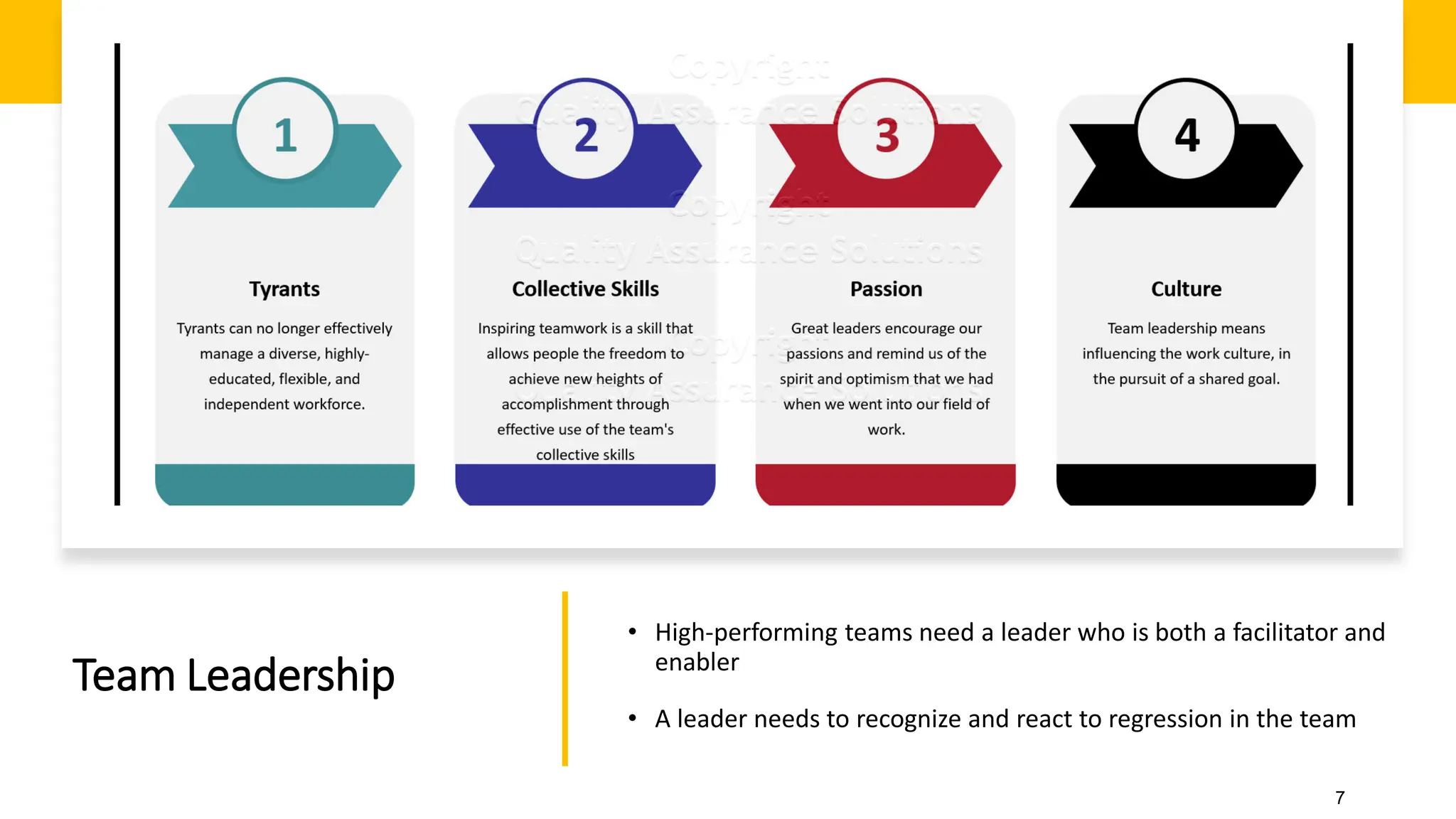
Team Leadership
• High-performing teams need a leader who is both a facilitator and
enabler
• A leader needs to recognize and react to regression in the team
7
Facilitator / Enabler
• Set clear directions…get out of the way
• Eliminate distractions, guesswork, politics and needless
tasks
• Remove roadblocks
• Keep everyone on same page
…and pointed in same direction
8
Being a Team Leader
You’re only as good as your Team
High Performing Teams start with
good leadership
9
Leadership Skills
• Develop Structure
• Clearly Communicate
• Lead by Example
• Encourage Trust
• Provide Motivation
• Be Reliable
10
Develop
Structure
• Project Management Plan
• Work Breakdown Structure
• Organizational Breakdown
Structure
• RESPONSIBILTY ASSIGNMENT
MATRIX
• Baseline Schedule
• Baseline Budget
• Project-Specific Procedures
11
Clearly Communicate
• Communications Plan as part of the
PMP
• Frequent, Recurring
• Be Clear and Consistent
• Common information repository:
SharePoint, FTP site
• Be a Good Listener
12
Lead by Example
• Roll your sleeves up
• Take responsibility
• Be truthful
• Acknowledge failure
• Create solutions
• Delegate
• Listen
• Watch what you say
13
Encourage Trust
• Be yourself
• Be honest
• Share some of your personal life
• Celebrate successes, even the small
ones
• Be direct, but diplomatic
• Listen more, talk less
• Remember what team members tell
you
14
Provide Motivation
• Set clear goals
• Communicate the vision
• Empower people
• Provide support, when needed
• Show appreciation
• Have FUN
• Say “Thank You”
15
Be Reliable
• Keep your promises
• Be consistent
• Be punctual
• Treat team member equally
• Provide assistance when needed
16
Regression
• Watch out! Team performance may go backwards
when there is a:
• Change in membership
• Change in leadership
• Change in goals or direction
• May need to step in more (change coaching style)
• Goal clarification and role clarification
• Conflict management
17
Learning and
Giving for
Better
Indonesia
www.humanikaconsulting.com

Changing Group to High Performing Teams with SOBATWAY through Leading

  • 1.
    Changing Group toHigh Performing Teams with SOBATWAY: Participating, Leading,Coaching Seta. A. Wicaksana Founder andCEOwww.humanikaconsulting.com
  • 2.
    Seta A. Wicaksana 081119 53 43 wicaksana@humanikaconsulting.com • Business Psychologist • Pendiri dan Direktur Humanika Consulting dan hipotest.com • Dosen Tetap dan Peneliti di Fakultas Psikologi Universitas Pancasila • Pembina Yayasan Humanika Edukasi Indonesia • Penulis Buku: Sobat Way (2016), Industri dan Organisasi: Pendekatan Integratif dalam menghadapi Perubahan (2020), Human Faktor Engineering: Integratif Desain Manusia dan Lingkungan Kerja (2021), Psikologi Industri dan Organisasi (2021), Psikologi Umum (2021), Manajemen Pengembangan Talenta (2021), PIODiagnostik: Pengukuran Psikologi di Lingkungan Kerja (2021), Transformasi Digital: Perspektif Organisasi, Talenta dan Budaya Organisasi (2021), Psikologi Pelayanan (2021) dan Psikologi Konsumen (2021). • Dosen Tidak Tetap di: Program Pasca Sarjana Ekonomi di Univ. Pancasila, STP TRISAKTI, Fakultas Psikologi Universitas Mercu Buana, STIKOM IMA • Certified of Assessor Talent Management • Certified of Human Resources Management (Reward Management) • Certified of Human Resources as a Business Partner • Certified of Risk Professional • Certified of HR Audit • Ilmu Ekonomi dan Manajemen (MSDM) S3 Universitas Pancasila • Fakultas Psikologi S1 dan S2 Universitas Indonesia • Sekolah ikatan dinas Akademi Sandi Negara
  • 3.
    Why is TeamworkImportant for an Organization? • Teamwork is important because it promotes a positive work environment where employees can achieve more opportunities and overcome more obstacles. • Businesses and organizations need teamwork the most when a project is time-sensitive and requires a diverse set of skills and experiences. • Teamwork can improve efficiency and productivity. • Efficiency rules when work is appropriately divided within a team, responsibilities are shared, and tasks are more likely to be finished within a set time frame. Good teamwork also enhances group outcomes and the measurable effectiveness of organizations. 3
  • 4.
    Objectives • Understand whata team is and what it is not • Understand why team dynamics are important • Understand the characteristics of high-performing teams, team members and team leaders • Understand the purpose, value, and nature of coaching in team situations 4
  • 5.
  • 6.
    Leading High-Performing Teams • Aproductive leader can help to improve efficiency by getting the most out of their team. • Leaders can help improve efficiency by ensuring everyone is working towards the same goal and doing what they do best. • They can provide guidance and direction and delegate tasks to make the most of everyone's strengths. • Someone who leads by example can expect to receive trust and respect from their team. • Superiors see them as someone who is capable of running a team, and employees see them as trusted mentors. • A trusted leader can also inspire teammates to respect and trust each other.
  • 7.
    Team Leadership • High-performingteams need a leader who is both a facilitator and enabler • A leader needs to recognize and react to regression in the team 7
  • 8.
    Facilitator / Enabler •Set clear directions…get out of the way • Eliminate distractions, guesswork, politics and needless tasks • Remove roadblocks • Keep everyone on same page …and pointed in same direction 8
  • 9.
    Being a TeamLeader You’re only as good as your Team High Performing Teams start with good leadership 9
  • 10.
    Leadership Skills • DevelopStructure • Clearly Communicate • Lead by Example • Encourage Trust • Provide Motivation • Be Reliable 10
  • 11.
    Develop Structure • Project ManagementPlan • Work Breakdown Structure • Organizational Breakdown Structure • RESPONSIBILTY ASSIGNMENT MATRIX • Baseline Schedule • Baseline Budget • Project-Specific Procedures 11
  • 12.
    Clearly Communicate • CommunicationsPlan as part of the PMP • Frequent, Recurring • Be Clear and Consistent • Common information repository: SharePoint, FTP site • Be a Good Listener 12
  • 13.
    Lead by Example •Roll your sleeves up • Take responsibility • Be truthful • Acknowledge failure • Create solutions • Delegate • Listen • Watch what you say 13
  • 14.
    Encourage Trust • Beyourself • Be honest • Share some of your personal life • Celebrate successes, even the small ones • Be direct, but diplomatic • Listen more, talk less • Remember what team members tell you 14
  • 15.
    Provide Motivation • Setclear goals • Communicate the vision • Empower people • Provide support, when needed • Show appreciation • Have FUN • Say “Thank You” 15
  • 16.
    Be Reliable • Keepyour promises • Be consistent • Be punctual • Treat team member equally • Provide assistance when needed 16
  • 17.
    Regression • Watch out!Team performance may go backwards when there is a: • Change in membership • Change in leadership • Change in goals or direction • May need to step in more (change coaching style) • Goal clarification and role clarification • Conflict management 17
  • 18.