PERFORMANCE MANAGEMENT
Concept & Objectives
Prerequisites
Dimensions of Performance management
Factors affecting performance management
Performance management & Performance appraisal
1
Concept
 Labour – a Factor of production-Scientific
management perspective – productivity of each worker
could be measured accurately
 Performance means outcomes achieved, or
accomplishments of work- the actual contribution of
an individual or team to the organisation’s strategic
goals, like stakeholder satisfaction, clean image and
economic sustainability.
 Performance includes both behaviours and results.
 Performance is about optimally realising one’s
potential.
2
Performance Framework
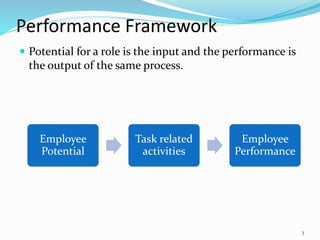
 Potential for a role is the input and the performance is
the output of the same process.
3
Employee
Potential
Task related
activities
Employee
Performance
Changing role of human resources and the importance
of their performance
Value addition and value creation
Sources of Competitive advantage-
training (Russel. et. al. 1985), selection (Terpestra &
Rozell, 1993), appraisals (Borman, 1991), and
compensation (Milkovich, 1992) –
Performance of organisation- productivity, turnover,
absenteeism, innovation, quality of products /services
HR an asset to the organisation
Integration of HR policies and practices
4
Importance of performance
 Performance of an organisation is ensured by the
performance of individuals and teams in the
organisation.
 P=f (abilities, willingness)
 Organisational culture, values and managerial
behaviour also exert a major impact on the
achievement of excellence on the individual, team, and
organisational performance.
 Thus, PM emerges as a major element in the field of
HR management.
5
HR PRACTICES
QUALITY OF
PRODUCTS/
SERVICES
CUSTOMER
SATISFACTION
PRODUCTIVITY
ORGANISATIONAL
PERFORMANCE
EMPLOYEE
SATISFACTION
EMPLOYEE
PERFORMANC
E
HR CLIMATE
EMPLOYEE
DEVELOPMENT
6
Need for managing performance
 Extraordinary Performance from an ordinary employee
can be possible by effectively and systematically
managing performance.
 Extraordinary performance has to be planned,
monitored and reinforced.
7
 Historically, organisations defined strategy and
objectives, and the measurement of employee and
organisational performance as completely separate
processes.
 An integrated performance management system is a
key component of the emerging requirement to tie the
strategy and the organisational processes to Human
resources processes.
8
Meaning & Definition
 The term was first used by Beer and Ruh in the year
1976.
 Performance management is an ongoing dynamic
process that articulates organisational vision and
objectives, installs performance criteria in light of
these objectives, and continuously reviews internal
procedures to integrate them with organisational
philosophy and culture.
9
Definitions
 Armstrong & Baron define performance
management as “ a strategic and integrated approach
to delivering sustained success to organisations by
improving performance of the people who work in
them and by developing the capabilities of teams and
individual contributors.“
 Strategic- long term organisational goals and in the
context of external environment
 Integrated – four dimensions: vertical, functional,
human resource, goals.
10
Definitions....
 Performance management is the process through
which managers ensure that employee’s activities and
outputs contribute to organisational goals. –Louis R
Gomez & David B Mejia
 Performance management may be defined as a
planned and systematic approach to managing the
performance of individuals ensuring their personal
development and contribution towards organisational
goals. – Ronnie Malcom.
11
OBJECTIVES OF PERFORMANCE
MANAGEMENT
 Strategic objectives:
Formulate strategy, determining the
objectives of the organisation
Manage the implementation of
strategies
Challenging assumptions- ensuring the
content is still valid
Sustain excellence in performance by
motivating employees to setting goals
that align with organisational
strategies.
Monitoring whether the expected
performance results are achieved or
not
Ensuring that the organisation is
complying with the minimum legal,
environmental requirements.
12
Communication Objectives
 :
 Communicate the
direction of organisation
so that the strategic goals
are achieved by
individuals
 Communicate with
external stakeholders
 Provide feedback to
employees on their
performance
13
MOTIVATIONAL OBJECTIVES
 Evaluate and reward behaviour;
motivate them to take actions
and make decisions which are
consistent with organisational
objectives and strategies.
 Encourage improvement and
learning at all levels across the
organisation.
 Assess current management
potential for the purpose of
succession planning.
 Empower employees to set
their own performance criteria
so that achieving these
objectives becomes their
mission.
14
PREREQUISITES (CRITERIA) OF PERFORMANCE
MANAGEMENT
 Organisational philosophies
 Attitudes and skills of those responsible for its
implementation
 Acceptance, commitment and ownership of
managers and employees
 Endorsement of the notions of ‘procedural
fairness’ (process equity)and ‘distributive justice’
(association with rewards & recognition)
15
PREREQUISITES (CRITERIA) OF PERFORMANCE
MANAGEMENT Contd.....
 Commitment and involvement of top management
 Adequate compensation package
 Access to resources, tools and skills to employees to do
their job
 Empowerment of managers for need based planning
 Familiarity of managers and employees with target
setting and achievement monitoring
 Establishing an effective communication system
 Developing a culture of accountability and openness
 Strong financial support in the organisation
 Decentralisation
 Customer’s pressure and quality assurance.
16
DIMENSIONS OF PERFORMANCE MANAGEMENT
17
FACTORS AFFECTING
PERFORMANCE MANAGEMENT
 Process
 People management capability
 Motivation
 Measurement and rewards
 Role of HR professionals – demonstrate expertise, draw
upon relevant theory and research evidence, influence
through leaders within the organisation to focus energy on
the aspects of performance management.
 Learning organisation
 Culture and clarity of purpose.
18
PERFORMANCE MANAGEMENT & PERFORMANCE
APPRAISAL
 Late 18th century- Industrial revolution- division of
labour- scientific management perspective- annual
performance appraisals of workers.
 Sole purpose of appraisal was to assess the productivity
of each worker retrospectively with a view to find ways
of improving individual performance.
 It was primarily a judgemental process where human
aspects were not considered.
19
20
 Hawthorne’s experiments brought in a change in the
approach, which established that the relationship
between fellow workers played a significant role at work
and only way to increase their productivity was to
motivate them at work.
 Now the focus shifted to predominantly assessing the
personality traits of workers and examining how
workers could be motivated to do better. But the
approach was still judgmental in nature.
 As a result in 1950s the merit rating became the
dominant way of assessing individual performance.
21
 Soon Merit rating approach was critised by McGregor
(1957) as being too focussed on the personality trait of the
individual instead of analysing his behaviour and
backward looking instead of forward looking.
 Napier and Latham (1986) felt that ‘situation’ in which the
individual performed was not considered.
 Gradually, it was felt that individual performance could be
improved by skilfully manoeuvring both external factors
and the internal factors of an employee.
 External factors -organisational structure and internal
factors- psychological well being of the employee.
22
 MBO approach proposed by Peter Drucker gained
popularity where the employee would set his own
objectives at the commencement of the appraisal period
and to review the progress at the end of the appraisal
period.
 The negative effects of both merit rating and the MBO
approaches frustrated the managers and there was
renewed interest in revising the appraisal process.
 Concept of Performance management slowly evolved
and gained increased attention. Training and
development was linked to the performance
appraisal process.
Performance appraisal Performance management
1. Performance appraisals
are reviews of employee
performance over time
2. Top down assessment
3. Annual reviews
4. Use of ratings
5. Massive system
6. Focuses on quantitative
objectives
7. Complex paper work
8. Owned by HR managers
9. Retrospective
1. Identifying, measuring,
managing, and developing the
performance of employees
2. Joint process through dialogue.
3. Continuous process
4. Ratings are less used
5. Flexible process
6. Focuses on values and
behaviour also
7. Documentation is minimum
8. Owned by line managers
9. Future orientation
23
24

Performance Management

  • 1.
    PERFORMANCE MANAGEMENT Concept &Objectives Prerequisites Dimensions of Performance management Factors affecting performance management Performance management & Performance appraisal 1
  • 2.
    Concept  Labour –a Factor of production-Scientific management perspective – productivity of each worker could be measured accurately  Performance means outcomes achieved, or accomplishments of work- the actual contribution of an individual or team to the organisation’s strategic goals, like stakeholder satisfaction, clean image and economic sustainability.  Performance includes both behaviours and results.  Performance is about optimally realising one’s potential. 2
  • 3.
    Performance Framework  Potentialfor a role is the input and the performance is the output of the same process. 3 Employee Potential Task related activities Employee Performance
  • 4.
    Changing role ofhuman resources and the importance of their performance Value addition and value creation Sources of Competitive advantage- training (Russel. et. al. 1985), selection (Terpestra & Rozell, 1993), appraisals (Borman, 1991), and compensation (Milkovich, 1992) – Performance of organisation- productivity, turnover, absenteeism, innovation, quality of products /services HR an asset to the organisation Integration of HR policies and practices 4
  • 5.
    Importance of performance Performance of an organisation is ensured by the performance of individuals and teams in the organisation.  P=f (abilities, willingness)  Organisational culture, values and managerial behaviour also exert a major impact on the achievement of excellence on the individual, team, and organisational performance.  Thus, PM emerges as a major element in the field of HR management. 5
  • 6.
  • 7.
    Need for managingperformance  Extraordinary Performance from an ordinary employee can be possible by effectively and systematically managing performance.  Extraordinary performance has to be planned, monitored and reinforced. 7
  • 8.
     Historically, organisationsdefined strategy and objectives, and the measurement of employee and organisational performance as completely separate processes.  An integrated performance management system is a key component of the emerging requirement to tie the strategy and the organisational processes to Human resources processes. 8
  • 9.
    Meaning & Definition The term was first used by Beer and Ruh in the year 1976.  Performance management is an ongoing dynamic process that articulates organisational vision and objectives, installs performance criteria in light of these objectives, and continuously reviews internal procedures to integrate them with organisational philosophy and culture. 9
  • 10.
    Definitions  Armstrong &Baron define performance management as “ a strategic and integrated approach to delivering sustained success to organisations by improving performance of the people who work in them and by developing the capabilities of teams and individual contributors.“  Strategic- long term organisational goals and in the context of external environment  Integrated – four dimensions: vertical, functional, human resource, goals. 10
  • 11.
    Definitions....  Performance managementis the process through which managers ensure that employee’s activities and outputs contribute to organisational goals. –Louis R Gomez & David B Mejia  Performance management may be defined as a planned and systematic approach to managing the performance of individuals ensuring their personal development and contribution towards organisational goals. – Ronnie Malcom. 11
  • 12.
    OBJECTIVES OF PERFORMANCE MANAGEMENT Strategic objectives: Formulate strategy, determining the objectives of the organisation Manage the implementation of strategies Challenging assumptions- ensuring the content is still valid Sustain excellence in performance by motivating employees to setting goals that align with organisational strategies. Monitoring whether the expected performance results are achieved or not Ensuring that the organisation is complying with the minimum legal, environmental requirements. 12
  • 13.
    Communication Objectives  : Communicate the direction of organisation so that the strategic goals are achieved by individuals  Communicate with external stakeholders  Provide feedback to employees on their performance 13
  • 14.
    MOTIVATIONAL OBJECTIVES  Evaluateand reward behaviour; motivate them to take actions and make decisions which are consistent with organisational objectives and strategies.  Encourage improvement and learning at all levels across the organisation.  Assess current management potential for the purpose of succession planning.  Empower employees to set their own performance criteria so that achieving these objectives becomes their mission. 14
  • 15.
    PREREQUISITES (CRITERIA) OFPERFORMANCE MANAGEMENT  Organisational philosophies  Attitudes and skills of those responsible for its implementation  Acceptance, commitment and ownership of managers and employees  Endorsement of the notions of ‘procedural fairness’ (process equity)and ‘distributive justice’ (association with rewards & recognition) 15
  • 16.
    PREREQUISITES (CRITERIA) OFPERFORMANCE MANAGEMENT Contd.....  Commitment and involvement of top management  Adequate compensation package  Access to resources, tools and skills to employees to do their job  Empowerment of managers for need based planning  Familiarity of managers and employees with target setting and achievement monitoring  Establishing an effective communication system  Developing a culture of accountability and openness  Strong financial support in the organisation  Decentralisation  Customer’s pressure and quality assurance. 16
  • 17.
  • 18.
    FACTORS AFFECTING PERFORMANCE MANAGEMENT Process  People management capability  Motivation  Measurement and rewards  Role of HR professionals – demonstrate expertise, draw upon relevant theory and research evidence, influence through leaders within the organisation to focus energy on the aspects of performance management.  Learning organisation  Culture and clarity of purpose. 18
  • 19.
    PERFORMANCE MANAGEMENT &PERFORMANCE APPRAISAL  Late 18th century- Industrial revolution- division of labour- scientific management perspective- annual performance appraisals of workers.  Sole purpose of appraisal was to assess the productivity of each worker retrospectively with a view to find ways of improving individual performance.  It was primarily a judgemental process where human aspects were not considered. 19
  • 20.
    20  Hawthorne’s experimentsbrought in a change in the approach, which established that the relationship between fellow workers played a significant role at work and only way to increase their productivity was to motivate them at work.  Now the focus shifted to predominantly assessing the personality traits of workers and examining how workers could be motivated to do better. But the approach was still judgmental in nature.  As a result in 1950s the merit rating became the dominant way of assessing individual performance.
  • 21.
    21  Soon Meritrating approach was critised by McGregor (1957) as being too focussed on the personality trait of the individual instead of analysing his behaviour and backward looking instead of forward looking.  Napier and Latham (1986) felt that ‘situation’ in which the individual performed was not considered.  Gradually, it was felt that individual performance could be improved by skilfully manoeuvring both external factors and the internal factors of an employee.  External factors -organisational structure and internal factors- psychological well being of the employee.
  • 22.
    22  MBO approachproposed by Peter Drucker gained popularity where the employee would set his own objectives at the commencement of the appraisal period and to review the progress at the end of the appraisal period.  The negative effects of both merit rating and the MBO approaches frustrated the managers and there was renewed interest in revising the appraisal process.  Concept of Performance management slowly evolved and gained increased attention. Training and development was linked to the performance appraisal process.
  • 23.
    Performance appraisal Performancemanagement 1. Performance appraisals are reviews of employee performance over time 2. Top down assessment 3. Annual reviews 4. Use of ratings 5. Massive system 6. Focuses on quantitative objectives 7. Complex paper work 8. Owned by HR managers 9. Retrospective 1. Identifying, measuring, managing, and developing the performance of employees 2. Joint process through dialogue. 3. Continuous process 4. Ratings are less used 5. Flexible process 6. Focuses on values and behaviour also 7. Documentation is minimum 8. Owned by line managers 9. Future orientation 23
  • 24.

Editor's Notes

  • #3 ‘et.al.’ Is a Latin word ‘et alia’ meaning ‘and others’
  • #5 Comp. Advtg. may be defined as the advantage over competitors gained by a firm’s ability to create value for the stakeholder most notably the customers, either by low cost or most differentiated position by making use of its superior resources, assets and the distinctive competencies
  • #16 Procedural fairness refers to the employees’ perception on overall process equity, and where distributive justices is linked to perceptions of the fairness of associated rewards and recognition outcomes.