MACROECONOMICS
Le Phuong Thao Quynh
FACULTY OF INTERNATIONAL ECONOMICS
Email: quynhlpt@ftu.edu.vn
Chapter 2:
Measuring macroeconomic variables
MEASURING A NATION’S INCOME
• Macroeconomics answers questions such as:
– Why is average income high in some countries and low in
others?
– Why do prices rise rapidly in some periods while they are
more stable in other periods?
– Why do production and employment expand in some
years and contract in others?
THE ECONOMY’S INCOME AND
EXPENDITURE
• When judging whether the economy is doing well or
poorly, it is natural to look at the total income that
everyone in the economy is earning.
THE ECONOMY’S INCOME AND
EXPENDITURE
• For an economy as a whole, income must equal
expenditure because:
– Every transaction has a buyer and a seller.
– Every dollar of spending by some buyer is a dollar of
income for some seller.
THE MEASUREMENT OF GDP
• Gross domestic product (GDP) is a measure of the total
income and expenditures of an economy.
• It is the total market value of all final goods and services
produced within a country in a given period of time.
THE MEASUREMENT OF GDP
• ‘GDP is the market value ...’
– Output is valued at market prices.
• ‘... of all final ...’– It records only the value of final goods,
not intermediate goods (the value is counted only once).
• ‘... goods and services ...’– It includes both tangible
goods (food, clothing, cars) and intangible services
(haircuts, house cleaning, doctors’ visits).
THE MEASUREMENT OF GDP
• ‘... produced ...’– It includes goods and services
currently produced, not transactions involving goods
produced in the past.
• • ‘... within a country ...’– It measures the value of
production within the geographic confines of a country.
• ‘... in a given period of time.’– It measures the value of
production that takes place within a specific interval of
time, usually a year or a quarter (three months).
THE COMPONENTS OF GDP
• GDP includes all items produced in the economy and sold
legally in markets.
• What is not counted in GDP?
– GDP excludes most items that are produced and
consumed at home and that never enter the marketplace.
– It excludes items produced and sold illicitly, such as
illegal drugs.
THE CIRCULAR-FLOW DIAGRAM
• Sectors of a simple economy:
1) Households – contain all the people
2) Firms – all the business enterprises
THE CIRCULAR-FLOW DIAGRAM
Sectors are connected by 2 markets: factor and product market:
1) Households sell productive services to firms through factor
markets
- The factors of production are land, labor, capital.
- When households sell productive services to firms, they receive
income: wages, rent, profits, interest
2) Firms sell goods & services in product markets
- The income of firms in this market is also the expenditure of
households
THE CIRCULAR-FLOW DIAGRAM
- Underlying principle of the circular flow: the dollar inflow
into each market or sector must equal the dollar outflow
from each market or sector
- So, total production = total spending = total income
COMPONENTS OF GDP
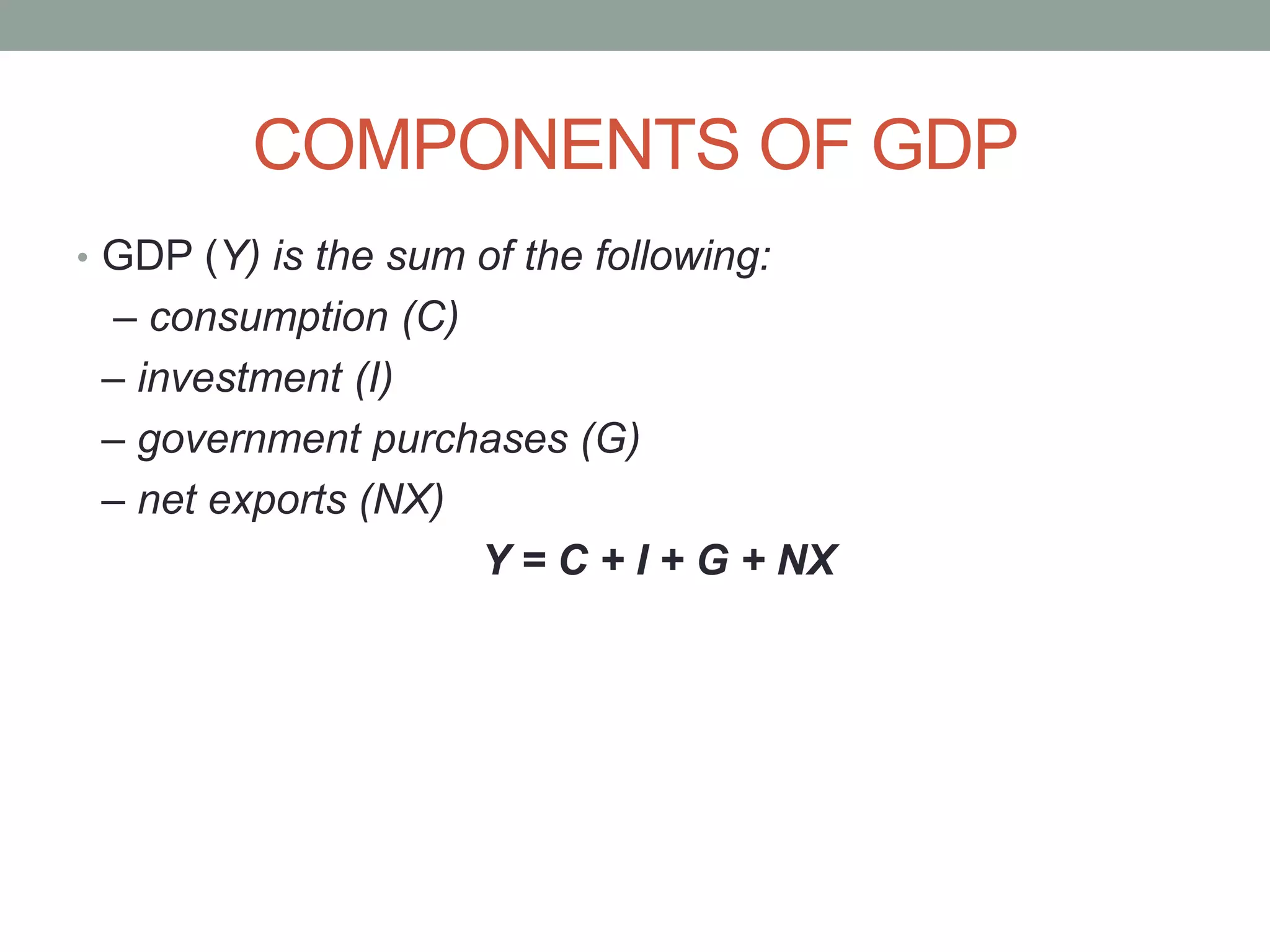
• GDP (Y) is the sum of the following:
– consumption (C)
– investment (I)
– government purchases (G)
– net exports (NX)
Y = C + I + G + NX
COMPONENTS OF GDP
• Consumption (C):
– The spending by households on goods and services,
with the exception of purchases of new housing.
• Investment (I):
– The spending on capital equipment, inventories and
structures, including household purchases of new
housing.
COMPONENTS OF GDP
• Government purchases (G):
– The spending on goods and services by local, State and
federal governments
– Does not include transfer payments because they are
not made in exchange for currently produced goods or
services
• Net exports (NX): Exports minus imports.
NX = X - M
Problems and applications
What happens to GDP’s components when:
• A household buy a new refrigerator
• You buy a new house
• A company sells its last year’s inventory
• You buy a pizza
• Hochiminh City constructs a new bridge
• Your parent buy a bottle of wine which was imported
from France
• A factory buys new machines for production
REAL VERSUS NOMINAL GDP
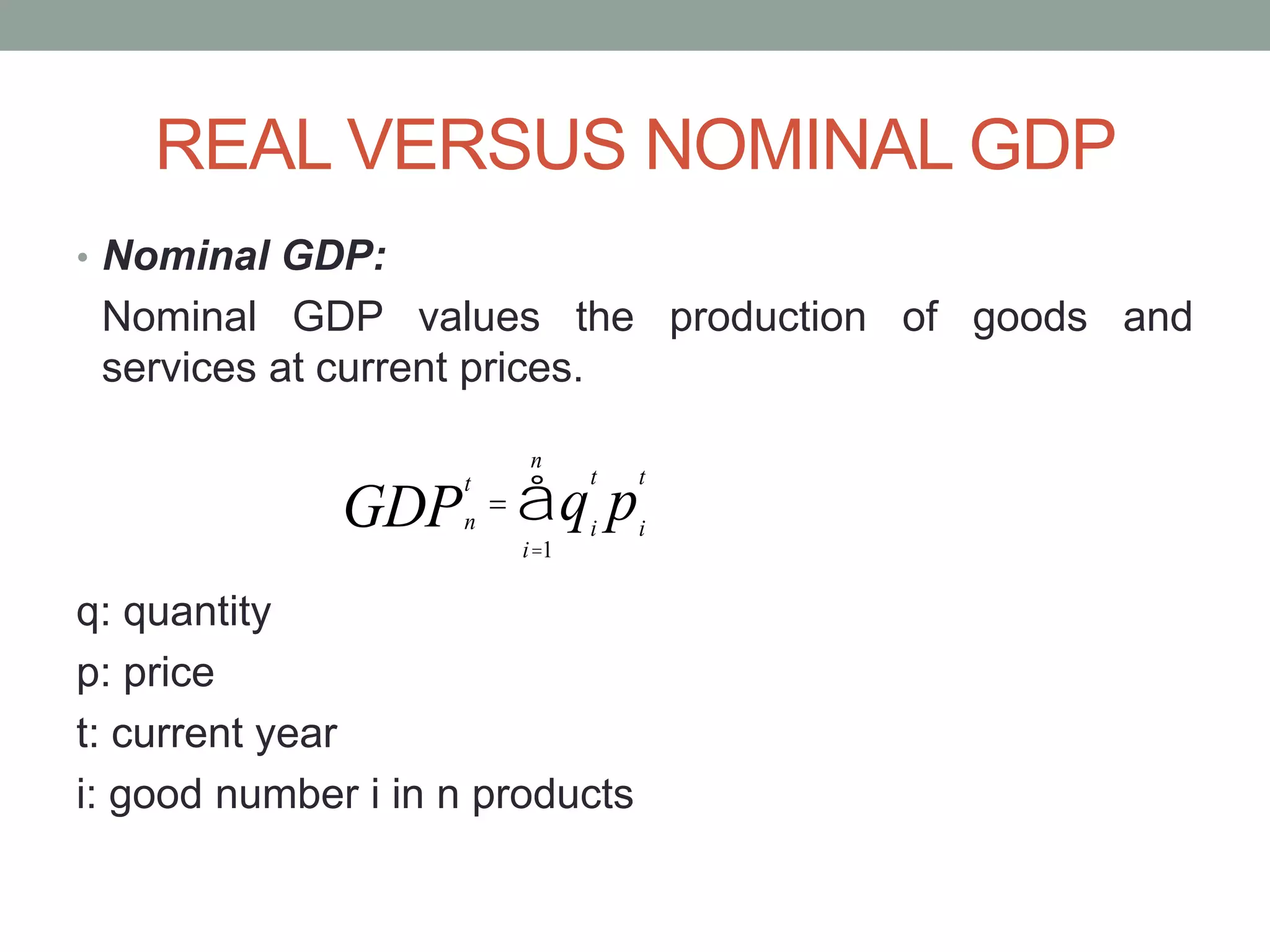
• Nominal GDP:
Nominal GDP values the production of goods and
services at current prices.
q: quantity
p: price
t: current year
i: good number i in n products
n
t
GDP =
i
t
q
i=1
n
å i
t
p
REAL VERSUS NOMINAL GDP
• In reality, GDPn often increases from year to year. Only
looking at GDPn we can not know whether the increase
comes from price or quantity.
REAL VERSUS NOMINAL GDP
• Real GDP (GDPr) values the production of goods and
services at constant prices.
• t = 0 is base year
r
t
GDP =
i
t
q
i=1
n
å i
0
p
REAL VERSUS NOMINAL GDP
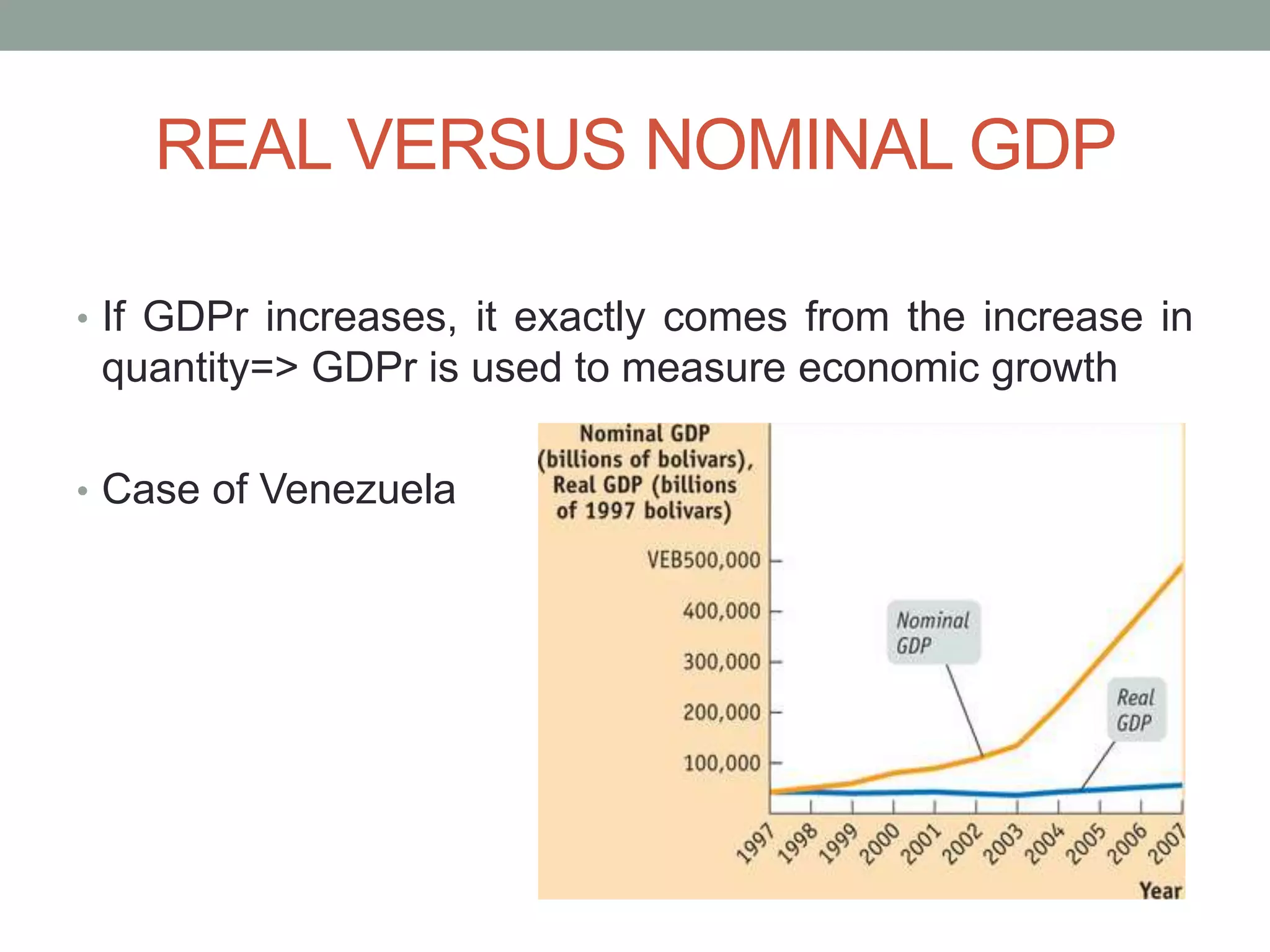
• If GDPr increases, it exactly comes from the increase in
quantity=> GDPr is used to measure economic growth
• Case of Venezuela
GDP deflator
• GDP Deflator-D GDP): The GDP deflator is a measure of
the price level calculated as the ratio of nominal GDP to
real GDP times 100.
• It tells us the rise in nominal GDP that is attributable to a
rise in prices rather than a rise in the quantities produced..
GDP
t
D = n
t
GDP
r
t
GDP
´100
GDPn, GDPr and GDP Deflator
P book Q book P pen Q pen
2011 5 100 3 75
2012 6 150 4 100
2013 7 200 5 150
GDPn, GDPr and GDP Deflator
• 2011 is base year
Year Nominal GDP
2011 100 x 5 + 3 x 75 = 725
2012 6 x 150 + 4 x 100 = 1300
2013 7 x 200 + 5 x 150 = 2150
GDPn, GDPr and GDP Deflator
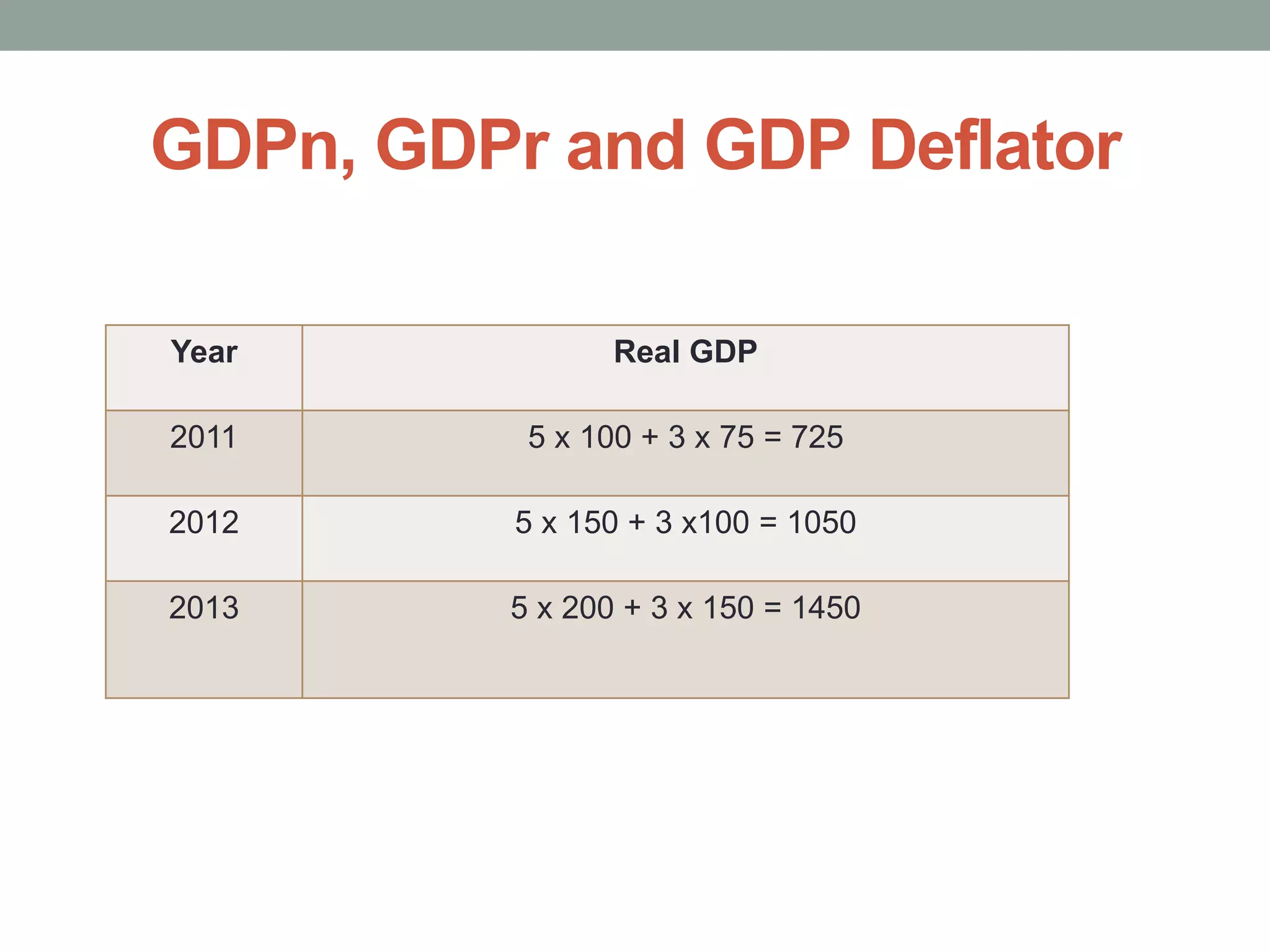
Year Real GDP
2011 5 x 100 + 3 x 75 = 725
2012 5 x 150 + 3 x100 = 1050
2013 5 x 200 + 3 x 150 = 1450
GDPn, GDPr and GDP Deflator
Year D GDP = (GDPn/GDPr) x 100
2011 D GDP = 725/725 x 100 = 100
2012 D GDP = 1300/1050 x 100 = 124
2013 D GDP = 2150/1450 x 100 = 148
GDPn, GDPr and GDP Deflator
Inflation rate in 2012 = (124 – 100)/100 = 24%
Inflation rate in 2013 = (148 – 124)/124 = 19.35%
DISCUSSION
• WHY SHOULD A MANAGER MONITOR GDP GROWTH?
GDP AND ECONOMIC WELLBEING
• GDP is the best single measure of the economic
wellbeing of a society.
• GDP per person tells us the income and expenditure of
the average person in the economy.
• Higher GDP per person indicates a higher standard of
living.
• However, GDP is not a perfect measure of the happiness
or quality of life.
GDP AND ECONOMIC WELLBEING
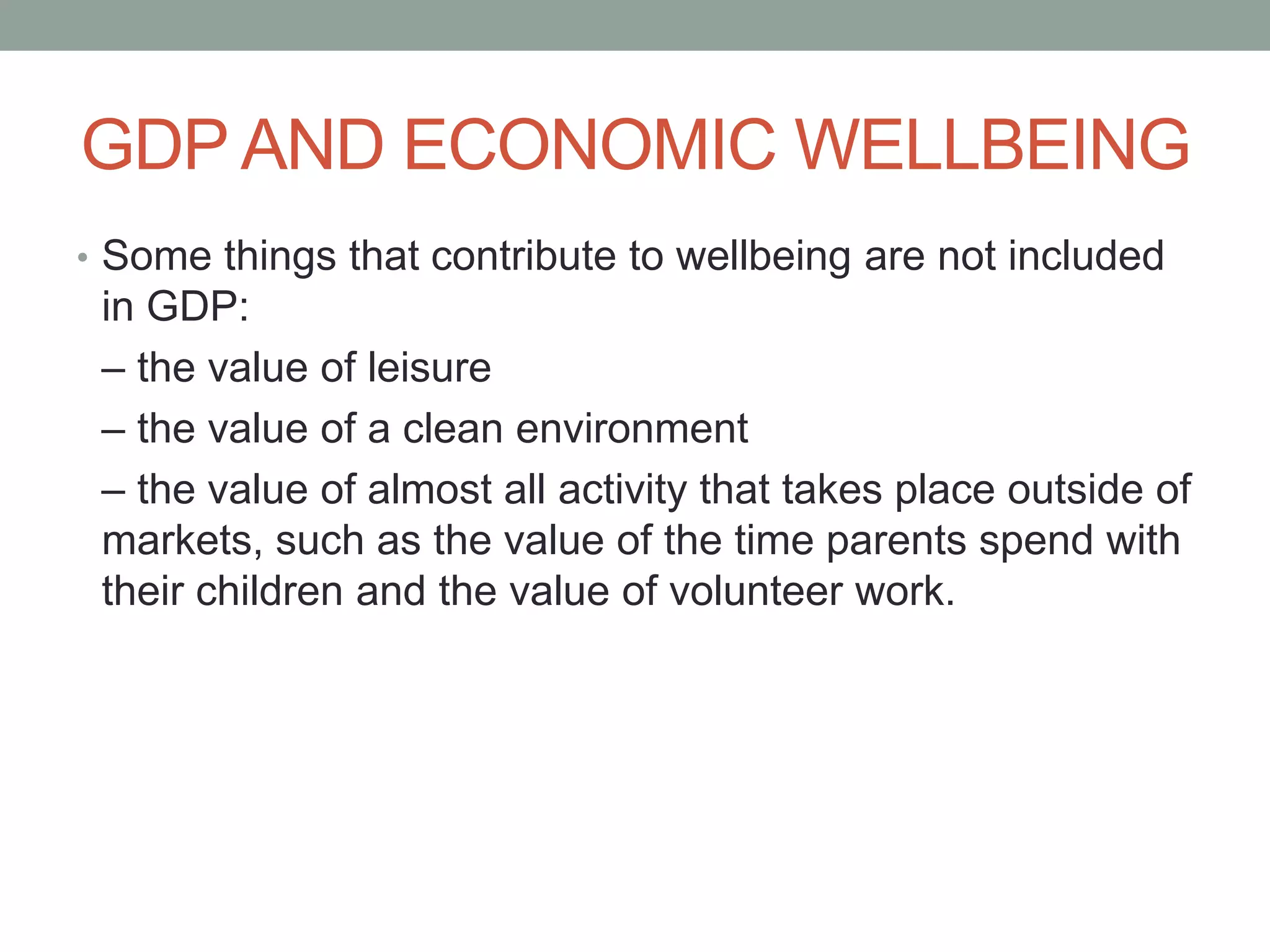
• Some things that contribute to wellbeing are not included
in GDP:
– the value of leisure
– the value of a clean environment
– the value of almost all activity that takes place outside of
markets, such as the value of the time parents spend with
their children and the value of volunteer work.
Net economic welfare (NEW)
• Net economic welfare (NEW)
• NEW = GDP(or GNP) + V1 – V2
• V1: value of rest, value of goods and services which are
not sold, revenue from transactions in black market…
• V2: negative externality for natural resource, environment
such as noise, traffic jam, air pollution…
• NEW reflects welfare better than GNP but it is very
difficult to have enough data to compute NEW. Therefore,
economists still use GDP and GNP
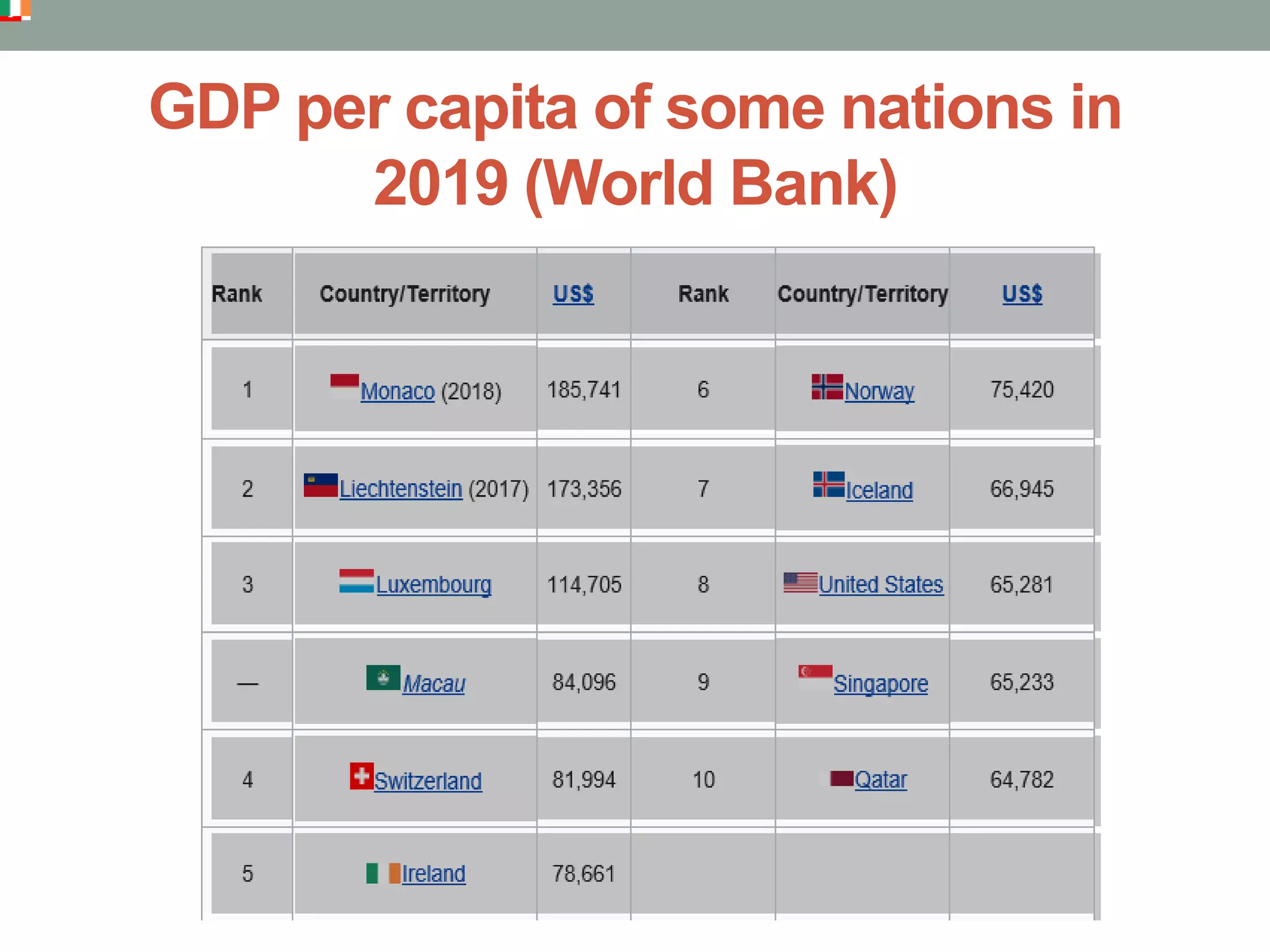
GDP per capita of some nations in
2019 (World Bank)
GDP and the quality of life
Country
Real GDP per
person (2005)
Life
expectancy
Adult literacy
(% of population)
Internet usage
(% of population)
United
States
Japan
Germany
Russia
Mexico
Brazil
China
Indonesia
India
Pakistan
Bangladesh
Nigeria
$41,890
31,267
29,461
10,845
10,751
8,402
6,757
3,843
3,452
2,370
2,053
1,128
78 years
82
79
65
76
72
72
70
64
65
63
47
99%
99
99
99
92
89
91
90
61
50
47
69
63 %
67
45
15
18
19
9
7
3
7
0.3
4
The table shows GDP per person and three other measures of the quality of life
for twelve major countries.
Country
Real GDP per
person (2005)
Life
expectancy
Adult literacy
(% of population)
Internet usage
(% of population)
United
States
Japan
Germany
Russia
Mexico
Brazil
China
Indonesia
India
Pakistan
Bangladesh
Nigeria
$41,890
31,267
29,461
10,845
10,751
8,402
6,757
3,843
3,452
2,370
2,053
1,128
78 years
82
79
65
76
72
72
70
64
65
63
47
99%
99
99
99
92
89
91
90
61
50
47
69
63 %
67
45
15
18
19
9
7
3
7
0.3
4
The table shows GDP per person and three other measures of the quality of life
for twelve major countries.
Consumer Price Index - CPI
CPI
The consumer price index (CPI) is a measure of the overall
cost of the goods and services bought by a typical
consumer.
- When the CPI rises, the typical family has to spend more
dollars to maintain the same standard of living.
- The Vietnamese Bureau of Statistics reports the CPI each
month.
Measurement of CPI in Vietnam
How the CPI is calculated?
B1: Fix the base year and the basket
of goods and services
- Year 2010
- Basket: 10kg rice và 5kg fish
B2: Determine the prices of each of
the goods and services in the basket
for each point in time.
Year P of rice P of fish
2010 3 15
2011 4 17
2012 5 22
B3: Calculate the basket’s cost: Use
the data on prices to calculate the
cost of the basket of goods and
services at different times. CP t =
2010: 3 x 10kg rice + 15 x 5kg fish = 105
2011: 4 x 10kg rice + 17 x 5kg fish = 125
2012: 5 x 10kg rice + 22 x 5kg fish = 160
B4: Compute the index 2010: = (105/105) X 100 = 100
2011: = (125/105) X 100 = 119
2012: = (160/105) X 100 = 152.4
B5: Compute inflation rate Inflation rate year 2011:
(119 - 100)/100 x 100% = 19%
Inflation rate year 2012:
(152.4 – 119)/119 x 100% = 28%
i
0
q
i
t
p
i
t
p
å ´
i
0
q
t
CPI = (
i
t
p
å i
t
q i
0
p
å i
0
q ) ´100
t
CPI -
t-1
CPI
t-1
CPI
´100%
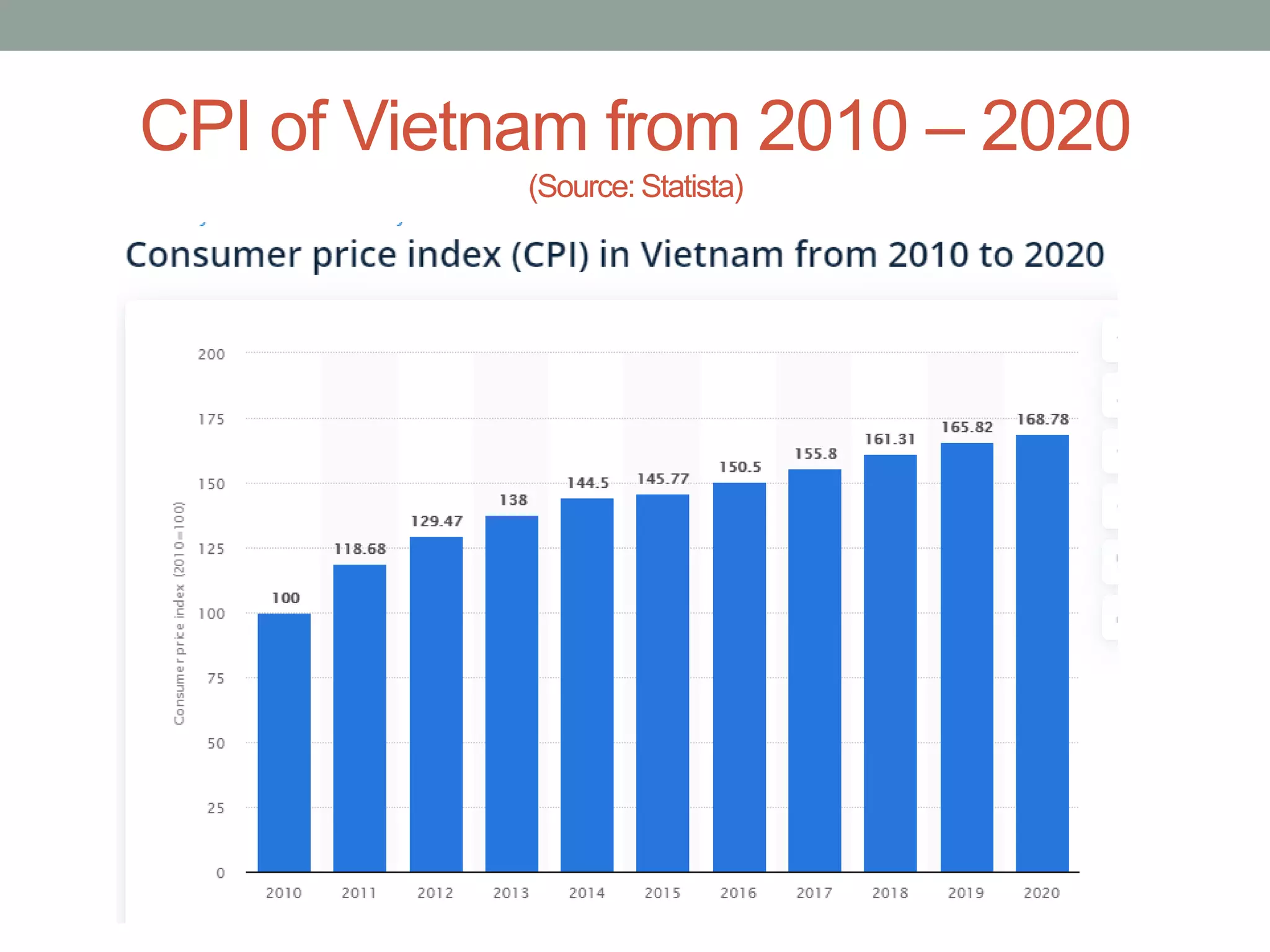
CPI of Vietnam from 2010 – 2020
(Source: Statista)
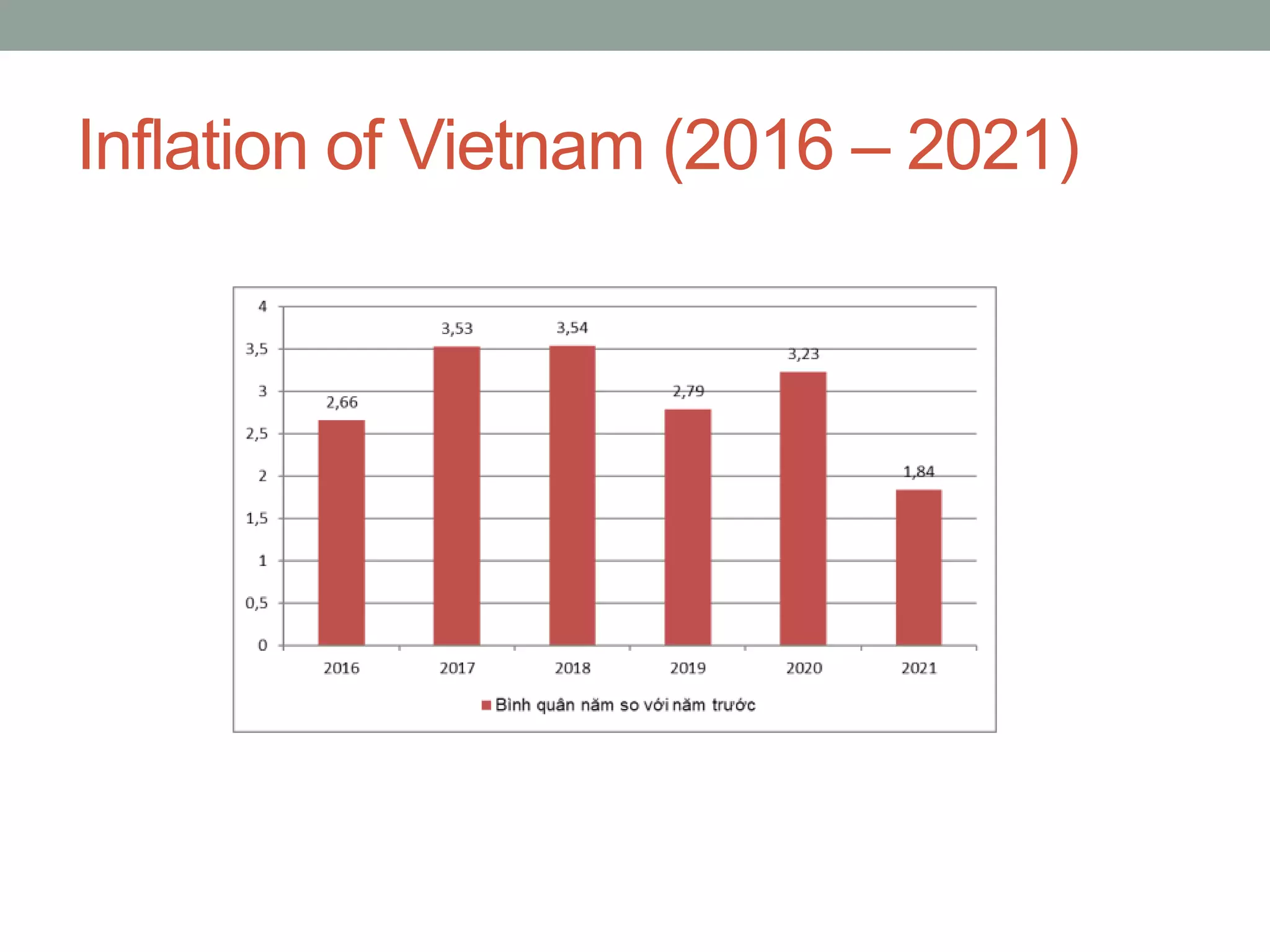
Inflation of Vietnam (2016 – 2021)
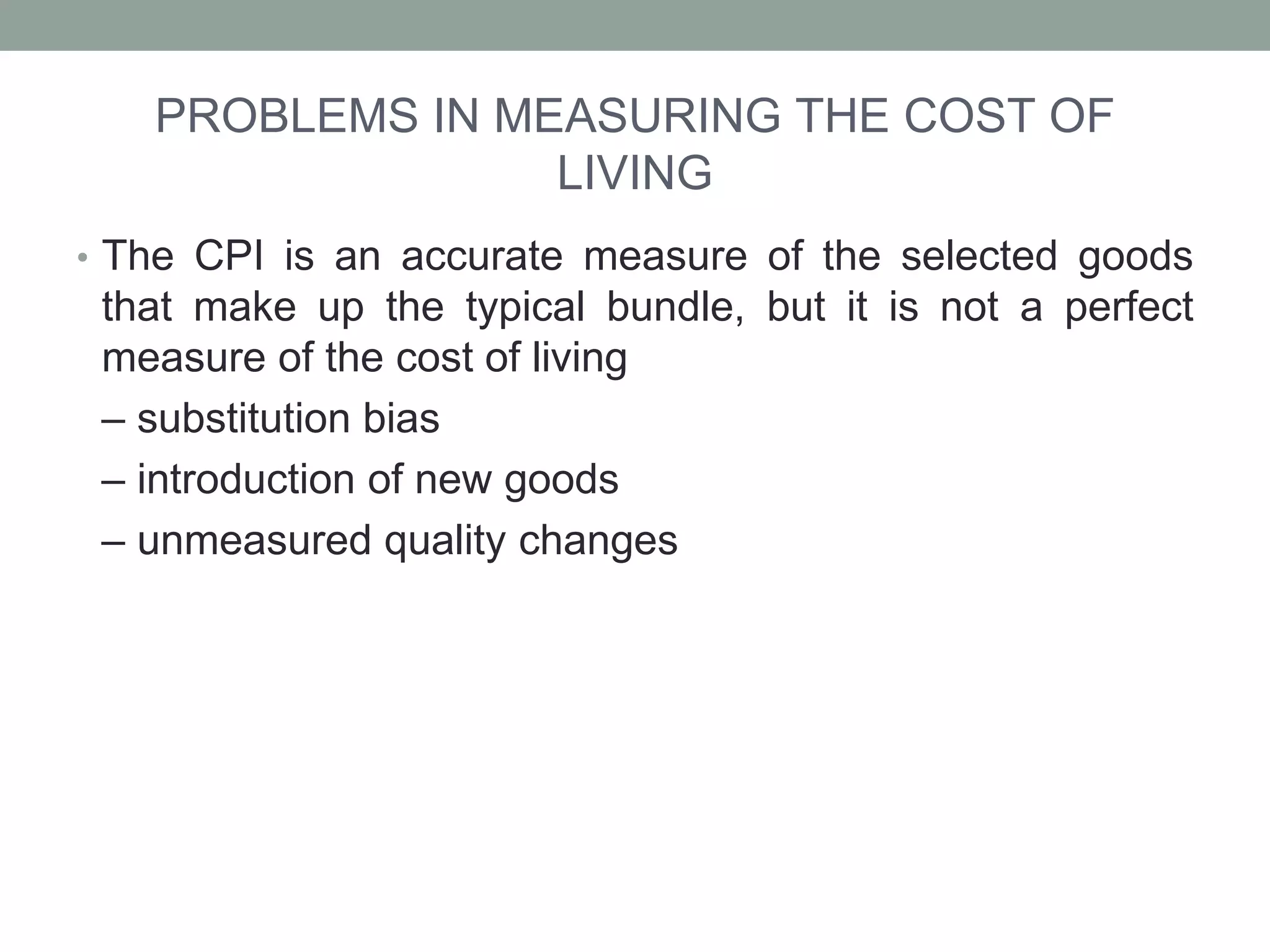
PROBLEMS IN MEASURING THE COST OF
LIVING
• The CPI is an accurate measure of the selected goods
that make up the typical bundle, but it is not a perfect
measure of the cost of living
– substitution bias
– introduction of new goods
– unmeasured quality changes
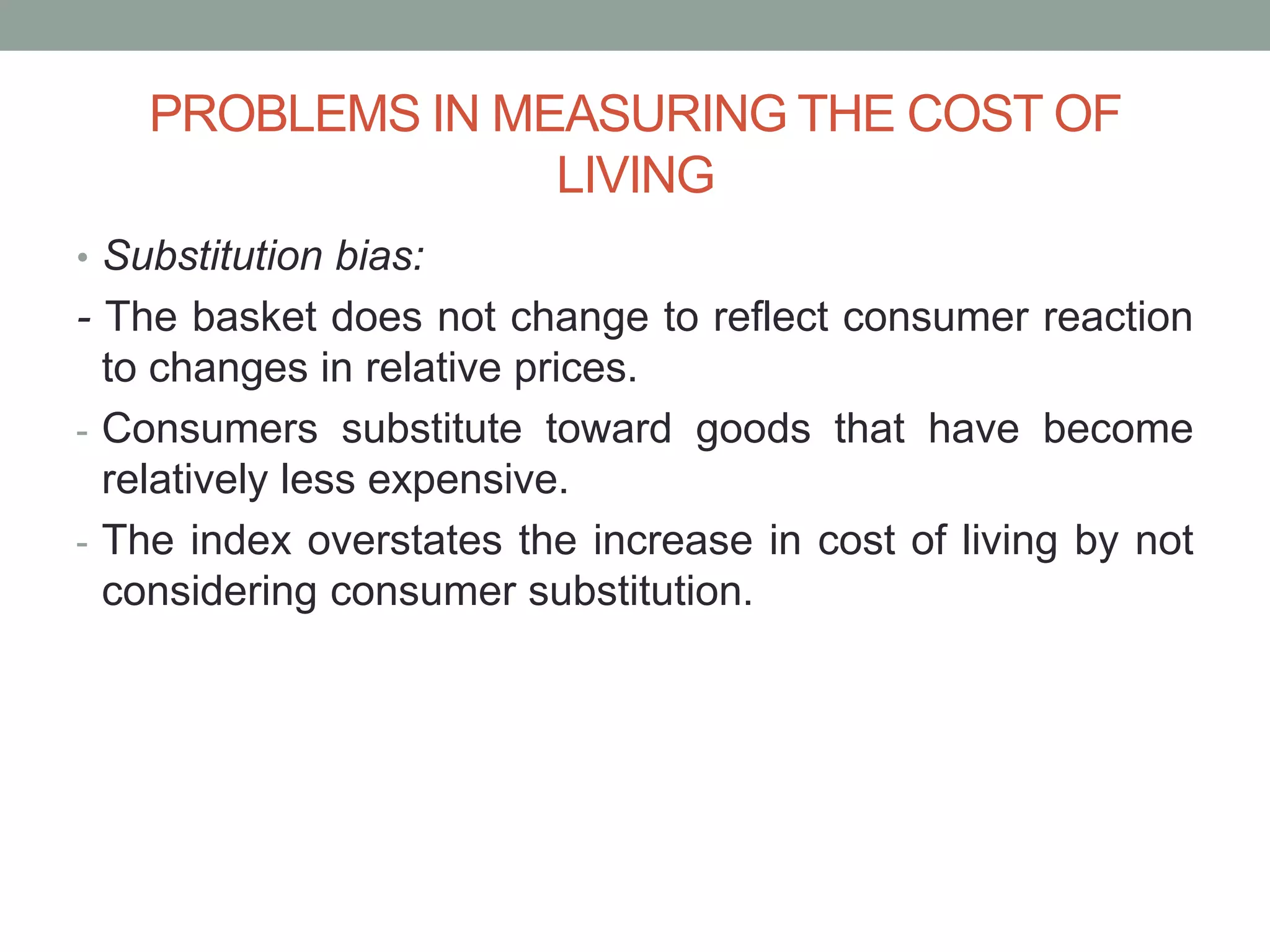
PROBLEMS IN MEASURING THE COST OF
LIVING
• Substitution bias:
- The basket does not change to reflect consumer reaction
to changes in relative prices.
- Consumers substitute toward goods that have become
relatively less expensive.
- The index overstates the increase in cost of living by not
considering consumer substitution.
PROBLEMS IN MEASURING THE
COST OF LIVING
• Introduction of new goods:
- The basket does not reflect the change in purchasing
power brought on by the introduction of new products.
- New products result in greater variety, which in turn
makes each dollar more valuable.
- Consumers need fewer dollars to maintain any given
standard of living.
PROBLEMS IN MEASURING THE COST OF
LIVING
• Unmeasured quality changes
– If the quality of a good rises from one year to the next, the
value of a dollar rises, even if the price of the good stays
the same.
CORRECTING ECONOMIC
VARIABLES FOR THE EFFECTS OF
INFLATION
• Price indexes are used to correct for the effects of inflation
when comparing dollar figures from different times.
DOLLAR FIGURES FROM DIFFERENT TIMES
REALAND NOMINAL INTEREST
RATES
Interest represents a payment in the future for a transfer of
money in the past.
• The nominal interest rate is the interest rate usually
reported and not corrected for inflation. It is the interest
rate that a bank pays.
• The real interest rate is the nominal interest rate that is
corrected for the effects of inflation.
REALAND NOMINAL INTEREST
RATES
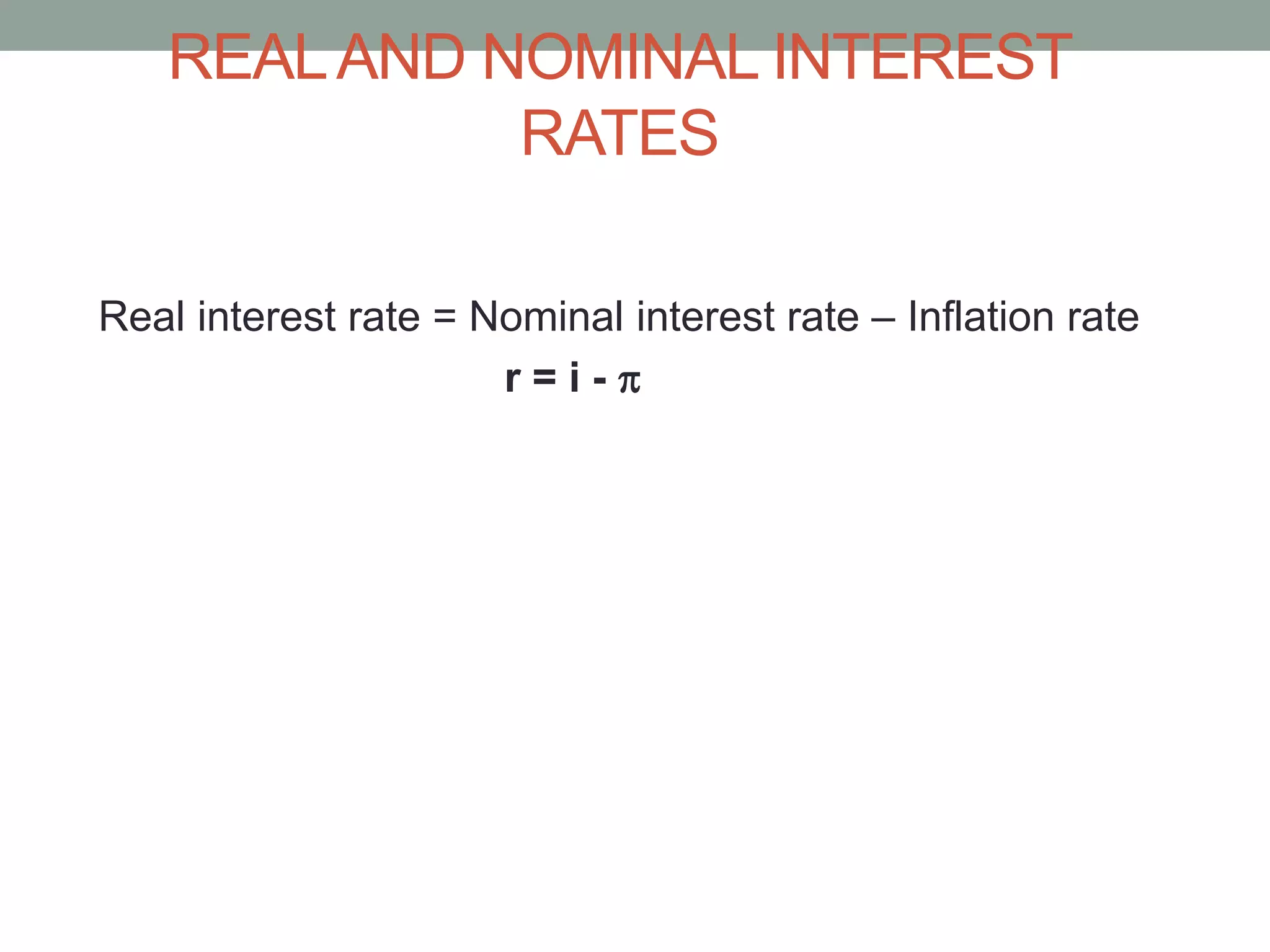
Real interest rate = Nominal interest rate – Inflation rate
r = i - 
Questions
1. GDP is equal to
a. The total value of goods and services produced in an economy during a
given period
b. C + I +G +IM
c. The total value of intermediate goods plus final goods
d. The total income received by producers of final goods and services
2. Which of the following is included in GDP?
a. Changes to inventories
b. Intermediate goods
c. Used goods
d. Financial assets
e. Foreign produced goods
Questions
3. Which is the following is not included in GDP:
a. Capital goods such as machinery
b. Imports
c. The value of domestically produced services
d. Government purchases of goods and services
e. The construction of structures

C2 - GDP.pptx

  • 1.
    MACROECONOMICS Le Phuong ThaoQuynh FACULTY OF INTERNATIONAL ECONOMICS Email: quynhlpt@ftu.edu.vn
  • 2.
  • 3.
    MEASURING A NATION’SINCOME • Macroeconomics answers questions such as: – Why is average income high in some countries and low in others? – Why do prices rise rapidly in some periods while they are more stable in other periods? – Why do production and employment expand in some years and contract in others?
  • 4.
    THE ECONOMY’S INCOMEAND EXPENDITURE • When judging whether the economy is doing well or poorly, it is natural to look at the total income that everyone in the economy is earning.
  • 5.
    THE ECONOMY’S INCOMEAND EXPENDITURE • For an economy as a whole, income must equal expenditure because: – Every transaction has a buyer and a seller. – Every dollar of spending by some buyer is a dollar of income for some seller.
  • 6.
    THE MEASUREMENT OFGDP • Gross domestic product (GDP) is a measure of the total income and expenditures of an economy. • It is the total market value of all final goods and services produced within a country in a given period of time.
  • 7.
    THE MEASUREMENT OFGDP • ‘GDP is the market value ...’ – Output is valued at market prices. • ‘... of all final ...’– It records only the value of final goods, not intermediate goods (the value is counted only once). • ‘... goods and services ...’– It includes both tangible goods (food, clothing, cars) and intangible services (haircuts, house cleaning, doctors’ visits).
  • 8.
    THE MEASUREMENT OFGDP • ‘... produced ...’– It includes goods and services currently produced, not transactions involving goods produced in the past. • • ‘... within a country ...’– It measures the value of production within the geographic confines of a country. • ‘... in a given period of time.’– It measures the value of production that takes place within a specific interval of time, usually a year or a quarter (three months).
  • 9.
    THE COMPONENTS OFGDP • GDP includes all items produced in the economy and sold legally in markets. • What is not counted in GDP? – GDP excludes most items that are produced and consumed at home and that never enter the marketplace. – It excludes items produced and sold illicitly, such as illegal drugs.
  • 10.
  • 11.
    THE CIRCULAR-FLOW DIAGRAM •Sectors of a simple economy: 1) Households – contain all the people 2) Firms – all the business enterprises
  • 12.
    THE CIRCULAR-FLOW DIAGRAM Sectorsare connected by 2 markets: factor and product market: 1) Households sell productive services to firms through factor markets - The factors of production are land, labor, capital. - When households sell productive services to firms, they receive income: wages, rent, profits, interest 2) Firms sell goods & services in product markets - The income of firms in this market is also the expenditure of households
  • 13.
    THE CIRCULAR-FLOW DIAGRAM -Underlying principle of the circular flow: the dollar inflow into each market or sector must equal the dollar outflow from each market or sector - So, total production = total spending = total income
  • 14.
    COMPONENTS OF GDP •GDP (Y) is the sum of the following: – consumption (C) – investment (I) – government purchases (G) – net exports (NX) Y = C + I + G + NX
  • 15.
    COMPONENTS OF GDP •Consumption (C): – The spending by households on goods and services, with the exception of purchases of new housing. • Investment (I): – The spending on capital equipment, inventories and structures, including household purchases of new housing.
  • 16.
    COMPONENTS OF GDP •Government purchases (G): – The spending on goods and services by local, State and federal governments – Does not include transfer payments because they are not made in exchange for currently produced goods or services • Net exports (NX): Exports minus imports. NX = X - M
  • 18.
    Problems and applications Whathappens to GDP’s components when: • A household buy a new refrigerator • You buy a new house • A company sells its last year’s inventory • You buy a pizza • Hochiminh City constructs a new bridge • Your parent buy a bottle of wine which was imported from France • A factory buys new machines for production
  • 19.
    REAL VERSUS NOMINALGDP • Nominal GDP: Nominal GDP values the production of goods and services at current prices. q: quantity p: price t: current year i: good number i in n products n t GDP = i t q i=1 n å i t p
  • 20.
    REAL VERSUS NOMINALGDP • In reality, GDPn often increases from year to year. Only looking at GDPn we can not know whether the increase comes from price or quantity.
  • 21.
    REAL VERSUS NOMINALGDP • Real GDP (GDPr) values the production of goods and services at constant prices. • t = 0 is base year r t GDP = i t q i=1 n å i 0 p
  • 22.
    REAL VERSUS NOMINALGDP • If GDPr increases, it exactly comes from the increase in quantity=> GDPr is used to measure economic growth • Case of Venezuela
  • 23.
    GDP deflator • GDPDeflator-D GDP): The GDP deflator is a measure of the price level calculated as the ratio of nominal GDP to real GDP times 100. • It tells us the rise in nominal GDP that is attributable to a rise in prices rather than a rise in the quantities produced.. GDP t D = n t GDP r t GDP ´100
  • 24.
    GDPn, GDPr andGDP Deflator P book Q book P pen Q pen 2011 5 100 3 75 2012 6 150 4 100 2013 7 200 5 150
  • 25.
    GDPn, GDPr andGDP Deflator • 2011 is base year Year Nominal GDP 2011 100 x 5 + 3 x 75 = 725 2012 6 x 150 + 4 x 100 = 1300 2013 7 x 200 + 5 x 150 = 2150
  • 26.
    GDPn, GDPr andGDP Deflator Year Real GDP 2011 5 x 100 + 3 x 75 = 725 2012 5 x 150 + 3 x100 = 1050 2013 5 x 200 + 3 x 150 = 1450
  • 27.
    GDPn, GDPr andGDP Deflator Year D GDP = (GDPn/GDPr) x 100 2011 D GDP = 725/725 x 100 = 100 2012 D GDP = 1300/1050 x 100 = 124 2013 D GDP = 2150/1450 x 100 = 148
  • 28.
    GDPn, GDPr andGDP Deflator Inflation rate in 2012 = (124 – 100)/100 = 24% Inflation rate in 2013 = (148 – 124)/124 = 19.35%
  • 29.
    DISCUSSION • WHY SHOULDA MANAGER MONITOR GDP GROWTH?
  • 30.
    GDP AND ECONOMICWELLBEING • GDP is the best single measure of the economic wellbeing of a society. • GDP per person tells us the income and expenditure of the average person in the economy. • Higher GDP per person indicates a higher standard of living. • However, GDP is not a perfect measure of the happiness or quality of life.
  • 31.
    GDP AND ECONOMICWELLBEING • Some things that contribute to wellbeing are not included in GDP: – the value of leisure – the value of a clean environment – the value of almost all activity that takes place outside of markets, such as the value of the time parents spend with their children and the value of volunteer work.
  • 32.
    Net economic welfare(NEW) • Net economic welfare (NEW) • NEW = GDP(or GNP) + V1 – V2 • V1: value of rest, value of goods and services which are not sold, revenue from transactions in black market… • V2: negative externality for natural resource, environment such as noise, traffic jam, air pollution… • NEW reflects welfare better than GNP but it is very difficult to have enough data to compute NEW. Therefore, economists still use GDP and GNP
  • 33.
    GDP per capitaof some nations in 2019 (World Bank)
  • 34.
    GDP and thequality of life Country Real GDP per person (2005) Life expectancy Adult literacy (% of population) Internet usage (% of population) United States Japan Germany Russia Mexico Brazil China Indonesia India Pakistan Bangladesh Nigeria $41,890 31,267 29,461 10,845 10,751 8,402 6,757 3,843 3,452 2,370 2,053 1,128 78 years 82 79 65 76 72 72 70 64 65 63 47 99% 99 99 99 92 89 91 90 61 50 47 69 63 % 67 45 15 18 19 9 7 3 7 0.3 4 The table shows GDP per person and three other measures of the quality of life for twelve major countries. Country Real GDP per person (2005) Life expectancy Adult literacy (% of population) Internet usage (% of population) United States Japan Germany Russia Mexico Brazil China Indonesia India Pakistan Bangladesh Nigeria $41,890 31,267 29,461 10,845 10,751 8,402 6,757 3,843 3,452 2,370 2,053 1,128 78 years 82 79 65 76 72 72 70 64 65 63 47 99% 99 99 99 92 89 91 90 61 50 47 69 63 % 67 45 15 18 19 9 7 3 7 0.3 4 The table shows GDP per person and three other measures of the quality of life for twelve major countries.
  • 35.
  • 36.
    CPI The consumer priceindex (CPI) is a measure of the overall cost of the goods and services bought by a typical consumer. - When the CPI rises, the typical family has to spend more dollars to maintain the same standard of living. - The Vietnamese Bureau of Statistics reports the CPI each month.
  • 37.
  • 38.
    How the CPIis calculated? B1: Fix the base year and the basket of goods and services - Year 2010 - Basket: 10kg rice và 5kg fish B2: Determine the prices of each of the goods and services in the basket for each point in time. Year P of rice P of fish 2010 3 15 2011 4 17 2012 5 22 B3: Calculate the basket’s cost: Use the data on prices to calculate the cost of the basket of goods and services at different times. CP t = 2010: 3 x 10kg rice + 15 x 5kg fish = 105 2011: 4 x 10kg rice + 17 x 5kg fish = 125 2012: 5 x 10kg rice + 22 x 5kg fish = 160 B4: Compute the index 2010: = (105/105) X 100 = 100 2011: = (125/105) X 100 = 119 2012: = (160/105) X 100 = 152.4 B5: Compute inflation rate Inflation rate year 2011: (119 - 100)/100 x 100% = 19% Inflation rate year 2012: (152.4 – 119)/119 x 100% = 28% i 0 q i t p i t p å ´ i 0 q t CPI = ( i t p å i t q i 0 p å i 0 q ) ´100 t CPI - t-1 CPI t-1 CPI ´100%
  • 39.
    CPI of Vietnamfrom 2010 – 2020 (Source: Statista)
  • 40.
    Inflation of Vietnam(2016 – 2021)
  • 41.
    PROBLEMS IN MEASURINGTHE COST OF LIVING • The CPI is an accurate measure of the selected goods that make up the typical bundle, but it is not a perfect measure of the cost of living – substitution bias – introduction of new goods – unmeasured quality changes
  • 42.
    PROBLEMS IN MEASURINGTHE COST OF LIVING • Substitution bias: - The basket does not change to reflect consumer reaction to changes in relative prices. - Consumers substitute toward goods that have become relatively less expensive. - The index overstates the increase in cost of living by not considering consumer substitution.
  • 43.
    PROBLEMS IN MEASURINGTHE COST OF LIVING • Introduction of new goods: - The basket does not reflect the change in purchasing power brought on by the introduction of new products. - New products result in greater variety, which in turn makes each dollar more valuable. - Consumers need fewer dollars to maintain any given standard of living.
  • 44.
    PROBLEMS IN MEASURINGTHE COST OF LIVING • Unmeasured quality changes – If the quality of a good rises from one year to the next, the value of a dollar rises, even if the price of the good stays the same.
  • 45.
    CORRECTING ECONOMIC VARIABLES FORTHE EFFECTS OF INFLATION • Price indexes are used to correct for the effects of inflation when comparing dollar figures from different times.
  • 46.
    DOLLAR FIGURES FROMDIFFERENT TIMES
  • 47.
    REALAND NOMINAL INTEREST RATES Interestrepresents a payment in the future for a transfer of money in the past. • The nominal interest rate is the interest rate usually reported and not corrected for inflation. It is the interest rate that a bank pays. • The real interest rate is the nominal interest rate that is corrected for the effects of inflation.
  • 48.
    REALAND NOMINAL INTEREST RATES Realinterest rate = Nominal interest rate – Inflation rate r = i - 
  • 49.
    Questions 1. GDP isequal to a. The total value of goods and services produced in an economy during a given period b. C + I +G +IM c. The total value of intermediate goods plus final goods d. The total income received by producers of final goods and services 2. Which of the following is included in GDP? a. Changes to inventories b. Intermediate goods c. Used goods d. Financial assets e. Foreign produced goods
  • 50.
    Questions 3. Which isthe following is not included in GDP: a. Capital goods such as machinery b. Imports c. The value of domestically produced services d. Government purchases of goods and services e. The construction of structures

Editor's Notes

  • #7 - How 1 country generates income? By producing goods and services and sell them => Income of one country is measured by GDP.
  • #8 - Bread and Wheat => bakeries
  • #17 Transfer payment: social security, unemployment insurance, benefits for disabled.
  • #20 GDP danh nghĩa là giá trị sản lượng hàng hóa và dịch vụ tính theo giá hiện hành. Nó bằng tổng lượng hàng hóa và dịch vụ sản xuất ra trong một năm nhân với giá hàng hóa và dịch vụ ấy trong năm đó.
  • #22 Năm gốc hiện tại được dùng để tính GDP Việt Nam là 1994.
  • #31 MONEY, IF IT DOES NOT BRING YOU HAPPINESS, WILL AT LEAST HELP YOU BE MISERABLE IN COMFORT.
  • #36 Năm 2000, lương của một công nhân nhà máy dệt là 1 triệu đồng/ tháng. Tới năm 2008, lương của một công nhân cũng làm việc ở vị trí đó là 2,5 triệu đồng/ tháng. Nhìn vào hai con số này, bạn có thể nghĩ rằng ngành dệt may ngày càng phát triển, người công nhân kiếm được nhiều tiền hơn. Song thực tế, như mọi người đều biết, từ năm 2000 tới năm 2008 giá cả hàng hóa và dịch vụ cũng tăng thêm rất nhiều. Năm 2000, 5000đ có thể mua được một bát phở, 10000đ một vé xem phim. Nên khó có thể kết luận người công nhân nhà máy dệt ở thời điểm nào được hưởng thụ mức sống tốt hơn.
  • #37 Giải thích: mức giá trung bình, giỏ hàng hóa và dịch vụ, người tiêu dùng điển hình. CPI là một chỉ tiêu tương đối phản ánh sự biến động của giá bán lẻ hàng hóa và dịch vụ dùng trong sinh hoạt của người dân. Bởi vậy, nó được dùng để theo dõi sự thay đổi chi phí sinh hoạt theo thời gian.
  • #38 Tuy nhiên từ năm 2010, Tổng Cục Thống Kê đã thay đổi rổ hàng hóa tính CPI. Theo đó, tỉ trọng của lương thực thực phẩm giảm xuống còn 39,93% thay vì mức 42,85% như cách tính từ năm 2005. Giá lương thực ở Việt Nam có độ dao động cao, với tỉ trọng cao của thực phẩm thì tổng chỉ số giá tiêu dùng bị ảnh hưởng rất lớn.
  • #40 Lam phat 2013 la 6.04% thap nhat trong 10 năm. Năm 2014: gần 4% FICA - Lạm phát trong năm nay chủ yếu do tác động của các hàng hóa, dịch vụ công như điện, xăng dầu, giá gas, giáo dục và y tế.
  • #42 CPI được dùng để tính toán tỷ lệ lạm phát của nền kinh tế, chính phủ cũng sử dụng CPI để xác định hướng điều chỉnh chi phí sinh hoạt, ngân hàng sử dụng CPI để điều chỉnh lãi suất tiền gửi và tiền cho vay
  • #43 VD: Năm ngoái, táo rẻ hơn lê, người tiêu dùng mua nhiều táo hơn lê và khi thiết lập giỏ hàng hóa, Tổng cục thống kê đưa táo vào giỏ hàng nhiều hơn lê. Nhưng năm nay, lê lại rẻ hơn táo, người tiêu dùng chuyển sang mua nhiều lê hơn và ít táo đi. Nhưng khi tính CPI, Tổng cục thống kê vẫn sử dụng giỏ hàng cũ nghĩa là vẫn cho rằng người tiêu dùng tiếp tục mua lượng táo như cũ mà bây giờ đã trở nên đắt hơn trước => CPI sẽ phản ánh mức giá sinh hoạt cao hơn so với thực tế.
  • #44 VD: Khi bếp gas xuất hiện, người tiêu dùng có thêm sự lựa chọn mới. Rõ ràng so với bếp điện, sử dụng bếp gas tiện dụng và rẻ hơn. Một chỉ số phản ánh giá sinh hoạt hoàn hảo phải chỉ ra sự xuất hiện của bếp gas làm cho giá sinh hoạt thấp hơn. Tuy nhiên, CPI lại không giảm khi có sự xuất hiện của bếp gas. Cuối cùng, tổng cục thống kê phải điều chỉnh giỏ hàng để tính đến bếp gas và do vậy CPI phản ánh sự thay đổi của giá bếp gas. Nhưng ban đầu sự giảm sút của giá tiêu dùng liên quan tới sự xuất hiện của bếp gas vẫn không được tính trong CPI.
  • #45 VD: Chiếc xe Toyota năm 2008 có công suất lớn hơn và tiết kiệm nhiên liệu hơn so với năm 2007, nhưng giá của nó tăng thêm 5%. Nếu như điều chỉnh theo chất lượng thay đổi thì giá của chiếc xe coi như là không tăng. Nhưng khi tính vào CPI thì giá của chiếc xe vẫn được tính tăng thêm 5%.
  • #47 Doanh thu cua Cuon theo chieu gio la 129M nam 1939 Kể từ khi được phát hành năm 1939, "Cuốn theo chiều gió" đã mang lại 5.4 tỉ đô la (gấp nhiều lần so với con số 1.84 tỉ đô la doanh thu phòng vé mà Titanic kiếm được, tính đến thời điểm này).