Chapter VI: MACROECONOMICS
1
Macro Economics
 Objectives of macroeconomics
 Basic problems of macroeconomics
 National Income Accounting
 Approaches in measuring GDP(Measures of Output)
 Nominal GDP Vs Real GDP
 GDP Per Capita
 Shortcomings of GDP as a Measure of Economic
Well-Being.
 Business cycle
 Unemployment
 Inflation
Contents:
2
Introduction
 Macroeconomics focuses on the economic behavior and policies
that affect consumption, investment, determinants of changes
in wages and prices, monetary and fiscal policies (such as
taxation, money stock, government budget, interest rate, etc).
 It is recognized since early periods that human beings are not
self-sufficient in production of goods and services, hence
exchange in between nations/regions too;
 In modern economic view development highly depend on trade
among nations/countries: trade policies (import substitution,
export promotion) and exchange policies (fixed, managerial or
floating);
 How a country maintains healthy inflow of capital in the form of
foreign direct investment >> open-macroeconomic
3
The Basic Problems in Macro-
economics:
 Business cycle
 Unemployment
 Inflation
 Budget deficit
 Balance of Payment (BoP) deficit [Trade &
Current account balances, Foreign investment, Borrowings &
repayment]
 Income distribution 4
The objectives of Macro-Economics:
High economic growth
Reduced unemployment
Stable inflation
Reduce budget deficit and balance of payment
(BoP) deficit
Fair income distribution
5
 Gross Domestic product (GDP)
 Government expenditure
 Total money supply
 Inflation
 Trade Balance
 Current Account Balance
 Balance of Payment (BoP)
 Exchange Rate
6
3.1 National Income Accounting
Elements of National Economy:
Measures of Output (Production)
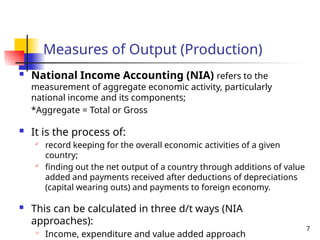
 National Income Accounting (NIA) refers to the
measurement of aggregate economic activity, particularly
national income and its components;
*Aggregate = Total or Gross
 It is the process of:
 record keeping for the overall economic activities of a given
country;
 finding out the net output of a country through additions of value
added and payments received after deductions of depreciations
(capital wearing outs) and payments to foreign economy.
 This can be calculated in three d/t ways (NIA
approaches):
 Income, expenditure and value added approach
7
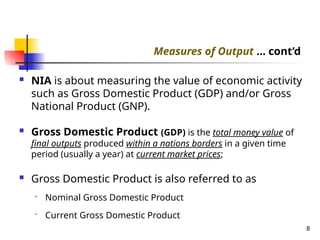
 NIA is about measuring the value of economic activity
such as Gross Domestic Product (GDP) and/or Gross
National Product (GNP).
 Gross Domestic Product (GDP) is the total money value of
final outputs produced within a nations borders in a given time
period (usually a year) at current market prices;
 Gross Domestic Product is also referred to as
• Nominal Gross Domestic Product
• Current Gross Domestic Product
8
Measures of Output … cont’d
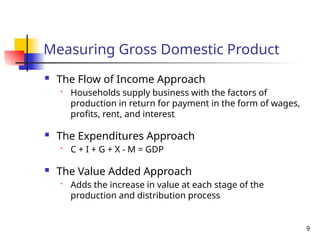
Measuring Gross Domestic Product
 The Flow of Income Approach
• Households supply business with the factors of
production in return for payment in the form of wages,
profits, rent, and interest
 The Expenditures Approach
• C + I + G + X - M = GDP
 The Value Added Approach
• Adds the increase in value at each stage of the
production and distribution process
9
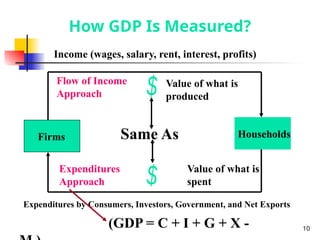
How GDP Is Measured?
Households
Firms
Income (wages, salary, rent, interest, profits)
Expenditures by Consumers, Investors, Government, and Net Exports
Same As
Value of what is
produced
Value of what is
spent
Flow of Income
Approach
Expenditures
Approach
(GDP = C + I + G + X - 10
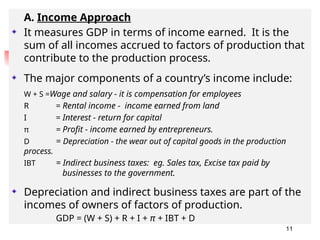
A. Income Approach
It measures GDP in terms of income earned. It is the
sum of all incomes accrued to factors of production that
contribute to the production process.
The major components of a country’s income include:
W + S =Wage and salary - it is compensation for employees
R = Rental income - income earned from land
I = Interest - return for capital
π = Profit - income earned by entrepreneurs.
D = Depreciation - the wear out of capital goods in the production
process.
IBT = Indirect business taxes: eg. Sales tax, Excise tax paid by
businesses to the government.
Depreciation and indirect business taxes are part of the
incomes of owners of factors of production.
GDP = (W + S) + R + I + π + IBT + D
11
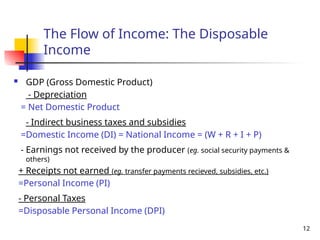
The Flow of Income: The Disposable
Income
 GDP (Gross Domestic Product)
- Depreciation
= Net Domestic Product
- Indirect business taxes and subsidies
=Domestic Income (DI) = National Income = (W + R + I + P)
- Earnings not received by the producer (eg. social security payments &
others)
+ Receipts not earned (eg. transfer payments recieved, subsidies, etc.)
=Personal Income (PI)
- Personal Taxes
=Disposable Personal Income (DPI)
12
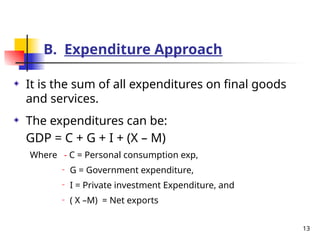
B. Expenditure Approach
It is the sum of all expenditures on final goods
and services.
The expenditures can be:
GDP = C + G + I + (X – M)
Where - C = Personal consumption exp,
− G = Government expenditure,
− I = Private investment Expenditure, and
− ( X –M) = Net exports
13
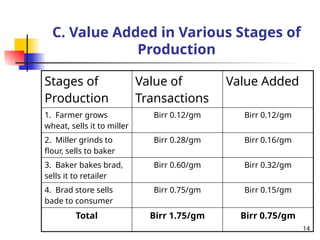
C. Value Added in Various Stages of
Production
Stages of
Production
Value of
Transactions
Value Added
1. Farmer grows
wheat, sells it to miller
Birr 0.12/gm Birr 0.12/gm
2. Miller grinds to
flour, sells to baker
Birr 0.28/gm Birr 0.16/gm
3. Baker bakes brad,
sells it to retailer
Birr 0.60/gm Birr 0.32/gm
4. Brad store sells
bade to consumer
Birr 0.75/gm Birr 0.15/gm
Total Birr 1.75/gm Birr 0.75/gm
14
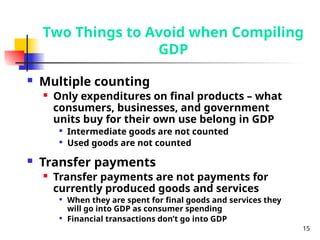
Two Things to Avoid when Compiling
GDP
 Multiple counting
 Only expenditures on final products – what
consumers, businesses, and government
units buy for their own use belong in GDP

Intermediate goods are not counted

Used goods are not counted
 Transfer payments
 Transfer payments are not payments for
currently produced goods and services

When they are spent for final goods and services they
will go into GDP as consumer spending

Financial transactions don’t go into GDP
15
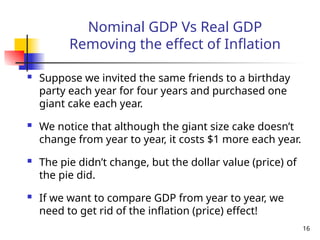
Nominal GDP Vs Real GDP
Removing the effect of Inflation
 Suppose we invited the same friends to a birthday
party each year for four years and purchased one
giant cake each year.
 We notice that although the giant size cake doesn’t
change from year to year, it costs $1 more each year.
 The pie didn’t change, but the dollar value (price) of
the pie did.
 If we want to compare GDP from year to year, we
need to get rid of the inflation (price) effect!
16
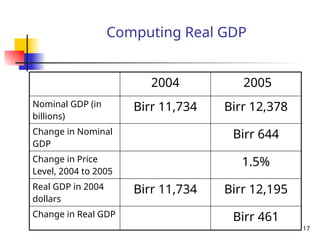
Computing Real GDP
2004 2005
Nominal GDP (in
billions)
Birr 11,734 Birr 12,378
Change in Nominal
GDP
Birr 644
Change in Price
Level, 2004 to 2005
1.5%
Real GDP in 2004
dollars
Birr 11,734 Birr 12,195
Change in Real GDP Birr 461
17
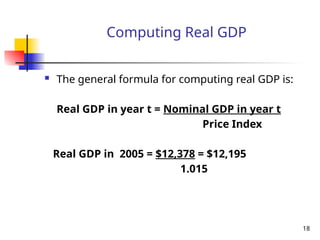
Computing Real GDP
 The general formula for computing real GDP is:
Real GDP in year t = Nominal GDP in year t
Price Index
Real GDP in 2005 = $12,378 = $12,195
1.015
18
GDP and the “GDP Deflator”
 To correct Nominal GDP for price increases from
one year to the next, we must calculate real GDP
using a Price Index.
 For GDP price adjustments, this price index is
called the GDP Deflator and is calculated quarterly
by the Department of Commerce.
 A price index is an index number that shows how
the average prices of goods change over time.
Based on percentage change from a “base year”.
19
International Comparisons of GDP
 International Comparisons of GDP are difficult for
a number of reasons:
1. Different countries use different national
income
accounting systems
2. International exchange rates into dollars
fluctuate
3. Data from other countries may be unreliable
20
Per Capita GDP
 Per Capita GDP calculations attempt to give us
additional information about how we are doing as
an economy.
 Per Capita GDP calculations may be a better
measure of the standard of living.
• For citizens living in the same country over time
• For comparing standards of living between citizens of
different countries
21
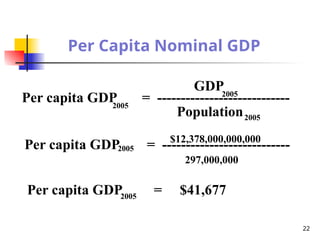
Per Capita Nominal GDP
Per capita GDP = ----------------------------
GDP
Population
2005
2005
2005
Per capita GDP = ---------------------------
$12,378,000,000,000
297,000,000
Per capita GDP = $41,677
2005
2005
22
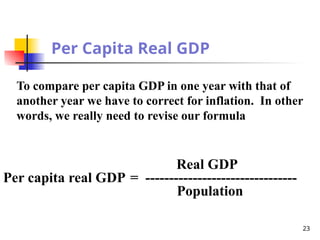
Per Capita Real GDP
Per capita real GDP = --------------------------------
Real GDP
Population
To compare per capita GDP in one year with that of
another year we have to correct for inflation. In other
words, we really need to revise our formula
23
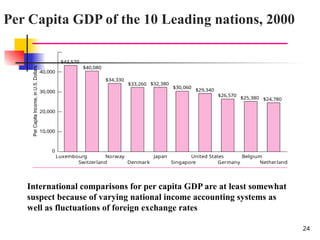
40,000
30,000
20,000
10,000
0
Switzerland
$34,330
Denmark
$33,260
Japan
$32,380
Singapore
$30,060
Norway
$29,340
Germany
$26,570
Belgium
$25,380
Luxembourg
$43,570
Netherlands
$24,780
United States
$40,080
Per Capita GDP of the 10 Leading nations, 2000
International comparisons for per capita GDP are at least somewhat
suspect because of varying national income accounting systems as
well as fluctuations of foreign exchange rates
24
Shortcomings of GDP as a Measure of
National Economic Well-Being
 Do the GDP accounts – either the expenditure side
or the income side – tell us anything we really
want to know about the quality of life?
25
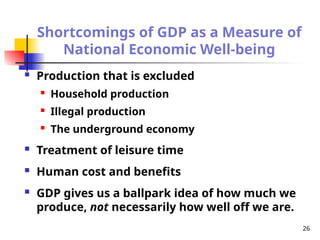
Shortcomings of GDP as a Measure of
National Economic Well-being
 Production that is excluded
 Household production
 Illegal production
 The underground economy
 Treatment of leisure time
 Human cost and benefits
 GDP gives us a ballpark idea of how much we
produce, not necessarily how well off we are.
26
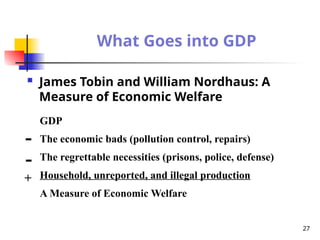
 James Tobin and William Nordhaus: A
Measure of Economic Welfare
What Goes into GDP
GDP
The economic bads (pollution control, repairs)
The regrettable necessities (prisons, police, defense)
Household, unreported, and illegal production
A Measure of Economic Welfare
-
-
+
27
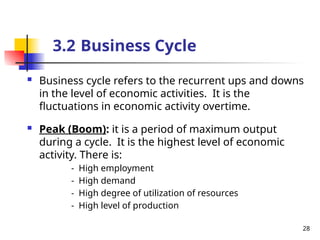
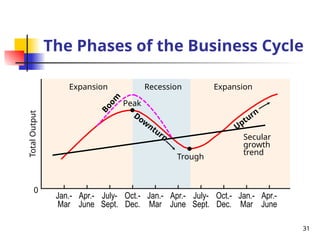
 Business cycle refers to the recurrent ups and downs
in the level of economic activities. It is the
fluctuations in economic activity overtime.
 Peak (Boom): it is a period of maximum output
during a cycle. It is the highest level of economic
activity. There is:
- High employment
- High demand
- High degree of utilization of resources
- High level of production
28
3.2 Business Cycle
Business Cycle … cont’d
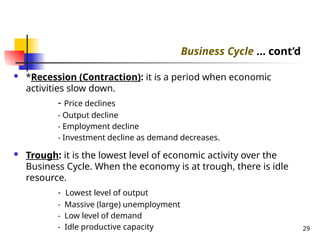
 *Recession (Contraction): it is a period when economic
activities slow down.
- Price declines
- Output decline
- Employment decline
- Investment decline as demand decreases.
 Trough: it is the lowest level of economic activity over the
Business Cycle. When the economy is at trough, there is idle
resource.
- Lowest level of output
- Massive (large) unemployment
- Low level of demand
- Idle productive capacity 29
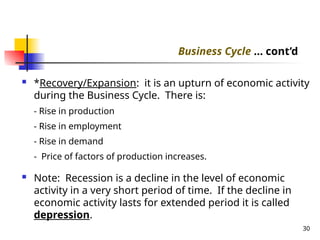
 *Recovery/Expansion: it is an upturn of economic activity
during the Business Cycle. There is:
- Rise in production
- Rise in employment
- Rise in demand
- Price of factors of production increases.
 Note: Recession is a decline in the level of economic
activity in a very short period of time. If the decline in
economic activity lasts for extended period it is called
depression.
30
Business Cycle … cont’d
Expansion Expansion
Recession
The Phases of the Business Cycle
B
o
o
m
Secular
growth
trend
Dow
nturn
Upturn
Trough
Peak
0
Jan.-
Mar
Total
Output
Apr.-
June
July-
Sept.
Oct.-
Dec.
Jan.-
Mar
Apr.-
June
July-
Sept.
Oct.-
Dec.
Jan.-
Mar
Apr.-
June
31
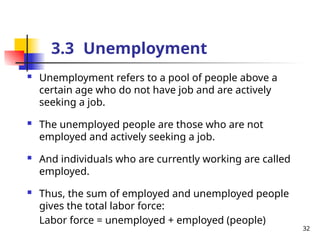
 Unemployment refers to a pool of people above a
certain age who do not have job and are actively
seeking a job.
 The unemployed people are those who are not
employed and actively seeking a job.
 And individuals who are currently working are called
employed.
 Thus, the sum of employed and unemployed people
gives the total labor force:
Labor force = unemployed + employed (people)
3.3 Unemployment
32
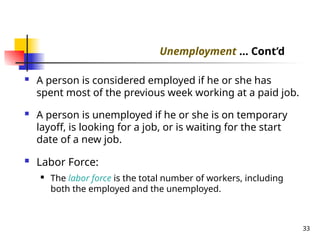
 A person is considered employed if he or she has
spent most of the previous week working at a paid job.
 A person is unemployed if he or she is on temporary
layoff, is looking for a job, or is waiting for the start
date of a new job.
 Labor Force:
 The labor force is the total number of workers, including
both the employed and the unemployed.
33
Unemployment ... Cont’d
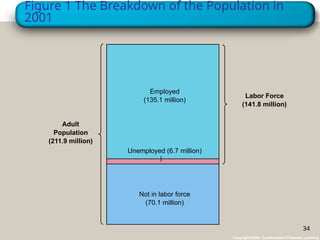
Figure 1 The Breakdown of the Population in
2001
Copyright©2003 Southwestern/Thomson Learning
Adult
Population
(211.9 million)
Labor Force
(141.8 million)
Employed
(135.1 million)
Not in labor force
(70.1 million)
Unemployed (6.7 million)
34
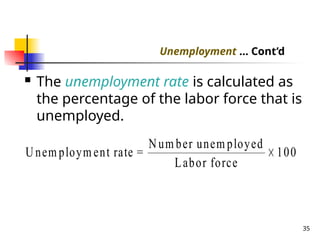
 The unemployment rate is calculated as
the percentage of the labor force that is
unemployed.
Unem ploym ent rate =
Num ber unem ployed
Labor force
 100
35
Unemployment ... Cont’d
Types of Unemployment
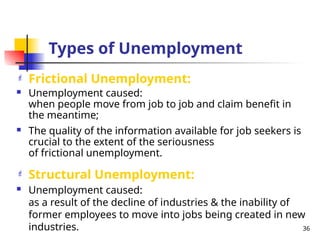
 Frictional Unemployment:
 Unemployment caused:
when people move from job to job and claim benefit in
the meantime;
 The quality of the information available for job seekers is
crucial to the extent of the seriousness
of frictional unemployment.
 Structural Unemployment:
 Unemployment caused:
as a result of the decline of industries & the inability of
former employees to move into jobs being created in new
industries. 36
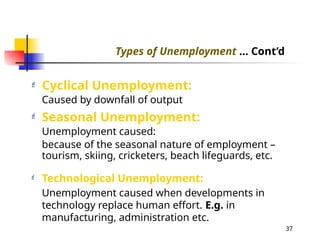
 Cyclical Unemployment:
Caused by downfall of output
 Seasonal Unemployment:
Unemployment caused:
because of the seasonal nature of employment –
tourism, skiing, cricketers, beach lifeguards, etc.
 Technological Unemployment:
Unemployment caused when developments in
technology replace human effort. E.g. in
manufacturing, administration etc.
Types of Unemployment ... Cont’d
37
3.4 Inflation
 This is the process by which the price level
rises and money loses value.
 There are two kinds of inflation:
a) Demand pull
b) Cost push
38
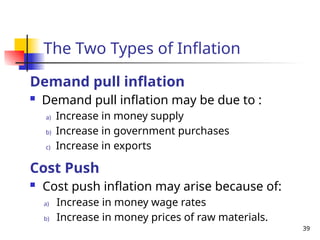
Demand pull inflation
 Demand pull inflation may be due to :
a) Increase in money supply
b) Increase in government purchases
c) Increase in exports
Cost Push
 Cost push inflation may arise because of:
a) Increase in money wage rates
b) Increase in money prices of raw materials.
The Two Types of Inflation
39
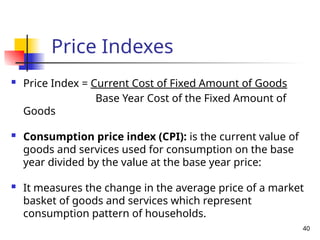
 Price Index = Current Cost of Fixed Amount of Goods
Base Year Cost of the Fixed Amount of
Goods
 Consumption price index (CPI): is the current value of
goods and services used for consumption on the base
year divided by the value at the base year price:
 It measures the change in the average price of a market
basket of goods and services which represent
consumption pattern of households.
40
Price Indexes
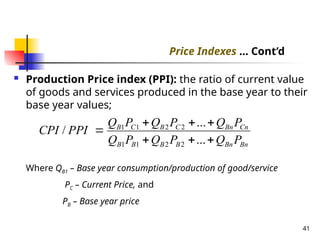
 Production Price index (PPI): the ratio of current value
of goods and services produced in the base year to their
base year values;
Where QB1 – Base year consumption/production of good/service
PC – Current Price, and
PB – Base year price
41
Bn
Bn
B
B
B
B
Cn
Bn
C
B
C
B
P
Q
P
Q
P
Q
P
Q
P
Q
P
Q
PPI
CPI







...
...
/
2
2
1
1
2
2
1
1
Price Indexes ... Cont’d
HU – Department of Economics 42
By: Abay G.
Thank You !!
Happy Times!

Part III - Macroecoomics.pptxPart III - Macroecoomics.pptx

  • 1.
  • 2.
    Macro Economics  Objectivesof macroeconomics  Basic problems of macroeconomics  National Income Accounting  Approaches in measuring GDP(Measures of Output)  Nominal GDP Vs Real GDP  GDP Per Capita  Shortcomings of GDP as a Measure of Economic Well-Being.  Business cycle  Unemployment  Inflation Contents: 2
  • 3.
    Introduction  Macroeconomics focuseson the economic behavior and policies that affect consumption, investment, determinants of changes in wages and prices, monetary and fiscal policies (such as taxation, money stock, government budget, interest rate, etc).  It is recognized since early periods that human beings are not self-sufficient in production of goods and services, hence exchange in between nations/regions too;  In modern economic view development highly depend on trade among nations/countries: trade policies (import substitution, export promotion) and exchange policies (fixed, managerial or floating);  How a country maintains healthy inflow of capital in the form of foreign direct investment >> open-macroeconomic 3
  • 4.
    The Basic Problemsin Macro- economics:  Business cycle  Unemployment  Inflation  Budget deficit  Balance of Payment (BoP) deficit [Trade & Current account balances, Foreign investment, Borrowings & repayment]  Income distribution 4
  • 5.
    The objectives ofMacro-Economics: High economic growth Reduced unemployment Stable inflation Reduce budget deficit and balance of payment (BoP) deficit Fair income distribution 5
  • 6.
     Gross Domesticproduct (GDP)  Government expenditure  Total money supply  Inflation  Trade Balance  Current Account Balance  Balance of Payment (BoP)  Exchange Rate 6 3.1 National Income Accounting Elements of National Economy:
  • 7.
    Measures of Output(Production)  National Income Accounting (NIA) refers to the measurement of aggregate economic activity, particularly national income and its components; *Aggregate = Total or Gross  It is the process of:  record keeping for the overall economic activities of a given country;  finding out the net output of a country through additions of value added and payments received after deductions of depreciations (capital wearing outs) and payments to foreign economy.  This can be calculated in three d/t ways (NIA approaches):  Income, expenditure and value added approach 7
  • 8.
     NIA isabout measuring the value of economic activity such as Gross Domestic Product (GDP) and/or Gross National Product (GNP).  Gross Domestic Product (GDP) is the total money value of final outputs produced within a nations borders in a given time period (usually a year) at current market prices;  Gross Domestic Product is also referred to as • Nominal Gross Domestic Product • Current Gross Domestic Product 8 Measures of Output … cont’d
  • 9.
    Measuring Gross DomesticProduct  The Flow of Income Approach • Households supply business with the factors of production in return for payment in the form of wages, profits, rent, and interest  The Expenditures Approach • C + I + G + X - M = GDP  The Value Added Approach • Adds the increase in value at each stage of the production and distribution process 9
  • 10.
    How GDP IsMeasured? Households Firms Income (wages, salary, rent, interest, profits) Expenditures by Consumers, Investors, Government, and Net Exports Same As Value of what is produced Value of what is spent Flow of Income Approach Expenditures Approach (GDP = C + I + G + X - 10
  • 11.
    A. Income Approach Itmeasures GDP in terms of income earned. It is the sum of all incomes accrued to factors of production that contribute to the production process. The major components of a country’s income include: W + S =Wage and salary - it is compensation for employees R = Rental income - income earned from land I = Interest - return for capital π = Profit - income earned by entrepreneurs. D = Depreciation - the wear out of capital goods in the production process. IBT = Indirect business taxes: eg. Sales tax, Excise tax paid by businesses to the government. Depreciation and indirect business taxes are part of the incomes of owners of factors of production. GDP = (W + S) + R + I + π + IBT + D 11
  • 12.
    The Flow ofIncome: The Disposable Income  GDP (Gross Domestic Product) - Depreciation = Net Domestic Product - Indirect business taxes and subsidies =Domestic Income (DI) = National Income = (W + R + I + P) - Earnings not received by the producer (eg. social security payments & others) + Receipts not earned (eg. transfer payments recieved, subsidies, etc.) =Personal Income (PI) - Personal Taxes =Disposable Personal Income (DPI) 12
  • 13.
    B. Expenditure Approach Itis the sum of all expenditures on final goods and services. The expenditures can be: GDP = C + G + I + (X – M) Where - C = Personal consumption exp, − G = Government expenditure, − I = Private investment Expenditure, and − ( X –M) = Net exports 13
  • 14.
    C. Value Addedin Various Stages of Production Stages of Production Value of Transactions Value Added 1. Farmer grows wheat, sells it to miller Birr 0.12/gm Birr 0.12/gm 2. Miller grinds to flour, sells to baker Birr 0.28/gm Birr 0.16/gm 3. Baker bakes brad, sells it to retailer Birr 0.60/gm Birr 0.32/gm 4. Brad store sells bade to consumer Birr 0.75/gm Birr 0.15/gm Total Birr 1.75/gm Birr 0.75/gm 14
  • 15.
    Two Things toAvoid when Compiling GDP  Multiple counting  Only expenditures on final products – what consumers, businesses, and government units buy for their own use belong in GDP  Intermediate goods are not counted  Used goods are not counted  Transfer payments  Transfer payments are not payments for currently produced goods and services  When they are spent for final goods and services they will go into GDP as consumer spending  Financial transactions don’t go into GDP 15
  • 16.
    Nominal GDP VsReal GDP Removing the effect of Inflation  Suppose we invited the same friends to a birthday party each year for four years and purchased one giant cake each year.  We notice that although the giant size cake doesn’t change from year to year, it costs $1 more each year.  The pie didn’t change, but the dollar value (price) of the pie did.  If we want to compare GDP from year to year, we need to get rid of the inflation (price) effect! 16
  • 17.
    Computing Real GDP 20042005 Nominal GDP (in billions) Birr 11,734 Birr 12,378 Change in Nominal GDP Birr 644 Change in Price Level, 2004 to 2005 1.5% Real GDP in 2004 dollars Birr 11,734 Birr 12,195 Change in Real GDP Birr 461 17
  • 18.
    Computing Real GDP The general formula for computing real GDP is: Real GDP in year t = Nominal GDP in year t Price Index Real GDP in 2005 = $12,378 = $12,195 1.015 18
  • 19.
    GDP and the“GDP Deflator”  To correct Nominal GDP for price increases from one year to the next, we must calculate real GDP using a Price Index.  For GDP price adjustments, this price index is called the GDP Deflator and is calculated quarterly by the Department of Commerce.  A price index is an index number that shows how the average prices of goods change over time. Based on percentage change from a “base year”. 19
  • 20.
    International Comparisons ofGDP  International Comparisons of GDP are difficult for a number of reasons: 1. Different countries use different national income accounting systems 2. International exchange rates into dollars fluctuate 3. Data from other countries may be unreliable 20
  • 21.
    Per Capita GDP Per Capita GDP calculations attempt to give us additional information about how we are doing as an economy.  Per Capita GDP calculations may be a better measure of the standard of living. • For citizens living in the same country over time • For comparing standards of living between citizens of different countries 21
  • 22.
    Per Capita NominalGDP Per capita GDP = ---------------------------- GDP Population 2005 2005 2005 Per capita GDP = --------------------------- $12,378,000,000,000 297,000,000 Per capita GDP = $41,677 2005 2005 22
  • 23.
    Per Capita RealGDP Per capita real GDP = -------------------------------- Real GDP Population To compare per capita GDP in one year with that of another year we have to correct for inflation. In other words, we really need to revise our formula 23
  • 24.
    40,000 30,000 20,000 10,000 0 Switzerland $34,330 Denmark $33,260 Japan $32,380 Singapore $30,060 Norway $29,340 Germany $26,570 Belgium $25,380 Luxembourg $43,570 Netherlands $24,780 United States $40,080 Per CapitaGDP of the 10 Leading nations, 2000 International comparisons for per capita GDP are at least somewhat suspect because of varying national income accounting systems as well as fluctuations of foreign exchange rates 24
  • 25.
    Shortcomings of GDPas a Measure of National Economic Well-Being  Do the GDP accounts – either the expenditure side or the income side – tell us anything we really want to know about the quality of life? 25
  • 26.
    Shortcomings of GDPas a Measure of National Economic Well-being  Production that is excluded  Household production  Illegal production  The underground economy  Treatment of leisure time  Human cost and benefits  GDP gives us a ballpark idea of how much we produce, not necessarily how well off we are. 26
  • 27.
     James Tobinand William Nordhaus: A Measure of Economic Welfare What Goes into GDP GDP The economic bads (pollution control, repairs) The regrettable necessities (prisons, police, defense) Household, unreported, and illegal production A Measure of Economic Welfare - - + 27
  • 28.
     Business cyclerefers to the recurrent ups and downs in the level of economic activities. It is the fluctuations in economic activity overtime.  Peak (Boom): it is a period of maximum output during a cycle. It is the highest level of economic activity. There is: - High employment - High demand - High degree of utilization of resources - High level of production 28 3.2 Business Cycle
  • 29.
    Business Cycle …cont’d  *Recession (Contraction): it is a period when economic activities slow down. - Price declines - Output decline - Employment decline - Investment decline as demand decreases.  Trough: it is the lowest level of economic activity over the Business Cycle. When the economy is at trough, there is idle resource. - Lowest level of output - Massive (large) unemployment - Low level of demand - Idle productive capacity 29
  • 30.
     *Recovery/Expansion: itis an upturn of economic activity during the Business Cycle. There is: - Rise in production - Rise in employment - Rise in demand - Price of factors of production increases.  Note: Recession is a decline in the level of economic activity in a very short period of time. If the decline in economic activity lasts for extended period it is called depression. 30 Business Cycle … cont’d
  • 31.
    Expansion Expansion Recession The Phasesof the Business Cycle B o o m Secular growth trend Dow nturn Upturn Trough Peak 0 Jan.- Mar Total Output Apr.- June July- Sept. Oct.- Dec. Jan.- Mar Apr.- June July- Sept. Oct.- Dec. Jan.- Mar Apr.- June 31
  • 32.
     Unemployment refersto a pool of people above a certain age who do not have job and are actively seeking a job.  The unemployed people are those who are not employed and actively seeking a job.  And individuals who are currently working are called employed.  Thus, the sum of employed and unemployed people gives the total labor force: Labor force = unemployed + employed (people) 3.3 Unemployment 32
  • 33.
     A personis considered employed if he or she has spent most of the previous week working at a paid job.  A person is unemployed if he or she is on temporary layoff, is looking for a job, or is waiting for the start date of a new job.  Labor Force:  The labor force is the total number of workers, including both the employed and the unemployed. 33 Unemployment ... Cont’d
  • 34.
    Figure 1 TheBreakdown of the Population in 2001 Copyright©2003 Southwestern/Thomson Learning Adult Population (211.9 million) Labor Force (141.8 million) Employed (135.1 million) Not in labor force (70.1 million) Unemployed (6.7 million) 34
  • 35.
     The unemploymentrate is calculated as the percentage of the labor force that is unemployed. Unem ploym ent rate = Num ber unem ployed Labor force  100 35 Unemployment ... Cont’d
  • 36.
    Types of Unemployment Frictional Unemployment:  Unemployment caused: when people move from job to job and claim benefit in the meantime;  The quality of the information available for job seekers is crucial to the extent of the seriousness of frictional unemployment.  Structural Unemployment:  Unemployment caused: as a result of the decline of industries & the inability of former employees to move into jobs being created in new industries. 36
  • 37.
     Cyclical Unemployment: Causedby downfall of output  Seasonal Unemployment: Unemployment caused: because of the seasonal nature of employment – tourism, skiing, cricketers, beach lifeguards, etc.  Technological Unemployment: Unemployment caused when developments in technology replace human effort. E.g. in manufacturing, administration etc. Types of Unemployment ... Cont’d 37
  • 38.
    3.4 Inflation  Thisis the process by which the price level rises and money loses value.  There are two kinds of inflation: a) Demand pull b) Cost push 38
  • 39.
    Demand pull inflation Demand pull inflation may be due to : a) Increase in money supply b) Increase in government purchases c) Increase in exports Cost Push  Cost push inflation may arise because of: a) Increase in money wage rates b) Increase in money prices of raw materials. The Two Types of Inflation 39
  • 40.
     Price Index= Current Cost of Fixed Amount of Goods Base Year Cost of the Fixed Amount of Goods  Consumption price index (CPI): is the current value of goods and services used for consumption on the base year divided by the value at the base year price:  It measures the change in the average price of a market basket of goods and services which represent consumption pattern of households. 40 Price Indexes
  • 41.
     Production Priceindex (PPI): the ratio of current value of goods and services produced in the base year to their base year values; Where QB1 – Base year consumption/production of good/service PC – Current Price, and PB – Base year price 41 Bn Bn B B B B Cn Bn C B C B P Q P Q P Q P Q P Q P Q PPI CPI        ... ... / 2 2 1 1 2 2 1 1 Price Indexes ... Cont’d
  • 42.
    HU – Departmentof Economics 42 By: Abay G. Thank You !! Happy Times!

Editor's Notes

  • #12 Indirect Business Taxes are primarily sales taxes and excise taxes; subsidies include payments such as those made to farmers Earnings not received include social security taxes and corporate profits not paid out as dividends Receipts not earned include Social Security Benefits plus other government transfer payments
  • #13 Indirect Business Taxes are primarily sales taxes and excise taxes; subsidies include payments such as those made to farmers Earnings not received include social security taxes and corporate profits not paid out as dividends Receipts not earned include Social Security Benefits plus other government transfer payments