Unit 2
Measuring a Nation’s
Income
• What is Gross Domestic Product (GDP)?
• How is GDP related to a nation’s total income and
spending?
• What are the components of GDP?
• How is GDP corrected for inflation?
• Does GDP measure society’s well-being?
2
In this unit, look for the
answers to these questions:
• Gross domestic product (GDP) is a measure of
the income and expenditures of an economy.
• GDP is the market value of all final goods and
services produced within a country in a given
period of time.
The measurement of gross
domestic product
MEASURING A NATION’S INCOME 4
…the market value of all final goods &
services produced within a country in a
given period of time.
Gross Domestic Product (GDP) Is…
 All goods measured in the same units
(e.g., dollars in the U.S.)
 Things that don’t have a market value are excluded,
e.g., housework you do for yourself.
 GDP includes all items produced and sold legally in
markets and excludes items produced and sold illicitly,
such as illegal drugs.
MEASURING A NATION’S INCOME 5
…the market value of all final goods &
services produced within a country in a
given period of time.
Gross Domestic Product (GDP) Is…
Final goods: intended for the end user
Intermediate goods: used as components
or ingredients in the production of other goods
GDP only includes final goods
MEASURING A NATION’S INCOME 6
…the market value of all final goods &
services produced within a country in a
given period of time.
Gross Domestic Product (GDP) Is…
GDP includes tangible goods
(like DVDs, mountain bikes, beer)
and intangible services
(dry cleaning, concerts, cell phone service).
MEASURING A NATION’S INCOME 7
…the market value of all final goods &
services produced within a country in a
given period of time.
Gross Domestic Product (GDP) Is…
It includes goods and services currently produced,
not transactions involving goods produced in the
past.
MEASURING A NATION’S INCOME 8
…the market value of all final goods &
services produced within a country in a
given period of time.
Gross Domestic Product (GDP) Is…
GDP measures the value of production that occurs
within a country’s borders, whether done by its own
citizens or by foreigners located there.
MEASURING A NATION’S INCOME 9
…the market value of all final goods &
services produced within a country in a
given period of time.
Gross Domestic Product (GDP) Is…
Usually a year or a quarter (3 months)
MEASURING A NATION’S INCOME 10
(1) The expenditure approach
(2) The income approach and
(3) The value added (production) approach
• These three approaches are equivalent, with
each rendering the same result.
Three ways to calculate gross
domestic product (GDP)
• For an economy as a whole, income must equal
expenditure because:
• Every transaction has a buyer and a seller.
• Every dollar of spending by some buyer is a dollar
of income for some seller.
• Thus, the sum of all expenditure equals the sum of
all income.
• The equality of income and expenditure can be
illustrated with the circular-flow diagram.
The economy’s income and
expenditure
The Circular-Flow
Diagram
Firms Household
Markets for factors
of production
Markets for goods
and services
Spending
Revenue
Goods and
services sold
Goods and
services bought
Wages, rent and
profit
Factor of
production
Income
Labor, land and
capital
Expenditure
Income
MEASURING A NATION’S INCOME 14
Expenditure Approach to
Calculating GDP
• One way to calculate a nation's GDP is to sum
all expenditures in the country. This method is
known as the expenditure approach and is
described below:
• Consumption (C)
• Investment (I)
• Government Purchases (G)
• Net Exports (NX)
 GDP = C + I + G + NX
Expenditure Approach to
Calculating GDP:
Consumption (C)
• Consumption (C) is the value of all goods
and services bought by households.
Includes:
• Durable goods: last a long time, ex: cars,
• Non-durable goods: last a short time, ex:
• Services: work done for consumers, ex: dry
travel.
• C excludes new housing bought by
households
Expenditure Approach to
Calculating GDP:
Investment (I)
• Def1: spending on [the factor of production]
capital.
• Def2: spending on goods bought for future use.
Note: “Investment” does not
mean the purchase of financial
assets like stocks and bonds.
Expenditure Approach to
Calculating GDP:
Investment (I)
• I Includes:
- business fixed investment: spending on plant
that firms will use to produce other goods &
services (machines, tools, factories).
-inventory investment: the change in the value
inventories (goods produced but not yet sold).
-residential fixed investment: spending on
consumers and landlords.
Expenditure Approach to
Calculating GDP:
Government purchases (G)
• G includes all government purchases on goods
and services.
• G excludes transfer payments (e.g. unemployment
insurance payments), because they are not made
in exchange for currently produced goods or
services.
Expenditure Approach to
Calculating GDP:
Net exports (NX)
• NX = exports – imports
• Exports represent foreign spending on the
economy’s goods & services
• Imports are the portions of C, I, and G that
are spent on g&s produced abroad.
MEASURING A NATION’S INCOME 21
GDP and its components
In each of the following cases, determine how much
GDP and each of its components is affected (if at
all).
A. Debbie spends $200 to buy her husband dinner at
the finest restaurant in Boston.
B. Sarah spends $1800 on a new laptop to use in her
publishing business. The laptop was built in
China.
C. Jane spends $1200 on a computer to use in her
editing business. She got last year’s model on
sale for a great price from a local manufacturer.
D. General Motors builds $500 million worth of cars,
Income Approach to Calculating
GDP
• The GDP is equivalent to the total income
received by factors of production engage in the
process of production during a certain period,
usually one year.
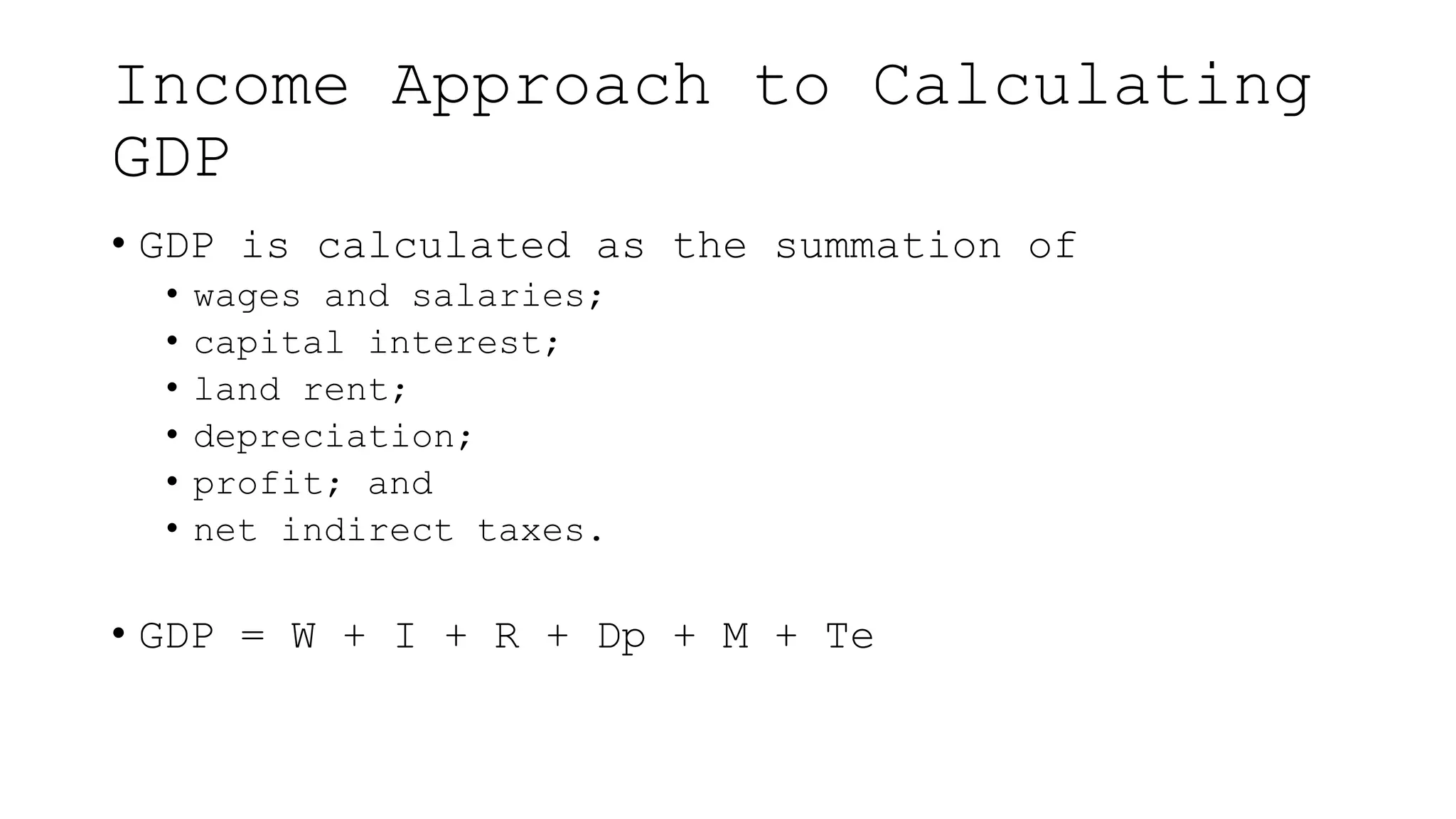
Income Approach to Calculating
GDP
• GDP is calculated as the summation of
• wages and salaries;
• capital interest;
• land rent;
• depreciation;
• profit; and
• net indirect taxes.
• GDP = W + I + R + Dp + M + Te
Value added Approach to
Calculating GDP
• Value added (VA)
A firm’s value added = the value of its output-
the value of the intermediate goods the firm
used to produce that output.
• GDP = sum of VA
• The value of the final goods already includes
the value of the intermediate goods, so
including intermediate goods in GDP would be
double-counting.
Value added Approach to
Calculating GDP
• A farmer grows a bushel of wheat and sells it
to a miller for $1.00.
• The miller turns the wheat into flour and sells
it to a baker for $3.00.
• The baker uses the flour to make a loaf of
bread and sells it to an engineer for $6.00.
• The engineer eats the bread.
• Compute
• value added at each stage of production
• GDP
Real vs. Nominal GDP
• GDP is the value of all final goods and
services produced.
• Nominal GDP measures these values using current
prices.
GDPt
n = Σ Qi
t Pi
t (i=1,n)
• Real GDP measure these values using the prices
of a base year.
GDPt
r = Σ Qi
t Pi
0 (i=1,n)
MEASURING A NATION’S INCOME 29
Pizza Latte
year P Q P Q
2005 $10 400 $2.00 1000
2006 $11 500 $2.50 1100
2007 $12 600 $3.00 1200
EXAMPLE: Compute nominal GDP
MEASURING A NATION’S INCOME 30
Pizza Latte
year P Q P Q
2005 $10 400 $2.00 1000
2006 $11 500 $2.50 1100
2007 $12 600 $3.00 1200
$10 $2.00
EXAMPLE: Compute real GDP,
based 2005
Real GDP controls for
inflation
• Changes in nominal GDP can be due to:
- changes in prices
- changes in quantities of output produced
• Changes in real GDP can only be due to changes
in quantities.
GDP growth rate (g)
gt =
GDPr
t – GDPr
t-1
GDP r
t-1
x 100 (%)
GDP Deflator
• The inflation rate is the percentage increase
in the overall level of prices.
• One measure of the price level is the GDP
Deflator, defined as
GDP deflator =
GDPn
t
X 100
GDPr
t
MEASURING A NATION’S INCOME 34
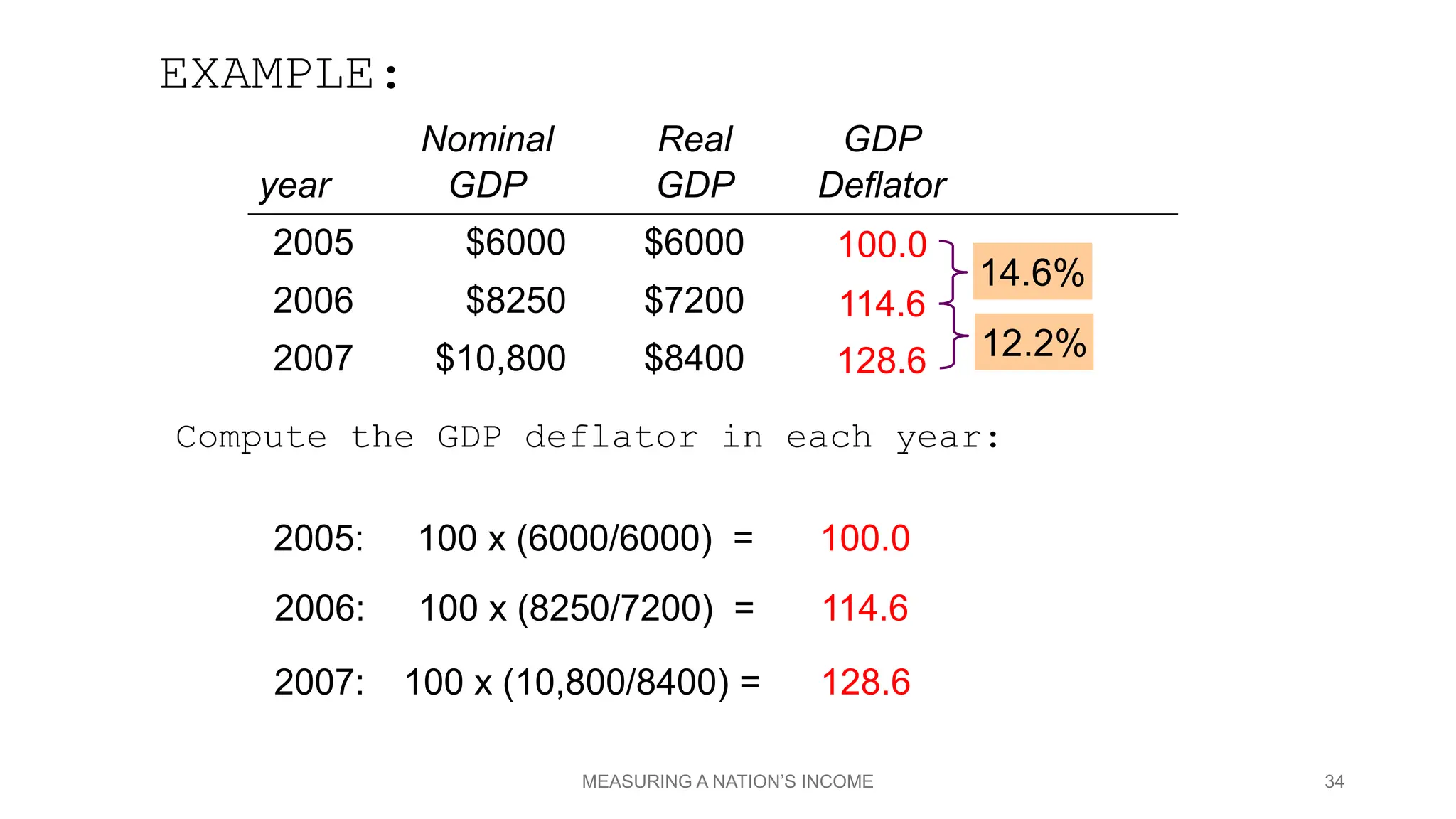
EXAMPLE:
Compute the GDP deflator in each year:
year
Nominal
GDP
Real
GDP
GDP
Deflator
2005 $6000 $6000
2006 $8250 $7200
2007 $10,800 $8400
2005: 100 x (6000/6000) = 100.0
100.0
2006: 100 x (8250/7200) = 114.6
114.6
2007: 100 x (10,800/8400) = 128.6
128.6
14.6%
12.2%
Computing GDP
35
Use the above data to solve these problems:
A. Compute nominal GDP in 2007.
B. Compute real GDP in 2008.
C. Compute the GDP deflator in 2009.
2007 (base yr) 2008 2009
P Q P Q P Q
Good A $30 900 $31 1,000 $36 1050
Good B $100 192 $102 200 $100 205
GDP and economic well- being
• GDP is the best single measure of the economic
well-being of a society.
• GDP per person tells us the income and
expenditure of the average person in the
economy
• Higher GDP per person indicates a higher
standard of living.
• GDP is not a perfect measure of the happiness
or quality of life, however.
GDP and economic well- being
• Some things that contribute to well-being are
not included in GDP.
• The value of leisure.
• The value of a clean environment.
• The value of almost all activity that takes place
outside of markets, such as the value of the time
parents spend with their children and the value of
volunteer work.
GDP and economic well- being
GDP, life expectancy and
literacy
Other measures of income
• Gross National Product (GNP)
• Net National Income (NI)
• Personal Income (PI)
• Disposable income (Yd)
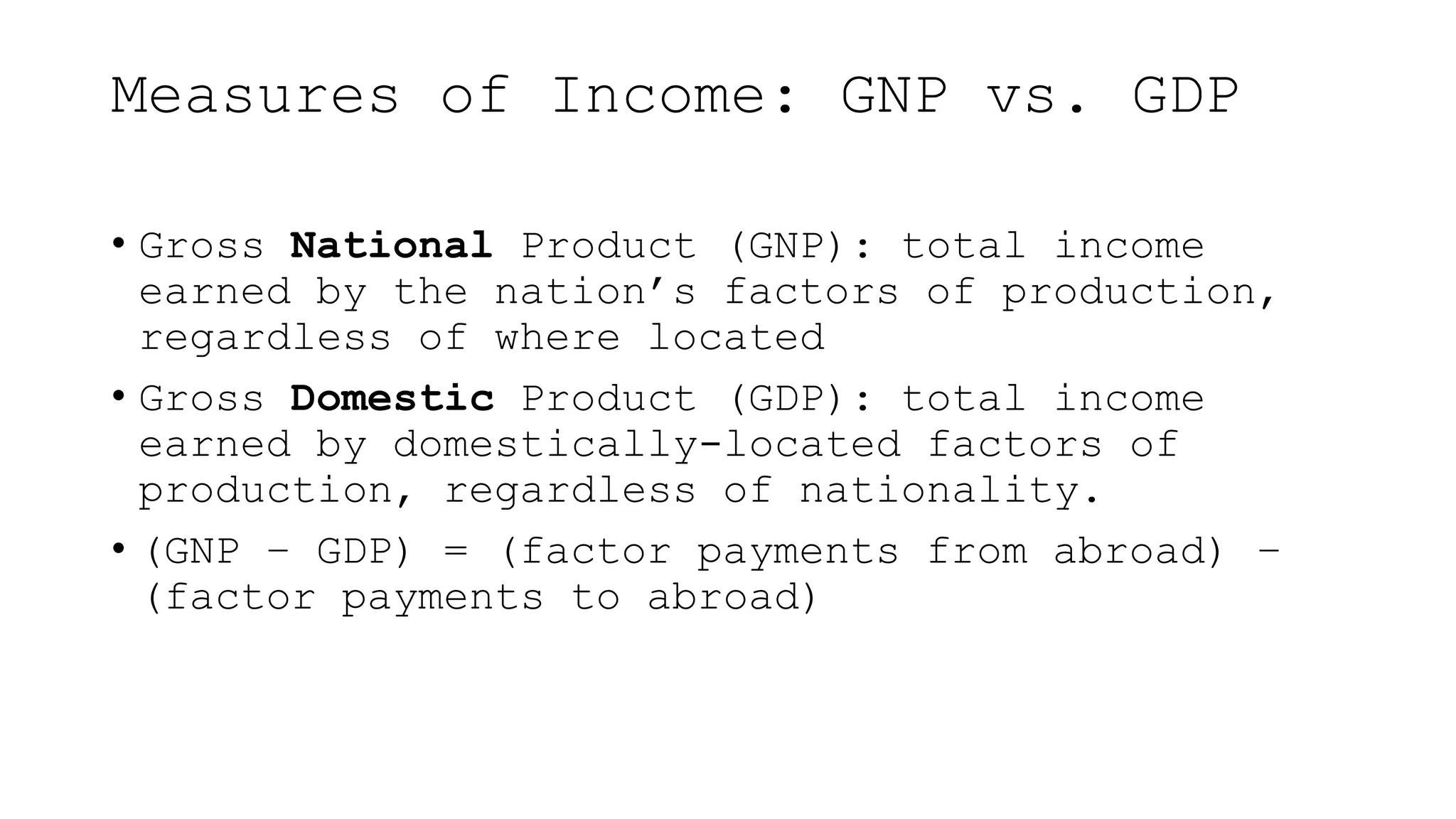
Measures of Income: GNP vs. GDP
• Gross National Product (GNP): total income
earned by the nation’s factors of production,
regardless of where located
• Gross Domestic Product (GDP): total income
earned by domestically-located factors of
production, regardless of nationality.
• (GNP – GDP) = (factor payments from abroad) –
(factor payments to abroad)
Other measures of income
• NNP = GNP - Deprecation
• NI= NNP - indirect taxes
• PI= NI - retained profits – social insurance
contributions + Government transfers
• Yd= Pi - personal taxes

Unit 2 Macro Measuring a Nations Income.pptx

  • 1.
    Unit 2 Measuring aNation’s Income
  • 2.
    • What isGross Domestic Product (GDP)? • How is GDP related to a nation’s total income and spending? • What are the components of GDP? • How is GDP corrected for inflation? • Does GDP measure society’s well-being? 2 In this unit, look for the answers to these questions:
  • 3.
    • Gross domesticproduct (GDP) is a measure of the income and expenditures of an economy. • GDP is the market value of all final goods and services produced within a country in a given period of time. The measurement of gross domestic product
  • 4.
    MEASURING A NATION’SINCOME 4 …the market value of all final goods & services produced within a country in a given period of time. Gross Domestic Product (GDP) Is…  All goods measured in the same units (e.g., dollars in the U.S.)  Things that don’t have a market value are excluded, e.g., housework you do for yourself.  GDP includes all items produced and sold legally in markets and excludes items produced and sold illicitly, such as illegal drugs.
  • 5.
    MEASURING A NATION’SINCOME 5 …the market value of all final goods & services produced within a country in a given period of time. Gross Domestic Product (GDP) Is… Final goods: intended for the end user Intermediate goods: used as components or ingredients in the production of other goods GDP only includes final goods
  • 6.
    MEASURING A NATION’SINCOME 6 …the market value of all final goods & services produced within a country in a given period of time. Gross Domestic Product (GDP) Is… GDP includes tangible goods (like DVDs, mountain bikes, beer) and intangible services (dry cleaning, concerts, cell phone service).
  • 7.
    MEASURING A NATION’SINCOME 7 …the market value of all final goods & services produced within a country in a given period of time. Gross Domestic Product (GDP) Is… It includes goods and services currently produced, not transactions involving goods produced in the past.
  • 8.
    MEASURING A NATION’SINCOME 8 …the market value of all final goods & services produced within a country in a given period of time. Gross Domestic Product (GDP) Is… GDP measures the value of production that occurs within a country’s borders, whether done by its own citizens or by foreigners located there.
  • 9.
    MEASURING A NATION’SINCOME 9 …the market value of all final goods & services produced within a country in a given period of time. Gross Domestic Product (GDP) Is… Usually a year or a quarter (3 months)
  • 10.
  • 11.
    (1) The expenditureapproach (2) The income approach and (3) The value added (production) approach • These three approaches are equivalent, with each rendering the same result. Three ways to calculate gross domestic product (GDP)
  • 12.
    • For aneconomy as a whole, income must equal expenditure because: • Every transaction has a buyer and a seller. • Every dollar of spending by some buyer is a dollar of income for some seller. • Thus, the sum of all expenditure equals the sum of all income. • The equality of income and expenditure can be illustrated with the circular-flow diagram. The economy’s income and expenditure
  • 13.
    The Circular-Flow Diagram Firms Household Marketsfor factors of production Markets for goods and services Spending Revenue Goods and services sold Goods and services bought Wages, rent and profit Factor of production Income Labor, land and capital Expenditure Income
  • 14.
  • 15.
    Expenditure Approach to CalculatingGDP • One way to calculate a nation's GDP is to sum all expenditures in the country. This method is known as the expenditure approach and is described below: • Consumption (C) • Investment (I) • Government Purchases (G) • Net Exports (NX)  GDP = C + I + G + NX
  • 16.
    Expenditure Approach to CalculatingGDP: Consumption (C) • Consumption (C) is the value of all goods and services bought by households. Includes: • Durable goods: last a long time, ex: cars, • Non-durable goods: last a short time, ex: • Services: work done for consumers, ex: dry travel. • C excludes new housing bought by households
  • 17.
    Expenditure Approach to CalculatingGDP: Investment (I) • Def1: spending on [the factor of production] capital. • Def2: spending on goods bought for future use. Note: “Investment” does not mean the purchase of financial assets like stocks and bonds.
  • 18.
    Expenditure Approach to CalculatingGDP: Investment (I) • I Includes: - business fixed investment: spending on plant that firms will use to produce other goods & services (machines, tools, factories). -inventory investment: the change in the value inventories (goods produced but not yet sold). -residential fixed investment: spending on consumers and landlords.
  • 19.
    Expenditure Approach to CalculatingGDP: Government purchases (G) • G includes all government purchases on goods and services. • G excludes transfer payments (e.g. unemployment insurance payments), because they are not made in exchange for currently produced goods or services.
  • 20.
    Expenditure Approach to CalculatingGDP: Net exports (NX) • NX = exports – imports • Exports represent foreign spending on the economy’s goods & services • Imports are the portions of C, I, and G that are spent on g&s produced abroad.
  • 21.
  • 22.
    GDP and itscomponents In each of the following cases, determine how much GDP and each of its components is affected (if at all). A. Debbie spends $200 to buy her husband dinner at the finest restaurant in Boston. B. Sarah spends $1800 on a new laptop to use in her publishing business. The laptop was built in China. C. Jane spends $1200 on a computer to use in her editing business. She got last year’s model on sale for a great price from a local manufacturer. D. General Motors builds $500 million worth of cars,
  • 24.
    Income Approach toCalculating GDP • The GDP is equivalent to the total income received by factors of production engage in the process of production during a certain period, usually one year.
  • 25.
    Income Approach toCalculating GDP • GDP is calculated as the summation of • wages and salaries; • capital interest; • land rent; • depreciation; • profit; and • net indirect taxes. • GDP = W + I + R + Dp + M + Te
  • 26.
    Value added Approachto Calculating GDP • Value added (VA) A firm’s value added = the value of its output- the value of the intermediate goods the firm used to produce that output. • GDP = sum of VA • The value of the final goods already includes the value of the intermediate goods, so including intermediate goods in GDP would be double-counting.
  • 27.
    Value added Approachto Calculating GDP • A farmer grows a bushel of wheat and sells it to a miller for $1.00. • The miller turns the wheat into flour and sells it to a baker for $3.00. • The baker uses the flour to make a loaf of bread and sells it to an engineer for $6.00. • The engineer eats the bread. • Compute • value added at each stage of production • GDP
  • 28.
    Real vs. NominalGDP • GDP is the value of all final goods and services produced. • Nominal GDP measures these values using current prices. GDPt n = Σ Qi t Pi t (i=1,n) • Real GDP measure these values using the prices of a base year. GDPt r = Σ Qi t Pi 0 (i=1,n)
  • 29.
    MEASURING A NATION’SINCOME 29 Pizza Latte year P Q P Q 2005 $10 400 $2.00 1000 2006 $11 500 $2.50 1100 2007 $12 600 $3.00 1200 EXAMPLE: Compute nominal GDP
  • 30.
    MEASURING A NATION’SINCOME 30 Pizza Latte year P Q P Q 2005 $10 400 $2.00 1000 2006 $11 500 $2.50 1100 2007 $12 600 $3.00 1200 $10 $2.00 EXAMPLE: Compute real GDP, based 2005
  • 31.
    Real GDP controlsfor inflation • Changes in nominal GDP can be due to: - changes in prices - changes in quantities of output produced • Changes in real GDP can only be due to changes in quantities.
  • 32.
    GDP growth rate(g) gt = GDPr t – GDPr t-1 GDP r t-1 x 100 (%)
  • 33.
    GDP Deflator • Theinflation rate is the percentage increase in the overall level of prices. • One measure of the price level is the GDP Deflator, defined as GDP deflator = GDPn t X 100 GDPr t
  • 34.
    MEASURING A NATION’SINCOME 34 EXAMPLE: Compute the GDP deflator in each year: year Nominal GDP Real GDP GDP Deflator 2005 $6000 $6000 2006 $8250 $7200 2007 $10,800 $8400 2005: 100 x (6000/6000) = 100.0 100.0 2006: 100 x (8250/7200) = 114.6 114.6 2007: 100 x (10,800/8400) = 128.6 128.6 14.6% 12.2%
  • 35.
    Computing GDP 35 Use theabove data to solve these problems: A. Compute nominal GDP in 2007. B. Compute real GDP in 2008. C. Compute the GDP deflator in 2009. 2007 (base yr) 2008 2009 P Q P Q P Q Good A $30 900 $31 1,000 $36 1050 Good B $100 192 $102 200 $100 205
  • 37.
    GDP and economicwell- being • GDP is the best single measure of the economic well-being of a society. • GDP per person tells us the income and expenditure of the average person in the economy
  • 38.
    • Higher GDPper person indicates a higher standard of living. • GDP is not a perfect measure of the happiness or quality of life, however. GDP and economic well- being
  • 39.
    • Some thingsthat contribute to well-being are not included in GDP. • The value of leisure. • The value of a clean environment. • The value of almost all activity that takes place outside of markets, such as the value of the time parents spend with their children and the value of volunteer work. GDP and economic well- being
  • 40.
  • 42.
    Other measures ofincome • Gross National Product (GNP) • Net National Income (NI) • Personal Income (PI) • Disposable income (Yd)
  • 43.
    Measures of Income:GNP vs. GDP • Gross National Product (GNP): total income earned by the nation’s factors of production, regardless of where located • Gross Domestic Product (GDP): total income earned by domestically-located factors of production, regardless of nationality. • (GNP – GDP) = (factor payments from abroad) – (factor payments to abroad)
  • 44.
    Other measures ofincome • NNP = GNP - Deprecation • NI= NNP - indirect taxes • PI= NI - retained profits – social insurance contributions + Government transfers • Yd= Pi - personal taxes