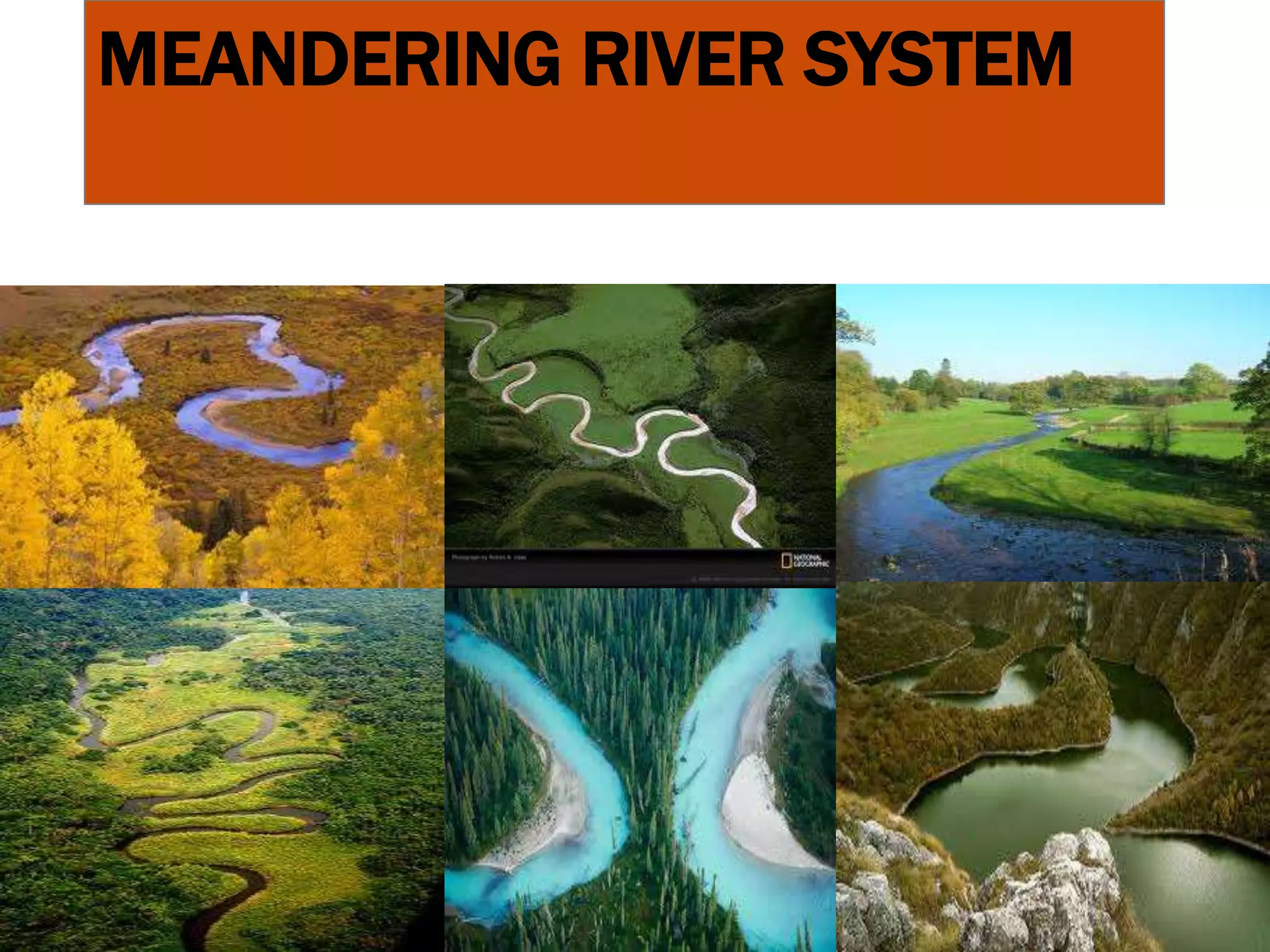
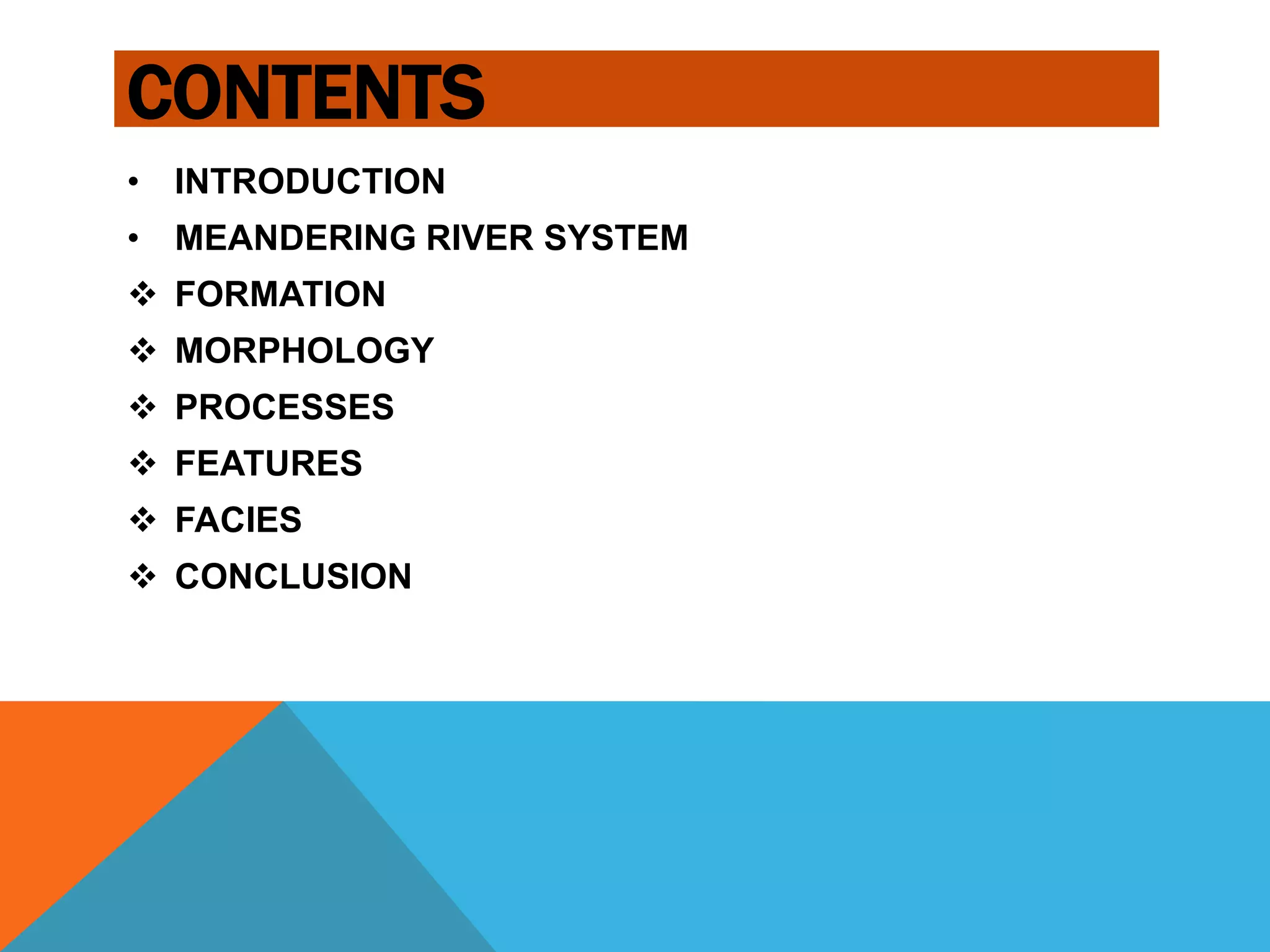
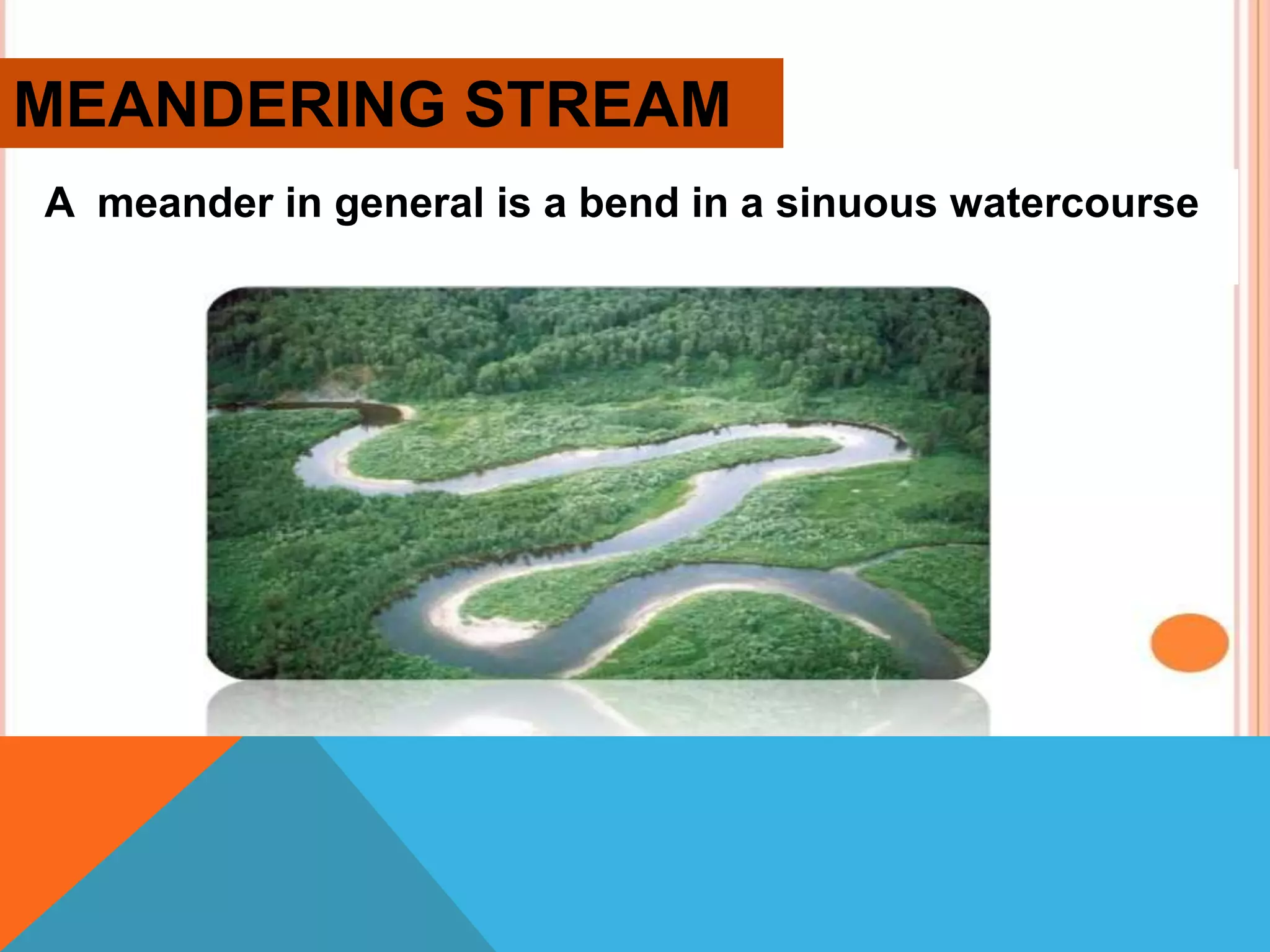
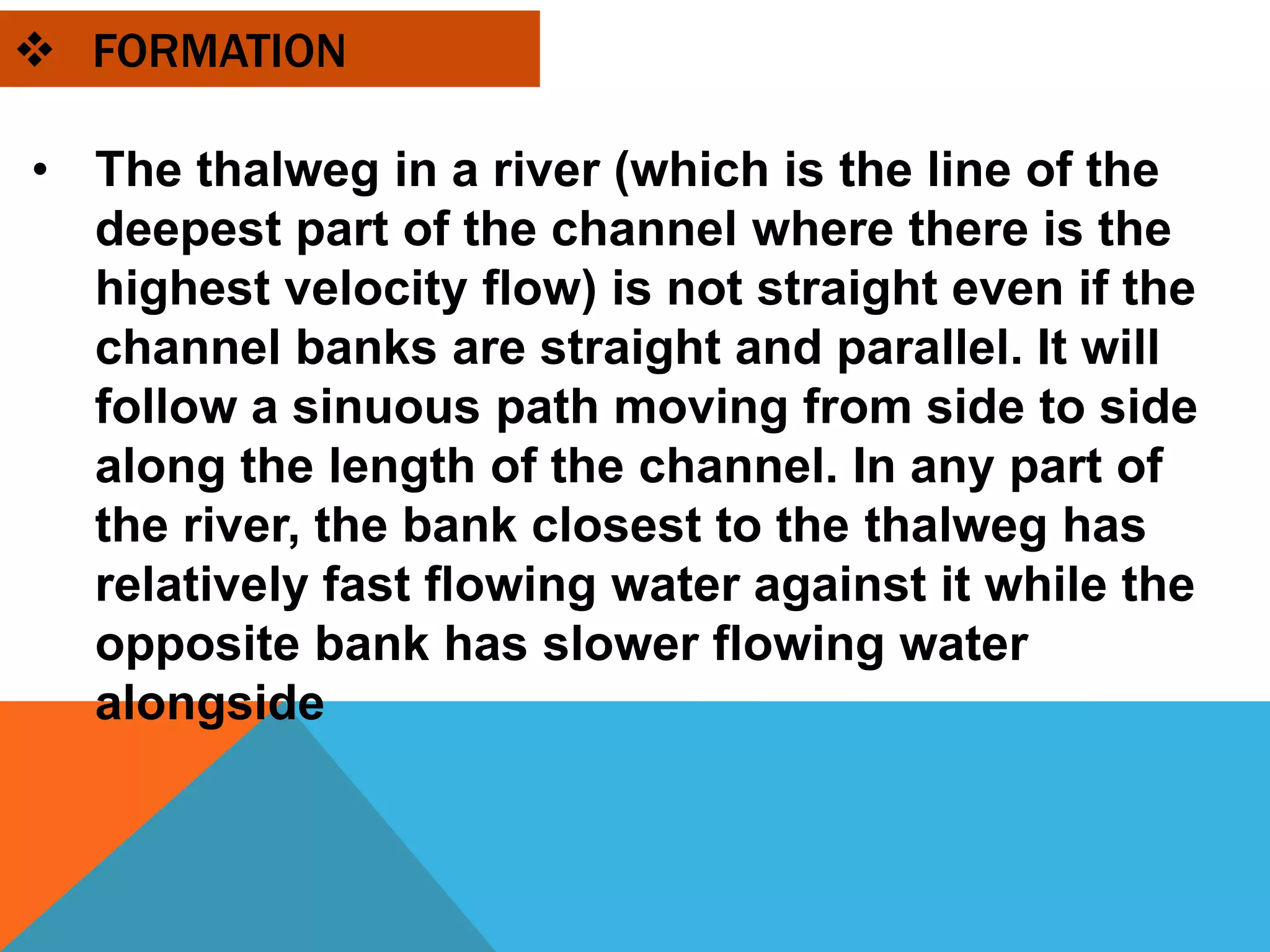
MEANDERING RIVER SYSTEM
CONTENTS
• INTRODUCTION
• MEANDERING RIVER SYSTEM
 FORMATION
 MORPHOLOGY
 PROCESSES
 FEATURES
 FACIES
 CONCLUSION
INTRODUCTION
MEANDERING STREAM
A meander in general is a bend in a sinuous watercourse
 FORMATION
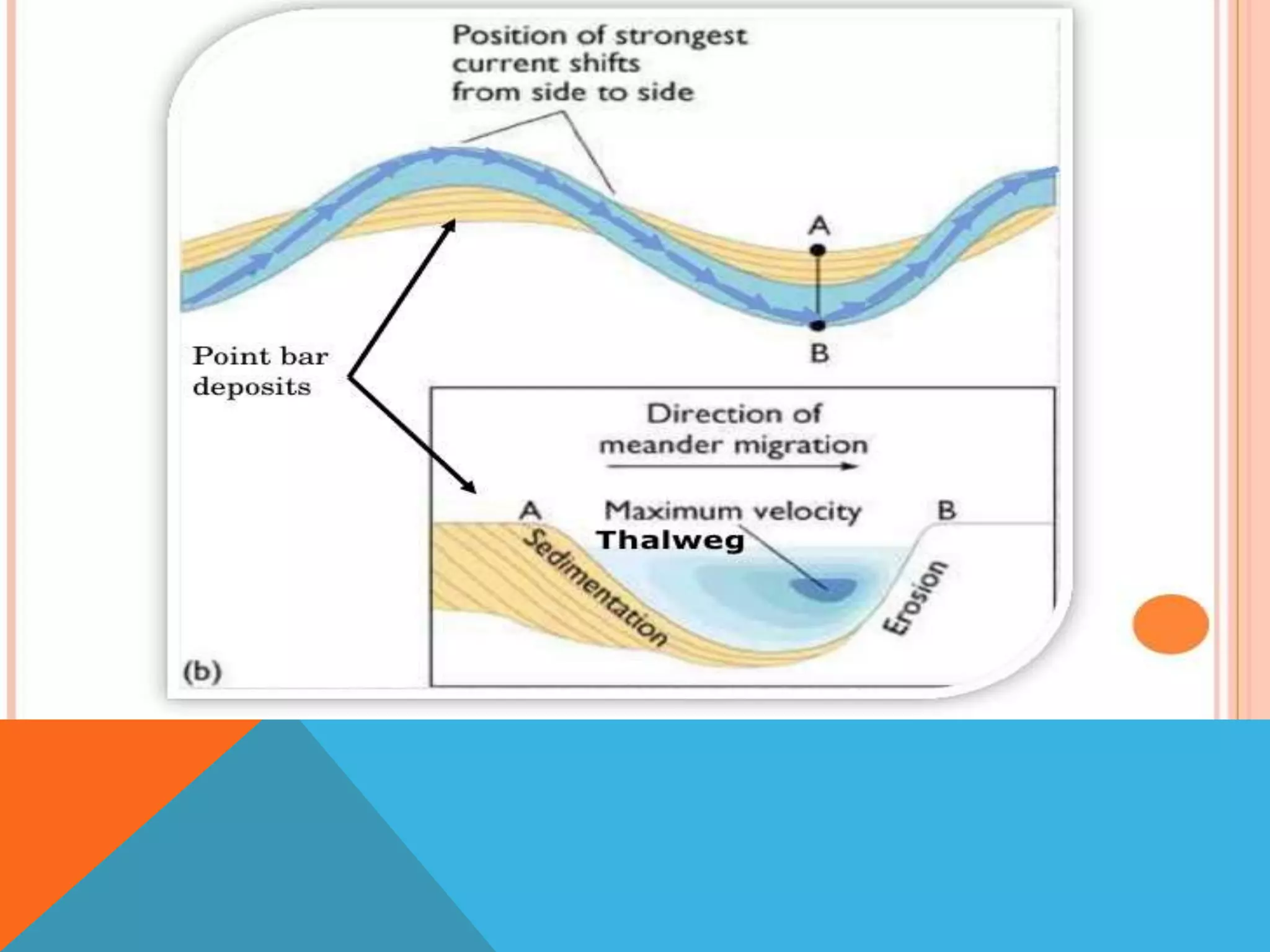
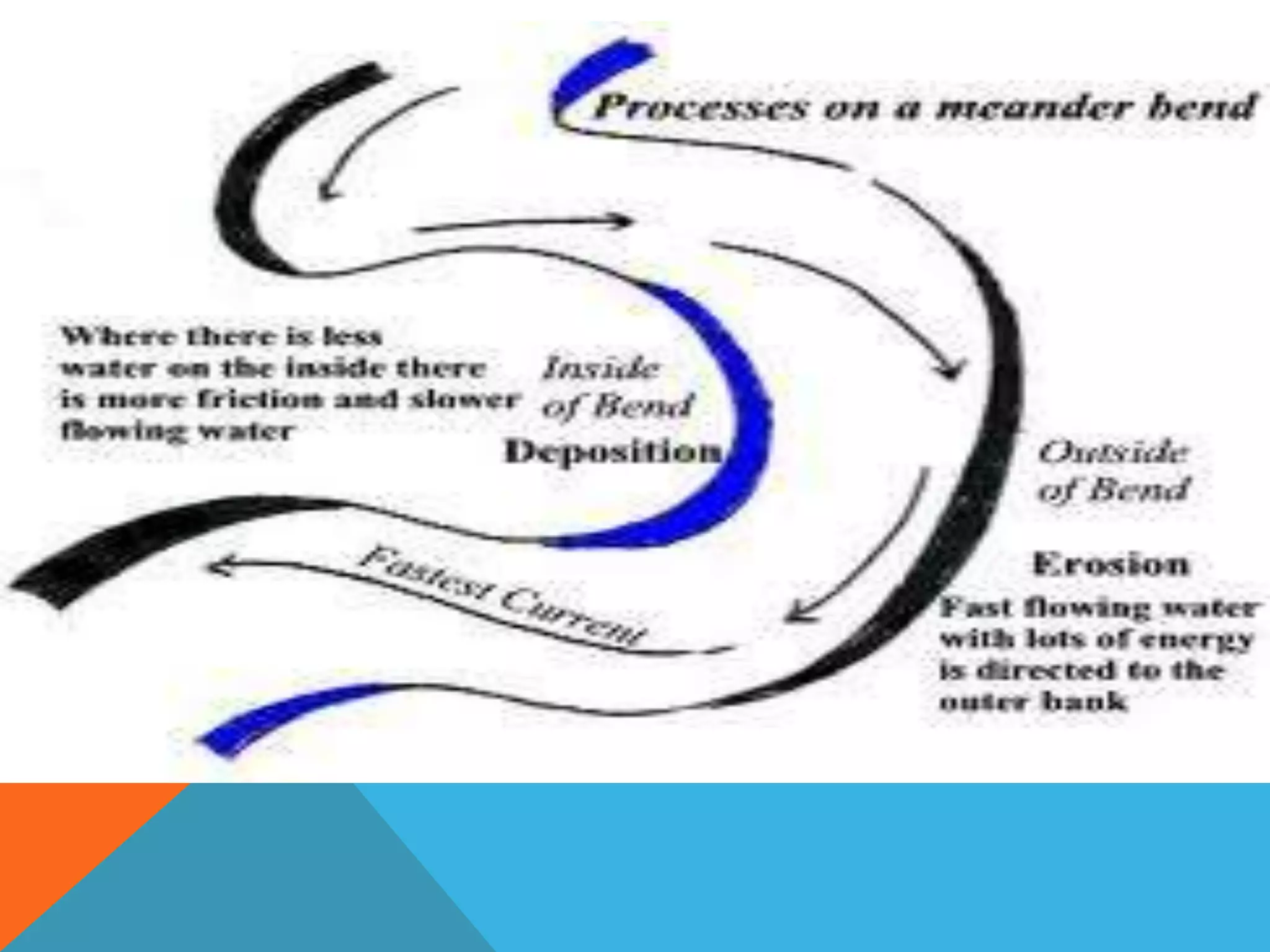
• The thalweg in a river (which is the line of the
deepest part of the channel where there is the
highest velocity flow) is not straight even if the
channel banks are straight and parallel. It will
follow a sinuous path moving from side to side
along the length of the channel. In any part of
the river, the bank closest to the thalweg has
relatively fast flowing water against it while the
opposite bank has slower flowing water
alongside
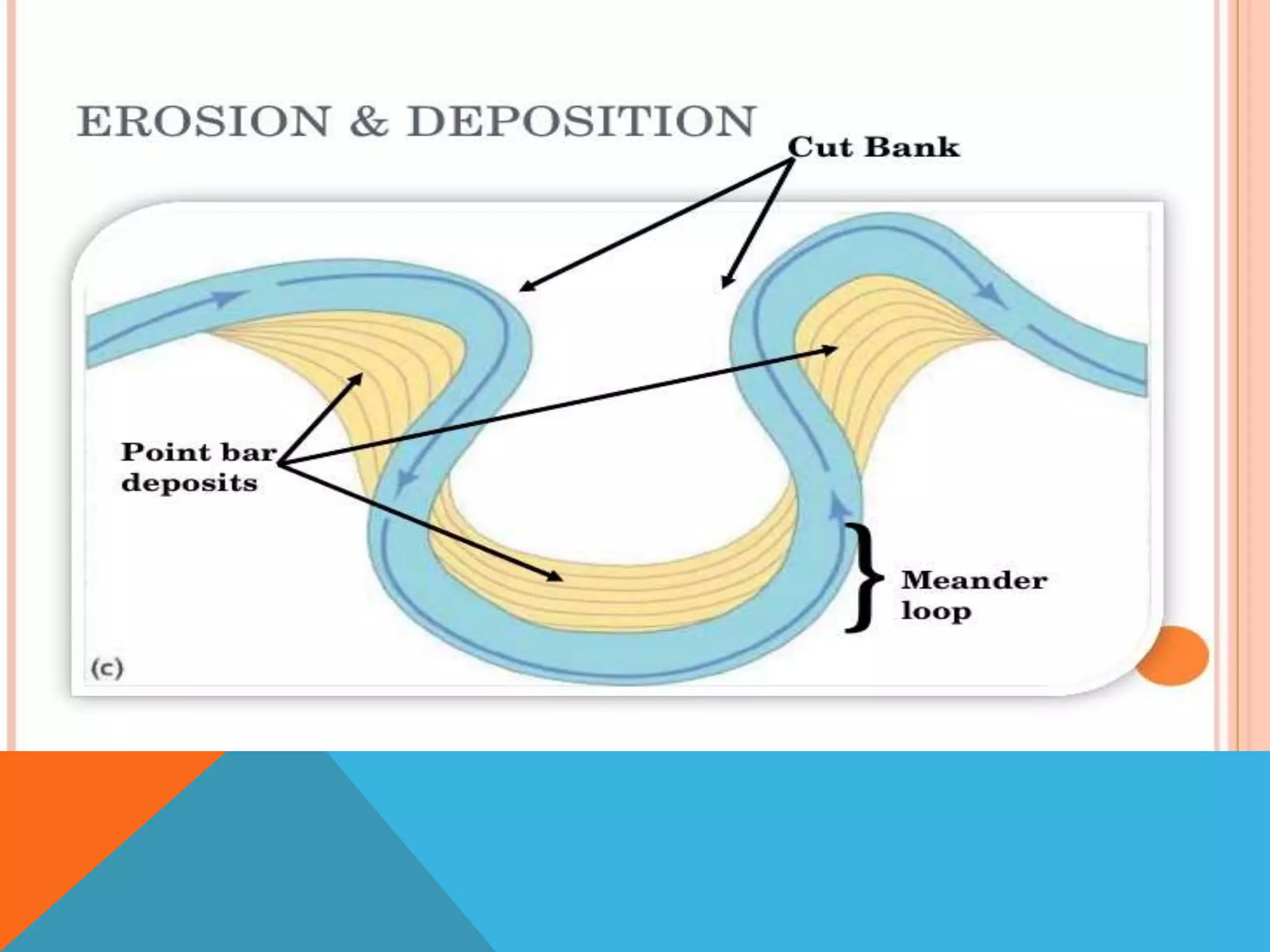
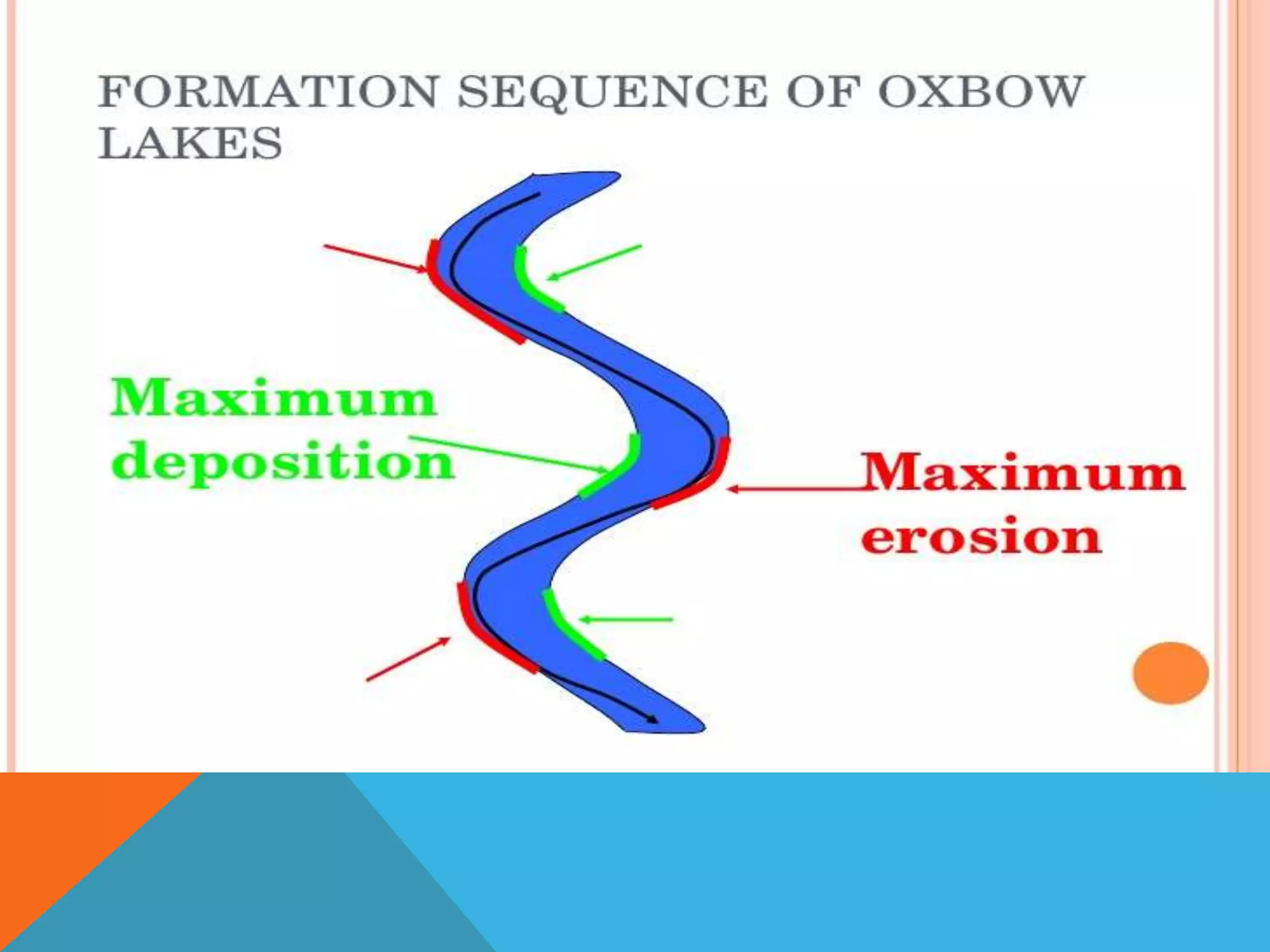
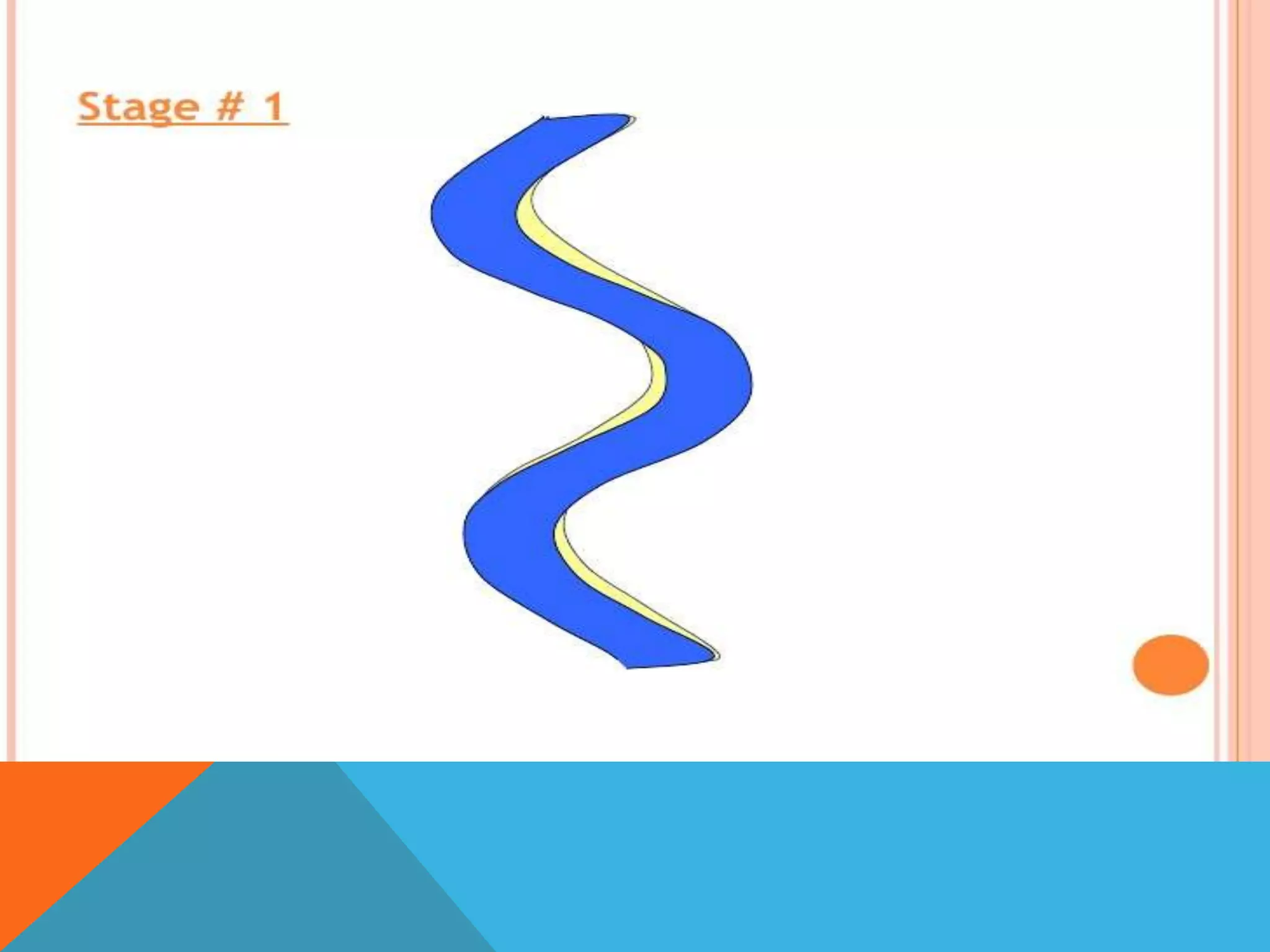
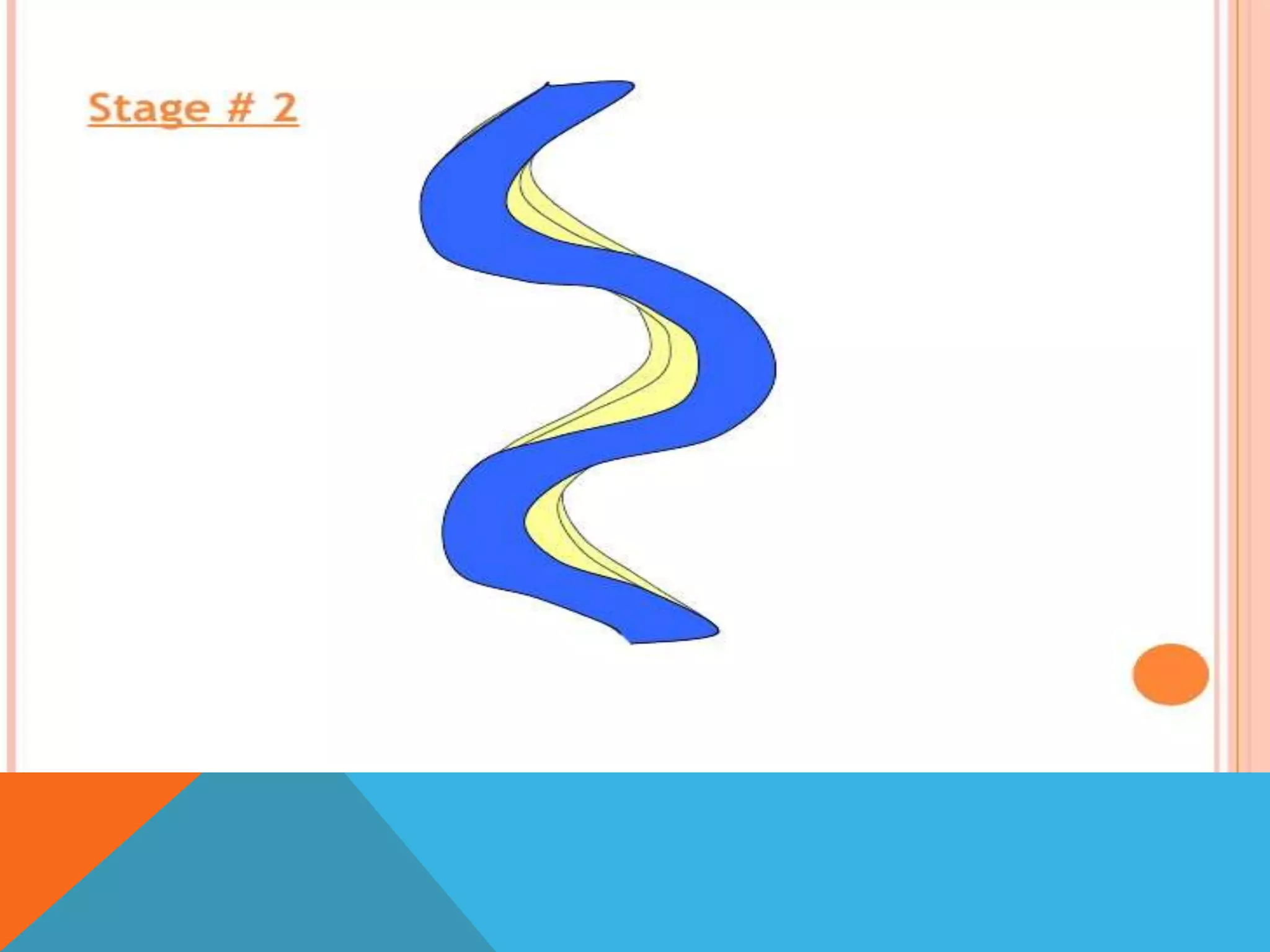
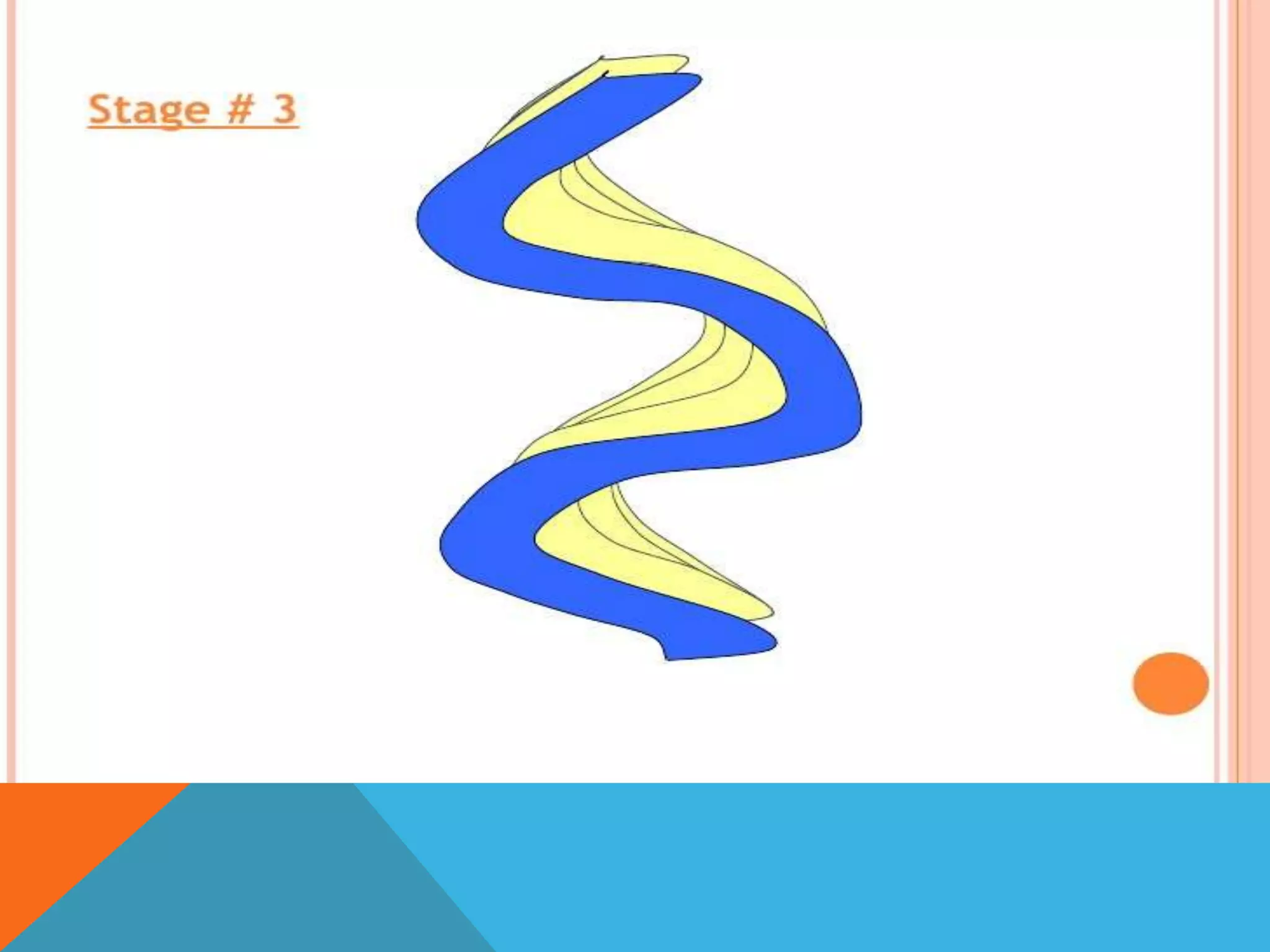
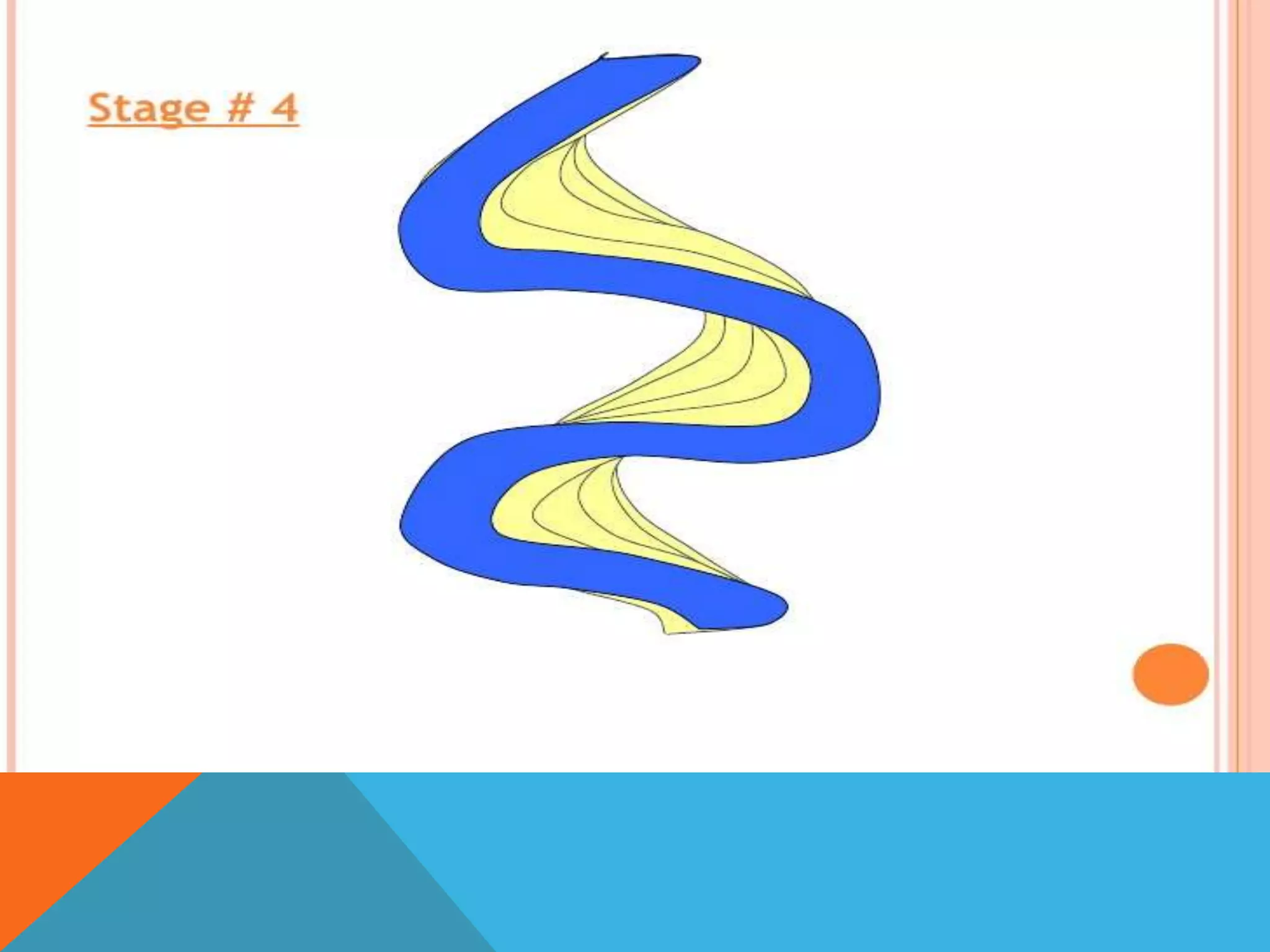
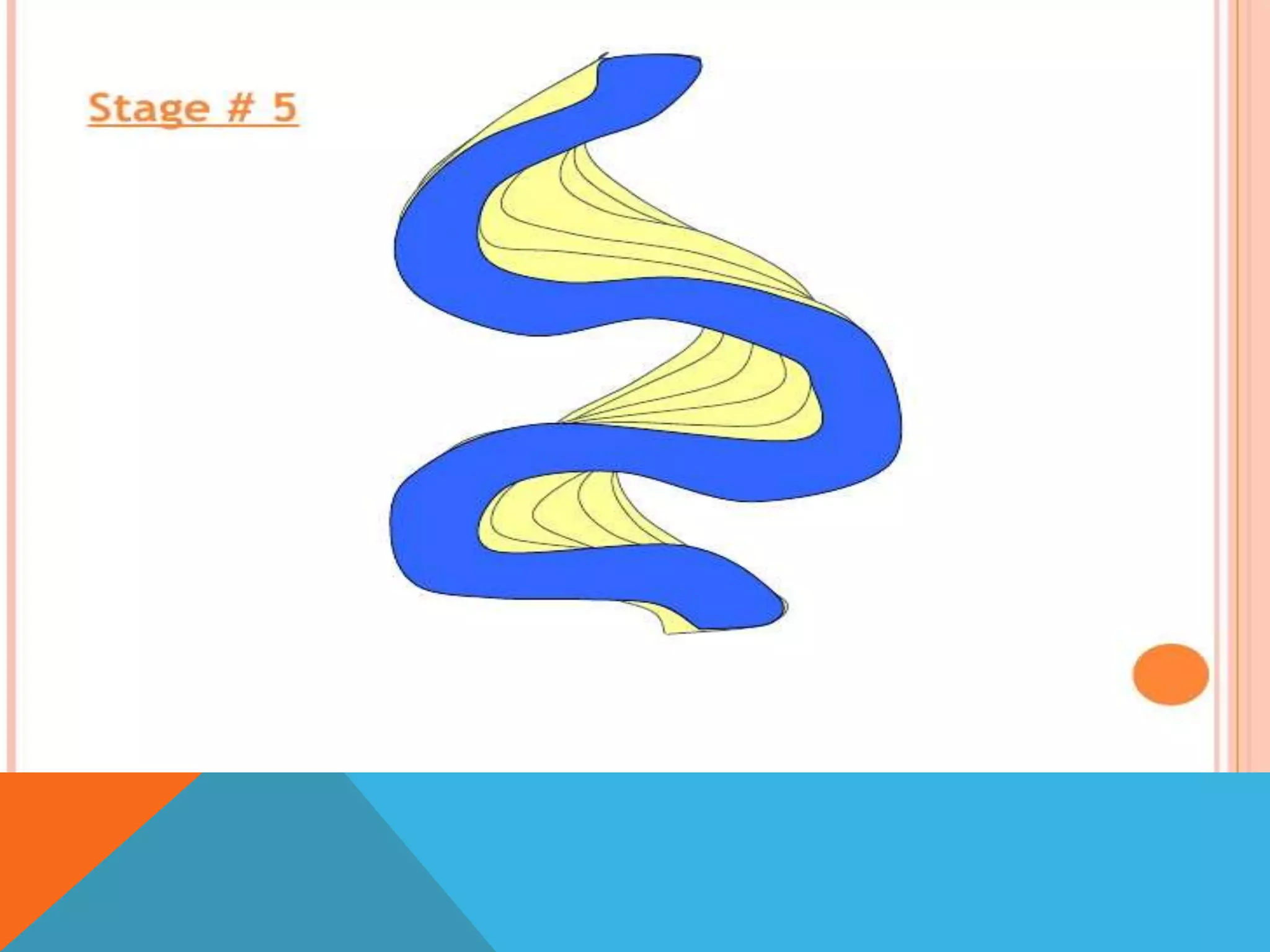
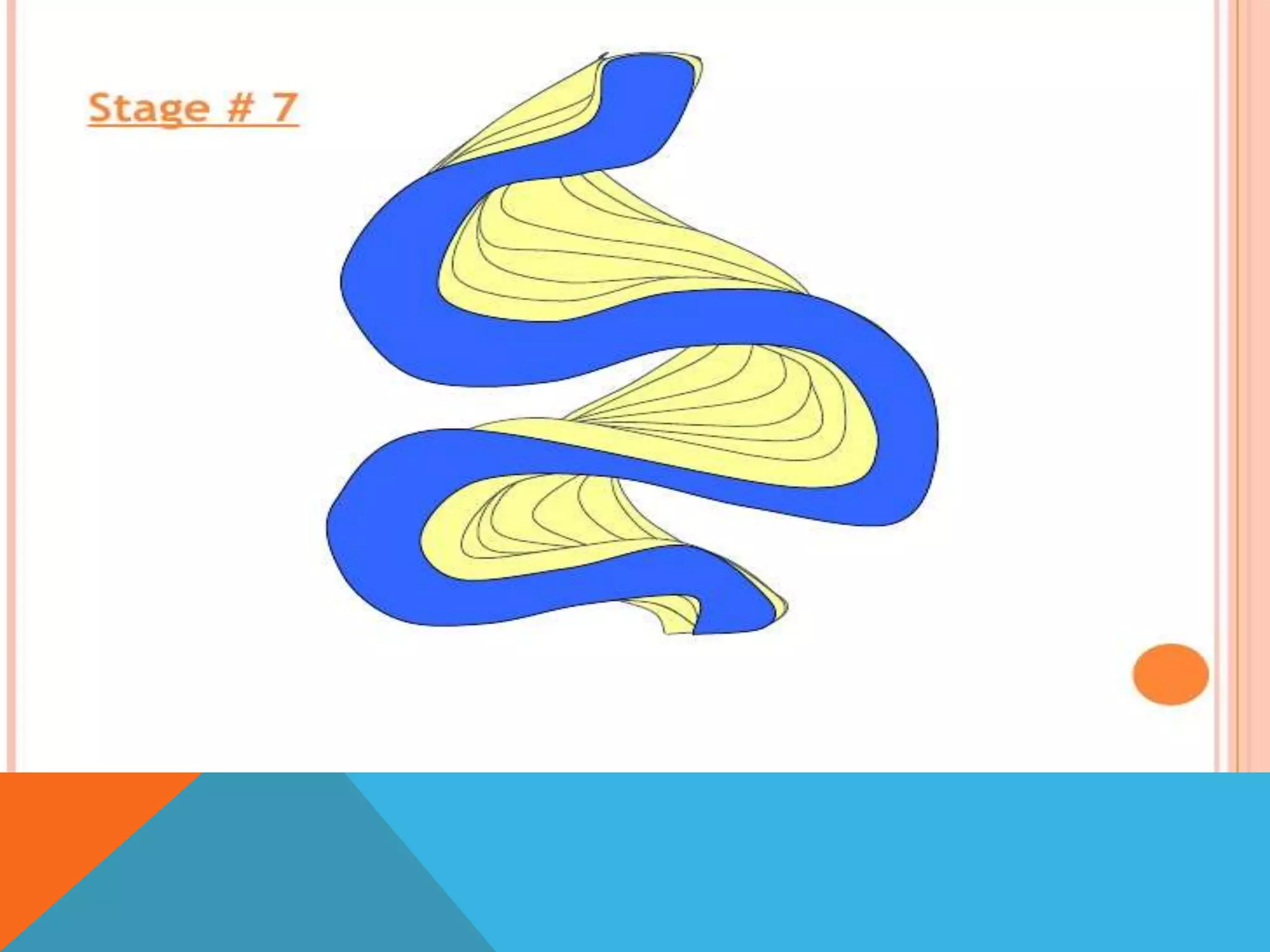
Meanders develop by the erosion of the bank
closest to the thalweg, accompanied by
deposition on the opposite side of the channel
where the flow is sluggish and the bed load can
no longer be carried.
With continued erosion of the outer bank and
deposition of bedload on the inner bank, the
channel develops a bend and meander loops are
formed
 MORPHOLOGY
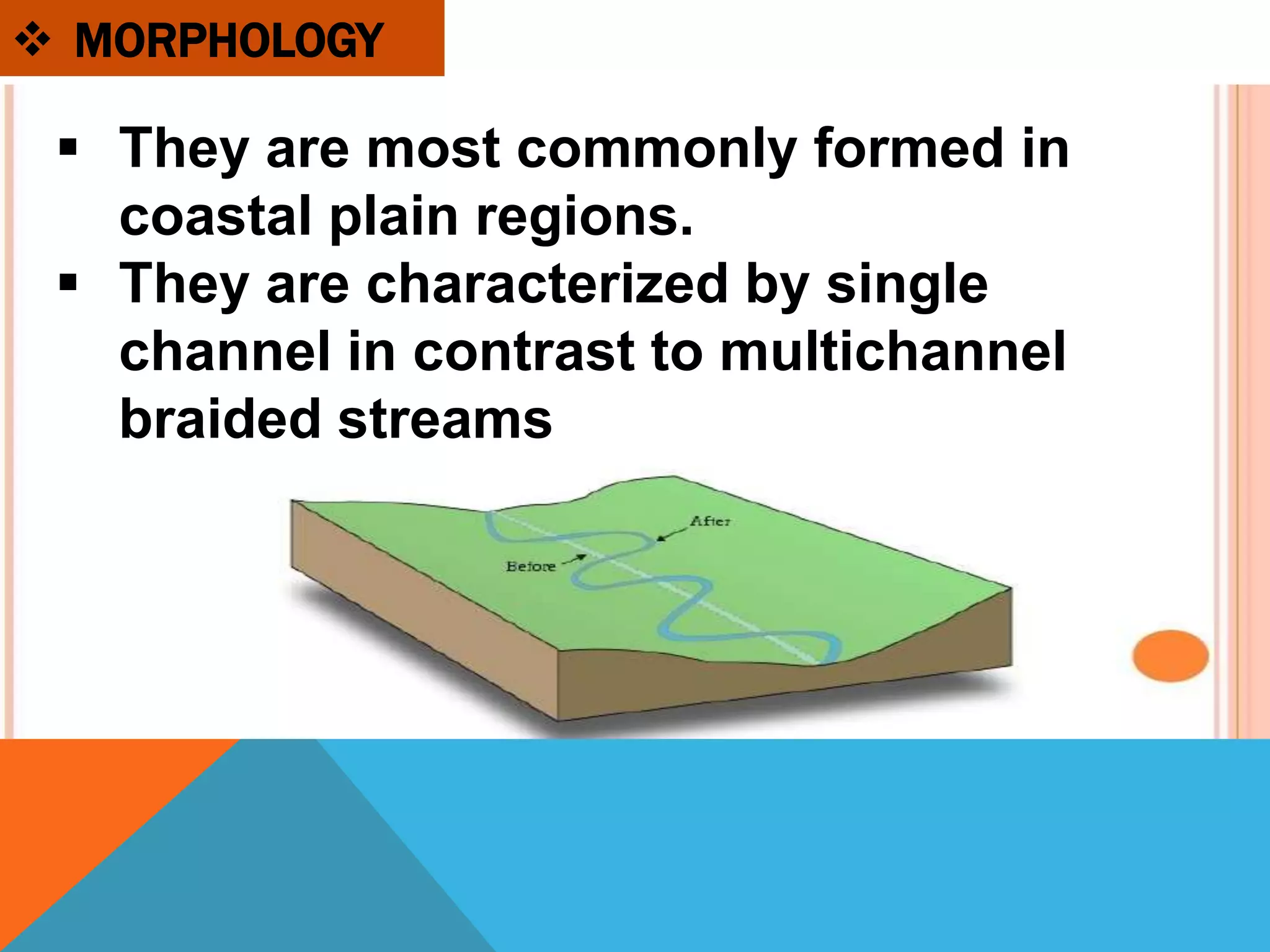
 They are most commonly formed in
coastal plain regions.
 They are characterized by single
channel in contrast to multichannel
braided streams
 Its morphology results from disruption in uniform
flow across the channel, caused by variation in;
 Sediments
 Slope or Gradient
 Bed roughness
 The channel profile comprises of a steep side & a
gently sloping side relative to stream bed.
 The steep side experiences lateral erosion and
gently sloping side is characterised by
sedimentation
 PROCESSES
 They are characterized by turbulent flow;
velocity varies both horizontally & vertically
across the channel.
 It transport the material both as bed-load
and suspended load.
 Unlike braided streams, meandering
streams provides a regular pattern of flow.
 There is a consensus about the flow in
meanders which may be ellaborated as;
Helical flow
 It is the major flow in the meander bends.
 This flow causes an elevation of water level on
the outside of meander.
 This helical flow produces a component of flow
which is normal to stream bank; towards the
eroding bank near the surface and towards the
accreting bank near the bottom
 This has the net effect of producing a
circulation cell which interacts with the bed to
carry sediments upslope along the accretion
surface
HELICAL FLOW
 FEATURES
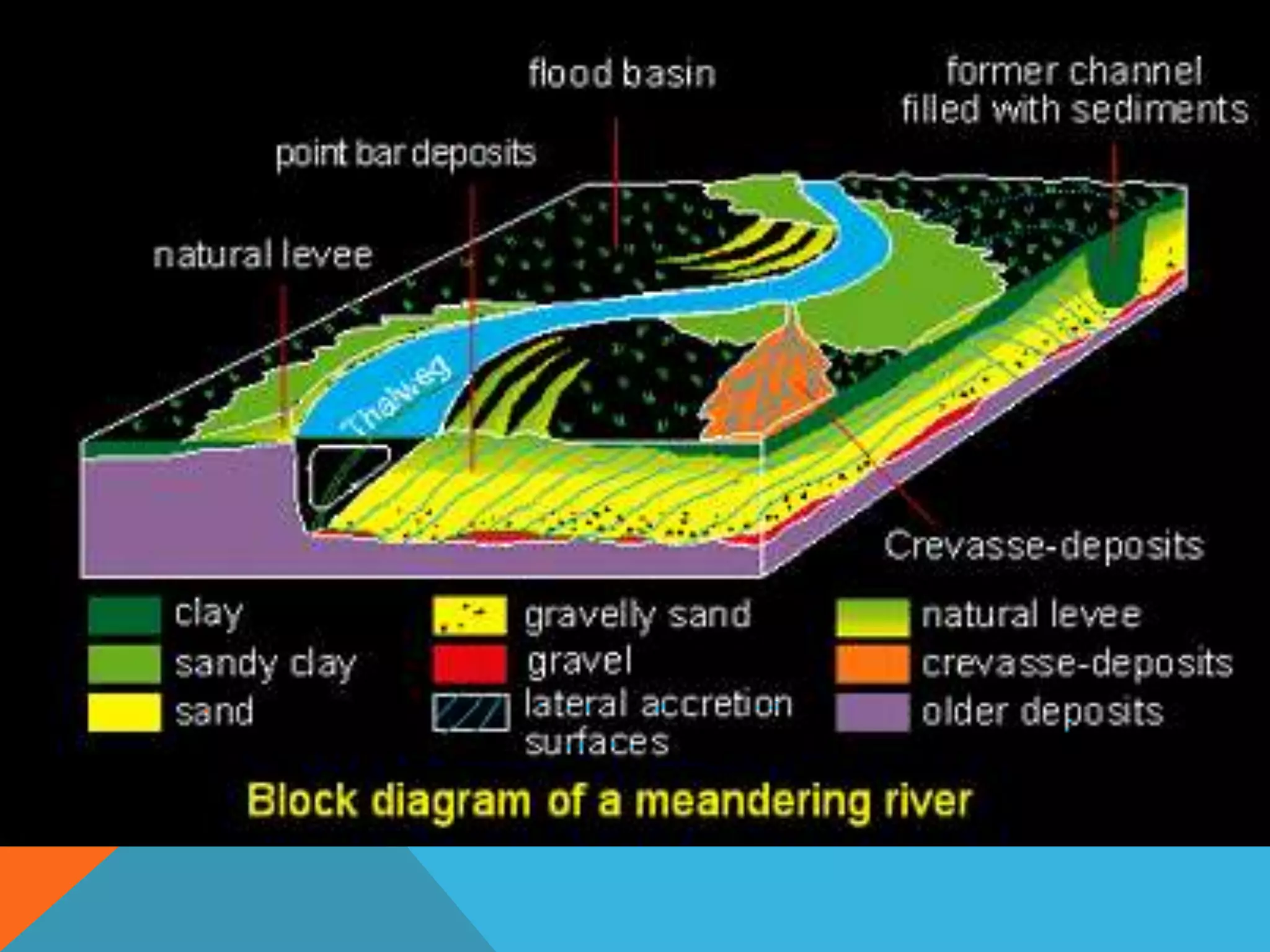
 There are numerous environment &
subenvironments related to meandering
streams; each having characteristics deposits
 These includes;
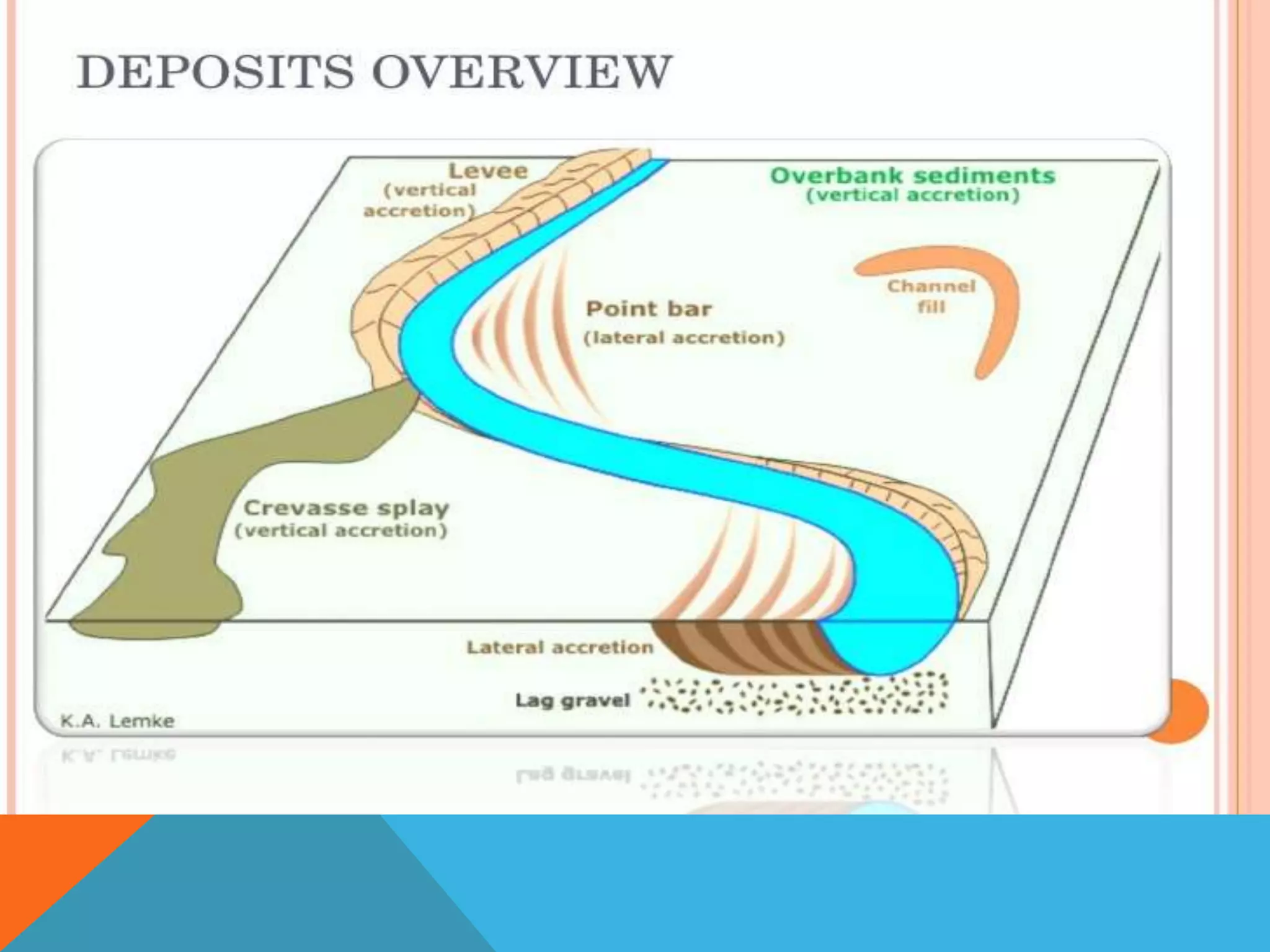
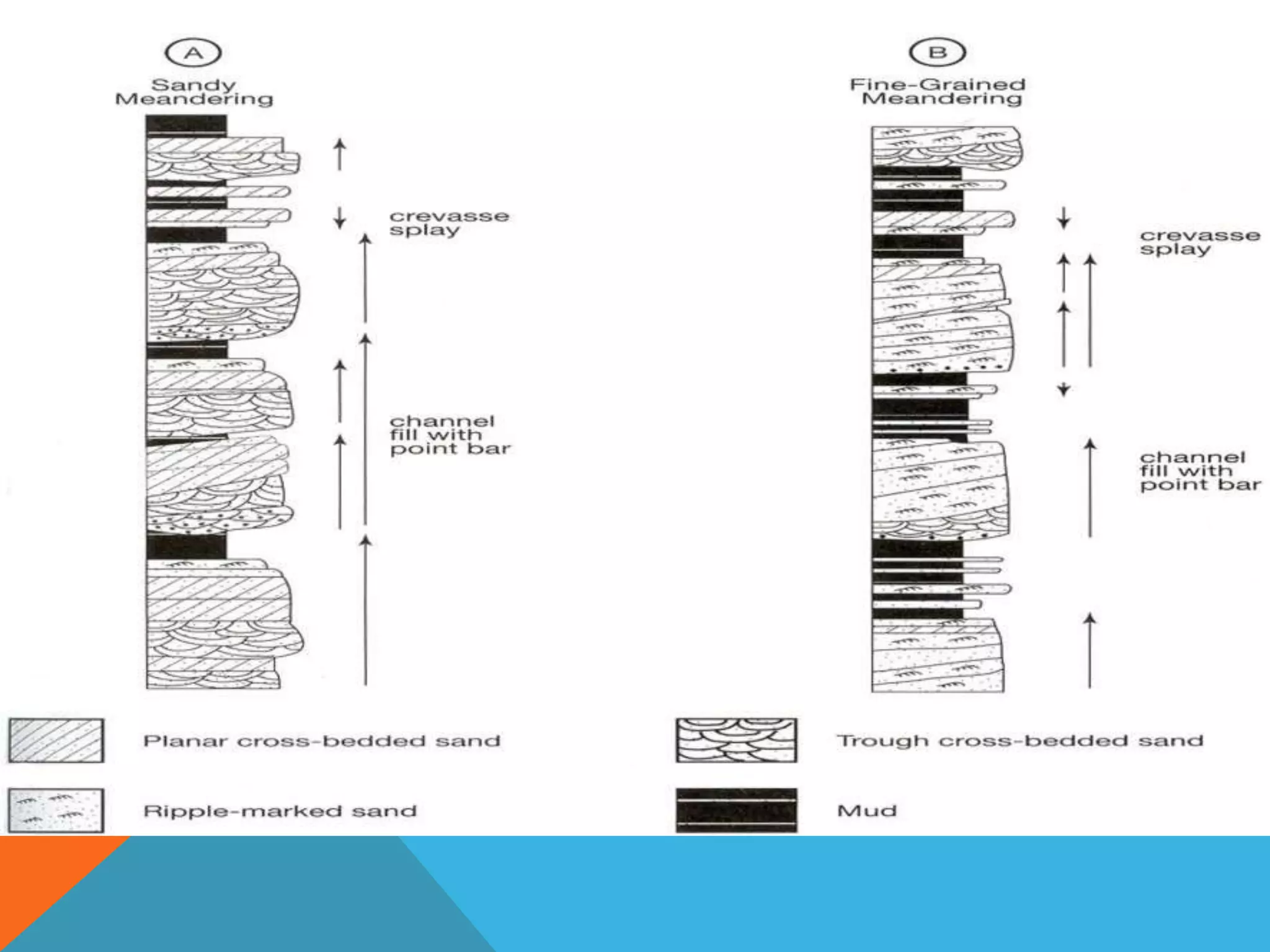
Channel Lag
Point Bar
Overbank Deposits
Natural Levees
Crevasse-splays
Oxbow Lakes
• CHANNEL LAG
Below the channel floor or thalweg,
coarsest material is sorted out and left
behind on the stream bed. Lying just above
the basal erosional surface (or scour base)
is the channel lag which consists of
mudclasts and blocks from bank erosion,
plant debris, boulders and bed-load sand
and gravel
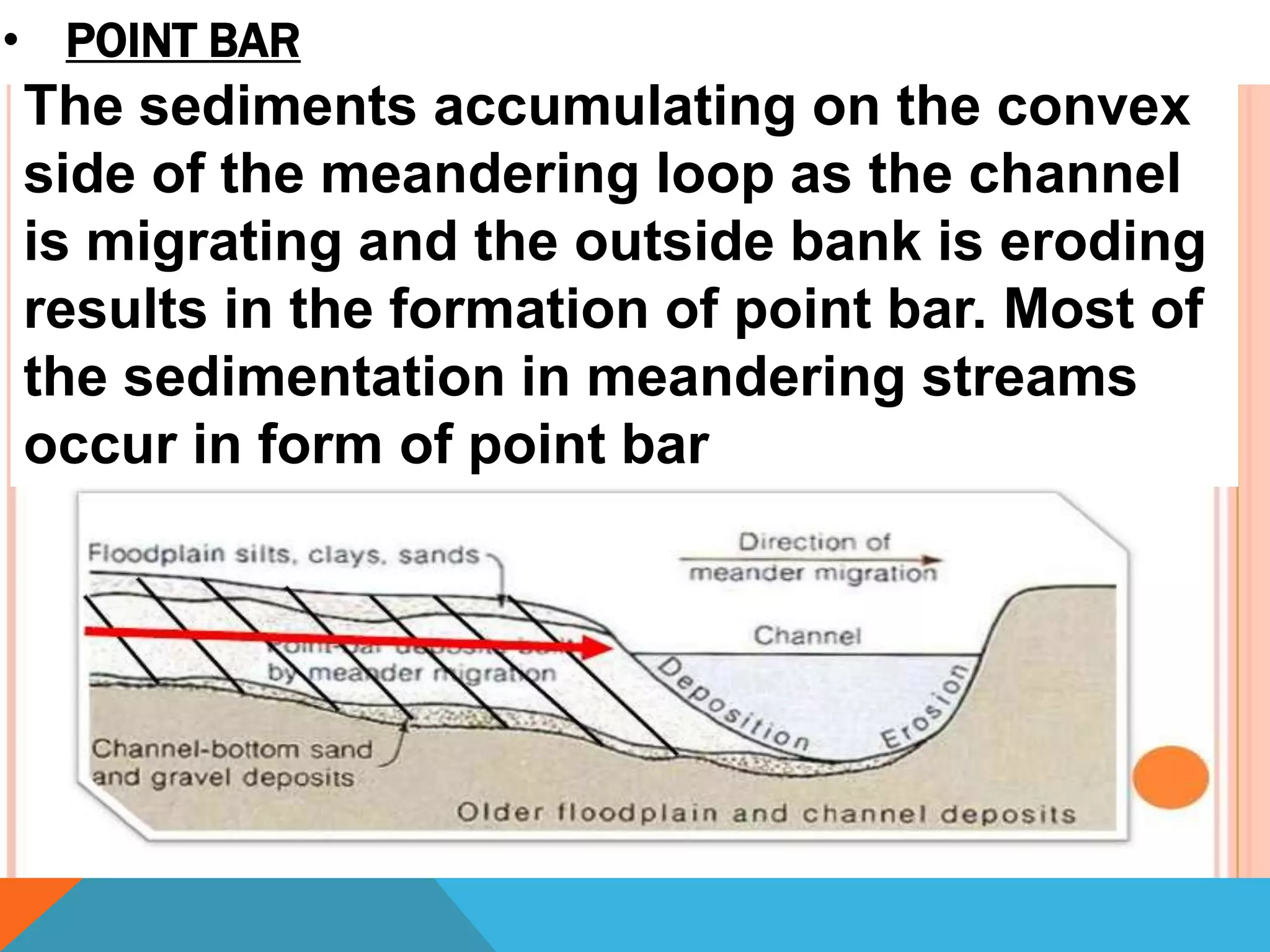
• POINT BAR
The sediments accumulating on the convex
side of the meandering loop as the channel
is migrating and the outside bank is eroding
results in the formation of point bar. Most of
the sedimentation in meandering streams
occur in form of point bar
Sediment deposited by a river on a valley
flow outside the stream channel. Such
waters usually contain much sediment in
suspension resulting in fine layers of
silt/sand deposition known as overbank
deposits
• OVERBANK DEPOSITS
Sheets of sand and silt deposited during floods
are thickest near to the channel bank because
coarser suspended load is dumped quickly by
the floodwaters as soon as they start flowing
away from the channel. Repeated deposition of
sand close to the channel edge leads to the
formation of a levee’, a bank of sediment at the
channel edge which is higher than the level of
the floodplain
• NATURAL LEVEES
In times of flooding, the river breaches its
banks. It may temporarily cut through the
outer levee and spill large quantities of
water and sediments. This is known as a
crevasse splay which is typically in a lobe
shape with a mixture of fine and coarse
grained sediments.
• CREVASSE SPLAY
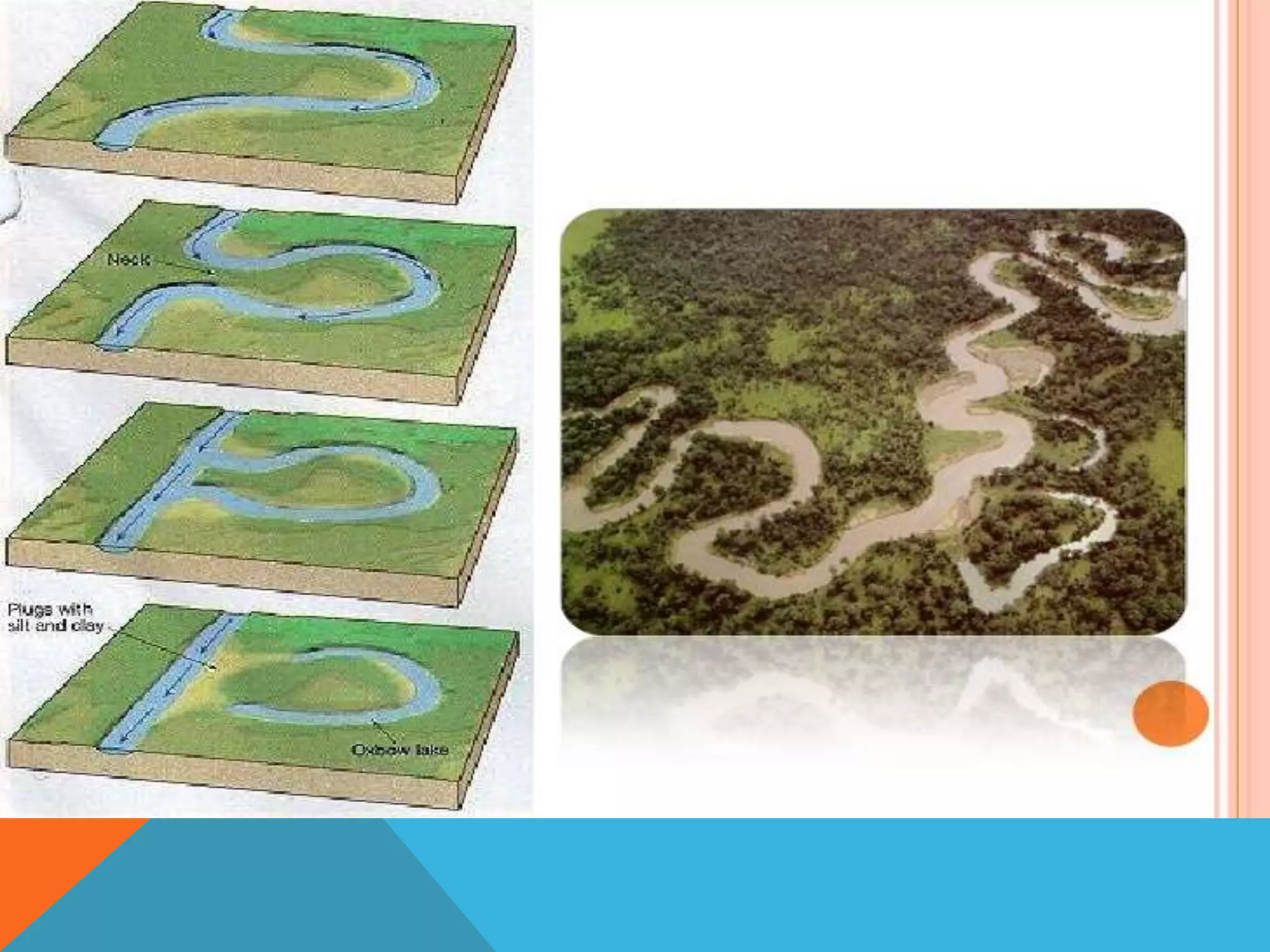
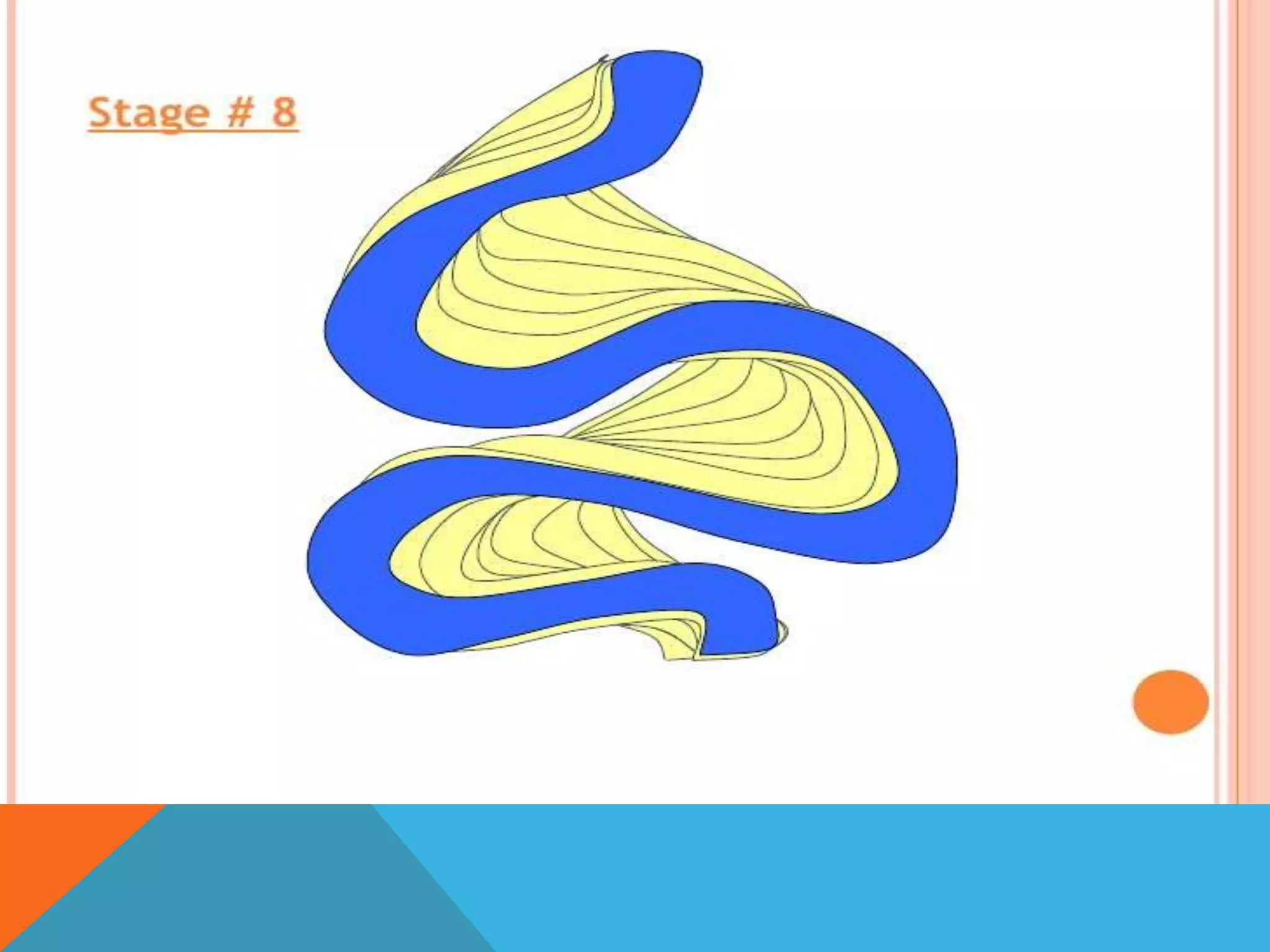
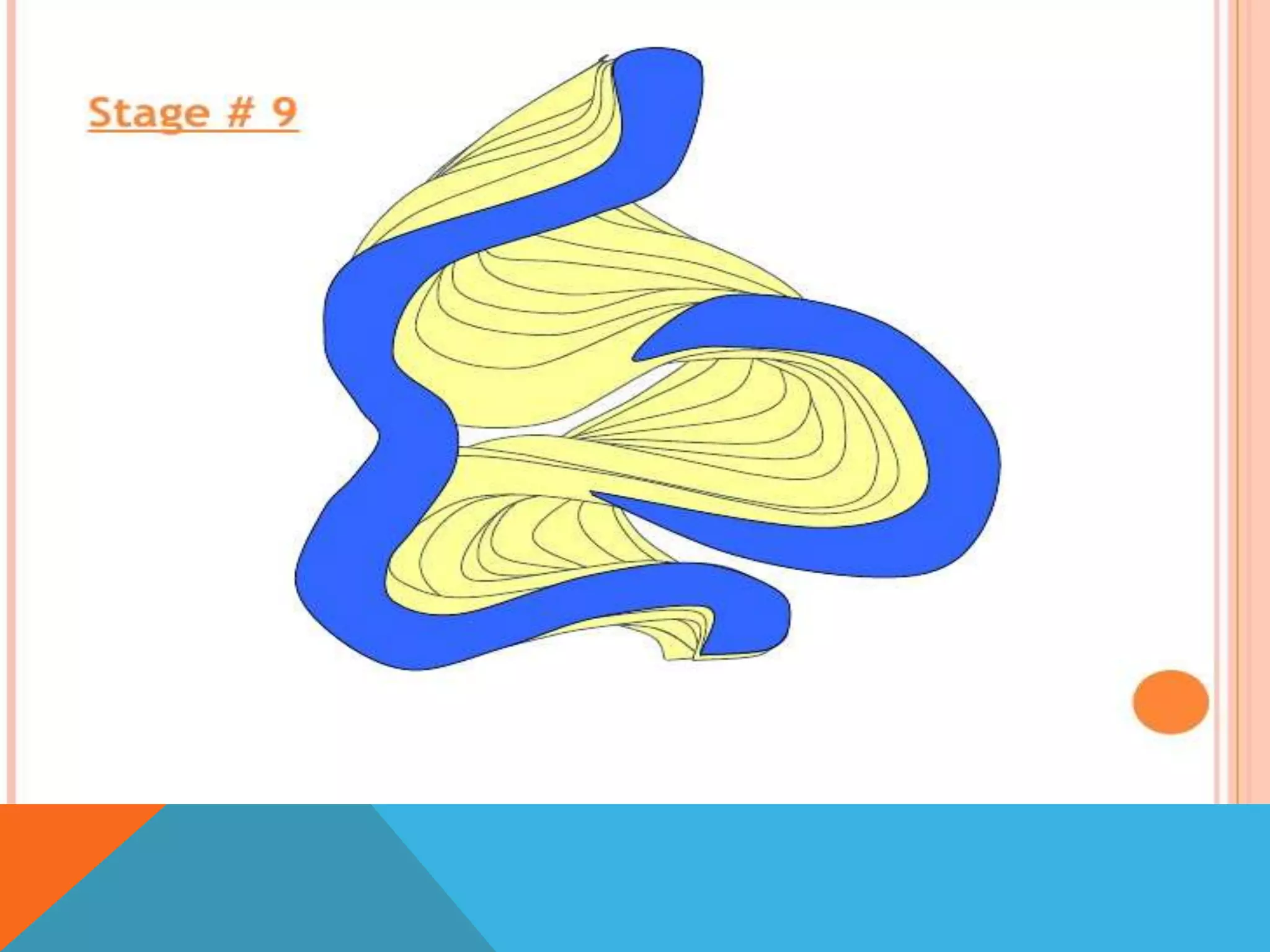
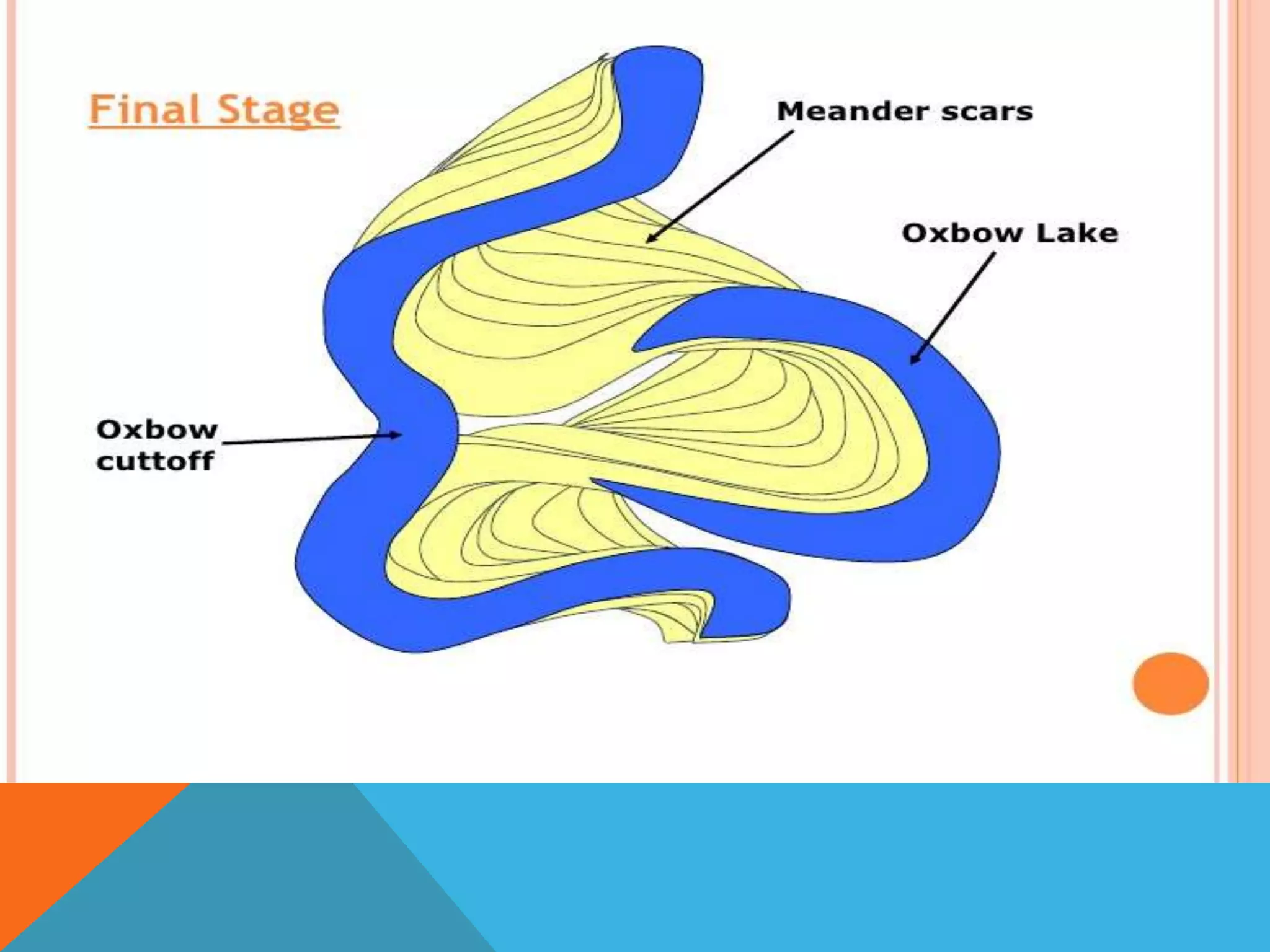
Oxbow lakes are created when growing
meanders intersect each other and cut off a
meander loop. These occurs when
meanders grow laterally through erosion
(outside bend) and sediment deposition
(inside bend, point bar). When the loops get
too large and consume too much energy
(friction), the river will eventually find a less
energetically “taxing” shortcut and a part of
the old channel will be abandoned and
becomes an oxbow lake. Over a period of
time, these oxbow lakes tend to dry out or
fill in with sediments.
 OXBOW LAKE
MEANDERING RIVER FACIES
A facies is a body of rock characterized by a
particular combination of lithology, texture,
suite of sedimentary structures, fossil
content, colour, geometry, paleocurrent
pattern, etc. A facies is produced by one or
several processes operating in a
depositional environment.
 Walther's Law of Facies named after the
geologist Johannes Walther(1860-1937),
states that: the vertical succession of facies
reflects lateral changes in environment.
Conversely, it states that when a
depositional environment "migrates"
laterally, sediments of one depositional
environment come to lie on top of another.
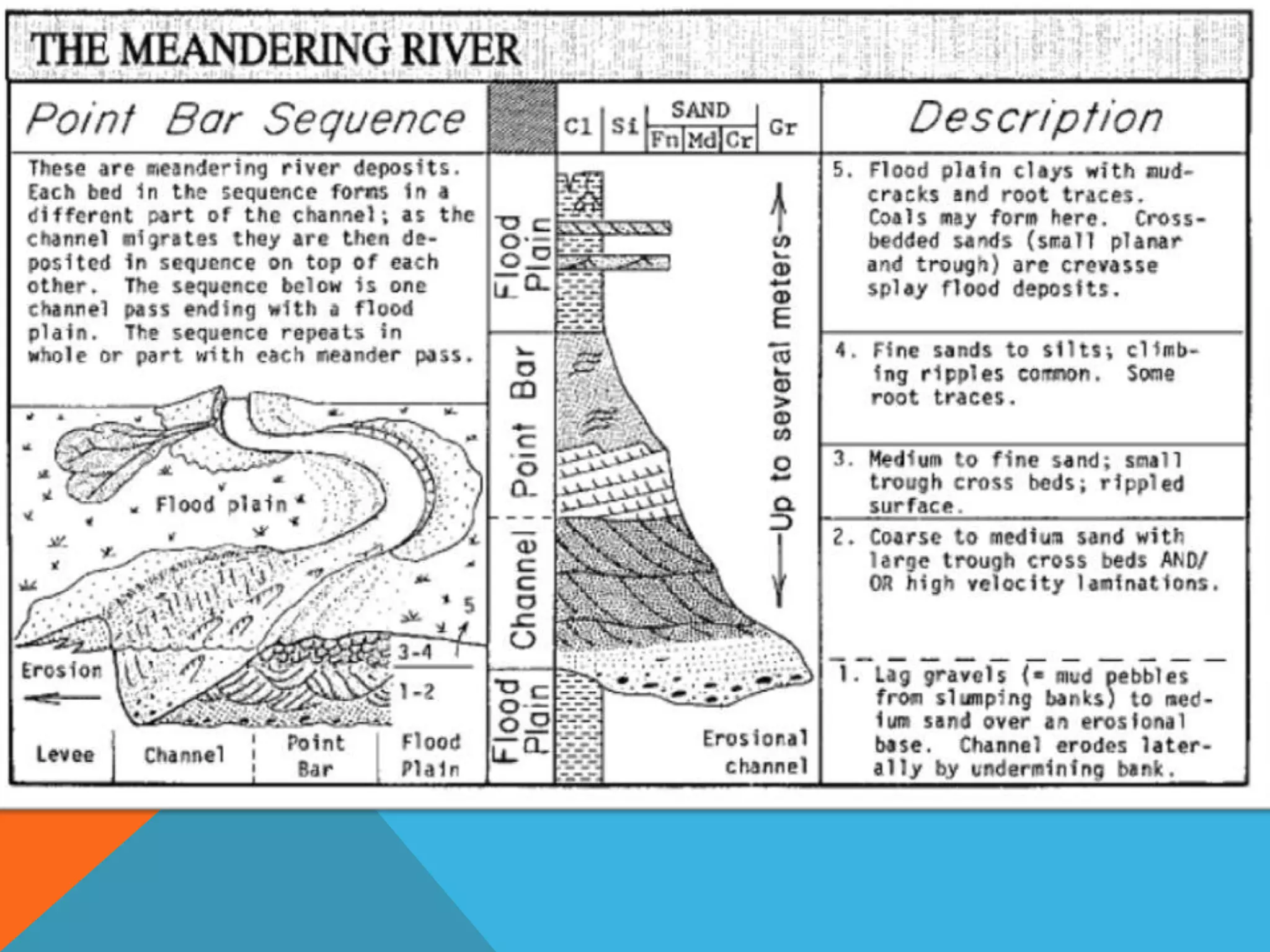
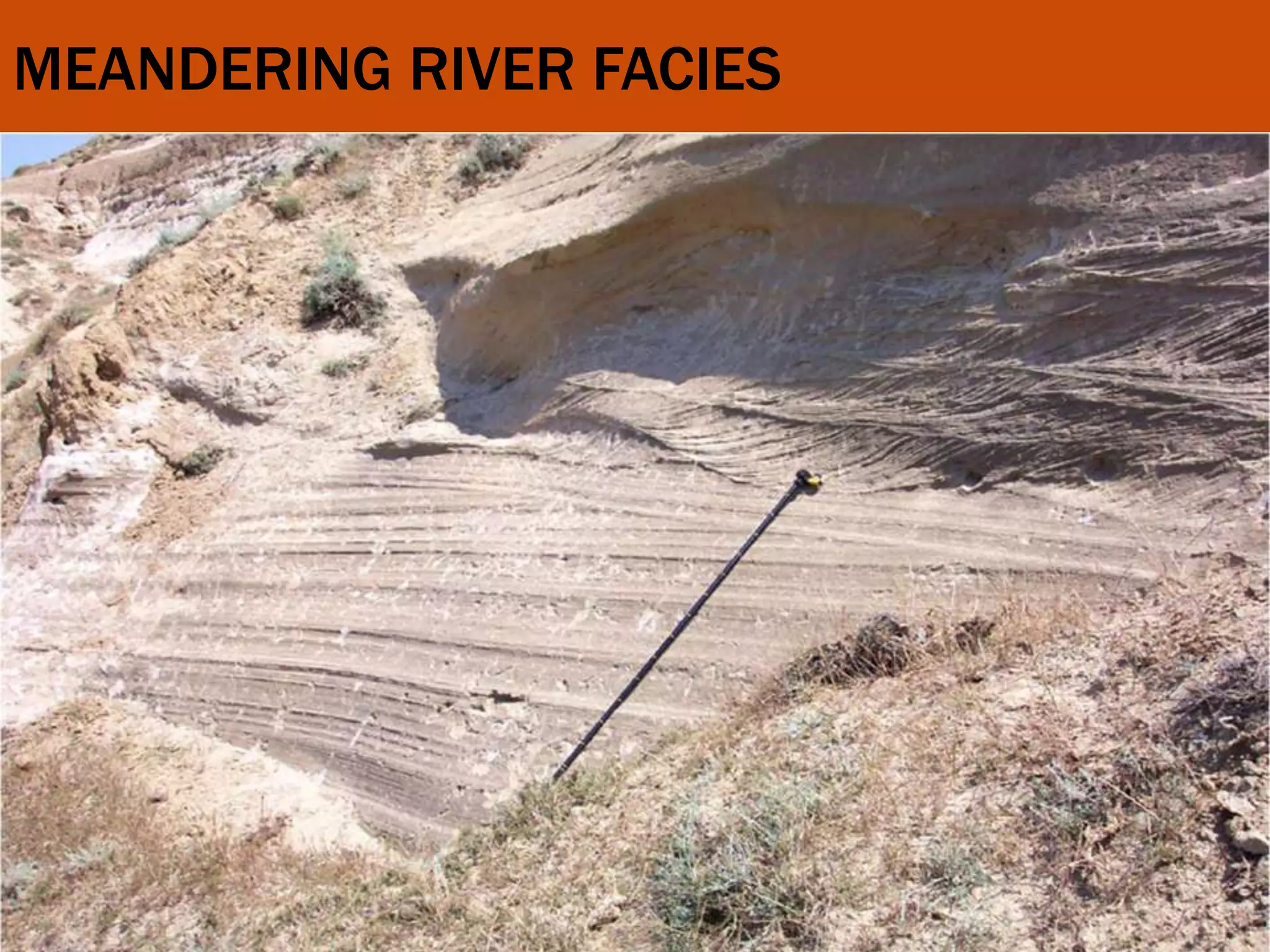
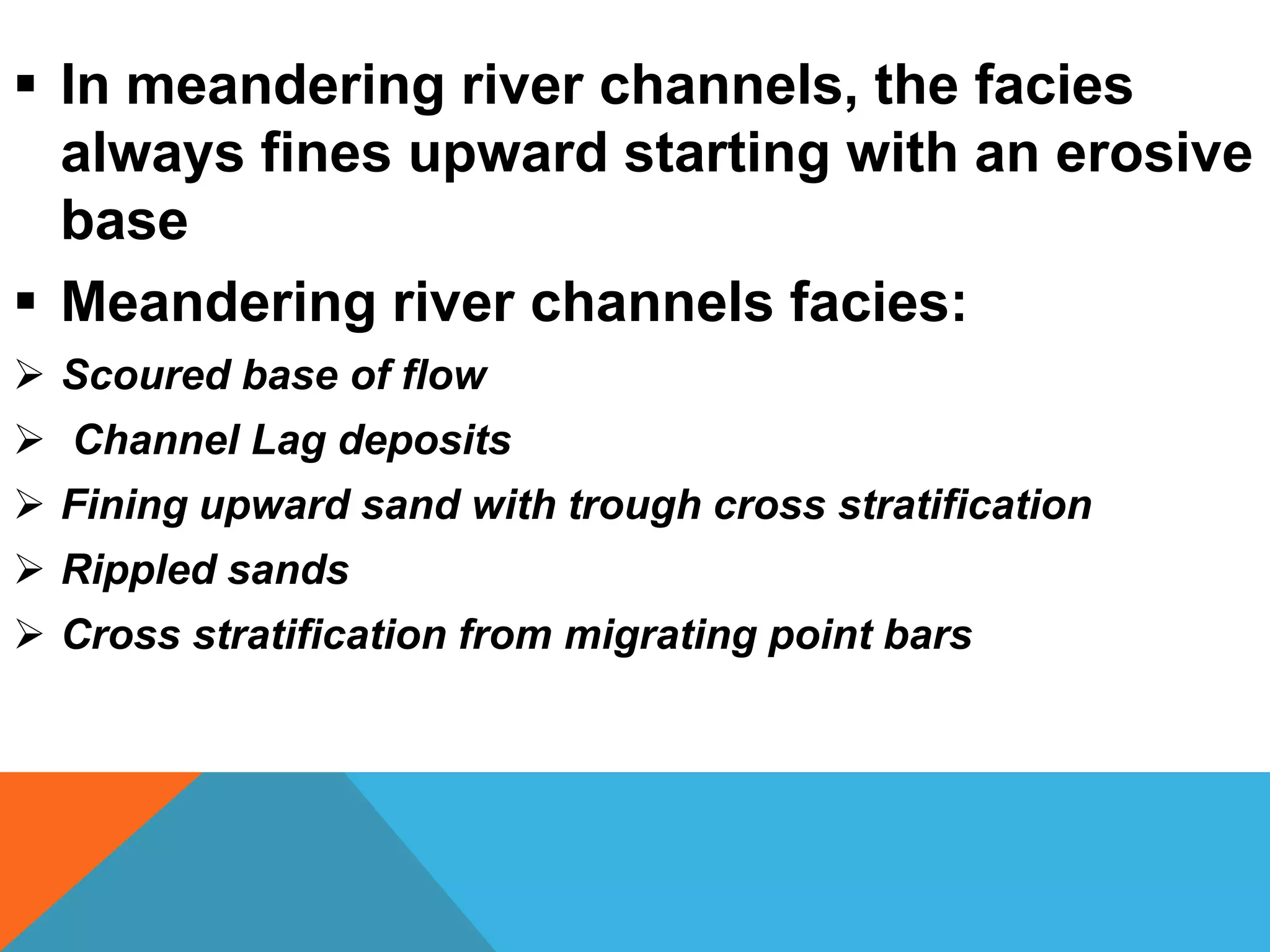
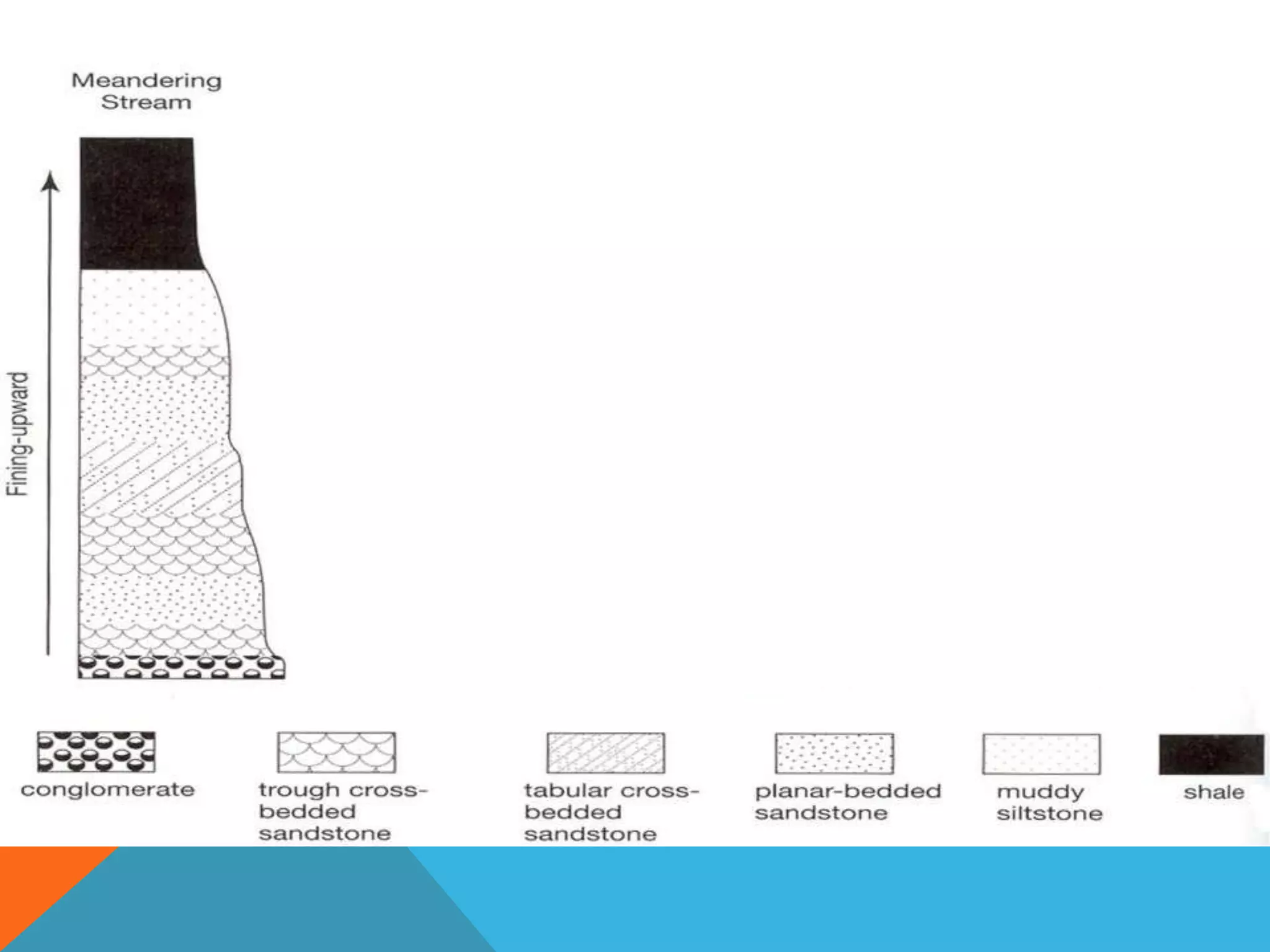
 In meandering river channels, the facies
always fines upward starting with an erosive
base
 Meandering river channels facies:
 Scoured base of flow
 Channel Lag deposits
 Fining upward sand with trough cross stratification
 Rippled sands
 Cross stratification from migrating point bars
CONCLUSION
THANK YOU
FOR
LISTENING

Meander.ppt

  • 1.
  • 2.
    CONTENTS • INTRODUCTION • MEANDERINGRIVER SYSTEM  FORMATION  MORPHOLOGY  PROCESSES  FEATURES  FACIES  CONCLUSION
  • 3.
  • 4.
    MEANDERING STREAM A meanderin general is a bend in a sinuous watercourse
  • 5.
     FORMATION • Thethalweg in a river (which is the line of the deepest part of the channel where there is the highest velocity flow) is not straight even if the channel banks are straight and parallel. It will follow a sinuous path moving from side to side along the length of the channel. In any part of the river, the bank closest to the thalweg has relatively fast flowing water against it while the opposite bank has slower flowing water alongside
  • 6.
    Meanders develop bythe erosion of the bank closest to the thalweg, accompanied by deposition on the opposite side of the channel where the flow is sluggish and the bed load can no longer be carried. With continued erosion of the outer bank and deposition of bedload on the inner bank, the channel develops a bend and meander loops are formed
  • 8.
     MORPHOLOGY  Theyare most commonly formed in coastal plain regions.  They are characterized by single channel in contrast to multichannel braided streams
  • 9.
     Its morphologyresults from disruption in uniform flow across the channel, caused by variation in;  Sediments  Slope or Gradient  Bed roughness  The channel profile comprises of a steep side & a gently sloping side relative to stream bed.  The steep side experiences lateral erosion and gently sloping side is characterised by sedimentation
  • 11.
     PROCESSES  Theyare characterized by turbulent flow; velocity varies both horizontally & vertically across the channel.  It transport the material both as bed-load and suspended load.  Unlike braided streams, meandering streams provides a regular pattern of flow.  There is a consensus about the flow in meanders which may be ellaborated as;
  • 12.
    Helical flow  Itis the major flow in the meander bends.  This flow causes an elevation of water level on the outside of meander.  This helical flow produces a component of flow which is normal to stream bank; towards the eroding bank near the surface and towards the accreting bank near the bottom  This has the net effect of producing a circulation cell which interacts with the bed to carry sediments upslope along the accretion surface HELICAL FLOW
  • 14.
     FEATURES  Thereare numerous environment & subenvironments related to meandering streams; each having characteristics deposits  These includes; Channel Lag Point Bar Overbank Deposits Natural Levees Crevasse-splays Oxbow Lakes
  • 15.
    • CHANNEL LAG Belowthe channel floor or thalweg, coarsest material is sorted out and left behind on the stream bed. Lying just above the basal erosional surface (or scour base) is the channel lag which consists of mudclasts and blocks from bank erosion, plant debris, boulders and bed-load sand and gravel
  • 16.
    • POINT BAR Thesediments accumulating on the convex side of the meandering loop as the channel is migrating and the outside bank is eroding results in the formation of point bar. Most of the sedimentation in meandering streams occur in form of point bar
  • 17.
    Sediment deposited bya river on a valley flow outside the stream channel. Such waters usually contain much sediment in suspension resulting in fine layers of silt/sand deposition known as overbank deposits • OVERBANK DEPOSITS
  • 18.
    Sheets of sandand silt deposited during floods are thickest near to the channel bank because coarser suspended load is dumped quickly by the floodwaters as soon as they start flowing away from the channel. Repeated deposition of sand close to the channel edge leads to the formation of a levee’, a bank of sediment at the channel edge which is higher than the level of the floodplain • NATURAL LEVEES
  • 19.
    In times offlooding, the river breaches its banks. It may temporarily cut through the outer levee and spill large quantities of water and sediments. This is known as a crevasse splay which is typically in a lobe shape with a mixture of fine and coarse grained sediments. • CREVASSE SPLAY
  • 21.
    Oxbow lakes arecreated when growing meanders intersect each other and cut off a meander loop. These occurs when meanders grow laterally through erosion (outside bend) and sediment deposition (inside bend, point bar). When the loops get too large and consume too much energy (friction), the river will eventually find a less energetically “taxing” shortcut and a part of the old channel will be abandoned and becomes an oxbow lake. Over a period of time, these oxbow lakes tend to dry out or fill in with sediments.  OXBOW LAKE
  • 34.
  • 35.
    A facies isa body of rock characterized by a particular combination of lithology, texture, suite of sedimentary structures, fossil content, colour, geometry, paleocurrent pattern, etc. A facies is produced by one or several processes operating in a depositional environment.
  • 36.
     Walther's Lawof Facies named after the geologist Johannes Walther(1860-1937), states that: the vertical succession of facies reflects lateral changes in environment. Conversely, it states that when a depositional environment "migrates" laterally, sediments of one depositional environment come to lie on top of another.
  • 37.
     In meanderingriver channels, the facies always fines upward starting with an erosive base  Meandering river channels facies:  Scoured base of flow  Channel Lag deposits  Fining upward sand with trough cross stratification  Rippled sands  Cross stratification from migrating point bars
  • 42.
  • 43.