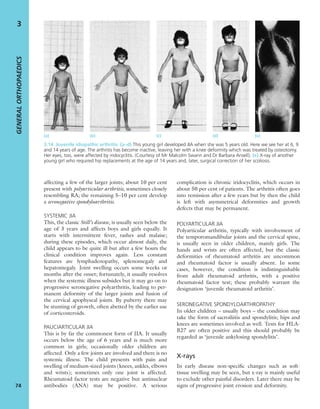
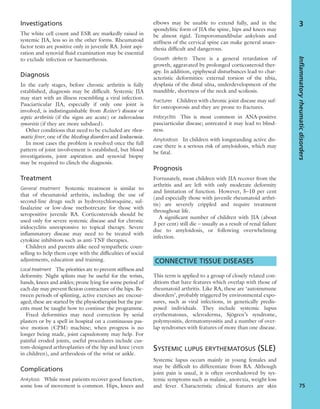
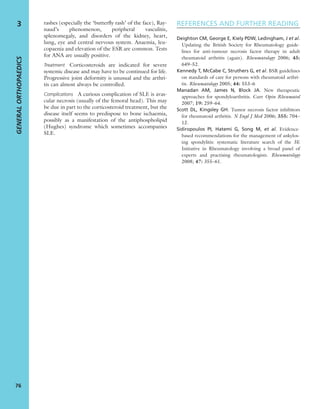
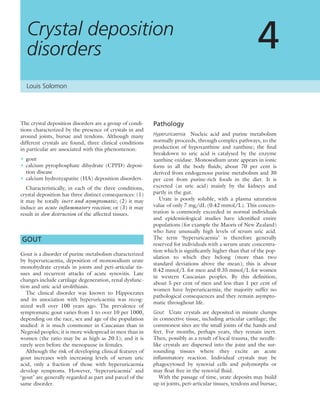
Apley’s
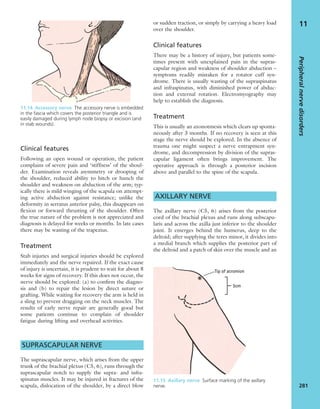
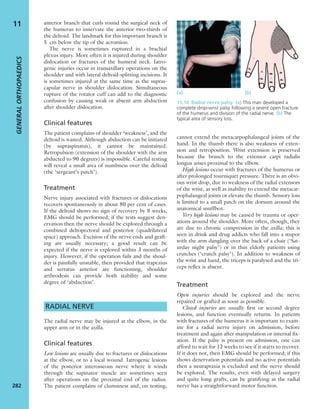
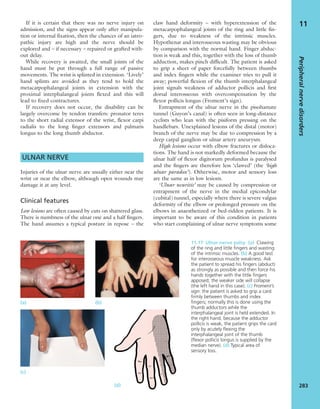
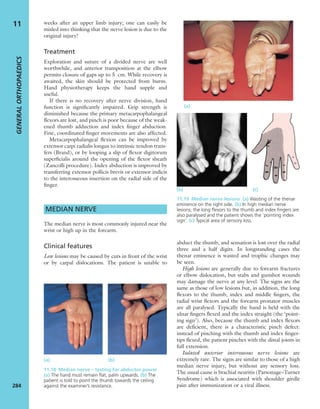
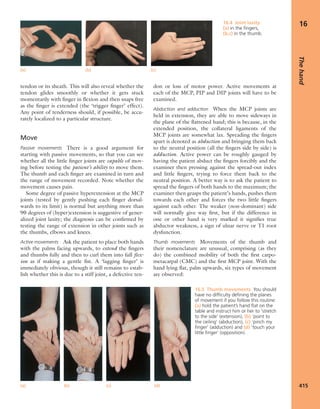
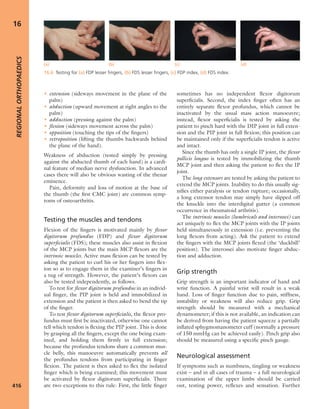
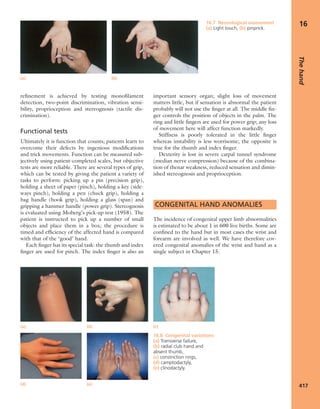
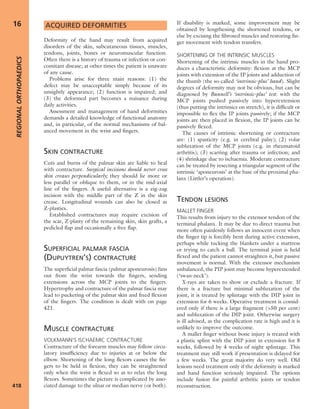
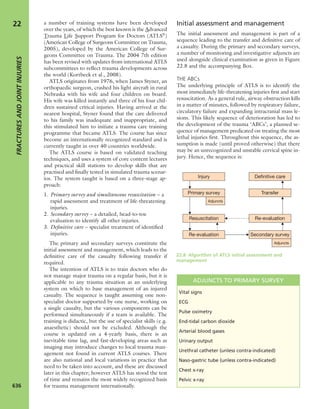
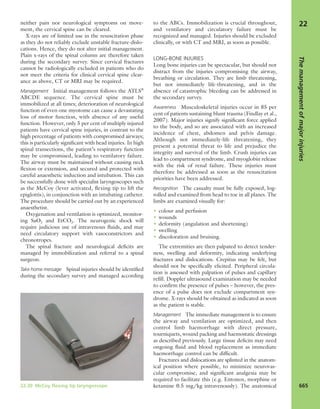
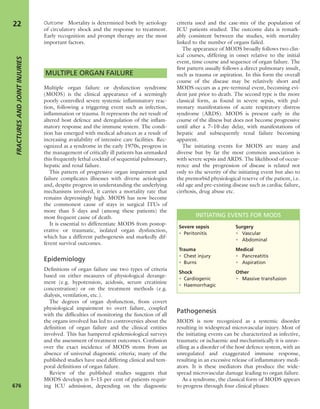
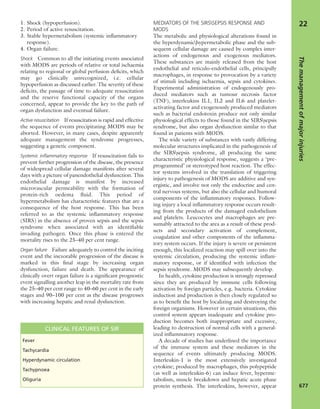
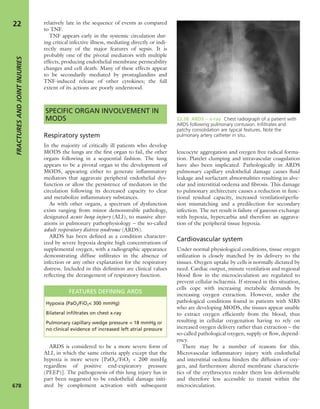
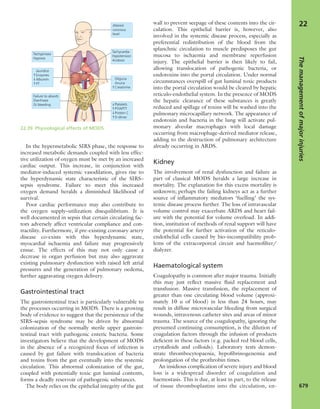
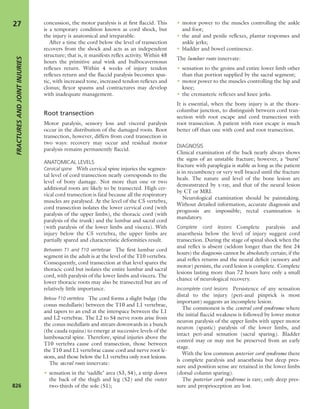
System of Orthopaedics
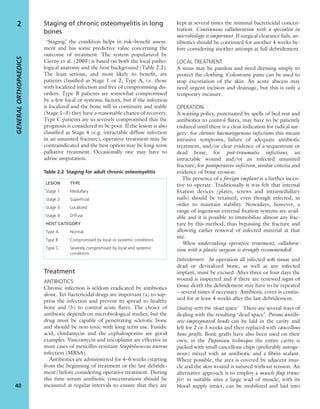
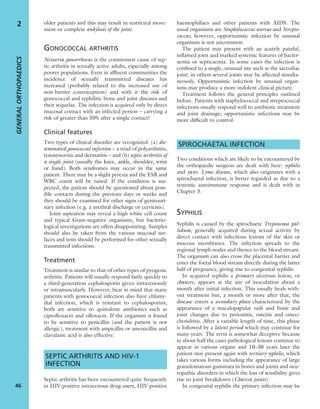
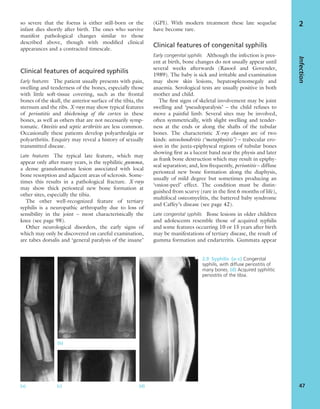
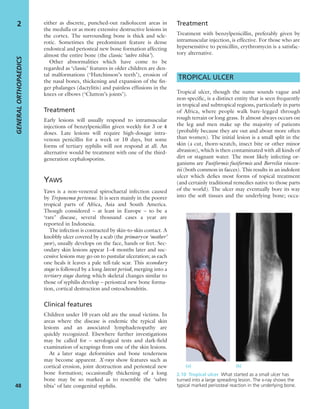
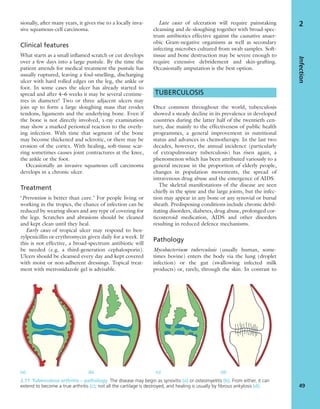
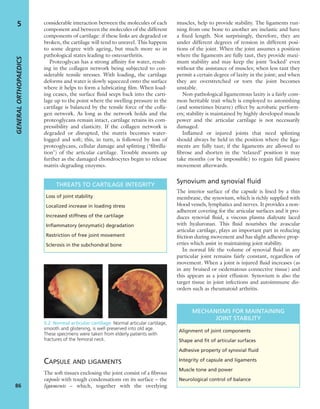
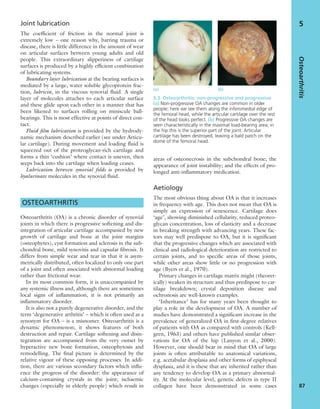
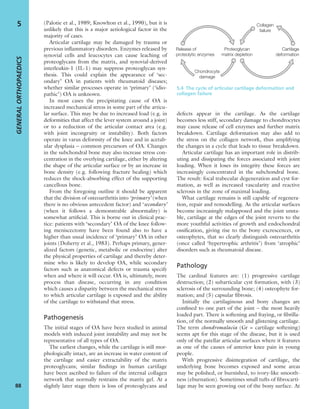
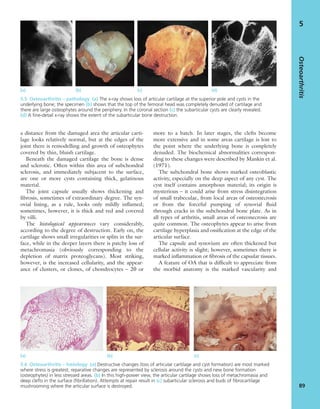
and Fractures
Alan Graham Apley 1914–1996
Inspired teacher, wise mentor and joyful friend
Louis Solomon MD FRCS
Emeritus Professor of Orthopaedics
Bristol
UK
David Warwick MD FRCS FRCSOrth Eur Dip Hand Surg
Consultant Hand Surgeon
Reader in Orthopaedic Surgery
University of Southampton
Southampton
UK
Selvadurai Nayagam BSc MChOrth
FRCSOrth
Consultant Orthopaedic Surgeon
Royal Liverpool Children’s Hospital
and
The Royal Liverpool University
Hospital
Liverpool
UK
Apley’s
System of Orthopaedics
and Fractures
Ninth Edition
iv
First published in Great Britain in 1959 by Butterworths Medical Publications
Second edition 1963
Third edition 1968
Fourth edition 1973
Fifth edition 1977
Sixth edition 1982
Seventh edition published in 1993 by Butterworth Heineman.
Eight edition published in 2001 by Arnold.
This ninth edition published in 2010 by
Hodder Arnold, an imprint of Hodder Education, an Hachette UK Company,
338 Euston Road, London NW1 3BH
http://www.hodderarnold.com
© 2010 Solomon, Warwick, Nayagam
All rights reserved. Apart from any use permitted under UK copyright law, this publica-
tion may only be reproduced, stored or transmitted, in any form, or by any means, with
prior permission in writing of the publishers or in the case of reprographic production, in
accordance with the terms of licences issued by the Copyright Licensing Agency. In the
United Kingdom such licences are issued by the Copyright Licensing Agency:
90 Tottenham Court Road, London W1T 4LP
Whilst the advice and information in this book are believed to be true and accurate at the
date of going to press, neither the author[s] nor the publisher can accept any legal
responsibility or liability for any errors or omissions that may be made. In particular (but
without limiting the generality of the preceding disclaimer) every effort has been made to
check drug dosages; however it is still possible that errors have been missed. Furthermore,
dosage schedules are constantly being revised and new side-effects recognized. For these
reasons the reader is strongly urged to consult the drug companies’ printed instructions
before administering any of the drugs recommended in this book.
British Library Cataloguing in Publication Data
A catalogue record for this book is available from the British Library
Library of Congress Cataloging-in-Publication Data
A catalog record for this book is available from the Library of Congress
ISBN-13 978 0 340 942 055
ISBN-13 [ISE] 978 0 340 942 086 (International Students’ Edition, restricted
territorial availability)
1 2 3 4 5 6 7 8 9 10
Commissioning Editor: Gavin Jamieson
Project Editor: Francesca Naish
Production Controller: Joanna Walker
Cover Designer: Helen Townson
Indexer: Laurence Errington
Additional editorial services provided by
Naughton Project Management.
Cover image © Linda Bucklin/stockphoto.com
Typeset in 10 on 12pt Galliard by Phoenix Photosetting, Chatham, Kent
Printed and bound in India by Replika Press
What do you think about this book? Or any other Hodder Arnold title?
Please visit our website: www.hodderarnold.com
To our students, trainees and patients, all of whom have helped to make our lives
interesting, stimulating and worthwhile; and also to our wives and children (and
grand-children) who have tolerated our absences – both material and spiritual – while
preparing this new edition.
Dedication
This page intentionally left blank
Contributors ix
Preface xi
Acknowledgements xiii
List of abbreviations used xv
PART 1: GENERAL ORTHOPAEDICS
1 Diagnosis in orthopaedics 3
Louis Solomon, Charles Wakeley
2 Infection 29
Louis Solomon, H. Srinivasan, Surendar Tuli, Shunmugam Govender
3 Inflammatory rheumatic disorders 59
Christopher Edwards, Louis Solomon
4 Crystal deposition disorders 77
Louis Solomon
5 Osteoarthritis 85
Louis Solomon
6 Osteonecrosis and related disorders 103
Louis Solomon
7 Metabolic and endocrine disorders 117
Louis Solomon
8 Genetic disorders, skeletal dysplasias and malformations 151
Deborah Eastwood, Louis Solomon
9 Tumours 187
Will Aston, Timothy Briggs, Louis Solomon
10 Neuromuscular disorders 225
Deborah Eastwood, Thomas Staunton, Louis Solomon
11 Peripheral nerve injuries 269
David Warwick, H. Srinivasan, Louis Solomon
12 Orthopaedic operations 303
Selvadurai Nyagam, David Warwick
PART 2: REGIONAL ORTHOPAEDICS
13 The shoulder and pectoral girdle 337
Andrew Cole, Paul Pavlou
14 The elbow and forearm 369
David Warwick
15 The wrist 383
David Warwick, Roderick Dunn
16 The hand 413
David Warwick, Roderick Dunn
17 The neck 439
Stephen Eisenstein, Louis Solomon
18 The back 453
Stephen Eisenstein, Surendar Tuli, Shunmugam Govender
Contents
19 The hip 493
Louis Solomon, Reinhold Ganz, Michael Leunig, Fergal Monsell,
Ian Learmonth
20 The knee 547
Louis Solomon, Theo Karachalios
21 The ankle and foot 587
Gavin Bowyer
PART 3: FRACTURES AND JOINT INJURIES
22 The management of major injuries 627
David Sutton, Max Jonas
23 Principles of fractures 687
Selvadurai Nayagam
24 Injuries of the shoulder, upper arm and elbow 733
Andrew Cole, Paul Pavlou, David Warwick
25 Injuries of the forearm and wrist 767
David Warwick
26 Hand injuries 787
David Warwick
27 Injuries of the spine 805
Stephen Eistenstein, Wagih El Masry
28 Injuries of the pelvis 829
Louis Solomon
29 Injuries of the hip and femur 843
Selvadurai Nayagam
30 Injuries of the knee and leg 875
Selvadurai Nayagam
31 Injuries of the ankle and foot 907
Gavin Bowyer
Epilogue: Global Orthopaedics 935
Christopher Lavy, Felicity Briggs
Index 939
CONTENTS
viii
Principal Authors
Louis Solomon MD FRCS Eng FRCS Ed
Emeritus Professor of Orthopaedic Surgery
Honorary Consultant Orthopaedic Surgeon
Bristol Royal Infirmary, Bristol, UK
Selvadurai Nayagam BSc, MChOrth FRCSOrth
Consultant Orthopaedic Surgeon
Royal Liverpool Children’s Hospital and
The Royal Liverpool University Hospital
Liverpool, UK
David Warwick MD BM FRCS FRCS (Orth)
Eur Dip Hand Surg
Consultant Hand Surgeon
Reader in Orthopaedic Surgery
University of Southampton, Southampton, UK
Contributing Authors
Will Aston BSc, MBBS, FRCS Ed(TR&Orth)
Consultant Orthopaedic Surgeon
Royal National Orthopaedic Hospital
Stanmore, UK
Tumours
Gavin William Bowyer MA MChir FRCS(Orth)
Consultant Trauma and Orthopaedic Surgeon
and Honorary Senior Lecturer
Southampton University Hospitals
Southampton, UK
The Ankle and Foot
Injuries of the ankle and foot
Felicity Briggs MA(Oxon) UK
Research Assistant and Graduate Medical Student
Epilogue: Global Orthopaedics
Timothy William Roy Briggs MD(Res)
MCh(Orth) FRCS FRCS Ed
Professor and Consultant Orthopaedic Surgeon
Joint Medical Director
Joint Training Programme Director
Royal National Orthopaedic Hospital
Stanmore, UK
Tumours
Andrew Spencer Cole BSc MBBS
FRCS(TR&Orth)
Consultant Orthopaedic Surgeon
Southampton University Hospitals
Southampton, UK
The Shoulder and Pectoral Girdle
Injuries of the Shoulder and Upper Arm and elbow
Roderick Dunn MBBS DMCC FRCS(Plast)
Consultant Plastic, Reconstructive and Hand
Surgeon, Odstock Centre for Burns, Plastic and
Maxillofacial Surgery, Salisbury District Hospital
Salisbury, UK
The Wrist and The Hand: Congenital Variations
Deborah Eastwood FRCS
Consultant Orthopaedic Surgeon and
Hon Senior Lecturer
University College London;
Great Ormond Street Hospital for Children
London, UK
Genetic Disorders, Dysplasias and Malformations
Neuromuscular Disorders
Christopher J Edwards BSc MBBS FRCP MD
Consultant Rheumatologist & Honorary Senior
Lecturer
Associate Director
Wellcome Trust Clinical Research Facility
Southampton University Hospitals NHS Trust
Southampton General Hospital, UK
Inflammatory Rheumatic Disorders
Contributors
Stephen Eisenstein PhD FRCS(Ed)
Hon Professor, Keele University; Emeritus Director
Centre for Spinal Studies;
The Robert Jones and Agnes Hunt Orthopaedic
Hospital, Shropshire, UK
The Neck
The Back
Injuries of the Spine
Reinhold Ganz MD
Professor and Chairman Emeritus
Orthopaedic Department Inselspital
University of Bern, Switzerland
The Hip: Femoro-acetabular Impingement
Shunmugam Govender MBBS MD FRCS
FC(Orth) (SA)
Professor and Head of Department of Orthopaedics;
Director of Spinal Services King George V Hospital;
Nelson R Mandela School of Medicine
Durban, South Africa
Infection
The Back: Infections of the Spine
Max Jonas MBBS FRCA
Consultant and Senior Lecturer in Critical Care
Southampton University Hospitals NHS Trust
Southampton, UK
The Management of Major Injuries
Theo Karachalios MD DSc
Associate Professor in Orthopaedics,
School of Health Sciences, University of Thessalia
University General Hospital of Larissa
Hellenic Republic
The Knee
Christopher Lavy OBE MD MCh FRCS
Hon Professor and Consultant,
Nuffield Department of Orthopaedic Surgery,
University of Oxford, UK
Epilogue: Global Orthopaedics
Ian Douglas Learmonth MB ChB FRCS Ed FRCS
FCS(SA)Orth
Emeritus Professor, ;
Honorary Consultant, University Hospitals, Bristol;
Honorary Consultant, North Bristol Trust, UK
Total Hip Replacement
Michael Leunig MD
Head of Orthopaedics, Lower Extremities
Schulthess Klinik, Zurich, Switzerland
The Hip: Femoro-Acetabular Impingement
Wagih S El Masry FRCS FRCP
Consultant Surgeon in Spinal Injuries;
Director, Midlands Centre for Spinal Injuries
President International Spinal Cord Society (ISCOS)
RJ & AH Orthopaedic Hospital, Oswestry, UK
Injuries of the Spine
Fergal P Monsell MSc FRCS FRCS(Orth)
Consultant Paediatric Orthopaedic Surgeon
Bristol Royal Hospital for Children
Bristol, UK
The Hip: Disorders in Children
Paul Pavlou BSc (Hons) MB BS MRCS
Orthopaedic Registrar, Wessex training scheme
The Shoulder and Pectoral Girdle
Injuries of the Shoulder
H. Srinivasan MB BS FRCS FRCS Ed
DSc (Hon)
Formerly Senior Orthopaedic Surgeon
Central Leprosy Teaching & Research Institute
Chengalpattu (Tamil Nadu), India;
Director Central JALMA Institute for Leprosy
(ICMR), Agra (UP), India; and Editor Indian
Journal of Leprosy
Infection and Peripheral Nerve Disorders: Leprosy
Thomas G Staunton MB FRCP(C) FRCP
Consultant Neurologist
Norfolk and Norwich University Hospital;
Consultant Clinical Neurophysiologist
Robert Jones and Agnes Hunt Orthopaedic
Hospital, Shropshire, UK
Neuromuscular Disorders: Neurophysiological Studies
David Sutton BM DA FRCA
Department of Anaesthetics
Southampton General Hospital
Southampton, UK
Management of Major Injuries
Surendar Mohan Tuli MBBS MS PhD
Senior Consultant in Spinal Diseases and
Orthopaedics, Vimhans Hospital, New Delhi, India
Infection: Tuberculosis of Bones and Joints
The Back
Charles J Wakeley BSc MBBS FRCS FRCS Ed
FRCR
Consultant Radiologist, Department of Radiology
University Hospital Bristol NHS Foundation Trust
Bristol, UK
Diagnosis in Orthopaedics: Imaging
CONTRIBUTORS
x
When Alan Apley produced the first edition of his Sys-
tem of Orthopaedics and Fractures 50 years ago he
saw it as an aid to accompany the courses that he con-
ducted for aspiring surgeons who were preparing for
the FRCS exams. With characteristic humour, he
called the book ‘a prophylactic against writer’s
cramp’. Pictures were unnecessary: if you had any
sense (and were quick enough to get on the heavily
oversubscribed Apley Course) you would be treated
to an unforgettable display of clinical signs by one of
the most gifted of teachers.
You also learnt how to elicit those signs by using a
methodical clinical approach – the Apley System. The
Fellowship exam was heavily weighted towards clinical
skills. Miss an important sign or stumble over how to
examine a knee or a finger and you could fail outright.
What Apley taught you was how to order the steps in
physical examination in a way that could be applied to
every part of the musculoskeletal system. ‘Look, Feel,
Move’ was the mantra. He liked to say that he had a
preference for four-letter words. And always in that
order! Deviate from the System by grasping a
patient’s leg before you look at it minutely, or by test-
ing the movements in a joint before you feel its con-
tours and establish the exact site of tenderness and
you risked becoming an unwilling participant in a the-
atrical comedy.
Much has changed since then. With each new edi-
tion the System has been expanded to accommodate
new tests and physical manoeuvres developed in the
tide of super-specialisation. Laboratory investigations
have become more important and imaging techniques
have advanced out of all recognition. Clinical classifi-
cations have sprung up and attempts are now made to
find a numerical slot for every imaginable fracture. No
medical textbook is complete without its ‘basic sci-
ence’ component, and advances are so rapid that
changes become necessary within the period of writ-
ing a single edition. The present volume is no excep-
tion: new bits were still being added right up to the
time of proof-reading.
For all that, we have retained the familiar structure
of the Apley System. As in earlier editions, the book is
divided into three sections: General Orthopaedics,
covering the main types of musculoskeletal disorder;
Regional Orthopaedics, where we engage with these
disorders in specific parts of the body; and thirdly
Fractures and Joint Injuries. In a major departure
from previous editions, we have enlisted the help of
colleagues who have particular experience of condi-
tions with which we as principal authors are less famil-
iar. Their contributions are gratefully acknowledged.
Even here, though, we have sought their permission
to ‘edit’ their material into the Apley mould so that
the book still has the sound and ‘feel’ of a single
authorial voice.
For the second edition of the book, in 1963, Apley
added a new chapter: ‘The Management of Major
Accidents’. Typically frank, he described the current
arrangements for dealing with serious accidents as
“woefully inadequate” and offered suggestions based
on the government’s Interim Report on Accident
Services in Great Britain and Ireland (1961). There
has been a vast improvement since then and the num-
ber of road accident deaths today is half of what it was
in the 1960’s (Department of Transport statistics). So
important is this subject that the relevant section has
now been re-written by two highly experienced Emer-
gency and Intensive Care Physicians and is by far the
longest chapter in the present edition.
Elsewhere the text has been brought completely up
to date and new pictures have been added. In most
cases the illustrations appear as composites – a series
of images that tell a story rather than a single ‘typical’
picture at one moment in the development of some
disorder. At the beginning of each Regional chapter,
in a run of pictures we show the method of examin-
ing that region: where to stand, how to confront the
patient and where to place our hands. For the experi-
enced reader this may seem like old hat; but then we
have designed this book for orthopaedic surgeons of
all ages and all levels of experience. We all have some-
thing to learn from each other.
As before, operations are described only in outline,
emphasising the principles that govern the choice of
treatment, the indications for surgery, the design of the
operation, its known complications and the likely out-
come. Technical procedures are learnt in simulation
Preface
courses and, ultimately, in the operating theatre. Writ-
ten instructions can only ever be a guide. Drawings are
usually too idealised and ‘in theatre’ photographs are
usually intelligible only to someone who has already
performed that operation. Textbooks that grapple with
these impediments tend to run to several volumes.
The emphasis throughout is on clinical
orthopaedics. We acknowledge the value of a more
academic approach that starts with embryology,
anatomy, biomechanics, molecular biology, physiol-
ogy and pathology before introducing any patient to
the reader. Instead we have chosen to present these
‘basic’ subjects in small portions where they are rele-
vant to the clinical disorder under discussion: bone
growth and metabolism in the chapter on metabolic
bone disease, genetics in the chapter on osteodystro-
phies, and so forth.
In the preface to the last edition we admitted our
doubts about the value of exhaustive lists of references
at the end of each chapter. We are even more divided
about this now, what with the plethora of ‘search
engines’ that have come to dominate the internet. We
can merely bow our heads and say we still have those
doubts and have given references only where it seems
appropriate to acknowledge where an old idea started
or where something new is being said that might at
first sight be questioned.
More than ever we are aware that there is a dwin-
dling number of orthopaedic surgeons who grew up
in the Apley era, even fewer who experienced his
thrilling teaching displays, and fewer still who worked
with him. Wherever they are, we trust that they will
recognise the Apley flavour in this new edition. Our
chief concern, however, is for the new readers who –
we hope – will glean something that helps them
become the next generation of teachers and mentors.
LS
SN
DJW
PREFACE
xii
Fifty years ago Apleys’ System of Orthopaedics and
Fractures was written by one person – the eponymous
Apley. As the years passed and new editions became
ever larger, a second author appeared and then a
third. Throughout those years we have always been
able to get help (and sometimes useful criticism) from
willing colleagues who have filled the gaps in our
knowledge. Their words and hints are scattered
among the pages of this book and we are forever
grateful to them.
For the present edition we have gone a step further
and enlisted a number of those colleagues as nomi-
nated Contributing Authors. In some cases they have
brought up to date existing chapters; in others they
have added entirely new sections to a book that has
now grown beyond the scope of two or three special-
ists. Their names are appropriately listed elsewhere
but here we wish to thank them again for joining us.
They have allowed us to mould their words into the
style of the Apley System so that the text continues to
carry the flavour of a unified authorial voice.
We are also grateful to those colleagues who have
supplied new pictures where our own collections have
fallen short. In particular we want to thank Dr
Santosh Rath and Dr G.N. Malaviya for pictures of
peripheral deformities in leprosy, Mr Evert Smith for
pictures (and helpful descriptions) of modern
implants in hip replacement operations, Dr Peter Bul-
lough who allowed us to reprint two of the excellent
illustrations in his book on Orthopaedic Pathology,
and Dr Asif Saifuddin for permission to use some
images from his book on Musculoskeletal MRI.
Others who gave us generous assistance with pictures
are Fiona Daglish, Colin Duncan, Neeraj Garg,
Nikolaos Giotakis, Jagdeep Nanchahal and Badri
Narayan.
We have been fortunate in having friends and family
around us who have given us helpful criticism on the
presentation of this work. Caryn Solomon, a tireless
internet traveller, found the picture for the cover and
Joan Solomon gave expert advice on layout and
design. James Crabtree stepped in as a model for
some ‘clinical’ pictures. We are grateful to all of them.
Throughout the long march to completion of this
work we have enjoyed the constant help and collabo-
ration of Francesca Naish, Gavin Jamieson, Joanna
Walker and Helen Townson (our Editorial Manager,
Commissioning Editor, Production Manager and
Design Manager respectively) at Hodder Arnold. No
problem was too complex and no obstacle too great
to withstand their tireless efforts in driving this work
forward.
Nora Naughton and Aileen Castell (Naughton
Project Management) were in the background setting
up the page copies, patiently enduring the many
amendments that came in over the internet. Their
attention to detail has been outstanding.
Finally, we want to express our deepest thanks to
those nearest to us who added not a word to the text
but through their support and patience made it poss-
ible for us to take so much time beyond the everyday
occupations of family life to produce a single book.
L. S.
D.W.
S. N.
Acknowledgements
This page intentionally left blank
ACA angulation correction axis
ACE angiotensin-converting enzyme
ACL anterior cruciate ligament
ACTH adrenocorticotropic hormone
AFP alpha-fetoprotein
AIDP acute inflammatory demyelinating
polyneuropathy
AIDS acquired immune deficiency
syndrome
AL anterolateral
ALI acute lung injury
AM anteromedial
AMC arthrogryposis multiplex congenita
ANA antinuclear antibodies
anti-CCP anti-cyclic citrullinated peptide
antibodies
AP anteroposterior
APC antigen-presenting cell
APC anteroposterior compression (injuries)
ARCO Association Research Circulation
Osseous
ARDS adult respiratory distress syndrome
ARDS acute respiratory distress syndrome
ARM awareness, recognition, management
AS ankylosing spondylitis
ATLS advanced trauma life support
AVN avascular necrosis
BASICS British Association for Immediate
Care
BCP basic calcium phosphate
BMD bone mineral density
BMP bone morphogenetic protein
BSA body surface area
BVM bag-valve-mask
CDH congenital dislocation of the hip
CFD congenital femoral deficiency
CMAP compound muscle action potential
CMC carpo-metacarpal
CMI cell-mediated immunity
CNS central nervous system
COMP cartilage oligometric matrix protein
CORA centre of rotation of angulation
CPM continuous passive motion
CPPD calcium pyrophosphate dihydrate
CRP C-reactive protein
CRPS complex regional pain syndrome
CSF cerebrospinal fluid
CT computed tomography
CVP central venous pressure
DDH developmental dysplasia of the hip
dGEMRIC delayed gadolinium-enhanced MRI of
cartilage
DIC disseminated intravascular coagulation
DIP distal interphalangeal (joint )
DISH diffuse idiopathic skeletal hyperostosis
DISI dorsal intercalated segment instability
DMARDs disease-modifying antirheumatic
drugs
DRUJ distal radio-ulnar joint
DTH delayed type hypersensitivity
DVT deep vein thrombosis
DXA dual-energy x-ray absorptiometry
ECRB extensor carpi radialis brevis
ECRL extensor carpi radialis longus
EDF elongation-derotation-flexion
EDG extensor diversion graft
EEG electroencephalography
EMG electromyography
EMS emergency medical service
ENL erythema nodosum leprosum
ESR erythrocyte sedimentation rate
ETA estimated time of arrival
FAI femoro-acetabular impingement
FAST focussed assessment sonography in
trauma
FDP flexor digitorum profundus
FDS flexor digitorum superficialis
FFOs functional foot orthoses
FPB flexor pollicis brevis
FPE fatal pulmonary embolism
FPL flexor pollicis longus
GABA gamma-aminobutryic acid
GAGs glycosaminoglycans
GCS Glasgow Coma Scale
GMFCS gross motor function classification
system
GPI general paralysis of the insane
HA hydroxyapatite
List of abbreviations used
ABBREVIATIONS
xvi
HEMS helicopter emergency medical service
HGPRT hypoxanthine-guanine
phosphoribosyltransferase
HHR humeral head replacement
HIV human immunodeficiency virus
HLA human leucocyte antigen
HMSN hereditary motor and sensory
neuropathy
HRT hormone replacement therapy
ICP intracerebral pressure
ICU intensive care unit
IL interleukin
INR international normalized ratio
IP interphalangeal
IRMER Ionising Radiation Medical Exposure
Regulations
ITAP intra-osseous transcutaneous
amputation prosthesis
IVF in vitro fertilization
JIA juvenile idiopathic arthritis
LCL lateral collateral ligament
LMA laryngeal mask airway
LMN lower motor neuron
LMWH low molecular weight heparin
MCL medial collateral ligament
MCP metacarpo-phalangeal (joint)
M-CSF macrophage colony-stimulating factor
MED multiple epiphyseal dysplasia
MHC major histocompatibility complex
MIC minimal inhibitory concentration
MIPO minimally invasive percutaneous
osteosynthesis
MIS minimally invasive surgery
MODS multiple organ failure or dysfunction
syndrome
MPM mortality prediction model
MPS mucopolysaccharidoses
MRI magnetic resonance imaging
MRSA methicillin-resistant Staphylococcus
aureus
MTP metatarsophalangeal (joint)
NCV nerve conduction velocity
NP nasopharyngeal
NSAIDs non-steroidal anti-inflammatory drugs
OA osteoarthritis
OI osteogenesis imperfecta
OP oropharyngeal
OPG osteoprotegerin
OPLL ossification of the posterior
longitudinal ligament
PA posteroanterior
PACS Picture Archiving and Communication
System
PAFC pulmonary artery flotation
catherization
PAOP pulmonary artery occlusion pressure
PCL posterior cruciate ligament
PCR polymerase chain reaction
PD proton density
PE pulmonary embolism
PEA pulseless electrical activity
PEEP positive end-expiratory pressure
PET positron emission tomography
PFFD proximal focal femoral deficiency
PIP proximal interphalangeal (joint)
PL posterolateral
PM posteromedial
PMMA polymethylmethacrylate
PNS peripheral nervous system
PPE personal protective equipment
PPS post-polio syndrome
PTH parathyroid hormone
PTS post-thrombotic syndrome
PVNS pigmented villonodular synovitis
QCT quantitative computed tomography
QUS quantitative ultrasonometry
RA radiographic absorptiometry and
rheumatoid arthritis
RANKL receptor activator of nuclear factor-
ligand
RF rheumatoid factor
RR reversal reaction
RSD reflex sympathetic dystrophy
RSI rapid sequence induction
SACE serum angiotensin converting enzyme
SAMU Services de l’Aide Medical Urgente
SAPHO for synovitis, acne, pustulosis,
hyperostosis and osteitis
SCFE slipped capital femoral epiphysis
SCIWORA spinal cord injury without obvious
radiographic abnormality
SDD digestive tract
SE spin echo
SED spondyloepiphyseal dysplasia
SEMLS single event multi-level surgery
SIRS systemic inflammatory response
SLAP superior labrum, anterior and posterior
(tear)
SLE systemic lupus erythematosus
SMR standardized mortality ratio
SMUR Services Mobile d’Urgence et de
Reamination
SNAP sensory nerve action potential
SNPs single nucleotide polymorphisms
SONK ‘spontaneous’ osteonecrosis of the
knee
SOPs standard operating procedure
SPECT single photon emission computed
tomography
SSEP somatosensory evoked responses
STIR short-tau inversion recovery
STT scaphoid-trapezium-trapezoid arthritis
SCIWORA spinal cord injury without radiographic
abnormality
ABBREVIATIONS
xvii
TAR prompts one to remember
thrombocytopaenia with absent radius
syndrome
TB tuberculosis
99m
Tc-MDP 99m
Tc-methyl diphosphonate
TE time to echo
TFCC triangular fibrocartilage complex
TIP terminal interphalangeal (joint)
TNF tumour necrosis factor
TR repetition time
TSR total shoulder replacement
UHMWPE ultra-high molecular weight
polyethylene
UMN upper motor neuron
US ultrasound
VACTERLS refers to the systems involved and the
defects identified: vertebral, anal,
cardiac, tracheal, esophageal, renal,
limb and single umbilical artery.
VCT voluntary counselling and testing
VISI volar intercalated segment
instability
VP ventriculo-peritoneal
VS vertical shear
VTE venous thromboembolism
VQC ventilation-perfusion
WBC white blood cell
XLPE highly cross-linked polyethylene
This page intentionally left blank
Section 1
General
Orthopaedics
1 Orthopaedic diagnosis 3
2 Infection 29
3 Inflammatory rheumatic disorders 59
4 Crystal deposition disorders 77
5 Osteoarthritis 85
6 Osteonecrosis and related disorders 103
7 Metabolic and endocrine disorders 117
8 Genetic disorders, skeletal dysplasias and
malformations 151
9 Tumours 187
10 Neuromuscular disorders 225
11 Peripheral nerve injuries 269
12 Orthopaedic operations 303
This page intentionally left blank
Orthopaedics is concerned with bones, joints, mus-
cles, tendons and nerves – the skeletal system and all
that makes it move. Conditions that affect these struc-
tures fall into seven easily remembered pairs:
1. Congenital and developmental abnormalities.
2. Infection and inflammation.
3. Arthritis and rheumatic disorders.
4. Metabolic and endocrine disorders.
5. Tumours and lesions that mimic them.
6. Neurological disorders and muscle weakness.
7. Injury and mechanical derangement.
Diagnosis in orthopaedics, as in all of medicine, is
the identification of disease. It begins from the very
first encounter with the patient and is gradually mod-
ified and fine-tuned until we have a picture, not only
of a pathological process but also of the functional
loss and the disability that goes with it. Understand-
ing evolves from the systematic gathering of informa-
tion from the history, the physical examination, tissue
and organ imaging and special investigations. System-
atic, but never mechanical; behind the enquiring mind
there should also be what D. H. Lawrence has called
‘the intelligent heart’. It must never be forgotten that
the patient has a unique personality, a job and hob-
bies, a family and a home; all have a bearing upon, and
are in turn affected by, the disorder and its treatment.
HISTORY
‘Taking a history’ is a misnomer. The patient tells a
story; it is we the listeners who construct a history.
The story may be maddeningly disorganized; the his-
tory has to be systematic. Carefully and patiently com-
piled, it can be every bit as informative as examination
or laboratory tests.
As we record it, certain key words and phrases will
inevitably stand out: injury, pain, stiffness, swelling,
deformity, instability, weakness, altered sensibility and
loss of function or inability to do certain things that
were easily accomplished before.
Each symptom is pursued for more detail: we need
to know when it began, whether suddenly or gradu-
ally, spontaneously or after some specific event; how it
has changed or progressed; what makes it worse; what
makes it better.
While listening, we consider whether the story fits
some pattern that we recognize, for we are already
thinking of a diagnosis. Every piece of information
should be thought of as part of a larger picture which
gradually unfolds in our understanding. The surgeon-
philosopher Wilfred Trotter (1870–1939) put it well:
‘Disease reveals itself in casual parentheses’.
SYMPTOMS
Pain
Pain is the most common symptom in orthopaedics.
It is usually described in metaphors that range from
inexpressively bland to unbelievably bizarre – descrip-
tions that tell us more about the patient’s state of
mind than about the physical disorder. Yet there are
clearly differences between the throbbing pain of an
abscess and the aching pain of chronic arthritis,
between the ‘burning pain’ of neuralgia and the ‘stab-
bing pain’ of a ruptured tendon.
Severity is even more subjective. High and low pain
thresholds undoubtedly exist, but to the patient pain
is as bad as it feels, and any system of ‘pain grading’
must take this into account. The main value of esti-
mating severity is in assessing the progress of the dis-
order or the response to treatment. The commonest
method is to invite the patient to mark the severity on
an analogue scale of 1–10, with 1 being mild and eas-
ily ignored and 10 being totally unbearable. The
problem about this type of grading is that patients
who have never experienced very severe pain simply
do not know what 8 or 9 or 10 would feel like. The
following is suggested as a simpler system:
• Grade I (mild) Pain that can easily be ignored.
• Grade II (moderate) Pain that cannot be ignored,
interferes with function and needs attention or
treatment from time to time.
Orthopaedic
diagnosis 1
Louis Solomon, Charles Wakeley
• Grade III (severe) Pain that is present most of the
time, demanding constant attention or treatment.
• Grade IV (excruciating) Totally incapacitating
pain.
Identifying the site of pain may be equally vague.
Yet its precise location is important, and in
orthopaedics it is useful to ask the patient to point to
– rather than to say – where it hurts. Even then, do
not assume that the site of pain is necessarily the site
of pathology; ‘referred’ pain and ‘autonomic’ pain can
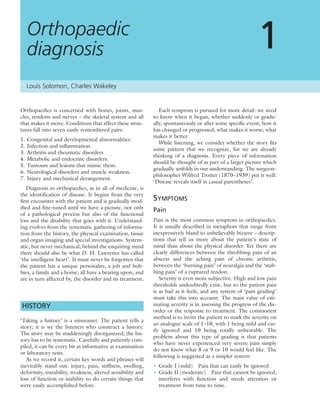
be very deceptive.
Referred pain Pain arising in or near the skin is usually
localized accurately. Pain arising in deep structures is
more diffuse and is sometimes of unexpected distri-
bution; thus, hip disease may manifest with pain in the
knee (so might an obturator hernia). This is not
because sensory nerves connect the two sites; it is due
to inability of the cerebral cortex to differentiate
clearly between sensory messages from separate but
embryologically related sites. A common example is
‘sciatica’ – pain at various points in the buttock, thigh
and leg, supposedly following the course of the sciatic
nerve. Such pain is not necessarily due to pressure on
the sciatic nerve or the lumbar nerve roots; it may be
‘referred’ from any one of a number of structures in
the lumbar spine, the pelvis and the posterior capsule
of the hip joint.
Autonomic pain We are so accustomed to matching
pain with some discrete anatomical structure and its
known sensory nerve supply that we are apt to dismiss
any pain that does not fit the usual pattern as ‘atypical’
or ‘inappropriate’ (i.e. psychologically determined).
But pain can also affect the autonomic nerves that
accompany the peripheral blood vessels and this is
much more vague, more widespread and often associ-
ated with vasomotor and trophic changes. It is poorly
understood, often doubted, but nonetheless real.
Stiffness
Stiffness may be generalized (typically in systemic dis-
orders such as rheumatoid arthritis and ankylosing
spondylitis) or localized to a particular joint. Patients
often have difficulty in distinguishing localized stiff-
ness from painful movement; limitation of movement
should never be assumed until verified by examina-
tion.
Ask when it occurs: regular early morning stiffness
of many joints is one of the cardinal symptoms of
rheumatoid arthritis, whereas transient stiffness of one
or two joints after periods of inactivity is typical of
osteoarthritis.
Locking ‘Locking’ is the term applied to the sudden
inability to complete a particular movement. It sug-
gests a mechanical block – for example, due to a loose
body or a torn meniscus becoming trapped between
the articular surfaces of the knee. Unfortunately,
patients tend to use the term for any painful limitation
of movement; much more reliable is a history of
‘unlocking’, when the offending body slips out of the
way.
Swelling
Swelling may be in the soft tissues, the joint or the
bone; to the patient they are all the same. It is impor-
tant to establish whether it followed an injury,
whether it appeared rapidly (think of a haematoma or
a haemarthrosis) or slowly (due to inflammation, a
joint effusion, infection or a tumour), whether it is
painful (suggestive of acute inflammation, infection or
a tumour), whether it is constant or comes and goes,
and whether it is increasing in size.
Deformity
The common deformities are described by patients in
terms such as round shoulders, spinal curvature,
knock knees, bow legs, pigeon toes and flat feet.
Deformity of a single bone or joint is less easily
described and the patient may simply declare that the
limb is ‘crooked’.
Some ‘deformities’ are merely variations of the nor-
mal (e.g. short stature or wide hips); others disappear
spontaneously with growth (e.g. flat feet or bandy legs
in an infant). However, if the deformity is progressive,
or if it affects only one side of the body while the
opposite joint or limb is normal, it may be serious.
Weakness
Generalized weakness is a feature of all chronic illness,
and any prolonged joint dysfunction will inevitably
GENERALORTHOPAEDICS
4
1
(a) (b)
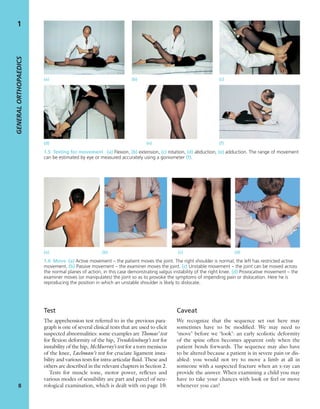
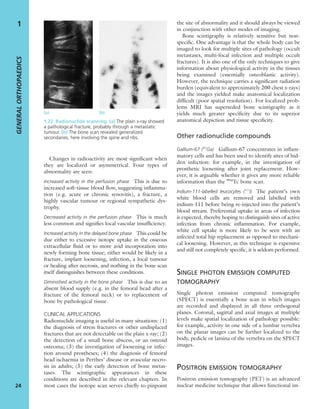
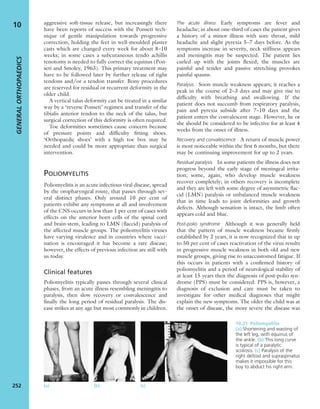
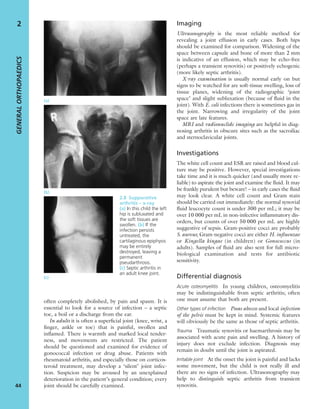
1.1 Referred pain Common sites of referred pain:
(1) from the shoulder; (2) from the hip; (3) from the neck;
(4) from the lumbar spine.
(1)
(2)
(3)
(4)
(4)
lead to weakness of the associated muscles. However,
pure muscular weakness – especially if it is confined to
one limb or to a single muscle group – is more specific
and suggests some neurological or muscle disorder.
Patients sometimes say that the limb is ‘dead’ when it
is actually weak, and this can be a source of confusion.
Questions should be framed to discover precisely
which movements are affected, for this may give
important clues, if not to the exact diagnosis at least
to the site of the lesion.
Instability
The patient may complain that the joint ‘gives way’ or
‘jumps out of place’. If this happens repeatedly, it sug-
gests abnormal joint laxity, capsular or ligamentous
deficiency, or some type of internal derangement such
as a torn meniscus or a loose body in the joint. If there
is a history of injury, its precise nature is important.
Change in sensibility
Tingling or numbness signifies interference with
nerve function – pressure from a neighbouring struc-
ture (e.g. a prolapsed intervertebral disc), local
ischaemia (e.g. nerve entrapment in a fibro-osseous
tunnel) or a peripheral neuropathy. It is important to
establish its exact distribution; from this we can tell
whether the fault lies in a peripheral nerve or in a
nerve root. We should also ask what makes it worse or
better; a change in posture might be the trigger, thus
focussing attention on a particular site.
Loss of function
Functional disability is more than the sum of individ-
ual symptoms and its expression depends upon the
needs of that particular patient. The patient may say ‘I
can’t stand for long’ rather than ‘I have backache’; or
‘I can’t put my socks on’ rather than ‘My hip is stiff’.
Moreover, what to one patient is merely inconvenient
may, to another, be incapacitating. Thus a lawyer or a
teacher may readily tolerate a stiff knee provided it is
painless, but to a plumber or a parson the same disor-
der might spell economic or spiritual disaster. One
question should elicit the important information:
‘What can’t you do now that you used to be able to
do?’
PAST HISTORY
Patients often forget to mention previous illnesses or
accidents, or they may simply not appreciate their rel-
evance to the present complaint. They should be
asked specifically about childhood disorders, periods
of incapacity and old injuries. A ‘twisted ankle’ many
years ago may be the clue to the onset of osteoarthri-
tis in what is otherwise an unusual site for this condi-
tion. Gastrointestinal disease, which in the patient’s
mind has nothing to do with bones, may be important
in the later development of ankylosing spondylitis or
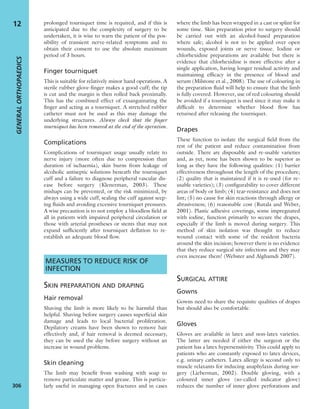
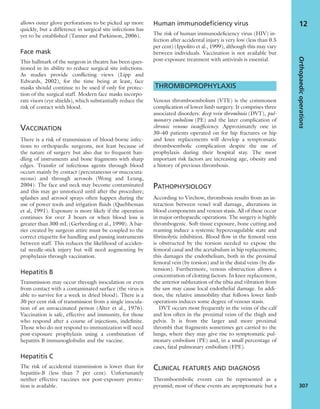
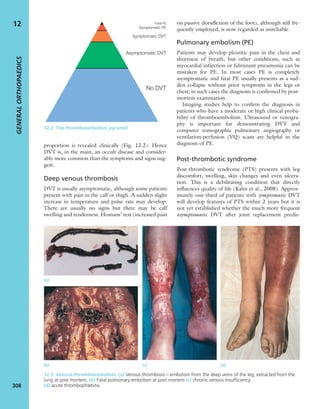
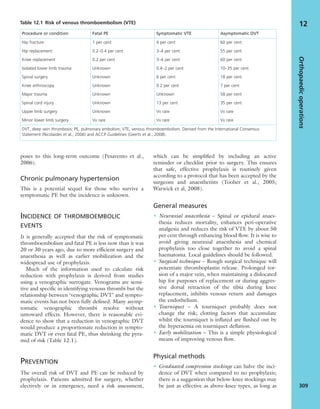
osteoporosis. Similarly, certain rheumatic disorders
may be suggested by a history of conjunctivitis, iritis,
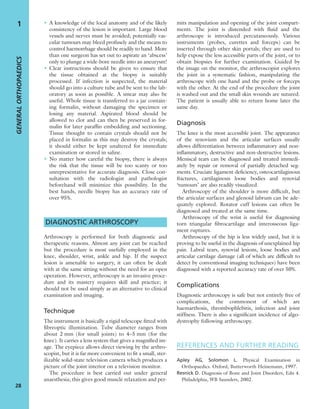
psoriasis or urogenital disease. Metastatic bone disease
may erupt many years after a mastectomy for breast
cancer. Patients should also be asked about previous
medication: many drugs, and especially cortico-
steroids, have long-term effects on bone. Alcohol and
drug abuse are important, and we must not be afraid
to ask about them.
FAMILY HISTORY
Patients often wonder (and worry) about inheriting a
disease or passing it on to their children. To the doc-
tor, information about musculoskeletal disorders in
the patient’s family may help with both diagnosis and
counselling.
When dealing with a suspected case of bone or joint
infection, ask about communicable diseases, such as
tuberculosis or sexually transmitted disease, in other
members of the family.
SOCIAL BACKGROUND
No history is complete without enquiry about the
patient’s background. There are the obvious things
such as the level of care and nutrition in children;
dietary constraints which may cause specific deficien-
cies; and, in certain cases, questions about smoking
habits, alcohol consumption and drug abuse, all of
which call for a special degree of tact and non-judge-
mental enquiry.
Orthopaedicdiagnosis
5
1
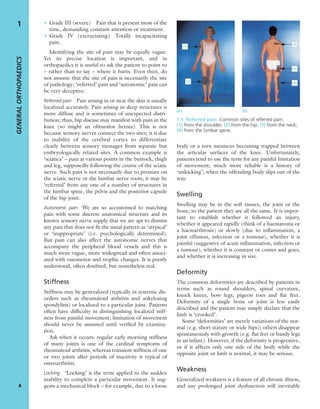
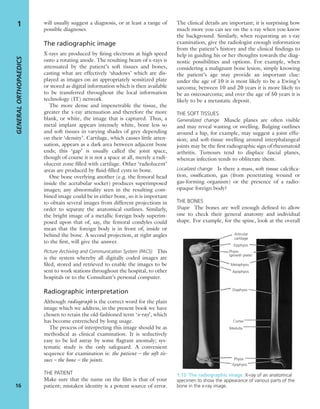
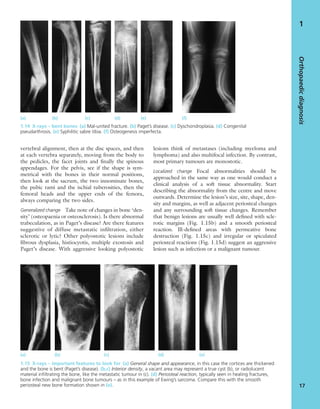
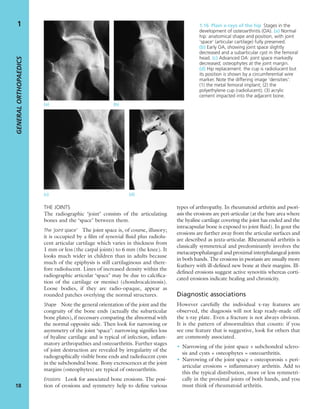
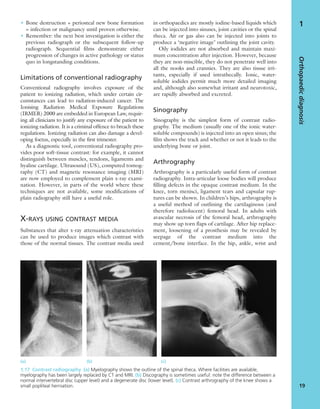
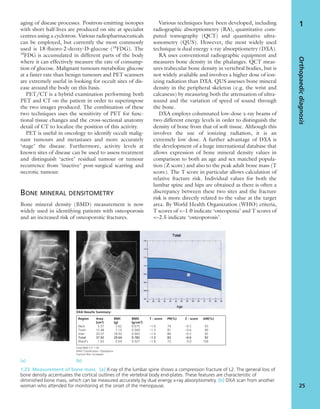
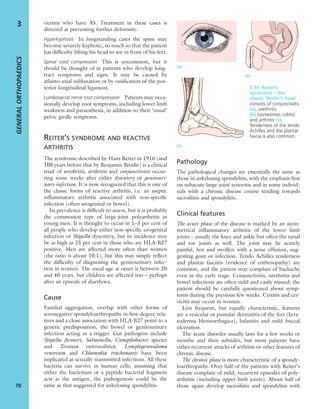
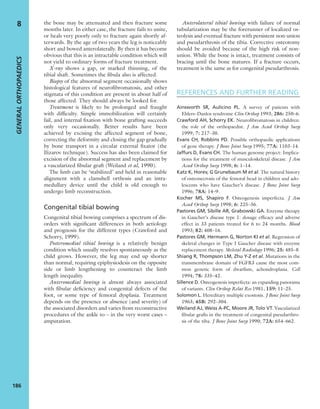
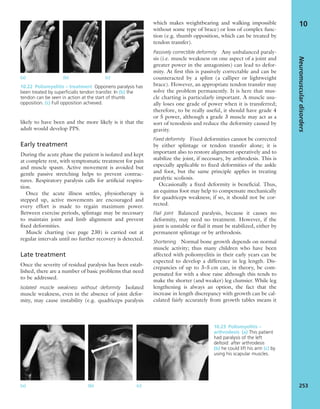
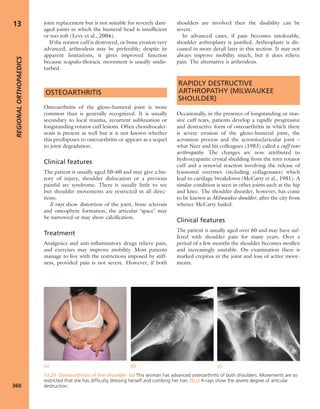
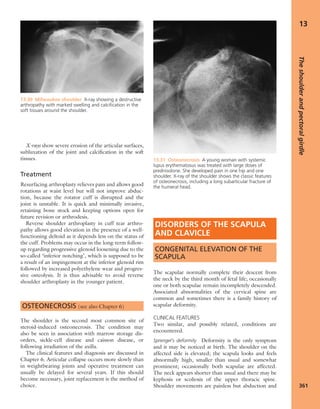
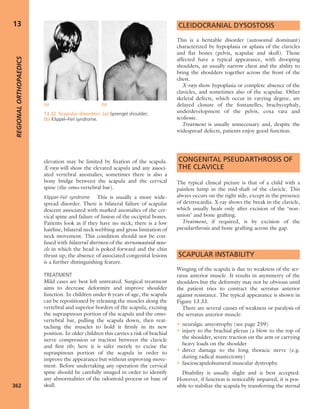
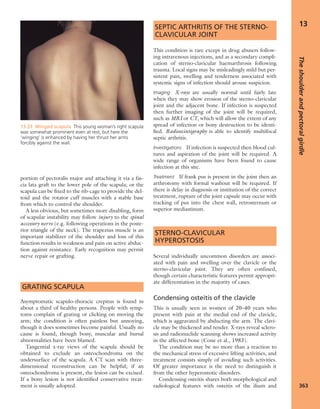
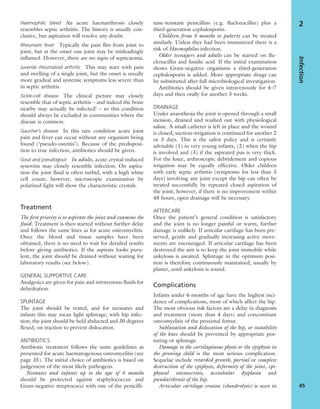
1.2 Deformity This young girl complained of a prominent
right hip; the real deformity was scoliosis.
Find out details about the patient’s work practices,
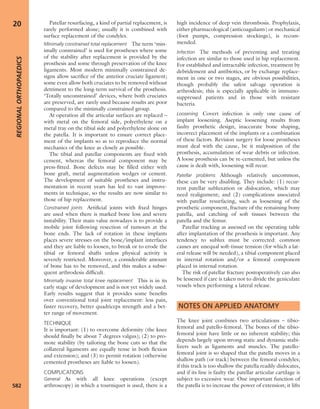
travel and recreation: could the disorder be due to a
particular repetitive activity in the home, at work or
on the sportsfield? Is the patient subject to any
unusual occupational strain? Has he or she travelled to
another country where tuberculosis is common?
Finally, it is important to assess the patient’s home
circumstances and the level of support by family and
friends. This will help to answer the question: ‘What
has the patient lost and what is he or she hoping to
regain?’
EXAMINATION
In A Case of Identity Sherlock Holmes has the follow-
ing conversation with Dr Watson.
Watson: You appeared to read a good deal upon
[your client] which was quite invisible to me.
Holmes: Not invisible but unnoticed, Watson.
Some disorders can be diagnosed at a glance: who
would mistake the facial appearance of acromegaly or
the hand deformities of rheumatoid arthritis for any-
thing else? Nevertheless, even in these cases systematic
examination is rewarding: it provides information
about the patient’s particular disability, as distinct
from the clinicopathological diagnosis; it keeps rein-
forcing good habits; and, never to be forgotten, it lets
the patient know that he or she has been thoroughly
attended to.
The examination actually begins from the moment
we set eyes on the patient. We observe his or her gen-
eral appearance, posture and gait. Can you spot any
distinctive feature: Knock-knees? Spinal curvature? A
short limb? A paralysed arm? Does he or she appear to
be in pain? Do their movements look natural? Do they
walk with a limp, or use a stick? A tell-tale gait may
suggest a painful hip, an unstable knee or a foot-drop.
The clues are endless and the game is played by every-
one (qualified or lay) at each new encounter through-
out life. In the clinical setting the assessment needs to
be more focussed.
When we proceed to the structured examination,
the patient must be suitably undressed; no mere
rolling up of a trouser leg is sufficient. If one limb is
affected, both must be exposed so that they can be
compared.
We examine the good limb (for comparison), then
the bad. There is a great temptation to rush in with
both hands – a temptation that must be resisted. Only
by proceeding in a purposeful, orderly way can we
avoid missing important signs.
Alan Apley, who developed and taught the system
used here, shied away from using long words where
short ones would do as well. (He also used to say ‘I’m
neither an inspector nor a manipulator, and I am defi-
nitely not a palpator’.) Thus the traditional clinical
routine, inspection, palpation, manipulation, was
replaced by look, feel, move. With time his teaching has
been extended and we now add test, to include the
special manoeuvres we employ in assessing neurolog-
ical integrity and complex functional attributes.
Look
Abnormalities are not always obvious at first sight. A
systematic, step by step process helps to avoid mis-
takes.
Shape and posture The first things to catch one’s
attention are the shape and posture of the limb or the
body or the entire person who is being examined. Is
the patient unusually thin or obese? Does the overall
posture look normal? Is the spine straight or unusu-
ally curved? Are the shoulders level? Are the limbs
normally positioned? It is important to look for defor-
mity in three planes, and always compare the affected
part with the normal side. In many joint disorders and
in most nerve lesions the limb assumes a characteristic
posture. In spinal disorders the entire torso may be
deformed. Now look more closely for swelling or
wasting – one often enhances the appearance of the
other! Or is there a definite lump?
Skin Careful attention is paid to the colour, quality
and markings of the skin. Look for bruising, wounds
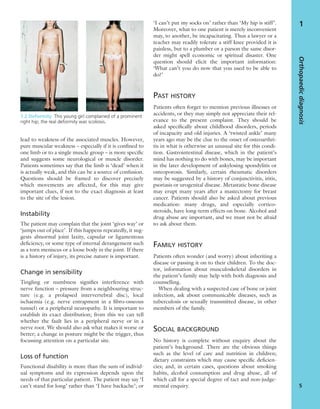
and ulceration. Scars are an informative record of the
past – surgical archaeology, so to speak. Colour
reflects vascular status or pigmentation – for example
the pallor of ischaemia, the blueness of cyanosis, the
redness of inflammation, or the dusky purple of an old
bruise. Abnormal creases, unless due to fibrosis, sug-
gest underlying deformity which is not always obvi-
ous; tight, shiny skin with no creases is typical of
oedema or trophic change.
GENERALORTHOPAEDICS
6
1
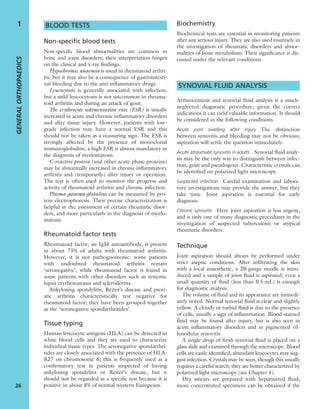
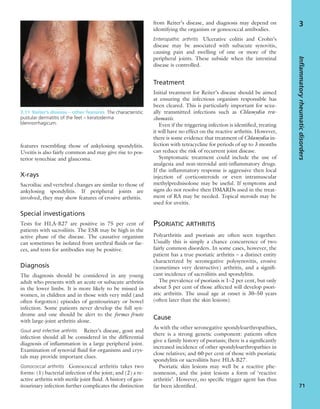
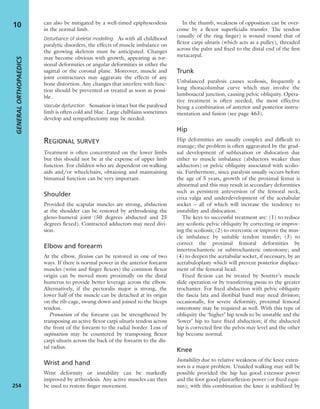
1.3 Look Scars often give clues to the previous history.
The faded scar on this patient’s thigh is an old operation
wound – internal fixation of a femoral fracture. The other
scars are due to postoperative infection; one of the sinuses
is still draining.
General survey Attention is initially focussed on the
symptomatic or most obviously abnormal area, but we
must also look further afield. The patient complains of
the joint that is hurting now, but we may see at a
glance that several other joints are affected as well.
Feel
Feeling is exploring, not groping aimlessly. Know
your anatomy and you will know where to feel for the
landmarks; find the landmarks and you can construct
a virtual anatomical picture in your mind’s eye.
The skin Is it warm or cold; moist or dry; and is sen-
sation normal?
The soft tissues Can you feel a lump; if so, what are its
characteristics? Are the pulses normal?
The bones and joints Are the outlines normal? Is the
synovium thickened? Is there excessive joint fluid?
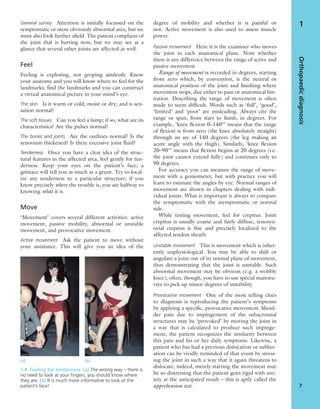
Tenderness Once you have a clear idea of the struc-
tural features in the affected area, feel gently for ten-
derness. Keep your eyes on the patient’s face; a
grimace will tell you as much as a grunt. Try to local-
ize any tenderness to a particular structure; if you
know precisely where the trouble is, you are halfway to
knowing what it is.
Move
‘Movement’ covers several different activities: active
movement, passive mobility, abnormal or unstable
movement, and provocative movement.
Active movement Ask the patient to move without
your assistance. This will give you an idea of the
degree of mobility and whether it is painful or
not. Active movement is also used to assess muscle
power.
Passive movement Here it is the examiner who moves
the joint in each anatomical plane. Note whether
there is any difference between the range of active and
passive movement.
Range of movement is recorded in degrees, starting
from zero which, by convention, is the neutral or
anatomical position of the joint and finishing where
movement stops, due either to pain or anatomical lim-
itation. Describing the range of movement is often
made to seem difficult. Words such as ‘full’, ‘good’,
‘limited’ and ‘poor’ are misleading. Always cite the
range or span, from start to finish, in degrees. For
example, ‘knee flexion 0–140°’ means that the range
of flexion is from zero (the knee absolutely straight)
through an arc of 140 degrees (the leg making an
acute angle with the thigh). Similarly, ‘knee flexion
20–90°’ means that flexion begins at 20 degrees (i.e.
the joint cannot extend fully) and continues only to
90 degrees.
For accuracy you can measure the range of move-
ment with a goniometer, but with practice you will
learn to estimate the angles by eye. Normal ranges of
movement are shown in chapters dealing with indi-
vidual joints. What is important is always to compare
the symptomatic with the asymptomatic or normal
side.
While testing movement, feel for crepitus. Joint
crepitus is usually coarse and fairly diffuse; tenosyn-
ovial crepitus is fine and precisely localized to the
affected tendon sheath.
Unstable movement This is movement which is inher-
ently unphysiological. You may be able to shift or
angulate a joint out of its normal plane of movement,
thus demonstrating that the joint is unstable. Such
abnormal movement may be obvious (e.g. a wobbly
knee); often, though, you have to use special manoeu-
vres to pick up minor degrees of instability.
Provocative movement One of the most telling clues
to diagnosis is reproducing the patient’s symptoms
by applying a specific, provocative movement. Shoul-
der pain due to impingement of the subacromial
structures may be ‘provoked’ by moving the joint in
a way that is calculated to produce such impinge-
ment; the patient recognizes the similarity between
this pain and his or her daily symptoms. Likewise, a
patient who has had a previous dislocation or sublux-
ation can be vividly reminded of that event by stress-
ing the joint in such a way that it again threatens to
dislocate; indeed, merely starting the movement may
be so distressing that the patient goes rigid with anx-
iety at the anticipated result – this is aptly called the
apprehension test.
Orthopaedicdiagnosis
7
1
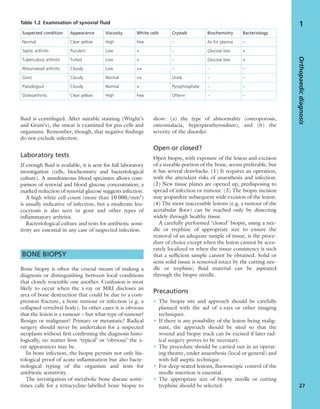
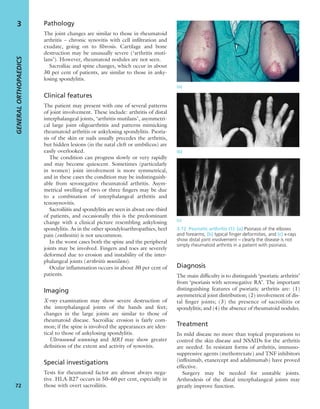
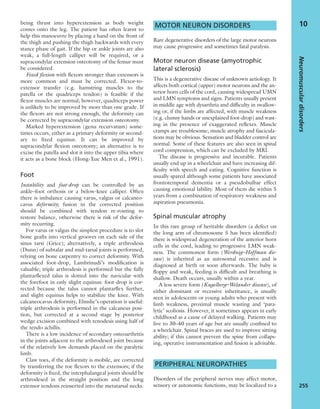
1.4 Feeling for tenderness (a) The wrong way – there is
no need to look at your fingers, you should know where
they are. (b) It is much more informative to look at the
patient’s face!
(a) (b)
GENERALORTHOPAEDICS
8
1
Test
The apprehension test referred to in the previous para-
graph is one of several clinical tests that are used to elicit
suspected abnormalities: some examples are Thomas’ test
for flexion deformity of the hip, Trendelenburg’s test for
instability of the hip, McMurray’s test for a torn meniscus
of the knee, Lachman’s test for cruciate ligament insta-
bility and various tests for intra-articular fluid. These and
others are described in the relevant chapters in Section 2.
Tests for muscle tone, motor power, reflexes and
various modes of sensibility are part and parcel of neu-
rological examination, which is dealt with on page 10.
Caveat
We recognize that the sequence set out here may
sometimes have to be modified. We may need to
‘move’ before we ‘look’: an early scoliotic deformity
of the spine often becomes apparent only when the
patient bends forwards. The sequence may also have
to be altered because a patient is in severe pain or dis-
abled: you would not try to move a limb at all in
someone with a suspected fracture when an x-ray can
provide the answer. When examining a child you may
have to take your chances with look or feel or move
whenever you can!
(a) (b) (c)
(d) (e) (f)
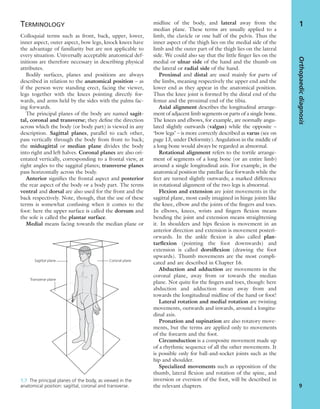
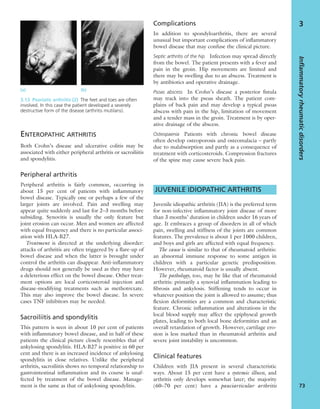
1.5 Testing for movement (a) Flexion, (b) extension, (c) rotation, (d) abduction, (e) adduction. The range of movement
can be estimated by eye or measured accurately using a goniometer (f).
1.6 Move (a) Active movement – the patient moves the joint. The right shoulder is normal; the left has restricted active
movement. (b) Passive movement – the examiner moves the joint. (c) Unstable movement – the joint can be moved across
the normal planes of action, in this case demonstrating valgus instability of the right knee. (d) Provocative movement – the
examiner moves (or manipulates) the joint so as to provoke the symptoms of impending pain or dislocation. Here he is
reproducing the position in which an unstable shoulder is likely to dislocate.
(a) (b) (c) (d)
TERMINOLOGY
Colloquial terms such as front, back, upper, lower,
inner aspect, outer aspect, bow legs, knock knees have
the advantage of familiarity but are not applicable to
every situation. Universally acceptable anatomical def-
initions are therefore necessary in describing physical
attributes.
Bodily surfaces, planes and positions are always
described in relation to the anatomical position – as
if the person were standing erect, facing the viewer,
legs together with the knees pointing directly for-
wards, and arms held by the sides with the palms fac-
ing forwards.
The principal planes of the body are named sagit-
tal, coronal and transverse; they define the direction
across which the body (or body part) is viewed in any
description. Sagittal planes, parallel to each other,
pass vertically through the body from front to back;
the midsagittal or median plane divides the body
into right and left halves. Coronal planes are also ori-
entated vertically, corresponding to a frontal view, at
right angles to the saggital planes; transverse planes
pass horizontally across the body.
Anterior signifies the frontal aspect and posterior
the rear aspect of the body or a body part. The terms
ventral and dorsal are also used for the front and the
back respectively. Note, though, that the use of these
terms is somewhat confusing when it comes to the
foot: here the upper surface is called the dorsum and
the sole is called the plantar surface.
Medial means facing towards the median plane or
midline of the body, and lateral away from the
median plane. These terms are usually applied to a
limb, the clavicle or one half of the pelvis. Thus the
inner aspect of the thigh lies on the medial side of the
limb and the outer part of the thigh lies on the lateral
side. We could also say that the little finger lies on the
medial or ulnar side of the hand and the thumb on
the lateral or radial side of the hand.
Proximal and distal are used mainly for parts of
the limbs, meaning respectively the upper end and the
lower end as they appear in the anatomical position.
Thus the knee joint is formed by the distal end of the
femur and the proximal end of the tibia.
Axial alignment describes the longitudinal arrange-
ment of adjacent limb segments or parts of a single bone.
The knees and elbows, for example, are normally angu-
lated slightly outwards (valgus) while the opposite –
‘bow legs’ – is more correctly described as varus (see on
page 13, under Deformity). Angulation in the middle of
a long bone would always be regarded as abnormal.
Rotational alignment refers to the tortile arrange-
ment of segments of a long bone (or an entire limb)
around a single longitudinal axis. For example, in the
anatomical position the patellae face forwards while the
feet are turned slightly outwards; a marked difference
in rotational alignment of the two legs is abnormal.
Flexion and extension are joint movements in the
sagittal plane, most easily imagined in hinge joints like
the knee, elbow and the joints of the fingers and toes.
In elbows, knees, wrists and fingers flexion means
bending the joint and extension means straightening
it. In shoulders and hips flexion is movement in an
anterior direction and extension is movement posteri-
orwards. In the ankle flexion is also called plan-
tarflexion (pointing the foot downwards) and
extension is called dorsiflexion (drawing the foot
upwards). Thumb movements are the most compli-
cated and are described in Chapter 16.
Abduction and adduction are movements in the
coronal plane, away from or towards the median
plane. Not quite for the fingers and toes, though: here
abduction and adduction mean away from and
towards the longitudinal midline of the hand or foot!
Lateral rotation and medial rotation are twisting
movements, outwards and inwards, around a longitu-
dinal axis.
Pronation and supination are also rotatory move-
ments, but the terms are applied only to movements
of the forearm and the foot.
Circumduction is a composite movement made up
of a rhythmic sequence of all the other movements. It
is possible only for ball-and-socket joints such as the
hip and shoulder.
Specialized movements such as opposition of the
thumb, lateral flexion and rotation of the spine, and
inversion or eversion of the foot, will be described in
the relevant chapters.
Orthopaedicdiagnosis
9
1
Sagittal plane Coronal plane
Transverse plane
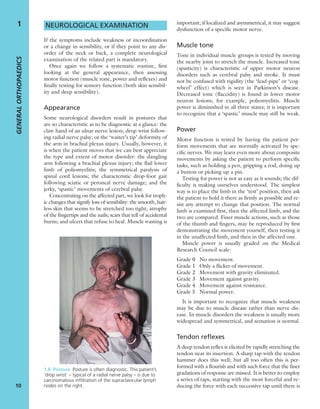
1.7 The principal planes of the body, as viewed in the
anatomical position: sagittal, coronal and transverse.
NEUROLOGICAL EXAMINATION
If the symptoms include weakness or incoordination
or a change in sensibility, or if they point to any dis-
order of the neck or back, a complete neurological
examination of the related part is mandatory.
Once again we follow a systematic routine, first
looking at the general appearance, then assessing
motor function (muscle tone, power and reflexes) and
finally testing for sensory function (both skin sensibil-
ity and deep sensibility).
Appearance
Some neurological disorders result in postures that
are so characteristic as to be diagnostic at a glance: the
claw hand of an ulnar nerve lesion; drop wrist follow-
ing radial nerve palsy; or the ‘waiter’s tip’ deformity of
the arm in brachial plexus injury. Usually, however, it
is when the patient moves that we can best appreciate
the type and extent of motor disorder: the dangling
arm following a brachial plexus injury; the flail lower
limb of poliomyelitis; the symmetrical paralysis of
spinal cord lesions; the characteristic drop-foot gait
following sciatic or peroneal nerve damage; and the
jerky, ‘spastic’ movements of cerebral palsy.
Concentrating on the affected part, we look for troph-
ic changes that signify loss of sensibility: the smooth, hair-
less skin that seems to be stretched too tight; atrophy
of the fingertips and the nails; scars that tell of accidental
burns; and ulcers that refuse to heal. Muscle wasting is
important; if localized and asymmetrical, it may suggest
dysfunction of a specific motor nerve.
Muscle tone
Tone in individual muscle groups is tested by moving
the nearby joint to stretch the muscle. Increased tone
(spasticity) is characteristic of upper motor neuron
disorders such as cerebral palsy and stroke. It must
not be confused with rigidity (the ‘lead-pipe’ or ‘cog-
wheel’ effect) which is seen in Parkinson’s disease.
Decreased tone (flaccidity) is found in lower motor
neuron lesions; for example, poliomyelitis. Muscle
power is diminished in all three states; it is important
to recognize that a ‘spastic’ muscle may still be weak.
Power
Motor function is tested by having the patient per-
form movements that are normally activated by spe-
cific nerves. We may learn even more about composite
movements by asking the patient to perform specific
tasks, such as holding a pen, gripping a rod, doing up
a button or picking up a pin.
Testing for power is not as easy as it sounds; the dif-
ficulty is making ourselves understood. The simplest
way is to place the limb in the ‘test’ position, then ask
the patient to hold it there as firmly as possible and re-
sist any attempt to change that position. The normal
limb is examined first, then the affected limb, and the
two are compared. Finer muscle actions, such as those
of the thumb and fingers, may be reproduced by first
demonstrating the movement yourself, then testing it
in the unaffected limb, and then in the affected one.
Muscle power is usually graded on the Medical
Research Council scale:
Grade 0 No movement.
Grade 1 Only a flicker of movement.
Grade 2 Movement with gravity eliminated.
Grade 3 Movement against gravity.
Grade 4 Movement against resistance.
Grade 5 Normal power.
It is important to recognize that muscle weakness
may be due to muscle disease rather than nerve dis-
ease. In muscle disorders the weakness is usually more
widespread and symmetrical, and sensation is normal.
Tendon reflexes
A deep tendon reflex is elicited by rapidly stretching the
tendon near its insertion. A sharp tap with the tendon
hammer does this well; but all too often this is per-
formed with a flourish and with such force that the finer
gradations of response are missed. It is better to employ
a series of taps, starting with the most forceful and re-
ducing the force with each successive tap until there is
GENERALORTHOPAEDICS
10
1
1.8 Posture Posture is often diagnostic. This patient’s
‘drop wrist’ – typical of a radial nerve palsy – is due to
carcinomatous infiltration of the supraclavicular lymph
nodes on the right.
no response. Comparing the two sides in this way, we
can pick up fine differences showing that a reflex is
‘diminished’ rather than ‘absent’. In the upper limb we
test biceps, triceps and brachioradialis; and in the lower
limb the patellar and Achilles tendons.
The tendon reflexes are monosynaptic segmental re-
flexes; that is, the reflex pathway takes a ‘short cut’
through the spinal cord at the segmental level. De-
pression or absence of the reflex signifies interruption
of the pathway at the posterior nerve root, the anterior
horn cell, the motor nerve root or the peripheral nerve.
It is a reliable pointer to the segmental level of dys-
function: thus, a depressed biceps jerk suggests pressure
on the fifth or sixth cervical (C5 or 6) nerve roots while
a depressed ankle jerk signifies a similar abnormality at
the first sacral level (S1). An unusually brisk reflex, on
the other hand, is characteristic of an upper motor
neuron disorder (e.g. cerebral palsy, a stroke or injury
to the spinal cord); the lower motor neuron is released
from the normal central inhibition and there is an ex-
aggerated response to tendon stimulation. This may
manifest as ankle clonus: a sharp upward jerk on the
foot (dorsiflexion) causes a repetitive, ‘clonic’ move-
ment of the foot; similarly, a sharp downward push on
the patella may elicit patellar clonus.
Superficial reflexes
The superficial reflexes are elicited by stroking the skin
at various sites to produce a specific muscle contrac-
tion; the best known are the abdominal (T7–T12),
cremasteric (L1, 2) and anal (S4, 5) reflexes. These
are corticospinal (upper motor neuron) reflexes.
Absence of the reflex indicates an upper motor neuron
lesion (usually in the spinal cord) above that level.
The plantar reflex
Forceful stroking of the sole normally produces flex-
ion of the toes (or no response at all). An extensor
response (the big toe extends while the others remain
in flexion) is characteristic of upper motor neuron dis-
orders. This is the Babinski sign – a type of withdrawal
reflex which is present in young infants and normally
disappears after the age of 18 months.
Orthopaedicdiagnosis
11
1
Sternomastoids Spinal accessory C2, 3, 4
Trapezius Spinal accessory C3, 4
Diaphragm C3, 4, 5
Deltoid C5, 6
Supra- and infraspinatus C5, 6
Serratus anterior C5, 6, 7
Pectoralis major C5, 6, 7, 8
Elbow flexion C5, 6
extension C7
Supination C5, 6
Pronation C6
Wrist extension C6, (7)
flexion C7, (8)
Finger extension C7
flexion C7, 8, T1
ab- and adduction C8, T1
Hip flexion L1, 2, 3
extension L5, S1
adduction L2, 3, 4
abduction L4, 5, S1
Knee extension L(2), 3, 4
flexion L5, S1
Ankle dorsiflexion L4, 5
plantarflexion S1, 2
inversion L4, 5
eversion L5, S1
Toe extension L5
flexion S1
abduction S1, 2
Table 1.1 Nerve root supply and actions of main
muscle groups
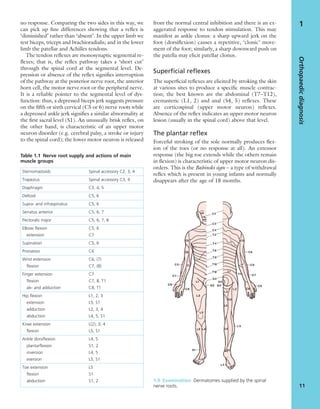
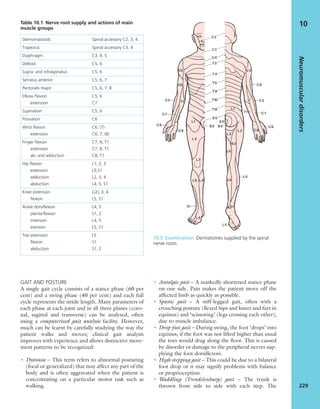
1.9 Examination Dermatomes supplied by the spinal
nerve roots.
Sensibility
Sensibility to touch and to pinprick may be increased
(hyperaesthesia) or unpleasant (dysaesthesia) in
certain irritative nerve lesions. More often, though, it
is diminished (hypoaesthesia) or absent (anaesthesia),
signifying pressure on or interruption of a peripheral
nerve, a nerve root or the sensory pathways in the
spinal cord. The area of sensory change can be
mapped out on the skin and compared with the
known segmental or dermatomal pattern of innerva-
tion. If the abnormality is well defined it is an easy
matter to establish the level of the lesion, even if the
precise cause remains unknown.
Brisk percussion along the course of an injured
nerve may elicit a tingling sensation in the distal dis-
tribution of the nerve (Tinel’s sign). The point of
hypersensitivity marks the site of abnormal nerve
sprouting: if it progresses distally at successive visits
this signifies regeneration; if it remains unchanged this
suggests a local neuroma.
Tests for temperature recognition and two-point
discrimination (the ability to recognize two touch-
points a few millimetres apart) are also used in the
assessment of peripheral nerve injuries.
Deep sensibility can be examined in several ways. In
the vibration test a sounded tuning fork is placed over
a peripheral bony point (e.g. the medial malleolus or
the head of the ulna); the patient is asked if he or she
can feel the vibrations and to say when they disappear.
By comparing the two sides, differences can be noted.
Position sense is tested by asking the patient to find
certain points on the body with the eyes closed – for
example, touching the tip of the nose with the fore-
finger. The sense of joint posture is tested by grasping
the big toe and placing it in different positions of flex-
ion and extension. The patient (whose eyes are
closed) is asked to say whether it is ‘up’ or ‘down’.
Stereognosis, the ability to recognize shape and tex-
ture by feel alone, is tested by giving the patient
(again with eyes closed) a variety of familiar objects to
hold and asking him or her to name each object.
The pathways for deep sensibility run in the post-
erior columns of the spinal cord. Disturbances are,
therefore, found in peripheral neuropathies and in
spinal cord lesions such as posterior column injuries or
tabes dorsalis. The sense of balance is also carried in
the posterior columns. This can be tested by asking
the patient to stand upright with his or her eyes
closed; excessive body sway is abnormal (Romberg’s
sign).
Cortical and cerebellar function
A staggering gait may imply an unstable knee – or a
disorder of the spinal cord or cerebellum. If there is
no musculoskeletal abnormality to account for the
sign, a full examination of the central nervous system
will be necessary.
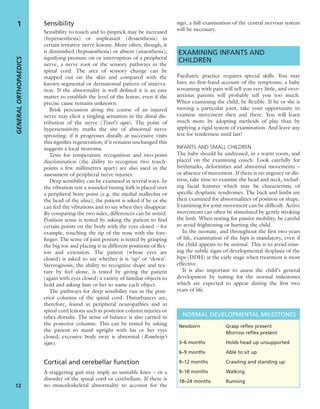
EXAMINING INFANTS AND
CHILDREN
Paediatric practice requires special skills. You may
have no first-hand account of the symptoms; a baby
screaming with pain will tell you very little, and over-
anxious parents will probably tell you too much.
When examining the child, be flexible. If he or she is
moving a particular joint, take your opportunity to
examine movement then and there. You will learn
much more by adopting methods of play than by
applying a rigid system of examination. And leave any
test for tenderness until last!
INFANTS AND SMALL CHILDREN
The baby should be undressed, in a warm room, and
placed on the examining couch. Look carefully for
birthmarks, deformities and abnormal movements –
or absence of movement. If there is no urgency or dis-
tress, take time to examine the head and neck, includ-
ing facial features which may be characteristic of
specific dysplastic syndromes. The back and limbs are
then examined for abnormalities of position or shape.
Examining for joint movement can be difficult. Active
movements can often be stimulated by gently stroking
the limb. When testing for passive mobility, be careful
to avoid frightening or hurting the child.
In the neonate, and throughout the first two years
of life, examination of the hips is mandatory, even if
the child appears to be normal. This is to avoid miss-
ing the subtle signs of developmental dysplasia of the
hips (DDH) at the early stage when treatment is most
effective.
It is also important to assess the child’s general
development by testing for the normal milestones
which are expected to appear during the first two
years of life.
GENERALORTHOPAEDICS
12
1
NORMAL DEVELOPMENTAL MILESTONES
Newborn Grasp reflex present
Morrow reflex present
3–6 months Holds head up unsupported
6–9 months Able to sit up
9–12 months Crawling and standing up
9–18 months Walking
18–24 months Running
OLDER CHILDREN
Most children can be examined in the same way as
adults, though with different emphasis on particular
physical features. Posture and gait are very important;
subtle deviations from the norm may herald the
appearance of serious abnormalities such as scoliosis
or neuromuscular disorders, while more obvious
‘deformities’ such as knock knees and bow legs may
be no more than transient stages in normal develop-
ment; similarly with mild degrees of ‘flat feet’ and
‘pigeon toes’. More complex variations in posture and
gait patterns, when the child sits and walks with the
knees turned inwards (medially rotated) or outwards
(laterally rotated) are usually due to anteversion or
retroversion of the femoral necks, sometimes associ-
ated with compensatory rotational ‘deformities’ of the
femora and tibiae. Seldom need anything be done
about this; the condition usually improves as the child
approaches puberty and only if the gait is very awk-
ward would one consider performing corrective
osteotomies of the femora.
PHYSICAL VARIATIONS AND
DEFORMITIES
JOINT LAXITY
Children’s joints are much more mobile than those of
most adults, allowing them to adopt postures that
would be impossible for their parents. An unusual
degree of joint mobility can also be attained by adults
willing to submit to rigorous exercise and practice, as
witness the performances of professional dancers and
athletes, but in most cases, when the exercises stop,
mobility gradually reverts to the normal range.
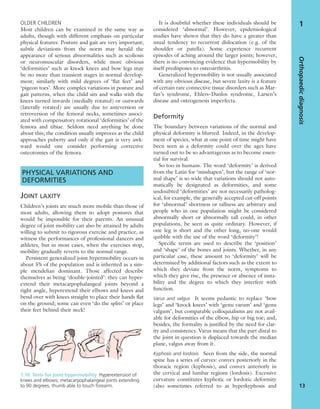
Persistent generalized joint hypermobility occurs in
about 5% of the population and is inherited as a sim-
ple mendelian dominant. Those affected describe
themselves as being ‘double-jointed’: they can hyper-
extend their metacarpophalangeal joints beyond a
right angle, hyperextend their elbows and knees and
bend over with knees straight to place their hands flat
on the ground; some can even ‘do the splits’ or place
their feet behind their neck!
It is doubtful whether these individuals should be
considered ‘abnormal’. However, epidemiological
studies have shown that they do have a greater than
usual tendency to recurrent dislocation (e.g. of the
shoulder or patella). Some experience recurrent
episodes of aching around the larger joints; however,
there is no convincing evidence that hypermobility by
itself predisposes to osteoarthritis.
Generalized hypermobility is not usually associated
with any obvious disease, but severe laxity is a feature
of certain rare connective tissue disorders such as Mar-
fan’s syndrome, Ehlers–Danlos syndrome, Larsen’s
disease and osteogenesis imperfecta.
Deformity
The boundary between variations of the normal and
physical deformity is blurred. Indeed, in the develop-
ment of species, what at one point of time might have
been seen as a deformity could over the ages have
turned out to be so advantageous as to become essen-
tial for survival.
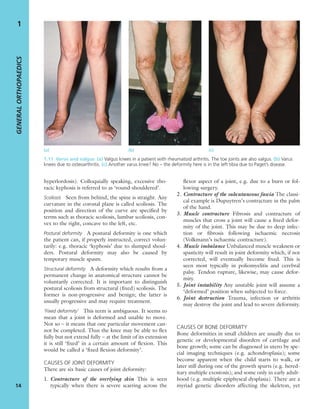
So too in humans. The word ‘deformity’ is derived
from the Latin for ‘misshapen’, but the range of ‘nor-
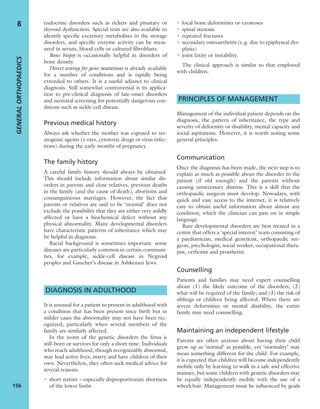
mal shape’ is so wide that variations should not auto-
matically be designated as deformities, and some
undoubted ‘deformities’ are not necessarily patholog-
ical; for example, the generally accepted cut-off points
for ‘abnormal’ shortness or tallness are arbitrary and
people who in one population might be considered
abnormally short or abnormally tall could, in other
populations, be seen as quite ordinary. However, if
one leg is short and the other long, no-one would
quibble with the use of the word ‘deformity’!
Specific terms are used to describe the ‘position’
and ‘shape’ of the bones and joints. Whether, in any
particular case, these amount to ‘deformity’ will be
determined by additional factors such as the extent to
which they deviate from the norm, symptoms to
which they give rise, the presence or absence of insta-
bility and the degree to which they interfere with
function.
Varus and valgus It seems pedantic to replace ‘bow
legs’ and ‘knock knees’ with ‘genu varum’ and ‘genu
valgum’, but comparable colloquialisms are not avail-
able for deformities of the elbow, hip or big toe; and,
besides, the formality is justified by the need for clar-
ity and consistency. Varus means that the part distal to
the joint in question is displaced towards the median
plane, valgus away from it.
Kyphosis and lordosis Seen from the side, the normal
spine has a series of curves: convex posteriorly in the
thoracic region (kyphosis), and convex anteriorly in
the cervical and lumbar regions (lordosis). Excessive
curvature constitutes kyphotic or lordotic deformity
(also sometimes referred to as hyperkyphosis and
Orthopaedicdiagnosis
13
1
1.10 Tests for joint hypermobility Hyperextension of
knees and elbows; metacarpophalangeal joints extending
to 90 degrees; thumb able to touch forearm.
hyperlordosis). Colloquially speaking, excessive tho-
racic kyphosis is referred to as ‘round-shouldered’.
Scoliosis Seen from behind, the spine is straight. Any
curvature in the coronal plane is called scoliosis. The
position and direction of the curve are specified by
terms such as thoracic scoliosis, lumbar scoliosis, con-
vex to the right, concave to the left, etc.
Postural deformity A postural deformity is one which
the patient can, if properly instructed, correct volun-
tarily: e.g. thoracic ‘kyphosis’ due to slumped shoul-
ders. Postural deformity may also be caused by
temporary muscle spasm.
Structural deformity A deformity which results from a
permanent change in anatomical structure cannot be
voluntarily corrected. It is important to distinguish
postural scoliosis from structural (fixed) scoliosis. The
former is non-progressive and benign; the latter is
usually progressive and may require treatment.
‘Fixed deformity’ This term is ambiguous. It seems to
mean that a joint is deformed and unable to move.
Not so – it means that one particular movement can-
not be completed. Thus the knee may be able to flex
fully but not extend fully – at the limit of its extension
it is still ‘fixed’ in a certain amount of flexion. This
would be called a ‘fixed flexion deformity’.
CAUSES OF JOINT DEFORMITY
There are six basic causes of joint deformity:
1. Contracture of the overlying skin This is seen
typically when there is severe scarring across the
flexor aspect of a joint, e.g. due to a burn or fol-
lowing surgery.
2. Contracture of the subcutaneous fascia The classi-
cal example is Dupuytren’s contracture in the palm
of the hand.
3. Muscle contracture Fibrosis and contracture of
muscles that cross a joint will cause a fixed defor-
mity of the joint. This may be due to deep infec-
tion or fibrosis following ischaemic necrosis
(Volkmann’s ischaemic contracture).
4. Muscle imbalance Unbalanced muscle weakness or
spasticity will result in joint deformity which, if not
corrected, will eventually become fixed. This is
seen most typically in poliomyelitis and cerebral
palsy. Tendon rupture, likewise, may cause defor-
mity.
5. Joint instability Any unstable joint will assume a
‘deformed’ position when subjected to force.
6. Joint destruction Trauma, infection or arthritis
may destroy the joint and lead to severe deformity.
CAUSES OF BONE DEFORMITY
Bone deformities in small children are usually due to
genetic or developmental disorders of cartilage and
bone growth; some can be diagnosed in utero by spe-
cial imaging techniques (e.g. achondroplasia); some
become apparent when the child starts to walk, or
later still during one of the growth spurts (e.g. hered-
itary multiple exostosis); and some only in early adult-
hood (e.g. multiple epiphyseal dysplasia). There are a
myriad genetic disorders affecting the skeleton, yet
GENERALORTHOPAEDICS
14
1
(a) (b) (c)
1.11 Varus and valgus (a) Valgus knees in a patient with rheumatoid arthritis. The toe joints are also valgus. (b) Varus
knees due to osteoarthritis. (c) Another varus knee? No – the deformity here is in the left tibia due to Paget’s disease.
any one of these conditions is rare. The least unusual
of them are described in Chapter 8.
Acquired deformities in children may be due to
fractures involving the physis (growth plate); ask
about previous injuries. Other causes include rickets,
endocrine disorders, malunited diaphyseal fractures
and tumours.
Acquired deformities of bone in adults are usually
the result of previous malunited fractures. However,
causes such as osteomalacia, bone tumours and
Paget’s disease should always be considered.
BONY LUMPS
A bony lump may be due to faulty development,
injury, inflammation or a tumour. Although x-ray
examination is essential, the clinical features can be
highly informative.
Size A large lump attached to bone, or a lump that is
getting bigger, is nearly always a tumour.
Site A lump near a joint is most likely to be a tumour
(benign or malignant); a lump in the shaft may be
fracture callus, inflammatory new bone or a tumour.
Margin A benign tumour has a well-defined margin;
malignant tumours, inflammatory lumps and callus
have a vague edge.
Consistency A benign tumour feels bony hard; malig-
nant tumours often give the impression that they can
be indented.
Tenderness Lumps due to active inflammation, recent
callus or a rapidly growing sarcoma are tender.
Multiplicity Multiple bony lumps are uncommon:
they occur in hereditary multiple exostosis and in
Ollier’s disease.
JOINT STIFFNESS
The term ‘stiffness’ covers a variety of limitations. We
consider three types of stiffness in particular: (1) all
movements absent; (2) all movements limited; (3)
one or two movements limited.
All movements absent Surprisingly, although move-
ment is completely blocked, the patient may retain
such good function that the restriction goes unno-
ticed until the joint is examined. Surgical fusion is
called ‘arthrodesis’; pathological fusion is called
‘ankylosis’. Acute suppurative arthritis typically ends
in bony ankylosis; tuberculous arthritis heals by
fibrosis and causes fibrous ankylosis – not strictly a
‘fusion’ because there may still be a small jog of move-
ment.
All movements limited After severe injury, movement
may be limited as a result of oedema and bruising.
Later, adhesions and loss of muscle extensibility may
perpetuate the stiffness.
With active inflammation all movements are
restricted and painful and the joint is said to be ‘irri-
table’. In acute arthritis spasm may prevent all but a
few degrees of movement.
In osteoarthritis the capsule fibroses and move-
ments become increasingly restricted, but pain occurs
only at the extremes of motion.
Some movements limited When one particular move-
ment suddenly becomes blocked, the cause is usually
mechanical. Thus a torn and displaced meniscus may
prevent extension of the knee but not flexion.
Bone deformity may alter the arc of movement,
such that it is limited in one direction (loss of abduc-
tion in coxa vara is an example) but movement in the
opposite direction is full or even increased.
These are all examples of ‘fixed deformity’.
DIAGNOSTIC IMAGING
The map is not the territory
Alfred Korzybski
PLAIN FILM RADIOGRAPHY
Plain film x-ray examination is over 100 years old.
Notwithstanding the extraordinary technical advances
of the last few decades, it remains the most useful
method of diagnostic imaging. Whereas other meth-
ods may define an inaccessible anatomical structure
more accurately, or may reveal some localized tissue
change, the plain film provides information simulta-
neously on the size, shape, tissue ‘density’ and bone
architecture – characteristics which, taken together,
Orthopaedicdiagnosis
15
1
1.12 Bony lumps The lump above the left knee is hard,
well-defined and not increasing in size. The clinical
diagnosis of cartilage-capped exostosis (osteochondroma)
is confirmed by the x-rays.
will usually suggest a diagnosis, or at least a range of
possible diagnoses.
The radiographic image
X-rays are produced by firing electrons at high speed
onto a rotating anode. The resulting beam of x-rays is
attenuated by the patient’s soft tissues and bones,
casting what are effectively ‘shadows’ which are dis-
played as images on an appropriately sensitized plate
or stored as digital information which is then available
to be transferred throughout the local information
technology (IT) network.
The more dense and impenetrable the tissue, the
greater the x-ray attenuation and therefore the more
blank, or white, the image that is captured. Thus, a
metal implant appears intensely white, bone less so
and soft tissues in varying shades of grey depending
on their ‘density’. Cartilage, which causes little atten-
uation, appears as a dark area between adjacent bone
ends; this ‘gap’ is usually called the joint space,
though of course it is not a space at all, merely a radi-
olucent zone filled with cartilage. Other ‘radiolucent’
areas are produced by fluid-filled cysts in bone.
One bone overlying another (e.g. the femoral head
inside the acetabular socket) produces superimposed
images; any abnormality seen in the resulting com-
bined image could be in either bone, so it is important
to obtain several images from different projections in
order to separate the anatomical outlines. Similarly,
the bright image of a metallic foreign body superim-
posed upon that of, say, the femoral condyles could
mean that the foreign body is in front of, inside or
behind the bone. A second projection, at right angles
to the first, will give the answer.
Picture Archiving and Communication System (PACS) This
is the system whereby all digitally coded images are
filed, stored and retrieved to enable the images to be
sent to work stations throughout the hospital, to other
hospitals or to the Consultant’s personal computer.
Radiographic interpretation
Although radiograph is the correct word for the plain
image which we address, in the present book we have
chosen to retain the old-fashioned term ‘x-ray’, which
has become entrenched by long usage.
The process of interpreting this image should be as
methodical as clinical examination. It is seductively
easy to be led astray by some flagrant anomaly; sys-
tematic study is the only safeguard. A convenient
sequence for examination is: the patient – the soft tis-
sues – the bone – the joints.
THE PATIENT
Make sure that the name on the film is that of your
patient; mistaken identity is a potent source of error.
The clinical details are important; it is surprising how
much more you can see on the x-ray when you know
the background. Similarly, when requesting an x-ray
examination, give the radiologist enough information
from the patient’s history and the clinical findings to
help in guiding his or her thoughts towards the diag-
nostic possibilities and options. For example, when
considering a malignant bone lesion, simply knowing
the patient’s age may provide an important clue:
under the age of 10 it is most likely to be a Ewing’s
sarcoma; between 10 and 20 years it is more likely to
be an osteosarcoma; and over the age of 50 years it is
likely to be a metastatic deposit.
THE SOFT TISSUES
Generalized change Muscle planes are often visible
and may reveal wasting or swelling. Bulging outlines
around a hip, for example, may suggest a joint effu-
sion; and soft-tissue swelling around interphalangeal
joints may be the first radiographic sign of rheumatoid
arthritis. Tumours tend to displace fascial planes,
whereas infection tends to obliterate them.
Localized change Is there a mass, soft tissue calcifica-
tion, ossification, gas (from penetrating wound or
gas-forming organism) or the presence of a radio-
opaque foreign body?
THE BONES
Shape The bones are well enough defined to allow
one to check their general anatomy and individual
shape. For example, for the spine, look at the overall
GENERALORTHOPAEDICS
16
1
1.13 The radiographic image X-ray of an anatomical
specimen to show the appearance of various parts of the
bone in the x-ray image.
Articular
cartilage
Epiphysis
Physis
(growth plate)
Metaphysis
Apophysis
Diaphysis
Cortex
Medulla
Physis
Epiphysis
vertebral alignment, then at the disc spaces, and then
at each vertebra separately, moving from the body to
the pedicles, the facet joints and finally the spinous
appendages. For the pelvis, see if the shape is sym-
metrical with the bones in their normal positions,
then look at the sacrum, the two innominate bones,
the pubic rami and the ischial tuberosities, then the
femoral heads and the upper ends of the femora,
always comparing the two sides.
Generalized change Take note of changes in bone ‘den-
sity’ (osteopaenia or osteosclerosis). Is there abnormal
trabeculation, as in Paget’s disease? Are there features
suggestive of diffuse metastatic infiltration, either
sclerotic or lytic? Other polyostotic lesions include
fibrous dysplasia, histiocyotis, multiple exostosis and
Paget’s disease. With aggressive looking polyostotic
lesions think of metastases (including myeloma and
lymphoma) and also multifocal infection. By contrast,
most primary tumours are monostotic.
Localized change Focal abnormalities should be
approached in the same way as one would conduct a
clinical analysis of a soft tissue abnormality. Start
describing the abnormality from the centre and move
outwards. Determine the lesion’s size, site, shape, den-
sity and margins, as well as adjacent periosteal changes
and any surrounding soft tissue changes. Remember
that benign lesions are usually well defined with scle-
rotic margins (Fig. 1.15b) and a smooth periosteal
reaction. Ill-defined areas with permeative bone
destruction (Fig. 1.15c) and irregular or spiculated
periosteal reactions (Fig. 1.15d) suggest an aggressive
lesion such as infection or a malignant tumour.
Orthopaedicdiagnosis
17
1
1.14 X-rays – bent bones (a) Mal-united fracture. (b) Paget’s disease. (c) Dyschondroplasia. (d) Congenital
pseudarthrosis. (e) Syphilitic sabre tibia. (f) Osteogenesis imperfecta.
(a) (b) (c) (d) (e) (f)
1.15 X-rays – important features to look for (a) General shape and appearance, in this case the cortices are thickened
and the bone is bent (Paget’s disease). (b,c) Interior density, a vacant area may represent a true cyst (b), or radiolucent
material infiltrating the bone, like the metastatic tumour in (c). (d) Periosteal reaction, typically seen in healing fractures,
bone infection and malignant bone tumours – as in this example of Ewing’s sarcoma. Compare this with the smooth
periosteal new bone formation shown in (e).
(a) (b) (c) (d) (e)
THE JOINTS
The radiographic ‘joint’ consists of the articulating
bones and the ‘space’ between them.
The ‘joint space’ The joint space is, of course, illusory;
it is occupied by a film of synovial fluid plus radiolu-
cent articular cartilage which varies in thickness from
1 mm or less (the carpal joints) to 6 mm (the knee). It
looks much wider in children than in adults because
much of the epiphysis is still cartilaginous and there-
fore radiolucent. Lines of increased density within the
radiographic articular ‘space’ may be due to calcifica-
tion of the cartilage or menisci (chondrocalcinosis).
Loose bodies, if they are radio-opaque, appear as
rounded patches overlying the normal structures.
Shape Note the general orientation of the joint and the
congruity of the bone ends (actually the subarticular
bone plates), if necessary comparing the abnormal with
the normal opposite side. Then look for narrowing or
asymmetry of the joint ‘space’: narrowing signifies loss
of hyaline cartilage and is typical of infection, inflam-
matory arthropathies and osteoarthritis. Further stages
of joint destruction are revealed by irregularity of the
radiographically visible bone ends and radiolucent cysts
in the subchondral bone. Bony excrescences at the joint
margins (osteophytes) are typical of osteoarthritis.
Erosions Look for associated bone erosions. The posi-
tion of erosions and symmetry help to define various
types of arthropathy. In rheumatoid arthritis and psori-
asis the erosions are peri-articular (at the bare area where
the hyaline cartilage covering the joint has ended and the
intracapsular bone is exposed to joint fluid). In gout the
erosions are further away from the articular surfaces and
are described as juxta-articular. Rheumatoid arthritis is
classically symmetrical and predominantly involves the
metacarpophalangeal and proximal interphalangeal joints
in both hands. The erosions in psoriasis are usually more
feathery with ill-defined new bone at their margins. Ill-
defined erosions suggest active synovitis whereas corti-
cated erosions indicate healing and chronicity.
Diagnostic associations
However carefully the individual x-ray features are
observed, the diagnosis will not leap ready-made off
the x-ray plate. Even a fracture is not always obvious.
It is the pattern of abnormalities that counts: if you
see one feature that is suggestive, look for others that
are commonly associated.
• Narrowing of the joint space + subchondral sclero-
sis and cysts + osteophytes = osteoarthritis.
• Narrowing of the joint space + osteoporosis + peri-
articular erosions = inflammatory arthritis. Add to
this the typical distribution, more or less symmetri-
cally in the proximal joints of both hands, and you
must think of rheumatoid arthritis.
GENERALORTHOPAEDICS
18
1 1.16 Plain x-rays of the hip Stages in the
development of osteoarthritis (OA). (a) Normal
hip: anatomical shape and position, with joint
‘space’ (articular cartilage) fully preserved.
(b) Early OA, showing joint space slightly
decreased and a subarticular cyst in the femoral
head. (c) Advanced OA: joint space markedly
decreased; osteophytes at the joint margin.
(d) Hip replacement: the cup is radiolucent but
its position is shown by a circumferential wire
marker. Note the differing image ‘densities’:
(1) the metal femoral implant; (2) the
polyethylene cup (radiolucent); (3) acrylic
cement impacted into the adjacent bone.
(a) (b)
(c) (d)
3
2
1
• Bone destruction + periosteal new bone formation
= infection or malignancy until proven otherwise.
• Remember: the next best investigation is either the
previous radiograph or the subsequent follow-up
radiograph. Sequential films demonstrate either
progression of changes in active pathology or status
quo in longstanding conditions.
Limitations of conventional radiography
Conventional radiography involves exposure of the
patient to ionizing radiation, which under certain cir-
cumstances can lead to radiation-induced cancer. The
Ionising Radiation Medical Exposure Regulations
(IRMER) 2000 are embedded in European Law, requir-
ing all clinicians to justify any exposure of the patient to
ionizing radiation. It is a criminal offence to breach these
regulations. Ionizing radiation can also damage a devel-
oping foetus, especially in the first trimester.
As a diagnostic tool, conventional radiography pro-
vides poor soft-tissue contrast: for example, it cannot
distinguish between muscles, tendons, ligaments and
hyaline cartilage. Ultrasound (US), computed tomog-
raphy (CT) and magnetic resonance imaging (MRI)
are now employed to complement plain x-ray exami-
nation. However, in parts of the world where these
techniques are not available, some modifications of
plain radiography still have a useful role.
X-RAYS USING CONTRAST MEDIA
Substances that alter x-ray attenuation characteristics
can be used to produce images which contrast with
those of the normal tissues. The contrast media used
in orthopaedics are mostly iodine-based liquids which
can be injected into sinuses, joint cavities or the spinal
theca. Air or gas also can be injected into joints to
produce a ‘negative image’ outlining the joint cavity.
Oily iodides are not absorbed and maintain maxi-
mum concentration after injection. However, because
they are non-miscible, they do not penetrate well into
all the nooks and crannies. They are also tissue irri-
tants, especially if used intrathecally. Ionic, water-
soluble iodides permit much more detailed imaging
and, although also somewhat irritant and neurotoxic,
are rapidly absorbed and excreted.
Sinography
Sinography is the simplest form of contrast radio-
graphy. The medium (usually one of the ionic water-
soluble compounds) is injected into an open sinus; the
film shows the track and whether or not it leads to the
underlying bone or joint.
Arthrography
Arthrography is a particularly useful form of contrast
radiography. Intra-articular loose bodies will produce
filling defects in the opaque contrast medium. In the
knee, torn menisci, ligament tears and capsular rup-
tures can be shown. In children’s hips, arthrography is
a useful method of outlining the cartilaginous (and
therefore radiolucent) femoral head. In adults with
avascular necrosis of the femoral head, arthrography
may show up torn flaps of cartilage. After hip replace-
ment, loosening of a prosthesis may be revealed by
seepage of the contrast medium into the
cement/bone interface. In the hip, ankle, wrist and
Orthopaedicdiagnosis
19
1
1.17 Contrast radiography (a) Myelography shows the outline of the spinal theca. Where facilities are available,
myelography has been largely replaced by CT and MRI. (b) Discography is sometimes useful: note the difference between a
normal intervertebral disc (upper level) and a degenerate disc (lower level). (c) Contrast arthrography of the knee shows a
small popliteal herniation.
(a) (b) (c)
shoulder, the injected contrast medium may disclose
labral tears or defects in the capsular structures. In the
spine, contrast radiography can be used to diagnose
disc degeneration (discography) and abnormalities of
the small facet joints (facetography).
Myelography
Myelography was used extensively in the past for the
diagnosis of disc prolapse and other spinal canal lesions.
It has been largely replaced by non-invasive methods
such as CT and MRI. However, it still has a place in the
investigation of nerve root lesions and as an adjunct to
other methods in patients with back pain.
The oily media are no longer used, and even with
the ionic water-soluble iodides there is a considerable
incidence of complications, such as low-pressure
headache (due to the lumbar puncture), muscular
spasms or convulsions (due to neurotoxicity, espe-
cially if the chemical is allowed to flow above the mid-
dorsal region) and arachnoiditis (which is attributed
to the hyperosmolality of these compounds in relation
to cerebrospinal fluid). Precautions, such as keeping
the patient sitting upright after myelography, must be
strictly observed.
Metrizamide has low neurotoxicity and at working
concentrations it is more or less isotonic with cere-
brospinal fluid. It can therefore be used throughout
the length of the spinal canal; the nerve roots are also
well delineated (radiculography). A bulging disc, an
intrathecal tumour or narrowing of the bony canal
will produce characteristic distortions of the opaque
column in the myelogram.
PLAIN TOMOGRAPHY
Tomography provides an image ‘focused’ on a
selected plane. By moving the tube and the x-ray film
in opposite directions around the patient during the
exposure, images on either side of the pivotal plane
are deliberately blurred out. When several ‘cuts’ are
studied, lesions obscured in conventional x-rays may
be revealed. The method is useful for diagnosing seg-
mental bone necrosis and depressed fractures in can-
cellous bone (e.g. of the vertebral body or the tibial
plateau); these defects are often obscured in the plain
x-ray by the surrounding intact mass of bone. Small
radiolucent lesions, such as osteoid osteomas and
bone abscesses, can also be revealed.
A useful procedure in former years, conventional
tomography has been largely supplanted by CT and MRI.
COMPUTED TOMOGRAPHY (CT)
Like plain tomography, CT produces sectional images
through selected tissue planes – but with much
greater resolution. A further advance over conven-
tional tomography is that the images are trans-axial
(like transverse anatomical sections), thus exposing
anatomical planes that are never viewed in plain film
x-rays. A general (or ‘localization’) view is obtained,
the region of interest is selected and a series of cross-
sectional images is produced and digitally recorded.
‘Slices’ through the larger joints or tissue masses may
be 5–10 mm apart; those through the small joints or
intervertebral discs have to be much thinner.
GENERALORTHOPAEDICS
20
1
1.18 Computed tomography (CT) The plain x-ray (a) shows a fracture of the vertebral
body but one cannot tell precisely how the bone fragments are displaced. The CT (b) shows
clearly that they are dangerously close to the cauda equina. (c) Congenital hip dislocation,
defined more clearly by (d) three-dimensional CT reconstruction.
(c) (d)
(a)
(b)
New multi-slice CT scanners provide images of
high quality from which multi-planar reconstructions
in all three orthogonal planes can be produced.
Three-dimensional surface rendered reconstructions
and volume rendered reconstructions may help in
demonstrating anatomical contours, but fine detail is
lost in this process.
Clinical applications
Because CT achieves excellent contrast resolution and
spatial localization, it is able to display the size, shape
and position of bone and soft-tissue masses in trans-
verse planes. Image acquisition is extremely fast. The
technique is therefore ideal for evaluating acute
trauma to the head, spine, chest, abdomen and pelvis.
It is better than MRI for demonstrating fine bone
detail and soft-tissue calcification or ossification.
Computed tomography is also an invaluable tool
for assisting with pre-operative planning in secondary
fracture management. It is routinely used for assessing
injuries of the vertebrae, acetabulum, proximal tibial
plateau, ankle and foot – indeed complex fractures
and fracture-dislocations at any site.
It is also useful in the assessment of bone tumour
size and spread, even if it is unable to characterize the
tumour type. It can be employed for guiding soft-
tissue and bone biopsies.
Limitations
An important limitation of CT is that it provides rela-
tively poor soft-tissue contrast when compared with
MRI.
A major disadvantage of this technique is the rela-
tively high radiation exposure to which the patient is
subjected. It should, therefore, be used with discre-
tion.
MAGNETIC RESONANCE IMAGING (MRI)
Magnetic resonance imaging produces cross-sectional
images of any body part in any plane. It yields superb
soft-tissue contrast, allowing different soft tissues to
be clearly distinguished, e.g. ligaments, tendons, mus-
cle and hyaline cartilage. Another big advantage of
MRI is that it does not use ionizing radiation. It is,
however, contra-indicated in patients with pacemakers
and possible metallic foreign bodies in the eye or
brain, as these could potentially move when the
patient is introduced into the scanner’s strong mag-
netic field. Approximately 5% of patients cannot toler-
ate the scan due to claustrophobia, but newer
scanners are being developed to be more ‘open’.
MRI physics
The patient’s body is placed in a strong magnetic field (be-
tween 5 and 30 000 times the strength of the earth’s mag-
netic field). The body’s protons have a positive charge and
align themselves along this strong external magnetic field.
The protons are spinning and can be further excited by ra-
diofrequency pulses, rather like whipping a spinning top.
These spinning positive charges will not only induce a
small magnetic field of their own, but will produce a sig-
nal as they relax (slow down) at different rates.
A proton density map is recorded from these signals
and plotted in x, y and z coordinates. Different speeds
of tissue excitation with radiofrequency pulses (repeti-
tion times, or TR) and different intervals between
recording these signals (time to echo, or TE) will yield
anatomical pictures with varying ‘weighting’ and char-
acteristics. T1 weighted (T1W) images have a high spa-
tial resolution and provide good anatomical-looking
pictures. T2 weighted (T2W) images give more infor-
mation about the physiological characteristics of the tis-
sue. Proton density (PD) images are also described as
Orthopaedicdiagnosis
21
1
(a) (b) (c)
1.19 CT for complex fractures (a) A plain x-ray shows a fracture of the calcaneum but the details are obscure. CT
sagittal and axial views (b,c) give a much clearer idea of the seriousness of this fracture.
‘balanced’ or ‘intermediate’ as they are essentially a
combination of T1 and T2 weighting and yield excellent
anatomical detail for orthopaedic imaging. Fat suppres-
sion sequences allow highlighting of abnormal water,
which is particularly useful in orthopaedics when assess-
ing both soft tissue and bone marrow oedema.
Intravenous contrast
Just as in CT, enhancement by intravenous contrast
relies on an active blood supply and leaky cell mem-
branes. Areas of inflammation and active tumour tis-
sue will be highlighted. Gadolinium compounds are
employed as they have seven unpaired electrons and
work by creating local magnetic field disturbances at
their sites of accumulation.
Indirect arthrography
Gadolinium compounds administered intravenously
will be secreted through joint synovium into joint
effusions resulting in indirect arthrography. However,
there is no additional distension of the joint, which
limits its effect.
Direct arthrography
Direct puncture of joints under image guidance with
a solution containing dilute gadolinium (1:200 con-
centration) is routinely performed. This provides a
positive contrast within the joint and distension of the
joint capsule, thereby separating many of the closely
applied soft-tissue structures that can be demon-
strated on the subsequent MRI scan.
Clinical applications
Magnetic resonance imaging is becoming cheaper and
more widely available. Its excellent anatomical detail,
soft-tissue contrast and multi-planar capability make it
ideal for non-invasive imaging of the musculoskeletal
system. The multi-planar capability provides accurate
cross-sectional information and the axial images in
particular will reveal detailed limb compartmental
anatomy. The excellent soft-tissue contrast allows
identification of similar density soft tissues, for exam-
ple in distinguishing between tendons, cartilage and
ligaments. By using combinations of T1W, T2W and
fat suppressed sequences, specific abnormalities can be
further characterized with tissue specificity, so further
extending the diagnostic possibilities.
In orthopaedic surgery, MRI of the hip, knee,
ankle, shoulder and wrist is now fairly commonplace.
It can detect the early changes of bone marrow
oedema and osteonecrosis before any other imaging
modality. In the knee, MRI is as accurate as
arthroscopy in diagnosing meniscal tears and cruciate
ligament injuries. Bone and soft-tissue tumours
should be routinely examined by MRI as the intra-
osseous and extra-osseous extent and spread of dis-
ease, as well as the compartmental anatomy, can be
accurately assessed. Additional use of fat suppression
sequences determines the extent of peri-lesional
oedema and intravenous contrast will demonstrate the
active part of the tumour.
Intravenous contrast is used to distinguish vascular-
ized from avascular tissue, e.g. following a scaphoid
fracture, or in defining active necrotic areas of tumour,
or in demonstrating areas of active inflammation.
Direct MRI arthrography is used to distend the
joint capsule and outline labral tears in the shoulder
and the hip. In the ankle, it provides the way to
demonstrate anterolateral impingement and assess the
integrity of the capsular ligaments.
GENERALORTHOPAEDICS
22
1
1.20 Magnetic resonance imaging MRI is ideal for
displaying soft-tissue injuries, particularly tears of the
menisci of the knee; this common injury is clearly shown in
the picture.
(a) (b)
1.21 MRI A case of septic arthritis of the ankle, suspected
from the plain x-ray (a) and confirmed by MRI (b).
Limitations
Despite its undoubted value, MRI (like all singular
methods of investigation) has its limitations and it
must be seen as one of a group of imaging techniques,
none of which by itself is appropriate in every situa-
tion. Conventional radiographs and CT are more sen-
sitive to soft-tissue calcification and ossification,
changes which can easily be easily overlooked on
MRI. Conventional radiographs should, therefore, be
used in combination with MRI to prevent such errors.
DIAGNOSTIC ULTRASOUND
High-frequency sound waves, generated by a trans-
ducer, can penetrate several centimetres into the soft
tissues; as they pass through the tissue interfaces some
of these waves are reflected back (like echoes) to the
transducer, where they are registered as electrical sig-
nals and displayed as images on a screen. Unlike x-
rays, the image does not depend on tissue density but
rather on reflective surfaces and soft-tissue interfaces.
This is the same principle as applies in sonar detection
for ships or submarines.
Depending on their structure, different tissues are
referred to as highly echogenic, mildly echogenic or
echo-free. Fluid-filled cysts are echo-free; fat is highly
echogenic; and semi-solid organs manifest varying
degrees of ‘echogenicity’, which makes it possible to
differentiate between them.
Real-time display on a monitor gives a dynamic im-
age, which is more useful than the usual static images.
A big advantage of this technique is that the equipment
is simple and portable and can be used almost any-
where; another is that it is entirely harmless.
Clinical applications
Because of the marked echogenic contrast between
cystic and solid masses, ultrasonography is particularly
useful for identifying hidden ‘cystic’ lesions such as
haematomas, abscesses, popliteal cysts and arterial
aneurysms. It is also capable of detecting intra-articu-
lar fluid and may be used to diagnose a synovial effu-
sion or to monitor the progress of an ‘irritable hip’.
Ultrasound is commonly used for assessing tendons
and diagnosing conditions such as tendinitis and par-
tial or complete tears. The rotator cuff, patellar liga-
ment, quadriceps tendon, Achilles tendon, flexor
tendons and peroneal tendons are typical examples.
The same technique is used extensively for guiding
needle placement in diagnostic and therapeutic joint
and soft-tissue injections.
Another important application is in the screening of
newborn babies for congenital dislocation (or dyspla-
sia) of the hip; the cartilaginous femoral head and
acetabulum (which are, of course, ‘invisible’ on x-ray)
can be clearly identified, and their relationship to each
other shows whether the hip is normal or abnormal.
Ultrasound imaging is quick, cheap, simple and
readily available. However, the information obtained
is highly operator dependent, relying on the experi-
ence and interpretation of the technician.
Doppler ultrasound
Blood flow can be detected by using the principle of a
change in frequency of sound when material is mov-
ing towards or away from the ultrasound transducer.
This is the same principle as the change in frequency
of the noise from a passing fire engine when travelling
towards and then away from an observer. Abnormal
increased blood flow can be observed in areas of
inflammation or in aggressive tumours. Different flow
rates can be shown by different colour representations
(‘colour Doppler’).
RADIONUCLIDE IMAGING
Photon emission by radionuclides taken up in specific
tissues can be recorded by a gamma camera to pro-
duce an image which reflects physiological activity in
that tissue or organ. The radiopharmaceutical used for
radionuclide imaging has two components: a chemical
compound that is chosen for its metabolic uptake in
the target tissue or organ, and a radioisotope tracer
that will emit photons for detection.
Isotope bone scans
For bone imaging the ideal isotope is technetium-
99m (99m
Tc): it has the appropriate energy characteris-
tics for gamma camera imaging, it has a relatively short
half-life (6 hours) and it is rapidly excreted in the urine.
A bone-seeking phosphate compound is used as the
substrate as it is selectively taken up and concentrated
in bone. The low background radioactivity means that
any site of increased uptake is readily visible.
Technetium-labelled hydroxymethylene diphos-
phonate (99m
Tc-HDP) is injected intravenously and its
activity is recorded at two stages: (1) the early perfu-
sion phase, shortly after injection, while the isotope is
still in the blood stream or the perivascular space thus
reflecting local blood flow difference; and (2) the
delayed bone phase, 3 hours later, when the isotope
has been taken up in bone tissue. Normally, in the
early perfusion phase the vascular soft tissues around
the joints produce the sharpest (most active) image; 3
hours later this activity has faded and the bone out-
lines are shown more clearly, the greatest activity
appearing in the cancellous tissue at the ends of the
long bones.
Orthopaedicdiagnosis
23
1
Changes in radioactivity are most significant when
they are localized or asymmetrical. Four types of
abnormality are seen:
Increased activity in the perfusion phase This is due to
increased soft-tissue blood flow, suggesting inflamma-
tion (e.g. acute or chronic synovitis), a fracture, a
highly vascular tumour or regional sympathetic dys-
trophy.
Decreased activity in the perfusion phase This is much
less common and signifies local vascular insufficiency.
Increased activity in the delayed bone phase This could be
due either to excessive isotope uptake in the osseous
extracellular fluid or to more avid incorporation into
newly forming bone tissue; either would be likely in a
fracture, implant loosening, infection, a local tumour
or healing after necrosis, and nothing in the bone scan
itself distinguishes between these conditions.
Diminished activity in the bone phase This is due to an
absent blood supply (e.g. in the femoral head after a
fracture of the femoral neck) or to replacement of
bone by pathological tissue.
CLINICAL APPLICATIONS
Radionuclide imaging is useful in many situations: (1)
the diagnosis of stress fractures or other undisplaced
fractures that are not detectable on the plain x-ray; (2)
the detection of a small bone abscess, or an osteoid
osteoma; (3) the investigation of loosening or infec-
tion around prostheses; (4) the diagnosis of femoral
head ischaemia in Perthes’ disease or avascular necro-
sis in adults; (5) the early detection of bone metas-
tases. The scintigraphic appearances in these
conditions are described in the relevant chapters. In
most cases the isotope scan serves chiefly to pinpoint
the site of abnormality and it should always be viewed
in conjunction with other modes of imaging.
Bone scintigraphy is relatively sensitive but non-
specific. One advantage is that the whole body can be
imaged to look for multiple sites of pathology (occult
metastases, multi-focal infection and multiple occult
fractures). It is also one of the only techniques to give
information about physiological activity in the tissues
being examined (essentially osteoblastic activity).
However, the technique carries a significant radiation
burden (equivalent to approximately 200 chest x-rays)
and the images yielded make anatomical localization
difficult (poor spatial resolution). For localized prob-
lems MRI has superseded bone scintigraphy as it
yields much greater specificity due to its superior
anatomical depiction and tissue specificity.
Other radionuclide compounds
Gallium-67 (67
Ga) Gallium-67 concentrates in inflam-
matory cells and has been used to identify sites of hid-
den infection: for example, in the investigation of
prosthetic loosening after joint replacement. How-
ever, it is arguable whether it gives any more reliable
information than the 99m
Tc bone scan.
Indium-111-labelled leucocytes (111
I) The patient’s own
white blood cells are removed and labelled with
indium-111 before being re-injected into the patient’s
blood stream. Preferential uptake in areas of infection
is expected, thereby hoping to distinguish sites of active
infection from chronic inflammation. For example,
white cell uptake is more likely to be seen with an
infected total hip replacement as opposed to mechani-
cal loosening. However, as this technique is expensive
and still not completely specific, it is seldom performed.
SINGLE PHOTON EMISSION COMPUTED
TOMOGRAPHY
Single photon emission computed tomography
(SPECT) is essentially a bone scan in which images
are recorded and displayed in all three orthogonal
planes. Coronal, sagittal and axial images at multiple
levels make spatial localization of pathology possible:
for example, activity in one side of a lumbar vertebra
on the planar images can be further localized to the
body, pedicle or lamina of the vertebra on the SPECT
images.
POSITRON EMISSION TOMOGRAPHY
Positron emission tomography (PET) is an advanced
nuclear medicine technique that allows functional im-
GENERALORTHOPAEDICS
24
1
(a) (b)
1.22 Radionuclide scanning (a) The plain x-ray showed
a pathological fracture, probably through a metastatic
tumour. (b) The bone scan revealed generalized
secondaries, here involving the spine and ribs.
aging of disease processes. Positron-emitting isotopes
with short half-lives are produced on site at specialist
centres using a cyclotron. Various radiopharmaceuticals
can be employed, but currently the most commonly
used is 18-fluoro-2-deoxy-D-glucose (18
FDG). The
18
FDG is accumulated in different parts of the body
where it can effectively measure the rate of consump-
tion of glucose. Malignant tumours metabolize glucose
at a faster rate than benign tumours and PET scanners
are extremely useful in looking for occult sites of dis-
ease around the body on this basis.
PET/CT is a hybrid examination performing both
PET and CT on the patient in order to superimpose
the two images produced. The combination of these
two techniques uses the sensitivity of PET for func-
tional tissue changes and the cross-sectional anatomy
detail of CT to localize the position of this activity.
PET is useful in oncology to identify occult malig-
nant tumours and metastases and more accurately
‘stage’ the disease. Furthermore, activity levels at
known sites of disease can be used to assess treatment
and distinguish ‘active’ residual tumour or tumour
recurrence from ‘inactive’ post-surgical scarring and
necrotic tumour.
BONE MINERAL DENSITOMETRY
Bone mineral density (BMD) measurement is now
widely used in identifying patients with osteoporosis
and an increased risk of osteoporotic fractures.
Various techniques have been developed, including
radiographic absorptiometry (RA), quantitative com-
puted tomography (QCT) and quantitative ultra-
sonometry (QUS). However, the most widely used
technique is dual energy x-ray absorptiometry (DXA).
RA uses conventional radiographic equipment and
measures bone density in the phalanges. QCT meas-
ures trabecular bone density in vertebral bodies, but is
not widely available and involves a higher dose of ion-
izing radiation than DXA. QUS assesses bone mineral
density in the peripheral skeleton (e.g. the wrist and
calcaneus) by measuring both the attenuation of ultra-
sound and the variation of speed of sound through
the bone.
DXA employs columnated low-dose x-ray beams of
two different energy levels in order to distinguish the
density of bone from that of soft tissue. Although this
involves the use of ionizing radiation, it is an
extremely low dose. A further advantage of DXA is
the development of a huge international database that
allows expression of bone mineral density values in
comparison to both an age and sex matched popula-
tion (Z score) and also to the peak adult bone mass (T
score). The T score in particular allows calculation of
relative fracture risk. Individual values for both the
lumbar spine and hips are obtained as there is often a
discrepancy between these two sites and the fracture
risk is more directly related to the value at the target
area. By World Health Organization (WHO) criteria,
T scores of <–1.0 indicate ‘osteopenia’ and T scores of
<–2.5 indicate ‘osteoporosis’.
Orthopaedicdiagnosis
25
1
1.23 Measurement of bone mass (a) X-ray of the lumbar spine shows a compression fracture of L2. The general loss of
bone density accentuates the cortical outlines of the vertebral body end-plates. These features are characteristic of
diminished bone mass, which can be measured accurately by dual energy x-ray absorptiometry. (b) DXA scan from another
woman who attended for monitoring at the onset of the menopause.
(a) (b)
Region Area BMC BMD T - score PR(%) Z - score AM(%)
(cm2
) (g) (g/cm2
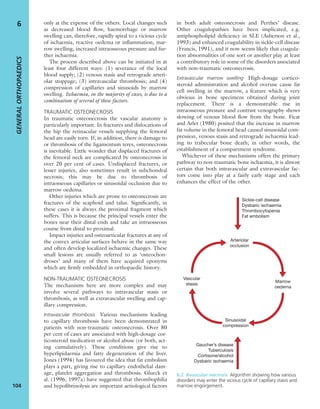
)
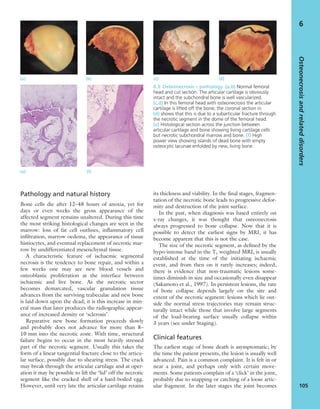
Neck 5.37 3.62 0.675 –1.6 79 –0.5 93
Troch 12.48 7.10 0.569 –1.3 81 –0.6 90
Inter 20.07 18.92 0.943 –1.0 86 –0.5 92
Total 37.92 29.64 0.782 –1.3 83 –0.6 92
Ward’s 1.03 0.54 0.527 –1.8 72 0.0 100
DXA Results Summary:
Total BMD CV 1.)%
WHO Classification: Osteopenia
Fracture Risk: Increased
BLOOD TESTS
Non-specific blood tests
Non-specific blood abnormalities are common in
bone and joint disorders; their interpretation hinges
on the clinical and x-ray findings.
Hypochromic anaemia is usual in rheumatoid arthri-
tis, but it may also be a consequence of gastrointesti-
nal bleeding due to the anti-inflammatory drugs.
Leucocytosis is generally associated with infection,
but a mild leucocytosis is not uncommon in rheuma-
toid arthritis and during an attack of gout.
The erythrocyte sedimentation rate (ESR) is usually
increased in acute and chronic inflammatory disorders
and after tissue injury. However, patients with low-
grade infection may have a normal ESR and this
should not be taken as a reassuring sign. The ESR is
strongly affected by the presence of monoclonal
immunoglobulins; a high ESR is almost mandatory in
the diagnosis of myelomatosis.
C-reactive protein (and other acute phase proteins)
may be abnormally increased in chronic inflammatory
arthritis and (temporarily) after injury or operation.
The test is often used to monitor the progress and
activity of rheumatoid arthritis and chronic infection.
Plasma gamma-globulins can be measured by pro-
tein electrophoresis. Their precise characterization is
helpful in the assessment of certain rheumatic disor-
ders, and more particularly in the diagnosis of myelo-
matosis.
Rheumatoid factor tests
Rheumatoid factor, an IgM autoantibody, is present
in about 75% of adults with rheumatoid arthritis.
However, it is not pathognomonic: some patients
with undoubted rheumatoid arthritis remain
‘seronegative’, while rheumatoid factor is found in
some patients with other disorders such as systemic
lupus erythematosus and scleroderma.
Ankylosing spondylitis, Reiter’s disease and psori-
atic arthritis characteristically test negative for
rheumatoid factor; they have been grouped together
as the ‘seronegative spondarthritides’.
Tissue typing
Human leucocyte antigens (HLA) can be detected in
white blood cells and they are used to characterize
individual tissue types. The seronegative spondarthri-
tides are closely associated with the presence of HLA-
B27 on chromosome 6; this is frequently used as a
confirmatory test in patients suspected of having
ankylosing spondylitis or Reiter’s disease, but it
should not be regarded as a specific test because it is
positive in about 8% of normal western Europeans.
Biochemistry
Biochemical tests are essential in monitoring patients
after any serious injury. They are also used routinely in
the investigation of rheumatic disorders and abnor-
malities of bone metabolism. Their significance is dis-
cussed under the relevant conditions.
SYNOVIAL FLUID ANALYSIS
Arthrocentesis and synovial fluid analysis is a much-
neglected diagnostic procedure; given the correct
indications it can yield valuable information. It should
be considered in the following conditions.
Acute joint swelling after injury The distinction
between synovitis and bleeding may not be obvious;
aspiration will settle the question immediately.
Acute atraumatic synovitis in adults Synovial fluid analy-
sis may be the only way to distinguish between infec-
tion, gout and pseudogout. Characteristic crystals can
be identified on polarized light microscopy.
Suspected infection Careful examination and labora-
tory investigations may provide the answer, but they
take time. Joint aspiration is essential for early
diagnosis.
Chronic synovitis Here joint aspiration is less urgent,
and is only one of many diagnostic procedures in the
investigation of suspected tuberculosis or atypical
rheumatic disorders.
Technique
Joint aspiration should always be performed under
strict aseptic conditions. After infiltrating the skin
with a local anaesthetic, a 20-gauge needle is intro-
duced and a sample of joint fluid is aspirated; even a
small quantity of fluid (less than 0.5 mL) is enough
for diagnostic analysis.
The volume of fluid and its appearance are immedi-
ately noted. Normal synovial fluid is clear and slightly
yellow. A cloudy or turbid fluid is due to the presence
of cells, usually a sign of inflammation. Blood-stained
fluid may be found after injury, but is also seen in
acute inflammatory disorders and in pigmented vil-
lonodular synovitis.
A single drop of fresh synovial fluid is placed on a
glass slide and examined through the microscope. Blood
cells are easily identified; abundant leucocytes may sug-
gest infection. Crystals may be seen, though this usually
requires a careful search; they are better characterized by
polarized light microscopy (see Chapter 4).
Dry smears are prepared with heparinized fluid;
more concentrated specimens can be obtained if the
GENERALORTHOPAEDICS
26
1
fluid is centrifuged. After suitable staining (Wright’s
and Gram’s), the smear is examined for pus cells and
organisms. Remember, though, that negative findings
do not exclude infection.
Laboratory tests
If enough fluid is available, it is sent for full laboratory
investigation (cells, biochemistry and bacteriological
culture). A simultaneous blood specimen allows com-
parison of synovial and blood glucose concentration; a
marked reduction of synovial glucose suggests infection.
A high white cell count (more than 10 000/mm3
)
is usually indicative of infection, but a moderate leu-
cocytosis is also seen in gout and other types of
inflammatory arthritis.
Bacteriological culture and tests for antibiotic sensi-
tivity are essential in any case of suspected infection.
BONE BIOPSY
Bone biopsy is often the crucial means of making a
diagnosis or distinguishing between local conditions
that closely resemble one another. Confusion is most
likely to occur when the x-ray or MRI discloses an
area of bone destruction that could be due to a com-
pression fracture, a bone tumour or infection (e.g. a
collapsed vertebral body). In other cases it is obvious
that the lesion is a tumour – but what type of tumour?
Benign or malignant? Primary or metastatic? Radical
surgery should never be undertaken for a suspected
neoplasm without first confirming the diagnosis histo-
logically, no matter how ‘typical’ or ‘obvious’ the x-
ray appearances may be.
In bone infection, the biopsy permits not only his-
tological proof of acute inflammation but also bacte-
riological typing of the organism and tests for
antibiotic sensitivity.
The investigation of metabolic bone disease some-
times calls for a tetracycline-labelled bone biopsy to
show: (a) the type of abnormality (osteoporosis,
osteomalacia, hyperparathyroidism), and (b) the
severity of the disorder.
Open or closed?
Open biopsy, with exposure of the lesion and excision
of a sizeable portion of the bone, seems preferable, but
it has several drawbacks. (1) It requires an operation,
with the attendant risks of anaesthesia and infection.
(2) New tissue planes are opened up, predisposing to
spread of infection or tumour. (3) The biopsy incision
may jeopardize subsequent wide excision of the lesion.
(4) The more inaccessible lesions (e.g. a tumour of the
acetabular floor) can be reached only by dissecting
widely through healthy tissue.
A carefully performed ‘closed’ biopsy, using a nee-
dle or trephine of appropriate size to ensure the
removal of an adequate sample of tissue, is the proce-
dure of choice except when the lesion cannot be accu-
rately localized or when the tissue consistency is such
that a sufficient sample cannot be obtained. Solid or
semi-solid tissue is removed intact by the cutting nee-
dle or trephine; fluid material can be aspirated
through the biopsy needle.
Precautions
• The biopsy site and approach should be carefully
planned with the aid of x-rays or other imaging
techniques.
• If there is any possibility of the lesion being malig-
nant, the approach should be sited so that the
wound and biopsy track can be excised if later rad-
ical surgery proves to be necessary.
• The procedure should be carried out in an operat-
ing theatre, under anaesthesia (local or general) and
with full aseptic technique.
• For deep-seated lesions, fluoroscopic control of the
needle insertion is essential.
• The appropriate size of biopsy needle or cutting
trephine should be selected.
Orthopaedicdiagnosis
27
1Table 1.2 Examination of synovial fluid
Suspected condition Appearance Viscosity White cells Crystals Biochemistry Bacteriology
Normal Clear yellow High Few – As for plasma –
Septic arthritis Purulent Low + – Glucose low +
Tuberculous arthritis Turbid Low + – Glucose low +
Rheumatoid arthritis Cloudy Low ++ – – –
Gout Cloudy Normal ++ Urate – –
Pseudogout Cloudy Normal + Pyrophosphate – –
Osteoarthritis Clear yellow High Few Often+ – –
GENERALORTHOPAEDICS
28
1 • A knowledge of the local anatomy and of the likely
consistency of the lesion is important. Large blood
vessels and nerves must be avoided; potentially vas-
cular tumours may bleed profusely and the means to
control haemorrhage should be readily to hand. More
than one surgeon has set out to aspirate an ‘abscess’
only to plunge a wide-bore needle into an aneurysm!
• Clear instructions should be given to ensure that
the tissue obtained at the biopsy is suitably
processed. If infection is suspected, the material
should go into a culture tube and be sent to the lab-
oratory as soon as possible. A smear may also be
useful. Whole tissue is transferred to a jar contain-
ing formalin, without damaging the specimen or
losing any material. Aspirated blood should be
allowed to clot and can then be preserved in for-
malin for later paraffin embedding and sectioning.
Tissue thought to contain crystals should not be
placed in formalin as this may destroy the crystals;
it should either be kept unaltered for immediate
examination or stored in saline.
• No matter how careful the biopsy, there is always
the risk that the tissue will be too scanty or too
unrepresentative for accurate diagnosis. Close con-
sultation with the radiologist and pathologist
beforehand will minimize this possibility. In the
best hands, needle biopsy has an accuracy rate of
over 95%.
DIAGNOSTIC ARTHROSCOPY
Arthroscopy is performed for both diagnostic and
therapeutic reasons. Almost any joint can be reached
but the procedure is most usefully employed in the
knee, shoulder, wrist, ankle and hip. If the suspect
lesion is amenable to surgery, it can often be dealt
with at the same sitting without the need for an open
operation. However, arthroscopy is an invasive proce-
dure and its mastery requires skill and practice; it
should not be used simply as an alternative to clinical
examination and imaging.
Technique
The instrument is basically a rigid telescope fitted with
fibreoptic illumination. Tube diameter ranges from
about 2 mm (for small joints) to 4–5 mm (for the
knee). It carries a lens system that gives a magnified im-
age. The eyepiece allows direct viewing by the arthro-
scopist, but it is far more convenient to fit a small, ster-
ilizable solid-state television camera which produces a
picture of the joint interior on a television monitor.
The procedure is best carried out under general
anaesthesia; this gives good muscle relaxation and per-
mits manipulation and opening of the joint compart-
ments. The joint is distended with fluid and the
arthroscope is introduced percutaneously. Various
instruments (probes, curettes and forceps) can be
inserted through other skin portals; they are used to
help expose the less accessible parts of the joint, or to
obtain biopsies for further examination. Guided by
the image on the monitor, the arthroscopist explores
the joint in a systematic fashion, manipulating the
arthroscope with one hand and the probe or forceps
with the other. At the end of the procedure the joint
is washed out and the small skin wounds are sutured.
The patient is usually able to return home later the
same day.
Diagnosis
The knee is the most accessible joint. The appearance
of the synovium and the articular surfaces usually
allows differentiation between inflammatory and non-
inflammatory, destructive and non-destructive lesions.
Meniscal tears can be diagnosed and treated immedi-
ately by repair or removal of partially detached seg-
ments. Cruciate ligament deficiency, osteocartilaginous
fractures, cartilaginous loose bodies and synovial
‘tumours’ are also readily visualized.
Arthroscopy of the shoulder is more difficult, but
the articular surfaces and glenoid labrum can be ade-
quately explored. Rotator cuff lesions can often be
diagnosed and treated at the same time.
Arthroscopy of the wrist is useful for diagnosing
torn triangular fibrocartilage and interosseous liga-
ment ruptures.
Arthroscopy of the hip is less widely used, but it is
proving to be useful in the diagnosis of unexplained hip
pain. Labral tears, synovial lesions, loose bodies and
articular cartilage damage (all of which are difficult to
detect by conventional imaging techniques) have been
diagnosed with a reported accuracy rate of over 50%.
Complications
Diagnostic arthroscopy is safe but not entirely free of
complications, the commonest of which are
haemarthosis, thrombophlebitis, infection and joint
stiffness. There is also a significant incidence of algo-
dystrophy following arthroscopy.
REFERENCES AND FURTHER READING
Apley AG, Solomon L. Physical Examination in
Orthopaedics. Oxford, Butterworth Heinemann, 1997.
Resnick D. Diagnosis of Bone and Joint Disorders, Edn 4.
Philadelphia, WB Saunders, 2002.
Micro-organisms may reach the musculoskeletal tis-
sues by (a) direct introduction through the skin (a pin-
prick, an injection, a stab wound, a laceration, an
open fracture or an operation), (b) direct spread from
a contiguous focus of infection, or (c) indirect spread
via the blood stream from a distant site such as the nose
or mouth, the respiratory tract, the bowel or the gen-
itourinary tract.
Depending on the type of invader, the site of infec-
tion and the host response, the result may be a pyo-
genic osteomyelitis, a septic arthritis, a chronic
granulomatous reaction (classically seen in tuberculo-
sis of either bone or joint), or an indolent response to
an unusual organism (e.g. a fungal infection). Soft-
tissue infections range from superficial wound sepsis
to widespread cellulitis and life-threatening necrotiz-
ing cellulitis. Parasitic lesions such as hydatid disease
also are considered in this chapter, although these are
infestations rather than infections.
GENERAL ASPECTS OF INFECTION
Infection – as distinct from mere residence of micro-
organisms – is a condition in which pathogenic organ-
isms multiply and spread within the body tissues. This
usually gives rise to an acute or chronic inflammatory
reaction, which is the body’s way of combating the
invaders and destroying them, or at least immobiliz-
ing them and confining them to a single area. The
signs of inflammation are recounted in the classical
mantra: redness, swelling, heat, pain and loss of func-
tion. In one important respect, bone infection differs
from soft-tissue infection: since bone consists of a col-
lection of rigid compartments, it is more susceptible
than soft tissues to vascular damage and cell death
from the build-up of pressure in acute inflammation.
Unless it is rapidly suppressed, bone infection will
inevitably lead to necrosis.
Host susceptibility to infection is increased by (a)
local factors such as trauma, scar tissue, poor circula-
tion, diminished sensibility, chronic bone or joint dis-
ease and the presence of foreign bodies, as well as (b)
systemic factors such as malnutrition, general illness,
debility, diabetes, rheumatoid disease, corticosteroid
administration and all forms of immunosuppression,
either acquired or induced. Resistance is also dimin-
ished in the very young and the very old.
Bacterial colonization and resistance to antibiotics is
enhanced by the ability of certain microbes (including
Staphylococcus) to adhere to avascular bone surfaces
and foreign implants, protected from both host
defences and antibiotics by a protein-polysaccharide
slime (glycocalyx).
Acute pyogenic bone infections are characterized by
the formation of pus – a concentrate of defunct leu-
cocytes, dead and dying bacteria and tissue debris –
which is often localized in an abscess. Pressure builds
up within the abscess and infection may then extend
into a contiguous joint or through the cortex and
along adjacent tissue planes. It may also spread further
afield via lymphatics (causing lymphangitis and lym-
phadenopathy) or via the blood stream (bacteraemia
and septicaemia). An accompanying systemic reaction
varies from a vague feeling of lassitude with mild
pyrexia to severe illness, fever, toxaemia and shock.
The generalized effects are due to the release of bac-
terial enzymes and endotoxins as well as cellular
breakdown products from the host tissues.
Chronic pyogenic infection may follow on unre-
solved acute infection and is characterized by persist-
ence of the infecting organism in pockets of necrotic
tissue. Purulent material accumulates and may be dis-
charged through sinuses at the skin or a poorly healed
wound. Factors which favour this outcome are the
presence of damaged muscle, dead bone or a foreign
implant, diminished local blood supply and a weak
host response. Resistance is likely to be depressed in
the very young and the very old, in states of malnu-
trition or immunosuppression, and in certain diseases
such as diabetes and leukaemia.
Infection
2
Louis Solomon, H. Srinivasan, Surendar Tuli, Shunmugam Govender
Chronic non-pyogenic infection may result from
invasion by organisms that produce a cellular reaction
leading to the formation of granulomas consisting
largely of lymphocytes, modified macrophages and
multinucleated giant cells; this type of granulomatous
infection is seen most typically in tuberculosis. Sys-
temic effects are less acute but may ultimately be very
debilitating, with lymphadenopathy, splenomegaly
and tissue wasting.
The principles of treatment are: (1) to provide anal-
gesia and general supportive measures; (2) to rest the
affected part; (3) to identify the infecting organism
and administer effective antibiotic treatment or
chemotherapy; (4) to release pus as soon as it is
detected; (5) to stabilize the bone if it has fractured;
(6) to eradicate avascular and necrotic tissue; (7) to
restore continuity if there is a gap in the bone; and (8)
to maintain soft-tissue and skin cover. Acute infec-
tions, if treated early with effective antibiotics, can
usually be cured. Once there is pus and bone necrosis,
operative drainage will be needed.
ACUTE HAEMATOGENOUS
OSTEOMYELITIS
Aetiology and pathogenesis
Acute haematogenous osteomyelitis is mainly a dis-
ease of children. When adults are affected it is usually
because their resistance is lowered. Trauma may deter-
mine the site of infection, possibly by causing a small
haematoma or fluid collection in a bone, in patients
with concurrent bacteraemia.
The incidence of acute haematogenous osteo-
myelitis in western European children is thought to
have declined in recent years, probably a reflection of
improving social conditions. A study from Glasgow,
Scotland, covering the period 1990–99, suggests that
it is less than 3 cases per 100 000 per year (Blyth et al.,
2001). However, it is almost certainly much higher
among less affluent populations.
The causal organism in both adults and children is
usually Staphylococcus aureus (found in over 70% of
cases), and less often one of the other Gram-positive
cocci, such as the Group A beta-haemolytic strepto-
coccus (Streptococcus pyogenes) which is found in
chronic skin infections, as well as Group B strepto-
coccus (especially in new-born babies) or the alpha-
haemolytic diplococcus S. pneumoniae.
In children between 1 and 4 years of age the Gram-
negative Haemophilus influenzae used to be a fairly
common pathogen for osteomyelitis and septic arthri-
tis, but the introduction of H. influenzae type B vac-
cination about 20 years ago has been followed by a
much reduced incidence of this infection in many
countries. In recent years its place has been taken by
GENERALORTHOPAEDICS
30
2 Table 2.1 Factors predisposing to bone infection
Malnutrition and general debility
Diabetes mellitus
Corticosteroid administration
Immune deficiency
Immunosuppressive drugs
Venous stasis in the limb
Peripheral vascular disease
Loss of sensibility
Iatrogenic invasive measures
Trauma
2.1 Epiphyseal and metaphyseal blood supply (a) In
new-born infants some metaphyseal arterioles from the
nutrient artery penetrate the physis and may carry infection
directly from the metaphysis to the epiphysis. (b) In older
children the physis acts as a barrier and the developing
epiphysis receives a separate blood supply from the
epiphyseal and peri-articular blood vessels.
(a) (b)
Kingella kingae, mainly following upper respiratory
infection in young children. Other Gram-negative
organisms (e.g. Escherichia coli, Pseudomonas aerugi-
nosa, Proteus mirabilis and the anaerobic Bacteroides
fragilis) occasionally cause acute bone infection. Curi-
ously, patients with sickle-cell disease are prone to
infection by Salmonella typhi.
Anaerobic organisms (particularly Peptococcus mag-
nus) have been found in patients with osteomyelitis,
usually as part of a mixed infection. Unusual organ-
isms are more likely to be found in heroin addicts and
as opportunistic pathogens in patients with compro-
mised immune defence mechanisms.
The blood stream is invaded, perhaps from a minor
skin abrasion, treading on a sharp object, an injection
point, a boil, a septic tooth or – in the newborn –
from an infected umbilical cord. In adults the source
of infection may be a urethral catheter, an indwelling
arterial line or a dirty needle and syringe.
In children the infection usually starts in the vascu-
lar metaphysis of a long bone, most often in the prox-
imal tibia or in the distal or proximal ends of the
femur. Predilection for this site has traditionally been
attributed to the peculiar arrangement of the blood
vessels in that area (Trueta, 1959): the non-anasto-
mosing terminal branches of the nutrient artery twist
back in hairpin loops before entering the large net-
work of sinusoidal veins; the relative vascular stasis
and consequent lowered oxygen tension are believed
to favour bacterial colonization. It has also been sug-
gested that the structure of the fine vessels in the
hypertrophic zone of the physis allows bacteria more
easily to pass through and adhere to type 1 collagen in
that area (Song and Sloboda, 2001). In infants, in
whom there are still anastomoses between metaphy-
seal and epiphyseal blood vessels, infection can also
reach the epiphysis.
In adults, haematogenous infection accounts for
only about 20% of cases of osteomyelitis, mostly
affecting the vertebrae. Staphylococcus aureus is the
commonest organism but Pseudomonas aeruginosa
often appears in patients using intravenous drugs.
Adults with diabetes, who are prone to soft-tissue
infections of the foot, may develop contiguous bone
infection involving a variety of organisms.
Pathology
Acute haematogenous osteomyelitis shows a charac-
teristic progression marked by inflammation, suppu-
ration, bone necrosis, reactive new bone formation and,
ultimately, resolution and healing or else intractable
chronicity. However, the pathological picture varies
considerably, depending on the patient’s age, the site
of infection, the virulence of the organism and the
host response.
Acute osteomyelitis in children The ‘classical’ picture is
seen in children between 2 and 6 years. The earliest
change in the metaphysis is an acute inflammatory
reaction with vascular congestion, exudation of fluid
and infiltration by polymorphonuclear leucocytes.
The intraosseous pressure rises rapidly, causing intense
pain, obstruction to blood flow and intravascular
thrombosis. Even at an early stage the bone tissue is
threatened by impending ischaemia and resorption
due to a combination of phagocytic activity and the
local accumulation of cytokines, growth factors,
prostaglandin and bacterial enzymes. By the second or
third day, pus forms within the bone and forces its
way along the Volkmann canals to the surface where
it produces a subperiosteal abscess. This is much more
evident in children, because of the relatively loose
attachment of the periosteum, than in adults. From
the subperiosteal abscess pus can spread along the
shaft, to re-enter the bone at another level or burst
into the surrounding soft tissues. The developing
physis acts as a barrier to direct spread towards the
epiphysis, but where the metaphysis is partly intracap-
sular (e.g. at the hip, shoulder or elbow) pus may dis-
charge through the periosteum into the joint.
The rising intraosseous pressure, vascular stasis,
small-vessel thrombosis and periosteal stripping
Infection
31
2
Sequestrum
Involucrum
Sinus
2.2 Acute osteomyelitis (a) Infection in the metaphysis
may spread towards the surface, to form a subperiosteal
abscess (b). Some of the bone may die, and is encased in
periosteal new bone as a sequestrum (c). The encasing
involucrum is sometimes perforated by sinuses.
(c)
(a) (b)
increasingly compromise the blood supply; by the end
of a week there is usually microscopic evidence of
bone death. Bacterial toxins and leucocytic enzymes
also may play their part in the advancing tissue
destruction. With the gradual ingrowth of granulation
tissue the boundary between living and devitalized
bone becomes defined. Pieces of dead bone may sep-
arate as sequestra varying in size from mere spicules to
large necrotic segments of the cortex in neglected
cases.
Macrophages and lymphocytes arrive in increasing
numbers and the debris is slowly removed by a com-
bination of phagocytosis and osteoclastic resorption.
A small focus in cancellous bone may be completely
resorbed, leaving a tiny cavity, but a large cortical or
cortico-cancellous sequestrum will remain entombed,
inaccessible to either final destruction or repair.
Another feature of advancing acute osteomyelitis is
new bone formation. Initially the area around the
infected zone is porotic (probably due to hyperaemia
and osteoclastic activity) but if the pus is not released,
either spontaneously or by surgical decompression,
new bone starts forming on viable surfaces in the
bone and from the deep layers of the stripped perios-
teum. This is typical of pyogenic infection and fine
streaks of subperiosteal new bone usually become
apparent on x-ray by the end of the second week.
With time this new bone thickens to form a casement,
or involucrum, enclosing the sequestrum and infected
tissue. If the infection persists, pus and tiny seques-
trated spicules of bone may discharge through perfo-
rations (cloacae) in the involucrum and track by
sinuses to the skin surface.
If the infection is controlled and intraosseous pres-
sure released at an early stage, this dire progress can
be halted. The bone around the zone of infection
becomes increasingly dense; this, together with the
periosteal reaction, results in thickening of the bone.
In some cases the normal anatomy may eventually be
reconstituted; in others, though healing is sound, the
bone is left permanently deformed.
If healing does not occur, a nidus of infection may
remain locked inside the bone, causing pus and some-
times bone debris to be discharged intermittently
through a persistent sinus (or several sinuses). The
infection has now lapsed into chronic osteomyelitis,
which may last for many years.
Acute osteomyelitis in infants The early features of
acute osteomyelitis in infants are much the same as
those in older children. However, a significant differ-
ence, during the first year of life, is the frequency with
which the metaphyseal infection spreads to the epiph-
ysis and from there into the adjacent joint. In the
process, the physeal anlage may be irreparably dam-
aged, further growth at that site is severely retarded
and the joint will be permanently deformed. How this
comes about is still argued over. Following Trueta
(1957) it has long been held that, during the first
6–9 months of life, small metaphyseal vessels pene-
trate the physeal cartilage and this permits the infec-
tion to spread into the cartilaginous epiphysis. Others
have disagreed with this hypothesis (Chung, 1976),
but what is indisputable is that during infancy
osteomyelitis and septic arthritis often go together.
Another feature in infants is an unusually exuberant
periosteal reaction resulting in sometimes bizarre new
bone formation along the diaphysis; fortunately, with
longitudinal growth and remodelling the diaphyseal
anatomy is gradually restored.
Acute osteomyelitis in adults Bone infection in the adult
usually follows an open injury, an operation or spread
from a contiguous focus of infection (e.g. a neuropathic
ulcer or an infected diabetic foot). True haematogenous
osteomyelitis is uncommon and when it does occur it
usually affects one of the vertebrae (e.g. following a
pelvic infection) or a small cuboidal bone. A vertebral
infection may spread through the end-plate and the in-
tervertebral disc into an adjacent vertebral body.
If a long bone is infected, the abscess is likely to
spread within the medullary cavity, eroding the cortex
and extending into the surrounding soft tissues.
Periosteal new bone formation is less obvious than in
childhood and the weakened cortex may fracture. If
the bone end becomes involved there is a risk of the
infection spreading into an adjacent joint. The out-
come is often a gradual slide towards subacute and
chronic osteomyelitis.
Clinical features
Clinical features differ in the three groups described
above.
Children The patient, usually a child over 4 years,
presents with severe pain, malaise and a fever; in neg-
lected cases, toxaemia may be marked. The parents
will have noticed that he or she refuses to use one
limb or to allow it to be handled or even touched.
There may be a recent history of infection: a septic
toe, a boil, a sore throat or a discharge from the ear.
Typically the child looks ill and feverish; the pulse
rate is likely to be over 100 and the temperature is
raised. The limb is held still and there is acute tender-
ness near one of the larger joints (e.g. above or below
the knee, in the popliteal fossa or in the groin). Even
the gentlest manipulation is painful and joint move-
ment is restricted (‘pseudoparalysis’). Local redness,
swelling, warmth and oedema are later signs and sig-
nify that pus has escaped from the interior of the bone.
Lymphadenopathy is common but non-specific. It is
important to remember that all these features may be
attenuated if antibiotics have been administered.
GENERALORTHOPAEDICS
32
2
Infants In children under a year old, and especially in
the newborn, the constitutional disturbance can be
misleadingly mild; the baby simply fails to thrive and
is drowsy but irritable. Suspicion should be aroused
by a history of birth difficulties, umbilical artery
catheterization or a site of infection (however mild)
such as an inflamed intravenous infusion point or even
a heel puncture. Metaphyseal tenderness and resist-
ance to joint movement can signify either
osteomyelitis or septic arthritis; indeed, both may be
present, so the distinction hardly matters. Look for
other sites – multiple infection is not uncommon,
especially in babies who acquire the infection in hos-
pital. Radionuclide bone scans may help to discover
additional sites.
Adults The commonest site for haematogenous
infection is the thoracolumbar spine. There may be a
history of some urological procedure followed by a
mild fever and backache. Local tenderness is not very
marked and it may take weeks before x-ray signs
appear; when they do appear the diagnosis may still
need to be confirmed by fine-needle aspiration and
bacteriological culture. Other bones are occasionally
involved, especially if there is a background of dia-
betes, malnutrition, drug addiction, leukaemia,
immunosuppressive therapy or debility.
In the very elderly, and in those with immune defi-
ciency, systemic features are mild and the diagnosis is
easily missed.
Diagnostic imaging
PLAIN X-RAY
During the first week after the onset of symptoms the
plain x-ray shows no abnormality of the bone. Dis-
placement of the fat planes signifies soft-tissue
swelling, but this could as well be due to a haematoma
or soft-tissue infection. By the second week there may
be a faint extra-cortical outline due to periosteal new
bone formation; this is the classic x-ray sign of early
pyogenic osteomyelitis, but treatment should not be
delayed while waiting for it to appear. Later the
periosteal thickening becomes more obvious and
there is patchy rarefaction of the metaphysis; later still
the ragged features of bone destruction appear.
An important late sign is the combination of
regional osteoporosis with a localized segment of
apparently increased density. Osteoporosis is a feature
of metabolically active, and thus living, bone; the seg-
ment that fails to become osteoporotic is metaboli-
cally inactive and possibly dead.
ULTRASONOGRAPHY
Ultrasonography may detect a subperiosteal collection
of fluid in the early stages of osteomyelitis, but it can-
not distinguish between a haematoma and pus.
RADIONUCLIDE SCANNING
Radioscintigraphy with 99m
Tc-HDP reveals increased
activity in both the perfusion phase and the bone
phase. This is a highly sensitive investigation, even in
the very early stages, but it has relatively low speci-
ficity and other inflammatory lesions can show similar
changes. In doubtful cases, scanning with 67
Ga-citrate
or 111
In-labelled leucocytes may be more revealing.
MAGNETIC RESONANCE IMAGING
Magnetic resonance imaging can be helpful in cases of
doubtful diagnosis, and particularly in suspected
infection of the axial skeleton. It is also the best
method of demonstrating bone marrow inflamma-
tion. It is extremely sensitive, even in the early phase
of bone infection, and can therefore assist in differen-
tiating between soft-tissue infection and
osteomyelitis. However, specificity is too low to
exclude other local inflammatory lesions.
Laboratory investigations
The most certain way to confirm the clinical diagnosis is
to aspirate pus or fluid from the metaphyseal sub-
periosteal abscess, the extraosseous soft tissues or an
adjacent joint. This is done using a 16- or 18-gauge
trocar needle. Even if no pus is found, a smear of the
aspirate is examined immediately for cells and organ-
isms; a simple Gram stain may help to identify the
type of infection and assist with the initial choice of
antibiotic. A sample is also sent for detailed microbio-
logical examination and tests for sensitivity to anti-
biotics. Tissue aspiration will give a positive result in
over 60% of cases; blood cultures are positive in less
than half the cases of proven infection.
The C-reactive protein (CRP) values are usually ele-
vated within 12–24 hours and the erythrocyte sedimen-
tation rate (ESR) within 24–48 hours after the onset
Infection
33
2
2.3 Acute osteomyelitis The first x-ray, 2 days after
symptoms began, is normal – it always is; metaphyseal
mottling and periosteal changes were not obvious until the
second film, taken 14 days later; eventually much of the
shaft was involved.
of symptoms. The white blood cell (WBC) count rises
and the haemoglobin concentration may be dimin-
ished. In the very young and the very old these tests are
less reliable and may show values within the range of
normal.
Antistaphylococcal antibody titres may be raised.
This test is useful in atypical cases where the diagnosis
is in doubt.
Osteomyelitis in an unusual site or with an unusual
organism should alert one to the possibility of heroin
addiction, sickle-cell disease (Salmonella may be cul-
tured from the faeces) or deficient host defence mech-
anisms including HIV infection.
Differential diagnosis
Cellulitis This is often mistaken for osteomyelitis.
There is widespread superficial redness and lymphan-
gitis. The source of skin infection may not be obvious
and should be searched for (e.g. on the sole or
between the toes). If doubt remains about the diag-
nosis, MRI will help to distinguish between bone
infection and soft-tissue infection. The organism is
usually staphylococcus or streptococcus. Mild cases
will respond to high dosage oral antibiotics; severe
cases need intravenous antibiotic treatment.
Acute suppurative arthritis Tenderness is diffuse, and
movement at the joint is completely abolished by
muscle spasm. In infants the distinction between
metaphyseal osteomyelitis and septic arthritis of the
adjacent joint is somewhat theoretical, as both often
coexist. A progressive rise in C-reactive protein values
over 24–48 hours is said to be suggestive of concur-
rent septic arthritis (Unkila-Kallis et al., 1994).
Streptococcal necrotizing myositis Group A beta-
haemolytic streptococci (the same organisms which
are responsible for the common ‘sore throat’) occa-
sionally invade muscles and cause an acute myositis
which, in its early stages, may be mistaken for celluli-
tis or osteomyelitis. Although the condition is rare, it
should be kept well to the foreground in the differen-
tial diagnosis because it may rapidly spiral out of con-
trol towards muscle necrosis, septicaemia and death.
Intense pain and board-like swelling of the limb in a
patient with fever and a general feeling of illness are
warning signs of a medical emergency. MRI will reveal
muscle swelling and possibly signs of tissue break-
down. Immediate treatment with intravenous antibi-
otics is essential. Surgical debridement of necrotic
tissue – and sometimes even amputation – may be
needed to save a life.
Acute rheumatism The pain is less severe and it tends
to flit from one joint to another. There may also be
signs of carditis, rheumatic nodules or erythema mar-
ginatum.
Sickle-cell crisis The patient may present with features
indistinguishable from those of acute osteomyelitis. In
areas where Salmonella is endemic it would be wise to
treat such patients with suitable antibiotics until infec-
tion is definitely excluded.
Gaucher’s disease ‘Pseudo-osteitis’ may occur with
features closely resembling those of osteomyelitis. The
diagnosis is made by finding other stigmata of the dis-
ease, especially enlargement of the spleen and liver.
Treatment
If osteomyelitis is suspected on clinical grounds, blood
and fluid samples should be taken for laboratory inves-
tigation and then treatment started immediately with-
out waiting for final confirmation of the diagnosis.
There are four important aspects to the management
of the patient:
• Supportive treatment for pain and dehydration.
• Splintage of the affected part.
• Appropriate antimicrobial therapy.
• Surgical drainage.
GENERAL SUPPORTIVE TREATMENT
The distressed child needs to be comforted and
treated for pain. Analgesics should be given at
repeated intervals without waiting for the patient to
ask for them. Septicaemia and fever can cause severe
dehydration and it may be necessary to give fluid
intravenously.
SPLINTAGE
Some type of splintage is desirable, partly for comfort
but also to prevent joint contractures. Simple skin
traction may suffice and, if the hip is involved, this also
helps to prevent dislocation. At other sites a plaster
slab or half-cylinder may be used but it should not
obscure the affected area.
ANTIBIOTICS
Blood and aspiration material are sent immediately for
examination and culture, but the prompt intravenous
GENERALORTHOPAEDICS
34
2 CARDINAL FEATURES OF ACUTE
OSTEOMYELITIS IN CHILDREN
Pain
Fever
Refusal to bear weight
Elevated white cell count
Elevated ESR
Elevated CRP
administration of antibiotics is so vital that treatment
should not await the result.
Initially the choice of antibiotics is based on the
findings from direct examination of the pus smear and
the clinician’s experience of local conditions – in other
words, a ‘best guess’ at the most likely pathogen.
Staphylococcus aureus is the most common at all ages,
but treatment should provide cover also for other bac-
teria that are likely to be encountered in each age
group; a more appropriate drug which is also capable
of good bone penetration can be substituted, if nec-
essary, once the infecting organism is identified and its
antibiotic sensitivity is known. Factors such as the
patient’s age, general state of resistance, renal func-
tion, degree of toxaemia and previous history of
allergy must be taken into account. The following rec-
ommendations are offered as a guide.
• Neonates and infants up to 6 months of age Initial
antibiotic treatment should be effective against
penicillin-resistant Staphylococcus aureus, Group B
streptococcus and Gram-negative organisms. Drugs
of choice are flucloxacillin plus a third-generation
cephalosporin like cefotaxime. Alternatively, effec-
tive empirical treatment can be provided by a com-
bination of flucloxacillin (for penicillin-resistant
staphylococci), benzylpenicillin (for Group B strep-
tococci) and gentamicin (for Gram-negative organ-
isms).
• Children 6 months to 6 years of age Empirical treat-
ment in this age group should include cover against
Haemophilus influenzae, unless it is known for cer-
tain that the child has had an anti-haemophilus vac-
cination. This is best provided by a combination of
intravenous flucloxacillin and cefotaxime or
cefuroxime.
• Older children and previously fit adults The vast
majority in this group will have a staphylococcal
infection and can be started on intravenous flu-
cloxacillin and fusidic acid. Fusidic acid is preferred
to benzylpenicillin partly because of the high preva-
lence of penicillin-resistant staphylococci and
because it is particularly well concentrated in bone.
However, for a known streptococcal infection ben-
zylpenicillin is better. Patients who are allergic to
penicillin should be treated with a second- or third-
generation cephalosporin.
• Elderly and previously unfit patients In this group
there is a greater than usual risk of Gram-negative
infections, due to respiratory, gastro-intestinal, or
urinary disorders and the likelihood of the patient
needing invasive procedures. The antibiotic of
choice would be a combination of flucloxacillin and
a second- or third-generation cephalosporin.
• Patients with sickle-cell disease These patients are
prone to osteomyelitis, which may be caused by a
staphylococcal infection but in many cases is due to
salmonella and/or other Gram-negative organisms.
Chloramphenicol, which is effective against Gram-
positive, Gram-negative and anaerobic organisms,
used to be the preferred antibiotic, though there
were always worries about the rare complication of
aplastic anaemia. Nowadays the antibiotic of choice
is a third-generation cephalosporin or a fluoro-
quinolone like ciprofloxacin.
• Heroin addicts and immunocompromised patients
Unusual infections (e.g. with Pseudomonas aerugi-
nosa, Proteus mirabilis or anaerobic Bacteroides
species) are likely in these patients. Infants with
human immunodeficiency virus (HIV) infection
may also have picked up other sexually transmitted
organisms during birth. All patients with this type
of background are therefore best treated empirically
with a broad-spectrum antibiotic such as one of the
third-generation cephalosporins or a fluoro-
quinolone preparation, depending on the results of
sensitivity tests.
• Patients considered to be at risk of meticillin-resistant
Staphylococcus aureus (MRSA) infection Patients
admitted with acute haematogenous osteomyelitis
and who have a previous history of MRSA infec-
tion, or any patient with a bone infection admitted
to a hospital or a ward where MRSA is endemic,
should be treated with intravenous vancomycin (or
similar antibiotic) together with a third-generation
cephalosporin.
The usual programme is to administer the drugs
intravenously (if necessary adjusting the choice of
antibiotic once the results of antimicrobial sensitivity
become available) until the patient’s condition begins
to improve and the CRP values return to normal lev-
els – which usually takes 2–4 weeks depending on the
virulence of the infection and the patient’s general
degree of fitness. By that time the most appropriate
antibiotic would have been prescribed, on the basis of
sensitivity tests; this can then be administered orally
for another 3–6 weeks, though if bone destruction is
marked the period of treatment may have to be
longer. While patients are on oral antibiotics it is
important to track the serum antibiotic levels in order
to ensure that the minimal inhibitory concentration
(MIC) is maintained or exceeded. CRP, ESR and
WBC values are also checked at regular intervals and
treatment can be discontinued when these are seen to
remain normal.
DRAINAGE
If antibiotics are given early (within the first 48 hours
after the onset of symptoms) drainage is often unnec-
essary. However, if the clinical features do not
improve within 36 hours of starting treatment, or
even earlier if there are signs of deep pus (swelling,
oedema, fluctuation), and most certainly if pus is
Infection
35
2
aspirated, the abscess should be drained by open oper-
ation under general anaesthesia. If pus is found – and
released – there is little to be gained by drilling into
the medullary cavity. If there is no obvious abscess, it
is reasonable to drill a few holes into the bone in var-
ious directions. There is no evidence that widespread
drilling has any advantage and it may do more harm
than good; if there is an extensive intramedullary
abscess, drainage can be better achieved by cutting a
small window in the cortex. The wound is closed
without a drain and the splint (or traction) is reap-
plied. Once the signs of infection subside, movements
are encouraged and the child is allowed to walk with
the aid of crutches. Full weightbearing is usually pos-
sible after 3–4 weeks.
At present about one-third of patients with con-
firmed osteomyelitis are likely to need an operation;
adults with vertebral infection seldom do.
Complications
A lethal outcome from septicaemia is nowadays ex-
tremely rare; with antibiotics the child nearly always re-
covers and the bone may return to normal. But mor-
bidity is common, especially if treatment is delayed or
the organism is insensitive to the chosen antibiotic.
Epiphyseal damage and altered bone growth In
neonates and infants whose epiphyses are still entirely
cartilaginous, metaphyseal vessels penetrate the physis
and may carry the infection into the epiphysis. If this
happens, the physeal growth plate can be irrevocably
damaged and the cartilaginous epiphysis may be
destroyed, leading to arrest of growth and shortening
of the bone. At the hip joint, the proximal end of the
femur may be so badly damaged as to result in a
pseudarthrosis.
Suppurative arthritis This may occur: (1) in very
young infants, in whom the growth disc is not an
impenetrable barrier; (2) where the metaphysis is
intracapsular, as in the upper femur; or (3) from
metastatic infection. In infants it is so common as
almost to be taken for granted, especially with
osteomyelitis of the femoral neck. Ultrasound will
help to demonstrate an effusion, but the definitive
diagnosis is given by joint aspiration.
Metastatic infection This is sometimes seen – generally
in infants – and may involve other bones, joints,
serous cavities, the brain or lung. In some cases the
infection may be multifocal from the outset. It is easy
to miss secondary sites of infection when attention is
focussed on one particular area; it is important to be
alert to this complication and to examine the child all
over and repeatedly.
Pathological fracture Fracture is uncommon, but it
may occur if treatment is delayed and the bone is
weakened either by erosion at the site of infection or
by overzealous debridement.
Chronic osteomyelitis Despite improved methods of di-
agnosis and treatment, acute osteomyelitis sometimes
fails to resolve. Weeks or months after the onset of
acute infection a sequestrum appears in the follow-up
x-ray and the patient is left with a chronic infection and
a draining sinus. This may be due to late or inadequate
treatment but is also seen in debilitated patients and in
those with compromised defence mechanisms.
SUBACUTE HAEMATOGENOUS
OSTEOMYELITIS
This condition is no longer rare, and in some coun-
tries the incidence is equal to that of acute
osteomyelitis. Its relative mildness is presumably due
to the organism being less virulent or the patient
more resistant (or both). It is more variable in skele-
tal distribution than acute osteomyelitis, but the distal
femur and the proximal and distal tibia are the
favourite sites. The anatomical classification suggested
by Roberts et al. (1982) is useful in comparing fea-
tures in various reported series of cases.
Pathology
Typically there is a well-defined cavity in cancellous
bone – usually in the tibial metaphysis – containing
glairy seropurulent fluid (rarely pus). The cavity is
lined by granulation tissue containing a mixture of
acute and chronic inflammatory cells. The surround-
ing bone trabeculae are often thickened. The lesion
sometimes encroaches on and erodes the bony cortex.
Occasionally it appears in the epiphysis and, in adults,
in one of the vertebral bodies.
Clinical features
The patient is usually a child or adolescent who has
had pain near one of the larger joints for several weeks
or even months. He or she may have a limp and often
there is slight swelling, muscle wasting and local ten-
derness. The temperature is usually normal and there
is little to suggest an infection.
The WBC count and blood cultures usually show
no abnormality but the ESR is sometimes elevated.
GENERALORTHOPAEDICS
36
2 When treating patients with bone or joint infection
it is wise to maintain continuous collaboration with
a specialist in microbiology
Imaging
The typical radiographic lesion is a circumscribed,
round or oval radiolucent ‘cavity’ 1–2 cm in diameter.
Most often it is seen in the tibial or femoral metaph-
ysis, but it may occur in the epiphysis or in one of the
cuboidal bones (e.g. the calcaneum). Sometimes the
‘cavity’ is surrounded by a halo of sclerosis (the clas-
sic Brodie’s abscess); occasionally it is less well defined,
extending into the diaphysis.
Metaphyseal lesions cause little or no periosteal
reaction; diaphyseal lesions may be associated with
periosteal new bone formation and marked cortical
thickening. If the cortex is eroded the lesion may be
mistaken for a malignant tumour.
The radioisotope scan shows markedly increased
activity.
Diagnosis
The clinical and x-ray appearances may resemble those
of cystic tuberculosis, eosinophilic granuloma or
osteoid osteoma; occasionally they mimic a malignant
bone tumour like Ewing’s sarcoma. Epiphyseal lesions
are easily mistaken for chondroblastoma. The diagno-
sis often remains in doubt until a biopsy is performed.
If fluid is encountered, it should be sent for bacte-
riological culture; this is positive in about half the
cases and the organism is almost always Staphylococcus
aureus.
Treatment
Treatment may be conservative if the diagnosis is not
in doubt. Immobilization and antibiotics (flu-
cloxacillin and fusidic acid) intravenously for 4 or 5
days and then orally for another 6 weeks usually
result in healing, though this may take up to 12
months. If the diagnosis is in doubt, an open biopsy
is needed and the lesion may be curetted at the same
time. Curettage is also indicated if the x-ray shows
that there is no healing after conservative treatment;
this is always followed by a further course of anti-
biotics.
POST-TRAUMATIC OSTEOMYELITIS
Open fractures are always contaminated and are
therefore prone to infection. The combination of tis-
sue injury, vascular damage, oedema, haematoma,
dead bone fragments and an open pathway to the
atmosphere must invite bacterial invasion even if the
wound is not contaminated with particulate dirt. This
is the most common cause of osteomyelitis in adults.
Staphylococcus aureus is the usual pathogen, but
other organisms such as E. coli, Proteus mirabilis and
Pseudomonas aeruginosa are sometimes involved.
Occasionally, anaerobic organisms (clostridia, anaero-
bic streptococci or Bacteroides) appear in contami-
nated wounds.
Clinical features
The patient becomes feverish and develops pain and
swelling over the fracture site; the wound is inflamed
and there may be a seropurulent discharge. Blood
tests reveal increased CRP levels, leucocytosis and an
elevated ESR; it should be remembered, though, that
these inflammatory markers are non-specific and may
be affected by tissue trauma.
X-ray appearances may be more difficult than usual
to interpret because of bone fragmentation. MRI can
be helpful in differentiating between bone and soft-
tissue infection, but is less reliable in distinguishing
Infection
37
22.4 Subacute osteomyelitis (a,b)
The classic Brodie’s abscess looks like a
small walled-off cavity in the bone with
little or no periosteal reaction;
(c) sometimes rarefaction is more
diffuse and there may be cortical
erosion and periosteal reaction.
(a) (b) (c)
between longstanding infection and bone destruction
due to trauma.
Microbiological investigation
A wound swab should be examined and cultured for
organisms which can be tested for antibiotic sensitiv-
ity. Unfortunately, though, standard laboratory meth-
ods still yield negative results in about 20 per cent of
cases of overt infection.
Treatment
The essence of treatment is prophylaxis: thorough
cleansing and debridement of open fractures, the pro-
vision of drainage by leaving the wound open, immo-
bilization of the fracture and antibiotics. In most cases
a combination of flucloxacillin and benzylpenicillin
(or sodium fusidate), given 6-hourly for 48 hours, will
suffice. If the wound is clearly contaminated, it is wise
also to give metronidazole for 4 or 5 days to control
both aerobic and anaerobic organisms.
Pyogenic wound infection, once it has taken root,
is difficult to eradicate. The presence of necrotic soft
tissue and dead bone, together with a mixed bacterial
flora, conspire against effective antibiotic control.
Treatment calls for regular wound dressing and
repeated excision of all dead and infected tissue.
Traditionally it was recommended that stable
implants (fixation plates and medullary nails) should
be left in place until the fracture had united, and this
advice is still respected in recognition of the adage
that even worse than an infected fracture is an
infected unstable fracture. However, advances in
external fixation techniques have meant that almost
all fractures can, if necessary, be securely fixed by that
method, with the added advantage that the wound
remains accessible for dressings and superficial
debridement.
If these measures fail, the management is essentially
that of chronic osteomyelitis.
POSTOPERATIVE
OSTEOMYELITIS
This subject is dealt with in Chapter 12.
CHRONIC OSTEOMYELITIS
This used to be the dreaded sequel to acute
haematogenous osteomyelitis; nowadays it more fre-
quently follows an open fracture or operation.
The usual organisms (and with time there is always
a mixed infection) are Staphylococcus aureus,
Escherichia coli, Streptococcus pyogenes, Proteus
mirabilis and Pseudomonas aeruginosa; in the presence
of foreign implants Staphylococcus epidermidis, which
is normally non-pathogenic, is the commonest of all.
Predisposing factors
Acute haematogenous osteomyelitis, if left untreated
– and provided the patient does not succumb to sep-
ticaemia – will subside into a chronic bone infection
which lingers indefinitely, perhaps with alternating
‘flare-ups’ and spells of apparent quiescence. The
host defences are inevitably compromised by the
presence of scar formation, dead and dying bone
around the focus of infection, poor penetration of
new blood vessels and non-collapsing cavities in
which microbes can thrive. Bacteria covered in a
protein–polysaccharide slime (glycocalyx) that pro-
tects them from both the host defences and antibi-
otics have the ability to adhere to inert surfaces such
as bone sequestra and metal implants, where they
multiply and colonize the area. There is also evidence
that bacteria can survive inside osteoblasts and osteo-
cytes and be released when the cells die (Ellington et
al., 2003).
These processes are evident in patients who have
been inadequately treated (perhaps ‘too little too
late’), but in any event certain patients are at greater
risk than others: those who are very old or debilitated,
those suffering from substance abuse and those with
diabetes, peripheral vascular disease, skin infections,
malnutrition, lupus erythematosus or any type of
immune deficiency. The commonest of all predispos-
ing factors is local trauma, such as an open fracture or
a prolonged bone operation, especially if this involves
the use of a foreign implant.
Pathology
Bone is destroyed or devitalized, either in a discrete
area around the focus of infection or more diffusely
along the surface of a foreign implant. Cavities con-
taining pus and pieces of dead bone (sequestra) are
surrounded by vascular tissue, and beyond that by
areas of sclerosis – the result of chronic reactive new
bone formation – which may take the form of a dis-
tinct bony sheath (involucrum). In the worst cases a
sizeable length of the diaphysis may be devitalized and
encased in a thick involucrum.
Sequestra act as substrates for bacterial adhesion in
much the same way as foreign implants, ensuring the
persistence of infection until they are removed or
discharged through perforations in the involucrum
and sinuses that drain to the skin. A sinus may seal off
for weeks or even months, giving the appearance of
GENERALORTHOPAEDICS
38
2
healing, only to reopen (or appear somewhere else)
when the tissue tension rises. Bone destruction, and
the increasingly brittle sclerosis, sometimes results in a
pathological fracture.
The histological picture is one of chronic inflamma-
tory cell infiltration around areas of acellular bone or
microscopic sequestra.
Clinical features
The patient presents because pain, pyrexia, redness
and tenderness have recurred (a ‘flare’), or with a dis-
charging sinus. In longstanding cases the tissues are
thickened and often puckered or folded inwards
where a scar or sinus adheres to the underlying bone.
There may be a seropurulent discharge and excoria-
tion of the surrounding skin. In post-traumatic
osteomyelitis the bone may be deformed or un-
united.
Imaging
X-ray examination will usually show bone resorption
– either as a patchy loss of density or as frank excava-
tion around an implant – with thickening and sclero-
sis of the surrounding bone. However, there are
marked variations: there may be no more than local-
ized loss of trabeculation, or an area of osteoporosis,
or periosteal thickening; sequestra show up as unnat-
urally dense fragments, in contrast to the surrounding
osteopaenic bone; sometimes the bone is crudely
thickened and misshapen, resembling a tumour. A
sinogram may help to localize the site of infection.
Radioisotope scintigraphy is sensitive but not spe-
cific. 99m
Tc-HDP scans show increased activity in both
the perfusion phase and the bone phase. Scanning
with 67
Ga-citrate or 111
In-labelled leucocytes is said to
be more specific for osteomyelitis; such scans are use-
ful for showing up hidden foci of infection.
CT and MRI are invaluable in planning operative
treatment: together they will show the extent of bone
destruction and reactive oedema, hidden abscesses
and sequestra.
Investigations
During acute flares the CSR, ESR and WBC levels
may be increased; these non-specific signs are helpful
in assessing the progress of bone infection but they
are not diagnostic.
Organisms cultured from discharging sinuses
should be tested repeatedly for antibiotic sensitivity;
with time, they often change their characteristics and
become resistant to treatment. Note, however, that a
superficial swab sample may not reflect the really per-
sistent infection in the deeper tissues; sampling from
deeper tissues is important.
The most effective antibiotic treatment can be
applied only if the pathogenic organism is identified
and tested for sensitivity. Unfortunately standard bac-
terial cultures still give negative results in about 20%
of cases of overt infection. In recent years more
sophisticated molecular techniques have been devel-
oped, based on the amplification of bacterial DNA or
RNA fragments (the polymerase chain reaction or
PCR) and their subsequent identification by gel elec-
trophoresis. However, although this has been shown
to reveal unusual and otherwise undetected organisms
in a significant percentage of cases, the technique is
not widely available for routine testing.
A range of other investigations may also be needed
to confirm or exclude suspected systemic disorders
(such as diabetes) that could influence the outcome.
Infection
39
2
(a) (b)
2.5 Chronic
osteomyelitis
Chronic osteomyelitis
may follow acute. The
young boy
(a) presented with
draining sinuses at the
site of a previous acute
infection. The x-ray
shows densely sclerotic
bone. (b) In adults,
chronic osteomyelitis is
usually a sequel to
open trauma or
operation.
Staging of chronic osteomyelitis in long
bones
‘Staging’ the condition helps in risk–benefit assess-
ment and has some predictive value concerning the
outcome of treatment. The system popularized by
Cierny et al. (2003) is based on both the local patho-
logical anatomy and the host background (Table 2.2).
The least serious, and most likely to benefit, are
patients classified as Stage 1 or 2, Type A, i.e. those
with localized infection and free of compromising dis-
orders. Type B patients are somewhat compromised
by a few local or systemic factors, but if the infection
is localized and the bone still in continuity and stable
(Stage 1–3) they have a reasonable chance of recovery.
Type C patients are so severely compromised that the
prognosis is considered to be poor. If the lesion is also
classified as Stage 4 (e.g. intractable diffuse infection
in an ununited fracture), operative treatment may be
contraindicated and the best option may be long-term
palliative treatment. Occasionally one may have to
advise amputation.
Treatment
ANTIBIOTICS
Chronic infection is seldom eradicated by antibiotics
alone. Yet bactericidal drugs are important (a) to sup-
press the infection and prevent its spread to healthy
bone and (b) to control acute flares. The choice of
antibiotic depends on microbiological studies, but the
drug must be capable of penetrating sclerotic bone
and should be non-toxic with long-term use. Fusidic
acid, clindamycin and the cephalosporins are good
examples. Vancomycin and teicoplanin are effective in
most cases of meticillin-resistant Staphylococcus aureus
infection (MRSA).
Antibiotics are administered for 4–6 weeks (starting
from the beginning of treatment or the last debride-
ment) before considering operative treatment. During
this time serum antibiotic concentrations should be
measured at regular intervals to ensure that they are
kept at several times the minimal bactericidal concen-
tration. Continuous collaboration with a specialist in
microbiology is important. If surgical clearance fails, an-
tibiotics should be continued for another 4 weeks be-
fore considering another attempt at full debridement.
LOCAL TREATMENT
A sinus may be painless and need dressing simply to
protect the clothing. Colostomy paste can be used to
stop excoriation of the skin. An acute abscess may
need urgent incision and drainage, but this is only a
temporary measure.
OPERATION
A waiting policy, punctuated by spells of bed rest and
antibiotics to control flares, may have to be patiently
endured until there is a clear indication for radical sur-
gery: for chronic haematogenous infections this means
intrusive symptoms, failure of adequate antibiotic
treatment, and/or clear evidence of a sequestrum or
dead bone; for post-traumatic infections, an
intractable wound and/or an infected ununited
fracture; for postoperative infection, similar criteria and
evidence of bone erosion.
The presence of a foreign implant is a further incen-
tive to operate. Traditionally it was felt that internal
fixation devices (plates, screws and intramedullary
nails) should be retained, even though infected, in
order to maintain stability. Nowadays, however, a
range of ingenious external fixation systems are avail-
able and it is possible to immobilize almost any frac-
ture by this method, thus bypassing the fracture and
allowing earlier removal of infected material at that
site.
When undertaking operative treatment, collabora-
tion with a plastic surgeon is strongly recommended.
Debridement At operation all infected soft tissue and
dead or devitalized bone, as well as any infected
implant, must be excised. After three or four days the
wound is inspected and if there are renewed signs of
tissue death the debridement may have to be repeated
– several times if necessary. Antibiotic cover is contin-
ued for at least 4 weeks after the last debridement.
Dealing with the ‘dead space’ There are several ways of
dealing with the resulting ‘dead space’. Porous antibi-
otic-impregnated beads can be laid in the cavity and
left for 2 or 3 weeks and then replaced with cancellous
bone grafts. Bone grafts have also been used on their
own; in the Papineau technique the entire cavity is
packed with small cancellous chips (preferably autoge-
nous) mixed with an antibiotic and a fibrin sealant.
Where possible, the area is covered by adjacent mus-
cle and the skin wound is sutured without tension. An
alternative approach is to employ a muscle flap trans-
fer: in suitable sites a large wad of muscle, with its
blood supply intact, can be mobilized and laid into
GENERALORTHOPAEDICS
40
2
LESION TYPE
Stage 1 Medullary
Stage 2 Superficial
Stage 3 Localized
Stage 4 Diffuse
HOST CATEGORY
Type A Normal
Type B Compromised by local or systemic conditions
Type C Severely compromised by local and systemic
conditions
Table 2.2 Staging for adult chronic osteomyelitis
the cavity; the surface is later covered with a split-skin
graft. In areas with too little adjacent muscle (e.g. the
distal part of the leg), the same objective can be
achieved by transferring a myocutaneous island flap
on a long vascular pedicle. A free vascularized bone
graft is considered to be a better option, provided the
site is suitable and the appropriate facilities for
microvascular surgery are available.
A different approach is the one developed and
refined by Lautenbach in South Africa. This involves
radical excision of all avascular and infected tissue fol-
lowed by closed irrigation and suction drainage of the
bed using double-lumen tubes and an appropriate
antibiotic solution in high concentration (based on
microbiological tests for bacterial sensitivity). The
‘dead space’ is gradually filled by vascular granulation
tissue. The tubes are removed when cultures remain
negative in three consecutive fluid samples and the
cavity is obliterated. The technique, which has been
used with considerable success, is described in detail
by Hashmi et al. (2004).
In refractory cases it may be possible to excise the
infected and/or devitalized segment of bone com-
pletely and then close the gap by the Ilizarov method
of ‘transporting’ a viable segment from the remaining
diaphysis. This is especially useful if infection is associ-
ated with an ununited fracture (see Chapter 12).
Soft-tissue cover Last but not least, the bone must be
adequately covered with skin. For small defects split-
thickness skin grafts may suffice; for larger wounds
local musculocutaneous flaps, or free vascularized
flaps, are needed.
Aftercare Success is difficult to measure; a minute
focus of infection might escape the therapeutic
onslaught, only to flare into full-blown osteomyelitis
many years later. Prognosis should always be guarded;
local trauma must be avoided and any recurrence of
symptoms, however slight, should be taken seriously
and investigated. The watchword is ‘cautious opti-
mism’ – a ‘probable cure’ is better than no cure at all.
GARRÉ’S SCLEROSING
OSTEOMYELITIS
Garré, in 1893, described a rare form of non-
suppurative osteomyelitis which is characterized by
marked sclerosis and cortical thickening. There is no
abscess, only a diffuse enlargement of the bone at the
affected site – usually the diaphysis of one of the tubu-
lar bones or the mandible. The patient is typically an
adolescent or young adult with a long history of
aching and slight swelling over the bone. Occasionally
there are recurrent attacks of more acute pain accom-
panied by malaise and slight fever.
X-rays show increased bone density and cortical
thickening; in some cases the marrow cavity is com-
pletely obliterated. There is no abscess cavity.
Diagnosis can be difficult. If a small segment of
bone is involved, it may be mistaken for an osteoid
osteoma. If there is marked periosteal layering of new
bone, the lesion resembles a Ewing’s sarcoma. The
biopsy will disclose a low-grade inflammatory lesion
with reactive bone formation. Micro-organisms are
seldom cultured but the condition is usually ascribed
to a staphylococcal infection.
Treatment is by operation: the abnormal area is
excised and the exposed surface thoroughly curetted.
Bone grafts, bone transport or free bone transfer may
be needed.
MULTIFOCAL NON-SUPPURATIVE
OSTEOMYELITIS
This obscure disorder – it is not even certain that it is
an infection – was first described in isolated cases in
the 1960s and 70s, and later in a more comprehensive
report on 20 patients of mixed age and sex (Björkstén
and Boquist, 1980). It is now recognized that: (1) it
is not as rare as initially suggested; (2) it comprises
several different syndromes which have certain fea-
tures in common; and (3) there is an association with
chronic skin infection, especially pustular lesions of
the palms and soles (palmo-plantar pustulosis) and
pustular psoriasis.
In children the condition usually takes the form of
multifocal (often symmetrical), recurrent lesions in
the long-bone metaphyses, clavicles and anterior rib-
cage; in adults the changes appear predominantly in
the sterno-costo-clavicular complex and the vertebrae.
In recent years the various syndromes have been
drawn together under the convenient acronym
SAPHO – standing for synovitis, acne, pustulosis,
hyperostosis and osteitis (Boutin and Resnick, 1998).
Early osteolytic lesions show histological features
suggesting a subacute inflammatory condition; in
longstanding cases there may be bone thickening and
round cell infiltration. The aetiology is unknown.
Despite the local and systemic signs of inflammation,
there is no purulent discharge and micro-organisms
have seldom been isolated.
The two most characteristic clinical syndromes will
be described.
SUBACUTE RECURRENT MULTIFOCAL
OSTEOMYELITIS
This appears as an inflammatory bone disorder affect-
ing mainly children and adolescents. Patients develop
recurrent attacks of pain, swelling and tenderness
around one or other of the long-bone metaphyses
Infection
41
2
(usually the distal femur or the proximal or distal
tibia), the medial ends of the clavicles or a vertebral
segment. Over the course of several years multiple
sites are affected, sometimes symmetrically and some-
times simultaneously; with each exacerbation the child
is slightly feverish and may have a raised ESR.
X-ray changes are characteristic. There are small
lytic lesions in the metaphysis, usually closely adjacent
to the physis. Some of these ‘cavities’ are surrounded
by sclerosis; others show varying stages of healing.
The clavicle may become markedly thickened. If the
spine is affected, it may lead to collapse of a vertebral
body. Radioscintigraphy shows increased activity
around the lesions.
Biopsy of the lytic focus is likely to show the typical
histological features of acute or subacute inflamma-
tion. In longstanding lesions there is a chronic inflam-
matory reaction with lymphocyte infiltration.
Bacteriological cultures are almost invariably negative.
Treatment is entirely palliative; antibiotics have no
effect on the disease. Although the condition may run
a protracted course, the prognosis is good and the
lesions eventually heal without complications.
STERNO-COSTO-CLAVICULAR HYPEROSTOSIS
Patients are usually in their forties or fifties, and men
are affected more often than women. Clinical and
radiological changes are usually confined to the ster-
num and adjacent bones and the vertebral column. As
with recurrent multifocal osteomyelitis, there is a curi-
ous association with cutaneous pustulosis. The usual
complaint is of pain, swelling and tenderness around
the sternoclavicular joints; sometimes there is also a
slight fever and the ESR may be elevated. Patients
with vertebral column involvement may develop back
pain and stiffness.
X-rays show hyperostosis of the medial ends of the
clavicles, the adjacent sternum and the anterior ends
of the upper ribs, as well as ossification of the stern-
oclavicular and costoclavicular ligaments. Vertebral
changes include sclerosis of individual vertebral bod-
ies, ossification of the anterior longitudinal ligament,
anterior intervertebral bridging, end-plate erosions,
disc space narrowing and vertebral collapse.
Radioscintigraphy shows increased activity around the
sternoclavicular joints and affected vertebrae.
The condition usually runs a protracted course with
recurrent ‘flares’. There is no effective treatment but
in the long term symptoms tend to diminish or disap-
pear; however, the patient may be left with ankylosis
of the affected joints.
INFANTILE CORTICAL HYPEROSTOSIS
(CAFFEY’S DISEASE)
Infantile cortical hyperostosis is a rare disease of
infants and young children. It usually starts during the
first few months of life with painful swelling over the
tubular bones and/or the mandible. The child may be
feverish and irritable, refusing to move the affected
limb. Infection may be suspected but, apart from the
swelling, there are no local signs of inflammation. The
ESR, though, is usually elevated.
X-rays characteristically show periosteal new-bone
formation resulting in thickening of the affected
bone.
After a few months the local features may resolve
spontaneously, only to reappear somewhere else. Flat
bones, such as the scapula and cranial vault, may also
be affected.
Other causes of hyperostosis (osteomyelitis, scurvy)
must be excluded. The cause of Caffey’s disease is
GENERALORTHOPAEDICS
42
2
(a) (b) (c) (d)
2.6 Caffey’s
disease This infant
with Caffey’s
disease developed
marked thickening
of the mandible and
long bones. The
lesions gradually
cleared up, leaving
little or no trace of
their former
ominous
appearance.
unknown but a virus infection has been suggested.
Antibiotics are sometimes employed; it is doubtful
whether they have any effect.
ACUTE SUPPURATIVE ARTHRITIS
A joint can become infected by: (1) direct invasion
through a penetrating wound, intra-articular injection
or arthroscopy; (2) direct spread from an adjacent
bone abscess; or (3) blood spread from a distant site.
In infants it is often difficult to tell whether the infec-
tion started in the metaphyseal bone and spread to the
joint or vice versa. In practice it hardly matters and in
advanced cases it should be assumed that the entire
joint and the adjacent bone ends are involved.
The causal organism is usually Staphylococcus
aureus; however, in children between 1 and 4 years
old, Haemophilus influenzae is an important pathogen
unless they have been vaccinated against this organ-
ism. Occasionally other microbes, such as Streptococ-
cus, Escherichia coli and Proteus, are encountered.
Predisposing conditions are rheumatoid arthritis,
chronic debilitating disorders, intravenous drug
abuse, immunosuppressive drug therapy and acquired
immune deficiency syndrome (AIDS).
Pathology
The usual trigger is a haematogenous infection which
settles in the synovial membrane; there is an acute
inflammatory reaction with a serous or seropurulent
exudate and an increase in synovial fluid. As pus
appears in the joint, articular cartilage is eroded and
destroyed, partly by bacterial enzymes and partly by
proteolytic enzymes released from synovial cells,
inflammatory cells and pus. In infants the entire epi-
physis, which is still largely cartilaginous, may be
severely damaged; in older children, vascular occlu-
sion may lead to necrosis of the epiphyseal bone. In
adults the effects are usually confined to the articular
cartilage, but in late cases there may be extensive ero-
sion due to synovial proliferation and ingrowth.
If the infection goes untreated, it will spread to the
underlying bone or burst out of the joint to form
abscesses and sinuses.
With healing there may be: (1) complete resolution
and a return to normal; (2) partial loss of articular car-
tilage and fibrosis of the joint; (3) loss of articular car-
tilage and bony ankylosis; or (4) bone destruction and
permanent deformity of the joint.
Clinical features
The clinical features differ somewhat according to the
age of the patient.
In new-born infants the emphasis is on septicaemia
rather than joint pain. The baby is irritable and refuses
to feed; there is a rapid pulse and sometimes a fever.
Infection is often suspected, but it could be anywhere!
The joints should be carefully felt and moved to elicit
the local signs of warmth, tenderness and resistance to
movement. The umbilical cord should be examined
for a source of infection. An inflamed intravenous
infusion site should always excite suspicion. The
baby’s chest, spine and abdomen should be carefully
examined to exclude other sites of infection.
Special care should be taken not to miss a concomitant
osteomyelitis in an adjacent bone end.
In children the usual features are acute pain in a sin-
gle large joint (commonly the hip or the knee) and
reluctance to move the limb (‘pseudoparesis’). The
child is ill, with a rapid pulse and a swinging fever. The
overlying skin looks red and in a superficial joint
swelling may be obvious. There is local warmth and
marked tenderness. All movements are restricted, and
Infection
43
2
(a) (b) (c) (d)
2.7 Acute suppurative arthritis – pathology In the early stage (a), there is an acute synovitis with a purulent joint
effusion. (b) Soon the articular cartilage is attacked by bacterial and cellular enzymes. If the infection is not arrested, the
cartilage may be completely destroyed (c). Healing then leads to bony ankylosis (d).
often completely abolished, by pain and spasm. It is
essential to look for a source of infection – a septic
toe, a boil or a discharge from the ear.
In adults it is often a superficial joint (knee, wrist, a
finger, ankle or toe) that is painful, swollen and
inflamed. There is warmth and marked local tender-
ness, and movements are restricted. The patient
should be questioned and examined for evidence of
gonococcal infection or drug abuse. Patients with
rheumatoid arthritis, and especially those on corticos-
teroid treatment, may develop a ‘silent’ joint infec-
tion. Suspicion may be aroused by an unexplained
deterioration in the patient’s general condition; every
joint should be carefully examined.
Imaging
Ultrasonography is the most reliable method for
revealing a joint effusion in early cases. Both hips
should be examined for comparison. Widening of the
space between capsule and bone of more than 2 mm
is indicative of an effusion, which may be echo-free
(perhaps a transient synovitis) or positively echogenic
(more likely septic arthritis).
X-ray examination is usually normal early on but
signs to be watched for are soft-tissue swelling, loss of
tissue planes, widening of the radiographic ‘joint
space’ and slight subluxation (because of fluid in the
joint). With E. coli infections there is sometimes gas in
the joint. Narrowing and irregularity of the joint
space are late features.
MRI and radionuclide imaging are helpful in diag-
nosing arthritis in obscure sites such as the sacroiliac
and sternoclavicular joints.
Investigations
The white cell count and ESR are raised and blood cul-
ture may be positive. However, special investigations
take time and it is much quicker (and usually more re-
liable) to aspirate the joint and examine the fluid. It may
be frankly purulent but beware! – in early cases the fluid
may look clear. A white cell count and Gram stain
should be carried out immediately: the normal synovial
fluid leucocyte count is under 300 per mL; it may be
over 10 000 per mL in non-infective inflammatory dis-
orders, but counts of over 50 000 per mL are highly
suggestive of sepsis. Gram-positive cocci are probably
S. aureus; Gram-negative cocci are either H. influenzae
or Kingella kingae (in children) or Gonococcus (in
adults). Samples of fluid are also sent for full micro-
biological examination and tests for antibiotic
sensitivity.
Differential diagnosis
Acute osteomyelitis In young children, osteomyelitis
may be indistinguishable from septic arthritis; often
one must assume that both are present.
Other types of infection Psoas abscess and local infection
of the pelvis must be kept in mind. Systemic features
will obviously be the same as those of septic arthritis.
Trauma Traumatic synovitis or haemarthrosis may be
associated with acute pain and swelling. A history of
injury does not exclude infection. Diagnosis may
remain in doubt until the joint is aspirated.
Irritable joint At the onset the joint is painful and lacks
some movement, but the child is not really ill and
there are no signs of infection. Ultrasonography may
help to distinguish septic arthritis from transient
synovitis.
GENERALORTHOPAEDICS
44
2
(a)
(b)
(c)
2.8 Suppurative
arthritis – x-ray
(a) In this child the left
hip is subluxated and
the soft tissues are
swollen. (b) If the
infection persists
untreated, the
cartilaginous epiphysis
may be entirely
destroyed, leaving a
permanent
pseudarthrosis.
(c) Septic arthritis in
an adult knee joint.
Haemophilic bleed An acute haemarthrosis closely
resembles septic arthritis. The history is usually con-
clusive, but aspiration will resolve any doubt.
Rheumatic fever Typically the pain flits from joint to
joint, but at the onset one joint may be misleadingly
inflamed. However, there are no signs of septicaemia.
Juvenile rheumatoid arthritis This may start with pain
and swelling of a single joint, but the onset is usually
more gradual and systemic symptoms less severe than
in septic arthritis.
Sickle-cell disease The clinical picture may closely
resemble that of septic arthritis – and indeed the bone
nearby may actually be infected! – so this condition
should always be excluded in communities where the
disease is common.
Gaucher’s disease In this rare condition acute joint
pain and fever can occur without any organism being
found (‘pseudo-osteitis’). Because of the predisposi-
tion to true infection, antibiotics should be given.
Gout and pseudogout In adults, acute crystal-induced
synovitis may closely resemble infection. On aspira-
tion the joint fluid is often turbid, with a high white
cell count; however, microscopic examination by
polarized light will show the characteristic crystals.
Treatment
The first priority is to aspirate the joint and examine the
fluid. Treatment is then started without further delay
and follows the same lines as for acute osteomyelitis.
Once the blood and tissue samples have been
obtained, there is no need to wait for detailed results
before giving antibiotics. If the aspirate looks puru-
lent, the joint should be drained without waiting for
laboratory results (see below).
GENERAL SUPPORTIVE CARE
Analgesics are given for pain and intravenous fluids for
dehydration.
SPLINTAGE
The joint should be rested, and for neonates and
infants this may mean light splintage; with hip infec-
tion, the joint should be held abducted and 30 degrees
flexed, on traction to prevent dislocation.
ANTIBIOTICS
Antibiotic treatment follows the same guidelines as
presented for acute haematogenous osteomyelitis (see
page 35). The initial choice of antibiotics is based on
judgement of the most likely pathogens.
Neonates and infants up to the age of 6 months
should be protected against staphylococcus and
Gram-negative streptococci with one of the penicilli-
nase-resistant penicillins (e.g. flucloxacillin) plus a
third-generation cephalosporin.
Children from 6 months to puberty can be treated
similarly. Unless they had been immunized there is a
risk of Haemophilus infection.
Older teenagers and adults can be started on flu-
cloxacillin and fusidic acid. If the initial examination
shows Gram-negative organisms a third-generation
cephalosporin is added. More appropriate drugs can
be substituted after full microbiological investigation.
Antibiotics should be given intravenously for 4–7
days and then orally for another 3 weeks.
DRAINAGE
Under anaesthesia the joint is opened through a small
incision, drained and washed out with physiological
saline. A small catheter is left in place and the wound
is closed; suction–irrigation is continued for another 2
or 3 days. This is the safest policy and is certainly
advisable (1) in very young infants, (2) when the hip
is involved and (3) if the aspirated pus is very thick.
For the knee, arthroscopic debridement and copious
irrigation may be equally effective. Older children
with early septic arthritis (symptoms for less than 3
days) involving any joint except the hip can often be
treated successfully by repeated closed aspiration of
the joint; however, if there is no improvement within
48 hours, open drainage will be necessary.
AFTERCARE
Once the patient’s general condition is satisfactory
and the joint is no longer painful or warm, further
damage is unlikely. If articular cartilage has been pre-
served, gentle and gradually increasing active move-
ments are encouraged. If articular cartilage has been
destroyed the aim is to keep the joint immobile while
ankylosis is awaited. Splintage in the optimum posi-
tion is therefore continuously maintained, usually by
plaster, until ankylosis is sound.
Complications
Infants under 6 months of age have the highest inci-
dence of complications, most of which affect the hip.
The most obvious risk factors are a delay in diagnosis
and treatment (more than 4 days) and concomitant
osteomyelitis of the proximal femur.
Subluxation and dislocation of the hip, or instability
of the knee should be prevented by appropriate pos-
turing or splintage.
Damage to the cartilaginous physis or the epiphysis in
the growing child is the most serious complication.
Sequelae include retarded growth, partial or complete
destruction of the epiphysis, deformity of the joint, epi-
physeal osteonecrosis, acetabular dysplasia and
pseudarthrosis of the hip.
Articular cartilage erosion (chondrolysis) is seen in
Infection
45
2
older patients and this may result in restricted move-
ment or complete ankylosis of the joint.
GONOCOCCAL ARTHRITIS
Neisseria gonorrhoeae is the commonest cause of sep-
tic arthritis in sexually active adults, especially among
poorer populations. Even in affluent communities the
incidence of sexually transmitted diseases has
increased (probably related to the increased use of
non-barrier contraception) and with it the risk of
gonococcal and syphilitic bone and joint diseases and
their sequelae. The infection is acquired only by direct
mucosal contact with an infected person – carrying a
risk of greater than 50% after a single contact!
Clinical features
Two types of clinical disorder are recognized: (a) dis-
seminated gonococcal infection – a triad of polyarthritis,
tenosynovitis and dermatitis – and (b) septic arthritis of
a single joint (usually the knee, ankle, shoulder, wrist
or hand). Both syndromes may occur in the same
patient. There may be a slight pyrexia and the ESR and
WBC count will be raised. If the condition is sus-
pected, the patient should be questioned about poss-
ible contacts during the previous days or weeks and
they should be examined for other signs of genitouri-
nary infection (e.g. a urethral discharge or cervicitis).
Joint aspiration may reveal a high white cell count
and typical Gram-negative organisms, but bacterio-
logical investigations are often disappointing. Samples
should also be taken from the various mucosal sur-
faces and tests should be performed for other sexually
transmitted infections.
Treatment
Treatment is similar to that of other types of pyogenic
arthritis. Patients will usually respond fairly quickly to
a third-generation cephalosporin given intravenously
or intramuscularly. However, bear in mind that many
patients with gonococcal infection also have chlamy-
dial infection, which is resistant to cephalosporins;
both are sensitive to quinolone antibiotics such as
ciprofloxacin and ofloxacin. If the organism is found
to be sensitive to penicillin (and the patient is not
allergic), treatment with ampicillin or amoxicillin and
clavulanic acid is also effective.
SEPTIC ARTHRITIS AND HIV-1
INFECTION
Septic arthritis has been encountered quite frequently
in HIV-positive intravenous drug users, HIV-positive
haemophiliacs and other patients with AIDS. The
usual organisms are Staphylococcus aureus and Strepto-
coccus; however, opportunistic infection by unusual
organisms is not uncommon.
The patient may present with an acutely painful,
inflamed joint and marked systemic features of bacter-
aemia or septicaemia. In some cases the infection is
confined to a single, unusual site such as the sacroiliac
joint; in others several joints may be affected simulta-
neously. Opportunistic infection by unusual organ-
isms may produce a more indolent clinical picture.
Treatment follows the general principles outlined
before. Patients with staphylococcal and streptococcal
infections usually respond well to antibiotic treatment
and joint drainage; opportunistic infections may be
more difficult to control.
SPIROCHAETAL INFECTION
Two conditions which are likely to be encountered by
the orthopaedic surgeon are dealt with here: syphilis
and yaws. Lyme disease, which also originates with a
spirochaetal infection, is better regarded as due to a
systemic autoimmune response and is dealt with in
Chapter 3.
SYPHILIS
Syphilis is caused by the spirochaete Treponema pal-
lidum, generally acquired during sexual activity by
direct contact with infectious lesions of the skin or
mucous membranes. The infection spreads to the
regional lymph nodes and thence to the blood stream.
The organism can also cross the placental barrier and
enter the foetal blood stream directly during the latter
half of pregnancy, giving rise to congenital syphilis.
In acquired syphilis a primary ulcerous lesion, or
chancre, appears at the site of inoculation about a
month after initial infection. This usually heals with-
out treatment but, a month or more after that, the
disease enters a secondary phase characterized by the
appearance of a maculopapular rash and bone and
joint changes due to periostitis, osteitis and osteo-
chondritis. After a variable length of time, this phase
is followed by a latent period which may continue for
many years. The term is somewhat deceptive because
in about half the cases pathological lesions continue to
appear in various organs and 10–30 years later the
patient may present again with tertiary syphilis, which
takes various forms including the appearance of large
granulomatous gummata in bones and joints and neu-
ropathic disorders in which the loss of sensibility gives
rise to joint breakdown (Charcot joints).
In congenital syphilis the primary infection may be
GENERALORTHOPAEDICS
46
2
so severe that the foetus is either still-born or the
infant dies shortly after birth. The ones who survive
manifest pathological changes similar to those
described above, though with modified clinical
appearances and a contracted timescale.
Clinical features of acquired syphilis
Early features The patient usually presents with pain,
swelling and tenderness of the bones, especially those
with little soft-tissue covering, such as the frontal
bones of the skull, the anterior surface of the tibia, the
sternum and the ribs. X-rays may show typical features
of periostitis and thickening of the cortex in these
bones, as well as others that are not necessarily symp-
tomatic. Osteitis and septic arthritis are less common.
Occasionally these patients develop polyarthralgia or
polyarthritis. Enquiry may reveal a history of sexually
transmitted disease.
Late features The typical late feature, which may
appear only after many years, is the syphilitic gumma,
a dense granulomatous lesion associated with local
bone resorption and adjacent areas of sclerosis. Some-
times this results in a pathological fracture. X-rays
may show thick periosteal new bone formation at
other sites, especially the tibia.
The other well-recognized feature of tertiary
syphilis is a neuropathic arthropathy due to loss of
sensibility in the joint – most characteristically the
knee (see page 98).
Other neurological disorders, the early signs of
which may only be discovered on careful examination,
are tabes dorsalis and ‘general paralysis of the insane’
(GPI). With modern treatment these late sequelae
have become rare.
Clinical features of congenital syphilis
Early congenital syphilis Although the infection is pres-
ent at birth, bone changes do not usually appear until
several weeks afterwards (Rasool and Govender,
1989). The baby is sick and irritable and examination
may show skin lesions, hepatosplenomegaly and
anaemia. Serological tests are usually positive in both
mother and child.
The first signs of skeletal involvement may be joint
swelling and ‘pseudoparalysis’ – the child refuses to
move a painful limb. Several sites may be involved,
often symmetrically, with slight swelling and tender-
ness at the ends or along the shafts of the tubular
bones. The characteristic X-ray changes are of two
kinds: osteochondritis (‘metaphysitis’) – trabecular ero-
sion in the juxta-epiphyseal regions of tubular bones
showing first as a lucent band near the physis and later
as frank bone destruction which may result in epiphy-
seal separation; and, less frequently, periostitis – diffuse
periosteal new bone formation along the diaphysis,
usually of mild degree but sometimes producing an
‘onion-peel’ effect. The condition must be distin-
guished from scurvy (rare in the first 6 months of life),
multifocal osteomyelitis, the battered baby syndrome
and Caffey’s disease (see page 42).
Late congenital syphilis Bone lesions in older children
and adolescents resemble those of acquired syphilis
and some features occurring 10 or 15 years after birth
may be manifestations of tertiary disease, the result of
gumma formation and endarteritis. Gummata appear
Infection
47
2
2.9 Syphilis (a–c) Congenital
syphilis, with diffuse periostitis of
many bones. (d) Acquired syphilitic
periostitis of the tibia.
(b)
(a) (c) (d)
either as discrete, punched-out radiolucent areas in
the medulla or as more extensive destructive lesions in
the cortex. The surrounding bone is thick and scle-
rotic. Sometimes the predominant feature is dense
endosteal and periosteal new bone formation affecting
almost the entire bone (the classic ‘sabre tibia’).
Other abnormalities which have come to be
regarded as ‘classic’ features in older children are den-
tal malformations (‘Hutchinson’s teeth’), erosion of
the nasal bones, thickening and expansion of the fin-
ger phalanges (dactylitis) and painless effusions in the
knees or elbows (‘Clutton’s joints’).
Treatment
Early lesions will usually respond to intramuscular
injections of benzylpenicillin given weekly for 3 or 4
doses. Late lesions will require high-dosage intra-
venous penicillin for a week or 10 days, but some
forms of tertiary syphilis will not respond at all. An
alternative would be treatment with one of the third-
generation cephalosporins.
YAWS
Yaws is a non-venereal spirochaetal infection caused
by Treponema pertenue. It is seen mainly in the poorer
tropical parts of Africa, Asia and South America.
Though considered – at least in Europe – to be a
‘rare’ disease, several thousand cases a year are
reported in Indonesia.
The infection is contracted by skin-to-skin contact. A
knobbly ulcer covered by a scab (the primary or ‘mother’
yaw), usually develops on the face, hands or feet. Sec-
ondary skin lesions appear 1–4 months later and suc-
cessive lesions may go on to pustular ulceration; as each
one heals it leaves a pale tell-tale scar. This secondary
stage is followed by a long latent period, merging into a
tertiary stage during which skeletal changes similar to
those of syphilis develop – periosteal new bone forma-
tion, cortical destruction and osteochondritis.
Clinical features
Children under 10 years old are the usual victims. In
areas where the disease is endemic the typical skin
lesions and an associated lymphadenopathy are
quickly recognized. Elsewhere further investigations
may be called for – serological tests and dark-field
examination of scrapings from one of the skin lesions.
At a later stage deformities and bone tenderness
may become apparent. X-rays show features such as
cortical erosion, joint destruction and periosteal new
bone formation; occasionally thickening of a long
bone may be so marked as to resemble the ‘sabre
tibia’ of late congenital syphilis.
Treatment
Treatment with benzylpenicillin, preferably given by
intramuscular injection, is effective. For those who are
hypersensitive to penicillin, erythromycin is a satisfac-
tory alternative.
TROPICAL ULCER
Tropical ulcer, though the name sounds vague and
non-specific, is a distinct entity that is seen frequently
in tropical and subtropical regions, particularly in parts
of Africa, where people walk bare-legged through
rough terrain or long grass. It almost always occurs on
the leg and men make up the majority of patients
(probably because they are out and about more often
than women). The initial lesion is a small split in the
skin (a cut, thorn-scratch, insect bite or other minor
abrasion), which is then contaminated with all kinds of
dirt or stagnant water. The most likely infecting or-
ganisms are Fusiformis fusiformis and Borrelia vincen-
tii (both common in faeces). This results in an indolent
ulcer which defies most forms of topical treatment
(and certainly traditional remedies native to those parts
of the world). The ulcer may eventually bore its way
into the soft tissues and the underlying bone; occa-
GENERALORTHOPAEDICS
48
2
(a) (b)
2.10 Tropical ulcer What started as a small ulcer has
turned into a large spreading lesion. The x-ray shows the
typical marked periosteal reaction in the underlying bone.
sionally, after many years, it gives rise to a locally inva-
sive squamous-cell carcinoma.
Clinical features
What starts as a small inflamed scratch or cut develops
over a few days into a large pustule. By the time the
patient attends for medical treatment the pustule has
usually ruptured, leaving a foul-smelling, discharging
ulcer with hard rolled edges on the leg, the ankle or
foot. In some cases the ulcer has already started to
spread and after 4–6 weeks it may be several centime-
tres in diameter! Two or three adjacent ulcers may
join up to form a large sloughing mass that erodes
tendons, ligaments and the underlying bone. Even if
the bone is not directly involved, x-ray examination
may show a marked periosteal reaction to the overly-
ing infection. With time that segment of the bone
may become thickened and sclerotic, or there may be
erosion of the cortex. With healing, soft-tissue scar-
ring sometimes causes joint contractures at the knee,
the ankle or the foot.
Occasionally an invasive squamous cell carcinoma
develops in a chronic ulcer.
Treatment
‘Prevention is better than cure.’ For people living or
working in the tropics, the chance of infection can be
reduced by wearing shoes and any type of covering for
the legs. Scratches and abrasions should be cleaned
and kept clean until they heal.
Early cases of tropical ulcer may respond to ben-
zylpenicillin or erythromycin given daily for a week. If
this is not effective, a broad-spectrum antibiotic will
be needed (e.g. a third-generation cephalosporin).
Ulcers should be cleansed every day and kept covered
with moist or non-adherent dressings. Topical treat-
ment with metronidazole gel is advisable.
Late cases of ulceration will require painstaking
cleansing and de-sloughing together with broad-spec-
trum antibiotics effective against the causative anaer-
obic Gram-negative organisms as well as secondary
infecting microbes cultured from swab samples. Soft-
tissue and bone destruction may be severe enough to
require extensive debridement and skin-grafting.
Occasionally amputation is the best option.
TUBERCULOSIS
Once common throughout the world, tuberculosis
showed a steady decline in its prevalence in developed
countries during the latter half of the twentieth cen-
tury, due mainly to the effectiveness of public health
programmes, a general improvement in nutritional
status and advances in chemotherapy. In the last two
decades, however, the annual incidence (particularly
of extrapulmonary tuberculosis) has risen again, a
phenomenon which has been attributed variously to a
general increase in the proportion of elderly people,
changes in population movements, the spread of
intravenous drug abuse and the emergence of AIDS.
The skeletal manifestations of the disease are seen
chiefly in the spine and the large joints, but the infec-
tion may appear in any bone or any synovial or bursal
sheath. Predisposing conditions include chronic debil-
itating disorders, diabetes, drug abuse, prolonged cor-
ticosteroid medication, AIDS and other disorders
resulting in reduced defence mechanisms.
Pathology
Mycobacterium tuberculosis (usually human, some-
times bovine) enters the body via the lung (droplet
infection) or the gut (swallowing infected milk
products) or, rarely, through the skin. In contrast to
Infection
49
2
(a) (b) (c) (d)
2.11 Tuberculous arthritis – pathology The disease may begin as synovitis (a) or osteomyelitis (b). From either, it can
extend to become a true arthritis (c); not all the cartilage is destroyed, and healing is usually by fibrous ankylosis (d).
pyogenic infection, it causes a granulomatous reaction
which is associated with tissue necrosis and caseation.
Primary complex The initial lesion in lung, pharynx or
gut is a small one with lymphatic spread to regional
lymph nodes; this combination is the primary complex.
Usually the bacilli are fixed in the nodes and no clinical
illness results, but occasionally the response is excessive,
with enlargement of glands in the neck or abdomen.
Even though there is often no clinical illness, the
initial infection has two important sequels: (1) within
nodes which are apparently healed or even calcified,
bacilli may survive for many years, so that a reservoir
exists; (2) the body has been sensitized to the toxin (a
positive Heaf test being an index of sensitization) and,
should reinfection occur, the response is quite differ-
ent, the lesion being a destructive one which spreads
by contiguity.
Secondary spread If resistance to the original infection
is low, widespread dissemination via the blood stream
may occur, giving rise to miliary tuberculosis, menin-
gitis or multiple tuberculous lesions. More often,
blood spread occurs months or years later, perhaps
during a period of lowered immunity, and bacilli are
deposited in extrapulmonary tissues. Some of these
foci develop into destructive lesions to which the term
‘tertiary’ may be applied.
Tertiary lesion Bones or joints are affected in about 5
per cent of patients with tuberculosis. There is a
predilection for the vertebral bodies and the large syn-
ovial joints. Multiple lesions occur in about one-third
of patients. In established cases it is difficult to tell
whether the infection started in the joint and then
spread to the adjacent bone or vice versa; synovial
membrane and subchondral bone have a common
blood supply and they may, of course, be infected
simultaneously.
Once the bacilli have gained a foothold, they elicit
a chronic inflammatory reaction. The characteristic
microscopic lesion is the tuberculous granuloma (or
‘tubercle’) – a collection of epithelioid and multinu-
cleated giant cells surrounding an area of necrosis,
with round cells (mainly lymphocytes) around the
periphery.
Within the affected area, small patches of caseous
necrosis appear. These may coalesce into a larger yel-
lowish mass, or the centre may break down to form an
abscess containing pus and fragments of necrotic bone.
Bone lesions tend to spread quite rapidly. Epiphy-
seal cartilage is no barrier to invasion and soon the
infection reaches the joint. Only in the vertebral bod-
ies, and more rarely in the greater trochanter of the
femur or the metatarsals and metacarpals, does the
infection persist as a pure chronic osteomyelitis.
If the synovium is involved, it becomes thick and
oedematous, giving rise to a marked effusion. A pan-
nus of granulation tissue may extend from the syn-
ovial reflections across the joint; articular cartilage is
GENERALORTHOPAEDICS
50
2
2.12 Tuberculosis – histology A typical tuberculous
granuloma, with central necrosis and scattered giant cells
surrounded by lymphocytes and histiocytes.
(a) (b) (c)
2.13 Tuberculosis – clinical and x-ray features (a) Generalized wasting used to be a common feature of all forms of
tuberculosis. Nowadays, skeletal tuberculosis occurs in deceptively healthy-looking individuals. An early feature is
peri-articular osteoporosis due to synovitis – the left knee in (b). This often resolves with treatment, but if cartilage and
bone are destroyed (c), healing occurs by fibrosis and the joint retains a ‘jog’ of painful movement.
slowly destroyed, though the rapid and complete
destruction elicited by pyogenic organisms does not
occur in the absence of secondary infection. At the
edges of the joint, along the synovial reflections, there
may be active bone erosion. In addition, the increased
vascularity causes local osteoporosis.
If unchecked, caseation and infection extend into
the surrounding soft tissues to produce a ‘cold’
abscess (‘cold’ only in comparison to a pyogenic
abscess). This may burst through the skin, forming a
sinus or tuberculous ulcer, or it may track along the
tissue planes to point at some distant site. Secondary
infection by pyogenic organisms is common. If the
disease is arrested at an early stage, healing may be by
resolution to apparent normality. If articular cartilage
has been severely damaged, healing is by fibrosis and
incomplete ankylosis, with progressive joint defor-
mity. Within the fibrocaseous mass, mycobacteria may
remain imprisoned, retaining the potential to flare up
into active disease many years later.
Clinical features
There may be a history of previous infection or recent
contact with tuberculosis. The patient, usually a child
or young adult, complains of pain and (in a superficial
joint) swelling. In advanced cases there may be attacks
of fever, night sweats, lassitude and loss of weight.
Relatives tell of ‘night cries’: the joint, splinted by
muscle spasm during the waking hours, relaxes with
sleep and the inflamed or damaged tissues are
stretched or compressed, causing sudden episodes of
intense pain. Muscle wasting is characteristic and syn-
ovial thickening is often striking. Regional lymph
nodes may be enlarged and tender. Movements are
limited in all directions. As articular erosion pro-
gresses the joint becomes stiff and deformed.
In tuberculosis of the spine, pain may be decep-
tively slight – often no more than an ache when the
spine is jarred. Consequently the patient may not
present until there is a visible abscess (usually in the
groin or the lumbar region to one side of the midline)
or until collapse causes a localized kyphosis. Occa-
sionally the presenting feature is weakness or instabil-
ity in the lower limbs.
Multiple foci of infection are sometimes found,
with bone and joint lesions at different stages of
development. This is more likely in people with low-
ered resistance.
X-ray
Soft-tissue swelling and peri-articular osteoporosis are
characteristic. The bone ends take on a ‘washed-out’
appearance and the articular space is narrowed. In
children the epiphyses may be enlarged, probably the
result of long-continued hyperaemia. Later on there is
erosion of the subarticular bone; characteristically this
is seen on both sides of the joint, indicating an inflam-
matory process starting in the synovium. Cystic
lesions may appear in the adjacent bone ends but
there is little or no periosteal reaction. In the spine the
characteristic appearance is one of bone erosion and
collapse around a diminished intervertebral disc space;
the soft-tissue shadows may define a paravertebral
abscess.
Investigations
The ESR is usually increased and there may be a rela-
tive lymphocytosis. The Mantoux or Heaf test will be
positive: these are sensitive but not specific tests; i.e. a
negative Mantoux virtually excludes the diagnosis,
but a positive test merely indicates tuberculous infec-
tion, now or at some time in the past.
If synovial fluid is aspirated, it may be cloudy, the
protein concentration is increased and the white cell
count is elevated.
Acid-fast bacilli are identified in synovial fluid in
10–20 per cent of cases, and cultures are positive in
over half. A synovial biopsy is more reliable: sections
will show the characteristic histological features and
acid-fast bacilli may be identified; cultures are positive
in about 80 per cent of patients who have not received
antimicrobial treatment.
Diagnosis
Except in areas where tuberculosis is common, diag-
nosis is often delayed simply because the disease is not
suspected. Features that should trigger more active
investigation are:
• a long history of pain or swelling
• involvement of only one joint
• marked synovial thickening
• severe muscle wasting
• enlarged and matted regional lymph nodes
• periarticular osteoporosis on x-ray
• a positive Mantoux test.
Synovial biopsy for histological examination and cul-
ture is often necessary. Joint tuberculosis must be dif-
ferentiated from the following.
Transient synovitis This is fairly common in children.
At first it seems no different from any other low-grade
inflammatory arthritis; however, it always settles down
after a few weeks’ rest in bed. If the synovitis recurs,
further investigation (even a biopsy) may be necessary.
Monarticular rheumatoid arthritis Occasionally rheuma-
toid arthritis starts in a single large joint. This is clinically
indistinguishable from tuberculosis and the diagnosis
may have to await the results of synovial biopsy.
Infection
51
2
Subacute arthritis Diseases such as amoebic dysentery
or brucellosis are sometimes complicated by arthritis.
The history, clinical features and pathological investi-
gations usually enable a diagnosis to be made.
Haemorrhagic arthritis The physical signs of blood in a
joint may resemble those of tuberculous arthritis. If
the bleeding has followed a single recent injury, the
history and absence of marked wasting are diagnostic.
Following repeated bleeding, as in haemophilia, the
clinical resemblance to tuberculosis is closer, but there
is also a history of bleeding elsewhere.
Pyogenic arthritis In longstanding cases it may be dif-
ficult to exclude an old septic arthritis.
Treatment
REST
Hugh Owen Thomas long ago urged that tuberculo-
sis should be treated by rest – which had to be ‘pro-
longed, uninterrupted, rigid and enforced’. This often
involved splintage of the joint and traction to over-
come muscle spasm and prevent collapse of the artic-
ular surfaces. With modern chemotherapy this is no
longer mandatory; rest and splintage are varied
according to the needs of the individual patient.
Those who are diagnosed and treated early are kept in
bed only until pain and systemic symptoms subside,
and thereafter are allowed restricted activity until the
joint changes resolve (usually 6 months to a year).
Those with progressive joint destruction may need a
longer period of rest and splintage to prevent ankylo-
sis in a bad position; however, as soon as symptoms
permit, movements are again encouraged.
CHEMOTHERAPY
The most effective treatment is a combination of anti-
tuberculous drugs, which should always include
rifampicin and isoniazid. During the last decade the
incidence of drug resistance has increased and this has
led to the addition of various ‘potentiating’ drugs to
the list. The following is one of several recommended
regimens.
Initial, ‘intensive phase treatment’, consists of isoni-
azid 300–400 mg, rifampicin 450–600 mg and fluoro-
quinolones 400–600 mg daily for 5 or 6 months. All
replicating sensitive bacteria are likely to be killed by
this bactericidal attack. This is followed by a ‘continu-
ation phase treatment’ lasting 9 months, the purpose of
which is to eliminate the ‘persisters’, slow-growing,
intermittently-growing, dormant or intracellular
mycobacteria. This involves the use of isoniazid and
pyrazinamide 1500 mg per day for 4½ months and iso-
niazid and rifampicin for another 4½ months. Then a
‘prophylactic phase’, consisting of isoniazid and etham-
butol 1200 mg per day for a further 3 or 4 months.
During the entire treatment period drugs and
dosage may have to be adjusted and modified,
depending on the individual patient’s age, size, gen-
eral health and drug reactions.
OPERATION
Operative drainage or clearance of a tuberculous focus
is seldom necessary nowadays. However, a cold
abscess may need immediate aspiration or draining.
Once the condition is controlled and arthritis has
completely subsided, normal activity can be resumed,
though the patient must report any renewed symp-
toms. If, however, the joint is painful and the articu-
lar surface is destroyed, arthrodesis or replacement
arthroplasty may be considered. The longer the
period of quiescence, the less the risk of reactivation
of the disease; there is always some risk and it is essen-
tial to give chemotherapy for 3 months before and
after the operation.
BRUCELLOSIS
Brucellosis is an unusual but nonetheless important
cause of subacute or chronic granulomatous infection
in bones and joints. Three species of organism are
seen in humans: Brucella melitensis, B. abortus (from
cattle) and B. suis (from pigs). Infection usually occurs
from drinking unpasteurized milk or from coming
into contact with infected meat (e.g. among farmers
and meat packers). In the past it has been more com-
mon in countries around the Mediterranean and in
certain parts of Africa and India. About 50 per cent of
patients with chronic brucellosis develop arthritis.
Pathology
The organism enters the body with infected milk pro-
ducts or, occasionally, directly through the skin or
mucosal surfaces. It is taken up by the lymphatics and
then carried by the blood stream to distant sites. Foci
of infection may occur in bones (usually the vertebral
bodies) or in the synovium of the larger joints. The
characteristic lesion is a chronic inflammatory granu-
loma with round-cell infiltration and giant cells. There
may be central necrosis and caseation leading to abscess
formation and invasion of the surrounding tissues.
Clinical features
The patient usually presents with fever, headache and
generalized weakness, followed by joint pains and back-
ache. The initial illness may be acute and alarming;
more often it begins insidiously and progresses until the
symptoms localize in a single large joint (usually the hip
or knee) or in the spine. The joint becomes painful,
swollen and tender; movements are restricted in all
GENERALORTHOPAEDICS
52
2
directions. If the spine is affected, there is usually local
tenderness and back movements are restricted.
The systemic illness follows a fluctuating course,
with alternating periods of fever and apparent
improvement (hence the older term ‘undulant fever’).
Diagnosis is often long delayed and may not be
resolved until destructive changes are advanced.
X-rays
The picture is that of a subacute arthritis, with loss of
articular space, slowly progressive bone erosion and
peri-articular osteoporosis. In the spine there may be
destruction and collapse of adjacent vertebral bodies
with obliteration of the disc.
Investigations
A positive agglutination test (titre above 1/80) is
diagnostic. Joint aspiration or biopsy may allow the
organism to be cultured and identified.
Diagnosis
Diagnosis is usually delayed while other types of sub-
acute arthritis are excluded.
Tuberculosis and brucellosis have similar clinical and
radiological features. The distinction is often difficult
and may have to await the results of agglutination
tests, synovial biopsy and bacteriological investiga-
tion.
Reiter’s disease and other forms of reactive arthritis
often follow an initial systemic illness. However, fever
is not so marked and joint erosion is usually late and
mild.
Treatment
Antibiotics The infection usually responds to a com-
bined onslaught with tetracycline and streptomycin
for 3–4 weeks. Alternative drugs, which are equally
effective and which may be used as ‘combination ther-
apy’, are rifampicin and the newer cephalosporins.
Operation An abscess will need drainage, and necrotic
bone and cartilage should be meticulously excised. If
the joint is destroyed, arthrodesis or arthroplasty may
be necessary once the infection is completely
controlled.
LEPROSY
Leprosy is a mildly infectious chronic inflammatory
disease caused by acid-fast Mycobacterium leprae. It
is characterized by granulomatous lesions in the
peripheral nerves, the skin and the mucosa of the
upper respiratory tract.
Leprosy was once common throughout the world.
Today it is rarely seen outside parts of South Asia,
Africa, Latin America and some of the Pacific Islands.
While the disease is easily cured with drugs, its crip-
pling effects persist in a cumulative number of people.
The infection is acquired mainly by respiratory
transmission; unbroken skin to skin contact is thought
not to be dangerous. Several years may elapse before
clinical features appear.
Pathology
Most people infected with M. leprae develop protec-
tive immunity and get rid of the infection. Some
develop a few skin lesions, appearing as vague
hypopigmented macules (indeterminate leprosy), that
recover spontaneously. If the condition progresses, it
takes one of several forms, depending on the host’s
immune response.
Tuberculoid leprosy occurs where there is delayed
type hypersensitivity (DTH) to M. leprae antigens,
combined with some decrease in cell-mediated immu-
nity (CMI). The granuloma in tuberculoid leprosy is
focal and circumscribed and is made up of epithelioid
cells, with a few scattered giant cells and a cuff of lym-
phocytes, very similar to tuberculosis.
Lepromatous leprosy is seen in patients who are
unable to mount effective CMI against M. leprae.
Here the granuloma is diffuse and extensive and it
consists of macrophages, many loaded with acid-fast
bacilli. There may be a sprinkling of round cells in the
lepromatous granuloma. The entire body skin may
thus be affected.
Borderline types are intermediate forms that show
some features of both of the above conditions. With-
out treatment, they tend to progress increasingly
towards the lepromatous form.
Peripheral nerves are always affected in leprosy.
Dermal nerve twigs, cutaneous nerves as well as major
nerve trunks may thus be involved. The affected
nerves become thickened. Besides the granuloma
there is hypertrophy of the epineurium and per-
ineurium, demyelination, axonal degeneration and
endoneurial fibrosis. A thickened nerve trunk may be
strangulated by its own sheath or by the rigid walls of
a fibro-osseous tunnel through which it passes (e.g.
the ulnar nerve at the elbow). Sometimes, a tubercu-
loid granuloma in a nerve undergoes caseation. An
important factor contributing to nerve damage is that
medication is less likely to reach the segment of the
nerve thus rendered ischaemic.
The chronic course of leprosy is often punctuated
by acute inflammatory episodes – so-called ‘reactions’
– which are due to the deposition of immune com-
plexes (erythema nodosum leprosum or ENL or Type
Infection
53
2
II reaction) or due to an increase in CMI and DTH
levels (reversal reaction or RR or Type I reaction).
Reactions occurring in the nerves (acute neuritis)
greatly increase the risk of nerve damage.
Clinical features
Hypopigmented skin patches with impaired sensibility
develop in all types of leprosy. Thickened cutaneous
nerves may be seen and thickened nerve trunks may
be felt where they are superficial, especially where they
cross a bone (typically behind the medial condyle of
the humerus at the elbow). Irrecoverable nerve dam-
age with characteristic patterns of muscle weakness
and deformities of the hands and feet may also be
seen. Trophic ulcers, causing progressive destruction
of the affected part, appear in the hands and feet.
Skin lesions in tuberculoid leprosy are sparse, well-de-
marcated, hypopigmented and anaesthetic. In contrast,
in lepromatous leprosy, the skin is affected diffusely and
extensively and the lesions present as multiple, sym-
metrically distributed macular patches with some sen-
sory impairment. Plaques and nodules develop in ad-
vanced stages. Coarsening of the facial skin and loss of
eyebrows may produce typical leonine features. Lep-
romatous ulceration of the nasal mucosa leads to de-
struction of the nasal septum and nasal deformity.
Peripheral nerves are affected extensively in lepro-
matous leprosy whereas in tuberculoid leprosy the neural
lesions are few and focal in distribution. Cutaneous
nerves as well as major nerve trunks of the upper and
lower limbs are usually involved. Except for the Vth
and VIIth nerves, the cranial nerves are not affected.
Clinical defects in nerve function appear early in tuber-
culoid leprosy but much later in lepromatous leprosy.
Nerve lesions in tuberculoid leprosy may undergo
caseation and liquefaction resulting in an intraneural
‘cold abscess’ mimicking an intraneural tumour, or
the pus may break through the epineurium to present
as a chronic collar-stud abscess.
Diagnosis
In countries where the disease is common the clinical
diagnosis is seldom in doubt. Suggestive signs are the
appearance of skin lesions with loss of sensibility, pal-
pably or even visibly thickened nerves which may also
be tender, areas of anaesthesia, chronic ulcers of the
feet and typical deformities of hands and feet due to
muscle weakness and imbalance. In countries where
the disease is not endemic, diagnosis may have to
await the results of skin smear examination, serologi-
cal tests and skin or nerve biopsy.
Patterns of nerve involvement
Nerve trunks of the upper limbs are involved more
often than those of the lower limbs. There is a pattern
in the selection, site of involvement, risk of damage
and chances of recovery (see Table 2.3). In the upper
limb ulnar nerve paralysis is the most common and
combined ulnar and median nerve paralysis is seen less
frequently. Occasionally, triple nerve paralysis (paraly-
sis of ulnar, median and radial nerves) may occur. Any
other pattern is extremely rare.
Treatment
For purposes of treatment, patients are categorized as
having paucibacillary (cases of indeterminate and
GENERALORTHOPAEDICS
54
2
(a) (b)
2.14 Leprosy – late features (a) Patient showing typical ulnar claw-hand deformity. (b) This patient was even worse off,
having lost all the fingers of both hands.
tuberculoid leprosy) or multibacillary (cases of lepro-
matous and borderline leprosy) leprosy.
MULTIDRUG THERAPY
Combined chemotherapy with rifampicin as one of the
drugs is the mainstay of treatment; however, the choice
of drugs and duration of treatment depend on the
type of disease. Following the recommendations of the
World Health Organization, patients with paucibacil-
lary disease are treated with rifampicin 600 mg once
monthly and dapsone 100 mg once daily, for 6 months;
and patients with multibacillary disease are given ri-
fampicin 600 mg and clofazimine 300 mg once
monthly and dapsone 100 mg and clofazimine 50 mg
once daily, for 12 months. Reactions, especially acute
neuritis, are treated with anti-inflammatory medica-
tion, of which prednisolone is the most important, and
other supportive therapy.
NERVE DECOMPRESSION
Surgical decompression of a nerve trunk is sometimes
required in order to improve perfusion of the nerve
and allow the anti-leprosy and anti-inflammatory
drugs to reach the affected segment and thus prevent
or abort nerve damage. Surgical decompression is
indicated: (a) in acute neuritis when, even while under
treatment with corticosteroids, there is increasing
neurological deficit; and (b) in cases of severe, unre-
sponsive nerve pain, for relief of pain. Decompression
involves tunnel release (often with excision of the
medial epicondyle for the ulnar nerve) combined with
incision of the epineurium over the entire sclerosed
segment of the nerve. Stripping the epineurium should
not be done.
TREATMENT OF NERVE ABSCESS
Cold abscesses associated with deteriorating neuro-
logical function and those that are likely to burst
through the skin need to be excised or surgically evac-
uated. If there is no associated neural deficit it is not
necessary to intervene immediately, provided the
patient can be reviewed periodically.
MANAGEMENT OF RESIDUAL PARALYSIS AND
TROPHIC LESIONS
The long-term neuropathic complications of leprosy
are dealt with in Chapter 11. The notorious deformi-
ties and disablement result from: (a) local leprous
granulomas (as in the face); (b) damage to nerves of
the hands and feet and consequent muscle paralysis;
and (c) so-called ‘trophic lesions’ (ulcers, shortening of
digits and mutilations) arising from injuries to insen-
sitive hands and feet. These conditions are prevented
by early treatment of the disease, adequate treatment
of neuritis and protection of anaesthetic hands and
feet.
Paresis and established deformities can usually be cor-
rected or at least improved by surgery (see Chapter 11).
Although this is done mainly to improve function,
restoration of normal appearance is also important for
leprosy patients. Deformities such as claw-fingers and
drop-foot stigmatize affected individuals as ‘leprosy
patients’, with dire social consequences.
Those requiring surgery should have had anti-
leprosy treatment and should not have had acute neu-
ritis of any nerve trunk for at least 6 months prior to
surgery. They must be well motivated and there
should be proper pre-operative preparation with
appropriate physiotherapy. Absence of facilities for
pre- and post-operative therapy is an absolute contra-
indication for corrective surgery.
MYCOTIC INFECTIONS
Mycotic or fungal infection causes an indolent granu-
lomatous reaction, often leading to abscess formation,
tissue destruction and ulceration. When the muscu-
loskeletal system is involved, it is usually by direct
spread from the adjacent soft tissues. Occasionally,
however, a bone or joint may be infected by
haematogenous spread from a distant site.
These disorders are conveniently divided into
‘superficial’ and ‘deep’ infections.
Infection
55
2Table 2.3 Features of nerve trunk involvement in leprosy
a Thickening; b tenderness/pain; c most commonly involved nerve trunk; + uncommon; ++ common; +++ quite common; ++++ very
common; NA, not applicable.
Nerve affected Preferred site Involvementa Motor paralysis Recovery
Ulnarc Above elbow/wrist ++++ ++++ +
Median Above wrist ++ ++ ++
Common peroneal Back of knee +++ + ++
Tibial Behind ankle +++ +++ b
Radial Cutaneous division +++ NA NA
Radial groove ++ (forearm muscles only) +++
Superficial mycoses These are primarily infections of
the skin or mucous surfaces which spread into the
adjacent soft tissues and bone. The more common
examples are the maduromycoses (a group consisting
of several species), Sporothrix and various species of
Candida.
The actinomycoses are usually included with the
superficial fungal infections. The causal organisms, of
which Actinomyces israelii is the commonest in
humans, are not really fungi but anaerobic bacilli with
fungus-like appearance and behaviour.
Deep mycoses This group comprises infections by
Blastomyces, Histoplasma, Coccidioides, Cryptococcus,
Aspergillus and other rare fungi. The organisms,
which occur in rotting vegetation and bird droppings,
gain entry through the lungs and, in humans, may
cause an influenza-like illness. Bone or joint infection
is uncommon except in patients with compromised
host defences.
MADUROMYCOSIS
This chronic fungal infection is seen mainly in
northern Africa and the Indian subcontinent. The
organisms usually enter through a cut in the foot;
from there they spread through the subcutaneous
tissues and along the tendon sheaths. The bones and
joints are infected by direct invasion; local abscesses
form and break through the skin as multiple sinuses.
The patient may present at an early stage with a tender
subcutaneous nodule (when the diagnosis is seldom
entertained); more often he or she is seen when the
foot is swollen and indurated, with discharging
sinuses and ulcers. X-rays may show multiple bone
cavities or progressive bone destruction. The organ-
ism can be identified in the sinus discharge or in tissue
biopsies.
Treatment is unsatisfactory as there is no really
effective chemotherapy. Intravenous amphotericin B
is advocated, but it is fairly toxic and causes side
effects such as headaches, vomiting and fever.
Necrotic tissue should be widely excised. Even then it
is sometimes difficult to stop further invasion, and
amputation is sometimes necessary.
CANDIDIASIS
Candida albicans is a normal commensal in humans
and it often causes superficial infection of the skin or
mucous membranes. Deep and systemic infections are
rare except under conditions of immunosuppression.
Candida osteomyelitis and arthritis may follow
direct contamination during surgery or other invasive
procedures such as joint aspiration or arthroscopy.
The diagnosis is usually made only after tissue sam-
pling and culture.
Treatment consists of thorough joint irrigation and
curettage of discrete bone lesions, together with intra-
venous amphotericin B.
ACTINOMYCOSIS
Infection is usually by Actinomyces israelii, an anaero-
bic Gram-positive bacillus. Although rare, it is impor-
tant that it should be diagnosed because the organism
is sensitive to antibiotics.
The most common site of infection is the mandible
(from the mouth and pharynx), but bone lesions are also
seen in the vertebrae (spreading from the lung or gut)
and the pelvis (spreading from the caecum or colon).
Peripheral lesions may occur by direct infection of the
soft tissues and later extension to the bones. There may
be a firm, tender swelling in the soft tissues, going on to
form an abscess and one or more chronic discharging
sinuses. X-rays may show cyst-like areas of bone
destruction. The organism can be readily identified in the
sinus discharge, but only on anaerobic culture.
Treatment, by large doses of benzylpenicillin G,
tetracycline or erythromycin, has to be continued for
several months.
THE DEEP MYCOSES
Histoplasmosis, blastomycosis and coccidioidomycosis
are rare causes of bone and joint infection, but they
should always be considered in patients on immuno-
suppressive therapy who develop arthritis of one of the
GENERALORTHOPAEDICS
56
2
2.15 Maduromycosis This Mediterranean market-worker
was perpetually troubled by tiny abscesses and weeping
sinuses in her foot. X-rays showed that bone destruction
had already spread to the tarsal bones, and after 2 years of
futile treatment the foot had to be amputated.
large joints or osteomyelitis in an unusual site. Diagno-
sis is usually delayed and often involves specialized
microbiological investigations to identify the organism.
Treatment with intravenous amphotericin B is
moderately effective. Operation may be necessary to
drain an abscess or to remove necrotic tissue.
HYDATID DISEASE
Hydatid disease is caused by the tapeworm Echinococ-
cus. Parasitic infestation is common among sheep
farmers, but bone lesions are rare.
The organism, a cestode worm, has a complicated
life-cycle. The definitive host is the dog or some other
carnivore that carries the tapeworm in its bowel. Seg-
ments of worm and ova pass out in the faeces and are
later ingested by one of the intermediate hosts – usu-
ally sheep or cattle or man. Here the larvae are carried
via the portal circulation to the liver, and occasionally
beyond to other organs, where they produce cysts
containing numerous scolices. Infested meat is then
eaten by dogs (or humans), giving rise to a new gen-
eration of tapeworm.
Scolices carried in the blood stream occasionally
settle in bone and produce hydatid cysts that slowly
enlarge with little respect for cortical or epiphyseal
boundaries. The bones most commonly affected are
the vertebrae, pelvis, femur, scapula and ribs.
Clinical features
The patient may complain of pain and swelling, or
may present for the first time with a pathological frac-
ture or compression of the spinal cord. Infestation
sometimes starts in childhood but the cysts take so
long to enlarge that clinical symptoms and signs may
not become apparent for many years. The diagnosis is
more likely if the patient comes from a sheep-farming
district.
Imaging
X-rays show solitary or multiloculated bone cysts, but
only moderate expansion of the cortices. However,
cortical thinning may lead to a pathological fracture.
In the spine, hydatid disease may involve adjacent ver-
tebrae, with large cysts extending into the paraverte-
bral soft tissues. These features are best seen on CT
and MRI, which should always be performed if oper-
ative excision of the lesion is contemplated.
Investigations
Casoni’s (complement fixation) test may be positive,
especially in longstanding cases.
Diagnosis
Hydatid disease must be included in the differential di-
agnosis of benign and malignant bone cysts and cyst-
like tumours. If the clinical and radiological features are
not conclusive, needle biopsy should be considered,
though there is a risk of spreading the disease.
Treatment
The anthelminthic drug albendazole is moderately
effective in destroying the parasite. It has to be given
Infection
57
2
2.16 Hydatid disease The life-cycle of the tapeworm
which causes hydatid disease.
2.17 Hydatid disease of bone Two examples of hydatid
involvement of bone: there is no expansion of the cortex in
(a) and very little in (b).
(a) (b)
in repeated courses: a recommended programme is
oral administration of 10 mg per kg per day for 3
weeks, repeated at least 4 times with a one-week ‘rest’
between courses. Liver, renal and bone marrow func-
tion should be monitored during treatment.
However, the bone cysts do not heal and recur-
rence is common. The indications for surgery are con-
tinuing enlargement or spread of the lesion, a risk of
fracture, invasion of soft tissues and pressure on
important structures. Curettage and bone grafting
will lessen the risk of pathological fracture; at opera-
tion the cavity can be ‘sterilized’ with copious
amounts of hypertonic saline, alcohol or formalin to
lessen the risk of recurrence.
Radical resection, with the margin at least 2 cm
beyond the cyst, is more certain, but also much more
challenging. In a long bone the space can sometimes
be filled with a tumour-prosthesis, to include an
arthroplasty if necessary. Large cysts of the vertebral
column, or the pelvis and hip joint, are particularly
difficult to manage in this way and in some cases sur-
gical excision is simply impractical or impossible.
REFERENCES AND FURTHER READING
Blyth MJG, Kinkaid R, Craigen MAC, Bennet GC. The
changing epidemiology of acute and subacute
haematogenous osteomyelitis in children. J Bone Joint
Surg 2001; 83B: 99–102.
Björkstén B & Boquist L. Histopathological aspects of
chronic recurrent multifocal osteomyelitis. J Bone Joint
Surg 1980; 62B: 276–380.
Boutin RD & Resnick D. The SAPHO syndrome: an evolv-
ing concept for unifying several idiopathic disorders of
bone and skin. Am J Roentgenol 1998; 170: 585–91.
Carr AJ, Cole WG, Robertson DM, Chow CW. Chronic
multifocal osteomyelitis. J Bone Joint Surg 1993; 75B:
582–91.
Chung SMK. The articular supply of the developing proximal
end of the human femur. J Bone Joint Surg 1976; 58A:
961–70,
Cierny G 3rd, Mader JT, Penninck JJ. A clinical staging
system for adult osteomyelitis. Clin Orthop Relat Res
2003; 414: 7–24.
Ebong WW. Acute osteomyelitis in Nigerians with sickle-
cell disease. Ann Rheum Dis 1986; 45: 911–5.
Ellington JK, Harris M, Webb L, et al. Intracellular
Staphylococcus aureus. A mechanism for the indolence of
osteomyelitis. J Bone Joint Surg 2003; 85B: 918–21.
Gristina AG. Biomaterial-centred infection: microbial
adhesion versus tissue integration. Science 1988; 237:
437–51
Hashmi MA, Norman P, Saleh M. The management of
chronic osteomyelitis using the Lautenbach method.
J Bone Joint Surg 2004; 86B: 269–75.
Lidwell OM. Clean air at operation and subsequent sepsis
in the joint. Clin Orthop Relat Res 1986; 211: 91–102.
Perez-Stable EJ & Hopewell PC. Current tuberculosis
treatment regimens: choosing the right one for your
patient. Clin Chest Med, 1989; 10: 323–39.
Rasool MN & Govender S. The skeletal manifestations of
congenital syphilis. J Bone Joint Surg 1989; 71B: 752–5.
Roberts JM, Drummond DS, Breed AL, et al. Subacute
haematogenous osteomyelitis in children: a retrospective
study. J Paediatr Orthop 1982; 2: 249–54.
Song Kit M, Sloboda John F. Acute hematogenous
osteomyelitis in children. J Am Acad Orthop Surg 2001;
9: 166–75.
Trueta J. The normal vascular anatomy of the human femoral
head during growth. J Bone Joint Surg 1957; 39B: 358–94.
Trueta J. Three types of acute haematogenous
osteomyelitis. J Bone Joint Surg 1959; 41B: 671–80.
Unkila-Kallis L, Kallis MJT, Peltola H. The usefulness of C-
reactive protein levels in the identification of concurrent
septic arthritis in children who have acute haematogenous
osteomyelitis. J Bone Joint Surg, 1994; 76A: 848–53.
Whalen JL, Fitzgeral RH Jr, Morrissy RT. A histological
study of acute haematogenous osteomyelitis following
physeal injuries in rabbits. J Bone Joint Surg 1988; 70A:
1383–92.
GENERALORTHOPAEDICS
58
2
The term ‘inflammatory rheumatic disorders’ covers a
number of diseases that cause chronic pain, stiffness
and swelling around joints and tendons. In addition,
they are commonly associated with extra-articular fea-
tures including skin rashes and inflammatory eye dis-
ease. Individuals with these diseases tend to die
younger than their peers as a result of the effects of
chronic inflammation. Many – perhaps all – are due to
a faulty immune reaction resulting from a combina-
tion of environmental exposures against a background
of genetic predisposition.
RHEUMATOID ARTHRITIS
Rheumatoid arthritis (RA) is the most common cause
of chronic inflammatory joint disease. The most typi-
cal features are a symmetrical polyarthritis and
tenosynovitis, morning stiffness, elevation of the ery-
throcyte sedimentation rate (ESR) and the appearance
of autoantibodies that target immunoglobulins
(rheumatoid factors) in the serum. Rheumatoid arthri-
tis is a systemic disease and changes can be widespread
in a number of tissues of the body. Individuals with
RA tend to die younger than their peers as a result of
the effects of chronic inflammation on a number of
organ systems. Chief among these is early ischaemic
heart disease secondary to the effects of inflammation
on the cardiovascular system.
The reported prevalence of RA in most populations
is 1–3 per cent, with a peak incidence in the fourth or
fifth decades. Women are affected 3 or 4 times more
commonly than men. Both the prevalence and the clin-
ical expression vary between populations; the disease is
more common (and generally more severe) in Cau-
casians living in the urban communities of Europe and
North America than in the rural populations of Africa.
Cause
The cause of RA is still incompletely worked out.
However, a great deal is now known about the
circumstances in which RA develops, and hypotheses
about its aetiology and pathogenesis have been sug-
gested. Important factors in the evolution of RA are:
(1) genetic susceptibility; (2) an immunological reac-
tion, possibly involving a foreign antigen, preferen-
tially focussed on synovial tissue; (3) an inflammatory
reaction in joints and tendon sheaths; (4) the appear-
ance of rheumatoid factors (RF) in the blood and syn-
ovium; (5) perpetuation of the inflammatory process;
and (6) articular cartilage destruction.
Genetic susceptibility A genetic association is sug-
gested by the fact that RA is more common in first-
degree relatives of patients than in the population at
large; furthermore twin studies have revealed a con-
cordance rate of around 30 per cent if one of the pair
is affected. The human leucocyte antigen (HLA) DR4
occurs in about 70 per cent of people with RA,
compared to a frequency of less than 30 per cent in
normal controls. HLA-DR4 is encoded in the major
histocompatibility complex (MHC) region on chro-
mosome 6. There are strong associations between
HLA-DR4 and RA. In particular a key structural
conformation within the HLA-DR4 binding groove
called the ‘shared epitope’ seems important. This may
suggest that a particular antigen that fits into this may
be playing a part.
HLA Class II molecules appear as surface antigens
on cells of the immune system (B lymphocytes,
macrophages, dendritic cells), which can act as anti-
gen-presenting cells (APCs). In some T-cell immune
reactions, the process is initiated only when the anti-
genic peptide is presented in association with a specific
HLA allele. It has been suggested that this is the case
in people who develop RA; the idea is even more
attractive if one proposes that the putative antigen has
a special affinity for synovial tissue. So far no such
antigen has been discovered.
The inflammatory reaction Once the APC/T-cell inter-
action is initiated, various local factors come into play
and lead to a progressive enhancement of the immune
response. There is a marked proliferation of cells in
the synovium, with the appearance of new blood
Inflammatory
rheumatic disorders 3
Christopher Edwards, Louis Solomon
vessel formation. Immune cells coordinate their
action by the use of ‘short-range hormones’ (cyto-
kines), which can activate inflammatory cells such as
macrophages and B cells. Some cytokines called
chemokines attract other inflammatory cells to the
area.
Over recent years it has become clear that certain
cytokines are important in RA. These include tumour
necrosis factor (TNF), interleukin-1 (IL-1) and inter-
leukin-6 (IL-6). The resulting synovitis, both in joints
and in tendon sheath linings, is the hallmark of early
RA.
Rheumatoid factor B-cell activation in RA leads to
the production of anti-IgG autoantibodies, which
are detected in the blood as ‘rheumatoid factor’
(RF). Low levels of RF can be found in many ‘nor-
mal’ individuals but when the levels are high an
inflammatory disease is likely. Other autoimmune
conditions such as systemic lupus erythematosus
(SLE) and Sjögren’s syndrome are also associated
with the presence of RF.
In recent years other autoantibodies associated with
RA have been identified. The most important are anti-
cyclic citrullinated peptide antibodies (anti-CCP).
The presence of anti-CCP is very specific for RA.
Patients with a positive RF test tend to be more
severely affected than those with a negative test.
Chronic synovitis and joint destruction Chronic rheuma-
toid synovitis is associated with the production of pro-
teolytic enzymes, prostaglandins and the cytokines
TNF and IL-1. Immune complexes are deposited in
the synovium and on the articular cartilage, where
they appear to augment the inflammatory process.
This combination of factors leads to depletion of the
cartilage matrix and, eventually, damage to cartilage
and underlying bone. Vascular proliferation and
osteoclastic activity, most marked at the edges of the
articular surface, may contribute further to cartilage
destruction and peri-articular bone erosion.
Pathology
Rheumatoid arthritis is a systemic disease but the
most characteristic lesions are seen in the synovium or
within rheumatoid nodules. The synovium is
engorged with new blood vessels and packed full of
inflammatory cells.
JOINTS AND TENDONS
The pathological changes, if unchecked, proceed in
four stages. Previously it was felt that having gone
through these stages the disease activity could be
‘burnt out’. This does not appear to be the case. In
any one joint features of different stages can be occur-
ring simultaneously and even when joints are very
badly destroyed the ongoing inflammation can con-
tinue to seriously damage systemic health by acceler-
ating other disease processes such as ischaemic heart
disease.
Stage 1 – pre-clinical Well before RA becomes clini-
cally apparent the immune pathology is already begin-
ning. Raised ESR, C-reactive protein (CRP) and RF
may be detectable years before the first diagnosis.
Stage 2 – synovitis Early changes are vascular conges-
tion with new blood vessel formation, proliferation of
synoviocytes and infiltration of the subsynovial layers
by polymorphs, lymphocytes and plasma cells. There
is thickening of the capsular structures, villous forma-
tion of the synovium and a cell-rich effusion into the
joints and tendon sheaths. Although painful, swollen
and tender, these structures are still intact and mobile,
and the disorder is potentially reversible.
Stage 3 – destruction Persistent inflammation causes
joint and tendon destruction. Articular cartilage is
eroded, partly by proteolytic enzymes, partly by vascu-
lar tissue in the folds of the synovial reflections, and
partly due to direct invasion of the cartilage by a pan-
nus of granulation tissue creeping over the articular
surface. At the margins of the joint, bone is eroded by
granulation tissue invasion and osteoclastic resorption.
Similar changes occur in tendon sheaths, causing
tenosynovitis, invasion of the collagen bundles and,
eventually, partial or complete rupture of tendons.
A synovial effusion, often containing copious
amounts of fibrinoid material, produces swelling of
the joints, tendons and bursae.
Stage 4 – deformity The combination of articular
destruction, capsular stretching and tendon rupture
leads to progressive instability and deformity of the
joints. The inflammatory process usually continues
but the mechanical and functional effects of joint and
tendon disruption now become vital.
EXTRA-ARTICULAR TISSUES
Rheumatoid nodules The rheumatoid nodule is a small
granulomatous lesion consisting of a central necrotic
zone surrounded by a radially disposed palisade of
local histiocytes, and beyond that by inflammatory
GENERALORTHOPAEDICS
60
3
3.1 Rheumatoid arthritis – pathology (a) Stage 1 –
pre-clinical. (b) Stage 2 – synovitis and joint swelling.
(c) Stage 3 – early joint destruction with peri-articular
erosions. (d) Stage 4 – advanced joint destruction and
deformity.
(a) (b) (c) (d)
granulation tissue. Nodules occur under the skin
(especially over bony prominences), in the synovium,
on tendons, in the sclera and in many of the viscera.
Lymphadenopathy Not only the nodes draining
inflamed joints, but also those at a distance such as the
mediastinal nodes, can be affected. This, as well as a
mild splenomegaly, is due to hyperactivity of the reti-
culoendothelial system. More severe splenomegaly
can also be associated with neutropaenia as part of
Felty’s syndrome.
Vasculitis This can be a serious and life-threatening
complication of RA. Involvement of the skin, includ-
ing nailfold infarcts, is common but organ infarction
can occur.
Muscle weakness Muscle weakness is common. It may
be due to a generalized myopathy or neuropathy, but it
is important to exclude spinal cord disease or cord
compression due to vertebral displacement (atlanto-
axial subluxation). Sensory changes may be part of a
neuropathy, but localized sensory and motor symp-
toms can also result from nerve compression by thick-
ened synovium (e.g. carpal tunnel syndrome).
Visceral disease The lungs, heart, kidneys, gastroin-
testinal tract and brain are sometimes affected.
Ischaemic heart disease and osteoporosis are common
complications.
Clinical features
The onset of RA is usually insidious, with symptoms
emerging over a period of months. Occasionally the
disease starts quite suddenly.
In the early stages the picture is mainly that of a
polysynovitis, with soft-tissue swelling and stiffness.
Typically, a woman of 30–40 years complains of pain,
swelling and loss of mobility in the proximal joints of
the fingers. There may be a previous history of ‘mus-
cle pain’, tiredness, loss of weight and a general lack
of well-being. As time passes, the symptoms ‘spread’
to other joints – the wrists, feet, knees and shoulders
in order of frequency. Another classic feature is gener-
alized stiffness after periods of inactivity, and espe-
cially after rising from bed in the early morning. This
early morning stiffness typically lasts longer than 30
minutes.
Physical signs may be minimal, but usually there is
symmetrically distributed swelling and tenderness of
the metacarpophalangeal joints, the proximal inter-
phalangeal joints and the wrists. Tenosynovitis is com-
mon in the extensor compartments of the wrist and
the flexor sheaths of the fingers; it is diagnosed by
feeling thickening, tenderness and crepitation over
the back of the wrist or the palm while passively mov-
ing the fingers. If the larger joints are involved, local
warmth, synovial hypertrophy and intra-articular effu-
sion may be more obvious. Movements are often lim-
ited but the joints are still stable and deformity is
unusual.
In the later stages joint deformity becomes increas-
ingly apparent and the acute pain of synovitis is
replaced by the more constant ache of progressive
joint destruction. The combination of joint instability
and tendon rupture produces the typical ‘rheumatoid’
deformities: ulnar deviation of the fingers, radial and
volar displacement of the wrists, valgus knees, valgus
feet and clawed toes. Joint movements are restricted
and often very painful. About a third of all patients
develop pain and stiffness in the cervical spine.
Function is increasingly disturbed and patients may
need help with grooming, dressing and eating.
Inflammatoryrheumaticdisorders
61
3
(a) (b)
3.2 Rheumatoid synovitis (a) The macroscopic appearance of rheumatoid synovitis with fibrinoid material oozing
through a rent in the capsule. (b) Histology shows proliferating synovium with round-cell infiltration and fibrinoid particles
in the joint cavity (x120).
Extra-articular features These often appear in patients
with severe disease. The most characteristic is the
appearance of nodules. They are usually found as small
subcutaneous lumps, rubbery in consistency, at the
back of the elbows, but they also develop in tendons
(where they may cause ‘triggering’ or rupture), in the
viscera and the eye. They are pathognomonic of RA,
but occur in only 25% of patients.
Less specific features include muscle wasting, lym-
phadenopathy, scleritis, nerve entrapment syndromes,
skin atrophy or ulceration, vasculitis and peripheral sen-
sory neuropathy. Marked visceral disease, such as pul-
monary fibrosis, is rare.
Imaging
X-rays Early on, x-rays show only the features of syn-
ovitis: soft-tissue swelling and peri-articular osteo-
porosis. The later stages are marked by the appearance
of marginal bony erosions and narrowing of the artic-
ular space, especially in the proximal joints of the
hands and feet. However, most individuals have evi-
dence of erosions within 2 years. In advanced disease,
articular destruction and joint deformity are obvious.
Flexion and extension views of the cervical spine often
show subluxation at the atlanto-axial or mid-cervical
levels; surprisingly, this causes few symptoms in the
majority of cases.
Ultrasound scanning and MRI The use of other imaging
techniques to look at soft-tissue changes and early
erosions within joints has become more common.
Ultrasound can be particularly useful in defining the
presence of synovitis and early erosions. Additional
information on vascularity can be obtained if Doppler
techniques are used.
Blood investigations
Normocytic, hypochromic anaemia is common and is
a reflection of abnormal erythropoiesis due to disease
activity. It may be aggravated by chronic gastrointesti-
nal blood loss caused by non-steroidal anti-inflamma-
tory drugs. In active phases the ESR and CRP
concentration are usually raised.
Serological tests for rheumatoid factor are positive
in about 80 per cent of patients and antinuclear fac-
tors are present in 30 per cent. Neither of these tests
is specific and neither is required for a diagnosis of
rheumatoid arthritis. Newer tests such as those for
anti-CCP antibodies have added much greater speci-
ficity but at the expense of sensitivity.
Synovial biopsy
Synovial tissue may be obtained by needle biopsy, via
the arthroscope, or by open operation. Unfortunately,
most of the histological features of rheumatoid arthri-
tis are non-specific.
GENERALORTHOPAEDICS
62
3
(a) (b) (c)
(d) (e) (f)
3.3 Rheumatoid arthritis – clinical features (a) Early features of swelling and stiffness of the proximal finger joints and
the wrists. (b) The late hand deformities are so characteristic as to be almost pathognomonic. (c) Occasionally rheumatoid
disease starts with synovitis of a single large joint (in this case the right knee). Extra-articular features include subcutaneous
nodules (d,e) and tendon ruptures (f).
Diagnosis
The usual criteria for diagnosing rheumatoid arthritis
are the presence of a bilateral, symmetrical polyarthri-
tis involving the proximal joints of the hands or feet,
and persisting for at least 6 weeks. If there are subcu-
taneous nodules or x-ray signs of peri-articular ero-
sions, the diagnosis is certain. A positive test for
rheumatoid factor in the absence of the above features is
not sufficient evidence of rheumatoid arthritis, nor does
a negative test exclude the diagnosis if the other features
are all present. The chief value of the rheumatoid fac-
tor tests is in the assessment of prognosis: persistently
high titres herald more serious disease including
extra-articular features.
Atypical forms of presentation are not uncommon.
The early stages may be punctuated by spells of qui-
escence, during which the diagnosis is doubted, but
sooner or later the more characteristic features appear.
Occasionally, in older people, the onset is explosive,
with the rapid appearance of severe joint pain and
stiffness; paradoxically these patients have a relatively
good prognosis. Now and then (more so in young
women) the disease starts with chronic pain and
swelling of a single large joint and it may take months
or years before other joints are involved.
The presence of tenderness on squeezing across all
metacarpophalangeal or metatarsophalangeal joints,
early morning stiffness of at least 30 minutes and a
raised ESR are highly suggestive of a diagnosis of
rheumatoid arthritis. A rapid diagnosis is vital so that
early treatment can be started with disease-modifying
antirheumatic drugs.
In the differential diagnosis of polyarthritis several
disorders must be considered.
Seronegative inflammatory polyarthritis Polyarthritis is a
feature of a number of conditions including psoriatic
arthritis, adult Still’s disease, systemic lupus erythe-
matosus and other connective-tissue diseases. These
are considered in later sections.
Ankylosing spondylitis This is primarily an inflamma-
tory disease of the sacroiliac and intervertebral joints,
causing back pain and progressive stiffness; however,
it may also involve the peripheral joints.
Reiter’s disease The larger joints and the lumbosacral
spine are the main targets. There is usually a history of
urethritis or colitis and often also conjunctivitis.
Polyarticular gout Tophaceous gout affecting multiple
joints can, at first sight, be mistaken for rheumatoid
arthritis. On x-ray the erosions are quite different
from those of rheumatoid arthritis; the diagnosis is
clinched by identifying typical birefringent urate crys-
tals in the joint fluid or a nodular tophus.
It is a curious fact that, although both gout and RA
are fairly common, the two conditions are rarely seen
in the same patient. The reason for this is unknown.
Calcium pyrophosphate deposition disease This condi-
tion is usually seen in older people. Typically it affects
large joints, but it may occur in the wrist and metacar-
pophalangeal joints as well. X-ray signs are fairly char-
acteristic and crystals may be identified in synovial
fluid or synovium.
Inflammatoryrheumaticdisorders
63
3
(a) (b) (c)
3.4 Rheumatoid arthritis – x-ray changes The progress of disease is well shown in this patient’s x-rays. First, there was
only soft-tissue swelling and peri-articular osteoporosis; later juxta-articular erosions appeared (arrow); ultimately, the joints
became unstable and deformed.
Sarcoidosis Sarcoid disease sometimes presents with a
symmetrical small-joint polyarthritis and no bone
involvement; in other cases a large joint such as the
knee or ankle may be involved. Erythema nodosum
and hilar lymphadenopathy on chest x-ray are clues to
the diagnosis.
Acute sarcoidosis usually subsides spontaneously
within 6 months. Chronic sarcoidosis produces granu-
lomatous infiltration of lungs, bone, synovium and
other organs and is more common in Afro-Caribbean
than Caucasian peoples. In addition to polyarthritis
and tenosynovitis, there are usually x-ray features of
punched-out ‘cysts’ and cortical erosions in the bones
of the hands and feet. The ESR and serum
angiotensin converting enzyme (SACE) may be
raised. Biopsy of affected tissue shows typical non-
caseating granulomas. Treatment with non-steroidal
anti-inflammatory drugs (NSAIDs) may be adequate
but in more intractable cases corticosteroids or other
immunosuppressive preparations are necessary.
Lyme disease This tick-borne spirochaetal infection
usually starts with a skin lesion and flu-like symptoms
and then spreads to multiple organs. If the initial
lesions are missed or left untreated, patients may pres-
ent with an asymmetrical inflammatory polyarthritis
affecting mainly the larger joints. It is most likely to
be encountered in known endemic areas in North
America, Europe and Asia. In late cases serological
tests may be positive. Treatment with doxycycline or
one of the newer cephalosporins is usually effective for
the arthritic features.
Viral arthritis Viral infections are often associated with
a transient polyarthralgia; flu-like illness and a rash
will suggest the diagnosis. However, some infections
– most typically parvovirus B19 – occasionally cause a
symmetrical polysynovitis (including the finger joints)
and early morning stiffness, symptoms which may last
for several months or may recur over a few years. The
absence of ‘rheumatoid’ x-ray features and subcuta-
neous nodules will raise suspicions about the diagno-
sis.
Polymyalgia rheumatica This condition, which is seen
mainly in the middle-aged or elderly, is characterized
by aching discomfort around the pectoral and pelvic
girdles, post-inactivity stiffness and muscular weakness.
The joints are not tender but the muscles may be. The
ESR and CRP are almost always elevated.
Corticosteroids (as little as 10 mg a day) provide rapid
and dramatic relief of all symptoms, and this response
is often used as a diagnostic test. The condition may
be associated with, and certainly carries the risk of,
temporal arteritis resulting in blindness.
Osteoarthritis Polyarticular osteoarthritis (OA), which
typically involves the finger joints, is often mistaken
for RA. A moment’s reflection will usually dispel any
doubt: OA always involves the distal interphalangeal
joints and causes a nodular arthritis with radiologically
obvious osteophytes, whereas RA affects the proximal
joints of the hand and causes predominantly erosive
features.
Some confusion may arise from the fact that RA, in
its later stages, is associated with loss of articular car-
tilage and secondary OA. Enquiry into the early his-
tory will usually untangle the diagnosis. Sometimes,
however, RA atypically affects only a few of the larger
joints and it is then very difficult to distinguish from
OA; x-ray features such as loss of articular cartilage
throughout the entire joint and lack of hypertrophic
bone changes (sclerosis and osteophytes) should sug-
gest an inflammatory arthritis.
Treatment
There is no cure for rheumatoid arthritis. However,
advances in therapy have revolutionized the treatment
approach with associated major improvements in out-
come (Kennedy et al., 2005). Medical treatment is
guided by the principle that inflammation should be
reduced rapidly and aggressively. A multidisciplinary
approach is needed from the beginning: ideally the
therapeutic team should include a rheumatologist,
orthopaedic surgeon, physiotherapist, occupational
therapist, orthotist and social worker. Their deploy-
GENERALORTHOPAEDICS
64
3
(a) (b) (c)
3.5 Rheumatoid arthritis – differential diagnosis All three patients presented with painful swollen fingers. In
(a) mainly the proximal joints were affected (rheumatoid arthritis); in (b) the distal joints were the worst (Heberden’s
osteoarthritis); in (c) there were asymmetrical nodular swellings around the joints (gouty tophi).
ment and priorities will vary according to the individ-
ual and stage of the disease.
At the onset of the disease both the patient and the
doctor will be uncertain about the likely rate of
progress. An attempt should be made to determine
the likely prognosis. Poor prognosis is associated with
female sex, multiple joint involvement, high ESR and
CRP, positive RF and anti-CCP, younger age and the
presence of erosions at diagnosis.
PRINCIPLES OF MEDICAL MANAGEMENT
Treatment should be aimed at controlling inflamma-
tion as rapidly as possible. This is likely to require the
use of corticosteroids for their rapid onset (initially
oral doses of 30 mg of prednisolone or 120 mg i.m.
methylprednisolone may be used). Steroids should be
rapidly tapered to prevent significant side effects.
In addition, disease-modifying antirheumatic drugs
(DMARDs) should be started at this time. The first
choice is now methotrexate at doses of 10–25 mg/week.
This may be used initially alone or in combination with
sulfasalazine and hydroxychloroquine. Leflunomide can
also be considered if methotrexate is not tolerated. Gold
and penicillamine are now used rarely.
Control of pain and stiffness with non-steroidal
anti-inflammatory drugs (NSAIDs) may be needed,
maintaining muscle tone and joint mobility by a bal-
anced programme of exercise, and general advice on
coping with the activities of daily living.
If there is no satisfactory response to DMARDs, it
is wise to progress rapidly to biological therapies such
as the TNF inhibitors infliximab, etanercept and adal-
imumab (Scott & Kingsley, 2006; Deighton et al.,
2006).
Additional measures include the injection of long-
acting corticosteroid preparations into inflamed joints
and tendon sheaths. It is sometimes feared that such
injections may themselves cause damage to articular
cartilage or tendons. However, there is little evidence
that they are harmful, provided they are used spar-
ingly and with full precautions against infection.
Prolonged rest and immobility is likely to weaken
muscles and lead to a worse prognosis. However, some
splinting can be helpful at any stage of the disease.
PHYSIOTHERAPY AND OCCUPATIONAL THERAPY
Preventative splinting and orthotic devices may delay
the march of events; however, it is important to
encourage activity. If these fail to restore and maintain
function, operative treatment is indicated.
SURGICAL MANAGEMENT
At first this consists mainly of soft-tissue procedures
(synovectomy, tendon repair or replacement and joint
stabilization); in some cases osteotomy may be more
appropriate.
In late rheumatoid disease, severe joint destruction,
fixed deformity and loss of function are clear indica-
tions for reconstructive surgery. Arthrodesis, osteo-
tomy and arthroplasty all have their place and are
considered in the appropriate chapters. However, it
should be recognized that patients who are no longer
suffering the pain of active synovitis and who are con-
tented with a limited pattern of life may not want or
need heroic surgery merely to improve their anatomy.
Careful assessment for occupational therapy, the pro-
vision of mechanical aids and adjustments to their
Inflammatoryrheumaticdisorders
65
3
(a)
(b)
3.6 Rheumatoid arthritis – aftermath After the acute
inflammatory phase has passed, the patient may be left
with features of secondary osteoarthritis, especially in the
hips (a) and the knees (b).
KEY ELEMENTS IN MEDICAL TREATMENT
Identify patients with RA as early as possible
Start disease-modifying antirheumatic drugs
(DMARDs) immediately
Consider combination therapy with multiple
DMARDs
If DMARDs fail, progress rapidly to biological
therapies such as the TNF inhibitors infliximab,
etanercept and adalimumab
home environment may be much more useful. It
appears safe to continue methotrexate during elective
orthopaedic surgery. However, doses of corticos-
teroids should be as low as possible and biological
therapies such as the TNF inhibitors should be
stopped prior to surgery where possible.
Complications
Fixed deformities The perils of rheumatoid arthritis
are often the commonplace ones resulting from igno-
rance and neglect. Early assessment and planning
should prevent postural deformities, which will result
in joint contractures.
Muscle weakness Even mild degrees of myopathy or
neuropathy, when combined with prolonged inactiv-
ity, may lead to profound muscle wasting and weak-
ness. This should be prevented by control of
inflammation, physiotherapy and pain control, if pos-
sible; if not, the surgeon must be forewarned of the
difficulty of postoperative rehabilitation.
Joint rupture Occasionally the joint lining ruptures
and synovial contents spill into the soft tissues. Treat-
ment is directed at the underlying synovitis, i.e. splin-
tage and injection of the joint, with synovectomy as a
second resort.
Infection Patients with rheumatoid arthritis – and
even more so those on corticosteroid therapy – are
susceptible to infection. Sudden clinical deterioration,
or increased pain in a single joint, should alert one to
the possibility of septic arthritis and the need for joint
aspiration.
Spinal cord compression This is a rare complication of
cervical spine (atlanto-axial) instability. The onset of
weakness and upper motor neuron signs in the lower
limbs is suspicious. If they occur, immobilization of
the neck is essential and spinal fusion should be car-
ried out as soon as possible.
Systemic vasculitis Vasculitis is a rare but potentially
serious complication. Corticosteroids and immuno-
suppressives such as intravenous cyclophosphamide
may be required.
Amyloidosis This is another rare but potentially lethal
complication of longstanding rheumatoid arthritis. The
patient presents with proteinuria and progressive renal
failure. Finding amyloid in a rectal or renal biopsy
makes the diagnosis. Aggressive control of inflamma-
tion has reduced this complication significantly.
Prognosis
Rheumatoid arthritis runs a variable course. When the
patient is first seen it is difficult to predict the out-
come, but high titres of rheumatoid factor, peri-artic-
ular erosions, rheumatoid nodules, severe muscle
wasting, joint contractures and evidence of vasculitis
are bad prognostic signs. Women, on the whole, fare
somewhat worse than men. Without effective treat-
ment about 10 per cent of patients improve steadily
after the first attack of active synovitis; 60 per cent
have intermittent phases of disease activity and remis-
sion, but with a slow downhill course over many years;
20 per cent have severe joint erosion, which is usually
evident within the first 5 years; and 10 per cent end
up completely disabled. In addition, a reduction in life
expectancy by 5–10 years is common and is often due
to premature ischaemic heart disease. However, early
aggressive medical treatment appears to reduce the
morbidity and mortality.
SERONEGATIVE
SPONDYLOARTHROPATHIES
ANKYLOSING SPONDYLITIS
Like rheumatoid arthritis, this is a generalized chronic
inflammatory disease, but its effects are seen mainly in
the spine and sacroiliac joints. It is characterized by
pain and stiffness of the back, with variable involve-
ment of the hips and shoulders and (more rarely) the
peripheral joints. Its reported prevalence is 0.1 to 0.2
per cent in western Europe and North America, but is
much lower in Japanese and African peoples. Males
are affected more frequently than females (estimates
vary from 2:1 to 10:1) and the usual age at onset is
between 15 and 25 years. There is a strong tendency
to familial aggregation and association with the
genetic marker HLA-B27.
Cause
There is considerable evidence for regarding ankylos-
ing spondylitis (AS) as a genetically determined
immunopathological disorder. The disease is much
more common in family members of patients than in
the general population – HLA-B27 is present in over
95 per cent of Caucasian patients and in half of their
first-degree relatives (as compared with 8 per cent of
the general population); and racial groups with an
unusually low prevalence of AS also show a very low
prevalence of HLA-B27 (e.g. less than 1 per cent in
Japanese people).
There are various theories about the ‘triggering fac-
tor’ that initiates the abnormal immune response. It
may be a bacterial antigen, which closely resembles
HLA-B27 that induces an antibody response, which
also targets the HLA-B27 positive cells; or, as in the
case of RA, the HLA-B27 molecule may be involved
in the presentation of a specific antigen to the T cells,
GENERALORTHOPAEDICS
66
3
which then react with the antigen-presenting cells.
Since classic ankylosing spondylitis is sometimes asso-
ciated with genitourinary or bowel infection, and dis-
orders such as Reiter’s disease and ulcerative colitis
cause vertebral and sacroiliac changes indistinguish-
able from those of ankylosing spondylitis, it has been
suggested that the putative organism may be carried
to the spine by local lymphatic drainage.
Pathology
There are two basic lesions: synovitis of diarthrodial
joints and inflammation at the fibro-osseous junctions
of syndesmotic joints and tendons. The preferential
involvement of the insertion of tendons and ligaments
(the entheses) has resulted in the unwieldy term
enthesopathy.
Synovitis of the sacroiliac and vertebral facet joints
causes destruction of articular cartilage and peri-artic-
ular bone. The costovertebral joints also are fre-
quently involved, leading to diminished respiratory
excursion. When peripheral joints are affected the
same changes occur.
Inflammation of the fibro-osseous junctions affects
the intervertebral discs, sacroiliac ligaments, symph-
ysis pubis, manubrium sterni and the bony insertions
of large tendons. Pathological changes proceed in
three stages: (1) an inflammatory reaction with cell
infiltration, granulation tissue formation and erosion
of adjacent bone; (2) replacement of the granulation
tissue by fibrous tissue; and (3) ossification of the
fibrous tissue, leading to ankylosis of the joint.
Ossification across the surface of the disc gives rise
to small bony bridges or syndesmophytes linking adja-
cent vertebral bodies. If many vertebrae are involved
the spine may become absolutely rigid.
Clinical features
The disease starts insidiously: a teenager or young adult
complains of backache and stiffness recurring at inter-
vals over a number of years. This is often diagnosed as
‘simple mechanical back pain’, but the symptoms are
worse in the early morning and after inactivity. Referred
pain in the buttocks and thighs may appear as ‘sciatica’
and some patients are mistakenly treated for interverte-
bral disc prolapse. Gradually pain and stiffness become
continuous and other symptoms begin to appear: gen-
eral fatigue, pain and swelling of joints, tenderness at
the insertion of the Achilles tendon, ‘foot strain’, or
intercostal pain and tenderness.
Occasionally the disease starts with pain and slight
swelling in a peripheral joint such as the ankle, or pain
and stiffness of the hip. Sooner or later, though, back-
ache will come to the fore. In women the axial skele-
tal disease may remain restricted to the sacroiliac
joints making diagnosis challenging.
Early on there is little to see apart from slight flat-
tening of the lower back and limitation of extension in
the lumbar spine. There may be diffuse tenderness
over the spine and sacroiliac joints, or (occasionally)
swelling and tenderness of a single large joint.
In established cases the posture is typical: loss of the
normal lumbar lordosis, increased thoracic kyphosis
and a forward thrust of the neck; upright posture and
balance are maintained by standing with the hips and
knees slightly flexed, and in late cases these may
become fixed deformities. Spinal movements are
diminished in all directions, but loss of extension is
always the earliest and the most severe disability. It is
revealed dramatically by the ‘wall test’: the patient is
asked to stand with his back to the wall; heels, but-
tocks, scapulae and occiput should all be able to touch
the wall simultaneously. If extension is seriously
diminished the patient will find this impossible. In the
most advanced stage the spine may be completely
ankylosed from occiput to sacrum – sometimes in
positions of grotesque deformity. Marked loss of cer-
vical extension may restrict the line of vision to a few
paces.
Chest expansion, which should be at least 7 cm in
young men, is often markedly decreased. In old peo-
ple, who may have pulmonary disease, this test is
unreliable.
Peripheral joints (usually shoulders, hips and knees)
are involved in over a third of the patients; they show
the features of inflammatory arthritis – swelling, ten-
derness, effusion and loss of mobility. There may also
be tenderness of the ligament and tendon insertions
close to a large joint or under the heel.
Inflammatoryrheumaticdisorders
67
3
(a) (b)
3.7 Ankylosing spondylitis
– early The cardinal clinical
feature is marked stiffness of
the spine. (a) This patient
manages to stand upright by
keeping his knees slightly
flexed. (b) It looks as if he can
bend down to touch his toes,
but his back is rigid and all the
movement takes place at his
hips.
GENERALORTHOPAEDICS
68
3
Extraskeletal manifestations General fatigue and loss of
weight are common. Acute anterior uveitis occurs in
about 25 per cent of patients; it usually responds well
to treatment but, if neglected, may lead to permanent
damage including glaucoma. Other extraskeletal dis-
orders, such as aortic valve disease, carditis and pul-
monary fibrosis (apical), are rare and occur very late in
the disease.
Imaging
X-rays The cardinal sign – and often the earliest – is
erosion and fuzziness of the sacroiliac joints. Later
there may be peri-articular sclerosis, especially on the
iliac side of the joint and finally bony ankylosis.
The earliest vertebral change is flattening of the
normal anterior concavity of the vertebral body
(‘squaring’). Later, ossification of the ligaments
around the intervertebral discs produces delicate
bridges (syndesmophytes) between adjacent verte-
brae. Bridging at several levels gives the appearance of
a ‘bamboo spine’.
Osteoporosis is common in longstanding cases and
there may be hyperkyphosis of the thoracic spine due
to wedging of the vertebral bodies.
Peripheral joints may show erosive arthritis or pro-
gressive bony ankylosis.
MRI MRI allows detailed investigation of sacroiliac
joints and may show typical erosions and features of
inflammation such as bone oedema. Various tech-
niques including gadolinium contrast can be used to
demonstrate inflammatory lesions in other areas of
the spine.
Special investigations
The ESR and CRP are usually elevated during active
phases of the disease. HLA-B27 is present in 95 per
cent of cases. Serological tests for rheumatoid factor
are usually negative.
Diagnosis
Diagnosis is easy in patients with spinal rigidity and
typical deformities, but it is often missed in those with
early disease or unusual forms of presentation. In over
10 per cent of cases the disease starts with an asym-
metrical inflammatory arthritis – usually of the hip,
knee or ankle – and it may be several years before back
pain appears. Atypical onset is more common in
women, who may show less obvious changes in the
sacroiliac joints. A history of AS in a close relative is
strongly suggestive.
(a)
(b)
(c)
3.8 Ankylosing spondylitis – x-rays (a) An early sign is ‘squaring’ of the lumbar
vertebrae. (b,c) Bony bridges (syndesmophytes) between the vertebral bodies convert
the spine into a rigid column.
Mechanical disorders Low back pain in young adults is
usually attributed to one of the more common disor-
ders such as muscular strain, facet joint dysfunction or
spondylolisthesis. These conditions differ from AS in
several ways: the onset of pain is related to specific
physical activities, stiffness is less pronounced and
symptoms are eased rather than aggravated by inactiv-
ity. Tenderness is also more localized and the periph-
eral joints are normal.
Diffuse idiopathic hyperostosis (Forestier’s disease) This
is a fairly common disorder, predominantly of older
men, characterized by widespread ossification of liga-
ments and tendon insertions. X-rays show pro-
nounced but asymmetrical intervertebral spur
formation and bridging throughout the dorsolumbar
spine (see Fig. 5.13b). Although it bears a superficial
resemblance to AS, it is not an inflammatory disease,
spinal pain and stiffness are seldom severe, the sacro-
iliac joints are not eroded and the ESR is normal.
Other seronegative spondyloarthropathies A number of
disorders are associated with vertebral and sacroiliac
lesions indistinguishable from those of ankylosing
spondylitis. They are Reiter’s disease, psoriatic arthri-
tis, ulcerative colitis, Crohn’s disease, Whipple’s disease
and Behçet’s syndrome. In each there are certain char-
acteristic features: the rash or nail changes of psoriasis,
intestinal ulceration in inflammatory bowel disease,
genitourinary and ocular inflammation in Reiter’s dis-
ease, buccal and genital ulceration in Behçet’s syn-
drome. Yet there is considerable overlap between
them; all show some familial aggregation and all are
associated with the histocompatibility antigen, HLA-
B27. Patients with one of these disorders (including
AS) often have close relatives with another, or with a
positive HLA-B27.
Treatment
The disease is not usually as damaging as rheumatoid
arthritis and many patients continue to lead an active
life. Treatment consists of: (1) general measures to
maintain satisfactory posture and preserve movement;
(2) anti-inflammatory drugs to counteract pain and
stiffness; (3) the use of TNF inhibitors for severe dis-
ease; and (4) operations to correct deformity or
restore mobility (Manadan et al., 2007; Siridopoulos
et al., 2008).
General measures Patients are encouraged to remain
active and follow their normal pursuits as far as possi-
ble. They should be taught how to maintain satisfac-
tory posture and urged to perform spinal extension
exercises every day. Swimming, dancing and gymnas-
tics are ideal forms of recreation. Rest and immobi-
lization are contraindicated because they tend to
increase the general feeling of stiffness.
Non-steroidal anti-inflammatory drugs It is doubtful
whether these drugs prevent or retard the progress to
ankylosis, but they do control pain and counteract
soft-tissue stiffness, thus making it possible to benefit
from exercise and activity. They may have to be con-
tinued for many years.
TNF inhibitors With the introduction of the TNF
inhibitors it has become possible to treat the underly-
ing inflammatory processes active in AS. This can
result in significant improvement in disease activity
including remission. These therapies are generally
reserved for individuals who have failed to be con-
trolled with non-steroidal anti-inflammatory drugs.
Operation Significantly damaged hips can be treated
by joint replacement, though this seldom provides
more than moderate mobility. Moreover, the inci-
dence of infection is higher than usual and patients
may need prolonged rehabilitation.
Deformity of the spine may be severe enough to
warrant lumbar or cervical osteotomy. These are diffi-
cult and potentially hazardous procedures; fortu-
nately, with improved activity and exercise
programmes, they are seldom needed. If spinal defor-
mity is combined with hip stiffness, hip replacements
(permitting full extension) often suffice.
Complications
Spinal fractures The spine is often both rigid and
osteoporotic; fractures may be caused by compara-
tively mild injuries. The commonest site is C5–7, but
it is prudent to x-ray the entire spine in accident
Inflammatoryrheumaticdisorders
69
3
3.9 Ankylosing spondylitis – operative treatment
Spinal osteotomy is occasionally performed to correct a
severe, rigid deformity. (a) Before operation this man could
see only a few paces ahead; (b) after osteotomy his back is
still rigid but his posture, function and outlook are
improved.
(a) (b)
victims who have AS. Treatment in these cases is
directed at preventing further deformity.
Hyperkyphosis In longstanding cases the spine may
become severely kyphotic, so much so that the patient
has difficulty lifting his head to see in front of his feet.
Spinal cord compression This is uncommon, but it
should be thought of in patients who develop long-
tract symptoms and signs. It may be caused by
atlanto-axial subluxation or by ossification of the pos-
terior longitudinal ligament.
Lumbosacral nerve root compression Patients may occa-
sionally develop root symptoms, including lower limb
weakness and paraesthesia, in addition to their ‘usual’
pelvic girdle symptoms.
REITER’S SYNDROME AND REACTIVE
ARTHRITIS
The syndrome described by Hans Reiter in 1916 (and
100 years before that by Benjamin Brodie) is a clinical
triad of urethritis, arthritis and conjunctivitis occur-
ring some weeks after either dysentery or genitouri-
nary infection. It is now recognized that this is one of
the classic forms of reactive arthritis, i.e. an aseptic
inflammatory arthritis associated with non-specific
infection (often urogenital or bowel).
Its prevalence is difficult to assess, but it is probably
the commonest type of large-joint polyarthritis in
young men. It is thought to occur in 1–3 per cent of
all people who develop either non-specific urogenital
infection or Shigella dysentery, but its incidence may
be as high as 25 per cent in those who are HLA-B27
positive. Men are affected more often than women
(the ratio is about 10:1), but this may simply reflect
the difficulty of diagnosing the genitourinary infec-
tion in women. The usual age at onset is between 20
and 40 years, but children are affected too – perhaps
after an episode of diarrhoea.
Cause
Familial aggregation, overlap with other forms of
seronegative spondyloarthropathy in first-degree rela-
tives and a close association with HLA-B27 point to a
genetic predisposition, the bowel or genitourinary
infection acting as a trigger. Gut pathogens include
Shigella flexneri, Salmonella, Campylobacter species
and Yersinia enterocolitica. Lymphogranuloma
venereum and Chlamydia trachomatis have been
implicated as sexually transmitted infections. All these
bacteria can survive in human cells; assuming that
either the bacterium or a peptide bacterial fragment
acts as the antigen, the pathogenesis could be the
same as that suggested for ankylosing spondylitis.
Pathology
The pathological changes are essentially the same as
those in ankylosing spondylitis, with the emphasis first
on subacute large-joint synovitis and in some individ-
uals with a chronic disease course tending towards
sacroiliitis and spondylitis.
Clinical features
The acute phase of the disease is marked by an asym-
metrical inflammatory arthritis of the lower limb
joints – usually the knee and ankle but often the tarsal
and toe joints as well. The joint may be acutely
painful, hot and swollen with a tense effusion, sug-
gesting gout or infection. Tendo Achilles tenderness
and plantar fasciitis (evidence of enthesopathy) are
common, and the patient may complain of backache
even in the early stage. Conjunctivitis, urethritis and
bowel infections are often mild and easily missed; the
patient should be carefully questioned about symp-
toms during the previous few weeks. Cystitis and cer-
vicitis may occur in women.
Less frequent, but equally characteristic, features
are a vesicular or pustular dermatitis of the feet (kera-
toderma blennorrhagica), balanitis and mild buccal
ulceration.
The acute disorder usually lasts for a few weeks or
months and then subsides, but most patients have
either recurrent attacks of arthritis or other features of
chronic disease.
The chronic phase is more characteristic of a spondy-
loarthropathy. Over half of the patients with Reiter’s
disease complain of mild, recurrent episodes of poly-
arthritis (including upper limb joints). About half of
those again develop sacroiliitis and spondylitis with
GENERALORTHOPAEDICS
70
3
(a)
(b)
(c)
3.10 Reiter’s
syndrome – the
classic ‘Reiter’s triad’
consists of conjunctivitis
(a), urethritis
(b) (sometimes colitis)
and arthritis (c).
Tenderness of the tendo
Achilles and the plantar
fascia is also common.
features resembling those of ankylosing spondylitis.
Uveitis is also fairly common and may give rise to pos-
terior synechiae and glaucoma.
X-rays
Sacroiliac and vertebral changes are similar to those of
ankylosing spondylitis. If peripheral joints are
involved, they may show features of erosive arthritis.
Special investigations
Tests for HLA-B27 are positive in 75 per cent of
patients with sacroiliitis. The ESR may be high in the
active phase of the disease. The causative organism
can sometimes be isolated from urethral fluids or fae-
ces, and tests for antibodies may be positive.
Diagnosis
The diagnosis should be considered in any young
adult who presents with an acute or subacute arthritis
in the lower limbs. It is more likely to be missed in
women, in children and in those with very mild (and
often forgotten) episodes of genitourinary or bowel
infection. Some patients never develop the full syn-
drome and one should be alert to the formes fruste
with large-joint arthritis alone.
Gout and infective arthritis Reiter’s disease, gout and
infection should all be considered in the differential
diagnosis of inflammation in a large peripheral joint.
Examination of synovial fluid for organisms and crys-
tals may provide important clues.
Gonococcal arthritis Gonococcal arthritis takes two
forms: (1) bacterial infection of the joint; and (2) a re-
active arthritis with sterile joint fluid. A history of gen-
itourinary infection further complicates the distinction
from Reiter’s disease, and diagnosis may depend on
identifying the organism or gonococcal antibodies.
Enteropathic arthritis Ulcerative colitis and Crohn’s
disease may be associated with subacute synovitis,
causing pain and swelling of one or more of the
peripheral joints. These subside when the intestinal
disease is controlled.
Treatment
Initial treatment for Reiter’s disease should be aimed
at ensuring the infectious organism responsible has
been cleared. This is particularly important for sexu-
ally transmitted infections such as Chlamydia tra-
chomatis.
Even if the triggering infection is identified, treating
it will have no effect on the reactive arthritis. However,
there is some evidence that treatment of Chlamydia in-
fection with tetracycline for periods of up to 3 months
can reduce the risk of recurrent joint disease.
Symptomatic treatment could include the use of
analgesia and non-steroidal anti-inflammatory drugs.
If the inflammatory response is aggressive then local
injection of corticosteroids or even intramuscular
methylprednisolone may be useful. If symptoms and
signs do not resolve then DMARDs used in the treat-
ment of RA may be needed. Topical steroids may be
used for uveitis.
PSORIATIC ARTHRITIS
Polyarthritis and psoriasis are often seen together.
Usually this is simply a chance concurrence of two
fairly common disorders. In some cases, however, the
patient has a true psoriatic arthritis – a distinct entity
characterized by seronegative polysynovitis, erosive
(sometimes very destructive) arthritis, and a signifi-
cant incidence of sacroiliitis and spondylitis.
The prevalence of psoriasis is 1–2 per cent, but only
about 5 per cent of those affected will develop psori-
atic arthritis. The usual age at onset is 30–50 years
(often later than the skin lesions).
Cause
As with the other seronegative spondyloarthropathies,
there is a strong genetic component: patients often
give a family history of psoriasis; there is a significantly
increased incidence of other spondyloarthropathies in
close relatives; and 60 per cent of those with psoriatic
spondylitis or sacroiliitis have HLA-B27.
Psoriatic skin lesions may well be a reactive phe-
nomenon, and the joint lesions a form of ‘reactive
arthritis’. However, no specific trigger agent has thus
far been identified.
Inflammatoryrheumaticdisorders
71
3
3.11 Reiter’s disease – other features The characteristic
pustular dermatitis of the feet – keratoderma
blennorrhagicum.
Pathology
The joint changes are similar to those in rheumatoid
arthritis – chronic synovitis with cell infiltration and
exudate, going on to fibrosis. Cartilage and bone
destruction may be unusually severe (‘arthritis muti-
lans’). However, rheumatoid nodules are not seen.
Sacroiliac and spine changes, which occur in about
30 per cent of patients, are similar to those in anky-
losing spondylitis.
Clinical features
The patient may present with one of several patterns
of joint involvement. These include: arthritis of distal
interphalangeal joints, ‘arthritis mutilans’, asymmetri-
cal large joint oligoarthritis and patterns mimicking
rheumatoid arthritis or ankylosing spondylitis. Psoria-
sis of the skin or nails usually precedes the arthritis,
but hidden lesions (in the natal cleft or umbilicus) are
easily overlooked.
The condition can progress slowly or very rapidly
and may become quiescent. Sometimes (particularly
in women) joint involvement is more symmetrical,
and in these cases the condition may be indistinguish-
able from seronegative rheumatoid arthritis. Asym-
metrical swelling of two or three fingers may be due
to a combination of interphalangeal arthritis and
tenosynovitis.
Sacroiliitis and spondylitis are seen in about one-third
of patients, and occasionally this is the predominant
change with a clinical picture resembling ankylosing
spondylitis. As in the other spondyloarthropathies, heel
pain (enthesitis) is not uncommon.
In the worst cases both the spine and the peripheral
joints may be involved. Fingers and toes are severely
deformed due to erosion and instability of the inter-
phalangeal joints (arthritis mutilans).
Ocular inflammation occurs in about 30 per cent of
patients.
Imaging
X-ray examination may show severe destruction of
the interphalangeal joints of the hands and feet;
changes in the large joints are similar to those of
rheumatoid disease. Sacroiliac erosion is fairly com-
mon; if the spine is involved the appearances are iden-
tical to those of ankylosing spondylitis.
Ultrasound scanning and MRI may show greater
definition of the extent and activity of synovitis.
Special investigations
Tests for rheumatoid factor are almost always nega-
tive. HLA-B27 occurs in 50–60 per cent, especially in
those with overt sacroiliitis.
Diagnosis
The main difficulty is to distinguish ‘psoriatic arthritis’
from ‘psoriasis with seronegative RA’. The important
distinguishing features of psoriatic arthritis are: (1)
asymmetrical joint distribution; (2) involvement of dis-
tal finger joints; (3) the presence of sacroiliitis or
spondylitis; and (4) the absence of rheumatoid nodules.
Treatment
In mild disease no more than topical preparations to
control the skin disease and NSAIDs for the arthritis
are needed. In resistant forms of arthritis, immuno-
suppressive agents (methotrexate) and TNF inhibitors
(infliximab, etanercept and adalimumab) have proved
effective.
Surgery may be needed for unstable joints.
Arthrodesis of the distal interphalangeal joints may
greatly improve function.
GENERALORTHOPAEDICS
72
3
(a)
(b)
(c)
3.12 Psoriatic arthritis (1) (a) Psoriasis of the elbows
and forearms; (b) typical finger deformities, and (c) x-rays
show distal joint involvement – clearly the disease is not
simply rheumatoid arthritis in a patient with psoriasis.
ENTEROPATHIC ARTHRITIS
Both Crohn’s disease and ulcerative colitis may be
associated with either peripheral arthritis or sacroiliitis
and spondylitis.
Peripheral arthritis
Peripheral arthritis is fairly common, occurring in
about 15 per cent of patients with inflammatory
bowel disease. Typically one or perhaps a few of the
larger joints are involved. Pain and swelling may
appear quite suddenly and last for 2–3 months before
subsiding. Synovitis is usually the only feature but
joint erosion can occur. Men and women are affected
with equal frequency and there is no particular associ-
ation with HLA-B27.
Treatment is directed at the underlying disorder:
attacks of arthritis are often triggered by a flare-up of
bowel disease and when the latter is brought under
control the arthritis can disappear. Anti-inflammatory
drugs should not generally be used as they may have
a deleterious effect on the bowel disease. Other treat-
ment options are local corticosteroid injection and
disease-modifying treatments such as methotrexate.
This may also improve the bowel disease. In severe
cases TNF inhibitors may be needed.
Sacroiliitis and spondylitis
This pattern is seen in about 10 per cent of patients
with inflammatory bowel disease, and in half of these
patients the clinical picture closely resembles that of
ankylosing spondylitis. HLA-B27 is positive in 60 per
cent and there is an increased incidence of ankylosing
spondylitis in close relatives. Unlike the peripheral
arthritis, sacroiliitis shows no temporal relationship to
gastrointestinal inflammation and its course is unaf-
fected by treatment of the bowel disease. Manage-
ment is the same as that of ankylosing spondylitis.
Complications
In addition to spondyloarthritis, there are several
unusual but important complications of inflammatory
bowel disease that may confuse the clinical picture.
Septic arthritis of the hip Infection may spread directly
from the bowel. The patient presents with a fever and
pain in the groin. Hip movements are limited and
there may be swelling due to an abscess. Treatment is
by antibiotics and operative drainage.
Psoas abscess In Crohn’s disease a posterior fistula
may track into the psoas sheath. The patient com-
plains of back pain and may develop a typical psoas
abscess with pain in the hip, limitation of movement
and a tender mass in the groin. Treatment is by oper-
ative drainage of the abscess.
Osteopaenia Patients with chronic bowel disease
often develop osteoporosis and osteomalacia – partly
due to malabsorption and partly as a consequence of
treatment with corticosteroids. Compression fractures
of the spine may cause severe back pain.
JUVENILE IDIOPATHIC ARTHRITIS
Juvenile idiopathic arthritis (JIA) is the preferred term
for non-infective inflammatory joint disease of more
than 3 months’ duration in children under 16 years of
age. It embraces a group of disorders in all of which
pain, swelling and stiffness of the joints are common
features. The prevalence is about 1 per 1000 children,
and boys and girls are affected with equal frequency.
The cause is similar to that of rheumatoid arthritis:
an abnormal immune response to some antigen in
children with a particular genetic predisposition.
However, rheumatoid factor is usually absent.
The pathology, too, may be like that of rheumatoid
arthritis: primarily a synovial inflammation leading to
fibrosis and ankylosis. Stiffening tends to occur in
whatever position the joint is allowed to assume; thus
flexion deformities are a common and characteristic
feature. Chronic inflammation and alterations in the
local blood supply may affect the epiphyseal growth
plates, leading to both local bone deformities and an
overall retardation of growth. However, cartilage ero-
sion is less marked than in rheumatoid arthritis and
severe joint instability is uncommon.
Clinical features
Children with JIA present in several characteristic
ways. About 15 per cent have a systemic illness, and
arthritis only develops somewhat later; the majority
(60–70 per cent) have a pauciarticular arthritis
Inflammatoryrheumaticdisorders
73
3
3.13 Psoriatic arthritis (2) The feet and toes are often
involved. In this case the patient developed a severely
destructive form of the disease (arthritis mutilans).
(a) (b)
affecting a few of the larger joints; about 10 per cent
present with polyarticular arthritis, sometimes closely
resembling RA; the remaining 5–10 per cent develop
a seronegative spondyloarthritis.
SYSTEMIC JIA
This, the classic Still’s disease, is usually seen below the
age of 3 years and affects boys and girls equally. It
starts with intermittent fever, rashes and malaise;
during these episodes, which occur almost daily, the
child appears to be quite ill but after a few hours the
clinical condition improves again. Less constant
features are lymphadenopathy, splenomegaly and
hepatomegaly. Joint swelling occurs some weeks or
months after the onset; fortunately, it usually resolves
when the systemic illness subsides but it may go on to
progressive seronegative polyarthritis, leading to per-
manent deformity of the larger joints and fusion of
the cervical apophyseal joints. By puberty there may
be stunting of growth, often abetted by the earlier use
of corticosteroids.
PAUCIARTICULAR JIA
This is by far the commonest form of JIA. It usually
occurs below the age of 6 years and is much more
common in girls; occasionally older children are
affected. Only a few joints are involved and there is no
systemic illness. The child presents with pain and
swelling of medium-sized joints (knees, ankles, elbows
and wrists); sometimes only one joint is affected.
Rheumatoid factor tests are negative but antinuclear
antibodies (ANA) may be positive. A serious
complication is chronic iridocyclitis, which occurs in
about 50 per cent of patients. The arthritis often goes
into remission after a few years but by then the child
is left with asymmetrical deformities and growth
defects that may be permanent.
POLYARTICULAR JIA
Polyarticular arthritis, typically with involvement of
the temporomandibular joints and the cervical spine,
is usually seen in older children, mainly girls. The
hands and wrists are often affected, but the classic
deformities of rheumatoid arthritis are uncommon
and rheumatoid factor is usually absent. In some
cases, however, the condition is indistinguishable
from adult rheumatoid arthritis, with a positive
rheumatoid factor test; these probably warrant the
designation ‘juvenile rheumatoid arthritis’.
SERONEGATIVE SPONDYLOARTHROPATHY
In older children – usually boys – the condition may
take the form of sacroiliitis and spondylitis; hips and
knees are sometimes involved as well. Tests for HLA-
B27 are often positive and this should probably be
regarded as ‘juvenile ankylosing spondylitis’.
X-rays
In early disease non-specific changes such as soft-
tissue swelling may be seen, but x-ray is mainly useful
to exclude other painful disorders. Later there may be
signs of progressive joint erosion and deformity.
GENERALORTHOPAEDICS
74
3
(a) (b) (c) (d) (e)
3.14 Juvenile idiopathic arthritis (a–d) This young girl developed JIA when she was 5 years old. Here we see her at 6, 9
and 14 years of age. The arthritis has become inactive, leaving her with a knee deformity which was treated by osteotomy.
Her eyes, too, were affected by iridocyclitis. (Courtesy of Mr Malcolm Swann and Dr Barbara Ansell). (e) X-ray of another
young girl who required hip replacements at the age of 14 years and, later, surgical correction of her scoliosis.
Investigations
The white cell count and ESR are markedly raised in
systemic JIA, less so in the other forms. Rheumatoid
factor tests are positive only in juvenile RA. Joint aspi-
ration and synovial fluid examination may be essential
to exclude infection or haemarthrosis.
Diagnosis
In the early stages, before chronic arthritis is fully
established, diagnosis may be difficult. Systemic JIA
may start with an illness resembling a viral infection.
Pauciarticular JIA, especially if only one joint is
involved, is indistinguishable from Reiter’s disease or
septic arthritis (if the signs are acute) or tuberculous
synovitis (if they are more subdued).
Other conditions that need to be excluded are rheu-
matic fever, one of the bleeding disorders and leukaemia.
In most cases the problem is resolved once the full
pattern of joint involvement is established, but blood
investigations, joint aspiration and synovial biopsy
may be required to clinch the diagnosis.
Treatment
General treatment Systemic treatment is similar to
that of rheumatoid arthritis, including the use of
second-line drugs such as hydroxychloroquine, sul-
fasalazine or low-dose methotrexate for those with
seropositive juvenile RA. Corticosteroids should be
used only for severe systemic disease and for chronic
iridocyclitis unresponsive to topical therapy. Severe
inflammatory disease may need to be treated with
cytokine inhibitors such as anti-TNF therapies.
Children and parents alike need sympathetic coun-
selling to help them cope with the difficulties of social
adjustments, education and training.
Local treatment The priorities are to prevent stiffness and
deformity. Night splints may be useful for the wrists,
hands, knees and ankles; prone lying for some period of
each day may prevent flexion contracture of the hips. Be-
tween periods of splinting, active exercises are encour-
aged; these are started by the physiotherapist but the par-
ents must be taught how to continue the programme.
Fixed deformities may need correction by serial
plasters or by a spell in hospital on a continuous pas-
sive motion (CPM) machine; when progress is no
longer being made, joint capsulotomy may help. For
painful eroded joints, useful procedures include cus-
tom-designed arthroplasties of the hip and knee (even
in children), and arthrodesis of the wrist or ankle.
Complications
Ankylosis While most patients recover good function,
some loss of movement is common. Hips, knees and
elbows may be unable to extend fully, and in the
spondylitic form of JIA the spine, hips and knees may
be almost rigid. Temporomandibular ankylosis and
stiffness of the cervical spine can make general anaes-
thesia difficult and dangerous.
Growth defects There is a general retardation of
growth, aggravated by prolonged corticosteroid ther-
apy. In addition, epiphyseal disturbances lead to char-
acteristic deformities: external torsion of the tibia,
dysplasia of the distal ulna, underdevelopment of the
mandible, shortness of the neck and scoliosis.
Fractures Children with chronic joint disease may suf-
fer osteoporosis and they are prone to fractures.
Iridocyclitis This is most common in ANA-positive
pauciarticular disease; untreated it may lead to blind-
ness.
Amyloidosis In children with longstanding active dis-
ease there is a serious risk of amyloidosis, which may
be fatal.
Prognosis
Fortunately, most children with JIA recover from the
arthritis and are left with only moderate deformity
and limitation of function. However, 5–10 per cent
(and especially those with juvenile rheumatoid arthri-
tis) are severely crippled and require treatment
throughout life.
A significant number of children with JIA (about
3 per cent) still die – usually as a result of renal failure
due to amyloidosis, or following overwhelming
infection.
CONNECTIVE TISSUE DISEASES
This term is applied to a group of closely related con-
ditions that have features which overlap with those of
rheumatoid arthritis. Like RA, these are ‘autoimmune
disorders’, probably triggered by environmental expo-
sures, such as viral infections, in genetically predis-
posed individuals. They include systemic lupus
erythematosus, scleroderma, Sjögren’s syndrome,
polymyositis, dermatomyositis and a number of over-
lap syndromes with features of more than one disease.
SYSTEMIC LUPUS ERYTHEMATOSUS (SLE)
Systemic lupus occurs mainly in young females and
may be difficult to differentiate from RA. Although
joint pain is usual, it is often overshadowed by sys-
temic symptoms such as malaise, anorexia, weight loss
and fever. Characteristic clinical features are skin
Inflammatoryrheumaticdisorders
75
3
rashes (especially the ‘butterfly rash’ of the face), Ray-
naud’s phenomenon, peripheral vasculitis,
splenomegaly, and disorders of the kidney, heart,
lung, eye and central nervous system. Anaemia, leu-
copaenia and elevation of the ESR are common. Tests
for ANA are usually positive.
Treatment Corticosteroids are indicated for severe
systemic disease and may have to be continued for life.
Progressive joint deformity is unusual and the arthri-
tis can almost always be controlled.
Complications A curious complication of SLE is avas-
cular necrosis (usually of the femoral head). This may
be due in part to the corticosteroid treatment, but the
disease itself seems to predispose to bone ischaemia,
possibly as a manifestation of the antiphospholipid
(Hughes) syndrome which sometimes accompanies
SLE.
REFERENCES AND FURTHER READING
Deighton CM, George E, Kiely PDW, Ledingham, J et al.
Updating the British Society for Rheumatology guide-
lines for anti-tumour necrosis factor therapy in adult
rheumatoid arthritis (again). Rheumatology 2006; 45:
649–52.
Kennedy T, McCabe C, Struthers G, et al. BSR guidelines
on standards of care for persons with rheumatoid arthri-
tis. Rheumatology 2005; 44: 553–6
Manadan AM, James N, Block JA. New therapeutic
approaches for spondyloarthritis. Curr Opin Rheumatol
2007; 19: 259–64.
Scott DL, Kingsley GH. Tumor necrosis factor inhibitors
for rheumatoid arthritis. N Engl J Med 2006; 355: 704–
12.
Sidiropoulos PI, Hatemi G, Song M, et al. Evidence-
based recommendations for the management of ankylos-
ing spondylitis: systematic literature search of the 3E
Initiative in Rheumatology involving a broad panel of
experts and practising rheumatologists. Rheumatology
2008; 47: 355–61.
GENERALORTHOPAEDICS
76
3
The crystal deposition disorders are a group of condi-
tions characterized by the presence of crystals in and
around joints, bursae and tendons. Although many
different crystals are found, three clinical conditions
in particular are associated with this phenomenon:
• gout
• calcium pyrophosphate dihydrate (CPPD) deposi-
tion disease
• calcium hydroxyapatite (HA) deposition disorders.
Characteristically, in each of the three conditions,
crystal deposition has three distinct consequences: (1)
it may be totally inert and asymptomatic; (2) it may
induce an acute inflammatory reaction; or (3) it may
result in slow destruction of the affected tissues.
GOUT
Gout is a disorder of purine metabolism characterized
by hyperuricaemia, deposition of monosodium urate
monohydrate crystals in joints and peri-articular tis-
sues and recurrent attacks of acute synovitis. Late
changes include cartilage degeneration, renal dysfunc-
tion and uric acid urolithiasis.
The clinical disorder was known to Hippocrates
and its association with hyperuricaemia was recog-
nized well over 100 years ago. The prevalence of
symptomatic gout varies from 1 to over 10 per 1000,
depending on the race, sex and age of the population
studied: it is much commoner in Caucasian than in
Negroid peoples; it is more widespread in men than in
women (the ratio may be as high as 20:1); and it is
rarely seen before the menopause in females.
Although the risk of developing clinical features of
gout increases with increasing levels of serum uric
acid, only a fraction of those with hyperuricaemia
develop symptoms. However, ‘hyperuricaemia’ and
‘gout’ are generally regarded as part and parcel of the
same disorder.
Pathology
Hyperuricaemia Nucleic acid and purine metabolism
normally proceeds, through complex pathways, to the
production of hypoxanthine and xanthine; the final
breakdown to uric acid is catalysed by the enzyme
xanthine oxidase. Monosodium urate appears in ionic
form in all the body fluids; about 70 per cent is
derived from endogenous purine metabolism and 30
per cent from purine-rich foods in the diet. It is
excreted (as uric acid) mainly by the kidneys and
partly in the gut.
Urate is poorly soluble, with a plasma saturation
value of only 7 mg/dL (0.42 mmol/L). This concen-
tration is commonly exceeded in normal individuals
and epidemiological studies have identified entire
populations (for example the Maoris of New Zealand)
who have unusually high levels of serum uric acid.
The term ‘hyperuricaemia’ is therefore generally
reserved for individuals with a serum urate concentra-
tion which is significantly higher than that of the pop-
ulation to which they belong (more than two
standard deviations above the mean); this is about
0.42 mmol/L for men and 0.35 mmol/L for women
in western Caucasian peoples. By this definition,
about 5 per cent of men and less than 1 per cent of
women have hyperuricaemia; the majority suffer no
pathological consequences and they remain asympto-
matic throughout life.
Gout Urate crystals are deposited in minute clumps
in connective tissue, including articular cartilage; the
commonest sites are the small joints of the hands and
feet. For months, perhaps years, they remain inert.
Then, possibly as a result of local trauma, the needle-
like crystals are dispersed into the joint and the sur-
rounding tissues where they excite an acute
inflammatory reaction. Individual crystals may be
phagocytosed by synovial cells and polymorphs or
may float free in the synovial fluid.
With the passage of time, urate deposits may build
up in joints, peri-articular tissues, tendons and bursae;
Crystal deposition
disorders 4
Louis Solomon
common sites are around the metatarsophalangeal
joints of the big toes, the Achilles tendons, the ole-
cranon bursae and the pinnae of the ears. These
clumps of chalky material, or tophi (L. tophus =
porous stone), vary in size from less than 1 mm to
several centimetres in diameter. They may ulcerate
through the skin or destroy cartilage and peri-articu-
lar bone.
Classification
Gout is often classified into ‘primary’ and ‘secondary’
forms. Primary gout (95 per cent) occurs in the
absence of any obvious cause and may be due to con-
stitutional under-excretion (the vast majority) or over-
production of urate. Secondary gout (5 per cent)
results from prolonged hyperuricaemia due to
acquired disorders such as myeloproliferative diseases,
administration of diuretics or renal failure.
This division is somewhat artificial; people with an
initial tendency to ‘primary’ hyperuricaemia may
develop gout only when secondary factors are intro-
duced – for example obesity, alcohol abuse, or treat-
ment with diuretics or salicylates which increase
tubular reabsorption of uric acid.
Clinical features
Patients are usually men over the age of 30 years;
women are seldom affected until after the menopause.
Often there is a family history of gout.
The gouty stereotype is obese, rubicund, hyperten-
sive and fond of alcohol. However, many patients
have none of these attributes and some are nudged
into an attack by the uncontrolled administration of
diuretics or aspirin.
THE ACUTE ATTACK
The sudden onset of severe joint pain which lasts for a
week or two before resolving completely is typical of
acute gout. The attack usually comes out of the blue
but may be precipitated by minor local trauma, opera-
tion, intercurrent illness, unaccustomed exercise or
alcohol consumption. The commonest sites are the
metatarsophalangeal joint of the big toe, the ankle and
finger joints, and the olecranon bursa. Occasionally,
more than one site is involved. The skin looks red and
shiny and there is considerable swelling. The joint feels
hot and extremely tender, suggesting a cellulitis or sep-
tic arthritis. Sometimes the only feature is acute pain
and tenderness in the heel or the sole. Hyperuricaemia
is present at some stage, though not necessarily during
an acute attack. However, while a low serum uric acid
makes gout unlikely, hyperuricaemia is not ‘diagnostic’
and is often seen in normal middle-aged men.
GENERALORTHOPAEDICS
78
4
4.1 Gout - pathology Histological section through a
gouty MTP joint, showing the urate tophus occupying a
cavity in the articular surface.
Table 4.1 Some factors predisposing to
hyperuricaemia
Older age, male gender
Genetic enzyme defects, hyperparathyroidism
Haemolytic disorders, myeloproliferative disorders
Obesity, diabetes, hypertension
High consumption of red meat, hyperlipidaemia
Chronic inflammatory diseases
Long-term use of aspirin or diuretics
Alcohol abuse
4.2 Gout (a) This is the typical ‘gouty type’, with his
rubicund face, large olecranon bursae and small
subcutaneous tophi over the elbows. (b,c) Tophaceous
gout affecting the hands and feet; the swollen big toe joint
is particularly characteristic.
(b) (c)
(a)
The true diagnosis can be established beyond doubt
by finding the characteristic negatively birefringent urate
crystals in the synovial fluid. A drop of fluid on a glass
slide is examined by polarizing microscopy. Crystals may
be sparse but if the fluid specimen is centrifuged a con-
centrated pellet may be obtained for examination.
CHRONIC GOUT
Recurrent acute attacks may eventually merge into
polyarticular gout. Joint erosion causes chronic pain,
stiffness and deformity; if the finger joints are
affected, this may be mistaken for rheumatoid arthri-
tis. Tophi may appear around joints over the olecra-
non, in the pinna of the ear and – less frequently – in
almost any other tissue. A large tophus can ulcerate
through the skin and discharge its chalky material.
Renal lesions include calculi, due to uric acid precipi-
tation in the urine, and parenchymal disease due to
deposition of monosodium urate from the blood.
X-rays
During the acute attack x-rays show only soft-tissue
swelling. Chronic gout may result in joint space nar-
rowing and secondary osteoarthritis. Tophi appear as
characteristic punched-out ‘cysts’ or deep erosions in
the para-articular bone ends; these excavations are
larger and slightly further from the joint margin than
the typical rheumatoid erosions. Occasionally, bone
destruction is more marked and may resemble neo-
plastic disease (see Fig. 9.1).
Differential diagnosis
Infection Cellulitis, septic bursitis, an infected bunion
or septic arthritis must all be excluded, if necessary by
immediate joint aspiration. Remember that crystals
and sepsis may coexist, so always send fluid for both
culture and crystal analysis.
Reiter’s disease This may present with acute pain and
swelling of a knee or ankle, but the history is more
protracted and the response to anti-inflammatory
drugs less dramatic.
Pseudogout Pyrophosphate crystal deposition may
cause an acute arthritis indistinguishable from gout –
except that it tends to affect large rather than small
joints and is somewhat more common in women than
in men. Articular calcification may show on x-ray.
Demonstrating the crystals in synovial fluid establishes
the diagnosis.
Rheumatoid arthritis (RA) Polyarticular gout affecting
the fingers may be mistaken for rheumatoid arthritis,
and elbow tophi for rheumatoid nodules. In difficult
cases biopsy will establish the diagnosis. RA and gout
seldom occur together.
Crystaldepositiondisorders
79
4
4.3 Gout – x-rays The typical picture is of large
periarticular excavations – tophi consisting of uric acid
deposits.
4.4 Crystals In polarized light, crystals appear bright on a
dark background. If a compensator is added to the optical
system, the background appears in shades of mauve and
birefringent crystals as yellow or blue, depending on their
spatial orientation. In these two specimens (obtained from
crystal deposits in cartilage) there are differences in shape,
size and type of birefringence of the crystals. (a) Urate
crystals are needle-like, 5–20 μm long and exhibit strong
negative birefringence. (b) Pyrophosphate crystals are
rhomboid-shaped, slightly smaller than urate crystals and
show weak positive birefringence. (Courtesy of Professor P.
A. Dieppe).
(b)
(a)
Treatment
The acute attack The acute attack should be treated
by resting the joint, applying ice packs if pain is severe,
and giving full doses of a non-steroidal anti-inflam-
matory drug (NSAID). Colchicine, one of the oldest
of medications, is less effective and may cause diar-
rhoea, nausea and vomiting. A tense joint effusion
may require aspiration and intra-articular injection of
corticosteroids. Oral corticosteroids are sometimes
used for patients who cannot tolerate NSAIDs or in
whom NSAIDs are contraindicated. The sooner treat-
ment is started the sooner is the attack likely to end.
Interval therapy Between attacks, attention should be
given to simple measures such as losing weight, cut-
ting out alcohol and eliminating diuretics. Urate-low-
ering drug therapy is indicated if acute attacks recur at
frequent intervals, if there are tophi or if renal function
is impaired. It should also be considered for asympto-
matic hyperuricaemia if the plasma urate concentration
is persistently above 6 mg/dL (0.36 mmol/L). How-
ever, one must remember that this starts a life-long
commitment and many clinicians feel that people who
have never had an attack of gout and are free of tophi
or urinary calculi do not need treatment.
Uricosuric drugs (probenecid or sulfinpyrazone)
can be used if renal function is normal. However,
allopurinol, a xanthine oxidase inhibitor, is usually
preferred, and for patients with renal complications or
chronic tophaceous gout allopurinol is definitely the
drug of choice.
Urate-lowering drugs should never be started before
the acute attack has completely subsided, and they should
always be covered by an anti-inflammatory preparation
or colchicine, otherwise they may actually prolong or pre-
cipitate an acute attack. Patients who suffer an acute
attack of gout while already on a constant dose of
urate-lowering treatment should be advised to con-
tinue taking the drug at the usual dosage while the
acute episode is being treated.
Surgery With prolonged urate-lowering therapy,
adjusted to maintain a normal serum uric acid level
(less than 0.36 mmol/L), tophi may gradually dis-
solve. However, ulcerating tophi that fail to heal with
conservative treatment can be evacuated by curettage;
the wound is left open and dressings are applied until
it heals.
CALCIUM PYROPHOSPHATE
DIHYDRATE ARTHROPATHY
(PSEUDOGOUT)
‘CPPD deposition’ encompasses three overlapping
conditions: (1) chondrocalcinosis – the appearance of
calcific material in articular cartilage and menisci;
(2) pseudogout – a crystal-induced synovitis; and
(3) chronic pyrophosphate arthropathy – a type of
degenerative joint disease. Any one of these condi-
tions may occur on its own or in any combination
with the others (Dieppe et al., 1982). In contrast to
classic gout, serum biochemistry shows no consistent
abnormality.
CPPD crystal deposition is known to occur in
certain metabolic disorders (e.g. hyperparathyroidism
and haemochromatosis) that cause a critical change in
ionic calcium and pyrophosphate equilibrium in
cartilage. The rare familial forms of chondrocalcinosis
are probably due to a similar biochemical defect.
However, in the vast majority of cases chondrocalci-
nosis follows some local change in the cartilage due
to ageing, degeneration, enzymatic degradation or
trauma.
Pathology
The incidence of CPPD arthropathy rises with
increasing age; men and women are equally affected
and in some cases the disease runs in families
Pyrophosphate is probably generated in abnormal
cartilage by enzyme activity at chondrocyte surfaces; it
combines with calcium ions in the matrix where crys-
tal nucleation occurs on collagen fibres. The crystals
grow into microscopic ‘tophi’, which appear as nests
of amorphous material in the cartilage matrix.
Chondrocalcinosis is most pronounced in fibrocarti-
laginous structures (e.g. the menisci of the knee, tri-
angular ligament of the wrist, pubic symphysis and
intervertebral discs) but may also occur in hyaline
articular cartilage, tendons and peri-articular soft tis-
sues. From time to time CPPD crystals are extruded
into the joint where they excite an inflammatory reac-
tion similar to gout. The longstanding presence of
CPPD crystals also appears to influence the develop-
ment of osteoarthritis in joints not usually prone to
this condition (e.g. shoulders, elbows and ankles).
Characteristically, there is a hypertrophic reaction
with marked osteophyte formation. Synovitis is more
obvious than in ‘ordinary’ osteoarthritis.
Clinical features
The clinical disorder takes several forms, all of them
appearing with increasing frequency in relation to age.
Asymptomatic chondrocalcinosis Calcification of the
menisci is common in elderly people and is usually
asymptomatic. When it is seen in association with
osteoarthritis, this does not necessarily imply cause
and effect. Both are common in elderly people and
they are bound to be seen together in some patients;
x-rays may reveal chondrocalcinosis in other, asymp-
tomatic, joints. Chondrocalcinosis in patients under
GENERALORTHOPAEDICS
80
4
50 years of age should suggest the possibility of an
underlying metabolic disease or a familial disorder.
Acute synovitis (pseudogout) The patient, typically a
middle-aged woman, complains of acute pain and
swelling in one of the larger joints – usually the knee.
Sometimes the attack is precipitated by a minor illness
or operation. The joint is tense and inflamed, though
usually not as acutely as in gout. Untreated the con-
dition lasts for a few weeks and then subsides sponta-
neously. X-rays may show signs of chondrocalcinosis,
and the diagnosis can be confirmed by finding posi-
tively birefringent crystals in the synovial fluid.
Chronic pyrophosphate arthropathy The patient, usually
an elderly woman, presents with polyarticular
‘osteoarthritis’ affecting the larger joints (hips, knees)
and – more helpfully – unusual joints, such as the
ankles, shoulders, elbows and wrists where osteoarthri-
tis is seldom seen. There are the usual features of pain,
stiffness, swelling, joint crepitus and loss of movement.
It is often diagnosed, simply, as ‘generalized
osteoarthritis’, but the x-ray features are distinctive.
Sometimes alternating bouts of acute synovitis and
chronic arthritis may mimic rheumatoid disease.
X-rays
The characteristic x-ray features arise from a combina-
tion of (1) intra-articular and peri-articular calcifica-
tion, and (2) degenerative arthritis in distinctive sites
(Resnick and Resnick, 1983).
Calcification is usually seen in and around the
knees, wrists, shoulders, hips, pubic symphysis and
intervertebral discs; it is often bilateral and symmetri-
cal. In articular cartilage it appears as a thin line paral-
lel to the joint. In the fibrocartilaginous menisci and
discs it produces cloudy, irregular opacities. Less com-
mon sites are the joint synovium, capsule, ligaments,
tendons and bursae.
Degenerative changes are similar to those of
straightforward osteoarthritis but notably involving
unusual sites such as the non-weightbearing joints,
the isolated patellofemoral compartment in the knee
and the talonavicular joint in the foot. In advanced
cases joint destruction may be marked, with the for-
mation of loose bodies.
Crystaldepositiondisorders
81
4
(a)
4.5 Chondrocalcinosis and pyrophosphate arthropathy Calcium pyrophosphate crystals may be deposited in cartilage,
causing (a) calcification of menisci and (b) a thin, dense line within the articular cartilage. (c,d) Chronic calcium
pyrophosphate arthropathy, on the other hand, is much more serious, as seen in this man who presented with osteoarthritis
in several of the larger joints, including unusual sites such as the elbow and ankle. X-ray of the right knee showed the
characteristic features of articular calcification, loose bodies in the joint and large trailing osteophytes around the
patellofemoral joint.
GOUT AND PSEUDOGOUT
GOUT PSEUDOGOUT
Smaller joints Large joints
Pain intense Pain moderate
Joint inflamed Joint swollen
Hyperuricaemia Chondrocalcinosis
Uric acid crystals Ca pyrophosphate crystals
(b) (c) (d)
Diagnosis
THE ACUTE ATTACK
‘Pseudogout’ must be distinguished from other acute
inflammatory disorders.
Acute gout usually occurs in men, and typically in
smaller joints or in the olecranon bursa. The final
word often lies with joint aspiration and identification
of the characteristic crystals.
Post-traumatic haemarthrosis can be misleading;
pseudogout is often precipitated by trauma. A clear
history and aspiration of blood-stained fluid will solve
the problem.
Septic arthritis must not be missed; a delay of 24
hours can mean the difference between successful and
unsuccessful treatment. Systemic features are more
evident, but blood tests and joint aspiration are essen-
tial to clinch the diagnosis; joint fluid should be sub-
mitted with a request for both crystal analysis and
bacteriological culture.
Reiter’s disease can start in a single large joint;
always enquire about (and look for) signs of conjunc-
tivitis, urethritis and colitis.
CHRONIC CPPD ARTHROPATHY
Chronic pyrophosphate arthropathy usually affects
multiple joints and it has to be distinguished from
other types of polyarticular arthritis.
Osteoarthritis and joint calcification are both com-
mon in older people; the two together do not neces-
sarily make it a CPPD arthropathy. The distinctive
x-ray features, and especially the involvement of
unusual joints (the elbow, wrist and ankle), point to a
CPPD disorder rather than a simple concurrence of
two common conditions.
Inflammatory polyarthritis usually involves the
smaller joints as well, and systemic features of inflam-
mation are more marked.
Metabolic disorders such as hyperparathyroidism,
haemochromatosis and alkaptonuria may be associ-
ated with calcification of articular cartilage and
fibrocartilage as well as joint symptoms. It is impor-
tant to exclude such generalized disorders before
labelling a patient as ‘just another case of chondro-
calcinosis’.
Haemochromatosis is an uncommon disorder of
middle-aged people (usually men), resulting from
chronic iron overload. The clinical features are those
of cirrhosis and diabetes, with a typical bronze pig-
mentation of the skin. About half of the patients
develop joint symptoms (particularly in the hands
and fingers); some also have chronic backache. X-
rays reveal chondrocalcinosis and a destructive
arthropathy, typically in the metacarpophalangeal
joints. The plasma iron and iron-binding capacity are
raised.
Alkaptonuria is a rare, heritable disorder character-
ized by the appearance of homogentisic acid in the
urine, dark pigmentation of the connective tissues
(ochronosis) and calcification of hyaline and fibrocarti-
lage. The inborn error is an absence of homogentisic
acid oxidase in the liver and kidney. Those affected
usually remain asymptomatic until the third or fourth
decade when they present with pain and stiffness of
the spine and (later) larger joints. There may also be
dark pigmentation of the ear cartilage and the sclerae,
and clothes may become stained by homogentisic
acid in the sweat. X-rays reveal narrowing and calcifi-
cation of the intervertebral discs at multiple levels,
and spinal osteoporosis. At a later stage the large
peripheral joints may show chondrocalcinosis and
severe osteoarthritis. The feature which gives the
condition its name is that the urine turns dark brown
when it is alkalinized or if it is left to stand for some
hours.
Hyperparathyroidism is described on page 140.
Treatment
The treatment of pseudogout is the same as that of
acute gout: rest and high-dosage anti-inflammatory
therapy. In elderly patients, joint aspiration and
intra-articular corticosteroid injection is the treat-
ment of choice as these patients are more vulnerable
to the side effects of non-steroidal anti-inflammatory
drugs.
Chronic chondrocalcinosis appears to be irreversible.
Fortunately it usually causes few symptoms and little
disability. When it is associated with progressive joint
degeneration the treatment is essentially that of
advanced osteoarthritis.
GENERALORTHOPAEDICS
82
4
4.6 Haemochromatosis and alkaptonuria
(a) Haemochromatosis: the degenerative arthritis of the
proximal finger joints is typical. (b) Alkaptonuria: the
intervertebral discs are calcified – this man has backache.
(a) (b)
BASIC CALCIUM PHOSPHATE
CRYSTAL DEPOSITION DISEASE
Basic calcium phosphate (BCP) is a normal compo-
nent of bone mineral, in the form of calcium hydrox-
yapatite crystals. It also occurs abnormally in dead or
damaged tissue. Minute deposits in joints and peri-
articular tissues can give rise to either an acute reac-
tion (synovitis or tendinitis) or a chronic, destructive
arthropathy.
Prolonged hypercalcaemia or hyperphosphataemia,
of whatever cause, may result in widespread metasta-
tic calcification. However, by far the most common
cause of BCP crystal deposition in and around joints
is local tissue damage – strained or torn ligaments,
tendon attrition and cartilage damage or degenera-
tion.
Pathology
The minute (less than 1 mm) BCP crystals are
deposited around chondrocytes in articular cartilage
and in relatively avascular or damaged parts of ten-
dons and ligaments – most notably around the shoul-
der and knee. The deposits grow by crystal accretion
and eventually may be detectable by x-ray in the peri-
articular tendons or ligaments. Calcification of the
posterior longitudinal ligament of the cervical spine
may also be associated with BCP crystal deposition.
Sometimes the calcific deposit has a creamy consis-
tency but in longstanding cases it is more like chalk.
The mini-tophus may be completely inert, but in
symptomatic cases it is surrounded by an acute vascu-
lar reaction and inflammation. Crystal shedding into
joints may give rise to synovitis. More rarely this is
complicated by the development of a rapidly destruc-
tive, erosive arthritis. Bits of articular cartilage and
bone or fragments of a meniscus may be found in the
synovial cavity.
Clinical features
Two clinical syndromes are associated with BCP crys-
tal deposition: (1) an acute or subacute peri-arthritis;
and (2) a chronic rapidly destructive arthritis.
ACUTE OR SUBACUTE PERI-ARTHRITIS
This is by far the commonest form of BCP crystal dep-
osition disorder affecting joints. The patient, usually an
adult between 30 and 50 years, complains of pain close
to one of the larger joints – most commonly the shoul-
der or the knee. Symptoms may start suddenly, perhaps
after minor trauma, and rise to a crescendo during
which the tissues around the joint are swollen, warm
and exquisitely tender – but tender near the joint in re-
lation to a tendon or ligament, rather than in the joint.
At other times the onset is more gradual and it is eas-
ier to localize the area of tenderness to one of the peri-
articular structures. Both forms of the condition are
seen most commonly in rotator cuff lesions of the
shoulder. Symptoms usually subside after a few weeks
or months; sometimes they are aborted only when the
calcific deposit is removed or the surrounding tissues
are decompressed. In acute cases, operation may
Crystaldepositiondisorders
83
4
4.7 Acute calcification of supraspinatus (a) Dense
mass in the tendon. (b) Following the ‘reaction’ some
calcium has escaped into the subdeltoid bursa.
(a) (b)
4.9 Rapidly destructive OA X-rays of two patients with
rapidly destructive OA of a large joint, (a) the hip in one
and (b) the shoulder in the other. Common features are
rapid progression to joint disruption, crumbling of the
sub-articular bone and peri-articular ossification.
(a) (b)
4.8 BCP destructive arthropathy (a) Knee joint exposed
at operation. The articular surface is severely eroded.
(b) Fragments of meniscus. Note the white crystalline
material on the large meniscal fragment.
(a) (b)
disclose a tense globule of creamy material oozing
from between the frayed fibres of tendon or ligament.
CHRONIC DESTRUCTIVE ARTHRITIS
BCP crystals are sometimes found in association with
a chronic erosive arthritis; whether they cause the
arthritis or modify a pre-existing disorder remains
uncertain.
A more dramatic type of rapidly destructive arthri-
tis of the shoulder is occasionally seen in elderly
patients with rotator cuff lesions. This was described
in 1981 by McCarty and his colleagues from Milwau-
kee and acquired the sobriquet ‘Milwaukee shoulder’.
Similar conditions affect the hip and knee. They have
been attributed to BCP crystal (or mixed BCP and
CPPD crystal) shedding into the joint.
X-rays
With peri-arthritis, calcification may be seen in ten-
dons or ligaments close to the joint, most commonly
in the rotator cuff around the shoulder.
Articular cartilage and fibrocartilaginous menisci and
discs never show the type of calcification seen in CPPD
deposition disease, but ‘loose bodies’ may be seen in
synovial joints. Erosive arthritis causes loss of the artic-
ular space, with little or no sclerosis or osteophyte for-
mation. The typical picture of rapidly destructive
arthritis is one of severe erosion and destruction of sub-
chondral bone. In advanced cases the joint may
become unstable and, eventually, dislocated.
Investigations
There is little help from special investigations. Serum
biochemistry is usually normal, except in those
patients with hypercalcaemia or hyperphosphataemia.
Synovial fluid examination may reveal high counts of
polymorphonuclear leucocytes, but this hardly serves
to distinguish the condition from other types of sub-
acute synovitis. BCP crystals are too small to be seen
by light microscopy but can be identified by electron
probe or transmission electron microscopy.
Treatment
Acute peri-arthritis should be treated by rest and non-
steroidal anti-inflammatory drugs. Resistant cases may
respond to local injection of corticosteroids; this
treatment should be used only to weather the acute
storm – repeated injections for lesser pain may
dampen the repair process in damaged tendons or lig-
aments and thus predispose to recurrent attacks. Per-
sistent pain and tenderness may call for operative
removal of the calcific deposit or ‘decompression’ of
the affected tendon or ligament.
Erosive arthritis is treated like osteoarthritis. How-
ever, rapidly progressive bone destruction calls for
early operation: in the case of the shoulder, synovec-
tomy and soft-tissue repair; for the hip, usually total
joint replacement.
REFERENCES AND FURTHER READING
Dieppe PA, Alexander GJM., Jones HE, et al. Pyrophos-
phate arthropathy: a clinical and radiological study of 105
cases. Ann Rheum Dis 1982; 41: 371–6.
McCarty DJ, Halverson PB, Carrera GF, et al. ‘Milwaukee
shoulder’ – association of microspheroids containing
hydroxyapatite crystals, active collagenase and neutral
protease with rotator cuff defects. Arth Rheum 1981; 24:
464–73.
Resnick CS, Resnick D. Crystal deposition disease. Semin
Arthritis Rheum 1983; 12: 390–403.
GENERALORTHOPAEDICS
84
4
Osteoarthritis
5
THE PHYSIOLOGY OF SYNOVIAL
JOINTS
ARTICULAR CARTILAGE
Hyaline cartilage, the pearly gristle which covers the
bone ends in every diarthrodeal joint, is supremely
adapted to transmit load and movement from one
skeletal segment to another. It increases the area of
the articular surfaces and helps to improve their
adaptability and stability; it changes its shape under
load and distributes compressive forces widely to the
subarticular bone; and, covered by a film of synovial
fluid, it is more slippery than any man-made material,
offering very little frictional resistance to movement
and surface gliding.
This specialized connective tissue has a gel-like
matrix consisting of a proteoglycan ground substance
in which are embedded an architecturally structured
collagen network and a relatively sparse scattering of
specialized cells, the chondrocytes, which are respon-
sible for producing all the structural components of
the tissue. It has a high water content (60–80 per
cent), most of which is exchangeable with the synovial
fluid.
Chondrocytes of adult hyaline cartilage have little
capacity for cell division in vivo and direct damage to
the articular surface is poorly repaired, or repaired
only with fibrocartilage. The fact that the normal wear
of daily joint activity does not result in degradation of
the articular surface is due to the highly effective
lubricating mechanisms bestowed by synovial fluid. In
another sense, though, chondrocytes do undertake
repair: in the early stages of cartilage degradation,
matrix molecular constituents will be replenished by
increased chondrocyte activity.
The proteoglycans exist mainly in the form of
aggrecan, a large aggregating molecule with a protein
core along which are arranged up to 100 chondroitin
sulphate and keratan sulphate glycosaminoglycans
(GAGs), rather like the bristles on a bottlebrush.
Hundreds of aggrecan molecules are linked, in turn,
to a long unbranched hyalurinate chain (hyaluronan),
to form an even larger molecule with a molecular
weight of over 100 million daltons. These negatively
charged macromolecules are responsible for the stiff-
ness and springiness of articular cartilage.
The fibrillar component of articular cartilage is
mainly type II collagen. The collagen bundles are
arranged in structured patterns, parallel to the articu-
lar surface in the superficial zones and perpendicular
to the surface in the deeper layers where they anchor
the articular cartilage to the subchondral bone.
The main functions of aggrecan are to absorb
changes in load and mitigate deformation, while the
collagen network copes with tensile forces. There is
5.1 Diagram showing the components of a synovial
joint
Muscle
Tendon
Joint capsule
Synovium
Articular cartilage
Subchondral bone
Cancellous bone
Louis Solomon
considerable interaction between the molecules of each
component and between the molecules of the different
components of cartilage: if these links are degraded or
broken, the cartilage will tend to unravel. This happens
to some degree with ageing, but much more so in
pathological states leading to osteoarthritis.
Proteoglycan has a strong affinity for water, result-
ing in the collagen network being subjected to con-
siderable tensile stresses. With loading, the cartilage
deforms and water is slowly squeezed onto the surface
where it helps to form a lubricating film. When load-
ing ceases, the surface fluid seeps back into the carti-
lage up to the point where the swelling pressure in the
cartilage is balanced by the tensile force of the colla-
gen network. As long as the network holds and the
proteoglycans remain intact, cartilage retains its com-
pressibility and elasticity. If the collagen network is
degraded or disrupted, the matrix becomes water-
logged and soft; this, in turn, is followed by loss of
proteoglycans, cellular damage and splitting (‘fibrilla-
tion’) of the articular cartilage. Trouble mounts up
further as the damaged chondrocytes begin to release
matrix-degrading enzymes.
CAPSULE AND LIGAMENTS
The soft tissues enclosing the joint consist of a fibrous
capsule with tough condensations on its surface – the
ligaments – which, together with the overlying
muscles, help to provide stability. The ligaments run-
ning from one bone to another are inelastic and have
a fixed length. Not surprisingly, therefore, they are
under different degrees of tension in different posi-
tions of the joint. When the joint assumes a position
where the ligaments are fully taut, they provide maxi-
mum stability and may keep the joint ‘locked’ even
without the assistance of muscles; when less taut they
permit a certain degree of laxity in the joint; and when
they are overstretched or torn the joint becomes
unstable.
Non-pathological ligamentous laxity is a fairly com-
mon heritable trait which is employed to astonishing
(and sometimes bizarre) effect by acrobatic perform-
ers; stability is maintained by highly developed muscle
power and the articular cartilage is not necessarily
damaged.
Inflamed or injured joints that need splinting
should always be held in the position where the liga-
ments are fully taut; if the ligaments are allowed to
fibrose and shorten in the ‘relaxed’ position it may
take months (or be impossible) to regain full passive
movement afterwards.
Synovium and synovial fluid
The interior surface of the capsule is lined by a thin
membrane, the synovium, which is richly supplied with
blood vessels, lymphatics and nerves. It provides a non-
adherent covering for the articular surfaces and it pro-
duces synovial fluid, a viscous plasma dialysate laced
with hyaluronan. This fluid nourishes the avascular
articular cartilage, plays an important part in reducing
friction during movement and has slight adhesive prop-
erties which assist in maintaining joint stability.
In normal life the volume of synovial fluid in any
particular joint remains fairly constant, regardless of
movement. When a joint is injured fluid increases (as
in any bruised or oedematous connective tissue) and
this appears as a joint effusion. Synovium is also the
target tissue in joint infections and autoimmune dis-
orders such as rheumatoid arthritis.
GENERALORTHOPAEDICS
86
5
THREATS TO CARTILAGE INTEGRITY
Loss of joint stability
Localized increase in loading stress
Increased stiffness of the cartilage
Inflammatory (enzymatic) degradation
Restriction of free joint movement
Sclerosis in the subchondral bone
5.2 Normal articular cartilage Normal articular cartilage,
smooth and glistening, is well preserved into old age.
These specimens were taken from elderly patients with
fractures of the femoral neck.
MECHANISMS FOR MAINTAINING
JOINT STABILITY
Alignment of joint components
Shape and fit of articular surfaces
Adhesive property of synovial fluid
Integrity of capsule and ligaments
Muscle tone and power
Neurological control of balance
Joint lubrication
The coefficient of friction in the normal joint is
extremely low – one reason why, barring trauma or
disease, there is little difference in the amount of wear
on articular surfaces between young adults and old
people. This extraordinary slipperiness of cartilage
surfaces is produced by a highly efficient combination
of lubricating systems.
Boundary layer lubrication at the bearing surfaces is
mediated by a large, water soluble glycoprotein frac-
tion, lubricin, in the viscous synovial fluid. A single
layer of molecules attaches to each articular surface
and these glide upon each other in a manner that has
been likened to surfaces rolling on miniscule ball-
bearings. This is most effective at points of direct con-
tact.
Fluid film lubrication is provided by the hydrody-
namic mechanism described earlier (see under Articu-
lar cartilage). During movement and loading fluid is
squeezed out of the proteoglycan-rich cartilage and
forms a thin ‘cushion’ where contact is uneven, then
seeps back into the cartilage when loading ceases.
Lubrication between synovial folds is provided by
hyalurinate molecules in the synovial fluid.
OSTEOARTHRITIS
Osteoarthritis (OA) is a chronic disorder of synovial
joints in which there is progressive softening and dis-
integration of articular cartilage accompanied by new
growth of cartilage and bone at the joint margins
(osteophytes), cyst formation and sclerosis in the sub-
chondral bone, mild synovitis and capsular fibrosis. It
differs from simple wear and tear in that it is asym-
metrically distributed, often localized to only one part
of a joint and often associated with abnormal loading
rather than frictional wear.
In its most common form, it is unaccompanied by
any systemic illness and, although there are sometimes
local signs of inflammation, it is not primarily an
inflammatory disorder.
It is also not a purely degenerative disorder, and the
term ‘degenerative arthritis’ – which is often used as a
synonym for OA – is a misnomer. Osteoarthritis is a
dynamic phenomenon; it shows features of both
destruction and repair. Cartilage softening and disin-
tegration are accompanied from the very outset by
hyperactive new bone formation, osteophytosis and
remodelling. The final picture is determined by the
relative vigour of these opposing processes. In addi-
tion, there are various secondary factors which influ-
ence the progress of the disorder: the appearance of
calcium-containing crystals in the joint; ischaemic
changes (especially in elderly people) which result in
areas of osteonecrosis in the subchondral bone; the
appearance of joint instability; and the effects of pro-
longed anti-inflammatory medication.
Aetiology
The most obvious thing about OA is that it increases
in frequency with age. This does not mean that OA is
simply an expression of senescence. Cartilage does
‘age’, showing diminished cellularity, reduced proteo-
glycan concentration, loss of elasticity and a decrease
in breaking strength with advancing years. These fac-
tors may well predispose to OA, but it is significant
that the progressive changes which are associated with
clinical and radiological deterioration are restricted to
certain joints, and to specific areas of those joints,
while other areas show little or no progression with
age (Byers et al., 1970).
Primary changes in cartilage matrix might (theoret-
ically) weaken its structure and thus predispose to car-
tilage breakdown; crystal deposition disease and
ochronosis are well-known examples.
‘Inheritance’ has for many years been thought to
play a role in the development of OA. A number of
studies have demonstrated a significant increase in the
prevalence of generalized OA in first-degree relatives
of patients with OA as compared with controls (Kell-
gren, 1963) and others have published similar obser-
vations for OA of the hip (Lanyon et al., 2000).
However, one should bear in mind that OA of large
joints is often attributable to anatomical variations,
e.g. acetabular dysplasia and other forms of epiphyseal
dysplasia, and it is these that are inherited rather than
any tendency to develop OA as a primary abnormal-
ity. At the molecular level, genetic defects in type II
collagen have been demonstrated in some cases
Osteoarthritis
87
5
(a) (b)
5.3 Osteoarthritis: non-progressive and progressive
(a) Non-progressive OA changes are common in older
people; here we see them along the inferomedial edge of
the femoral head, while the articular cartilage over the rest
of the head looks perfect. (b) Progressive OA changes are
seen characteristically in the maximal load-bearing area; in
the hip this is the superior part of the joint. Articular
cartilage has been destroyed, leaving a bald patch on the
dome of the femoral head.
(Palotie et al., 1989; Knowlton et al., 1990), but it is
unlikely that this is a major aetiological factor in the
majority of cases.
Articular cartilage may be damaged by trauma or
previous inflammatory disorders. Enzymes released by
synovial cells and leucocytes can cause leaching of
proteoglycans from the matrix, and synovial-derived
interleukin-1 (IL-1) may suppress proteoglycan syn-
thesis. This could explain the appearance of ‘sec-
ondary’ OA in patients with rheumatoid diseases;
whether similar processes operate in ‘primary’ (‘idio-
pathic’) OA is unknown.
In most cases the precipitating cause of OA is
increased mechanical stress in some part of the articu-
lar surface. This may be due to increased load (e.g. in
deformities that affect the lever system around a joint)
or to a reduction of the articular contact area (e.g.
with joint incongruity or instability). Both factors
operate in varus deformity of the knee and in acetab-
ular dysplasia – common precursors of OA. Changes
in the subchondral bone may also increase stress con-
centration in the overlying cartilage, either by altering
the shape of the articular surface or by an increase in
bone density (e.g. following fracture healing) which
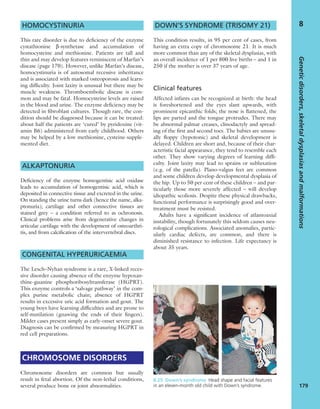
reduces the shock-absorbing effect of the supporting
cancellous bone.
From the foregoing outline it should be apparent
that the division of osteoarthritis into ‘primary’ (when
there is no obvious antecedent factor) and ‘secondary’
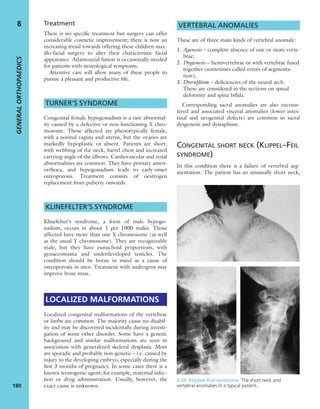
(when it follows a demonstrable abnormality) is
somewhat artificial. This is borne out in clinical prac-
tice: patients with ‘secondary’ OA of the knee follow-
ing meniscectomy have been found also to have a
higher than usual incidence of ‘primary’ OA in other
joints (Doherty et al., 1983). Perhaps primary, gener-
alized factors (genetic, metabolic or endocrine) alter
the physical properties of cartilage and thereby deter-
mine who is likely to develop OA, while secondary
factors such as anatomical defects or trauma specify
when and where it will occur. OA is, ultimately, more
process than disease, occurring in any condition
which causes a disparity between the mechanical stress
to which articular cartilage is exposed and the ability
of the cartilage to withstand that stress.
Pathogenesis
The initial stages of OA have been studied in animal
models with induced joint instability and may not be
representative of all types of OA.
The earliest changes, while the cartilage is still mor-
phologically intact, are an increase in water content of
the cartilage and easier extractability of the matrix
proteoglycans; similar findings in human cartilage
have been ascribed to failure of the internal collagen
network that normally restrains the matrix gel. At a
slightly later stage there is loss of proteoglycans and
defects appear in the cartilage. As the cartilage
becomes less stiff, secondary damage to chondrocytes
may cause release of cell enzymes and further matrix
breakdown. Cartilage deformation may also add to
the stress on the collagen network, thus amplifying
the changes in a cycle that leads to tissue breakdown.
Articular cartilage has an important role in distrib-
uting and dissipating the forces associated with joint
loading. When it loses its integrity these forces are
increasingly concentrated in the subchondral bone.
The result: focal trabecular degeneration and cyst for-
mation, as well as increased vascularity and reactive
sclerosis in the zone of maximal loading.
What cartilage remains is still capable of regenera-
tion, repair and remodelling. As the articular surfaces
become increasingly malapposed and the joint unsta-
ble, cartilage at the edges of the joint reverts to the
more youthful activities of growth and endochondral
ossification, giving rise to the bony excrescences, or
osteophytes, that so clearly distinguish osteoarthritis
(once called ‘hypertrophic arthritis’) from ‘atrophic’
disorders such as rheumatoid disease.
Pathology
The cardinal features are: (1) progressive cartilage
destruction; (2) subarticular cyst formation, with (3)
sclerosis of the surrounding bone; (4) osteophyte for-
mation; and (5) capsular fibrosis.
Initially the cartilaginous and bony changes are
confined to one part of the joint – the most heavily
loaded part. There is softening and fraying, or fibrilla-
tion, of the normally smooth and glistening cartilage.
The term chondromalacia (Gr = cartilage softening)
seems apt for this stage of the disease, but it is used
only of the patellar articular surfaces where it features
as one of the causes of anterior knee pain in young
people.
With progressive disintegration of cartilage, the
underlying bone becomes exposed and some areas
may be polished, or burnished, to ivory-like smooth-
ness (eburnation). Sometimes small tufts of fibrocarti-
lage may be seen growing out of the bony surface. At
GENERALORTHOPAEDICS
88
5
5.4 The cycle of articular cartilage deformation and
collagen failure
Release of
proteolytic enzymes
Proteoglycan
matrix depletion
Cartilage
deformation
Collagen
failure
Chondrocyte
damage
a distance from the damaged area the articular carti-
lage looks relatively normal, but at the edges of the
joint there is remodelling and growth of osteophytes
covered by thin, bluish cartilage.
Beneath the damaged cartilage the bone is dense
and sclerotic. Often within this area of subchondral
sclerosis, and immediately subjacent to the surface,
are one or more cysts containing thick, gelatinous
material.
The joint capsule usually shows thickening and
fibrosis, sometimes of extraordinary degree. The syn-
ovial lining, as a rule, looks only mildly inflamed;
sometimes, however, it is thick and red and covered
by villi.
The histological appearances vary considerably,
according to the degree of destruction. Early on, the
cartilage shows small irregularities or splits in the sur-
face, while in the deeper layers there is patchy loss of
metachromasia (obviously corresponding to the
depletion of matrix proteoglycans). Most striking,
however, is the increased cellularity, and the appear-
ance of clusters, or clones, of chondrocytes – 20 or
more to a batch. In later stages, the clefts become
more extensive and in some areas cartilage is lost to
the point where the underlying bone is completely
denuded. The biochemical abnormalities correspon-
ding to these changes were described by Mankin et al.
(1971).
The subchondral bone shows marked osteoblastic
activity, especially on the deep aspect of any cyst. The
cyst itself contains amorphous material; its origin is
mysterious – it could arise from stress disintegration
of small trabeculae, from local areas of osteonecrosis
or from the forceful pumping of synovial fluid
through cracks in the subchondral bone plate. As in
all types of arthritis, small areas of osteonecrosis are
quite common. The osteophytes appear to arise from
cartilage hyperplasia and ossification at the edge of the
articular surface.
The capsule and synovium are often thickened but
cellular activity is slight; however, sometimes there is
marked inflammation or fibrosis of the capsular tissues.
A feature of OA that is difficult to appreciate from
the morbid anatomy is the marked vascularity and
Osteoarthritis
89
5
(a) (b) (c) (d)
5.5 Osteoarthritis – pathology (a) The x-ray shows loss of articular cartilage at the superior pole and cysts in the
underlying bone; the specimen (b) shows that the top of the femoral head was completely denuded of cartilage and
there are large osteophytes around the periphery. In the coronal section (c) the subarticular cysts are clearly revealed.
(d) A fine-detail x-ray shows the extent of the subarticular bone destruction.
(a) (b) (c)
5.6 Osteoarthritis – histology (a) Destructive changes (loss of articular cartilage and cyst formation) are most marked
where stress is greatest; reparative changes are represented by sclerosis around the cysts and new bone formation
(osteophytes) in less stressed areas. (b) In this high-power view, the articular cartilage shows loss of metachromasia and
deep clefts in the surface (fibrillation). Attempts at repair result in (c) subarticular sclerosis and buds of fibrocartilage
mushrooming where the articular surface is destroyed.
venous congestion of the subchondral bone. This can
be shown by angiographic studies and the demonstra-
tion of increased intraosseous pressure. It is also
apparent from the intense activity around
osteoarthritic joints on radionuclide scanning.
Prevalence
Osteoarthritis is the commonest of all joint diseases. It
is a truly universal disorder, affecting both sexes and
all races; everyone who lives long enough will have it
somewhere, in some degree. However, there are sig-
nificant differences in its rate of occurrence in differ-
ent ethnic groups, in the different sexes within any
group, and in the different joints.
Reports of prevalence rates vary, depending on the
method of evaluation. Autopsy studies show OA
changes in everyone over the age of 65 years. Radi-
ographic surveys suggest that the prevalence rises
from 1 per cent below the age of 30 years to over 50
per cent in people above the age of 60. Osteoarthritis
of the finger joints is particularly common in elderly
women, affecting more than 70 per cent of those over
70 years.
Men and women are equally likely to develop OA,
but more joints are affected in women than in men.
Osteoarthritis is much more common in some
joints (the fingers, hip, knee and spine) than in others
(the elbow, wrist and ankle). This may simply reflect
the fact that some joints are more prone to predispos-
ing abnormalities than others.
A similar explanation may account for certain geo-
graphical and ethnic differences in prevalence. For
example, the female-to-male ratio for OA of the hip is
about 1:1 in northern Europe but is nearer 2:1 in
southern Europe where there is a high incidence of
acetabular dysplasia in girls. Even more striking is the
virtual absence of hip OA in southern Chinese and
African blacks (Hoagland et al., 1973; Solomon,
1976); this may simply be because predisposing disor-
ders such as developmental displacement of the hip,
Perthes’ disease and slipped femoral epiphysis are
uncommon in these populations. That they have no
inherent resistance to OA is shown by the fact that
they often develop the condition in other joints, for
example the knee.
Risk factors
Joint dysplasia Disorders such as congenital acetabular
dysplasia and Perthes’ disease presage a greater than
normal risk of OA in later life. It is not always easy to
spot minor degrees of dysplasia and careful studies
may have to be undertaken if these are not to be
missed.
Trauma Fractures involving the articular surface are
obvious precursors of secondary OA, so too lesser
injuries which result in joint instability. What is less
certain is whether malunion of a long-bone fracture
predisposes to OA by causing segmental overload in a
joint above or below the healed fracture (for example,
in the knee or ankle after a tibial fracture). Contrary
to popular belief, research has shown that moderate
angular deformities of the tibia (up to 15 degrees) are
not associated with an increased risk of OA (Merchant
and Dietz, 1989). This applies to mid-shaft fractures;
malunion close to a joint may well predispose to
secondary OA.
Occupation There is good evidence of an association
between OA and certain occupations which cause
repetitive stress, for example OA of the knees in work-
ers engaged in knee-bending activities (Felson, 1991),
OA in the upper limbs in people working with heavy
vibrating tools (Schumacher et al., 1972) and OA of
the hands in cotton mill workers (Lawrence, 1961).
More controversial is the relationship of OA to sport-
ing activity. Boxers are certainly prone to developing
OA of the hands but this may be due to trauma. The
same applies to footballers with OA of the knees and
baseball pitchers with OA of the shoulder. More con-
vincing evidence of a causative relationship comes
from recent studies which have shown a significant
increase in the risk of hip and knee OA in athletes
(Harris et al., 1994; Kulkala et al., 1994).
Bone density It has long been known that women
with femoral neck fractures seldom have OA of the
hip. This negative association between OA and osteo-
porosis is reflected in more recent studies which have
demonstrated a significant increase in bone mineral
density in people with OA compared to those without
(Hannan et al., 1992; Hart et al., 1994). However,
this may not be simple cause and effect: bone density
is determined by a variety of genetic, hormonal and
metabolic factors which may also influence cartilage
metabolism independently of any effect due to bone
density.
Obesity The simple idea that obesity causes increased
joint loading and therefore predisposes to OA may be
correct – at least in part. The association is closer in
women than in men and therefore (as with bone
density) it may reflect other endocrine or metabolic
factors in the pathogenesis of OA.
Family history Women whose mothers had general-
ized OA are more likely to develop the same condi-
tion. The particular trait responsible for this is not
known (see above under Aetiology).
Symptoms
Patients usually present after middle age. Joint involve-
ment follows several different patterns: symptoms
centre either on one or two of the weightbearing joints
GENERALORTHOPAEDICS
90
5
(hip or knee), on the interphalangeal joints (especially
in women) or on any joint that has suffered a previous
affliction (e.g. congenital dysplasia, osteonecrosis or
intra-articular fracture). A family history is common in
patients with polyarticular OA.
Pain is the usual presenting symptom. It is often
quite widespread, or it may be referred to a distant site
– for example, pain in the knee from OA of the hip. It
starts insidiously and increases slowly over months or
years. It is aggravated by exertion and relieved by rest,
although with time relief is less and less complete. In
the late stage the patient may have pain in bed at
night. There are several possible causes of pain: mild
synovial inflammation, capsular fibrosis with pain on
stretching the shrunken tissue; muscular fatigue; and,
perhaps most important of all, bone pressure due to
vascular congestion and intraosseous hypertension.
Stiffness is common; characteristically it occurs after
periods of inactivity, but with time it becomes con-
stant and progressive.
Swelling may be intermittent (suggesting an effu-
sion) or continuous (with capsular thickening or large
osteophytes).
Deformity may result from capsular contracture or
joint instability, but be aware that the deformity may
actually have preceded and contributed to the onset
of OA.
Loss of function, though not the most dramatic, is
often the most distressing symptom. A limp, difficulty
in climbing stairs, restriction of walking distance, or
progressive inability to perform everyday tasks or
enjoy recreation may eventually drive the patient to
seek help.
Typically, the symptoms of OA follow an intermit-
tent course, with periods of remission sometimes last-
ing for months.
Signs
Joint swelling may be the first thing one notices in
peripheral joints (especially the fingers, wrists, knees
and toes). This may be due to an effusion, but hard
(‘knobbly’) ridges around the margins of the distal
interphalangeal, the first metatarsophalangeal or knee
joints can be just as obvious.
Tell-tale scars denote previous abnormalities, and
muscle wasting suggests longstanding dysfunction.
Deformity is easily spotted in exposed joints (the
knee or the large-toe metatarsophalangeal joint), but
deformity of the hip can be masked by postural adjust-
ments of the pelvis and spine.
Local tenderness is common, and in superficial joints
fluid, synovial thickening or osteophytes may be felt.
Limited movement in some directions but not oth-
ers is usually a feature, and is sometimes associated
with pain at the extremes of motion.
Crepitus may be felt over the joint (most obvious in
the knee) during passive movements.
Instability is common in the late stages of articular
destruction, but it may be detected much earlier by
special testing. Instability can be due to loss of carti-
lage and bone, asymmetrical capsular contracture
and/or muscle weakness.
Other joints should always be examined; they may
show signs of a more generalized disorder. It is also
helpful to know whether problems in other joints add
to the difficulties in the one complained of (e.g. a stiff
lumbar spine or an unstable knee making it more dif-
ficult to cope with restricted movement in an
osteoarthritic hip).
Function in everyday activities must be assessed.
X-ray appearances do not always correlate with either
the degree of pain or the patient’s actual functional
capacity. Can the patient with an arthritic knee walk
up and down stairs, or rise easily from a chair? Does
he or she limp? Or use a walking stick?
Detailed examination of specific joints is dealt with
in Section 2 of the book.
Imaging
X-rays X-ray appearances are so characteristic that
other forms of imaging are seldom necessary for ordi-
nary clinical assessment. The cardinal signs are asym-
metrical loss of cartilage (narrowing of the ‘joint
space’), sclerosis of the subchondral bone under the
area of cartilage loss, cysts close to the articular sur-
face, osteophytes at the margins of the joint and
remodelling of the bone ends on either side of the
joint. Late features may include joint displacement
and bone destruction.
Look carefully for signs of previous disorders (e.g.
congenital defects, old fractures, Perthes’ disease or
rheumatoid arthritis). Such cases are usually designated
Osteoarthritis
91
5
(a) (b)
5.7 Osteoarthritis – clinical and x-ray (a) Varus
deformity of the right knee due to osteoarthritis. (b) The
x-ray shows the classic features: disappearance of the joint
‘space’, subarticular sclerosis and osteophyte formation at
the margins of the joint.
as ‘secondary osteoarthritis’, though in a certain sense
OA is always secondary to some previous abnormality
if only we could discover what it was!
Radionuclide scanning Scanning with 99m
Tc-HDP
shows increased activity during the bone phase in the
subchondral regions of affected joints. This is due to
increased vascularity and new bone formation.
CT and MRI Advanced imaging is sometimes needed
to elucidate a specific problem, e.g. early detection of
an osteocartilaginous fracture, bone oedema or avas-
cular necrosis. These methods are also used for sever-
ity grading in clinical trials.
Arthroscopy
Arthroscopy may show cartilage damage before x-ray
changes appear. The problem is that it reveals too
much, and the patient’s symptoms may be ascribed to
chondromalacia or OA when they are, in fact, due to
some other disorder.
Natural history
Osteoarthritis usually evolves as a slowly progressive
disorder. However, symptoms characteristically wax
and wane in intensity, sometimes disappearing for sev-
eral months.
The x-rays show no such fluctuation. However,
there is considerable variation between patients in the
degrees of destruction and repair. Most of the men
and half of the women have a hypertrophic reaction,
with marked sclerosis and large osteophytes. In about
20 per cent of cases – most of them women – reactive
changes are more subdued, inviting descriptions such
as atrophic or osteopaenic OA. Occasionally OA takes
the form of a rapidly progressive disorder (Solomon,
1976; Solomon, 1984).
(a) (b) (c)
5.8 Osteoarthritis – x-rays The cardinal features of osteoarthritis are remarkably constant whether in (a) the hip, (b) the
knee or (c) the ankle: loss of articular cartilage seen as narrowing of the ‘joint space’, subarticular cyst formation and
sclerosis, osteophyte formation and bone remodelling.
THE CARDINAL SIGNS OF OSTEOARTHRITIS
Narrowing of the ‘joint space’
Subchondral sclerosis
Marginal osteophytes
Subchondral cysts
Bone remodelling
5.9 Secondary osteoarthritis The flattened femoral
heads and shortened femoral necks are tell-tale signs of
multiple epiphyseal dysplasia in this patient with secondary
OA. Her mother had an almost identical x-ray picture.
GENERALORTHOPAEDICS
92
5
(a) (b)
(c) (d) (e)
5.10 Polyarticular (generalized) osteoarthritis (a,b) An almost invariable feature of polyarticular OA is involvement of
the terminal finger joints – Heberden’s nodes. There is a strong association with OA of the knees (c,d) and the lumbar facet
joints (e).
Complications
Capsular herniation Osteoarthritis of the knee is some-
times associated with a marked effusion and hernia-
tion of the posterior capsule (Baker’s cyst).
Loose bodies Cartilage and bone fragments may give
rise to loose bodies, resulting in episodes of locking.
Rotator cuff dysfunction Osteoarthritis of the acromio-
clavicular joint may cause rotator cuff impingement,
tendinitis or cuff tears.
Spinal stenosis Longstanding hypertrophic OA of the
lumbar apophyseal joints may give rise to acquired
spinal stenosis. The abnormality is best demonstrated
by CT and MRI.
Spondylolisthesis In patients over 60 years of age,
destructive OA of the apophyseal joints may result in
severe segmental instability and spondylolisthesis (so-
called ‘degenerative’ spondylolisthesis, which almost
always occurs at L4/5).
Clinical variants of osteoarthritis
Although the features of OA in any particular joint are
fairly consistent, the overall clinical picture shows vari-
ations which define a number of subgroups.
MONARTICULAR AND PAUCIARTICULAR
OSTEOARTHRITIS
In its ‘classic’ form, OA presents with pain and dys-
function in one or two of the large weightbearing
joints. There may be an obvious underlying abnor-
mality: multiple epiphyseal dysplasia, localized acetab-
ular dysplasia, old Perthes’ disease, previous slipped
epiphysis, inflammatory joint disease, avascular necro-
sis, a previous fracture or damage to ligaments or
menisci. In the majority, however, the abnormality is
more subtle and may come to light only with special
imaging techniques.
POLYARTICULAR (GENERALIZED) OSTEOARTHRITIS
This is by far the most common form of OA, though
most of the patients never consult an orthopaedic sur-
geon. The patient is usually a middle-aged woman
who presents with pain, swelling and stiffness of the
finger joints. The first carpometacarpal and the big toe
metatarsophalangeal joints, the knees and the lumbar
facet joints may be affected at more or less the same
time.
The changes are most obvious in the hands. The
interphalangeal joints become swollen and tender,
and in the early stages they often appear to be
inflamed. Over a period of years osteophytes and soft-
tissue swelling produce a characteristic knobbly
Osteoarthritis
93
5
appearance of the distal interphalangeal joints (Her-
berden’s nodes) and, less often, the proximal inter-
phalangeal joints (Bouchard’s nodes); pain may later
disappear but stiffness and deformity persist. Some
patients present with painful knees or backache and
the knobbly fingers are noticed only in passing. There
is a strong association with carpal tunnel syndrome
and isolated tenovaginitis.
X-rays show the characteristic features of OA, usu-
ally maximal in the distal interphalangeal joints of the
fingers.
OSTEOARTHRITIS IN UNUSUAL SITES
Osteoarthritis is uncommon in the shoulder, elbow,
wrist and ankle. If any of these joints is affected one
should suspect a previous abnormality – congenital or
traumatic – or an associated generalized disease such
as a crystal arthropathy.
RAPIDLY DESTRUCTIVE OSTEOARTHRITIS (see also
page 84)
Every so often a patient with apparently straightfor-
ward OA shows rapid and startling progression of
bone destruction. The condition was at one time
thought to be due to the dampening of pain impulses
by powerful anti-inflammatory drugs – a notional type
of ‘analgesic arthropathy’. It is now recognized that it
occurs mainly in elderly women and that it is associ-
ated with the deposition of calcium pyrophosphate
dihydrate crystals, though whether this is the cause of
the condition or a consequence thereof is still unde-
cided.
Differential diagnosis of osteoarthritis
A number of conditions may mimic OA, some pre-
senting as a monarthritis and some as a polyarthritis
affecting the finger joint.
Avascular necrosis ‘Idiopathic’ osteonecrosis causes
joint pain and local effusion. Early on the diagnosis is
made by MRI. Later x-ray appearances are usually
pathognomonic; however, once bone destruction
occurs the x-ray changes can be mistaken for those of
OA. The cardinal distinguishing feature is that in
osteonecrosis the ‘joint space’ (articular cartilage) is
preserved in the face of progressive bone collapse and
deformity, whereas in OA articular cartilage loss pre-
cedes bone destruction.
Inflammatory arthropathies Rheumatoid arthritis,
ankylosing spondylitis and Reiter’s disease may start in
one or two large joints. The history is short and there
are local signs of inflammation. X-rays show a pre-
dominantly atrophic or erosive arthritis. Sooner or
later other joints are affected and systemic features
appear.
GENERALORTHOPAEDICS
94
5
(a) (b)
5.11 Rapidly destructive osteoarthritis (a) X-ray obtained when the patient was first seen, complaining of pain in the
left hip. This shows the typical features of an atrophic form of osteoarthritis on the painful side. (b) Eleven months later
there is marked destruction of the left hip, with crumbling of both the femoral head and the acetabular floor, and similar
features are beginning to appear on the right side.
(a) (b)
5.12 Differential diagnosis – osteoarthritis and
osteonecrosis (a) Osteoarthritis with marked subarticular
bone collapse is sometimes mistaken for osteonecrosis. The
clue to the diagnosis is that in OA the articular ‘space’
(cartilage) is progressively reduced before bone collapse
occurs, whereas in primary osteonecrosis (b) articular
cartilage is preserved even while the underlying bone
crumbles.
Polyarthritis of the fingers Polyarticular OA may be
confused with other disorders which affect the finger
joints (see Fig. 5.10). Close observation shows several
distinguishing features. Nodal OA affects predomi-
nantly the distal joints, rheumatoid arthritis the proxi-
mal joints. Psoriatic arthritis is a purely destructive
arthropathy and there are no interphalangeal ‘nodes’.
Tophaceous gout may cause knobbly fingers, but the
knobs are tophi, not osteophytes. X-rays will show the
difference.
Diffuse idiopathic skeletal hyperostosis (DISH) This is a
fairly common disorder of middle-aged people, char-
acterized by bone proliferation at the ligament and
tendon insertions around peripheral joints and the
intervertebral discs (Resnick et al., 1975). On x-ray
examination the large bony spurs are easily mistaken
for osteophytes. DISH and OA often appear together,
but DISH is not OA: the bone spurs are symmetri-
cally distributed, especially along the pelvic apophyses
and throughout the vertebral column. When DISH
occurs by itself it is usually asymptomatic.
Multiple diagnosis Osteoarthritis is so common after
middle age that it is often found in patients with other
conditions that cause pain in or around a joint. Before
jumping to the conclusion that the symptoms are due
to the OA features seen on x-ray, be sure to exclude
peri-articular disorders as well as more distant abnor-
malities giving rise to referred pain.
Management
The management of OA depends on the joint (or
joints) involved, the stage of the disorder, the severity
of the symptoms, the age of the patient and his or her
functional needs. Three observations should be borne
in mind: (1) symptoms characteristically wax and
wane, and pain may subside spontaneously for long
periods; (2) some forms of OA actually become less
painful with the passage of time and the patient may
need no more than reassurance and a prescription for
pain killers; (3) at the other extreme, the recognition
(from serial x-rays) that the patient has a rapidly pro-
gressive type of OA may warrant an early move to
reconstructive surgery before bone loss compromises
the outcome of any operation.
EARLY TREATMENT
There is, as yet, no drug that can modify the effects of
OA. Treatment is, therefore, symptomatic. The prin-
ciples are: (1) maintain movement and muscle
strength; (2) protect the joint from ‘overload’; (3)
relieve pain; and (4) modify daily activities.
Physical therapy The mainstay of treatment in the
early case is physical therapy, which should be directed
at maintaining joint mobility and improving muscle
strength. The programme can include aerobic exer-
cise, but care should be taken to avoid activities which
increase impact loading. Other measures, such as mas-
sage and the application of warmth, may reduce pain
but improvement is short-lived and the treatment has
to be repeated.
Load reduction Protecting the joint from excessive
load may slow down the rate of cartilage loss. It is also
effective in relieving pain. Common sense measures
such as weight reduction for obese patients, wearing
shock-absorbing shoes, avoiding activities like climb-
ing stairs and using a walking stick are worthwhile.
Analgesic medication Pain relief is important, but not
all patients require drug therapy and those who do
may not need it all the time. If other measures do not
provide symptomatic improvement, patients may
respond to a simple analgesic such as paracetamol. If
this fails to control pain, a non-steroidal anti-inflam-
matory preparation may be better.
INTERMEDIATE TREATMENT
Joint debridement (removal of loose bodies, cartilage
tags, interfering osteophytes or a torn or impinging
acetabular or glenoid labrum) may give some
improvement. This may be done either by
arthroscopy or by open operation.
If appropriate radiographic images suggest that
symptoms are due to localized articular overload aris-
ing from joint malalignment (e.g. varus deformity of
the knee) or incongruity (e.g. acetabular and femoral
head dysplasia), a corrective osteotomy may prevent
or delay progression of the cartilage damage. These
techniques are discussed in the relevant chapters in
Section 2.
Osteoarthritis
95
5
(a) (b)
5.13 Diffuse idiopathic skeletal hyperostosis – DISH
(a) The large bony outgrowths around the knee suggest
something more than the usual OA. X-rays of the spine (b)
show the typical features of DISH. The spinal condition is
also known as Forestier’s disease.
LATE TREATMENT
Progressive joint destruction, with increasing pain,
instability and deformity (particularly of one of the
weightbearing joints), usually requires reconstructive
surgery. Three types of operation have, at different
times, held the field: realignment osteotomy, arthro-
plasty and arthrodesis.
Realignment osteotomy Until the development of
joint replacement surgery in the 1970s, realignment
osteotomy was widely employed. Refinements in tech-
niques, fixation devices and instrumentation led to
acceptable results from operations on the hip and
knee, ensuring that this approach has not been com-
pletely abandoned. High tibial osteotomy is still con-
sidered to be a viable alternative to partial joint
replacement for unicompartmental OA of the knee,
and intertrochanteric femoral osteotomy is sometimes
preferred for young patients with localized destructive
OA of the hip. These operations should be done while
the joint is still stable and mobile and x-rays show that
a major part of the articular surface (the radiographic
‘joint space’) is preserved. Pain relief is often dramatic
and is ascribed to (1) vascular decompression of the
subchondral bone, and (2) redistribution of loading
forces towards less damaged parts of the joint. After
load redistribution, fibrocartilage may grow to cover
exposed bone.
Joint replacement Joint replacement, in one form or
another, is nowadays the procedure of choice for OA
in patients with intolerable symptoms, marked loss of
function and severe restriction of daily activities. For
OA of the hip and knee in middle-aged and older
patients, total joint replacement by modern tech-
niques promises improvement lasting for 15 years or
longer. Similar operations for the shoulder, elbow and
ankle are less successful but techniques are improving
year by year. However, joint replacement operations
are highly dependent on technical skills, implant
design, appropriate instrumentation and postopera-
tive care – requirements that cannot always be met, or
may not be cost-effective, in all parts of the world.
Arthrodesis Arthrodesis is still a reasonable choice if
the stiffness is acceptable and neighbouring joints are
not likely to be prejudiced. This is most likely to apply
to small joints that are prone to OA, e.g. the carpal
and tarsal joints and the large toe metatarsophalangeal
joint.
ENDEMIC OSTEOARTHRITIS
Osteoarthritis occasionally occurs as an endemic dis-
order affecting entire communities. This phenome-
non may be due either to an underlying generalized
dysplasia in a genetically isolated community or some
environmental factor peculiar to that region.
KASHIN–BECK DISEASE
In 1859 Kashin, a Russian physician, reported the
occurrence of an unusual form of polyarticular
osteoarthritis associated with stunted growth in a
Siberian population. It is now known that the condi-
tion affects large numbers of children and adults (esti-
mates vary from 1 to 6 million!) in the area stretching
from Northern China across Eastern Siberia to North
Korea (Allander, 1994).
GENERALORTHOPAEDICS
96
5 5.14 Operative treatment The three basic
operations: (a) osteotomy, (b) arthroplasty,
(c) athrodesis – at the hip.
(a) (b) (c)
Clinical features
The condition starts in childhood with joint pain and
progressive signs of polyarticular swelling, deformity
and shortness of stature. Adults with this condition
may be severely crippled.
X-rays show distortion of the epiphyses in tubular
bones during growth, and increasing signs of
osteoarthritis in affected joints during adult life.
Pathogenesis
There is, as yet, no agreement about the aetiology and
pathogenesis of this condition. Hypothetical causes
that have received the most attention are (a) defi-
ciency of trace elements such as selenium and iodine
in the soil and (b) contamination of the staple grain
product by mycotoxins during storage. This combina-
tion could lead to an accumulation of free radicals and
subsequent damage to growing chondrocytes in the
exposed community. There are, however, some argu-
ments against a purely environmental causation: first,
there is no consistent correlation between local sele-
nium and iodine levels and the prevalence of Kashin–
Beck disease; second, the condition may be common
in one village and completely absent in another only
30–50 miles away (Allender, 1994). The early radi-
ographic changes appear only in the epiphyses and the
adjacent growth plates and not in other parts of the
tubular bones which must, at an earlier stage, have
consisted largely of cartilage. This, as well as the clin-
ical appearances and the tendency for the condition to
appear in familial clusters, are reminiscent of a genetic
disorder such as spondylo-epiphyseal dysplasia, a rec-
ognized cause of stunted growth, bone deformities
and ‘secondary’ polyarticular OA. The most likely
explanation for this endemic disorder is that it is either
an expression of a straightforward genetic defect caus-
ing a type of chondrodysplasia or that the genetic
defect causes an increased susceptibility to the toxic
effects of certain trace element deficiencies.
Treatment
There is no specific treatment for this condition. Pre-
ventive measures consist mainly of selenium supple-
mentation in children’s diet or added to agricultural
fertilizer. In iodine-deficient areas, iodine is given as
well. Dosage should be monitored since selenium
excess can cause unpleasant side effects and, in some
cases, severe illness.
Patients with established arthritis will need treat-
ment as for other forms of OA.
MSELENI JOINT DISEASE
For many years visitors travelling along the eastern
seaboard of South Africa have known about a crip-
pling type of polyarticular OA that was common
among the Tsonga people living around the Mseleni
Mission Station in Northern Zululand (now
Kwazulu). The first report in the medical literature
appeared in 1970 (Wittman and Fellingham, 1970).
Further studies suggested an overall prevalence rate of
at least 5 per cent, with women affected more often
than men and relatives of affected individuals much
more commonly than relatives of unaffected people
(Fellingham et al., 1973; Yach and Botha, 1985). A
later radiographic survey showed that the
polyarthropathy actually comprises two distinct dis-
orders: one with features of multiple epiphyseal dys-
plasia affecting males and females in equal proportions
and another with typical features of protrusio acetab-
uli occurring almost exclusively in females (Solomon
et al., 1986).
Clinical features
In the first group, symptoms such as joint discomfort,
slight deformity and stunting of growth start to
appear in both boys and girls during childhood. When
x-ray changes appear they are those of symmetrically
Osteoarthritis
97
5
(a) (b)
5.15 Endemic osteoarthritis – Mseleni disease X-rays showing the two forms of osteoarthritis endemic in the African
population of eastern Kwazulu: (a) generalized epiphyseal dysplasia and (b) bilateral protrusio acetabuli.
distributed epiphyseal dysplasia affecting particularly
the hips, knees and ankles; sometimes the vertebral
bodies also develop abnormally. During adulthood
the affected joints develop secondary OA: they
become painful and swollen, unstable and increasingly
deformed.
The second group consists mainly of girls at
puberty or a year or two later. Their main complaint
is of pain in the hip joints and even at that age x-ray
features of early protrusio acetabuli can be discerned.
During adulthood those with the most marked
changes develop typical features of secondary OA.
Causation
Various studies on the aetiology of Mseleni joint dis-
ease have failed to identify a convincing nutritional or
other environmental cause for this condition. There
seems little doubt that the group with typical features
of epiphyseal changes represent a heritable form of
multiple epiphyseal dysplasia or spondylo-epiphyseal
dysplasia.
It is uncertain whether those with protrusio acetab-
uli have been fully investigated as a separate entity.
However, what is well recognized is that features of
calcium deficiency rickets are found in African chil-
dren from this area (Pettifor, 2008) and that (at least
in the past) young girls in Kwazulu were the ones who
traditionally were given the work of carrying the loads
of water and other foodstuffs needed by their families
– often over long distances. Young boys were not
expected to do this work. Could this combination of
factors affecting girls have caused some distortion of
the acetabular socket before closure of the triradiate
cartilage? Whether a changing cultural milieu will
improve the situation remains to be seen.
Treatment
In the past the people of Mseleni lived as a fairly iso-
lated group without intermarrying among neighbour-
ing peoples and thereby changing the gene pool. As
with other endemic disorders, Mseleni disease is in
part a social problem and one can expect its preva-
lence to fall with increasing social mobility and
improved living conditions. Meanwhile, patients are
treated as are those with other types of OA, i.e. by
employing a mixture of analgesic medication, physical
therapy and reconstructive surgery where necessary
and feasible.
HANDIGODU JOINT DISEASE
This is yet another endemic polyosteoarthopathy, sim-
ilar to that of Mseleni joint disease, which was
encountered some 30 years ago in a Dalit community
in Handigodu, South-Western India. It evidently
starts in childhood and by early adulthood patients
appear with painful, swollen joints (mainly the hips
and knees), deformities and stunting of growth. In
the most severe cases they have great difficulty walk-
ing and are reduced to crawling. As with Mseleni joint
disease in the past, this community is isolated from
the general population and patients appear in family
clusters. It is, in all probability, a heritable form of
multiple epiphyseal dysplasia.
NEUROPATHIC JOINT DISEASE
Charcot, in 1868, described a type of destructive
arthropathy associated with disease of the central
nervous system. Almost all his patients had tabes dor-
salis, but the name ‘Charcot’s joint disease’ came to be
applied to any destructive arthropathy arising from
loss of pain sensibility and position sense.
Nowadays the most common cause is diabetic neu-
ropathy, which occurs in 0.2–0.5 per cent of patients
with diabetes mellitus; other causes are tabes dorsalis,
leprosy (affecting mainly the lower limb joints),
syringomyelia (upper and lower limbs), multiple scle-
rosis, myelomeningocele, spinal cord compression
and congenital indifference to pain. The term is also
applied (less accurately) to rapidly destructive forms of
osteoarthritis where there is no neurological lesion.
Pathogenesis and pathology
Neuropathic joints lack the normal reflex safeguards
against abnormal stress or injury and the subchondral
bone disintegrates with alarming speed. Unlike the
usual forms of osteoarthritis, this is a mainly destruc-
tive condition and there are few signs of repair. Some
cases show increased vascularity and osteoclastic activ-
ity in the subchondral bone; in others, capsular and
ligamentous laxity and joint instability go hand in
hand with articular disintegration.
The early changes are similar to those of
osteoarthritis. However, it soon becomes apparent
that this is a rapidly destructive process; the articular
surface breaks up, fragments of bone and cartilage
appear in the joint or embedded in the synovium, and
there is thickening of the synovial membrane and
marked joint effusion. In the late stages, there is com-
plete loss of articular cartilage, fragmentation of the
subchondral bone and joint subluxation.
Clinical features
The patient complains of weakness, instability,
swelling, laxity and progressive deformity of the joint:
usually the tarsal or ankle joints in diabetics, the large
GENERALORTHOPAEDICS
98
5
lower limb joints in leprosy and tabes dorsalis and the
upper limb joints (especially the shoulder) in
syringomyelia. The joint is neither warm nor particu-
larly tender, but swelling is marked, fluid is greatly
increased and in the late stages bits of bone may be
felt everywhere. There is always some instability and
in the worst cases the joint is flail. The appearances
suggest that movement would be agonizing and yet it
is often painless. The paradox is diagnostic. General
examination may reveal features of the underlying
neurological disorder.
A fracture or dislocation may initiate the destructive
process and in those cases clinical deterioration is
more rapid and more painful than usual.
X-rays
The radiogaphic changes may at first be mistaken for
those of osteoarthritis. However, thinning of the
articular space is unusually rapid and there is little in
the way of osteophyte formation. Joint swelling and
the appearance of intra-articular ‘calcification’ are fur-
ther clues. Ultimately there is gross erosion of the
articular surfaces and displacement of the joint.
Treatment
There is no way of halting or slowing the destructive
process. Treatment is usually conservative and consists
of splintage of the unstable joint. Despite the bizarre
appearances, patients often seem to manage well.
Some patients complain of pain and may need anal-
gesic medication.
Weightbearing joints are sometimes so unstable
that splintage is useless. Arthrodesis may be
attempted, but the patient should be warned that
there is only a small chance of success.
HAEMOPHILIC ARTHROPATHY
Recurrent intra-articular bleeding may lead to chronic
synovitis and progressive articular destruction. Clini-
cally this is seen only in classic haemophilia, in which
there is a deficiency of clotting factor VIII, and
Christmas disease, due to deficiency of factor IX. Both
are X-linked recessive disorders manifesting in males
but carried by females. Their incidence is about 1 per
10 000 male births. Plasma clotting factor levels
above 40 per cent of the normal are compatible with
normal control of haemorrhage. Patients with clotting
factor levels above 5 per cent (‘mild haemophilia’)
may have prolonged bleeding after injury or opera-
tion; those with levels below 1 per cent (‘severe
haemophilia’) have frequent spontaneous joint and
muscle haemorrhages.
Pathology
Haemorrhage into the joint causes synovial irritation,
inflammation and subsynovial fibrosis. Haemosiderin
appears in the synovial cells and macrophages and
after repeated bleeds the synovium becomes thick and
heavily pigmented. A vascular pannus creeps over the
articular surface and the cartilage is gradually eroded.
The subchondral bone may be exposed and pene-
trated, and occasionally large cysts develop at the
bone ends. These changes are attributed to cartilage-
degrading enzymes released by the proliferative syn-
ovitis and by cells that have accumulated iron, but an
additional factor may be the interference with normal
cartilage nutrition due to prolonged or repeated joint
immobilization.
Bleeding into muscles is less common but equally
harmful. Increased tension may lead to muscle necro-
Osteoarthritis
99
55.16 Charcot’s disease The
vertebrae are distorted and
dense, the buttocks show the
radio-opaque remains of
former injections; the knee,
elbow and hip joints look
grotesque. Moral: ‘If it’s bizarre,
do a “WR”’. Note also the
happy smile (though not all
Charcot joints are tabetic nor
are they always painless).
sis, reactive fibrosis and joint contractures. Sometimes
nerves are compressed, causing a neurapraxia; tempo-
rary weakness may contribute further to the develop-
ment of joint deformity.
Cysts and pseudotumours are rare phenomena. A
large soft-tissue haematoma may become encapsu-
lated before it is absorbed, and may then draw in
more fluid by osmosis to produce a slowly expanding
‘cyst’. A subperiosteal haematoma occasionally stimu-
lates cystic resorption of bone resembling a tumour.
Clinical features
Only males are affected and in severe haemophilia
joint bleeds usually begin when the child starts to
walk. The clinical picture depends on the severity of
the disorder, the site of bleeding and the efficacy of
long-term treatment. The commonest features are
acute bleeding into joints or muscles, chronic arthritis
and joint contractures. The sites most frequently
involved are the knees, ankles, elbow, shoulders and
hips.
ACUTE BLEEDING INTO A JOINT, MUSCLE OR NERVE
With trivial injury a joint (usually the knee, elbow or
ankle) may rapidly fill with blood. Pain, warmth,
boggy swelling, tenderness and limited movement are
the outstanding features. The resemblance to a low-
grade inflammatory joint is striking, but the history is
diagnostic.
Acute bleeding into muscles (especially the fore-
arm, calf or thigh) is less common. A painful swelling
appears and movement of the related joint is resisted.
The distinction from a haemarthosis may be difficult
(e.g. with groin pain due to iliopsoas haemorrhage);
usually only those movements that stretch the affected
muscles are painful, whereas in haemarthrosis all
movements are painful.
Bleeding into a peripheral nerve causes intense pain
followed by a variable degree of sensory change and
muscle weakness. Nerve function usually recovers
after several months.
Neurological symptoms and signs may also be
caused by a large soft-tissue haematoma. Following
effective treatment, the haematoma is usually
resorbed within 10–14 days but full movement may
take longer to return.
Bleeding into the forearm or leg may give rise to a
classical compartment syndrome. The tell-tale signs of
acute pain and tissue tension should be heeded before
sensory and motor impairment are obvious.
JOINT DEGENERATION
This, the sequel to repeated bleeding, usually begins
before the age of 15 years. Chronic synovitis is fol-
lowed by cartilage degeneration. An affected joint
shows wasting, limitation of movement and fixed
deformity not unlike a tuberculous or rheumatoid
joint. In longstanding cases, articular destruction may
lead to instability.
X-ray changes vary according to the stage of the
disorder. A useful classification is that of Arnold and
Hilgartner (1977): Stage I – soft-tissue swelling; Stage
II – osteoporosis and epiphyseal overgrowth; Stage III
– slight narrowing of the articular space and squaring
of the bone ends; Stage IV – marked narrowing of the
articular space; and Stage V – joint disintegration.
Cysts and pseudotumours are rare complications.
Treatment
The most important aspect of treatment is to coun-
teract bleeding as soon as it occurs, or better still to
prevent recurrent bleeds. Patients are taught to rec-
ognize the early symptoms of bleeding and to admin-
ister the appropriate clotting factor concentrate
themselves. In some centres factor concentrate is
administered prophylactically two or three times a
week; this is given intravenously, if necessary by
indwelling catheter. It is essential to establish the pre-
cise diagnosis: factor VIII or IX is effective only for
the specific disorder.
In former years (and probably still in some parts of
the world) fresh-frozen plasma or concentrates that
had not undergone viral inactivation were used for
factor replacement, but this carried the risk of HIV
contamination. These products are no longer recom-
mended and have been replaced by virally inactivated
factor concentrates.
The acute bleed Bleeding into the tissues is treated by
GENERALORTHOPAEDICS
100
5
(a) (b)
5.17 Haemophilic arthropathy – clinical features
(a) Recurrent haemarthrosis and chronic synovitis led to
contractures of the elbow joints and deformities of the
knees and ankles. (b) This man had difficulty staying
upright, let alone walking, without support.
immediate factor replacement. Analgesics are given
for pain and the limb is immobilized in a splint – but
not for more than a day or two. Once the acute
episode has passed, movement is encouraged, under
continuing cover with factor concentrate. Aspiration
is avoided unless distension is severe or there is a
strong suspicion of infection. Nerve palsy may require
intermittent splintage and physiotherapy until the
neurapraxia recovers, and during this time the skin
must be protected from injury.
Chronic arthropathy The aim is to prevent the devel-
opment of joint contractures, stiffness and progressive
muscle weakness. Under cover of factor infusions the
patient is given physiotherapy, and impending con-
tractures are managed by intermittent splintage and, if
necessary, traction or passive correction by an inflat-
able splint.
Operative treatment has become safer since the
introduction of clotting factor concentrates. How-
ever, patients who develop anti-factor antibodies are
unsuitable for any form of surgery. It is also important
to screen patients for hepatitis B virus and HIV anti-
bodies, as their presence demands special precautions
during the operation.
The clotting factor concentration should be raised
to above 25 per cent for factor VIII and above 15 per
cent for factor IX, and it should be kept at those lev-
els throughout the postoperative period. It goes with-
out saying that operative treatment should be carried
out in a hospital with the appropriate multidiscipli-
nary expertise on site.
Useful procedures are tendon lengthening (to cor-
rect contractures), osteotomy (for established defor-
mity) and arthrodesis of the knee or ankle (for painful
joint destruction). Synovectomy is sometimes per-
formed but the benefits are dubious. Total hip
replacement is technically feasible, but tissue dissec-
tion should be kept to a minimum and meticulous
haemostasis is needed. Not surprisingly, the complica-
tion rate is higher than for hip replacement in non-
bleeders (Nelson et al., 1992).
REFERENCES AND FURTHER READING
Allander E. Kashin–Beck disease. An analysis of research
and public health activities based on a bibliography 1849–
1992. Scand J Rheumat 1994; 23(suppl 99): 1–36.
Arnold WD, Hilgartner MW. Hemophilic arthropathy.
J Bone Joint Surg, 1977; 59A: 287–305.
Byers PD, Contepomi CA, Farkas TA. A post mortem
study of the hip joint including the prevalence of features
on the right side. Ann Rheum Dis 1970; 29: 15–31.
Doherty M, Holt M, MacMillan P et al. A reappraisal of
‘analgesic hip’. Ann Rheum Dis 1986; 45: 272–6.
Doherty M, Watt I, Dieppe P. Influence of primary gener-
alised osteoarthritis on development of secondary
osteoarthritis. Lancet 1983; 2: 8–11.
Fellingham SA, Elphinstone RD, Wittman W. Mseleni
joint disease: background and prevalence. S Afr Med J
1973; 47: 2173–80.
Felson DT, Anderson JJ, Namack A et al. Obesity and
symptomatic knee osteoarthritis. Arthr Rheum 1987; 30:
S130.
Felson DT, Hannan MT, Naimark A, et al. Occupational
physical demands, knee bending, and knee osteoarthritis:
results from the Framingham Study. J Rheumatol, 1991;
18: 1587–92.
Hannan MT, Zhang Y, Anderson JJ, et al. Bone mineral
density and knee osteoarthritis in elderly men and
women: The Framingham Study. Arthr Rheum 1992; 35:
S1 (S40).
Harris PA, Hart DJ, Jawad S et al. Risk of osteoarthritis
(OA) associated with running: A radiological survey.
Arthr Rheum 1994; 37: S369.
Osteoarthritis
101
5
(a) (b) (c) (d) (e) (f)
5.18 Haemophilic arthritis (a) At first, there is blood in the joint but the surfaces are intact; (b) later the cartilage is
attacked and the joint ‘space’ narrows; (c) bony erosions appear and eventually the joint becomes deformed and unstable;
in (d) early subluxation is obvious. (e,f) This large pseudotumour was extirpated and, at the same time, massive bone grafts
were inserted – no light undertaking in a haemophilic.
Hart DJ, Mootoosamy I, Doyle DV, et al. The relationship
between osteoarthritis and osteoporosis in the general
population: The Chingford Study. Ann Rheum Dis 1994;
53: 158–62.
Hoaglund FT, Yau ACMC, Wong WL. Osteoarthritis of the
hip and other joints in Southern Chinese in Hong Kong.
J Bone Joint Surg 1973; 55A: 545–7.
Kellgren JH. Genetic factors in generalized osteoarthrosis.
Ann Rheum Dis 1963; 22: 237–55.
Knowlton RG, Katzenstein PL, Moskowitz RW et al.
Genetic linkage of a polymorphism in the type II procol-
lagen gene (COL2A1) to primary osteoarthritis associ-
ated with mild chondrodysplasia. N Eng J Med 1990;
322: 526.
Kulkala UM, Kaprio J, Sarno S. Osteoarthritis of weight
bearing joints of lower limbs in former elite male athletes.
BMJ 1994; 308: 231.
Lanyon P, Doherty S, Doherty M. Assessment of a genetic
contribution to osteoarthritis of the hip: sibling study.
BMJ 2000; 321(7270): 1179–83.
Lawrence, JS. Rheumatism in cotton operatives. Br J of Ind
Med 1961; 18: 270–6.
Mankin HJ, Dorfman DD, Lippiello L, Zarins A. Bio-
chemical and metabolic abnormalities in articular carti-
lage from osteoarthritic human hips. II. Correlation of
morphology with metabolic data. J Bone Joint Surg 1971;
53A: 523–37.
Merchant TC, Dietz FR. Long-term follow-up after frac-
tures of the tibial and fibular shafts. J Bone Joint Surg
1989; 71A: 599.
Nelson IW, Sivamerugan S, Latham PD et al. Total hip
arthroplasties for haemophilic arthropathies. Clin Orthop
Relat Res 1992; 276: 210–13.
Palotie A, Vaisanen P, Ott J et al. Predisposition to fami-
lial osteoarthrosis linked to type II collagen gene. Lancet
1989; 2: 924.
Pettifor JM. Vitamin D and/or calcium deficiency rickets
in infants and children: a global perspective. Indian J Med
Res 2008; 127: 245–9.
Resnick D, Shaul SR, Robins JM. Diffuse idiopathic skele-
tal hyperostosis (DISH): Forestier’s disease with extraspinal
manifestations. Radiology 1975; 115: 513–24.
Schumacher HR, Agudelo C, Labowitz R. Jackhammer
arthropathy. J Occup Med 1972; 14: 563.
Sokoloff, L. Endemic forms of osteoarthritis. Clin Rheum
Dis 1985; 11: 187–202.
Solomon L. Patterns of osteoarthritis of the hip. J Bone
Joint Surg 1976; 58B: 176–83.
Solomon L. Geographical and anatomical patterns of
osteoarthritis. Br J Rheumatol 1984; 23: 177–180.
Solomon L, McLaren P, Irwig L et al. Distinct types of hip
disorder in Mselini joint disease. S Afr Med J 1986; 69:
15–17.
Wittman W, Fellingham S. Unusual hip disease in remote
part of Zululand. Lancet 1970; 1: 842–3.
Yach D, Botha JL. Mseleni joint disease in 1981: decreased
prevalence rates, wider geographical location than before,
and socioeconomic impact of an endemic osteoarthrosis
in an underdeveloped community in South Africa. Int J
Epidemiol 1985; 14: 276–84.
GENERALORTHOPAEDICS
102
5
Avascular necrosis has long been recognized as a com-
plication of femoral head fractures, the usual explana-
tion being traumatic severance of the blood supply to
the femoral head. Segmental osteonecrosis also
appears as a distinctive feature in a number of non-
traumatic disorders: joint infection, Perthes’ disease,
caisson disease, Gaucher’s disease, systemic lupus ery-
thematosus (SLE), high-dosage corticosteroid admin-
istration and alcohol abuse, to mention only the more
common ones. Whatever the cause, the condition,
once established, may come to dominate the clinical
picture, demanding attention in its own right.
Aetiology and pathogenesis
Sites which are peculiarly vulnerable to ischaemic
necrosis are the femoral head, the femoral condyles,
the head of the humerus, the capitulum and the prox-
imal parts of the scaphoid and talus. These subarticu-
lar regions lie at the most distant parts of the bone’s
vascular territory, and they are largely enclosed by car-
tilage, giving restricted access to local blood vessels.
The subchondral trabeculae are further compromised
in that they are sustained largely by a system of endar-
terioles with limited collateral connections.
Another factor which needs to be taken into
account is that the vascular sinusoids which nourish
the marrow and bone cells, unlike arterial capillaries,
have no adventitial layer and their patency is deter-
mined by the volume and pressure of the surrounding
marrow tissue, which itself is encased in unyielding
bone. The system functions essentially as a closed
compartment within which one element can expand
Osteonecrosis and
related disorders 6
MAIN CONDITIONS ASSOCIATED WITH
NON-TRAUMATIC OSTEONECROSIS
Infections
• Osteomyelitis
• Septic arthritis
Haemoglobinopathy
• Sickle cell disease
Storage disorders
• Gaucher’s disease
Caisson disease
• Dysbaric osteonecrosis
Coagulation disorders
• Familial thrombophilia
• Hypofibrinolysis
• Hypolipoproteinaemia
• Thrombocytopenic purpura
Other
• Perthes’ disease
• Cortisone administration
• Alcohol abuse
• SLE (? increase in antiphospholipid antibodies)
• Pregnancy (? decreased fibrinolysis; ? fatty liver)
• Anaphylactic shock
• Ionizing radiation
SLE, systemic lupus erythematosus.
6.1 Avascular necrosis – pathogenesis The medullary
cavity of bone is virtually a closed compartment containing
myeloid tissue, marrow fat and capillary blood vessels. Any
increase in fat cell volume will reduce capillary circulation
and may result in bone ischaemia.
Louis Solomon
only at the expense of the others. Local changes such
as decreased blood flow, haemorrhage or marrow
swelling can, therefore, rapidly spiral to a vicious cycle
of ischaemia, reactive oedema or inflammation, mar-
row swelling, increased intraosseous pressure and fur-
ther ischaemia.
The process described above can be initiated in at
least four different ways: (1) severance of the local
blood supply; (2) venous stasis and retrograde arteri-
olar stoppage; (3) intravascular thrombosis; and (4)
compression of capillaries and sinusoids by marrow
swelling. Ischaemia, in the majority of cases, is due to a
combination of several of these factors.
TRAUMATIC OSTEONECROSIS
In traumatic osteonecrosis the vascular anatomy is
particularly important. In fractures and dislocations of
the hip the retinacular vessels supplying the femoral
head are easily torn. If, in addition, there is damage to
or thrombosis of the ligamentum teres, osteonecrosis
is inevitable. Little wonder that displaced fractures of
the femoral neck are complicated by osteonecrosis in
over 20 per cent of cases. Undisplaced fractures, or
lesser injuries, also sometimes result in subchondral
necrosis; this may be due to thrombosis of
intraosseous capillaries or sinusoidal occlusion due to
marrow oedema.
Other injuries which are prone to osteonecrosis are
fractures of the scaphoid and talus. Significantly, in
these cases it is always the proximal fragment which
suffers. This is because the principal vessels enter the
bones near their distal ends and take an intraosseous
course from distal to proximal.
Impact injuries and osteoarticular fractures at any of
the convex articular surfaces behave in the same way
and often develop localized ischaemic changes. These
small lesions are usually referred to as ‘osteochon-
droses’ and many of them have acquired eponyms
which are firmly embedded in orthopaedic history.
NON-TRAUMATIC OSTEONECROSIS
The mechanisms here are more complex and may
involve several pathways to intravascular stasis or
thrombosis, as well as extravascular swelling and cap-
illary compression.
Intravascular thrombosis Various mechanisms leading
to capillary thrombosis have been demonstrated in
patients with non-traumatic osteonecrosis. Over 80
per cent of cases are associated with high-dosage cor-
ticosteroid medication or alcohol abuse (or both, act-
ing cumulatively). These conditions give rise to
hyperlipidaemia and fatty degeneration of the liver.
Jones (1994) has favoured the idea that fat embolism
plays a part, giving rise to capillary endothelial dam-
age, platelet aggregation and thrombosis. Glueck et
al. (1996, 1997a) have suggested that thrombophilia
and hypofibrinolysis are important aetiological factors
in both adult osteonecrosis and Perthes’ disease.
Other coagulopathies have been implicated, e.g.
antiphospholipid deficiency in SLE (Asherson et al.,
1993) and enhanced coagulability in sickle-cell disease
(Francis, 1991), and it now seems likely that coagula-
tion abnormalities of one sort or another play at least
a contributory role in some of the disorders associated
with non-traumatic osteonecrosis.
Extravascular marrow swelling High-dosage cortico-
steroid administration and alcohol overuse cause fat
cell swelling in the marrow, a feature which is very
obvious in bone specimens obtained during joint
replacement. There is a demonstrable rise in
intraosseous pressure and contrast venography shows
slowing of venous blood flow from the bone. Ficat
and Arlet (1980) posited that the increase in marrow
fat volume in the femoral head caused sinusoidal com-
pression, venous stasis and retrograde ischaemia lead-
ing to trabecular bone death; in other words, the
establishment of a compartment syndrome.
Whichever of these mechanisms offers the primary
pathway to non-traumatic bone ischaemia, it is almost
certain that both intravascular and extravascular fac-
tors come into play at a fairly early stage and each
enhances the effect of the other.
GENERALORTHOPAEDICS
104
6
Sickle-cell disease
Dysbaric ischaemia
Thrombocytopenia
Fat embolism
Gaucher’s disease
Tuberculosis
Cortisone/alcohol
Dysbaric ischaemia
Arteriolar
occlusion
Vascular
stasis
Marrow
oedema
Sinusoidal
compression
6.2 Avascular necrosis Algorithm showing how various
disorders may enter the vicious cycle of capillary stasis and
marrow engorgement.
Pathology and natural history
Bone cells die after 12–48 hours of anoxia, yet for
days or even weeks the gross appearance of the
affected segment remains unaltered. During this time
the most striking histological changes are seen in the
marrow: loss of fat cell outlines, inflammatory cell
infiltration, marrow oedema, the appearance of tissue
histiocytes, and eventual replacement of necrotic mar-
row by undifferentiated mesenchymal tissue.
A characteristic feature of ischaemic segmental
necrosis is the tendency to bone repair, and within a
few weeks one may see new blood vessels and
osteoblastic proliferation at the interface between
ischaemic and live bone. As the necrotic sector
becomes demarcated, vascular granulation tissue
advances from the surviving trabeculae and new bone
is laid down upon the dead; it is this increase in min-
eral mass that later produces the radiographic appear-
ance of increased density or ‘sclerosis’.
Reparative new bone formation proceeds slowly
and probably does not advance for more than 8–
10 mm into the necrotic zone. With time, structural
failure begins to occur in the most heavily stressed
part of the necrotic segment. Usually this takes the
form of a linear tangential fracture close to the articu-
lar surface, possibly due to shearing stress. The crack
may break through the articular cartilage and at oper-
ation it may be possible to lift the ‘lid’ off the necrotic
segment like the cracked shell of a hard-boiled egg.
However, until very late the articular cartilage retains
its thickness and viability. In the final stages, fragmen-
tation of the necrotic bone leads to progressive defor-
mity and destruction of the joint surface.
In the past, when diagnosis was based entirely on
x-ray changes, it was thought that osteonecrosis
always progressed to bone collapse. Now that it is
possible to detect the earliest signs by MRI, it has
become apparent that this is not the case.
The size of the necrotic segment, as defined by the
hypo-intense band in the T1 weighted MRI, is usually
established at the time of the initiating ischaemic
event, and from then on it rarely increases; indeed,
there is evidence that non-traumatic lesions some-
times diminish in size and occasionally even disappear
(Sakamoto et al., 1997). In persistent lesions, the rate
of bone collapse depends largely on the site and
extent of the necrotic segment: lesions which lie out-
side the normal stress trajectories may remain struc-
turally intact while those that involve large segments
of the load-bearing surface usually collapse within
3 years (see under Staging).
Clinical features
The earliest stage of bone death is asymptomatic; by
the time the patient presents, the lesion is usually well
advanced. Pain is a common complaint. It is felt in or
near a joint, and perhaps only with certain move-
ments. Some patients complain of a ‘click’ in the joint,
probably due to snapping or catching of a loose artic-
ular fragment. In the later stages the joint becomes
Osteonecrosisandrelateddisorders
105
6
(a) (b) (c) (d)
(e) (f)
6.3 Osteonecrosis – pathology (a,b) Normal femoral
head and cut section. The articular cartilage is obviously
intact and the subchondral bone is well vascularized.
(c,d) In this femoral head with osteonecrosis the articular
cartilage is lifted off the bone; the coronal section in
(d) shows that this is due to a subarticular fracture through
the necrotic segment in the dome of the femoral head.
(e) Histological section across the junction between
articular cartilage and bone showing living cartilage cells
but necrotic subchondral marrow and bone. (f) High
power view showing islands of dead bone with empty
osteocytic lacunae enfolded by new, living bone.
stiff and deformed. Local tenderness may be present
and, if a superficial bone is affected, there may be
some swelling. Movements – or perhaps one particu-
lar movement – may be restricted; in advanced cases
there may be fixed deformities.
Imaging
X-ray The early signs of ischaemia are confined to the
bone marrow and cannot be detected by plain x-ray
examination. X-ray changes, when they appear (sel-
dom before 3 months after the onset of ischaemia),
are due to (a) reactive new bone formation at the
boundary of the ischaemic area and (b) trabecular fail-
ure in the necrotic segment. An area of increased radi-
ographic density appears in the subchondral bone;
soon afterwards, suitable views may show a thin tan-
gential fracture line just below the articular surface –
the ‘crescent sign’. In the late stages there is distortion
of the articular surface and more intense ‘sclerosis’,
now partly due to bone compression in a collapsed
segment.
Occasionally the necrotic portion separates from
the parent bone as a discrete fragment. However, it is
now recognized that in the case of the femoral head
and the medial femoral condyle such necrotic frag-
ments may have resulted from small osteo-articular
fractures which only later failed to unite and lost their
blood supply.
With all the changes described here (and this is the
cardinal feature distinguishing primary avascular
necrosis from the sclerotic and destructive forms of
osteoarthritis) the ‘joint space’ retains its normal
width because the articular cartilage is not destroyed
until very late.
Radioscintigraphy Radionuclide scanning with 99m
Tc-
sulphur colloid, which is taken up in myeloid tissue,
GENERALORTHOPAEDICS
106
6
(a) (b) (c) (d)
6.4 Avascular necrosis of bone – pathology (a) This is a diagramatic guide to the fine-detail x-rays of necrotic femoral
heads (b–d) which show the progress of osteonecrosis. The articular cartilage (A) remains intact for a long time. The
necrotic segment (B) has a texture similar to that of normal bone, but it may develop fine cracks. New bone surrounds the
dead trabeculae and causes marked sclerosis (C). Beyond this the bone remains unchanged (D). In the later stages the
necrotic bone breaks up and finally the joint surface is destroyed.
(a) (b) (c)
6.5 Avascular necrosis – x-ray (a) The earliest x-ray sign is a thin radiolucent crescent just below the convex articular
surface where load bearing is at its greatest. This represents an undisplaced subarticular fracture in the early necrotic
segment. (b) At a later stage the avascular segment is defined by a band of increased density due to vital new bone
formation. At this stage the femoral head may still be spherical and (unlike osteoarthritis) the articular space is still
well-defined. (c) In late cases there is obvious collapse and distortion of the articular surface.
may reveal an avascular segment. This is most likely in
traumatic avascular necrosis, where a large segment of
bone is involved, or in sickle-cell disease where a
‘cold’ area contrasts significantly with the generally
high nuclide uptake due to increased erythroblastic
activity. 99m
Tc-HDP scans (in the bone phase) may
also show a ‘cold’ area, particularly if a large segment
of bone is avascular (e.g. after fracture of the femoral
neck). More often, however, the picture is dominated
by increased activity, reflecting hyperaemia and new
bone formation in the area around the infarct.
Magnetic resonance imaging MRI is the most reliable
way of diagnosing marrow changes and bone
ischaemia at a comparatively early stage. The first sign
is a band-like low-intensity signal on the T1 weighted
spin echo (SE) image (and a similar but high-intensity
signal on the short-tau inversion recovery (STIR)
image), corresponding to the interface between
ischaemic and normal bone. The site and size of the
demarcated necrotic zone have been used to predict
the progress of the lesions (see Chapter 19).
Computed tomography CT involves considerable radi-
ation exposure and it is not very useful for diagnosing
osteonecrosis. However, it does show the area of bone
destruction very clearly and it may be useful in plan-
ning surgery.
Tests for haemodynamic function
During the early stage of ischaemic necrosis the
intramedullary pressure is often markedly raised. This
phenomenon is most easily demonstrated in the
femoral head. A cannula introduced into the metaph-
ysis enables measurements to be taken (1) at rest and
(2) after rapid injection of saline. The normal resting
pressure is 10–20 mmHg, rising by about 15 mm
after saline injection; in early osteonecrosis both the
intramedullary pressure and the response to saline
injection may be increased three- or four-fold. Venous
stasis can also be demonstrated by venography after
injection of radio-opaque medium into the bone.
Similar findings have been recorded in osteoarthri-
tis, but the change is not nearly as marked as in
osteonecrosis.
Staging the lesion
Ficat and Arlet (1980) introduced the concept of radi-
ographic staging for osteonecrosis of the hip to distin-
guish between early (pre-symptomatic) signs and later
features of progressive demarcation and collapse of the
necrotic segment in the femoral head. Stage 1 showed no
Osteonecrosisandrelateddisorders
107
6
(a) (b) (c)
(a) (b)
6.6 Osteonecrosis – MRI (a) Before any change is
discernible on the plain x-ray, MRI will show a typical hypo-
intense band in the T1 weighted image, outlining the
ischaemic segment beneath the articular surface. (b) In this
case the size of the ischaemic segment is much larger –
and the likelihood of bone crumbling much greater.
6.7 Osteonecrosis – distribution The most common sites for osteonecrosis are the head of the femur, the head of the
humerus and, as shown here, the medial condyle of the femur, the talus and the capitulum. All these areas are located
beneath convex articular surfaces; osteonecrosis is seldom seen beneath a concave articular surface.
x-ray change and the diagnosis was based on measure-
ment of intraosseous pressure and histological features of
bone biopsy (or nowadays on MRI). In Stage 2 the
femoral head contour was still normal but there were
early signs of reactive change in the subchondral area.
Stage 3 was defined by clearcut x-ray signs of osteonecro-
sis with evidence of structural damage and distortion of
the bone outline. In Stage 4 there were collapse of the
articular surface and signs of secondary OA.
Later modifications involving assessment of both
the extent and the location of the early changes on plain
x-ray and MRI have proved to be more reliable as pre-
dictors of outcome, at least in relation to femoral head
necrosis (Shimizu et al., 1994; Steinberg et al., 1995).
The location and size of the necrotic segment in
Ficat stages 1–3 are defined by the hypo-intense band
on the T1 weighted MRI. Two general observations
can be made: (1) the size of the ischaemic segment is
determined at a very early stage and it rarely increases
after that; (2) small lesions which do not involve the
maximally loaded zone of the articular surface tend
not to collapse, whereas large lesions extending under
the maximally loaded articular surface break down in
over 60 per cent of cases. Shimizu’s classification is
particularly useful in planning treatment; this is dis-
cussed in Chapter 19.
The most widely used system, which permits com-
parison between series from different participating
centres, is the one promoted by the International
Association of Bone Circulation and Bone Necrosis
(Association Research Circulation Osseous – ARCO)
which applies mainly to femoral head necrosis (Table
6.1).
Diagnosis of the underlying disorder
In many cases of osteonecrosis an underlying disorder
will be obvious from the history: a known episode of
trauma, an occupation such as deep-sea diving or
working under compressed air, a family background
of Gaucher’s disease or sickle-cell disease. There may
be a record of high-dosage corticosteroid administra-
tion; for example, after renal transplantation where
the drug is used for immunosuppression. However,
smaller doses (e.g. as short-term treatment for asthma
or as an adjunct in neurosurgical emergencies) and
even topical steroid preparations can also be danger-
ous in patients with other risk factors (Solomon and
Pearse, 1994). Combinations of drugs (e.g. cortico-
steroids and azathioprine, or corticosteroids after a
period of alcohol abuse) also can be potent causes of
osteonecrosis; occasionally corticosteroids have been
given without the patient’s knowledge.
Alcohol abuse is often difficult to determine
because patients tend to hide the information. There
is no biochemical marker that is specific for high
alcohol intake but elevation of three or four of the fol-
lowing is suggestive: aspartate transaminase, γ-glu-
tamyl transpeptidase, serum urate, serum triglyceride
and mean red cell volume (Whitehead et al., 1978).
Ideally patients with very early non-traumatic
osteonecrosis, and children with early Perthes’ dis-
ease, should undergo laboratory tests for coagu-
lopathies; this is justified by reports of cases in which
the condition has been halted or reversed by treat-
ment with antithrombotic preparations such as war-
farin and stanozolol (Glueck et al., 1997b).
Unfortunately the tests are very expensive and there is
understandable resistance to adopting this approach
in routine management.
In cases of suspected SLE, antiphospholipid anti-
bodies may be measured.
Prevention
Where risk factors for osteonecrosis are recognized,
preventive steps can be taken especially in the man-
agement of corticosteroid medication and alcohol
abuse. Corticosteroids should be used only when
essential and in minimal effective dosage. It is impor-
tant also to be aware of the cumulative effect of even
moderate doses of corticosteroids in patients with a his-
tory of alcohol abuse. Anoxia must be prevented in
GENERALORTHOPAEDICS
108
6
Table 6.1 ARCO staging of osteonecrosis
Stage 0 Patient asymptomatic and all clinical investigations
‘normal’
Biopsy shows osteonecrosis
Stage 1 X-rays normal. MRI or radionuclide scan shows
osteonecrosis
Stage 2 X-rays and/or MRI show early signs of osteonecrosis
but no distortion of bone shape or subchondral ‘cres-
cent sign’
Subclassification by area of articular surface involved:
A = less than 15 per cent
B = 15–30 per cent
C = more than 30 per cent
Stage 3 X-ray shows ‘crescent sign’ but femoral head still
spherical
Subclassification by length of ‘crescent’/articular sur-
face:
A = less than 15 per cent
B = 15–30 per cent
C = more than 30 per cent
Stage 4 Signs of flattening or collapse of femoral head
A = less than 15 per cent of articular surface
B = 15–30 per cent of articular surface
C = more than 30 per cent of articular surface
Stage 5 Changes as above plus loss of ‘joint space’ (secondary
OA)
Stage 6 Changes as above plus marked destruction of articular
surfaces
patients with haemoglobinopathies. Decompression
procedures for divers and compressed-air workers
should be rigorously applied.
Treatment
In planning treatment, all the factors that influence
the natural course of the condition must be taken into
account: the general medical background, the type of
ischaemic necrosis, the site and extent of the necrotic
segment, its stage of development, the patient’s age
and capacity for bone repair, the persistence or other-
wise of the aetiological agent and its effect on bone
turnover.
Only general principles will be discussed here; the
treatment of osteonecrosis in specific sites is dealt with
in the appropriate chapters on regional orthopaedics.
EARLY OSTEONECROSIS
While the bone contour is intact there is always the
hope that structural failure can be prevented. Some
lesions heal spontaneously and with minimal defor-
mity; this is seen especially in areas which are not
severely stressed: the non-weightbearing joints, the
superomedial part of the femoral head and the non-
weightbearing surfaces of the femoral condyles and
talus. Here one can afford to pursue a waiting policy.
In the past, various types of medication failed to
show convincing evidence of preventing collapse of
the subchondral bone in cases of early osteonecrosis.
Recently, however, there have been promising reports
of the effect of bisphosphonates in these cases. In a
controlled study of the patients (54 femoral heads)
with ARCO stage 2 or 3 osteonecrosis, those treated
with oral alendronate for 25 weeks were found after 2
years to show a significantly lower rate of femoral
head collapse than untreated controls (Lai et al.,
2005). Other studies have shown similar results
(Nishii et al., 2006). However, it is still too early to
comment on the long-term success of this treatment.
Lesions in heavily loaded joints have a poor prog-
nosis and will probably end in structural failure if left
untreated. Simple measures to reduce loading of
weight-bearing joints may help, though their value
has not been proven. If the bone contour is still intact,
an ‘unloading’ osteotomy will help to preserve the
anatomy while remodelling proceeds. This approach
is applicable especially to the hip and knee.
Medullary decompression and bone grafting may
have a place in ARCO stage 1 and 2 osteonecrosis of
the femoral head (Chapter 19).
INTERMEDIATE STAGE OSTEONECROSIS
Once there is structural damage and distortion of the
articular surface, conservative operations are inappro-
priate. However, the joint may still be salvageable and
in this situation realignment osteotomy – either alone
or combined with curettage and bone grafting of the
necrotic segment – has a useful role.
If mobility can be sacrificed without severe loss of
function (e.g. in the ankle or wrist), arthrodesis will
relieve pain and restore stability.
LATE STAGE OSTEONECROSIS
Destruction of the articular surface may be give rise to
pain and severe loss of function. Three options are
available: (1) non-operative management, concentrat-
ing on pain control, modification of daily activities
and, where appropriate, splintage of the joint; (2)
arthrodesis of the joint, e.g. the ankle or wrist; or (3)
partial or total joint replacement, the preferred option
for the shoulder, hip and knee.
Osteonecrosisandrelateddisorders
109
6
(a)
(b)
6.8 Osteonecrosis – treatment
(a) Alcohol abuse has led to bilateral
femoral head necrosis, advanced on the
left but detectable only by MRI on the
right. (b) The left hip had to be
replaced; at the same time the right side
was treated by drilling of the femoral
neck (medullary decompression). This
x-ray was taken 8 years later.
SYSTEMIC DISORDERS ASSOCIATED
WITH OSTEONECROSIS
DRUG-INDUCED NECROSIS
Alcohol, corticosteroids, immunosuppressives and
cytotoxic drugs, either singly or in combination, are
the commonest causes of non-traumatic osteonecro-
sis. ‘At risk’ doses for these drugs have not been estab-
lished; the threshold depends not only on the total
intake but also on the time over which the intake is
spread and the presence or absence of associated dis-
orders which themselves may predispose to
osteonecrosis. A cumulative dose of 2000 mg of pred-
nisone equivalent administered over several years (for
example in the treatment of rheumatoid arthritis) is
less likely to cause osteonecrosis than the same dose
given over a period of a few months (e.g. after organ
transplantation). It is important to bear in mind that
multiple causative agents have an additive effect; thus,
osteonecrosis has been encountered after compara-
tively short courses and low doses of corticosteroids
(totals of 800 mg or less), but in these cases an addi-
tive factor can almost always be identified (Solomon
and Pearse, 1994).
The threshold dose for alcohol is equally vague.
However, based on the known dose relationship of
alcohol-induced fatty degeneration of the liver, we
would set it at around 150 mg of ethanol per day
(for men) – the equivalent of 300 mL of spirits, 1.2
litres of table wine or 3 litres of beer – continuing for
over 2 years. The dose for women is considerably
less. Asking patients ‘How much do you drink?’ is
unlikely to elicit an accurate response. However, the
presence of raised serum triglyceride and g-GT lev-
els, together with an increased mean corpuscular vol-
ume (MCV), is suggestive of excessive alcohol
intake.
SICKLE-CELL DISEASE
Sickle-cell disease is a genetic disorder in which the
red cells contain abnormal haemoglobin (HbS). In
deoxygenated blood there is increased aggregation of
the haemoglobin molecules and distortion of the red
cells, which become somewhat sickle-shaped. At first
this is reversible and the cells reacquire their normal
shape when the blood is oxygenated. Eventually, how-
ever, the red cell membrane becomes damaged and
the cells are permanently deformed.
The sickle-cell trait, which originated in West and
Central Africa centuries ago, is an example of natural
selection for survival in areas where malaria was
endemic. From there the gene was carried to coun-
tries along the Mediterranean, the Persian Gulf, parts
of India and across the Atlantic where it appears in
people of Afro-American descent. In recent years it
has spread more widely in Europe but it is rarely
encountered south of the equator.
Sickle-cell disease is most likely in homozygous off-
spring (those with HbS genes from both mother and
father), but it may also occur in heterozygous children
with HbS/C haemoglobinopathy and HbS/thalas-
saemia. Inheritance of one HbS gene and one normal
b-globin gene confers the (heterozygous) sickle-cell
trait; HbS concentration is low and sickling occurs
only under conditions of hypoxia (e.g. under ineffi-
cient anaesthesia, in extreme cold, at very high alti-
tudes and when flying in unpressurized aircraft).
In the established disorder, the main clinical fea-
tures are due to a combination of chronic haemolytic
anaemia and a tendency to clumping of the sickle-
shaped cells which results in diminished capillary flow
and recurrent episodes of intracapillary thrombosis.
Secondary changes such as trabecular coarsening,
infarctions of the marrow, periostitis and osteonecro-
sis are common. Complications include hyperuri-
caemia (due to increased red cell turnover) and an
increased susceptibility to bacterial infection.
Clinical features
Children during the first two years of life may present
with swelling of the hands and feet. X-rays at first
seem normal, but later there may be suggestive fea-
tures such as marrow densities and periosteal new
bone formation (‘dactylitis’). These changes are usu-
ally transient, but treatment is required for pain.
In older children a typical feature is recurrent
episodes of severe pain, sometimes associated with
fever. These ‘crises’, which may affect almost any part
of the body, are thought to be due to infarcts.
Osteonecrosis of the femoral head is common, both
in children (when it is sometimes mistaken for Perthes’
disease) and in young adults, in whom other causes of
non-traumatic osteonecrosis have to be excluded
(Iwegbu and Fleming, 1985). Males and females are
affected with almost equal frequency. The child devel-
ops a painful limp and movements are restricted.
X-rays may show no more than a diffuse increase in
density of the epiphysis; however, in most cases the
changes are very similar to those of Perthes’ disease,
usually going on to flattening of the epiphysis. In
young adults there are both destructive lesions and
diffuse sclerosis of the femoral head. The head of the
humerus and the femoral condyles may be similarly
affected.
Other bone changes are due to a combination of
marrow hyperplasia and medullary infarctions. Tra-
becular coarsening and thickening of the cortices may
be mistaken for signs of infection.
GENERALORTHOPAEDICS
110
6
Bacterial osteomyelitis and septic arthritis, some-
times involving multiple sites, are serious complica-
tions, particularly in children. In over 50 per cent of
cases the organism is Salmonella.
Treatment
A follow-up study of untreated children with femoral
head necrosis due to sickle-cell disease showed that 80
per cent of them had permanently damaged hips with
severe loss of function (Hernigou et al., 1991). This
may be due to recurrent infarction and inflammatory
changes in the joint.
Hypoxic conditions favouring the occurrence of
crises should be avoided. If episodes of bone pain are
frequent, transfusions may be necessary to reduce the
concentration of HbS. During a crisis the patient
should be given adequate analgesia and should be kept
fully oxygenated. Infections should be guarded against,
or treated promptly with the appropriate antibiotics.
Femoral head necrosis in children should be treated
in the same way as Perthes’ disease (see page 511).
Adults are treated along the lines described on page
531. The emphasis in all cases should be on conser-
vatism. Anaesthesia carries definite risks; failure to
maintain adequate oxygenation may precipitate vascu-
lar occlusion in the central nervous system, lungs or
kidneys. Prophylactic antibiotics are advisable as the
risk of postoperative infection is high.
CAISSON DISEASE AND DYSBARIC
OSTEONECROSIS
Decompression sickness (caisson disease) and
osteonecrosis are important causes of disability in
deep-sea divers and compressed-air workers building
tunnels or underwater structures. Under increased air
pressure the blood and other tissues (especially fat)
become supersaturated with nitrogen; if decompres-
sion is too rapid the gas is released as bubbles, which
cause local tissue damage, generalized embolic phe-
nomena and intracapillary coagulation. Prolonged
compression may also cause swelling of marrow fat
cells and decreased intramedullary blood flow, possi-
bly due to oxygen toxicity (Pooley and Walder, 1984).
The symptoms of decompression sickness, which
may develop within minutes, are pain near the joints
(‘the bends’), breathing difficulty and vertigo (‘the
staggers’). In the most acute cases there can be circu-
latory and respiratory collapse, severe neurological
changes, coma and death. Only 10 per cent of patients
with bone necrosis give a history of decompression
sickness.
Radiological bone lesions have been found in 17 per
cent of compressed-air workers in the UK; almost half
the lesions are juxta-articular – mainly in the humeral
head and femoral head – but microscopic bone death is
much more widespread than x-rays suggest.
Clinical and x-ray features The necrosis may cause pain
and loss of joint movement, but many lesions remain
‘silent’ and are found only on routine x-ray examina-
tion. Medullary infarcts cause mottled calcification or
areas of dense sclerosis. Juxta-articular changes are
similar to those in other forms of osteonecrosis.
Management The aim is prevention; the incidence of
osteonecrosis is proportional to the working pressure,
the length of exposure, the rate of decompression and
the number of exposures. Strict enforcement of suit-
able working schedules has reduced the risks consid-
erably. The treatment of established lesions follows
the principles already outlined.
GAUCHER’S DISEASE (see also page 177)
In this familial disorder lack of a specific enzyme
results in the abnormal storage of glucocerebroside in
the macrophages of the reticuloendothelial system.
Osteonecrosisandrelateddisorders
111
6
6.9 Sickle-cell disease (a) Typical features of
osteonecrosis are seen in the femoral head, often
accompanied by patchy areas of bone destruction and
endosteal sclerosis in the femoral shaft. (b) The spine also
may be involved, producing appearances similar to those of
bone infection. (c) In severe cases infarctions of tubular
bones may resemble osteomyelitis, with sequestra and a
marked periosteal reaction.
(a)
(b) (c)
The effects are seen chiefly in the liver, spleen and
bone marrow, where the large polyhedral ‘Gaucher
cells’ accumulate. Bone complications are common
and osteonecrosis is among the worst of them. The
hip is most frequently affected, but lesions also appear
in the distal femur, the talus and the head of the
humerus. Bone ischaemia is usually attributed to the
increase in medullary cell volume and sinusoidal com-
pression, but it is likely that other effects (abnormal
cell emboli and increased blood viscosity) are equally
important.
Clinical features
Bone necrosis may occur at any age and causes pain
around one of the larger joints (usually the hip). In
longstanding cases movements are restricted. There is
a tendency for the Gaucher deposits to become
infected and the patient may present with septicaemia.
Blood tests reveal anaemia, leucopenia and thrombo-
cytopaenia. A diagnostic, though inconstant, finding
is a raised serum acid phosphatase level.
X-ray
The appearances resemble those in other types of
osteonecrosis, and ‘silent’ lesions may be found in a
number of bones. A special feature (due to replacement
of myeloid tissue by Gaucher cells) is expansion of the
tubular bones, especially the distal femur, producing
the Erlenmeyer flask appearance. Cortical thinning and
osteoporosis may lead to pathological fracture.
Treatment
The condition can now be treated by replacement of
the missing enzyme and there is evidence that this will
reduce the incidence of bone complications.
The management of established osteonecrosis fol-
lows the principles outlined earlier. However, there is
a greater risk of infection following operation and
suitable precautions should be taken. For adults, total
joint replacement is probably preferable to other pro-
cedures.
RADIATION NECROSIS
Ionizing radiation, if sufficiently intense or prolonged,
may cause bone death. This is due to the combined
effects of damage to small blood vessels, marrow cells
and bone cells. Such changes, which are dose-related,
often occurred in the past when low-energy radiation
was in use. Nowadays, with megavoltage apparatus
and more sophisticated planning techniques, long-
term bone damage is much less likely; patients who
present with osteonecrosis are usually those who were
treated some years ago. Areas affected are mainly the
shoulder and ribs (after external irradiation for breast
cancer), the sacrum, pelvis and hip (after irradiation of
pelvic lesions) and the jaws (after treatment of
tumours around the head and neck).
GENERALORTHOPAEDICS
112
6
(a)
(b)
(c) (d)
6.10 Gaucher’s disease (a) Gaucher deposits are seen
throughout the femur. The cortices are thin and there is
osteonecrosis of the femoral head. (b) Bone infarction is
seen in the distal end of the tibia and the talus. (c) The
typical Erlenmeyer flask appearance is seen in the x-ray of
this teenager. (d) Ten years later the bone changes are
much more marked, the cortices are extremely thin and the
patient has obviously suffered a pathological fracture.
6.11 Radiation necrosis – x-rays This patient received
radiation therapy for carcinoma of the bladder. One year
later he developed pain in the left hip and x-ray showed
(a) a fracture of the acetabulum. Diagnosis of radiation
necrosis was confirmed when (b) the fracture failed to heal
and the joint crumbled.
(a) (b)
Pathology
Unlike the common forms of ischaemic necrosis,
which always involve subchondral bone, radiation
necrosis is more diffuse and the effects more variable.
Marrow and bone cells die, but for months or even
years there may be no structural change in the bone.
Gradually, however, stress fractures appear and may
result in widespread bone destruction. A striking fea-
ture is the absence of repair and remodelling. The sur-
rounding bone is usually osteoporotic; in the jaw,
infection may follow tooth extraction.
Clinical features
The patient usually presents with pain around the
shoulder, the hip, the sacrum or the pubic symphysis.
There will always be a history of previous treatment
by ionizing radiation, though this may not come to
light unless appropriate questions are asked.
There may be local signs of irradiation, such as skin
pigmentation, and the area is usually tender. Move-
ments in the nearby joint are restricted. General
examination may reveal scars or other evidence of the
original lesion.
X-rays show areas of bone destruction and patchy
sclerosis; in the hip there may be an unsuspected frac-
ture of the acetabulum or femoral neck, or collapse of
the femoral head.
Treatment
Treatment depends on the site of osteonecrosis, the
quality of the surrounding bone and the life
expectancy of the patient. If a large joint is involved
(e.g. the hip), replacement arthroplasty may be con-
sidered; however, bone quality is often poor and there
is a high risk of early implant loosening. Nevertheless,
if pain cannot be adequately controlled, and if the
patient has a reasonable life expectancy, joint replace-
ment is justified.
OSTEOCHONDROSIS (OSTEOCHONDRITIS)
The terms ‘osteochondrosis’ or ‘osteochondritis’ have
for many years been applied to a group of conditions
in which there is demarcation, and sometimes separa-
tion and necrosis, of a small segment of articular car-
tilage and bone. The affected area shows many of the
features of ischaemic necrosis, including death of
bone cells in the osteoarticular fragment and reactive
vascularity and osteogenesis in the surrounding bone.
The disorder occurs mainly in adolescents and young
adults, often during phases of increased physical activ-
ity, and may be initiated by trauma or repetitive stress.
The pathogenesis of these lesions is still not com-
pletely understood. Impact injuries can cause oedema
or bleeding in the subarticular bone, resulting in cap-
illary compression or thrombosis and localized
ischaemia. The critical event may well be a small
osteochondral fracture, too faint to show up on plain
x-ray examination but often visible on MRI. If the
crack fails to unite, the isolated fragment may lose its
blood supply and become necrotic. Traction injuries
may similarly damage the blood supply to an apoph-
ysis. However, it is thought that there must be other
predisposing factors, for the condition is sometimes
multifocal and sometimes runs in families.
Clinical presentation
The classic example of this disorder is the condition
known as osteochondritis dissecans. This occurs typi-
cally in young adults, usually men, and affects partic-
ular sites: the inner (medial) surface of the medial
femoral condyle in the knee, the anteromedial corner
of the talus in the ankle, the superomedial part of the
femoral head, the humeral capitulum and the head of
the second metatarsal bone. (Note that these are all
slightly bulbous areas with convex articular surfaces).
The patient usually complains of intermittent pain;
sometimes there is swelling and a small effusion in the
joint. If the necrotic fragment becomes completely
Osteonecrosisandrelateddisorders
113
6
(a) (b) (c)
6.12 Osteochondritis dissecans The osteochondral fragment usually remains in place at the articular surface. The most
common sites are (a) the medial femoral condyle, (b) the talus and (c) the capitulum.
detached it may cause locking of the joint, or unex-
pected episodes of ‘giving way’ in the knee or ankle.
Imaging
X-rays must be taken with the joint in the appropriate
position to show the affected part of the articular sur-
face in tangential projection. The dissecting fragment
is defined by a radiolucent line of demarcation. When
it separates, the resulting ‘crater’ may be obvious.
The early changes (i.e. before demarcation of the
dissecting fragment) are better shown by MRI: there
is decreased signal intensity in the area around the
affected osteochondral segment.
Radionuclide scanning with 99m
Tc-HDP shows
markedly increased activity in the same area.
Treatment
Treatment in the early stage consists of load reduction
and restriction of activity. In young people complete
healing may occur, though it can take up to two years.
For a large joint like the knee, it is generally recom-
mended that partially detached fragments be pinned
back in position after roughening of the base, while
completely detached fragments should be pinned back
only if they are fairly large and completely preserved.
These procedures may be carried out by arthroscopy.
If the fragment becomes detached and causes symp-
toms, it should be fixed back in position or else com-
pletely removed.
Treatment of osteochondrosis at the elbow, wrist
and metatarsal head is discussed in the relevant chap-
ters.
‘Spontaneous’ osteonecrosis of the knee
(‘SONK’)
This condition is similar to osteochondritis dissecans
of the medial femoral condyle, but is distinguished by
three important features: it appears in elderly people
(usually women) who are osteoporotic and the lesion
invariably appears on the highest part of the medial
femoral condyle. A detailed description appears in
Chapter 20.
BONE MARROW OEDEMA
SYNDROME
In 1959 Curtiss and Kincaid described an uncommon
clinical syndrome characterized by pain and transient
osteoporosis of one or both hips affecting women in the
last trimester of pregnancy. It is now recognized that
the condition can occur in patients of either sex and at
all ages from late adolescence onwards. Although
quite distressing at its onset, the condition typically
lasts for only 6–12 months, after which the symptoms
subside and radiographic bone density is restored.
Sometimes successive joints are affected (‘regional
migratory osteoporosis’), with similar symptoms
occurring at each site.
The aetiology of this condition is obscure. The
intense activity shown on radionuclide scanning sug-
gests a neurovascular abnormality akin to that of
reflex sympathetic dystrophy (RSD). However, there
are no trophic changes in the soft tissues and no long-
term effects, such as one sees in RSD. The demon-
stration of diffuse changes on MRI – low signal
intensity on T1 weighted images and matching high
signal intensity on T2 weighted images – correspon-
ding to the areas of increased scintigraphic activity are
characteristic of bone marrow oedema (Wilson et al.,
1988), and this is now thought to be an important
aspect of transient osteoporosis. What causes it is still
unknown.
Similar ‘marrow oedema changes’ are sometimes
seen in areas around typical lesions of osteonecrosis
and it has been suggested that transient osteoporosis
is due to a sub-lethal, reversible episode of ischaemia
associated with reactive hyperaemia in the surround-
ing bone (Hofmann et al., 1993). Many would dis-
agree with this hypothesis; the most significant
differences between the two conditions are listed in
Table 6.2. The issue is important because transient
osteoporosis has until now been regarded as a
reversible disorder which requires only symptomatic
treatment while osteonecrosis often calls for operative
intervention.
GENERALORTHOPAEDICS
114
6
6.13 Bone marrow oedema MRI showing the typical
diffuse area of low signal intensity in the right femoral
head in the T1 weighted image.
REFERENCES AND FURTHER READING
Asherson RA, Lioté F, Page B et al. Avascular necrosis of
bone and antiphospholipid antibodies in systemic lupus
erythematosus. J Rheum 1993; 20: 284–8.
Curtiss PH, Kincaid WE. Transitory demineralization of the
hip in pregnancy: A report of three cases. J Bone Joint
Surg 1959; 41A: 1327–33.
Ficat RP. Idiopathic bone necrosis of the femoral head:
Early diagnosis and treatment. J Bone Joint Surg 1985;
67B: 3–9.
Ficat RP, Arlet J. Ischemia and Necroses of Bone (edited and
adapted by DS Hungerford), Williams & Wilkins, Balti-
more, 1980.
Francis RB Jr. Platelets, coagulation and fibrinolysis in
sickle-cell disease: Their possible role in vascular occlu-
sion. Blood Coagul Fibrinolysis 1991; 2: 341–53.
Glueck CJ, Crawford A, Roy D et al. Association of
antithrombotic factor deficiencies and hypofibrinolysis
with Legg-Perthes’ disease. J Bone Joint Surg 1996; 78A:
3–13.
Glueck CJ, Freiberg R, Tracy T et al. Thrombophilia and
hypofibrinolysis. Pathophysiologies of osteonecrosis. Clin
Orthop 1997a; 334: 43–56.
Glueck CJ, Crawford A, Roy D et al. Correspondence.
J Bone Joint Surg 1997b; 79A: 1114–15.
Guerra JJ, Steinberg ME. Distinguishing transient osteo-
porosis from avascular necrosis of the hip. J Bone Joint
Surg 1995; 77A: 616–24.
Hernigou P, Galacteros F, Bachir D, et al. Deformities of
the hip in adults who have sickle-cell disease and had avas-
cular necrosis in childhood. J Bone Joint Surg 1991; 73A:
81–92.
Hofmann S, Engel A, Neuhold A, et al. Bone-marrow
oedema syndrome and transient osteoporosis of the hip.
J Bone Joint Surg 1993; 75B: 210–16.
Iwegbu CF, Fleming AF. Avascular necrosis of the femoral
head in sickle-cell disease. J Bone Joint Surg 1985; 67B:
29–32.
Jones JP Jr. Concepts of etiology and early pathogenesis of
osteonecrosis. In Schafer IM (ed.). Instructional Course
Lectures, Am Acad Orthop Surg 1994; 43: 499–512.
Lai KA, Shen WJ, Yang CY et al. The use of alendronate
to prevent early collapse of the femoral head in patients
with nontraumatic osteonecrosis. J Bone Joint Surg 2005;
87A: 2155–59.
Nishii T, Sugano N, Miki H et al. Does alendronate pre-
vent collapse in osteonecrosis of the femoral head? Clin
Orthop Relat Res 2006; 443: 273–9.
Pooley J, Walder DN. The effect of compressed air on
bone marrow blood flow and its relationship to caisson
disease of bone. In Bone Circulation eds Arlet J, Ficat RP,
Hungerford DS. Baltimore, Williams & Wilkins, pp 63–
67, 1984.
Sakamoto M, Shimizu K, Iida S, et al. Osteonecrosis of
the femoral head. A prospective study with MRI. J Bone
Joint Surg 1997; 79B: 213–19.
Shimizu K, Moriya H, Akita T. Prediction of collapse with
magnetic resonance imaging of avascular necrosis of the
femoral head. J Bone Joint Surg 1994; 76A: 215–23.
Solomon L, Pearse MF. Osteonecrosis following low-dose
short-course corticosteroids. J Orthop Rheumatol 1994;
7: 203–5.
Steinberg ME, Hayken GD, Steinberg DR. A quantitative
system for staging avascular necrosis. J Bone Joint Surg
1995; 77B: 34–41.
Whitehead TP, Clarke CA, Whitfield AGW. Biochemical
and haematological markers of alcohol intake. Lancet
1978; 1: 978–81.
Wilson AJ, Murphy WA, Hardy DC, et al. Transient
osteoporosis: transient bone marrow oedema? Radiology
1988; 167: 757–60.
Yamamoto T, Bullough PG. Spontaneous osteonecrosis of
the knee: the result of spontaneous insufficiency fracture.
J Bone Joint Surg 2000; 82A: 858–66.
Yamamoto T, Kubo T, Hirasawa Y, et al. A clinicopatho-
logic study of transient osteoporosis of the hip. Skeletal
Radiol 1999; 28: 621–7.
Osteonecrosisandrelateddisorders
115
6Table 6.2 Differences between transient bone mar-
row oedema and osteonecrosis
Bone marrow Osteonecrosis
oedema
Sex distribution (M:F) 1:3 1:1
Predisposing factors Pregnancy Systemic disorders
Corticosteroids
Onset Acute Gradual
Clinical progress Self-limiting Progressive
X-ray Osteopaenia Sclerosis
Scintigraphy Increased activity Reduced activity
MRI Diffuse changes Focal changes
Histology Marrow oedema Marrow necrosis
Minimal bone death Bone necrosis
This page intentionally left blank
Metabolic bone disorders are associated with critical
alterations in the regulation of bone formation, bone
resorption and distribution of minerals in bone. Clin-
ical features arise from both systemic responses to
changes in mineral exchange and local effects of
abnormal bone structure and composition.
Orthopaedic surgeons deal mainly with the bone
abnormalities (e.g. rickety deformities in growing
bones or insufficiency fractures in the elderly) but it is
important also to be aware of the systemic disorders
that may lie behind apparently straightforward
‘orthopaedic’ defects and to understand the unseen
metabolic changes that influence the outcome of
many of our surgical interventions.
BONE AND BONES
Understanding of disorders of the musculoskeletal
system begins with a basic knowledge of the anatom-
ical structure and physiology of the bones and joints –
the framework that supports the body, protects the
soft tissues, transmits load and power from one part of
the body to another and mediates movement and
locomotion.
Embryonic development of the limbs begins with
the appearance of the arm buds at about 4 weeks from
ovulation and the leg buds shortly afterwards. These
at first have the appearance of miniature paddles but
by around 5 weeks the finger and toe rays become dif-
ferentiated. By then primitive skeletal elements and
pre-muscle masses have begun to differentiate in the
limbs. From about 6 weeks after ovulation the primi-
tive cartilaginous bone-models start to become vascu-
larized and primary ossification centres appear in the
chondroid anlage. By now spinal nerves would be
growing into the limbs. At 7 or 8 weeks cavitation
occurs where the joints will appear and during the
next few weeks the cartilaginous epiphyseal precursors
become vascularized. Between 8 and 12 weeks the
primitive joints and synovium become defined.
From then onwards further development goes hand
in hand with growth. Bone formation in the cartilagi-
nous model progresses along the diaphysis but the
epiphyseal ends remain unossified until after birth.
The entire sequence has been aptly summarized as
condensation → chondrification → ossification.
Soon after birth secondary ossification centres
begin to appear in the still cartilaginous ends of the
tubular bones, a process that will occur during child-
hood in all the endochondrial bones (bones formed in
cartilage). By then each bone end is defined as an epi-
physis, the still-growing cartilage beyond that as the
physis and the shaft as the diaphysis.
Longitudinal growth continues through adoles-
cence until the epiphysis is fully ossified and fused to
the diaphysis. At the same time an increase in bone
girth occurs by a different process – appositional bone
formation by generative cells in the deepest layer of
the periosteum. The small cuboidal bones also grow
by interstitial cartilage proliferation and appositional
(periosteal) bone formation.
After the end of bone growth (which varies for dif-
ferent bones) no further increase in size occurs, but
bone and joint remodelling continues throughout life.
Where bones connect with each other, i.e. at the
joints, the contact surfaces remain cartilaginous. In
diarthrodial joints (freely movable, synovial joints)
this is hyaline cartilage, which is ideally suited to per-
mit low-friction movement and to accommodate both
compressive and tensile forces. In synarthroses, where
greater resistance to shearing forces is needed, the
interface usually consists of tough fibrocartilage (e.g.
the pubic symphysis).
BONE STRUCTURE AND
PHYSIOLOGY
Bones as structural organs have three main functions:
support, protection and leverage. They support every
part of the body in a wide variety of positions and
Metabolic and
endocrine disorders 7
Louis Solomon
load-bearing; they protect important soft tissues such
as the brain, the spinal cord, the heart and the lungs;
and they act as jointed levers that facilitate a range of
movements from straightforward locomotion to the
breathtaking feats of musical virtuosos, ballet dancers
and Olympic athletes.
Bone as tissue has an equally important role: it is a
mineral reservoir which helps to regulate the compo-
sition – and in particular the calcium ion concentra-
tion – of the extracellular fluid. For all its solidity, it is
in a continuous state of flux, its internal shape and
structure changing from moment to moment in con-
cert with the normal variations in mechanical function
and mineral exchange.
All modulations in bone structure and composition
are brought about by cellular activity, which is regu-
lated by hormones and local factors; these agents, in
turn, are controlled by alterations in mineral ion con-
centrations. Disruption of this complex interactive
system results in systemic changes in mineral metabo-
lism and generalized skeletal abnormalities.
BONE COMPOSITION
Bone consists of a largely collagenous matrix which is
impregnated with mineral salts and populated by cells
(osteoblasts and osteoclasts).
The matrix
Type I collagen fibres, derived from tropocollagen
molecules produced by osteoblasts, make up over 80
per cent of the unmineralized matrix. They form a
network which embodies a mucopolysaccharide (pro-
teoglycans) ground substance and also acts as a scaf-
fold on which the mineral component – crystalline
hydroxyapatite – is deposited.
Other non-collagenous proteins exist in small
amounts in the mineralized matrix – mainly sialopro-
teins (osteopontin), osteonectin, osteocalcin (bone Gla
protein) and alkaline phosphatases. Their functions
have not been fully elucidated but they appear to be
involved in the regulation of bone cells and matrix
GENERALORTHOPAEDICS
118
7
Fetus Child Adolescent Adult
Cartilage
Growth zone
Ossification
centre
Physis
Articular cartilage
Epiphysis
Physis
Diaphysis
Metaphysis
7.1 Stages in bone development Schematic representation of the stages in the development of a tubular bone showing
the progress from diaphyseal ossification, through endochondral growth at the physis and increase in width of the diaphysis
by sub-periosteal appositional bone formation.
mineralization. Osteocalcin is produced only by
osteoblasts and its concentration in the blood is, to
some extent, a measure of osteoblastic activity.
A number of growth factors have now been identified;
they are produced by the osteoblasts and some of them,
acting in combination, have a regulatory effect on bone
cell development, differentiation and metabolism.
Bone morphogenetic protein (BMP) – a collection of
growth factor proteins – has attracted a great deal of
attention. It was originally found by Marshall Urist in
1964 (Urist, 1965) and is now produced in purified
form from bone matrix. It has been shown to have the
important property of inducing the differentiation of
progenitor cells into cartilage and thereafter into
bone. It is now produced commercially and is being
used to enhance osteogenesis in bone fusion opera-
tions (Rihn et al., 2008).
Bone mineral
Almost half the bone volume is mineral matter –
mainly calcium and phosphate in the form of crystalline
hydroxyapatite which is laid down in osteoid at the cal-
cification front. The interface between bone and
osteoid can be labelled by administering tetracycline,
which is taken up avidly in newly mineralized bone
and shows as a fluorescent band on ultraviolet light
microscopy. In mature bone the proportions of cal-
cium and phosphate are constant and the molecule is
firmly bound to collagen. It is important to appreciate
that in life ‘demineralization’ of bone occurs only by
resorption of the entire matrix.
While the collagenous component lends tensile
strength to bone, the crystalline mineral enhances its
ability to resist compression.
Unmineralized matrix is known as osteoid; in nor-
mal life it is seen only as a thin layer on surfaces where
active new bone formation is taking place, but the
proportion of osteoid to mineralized bone increases
significantly in rickets and osteomalacia.
Bone cells
There are three types of bone cell: osteoblasts, osteo-
cytes and osteoclasts.
Osteoblasts Osteoblasts are concerned with bone
formation and osteoclast activation. They are derived
from mesenchymal precursors in the bone marrow and
the deep layer of the periosteum. Differentiation is
controlled by a number of interacting growth factors,
including bone morphogenetic proteins.
Mature osteoblasts form rows of small (20 μm)
mononuclear cells along the free surfaces of trabecu-
lae and haversian systems where osteoid is laid down
prior to calcification. They are rich in alkaline phos-
phatase and are responsible for the production of type
I collagen as well as the non-collagenous bone pro-
teins and for the mineralization of bone matrix (Peck
and Woods, 1988). Stimulated by parathyroid hor-
mone (PTH), they play a critical role in the initiation
and control of osteoclastic activity (page 122).
At the end of each bone remodelling cycle the
osteoblasts either remain on the newly formed bone
surface as quiescent lining cells or they become
embedded in the matrix as ‘resting’ osteocytes. Dur-
ing advanced ageing their numbers decrease.
Osteocytes These cells can be regarded as spent
osteoblasts; however, they are by no means inactive.
Lying in their bony lacunae, they communicate with
each other and with the surface lining cells by slender
cytoplasmic processes. Their function is obscure: they
may, under the influence of PTH, participate in bone
resorption (‘osteocytic osteolysis’) and calcium ion
transport (Peck and Woods, 1988). It has also been
suggested that they are sensitive to mechanical stimuli
and communicate information and changes in stress and
strain to the active osteoblasts (Skerry et al., 1989) which
can then modify their osteogenic activity accordingly.
Ultimately the ageing osteocytes are phagocytosed
during osteoclastic bone resorption and remodelling.
Osteoclasts These large multinucleated cells are the
principal mediators of bone resorption. They develop
from mononuclear precursors in the haemopoietic
marrow (the same lineage as macrophages) under the
influence of local osteoblastic stromal cells that
generate an essential osteoclast differentiating factor –
Metabolicandendocrinedisorders
119
7
(b)(a)
7.2 Bone cells (a) Histological section showing a
trabecula lined on one surface by excavating osteoclasts
and on the other surface by a string of much smaller
osteoblasts. These two types of cell, working in concert,
continuously remodel the internal bone structure. (b) In
compact bone the osteoclasts burrow deeply into the
existing bone, with the osteoblasts following close behind
to re-line the cavity with new bone.
receptor activator of nuclear factor-κβ ligand
(RANKL) – which binds with a specific receptor site
(RANK) on the osteoclast precursors.
Mature osteoclasts have a foamy appearance, due to
the presence of numerous vesicles in the cytoplasm. In
response to appropriate stimuli the osteoclast forms a
sealed attachment to a bone surface, where the cell
membrane develops a ruffled border within which
bone resorption takes place. This process, and the
important interactions between RANKL and RANK,
are discussed further on page 122.
Following resorption of the bone matrix, the osteo-
clasts are left in shallow excavations – Howship’s lacu-
nae – along free bone surfaces. By identifying these
excavations one can distinguish ‘resorption surfaces’
from the smooth ‘formation surfaces’ or ‘resting sur-
faces’ in histological sections.
BONE STRUCTURE
Bone in its immature state is called woven bone; the col-
lagen fibres are arranged haphazardly and the cells
have no specific orientation. Typically it is found in the
early stages of fracture healing, where it acts as a tem-
porary weld before being replaced by mature bone.
The mature tissue is lamellar bone, in which the col-
lagen fibres are arranged parallel to each other to form
multiple layers (or laminae) with the osteocytes lying
between the lamellae. Unlike woven bone, which is
laid down in fibrous tissue, lamellar bone forms only
on existing bone surfaces.
Lamellar bone exists in two structurally different
forms, compact (cortical) bone and cancellous (trabec-
ular) bone.
Compact bone
Compact (cortical) bone is dense to the naked eye. It is
found where support matters most: the outer walls of
all bones but especially the shafts of tubular bones, and
the subchondral plates supporting articular cartilage. It
is made up of compact units – haversian systems or
osteons – each of which consists of a central canal (the
haversian canal) containing blood vessels, lymphatics
and nerves and enclosed by closely packed, more or less
concentric lamellae of bone. Between the lamellae lie
osteocytes, bedded in lacunae which appear to be dis-
crete but which are in fact connected by a network of
fine canaliculi. The haversian canal offers a free surface
lined by bone cells; its size varies, depending on
whether the osteon is in a phase of resorption or for-
mation. During resorption osteoclasts eat into the sur-
rounding lamellae and the canal widens out; during
formation osteoblasts lay down new lamellae on the
inner surface and the canal closes down again.
Cancellous bone
Cancellous (trabecular) bone has a honeycomb
appearance; it makes up the interior meshwork of all
bones and is particularly well developed in the ends of
the tubular bones and the vertebral bodies. The struc-
tural units of trabecular bone are flattened sheets or
spars that can be thought of as unfolded osteons.
Three-dimensionally the trabecular sheets are inter-
connected (like a honeycomb) and arranged accord-
ing to the mechanical needs of the structure, the
thickest and strongest along trajectories of compres-
sive stress and the thinnest in the planes of tensile
stress. The interconnectedness of this meshwork lends
added strength to cancellous bone beyond the simple
effect of tissue mass. The spaces between trabeculae –
the ‘opened out’ vascular spaces – contain the marrow
and fine sinusoidal vessels that course through the tis-
sue, nourishing both marrow and bone.
Trabecular bone is obviously more porous than cor-
tical bone. Although it makes up only one-quarter of
the total skeletal mass, it provides two-thirds of the
total bone surface. Add to this the fact that it is cov-
ered with marrow and it is easy to understand why the
effects of metabolic disorders are usually seen first in
trabecular bone.
Haversian system
Bones vary greatly in size and shape. At the most basic
level, however, they are similar: compact on the out-
side and spongy on the inside. Their outer surfaces
(except at the articular ends) are covered by a tough
periosteal membrane, the deepest layer of which con-
sists of potentially bone-forming cells. The inner,
endosteal, surfaces are irregular and lined by a fine
endosteal membrane in close contact with the marrow
spaces.
The osteonal pattern in the cortex is usually
depicted from two-dimensional histological sections.
A three-dimensional reconstruction would show that
the haversian canals are long branching channels run-
ning in the longitudinal axis of the bone and con-
necting extensively with each other and with the
endosteal and periosteal surfaces by smaller channels
(Volkmann canals). In this way the vessels in the
haversian canals form a rich anastomotic network
between the medullary and periosteal blood supply.
Blood flow in this capillary network is normally cen-
trifugal – from the medullary cavity outwards – and it
has long been held that the cortex is supplied entirely
from this source. However, it seems likely that at least
the outermost layers of the cortex are normally also
supplied by periosteal vessels, and if the medullary
vessels are blocked or destroyed the periosteal circula-
tion can take over entirely and the direction of blood
flow is reversed.
GENERALORTHOPAEDICS
120
7
BONE DEVELOPMENT AND
GROWTH
Bones develop in two different ways: by ossification of
a prior cartilage model or framework (endochondral
ossification) and by direct intramembranous ossification.
ENDOCHONDRAL OSSIFICATION
This is the usual manner in which tubular bones
develop. At birth the cartilage model is complete and
ossification has already begun at the centre of the dia-
physis. After secondary ossification of the epiphyseal
ends has begun, further growth in length takes place
in the still cartilaginous zone between the extending
area of diaphyseal bone and the epiphysis. In this way
the still-cartilaginous zone between the ossifying dia-
physis and the epiphysis gradually narrows down but
does not disappear until late adolescence. This actively
growing cartilage disc is called the physis, seated as it
is between the epiphysis and the diaphysis.
The physis (or what used to be known as the
‘growth plate’) consists of four distinct zones. Co-
extensive with the epiphysis is a zone of resting chon-
drocytes in haphazard array. This merges into a
proliferative zone in which the chondrocytes are lined
up longitudinally; being capable of interstitial growth,
they add progressively to the overall length of the
bone. The older cells in this zone (those ‘left behind’
nearest the advancing new bone of the diaphysis)
gradually enlarge and constitute a hypertrophic zone.
Close to the interface between cartilage and bone the
cartilage becomes calcified (probably with the
involvement of alkaline phosphatase produced by the
hypertrophic cells); this zone of calcified cartilage
finally undergoes osteoclastic resorption and, with the
ingrowth of new blood vessels from the metaphysis,
ossification. Woven bone is laid down on the calcified
scaffolding and this in turn is replaced by lamellar
bone which forms the newest part of the bone shaft,
now called the metaphysis.
It should be noted that a similar process takes place
in the late stage of fracture repair.
INTRAMEMBRANOUS OSSIFICATION
With the growth in length, the bone also has to increase
in girth and, since a tubular bone is an open cylinder,
this inevitably demands that the medullary cavity in-
crease in size proportionately. New bone is added to the
outside by direct ossification at the deepest layer of the
Metabolicandendocrinedisorders
121
7
7.3 The haversian systems (a) A schematic diagram representing a wedge taken from the cortex of a long bone. It
shows the basic elements of compact bone: densely packed osteons, each made up of concentric layers of bone and
osteocytes around a central haversian canal which contains the blood vessels; outer laminae of sub-periosteal bone; and
similar laminae on the interior surface (endosteum) merging into a lattice of cancellous bone. (b,c) Low- and high-power
views showing the osteons in various stages of formation and resorption.
(a)
(b)
(c)
periosteum where mesenchymal cells differentiate into
osteoblasts (intramembranous, or ‘appositional’, bone
formation) and old bone is removed from the inside of
the cylinder by osteoclastic endosteal resorption.
Intramembranous periosteal new bone formation
also occurs as a response to periosteal stripping due to
trauma, infection or tumour growth, and its appear-
ance is a useful radiographic pointer.
BONE RESORPTION
Bone resorption is carried out by the osteoclasts under
the influence of stromal cells (including osteoblasts)
and both local and systemic activators. Although it has
long been known that PTH promotes bone resorp-
tion, osteoclasts have no receptor for PTH but the
hormone acts indirectly through its effect on the
vitamin D metabolite 1,25-dihydroxycholecalciferol
[1,25(OH)2D3] and osteoblasts.
Proliferation of osteoclastic progenitor cells
requires the presence of an osteoclast differentiating
factor produced by the stromal osteoblasts after stim-
ulation by (for example) PTH, glucocorticoids or
pro-inflammatory cytokines. It is now known that this
‘osteoclast differentiating factor’ is the receptor acti-
vator of nuclear factor-κβ ligand (RANKL for short),
and that it has to bind with a RANK receptor on the
osteoclast precursor in the presence of a macrophage
colony-stimulating factor (M-CSF) before full matu-
ration and osteoclastic resorption can begin.
It is thought that osteoblasts first ‘prepare’ the
resorption site by removing osteoid from the bone
surface while other matrix constituents act as osteo-
clast attractors. During resorption each osteoclast
forms a sealed attachment to the bone surface where
the cell membrane folds into a characteristic ruffled
border within which hydrochloric acid and proteolytic
enzymes are secreted. At this low pH minerals in the
matrix are dissolved and the organic components are
destroyed by lysosomal enzymes. Calcium and phos-
phate ions are absorbed into the osteoclast vesicles
from where they pass into the extracellular fluid and,
ultimately, the blood stream.
In cancellous bone this process results in thinning
(and sometimes actual perforation) of existing trabec-
ulae. In cortical bone the cells either enlarge an exist-
ing haversian canal or else burrow into the compact
bone to create a cutting cone – like miners sinking a
new shaft in the ground. During hyperactive bone
resorption these processes are reflected in the appear-
ance of hydroxyproline in the urine and a rise in
serum calcium and phosphate levels.
BONE MODELLING AND REMODELLING
The sequential process of bone resorption and forma-
tion has been likened to sculpting and is, in fact,
known as bone modelling and remodelling. During
growth each bone has continuously to be ‘sculpted’
into the normal shape of that particular part of the
skeleton. How else can a long bone retain its basic
shape as the flared ends are constantly re-formed fur-
ther and further from the midshaft during growth?
The internal architecture of the bone is also subject
to remodelling, not only during growth but through-
out life. This serves several crucial purposes: ‘old
bone’ is continually replaced by ‘new bone’ and in this
way the skeleton is protected from exposure to cumu-
lative loading frequencies and the risk of stress failure;
bone turnover is sensitive to the demands of function
GENERALORTHOPAEDICS
122
7
7.4 Blood supply to bone Schematic presentation of
blood supply in tubular bones. (Reproduced from Bullough
PG. Atlas of Orthopaedic Pathology: With Clinical and
Radiological Correlations (2nd edition). Baltimore:
University Park Press, 1985. By kind permission of Dr Peter
G Bullough and Elsevier.)
Epiphyseal
artery
Reserve cells
Proliferative cells
Hypertrophic cells
Degenerate cells
Calcified zone
Vascular invasion
Ossification
and trabeculae are fashioned (or refashioned) in
accordance with the stresses imposed upon the bone,
the thicker and stronger trabeculae following the tra-
jectories of compressive stress and the finer trabeculae
lying in the planes of tensile stress; besides, the main-
tenance of calcium homeostasis requires a constant
turnover of the mineral deposits which would other-
wise stay locked in bone.
At each remodelling site work proceeds in an orderly
sequence. Prompted by the osteoblasts, osteoclasts
gather on a free bone surface and proceed to excavate
a cavity. After 2–4 weeks resorption ceases; the osteo-
clasts undergo apoptosis and are phagocytosed. There
is a short quiescent period, then the excavated surface
is covered with osteoblasts and for the next 3 months
osteoid is laid down and mineralized to leave a new
‘packet’ of bone (or osteon). The entire remodelling
cycle takes from 4 to 6 months and at the end the
boundary between ‘old’ and ‘new’ bone is marked by
a histologically identifiable ‘cement line’.
The osteoblasts and osteoclasts participating in
each cycle of bone turnover work in concert, together
acting as a bone remodelling unit (of which there are
more than a million at work in the adult skeleton at
any time). Resorption and formation are coupled, the
one ineluctably following the other. Systemic hor-
mones and local growth factors are involved in coor-
dinating this process; indeed it is likely that PTH and
1,25-(OH)2D are involved in initiating both forma-
tion and resorption. This ensures that (at least over
the short term) a balance is maintained though at any
moment and at any particular site one or other phase
may predominate.
In the long term, change does occur. The annual
rate of bone turnover in healthy adults has been esti-
mated as 4 per cent for cortical bone and 25 per cent
for trabecular bone (Parfitt, 1988). The rate may be
increased or decreased either by alterations in the
number of remodelling units at work or by changes in
Metabolicandendocrinedisorders
123
7
7.6 Wolff’s Law Wolff’s Law is beautifully demonstrated
in the trabecular pattern at the upper end of the femur.
The thickest trabeculae are arranged along the trajectories
of greatest stress.
7.5 Endochondral ossification Histological section of a growing endochondral bone with a schematic figure showing
the layers of the growth disc (physis). (Reproduced from Bullough PG. Atlas of Orthopaedic Pathology: With Clinical and
Radiological Correlations (2nd edition). Baltimore: University Park Press, 1985. Second figure by kind permission of
Dr Peter G Bullough and Elsevier.)
the remodelling time. During the first half of life for-
mation slightly exceeds resorption and bone mass
increases; in later years resorption exceeds formation
and bone mass steadily diminishes. Connecting spars
may be perforated or lost, further diminishing bone
strength and increasing the likelihood of fragility
fractures. Rapid bone loss is usually due to excessive
resorption rather than diminished formation.
Local regulation of bone remodelling
The coordinated interaction between osteoblastic
bone formation and osteoclastic resorption has been
explained to a large extent by elucidation of the
RANKL/RANK connection. However, another
cytokine – osteoprotegerin (OPG) – comes into play
in the regulatory mechanism of this system. OPG,
which is also expressed by osteoblasts, is able to
inhibit the differentiation of osteoclast precursors by
preferentially binding with RANKL (acting as a
‘decoy’ receptor) and so reducing bone resorption by
preventing RANKL from binding with its receptor on
the osteoclast precursor.
Bone remodelling is, therefore, influenced continu-
ously by an array of hormones, cytokine systems,
dietary elements, medication and signals from
mechanical stresses that impinge on any part of the
RANKL/RANK/OPG triad. Already explanations
involving this system have been advanced for the
occurrence of osteoporosis in metastatic bone disease,
myelomatosis, rheumatoid arthritis and other inflam-
matory conditions. There is promise also that down-
regulation of osteoclastogenesis may offer an effective
treatment for age-related osteoporosis.
It has been said, with good reason, that the
RANKL/RANK/OPG signalling system is ‘…one of
the most important discoveries in bone biology in the
past decade’ (Boyce and Xing, 2007).
MINERAL EXCHANGE AND BONE
TURNOVER
Calcium and phosphorus have an essential role in a
wide range of physiological processes. Over 98 per
cent of the body’s calcium and 85 per cent of its phos-
phorus are tightly packed as hydroxyapatite crystals in
bone and capable of only very slow exchange. A small
amount exists in a rapidly exchangeable form, either
in partially formed crystals or in the extracellular fluid
and blood where their concentration is maintained
within very narrow limits by an efficient homeostatic
mechanism involving intestinal absorption, renal
excretion and mineral exchange in bone.
The control of calcium is more critical than that of
phosphate. Transient alterations in blood levels are
rapidly compensated for by changes in renal tubular
absorption. A more persistent fall in extracellular cal-
cium concentration can be accommodated by increas-
ing bone resorption.
All these adjustments are regulated by PTH, 1,25-
(OH)2 D and an array of systemic and local growth
factors.
Calcium
Calcium is essential for normal cell function and phys-
iological processes such as blood coagulation, nerve
conduction and muscle contraction. An uncompen-
sated fall in extracellular calcium concentration
(hypocalcaemia) may cause tetany; an excessive rise
(hypercalcaemia) can lead to depressed neuromuscu-
lar transmission.
The main sources of calcium are dairy products,
green vegetables and soya (or fortified foods). The
recommended daily intake for adults is 800–1000 mg
(20–25 mmol), and ideally this should be increased to
1200 mg during pregnancy and lactation. Children
need less, about 200–400 mg per day.
About 50 per cent of the dietary calcium is absorbed
(mainly in the upper gut) but much of that is secreted
back into the bowel and only about 200 mg (5 mmol)
enters the circulation. The normal concentration in
plasma and extracellular fluid is 2.2–2.6 mmol/l (8.8–
10.4 mg/dL). Much of this is bound to protein; about
half (1.1 mmol) is ionized and effective in cell metab-
olism and the regulation of calcium homoeostasis.
Calcium absorption in the intestine is promoted by
vitamin D metabolites, particularly 1,25-(OH)2 vitamin
D, and requires a suitable calcium/phosphate ratio.
Absorption is inhibited by excessive intake of phos-
phates (common in soft drinks), oxalates (found in tea
and coffee), phytates (chapatti flour) and fats, by the
administration of certain drugs (including corticos-
teroids) and in malabsorption disorders of the bowel.
Urinary excretion varies between 2.5 and 5 mmol
(100–200 mg) per 24 hours. If the plasma ionized cal-
cium concentration falls, PTH is released and causes
(a) increased renal tubular reabsorption of calcium and
(b) a switch to increased 1,25-(OH)2 vitamin D pro-
duction and enhanced intestinal calcium absorption. If
the calcium concentration remains low, calcium is
drawn from the skeleton by increased bone resorption,
which again is under the indirect influence of PTH.
Hypocalcaemia The classic feature of hypocalcaemia is
the development of tetany. Patients may complain of
loss of sensation, paraesthesiae and muscle spasms.
More severe signs are convulsions and laryngeal spasm.
Hypercalcaemia Clinical features vary with the degree
of hypercalcaemia: a mild elevation of serum calcium
concentration may cause no more than general
lassitude, polyuria and polydipsia. With plasma levels
GENERALORTHOPAEDICS
124
7
between 3 and 3.5 mmol/L, patients may complain of
anorexia, nausea, muscle weakness and fatigue. Those
with severe hypercalcaemia (more than 3.5 mmol/L)
have a plethora of symptoms including abdominal pain,
nausea, vomiting, severe fatigue and depression. In
longstanding cases patients may develop kidney stones
or nephrocalcinosis due to chronic hypercalciuria;
some complain of joint symptoms, due to
chondrocalcinosis. The clinical picture is aptly (though
unkindly) summarized in the old adage ‘moans,
groans, bones and stones’.
There may also be symptoms and signs of the
underlying cause, which should always be sought (in
the vast majority this will be hyperparathyroidism,
metastatic bone disease, myelomatosis, Paget’s disease
or renal failure).
Phosphorus
Apart from its role (with calcium) in the composition
of hydroxyapatite crystals in bone, phosphorus is
needed for many important metabolic processes,
including energy transport and intracellular cell sig-
nalling. It is abundantly available in the diet and is
absorbed in the small intestine, more or less in pro-
portion to the amount ingested; however, absorption
is reduced in the presence of antacids such as alu-
minium hydroxide, which binds phosphorus in the
gut. Phosphate excretion is extremely efficient, but 90
per cent is reabsorbed in the proximal tubules. Plasma
concentration – almost entirely in the form of ionized
inorganic phosphate (Pi) – is normally maintained at
0.9–1.3 mmol/L (2.8–4.0 mg/dL).
The solubility product of calcium and phosphate is
held at a fairly constant level; any increase in the one
will cause the other to fall. The main regulators of
plasma phosphate concentration are PTH and 1,25-
(OH)2D. If the Pi rises abnormally, a reciprocal fall in
calcium concentration will stimulate PTH secretion
which in turn will suppress urinary tubular reabsorp-
tion of Pi, resulting in increased Pi excretion and a fall
in plasma Pi. High Pi levels also result in diminished
1,25-(OH)2D production, causing reduced intestinal
absorption of phosphorus.
In recent years interest has centred on another group
of hormones or growth factors which also have the ef-
fect of suppressing tubular reabsorption of phosphate
independently of PTH. These so-called ‘phospho-
tonins’ are associated with rare phosphate-losing dis-
orders and tumour-induced osteomalacia. Their exact
role in normal physiology is still under investigation.
Magnesium
Magnesium plays a small but important part in min-
eral homeostasis. The cations are distributed in the
cellular and extracellular compartments of the body
and appear in high concentration in bone. Magne-
sium is necessary for the efficient secretion and
peripheral action of parathyroid hormone. Thus, if
hypocalcaemia is accompanied by hypomagnesaemia
it cannot be fully corrected until normal magnesium
concentration is restored.
Vitamin D
Vitamin D, through its active metabolites, is princi-
pally concerned with calcium absorption and transport
and (acting together with PTH) bone remodelling.
Target organs are the small intestine and bone.
Naturally occurring vitamin D (cholecalciferol) is
derived from two sources: directly from the diet and
indirectly by the action of ultraviolet light on the pre-
cursor 7-dehydrocholesterol in the skin. For people
who do not receive adequate exposure to bright sun-
light, the recommended daily requirement for adults is
400–800 IU (10–20 μg) per day – the higher dose for
people over 70 years of age. In most countries this is
obtained mainly from exposure to sunlight; those who
lack such exposure are likely to suffer from vitamin D
deficiency unless they take dietary supplements.
Vitamin D itself is inactive. Conversion to active
metabolites (which function as hormones) takes place
first in the liver by 25-hydroxylation to form 25-
hydroxycholecalciferol [25-OHD], and then in the
kidneys by further hydroxylation to 1,25-dihydroxy-
cholecalciferol [1,25-(OH)2D]. The enzyme responsi-
ble for this conversion is activated mainly by PTH, but
also by other hormones (including oestrogen and pro-
lactin) or by an abnormally low concentration of phos-
phate. If the PTH concentration falls and phosphate
remains high, 25-OHD is converted alternatively to
24,25-(OH)2D which is inactive. On the other hand,
during negative calcium balance production switches
to 1,25-(OH)2D in response to PTH secretion (see
below); the increased 1,25-(OH)2D then helps to
restore the serum calcium concentration.
Metabolicandendocrinedisorders
125
7
7.7 Vitamin D metabolism The active vitamin D
metabolites are derived either from the diet or by
conversion of precursors when the skin is exposed to
sunlight. The inactive ‘vitamin’ is hydroxylated, first in the
liver and then in the kidney, to form the active metabolites
25-HCC and 1,25-DHCC.
The terminal metabolite, 1,25-(OH)2D (calcitriol)
acts on the lining cells of the small intestine to increase
the absorption of calcium and phosphate. In bone it
promotes osteoclastic resorption; it also enhances cal-
cium transport across the cell membrane and indi-
rectly assists with osteoid mineralization.
Some antiepileptic drugs interfere with the vitamin
D metabolic pathway and may cause vitamin D defi-
ciency.
The concentration of all the active metabolites can
be measured in serum samples, the best indicator of
vitamin D status being 25-OHD concentration
(serum 1,25-(OH)2D has a half-life of only 15 hours
and is therefore not as good an indicator). The rec-
ommended serum concentration is 25–30 ng/L, a
level which is often not achieved in elderly people,
especially in northern climes.
Parathyroid hormone
Parathyroid hormone (PTH) is the fine regulator of
calcium exchange, controlling the concentration of
extracellular calcium between critical limits by either
direct or indirect action on the renal tubules, the renal
parenchyma, the intestine and bone.
Production and release are stimulated by a fall and
suppressed (up to a point) by a rise in plasma ionized
calcium. The active terminal fragment of the PTH
molecule can be readily estimated in blood samples.
Acting on the renal tubules, PTH increases phos-
phate excretion by restricting its reabsorption, and
conserves calcium by increasing its reabsorption.
These responses rapidly compensate for any change in
plasma ionized calcium.
Acting on the kidney parenchyma, PTH controls
hydroxylation of the vitamin D metabolite 25-OHD;
a rise in PTH concentration stimulates conversion to
the active metabolite 1,25-(OH)2D and a fall in PTH
causes a switch towards the inactive metabolite 24,25-
(OH)2D.
In the intestine PTH has the indirect effect of
stimulating calcium absorption by promoting the
conversion of 25-OHD to 1,25-(OH)2D in the
kidney.
In bone PTH acts to promote osteoclastic resorp-
tion and the release of calcium and phosphate into the
blood. This it does not by direct action on osteoclasts
but by stimulating osteoblastic activity, increased
expression of RANKL and diminished production of
OPG, thus leading to enhanced osteoclast differentia-
tion and maturation (see page 124). Furthermore, the
PTH-induced rise in 1,25(OH)2D also has the effect
of stimulating osteoclastogenesis. The net effect of
these complex interactions is a prolonged rise in
plasma calcium.
Calcitonin
Calcitonin, which is secreted by the C cells of the thy-
roid, does more or less the opposite of PTH: it binds
to receptors on the osteoclasts, suppresses osteoclastic
bone resorption and increases renal calcium excretion.
This occurs especially when bone turnover is high, as
in Paget’s disease. Its secretion is stimulated by a rise
in serum calcium concentration above 2.25 mmol/L
(9 mg/dL).
Gonadal hormones
In addition to their effects on bone growth, gonadal
hormones have an important role in maintaining bone
mass and trabecular integrity. Oestrogen appears to act
on both osteoblasts and osteoclasts and is now believed
to work via the RANKL/RANK/OPG system. It in-
creases the production and activity of OPG, thereby
interfering with osteoclast differentiation and bone
resorption. Oestrogen is also thought to enhance
calcium absorption by the intestine. It is well known
that bone loss accelerates after the menopause and a
similar effect is seen in amenorrhoeic young women
GENERALORTHOPAEDICS
126
7
Table 7.1 Regulation of mineral metabolism by PTH and 1,25-(OH)2 vitamin D
Source Secretion
increased
by
Secretion
decreased by
Effects on
intestine
Effects on kidney Effects on bone Effect on
serum Ca
and Pi
PTH Parathyroid
gland
Fall in
serum Ca
Rise in serum
Ca
Increase in
1,25-(OH)2D
No direct effect
but Ca
absorption
increased
through
1,25-(OH)2D
Increase in
1,25-(OH)2D
Increased reabsorption
of Ca
Increased excretion of
phosphate
No direct effect but
resorption
increased via action
on 1,25-(OH)2D
Rise in serum
Ca
Fall in serum
Pi
1,25(OH)2
vitamin D
Kidney
tubule
Fall in
serum Ca
Fall in
serum Pi
Rise in
serum PTH
Rise in serum
Ca
Rise in serum Pi
Fall in PTH
Increased
absorption of Ca
Increased
absorption of
phosphate
Osteoclastogenesis
and increased bone
resorption
Rise in serum
Ca+Pi
Metabolicandendocrinedisorders
127
7who may actually lose bone at a time when their peers
are building up to peak bone mass.
Androgens also retard bone resorption, though the
signalling pathway is somewhat uncertain. Bone loss
increases after the male climacteric, which occurs 15–
20 years later than the female menopause.
Glucocorticoids
Corticosteroids in excess cause a pernicious type of
osteoporosis due to a combination of factors: dimin-
ished osteoblastic bone formation (the most impor-
tant effect), an adverse effect on collagen, decreased
intestinal calcium absorption and increased calcium
excretion. RANKL expression by osteoblasts is
enhanced and OPG expression is opposed, leading to
increased osteoclastogenesis and bone resorption.
Thyroxine
Thyroxine increases both formation and resorption,
but more so the latter; hyperthyroidism is associated
with high bone turnover and osteoporosis.
Local factors
The intimate processes of signalling between
osteoblasts and osteoclasts, cell recruitment and acti-
vation, spatial organization and mineral transport are
mediated by local factors derived from bone cells,
matrix components and cells of the immune system.
Some serve as messengers between systemic and local
agents, or between the various cells that are responsi-
ble for bone remodelling; others are important in pro-
moting bone resorption in inflammatory disorders
and fractures and may also account for the bone
destruction and hypercalcaemia in metastatic bone
disease and myelomatosis.
Mechanical stress
It is well known that the direction and thickness of tra-
beculae in cancellous bone are related to regional stress
trajectories. This is recognized in Wolff’s Law (1896),
which says that the architecture and mass of the skele-
ton are adjusted to withstand the prevailing forces
imposed by functional need or deformity. Physiological
stress is supplied by gravity, load-bearing, muscle action
and vascular pulsation. If a continuous bending force is
applied, more bone will form on the concave surfaces
(where there is compression) and bone will thin down
on the convex surfaces (which are under tension).
Weightlessness, prolonged bed rest, lack of exercise,
muscular weakness and limb immobilization are all
associated with osteoporosis. How physical signals are
transmitted to bone cells is not known, but they almost
certainly operate through local growth factors.
Electrical stimulation
When bone is loaded or deformed, small electrical
potentials are generated – negative on compressed
surfaces and positive on surfaces under tension
(Brighton and McCluskey, 1986). This observation
led to the idea that stress-generated changes in bone
mass may be mediated by electrical signals; from this
it was a logical step to suggest that induced electrical
potentials can affect bone formation and resorption.
How, precisely, this is mediated remains unknown.
Electromagnetic field potentials have been used for
the treatment of delayed fracture union and regional
osteoporosis, so far with inconclusive results.
Other environmental factors
Moderate rises in temperature or oxygen tension have
been shown experimentally to increase bone forma-
tion. Acid–base balance affects bone resorption, which
is increased in chronic acidosis and decreased in alka-
losis.
Increased dietary phosphates or pyrophosphates tend
to inhibit bone resorption. Pyrophosphate analogues
(bisphosphonates) are used in the treatment of osteo-
porosis, where they appear to inhibit both resorption
and formation.
Fluoride has complex effects on bone, the most
important being direct stimulation of osteoblastic
activity, the formation of fluorapatite crystals (which
are resistant to osteoclastic resorption) and an appar-
ent increase in mineral density without a concomitant
gain in strength; there is also evidence of calcium
retention and secondary hyperparathyroidism. Fluoro-
sis occurs as an endemic disorder in India and some
other parts of the world due to an excess of fluoride
in the drinking water.
AGE-RELATED CHANGES IN BONE
During childhood each bone increases in size and
changes somewhat in shape. At the epiphyseal growth
plate (physis), new bone is added by endochondral
ossification; on the surface, bone is formed directly by
sub-periosteal appositional ossification; the medullary
cavity is expanded by endosteal bone resorption; bul-
bous bone ends are re-formed and sculpted continu-
ously by coordinated formation and resorption.
Although during childhood each bone gets longer
and wider, the bone tissue of which it is made remains
quite porous.
Between puberty and 30 years of age the haversian
canals and intertrabecular spaces are to some extent
filled in and the cortices increase in overall thickness; i.e.
the bones become heavier and stronger. Bone mass in-
creases at the rate of about 3 per cent per year and dur-
ing the third decade each individual attains a state of
peak bone mass, the level of which is determined by ge-
netic, hormonal, nutritional and environmental fac-
tors. By the end of bone growth, mean bone mass is
about 5–10 per cent greater in young men than in
young women, due mainly to increased appositional
bone formation when androgen levels rise after puberty
(Seeman, 2003). At the other end of the scale, young
women with amenorrhoea due to prolonged and in-
tensive exercise or anorexia nervosa tend to have lower
than normal bone mass. The greater the peak bone
mass, the less marked will be the effects of the inevitable
depletion which occurs in later life.
From 30 years onwards there is a slow but inexorable
loss of bone; haversian spaces enlarge, trabeculae
become thinner, the endosteal surface is resorbed and
the medullary space expands, i.e. year by year the
bones become slightly more porous. The diminution
in bone mass proceeds at a rate of about 0.3 per cent
per year in men and 0.5 per cent per year in women
up to the menopause.
From the onset of the menopause and for the next 10
years the rate of bone loss in women accelerates to
about 3 per cent per year, occurring predominantly in
trabecular bone. This steady depletion is due mainly
to excessive resorption – osteoclastic activity seeming
to be released from the restraining influence of
gonadal hormone. (Similar changes are seen in
younger women about 5 years after oophorectomy).
About 30 per cent of white women will lose bone to
the extent of developing postmenopausal osteoporo-
sis. For reasons that are not yet fully understood, the
degree of bone depletion is less marked in blacks than
in whites (Solomon 1968).
From the age of 65 or 70 years the rate of bone loss
in women gradually tails off and by the age of 75 years
it is about 0.5 per cent per year. This later phase of
depletion is due mainly to diminishing osteoblastic
activity (Parfitt, 1988).
Men are affected in a similar manner, but the phase
of rapid bone loss occurs 15 or 20 years later than in
women, at the climacteric.
Bone mass and bone strength
It is important to recognize that throughout life, and
regardless of whether bone mass increases or decreases,
the degree of mineralization in normal people varies
very little from age to age or from one person to an-
other.
With advancing years the loss of bone mass is ac-
companied by a disproportionate loss of bone strength,
which is explained in a number of ways. (1) The
absolute diminution in bone mass is the most impor-
tant, but not the only, factor. (2) With increased post-
menopausal bone resorption, perforations and gaps
appear in the plates and cross-spars of trabecular bone;
not all these defects are repaired and the loss of struc-
tural connectivity further reduces the overall strength
of the bone. (3) In old age the decrease in bone cell ac-
tivity makes for a slower remodelling rate; old bone
takes longer to be replaced and microtrauma to be re-
paired, thus increasing the likelihood of stress failure.
This tendency to increased bone fragility with age is
counteracted to some extent, in tubular bones, by the
fact that as their cortices become thinner they actually
increase in diameter; i.e. during each remodelling
cycle resorption exceeds formation on the endosteal
surface while formation slightly exceeds resorption on
the periosteal surface. Simple mechanics can show
that, of two cylinders with equal mass, the one with a
greater diameter and thin walls is stronger than one
with thicker walls but lesser diameter.
The boundary between ‘normal’ age-related bone
loss and a clinical disorder (osteoporosis) is poorly
defined. Factors that have an adverse influence on bone
mass are shown in Table 7.2. Ageing individuals also
often have some degree of osteomalacia due to lack of
dietary vitamin D and poor exposure to sunlight, and
this added to the normal age-related bone depletion
GENERALORTHOPAEDICS
128
7
7.8 Age-related changes in bone These fine-detail
x-rays of iliac crest biopsies and femoral head slices show
the marked contrast between trabecular density in a
healthy 40-year-old woman (a,b) and one of 75 years
(c,d).
(c) (d)
(a) (b)
makes them more vulnerable than usual to insuffi-
ciency fractures (Schnitzler and Solomon, 1983).
METABOLIC BONE DISORDERS
Patients with metabolic bone disorders usually appear
to the orthopaedic surgeon in one of the following
guises: a child with bone deformities (rickets); an elderly
person with a fracture of the femoral neck or a verte-
bral body following comparatively minor trauma (post-
menopausal or post-climacteric osteoporosis); an elderly
patient with bone pain and multiple compression frac-
tures of the spine (osteomalacia); a middle-aged person
with hypercalcaemia and pseudogout (hyperpara-
thyroidism); or someone with multiple fractures and a
history of prolonged corticosteroid treatment.
X-rays may show stress fractures, vertebral compres-
sion, cortical thinning, loss of trabecular structure or
merely an ill-defined loss of radiographic density –
osteopaenia – which can signify either osteomalacia or
osteoporosis.
These appearances are so common in old people
that they seldom generate a call for detailed investiga-
tion. However, in patients under the age of 50, those
with repeated fractures or bone deformities and those
with associated systemic features, a full clinical, radio-
logical and biochemical evaluation is essential.
History
Children are likely to be brought for examination
because of failure to thrive, below-normal growth or
deformity of the lower limbs. Adults may complain of
back pain, the sudden onset of bone pain near one of
the large joints or symptoms suggesting a full-blown
fracture following some comparatively modest injury.
Generalized muscle weakness is common in osteoma-
lacia.
Details such as the patient’s sex, age, race, onset of
menopause, nutritional background, level of physical
activity, previous illnesses, medication and operations
are important. The onset and duration of symptoms
and their relationship to previous disease or trauma
should be carefully considered, especially in older
people who may have suffered insufficiency fractures.
Other causal associations are retarded growth, malnu-
trition, dietary fads, intestinal malabsorption, alcohol
abuse and cigarette smoking.
A careful family history may yield clues to heritable
disorders associated with osteoporosis and vulnerabil-
ity to fracture.
Examination
The patient’s appearance may be suggestive of an
endocrine or metabolic disorder: the moon face and
cushingoid build of hypercortisonism; the smooth, hair-
less skin of testicular atrophy; physical underdevelop-
ment and bone deformities in rickets. Thoracic kyphosis
is a non-specific feature of vertebral osteoporosis.
X-rays
Decreased skeletal radiodensity is a late and unreliable
sign of bone loss; it becomes apparent only after a 30
per cent reduction in mineral or skeletal mass, and
even then one cannot tell whether this is due to osteo-
porosis (a decrease in bone mass) or osteomalacia
(insufficient mineralization of bone) or a combination
of both. Sometimes the term osteopaenia is used to
describe a mild or moderate loss of radiodensity in
bone x-rays without implying whether this is patho-
logical or not.
A more reliable sign of osteoporosis is a loss of the
horizontal trabeculae in vertebral bodies; the remain-
ing vertical trabeculae seem, by contrast, to be more
conspicuous and the vertebral cortices are sharply
etched around the faded interiors. The presence of
obvious fractures – new and old – especially in the
spine, ribs, pubic rami or corticocancellous junctions
of the long bones, is suggestive of severe osteoporo-
sis. Small stress fractures are more difficult to detect:
they may be found in the femoral neck, the proximal
part of the femur or the upper end of the tibia.
In addition to these general signs of reduced bone
mass or defective mineralization, there may be specific
features of bone disorders such as rickets, hyper-
parathyroidism, metastatic bone disease or myelo-
matosis.
Measurement of bone mass
The investigation of bone-losing disorders has been
greatly advanced by the development of methods for
measuring bone mineral density and bone mass. Meas-
urement is based on the principle that a beam of energy
is attenuated as it passes through bone, and the degree
of attenuation is related to the mass and mineral con-
tent of the bone. Bone mineral density (BMD) is ex-
Metabolicandendocrinedisorders
129
7Table 7.2 Factors adversely affecting bone mass
Early onset of menopause
General nutritional deficiency and ill health
Lack of vitamin D, calcium and phosphate
Chronic illness
High consumption of alcohol
Smoking
Inactivity
Long-term medication (anti-inflammatory drugs, diuretics,
glucocorticoids, antiepileptic drugs, thyroid hormone)
pressed in grams per unit area (or unit volume in the
case of quantitative computed tomography) and is
recorded in comparison to the sex and age specific dis-
tribution of these values in the general population.
The measurements are specific for each location (lum-
bar spine, femoral neck, distal radius, etc).
Radiographic absorptiometry Density is measured using
standard radiographs and comparing the values against
those of an aluminium reference wedge. The method
is applicable only to appendicular sites such as the hand
or calcaneum and values do not necessarily correlate to
findings in the femoral neck or vertebrae.
Single-energy x-ray absorptiometry This measures the
attenuation of a collimated photon beam as it passes
through bone. The method is simple and not very
expensive. However, it is applicable only to the
appendicular skeleton, and measuring the BMD at the
wrist (for example) does not accurately reflect bone
density in the spine or femoral neck.
Dual-energy x-ray absorptiometry (DXA) This is now the
method of choice (see Fig. 1.23). Precision and
accuracy are excellent, x-ray exposure is not excessive
and measurements can be obtained anywhere in the
skeleton (Mirsky and Einhorn, 1998). Normative
graphs and tables are provided to show where the
obtained measurement falls in relation to age and
gender matched controls; a value of 2.5 standard
deviations or more below the norm is usually taken as
indicative of abnormal loss of bone mass.
Some investigators have reported good correlation
between measurements in the appendicular and axial
skeleton. However, the risk of fracture at any particu-
lar site is best gauged by measuring bone density at
the target site, though it should be noted that the
presence of vertebral spurs or osteophytes and inter-
vertebral bone bridges can make density measure-
ments less reliable for that region. DXA can also
provide a lateral view of the entire spine in one image;
while lacking the higher definition of conventional
x-rays, this is a helpful screening method for identify-
ing vertebral compression fractures.
Quantitative computed tomography (QCT) Quantitative
CT permits measurement of mineral content per unit
volume of bone, which is a three-dimensional
expression of bone density. It also provides separate
values for cortical and cancellous bone. Its main
drawback is the high radiation exposure (compared to
DXA), and there is as yet no evidence that it is more
accurately predictive of fracture than DXA.
Indications for bone densitometry
The main indications for using bone densitometry
are: (a) to assess the degree and progress of bone loss
in patients with clinically diagnosed metabolic bone
disease or conditions such as hyperparathyroidism,
corticosteroid-induced osteoporosis, gonadal defi-
ciency or other endocrine disorders; (b) as a screening
procedure for perimenopausal women with multiple
risk factors for osteoporotic fractures; and (c) to mon-
itor the effect of treatment for osteoporosis. Other
indications are mentioned in Table 7.3.
Biochemical tests
Serum calcium and phosphate concentrations should be
measured in the fasting state, and it is the ionized cal-
cium fraction that is important.
Serum bone alkaline phosphatase concentration is an
index of osteoblastic activity; it is raised in osteomala-
GENERALORTHOPAEDICS
130
7
(a) (b)
(c)
7.9 Clinical and x-ray features An elderly patient
known to have spinal osteoporosis (a) presents with
sudden onset of pain in the left groin. The plain x-ray
(b) shows a suspicious feature at the base of the femoral
neck. This is enough to call for a bone scan (c) which
reveals increased activity at the suspicious site, confirming
the diagnosis of a spontaneous stress fracture.
cia and in disorders associated with high bone
turnover (hyperparathyroidism, Paget’s disease, bone
metastases).
Osteocalcin (Gla protein) is a more specific marker
of bone formation; elevated serum levels suggest
increased bone turnover.
Parathyroid hormone activity can be estimated from
serum assays of the COOH terminal fragment. How-
ever, in renal failure the test is unreliable because there
is reduced clearance of the COOH fragment.
Vitamin D activity is assessed by measuring the
serum 25-OHD concentration. Serum 1,25-(OH)2D
levels do not necessarily reflect vitamin uptake but are
reduced in advanced renal disease.
Urinary calcium and phosphate excretion can be
measured. Significant alterations are found in malab-
sorption disorders, hyperparathyroidism and other
conditions associated with hypercalcaemia.
Urinary hydroxyproline excretion is a measure of
bone resorption. It may be increased in high-turnover
conditions such as Paget’s disease but it is not sensi-
tive enough to reflect lesser increases in bone resorp-
tion.
Excretion of pyridinium compounds and telopeptides
derived from bone collagen cross-links is a much
more sensitive index of bone resorption (Rosen et al.,
1994). This may be useful in monitoring the progress
of hyperparathyroidism and other types of osteoporo-
sis. However, excretion is also increased in chronic
arthritis associated with bone destruction.
NB: Laboratory reports should always state the
normal range for each test, which may be different for
infants, children and adults.
Bone biopsy
Standardized bone samples are easily obtained from
the iliac crest and can be examined (without prior
decalcification) for histological bone volume, osteoid
formation and the relative distribution of formation
and resorption surfaces. The rate of bone remodelling
can also be gauged by labelling the bone with tetracy-
cline on two occasions (2 weeks apart) before obtain-
ing the biopsy. Tetracycline is taken up in new bone
and produces a fluorescent strip on ultraviolet light
microscopy. By measuring the distance between the
two labels, the rate of new bone formation can be cal-
culated. Characteristically in osteomalacia there is a
decrease in the rate of bone turnover and an increase
in the amount of uncalcified osteoid.
OSTEOPOROSIS
Osteoporosis as a clinical disorder is characterized by
an abnormally low bone mass and defects in bone
structure, a combination which renders the bone
unusually fragile and at greater than normal risk of
fracture in a person of that age, sex and race.
Although the cancellous regions are more porous and
the cortices thinner than normal, the existing bone is
fully mineralized.
Bone depletion may be brought about by predom-
inant bone resorption, decreased bone formation or a
combination of the two. It seems self-evident that the
main reason for the loss of bone strength is the
reduction in bone mass; however, in the remaining
trabecular bone there may also be a loss of structural
connectivity between bone plates, and this so alters
the mechanical properties that the loss of strength is
out of proportion to the diminution in bone mass. As
a consequence, the bone – particularly around the
diaphyseo-metaphyseal junctions in tubular bones and
in the mainly cancellous vertebral bodies – eventually
reaches a state in which a comparatively modest stress
or strain causes a fracture. For reasons that are not
fully understood, black African peoples are consider-
Metabolicandendocrinedisorders
131
7Table 7.3 Indications for BMD measurement
All postmenopausal women under the age of 65
Young women following oophorectomy
Men with testosterone deficiency
Perimenopausal women with fractures of wrist, ribs, vertebral
bodies or hip
Women or men with x-ray features of osteopaenia
Patients with hyperparathyroidism, hyperthyroidism, renal
insufficiency or rheumatoid arthritis
Patients on long-term glucocorticoids, thyroid hormone,
thiazide diuretics
Patients with dietary deficiencies
Some experts would add all women over the age of 65
regardless of risk factors
7.10 Bone biopsy von Kossa stain showing the unusually
wide osteoid layer (in red) in a patient with osteomalacia.
ably less prone to these effects and have a low inci-
dence of ‘osteoprotic fractures’ (Solomon, 1968).
This section deals with generalized osteoporosis, but
it should not be forgotten that osteoporosis is some-
times confined to a particular bone or group of bones
– regional osteoporosis (for example due to disuse,
immobilization or inflammation) – which is usually
reversible once the local cause is addressed.
X-rays and bone densitometry
The term osteopaenia is sometimes used to describe
bone which appears to be less ‘dense’ than normal on
x-ray, without defining whether the loss of density is
due to osteoporosis or osteomalacia, or indeed whether
it is sufficiently marked to be regarded as at all patho-
logical. More characteristic signs of osteoporosis are
loss of trabecular definition, thinning of the cortices
and insufficiency fractures. Compression fractures of
the vertebral bodies, wedging at multiple levels or
biconcave distortion of the vertebral end-plates due to
bulging of intact intervertebral discs are typical of
severe postmenopausal osteoporosis.
The clinical and radiographic diagnosis should be
backed up by assessment of BMD as measured by
DXA of the spine and hips, using the lower value of
the two. In otherwise ‘normal’ women over the age of
50 years, anything more than 2 standard deviations
below the average for the relevant population group
may be taken as indicative of osteoporosis.
POSTMENOPAUSAL OSTEOPOROSIS
Symptomatic postmenopausal osteoporosis is an exag-
gerated form of the physiological bone depletion that
normally accompanies ageing and loss of gonadal
activity. Two overlapping phases are recognized: an
GENERALORTHOPAEDICS
132
7
(a) (b) (c) (d)
7.11 Osteoporosis – clinical features (a) This woman noticed that she was becoming increasingly round-shouldered;
she also had chronic backache and her x-rays (b) show typical features of postmenopausal osteoporosis: loss of bone
density in the vertebral bodies giving relative prominence to the vertebral end-plates, ballooning of the disc spaces
associated with marked compression of several vertebral bodies and obvious compression fractures of T12 and L1. An
additional feature commonly seen in osteoporotic patients is calcification of the aorta. (c) The next most common feature in
these patients is a fracture of the proximal end of the femur. (d) The incidence of fractures of the vertebrae, hip and wrist
rises progressively after the menopause.
RISK FACTORS FOR POSTMENOPAUSAL
OSTEOPOROSIS
Caucasoid (white) or Asiatic ethnicity
Family history of osteoporosis
History of anorexia nervosa and/or amenorrhoea
Low peak bone mass in the third decade
Early onset of menopause
Unusually slim or emaciated build
Oophorectomy
Early hysterectomy
Nutritional insufficiency
Chronic lack of exercise
Cigarette smoking
Alcohol abuse
early postmenopausal syndrome characterized by
rapid bone loss due predominantly to increased osteo-
clastic resorption (high-turnover osteoporosis) and a
less well-defined syndrome which emerges in elderly
people and is due to a gradual slow-down in
osteoblastic activity and the increasing effects of
dietary insufficiencies, chronic ill health and reduced
mobility (low-turnover osteoporosis).
Around the menopause, and for the next 10 years,
bone loss normally accelerates to about 3 per cent per
year compared with 0.3 per cent during the preceding
two decades. This is due mainly to increased bone
resorption, the withdrawal of oestrogen having
removed one of the normal restraints on osteoclastic
activity. Genetic influences play an important part in
determining when and how this process becomes
exaggerated, but a number of other risk factors have
been identified (see Box on page 132).
Clinical features and diagnosis
A woman at or near the menopause develops back
pain and increased thoracic kyphosis; she, or someone
in the family, may have noticed that her height has
diminished. X-rays of the spine may show wedging or
compression of one or more vertebral bodies and
often the lateral view also shows calcification of the
aorta.
This is the typical picture, but sometimes the first
clinical event is a low-energy fracture of the distal
radius (Colles’ fracture), the hip or the ankle. Women
who have had one low-energy fracture have twice the
normal risk of developing another.
DXA may show significantly reduced bone density
in the vertebral bodies or femoral neck.
The rate of bone turnover is either normal or
slightly increased; measurement of excreted collagen
cross-link products and telopeptides may suggest a
high-turnover type of bone loss.
Once the clinical diagnosis has been established,
screening tests should be performed to rule out other
causes of osteoporosis (e.g. hyperparathyroidism,
malignant disease or hypercortisonism).
Prevention and treatment
Bone densitometry can be used to identify women who
are at more than usual risk of suffering a fracture at the
menopause, and prophylactic treatment of this group is
sensible. However, routine DXA screening (even in
countries where it is available) is still not universally em-
ployed; for practical purposes, it is usually reserved for
women with multiple risk factors and particularly those
with suspected oestrogen deficiency (premature or sur-
gically induced menopause) or some other bone-losing
disorder, and those who have already suffered previous
low-energy fractures at the menopause.
Women approaching the menopause should be
advised to maintain adequate levels of dietary calcium
and vitamin D, to keep up a high level of physical
activity and to avoid smoking and excessive consump-
tion of alcohol. If necessary, the recommended daily
requirements should be met by taking calcium and
vitamin D supplements; these measures have been
shown to reduce the risk of low-energy fractures in
elderly women (Chapuy et al., 1994).
Hormone replacement therapy (HRT) Until the beginning
of the twenty-first century HRT was the most widely
used medication for postmenopausal osteoporosis.
Taking oestrogen (or a combination of oestrogen and
progesterone) for 5–10 years was shown convincingly
to reduce the risk of osteoporotic fractures, though
after stopping the medication the BMD gradually falls
to the usual low level. Moreover there was growing
concern about the apparent increased risks of
thromboembolism, stroke, breast cancer and uterine
cancer. As more experience has been gained with other
antiresorptive drugs, the preference for HRT has
waned.
Bisphosphonates Bisphosphonates are now regarded as
the preferred medication for postmenopausal
osteoporosis. They act by reducing osteoclastic bone
resorption and the general rate of bone turnover. The
newer preparations have been shown to prevent bone
loss and to reduce the risk of vertebral and hip
fractures. Alendronate can be administered by mouth
in once-weekly doses for both prevention and
treatment of osteoporosis. Gastrointestinal side effects
are a bother and suitable precautions should be taken;
for patients who cannot tolerate the drug, pamidronate
has been given intravenously at 3-monthly intervals.
Parathyroid hormone Trials of parathyroid hormone,
either by itself or in combination with alendronate,
have shown good results in obtaining a rise in BMD in
patients with postmenopausal osteoporosis (Black et
al., 2005). This could be a way of managing patients
with severe osteoporosis who do not respond to
bisphosphonates alone.
Recent advances in drug treatment A novel way of
reducing osteoclastic activity and bone resorption is to
interrupt the RANKL–RANK interaction which is
essential for prompting osteoclastogenesis (see page
122). Phase 3 trials are now being conducted using
denosumab, an antibody to RANKL, which holds out
the promise of an effective new line of treatment for
postmenopausal osteoporosis (McClung et al., 2006).
Management of fractures Femoral neck and other
long-bone fractures may need operative treatment.
Methods are described in the relevant chapters in
Section 3.
Vertebral fractures are painful and patients will need
Metabolicandendocrinedisorders
133
7
analgesic treatment, partial rest and assistance with
personal care for about 6 weeks. Physiotherapy should
initially be aimed at maintaining muscle tone and
movement in all unaffected areas; if pain is adequately
controlled, patients should be encouraged to walk and
when symptoms allow they can be introduced to pos-
tural training. Spinal orthoses may be needed for sup-
port and pain relief, but they cannot be expected to
correct any structural deformity. Operative measures
are occasionally called for to treat severe compression
fractures.
INVOLUTIONAL OSTEOPOROSIS
In advanced age the rate of bone loss slowly decreases
but the incidence of femoral neck and vertebral frac-
tures rises steadily; by around 75 years of age almost a
third of white women will have at least one vertebral
fracture. For reasons that are not completely known,
age-related fractures are much less common in black
people.
BMD measurements in this age group show that
there is considerable overlap between those who suf-
fer fractures and those who do not; the assumption is
that qualitative changes contribute increasingly to
bone fragility in old age. Causes include a rising inci-
dence of chronic illness, mild urinary insufficiency,
dietary deficiency, lack of exposure to sunlight, mus-
cular atrophy, loss of balance and an increased ten-
dency to fall. Many old people suffer from vitamin D
deficiency and develop some degree of osteomalacia
on top of the postmenopausal osteoporosis
(Solomon, 1973).
Treatment Initially, treatment is directed at manage-
ment of the fracture. This will often require internal
fixation; the sooner these patients are mobilized and
rehabilitated the better. Patients with muscle weak-
ness and/or poor balance may benefit from gait train-
ing and, if necessary, the use of walking aids and rail
fittings in the home.
Thereafter the question of general treatment must
be considered. Obvious factors such as concurrent ill-
ness, dietary deficiencies, lack of exposure to sunlight
and lack of exercise will need attention. If the patient
is not already on vitamin D and calcium as well as
antiresorptive medication, this should be prescribed;
although bone mass will not be restored, at least fur-
ther loss may be slowed.
POST-CLIMACTERIC OSTEOPOROSIS IN
MEN
With the gradual depletion in androgenic hormones,
men eventually suffer the same bone changes as post-
menopausal women, only this occurs about 15 years
later unless there is some specific cause for testicular
failure. Osteoporotic fractures in men under 60 years of
age should arouse the suspicion of some underlying dis-
order – notably hypogonadism, metastatic bone disease,
multiple myeloma, liver disease, renal hypercalciuria,
alcohol abuse, malabsorption disorder, malnutrition,
glucocorticoid medication or anti-gonadal hormone
treatment for prostate cancer. Other causes of second-
ary osteoporosis are shown in Table 7.4.
Treatment is much the same as for postmenopausal
osteoporosis. Vitamin D and calcium supplementa-
tion is important; alendronate is the antiresorptive
drug of choice. If testosterone levels are unusually
low, hormone treatment should be considered.
SECONDARY OSTEOPOROSIS
Among the numerous causes of secondary osteoporo-
sis, hypercortisonism, gonadal hormone deficiency,
hyperthyroidism, multiple myeloma, chronic alco-
holism and immobilization will be considered further.
Hypercortisonism
Glucocorticoid overload occurs in endogenous Cush-
ing’s disease or after prolonged treatment with corti-
costeroids. This often results in severe osteoporosis,
especially if the condition for which the drug is
administered is itself associated with bone loss – for
example, rheumatoid arthritis.
Glucocorticoids have a complex mode of action.
The deleterious effect on bone is mainly by suppres-
sion of osteoblast function, but it also causes reduced
calcium absorption, increased calcium excretion and
stimulation of PTH secretion (Hahn, 1980). There is
now evidence that it also depresses OPG expression
and this would have an enhancing effect on osteoclas-
togenesis and bone resorption.
Treatment presents a problem, because the drug may
be essential for the control of some generalized disease.
However, forewarned is forearmed: corticosteroid
dosage should be kept to a minimum, and it should not
be forgotten that intra-articular preparations and corti-
sone ointments are absorbed and may have systemic
effects if given in high dosage or for prolonged periods.
Patients on long-term glucocorticoid treatment
should, ideally, be monitored for bone density.
Preventive measures include the use of calcium sup-
plements (at least 1500 mg per day) and vitamin D
metabolites. In postmenopausal women and elderly
men bisphosphonates may be effective in reducing
bone resorption.
In late cases general measures to control bone pain
may be required. Fractures are treated as and when
they occur.
GENERALORTHOPAEDICS
134
7
Gonadal hormone insufficiency
Oestrogen lack is an important factor in postmenopausal
osteoporosis. It also accounts for osteoporosis in
younger women who have undergone oophorectomy,
and in pubertal girls with ovarian agenesis and primary
amenorrhoea (Turner’s syndrome). Treatment is the
same as for postmenopausal osteoporosis.
Amenorrhoeic female athletes, and adolescents with
anorexia nervosa, may become osteoporotic; fortu-
nately these conditions are usually self-limiting.
A decline in testicular function probably con-
tributes to the continuing bone loss and rising frac-
ture rate in men over 70 years of age. A more obvious
relationship is found in young men with overt hypog-
onadism; this may require long-term treatment with
testosterone.
Hyperthyroidism
Thyroxine speeds up the rate of bone turnover, but re-
sorption exceeds formation. Osteoporosis is quite com-
mon in hyperthyroidism, but fractures usually occur
only in older people who suffer the cumulative effects
of the menopause and thyroid overload. In the worst
cases osteoporosis may be severe with spontaneous
fractures, a marked rise in serum alkaline phosphatase,
hypercalcaemia and hypercalciuria. Treatment is needed
for both the osteoporosis and the thyrotoxicosis.
Multiple myeloma and carcinomatosis
Generalized osteoporosis, anaemia and a high ESR are
characteristic features of myelomatosis and metastatic
bone disease. Bone loss is due to overproduction of
local osteoclast-activating factors. Treatment with bis-
phosphonates may reduce the risk of fracture.
Alcohol abuse
This is a common (and often neglected) cause of os-
teoporosis at all ages, with the added factor of an in-
creased tendency to falls and other injuries. Bone
changes are due to a combination of decreased calcium
absorption, liver failure and a toxic effect on osteoblast
function. Alcohol also has a mild glucocorticoid effect.
Immobilization
The worst effects of stress reduction are seen in states
of weightlessness; bone resorption, unbalanced by
formation, leads to hypercalcaemia, hypercalciuria and
severe osteoporosis. Lesser degrees of osteoporosis
are seen in bedridden patients, and regional
osteoporosis is common after immobilization of a
limb. The effects can be mitigated by encouraging
mobility, exercise and weightbearing.
Other conditions
There are many other causes of secondary osteoporo-
sis, including hyperparathyroidism (which is consid-
ered below), rheumatoid arthritis, ankylosing
spondylitis and subclinical forms of osteogenesis
imperfecta. The associated clinical features usually
point to the diagnosis.
RICKETS AND OSTEOMALACIA
Rickets and osteomalacia are different expressions of
the same disease: inadequate mineralization of bone.
Osteoid throughout the skeleton is incompletely
Metabolicandendocrinedisorders
135
7
7.12 Disuse osteoporosis X-ray of the knee after
prolonged immobilization. Note the extremely thin cortices
and the loss of trabecular pattern in the metaphyses.
Table 7.4 Causes of secondary osteoporosis
Nutritional
Malabsorption
Malnutrition
Scurvy
Inflammatory disorders
Rheumatoid disease
Ankylosing spondylitis
Tuberculosis
Drug induced
Corticosteroids
Excessive alcohol
consumption
Anticonvulsants
Heparin
Immunosuppressives
Endocrine disorders
Gonadal insufficiency
Hyperparathyroidism
Thyrotoxicosis
Cushing’s disease
Malignant disease
Carcinomatosis
Multiple myeloma
Leukaemia
Other
Smoking
Chronic obstructive
pulmonary disease
Osteogenesis imperfecta
Chronic renal disease
calcified, and the bone is therefore ‘softened’ (osteo-
malacia). In children there are additional effects on
physeal growth and ossification, resulting in deformi-
ties of the endochondral skeleton (rickets).
The inadequacy may be due to defects anywhere
along the metabolic pathway for vitamin D: nutri-
tional lack, underexposure to sunlight, intestinal mal-
absorption, decreased 25-hydroxylation (liver disease,
anticonvulsants) and reduced 1α-hydroxylation (renal
disease, nephrectomy, 1α-hydroxylase deficiency).
The pathological changes may also be caused by cal-
cium deficiency or hypophosphataemia.
Pathology
The characteristic pathological changes in rickets arise
from the inability to calcify the intercellular matrix in
the deeper layers of the physis. The proliferative zone
is as active as ever, but the cells, instead of arranging
themselves in orderly columns, pile up irregularly; the
entire physeal plate increases in thickness, the zone of
calcification is poorly mineralized and bone formation
is sparse in the zone of ossification. The new trabecu-
lae are thin and weak, and with joint loading the
juxta-epiphyseal metaphysis becomes broad and cup-
shaped.
Away from the physis the changes are essentially
those of osteomalacia. Sparse islands of bone are lined
by wide osteoid seams, producing unmineralized ghost
trabeculae that are not very strong. The cortices also
are thinner than normal and may show signs of new or
older stress fractures. If the condition has been present
for a long time there may be stress deformities of the
bones: indentation of the pelvis, bending of the femoral
neck (coxa vara) and bowing of the femora and tibiae.
Remember that even mild osteomalacia can increase
the risk of fracture if it is superimposed on post-
menopausal or senile osteoporosis.
Clinical features of rickets and
osteomalacia
In the past the vast majority of cases of rickets and
osteomalacia were due to dietary vitamin D deficiency
and/or insufficient exposure to sunlight. These patients
still embody the classical picture of the disorder.
Children The infant with rickets may present with tetany
or convulsions. Later the parents may notice that there
is a failure to thrive, listlessness and muscular flaccidity.
Early bone changes are deformity of the skull (cran-
iotabes) and thickening of the knees, ankles and wrists
from physeal overgrowth. Enlargement of the costo-
chondral junctions (‘rickety rosary’) and lateral inden-
tation of the chest (Harrison’s sulcus) may also appear.
Distal tibial bowing has been attributed to sitting or ly-
ing cross-legged. Once the child stands, lower limb de-
formities increase, and stunting of growth may be ob-
vious. In severe rickets there may be spinal curvature,
coxa vara and bending or fractures of the long bones.
Adults Osteomalacia has a much more insidious
course and patients may complain of bone pain, back-
ache and muscle weakness for many years before the
diagnosis is made. Vertebral collapse causes loss of
height, and existing deformities such as mild kyphosis
or knock knees – themselves perhaps due to child-
hood rickets – may increase in later life. Unexplained
pain in the hip or one of the long bones may presage
a stress fracture.
X-rays
Children In active rickets there is thickening and
widening of the growth plate, cupping of the meta-
physis and, sometimes, bowing of the diaphysis. The
metaphysis may remain abnormally wide even after
healing has occurred. If the serum calcium remains
persistently low there may be signs of secondary hyper-
parathyroidism: sub-periosteal erosions are at the sites
of maximal remodelling (medial borders of the prox-
imal humerus, femoral neck, distal femur and proximal
tibia, lateral borders of the distal radius and ulna).
GENERALORTHOPAEDICS
136
7
7.13 Rickets In countries with advanced health systems
nutritional rickets is nowadays uncommon. This 5-year-old
girl, after investigation, was found to have familial
hypophosphataemic rickets. In addition to the obvious
varus deformities on her legs, (a) her lower limbs are
disproportionately short compared to her upper body.
(b) X-ray of another child with classical nutritional rickets,
showing the well-marked physes, the flared metaphyses
and the bowing deformities of the lower limb bones.
(a) (b)
Metabolicandendocrinedisorders
137
7
7.14 Rickets – x-rays X-rays obtained at two points during growth in a child with nutritional rickets. The typical features
such as widening of the physis and flaring of the metaphysis are well marked (a). After treatment the bones have begun to
heal but the bone deformities are still noticeable (b).
(a) (b)
Adults The classical lesion of osteomalacia is the
Looser zone, a thin transverse band of rarefaction in
an otherwise normal-looking bone. These zones,
seen especially in the shafts of long bones and the
axillary edge of the scapula, are due to incomplete
stress fractures which heal with callus lacking in cal-
cium. More often, however, there is simply a slow
fading of skeletal structure, resulting in biconcave
vertebrae (from disc pressure), lateral indentation of
the acetabula (‘trefoil’ pelvis) and spontaneous frac-
tures of the ribs, pubic rami, femoral neck or the
metaphyses above and below the knee. Features of
secondary hyperparathyroidism characteristically
appear in the middle phalanges of the fingers, and in
severe cases so-called ‘brown tumours’ are seen in the
long bones.
(a)
(b) (c) (d)
7.15 Osteomalacia Four characteristic features of osteomalacia: (a) indentation of the acetabula producing the trefoil or
champagne glass pelvis; (b) Looser’s zones in the pubic rami and left femoral neck; (c) biconcave vertebrae; and
(d) fracture in the mid-diaphysis of a long bone following low-energy trauma (the femoral cortices in this case are egg-shell
thin).
Biochemistry
Changes common to almost all types of vitamin D
related rickets and osteomalacia are diminished levels
of serum calcium and phosphate, increased alkaline
phosphatase and diminished urinary excretion of cal-
cium. In vitamin D deficiency 25-OH D levels also are
low. The ‘calcium phosphate product’ (derived by
multiplying calcium and phosphorus levels expressed
in mmol/L), normally about 3, is diminished in rick-
ets and osteomalacia, and values of less than 2.4 are
diagnostic.
Bone biopsy
With clearcut clinical and x-ray features the diagnosis
is obvious. In less typical cases a bone biopsy will pro-
vide the answer. Osteoid seams are both wider and
more extensive, and tetracycline labelling shows that
mineralization is defective.
Treatment
Dietary lack of vitamin D (less than 100 IU per day) is
common in strict vegetarians, in old people who often
eat very little and even in entire populations whose tra-
ditional foods contain very little vitamin D. If there is
also reduced exposure to sunlight, rickets or osteoma-
lacia may result. The use of sun-blocking lotions, or
overall cover by clothing, may seriously reduce expo-
sure to ultraviolet light. Some of these problems can be
corrected by simple social adjustments.
Treatment with vitamin D (400–1000 IU per day)
and calcium supplements is usually effective; however,
elderly people often require larger doses of vitamin D
(up to 2000 IU per day).
Intestinal malabsorption – especially fat malabsorp-
tion – can cause vitamin D deficiency (fat and vitamin
D absorption go hand in hand). If vitamin D supple-
ments are administered they have to be given in large
doses (50 000 IU per day).
Surgery Established long-bone deformities may need
bracing or operative correction once the metabolic
disorder has been treated.
VITAMIN D RESISTANT RICKETS AND
OSTEOMALACIA
There are several types of rickets and osteomalacia that
do not respond to physiological doses of vitamin D.
Although some are uncommon, they should be borne
in mind in dealing with resistant cases.
Inadequacy of hepatic 25-OHD
Defective conversion to (or too-rapid breakdown of)
25-OHD in the liver may result from long-term admin-
istration of anticonvulsants or rifampicin, and if these
drugs are prescribed it is wise to give adequate amounts
of vitamin D at the same time. Occasionally the condi-
tion is also seen in severe liver failure. Treatment in
these cases requires vitamin D in very large doses.
Abnormalities of 1,25-(OH)2D
metabolism
Renal failure Patients with early renal failure some-
times develop osteomalacia; this is thought to be due
to reduced 1α-hydroxylase activity resulting in defi-
ciency of 1,25-(OH)2D. The condition can be
treated with 1,25-(OH)2D (or else with very large
doses of vitamin D).
Patients with advanced renal disease treated by
haemodialysis develop a more complex syndrome –
renal osteodystrophy. This is considered on page 141.
Vitamin D dependent rickets and osteomalacia Rare
causes of 1,25-(OH)2D failure are two heritable
(autosomal recessive) disorders.
Type I (pseudo vitamin D deficient rickets) is due to
deficiency of 1α-hydroxylase; children develop very
severe rickets and secondary hyperparathyroidism
causing multiple fractures and generalized myopathy,
as well as dental enamel hypoplasia. They need life-
long treatment with 1-(OH) D.
Type II vitamin D dependent rickets and osteomala-
cia is resistant to treatment with both vitamin D and
calcitriol (1,25-(OH)2D). Plasma 1,25-(OH)2D levels
are elevated but vitamin D receptors at the target
organs (intestine and bone) are defective. Bone
changes usually appear during childhood but adults
also are affected. There is hypocalcaemia and second-
ary hyperparathyroidism. Neither vitamin D nor any
GENERALORTHOPAEDICS
138
7
OSTEOMALACIA AND OSTEOPOROSIS
Common in ageing women
Prone to pathological fracture
Decreased bone density
Osteomalacia Osteoporosis
Unwell Well
Generalized chronic ache Pain only after fracture
Muscles weak Muscles normal
Looser’s zones No Looser’s zones
Alkaline phosphatase Normal
increased
Serum phosphorus Normal
decreased
Ca × P <2.4 mmol/L Ca × P >2.4 mmol/L
of its metabolites is curative and patients may need
long-term parenteral calcium.
NB: Patients treated with supra-physiological doses of
calcitriol run the risk of developing hypercalcaemia,
hypercalciuria and nephrocalcinosis; plasma calcium
concentration should be measured regularly and ideally
treatment should be conducted under the supervision of
a specialist in this field.
Hypophosphataemic rickets and
osteomalacia
Chronic hypophosphataemia occurs in a number of
disorders in which there is impaired renal tubular
reabsorption of phosphate. Calcium levels are normal
and there are no signs of hyperparathyroidism, but
bone mineralization is defective.
Familial hypophosphataemic rickets In many countries
this is the commonest form of rickets seen today. It is
an X-linked genetic disorder with dominant inheri-
tance, starting in infancy or soon after and causing
bony deformity of the lower limbs if it is not recog-
nized and treated.
During infancy the children look normal but defor-
mities of the lower limbs (genu valgum or genu
varum) develop when they begin to walk, and growth
is below normal. There is no myopathy. X-rays may
show marked epiphyseal changes but, because the
serum calcium is normal, there are no signs of sec-
ondary hyperparathyroidism.
During adulthood there is a tendency to develop
heterotopic bone formation around some of the larger
joints and in the longitudinal ligaments of the spinal
canal (which may give rise to neurological symptoms).
Treatment requires the use of phosphate (up to 3 g
per day, to replace that which is lost in the urine) and
large doses of vitamin D (to prevent secondary hyper-
parathyroidism due to phosphate administration). If
calcitriol is given instead, plasma calcium concentra-
tion should be monitored in order to forestall the devel-
opment of hypercalciuria and nephrocalcinosis.
Treatment is continued until growth ceases.
Bony deformities may require bracing or osteo-
tomy. If the child needs to be immobilized, vitamin D
must be stopped temporarily to prevent hypercal-
Metabolicandendocrinedisorders
139
7
(a) (b) (c)
7.16 Renal tubular rickets – familial hypophosphataemia (a) These brothers presented with knee deformities; their
x-rays (b) show defective juxta-epiphyseal calcification. (c) Another example of hypophosphataemic rickets; his growth
chart shows that he was well below the normal range in height, but improved dramatically on treatment with vitamin D
and inorganic phosphate.
Vitamin D
deficiency
Renal
tubular
Renal
glomerular
Family history – + –
Myopathy + – +
Growth defect ± ++ ++
Serum:
Ca ↓ N ↓
P ↓ ↓ ↑
Alk. phos. ↑ ↑ ↑
Urine:
Ca ↓ ↓ ↓
P ↓ ↑ ↓
Osteitis fibrosa ± + ++
Other Dietary
deficiency or
malabsorption
Amino-
aciduria
Renal failure
Anaemia
N = normal; Ca = calcium; P = phosphorus; Alk. Phos. = alkaline
phosphatase.
Table 7.5 Characteristics of different types of rickets
caemia from the combined effects of treatment and
disuse bone resorption.
Adult-onset hypophosphataemia Although rare, this
must be remembered as a cause of unexplained bone
loss and joint pains in adults. The condition responds
dramatically to treatment with phosphate, vitamin D
and calcium.
More severe renal tubular defects can produce a
variety of biochemical abnormalities, including
chronic phosphate depletion and osteomalacia. If
there is acidosis, this must be corrected; in addition,
patients may need phosphate replacement, together
with calcium and vitamin D.
Oncogenic osteomalacia Hypophosphataemic vitamin D
resistant rickets or osteomalacia may be induced by cer-
tain tumours, particularly vascular tumours like
haemangiopericytomas, and also fibrohistiocytic lesions
such as giant cell tumours and pigmented villonodular
synovitis. The patient is usually an adult and osteomala-
cia may appear before the tumour is discovered. Clini-
cal and biochemical features are similar to those of other
types of hypophosphataemic disorder and (as in the lat-
ter) the condition is believed to be mediated by phos-
phatonin (Sundaram and McCarthy, 2000). Removal of
the tumour will reverse the bone changes; if this cannot
be done, treatment is the same as outlined above.
HYPERPARATHYROIDISM
Excessive secretion of PTH may be primary (usually
due to an adenoma or hyperplasia), secondary (due to
persistent hypocalcaemia) or tertiary (when second-
ary hyperplasia leads to autonomous overactivity).
Pathology
Overproduction of PTH enhances calcium conservation
by stimulating tubular absorption, intestinal absorption
and bone resorption. The resulting hypercalcaemia so
increases glomerular filtration of calcium that there is
hypercalciuria despite the augmented tubular reabsorp-
tion. Urinary phosphate also is increased, due to sup-
pressed tubular reabsorption. The main effects of these
changes are seen in the kidney: calcinosis, stone forma-
tion, recurrent infection and impaired function. There
may also be calcification of soft tissues.
There is a general loss of bone substance. In severe
cases, osteoclastic hyperactivity produces sub-
periosteal erosions, endosteal cavitation and replace-
ment of the marrow spaces by vascular granulations
and fibrous tissue (osteitis fibrosa cystica). Haemor-
rhage and giant-cell reaction within the fibrous
stroma may give rise to brownish, tumour-like masses,
whose liquefaction leads to fluid-filled cysts.
PRIMARY HYPERPARATHYROIDISM
Primary hyperparathyroidism is usually caused by a
solitary adenoma in one of the small glands. Patients
are middle-aged (40–65 years) and women are
affected twice as often as men. Many remain asymp-
tomatic and are diagnosed only because routine bio-
chemistry tests unexpectedly reveal a raised serum
calcium level.
Clinical features
Symptoms and signs are mainly due to hypercal-
caemia: anorexia, nausea, abdominal pain, depression,
GENERALORTHOPAEDICS
140
7
7.17 Hyperparathyroidism (a) This hyperparathyroid patient with spinal osteoporosis later developed pain in the right
arm; an x-ray (b) showed cortical erosion of the humerus; he also showed (c) typical erosions of the phalanges.
(d) Another case, showing ‘brown tumours’ of the humerus and a pathological fracture.
(a) (b) (c) (d)
fatigue and muscle weakness. Patients may develop
polyuria, kidney stones or nephrocalcinosis due to
chronic hypercalciuria. Some complain of joint symp-
toms, due to chondrocalcinosis. Only a minority
(probably less than 10 per cent) present with bone
disease; this is usually generalized osteoporosis rather
than the classic features of osteitis fibrosa, bone cysts
and pathological fractures.
X-rays
Typical x-ray features are osteoporosis (sometimes
including vertebral collapse) and areas of cortical ero-
sion. Hyperparathyroid ‘brown tumours’ should be
considered in the differential diagnosis of atypical
cyst-like lesions of long bones. The classical – and
almost pathognomonic – feature, which should always
be sought, is sub-periosteal cortical resorption of the
middle phalanges. Non-specific features of hypercal-
caemia are renal calculi, nephrocalcinosis and chon-
drocalcinosis.
Biochemical tests
There may be hypercalcaemia, hypophosphataemia
and a raised serum PTH concentration. Serum alka-
line phosphatase is raised with osteitis fibrosa.
Diagnosis
It is necessary to exclude other causes of hypercal-
caemia (multiple myeloma, metastatic disease, sar-
coidosis) in which PTH levels are usually depressed.
Hyperparathyroidism also comes into the differential
diagnosis of all types of osteoporosis and osteomalacia.
Treatment
Treatment is usually conservative and includes ade-
quate hydration and decreased calcium intake. The
indications for parathyroidectomy are marked and
unremitting hypercalcaemia, recurrent renal calculi,
progressive nephrocalcinosis and severe osteoporosis.
Postoperatively there is a danger of severe hypocal-
caemia due to brisk formation of new bone (the ‘hun-
gry bone syndrome’). This must be treated promptly,
with one of the fast-acting vitamin D metabolites.
SECONDARY HYPERPARATHYROIDISM
Parathyroid oversecretion is a predictable response to
chronic hypocalcaemia. Secondary hyperparathy-
roidism is seen, therefore, in various types of rickets
and osteomalacia, and accounts for some of the radi-
ological features in these disorders. Treatment is
directed at the primary condition.
RENAL OSTEODYSTROPHY
Patients with chronic renal failure and lowered
glomerular filtration rate are liable to develop diffuse
bone changes which resemble those of other condi-
tions that affect bone formation and mineralization.
Thus the dominant picture may be that of secondary
hyperparathyroidism [due to phosphate retention,
hypocalcaemia and diminished production of 1,25-
(OH)2D], osteoporosis, osteomalacia or – in
advanced cases – a combination of these. In older
Metabolicandendocrinedisorders
141
7
(a) (c)
(b)
7.18 Renal glomerular
osteodystrophy (a) This young
boy with chronic renal failure
developed severe deformities of
(b) the hips and (c) the knees.
Note the displacement of the
upper femoral epiphyses.
patients the effects of postmenopausal osteoporosis
may be superimposed; in some there are concomitant
changes due to glucocorticoid medication; and in
patients with end-stage renal failure bone changes can
be aggravated by aluminium retention or contamina-
tion of dialysing fluids.
Clinical features
Renal abnormalities usually precede the bone changes by
several years. Children are more severely affected than
adults: they are usually stunted, pasty-faced and have
marked rachitic deformities associated with myopathy. X-
rays show widened and irregular epiphyseal plates.
In older children with longstanding disease there
may be displacement of the epiphyses (epiphyseoly-
sis). Osteosclerosis is seen mainly in the axial skeleton
and is more common in young patients: it may pro-
duce a ‘rugger jersey’ appearance in lateral x-rays of
the spine, due to alternating bands of increased and
decreased bone density.
In all patients signs of secondary hyperparathy-
roidism may be widespread and severe. Biochemical
features are low serum calcium, high serum phosphate
and elevated alkaline phosphatase levels. Urinary
excretion of calcium and phosphate is diminished.
Plasma PTH levels may be raised.
Diagnosis
Precise diagnosis, differentiation from other meta-
bolic bone disorders and attribution to a specific cat-
egory of change requires painstaking biochemical
investigation and bone biopsy for quantitative tetracy-
cline histomorphometry. It is important that the
underlying metabolic changes be established as this
will determine the choice of treatment.
Treatment
Hyperphosphataemia and secondary hyperparathy-
roidism can be treated by restricting the intake of
phosphorus (e.g. by taking phosphate binders) and
administering vitamin D or one of its analogues. More
recently a calcimimetic drug, cinacalcet, has been
introduced; this acts directly on the parathyroid
glands increasing the sensitivity of calcium receptors
and inducing a reduction in serum PTH levels. How-
ever, the biochemical changes are usually more com-
plex and treatment should always be managed by a
specialist in this field.
Renal failure, if irreversible, may require haemodial-
ysis or renal transplantation.
Epiphyseolysis may need internal fixation and resid-
ual deformities can be corrected once the disease is
under control.
SCURVY
Vitamin C (ascorbic acid) deficiency causes failure of
collagen synthesis and osteoid formation. The result is
osteoporosis, which in infants is most marked in the
juxta-epiphyseal bone. Spontaneous bleeding is com-
mon.
The infant is irritable and anaemic. The gums may
be spongy and bleeding. Sub-periosteal haemorrhage
GENERALORTHOPAEDICS
142
7
7.19 Scurvy (a,b) The
epiphyseal ring sign and
small sub-periosteal
haemorrhages; (c) the
femoral epiphysis has
displaced and the sub-
periosteal haemorrhage
has calcified.
(a) (b) (c)
causes excruciating pain and tenderness near the large
joints. Fractures or epiphyseal separations may occur.
X-rays show generalized bone rarefaction, most
marked in the long-bone metaphyses. The normal
calcification in growing cartilage produces dense
transverse bands at the juxta-epiphyseal zones and
around the ossific centres of the epiphyses (the ‘ring
sign’). The metaphyses may be deformed or fractured.
Sub-periosteal haematomas show as soft-tissue
swellings or peri-osseous calcification.
Treatment is with large doses of vitamin C.
HYPERVITAMINOSIS
Hypervitaminosis A occurs in children following
excessive dosage; in adults it seldom occurs except in
explorers who eat polar bear livers. There may be
bone pain, and headache and vomiting due to raised
intracranial pressure. X-ray shows increased density in
the metaphyseal region and sub-periosteal calcifica-
tion.
Hypervitaminosis D occurs if too much vitamin D is
given. It exerts a PTH-like effect and so, as in the
underlying rickets, calcium is withdrawn from bones;
but metastatic calcification occurs. In treatment the
dose of vitamin D must be properly regulated and the
infant given a low-calcium diet but plentiful fluids.
FLUOROSIS
Fluorine in very low concentration – 1 part per mil-
lion (ppm) or less – has been used to reduce the inci-
dence of dental caries. At slightly higher levels (2–4
ppm) it may produce mottling of the teeth, a condi-
tion which is fairly common in those parts of the
world where fluorine appears in the soil and drinking
water. In some areas – notably parts of India and
Africa where fluorine concentrations in the drinking
water may be above 10 ppm – chronic fluorine intox-
ication (fluorosis) is endemic and widespread skeletal
abnormalities are occasionally encountered in the
affected population. Mild bone changes are also
sometimes seen in patients treated with sodium fluo-
ride for osteoporosis.
Fluorine directly stimulates osteoblastic activity;
fluoroapatite crystals are laid down in bone and these
are unusually resistant to osteoclastic resorption.
Other effects are thought to be due to calcium reten-
tion, impaired mineralization and secondary hyper-
parathyroidism. The characteristic pathological
features in severe cases are sub-periosteal new-bone
accretion and osteosclerosis, most marked in the ver-
tebrae, ribs, pelvis and the forearm and leg bones,
together with hyperostosis at the bony attachments of
ligaments, tendons and fascia in these areas. Despite
the apparent thickening and ‘density’ of the skeleton,
tensile strength is reduced and the bones fracture
more easily under bending and twisting loads.
Patients complain of backache, bone pain and joint
stiffness. Examination may show thickening of the
tubular bones. Sometimes the first clinical manifesta-
tion is a stress fracture. In the worst cases there may
be deformities of the spine and lower limbs; hyperos-
tosis can lead to vertebral canal encroachment and
resultant neurological defects.
The typical x-ray features are osteosclerosis, osteo-
phytosis and heterotopic ossification of ligamentous
and fascial attachments. Changes are most marked in
the spine and pelvis, where the bones become densely
opaque.
In a full-blown case the diagnosis should be obvious,
but the rarity of the condition leads to it being over-
looked. X-ray features at individual sites can be mis-
taken for those of Paget’s disease, idiopathic skeletal hy-
perostosis, renal osteodystrophy or osteopetrosis.
There is no specific treatment for this condition.
After exposure ceases it still takes years for bone fluo-
ride to be excreted. If there is evidence of osteomala-
cia and secondary hyperparathyroidism, this can be
treated with calcium and vitamin D.
PAGET’S DISEASE (OSTEITIS
DEFORMANS)
Paget’s disease is characterized by increased bone
turnover and enlargement and thickening of the
bone, but the internal architecture is abnormal and
the bone is unusually brittle. The condition has a curi-
ous ethnic and geographical distribution, being rela-
tively common (a prevalence of more than 3 per cent
in people aged over 40) in North America, Britain,
western Europe and Australia but rare in Asia, Africa
and the Middle East. There is a tendency to familial
aggregation. The cause is unknown, although the dis-
covery of inclusion bodies in the osteoclasts has sug-
gested a viral infection (Rebel et al., 1980).
Pathology
The disease may appear in one or several sites; in the
tubular bones it starts at one end and progresses
slowly towards the diaphysis, leaving a trail of altered
architecture behind. The characteristic cellular change
is a marked increase in osteoclastic and osteoblastic
activity. Bone turnover is accelerated, plasma alkaline
phosphatase is raised (a sign of osteoblastic activity)
and there is increased excretion of hydroxyproline in
Metabolicandendocrinedisorders
143
7
the urine (due to osteoclastic activity).
In the osteolytic (or ‘vascular’) stage there is avid
resorption of existing bone by large osteoclasts, the
excavations being filled with vascular fibrous tissue. In
adjacent areas osteoblastic activity produces new
woven and lamellar bone, which in turn is attacked by
osteoclasts. This alternating activity extends on both
endosteal and periosteal surfaces, so the bone
increases in thickness but is structurally weak and
easily deformed. Gradually, osteoclastic activity abates
and the eroded areas fill with new lamellar bone, leav-
ing an irregular pattern of cement lines that mark the
limits of the old resorption cavities; these ‘tidemarks’
produce a marbled or mosaic appearance on micros-
copy. In the late, osteoblastic, stage the thickened
bone becomes increasingly sclerotic and brittle.
Clinical features
Paget’s disease affects men and women equally. Only
occasionally does it present in patients under 50, but
from that age onwards it becomes increasingly com-
mon. The disease may for many years remain localized
to part or the whole of one bone – the pelvis and tibia
being the commonest sites, and the femur, skull, spine
and clavicle the next commonest.
Most people with Paget’s disease are asymptomatic,
the disorder being diagnosed when an x-ray is taken
for some unrelated condition or after the incidental
discovery of a raised serum alkaline phosphatase level.
When patients do present, it is usually because of pain
or deformity, or some complication of the disease.
The pain is a dull constant ache, worse in bed when
the patient warms up, but rarely severe unless a frac-
ture occurs or sarcoma supervenes.
Deformities are seen mainly in the lower limbs.
Long bones bend across the trajectories of mechanical
stress; thus the tibia bows anteriorly and the femur
anterolaterally. The limb looks bent and feels thick,
and the skin is unduly warm – hence the term ‘osteitis
deformans’. If the skull is affected, it enlarges; the
patient may complain that old hats no longer fit. The
skull base may become flattened (platybasia), giving
the appearance of a short neck. In generalized Paget’s
disease there may also be considerable kyphosis, so the
patient becomes shorter and ape-like, with bent legs
and arms hanging in front of him.
Cranial nerve compression may lead to impaired
vision, facial palsy, trigeminal neuralgia or deafness.
Another cause of deafness is otosclerosis. Vertebral
thickening may cause spinal cord or nerve root com-
pression.
Steal syndromes, in which blood is diverted from
internal organs to the surrounding skeletal circula-
tion, may cause cerebral impairment and spinal cord
ischaemia. If there is also spinal stenosis the patient
develops typical symptoms of ‘spinal claudication’ and
lower limb weakness.
X-rays
The appearances are so characteristic that the diagno-
sis is seldom in doubt. During the resorptive phase
there may be localized areas of osteolysis; most typical
is the flame-shaped lesion extending along the shaft of
GENERALORTHOPAEDICS
144
7
7.20 Paget’s disease – histology Section from pagetic
bone, showing the mosaic pattern due to overactive bone
resorption and bone formation. The trabeculae are thick
and patterned by cement lines. Some surfaces are
excavated by osteoclastic activity whilst others are lined by
rows of osteoblasts. The marrow spaces contain
fibrovascular tissue.
7.21 Paget’s disease Paget’s original case compared with
a modern photograph.
the bone, or a circumscribed patch of osteoporosis in
the skull (osteoporosis circumscripta). Later the bone
becomes thick and sclerotic, with coarse trabecula-
tion. The femur or tibia sometimes develops fine
cracks on the convex surface – stress fractures that
heal with increasing deformity of the bone. Occasion-
ally the diagnosis is made only when the patient pres-
ents with a pathological fracture. Silent lesions are
revealed by increased activity in the radionuclide scan.
Biochemical investigations
Serum calcium and phosphate levels are usually normal,
though patients who are immobilized may develop hy-
percalcaemia. The most useful routine tests are meas-
urement of the serum alkaline phosphatase concentra-
tion (which reflects osteoblastic activity and extent of
the disease) and 24-hour urinary hydroxyproline
(which correlates with bone resorption). Urinary N-
telopeptide is a sensitive marker of bone resorption
and is helpful in gauging the response to treatment.
Complications
Fractures Fractures are common, especially in the
weightbearing long bones. In the femoral neck they
are often vertical; elsewhere the fracture line is usually
partly transverse and partly oblique, like the line of
section of a felled tree. In the femur there is a high
rate of non-union; for femoral neck fractures pros-
thetic replacement and for shaft fractures early inter-
nal fixation are recommended. Small stress fractures
may be very painful; they resemble Looser’s zones on
x-ray, except that they occur on convex surfaces.
Osteoarthritis Osteoarthritis of the hip or knee is not
merely a consequence of abnormal loading due to
bone deformity; in the hip it seldom occurs unless the
Metabolicandendocrinedisorders
145
7
(a) (b) (c) (d) (e)
7.22 Paget’s disease (a) Deformity of the tibia due to Paget’s disease. (b) X-ray shows that the bone is thickened,
coarsened and bent. Complications include (c) erosive arthritis in a nearby joint; (d) fracture; and (e) osteosarcoma of the
affected bone.
(a) (b) (c)
7.23 Paget’s disease
(a,b) In this early case
the x-ray is almost
normal, but the
radionuclide scan of
the same femur
shows increased
activity. (c) Flame-
shaped area of
osteopaenia.
innominate bone is involved. The x-ray appearances
suggest an atrophic arthritis with sparse remodelling,
and at operation joint vascularity is increased.
Nerve compression and spinal stenosis Occasionally this
is the first abnormality to be detected, and may call for
definitive surgical treatment. Local bone hypertrophy
may cause hearing loss.
Bone sarcoma Osteosarcoma arising in an elderly
patient is almost always due to malignant transforma-
tion in Paget’s disease. The frequency of malignant
change is probably around 1 per cent. It should
always be suspected if a previously diseased bone
becomes more painful, swollen and tender. Occasion-
ally it presents as the first evidence of Paget’s disease.
The prognosis is extremely grave.
High-output cardiac failure Though rare, this is an
important general complication. It is due to pro-
longed, increased bone blood flow.
Hypercalcaemia Hypercalcaemia may occur if the
patient is immobilized for long.
In spite of all these complications, patients with
Paget’s disease usually come to terms with the condi-
tion and live to a ripe old age.
Treatment
Most patients with Paget’s disease never have any
symptoms and require no treatment. Sometimes pain
is due to an associated arthritis rather than bone dis-
ease, and this may respond to non-steroidal anti-
inflammatory therapy.
The indications for specific treatment are: (1) per-
sistent bone pain; (2) repeated fractures; (3) neuro-
logical complications; (4) high-output cardiac failure;
(5) hypercalcaemia due to immobilization; and (6) for
some months before and after major bone surgery
where there is a risk of excessive haemorrhage.
Drugs that suppress bone turnover, notably calci-
tonin and bisphosphonates, are most effective when
the disease is active and bone turnover is high.
Calcitonin is the most widely used. It reduces bone
resorption by decreasing both the activity and the num-
ber of osteoclasts; serum alkaline phosphatase and uri-
nary hydroxyproline levels are lowered. Salmon calci-
tonin is more effective than the porcine variety;
subcutaneous injections of 50–100 MRC units are
given daily until pain is relieved and the alkaline phos-
phatase levels are reduced and stabilized. Maintenance
injections once or twice weekly may have to be con-
tinued indefinitely, but some authorities advocate stop-
ping the drug and resuming treatment if symptoms re-
cur. Calcitonin can also be administered in a nasal
spray.
Bisphosphonates bind to hydroxyapatite crystals,
inhibiting their rate of growth and dissolution. It is
claimed that the reduction in bone turnover following
their use is associated with the formation of lamellar
rather than woven bone and that, even after treatment
is stopped, there may be prolonged remission of dis-
ease (Bickerstaff et al., 1990). Etidronate can be given
orally (always on an empty stomach) but dosage
should be kept low (e.g. 5 mg/kg per day for up to 6
months) and vitamin D and calcium should also be
given lest impaired bone mineralization results in
osteomalacia. The newer bisphosphonates (e.g. alen-
dronate or pamidronate) do not have this disadvan-
tage, so they should be used as the treatment of
choice; they produce remissions even with short
courses of 1 or 2 weeks.
Surgery The main indication for operation is a patho-
logical fracture, which (in a long bone) usually requires
internal fixation. When the fracture is treated the
opportunity should be taken to straighten the bone.
Other indications for surgery are painful osteoarthritis
(total joint replacement), nerve entrapment (decom-
pression) and severe spinal stenosis (decompression).
Beware – blood loss is likely to be excessive in these cases.
An osteosarcoma, if detected early, may be resectable,
but generally the prognosis is grave.
GENERALORTHOPAEDICS
146
7
(a) (b)
7.24 Endocrine disorders (a) Hypopituitarism: a boy of
12 with the unmistakable build of Frölich’s syndrome.
(b) Hyperpituitarism: this 16-year-old giant suffered from a
pituitary adenoma.
ENDOCRINE DISORDERS
The endocrine system plays an important part in skele-
tal growth and maturation, as well as the maintenance
of bone turnover. The anterior lobe of the pituitary
gland directly affects growth; it also controls the activ-
ities of the thyroid, the gonads and the adrenal cortex,
each of which has its own influence on bone; and the
pituitary itself is subject to feedback stimuli from the
other glands. The various mechanisms are, in fact, part
of an interactive system in which balance is more
important than individual activity. For example: pitu-
itary growth hormone stimulates cell proliferation and
growth at the physes. Gonadal hormone promotes
growth plate maturation and fusion. While pituitary
activity is in the ascendant, the bones elongate; after
sexual maturation, the rise in gonadal hormone activ-
ity simultaneously ‘feeds back’ on the pituitary and
also directly closes down further physeal growth.
When the system goes out of balance abnormalities
occur. They are often complex, with several levels of
dysfunction, due to (a) the local effects of the lesion
which upsets the endocrine gland (e.g. pressure on
cranial nerves from a pituitary adenoma); (b) over-
secretion or undersecretion by the gland affected; and
(c) over- or under-activity of other glands that are
dependent on the primary dysfunctional gland.
The descriptions which follow have been somewhat
simplified.
PITUITARY DYSFUNCTION
The posterior lobe of the pituitary gland has no influ-
ence on the musculoskeletal system.
The anterior lobe is responsible for the secretion of
pituitary growth hormone, as well as the thyrotropic,
gonadotropic and adrenocorticotropic hormones.
Abnormalities may affect the production of some of
these hormones and not others; thus there is no sin-
gle picture of ‘pituitary deficiency’ or ‘pituitary
excess’. Moreover, the clinical effects are determined
in part by the stage in skeletal maturation at which the
abnormality occurs.
Hypopituitarism
Anterior pituitary hyposecretion may be caused by
intrinsic disorders such as infarction or haemorrhage in
the pituitary, infection and intrapituitary tumours, or
by extrinsic lesions (such as a craniopharyngioma)
which press on the anterior lobe of the pituitary. In
some cases there may also be features due to posterior
lobe dysfunction (e.g. diabetes insipidus); and space-
occupying lesions are likely to have other intracranial
pressure effects, such as headache or visual field defects.
CLINICAL FEATURES
Children In childhood and adolescence two distinct
clinical disorders are encountered. In the Lorain syn-
drome the predominant effect is on growth. The body
proportions are normal but the child fails to grow
(proportionate dwarfism). Sexual development may
be unaffected. The condition must be distinguished
from other causes of short stature: hereditary or con-
stitutional shortness, which is not as marked; child-
hood illness or malnutrition; rickets; and the various
bone dysplasias, which generally result in dispropor-
tionate dwarfism.
In Fröhlich’s adiposogenital syndrome the effects
include those of gonadal hormone deficiency. There is
delayed skeletal maturation associated with adiposity
and immaturity of the secondary sexual characteris-
tics. Weakness of the physes combined with dispro-
portionate adiposity may result in epiphyseal
displacement (epiphysiolysis or ‘slipped epiphysis’) at
the hip or knee.
Adults Panhypopituitarism causes a variety of symp-
toms and signs, including those of cortisol and sex
hormone deficiency. The only important skeletal
effect is premature osteoporosis.
INVESTIGATIONS
Laboratory investigations should include direct assays
and tests for hormone function.
X-rays of the skull may show expansion of the pitu-
itary fossa and erosion of the adjacent bone.
CT and MRI may reveal the tumour.
TREATMENT
Treatment will depend on the cause and the degree of
dwarfism. If a tumour is identified, it can be removed
or ablated. A word of warning: the sudden reactiva-
tion of pituitary function after removal of a tumour
may result in slipping of the proximal femoral epiph-
ysis. Awareness of this risk will make for early diagno-
sis and, if necessary, surgical treatment of the
epiphysiolysis.
Growth hormone deficiency has been successfully
treated by the administration of biosynthetic growth
hormone (somatotropin). The response should be
checked by serial plots on the growth chart.
Hyperpituitarism
Oversecretion of pituitary growth hormone is usually
due to an acidophil adenoma. However, there are rare
cases of growth hormone secretion by pancreatic (and
other) tumours. The effects vary according to the age
of onset.
Gigantism Growth hormone oversecretion in child-
hood and adolescence causes excessive growth of the
Metabolicandendocrinedisorders
147
7
entire skeleton. The condition may be suspected quite
early, and it is important to track the child’s develop-
ment by regular clinical and x-ray examination. In
addition to being excessively tall, patients may
develop deformity of the hip due to epiphyseal dis-
placement (epiphysiolysis). There may be mental
retardation and sexual immaturity.
Treatment is directed at early removal of the pitu-
itary tumour.
Acromegaly Oversecretion of pituitary growth hor-
mone in adulthood causes enlargement of the bones
and soft tissues, but without the very marked elonga-
tion which is seen in gigantism. The bones are thick-
ened, rather than lengthened, due to appositional
growth; there is also hypertrophy of articular carti-
lage, which leads to enlargement of the joints. Bones
such as the mandible, the clavicles, ribs, sternum and
scapulae, which develop secondary growth centres in
late adolescence or early adulthood, may go on grow-
ing longer than usual. Thickening of the skull, promi-
nence of the orbital margins, overgrowth of the jaw
and enlargement of the nose, lips and tongue produce
the characteristic facies of acromegaly. The chest is
broad and barrel-shaped and the hands and feet are
large. Thickening of the bone ends may cause sec-
ondary osteoarthritis. About 10 per cent of acrome-
galics develop diabetes and cardiovascular disease is
more common than usual.
Treatment is sometimes possible; the indications for
operation are the presence of a tumour in childhood
and cranial nerve pressure symptoms at any age.
Trans-sphenoidal surgery has a high rate of success,
provided the diagnosis is made reasonably early and
the tumour is not too large. Mild cases of acromegaly
can be treated by administering growth hormone sup-
pressants (a somatostatin analogue or bromocriptine,
a dopamine agonist).
ADRENOCORTICAL DYSFUNCTION
The adrenal cortex secretes both mineralocorticoids
(aldosterone) and glucocorticoids (cortisol). The lat-
ter has profound effects on bone and mineral metab-
olism, causing suppression of osteoblast activity,
reduced calcium absorption, increased calcium excre-
tion and enhanced PTH activity. Bone resorption is
increased and formation is suppressed.
Hypercortisonism (Cushing’s syndrome)
Glucocorticoid excess may be caused by increased
pituitary secretion of adrenocorticotropic hormone
(ACTH) (the original Cushing’s disease), by inde-
pendent oversecretion by the adrenal cortex (usually
due to a steroid-secreting tumour) or by excessive
treatment with glucocorticoids (probably the com-
monest cause). Whatever the cause, the clinical pic-
ture is much the same and is generally referred to as
Cushing’s syndrome.
Patients have a characteristic appearance: the face is
rounded and looks somewhat puffy (‘moon face’) and
the trunk is distinctly obese, often with abdominal
striae. However, the legs are quite thin and there may
be proximal wasting and weakness.
X-rays show generalized osteoporosis; fractures of
the vertebrae and femoral neck are common. A CT
scan may show an adrenal tumour.
Biochemical tests are usually normal, but there may
be a slight increase in urinary calcium.
Problems for the orthopaedic surgeon are manifold:
fractures and wounds heal slowly, bones provide little
purchase for internal fixation, wound breakdown and
infection are more common than usual, and the
patients are generally less fit.
Prevention means using systemic corticosteroids
only when essential and in low dosage. If treatment is
prolonged, calcium supplements (at least 1500 mg
per day) and vitamin D should be given. In post-
menopausal women and elderly men, hormone
replacement therapy is important. Bisphosphonates
may also be effective in slowing the rate of bone loss
and preventing further fractures.
Treatment includes the management of fractures
and general measures to control bone pain. If a
tumour is found, this will need surgical removal.
GENERALORTHOPAEDICS
148
7
(a) (b)
7.25 Cushing’s syndrome (a) A patient with rheumatoid
arthritis on long-term corticosteroid treatment. (b) On
x-ray, the bones look washed-out and there are
compression fractures at multiple levels.
THYROID DYSFUNCTION
Hypothyroidism
Hypothyroidism takes various forms, depending on
the age of onset.
Congenital hypothyroidism (cretinism) may be caused
by developmental abnormalities of the thyroid, but it
also occurs in endemic form in areas of iodine defi-
ciency. Unless the condition is treated immediately
(and diagnosis at birth is not easy!) the child becomes
severely dwarfed and may have learning disabilities.
X-rays may show irregular epiphyseal ossification.
Treatment with thyroid hormone is essential.
Juvenile hypothyroidism is usually less severe than
the congenital type. Growth and sexual development
are retarded and the child may be mentally subnor-
mal. X-rays show the typical epiphyseal ‘fragmenta-
tion’ appearance. Treatment with thyroid hormone
may reverse these changes.
Adult hypothyroidism (myxoedema) may result from
some primary disorder of thyroid function (including
Hashimoto’s disease) or from iatrogenic suppression
following treatment for hyperthyroidism. The onset is
slow and there may be a long period of non-specific
symptoms such as weight increase, a general lack of
energy and depression. Later complications include
deafness, thinning of the hair, muscle weakness, nerve
entrapment syndromes and joint pain, sometimes
associated with CPPD crystal deposition.
Treatment with thyroxine is effective and will have
to be continued for life.
Hyperthyroidism
Hyperthyroidism is an important cause of osteoporo-
sis. This is dealt with on page 135.
PREGNANCY
Pregnancy can hardly be described as an endocrine
disorder. However, pregnant women often develop
musculoskeletal symptoms, some of which have been
ascribed to hormonal changes; others are due to the
increased weight and unusual posture.
Backache is common during the later months. The
lordotic posture may be to blame and postural exer-
cises are a help. But there is also increased laxity of the
pelvic joints due to secretion of relaxin, and this may
play a part. Back pain may persist after childbirth and
x-rays sometimes show increased sclerosis near the
sacroiliac joint – osteitis condensans ilii. This is, in all
probability, due to increased stress or minor trauma to
the bone associated with sacroiliac laxity.
Carpal tunnel syndrome is common; it is probably
due to fluid retention and soft-tissue swelling. Opera-
tion should be avoided; symptoms can be controlled
with a wrist splint and the condition does not recur
after the end of pregnancy.
Rheumatic disorders respond in unusual ways.
Patients with rheumatoid arthritis often improve dra-
matically, while those with systemic lupus erythe-
matosus sometimes develop a severe exacerbation of
the disease.
REFERENCES AND FURTHER READING
Bickerstaff DR, Douglas DL, Burke PH et al. Improve-
ment in the deformity of the face in Paget’s disease
treated with diphosphonates. J Bone Joint Surg 1990;
72B: 132–6.
Black DM, Cummings SR, Karpf DB et al. Randomised
trial of effect of alendronate on risk of fracture in women
with existing vertebral fractures. Lancet 1996; 348:
1535–41.
Black DM, Bilezikian JP, Ensrud KE et al. One year of
alendronate after one year of parathyroid hormone.
N Engl J Med 2005; 353: 555–65.
Boyce BF, Xing L. Biology of RANK, RANKL and osteo-
protegerin. Arthritis Res Ther 2007; 9(Suppl 1):S1.
Brighton CT, McCluskey WP. Cellular response and mech-
anisms of action of electrically induced osteogenisis. In
Bone and Mineral Research 4th
ed Peck WA. Elsevier,
Amsterdam 1986.
Chapuy MC, Arlot ME, Delmas PD et al. Effect of calcium
and cholecalciferol treatment for three years on hip frac-
tures in elderly women. BMJ 1994; 308: 1081–2.
Cummings SR, Black DM, Nevitt MC et al. Bone density
at various sites for prediction of hip fractures. Lancet
1993; 341: 72–5.
El Hajj Fuleihan G, Testa MA, Angell JE et al. Repro-
ducibility of DXA absorptiometry: a model for bone loss
estimates. J Bone Miner Res 1995; 10: 1004–14.
Geneant HK, Engelke K, Fuerst T et al. Noninvasive
assessment of bone mineral and structure: State of the art.
J Bone Miner Res 1996; 11: 707–30.
Hahn TJ. Drug-induced disorders of vitamin D and mineral
metabolism. Clin Endocrinol Metab 1980; 9: 107–29.
Horowitz MC. Cytokines and estrogen in bone: anti-
osteoporotic effects. Science 1993; 260: 626–27.
HYP Consortium. A gene (PEX) with homologies to
endopeptidases is mutated in patients with X-linked
hypophosphatemic rickets. Nat Genet 1995; 11: 130–6.
Liberman UA, Downs RW Jr, Dequeker J et al. Effect of
oral alendronate on bone mineral density and the inci-
dence of fractures in postmenopausal osteoporosis.
N Engl J Med 1995; 333: 1437–43.
Lindsay R, Hart DM, Clark DM. The minimum effective
dose of estrogen for prevention of postmenopausal bone
loss. Obstet Gynecol 1984; 63: 759–63.
Metabolicandendocrinedisorders
149
7
Masud T, Mootoosamy I, McCloskey EV et al. Assessment
of osteopenia from spinal radiographs using two different
methods: the Chingford study. Br J Radiol 1996; 69:
451–6.
McClung MR, Lewiecki ME, Cohen S et al. Denosumab
in postmenopausal women with low bone mineral den-
sity. N Engl J Med 2006; 354: 821–31.
Mirsky EC, Einhorn TA. Bone densitometry in orthopaedic
practice. J Bone Joint Surg 1998; 80A: 1687–98.
Nesbitt T, Drezner MK. Hepatocyte production of phos-
phatonin in HYP mice. J Bone Miner Res 1996; (Supple-
ment 1):S136.
Pak CYC, Sakhall K, Adams-Huet B. Treatment of post-
menopausal osteoporosis with slow-release sodium fluo-
ride. Ann Intern Med 1995; 123: 401–8.
Parfitt AM. Bone remodelling: relationship to the amount
and structure of bone, and the pathogenesis and preven-
tion of fractures. In Osteoporosis eds Riggs BL, Nelton
LJ III, Raven Press, New York, pp. 45–93 1988.
Peck WA, Woods WL. The cells of bone. In Osteoporosis eds
Riggs BL, Melton LJ III, Raven Press, New York, pp.
1–44 1988.
Rebel A, Basle M, Poulard A et al. Towards a viral aetio-
logy for Paget’s disease of bone. Metab Bone Dis Relat Res
1980; 3: 235–8.
Rihn JA, Gates C, Glassman SD et al. The use of bone
morphogenetic protein in lumbar spine surgery. J Bone
Joint Surg 2008; 90A: 2014–25.
Rosen HN, Dresner-Pollak R, Moses AC et al. Specificity
of urinary excretion of cross-linked N-telopeptides of
type I collagen as a marker of bone turnover. Calcif Tiss
Int 1994; 54: 26–9.
Schnitzler CM, Solomon L. Osteomalacia in elderly white
South African women. S Afr Med J 1983; 64: 527–30.
Seeman E. Periosteal bone formation – a neglected deter-
minant of bone strength. N Engl J Med 2003; 349: 320–
23.
Skerry TM, Bitensky L, Chayen J, Lanyon LE. Early strain-
related changes in enzyme activity in osteocytes following
bone loading in vivo. J Bone Miner Res 1989; 4: 783–
788.
Solomon L. Fracture of the femoral neck in the elderly. Bone
ageing or disease? S Afr J Surg 1973; 11: 269–79.
Solomon L. Osteoporosis and fracture of the femoral neck in
the South African Bantu. J Bone Joint Surg 1968; 50B:
2–13.
Sundaram M, McCarthy M. Oncogeneic osteomalacia.
Skeletal Radiol, 2000; 29: 117–124.
Urist MR. Bone: formation by induction. Science 1965;
150: 893–9.
GENERALORTHOPAEDICS
150
7
There can be few diseases in which genetic factors do
not play a role – if only in creating a background
favourable to the operation of some more proximate
pathogen. Sometimes, however, a genetic defect is the
major – or the only – determinant of an abnormality
that is either present at birth (e.g. achondroplasia) or
evolves over time (e.g. Huntington’s chorea). Such
conditions can be broadly divided into three cate-
gories: chromosome disorders, single gene disorders and
polygenic or multifactorial disorders. Various anom-
alies may also result from injury to the formed embryo.
Many of these conditions affect the musculoskeletal
system, producing cartilage and bone dysplasia
(abnormal bone growth and/or modelling), malfor-
mations (e.g. absence or duplication of certain parts)
or structural defects of connective tissue. In some a spe-
cific metabolic abnormality has been identified.
Genetic influences also contribute to the develop-
ment of many acquired disorders. Osteoporosis, for
example, is the result of a multiplicity of endocrine,
dietary and environmental factors, yet twin studies
have shown a significantly closer concordance in bone
mass between identical twins than between non-iden-
tical twins.
Before considering the vast range of developmental
disorders, it may be helpful to review certain general
aspects of genetic abnormalities.
THE HUMAN GENOME
Each cell (apart from germ cells) in the human body
contains within its nucleus 46 chromosomes, each of
which consists of a single molecule of deoxyribonucleic
acid (DNA); unravelled, this life-imparting molecule
would be several centimetres long, a double-stranded
chain along which thousands of segments are defined
and demarcated as genes. A small amount of DNA is
also found within the mitochondria of the cell and this
is termed the mitochondrial DNA.
Each gene consists of a group of nucleotides and
every nucleotide contains a deoxyribose sugar, a
phosphate molecule and either a purine base (adenine
or guanine) or a pyrimidine (thymine or cytosine)
base. Some genes are comparatively large and some
much smaller. They are the basic units of inherited
biological information, each one coding for the syn-
thesis of a specific protein. Working as a set (or
genome) they ‘tell’ the cells how to develop, differen-
tiate and function in specialized ways.
Chromosomes can be identified and numbered by
microscopic examination of suitably prepared blood
cells or tissue samples; the cell karyotype defines its
chromosomal complement. Somatic (diploid) cells
should have 46 chromosomes: 44 (numbers 1–22),
called autosomes, are disposed in 22 homologous pairs
– one of each pair being derived from the mother and
one from the father, both carrying the same type of
genetic information; the remaining 2 chromosomes
are the sex chromosomes, females having two X chro-
mosomes (one from each parent) and males having
one X chromosome from the mother and one Y chro-
mosome from the father. Germ line cells (eggs and
sperm) have a haploid number of chromosomes (22
plus either an X or a Y). This is the euploidic situation;
abnormalities of chromosome number would lead to
an aneuploidic state.
Gene studies are complicated and involve the map-
ping of molecular sequences by specialized techniques
after fragmenting the chains of DNA by means of
restriction enzymes. Each gene occurs at a specific
point, or locus, on a specific chromosome. The chro-
mosomes being paired, there will be two forms, or
alleles, of each gene (one maternal, one paternal) at
each locus; if the two alleles coding for a particular
trait are identical, the person is said to be homozygous
for that trait; if they are not identical, the individual is
heterozygous. Some chromosomes contain only a few
genes (e.g. chromosomes 13, 18 and 21) whereas
others contain many more (e.g. 17, 19 and 22).
The full genetic make-up of an individual is called the
genotype. The finished person – a product of inherited
traits and environmental influences – is the phenotype.
An important part of the unique human genotype
is the major histocompatibility complex (MHC), also
Genetic disorders,
skeletal dysplasias and
malformations
8
Deborah Eastwood, Louis Solomon
known as the HLA system (after human leucocyte anti-
gen). This is a cluster of genes on chromosome 6 that
is responsible for immunological specificity. The pro-
teins for which they code are attached to cell surfaces
and act as ‘chaperones’ for foreign antigens which
have to be accompanied by HLA before they are rec-
ognized and engaged by the body’s T-cells. HLA pro-
teins can be identified by serological tests and are
registered according to their corresponding genetic
loci on the short arm of chromosome 6. HLA typing
is particularly important in tissue transplantation:
acceptance or rejection of the transplant hinges on the
degree of matching between the HLA genes of donor
and recipient.
Genetic mutation
A mutation is any permanent change in DNA
sequencing or structure. Such changes in a somatic
cell are characteristic of malignancy. In a germ-line
cell, mutations contribute to generational diversity.
Some genes have many forms (or mutations) and the
Human Genome Project has identified thousands of
single nucleotide polymorphisms (SNPs).
Point mutations The substitution of one nucleotide
for another is the most common type of mutation.
The effect varies from production of a more useful
protein to a new but functionless protein, or an inabil-
ity to form any protein at all; the result may be com-
patible with an essentially normal life or it may be
lethal.
Deletions/Insertions Deletion or insertion of a segment
in the gene chain can result in an unusual protein
being synthesized, perhaps a more advantageous one
but maybe one that is non-functional or one that has
a dire effect on tissue structure and function (e.g. pro-
duction of a shortened dystrophin protein in the
Becker variant of muscular dystrophy).
GENETIC DISORDER
Any serious disturbance of either the quantity or the
arrangement of genetic material may result in disease.
Three broad categories of abnormality are recog-
nized: chromosome disorders, single gene disorders
and polygenic or multifactorial disorders.
Chromosome disorders Additions, deletions and
changes in chromosomal structure usually have seri-
ous effects; affected fetuses are either still-born or
become infants with severe physical and mental
abnormalities. In live-born children there are a few
chromosome disorders with significant orthopaedic
abnormalities: Down’s syndrome, in which there is one
extra chromosome 21 (trisomy 21), Turner’s syn-
drome, in which one of the X chromosomes is lacking
(monosomy X), and Klinefelter’s syndrome, in which
there is one Y but several X chromosomes.
Single gene disorders Gene mutation may occur by
insertion, deletion, substitution or fusion of amino-
acids or nucleotides in the DNA chain. This can have
profound consequences for cartilage growth, collagen
structure, matrix patterning and marrow cell metabo-
lism. The abnormality is then passed on to future gen-
erations according to simple mendelian rules (see
below). There are literally thousands of single gene
disorders, accounting for over 5 per cent of child
deaths, yet it is rare to see any one of them in a life-
time of orthopaedic practice.
Polygenic and multifactorial disorders Many normal
traits (body build, for example) derive from the inter-
action of multiple genetic and environmental influ-
ences. Likewise, certain diseases have a polygenic
background, and some occur only when a genetic pre-
disposition combines with an appropriate environ-
mental ‘trigger’. Gout, for example, is more common
than usual in families with hyperuricaemia: the uric
acid level is a polygenic trait, reflecting the interplay of
multiple genes; it is also influenced by diet and may be
more than usually elevated after a period of overindul-
gence; finally, a slight bump on the toe acts as the
proximate trigger for an acute attack of gout.
NON-GENETIC DEVELOPMENTAL DISORDERS
Many developmental abnormalities occur sporadically
and have no genetic background. Most of these are of
unknown aetiology, but some have been linked to
specific teratogenic agents which damage the embryo
or the placenta during the first few months of gesta-
tion. Suspected or known teratogens include viral
infections (e.g. rubella), certain drugs (e.g. thalido-
mide) and ionizing radiation. The clinical features are
usually asymmetrical and localized, ranging from mild
morphological defects to severe malformations such
as spina bifida or phocomelia (‘congenital amputa-
tions’).
PATTERNS OF INHERITANCE
The single gene disorders have characteristic patterns
of inheritance, which may be autosomal or X-linked,
and dominant or recessive.
Autosomal dominant disorders Autosomal dominant
disorders are inherited even if only one of a pair of
alleles on a non-sex chromosome is abnormal; the
condition is said to be heterozygous. A typical example
is hereditary multiple exostoses. Either parent may be
GENERALORTHOPAEDICS
152
8
affected and half the children of both sexes develop
exostoses. The pedigree shows a ‘vertical’ pattern of
inheritance, with several affected siblings in successive
generations (Fig. 8.1a)
Sometimes both parents appear to be normal: the
patient may be the first member of the family to suf-
fer the effects of a mutant gene; or (as often happens)
the disease shows variable expressivity, some members
of the family (in the above example) developing many
large exostoses and severe bone deformities, while
others have only a few small and well-disguised
nodules.
Autosomal recessive disorders These disorders appear
only when both alleles of a pair are abnormal – i.e. the
condition is always homozygous. Each parent con-
tributes a faulty gene, though if both are heterozy-
gous they themselves will be clinically normal.
Theoretically 1 in 4 of the children will be homozy-
gous and will therefore develop the disease; 2 out of
4 will be heterozygous carriers of the faulty gene. The
typical pedigree shows a ‘horizontal’ pattern of inher-
itance: several siblings in one generation are affected
but neither their parents nor their children have the
disease (Fig. 8.1b).
X-linked disorders These conditions are caused by a
faulty gene in the X chromosome. Characteristically,
therefore, they never pass directly from father to son
because the father’s X chromosome inevitably goes to
the daughter and the Y chromosome to the son. X-
linked dominant disorders (e.g. hypophosphataemic
rickets) pass from an affected mother to half of her
daughters and half of her sons, or from an affected
father to all of his daughters but none of his sons. Not
surprisingly, they are twice as common in girls as in
boys. X-linked recessive disorders – of which the most
notorious is haemophilia – have a highly distinctive
pattern of inheritance (Fig. 8.1c): an affected male
will pass the gene only to his daughters, who will
become unaffected heterozygous carriers; they, in
turn, will transmit it to half of their daughters (who
will likewise be carriers) and half of their sons (who
will be bleeders).
Geneticdisorders,skeletaldysplasiasandmalformations
153
8
Proband
Affected male
Affected female
Carrier
Unaffected male
Unaffected female
8.1 Patterns of inheritance (a) Autosomal dominant. (b) Autosomal recessive. (c) X-linked recessive.
(a) (b)
(c)
In-breeding
All types of genetic disease are more likely to occur in
the children of consanguineous marriages or in closed
communities where many people are related to each
other. The rare recessive disorders, in particular, are
seen in these circumstances, where there is an
increased risk of a homozygous pairing between two
mutant genes.
Genetic heterogenicity
The same phenotype (i.e. a patient with a characteris-
tic set of clinical features) can result from widely dif-
ferent gene mutations. For example, there are four
different types of osteogenesis imperfecta (brittle
bone disease), some showing autosomal dominant
and some autosomal recessive inheritance. Where this
occurs, the recessive form is usually the more severe.
Subtleties of this kind must be borne in mind when
counselling parents.
Genetic markers
Many common disorders show an unusually close as-
sociation with certain blood groups, tissue types or
other serum proteins that occur with higher than ex-
pected frequency in the patients and their relatives.
These are referred to as genetic markers; they arise
from gene sequences that do not cause the disease but
are either ‘linked’ to other (abnormal) loci or else ex-
press some factor that predisposes the individual to a
harmful environmental agent. A good example is anky-
losing spondylitis: over 90 per cent of patients, and 60
per cent of their first-degree relatives, are positive for
HLA-B27. In this case (as in other autoimmune dis-
eases) the HLA marker gene may provide the necessary
conditions for invasion by a foreign viral fragment.
Gene mapping
With advancing recombinant DNA technology, the
genetic disorders are gradually being mapped to specific
loci. In some cases (e.g. Duchenne muscular dystrophy)
the mutant gene itself has been cloned, holding out the
possibility of effective treatment in the future.
PRE-NATAL DIAGNOSIS
Many genetic disorders can be diagnosed before
birth, thus improving the chances of treatment or, at
worst, giving the parents the choice of selective abor-
tion. Ultrasound imaging is harmless and is now done
almost routinely. On the other hand, tests that involve
amniocentesis or chorionic villus sampling carry a risk
of injury to the fetus and are therefore used only when
there is reason to suspect some abnormality. Indica-
tions are: (1) maternal age over 35 years (increased
risk of Down’s syndrome) or an unduly high paternal
age (increased risk of achondroplasia); (2) a previous
history of chromosomal abnormalities (e.g. Down’s
syndrome) or genetic abnormalities amenable to bio-
chemical diagnosis (neural tube defects, or inborn
errors of metabolism) which will benefit from prompt
neonatal treatment; or (3) to confirm non-invasive
tests suggesting an abnormality.
Maternal screening
Fetal neural tube defects are associated with increased
levels of alpha-fetoprotein (AFP) in the amniotic fluid
and, to a lesser extent, the maternal blood. Women
with positive blood tests may be given the option of
further investigation by amniocentesis. It has also
been noted that abnormally low levels of AFP are
associated with Down’s syndrome.
Fetal cells may be present in maternal plasma and in
the near future it is possible that genetic testing of
these cells will be possible.
Amniocentesis
Under local anaesthesia, a small amount (about
20 ml) of fluid is withdrawn from the amniotic sac
with a needle and syringe. (It is best to determine the
position of the fetus beforehand by ultrasonography.)
The procedure is usually carried out between the 12th
and 15th weeks of pregnancy. The fluid can be exam-
ined directly for AFP and desquamated fetal cells can
be collected and cultured for chromosomal studies
and biochemical tests for enzyme disorders. It is well
to remember that this procedure carries a small risk
(0.5–0.75 per cent of cases) of losing the fetus.
Chorionic villus sampling
Under ultrasound screening, a fine catheter is passed
through the cervix and a small sample of chorion is
sucked out. This is usually done between the 10th and
12th weeks of pregnancy. Mesenchymal fibroblasts
can be cultured and used for chromosomal studies, bio-
chemical tests and DNA analysis. Rapid advances in
DNA technology have made it possible to diagnose
sickle-cell anaemia and haemophilia (among other dis-
orders) during early pregnancy, but spina bifida can-
not be tested for. The procedure-related fetal loss rate
is about 1 per cent.
Pre-implantation genetic diagnosis
With assisted reproductive technologies such as in
vitro fertilization (IVF), genetic abnormalities in the
GENERALORTHOPAEDICS
154
8
embryos can be detected prior to implantation, thus
allowing only ‘healthy’ embryos (as far as technology
can tell) to be implanted into the mother.
Fetal imaging
High resolution ultrasonography should provide
images of all the long bones and joint movements by
11 weeks of gestation. Bone lengths increase linearly
with time and by 18–23 weeks all three segments of
each limb are clearly visible; a single measurement of
one bone can be used to estimate growth. A femoral
length that is normal for the fetal age is very signifi-
cant in excluding many of the skeletal dysplasias or
malformations; even with mesomelic abnormalities
where the lower leg is most affected, the femur is
likely to be short. By the 18th week of pregnancy
anatomical abnormalities such as open neural tube
defects and short limbs should be visible.
DIAGNOSIS IN CHILDHOOD
Clinical features
Tell-tale features suggesting skeletal dysplasia are:
• retarded growth and shortness of stature
• disproportionate length of trunk and limbs
• localized malformations (dysmorphism)
• soft-tissue contractures
• childhood deformity.
All the skeletal dysplasias affect growth, although this
may not be obvious at birth. Children should be
measured at regular intervals and a record kept of
height, length of lower segment (top of pubic symph-
ysis to heel), upper segment (pubis to cranium), span,
head circumference and chest circumference. Failure
to reach the expected height for the local population
group should be noted, and marked shortness of
stature is highly suspicious.
Bodily proportion is as important as overall height.
The normal upper segment:lower segment ratio
changes gradually from about 1.5:1 at the end of the
first year to about 1:1 at puberty. Shortness of stature
with normal proportions is not necessarily abnormal,
but it is also seen in endocrine disorders which affect
the different parts of the skeleton more or less equally
(e.g. hypopituitarism). By contrast, small stature with
disproportionate shortness of the limbs is characteristic
of skeletal dysplasia, the long bones being more
markedly affected than the axial skeleton.
The different segments of the limbs also may be dis-
proportionately affected. The subtleties of dysplastic
growth are reflected in terms such as rhizomelia –
unusually short proximal segments (humeri and
femora), mesomelia – short middle segments (fore-
arms and legs) and acromelia – stubby hands and feet.
Dysmorphism (a misshapen part of the body) is most
obvious in the face and hands. There is a remarkable
consistency about these changes, which makes for a
disturbing similarity of appearance in members of a
particular group.
Local deformities – such as kyphosis, valgus or varus
knees, bowed forearms and ulnar deviated wrists –
result from disturbed bone growth.
X-rays
The presence of any of the above features calls for a
limited radiographic survey: a posteroanterior view of
the chest, anteroposterior views of the pelvis, knees
and hands, additional views of one arm and one leg, a
lateral view of the thoracolumbar spine and standard
views of the skull. Fractures, bent bones, exostoses,
epiphyseal dysplasia and spinal deformities may be
obvious, especially in the older child. Sometimes a
complete survey is needed and it is important to note
which portion of the long bones (epiphysis, metaph-
ysis or diaphysis) is affected. With severe and varied
changes in the metaphyses, periosteal new bone for-
mation or epiphyseal separation, always consider the
possibility of non-accidental injuries – the ‘battered
baby’ syndrome.
Special investigations
In many cases the diagnosis can be made without
laboratory tests; however, routine blood and urine
analysis may be helpful in excluding metabolic and
Geneticdisorders,skeletaldysplasiasandmalformations
155
8
8.2 Normal proportions Upper segment = lower
segment. Total height = span.
endocrine disorders such as rickets and pituitary or
thyroid dysfunction. Special tests are also available to
identify specific excretory metabolites in the storage
disorders, and specific enzyme activity can be meas-
ured in serum, blood cells or cultured fibroblasts.
Bone biopsy is occasionally helpful in disorders of
bone density.
Direct testing for gene mutations is already available
for a number of conditions and is rapidly being
extended to others. It is a useful adjunct to clinical
diagnosis. Still somewhat controversial is its applica-
tion to pre-clinical diagnosis of late-onset disorders
and neonatal screening for potentially dangerous con-
ditions such as sickle-cell disease.
Previous medical history
Always ask whether the mother was exposed to ter-
atogenic agents (x-rays, cytotoxic drugs or virus infec-
tions) during the early months of pregnancy.
The family history
A careful family history should always be obtained.
This should include information about similar dis-
orders in parents and close relatives, previous deaths
in the family (and the cause of death), abortions and
consanguineous marriages. However, the fact that
parents or relatives are said to be ‘normal’ does not
exclude the possibility that they are either very mildly
affected or have a biochemical defect without any
physical abnormality. Many developmental disorders
have characteristic patterns of inheritance which may
be helpful in diagnosis.
Racial background is sometimes important: some
diseases are particularly common in certain communi-
ties, for example, sickle-cell disease in Negroid
peoples and Gaucher’s disease in Ashkenazi Jews.
DIAGNOSIS IN ADULTHOOD
It is unusual for a patient to present in adulthood with
a condition that has been present since birth but in
milder cases the abnormality may not have been rec-
ognized, particularly when several members of the
family are similarly affected.
In the worst of the genetic disorders the fetus is
still-born or survives for only a short time. Individuals
who reach adulthood, though recognizably abnormal,
may lead active lives, marry and have children of their
own. Nevertheless, they often seek medical advice for
several reasons:
• short stature – especially disproportionate shortness
of the lower limbs
• local bone deformities or exostoses
• spinal stenosis
• repeated fractures
• secondary osteoarthritis (e.g. due to epiphyseal dys-
plasia)
• joint laxity or instability.
The clinical approach is similar to that employed
with children.
PRINCIPLES OF MANAGEMENT
Management of the individual patient depends on the
diagnosis, the pattern of inheritance, the type and
severity of deformity or disability, mental capacity and
social aspirations. However, it is worth noting some
general principles.
Communication
Once the diagnosis has been made, the next step is to
explain as much as possible about the disorder to the
patient (if old enough) and the parents without
causing unnecessary distress. This is a skill that the
orthopaedic surgeon must develop. Nowadays, with
quick and easy access to the internet, it is relatively
easy to obtain useful information about almost any
condition, which the clinician can pass on in simple
language.
Rare developmental disorders are best treated in a
centre that offers a ‘special interest’ team consisting of
a paediatrician, medical geneticist, orthopaedic sur-
geon, psychologist, social worker, occupational thera-
pist, orthotist and prosthetist.
Counselling
Patients and families may need expert counselling
about (1) the likely outcome of the disorders; (2)
what will be required of the family; and (3) the risk of
siblings or children being affected. Where there are
severe deformities or mental disability, the entire
family may need counselling.
Maintaining an independent lifestyle
Parents are often anxious about having their child
grow up as ‘normal’ as possible, yet ‘normality’ may
mean something different for the child. For example,
it is expected that children will become independently
mobile only by learning to walk in a safe and effective
manner, but some children with genetic disorders may
be equally independently mobile with the use of a
wheelchair. Management must be influenced by goals
GENERALORTHOPAEDICS
156
8
for adult life and not just the short-term goals of
childhood.
Intrauterine surgery
The concept of operating on the unborn fetus is
already a reality and is likely to be extended in the
future. At present, however, it is still too early to say
whether the advantages (e.g. prenatal skin closure for
dysraphism) will outweigh the risks.
Prevention and correction of deformities
Realignment of the limb, correction of ligamentous
laxity and/or joint reconstruction can improve the
stability and efficiency of gait and reduce the risk of
secondary joint degenerative change.
Anomalies such as coxa vara, genu valgum, club
foot, radial club hand or scoliosis (and many others
outside the field of orthopaedics) are amenable to cor-
rective surgery. In recent years, with advances in
methods of limb lengthening, many short-limbed
patients have benefited from this operation; however,
the risks should be carefully explained and the
expected benefits should not be exaggerated.
Several developmental disorders are associated with
potentially dangerous spinal anomalies: for example,
spinal stenosis and cord compression in achondro-
plasia; atlantoaxial instability, due to odontoid aplasia,
in any disorder causing vertebral dysplasia; or severe
kyphoscoliosis, which occurs in a number of condi-
tions. Cord decompression or occipitocervical fusion
are perfectly feasible, but surgical correction of con-
genital kyphoscoliosis carries considerable risks and
should be undertaken only in specialized units.
When considering the need for surgery, it must be
remembered that some of these patients have a sig-
nificantly reduced walking tolerance and hence
improvements in limb alignment or length, for
example, may not bring about any significant func-
tional change. Conservative measures such as physio-
therapy and splinting still have an important role to
play.
Gene therapy
Gene therapy is still at the experimental stage. A car-
rier molecule or vector (often a virus that has been
genetically modified to carry some normal human
genetic material) is used to deliver the therapeutic (i.e.
normal) material into the abnormal target cells where
the DNA is ‘uploaded’ allowing, for example, func-
tional protein production to be resumed. There have
been considerable concerns that the viral ‘infection’
may trigger an immune reaction and this is one of sev-
eral factors affecting the development of this line of
therapy in the human ‘model’.
CLASSIFICATION OF
DEVELOPMENTAL DISORDERS
There is no completely satisfactory classification of
developmental disorders. The same genetic abnormal-
ity may be expressed in different ways, while a variety
of gene defects may cause almost identical clinical syn-
dromes. The grouping used in Table 8.1 lists only the
least rare of the developmental disorders that come
within the sphere of orthopaedic surgery and offers
no more than a convenient way of remembering and
dividing the various clinical syndromes.
THE CHONDRO-
OSTEODYSTROPHIES
The chondro-osteodystrophies, or skeletal dysplasias,
are a large group of disorders characterized by abnor-
mal cartilage and bone growth. Since the various con-
ditions are caused by different gene defects, it would
be scientifically correct to classify them according to
their basic molecular pathology. However, the
orthopaedic surgeon faced with a patient will seek first
to categorize the disorder according to recognizable
clinical and x-ray appearances; it is with this in mind
that the conditions are presented here in clinical
rather than etiological groups, as follows:
• those with predominantly epiphyseal changes
• those with predominantly physeal and metaphyseal
changes
• those with mainly diaphyseal changes; and
• those with a mixture of abnormalities.
DYSPLASIAS WITH PREDOMINANTLY
EPIPHYSEAL CHANGES
This group of disorders is characterized by abnormal
development and ossification of the epiphyses. Limb
length may be reduced, though not as severely as in
conditions where the physis is affected.
MULTIPLE EPIPHYSEAL DYSPLASIA
Multiple epiphyseal dysplasia (MED) varies in severity
from a trouble-free disorder with mild anatomical
abnormalities to a severe crippling condition. There is
widespread involvement of the epiphyses but the ver-
tebrae are not at all, or only mildly, affected.
Geneticdisorders,skeletaldysplasiasandmalformations
157
8
Clinical features
Children are below average height and the parents
may have noticed that the lower limbs are dispropor-
tionately short compared to the trunk. They some-
times walk with a waddling gait and they may
complain of hip or knee pain. Some develop progres-
sive deformities of the knees and/or ankles. The
hands and feet may be short and broad. The face,
skull and spine are normal.
In some cases only one or two pairs of joints are
involved, while in others the condition is widespread;
these are probably expressions of several different dis-
orders.
In adult life, residual epiphyseal defects may lead to
joint incongruity and secondary osteoarthritis. If the
anatomical changes are mild, the underlying abnor-
mality may be missed and the patient is regarded as
‘just another case of OA’ (see Fig. 5.9 page 92).
X-ray
Changes are apparent from early childhood. Epiphyseal
ossification is delayed, and when it appears it is irregu-
lar or abnormal in outline. In the growing child the epi-
physes are misshapen; in the hips this may be mistaken
for bilateral Perthes’ disease, but the symmetrical nature
GENERALORTHOPAEDICS
158
8
1 Disorders of cartilage and bone growth
1.1 Dysplasias with predominantly physeal and
metaphyseal changes
1.1.1 Hereditary multiple exostosis
1.1.2 Achondroplasia
1.1.3 Hypochondroplasia
1.1.4 Metaphyseal chondrodysplasia
1.1.5 Dyschondroplasia (enchodromatosis, Ollier’s
disease)
1.2 Dysplasias with predominantly epiphyseal
changes
1.2.1 Multiple epiphyseal dysplasia
1.2.2 Spondyloepiphyseal dysplasia
1.2.3 Dysplasia epiphysealis hemimlica (Trevor’s
disease)
1.2.4 Chondrodysplasia punctata (stippled epiphysis)
1.3 Dysplasias with predominantly metaphyseal and
diaphyseal changes
1.3.1 Metaphyseal dysplasia (Pyle’s disease)
1.3.2 Craniometaphyseal dysplasia
1.3.3 Diaphyseal dysplasia (Engelmann’s disease,
Cumurati’s disease)
1.3.4 Craniodiaphyseal dysplasia
1.3.5 Osteopetrosis (marble bones, Albers–Shönbert
disease)
1.3.6 Pyknodysostosis
1.3.7 Candle bones, spotted bones and striped bones
1.4 Combined and mixed dysplasias
1.4.1 Spondylometaphyseal
1.4.2 Pseudoachondroplasia
1.4.3 Diastrophic dysplasia
1.4.4 Cleidocranial dysplasia
1.4.5 Nail–patella syndrome
1.4.6 Craniofacial dysplasia
2 Connective tissue disorders
2.1 Generalized joint laxity
2.2 Ehlers–Danlos syndrome
2.3 Larsen’s syndrome
2.4 Osteogenesis imperfecta (brittle bones)
2.4.1 Mild
2.4.2 Lethal
2.4.3 Severe
2.4.4 Moderate
2.5 Fibrodysplasia ossificans progressive
3 Storage disorders and other metabolic defects
3.1 Mucopolysaccharidoses
3.1.1 Hurler’s syndrome (MPS I)
3.1.2 Hunter’s syndrome (MPS II)
3.1.3 Morquio–Brailsford syndrome (MPS IV)
3.2 Gaucher’s disease
3.3 Homocystinuria
3.4 Alkaptonuria
3.5 Congenital hyperuricaemia
4 Chromosome disorders
4.1 Down’s syndrome
4.2 Thoracospinal anomalies
4.3 Elevation of the scapula (Sprengel’s deformity)
4.4 Limb anomalies
Table 8.1 A practical grouping of generalized developmental disorders
of the changes and the presence of changes in other epi-
physes usually define the condition as MED. The ver-
tebral ring epiphyses may be affected, but only mildly.
At maturity the femoral heads, femoral condyles and
humeral heads are flattened; secondary osteoarthritis
may ensue and, if many joints are involved, the patient
can be severely crippled.
Genetics
This appears to be a heterogeneous disorder but most
cases have an autosomal dominant pattern of inheri-
tance.
The abnormality identified in some cases is in the
gene which codes for cartilage oligometric matrix pro-
tein (COMP). In ways which are not fully under-
stood, this results in defective chondrocyte function.
Diagnosis
MED is often confused with other childhood disor-
ders which are associated with either lower-limb
shortness or Perthes-like changes in the epiphyses.
Achondroplasia and hypochondroplasia should not
be difficult to exclude. The former is marked by a
more severe shortening in height and characteristic
facial changes; the latter by the absence of epiphyseal
changes. Dyschondrosteosis, likewise, is associated with
normal epiphyses.
Pseudoachondroplasia shows widespread epiphyseal
abnormalities. However, the skeletal deformities are
more severe than those of MED and they also involve
the spine.
Perthes’ disease is confined to the hips and shows a
typical cycle of changes from epiphyseal irregularity to
fragmentation, flattening and healing.
Hypothyroidism, if untreated, causes progressive and
widespread epiphyseal dysplasia. However, these chil-
dren have other clinical and biochemical abnormali-
ties and have learning difficulties.
Management
Children may complain of slight pain and limp, but
little can (or need) be done about this. At maturity,
deformities around the hips, knees or ankles some-
times require corrective osteotomy.
In later life, secondary osteoarthritis may call for
reconstructive surgery.
SPONDYLOEPIPHYSEAL DYSPLASIA
The term ‘spondyloepiphyseal dysplasia’ (SED) en-
compasses a heterogeneous group of disorders in which
multiple epiphyseal dysplasia is associated with well-
marked vertebral changes – delayed ossification, flat-
tening of the vertebral bodies (platyspondyly), irregu-
lar ossification of the ring epiphyses and indentations of
the end-plates (Schmorl’s nodes). The mildest of these
disorders is indistinguishable from MED; the more se-
vere forms have characteristic appearances.
Clinical features
SED CONGENITA
This autosomal dominant disorder can be diagnosed
in infancy: the limbs are short, but the trunk is even
Geneticdisorders,skeletaldysplasiasandmalformations
159
8
(b) (c)
(a)
8.3 Multiple
epiphyseal
dysplasia
(a,b) X-rays show
epiphyseal distortion
and flattening at
multiple sites, in this
case the hips, knees
and ankles. (c) The
ring epiphyses of the
vertebral bodies also
may be affected; in
spondyloepiphyseal
dysplasia this is the
dominant feature.
shorter and the neck hardly there. Older children
develop a dorsal kyphosis and a typical barrel-shaped
chest; they stand with the hips flexed and the lumbar
spine in marked lordosis. By adolescence they often
have scoliosis.
X-rays show widespread epiphyseal dysplasia and
the characteristic vertebral changes. Odontoid
hypoplasia is common and may lead to atlantoaxial
subluxation and cord compression.
Diagnosis is not always easy; there are obvious sim-
ilarities to Morquio’s disease but, in the latter, short-
ening is in the distal limb segments and urinalysis
shows increased excretion of keratan sulphate.
Management may involve corrective osteotomies
for severe coxa vara or knee deformities. Odontoid
hypoplasia increases the risks of anaesthesia; if there is
evidence of subluxation, atlantoaxial fusion may be
advisable.
SED TARDA
An X-linked recessive disorder, SED tarda is much less
severe and may become apparent only after the age of 5
years when the child fails to grow normally and develops
a kyphoscoliosis. Adult men tend to be more severely
affected than women, showing a disproportionate
shortening of the trunk and a tendency to barrel chest.
They may develop backache or secondary osteoarthritis
of the hips.
X-rays show the characteristic platyspondyly and
abnormal ossification of the ring epiphyses, together
with more widespread dysplasia.
Treatment may be needed for backache or (in older
adults) for secondary osteoarthritis of the hips.
DYSPLASIA EPIPHYSEALIS HEMIMELICA
(TREVOR’S DISEASE)
This is a curious ‘hemidysplasia’ affecting just one half
(medial or lateral) of one or more epiphyses on one
GENERALORTHOPAEDICS
160
8
(a)
(b)
8.5 Epiphyseal
dysplasia
(a) Trevor’s disease.
(b) Conradi’s
disease – the
‘spots’ disappeared
later.
8.4 Spondyloepiphyseal dysplasia (a,b) Adolescent
boys with marked lumbar lordosis, vertebral deformities,
flexed hips and epiphyseal dysplasia affecting all the limbs.
(c) Widespread deformities and barrel chest in adulthood.
X-rays show severe secondary osteoarthritis of the hips.
(c)
(b)
(a)
side of the body. It is a sporadic disorder which usu-
ally appears at the ankle or knee. The child (most
often a boy) presents with a bony swelling on one side
of the joint; several sites may be affected – all on the
same side in the same limb, but rarely in the upper
limb.
X-rays show an asymmetrical enlargement of the
bony epiphysis and distortion of the adjacent joint. At
the ankle, this may give the appearance of an abnor-
mally large medial malleolus.
Treatment is called for if the deformity interferes
with joint function. The excess bone is removed, tak-
ing care not to damage the articular cartilage or liga-
ments.
CHONDRODYPLASIA PUNCTATA (STIPPLED
EPIPHYSES)
Chondrodysplasia punctata (or Conradi’s disease) is a
generalized, multisystem disorder producing facial
abnormalities, vertebral anomalies, asymmetrical epi-
physeal changes and bone shortening. In severe cases
there may also be cardiac anomalies, congenital
cataracts and learning difficulties; some of these chil-
dren die during infancy.
The characteristic x-ray feature is a punctate stip-
pling of the cartilaginous epiphyses and apophyses.
This disappears by the age of 4 years but is often fol-
lowed by epiphyseal irregularities and dysplasia. It is
unlikely that these changes will be confused with
those of MED, Down’s syndrome or hypothyroidism.
Orthopaedic management is directed at the defor-
mities that develop in older children: joint contrac-
tures, limb length inequality or scoliosis.
DYSPLASIAS WITH PREDOMINANTLY
PHYSEAL AND METAPHYSEAL
CHANGES
In these disorders there is abnormal physeal growth,
defective metaphyseal modelling and shortness of the
tubular bones. The axial skeleton is affected too, but
the limbs are disproportionately short compared to
the spine.
HEREDITARY MULTIPLE EXOSTOSIS
(DIAPHYSEAL ACLASIS)
Multiple exostosis is the most common, and least dis-
figuring, of the skeletal dysplasias.
Clinical Features
The condition is usually discovered in childhood; hard
lumps appear at the ends of the long bones and along
the apophyseal borders of the scapula and pelvis. As
the child grows, these lumps enlarge and some may
become hugely visible, especially around the knee.
The more severely affected bones are abnormally
short; this is seldom very marked but on measurement
the lower body segment is shorter than the upper and
span is less than height (Solomon, 1963). In the fore-
arm and leg, the thinner of the two bones (the ulna or
fibula) is usually the more defective, resulting in typi-
cal deformities: ulnar deviation of the wrist, bowing of
the radius, subluxation of the radial head, valgus knees
and valgus ankles. Bony lumps may cause pressure on
nerves or vessels. Occasionally one of the cartilage-
capped exostoses goes on growing into adult life and
transforms to a chondrosarcoma; this is said to occur
in 1–2 per cent of patients.
X-RAY
Typically the long-bone metaphyses are broad and
poorly modelled, with sessile or pedunculated exos-
toses arising from the cortices – almost as if longitu-
dinal growth has been squandered in profligate lateral
expansion. A mottled appearance around a bony
excrescence indicates calcification in the cartilage cap.
The distal end of the ulna is sometimes tapered or car-
rot-shaped and the bone may be markedly reduced in
length; in these cases the radius is usually bowed, or
the discrepancy in length may lead to subluxation of
the radiohumeral joint.
The cuboidal carpal and tarsal bones show little or
no change on x-ray. This is simply because the ossified
parts of these bones (which is all that is visible on
x-ray) are completely surrounded by cartilage during
early development, and any cartilage irregularities are
subsumed in the overall expansion of the bone.
Pathology
The underlying fault in multiple exostosis is unre-
strained transverse growth of the cartilaginous physis
(growth plate). The condition affects only the endo-
chondral bones. Cartilaginous excrescences appear at
the periphery of the physes and proceed, in the usual
way, to endochondral ossification. If the abnormal
physeal proliferation ceases at that point, but the bone
continues to grow in length, the exostosis is left behind
where it arose (now part of the metaphysis) but its car-
tilage cap is still capable of autonomous growth. If the
physeal abnormality persists, further growth proceeds
in the new abnormal mould, without remodelling of
the broadened and misshapen metaphysis. The process
finally comes to a stop when endochondral proliferation
Geneticdisorders,skeletaldysplasiasandmalformations
161
8
ceases at the end of the normal period of growth for
that bone; any further growth of the exostotic cartilage
cap after that suggests neoplastic change.
Genetics
The condition is acquired by autosomal dominant
transmission; half the children are affected, boys and
girls equally. However, expression is variable and some
people are so mildly affected as to be unaware of the
disorder. In some cases the condition appears to be due
to a spontaneous mutation but this may be because the
parent is so mildly affected as to seem normal.
Abnormalities have been identified on chromo-
somes 8, 11 and 19, referred to as EXT 1, 2 and 3,
the differing sites being responsible for different phe-
notypes. The molecular basis of this condition is not
yet understood.
GENERALORTHOPAEDICS
162
8 8.6 Hereditary multiple exostoses
Clinical presentation at (a) 3 years
(b) 6 years and (c) 28 years. In (c) note
the numerous small ‘bumps’, the one
large tumour near the right shoulder,
bowing of the left radius, shortening
of the left forearm and valgus
deformity of the right knee.
(a) (b) (c)
(a) (b) (c)
(d)
8.7 Hereditary multiple
exostoses – x-rays
(a) Typical x-ray appearances
of the knees. (b) Sessile
exostoses of the femoral
neck. (c) A large
pedunculated exostosis of the
distal femur. (d) Evolution of
the wide metaphysis during
growth.
Management
Exostoses may need removal because of pressure on a
nerve or vessel, because of their unsightly appearance,
or because they tend to get bumped during everyday
activities. Care must be taken not to damage the phy-
ses. Deformities of the legs or forearms may be severe
enough to warrant treatment by corrective osteotomy
or concomitant correction and lengthening by the
Ilizarov technique (see Chapter 12). Physeal stapling or
plating may be used to direct longitudinal growth.
Exostoses should stop growing when the parent
bone does; any subsequent enlargement suggests
malignant change and calls for advanced imaging and
wide local resection.
ACHONDROPLASIA
This is the commonest form of abnormally short
stature; adult height is usually around 122 cm (48
inches). Disproportionate shortening of the limb
bones is detectable in utero by ultrasound scan.
Clinical Features
The abnormality is obvious in childhood: growth is
severely stunted; the limbs – particularly the proximal
segments – are disproportionately short (rhizomelic
shortening) and the skull is quite large with promi-
nent forehead and saddle-shaped nose. Frontal boss-
ing and mid-face hypoplasia contribute to the
characteristic appearance of people with achondropla-
sia. The fingers appear stubby and somewhat splayed
(trident hands). A thoracolumbar kyphos is often
present in infancy but this almost always disappears in
a year or two. Mental development is normal.
By early childhood the trunk is obviously dispropor-
tionately long in comparison with the limbs. Joint laxity
is common and contributes to the characteristic standing
posture: flat feet, bowed legs, flexed hips, prominent
buttocks, lordotic spine and elbows slightly flexed.
Relative stenosis of the foramen magnum can be a
problem in infancy. During adulthood, shortening of
the vertebral pedicles may lead to lumbar spinal steno-
sis and disc prolapse (which is quite common) has
exceptionally severe neurological effects. Cervical spine
stenosis may cause typical features of cord compression.
X-Rays
All bones that are formed by endochondral ossifica-
tion are affected, so the facial bones and skull base are
abnormal but the cranial vault is not. The foramen
magnum is smaller than usual. The tubular bones are
short but thick, the metaphyses flared and the physeal
lines somewhat irregular; sites of muscle attachment,
such as the tibial tubercle and the greater trochanter
of the femur, are prominent. Although the proximal
limb bones are disproportionately affected (rhi-
zomelia), changes are also seen in the wrists and
hands, where the metaphyses are broad and cup-
shaped. The epiphyses are surprisingly normal and
hence joint degeneration is uncommon.
The pelvic cavity is small (too small for normal
delivery) and the iliac wings are flared, producing an
almost horizontal acetabular roof. The vertebral inter-
pedicular distance often diminishes from L1 to L5 and
the spinal canal is reduced in size. These features are
best defined on CT or MRI.
Geneticdisorders,skeletaldysplasiasandmalformations
163
8
(a) (b) (c) (d)
8.8 Achondroplasia (a) Mother and child with achondroplasia, showing the typical disproportionate shortening of the
tubular bones, particularly the proximal segments of the upper and lower limbs. (b) Other features are seen in this child:
lumbar lordosis, a prominent thoracolumbar gibbus and bossing of the forehead. (c,d) X-rays show the short, thick bones
(including the metacarpals).
Diagnosis
Achondroplasia should not be confused with other
types of short-limbed ‘dwarfism’. In some (e.g.
Morquio’s disease) the shortening affects distal seg-
ments more than proximal and there may be wide-
spread associated abnormalities. Others (e.g.
pseudoachondroplasia and the epiphyseal dysplasias)
are distinguished by the fact that the head and face are
quite normal whereas the epiphyses show characteris-
tic changes on x-ray examination.
Pathology
This is essentially an abnormality of endochondral
longitudinal growth resulting in diminished length of
the tubular bones. Membrane bone formation is unaf-
fected, hence the normal growth of the skull vault and
the periosteal contribution to bone width.
Genetics
Achondroplasia occurs in about 1 in 30,000 births.
Inheritance is by autosomal dominant transmission;
however, because few achondroplastic people have
children, over 80 per cent of cases are sporadic.
The fault has been shown to be a gain-in-function
mutation in the gene encoding for the growth-
suppressing fibroblast growth factor receptor 3
(FGFR-3) on chromosome 4. The effect on the
proliferative zone of the physis is increased inhibition
of growth, and the thickness of the hypertrophic cell
zone is reduced; this accounts for the diminution in
endochondral bone growth.
Management
During childhood, operative treatment may be needed
for lower limb deformities (usually genu varum). Oc-
casionally the thoracolumbar kyphosis fails to correct it-
self; if there is significant deformity (angulation of more
than 40°) by the age of 5 years, there is a risk of cord
compression and operative correction may be needed.
During adulthood, spinal stenosis may call for
decompression. Intervertebral disc prolapse superim-
posed on a narrow spinal canal should be treated as an
emergency.
Advances in methods of external fixation have made
leg lengthening a feasible option. This is achieved by
distraction osteogenesis (see Chapter 12). However,
there are drawbacks: complications, including non-
union, infection and nerve palsy, may be disastrous; and
the cosmetic effect of long legs and short arms may be
less pleasing than anticipated. It is essential that the de-
tails of the operation, its aims and limitations and the
potential complications be fully discussed with the pa-
tient (and, where appropriate, with the parents).
Anaesthesia carries a greater than usual risk and
requires expert supervision.
HYPOCHONDROPLASIA
This has been described as a very mild form of achon-
droplasia. However, apart from shortness of stature
(with the emphasis on proximal limb segments) and
noticeable lumbar lordosis, there is little to suggest any
abnormality; the head and face are not affected and
many of those with hypochondroplasia pass for normal
stocky individuals. X-rays may show slight pelvic flat-
tening and thickening of the long bones. The condi-
tion is transmitted as autosomal dominant, hence
several members of the same family may be affected.
Those affected sometimes ask for limb lengthening;
after careful discussion, this may be done with a con-
siderable chance of success.
DYSCHONDROSTEOSIS (LEHRI–WEILL
SYNDROME)
In this disorder there is also disproportionate short-
ening of the limbs, but it is mainly the middle
segments (forearms and legs) which are affected. It is
the commonest of the mesomelic dysplasias and is
transmitted as an autosomal dominant defect. Stature
is reduced but not as markedly as in achondroplasia.
The most characteristic x-ray changes are shortening
of the forearms and leg bones, bowing of the radius
and Madelung’s deformity of the wrist, which may
require operative treatment (see page 390).
METAPHYSEAL CHONDRODYSPLASIA
(DYSOSTOSIS)
This term describes a type of short-limbed dwarfism in
which the bony abnormality is virtually confined to the
metaphyses. The epiphyses are unaffected but the
metaphyseal segments adjacent to the growth plates
are broadened and mildly scalloped, somewhat resem-
bling rickets. There may be bilateral coxa vara and
bowed legs; patients tend to walk with a waddling gait.
Apart from a lordotic posture, the spine is normal. The
main deformities are around the hips and knees.
There are several forms of metaphyseal chondrodys-
plasia. The best known (Schmid type) has the classic
features described above, with autosomal dominant
inheritance. Another group (McKusick type) is associ-
ated with sparse hair growth and is sometimes compli-
cated by Hirschsprung’s disease; inheritance shows an
autosomal recessive pattern. It is thought that these
cases may represent an entirely distinct entity. The
GENERALORTHOPAEDICS
164
8
rarest (and most severe) of all (Jansen type) is usually
sporadic and may be associated with deafness.
Operative correction (osteotomy) may be needed
for coxa vara or tibia vara.
DYSCHONDROPLASIA
(ENCHONDROMATOSIS; OLLIER’S
DISEASE)
This is a rare, but easily recognized, disorder in which
there is defective transformation of physeal cartilage
columns into bone. No consistent inheritance pattern
has been identified.
Clinical Features
Typically the disorder is unilateral; indeed only one
limb or even one bone may be involved. An affected
limb is short, and if the growth plate is asymmetrically
involved the bone grows bent; bowing of the distal
end of the femur or tibia is not uncommon and the
patient may present with valgus or varus deformity at
the knee and ankle. Shortening of the ulna may lead
to bowing of the radius and, sometimes, dislocation of
the radial head. The fingers or toes frequently contain
multiple enchondromata, which are characteristic of
the disease and may be so numerous that the hand is
crippled. A rare variety of dyschondroplasia is associ-
ated with multiple haemangiomata (Maffucci’s dis-
ease); this is described below.
The condition is not inherited; indeed, it is proba-
bly an embryonal rather than a genetic disorder.
X-Rays
The characteristic change in the long bones is radio-
lucent streaking extending from the physis into the
metaphysis – the appearance of persistent, incom-
pletely ossified cartilage columns trapped in bone. If
only half the physis is affected, growth is asymmetri-
cally retarded and the bone becomes curved. With
maturation the radiolucent columns eventually ossify
but the deformities remain. In the hands and feet the
cartilage islands characteristically produce multiple
enchondromata. Beware of any change in the appear-
ance of the lesions after the end of normal growth;
this may be a sign of malignant change, which occurs
in 5–10 per cent of cases.
Treatment
Bone deformity may need correction, but this should
be deferred until growth is complete; otherwise it is
likely to recur.
Geneticdisorders,skeletaldysplasiasandmalformations
165
8
8.9 Metaphyseal chondrodysplasia This boy with the
rare Jansen type shows the typical shortening of the lower
limbs and metaphyseal enlargement of the long bones. The
x-rays show that the changes are confined to the
metaphyses.
(a) (b)
(a) (b) (c) (d) (e)
8.10 Dyschondroplasia (a,b) The bent femur in this boy is due to slow growth of half the lower femoral physis.
(c) Incomplete ossification of the cartilage columns accounts for the curious metaphyseal appearance. (d,e) Two patients
with multiple chondromas.
MAFFUCCI’S DISEASE
This rare disorder is characterized by the development
of multiple enchondromas and soft-tissue haeman-
giomas of the skin and viscera. Lesions appear during
childhood; boys and girls are affected with equal fre-
quency.
There is a strong tendency for malignant change to
occur in both soft-tissue and bone lesions; the inci-
dence of sarcomatous transformation in one of the
enchondromas is probably greater than 50 per cent,
but fortunately these tumours are not highly malig-
nant.
Patients with Mafucci’s disease should be moni-
tored regularly throughout life for any change in
either the bone or visceral lesions.
METAPHYSEAL DYSPLASIA (PYLE’S
DISEASE)
The only significant clinical feature in this disorder is
genu valgum – or rather valgus angulation of the
bones on either side of the knee. X-rays show a typi-
cal ‘bottle shape’ of the distal femur or proximal tibia
– the so-called Erlenmeyer flask deformity – suggest-
ing a failure of bone modelling. Inheritance pattern is
autosomal recessive. Treatment is seldom needed.
Other conditions – notably Gaucher’s disease and
thalassaemia – are also associated with Ehlenmeyer
flask deformities of the femur.
Craniometaphyseal dysplasia
This condition, of autosomal dominant inheritance, is
similar to Pyle’s disease, but here the tubular defect is
associated with progressive thickening of the skull and
mandible resulting in a curiously prominent forehead,
a large jaw and a squashed-looking nose. Foraminal
occlusion may cause cranial nerve compression –
sometimes severe enough to require operative treat-
ment.
DYSPLASIAS WITH PREDOMINANTLY
DIAPHYSEAL CHANGES
Most of the ‘metaphyseal’ and ‘diaphyseal dysplasias’
appear to be the result of defective bone modelling.
Unlike the physeal and epiphyseal disorders, dwarfing
is not a feature. There may be associated thickening of
the skull bones, with the risk of foraminal occlusion
and cranial nerve entrapment.
Fibrous dysplasia is dealt with in Chapter 9.
OSTEOPETROSIS (MARBLE BONES,
ALBERS–SCHÖNBERG DISEASE)
Osteopetrosis is one of several conditions which are
characterized by sclerosis and thickening of the bones
which appear with increased radiographic density.
This is the result of an imbalance between bone for-
mation and bone resorption; in the most common
form, osteopetrosis, there is failed bone resorption
due to a defect in osteoclast production and/or func-
tion.
Osteopetrosis tarda
The common form of osteopetrosis is a fairly benign,
autosomal dominant disorder that seldom causes
symptoms and may only be discovered in adolescence
or adulthood after a pathological fracture or when an
x-ray is taken for other reasons – hence the designa-
tion tarda. Appearance and function are unimpaired,
unless there are complications: pathological fracture
GENERALORTHOPAEDICS
166
8
8.11 Marble bones Despite the remarkable density, the bones break easily; but, as in this humerus, union occurs,
although rather slowly.
or cranial nerve compression due to bone encroach-
ment on foramina. Sufferers are also prone to bone
infection, particularly of the mandible after tooth
extraction.
X-rays show increased density of all the bones: cor-
tices are widened, leaving narrow medullary canals;
sclerotic vertebral end-plates produce a striped
appearance (‘football-jersey spine’); the skull is thick-
ened and the base densely sclerotic.
Treatment is required only if complications occur.
Osteopetrosis congenita
This rare, autosomal recessive form of osteopetrosis is
present at birth and causes severe disability. Bone
encroachment on marrow results in pancytopenia,
haemolysis, anaemia and hepatosplenomegaly. Foram-
inal occlusion may cause optic or facial nerve palsy.
Osteomyelitis following, for example, tooth extrac-
tion or internal fixation of a fracture is quite common.
Repeated haemorrhage or infection usually leads to
death in early childhood.
Treatment, in recent years, has focused on methods
of enhancing bone resorption and haematopoeisis,
e.g. by transplanting marrow from normal donors and
by long-term treatment with gamma-interferon.
DIAPHYSEAL DYSPLASIA (ENGELMANN’S
OR CAMURATI’S DISEASE)
This is another rare childhood disorder in which x-
rays show fusiform widening and sclerosis of the shafts
of the long bones, and sometimes thickening of the
skull. The condition is notable because of its associa-
tion with muscle pain and weakness. Children com-
plain of ‘tired legs’ and have a typical wide-based or
waddling gait. There may be muscle wasting and fail-
ure to thrive.
Muscle pain may need symptomatic treatment.
Milder cases usually clear up spontaneously by the age
of 25 years.
CRANIODIAPHYSEAL DYSPLASIA
This rare autosomal recessive disorder is characterized
by cylindrical expansion of the long bones and gross
thickening of the skull and facial bones. Prominent
facial contours may appear in early childhood and are
the most striking feature of the condition – giving rise
to the name ‘leontiasis’. Foraminal occlusion may
cause deafness or visual impairment.
PYKNODYSOSTOSIS
Interest in this rare disorder owes something to the
suggestion that the French impressionist, Toulouse-
Lautrec, was a victim. Clinical features are shortness
of stature, frontal bossing, underdevelopment of the
mandible and abnormal dentition. The presence of
blue sclerae and propensity to fracture may cause con-
fusion with osteogenesis imperfecta. The condition is
inherited as an autosomal recessive trait.
On x-ray the bones are dense; the skull is enlarged,
with wide suture lines and open fontanelles, but the
facial bones and mandible are hypoplastic, thus
accounting for the typical ‘triangular’ facies.
Despite appearances, it causes little trouble (apart
from the odd pathological fracture) and needs no
treatment.
CANDLE, SPOTTED AND STRIPED BONES
Candle bones (melorheostosis, Leri’s disease) This rare,
non-familial, condition is sometimes discovered
(almost accidentally) in patients who complain of pain
and stiffness in one limb. X-rays show irregular
patches of sclerosis, usually distributed in a linear fash-
ion through the limb; the appearance is reminiscent of
wax that congeals on the side of a burning candle.
Some patients also develop scleroderma and joint
contractures.
Spotted bones (osteopoikilosis) Routine x-rays some-
times show (quite incidentally) numerous white spots
distributed throughout the skeleton. Closer examina-
tion occasionally reveals whitish spots in the skin (dis-
seminated lenticular dermatofibrosis). The condition
is inherited as an autosomal dominant trait.
Striped bones (osteopathia striata) X-rays show lines of
increased density parallel to the shafts of long bones,
but radiating like a fan in the pelvis. The condition is
symptomless. Some cases show autosomal dominant
inheritance.
Geneticdisorders,skeletaldysplasiasandmalformations
167
8
8.12 Engelmann’s disease This patient had considerable
discomfort from her long bones – all of which were wide
and looked dense on x-ray.
COMBINED AND MIXED DYSPLASIAS
A number of disorders show a mixture of epiphyseal,
physeal, metaphyseal and vertebral defects – i.e.
dwarfism combined with epiphyseal maldevelopment,
abnormal modelling of the metaphyses and
platyspondyly.
SPONDYLOMETAPHYSEAL DYSPLASIA
This is the commonest of the ‘mixed’ dysplasias.
There may be severe vertebral flattening and
kyphoscoliosis. Epiphyseal changes are usually mild
but the metaphyses are broad and ill-formed. Patients
may need treatment for spinal deformity or malalign-
ment of the hip or knee.
PSEUDOACHONDROPLASIA
This rare autosomal dominant disorder resembles
achondroplasia in that it is characterized by short-
limbed dwarfism associated with ligamentous laxity,
exaggerated lumbar lordosis and bow-leg deformities.
In contrast to achondroplasia, clinical features are not
evident at birth but become apparent only a year or two
later; the head and face look normal and spinal stenosis
is not a feature.
Ligamentous laxity (particularly noticeable in the
wrists) as much as anything has a significant effect on
restricting function and also walking tolerance.
The characteristic x-ray features are underdevelop-
ment and flattening of the epiphyses, widening of the
metaphyses, shortening of the tubular bones and oval-
shaped vertebral bodies. By the end of growth, the
hips may be dysplastic and the vertebral bodies often
show defects of the bony end-plates. Spinal stenosis is
not a feature.
Deformities sometimes require surgical correction.
In adults, secondary osteoarthritis may call for recon-
structive surgery.
DIASTROPHIC DYSPLASIA
This autosomal recessive disorder affects all types of
cartilage. Infants are severely dwarfed and distorted,
with deformities of the hands (‘hitch-hiker’s thumb’),
club feet, joint contractures, dislocations, ‘cauliflower’
GENERALORTHOPAEDICS
168
8
(a) (b) (c)
(d) (e) (f)
8.13 Candle bones, spotted
bones and striped bones
(a,b) Melorheostosis
(c,d) Osteopoikilosis
(e,f) Osteopathia striatia.
ears and cleft palate. Softening of the laryngeal carti-
lage may produce respiratory distress. In older chil-
dren the main problems are scoliosis and joint
contractures.
X-rays show epiphyseal hypoplasia and maldevelop-
ment, metaphyseal thickening, flattening of the pelvis
and kyphoscoliosis. Odontoid hypoplasia is usual.
Management involves early correction of joint con-
tractures and treatment of club foot and hand defor-
mities. Scoliosis may require correction and spinal
fusion.
CLEIDOCRANIAL DYSPLASIA
This disorder, of autosomal dominant inheritance, is
characterized by hypoplasia of the clavicles and flat
bones. In a typical case the patient is somewhat short,
with a large head, frontal prominence, a flat-looking
face and drooping shoulders. The teeth appear late
and develop poorly. Because the clavicles are
hypoplastic or absent, the chest seems narrow and the
patient can bring his shoulders together anteriorly.
The pelvis is narrow but the symphysis pubis may be
unduly wide and there may be some disproportion of
the forearm or finger bones.
X-rays show a brachycephalic skull and persistence
of wormian bones. Characteristically there is underde-
velopment of the clavicles, scapulae and pelvis. Much
of the clavicle may be missing, leaving a nubbin of
bone at the medial or lateral end. Scoliosis and coxa
vara are common.
Treatment is unnecessary unless the patient devel-
ops severe coxa vara or scoliosis; dental anomalies may
need attention.
NAIL–PATELLA SYNDROME
This curious condition is relatively common and is
inherited as an autosomal dominant trait. The nails
are hypoplastic and the patellae unusually small or
absent. The radial head is subluxed laterally and the
elbows may lack full extension. Congenital nephro-
pathy may be associated. The characteristic x-ray
features are hypoplastic or absent patellae and the
presence of bony protuberances (‘horns’) on the
lateral aspect of the iliac blades.
Geneticdisorders,skeletaldysplasiasandmalformations
169
8
8.14 Cleidocranial
dysplasia The ‘squashed
face’ and sloping shoulders
which can be brought
together anteriorly are
pathognomonic.
8.15 The nail–patella
syndrome The dystrophic
nails, minute patellae, pelvic
‘horns’ and subluxed radii
combine to give an
unmistakable picture.
CRANIOFACIAL DYSPLASIA
Many disorders – some inherited, some not – are dis-
tinguished primarily by the abnormal appearance of
the face and skull. Other bones may be affected as
well, but it is the odd facial appearance that is most
striking. Premature fusion of the cranial sutures may
lead to exophthalmos and learning difficulties.
Orthopaedic problems arise from the associated
anomalies of the hands and feet.
The best-known of these conditions is Apert’s syn-
drome (acrocephalosyndactyly). The head is somewhat
egg-shaped: flat at the back, narrow anteroposteriorly,
with a broad, towering forehead, depressed face,
bulging eyes and prominent jaw. The hands and feet are
misshapen, with syndactyly or synostosis of the medial
rays. The condition sometimes shows autosomal dom-
inant inheritance, but most cases are sporadic.
Cerebral compression can be prevented by early
craniotomy and the facial appearance may be
improved by maxillofacial reconstruction. Syndactyly
usually needs operative treatment.
CONNECTIVE TISSUE
DISORDERS
Collagen is the commonest form of body protein, mak-
ing up 90 per cent of the non-mineral bony matrix and
70 per cent of the structural tissue in ligaments and ten-
dons. Some 20 types of collagen, produced by 30 or
more genes, have been identified; those distributed
most abundantly in the musculoskeletal system are type
I (in bone, ligament, tendon and skin), type II (in car-
tilage) and type III (in blood vessels, muscle and skin).
Heritable defects of collagen synthesis give rise to a
number of disorders involving either the soft connec-
tive tissues or bone, or both. In many cases the spe-
cific collagen defect can now be identified.
BENIGN JOINT HYPERMOBILITY
(GENERALIZED FAMILIAL JOINT LAXITY)
About 5 per cent of normal people have joint hyper-
mobility, as defined by a positive score of more than 5
(the Beighton score) in the following tests:
1. Passive hyperextension of the metacarpopha-
langeal joint of the fifth finger to beyond 90°
(score 2);
2. Passive stretching of the thumb to touch the
radial border of the forearm (score 2);
3. Hyperextension of the elbows (score 2);
4. Hyperextension of the knees (score 2);
5. Ability to bend forward and place the hands flat
on the floor with the knees held perfectly straight
(score 1).
The trait runs in families and is inherited as a
mendelian dominant. The condition is not in itself
disabling but it may predispose to congenital disloca-
tion of the hip in the newborn or recurrent disloca-
tion of the patella or shoulder in later life. Transient
joint pains are common and there is an increased risk
of ankle sprains.
A more florid hypermobility syndrome character-
ized by lax connective tissues and joint subluxations
may be associated with other conditions such as gas-
tro-oesophageal reflux, irritable bowel syndrome and
bowel or uterine prolapse, sometimes merging with
variants of Ehlers–Danlos syndome (see below).
MARFAN’S SYNDROME
This is a generalized disorder affecting the skeleton,
joint ligaments, eyes and cardiovascular structures. It
is thought to be due to a cross-linkage defect in colla-
gen and elastin. The genetic abnormality has been
mapped to the fibrillin gene on chromosome 15. It is
transmitted as autosomal dominant but sporadic cases
also occur. Males and females are affected equally.
Clinical Features
Patients tend to be tall, with disproportionately long
legs and arms, and often with flattening or hollowing
of the chest (pectus excavatum). Typically, the upper
body segment is shorter than the lower (a ratio of less
than 0.8 is suggestive) and arm span exceeds height
by 5 cm or more. The digits are unusually long, giv-
ing rise to the term ‘arachnodactyly’ (spider fingers).
Spinal abnormalities include spondylolisthesis and
scoliosis. There is an increased incidence of slipped
upper femoral epiphysis. Generalized joint laxity is
GENERALORTHOPAEDICS
170
8
8.16 Generalized joint laxity Simple
tests for joint hypermobility.
usual and patients may develop flat feet or dislocation
of the patella or shoulder.
Associated abnormalities include a high arched
palate, hernias, lens dislocation, retinal detachment,
aortic aneurysm and mitral or aortic incompetence.
Cardiovascular complications are particularly serious
and account for most of the deaths in severe cases.
X-rays
Bone structure appears normal (apart from excessive
length), but x-rays may reveal complications such as
scoliosis, spondylolisthesis or slipped epiphysis.
Diagnosis
‘Marfanoid’ features are quite common and it is now
thought that there are several variants of the underly-
ing condition. Mild cases are easily missed or mistaken
for uncomplicated joint laxity; it is important to look
for ophthalmic and cardiovascular defects.
Homocystinuria, an inborn error of methionine
metabolism; has in the past been confused with
Marfan’s syndrome.
Management
Patients occasionally need treatment for progressive
scoliosis or flat feet. The heart should be carefully
checked before operation.
EHLERS–DANLOS SYNDROME
This syndrome comprises a collection of 6 major but
heterogenous subtypes with a common phenotype of
unusual skin elasticity, joint hypermobility and vascular
fragility, expressions of underlying abnormalities of
elastin and collagen formation. Sub-grouping is based
on clinical findings, genetic cause and inheritance
pattern. Of the many types of EDS so far described over
90 per cent show autosomal dominant inheritance.
Clinical Features
Babies may show marked hypotonia and joint laxity.
Hypermobility persists and older patients are often
capable of bizarre feats of contortion. The skin is soft
and hyperextensible; it is easily damaged and vascular
fragility may give rise to ‘spontaneous’ bruising. Joint
laxity, recurrent dislocations and scoliosis are com-
mon.
Management
Complications (e.g. recurrent dislocation or scoliosis)
may need treatment. However, if joint laxity is
marked, soft-tissue reconstruction usually fails to cure
the tendency to dislocation. Beware! Blood vessel
fragility may cause severe bleeding at operation or
afterwards. Wound healing is often poor, leaving ‘cig-
arette paper’ scars.
Joint instability may lead to osteoarthritis in later
life.
LARSEN’S SYNDROME
This is a heterogeneous condition, the more severe
(recessive) forms presenting in infancy with marked
joint laxity and dislocation of the hips, instability of
the knees, subluxation of the radial head, equinovarus
deformities of the feet and ‘dish-face’ appearance.
Spinal deformities are common in older children.
Mild forms of the same condition show autosomal
dominant inheritance.
Operative treatment may be needed for joint insta-
bility and dislocation.
Geneticdisorders,skeletaldysplasiasandmalformations
171
8
8.17 Marfan’s syndrome The combination of spider fingers and toes with scoliosis is
characteristic; the high-arched palate is sometimes associated.
OSTEOGENESIS IMPERFECTA (BRITTLE
BONES)
Osteogenesis imperfecta (OI) is one of the common-
est of the genetic disorders of bone, with an estimated
incidence of 1 in 20000. Abnormal synthesis and
structural defects of type I collagen result in abnor-
malities of the bones, teeth, ligaments, sclerae and
skin. The defining clinical features are (1) osteopenia,
(2) liability to fracture, (3) laxity of ligaments, (4)
blue coloration of the sclerae and (5) dentinogenesis
imperfecta (‘crumbling teeth’). However, there are
considerable variations in the severity of expression of
these features and in the pattern of inheritance and it
is now recognized that the condition embraces a het-
erogeneous group of collagen abnormalities resulting
from many different genetic mutational defects
(Kocher and Shapiro, 1998).
Pathology
The genetic abnormality in OI expresses itself as an al-
teration in the structural integrity, or a reduction in the
total amount of type I collagen, one of the major com-
ponents of fibrillar connective tissue in skin, ligaments
and bone. Even small alterations in the composition of
type I collagen can lead to weakening of these tissues
and imperfect ossification in all types of bone. Bone for-
mation is initiated in the normal way but it progresses
abnormally, the fully formed tissue consisting of a mix-
ture of woven and lamellar bone, and in the worst
cases almost entirely of immature woven bone. There
is thinning of the dermis, laxity of ligaments, increased
corneal translucency and (in some cases) loss of dentin
leading to tooth decay.
Clinical features
The clinical features vary considerably, according to
the severity of the condition. The most striking abnor-
mality is the propensity to fracture, generally after
minor trauma and often without much pain or
swelling. In the classic case fractures are discovered
during infancy and they recur frequently throughout
childhood. Callus formation is florid, so much so that
the lump has occasionally been mistaken for an
osteosarcoma; however, the new bone is also abnor-
mal and it remains ‘pliable’ for a long time, thus pre-
disposing to malunion and an increased risk of further
fracture. By the age of 6 years there may be severe
deformities of the long bones, and vertebral compres-
sion fractures often lead to kyphoscoliosis. After
puberty fractures occur less frequently.
GENERALORTHOPAEDICS
172
8
8.18 Ehlers–Danlos syndrome (a) Typical features of
Ehlers–Danlos syndrome: marked joint hypermobility and skin
laxity. (b) Characteristic tissue-paper scarring of the knees and
(c) the usual remarkable skin hyperextensibility.
(a) (b)
(c)
The skin is thin and somewhat loose and the joints
are hypermobile. Blue or grey sclerae, when they
occur, are due to uveal pigment showing through the
hypertranslucent cornea. The teeth may be dis-
coloured and carious.
In milder cases fractures develop a year or two after
birth – perhaps when the child starts to walk; they are
also less frequent and deformity is not a marked fea-
ture.
In the most severe types of OI, fractures are present
before birth and the infant is either stillborn or lives
only for a few weeks, death being due to respiratory
failure, basilar indentation or intracranial haemor-
rhage following injury.
X-rays
There is generalized osteopenia, thinning of the long
bones, fractures in various stages of healing, vertebral
compression and spinal deformity. The type of abnor-
mality varies with the severity of the disease. The skull
may be enlarged and shows the presence of wormian
bones – areas of vicarious ossification in the calvarium.
After puberty, fractures occur less frequently, but in
those who survive the incidence rises again after the
climacteric. It is thought that very mild (‘subclinical’)
forms of OI may account for some cases of recurrent
fractures in adults.
Diagnosis
In most cases the clinical and radiological features are
so distinctive that the diagnosis is not in doubt. How-
ever, mistakes have been made and rare disorders
causing multiple fractures may have to be excluded by
laboratory tests. In hypophosphatasia, for example,
the serum alkaline phosphatase level is very low. In
older children with atypical features it is essential to
look for evidence of physical abuse.
Classification
The clinical variants of OI can be divided into sub-
groups showing well-defined differences in the pat-
tern of inheritance, age of presentation and severity of
changes in the bones and extra-skeletal tissues. This is
helpful in assessing the prognosis and planning treat-
ment for any particular patient.
The most widely used classification is that of Sillence
(1981), which defines four clinical types of OI. The
principal features can be summarized as follows:
OI TYPE I (MILD)
• The commonest variety; over 50 per cent of all cases.
• Fractures usually appear at 1–2 years of age.
• Healing is reasonably good and deformities are not
marked.
Geneticdisorders,skeletaldysplasiasandmalformations
173
8
(a) (b) (c)
(d) (e)
8.19 Osteogenesis imperfecta
(a) This young girl had severe
deformities of all her limbs, the result
of multiple mini-fractures of the long
bones over time. This is the classic
(type III) form of OI. (b,c) X-ray
features in a slightly older patient
with the same condition. (d) The
typical deep blue sclerae in type I
disease. (e) Faulty dentine in a
patient with type IV disease.
• Sclerae deep blue
• Teeth usually normal but some have dentinogenesis
imperfecta.
• Impaired hearing in adults.
• Quality of life good; normal life expectancy.
• Autosomal dominant inheritance.
OI TYPE II (LETHAL)
• 5–10 per cent of cases.
• Intra-uterine and neonatal fractures.
• Large skull and wormian bones.
• Sclerae grey.
• Rib fractures and respiratory difficulty.
• Stillborn or survive for only a few weeks.
• Most due to new dominant mutations; some auto-
somal recessive.
OI TYPE III (SEVERE DEFORMING)
• The ‘classic’, but not the most common, form of
OI.
• Fractures often present at birth.
• Large skull and wormian bones; pinched-looking
face.
• Marked deformities and kyphoscoliosis by 6 years.
• Sclerae grey, becoming white.
• Dentinogenesis imperfecta.
• Marked joint laxity.
• Respiratory problems.
• Poor quality of life; few survive to adulthood.
• Sporadic, or autosomal recessive inheritance.
OI TYPE IV (MODERATELY SEVERE).
• Uncommon; less than 5 per cent of cases.
• Frequent fractures during early childhood.
• Deformities common.
• Sclerae pale blue or normal.
• Dentinogenesis imperfecta.
• Survive to adulthood with fairly good function.
• Autosomal dominant inheritance.
Management
There is no medical treatment which will counteract
the effects of this abnormality, and genetic manipula-
tion is no more than a promise for the future.
Conservative treatment is directed at preventing
fractures – if necessary by using lightweight orthoses
during physical activity – and treating fractures when
they occur. However, splintage should not be over-
done as this may contribute further to the prevailing
osteopenia. General measures to prevent recurrent
trauma, maintain movement and encourage social
adaptation are very important. Children with severe
OI may be treated medically with cyclical bisphos-
phonates to increase bone mineral density and reduce
the tendency to fracture.
Most of the long-term orthopaedic problems are
encountered in types III and IV. Fractures are treated
conservatively, but immobilization must be kept to a
minimum. Long-bone deformities are common, due ei-
ther to malunion of complete fractures or breaking of
recurrent incomplete fractures; these may require op-
erative correction, usually by 4 or 5 years of age. Mul-
tiple osteotomies are performed and the bone frag-
ments are then realigned on a straight intramedullary
rod; the same effect can be achieved by closed osteo-
clasis. The problem of the bone outgrowing the rod has
been addressed by using telescoping nails; however,
these carry a fairly high complication rate.
Spinal deformity is also common and is particularly
difficult to treat. Bracing is ineffectual and progressive
curves require operative instrumentation and spinal
fusion.
After adolescence, fractures are much less common
and patients may pursue a reasonably comfortable and
useful life.
FIBRODYSPLASIA OSSIFICANS
PROGRESSIVA
This rare condition, formerly known as myositis ossifi-
cans progressiva, is characterized by widespread ossifi-
cation of the connective tissue of muscle, mainly in the
trunk. It starts in early childhood with episodes of
fever and soft-tissue inflammation around the shoulders
and trunk. As this subsides the tissues harden and
plaques of ossification extend throughout the affected
areas. In the worst cases movements are restricted and
the patient is severely disabled. Associated anomalies are
shortening of the big toe and thumb. The condition is
probably transmitted as an autosomal dominant but,
since affected individuals seldom have children, most
GENERALORTHOPAEDICS
174
8
(a) (b)
8.20 Osteogenesis imperfecta (a) Moderately severe
(type IV) disease. These deformities can be corrected by
multiple osteotomies and ‘rodding’ (b).
cases result from new mutations. Treatment with bis-
phosphonates may prevent progression.
NEUROFIBROMATOSIS
Neurofibromatosis is one of the commonest single
gene disorders affecting the skeleton. Two types are
recognized:
Type 1 (NF-1) – also known as von Recklinghausen’s
disease – has an incidence of about 1 in 3500 live
births. The abnormality is located in the gene which
codes for neurofibromin, on chromososme 17. It is
transmitted as autosomal dominant, with almost 100
per cent penetrance, but more than 50 per cent of
cases are due to new mutation. The most characteris-
tic lesions are neurofibromata (Schwann cell tumours)
and patches of skin pigmentation (café au lait spots),
but other features are remarkably protean and muscu-
loskeletal abnormalities are seen in almost half of
those affected.
Type 2 (NF-2) is much less common, with an inci-
dence of 1 in 50000 births. It is associated with the
gene which codes for schwannomin, located on chro-
mosome 22. Like NF-1, it is transmitted as autosomal
dominant. Unlike NF-1, intracranial lesions (e.g.
acoustic neuromas and meningiomas) are usual while
musculoskeletal manifestations are rare.
Clinical features of NF-1
Almost all patients have the typical widespread
patches of skin pigmentation and multiple cutaneous
neurofibromata which usually appear before puberty.
Less common is a single large plexiform neurofi-
broma, or an area of soft-tissue overgrowth in one of
the limbs.
The orthopaedic surgeon is most likely to encounter
the condition in a child or adolescent who presents with
scoliosis (the most suggestive deformity is a very short,
sharp curve) or with localized vertebral abnormalities
such as scalloping of the posterior aspects of the verte-
Geneticdisorders,skeletaldysplasiasandmalformations
175
88.21 Fibrodysplasia
ossificans progressive
(a) The lumps in this boy’s
back were hard and his back
movements were limited.
(b,c) This adult shows the
extensive soft-tissue
ossification.
(a) (b) (c)
8.22 Neurofirbromatosis (a) Café-au-lait spots; (b) multiple neurofibromata and slight scoliosis; (c,d) a patient with
scoliosis and soft-tissue overgrowth (‘elephantiasis’).
(a) (b) (c) (d)
bral bodies, erosion of the pedicles, intervertebral
foraminal enlargement and pencilling of the ribs at af-
fected levels. Dystrophic spinal deformities, including de-
formities of the cervical spine, are also seen.
Congenital tibial dysplasia and pseudarthrosis are
rare conditions, but almost 50 per cent of patients
with these lesions have some evidence of neurofibro-
matosis (see page 185).
Malignant change occurs in 2–5 per cent of affected
individuals and is the most common complication in
older patients.
Treatment
The orthopaedic conditions associated with neurofi-
bromatosis are dealt with on page 184 of this chapter
and in the section on scoliosis in Chapter 18.
STORAGE DISORDERS AND
METABOLIC DEFECTS
Many single gene disorders are expressed as under-
secretion of an enzyme that controls a specific stage in
the metabolic chain; the undegraded substrate
accumulates and may be stored, with harmful effects,
in various tissues or be excreted in the urine. Condi-
tions involving the musculoskeletal system are the
mucopolysaccharidoses (MPS), Gaucher’s disease,
homocystinuria, alkaptonuria and congenital hyper-
uricaemia. All these inborn errors of metabolism are
inherited as recessive traits.
MUCOPOLYSACCHARIDOSES
The polysaccharide glycosaminoglycans (GAGs) form
the side-chains of macromolecular proteoglycans, a
major component of the matrix in bone, cartilage,
intervertebral discs, synovium and other connective
tissues. Defunct proteoglycans are degraded by lyso-
somal enzymes. Deficiency of any of these enzymes
causes a hold-up on the degradative pathway. Partially
degraded GAGs accumulate in the lysosomes in the
liver, spleen, bones and other tissues, and spill over in
the blood and urine where they can be detected by
suitable biochemical tests. Confirmation of the
enzyme lack can be obtained by tests on cultured
fibroblasts or leucocytes.
Clinical Features
Depending on the specific enzyme deficiency and the
type of GAG storage, at least six clinical syndromes
have been defined. All except Hunter’s syndrome (an
X-linked recessive disorder) are transmitted as autoso-
mal recessive. As a group they have certain recogniz-
able features: significantly short stature with vertebral
deformity, coarse facies, hepatosplenomegaly and (in
some cases) learning difficulties. X-rays show bone
dysplasia affecting the vertebral bodies, epiphyses and
metaphyses; typically the bones have a spatulate
appearance.
There is a superficial similarity to spondyloepiphy-
seal and spondylometaphyseal dysplasia. However,
careful observation reveals several points of difference,
and the diagnosis can be confirmed by testing for
abnormal GAG excretion or demonstrating the
enzyme deficiency in blood cells or cultured fibrob-
lasts.
At least 10 different disorders are recognized; here
only the three most common conditions will be
described.
HURLER’S SYNDROME (MPS I)
Infants look normal at birth but over the next 2–3
years they gradually develop a typical appearance: they
are undersized, with increasing kyphosis, hepato-
splenomegaly, coarse facies, protruding tongue,
defective hearing and learning difficulty. Speech is
very poor. Joints are stiff and walking is delayed.
There may be corneal opacities, respiratory difficulty
and cardiac anomalies.
X-rays usually show unmistakable features such as
hypoplastic epiphyses and vertebral bodies, poorly
modelled metaphyses, short but wide metacarpals,
underdeveloped mandible, spatulate ribs and clavicles,
flared iliac blades, shallow acetabuli and coxa valga.
Cardiac or respiratory complications usually cause
death in later childhood.
HUNTER’S SYNDROME (MPS II)
This is also a recessive disorder, but X-linked – so all
patients are male. Clinical features are similar to those
of Hurler’s syndrome, but less severe. Suspicious fea-
tures usually appear at about 3 years, cardiorespiratory
complications gradually become more severe and
death usually occurs in the middle or late teens.
MORQUIO–BRAILSFORD SYNDROME
(MPS IV)
Development seems normal for the first year or two, al-
though walking may be delayed. Thereafter the child
beings to look dwarfed, with a moderate kyphosis,
GENERALORTHOPAEDICS
176
8
short neck and protuberant sternum. There is marked
joint laxity and progressive genu valgum. Suitable tests
will reveal a conductive hearing loss. However, the
face is unaffected and intelligence is normal.
X-rays of the spine show the typical ovoid,
hypoplastic vertebral bodies, which end up abnor-
mally flat (platyspondyly) and peculiarly pointed ante-
riorly. Odontoid hypoplasia is usual. A marked
manubriosternal angle (almost 90°) is pathogno-
monic. By the age of 5 years the femoral head epi-
physes are underdeveloped and flat, and the acetabula
abnormally shallow. The long bones are of normal
width but the metacarpals may be short and broad,
and pointed at their proximal ends.
Management
There is, as yet, no specific treatment for the
mucopolysaccharide disorder. However, enzyme
replacement and gene manipulation are possible in
the future.
Bone marrow transplantation has been used for the
last 20–30 years; when successful it halts progression
of CNS disease and some of the clinical features of the
condition but it cannot reverse neurological damage
that has already developed and it does not prevent
progression of bone and joint disease. Enzyme
replacement therapy is successful in mild cases of MPS
I but it does not cross the blood-brain barrier.
Hurler’s syndrome has a very poor prognosis but
the complications (e.g. respiratory infection) may
need treatment.
Morquio’s syndrome presents several orthopaedic
problems. Genu valgum may need correction by
femoral osteotomy, though this should be delayed till
growth has ceased. Coxa valga and subluxation of
the hips, if symmetrical, may cause little disability;
unilateral subluxation may need femoral or acetabular
osteotomy. Atlantoaxial instability may threaten the
cord and require occipitocervical fusion. All the
‘spondylodysplasias’ carry a risk of atlantoaxial sub-
luxation during anaesthesia and intubation, and spe-
cial precautions are needed during operation.
GAUCHER’S DISEASE
The genetic disorder first described by Gaucher over
100 years ago is now known to be caused by lack of a
specific enzyme which is responsible for the break-
down of and excretion of cell membrane products
from defunct cells. This is a classic example of a lipid
storage disease for which the pathogenesis has been
painstakingly worked out, leading to the development
of effective treatment.
Each time one of the cells in the body dies, a glu-
cocerebroside is released from the cell membrane;
before it can be excreted, the glycoside bond holding
the glucose molecule has to be split by a specific
enzyme – glucosylceramide β-glucosidase. If this
enzyme is lacking, the glucocerebroside cannot be
excreted and instead is stored in the lysosomal bodies
of macrophages of the reticuloendothelial system,
notably in the marrow, spleen and liver. Accumulation
of these abnormal macrophages leads to enlargement
of the spleen and liver, and secondary changes in the
marrow and bone.
Most patients suffer from a chronic form of the
disorder, with changes predominantly in the mar-
row, bone and spleen, and varying degrees of pan-
cytopenia (Type I). A rare form of the disease
affecting the central nervous system (Type II)
appears in infancy and usually causes death within a
Geneticdisorders,skeletaldysplasiasandmalformations
177
8
(a) (d)
8.23 Mucopolysaccharidoses (a) Morquio-Brailsford
syndrome – note the manubriosternal angle.
(b) Platyspondyly in a similar patient, contrasted with
(c) the sabot appearance in Hurler’s syndrome. (d) A boy
with Hunter’s syndrome; his appearance is similar to that
in Hurler’s syndrome.
(b) (c)
year. Type III is a subacute disorder characterized
by the appearance of hepatosplenomegaly in child-
hood and skeletal and neurological abnormalities
during adolescence.
Like other storage disorders, Gaucher’s disease is
acquired by autosomal recessive transmission. The
genetic abnormality accountable for the lack of the
specific enzyme glucosylceramide b-glucosidase is
located on the long arm of chromosome 1 (1q21)
where around 80 mutations of 3 basic types have been
identified.
Clinical Features
In the commonest form of the disease (Type I),
patients present in childhood or adult life with bone
pain and, sometimes, loss of movement in one of the
larger joints. The spleen may be enlarged, or it may
already have been removed. Older patients may
develop back pain, due to vertebral osteopenia and
compression fractures. Femoral neck fractures also are
not uncommon; however, diaphyseal fractures are
rare. The haematocrit and platelet count are usually
diminished. A suggestive finding (when positive) is
elevation of the serum acid phosphatase level.
A common complication is osteonecrosis, usually of
the femoral head but sometimes in the femoral
condyles, the proximal end of the humerus or the
bones around the ankle. The patient (usually a child
or adolescent) may present with an acute ‘bone crisis’:
unrelenting pain, local tenderness and restriction of
movement accompanied by pyrexia, leucocytosis and
an elevated ESR. The clinical features resemble those
of osteomyelitis or septic arthritis; indeed, Gaucher’s
disease predisposes to bone infection and this may be
a source of confusion.
Imaging
X-rays show a variable pattern of radiolucency or
patchy density, more marked in cancellous bone. The
distal end of the femur may be expanded, producing
the Erlenmeyer flask appearance. A skeletal survey
may reveal osteonecrosis of the femoral head, femoral
condyles, talus or humeral head.
A radioisotope bone scan may help to distinguish a
crisis episode from infection: the former is usually
‘cold’, the latter ‘hot’.
MRI is the most reliable way of defining marrow
involvement.
Treatment
Bone pain may need symptomatic treatment and bis-
phosphonates have been used for osteoporosis. For
the acute crisis, analgesic medication and bed rest fol-
lowed by non-weightbearing walking with crutches is
recommended.
Specific therapy is available (albeit costly) in the
form of the replacement enzyme, alglucerase. This has
been shown to reverse the blood changes and reduce
the size of the liver and spleen. The bone complica-
tions also are diminished.
Osteonecrosis of the femoral head usually results in
progressive deformity of the hip. However most
patients manage quite well with symptomatic treat-
ment and surgery should be deferred for as long as
possible (Katz et al, 1996).
GENERALORTHOPAEDICS
178
8
(a) (c) (d) (e)
(b)
8.24 Gaucher’s disease (a) A distressed young boy during an acute Gaucher crisis. The right hip is intensely painful and
abduction is restricted. The x-ray (b) shows avascular necrosis of the right femoral head. (c) X-ray of an older patient with a
sclerotic left femoral head, the result of previous ischaemic necrosis. (d) Bilateral failure of femoral tubularization (the
Erlenmeyer flask appearance). (e) Pathological fractures sometimes occur and can be treated by internal fixation. The
sclerotic patches in the interior part of the bone are typical of old medullary infarcts.
HOMOCYSTINURIA
This rare disorder is due to deficiency of the enzyme
cystathionine b-synthetase and accumulation of
homocysteine and methionine. Patients are tall and
thin and may develop features reminiscent of Marfan’s
disease (page 170). However, unlike Marfan’s disease,
homocystinuria is of autosomal recessive inheritance
and is associated with marked osteoporosis and learn-
ing difficulty. Joint laxity is unusual but there may be
muscle weakness. Thromboembolic disease is com-
mon and may be fatal. Homocysteine levels are raised
in the blood and urine. The enzyme deficiency may be
detected in fibroblast cultures. Though rare, the con-
dition should be diagnosed because it can be treated:
about half the patients are ‘cured’ by pyridoxine (vit-
amin B6) administered from early childhood. Others
may be helped by a low methionine, cysteine-supple-
mented diet.
ALKAPTONURIA
Deficiency of the enzyme homogentisic acid oxidase
leads to accumulation of homogentisic acid, which is
deposited in connective tissue and excreted in the urine.
On standing the urine turns dark (hence the name, alka-
ptonuria); cartilage and other connective tissues are
stained grey – a condition referred to as ochronosis.
Clinical problems arise from degenerative changes in
articular cartilage with the development of osteoarthri-
tis, and from calcification of the intervertebral discs.
CONGENITAL HYPERURICAEMIA
The Lesch–Nyhan syndrome is a rare, X-linked reces-
sive disorder causing absence of the enzyme hypoxan-
thine-guanine phosphoribosyltransferase (HGPRT).
This enzyme controls a ‘salvage pathway’ in the com-
plex purine metabolic chain; absence of HGPRT
results in excessive uric acid formation and gout. The
young boys have learning difficulties and are prone to
self-mutilation (gnawing the ends of their fingers).
Milder cases present simply as early-onset severe gout.
Diagnosis can be confirmed by measuring HGPRT in
red cell preparations.
CHROMOSOME DISORDERS
Chromosome disorders are common but usually
result in fetal abortion. Of the non-lethal conditions,
several produce bone or joint abnormalities.
DOWN’S SYNDROME (TRISOMY 21)
This condition results, in 95 per cent of cases, from
having an extra copy of chromosome 21. It is much
more common than any of the skeletal dysplasias, with
an overall incidence of 1 per 800 live births – and 1 in
250 if the mother is over 37 years of age.
Clinical features
Affected infants can be recognized at birth: the head
is foreshortened and the eyes slant upwards, with
prominent epicanthic folds; the nose is flattened, the
lips are parted and the tongue protrudes. There may
be abnormal palmar creases, clinodactyly and spread-
ing of the first and second toes. The babies are unusu-
ally floppy (hypotonic) and skeletal development is
delayed. Children are short and, because of their char-
acteristic facial appearance, they tend to resemble each
other. They show varying degrees of learning diffi-
culty. Joint laxity may lead to sprains or subluxation
(e.g. of the patella). Plano-valgus feet are common
and some children develop developmental dysplasia of
the hip. Up to 50 per cent of these children – and par-
ticularly those more severely affected – will develop
idiopathic scoliosis. Despite these physical drawbacks,
functional performance is surprisingly good and over-
treatment must be resisted.
Adults have a significant incidence of atlantoaxial
instability, though fortunately this seldom causes neu-
rological complications. Associated anomalies, partic-
ularly cardiac defects, are common, and there is
diminished resistance to infection. Life expectancy is
about 35 years.
Geneticdisorders,skeletaldysplasiasandmalformations
179
8
8.25 Down’s syndrome Head shape and facial features
in an eleven-month old child with Down’s syndrome.
Treatment
There is no specific treatment but surgery can offer
considerable cosmetic improvement; there is now an
increasing trend towards offering these children max-
illo-facial surgery to alter their characteristic facial
appearance. Atlantoaxial fusion is occasionally needed
for patients with neurological symptoms.
Attentive care will allow many of these people to
pursue a pleasant and productive life.
TURNER’S SYNDROME
Congenital female hypogonadism is a rare abnormal-
ity caused by a defective or non-functioning X chro-
mosome. Those affected are phenotypically female,
with a normal vagina and uterus, but the ovaries are
markedly hypoplastic or absent. Patients are short,
with webbing of the neck, barrel chest and increased
carrying angle of the elbows. Cardiovascular and renal
abnormalities are common. They have primary amen-
orrhoea, and hypogonadism leads to early-onset
osteoporosis. Treatment consists of oestrogen
replacement from puberty onwards.
KLINEFELTER’S SYNDROME
Klinefelter’s syndrome, a form of male hypogo-
nadism, occurs in about 1 per 1000 males. Those
affected have more than one X chromosome (as well
as the usual Y chromosome). They are recognizably
male, but they have eunuchoid proportions, with
gynaecomastia and underdeveloped testicles. The
condition should be borne in mind as a cause of
osteoporosis in men. Treatment with androgens may
improve bone mass.
LOCALIZED MALFORMATIONS
Localized congenital malformations of the vertebrae
or limbs are common. The majority cause no disabil-
ity and may be discovered incidentally during investi-
gation of some other disorder. Some have a genetic
background and similar malformations are seen in
association with generalized skeletal dysplasia. Most
are sporadic and probably non-genetic – i.e. caused by
injury to the developing embryo, especially during the
first 3 months of pregnancy. In some cases there is a
known teratogenic agent; for example, maternal infec-
tion or drug administration. Usually, however, the
exact cause is unknown.
VERTEBRAL ANOMALIES
These are of three main kinds of vertebral anomaly:
1. Agenesis – complete absence of one or more verte-
brae;
2. Dysgenesis – hemivertebrae or with vertebrae fused
together (sometimes called errors of segmenta-
tion);
3. Dysraphism – deficiencies of the neural arch.
These are considered in the sections on spinal
deformity and spina bifida.
Corresponding sacral anomalies are also encoun-
tered and associated visceral anomalies (lower intes-
tinal and urogenital defects) are common in sacral
dysgenesis and dysraphism.
CONGENITAL SHORT NECK (KLIPPEL–FEIL
SYNDROME)
In this condition there is a failure of vertebral seg-
mentation. The patient has an unusually short neck,
GENERALORTHOPAEDICS
180
8
8.26 Klippel–Feil syndrome The short neck and
vertebral anomalies in a typical patient.
and neck movements are restricted or absent. Promi-
nence of the trapezius muscles gives the appearance of
webbing at the base of the neck. The posterior hair-
line is much lower than normal. Associated anomalies
are common and include hemivertebra, posterior arch
defects, cervical meningomyelocele, thoracic defects,
scapular elevation and visceral abnormalities involving
the renal and cardio-respiratory systems. Occasionally,
a familial pattern of inheritance is noted suggesting a
genetic aetiology.
X-rays may show fusion of the lower cervical verte-
brae and various combinations of the associated disor-
ders, together with scoliosis or kyphosis.
The natural history of the condition often depends
on the severity of the visceral anomalies.
Orthopaedic treatment is usually unnecessary. How-
ever cervical instability, with the risk of neurological
injury, may develop in the relatively hypermobile seg-
ment adjacent to the fusion mass and surgical fusion
with or without cord decompression may be war-
ranted. Contact sports should be avoided.
ELEVATION OF THE SCAPULA
(SPRENGEL’S DEFORMITY)
Mild degrees of congenital elevation of the scapula are
common. In the full-blown Sprengel deformity the
child has obvious asymmetry of the shoulders, with
elevation and underdevelopment of the affected side.
The scapula is abnormally small and too high. Some-
times the clavicle is affected as well. Shoulder move-
ments may be restricted and on abduction or
elevation the scapula moves very little or not at all.
Occasionally both sides are involved.
Sprengel’s deformity may be associated with other
defects of the cervical spine (e.g. Klippel–Feil syn-
drome), and high thoracic kyphosis or scoliosis is
quite common.
This condition, which usually occurs sporadically,
represents a failure of scapular descent from the cervi-
cal spine. The high scapula may still be attached to the
spine by a tough fibrous band or a cartilaginous bar
(the omovertebral bar). Associated vertebral or rib
anomalies are quite common.
Treatment is required only if shoulder movements
are severely limited or if the deformity is particularly
unsightly. Operation is best performed before the age
of 6 years. The vertebroscapular muscles are released
from the spine, the supraspinous part of the scapula is
excised together with the omovertebral bar and the
scapula is repositioned by tightening the lower mus-
cles. Great care is needed as there is a risk of injury to
the accessory nerve or the brachial plexus.
THORACOSPINAL ANOMALIES
Segmentation defects in the thoracic region usually
involve the ribs as well; for example, hemivertebrae
may be associated with fusion of adjacent ribs or other
types of dysplasia. Some of these disorders are of auto-
somal dominant inheritance.
Clinically, patients present in childhood with scolio-
sis or kyphoscoliosis, sometimes leading to paraplegia.
X-rays may show various combinations of thoracic
vertebral fusion or dysgenesis and rib anomalies,
together with scoliosis and marked distortion of the
thorax.
Operative treatment may be needed for threatened
cord compression.
SACRAL AGENESIS
This term describes a group of conditions in which
part or all of the distal spine is missing. Variable motor
deficiencies are noted below the lowest level of nor-
mal spine but sensation is often preserved more dis-
tally. Other deformities of the lower limb may be
Geneticdisorders,skeletaldysplasiasandmalformations
181
8
(a) (b) (c)
8.27 Sacral agenesis This girl shows (a) the characteristic sitting posture and (b) the spinal hump. (c) The sacrum is
absent and the hips are dislocated.
present and, as with congenital scoliosis, there may be
associated cardiac, visceral and renal abnormalities.
Some cases of sacral agenesis appear to be inherited in
either an autosomal or sex-linked dominant fashion.
LIMB ANOMALIES
Localized malformations of the limbs include extra
bones, absent bones, hypoplastic bones and fusions.
Complete absence of a limb is called amelia, almost
complete absence (a mere stub remaining) phocomelia
and partial absence ectromelia; defects may be trans-
verse or axial. In the hands and feet brachydactyly, syn-
dactyly, polydactyly and symphalangism are among the
many possibilities.
The embryonal limb buds appear at about the 26th
day of gestation; by the 30th day the upper limb has
started differentiating into its three segments (upper
arm, forearm and hand) and in the lower limb the
same process occurs shortly afterwards. By the end of
the 6th week the embryo has acquired a recognizable
human form. The upper limb is fully formed by 12
weeks and the lower limb by 14 weeks. During this
period the muscles and nerves also develop and by the
20th week joint movement is possible.
Most of the malformations involving limb reduc-
tions are due to embryonal insults between the 4th
and 6th weeks of gestation. Some are genetically
determined and these usually have an autosomal dom-
inant pattern of inheritance.
Classification
Various classifications of limb deficiencies have been
proposed; none is completely satisfactory. Some veer
towards the purely descriptive; others go into almost
obsessive detail based on topographical and morpho-
logical features. Their usefulness lies in the elabora-
tion of an agreed terminology which will aid
communication and permit sensible auditing of the
results of various forms of treatment.
Some of the important and less rare disorders are
described below and further details appear in the sec-
tion on Regional Orthopaedics.
UPPER LIMB
When dealing with upper limb deficiencies it is impor-
tant to remember that hand function may be very sat-
isfactory (albeit not ideal) even if the appearance is
not. Before any surgical treatment is considered, it is
important to decide what the aims of treatment are,
what side effects there might be and how to achieve
the most acceptable balance between function,
appearance and pain. A hand that functions better but
hurts more may not be more useful to a particular
patient. Hand dominance and whether or not the
abnormality is bilateral are also important factors to
note when planning treatment.
Radial deficiency
Absence or hypoplasia of the radius may occur alone
or in association with visceral anomalies or (more
rarely) certain blood dyscrasias. Two acronyms may
help to keep this in mind. ‘VACTERLS’ refers to the
systems involved and the defects identified: vertebral,
anal, cardiac, tracheal, esophageal, renal, limb and sin-
gle umbilical artery. ‘TAR’ prompts one to remember
thrombocytopaenia with absent radius syndrome.
Fanconi’s anaemia and the Holt–Oram syndrome are
also sometimes associated with radial deficiency.
The forearm is short and bowed; the hand is under-
developed and markedly deviated towards the radial
side (radial club hand) and the thumb may be miss-
ing. The elbow too is often abnormal. In about half
the cases the condition is bilateral.
The clinical deformity may look bizarre but chil-
dren often acquire excellent function. If this seems
unlikely, operative reconstruction may be advisable.
This could involve pollicisation of a digit and other
complex reconstructive procedures. In the young
child simple stretching and splinting may help to
GENERALORTHOPAEDICS
182
8
(a) (b)
8.28 Radial dysplasia
(a) Bilateral. (b) X-ray
showing that the entire radius
is absent.
improve and/or maintain hand and wrist position
until further options have to be considered.
Ulnar deficiency
Hypoplasia of the distal end of the ulna is usually seen
as part of a generalized dysplasia, but occasionally it oc-
curs alone. The radius is bowed (as if growth is tethered
on the ulnar side) and the radial head may dislocate; the
wrist is deviated medially. Only if function is severely
disturbed should wrist stabilization be advised.
Congenital absence of the ulna is extremely rare.
The forearm deformity is not as marked as in radial
deficiency but overall function is severely restricted.
Operative reconstruction may provide some improve-
ment.
Radio-ulnar Synostosis
This is often associated with a posterolateral disloca-
tion of the radial head. Clinically there is complete
loss of pronation and supination, although some chil-
dren appear to maintain some forearm rotation due to
laxity of the wrist and elbow.
Forearm rotation cannot be regained with surgery
but improvement in the resting position of the fore-
arm (and hence of the hand) can be achieved.
Cleft hand
A central defect of the hand is more common than an
ulnar post-axial deficiency. If associated with cleft
foot, the ectrodactyly may be an autosomal dominant
condition but with variable penetrance affecting boys
more frequently than girls. Complex reconstructions
can be considered but the balance between appear-
ance and function must be remembered.
Pseudarthrosis of the clavicle
This almost always affects the right side (except in cases
of dextrocardia!) and the child presents with a lump
over the mid-clavicular region. Often there is obvious
mobility at the pseudarthrosis site. Whilst occasional
familial autosomal dominant cases have been described,
the true aetiology is unknown; other theories such as
external compression from the subclavian artery or a
failure of coalescence of the two intramembranous cen-
tres of ossification have been proposed.
Over time, the mobile pseudarthrosis may become
painful, particularly with overhead activities and on
direct pressure, but shoulder dysfunction itself is
unusual. Furthermore, the cosmetic appearance may
be unacceptable.
Operative treatment is usually successful (in con-
trast to the other ‘congenital’ pseudarthrosis that
affects the tibia) and involves excision of the
pseudarthrosis and internal fixation with or without
the use of bone graft.
Digital anomalies
A wide variety of anomalies can occur ranging from
simple soft-tissue ‘extra digits’ (which are easy to
excise) to complex syndactylies that restrict hand
function. They may occur alone or in conjunction
with more generalized skeletal dysplasias.
Transverse deficiency of the arm
Transverse deficiency of the distal part of the arm will
leave a simple stump below a normal elbow. This can
be managed by fitting a prosthesis with a mechanical
facility for grasp.
LOWER LIMB
Femoral deficiency (congenital short
femur)
In its most benign form, femoral dysplasia consists
merely of shortening of the bone with a normal hip and
knee. This can be dealt with by limb lengthening pro-
cedures or, if shortening is very marked, by adding a
distal orthosis. If this is associated with coxa vara a
proximal osteotomy may be needed.
Dysplasia of the distal third – sometimes with synos-
tosis of the knee – is uncommon. Since the hip per-
mits normal weightbearing, this condition also can be
managed by limb lengthening operations.
Proximal femoral dysplasia is more common – and
usually much more serious because it presents a two-
fold problem: shortening of the limb and defective
weightbearing at the hip.
Various grades of proximal femoral dysplasia are
encountered. The most widely used classification is
that of Aitkin, as illustrated in Figure 8.31.
Coxa vara with moderate shortening of the shaft
can be dealt with by corrective osteotomy and limb
lengthening. Severe degrees of coxa vara, sometimes
associated with pseudoarthrosis of the femoral neck,
may result in marked shortening of the femur.
In the worst cases most of the femoral shaft is miss-
Geneticdisorders,skeletaldysplasiasandmalformations
183
8
8.29 Pseudoarthrosis of the clavicle It is always the
right side which is affected.
ing, the knee is situated at thigh level and the foot
hangs where the knee is normally expected to be. If
the deformity is bilateral and symmetrical, walking is
possible and some individuals acquire remarkable
agility; however, they may still seek treatment to over-
come the severe cosmetic problem. Unilateral defor-
mities are not only unsightly but also very disabling.
Effective limb lengthening is out of the question, and
fitting a prosthesis to a short limb with flexion defor-
mities of the ‘hip’ and knee and a foot jutting for-
wards where the knee-hinge of the prosthesis will lie
is a daunting prospect. In the past there was some
enthusiasm for the Van Nes operation: fusion of the
knee and 180 degree rotational osteotomy of the leg
bones to get the foot facing back-to-front and the
ankle substituting for the knee, followed by fitting an
‘above-knee’ prosthesis. However, the trick is easier,
and looks better, in drawings than in real life and the
procedure is seldom done nowadays. One alternative
is to fuse the knee in a functional position, amputate
GENERALORTHOPAEDICS
184
8
8.32 Coxa vara and shortening (a) This young boy has
marked shortening of the right femur. (b) The x-ray shows
severe coxa vara deformity.
(a) (b)
(a) (b) (c) (d)
8.31 Proximal femoral dysplasia The most widely used classification of proximal femoral focal deficiency is that of
Aitken. Type A: the child is born with a ‘gap’ between the proximal part of the femur and the diaphysis but this usually
ossifies by the end of growth. Type B: the femoral head is present (though hypoplastic) but there is a ‘gap’ which fails to
ossify. Type C: the femoral head and neck are absent and the acetebulum is under-developed. Type D: the acetabulum and
proximal femur are absent. Congenital coxa vara is not included in this classification although it may also be a variant of the
same disorder (see Chapter 19).
(a) (b) (c) (d)
8.30 Failure of formation and digital anomalies (a) Transverse failure of the hand; (b) transverse failure of the fingers;
(c) central failure of formation; (d) extra digit.
the foot and fit a suitable prosthesis. The earlier this is
done the better.
Tibial deficiency
Tibial dysplasia is very rare: several forms exist and the
condition may be associated with other limb anomalies.
Prognosis, and hence treatment, depend on the qual-
ity of the knee joint: if there is no ability for knee ex-
tension, a proximal amputation must be considered. If
the ankle cannot be reconstructed a distal amputation
may be required and a fibula transfer may extend the
useful portion of the tibia. It is quite possible to con-
struct a functioning one-bone leg by transposing the
fibula and fusing it to the centre of the femoral articu-
lar surface; once fusion is achieved, a Syme’s amputa-
tion can be performed. In other cases reconstruction
using limb lengthening techniques may be applicable.
This should be done as soon as the fibula has devel-
oped sufficiently to permit fusion at the knee. If the
procedure fails, or if the associated abnormalities turn
out to be more severe than expected, proximal ampu-
tation can be undertaken at a later stage.
Fibular deficiency
This is the most common long-bone deficiency. Mild
fibular dysplasia causes little shortening or deformity;
however, complete absence of the fibula leads to con-
siderable shortening of the leg, bowing of the tibia
and valgus deformity of the unsupported ankle. There
may also be absence of the fourth and fifth rays of the
foot and underdevelopment of the entire limb. Some-
times, if only the distal fibula is absent, there is a
fibrous band in its place. Excision of this remnant may
permit correction of the valgus deformity.
In severe cases, management is dictated by the
quality of the foot and by the percentage growth inhi-
bition. This can be calculated by a variety of methods
and allows good prediction of final limb length dis-
crepancy at skeletal maturity. Once this is known,
treatment can be planned. Options range from partial
amputation and the use of a prosthetic limb to epi-
physeodesis of the longer limb and one or more limb
lengthening procedures involving distraction osteoge-
nesis techniques and ring external fixators (the efficacy
and longevity of new internal intramedullary length-
ening devices are as yet unproven).
Reconstructive techniques such as these are becom-
ing more successful but they rely on a high degree of
compliance from the child and their family over a long
time-span; the worse the initial problem the less likely
the child is to have a ‘normal’ limb.
In contrast, modern technology is allowing signifi-
cant advances to be made in the field of amputation
prosthetics and it is possible that devices such as the
ITAP (intra-osseous transcutaneous amputation pros-
thesis) may turn out to be successful over the long
term in allowing a cosmetically acceptable as well as
more functional prosthetic limb to be worn. This may
be more acceptable to the patient than the outcome
from limb lengthening treatment.
Congenital pseudarthrosis of the tibia
This rare condition is usually diagnosed in early in-
fancy. The child may be born with a fractured tibia, or
Geneticdisorders,skeletaldysplasiasandmalformations
185
8
(a) (b) (c)
8.33 Proximal femoral dysplasia (a) This man was born
with transverse deficiency of the right arm and bilateral
proximal femoral focal deficiency. Though unhappy with
his appearance, because the lower limb defects were
symmetrical he was able to get about remarkably well.
(b) By contrast, this young man with a similar but unilateral
dysplasia, was severely disabled.
(c) X-ray showing the proximal femoral deficiency.
(a) (b)
8.34 Congenital pseudarthrosis The tibia is the most
common site (a); in this case bone-grafting was successful
(b).
the bone may be attenuated and then fracture some
months later. In either case, the fracture fails to unite,
or heals very poorly only to fracture again shortly af-
terwards. By the age of two years the leg is noticeably
short and bowed anterolaterally. By then it has become
obvious that this is an intractable condition which will
not yield to ordinary forms of fracture treatment.
X-ray shows a gap, or marked thinning, of the
tibial shaft. Sometimes the fibula also is affected.
Biopsy of the abnormal segment occasionally shows
histological features of neurofibromatosis, and other
stigmata of this condition are present in about half of
those affected. They should always be looked for.
Treatment is likely to be prolonged and fraught
with difficulty. Simple immobilization will certainly
fail, and internal fixation with bone grafting succeeds
only very occasionally. Better results have been
achieved by excising the affected segment of bone,
correcting the deformity and closing the gap gradually
by bone transport in a circular external fixator (the
Ilizarov technique). Success has also been claimed for
excision of the abnormal segment and replacement by
a vascularized fibular graft (Weiland et al, 1990).
The limb can be ‘stabilized’ and held in reasonable
alignment with a clamshell orthosis and an intra-
medullary device until the child is old enough to
undergo limb reconstruction.
Congenital tibial bowing
Congenital tibial bowing comprises a spectrum of dis-
orders with significant differences in both aetiology
and prognosis for the different types (Crawford and
Schorry, 1999).
Posteromedial tibial bowing is a relatively benign
condition which usually resolves spontaneously as the
child grows. However, the leg may end up shorter
than normal, requiring epiphysiodesis on the opposite
side or limb lengthening to counteract the limb
length inequality.
Anteromedial bowing is almost always associated
with fibular deficiency and congenital defects of the
foot, or some type of femoral dysplasia. Treatment
depends on the presence or absence (and severity) of
the associated disorders and varies from reconstructive
procedures of the ankle to – in the very worst cases –
amputation.
Anterolateral tibial bowing with failure of normal
tubularization may be the forerunner of localized os-
teolysis and eventual fracture with persistent non-union
and pseudarthrosis of the tibia. Corrective osteotomy
should be avoided because of the high risk of non-
union. While the bone is intact, treatment consists of
bracing until the bone matures. If a fracture occurs,
treatment is the same as for congenital pseudarthrosis.
REFERENCES AND FURTHER READING
Ainsworth SR, Aulicino PL. A survey of patients with
Ehlers–Danlos syndrome Clin Orthop 1993; 286: 250–6.
Crawford AH, Schorry EK. Neurofibromatosis in children:
the role of the orthopaedist. J Am Acad Orthop Surg
1999; 7: 217–30.
Evans CH, Robbins PD. Possible orthopaedic applications
of gene therapy. J Bone Joint Surg 1995; 77A: 1103–14.
Jaffurs D, Evans CH. The human genome project: Implica-
tions for the treatment of musculoskeletal disease. J Am
Acad Orthop Surg 1998; 6: 1–14.
Katz K, Horev, G Grunebaum M et al. The natural history
of osteonecrosis of the femoral head in children and ado-
lescents who have Gaucher’s disease. J Bone Joint Surg
1996; 78A: 14–9.
Kocher MS, Shapiro F. Osteogenesis imperfecta. J Am
Acad Orthop Surg 1998; 6: 225–36.
Pastores GM, Sibille AR, Grabowski GA. Enzyme therapy
in Gaucher’s disease type 1: dosage efficacy and adverse
effect in 33 patients treated for 6 to 24 months. Blood
1993; 82: 408–16.
Pastores GM, Hermann G, Norton KI et al. Regression of
skeletal changes in Type I Gaucher disease with enzyme
replacement therapy. Skeletal Radiology 1996; 25: 485–8.
Shiang R, Thompson LM, Zhu Y-Z et al. Mutations in the
transmembrane domain of FGFR3 cause the most com-
mon genetic form of dwarfism, achondroplasia. Cell
1994; 78: 335–42.
Sillence D. Osteogenesis imperfecta: an expanding panorama
of variants. Clin Orthop Relat Res 1981; 159: 11–25.
Solomon L. Hereditary multiple exostosis. J Bone Joint Surg
1963; 45B: 292–304.
Weiland AJ, Weiss A-PC, Moore JR, Tolo VT. Vascularized
fibular grafts in the treatment of congenital pseudarthro-
sis of the tiba. J Bone Joint Surg 1990; 72A: 654–662.
GENERALORTHOPAEDICS
186
8
Tumours, tumour-like lesions and cysts are considered
together, partly because their clinical presentation and
management are similar and partly because the defin-
itive classification of bone tumours is still evolving and
some disorders may yet move from one category to
another. Benign lesions are quite common, primary
malignant ones rare; yet so often do they mimic each
other, and so critical are the decisions on treatment,
that a working knowledge of all the important condi-
tions is necessary.
CLASSIFICATION
Most classifications of bone tumours are based on the
recognition of the dominant tissue in the various
lesions (Table 9.1). Knowing the cell line from which
the tumour has sprung may help with both diagnosis
and planning of treatment. There are, however, pit-
falls in this approach:
Tumours
9
Table 9.1 A classification of bone tumours. Modified after Revised WHO Classification –
Schajowicz (1994)
Predominant tissue Benign Malignant
Bone forming Osteoma Osteosarcoma:
Osteoid osteoma central
Osteoblastoma peripheral
parosteal
Cartilage forming Chondroma Chondrosarcoma:
Osteochondroma central
Chondroblastoma peripheral
?Chondromyxoid fibroma juxtacortical
clear-cell
mesenchymal
Fibrous tissue Fibroma Fibrosarcoma
Fibromatosis
Mixed ?Chondromyxoid fibroma
Giant-cell tumours Benign osteoclastoma Malignant osteoclastoma
Marrow tumours Ewing’s tumour
Myeloma
Vascular tissue Haemangioma Angiosarcoma
Haemangiopericytoma Malignant haemangiopericytoma
Haemangioendothelioma
Other connective tissue Fibroma Fibrosarcoma
Fibrous histiocytoma Malignant fibrous histiocytoma
Lipoma Liposarcoma
Other tumours Neurofibroma Adamantinoma
Neurilemmoma Chordoma
Will Aston, Timothy Briggs, Louis Solomon
• the most pervasive tissue is not necessarily the tissue
of origin
• there is not necessarily any connection between
conditions in one category
• there is often no relationship between benign and
malignant lesions with similar tissue elements (e.g.
osteoma and osteosarcoma)
• the commonest malignant lesions in bone –
metastatic tumours – are not, strictly speaking,
‘bone’ tumours, i.e. not of mesenchymal origin.
CLINICAL PRESENTATION
HISTORY
The history is often prolonged, and this unfortunately
results in a delay in obtaining treatment. Patients may
be completely asymptomatic until the abnormality is
discovered on x-ray. This is more likely with benign
lesions; and, since some of these (e.g. non-ossifying
fibroma) are common in children but rare after the age
of 30, they must be capable of spontaneous resolution.
Malignant tumours, too, may remain silent if they are
slow-growing and situated where there is room for
inconspicuous expansion (e.g. the cavity of the pelvis).
Age may be a useful clue. Many benign lesions pres-
ent during childhood and adolescence – but so do
some primary malignant tumours, notably Ewing’s
tumour and osteosarcoma. Chondrosarcoma and
fibrosarcoma typically occur in older people (fourth or
sixth decades); and myeloma, the commonest of all
primary malignant bone tumours, is seldom seen
before the sixth decade. In patients over 70 years of
age, metastatic bone lesions are more common than all
primary tumours together.
Pain is a common complaint and gives little indica-
tion of the nature of the lesion; however, progressive
and unremitting pain is a sinister symptom. It may be
caused by rapid expansion with stretching of sur-
rounding tissues, central haemorrhage or degeneration
in the tumour, or an incipient pathological fracture.
However, even a tiny lesion may be very painful if it is
encapsulated in dense bone (e.g. an osteoid osteoma).
Swelling, or the appearance of a lump, may be
alarming. Often, though, patients seek advice only
when a mass becomes painful or continues to grow.
A history of trauma is offered so frequently that it
cannot be dismissed as having no significance. Yet,
whether the injury initiates a pathological change or
merely draws attention to what is already there
remains unanswered.
Neurological symptoms (paraesthesiae or numbness)
may be caused by pressure upon or stretching of a
peripheral nerve. Progressive dysfunction is more omi-
nous and suggests invasion by an aggressive tumour.
Pathological fracture may be the first (and only)
clinical signal. Suspicion is aroused if the injury was
slight; in elderly people, whose bones usually fracture
at the cortico-cancellous junctions, any break in the
mid-shaft should be regarded as pathological until
proved otherwise.
EXAMINATION
If there is a lump, where does it arise? Is it discrete or
ill-defined? Is it soft or hard, or pulsatile? And is it ten-
der? Swelling is sometimes diffuse, and the overlying
skin warm and inflamed; it can be difficult to distin-
guish a tumour from infection or a haematoma.
If the tumour is near a joint there may be an effu-
sion and/or limitation of movement. Spinal lesions,
whether benign or malignant, often cause muscle
spasm and back stiffness, or a painful scoliosis.
The examination will focus on the symptomatic
part, but it should include the area of lymphatic
drainage and, often, the pelvis, abdomen, chest and
spine.
IMAGING
X-RAYS
Plain x-rays are still the most useful of all imaging
techniques. There may be an obvious abnormality in
the bone – cortical thickening, a discrete lump, a
‘cyst’ or ill-defined destruction. Where is the lesion: in
the metaphysis or the diaphysis? Is it solitary or are
there multiple lesions? Are the margins well-defined
or ill-defined?
Remember that ‘cystic’ lesions are not necessarily
hollow cavities: any radiolucent material (e.g. a
fibroma or a chondroma) may look like a cyst. If the
boundary of the ‘cyst’ is sharply defined it is probably
GENERALORTHOPAEDICS
188
9
QUESTIONS TO ASK WHEN STUDYING AN
X-RAY
Is the lesion solitary or are there multiple lesions?
What type of bone is involved?
Where is the lesion in the bone?
Are the margins of the lesion well- or ill-defined?
Are there flecks of calcification in the lesion?
Is the cortex eroded or destroyed?
Is there any periosteal new-bone formation?
Does the tumour extend into the soft tissues?
benign; if it is hazy and diffuse it suggests an invasive
tumour. Stippled calcification inside a cystic area is
characteristic of cartilage tumours.
Look carefully at the bone surfaces: periosteal new-
bone formation and extension of the tumour into the
soft tissues are suggestive of malignant change.
Look also at the soft tissues: Are the muscle planes
distorted by swelling? Is there calcification?
For all its informative detail, the x-ray alone can sel-
dom be relied on for a definitive diagnosis. With some
notable exceptions, in which the appearances are
pathognomonic (osteochondroma, non-ossifying
fibroma, osteoid osteoma), further investigations will
be needed. If other forms of imaging are planned (bone
scans, CT or MRI), they should be done before under-
taking a biopsy, which itself may distort the appearances.
RADIONUCLIDE SCANNING
Scanning with 99m
Tc-methyl diphosphonate (99m
Tc-
MDP) shows non-specific reactive changes in bone; this
can be helpful in revealing the site of a small tumour
(e.g. an osteoid osteoma) that does not show up clearly
on x-ray. Skeletal scintigraphy is also useful for detect-
ing skip lesions or ‘silent’ secondary deposits.
COMPUTED TOMOGRAPHY
CT extends the range of x-ray diagnosis; it shows
more accurately both intraosseous and extraosseous
extension of the tumour and the relationship to sur-
rounding structures. It may also reveal suspected
lesions in inaccessible sites, like the spine or pelvis; and
it is a reliable method of detecting pulmonary metas-
tases.
MAGNETIC RESONANCE IMAGING
MRI provides further information. Its greatest value is
in the assessment of tumour spread: (a) within the
bone, (b) into a nearby joint and (c) into the soft tis-
sues. Blood vessels and the relationship of the tumour
to the perivascular space are well defined. MRI is also
useful in assessing soft-tissue tumours and cartilagi-
nous lesions.
LABORATORY INVESTIGATIONS
Blood tests are often necessary to exclude other con-
ditions, e.g. infection or metabolic bone disorders, or
a ‘brown tumour’ in hyperparathyroidism. Anaemia,
increased ESR and elevated serum alkaline phosphatase
levels are non-specific findings, but if other causes are
excluded they may help in differentiating between
benign and malignant bone lesions. Serum protein
electrophoresis may reveal an abnormal globulin frac-
tion and the urine may contain Bence Jones protein in
patients with myeloma. A raised serum acid phos-
phatase suggests prostatic carcinoma.
BIOPSY
Needle biopsy Needle biopsy should be performed
either by the surgeon planning definitive treatment or
by an experienced radiologist. Often it is carried out
with the help of ultrasound or CT guidance (Stoker et
al., 1991; Saifuddin et al., 2000). A large bore biopsy
needle, such as a Jamshidi or a Trucut needle, is used.
It is important to ensure that a representative sample
of the tumour is taken and that it is adequate to make
a histological diagnosis; a frozen section can be used
in order to confirm this. If infection is suspected then
a sample should be sent for microbiology. It is also
essential that the biopsy is carried out in the line of
any further surgical incision so that the tract can be
excised at the time of definitive surgery.
Open biopsy This is a more reliable way of obtaining
a representative sample, however it is associated with
significant morbidity (Mankin et al., 1982). It is often
performed if a needle biopsy would place the neu-
rovascular structures at risk or if a diagnosis has not
been made after needle biopsy. The site is selected so
that it can be included in any subsequent operation.
As little as possible of the tumour is exposed and a
block of tissue is removed – ideally in the boundary
zone, so as to include normal tissue, pseudocapsule
and abnormal tissue. If bone is removed the raw area
is covered with bone wax or methylmethacrylate
cement. If a tourniquet is used, it should be released
and full haemostasis achieved before closing the
wound. Drains should be avoided, so as to minimize
the risk of tumour contamination.
An experienced histopathologist should be on hand
and the specimens should be delivered fresh, unfixed
and uncrushed.
For tumours that are almost certainly benign, an
excisional biopsy is permissible (the entire lesion is
removed); with cysts that need operations, represen-
tative tissue can be obtained by careful curettage. In
either case, histological confirmation of the diagnosis
is essential.
Biopsy should never be regarded as a ‘minor’ pro-
cedure. Complications include haemorrhage, wound
breakdown, infection and pathological fracture
(Mankin at al., 1982, 1996; Springfield and Rosen-
berg, 1996). The person doing the biopsy should
have a clear idea of what may be done next and where
operative incisions or skin flaps will be placed. Errors
and complications are far less likely if the procedure is
performed in a specializing centre.
A last word of warning: When dealing with tumours
that could be malignant, there is a strong temptation to
perform the biopsy as soon as possible; as this may alter
the CT and MRI appearances, it is important to delay
the procedure until all the imaging studies have been
completed.
Tumours
189
9
DIFFERENTIAL DIAGNOSIS
A number of conditions may mimic a tumour, either
clinically or radiologically, and the histopathology
may be difficult to interpret. It is important not to be
misled by the common dissemblers.
Soft-tissue haematoma A large, clotted sub-periosteal
or soft-tissue haematoma may present as a painful
lump in the arm or lower limb. Sometimes the x-ray
shows an irregular surface on the underlying bone.
Important clues are the history and the rapid onset of
symptoms.
Myositis ossificans Although rare, this may be a source
of confusion. Following an injury the patient develops
a tender swelling in the vicinity of a joint; the x-ray
shows fluffy density in the soft tissue adjacent to bone.
Unlike a malignant tumour, however, the condition
soon becomes less painful and the new bone better
defined and well demarcated.
Stress fracture Some of the worst mistakes have been
made in misdiagnosing a stress fracture. The patient is
often a young adult with localized pain near a large
joint; x-rays show a dubious area of cortical ‘destruc-
tion’ and overlying periosteal new bone; if a biopsy is
performed the healing callus may show histological
features resembling those of osteosarcoma. If the pit-
fall is recognized, and there is adequate consultation
between surgeon, radiologist and pathologist, a seri-
ous error can be prevented.
Tendon avulsion injuries Children and adolescents –
especially those engaged in vigorous sports – are prone
to avulsion injuries at sites of tendon insertion, partic-
ularly around the hip and knee (Donnelly et al., 1999).
The best known example is the tibial apophyseal stress
lesion of Osgood–Schlatter’s disease (see page 565),
but lesions at less familiar sites (the iliac crest, the ischial
tuberosity, the lesser trochanter of the femur, the ham-
string insertions, the attachments of adductor magnus
and longus and the distal humeral apophyses) may es-
cape immediate recognition.
Bone infection Osteomyelitis typically causes pain and
swelling near one of the larger joints; as with primary
bone tumours, the patients are usually children or
young adults. X-rays may show an area of destruction
in the metaphysis, with periosteal new bone. Systemic
features, especially if the patient has been treated with
antibiotics, may be mild. If the area is explored, tissue
should be submitted for both bacteriological and his-
tological examination.
Gout Occasionally a large gouty tophus causes a
painful swelling at one of the bone ends, and x-ray
shows a large, poorly defined excavation. If it is kept
in mind the diagnosis will be easily confirmed – if nec-
essary by obtaining a biopsy from the lump.
Other bone lesions Non-neoplastic bone lesions such
as fibrous cortical defects, medullary infarcts and
‘bone islands’ are occasionally mistaken for tumours.
STAGING OF BONE TUMOURS
In treating tumours we strive to reconcile two con-
flicting principles: the lesion must be removed widely
enough to ensure that it does not recur, but damage
must be kept to a minimum. The balance between
GENERALORTHOPAEDICS
190
9
(a) (b) (c) (d) (e)
9.1 Tumours – differential diagnosis (a) This huge swelling was simply a clotted haematoma. (b) Bone infection with
pathological fracture. (c) Florid callus in an un-united fracture. (d) Large erosion in the calcaneum by a gouty tophus.
(e) Bone infarcts.
these objectives depends on knowing (a) how the
tumour usually behaves (i.e. how aggressive it is), and
(b) how far it has spread. The answers to these two
questions are embodied in the staging system devel-
oped by Enneking (1986).
AGGRESSIVENESS
Tumours are graded not only on their cytological
characteristics but also on their clinical behaviour, i.e.
the likelihood of recurrence and spread after surgical
removal.
Benign lesions, by definition, occupy the lowest
grade, though even in this group there are important
differences in behaviour calling for further subdivision
into latent, active and aggressive lesions (Table 9.2).
The least aggressive tumours may disappear sponta-
neously (e.g. non-osteogenic fibroma); the most
aggressive are difficult to distinguish from a low-grade
sarcoma and sometimes undergo malignant change
(e.g. aggressive osteoblastoma). Most are amenable to
local (marginal) excision with little risk of recurrence.
Malignant tumours are divided into ‘low-grade’
and ‘high-grade’: the former are only moderately
aggressive and take a long time to metastasize (e.g.
secondary chondrosarcoma or parosteal osteosar-
coma), while the latter are usually very aggressive and
metastasize early (e.g. osteosarcoma or fibrosarcoma).
SPREAD
Assuming that there are no metastases, the local
extent of the tumour is the most important factor in
deciding how much tissue has to be removed. Lesions
that are confined to an enclosed tissue space (e.g. a
bone, a joint cavity or a muscle group within its fascial
envelope) are called ‘intracompartmental’. Those that
extend into interfascial or extrafascial planes with no
natural barrier to proximal or distal spread (e.g.
perivascular sheaths, pelvis, axilla) are designated
‘extracompartmental’. The extent of the tumour and
adjacent ‘contaminated’ tissue are best shown by CT
and MRI; skip lesions can be detected by scintigraphy.
SURGICAL STAGE
‘Staging’ the tumour is an important step towards
selecting the operation best suited to that particular
patient, and carrying a low risk of recurrence. Locally
recurrent sarcomas tend to be more aggressive, more
often extracompartmental and more likely to metasta-
size than the original tumour.
Bone sarcomas are broadly divided as follows:
• Stage I All low-grade sarcomas.
• Stage II Histologically high-grade lesions.
• Stage III Sarcomas which have metastasized.
Following Enneking’s original classification, each
category is further subdivided into Type A (intracom-
partmental) and Type B (extracompartmental) (Fig.
9.3). Thus, a localized chondrosarcoma arising in a
cartilage-capped exostosis would be designated IA,
suitable for wide excision without exposing the
tumour. An osteosarcoma confined to bone would be
IIA – operable by wide excision or amputation with a
low risk of local recurrence; if it has spread into the
soft tissues it would be IIB – less suitable for wide
excision and preferably treated by radical resection or
disarticulation through the proximal joint. If there are
pulmonary metastases it would be classified as stage
III.
STAGING OF SOFT-TISSUE TUMOURS
Soft-tissue tumours are staged using the American
Joint Committee for Cancer Staging System, accord-
ing to their histological grade (G), size (T), lymph
node involvement (N) and whether they have metas-
tasized (M) (Russell et al., 1977). The main differ-
ences between this and the Enneking system are the
increased number of histological grades (from low
and high to 1, 2 and 3) and use of the size of the
tumour (less than or greater than 5 cm), rather than
whether it is intra- or extracompartmental.
Tumours
191
9Table 9.2 Staging of benign bone tumours as
described by Enneking
Latent Well-defined margin. Grows slowly and then
stops
Remains static/heals spontaneously
E.g. Osteoid osteoma
Active Progressive growth limited by natural barriers
Not self-limiting. Tendency to recur
E.g. Aneurysmal bone cyst
Aggressive Growth not limited by natural barriers (e.g. giant
cell tumour)
Table 9.3 Surgical stages as described by Enneking
Stage Grade Site Metastases
IA Low Intracompartmental No
IB Low Extracompartmental No
IIA High Intracompartmental No
IIB High Extracompartmental No
IIIA Low Intra- or
extracompartmental
Yes
IIIA High Intra- or
extracompartmental
Yes
PRINCIPLES OF MANAGEMENT
For all but the simplest and most obvious of benign
tumours, management calls for a multidisciplinary
team approach and is best conducted in a tertiary
centre specializing in the treatment of bone and soft-
tissue tumours. Consultation and cooperation
between the orthopaedic surgeon, radiologist, patho-
logist and (certainly in the case of malignant tumours)
the oncologist is essential in the initial management.
In many cases physiotherapists, occupational thera-
pists and prosthetists will also be involved.
Once clinical and radiological examination have
suggested the most likely diagnosis, further manage-
ment proceeds as follows.
Benign, asymptomatic lesions If the diagnosis is beyond
doubt (e.g. a non-ossifying fibroma or a small osteo-
chondroma) one can afford to temporize; treatment
may never be needed. However, if the appearances are
not pathognomonic, a biopsy is advisable and this may
take the form of excision or curettage of the lesion.
Benign, symptomatic or enlarging tumours Painful
lesions, or tumours that continue to enlarge after the
end of normal bone growth, require biopsy and con-
firmation of the diagnosis. Unless they are unusually
aggressive, they can generally be removed by local
(marginal) excision or (in the case of benign cysts) by
curettage.
Suspected malignant tumours If the lesion is thought
to be a primary malignant tumour, the patient is
admitted for more detailed examination, blood tests,
chest x-ray, further imaging (including pulmonary
CT) and biopsy. This should allow a firm diagnosis
and staging to be established. The various treatment
options can then be discussed with the patient (or the
parents, in the case of a young child). A choice needs
to be made between amputation, limb-sparing opera-
tions and different types of adjuvant therapy, and the
patient must be fully informed about the pros and
cons of each.
METHODS OF TREATMENT
TUMOUR EXCISION
The more aggressive the lesion the more widely does
it need to be excised, in order to ensure that the
tumour as well as any dubious marginal tissue is com-
pletely removed.
Intracapsular (intralesional) excision and curettage
are incomplete forms of tumour ablation and there-
fore applicable only to benign lesions with a very low
risk of recurrence, or to incurable tumours which
need debulking to relieve local symptoms. Adjunctive
treatment such as the use of acrylic cement after
curettage decreases the risk of local recurrence.
Marginal excision goes beyond the tumour, but
only just. If the dissection of a malignant lesion is car-
ried through the reactive zone, there is a significant
risk of recurrence (up to 50 per cent). For benign
lesions, however, this is a suitable method; the result-
ing cavity can be filled with graft bone.
Wide excision implies that the dissection is carried
out well clear of the tumour, through normal tissue.
This is appropriate for low-grade intracompartmental
lesions (grade IA), providing a risk of local recurrence
GENERALORTHOPAEDICS
192
9
(a) (b) (c) (d)
9.2 Staging (a) Plain x-ray shows a destructive lesion of the proximal tibia, almost certainly an osteosarcoma; but is it
locally resectable? (b,c) Coronal and sagittal MR images show the tumour extending medially, laterally and posteriorly into
the soft tissue. (d) Transectional MRI shows that the abnormal tissue extends posteriorly right up to the vascular
compartment (arrow). This tumour would be assessed as Stage IIB.
below 10 per cent. However, wide excision is also
used in conjunction with chemotherapy for grade IIA
lesions.
Radical resection means that the entire compart-
ment in which the tumour lies is removed en bloc
without exposing the lesion. It may be possible to do
this while still sparing the limb, but the surrounding
muscles, ligaments and connective tissues will have to
be sacrificed; in some cases a true radical resection can
be achieved only by amputating at a level above the
compartment involved. This method is required for
high-grade tumours (IIA or IIB).
LIMB SALVAGE
Amputation is no longer the automatic choice for
grade II sarcomas. Improved methods of imaging and
advances in chemotherapy have made limb salvage the
treatment of choice for many patients. However, this
option should be considered only if the local control
of the tumour is likely to be as good as that obtained
by amputation, if it is certain that there are no skip
lesions and if a functional limb can be preserved. The
ongoing debate around limb sparing versus amputa-
tion is addressed in an excellent paper by DiCaprio
and Friedlaender (2003).
Advanced surgical facilities for bone grafting and
endoprosthetic replacement at various sites must be
available. The first step consists of wide excision of the
tumour with preservation of the neurovascular struc-
tures. The resulting defect is then dealt with in one of
several ways. Short diaphyseal segments can be
replaced by vascularized or non-vascularized bone
grafts. Longer gaps may require custom-made
implants. Osteo-articular segments can be replaced by
large allografts, endoprostheses or allograft–prosthetic
composites. It is recognized, however, that the use of
large allografts carries a high risk of infection and frac-
ture; this has led to them not being used as widely as
in the past. Endoprostheses used to be custom-made
but nowadays modular systems for tumour recon-
struction are available.
In growing children, extendible implants have been
used in order to avoid the need for repeated opera-
tions; however, they may need to be replaced at the
end of growth. Other procedures, such as grafting
and arthrodesis or distraction osteosynthesis, are suit-
able for some situations.
Sarcomas around the hip and shoulder present spe-
cial problems. Complete excision is difficult and
reconstruction involves complex grafting and replace-
ment procedures (O’Connor et al., 1996).
Outcome Tumour replacement by massive endopros-
thesis carries a high risk of complications such as
wound breakdown and infection; the 10-year survival
rate of these prostheses with mechanical failure as the
end point is 75 per cent and for failure due to any
cause is 58 per cent. The limb salvage rate at 20 years
is 84 per cent (Jeys et al., 2008).
AMPUTATION
Considering the difficulties of limb-sparing surgery –
particularly for high-grade tumours or if there is
doubt about whether the lesion is intracompartmen-
tal – amputation and early rehabilitation may be the
wisest option. Preoperative planning and the defini-
tive operation are best carried out in a specialized
unit, so as to minimize the risk of complications and
permit early rehabilitation.
Amputation may be curative but it is sometimes
performed essentially to achieve local control of a
tumour which is resistant to chemotherapy and radia-
tion therapy.
MULTI-AGENT CHEMOTHERAPY
Multi-agent chemotherapy is now the preferred
neoadjuvant and adjuvant treatment for malignant
Tumours
193
9
9.3 Tumour excision The more aggressive a tumour is,
and the wider it has spread, the more widely it needs to be
excised. Local excision is suitable only for low-grade
tumours that are confined to a single compartment.
Radical resection may be needed for high-grade tumours
and this often means amputation at a level above the
compartment involved.
bone and soft-tissue tumours. There is good evidence
to show that, for sensitive tumours, modern
chemotherapy regimens effectively reduce the size of
the primary lesion, prevent metastatic seeding and
improve the chances of survival. When combined with
surgery for osteosarcoma and Ewing’s tumours, the
long-term disease-free survival rate in the best series is
now about 60 per cent.
Drugs currently in use are methotrexate, doxoru-
bicin (Adriamycin), cyclophosphamide, vincristine
and cis-platinum. Treatment is started 8–12 weeks
preoperatively and the effect is assessed by examining
the resected tissue for tumour necrosis; greater than
90 per cent necrosis is taken as a good response. If
there is little or no necrosis, a different drug may be
selected for postoperative treatment. Maintenance
chemotherapy is continued for another 6–12 months.
RADIOTHERAPY
High-energy irradiation has long been used to destroy
radiosensitive tumours or as adjuvant therapy before
operation. Nowadays the indications are more
restricted. For highly sensitive tumours (such as
Ewing’s sarcoma) it offers an alternative to amputa-
tion; it is then combined with adjuvant chemotherapy.
The same combination can be used as adjunctive
treatment for high-grade tumours, for tumours in
inaccessible sites, lesions that are inoperable because
of their size, proximity to major blood vessels or
advanced local spread, for marrow-cell tumours such
as myeloma and malignant lymphoma, for metastatic
deposits and for palliative local tumour control where
no surgery is planned. Radiotherapy may also be
employed postoperatively when a marginal or intrale-
sional excision has occurred, so as to ‘sterilize’ the
tumour bed.
The main complications of this treatment are the
occurrence of post-irradiation spindle-cell sarcoma
and pathological fracture in weightbearing bones, par-
ticularly in the proximal half of the femur.
BENIGN BONE LESIONS
NON-OSSIFYING FIBROMA (FIBROUS
CORTICAL DEFECT)
This, the commonest benign lesion of bone, is a
developmental defect in which a nest of fibrous tissue
appears within the bone and persists for some years
before ossifying. It is asymptomatic and is almost
always encountered in children as an incidental find-
ing on x-ray. The commonest sites are the metaphyses
of long bones; occasionally there are multiple lesions.
The x-ray appearance is unmistakable. There is a
more or less oval radiolucent area surrounded by a
thin margin of dense bone; views in different planes
may show that a lesion that appears to be ‘central’ is
actually adjacent to or within the cortex, hence the
alternative name ‘fibrous cortical defect’.
Pathology Although it looks cystic on x-ray, it is a
solid lesion consisting of unremarkable fibrous tissue
with a few scattered giant cells.
As the bone grows the defect becomes less obvious
and it eventually heals spontaneously. However, it
sometimes enlarges to several centimetres in diameter
and there may be a pathological fracture. There is no
risk of malignant change.
Treatment Treatment is usually unnecessary. If the
defect is very large or has led to repeated fractures, it
can be treated by curettage and bone grafting. Recur-
rence is rare.
FIBROUS DYSPLASIA
Fibrous dysplasia is a developmental disorder in which
areas of trabecular bone are replaced by cellular
fibrous tissue containing flecks of osteoid and woven
bone. It may affect one bone (monostotic), one limb
GENERALORTHOPAEDICS
194
9
(a) (b) (c)
9.4 Non-ossifying fibroma
(a) The x-ray shows a cortical
defect, although in some
projection planes this looks
deceptively like a medullary
lesion (b). The bone may
fracture through the weakened
area (c).
(monomelic) or many bones (polyostotic). If the
lesions are large, the bone is considerably weakened
and pathological fractures or progressive deformity
may occur.
The most common sites of occurrence are the prox-
imal femur, tibia, humerus, ribs and cranio-facial
bones. Small, single lesions are asymptomatic. Large,
monostotic lesions may cause pain or may be discov-
ered only when the patient develops a pathological
fracture. Patients with polyostotic disease present in
childhood or adolescence with pain, limp, bony
enlargement, deformity or pathological fracture.
Untreated, the characteristic deformities persist
through adult life.
Occasionally the bone disorder is associated with
café-au-lait patches on the skin and (in girls) preco-
cious sexual development (Albright’s syndrome).
X-rays show radiolucent ‘cystic’ areas in the meta-
physis or shaft; because they contain fibrous tissue
with diffuse spots of immature bone, the lucent
patches typically have a slightly hazy or ‘ground-glass’
appearance. The weightbearing bones may be bent,
and one of the classic features is the ‘shepherd’s
crook’ deformity of the proximal femur. Radioscintig-
raphy shows marked activity in the lesion.
Pathology At operation the lesional tissue has a
coarse, gritty feel (due to the specks of immature
bone). The histological picture is of loose, cellular
fibrous tissue with widespread patches of woven bone
and scattered giant cells.
Both clinically and histologically the monostotic
condition may resemble either a bone-forming
tumour or hyperparathyroidism. However, detailed x-
ray and laboratory studies will exclude these disorders.
Malignant transformation to fibrosarcoma occurs in
0.5 per cent of patients with monostotic lesions and
up to 5 per cent of patients with Albright’s syndrome.
Treatment Treatment depends on the extent of the
defect and the presence or absence of deformities.
Small lesions need no treatment. Those that are large
and painful or threatening to fracture (or have frac-
tured) can be curetted and grafted, but there is a strong
tendency for the abnormality to recur. A mixture of cor-
tical and cancellous bone grafts may provide added
strength even if the lesion is not eradicated. For very
Tumours
195
9
(a) (b) (c)
9.5 Fibrous dysplasia Monostotic fibrous dysplasia of (a) the upper femur (with the so-called ‘shepherd’s crook’
appearance) and (b) of the tibia. (c) Polyostotic fibrous dysplasia.
9.6 Fibrous dysplasia – histology Microscopic islands of
metaplastic bone lie scattered in a bed of cellular fibrous
tissue. Occasional giant cells are seen. (x120)
large lesions, the grafts can be supplemented by methyl-
methacrylate cement. Deformities may need correction
by suitably designed osteotomies.
With large cysts, the bone often bleeds profusely at
operation: forewarned is forearmed.
OSTEOID OSTEOMA
This tiny bone tumour (less than 1 cm in diameter)
causes symptoms out of all proportion to its size.
Patients are usually under 30 years of age and males
predominate. Any bone except the skull may be
affected, but over half the cases occur in the femur or
tibia. The patient complains of persistent pain, some-
times well localized but sometimes referred over a
wide area. Typically the pain is relieved by salicylates.
If the diagnosis is delayed, other features appear: a
limp or muscle wasting and weakness; spinal lesions
may cause intense pain, muscle spasm and scoliosis.
The important x-ray feature is a small radiolucent
area, the so-called ‘nidus’. Lesions in the diaphysis are
surrounded by dense sclerosis and cortical thickening;
this may be so marked that the nidus can be seen only
in fine cut CT scans. Lesions in the metaphysis show
less cortical thickening. Further away the bone may be
osteoporotic. 99m
Tc-MDP scintigraphy reveals intense,
localized activity.
It is sometimes difficult to distinguish an osteoid
osteoma from a small Brodie’s abscess without biopsy.
Ewing’s sarcoma and chronic periostitis must also be
excluded.
Pathology The excised lesion appears as a dark-brown
or reddish ‘nucleus’ surrounded by dense bone; the
central area consists of unorganized sheets of osteoid
and bone cells.
There is no risk of malignant transformation.
Treatment The only effective treatment is complete
removal or destruction of the nidus. The lesion is
carefully localized by x-ray and/or CT and then
excised in a small block of bone or destroyed by CT-
localized radio-ablation. The specimen should be x-
rayed immediately to confirm that it does contain the
little tumour. If the excision is likely to weaken the
host bone (especially in the vulnerable medial cortex
of the femoral neck), prophylactic internal fixation
may be needed.
OSTEOBLASTOMA (GIANT OSTEOID
OSTEOMA)
This tumour is similar to an osteoid osteoma but it is
larger (more than 1 cm in diameter), more cellular
and sometimes more ominous in appearance. It is
usually seen in young adults, more often in men than
in women. It tends to occur in the spine and the flat
bones; patients present with pain and local muscle
spasm.
X-ray shows a well-demarcated osteolytic lesion
which may contain small flecks of ossification. There
is surrounding sclerosis but this is not always easy to
see, especially with lesions in the flat bones or the ver-
tebral pedicle. A radioisotope scan will reveal the ‘hot’
area. Larger lesions may appear cystic, and sometimes
a typical aneurysmal bone cyst appears to have arisen
in an osteoblastoma.
Pathology When the tumour is exposed it has a some-
what fleshy appearance. Histologically it resembles an
osteoid osteoma, but the cellularity is more striking.
Occasionally the picture may suggest a low-grade
osteosarcoma.
GENERALORTHOPAEDICS
196
9
(a)
(b)
9.7 Osteoid osteoma The x-ray
appearance depends on the site of the
lesion. (a) With cortical tumours there is
marked reactive bone thickening leaving a
small lucent nidus, which may itself have a
central speck of ossification. (b) Lesions in
cancellous bone produce far less periosteal
reaction and are easily mistaken for a
Brodie’s abscess.
9.8 Osteoid osteoma – histology The histological
features are characteristic: the nidus consists of sheets of
pink-staining osteoid in a fibrovascular stroma. Giant cells
and osteoblasts are prominent. (×300)
Treatment Treatment consists of excision and bone
grafting. With lesions in the vertebral pedicle or the
floor of the acetabulum, this is not always easy and
removal may be incomplete; local recurrence is com-
mon and malignant transformation has been reported
(McLeod et al., 1976).
COMPACT OSTEOMA (IVORY EXOSTOSIS)
This rare benign ‘tumour’ appears as a localized thick-
ening on the outer or inner surface of compact bone.
An adolescent or young adult presents with a painless,
ivory-hard lump, usually on the outer surface of the
skull, occasionally on the subcutaneous surface of the
tibia. If it occurs on the inner table of the skull it may
cause focal epilepsy; sometimes it protrudes into the
paranasal sinuses. On x-ray a sessile plaque of exceed-
ingly dense bone with a well-circumscribed edge is
seen. This might suggest a parosteal osteosarcoma,
but the long history, the absence of pain and the
smooth outline will dispel this suspicion.
Treatment Unless the tumour impinges on important
structures, it need not be removed. However, the
patient may want to be rid of it; excision is easier if a
margin of normal bone is taken with it.
CHONDROMA (ENCHONDROMA)
Islands of cartilage may persist in the metaphyses of
bones formed by endochondral ossification; some-
times they grow and take on the characteristics of a
benign tumour. Chondromas are usually asympto-
matic and are discovered incidentally on x-ray or after
a pathological fracture. They are seen at any age (but
mostly in young people) and in any bone preformed
in cartilage (most commonly the tubular bones of the
hands and feet). Lesions may be solitary or multiple
and part of a generalized dysplasia.
X-ray shows a well-defined, centrally placed radi-
olucent area at the junction of metaphysis and diaph-
ysis; sometimes the bone is slightly expanded. In
mature lesions there are flecks or wisps of calcification
within the lucent area; when present, this is a pathog-
nomonic feature.
Pathology When it is exposed the lesion is seen to con-
sist of pearly-white cartilaginous tissue, often with a cen-
tral area of degeneration and calcification. Histologically
the appearances are those of simple hyaline cartilage.
Complications There is a small but significant risk of
malignant change – probably less than 2 per cent (and
hardly ever in a child) for patients with solitary lesions
but as high as 30 per cent in those with multiple
lesions (Ollier’s disease) and up to 100 per cent in
patients with associated haemangiomas (Maffucci’s
syndrome).
Signs of malignant transformation in patients over
30 years are: (1) the onset of pain; (2) enlargement of
the lesion; and (3) cortical erosion. Unfortunately,
biopsy is of little help in this regard as the cartilage
usually looks benign during the early stages of malig-
nant transformation. If the other features are present,
and especially in older patients, the lesion should be
treated as a stage IA malignancy; the biopsy then
serves chiefly to confirm the fact that it is a cartilage
tumour.
Treatment Treatment is not always necessary, but if
the tumour appears to be enlarging, or if it presents as
a pathological fracture, it should be removed as thor-
oughly as possible by curettage; the defect is filled
with bone graft or bone cement. There is a fairly high
recurrence rate and the tissue may be seeded in adja-
cent bone or soft tissues. Chondromas in expendable
sites are better removed en bloc.
PERIOSTEAL CHONDROMA
These are rare developmental lesions arising in the
deep layer of the periosteum, usually around the prox-
imal humerus, femur or phalanges. A cartilaginous
lump bulges from the bone into the soft tissues and
causes some alarm when it is discovered by the
patient.
Because the cartilage remains uncalcified, the lesion
itself does not show on x-ray, but the surface of the
Tumours
197
9
(a) (b)
9.9 Chondroma (a) The hand is a common site.
(b) Another chondroma before and after curettage and
bone grafting.
bone may be irregular or scalloped. MRI may reveal
the full extent of the tumour. Histologically the lesion
is composed of highly cellular cartilage.
Treatment Because of its propensity to recur, it is best
removed by marginal excision (taking a rim of normal
bone). Recurrent lesions may look more aggressive
but the lesion probably does not undergo malignant
change.
CHONDROBLASTOMA
This benign tumour of immature cartilage cells is one of
the few lesions to appear primarily in the epiphysis, usu-
ally of the proximal humerus, femur or tibia. Patients
are affected around the end of the growth period or in
early adult life; there is a predilection for males. The pre-
senting symptom is a constant ache in the joint; the ten-
der spot is actually in the adjacent bone.
X-ray shows a rounded, well-demarcated radiolu-
cent area in the epiphysis with no hint of central cal-
cification; this site is so unusual that the diagnosis
springs readily to mind. However, sometimes the
lesion extends across the physeal line. Occasionally the
articular surface is breached. Like osteoblastoma, the
lesion sometimes expands and acquires the features of
an aneurysmal bone cyst.
Pathology The histological appearances are fairly typ-
ical – there are large collections of chondroblasts set
off by the surrounding matrix of immature fibrous tis-
sue. Within the stroma are scattered giant cells. In
expansile lesions, the edge may resemble that of an
aneurysmal bone cyst. These tumours do not undergo
malignant change but they may be locally aggressive
and extend into the joint.
Treatment In children the risk of damage to the
physis makes one hesitate to remove the lesion. After
the end of the growth period the lesion can be
removed – by marginal excision wherever possible or
(less satisfactorily) by curettage and alcohol or phenol
cauterization – and replaced with autogenous bone
grafts. There is a high risk of recurrence after incom-
plete removal, and if this happens repeatedly there
may be serious damage to the nearby joint. Occasion-
ally one is forced to excise the recurrent lesion with an
adequate margin of bone and accept the inevitable
need for joint reconstruction.
CHONDROMYXOID FIBROMA
Like other benign cartilaginous lesions, this is seen
mainly in adolescents and young adults. It may occur
in any bone but is more common in those of the lower
limb.
Patients seldom complain and the lesion is usually
discovered by accident or after a pathological fracture.
X-rays are very characteristic: there is a rounded or
ovoid radiolucent area placed eccentrically in the
metaphysis; in children it may extend up to or even
slightly across the physis. The endosteal margin may
be scalloped, but is almost always bounded by a dense
zone of reactive bone extending tongue-like towards
the diaphysis. The cortex may be asymmetrically
expanded. Sometimes there is calcification in the
‘vacant’ area.
Pathology Although the lesion looks ‘cystic’ on x-ray,
it contains mucinous material and bits of cartilage.
Histologically three types of tissue can usually be
identified: patches of myxomatous tissue with deli-
cate, stellate cells; islands of hyaline cartilage; and
GENERALORTHOPAEDICS
198
9
9.10 Chondroblastoma (a) X-ray shows a cyst-like lesion occupying the epiphysis, and sometimes extending across the
physis into the adjacent bone. (b) The characteristic features in this photomicrograph are the more faintly staining islands
of chondroid tissue composed of round cells (‘chondroblasts’) and scattered multinucleated giant cells. (×300)
(a) (b)
areas of fibrous tissue with cells of varying degrees of
maturity.
Malignant change has been recorded but this is
extremely rare.
Treatment Where feasible, the lesion should be
excised but often one can do no more than a thor-
ough curettage followed by autogenous bone graft-
ing. There is a considerable risk of recurrence; if
repeated operations are needed, care should be taken
to prevent damage to the physis (in children) or the
nearby joint surface.
OSTEOCHONDROMA (CARTILAGE-CAPPED
EXOSTOSIS)
This, one of the commonest ‘tumours’ of bone, is a
developmental lesion which starts as a small over-
growth of cartilage at the edge of the physeal plate and
develops by endochondral ossification into a bony pro-
tuberance still covered by the cap of cartilage. Any
bone that develops in cartilage may be involved; the
commonest sites are the fast-growing ends of long
bones and the crest of the ilium. In long bones, growth
leaves the bump stranded further down the metaphysis.
Here it may go on growing but at the end of the nor-
mal growth period for that bone it stops enlarging. Any
further enlargement after the end of the growth period is
suggestive of malignant transformation.
The patient is usually a teenager or young adult
when the lump is first discovered. Occasionally there
is pain due to an overlying bursa or impingement on
soft tissues, or, rarely, paraesthesia due to stretching of
an adjacent nerve.
The x-ray appearance is pathognomonic. There is a
well-defined exostosis emerging from the metaphysis,
its base co-extensive with the parent bone. It looks
smaller than it feels because the cartilage cap is usually
invisible on x-ray; however, large lesions undergo
cartilage degeneration and calcification and then the
x-ray shows the bony exostosis surrounded by clouds
of calcified material.
Multiple lesions may develop as part of a heritable
disorder – hereditary multiple exostosis – in which there
are also features of abnormal bone growth resulting in
characteristic deformities (see Chapter 8).
Pathology At operation the cartilage cap is seen sur-
mounting a narrow base or pedicle of bone. The cap
consists of simple hyaline cartilage; in a growing exos-
tosis the deeper cartilage cells are arranged in
columns, giving rise to the formation of endochondral
new bone. Large lesions may have a ‘cauliflower’
appearance, with degeneration and calcification in the
centre of the cartilage cap.
Complications The incidence of malignant transfor-
mation is difficult to assess because troublesome
lesions are so often removed before they show histo-
logical features of malignancy. Figures usually quoted
are 1 per cent for solitary lesions and 6 per cent for
multiple.
Features suggestive of malignant change are:
(1) enlargement of the cartilage cap in successive
examinations; (2) a bulky cartilage cap (more than
1 cm in thickness); (3) irregularly scattered flecks of
calcification within the cartilage cap; and (4) spread
into the surrounding soft tissues. MRI may be needed
to reveal these changes.
Treatment If the tumour causes symptoms it should
be excised; if, in an adult, it has recently become big-
ger or painful then operation is urgent, for these fea-
tures suggest malignancy. This is seen most often with
pelvic exostoses – not because they are inherently dif-
ferent but because considerable enlargement may, for
long periods, pass unnoticed. If there are suspicious
features, further imaging and staging should be car-
ried out before doing a biopsy. If the histology is that
of ‘benign’ cartilage but the tumour is known for
Tumours
199
9
(a) (b)
9.11 Chrondromyxoid
fibroma (a) The x-ray is quite
typical: there is an eccentric
cyst-like lesion with a densely
sclerotic endosteal margin
often extending like a tongue
towards the diaphysis. (b) The
section shows predominantly
myxomatous cells and fibrous
tissue; elsewhere chondroid
tissue and giant cells are more
obvious. (×300)
certain to be enlarging after the end of the growth
period, it should be treated as a chondrosarcoma.
SIMPLE BONE CYST
This lesion (also known as a solitary cyst or unicameral
bone cyst) appears during childhood, typically in the
metaphysis of one of the long bones and most com-
monly in the proximal humerus or femur. It is not a
tumour, it tends to heal spontaneously and it is sel-
dom seen in adults. The condition is usually discov-
ered after a pathological fracture or as an incidental
finding on x-ray.
X-rays show a well-demarcated radiolucent area in
the metaphysis, often extending up to the physeal
plate; the cortex may be thinned and the bone
expanded.
Diagnosis is usually not difficult but other cyst-like
lesions may need to be excluded. Non-osteogenic
fibroma, fibrous dysplasia and the benign cartilage
tumours are solid and merely look cystic on x-ray. In
doubtful cases a needle can be inserted into the lesion
under x-ray control: with a simple cyst, straw-
coloured fluid will be withdrawn. Very seldom will
there be any need for biopsy. However, if curettage is
thought to be necessary, material from the cyst should
be submitted for examination.
GENERALORTHOPAEDICS
200
9
9.12 Osteochondroma (a) A young girl presented with this lump on her leg. It felt bony hard. (b) X-ray examination
showed the typical features of a large cartilage-capped exostosis; of course the cartilage cap does not show on x-ray unless
it is calcified. The bony part may be sessile, pedunculated or cauliflower-like. (c) Histological sections show that the
exostosis is always covered by a hyaline cartilage cap from which the bony excrescence grows.
(a) (b) (c)
(a) (b)
9.13 Osteochondroma – treatment (a) This 20-year-old man had known about the lump on his left scapula for many
years. He stopped growing at the age of 18 but the tumour continued to enlarge. (b) Despite the benign histology in the
biopsy, the tumour together with most of the scapula was removed; sections taken from the depths of the lesion showed
atypical cells suggestive of malignant change.
Pathology The lining membrane consists of flimsy
fibrous tissue, often containing giant cells. In an
actively growing cyst, there is osteoclastic resorption
of the adjacent bone.
Treatment Treatment depends on whether the cyst is
symptomatic, actively growing or involved in a fracture.
Asymptomatic lesions in older children can be left alone
but the patient should be cautioned to avoid injury
which might cause a fracture. ‘Active’ cysts (those in
young children, usually abutting against the physeal
plate and obviously enlarging in sequential x-rays)
should be treated, in the first instance, by aspiration of
fluid and injection of 80–160 mg of methylpred-
nisolone or autogenous bone marrow. This often stops
further enlargement and leads to healing of the cyst.
If the cyst goes on enlarging, or if there is a patholog-
ical fracture, the cavity should be thoroughly cleaned
by curettage and then packed with bone chips, but
great care should be taken not to damage the nearby
physeal plate. If the risk of fracture is thought to be
high, prophylactic internal fixation should be applied.
There is always the risk that the cyst will recur and
more than one operation may be needed.
ANEURYSMAL BONE CYST
Aneurysmal bone cyst may be encountered at any age
and in almost any bone, though more often in young
adults and in the long-bone metaphyses. Usually it
arises spontaneously but it may appear after degener-
ation or haemorrhage in some other lesion.
With expanding lesions, patients may complain of
pain. Occasionally, a large cyst may cause a visible or
palpable swelling of the bone.
X-rays show a well-defined radiolucent cyst, often
trabeculated and eccentrically placed. In a growing
tubular bone it is always situated in the metaphysis
and therefore may resemble a simple cyst or one of the
other cyst-like lesions. Occasional sites include verte-
brae and the flat bones. In an adult an aneurysmal
bone cyst may be mistaken for a giant-cell tumour
Tumours
201
9
(a) (b) (c) (d)
9.14 Simple bone cysts (a) A typical solitary (or unicameral) cyst – on the shaft side of the physis and expanding the
cortex. (b) Injection with methylprednisolone, and (c) healing. (d) Fracture through a cyst.
9.15 Cyst-like lesions (a) Simple bone cyst. Fills the medullary cavity but does not expand the bone. (b) Chondromyxoid
fibroma. Looks cystic but it is actually a radiolucent benign tumour; always in the metaphysis; hard boundary tailing off
towards the diaphysis. (c) Aneurysmal bone cyst. Expansile cystic tumour, always on the metaphyseal side of the physis.
(d) Giant-cell tumour. Hardly ever appears before epiphysis has fused, the pathognomonic feature is that it extends right up
to the subarticular bone plate; sometimes malignant.
(a) (b) (c) (d)
but, unlike the latter, it usually does not extend right
up to the articular margin. Occasionally it causes
marked ballooning of the bone end.
Pathology When the cyst is opened it is found to con-
tain clotted blood, and during curettage there may be
considerable bleeding from the fleshy lining mem-
brane. Histologically the lining consists of fibrous tis-
sue with vascular spaces, deposits of haemosiderin and
multinucleated giant cells. Occasionally the appear-
ances so closely resemble those of giant-cell tumour
that only the most experienced pathologists can con-
fidently make the diagnosis. Malignant transformation
does not occur.
Treatment The cyst should be carefully opened, thor-
oughly curetted and then packed with bone grafts.
Sometimes the graft is resorbed and the cyst recurs,
necessitating a second or third operation. In these
cases, packing with methylmethacrylate cement may
be more effective. However, if the cyst is in a ‘safe’
area (i.e. where there is no risk of fracture) there is no
hurry to re-operate; the lesion occasionally heals
spontaneously (Malghem et al., 1989).
GIANT-CELL TUMOUR
Giant-cell tumour, which represents 5 per cent of all
primary bone tumours, is a lesion of uncertain origin
that appears in mature bone, most commonly in the
distal femur, proximal tibia, proximal humerus and
distal radius, though other bones also may be
affected. It is hardly ever seen before closure of the
nearby physis and characteristically it extends right up
to the subarticular bone plate. Rarely, there are multi-
ple lesions.
The patient is usually a young adult who complains
of pain at the end of a long bone; sometimes there is
slight swelling. A history of trauma is not uncommon
GENERALORTHOPAEDICS
202
9
(a) (b)
9.16 Aneurysmal bone cyst – histology (a) The cyst contained blood and was lined by loose fibrous tissue containing
numerous giant cells. (×120) (b) A high-power view of the same. (×300)
9.18 Giant-cell tumour – histology A low-power view
of the biopsy shows the abundant multinucleated giant
cells lying in a stroma composed of round and polyhedral
tumour cells. There are numerous mitotic figures.
9.17 Giant-cell tumours The tumour always abuts
against the joint margin.
and pathological fracture occurs in 10–15 per cent of
cases. On examination there may be a palpable mass
with warmth of the overlying tissues.
X-rays show a radiolucent area situated eccentrically
at the end of a long bone and bounded by the sub-
chondral bone plate. The endosteal margin may be
quite obvious, but in aggressive lesions it is ill-defined.
The centre sometimes has a soap-bubble appearance
due to ridging of the surrounding bone. The cortex is
thin and sometimes ballooned; aggressive lesions
extend into the soft tissue. The appearance of a ‘cys-
tic’ lesion in mature bone, extending right up to the
subchondral plate, is so characteristic that the diagno-
sis is seldom in doubt. However, it is prudent to
obtain estimations of blood calcium, phosphate and
alkaline phosphatise concentrations so as exclude an
unusual ‘brown tumour’ associated with hyper-
parathyroidism.
Because of the tumour’s potential for aggressive
behaviour, detailed staging procedures are essential.
CT scans and MRI will reveal the extent of the
tumour, both within the bone and beyond. It is
important to establish whether the articular surface
has been breached.
Biopsy is essential. This can be done either as a
frozen section before proceeding with operative treat-
ment or (especially if a more extensive operation is
contemplated) as a separate procedure.
Pathology The tumour has a reddish, fleshy
appearance; it comes away in pieces quite easily when
curetted but is difficult to remove completely from the
surrounding bone. Aggressive lesions have a poorly
defined edge and extend well into the surrounding
bone. Histologically the striking feature is an
abundance of multinucleated giant cells scattered on a
background of stromal cells with little or no visible
intercellular tissue. Aggressive lesions tend to show
more cellular atypia and mitotic figures, but histological
grading is unreliable as a predictor of tumour
behaviour.
Rarely metastases are discovered in the lungs. The
tumour has the potential to transform into an
osteosarcoma.
Treatment Well-confined, slow-growing lesions with
benign histology can safely be treated by thorough
curettage and ‘stripping’ of the cavity with burrs and
gouges, followed by swabbing with hydrogen perox-
ide or by the application of liquid nitrogen; the cavity
is then packed with bone chips. More aggressive
tumours, and recurrent lesions, should be treated by
excision followed, if necessary, by bone grafting or
prosthetic replacement. Tumours in awkward sites
(e.g. the spine) may be difficult to eradicate; supple-
mentary radiotherapy is sometimes recommended,
but it carries a significant risk of causing malignant
transformation.
Tumours
203
9
9.19 Giant-cell tumour – treatment (a) Excision and
bone grafts. (b) Block resection and replacement with a
large allograft.
(b)
(a)
9.20 Cysts and cyst-like lesions of bone Thumb-nail sketches of lesions which appear as ‘cysts’ on x-ray examination.
GIANT-CELL SARCOMA
Giant-cell sarcoma is an unequivocally malignant
lesion with x-ray features like those of a highly
aggressive benign giant-cell tumour. There is a high
risk of metastasis and treatment requires wide, or even
radical, resection.
EOSINOPHILIC GRANULOMA AND
HISTIOCYTOSIS
Histiocytosis-X defines an unusual group of disorders
in which cells of the reticuloendothelial system (histi-
ocytes and eosinophils) form granulomatous collec-
tions which may cause osteolytic lesions resembling
bone tumours.
Eosinophilic granuloma is the commonest of these
conditions, and the only one presenting as a pure
bone lesion. Marrow-containing bone is resorbed and
one or more lytic lesions may appear in the flat bones
or the metaphyses of long bones. The patient is usu-
ally a child; there is seldom any complaint of pain and
the condition is discovered incidentally or after a
pathological fracture.
X-ray shows a well-demarcated oval area of radiolu-
cency within the bone; sometimes this is associated with
marked reactive sclerosis. There may be multiple lesions
and in the skull they have a characteristic punched-out
appearance. Vertebral collapse may result in a flat wedge
(vertebra plana) which is pathognomonic.
The condition usually heals spontaneously and is
therefore rarely seen in adults. Occasionally, however,
a solitary lesion may herald the onset of one of the
generalized disorders (see below). Operation is usu-
ally done to obtain a biopsy; if the lesion is easily
accessible it may be completely excised or curetted; if
not, radiotherapy is effective.
Hand–Schüller–Christian disease is a disseminated
form of the same condition. The patient is a child,
usually with widespread lesions involving the skull,
vertebral bodies, liver and spleen. There may be
anaemia and a tendency to recurrent infection.
Individual lesions can be treated by curettage or
radiotherapy; however, complete remission is very
unlikely.
Letterer–Siwe disease is an extremely rare (and
severe) form of histiocytosis. It is seen in infants and
usually progresses rapidly to a fatal outcome.
HAEMANGIOMA
Osseous haemangiomas consist of vascular channels
(capillary, venous or cavernous) and are usually seen
in middle-aged patients, the spine being the com-
monest site. They are usually symptomless and dis-
covered accidentally when the back is x-rayed for
some other reason. However, if the patient does have
backache, the haemangioma is likely to be blamed.
The x-ray shows coarse vertical trabeculation (the
so-called ‘corduroy appearance’) in the vertebral
body. Other sites include the skull and pelvis where
the appearance occasionally suggests malignancy, but
there is no associated cortical or medullary destruc-
tion. Rarely the presenting feature may be a patho-
logical fracture.
If operation is needed there is a risk of profuse bleed-
ing, and embolization may be a useful preliminary.
OSTEOLYSIS (‘DISAPPEARING BONES’)
In massive osteolysis (Gorham’s disease) there is pro-
gressive disappearance of bone, associated with hae-
GENERALORTHOPAEDICS
204
9
(a) (b) (c) (d) (e)
9.21 Histiocytosis-X (a) An eosinophilic granuloma of the ischium which went on to spontaneous healing.
(b) Completely flattened vertebral body with discs of normal height, probably due to eosinophilic granuloma. (c,d) Two
stages in the development of vertebral flattening from an eosinophilic granuloma. (e) Hand–Schüller–Christian disease,
which typically affects the skull.
mangiomatosis or multiple lymphangiectases. Usually
the progression involves contiguous bones, but occa-
sionally multiple sites are affected. Patients may pres-
ent with mild pain or with a pathological fracture. No
effective treatment is known, but spontaneous arrest
has been described. Occasionally, however, the
process spreads to vital structures and the outcome is
fatal.
PRIMARY MALIGNANT BONE
TUMOURS
CHONDROSARCOMA
Chondrosarcoma is one of the commonest malignant
tumours originating in bone. The highest incidence is
in the fourth and fifth decades and men are affected
more often than women.
These tumours are slow-growing and are usually
present for many months before being discovered.
Patients may complain of a dull ache or a gradually
enlarging lump. Medullary lesions may present as a
pathological fracture.
Although chondrosarcoma may develop in any of
the bones that normally develop in cartilage, almost
50 per cent appear in the metaphysis of one of the
long tubular bones, mostly in the lower limbs. The
next most common sites are the pelvis and the ribs.
Despite the relatively frequent occurrence of benign
cartilage tumours in the small bones of the hands and
feet, malignant lesions are rare at these sites.
Chondrosarcomas take various forms, usually desig-
nated according to: (a) their location in the bone (cen-
tral or peripheral); (b) whether they develop without
precedent (primary chondrosarcoma) or by malignant
change in a pre-existing benign lesion (secondary
chondrosarcoma); and (c) the predominant cell type in
the tumour.
By far the majority of chondrosarcomas fall into
two well-defined categories: central tumours occupy-
ing the medullary cavity of the bone, and so-called
‘peripheral tumours’ growing out from the cortex.
Less common varieties are juxtacortical chondrosar-
coma, clear-cell chondrosarcoma and mesenchymal
chondrosarcoma.
Central chondrosarcoma The tumour develops in the
medullary cavity of either tubular or flat bones, most
commonly at the proximal end of the femur or in the
innominate bone of the pelvis. X-rays show an
expanded, somewhat radiolucent area in the bone, with
flecks of increased density due to calcification within the
tumour. Aggressive lesions may take on a globular
appearance with scalloping or destruction of the cortex.
When a benign medullary chondroma (enchon-
droma) undergoes malignant transformation, it is dif-
ficult to be sure that the lesion was not a slowly
evolving sarcoma from the outset.
Peripheral chondrosarcoma This tumour usually arises
in the cartilage cap of an exostosis (osteochondroma)
that has been present since childhood. Exostoses of
the pelvis and scapula seem to be more susceptible
than others to malignant change, but perhaps this is
simply because the site allows a tumour to grow with-
out being detected and removed at an early stage. X-
rays show the bony exostosis, often surmounted by
clouds of patchy calcification in the otherwise unseen
lobulated cartilage cap. A tumour that is very large
and calcification that is very fluffy and poorly outlined
are suspicious features, but the clearest sign of malig-
nant change is a demonstrable progressive enlarge-
ment of an osteochondroma after the end of normal
bone growth. MRI is the best means of showing the
size and internal features of the cartilage cap.
Juxtacortical (periosteal) chondrosarcoma Here the lesion
appears as an excrescence on the surface of one of the
tubular bones – usually the femur. It arises from the
outermost layers of the cortex, deep to the periosteum.
X-ray changes comprise features of both a
chondrosarcoma and a periosteal osteosarcoma: an
outgrowth from the bone surface, often containing
flecks of calcification, as well as ‘sunray’ streaks and
new-bone formation at the margins of the stripped
periosteum. The dominant cell type is chondroblastic
but there may also be sparse osteoid formation, leading
one to doubt whether this is a cartilage tumour or a
non-aggressive osteosarcoma.
Clear-cell chondrosarcoma There is some doubt as to
whether this rare tumour is really a chondrosarcoma.
In some respects the tumour resembles an aggressive
chondroblastoma (e.g. its typical location in the head
of the femur rather than the metaphysis). However,
despite the fact that it is very slow-growing, it does
eventually metastasize.
Tumours
205
9
9.22 Haemangioma Most of these tumours are
symptomless and discovered accidentally during x-ray
examination for another reason, but in this case the
vertebra collapsed and the patient presented with back
pain.
GENERALORTHOPAEDICS
206
9
(a) (b) (d)
(c)
9.23 Central chondrosaroma (a) Typical x-ray of a central chondrosarcoma of the femur. (b) In this case the patient
presented with a pathological fracture of the humerus. X-rays showed rarefaction of the bone with central flecks of
calcification. At the fracture site the lesion extends into the soft tissues. (c) Radical resection was carried out. Pale glistening
cartilage tissue was found in the medullary cavity and, in several places, spreading beyond the cortex. Much of the bone is
occupied by haemorrhagic tissue. (d) The histological sections show lobules of highly atypical cartilage cells, including
binucleate cells.
(a) (b)
9.24 Chondrosarcoma At the age of 20 years, this young man complained of pain in the right groin; x-ray showed an
osteochondroma of the right inferior pubic ramus. (a) A biopsy showed ‘benign’ cartilage but a year later the tumour had
doubled its size (b), a clear sign that it was malignant.
Mesenchymal chondrosarcoma This is an equally
controversial entity. It tends to occur in younger
individuals and in about 50 per cent of cases the
tumour lies in the soft tissues outside an adjacent bone.
The x-ray appearances are similar to those of the
common types of chondrosarcoma but the clinical
behaviour of the tumour is usually more aggressive.
Histology shows a mixture of mesenchymal cells and
chondroid tissue.
Staging
If a chondrosarcoma is suspected, full staging proce-
dures should be employed. CT scans and MRI must
be carried out before performing a biopsy.
Pathology
A biopsy is essential to confirm the diagnosis. How-
ever, low-grade chondrosarcoma may show histologi-
cal features no different from those of an aggressive
benign cartilaginous lesion. High-grade tumours are
more cellular, and there may be obvious abnormal
features of the cells, such as plumpness, hyperchroma-
sia and mitoses.
Treatment
Since most chondrosarcomas are slow-growing and
metastasize late, they present the ideal case for wide
excision and prosthetic replacement, provided it is
certain that the lesion can be completely removed
without exposing the tumour and without causing an
unacceptable loss of function; in that case amputation
may be preferable. In some cases isolated pulmonary
metastases can be resected. The tumour does not
respond to either radiotherapy or chemotherapy.
Prognosis is determined largely by the cellular
grade and the resection margin. There is a tendency
for these tumours to recur late and the patient should
therefore be followed up for 10 years or longer.
OSTEOSARCOMA
In its classic (intramedullary) form, osteosarcoma is a
highly malignant tumour arising within the bone and
spreading rapidly outwards to the periosteum and sur-
rounding soft tissues. It is said to occur predominantly
in children and adolescents, but epidemiological stud-
ies suggest that between 1972 and 1981 the age of
presentation rose significantly (Stark et al., 1990). It
may affect any bone but most commonly involves the
long-bone metaphyses, especially around the knee and
at the proximal end of the humerus.
Pain is usually the first symptom; it is constant, worse
at night and gradually increases in severity. Sometimes
the patient presents with a lump. Pathological fracture
is rare. On examination there may be little to find
except local tenderness. In later cases there is a palpable
mass and the overlying tissues may appear swollen and
inflamed. The ESR is usually raised and there may be
an increase in serum alkaline phosphatase.
X-rays
The x-ray appearances are variable: hazy osteolytic
areas may alternate with unusually dense osteoblastic
areas. The endosteal margin is poorly defined. Often
the cortex is breached and the tumour extends into
Tumours
207
9
9.25 Osteosarcoma (a) The metaphyseal site; increased density, cortical erosion and periosteal reaction are characteristic.
(b) Sunray spicules and Codman’s triangle; (c) the same patient after radiotherapy. (d) A predominantly osteolytic tumour.
(a) (b) (c) (d)
the adjacent tissues; when this happens, streaks of new
bone appear, radiating outwards from the cortex – the
so-called ‘sunburst’ effect. Where the tumour
emerges from the cortex, reactive new bone forms at
the angles of periosteal elevation (Codman’s triangle).
While both the sunburst appearance and Codman’s
triangle are typical of osteosarcoma, they may occa-
sionally be seen in other rapidly growing tumours.
Diagnosis and staging
In most cases the diagnosis can be made with confi-
dence on the x-ray appearances. However, atypical
lesions can cause confusion. Conditions to be
excluded are post-traumatic swellings, infection, stress
fracture and the more aggressive ‘cystic’ lesions.
Other imaging studies are essential for staging pur-
poses. Radioisotope scans may show up skip lesions,
but a negative scan does not exclude them. CT and
MRI reliably show the extent of the tumour. Chest x-
rays are done routinely, but pulmonary CT is a much
more sensitive detector of lung metastases. About 10
per cent of patients have pulmonary metastases by the
time they are first seen.
A biopsy should always be carried out before com-
mencing treatment; it must be carefully planned to
allow for complete removal of the tract when the
tumour is excised.
Pathology
The tumour is usually situated in the metaphysis of a
long bone, where it destroys and replaces normal bone.
Areas of bone loss and cavitation alternate with dense
patches of abnormal new bone. The tumour extends
within the medulla and across the physeal plate. There
may be obvious spread into the soft tissues with ossifi-
cation at the periosteal margins and streaks of new
bone extending into the extraosseous mass.
The histological appearances show considerable
variation: some areas may have the characteristic spin-
dle cells with a pink-staining osteoid matrix; others
may contain cartilage cells or fibroblastic tissue with
little or no osteoid. Several samples may have to be
examined; pathologists are reluctant to commit them-
selves to the diagnosis unless they see evidence of
osteoid formation.
Treatment
The appalling prognosis that formerly attended this
tumour has markedly improved, partly as a result of
better diagnostic and staging procedures, and possibly
because the average age of the patients has increased,
but mainly because of advances in chemotherapy to
control metastatic spread. However, it is still impor-
tant to eradicate the primary lesion completely; the
mortality rate after local recurrence is far worse than
following effective ablation at the first encounter.
The principles of treatment are outlined on page
192. After clinical assessment and advanced imaging,
the patient is admitted to a special centre for biopsy.
The lesion will probably be graded IIA or IIB. Multi-
agent neoadjuvant chemotherapy is given for 8–12
weeks and then, provided the tumour is resectable
and there are no skip lesions, a wide resection is car-
GENERALORTHOPAEDICS
208
9 9.26 Osteosarcoma –
pathology (a) After
resection this lesion was cut
in half; pale tumour tissue is
seen occupying the distal
third of the femur and
extending through the
cortex. (b) The dominant
features in the histological
sections were malignant
stromal tissue showing
osteoid formation (pink
masses). (×480) (c) The same
tumour showed areas of
chondroblastic
differentiation. (×480)
(a) (c)
(b)
Tumours
209
9
(a) (b)
9.27 Osteosarcoma – imaging (a,b) X-rays of a
distal femoral osteosarcoma in a child. (c,d,e) MRI
examination: coronal, sagittal and axial scans
showing the intra-and extra-osseous extensions of
the tumour and its proximity to the neurovascular
bundle.
9.28 Osteosarcoma – operative treatment Postoperative x-rays showing an endoprosthetic replacement following wide
resection of the lesion (Stanmore Implants Worldwide).
(c) (d) (e)
ried out. Depending on the site of the tumour, prepa-
rations would have been made to replace that segment
of bone with either a large bone graft or a custom-
made implant; in some cases an amputation may be
more appropriate.
The pathological specimen is examined to assess the
response to preoperative chemotherapy. If tumour
necrosis is marked (more than 90 per cent),
chemotherapy is continued for another 6–12 months;
if the response is poor, a different chemotherapeutic
regime is substituted.
Pulmonary metastases, especially if they are small
and peripherally situated, may be completely resected
with a wedge of lung tissue.
Outcome
Long-term survival after wide resection and
chemotherapy has improved from around 50 per cent
in 1980 (Rosen et al., 1982; Carter et al., 1991) to
over 60 per cent in recent years (Smeland et al.,
2004). Tumour-replacement implants usually func-
tion well. There is a fairly high complication rate
(mainly wound breakdown and infection) but, in
patients who survive, 10-year survival with mechani-
cal failure as the end point is 75 per cent and for fail-
ure for any cause is 58 per cent. The limb salvage rate
at 20 years is 84 per cent (Jeys et al., 2008) Aseptic
loosening is more prevalent in younger patients.
VARIANTS OF OSTEOSARCOMA
PAROSTEAL OSTEOSARCOMA
This is a low-grade sarcoma situated on the surface of
one of the tubular bones, usually at the distal femoral
or proximal tibial metaphysis. The patient is a young
adult who presents with a slowly enlarging mass near
the bone end.
X-ray shows a dense bony mass on the surface of the
bone or encircling it; the cortex is not eroded and usu-
ally a thin gap remains between cortex and tumour. The
picture is easily mistaken for that of a benign bone le-
sion and the diagnosis is often missed until the tumour
recurs after local excision. CT and MRI will show the
boundary between tumour and surrounding soft tissues.
Although the lesion is outside the bone, it does not
spread into the adjacent muscle compartment until
fairly late. Staging, therefore, often defines it as a low-
grade intracompartmental tumour (stage IA).
Pathology At biopsy the tumour appears as a hard
mass. On microscopic examination the lesion consists
of well-formed bone but without any regular trabecu-
lar arrangement. The spaces between trabeculae are
filled with cellular fibroblastic tissue; a few atypical
cells and mitotic figures can usually be found. Occa-
sionally the tumour has a much more aggressive
appearance (dedifferentiated parosteal osteosarcoma).
Treatment For a low-grade parosteal osteosarcoma,
wide excision without adjuvant therapy is sufficient to
ensure a recurrence rate below 10 per cent. Dediffer-
entiated parosteal osteosarcoma should be treated in
the same way as intramedullary sarcoma.
PERIOSTEAL OSTEOSARCOMA
This rare tumour is quite distinct from parosteal osteo-
sarcoma. It is more like an intramedullary osteosar-
coma, but situated on the surface of the bone. It occurs
in young adults and causes local pain and swelling.
X-ray shows a superficial defect of the cortex, but
CT and MRI may reveal a larger soft-tissue mass. The
appearances sometimes suggest a periosteal chon-
droma and the diagnosis may not be certain until a
biopsy is performed.
Pathology Histologically this is a true osteosarcoma,
but characteristically the sections show a prominent
cartilaginous element.
Treatment Treatment is the same as that of classic
osteosarcoma.
PAGET’S SARCOMA
Paget’s disease affects about 2 per cent of western
Europeans. Although malignant transformation is a
rare complication of this disease, most osteosarcomas
appearing after the age of 50 years fall into this cate-
gory. Warning signs are the appearance of pain or
swelling in a patient with longstanding Paget’s dis-
ease. In late cases, pathological fracture may occur.
GENERALORTHOPAEDICS
210
9
9.29 Parosteal osteosarcoma (a,b) X-rays show an
ill-defined extraosseous tumour – note the linear gap
between cortex and tumour.
(a) (b)
X-ray shows the usual features of Paget’s disease, but
with areas of bone destruction and soft-tissue invasion.
This is a high-grade tumour – if anything even
more malignant than classic osteosarcoma. Staging
usually shows that extracompartmental spread has
occurred; most patients have pulmonary metastases
by the time the tumour is diagnosed.
Treatment Even with radical resection or amputation
and chemotherapy the 5-year survival rate is low. If the
lesion is definitely extracompartmental, palliative treat-
ment by radiotherapy may be preferable; chemotherapy
is usually difficult because of the patient’s age and un-
certainty about renal and cardiac function.
FIBROSARCOMA OF BONE
Fibrosarcoma is rare in bone; it is more likely to arise
in previously abnormal tissue (a bone infarct, fibrous
dysplasia or after irradiation). The patient – usually an
adult – complains of pain or swelling; there may be a
pathological fracture.
X-ray shows an undistinctive area of bone destruc-
tion. CT or MRI will reveal the soft-tissue extension.
Pathology Histologically the lesion consists of masses
of fibroblastic tissue with scattered atypical and mitotic
cells. Appearances vary from well-differentiated to
highly undifferentiated, and the tumours are some-
times graded accordingly.
Treatment Low-grade, well-confined tumours (stage
IA) can be treated by wide excision with prosthetic
replacement. High-grade lesions (IIA or IIB) require
radical resection or amputation; if this cannot be
achieved, local excision must be combined with radi-
ation therapy. The value of adjuvant chemotherapy is
still uncertain.
MALIGNANT FIBROUS HISTIOCYTOMA
Like fibrosarcoma, this tumour tends to occur in pre-
viously abnormal bone (old infarcts or Paget’s dis-
ease). Patients are usually middle-aged adults and
x-rays may reveal a destructive lesion adjacent to an
Tumours
211
9
(a) (b)
9.30 Parosteal osteosarcoma – histology (a) Histologically there are bony trabeculae and spindle-shaped, well-
differentiated fibrous tissue cells with occasional mitotic figures. (×120) (b) High-power view of the same. (×300)
9.31 Fibrosarcoma
(a) The area of bone
destruction in the femoral
condyle has no special
distinguishing features.
(b) The biopsy showed
highly atypical fibroblastic
tissue.
(a) (b)
old area of medullary infarction. Staging studies
almost invariably show that the tumour has spread
beyond the bone.
Histologically it is a fibrous tumour, but the
arrangement of the tissue is in interweaving bundles,
and the presence of histiocytes and of giant cells dis-
tinguishes it from the more uniform fibrosarcoma.
Treatment Treatment consists of wide or radical
resection and adjuvant chemotherapy. For inaccessible
lesions, local radiotherapy may be needed.
EWING’S SARCOMA
Ewing’s sarcoma is believed to arise from endothelial
cells in the bone marrow. It occurs most commonly
between the ages of 10 and 20 years, usually in a
tubular bone and especially in the tibia, fibula or
clavicle.
The patient presents with pain – often throbbing
in character – and swelling. Generalized illness and
pyrexia, together with a warm, tender swelling and
a raised ESR, may suggest a diagnosis of osteomyelitis.
Imaging
X-rays usually show an area of bone destruction
which, unlike that in osteosarcoma, is predominantly
in the mid-diaphysis. New bone formation may
extend along the shaft and sometimes it appears as
fusiform layers of bone around the lesion – the so-
called ‘onion-peel’ effect. Often the tumour extends
into the surrounding soft tissues, with radiating
streaks of ossification and reactive periosteal bone at
the proximal and distal margins. These features (the
‘sunray’ appearance and Codman’s triangles) are usu-
ally associated with osteosarcoma, but they are just as
common in Ewing’s sarcoma.
CT and MRI reveal the large extraosseous compo-
nent. Radioisotope scans may show multiple areas of
activity in the skeleton.
Pathology
Macroscopically the tumour is lobulated and often
fairly large. It may look grey (like brain) or red (like
redcurrant jelly) if haemorrhage has occurred into it.
Microscopically, sheets of small dark polyhedral cells
with no regular arrangement and no ground sub-
stance are seen.
Diagnosis
The condition which should be excluded as rapidly as
possible is bone infection. On biopsy the essential step
is to recognize this as a malignant round-cell tumour,
distinct from osteosarcoma. Other round-cell
tumours that may resemble Ewing’s are reticulum-cell
sarcoma (see below) and metastatic neuroblastoma.
GENERALORTHOPAEDICS
212
9
(a) (b) (c)
9.33 Ewing’s tumour Examples of Ewing’s tumour in
(a) the humerus, (b) the mid-shaft of the fibula and
(c) the lower end of the fibula.
9.32 Malignant fibrous
histiocytoma (a) X-ray
showing a large ‘cystic’
lesion in the distal femur.
The lesion may occur in an
area of old bone ‘infarct’,
which may account for the
flecks of increased density in
this x-ray. (b) Histology
shows abnormal
fibrohistiocytic cells, many of
which are unusually large
and some of which are
binucleate or multinucleate.
(×480)
(a) (b)
Treatment
The prognosis is always poor and surgery alone does
little to improve it. Radiotherapy has a dramatic effect
on the tumour but overall survival is not much
enhanced. Chemotherapy is much more effective,
offering a 5-year survival rate of about 50 per cent
(Souhami and Craft, 1988; Damron et al., 2007).
The best results are achieved by a combination of
all three methods: a course of preoperative neoadju-
vant chemotherapy; then wide excision if the tumour
is in a favourable site, or radiotherapy followed by
local excision if it is less accessible; and then a further
course of chemotherapy for 1 year. Postoperative
radiotherapy may be added if the resected specimen is
found not to have a sufficiently wide margin of nor-
mal tissue.
The prognosis for these tumours has improved dra-
matically since the introduction of multi-agent
chemotherapy – from an erstwhile 10 per cent survival
rate to the current 70 per cent for patients with non-
metastatic Ewing’s sarcoma.
NON-HODGKIN’S LYMPHOMA
(RETICULUM-CELL SARCOMA)
Like Ewing’s sarcoma, this is a round-cell tumour of
the reticuloendothelial system. It is usually seen in
sites with abundant red marrow: the flat bones, the
spine and the long-bone metaphyses. The patient,
usually an adult of 30–40 years, presents with pain or
a pathological fracture.
X-ray shows a mottled area of bone destruction in
areas that normally contain red marrow; the radioiso-
tope scan may reveal multiple lesions.
Pathology Histologically this is a marrow-cell tumour
with collections of abnormal lymphocytes. Special
reticulin stains are needed to show the fine fibrillar
network that helps to distinguish the picture from
that of Ewing’s sarcoma.
Treatment The preferred treatment is by chemother-
apy and radical resection; radiotherapy is reserved for
less accessible lesions.
MULTIPLE MYELOMA
Multiple myeloma is a malignant B-cell lymphopro-
liferative disorder of the marrow, with plasma cells
predominating. The effects on bone are due to
marrow cell proliferation and increased osteoclastic
activity, resulting in osteoporosis and the appearance of
discrete lytic lesions throughout the skeleton. A
Tumours
213
9
9.34 Ewing’s tumour – histology There is a
monotonous pattern of small round cells clustered around
blood vessels. (×480)
9.36 Non-Hodgkin’s lymphoma – histology There is
dense infiltration of abnormal lymphoid cells (a typical
‘round-cell tumour’), which is distinguished from Ewing’s
by the characteristic distribution of reticulin around
collections of cells and between individual cells. (×200;
special reticulin stain)
(a) (b)
9.35 Non-Hodgkin’s lymphoma (a) X-ray showing a
rather nondescript moth-eaten appearance of the ilium.
(b) MRI reveals the extent of the soft-tissue lesion.
particularly large colony of plasma cells may form
what appears to be a solitary tumour (plasmacytoma)
in one of the bones, but sooner or later most of these
cases turn out to be unusual examples of the same
widespread disease.
Associated features of the marrow-cell disorder are
plasma protein abnormalities, increased blood
viscosity and anaemia. Bone resorption leads to
hypercalcaemia in about one-third of cases. Late sec-
ondary features are due to renal dysfunction and
spinal cord or root compression caused by vertebral
collapse.
The patient, typically aged 45–65, presents with
weakness, backache, bone pain or a pathological frac-
ture. Hypercalcaemia may cause symptoms such as
thirst, polyuria and abdominal pain. Clinical signs
(apart from a pathological fracture) are often unre-
markable. Localized tenderness and restricted hip
movements could be due to a plasmacytoma in the
proximal femur. In late cases there may be signs of
cord or nerve root compression, chronic nephritis and
recurrent infection.
X-rays
X-rays often show nothing more than generalized
osteoporosis; but remember that myeloma is one of the
commonest causes of osteoporosis and vertebral compres-
sion fracture in men over the age of 45 years. The ‘clas-
sical’ lesions are multiple punched-out defects with
‘soft’ margins (lack of new bone) in the skull, pelvis
and proximal femur, a crushed vertebra, or a solitary
lytic tumour in a large-bone metaphysis.
Investigations
Mild anaemia is common, and an almost constant fea-
ture is a high ESR. Blood chemistry may show a raised
creatinine level and hypercalcaemia. Over half the
patients have Bence Jones protein in their urine, and
serum protein electrophoresis shows a characteristic
abnormal band. A sternal marrow puncture may show
plasmacytosis, with typical ‘myeloma’ cells.
Diagnosis
If the only x-ray change is osteoporosis, the differen-
tial diagnosis must include all the other causes of bone
loss. If there are lytic lesions, the features can be simi-
lar to those of metastatic bone disease.
Paraproteinaemia is a feature of other (benign)
gammopathies; it is wise to seek the help of a haema-
tologist before reaching a clinical diagnosis.
Pathology
At operation the affected bone is soft and crumbly.
The typical microscopic picture is of sheets of plasma-
GENERALORTHOPAEDICS
214
9
9.37 Myeloma The characteristic x-ray features are bone rarefaction, vertebral compression fractures, expanding lesions
(typically in the ribs and pelvis) and punched-out areas in the skull and the long bones.
cytes with a large eccentric nucleus containing a
spoke-like arrangement of chromatin.
Treatment
The immediate need is for pain control and, if neces-
sary, treatment of pathological fractures. General sup-
portive measures include correction of fluid balance
and (in some cases) hypercalcaemia.
Limb fractures are best managed by internal fixa-
tion and packing of cavities with methylmethacrylate
cement (which also helps to staunch the profuse
bleeding that sometimes occurs). Perioperative antibi-
otic prophylaxis is important as there is a higher than
usual risk of infection and wound breakdown.
Spinal fractures carry the risk of cord compression
and need immediate stabilization – either by effective
bracing or by internal fixation. Unrelieved cord pres-
sure may need decompression.
Solitary plasmacytomas can be treated by radio-
therapy.
Specific therapy is with alkylating cytotoxic agents
(e.g. melphalan). Corticosteroids are also used –
especially if bone pain is marked – but this probably
does not alter the course of the disease. Treatment
should be carried out in a specialized unit where
dosages and response parameters can be properly
monitored.
The prognosis in established cases is poor, with a
median survival of between 2 and 5 years.
CHORDOMA
This rare malignant tumour arises from primitive
notochordal remnants. It affects young adults and
usually presents as a slow-growing mass in the sacrum;
however, it may occur elsewhere along the spine.
The patient complains of longstanding backache.
The tumour expands anteriorly and, if it involves the
sacrum, may eventually (after months or even years)
cause rectal or urethral obstruction; rectal examina-
tion may disclose the presacral mass. In late cases
there may also be neurological signs.
X-ray shows a radiolucent lesion in the sacrum. CT
and MRI reveal the extent of intrapelvic enlargement.
Treatment This is a low-grade tumour, though often
with extracompartmental spread. After wide excision
there is little risk of recurrence. However, attempts to
prevent damage to the pelvic viscera usually result in
inadequate surgery (intralesional or close marginal
excision) and consequently a greater risk of recur-
rence. If there are doubts in this regard, operation
should be combined with local radiotherapy.
ADAMANTINOMA
This rare tumour has a predilection for the anterior
cortex of the tibia but is occasionally found in other
long bones. The patient is usually a young adult who
complains of aching and mild swelling in the front of
the leg. On examination there is thickening and
tenderness along the subcutaneous border of the
tibia.
X-ray shows a typical bubble-like defect in the
anterior tibial cortex; sometimes there is thickening of
the surrounding bone.
Adamantinoma is a low-grade tumour which metas-
tasizes late – and usually only after repeated and inad-
equate attempts at removal. Early on it is confined to
bone; later, CT may show that the tumour has
extended inwards to the medullary canal or outwards
beyond the periosteum.
Pathology The histological picture varies considerably
but the most typical features are islands of epithelial-
like cells in a densely-populated stroma of spindle
cells; the ‘epithelial’ nests may have an acinar arrange-
ment.
Treatment If the diagnosis is made reasonably early,
wide local excision with a substantial margin of nor-
mal bone is adequate. Preoperative CT and MRI are
essential to determine how deep the tumour pene-
trates; if it is confined to the anterior cortex, the pos-
terior cortex can be preserved and this makes
reconstruction much easier. If the lesion extends to
the endosteal surface, a full segment of bone must be
excised; the gap is filled with a vascularized graft or a
suitable endoprosthesis, or managed by distraction
osteogenesis (see Chapter 12).
If there has been more than one recurrence, or if
the tumour extends into the surrounding soft tissues,
radical resection or amputation is advisable.
Tumours
215
9
9.38 Myeloma – histology There are dense sheets of
plasma cells with eccentric nuclei. (×480)
METASTATIC BONE DISEASE
The skeleton is one of the commonest sites of sec-
ondary cancer; in patients over 50 years bone metastases
are seen more frequently than all primary malignant
bone tumours together. The commonest source is car-
cinoma of the breast; next in frequency are carcino-
mas of the prostate, kidney, lung, thyroid, bladder and
gastrointestinal tract. In about 10 per cent of cases no
primary tumour is found.
The commonest sites for bone metastases are the
vertebrae, pelvis, the proximal half of the femur and
the humerus. Spread is usually via the blood stream;
occasionally, visceral tumours spread directly to adja-
cent bones (e.g. the pelvis or ribs).
Metastases are usually osteolytic, and pathological frac-
tures are common. Bone resorption is due either to the
direct action of tumour cells or to tumour-derived factors
that stimulate osteoclastic activity. Osteoblastic lesions are
uncommon; they usually occur in prostatic carcinoma.
Clinical features
The patient is usually aged 50–70 years; with any
destructive bone lesion in this age group, the differ-
ential diagnosis must include metastasis.
GENERALORTHOPAEDICS
216
9
9.40 Metastatic tumours (a,b) This patient presented with pain in the right upper thigh. X-ray showed what appeared
to be a single metastasis in the upper third of the femur. However, the radioisotope scan revealed many deposits in other
parts of the skeleton. (c) Patients over 60 with vertebral compression fractures may simply be very osteoporotic, but they
should always be investigated for metastatic bone disease and myelomatosis. (d) Prophylactic nailing for a femoral
metastasis which might otherwise have resulted in a pathological fracture.
(a) (b) (c) (d)
9.39 Adamantinoma
(a) The bubble-like
appearance in the mid-shaft
of the tibia is typical.
(b) Histology shows clusters
of epithelial-like cells,
sometimes with an acinar
arrangement in a
moderately cellular fibrous
stroma. (×300)
(a) (b)
Pain is the commonest – and often the only – clin-
ical feature. The sudden appearance of backache or
thigh pain in an elderly person (especially someone
known to have been treated for carcinoma in the past)
is always suspicious. If x-rays do not show anything, a
radionuclide scan might.
Some deposits remain clinically silent and are dis-
covered incidentally on x-ray examination or bone
scanning, or after a pathological fracture. Sudden col-
lapse of a vertebral body or a fracture of the mid-shaft
of a long bone in an elderly person are ominous signs;
if there is no history and no clinical clue pointing to a
primary carcinoma, a biopsy of the fracture area is
essential.
Symptoms of hypercalcaemia may occur (and are
often missed) in patients with skeletal metastases.
These include anorexia, nausea, thirst, polyuria,
abdominal pain, general weakness and depression.
In children under 6 years of age, metastatic lesions
are most commonly from adrenal neuroblastoma. The
child presents with bone pain and fever; examination
reveals the abdominal mass.
Imaging
X-rays Most skeletal deposits are osteolytic and
appear as rarified areas in the medulla or produce a
moth-eaten appearance in the cortex; sometimes
there is marked bone destruction, with or without a
pathological fracture. Osteoblastic deposits suggest a
prostatic carcinoma; the pelvis may show a mottled
increase in density which has to be distinguished from
Paget’s disease or lymphoma.
Radioscintigraphy Bone scans with 99m
Tc-MDP are the
most sensitive method of detecting ‘silent’ metastatic
deposits in bone; areas of increased activity are
selected for x-ray examination.
Special investigations
The ESR may be increased and the haemoglobin con-
centration is usually low. The serum alkaline phos-
phatase concentration is often increased, and in pro-
static carcinoma the acid phosphatase also is elevated.
Patients with breast cancer can be screened by
measuring blood levels of tumour-associated antigen
markers.
Treatment
By the time a patient has developed secondary
deposits the prognosis for survival is poor. Occasion-
ally, radical treatment (combined chemotherapy,
radiotherapy and surgery) targeted at a solitary sec-
ondary deposit and the parent primary lesion may be
rewarding and even apparently curative. This applies
particularly to solitary renal cell, breast and thyroid
tumour metastases; but in the great majority of cases,
and certainly in those with multiple secondaries, treat-
ment is entirely symptomatic. For that reason, elabo-
rate witch-hunts to discover the source of an occult
primary tumour are avoided, though it may be worth-
while investigating for tumours that are amenable to
hormonal manipulation.
Prognosis
Bauer (1995) has suggested useful criteria for assess-
ing prognosis (see Box). In his series of patients, sur-
vivorship at 1 year was as follows:
• of patients with 4 or 5 of Bauer’s criteria 50 per
cent were alive
• of patients with 2 or 3 criteria 25 per cent were alive
• of patients with only 1 or none of the criteria, the
majority survived for less than 6 months and none
were alive at 1 year.
Palliative care
Despite a poor prognosis, patients deserve to be made
comfortable, to enjoy (as far as possible) their remain-
ing months or years, and to die in a peaceful and dig-
nified way. The active treatment of skeletal metastases
contributes to this in no small measure. In addition,
patients need sympathetic counselling and practical
assistance with their material affairs.
Control of pain and metastatic activity Most patients
require analgesics, but the more powerful narcotics
should be reserved for the terminally ill.
Unless specifically contraindicated, radiotherapy is
used both to control pain and to reduce metastatic
growth. This is often combined with other forms of
treatment (e.g. internal fixation).
Secondary deposits from breast or prostate can
often be controlled by hormone therapy: stilboestrol
for prostatic secondaries and androgenic drugs or
oestrogens for breast carcinoma. Disseminated sec-
ondaries from breast carcinoma are sometimes treated
by oophorectomy combined with adrenalectomy or
by hypophyseal ablation.
Tumours
217
9
BAUER’S POSITIVE CRITERIA FOR SURVIVAL
A solitary metastasis
No pathological fracture
No visceral metastases
Renal or breast primary
No lung cancer
Hypercalcaemia may have serious consequences,
including renal acidosis, nephrocalcinosis, uncon-
sciousness and coma. It should be treated by ensuring
adequate hydration, reducing the calcium intake and,
if necessary, administering bisphosphonates.
Treatment of limb fractures Surgical timidity may con-
demn the patient to a painful lingering death, so shaft
fractures should almost always be treated by internal
fixation and (if necessary) packing with methyl-
methacrylate cement. If there are multiple fractures,
more than one bone may be fixed at the same sitting,
though one must bear in mind that the risk of fat
embolism increases with multiple intramedullary nail-
ing. Pain is immediately relieved, nursing is made eas-
ier and the patient can get up and about or attend for
other types of treatment without unnecessary discom-
fort. Shaft fractures usually unite satisfactorily.
In most cases intramedullary nailing is the most
effective method; fractures near joints (e.g. the distal
femur or proximal tibia) may need fixation with plates
or blade-plates, and sometimes replacement by an
endoprosthesis.
Fractures of the femoral neck rarely, if ever, unite.
They are best treated by prosthetic replacement: a
hemiarthroplasty if the pelvis is intact, or total joint
replacement if the acetabulum is involved. If the
pelvic wall is destroyed, it can be reconstructed by
large bone grafts, a reconstruction cage or a custom-
made prosthesis; however, if such extensive surgery is
contraindicated, one may have to settle for a simple
excisional arthroplasty.
Postoperative irradiation is essential to prevent fur-
ther extension of the metastatic lesion.
Prophylactic fixation Large deposits that threaten to
result in fracture should be treated by internal fixation
while the bone is still intact. As a rule of thumb,
where 50 per cent of a single cortex of a long bone (in
any radiological view) has been destroyed, pathologi-
cal fracture should be regarded as inevitable. In addi-
tion, avulsion of the lesser trochanter is an indication
of imminent hip fracture.
Mirels devised a scoring system (Table 9.4) to eval-
uate fracture risk and therefore act as a guide as to
whether (and when) a fracture should be fixed or not.
A score of 8 or more indicates a high risk and a need
for internal fixation to be carried out prior to radio-
therapy (Mirels, 1989).
The principles of fixation are the same as for the
management of fractures in general. A preoperative
radionuclide scan will show whether other lesions are
present in that bone, thus calling for more extensive
fixation and postoperative radiotherapy.
Treatment of metastatic spinal disease Metastatic spinal
disease is 40 times more common than all primary
tumours of the spine together (Galasko et al., 2000).
Between 41 and 70 per cent of all malignant tumours
have a spinal metastasis, mostly in the thoracic spine
and mainly in the vertebral body. The aims of inter-
vention are to decrease pain, preserve the ability to
walk, maintain urinary and faecal continence and pro-
long survival.
Pathological fractures usually require some form of
support. If the spine is still completely stable, a well-
fitting brace may be sufficient. However, spinal insta-
bility may cause severe pain, making it almost
impossible for the patient to sit or stand – with or
without a brace. For these patients, operative stabi-
lization is indicated – either posterior or anterior
spinal fusion, depending on the individual need. Pre-
operative assessment should include CT or MRI to
establish whether the cord is threatened; if it is, spinal
decompression should be carried out at the same
time. If there are overt symptoms and signs of cord com-
pression, treatment is urgent.
Other forms of surgery sometimes called for are
debulking of the tumour or removal of a solitary
metastasis by vertebrectomy and reconstruction.
Operative intervention appears to provide a better
functional outcome than radiotherapy. Patients
remain ambulatory and continent for longer and the
5-year survival rate is around 18 per cent. In general,
radiotherapy alone is reserved for patients with soft-
tissue compression and as palliation for inoperable
cases.
It is well to remember that radiotherapy used as a
preoperative adjunct has been shown to increase the
postoperative infection rate (Jeys et al., 2005).
SOFT-TISSUE TUMOURS
Benign soft-tissue tumours are common, malignant
ones rare. The distinction between these two groups
is not always easy, and some lesions, treated confi-
dently as ‘benign’, recur in more aggressive form after
inadequate removal. Features suggestive of malig-
nancy are: pain in a previously painless lump; a rapid
GENERALORTHOPAEDICS
218
9
Score 1 2 3
Site Upper limb Lower limb Peritrochanteric
Pain Mild Moderate Functional
Lesion Blastic Mixed Lytic
Size* <1/3 1/3–2/3 >2/3
*As seen on plain x-ray, maximum destruction of cortex in any view.
Maximum possible score is 12. If the lesion scores 8 or above, then
prophylactic fixation is recommended prior to radiotherapy.
Table 9.4 Mirel’s scoring system for metastatic bone
disease
increase in size; a lump deep to the fascia; size greater
than 5 cm; poor demarcation; and attachment to the
surrounding structures.
As with bone tumours, special imaging and staging
should be carried out before the field is disturbed by
operation. Chest x-rays and blood investigations may
also be necessary. If the imaging is conclusive then the
lesion can be removed with either a marginal or wide
excision biopsy, dependent on the diagnosis. Alterna-
tively, a biopsy to confirm the diagnosis should be
undertaken prior to excision.
The role of chemotherapy for soft-tissue sarcomas is
uncertain, except in the treatment of rhabdomyosar-
coma and synovial sarcoma.
Radiotherapy is indicated for all high-grade lesions
and for tumours that are removed with poor margins
or by intralesional excision. If margins are contami-
nated then re-operation with wide resection of that
margin must be performed.
The account that follows is intended as a summary
of those soft-tissue tumours likely to be encountered
in orthopaedics.
FATTY TUMOURS
LIPOMA
A lipoma, one of the commonest of all tumours, may
occur almost anywhere; sometimes there are multiple
lesions. The tumour usually arises in the subcutaneous
layer. It consists of lobules of fat with a surrounding
capsule which may become tethered to neighbouring
structures. The patient, usually aged over 50, com-
plains of a painless swelling. The lump is soft and
almost fluctuant; the well-defined edge and lobulated
surface distinguish it from a chronic abscess. Fat is
notably radiotranslucent, a feature that betrays the
occasional sub-periosteal lipoma.
If the lump is troublesome it may be removed by
marginal excision. Prior biopsy is usually unnecessary;
however, one should never be complacent about a
‘lipoma’ and if there are any atypical features, preop-
erative staging and biopsy are essential in order to
avoid the risk of performing a marginal excision and
then discovering that the lesion was malignant.
LIPOSARCOMA
Liposarcoma is rare but should be suspected if a fatty
tumour (especially in the buttock, the thigh or the
popliteal fossa) goes on growing and becomes painful.
The lump may feel quite firm and is usually not
translucent. CT or MRI is essential to determine the
extent of the tumour.
Treatment depends on the degree of malignancy. Low-
grade lesions can be removed by wide excision; high-
grade tumours need radical resection. For liposarcomas
in inaccessible sites, radiation therapy is often effective.
FIBROUS TUMOURS
FIBROMA
The common fibroma is a solitary, benign tumour of
fibrous tissue. It is usually discovered as a small
asymptomatic nodule or lump. Treatment is not
essential; if it is removed, a marginal excision is ade-
quate.
FIBROMATOSIS
This term encompasses a group of well-differentiated
fibrous lesions that typically infiltrate the tissues,
sometimes in an aggressive manner. They have a
strong tendency to recur after local excision but they
do not metastasize.
The lesions appear in various forms, divided broadly
into superficial fibromatoses (comprising clinical
Tumours
219
9
(a) (b) (c)
9.41 Fatty tumours
(a) Subcutaneous lipoma in the
thigh. Like so many lipomas,
this one felt almost fluctuant;
(b) intramuscular lipoma;
(c) liposarcoma – the cortex of
the fibula has been eroded.
entities as diverse as Dupuytren’s contracture,
Peyronie’s disease and thickened fibrous plaques
elsewhere in superficial mesenchymal tissues), and
more aggressive but comparatively rare deep fibro-
matoses, or desmoid tumours, which usually appear in
young adults as thick cords or plaques in the subcuta-
neous tissues of the limbs or trunk where they grow
into featureless masses with ill-defined margins. CT
and MRI are useful to show the extent of this invasive
tumour.
After local excision, desmoid tumours often recur
in increasingly invasive form, threatening nearby neu-
rovascular structures. Pressure on nerves may cause
paraesthesiae. A particularly hazardous situation arises
when the tumour, after several attempts at eradica-
tion, infiltrates into the axilla or pelvis; once this
occurs, complete removal may be impossible.
Pathology Microscopically these lesions vary from
those with clearly benign cells to some whose appear-
ance suggests malignancy (multinucleated cells with
many mitoses). Differentiation from fibrosarcoma
may be difficult and demands considerable histologi-
cal expertise, but it is important because fibromatosis
does not metastasize and can be eradicated if surgery
is sufficiently thorough.
Treatment Although the tumour sometimes regresses
spontaneously, the most predictable results are
achieved by a combination of wide excision and radi-
ation therapy (Pritchard et al., 1996). The risk of local
recurrence is strongly related to the adequacy of the
margin of resection. Intralesional and marginal resec-
tions result in more than twice the recurrence rate fol-
lowing resection well beyond the tumour margins.
Non-operative treatment has been tried for lesions
that are inaccessible or where several attempts at sur-
gical removal have failed. The most promising results
thus far reported have been achieved by the use of
hormonal agents (e.g. tamoxifen, an anti-oestrogen
preparation) and cytotoxic chemotherapy (Janinis et
al., 2003).
FIBROSARCOMA
Fibrosarcoma may occur in any area of connective
tissue but is more common in the extremities. It pres-
ents as an ill-defined, painless mass and may grow to
a considerable size. The diagnosis is usually made only
after biopsy and histological examination. Local
extension can be shown on MRI. There may be
metastases in the lungs.
High-grade lesions showing atypical spindle cells
are usually easy to diagnose. Low-grade lesions may
be difficult to distinguish from fibromatosis.
For low-grade lesions, wide excision is usually suffi-
cient. For high-grade lesions, wide excision should be
supplemented by preoperative and postoperative radi-
ation therapy.
SYNOVIAL TUMOURS
PIGMENTED VILLONODULAR SYNOVITIS AND GIANT-
CELL TUMOUR OF TENDON SHEATH
These are two forms of the same condition – a benign
disorder that occurs wherever synovial membrane is
found: in joints, tendon sheaths or bursae.
Pigmented villonodular synovitis (PVNS) presents as
a longstanding boggy swelling of the joint – usually the
hip, knee or ankle – in an adolescent or young adult. X-
ray may show excavations in the juxta-articular bone on
either side of the joint. When the joint is opened, the
synovium is swollen and hyperplastic, often covered
with villi and golden-brown in colour – the effect of
haemosiderin deposition. The juxta-articular excava-
tions contain clumps of friable synovial material.
Tendon sheath lesions are seen mainly in the hands
and feet, where they cause nodular thickening of the
affected sheath. X-ray may show pressure erosion of
an adjacent bone surface – for example, on one of the
phalanges. At operation the boggy synovial tissue is
often yellow; this type of lesion is sometimes called
xanthoma of tendon sheath.
Pathology Histologically, joint and tendon sheath
lesions are identical. There is proliferation and hyper-
trophy of the synovium, which contains fibroblastic
tissue with foamy histiocytes and multinucleated giant
cells. These features have engendered yet another
name for the same condition: giant-cell tumour of ten-
don sheath.
Treatment The only effective treatment is synovec-
tomy. Although the tumour does not undergo malig-
nant change, the recurrence rate is high unless excision
is complete. This may be unattainable and subtotal
synovectomy is then sometimes combined with local ra-
diotherapy. If, despite such aggressive treatment, there
are repeated recurrences, it may be necessary to sacri-
fice the joint and carry out arthroplasty or arthrodesis.
SYNOVIAL SARCOMA
This malignant tumour usually develops near synovial
joints in adolescents and young adults. However, only
about 20 per cent involve the joint itself and the term
‘synovioma’ is a misnomer because this is not a
tumour of synovium, though the histological appear-
ance may resemble that of synovium.
The patient usually complains of rapid enlargement
of a lump around one of the larger joints – the hip, the
knee or the shoulder. Occasionally the tumour
presents as a small swelling in the hand or foot and the
histological diagnosis comes as a complete surprise.
Pain is a common feature and many lesions are pres-
ent for years before they are diagnosed. X-rays show a
soft-tissue mass, sometimes with extensive calcifica-
tion. MRI will help to outline the tumour.
Biopsy reveals a fleshy lesion composed of prolifera-
GENERALORTHOPAEDICS
220
9
tive ‘synovial’ cells and fibroblastic tissue; characteris-
tically the cellular areas are punctured by vacant slits
that give the tissue an acinar appearance. Cellular
abnormality and mitoses reflect the degree of malig-
nancy.
Small, well-defined lesions can be treated by wide
excision. High-grade lesions, which usually have ill-
defined margins, require radical resection – and this may
mean radical amputation. Resection may be combined
with radiotherapy and occasionally chemotherapy.
BLOOD VESSEL TUMOURS
HAEMANGIOMA
This benign lesion, probably a hamartoma, is usually
seen during childhood but may be present at birth. It
occurs in two forms. The capillary haemangioma is
more common; it usually appears as a reddish patch
on the skin, and the congenital naevus or ‘birthmark’
is a familiar example. A cavernous haemangioma con-
sists of a sponge-like collection of blood spaces; super-
ficial lesions appear as blue or purple skin patches,
sometimes overlying a soft subcutaneous mass; deep
lesions may extend into the fascia or muscles, and
occasionally an entire limb is involved. X-rays may
show calcified phleboliths in the cavernous lesions.
There is no risk of malignant change and treatment
is needed only if there is significant discomfort or dis-
ability. Local excision carries a high risk of recurrence,
but more radical procedures seem unnecessarily
destructive. Preoperative embolization of feeding
vessels may reduce intra-operative bleeding.
GLOMUS TUMOUR
This rare tumour usually occurs around fine periph-
eral neurovascular structures, and especially in the nail
beds of fingers or toes. A young adult presents with
recurrent episodes of intense pain in the fingertip. A
Tumours
221
9
(a) (b)
9.42 Pigmented villonodular synovitis (a) A farmer presented with pain in the hip. The x-rays showed cystic
excavations on both sides of the joint and at first suggested tuberculosis. However, there were no signs of
infection. At operation the synovium was thick and golden in colour. (b) The biopsy showed dense proliferation
of the synovium with scattered multinucleated giant cells and haemosiderin. (×120)
9.43 Malignant synoviomas X-rays showing the
so-called ‘snowstorm’ appearance.
small bluish nodule may be seen under the nail; the
area is sensitive to cold and exquisitely tender. X-rays
sometimes show erosion of the underlying phalanx.
Treatment is excision; the tumour, never larger than a
pea, is easily shelled out of its fibrous capsule.
NERVE TUMOURS
NEUROMA
A neuroma is not a tumour but an overgrowth of
fibrous tissue and randomly sprouting nerve fibrils fol-
lowing injury to a nerve. It is often tender and local
percussion may induce distal paraesthesiae, thus indi-
cating the level of the lesion (Tinel’s sign).
Treatment can be frustrating. If the neuroma is
excised (or as a prophylactic measure during amputa-
tion) the epineural sleeve can be freed from the nerve
fascicles and sealed with a synthetic tissue adhesive.
NEURILEMMOMA
Neurilemmoma is a benign tumour of the nerve
sheath. It is seen in the peripheral nerves and in the
spinal nerve roots. The patient complains of pain or
paraesthesiae; sometimes there is a small palpable
swelling along the course of the nerve.
Growth on a spinal nerve root is a rare cause of
‘sciatica’, and x-rays of the spine may show erosion of the
intervertebral foramen at that level. MRI will demon-
strate the eccentric swelling on a peripheral nerve.
With careful dissection the tumour can be removed
from its capsule without damage to the nerve.
NEUROFIBROMA
This is a benign tumour of fibrous and neural elements;
its origin in a peripheral nerve may be obvious, but it is
also seen as a nodule in the skin or subcutaneous tissues
where it presumably originates in fine nerve fibrils. Oc-
casionally it arises directly in bone; more often it causes
pressure erosion of an adjacent surface.
Lesions may be solitary or multiple. Curiously, they
are sometimes associated with skeletal abnormalities
(scoliosis, pseudarthrosis of the tibia) or overgrowth
of a digit or an entire limb, in which there is no obvi-
ous neural pathology.
The patient may present with a lump overlying one
of the peripheral nerves, or with neurological symp-
toms such as paraesthesiae or muscle weakness. If a
nerve root is involved, symptoms can mimic those of
a disc prolapse; x-rays may show erosion of a vertebral
pedicle or enlargement of the intervertebral foramen.
9.45 Neurofibromatosis (a) Café-au-lait spots, (b) multiple fibromata and slight scoliosis; (c,d) a patient with scoliosis
and elephantiasis.
GENERALORTHOPAEDICS
222
9
9.44 Neurofibromatosis (a) The anteroposterior x-ray
shows erosion of the pedicles of L1 and L2. Compare the
appearance with the well-marked pedicles (like staring
eyes) at L3 and L4. (b) The lateral view shows scalloping of
the backs of L1 and L2.
(a) (b)
L1
L2
(a) (b) (c) (d)
L1
L2
Multiple neurofibromatosis (von Recklinghausen’s
disease) is transmitted by autosomal dominant inheri-
tance (see page 175). Patients (usually children)
develop numerous skin nodules and café-au-lait
patches; there may be associated skeletal abnormali-
ties. Malignant transformation is said to occur in 5–10
per cent of cases.
Pathology The pathological appearance of the indi-
vidual tumour is characteristic: on cross-section the
lesion consists of pale fibrous tissue with nerve ele-
ments running into and through the substance of the
tumour. Microscopically, the fibrillar and cellular ele-
ments are arranged in a wavy pattern.
Treatment Treatment is needed only if pain or paraes-
thesiae become troublesome, or if a tumour becomes
very large. However, the tumour cannot be completely
separated from intact nerve fibres; if it involves an
unimportant nerve, it can be excised en bloc; if nerve
damage is not acceptable, intracapsular shelling out is
preferable, notwithstanding the risk of recurrence.
NEUROSARCOMA (MALIGNANT SCHWANNOMA)
Malignant tumours may arise from the cells of the
nerve sheath or from a pre-existing neurofibroma.
Symptoms are due to local pressure. There may be a
visible or palpable swelling and percussion causes dis-
tal paraesthesiae.
Histologically this is a cellular fibrous lesion.
If the tumour arises in the neurovascular bundle,
spread is inevitable and local excision is not feasible
without severe damage to important structures. For
this reason, treatment usually involves amputation.
MUSCLE TUMOURS
Tumours of muscle are rare; only those that occur in
the striped muscle of the extremities are considered
here.
RHABDOMYOMA
Rhabdomyoma is a rare cause of a lump in the mus-
cle. It is occasionally confused with the ‘lump’ that
appears after muscle rupture: both are in the line of a
muscle, can be moved across but not along it, and
harden with muscle contraction. However, with mus-
cle rupture symptoms appear quite suddenly, there is
a depression proximal or distal to the lump and the
swelling does not grow any bigger. If a tumour is sus-
pected, early exploration and biopsy are advisable
because malignant change may occur. If the diagnosis
is confirmed, the tumour should be excised.
RHABDOMYOSARCOMA
Malignant tumours are occasionally seen in the mus-
cles around the shoulder or hip. The patient – usually
a young adult – presents with ache and an enlarging,
ill-defined lump that moves with the affected muscle.
CT and MRI show that the mass is in the muscle, but
the edge may be poorly demarcated because the
tumour tends to spread along the fascial planes. At
biopsy the tissue looks and feels different from normal
muscle and microscopic examination shows clusters of
highly abnormal muscle cells.
This is a high-grade lesion which requires radical re-
section of the affected muscle, i.e. from its origin to its
insertion. If this cannot be assured or if the tumour has
spread beyond the fascial sheath, amputation is advis-
able. Recurrent lesions are also treated by amputation.
If complete removal is impossible, adjunctive radio-
therapy may lessen the risk of recurrence.
REFERENCES AND FURTHER READING
American Joint Committee on Cancer. Bone: In AJCC
Cancer Staging Manual, 5th Edn, eds Fleming ID et al.
Lippincott-Raven, Philadelphia 1997.
Bauer HCF. Posterior decompression and stabilization for
spinal metastases. Analysis of sixty-seven consecutive
patients. J Bone Joint Surg 1997; 79A: 514–22.
Bauer HCF, Wedin R. Survival after surgery for spinal and
extremity metastases. Prognostication in 241 patients.
Acta Orthop Scand 1995; 66: 143–6.
Damron TA, Ward WG, Stewart A. Osteosarcoma, chon-
drosarcoma, and Ewing’s sarcoma: National Cancer Data
Base Report. Clin Orthop Relat Res 2007; 459: 40–7.
Carter SR, Grimer RJ, Sneath RS. A review of 13 years
experience of osteosarcoma. Clin Orthop Relat Res 1991;
270: 45–51.
DiCaprio MR, Friedlaender GE. Malignant bone tumours:
Limb sparing versus amputation. J Amer Med Assoc 2003;
11: 25–37.
Donnelly LF, Bisset GF, Helms CA et al. Chronic avulsive
injuries of childhood. Skeletal Radiol 1999; 28: 138–44.
Enneking WF. A system of staging musculoskeletal neo-
plasms. Clin Orthop Relat Res 1986; 204: 9–24.
Galasko CS, Norris HE, Crank S. Spinal instability secondary
to metastatic cancer. J Bone Joint Surg 2000; 82A: 570–94.
Horowitz SM, Glasser DB, Lane JM, Healy JH Prosthetic
and extremity survivorship after limb salvage for sarcoma.
Clin Orthop 1993; 295: 280–6.
Janinis J, Patriki M, Vini L et al. The pharmacological
treatment of aggressive fibromatosis: a systematic review.
Ann Oncol 2003; 14: 181–90.
Jeys LM, Grimer RJ, Carter SR, Tillman RM. Periprosthetic
infection in patients treated for an orthopaedic onco-
logical condition. J Bone Joint Surg 2005; 87A: 842–9.
Jeys LM, Kulkarni A, Grimer RJ, Carter SR, et al. Endo-
prosthetic reconstruction for the treatment of muscu-
loskeletal tumors of the appendicular skeleton and pelvis.
J Bone Joint Surg 2008; 90A: 1265–71.
Tumours
223
9
Lange TA, Austin CW, Siebert JJ et al. Ultrasound imag-
ing as a screening study for malignant soft tissue tumors.
J Bone Joint Surg 1987; 69A: 100–105.
Malghem J, Maldague B, Esselinckx W et al. Sponta-
neous healing of aneurysmal bone cysts. J Bone Joint Surg
1989; 71B: 645–50.
Mankin HJ, Gebhardt MC. Advances in the management
of bone tumours. Clin Orthop Relat Res 1985; 200:
73–84.
Mankin HJ, Lange TA, Spanier SS. The hazards of biopsy
in patients with malignant primary bone and soft-tissue
tumors. J Bone Joint Surg 1982; 64A: 1121–7.
Mankin HJ, Mankin CJ, Simon MA. The hazards of biopsy,
revisited. J Bone Joint Surg 1996; 78A: 656–63
McLeod RA, Dahlin DC, Beabout JW. The spectrum of
osteoblastoma. Am J Roentgenol 1976; 126: 321–35.
Mirels H. Metastatic disease in long bones: A proposed
scoring system for diagnosing impending pathological
fractures. Clin Orthop Relat Res 1989; 249: 256–64.
O’Connor MI, Sim FH, Chao EYS. Limb salvage for neo-
plasms around the shoulder girdle. J Bone Joint Surg
1996; 78A: 1872–88.
Peabody TD, Gibbs CP, Simon MA. Evaluation and stag-
ing of musculoskeletal neoplasms. J Bone Joint Surg 1998;
80A: 1204–18.
Pettersson H, Gillespy T, Hamlin DJ et al. Primary mus-
culoskeletal tumors: examination with MR imaging com-
pared with conventional modalities. Radiology 1987;
164: 237–41.
Pritchard DJ, Nascimento AG, Petersen IA. Local control
of extra-abdominal desmoid tumors. J Bone Joint Surg
1996; 78A: 848–54.
Roberts P, Chan D, Grimer RJ et al. Prosthetic replace-
ment of the distal femur for primary bone tumours.
J Bone Joint Surg 1991; 73B: 762–9.
Rosen G. Neoadjuvant chemotherapy for osteogenic sarcoma.
In Limb Salvage in Musculoskeletal Oncology ed. Enneking
WF, Churchill Livingstone, New York, p. 260, 1987.
Rosen G, Caparrow B, Huvos AG et al. Pre-operative
chemotherapy for osteogenic sarcoma: selection of post-
operative chemotherapy based on the response of the pri-
mary tumor to pre-operative chemotherapy. Cancer
1982; 49: 1221–30.
Saifuddin A, Mitchell R, Burnett S. et al. Ultrasound
guided needle biopsy of primary bone tumours. J Bone
Joint Surg 2000; 82B: 505–4.
Russell WO, Cohen J, Enzinger F, et al. A clinical and
pathological staging system for soft tissue sarcoma. Can-
cer 1977; 40: 1562–70.
Schajowicz F. Tumors and tumorlike lesions of bone, 2nd
ed., Berlin: Springer–Verlag; 1994.
Sim FH, Frassica FJ, Frassica DA. Soft-tissue tumours:
Diagnosis, evaluation, and management. J Am Acad
Orthop Surg 1994; 2: 202–11.
Smeland S, WiebeT, Böhling T, et al. Chemotherapy in
osteosarcoma. The Scandinavian Sarcoma Group experi-
ence. Acta Orthop Scand 2004; (Suppl 311): 75
Souhami RL, Craft AW. Annotation. Progress in manage-
ment of malignant bone tumours. J Bone Joint Surg 1988;
70B: 345–7.
Springfield DS, Rosenberg A. Biopsy: complicated and
risky. J Bone Joint Surg 1996; 78A: 639–43.
Stark A, Kreicbergs A, Nilsonne U, Sillvensward L. The
age of osteosarcoma patients is increasing. J Bone Joint
Surg 1990; 72: 89–93.
Stoker DJ, Cobb JP, Pringle JAS. Needle biopsy of muscu-
loskeletal lesions. A review of 208 procedures. J Bone
Joint Surg 1991; 37B: 498–500.
Watt, I. Radiology in the diagnosis and management of
bone tumours. J Bone Joint Surg 1985; 67B: 520–9.
GENERALORTHOPAEDICS
224
9
NERVES AND MUSCLES
NEURONS
The neuron is the defining unit of the nervous system.
It is a specialized cell, capable of electrical excitation
and conduction of electrochemical impulses (action
potentials) along its thread-like extensions. Its basic
structure consists of a cell body, 5–25 μm in diameter,
with branching processes – dendrites – that are capa-
ble of receiving signals from other neuronal terminals.
A finer, longer branch – the axon – carries the action
potentials along its length to or from excitable target
organs. Further signal transmission to the dendrites of
another neuron, or neuro-excitable tissue like muscle,
occurs at a synapse where the axon terminal releases a
chemical neurotransmitter – typically acetylcholine.
All motor axons and the larger sensory axons serv-
ing touch, pain and proprioception are covered by a
sheath – the neurilemma – and coated with myelin, a
multilayered lipoprotein substance derived from the
accompanying Schwann cells (or oligodendrocytes in
the central nervous system). Every few millimetres the
myelin sheath is interrupted, leaving short segments of
bare axon called the nodes of Ranvier. In these nerves
the myelin coating serves as an insulator, which allows
the impulse to be propagated by electromagnetic con-
duction from node to node, much faster than is the
case in unmyelinated nerves. Consequently, depletion
of the myelin sheath causes slowing – and eventually
complete blocking – of axonal conduction.
Most axons, in particular the small-diameter fibres
carrying crude sensation and efferent sympathetic
fibres, are not myelinated but wrapped in Schwann
cell cytoplasm. Damage to these axons causes unpleas-
ant or bizarre sensations and abnormal sudomotor
and vasomotor effects.
NERVOUS PATHWAYS
Anatomically, neurological structures can be divided
into the central nervous system (the CNS, comprising
the brain and tracts of the spinal cord) and the periph-
eral nervous system (PNS) which includes the cranial
and spinal nerves. In terms of physiological function,
both the CNS and the PNS have a somatic compo-
nent and an autonomic component.
The somatic nervous system provides efferent motor
and afferent sensory pathways to and from peripheral
parts of the body serving, respectively, voluntary mus-
cle contraction and sensibility.
Neuromuscular
disorders 10
Cell body
Nucleus
Dendrites
Axon
Myelin sheath
Schwann cells
Ranvier’s node
Terminal bouton
10.1 Diagram of a typical neuron
Deborah Eastwood, Thomas Staunton, Louis Solomon
The autonomic system controls involuntary reflex
and homeostatic activities of the cardiovascular sys-
tem, visceral organs and glands. Its two components,
sympathetic and parasympathetic divisions, serve
more or less opposing functions.
SOMATIC MOTOR SYSTEM
Efferent impulses are conducted along axons in the
corticospinal or pyramidal tracts (upper motor neu-
rons – UMN) and along peripheral nerves from cell
bodies in the anterior horn of the spinal cord to stri-
ated muscle fibres (lower motor neurons – LMN).
The terminal synapses are situated at the neuromus-
cular junctions. Each large α-motor neuron inner-
vates from a few to several hundred muscle fibres
(together forming a motor unit) and stimulates mus-
cle fibre contraction. In large muscles of the lower
limb, power is adjusted by recruiting more or fewer
motor units. Smaller γ-motor neurons connect to sen-
sors (muscle spindles) that control proprioceptive
feedback from muscle fibres.
SOMATIC SENSORY SYSTEM
Axons conveying afferent impulses from receptors in
the skin and other peripheral structures enter the dor-
sal nerve roots, with their cell bodies in the dorsal
root (or cranial nerve) ganglia, and end in synapses
within the central nervous system. Myelinated fibres
carrying sensory stimuli from touch, pressure, pain
and temperature (exteroceptive sensation) decussate
and enter the contralateral spinothalamic tracts run-
ning up the spinal cord to the brain. Fibres from sen-
sors in the joints, ligaments, tendons and muscle
carrying the sense of movement and bodily position in
space (proprioceptive sensation) join the ipsilateral pos-
terior columns in the spinal cord.
Sensory areas (dermatomes) corresponding to the
spinal nerve roots are shown in Figure 10.5. However,
it should be remembered that there is considerable
overlap of the boundaries shown in these body maps;
furthermore, some parts, such as the hands and lips, are
more sensitive and discriminatory than others.
REFLEX ACTIVITY AND TONE
Sudden stretching of a muscle (e.g. by tapping sharply
over the tendon) induces an involuntary muscle con-
traction – the stretch reflex. The sharp change in mus-
cle fibre length is detected by the muscle spindle; the
impulse is transmitted rapidly along myelinated affer-
ent (sensory) neurons which synapse directly with the
corresponding segmental α-motor neurons in the
spinal cord, triggering efferent signals which stimulate
the muscle to contract. This is the basis of the famil-
iar clinical tests for tendon reflexes, and is also the
mechanism for maintaining normal muscle tone.
Segmental reflex activity is normally regulated by
motor impulses passing from the brain down the
spinal cord. Interruption of the UMN pathways
results in undamped reflex muscle contraction (clini-
cally hyperactive tendon reflexes) and spastic paralysis.
Damage to either afferent or efferent neurons in the
reflex arc causes hypotonia; interruption of the LMN
pathway results in flaccid LMN paralysis.
AUTONOMIC SYSTEM
The autonomic system is involved with the regulation
of involuntary activities of cardiac muscle and smooth
(unstriated) muscle of the lungs, gastrointestinal tract,
kidneys, bladder, genital organs, sweat glands and
small blood vessels, with afferent (sensory) and effer-
ent (motor) pathways constituting a continuously
active reflex arc (though there is also some input from
higher centres). In addition afferent fibres also convey
visceral pain sensation.
The system is divided into sympathetic and parasym-
pathetic pathways, both of which comprise efferent
and afferent neurons.
Preganglionic sympathetic neurons leave the spinal
cord with the ventral nerve roots at all levels from T1
to L1, enter the paravertebral sympathetic chain of
ganglia and synapse with postganglionic neurons that
spread out to all parts of the body; they may also run
up or down the sympathetic chain to synapse in other
ganglia or pass on to become splanchnic nerves. Impor-
tant functions are the reflex control of heart rate, blood
flow and sweating, as well as other responses associated
with conditions of ‘fight and flight’.
GENERALORTHOPAEDICS
226
10
Pyramidal
tracts
Spinothalamic
tract
Posterior
columns
Dorsal
root
Ventral
root
Dorsal
root
ganglion
Spinal
nerve
Motor
neuron
10.2 Main nerve pathways Simplified diagram showing
the main neurological pathways to and from a typical
thoracic spinal cord segment. Fibres carrying touch, sharp
pain and temperature impulses (-------) decussate, in some
cases over several spinal segments, and ascend in the
contralateral spinothalamic tracts; those carrying vibration
and proprioceptive impulses (——) enter the ipsilateral
posterior columns. Motor neurons (——) arise in the
anterior horn of the grey matter and innervate ipsilateral
muscles.
Parasympathetic neurons leave the CNS (from the
brain-stem) with cranial nerves III, VII, IX, X and
with the nerve roots of S2, 3 and 4 to reach ganglia
where they synapse with postganglionic neurons close
to their target organs.
PERIPHERAL NERVES
Peripheral nerves are bundles of axons conducting
efferent (motor) impulses from cells in the anterior
horn of the spinal cord to the muscles, and afferent
(sensory) impulses from peripheral receptors via cells
in the posterior root ganglia to the cord. They also
convey sudomotor and vasomotor fibres from gan-
glion cells in the sympathetic chain. Some nerves are
predominantly motor, some predominantly sensory;
the larger trunks are mixed, with motor and sensory
axons running in separate bundles. Detailed periph-
eral nerve structure is described in Chapter 11.
SKELETAL MUSCLE
Each skeletal muscle belly, held within a connective
tissue epimysium, consists of thousands of muscle
fibres, separated into bundles (or fascicles). Each fasci-
cle is surrounded by a flimsy perimysium which
envelops anything up to about 100 muscle fibres;
large muscles concerned with mass movement, like
the glutei or quadriceps, have a large number of fibres
in each fascicle, while muscles used for precision
movements (like those of the hand) have a much
smaller number in each bundle.
The muscle fibre is the important unit of all striated
muscle. Lying in a barely discernable connective tissue
cover, or endomysium, it is in actuality a single cell
with a cell membrane (the sarcolemma), a type of
cytoplasm (or sarcoplasm), mitochondria and many
thousands of nuclei; its diameter is about 10 μm at
birth and 60–80 μm in mature adults.
The fibre itself consists of many tiny (1 μm diameter)
myofibrils, each of which is striated: dark bands con-
sisting of thick myosin filaments alternate with light
bands of thin actin filaments (A and I bands respec-
tively). In the middle of each A band is a lighter H zone
and in the middle of the I band there is a dark thin Z
line. The portion of the myofibril between two Z lines
is the sarcomere, representing a single contractile unit.
The α-motor neuron and the group of muscle
fibres it supplies constitute a single motor unit; the
number of muscle fibres in the unit may be less than
five in muscles concerned with fine manipulatory
movements or more than 100 in those employed in
gross power movements.
Neuromusculardisorders
227
10
Ventral root
Dorsal root
Sensory ganglion
Nerve
Schwann cell
Myelin
Neuron
Axon
Endoneurium
Perineurium
Epineurium
Fascicle
Striated muscle
10.3 Nerve structure Diagram of the structural elements
of a peripheral nerve.
Perimysium
Fascicle
Endomysium
Muscle
Blood vessel
Muscle fibre
Muscle fibre
Sarcolemma
Z band
10.4 Muscle structure Diagram showing the structural
elements of striated muscle.
Muscle fibres are also of different types, which can be
distinguished by histochemical staining. Type I fibres
contract slowly and are not easily fatigued; their prime
function is postural control. Type II fibres are fast con-
tracting but they fatigue rapidly; hence they are ideally
suited to intense activities of short duration. All mus-
cles consist of a mixture of fibre types, the balance
depending on anatomical site, basic muscle function,
degree of training, genetic disposition and response to
previous injury or illness. Long-distance runners have
a greater proportion of type I fibres than the average
in age- and sex-matched individuals.
Muscle contraction is a complex activity. Individual
myofibrils respond to electrical stimuli in much the
same way as do motor neurons. However, muscle
fibres, and the muscle as a whole, are activated by
overlap and summation of contractile responses.
When the fibres contract, internal tension in the mus-
cle increases. In isometric contraction there is
increased tension without actual shortening of the
muscle or movement of the joint controlled by that
muscle. In isotonic contraction the muscle shortens
and moves the joint, but tension within the muscle
fibres remains constant.
Muscle tone is the state of tension in a resting mus-
cle when it is passively stretched; characteristically
tone is increased in upper motor neuron (UMN)
lesions (spastic paralysis) and decreased in lower
motor neuron (LMN) lesions (flaccid paralysis).
Muscle contracture (as distinct from contraction) is
the adaptive change which occurs when a normally
innervated muscle is held immobile in a shortened
position for some length of time. If a joint is allowed
to be held flexed for a long time, it may be impossible
to straighten it passively without injuring the muscle.
Active exercise will eventually overcome the muscle
contracture, unless the muscle has been permanently
damaged.
Muscle wasting follows either disuse or denervation;
in the former, the fibres are intact but thinner; in the
latter, they degenerate and are replaced by fibrous tis-
sue or fat.
Muscle fasciculation – or muscle twitch – is a local
involuntary muscle contraction of a small bundle of
muscle fibres. It is usually benign but can be due to
motor neuron disease or dysfunction.
CLINICAL ASSESSMENT
History
Age at presentation is important. Certain congenital
or syndromic neuromuscular disorders are obvious at
birth (e.g. spina bifida and arthrogryposis). Others,
while undoubtedly caused by perinatal problems, may
not actually manifest themselves until later in child-
hood; cerebral palsy is the prime example. Conditions
such as poliomyelitis may affect anyone although chil-
dren are most commonly afflicted. In contrast, spinal
cord lesions and peripheral neuropathies are more
common in adults. The orthopaedic surgeon must be
ready to diagnose and treat neuromuscular disease
throughout life.
Past medical history may be relevant in terms of pre-
vious trauma (accidental or surgical), previous ill-
nesses and their treatment (chemotherapy).
Muscle weakness may be due to upper or lower
motor neuron lesions (spastic versus flaccid paralysis)
but it may also be due to a primary muscle problem.
The type and degree of weakness, the rate of onset,
whether it affects part of a limb, a whole limb, upper
or lower limb, one side of the body or both sides – all
these details should be enquired into and help to give
an insight into the aetiology.
Numbness and paraesthesiae may be the main com-
plaints. It is important to establish their exact distri-
bution to help localize the anatomical nature and level
of the lesion accurately. The rate of onset and the rela-
tionship to posture may, similarly, suggest the cause.
A history of trauma, including recent surgical proce-
dures, or the use of a tourniquet must be noted.
Deformity is a common complaint in longstanding
disorders. It arises as a result of muscle imbalances
that may be very subtle and the deformity (such as
‘claw toes’) may not be recognized until it is pointed
out to the patient.
Non-orthopaedic problems should also be discussed.
It can be particularly important to note ‘throw-away’
comments regarding problems such as headaches,
dizziness, falls, feeding problems, hearing difficulties
or visual disturbances in addition to the more obvious
complaints of cognitive impairment, speech disorders
or incontinence. Some symptoms will only be dis-
closed on direct questioning as the patient may not
consider them relevant; other symptoms, such as
incontinence or impotence, may be too embarrassing
to mention. Symptoms may also have been present for
so long that they are considered to be ‘normal’.
Family history may reveal clues to the underlying
aetiology of the patient’s symptoms.
Examination
Neurological examination is described in Chapter 1.
Particular attention should be paid to the patient’s
mental state, natural posture, gait, sense of balance,
involuntary movements, muscle wasting, muscle tone
and power, reflexes, skin changes, the various modes
of sensibility and autonomic functions such as sphinc-
ter control, peripheral blood flow and sweating. The
back should always be carefully examined as it holds
the key to many causes of neurological disorder.
GENERALORTHOPAEDICS
228
10
GAIT AND POSTURE
A single gait cycle consists of a stance phase (60 per
cent) and a swing phase (40 per cent) and each full
cycle represents the stride length. Many parameters of
each phase at each joint and in all three planes (coro-
nal, sagittal and transverse) can be analysed, often
using a computerized gait analysis facility. However,
much can be learnt by carefully studying the way the
patient walks and moves; clinical gait analysis
improves with experience and allows distinctive move-
ment patterns to be recognized:
• Dystonia – This term refers to abnormal posturing
(focal or generalized) that may affect any part of the
body and is often aggravated when the patient is
concentrating on a particular motor task such as
walking.
• Antalgic gait – A markedly shortened stance phase
on one side. Pain makes the patient move off the
affected limb as quickly as possible.
• Spastic gait – A stiff-legged gait, often with a
crouching posture (flexed hips and knees and feet in
equinus) and ‘scissoring’ (legs crossing each other),
due to muscle imbalance.
• Drop-foot gait – During swing, the foot ‘drops’ into
equinus; if the foot was not lifted higher than usual
the toes would drag along the floor. This is caused
by disorder or damage to the peripheral nerves sup-
plying the foot dorsiflexors.
• High-stepping gait – This could be due to a bilateral
foot drop or it may signify problems with balance
or proprioception.
• Waddling (Trendelenburg) gait – The trunk is
thrown from side to side with each step. The
Neuromusculardisorders
229
10Table 10.1 Nerve root supply and actions of main
muscle groups
Sternomastoids Spinal accessory C2, 3, 4
Trapezius Spinal accessory C3, 4
Diaphragm C3, 4, 5
Deltoid C5, 6
Supra- and infraspinatus C5, 6
Serratus anterior C5, 6, 7
Pectoralis major C5, 6, 7, 8
Elbow flexion C5, 6
extension C7
Supination C5, 6
Pronation C6
Wrist flexion C6, (7)
extension C6, 7, (8)
Finger flexion C7, 8, T1
extension C7, 8, T1
ab- and adduction C8, T1
Hip flexion L1, 2, 3
extension L5,S1
adduction L2, 3, 4
abduction L4, 5, S1
Knee extension L(2), 3, 4
flexion L5, S1
Ankle dorsiflexion L4, 5
plantarflexion S1, 2
inversion L4, 5
eversion L5, S1
Toe extension L5
flexion S1
abduction S1, 2
10.5 Examination Dermatomes supplied by the spinal
nerve roots.
mechanics are similar to those that produce a posi-
tive Trendelenburg test (see page 493), as seen in
patients with functionally weak abductor muscles
(or dislocation) of the hip.
• Ataxic gait – Ataxia produces a more obvious and
irregular loss of balance, which is compensated for
by a broad-based gait, or sometimes uncontrollable
staggering.
MOTOR POWER AND TONE
It is important to examine not only individual muscles
but also functional groups. In flaccid paralysis, grad-
ing muscle power is important; in spastic paralysis, the
spasticity often obscures the inherent weakness and
testing specific muscles can be difficult due to the
patient’s inability to isolate individual movements.
Muscle power is usually graded as shown in the
accompanying Box. Repeated muscle charting allows
an objective measure of progressive disease or recov-
ery to be documented.
WEAKNESS
When patients complain of ‘weakness’ they often fail
to distinguish between true loss of muscle power and
difficulties due to pain or instability. When testing for
muscle power it is essential to address individual mus-
cles and muscle groups as well as mass movements.
Different patterns of weakness will be encountered.
Weakness may be partial (paresis) or complete (paral-
ysis).
• Monoplegia (weakness of one limb) is usually
indicative of a lower motor neuron defect, most
commonly a peripheral nerve or nerve root; the
movements affected on clinical testing will suggest
the likely anatomical location. However, if only the
lower limb is affected the lesion could be in the dis-
tal part of the spinal cord.
• Hemiparesis (weakness of either the right or the left
side of the body) usually denotes pathology some-
where between the cerebral cortex and the cervical
segment of the spinal cord; this will be an upper
motor neuron (spastic) type of weakness. Complete
loss of power is called hemiplegia.
• Diplegia (weakness in both upper or both lower
limbs) can be due to either UMN or LMN disor-
der. In some cases the apparently unaffected limbs
may show minimal degrees of weakness which
could easily be missed.
• Quadriplegia (all four limbs affected) could be due
to either UMN or LMN pathology, e.g. cerebral
palsy, high cord damage or anterior horn cell
pathology like poliomyelitis.
DEFORMITY
In unbalanced paralysis, one group of muscles is too
weak to balance the pull of the antagonists. At first
this produces a deformity that can be corrected pas-
sively (dynamic deformity); over time the active mus-
cles and the soft tissues of the joints contract and the
deformity becomes fixed or structural.
In balanced paralysis, the joint assumes the position
imposed on it by gravity and it may feel floppy or flail.
In a dynamic deformity, rebalancing of the muscle
forces may be possible with a tendon transfer. If the
deformity is fixed, soft-tissue releases, and possibly
osteotomies, may be needed to correct the deformity
before rebalancing can be considered.
Paralysis occurring in childhood seriously affects
growth. Bones are thinner and shorter than usual and
in the absence of normal mechanical stresses (imposed
by normal muscle pull) bone modelling can be defec-
tive (e.g. a valgus femoral neck–shaft angle, which is
often seen in neuromuscular disorders).
SENSATION
All sensory modalities must be tested over all der-
matomes. Any sensory disturbance must be mapped
to see if it fits a particular distribution pattern: der-
matomal, glove and stocking or peripheral nerve dis-
tribution.
AUTONOMIC SYSTEM
A basic assessment of autonomic nervous system func-
tion is useful: colour, warmth and sudomotor function
can be assessed quickly and easily.
Imaging
Plain x-rays of the skull and/or spine are routine for
all disorders of the central nervous system. If the diag-
nosis is not obvious, further studies by CT or MRI
may be necessary.
Spinal imaging is usually directed at identifying
compression of the cord or the nerve roots, the level
of compression and its cause. Fractures and disloca-
tions usually show on the plain x-rays but a CT scan
GENERALORTHOPAEDICS
230
10 MRC GRADING OF MUSCLE POWER
Grade Description
0 No muscle action – total paralysis
1 Minimal muscle contraction
2 Power insufficient to overcome gravity
3 Anti-gravity muscle power
4 Less than full power
5 Full power
will reveal the exact relationship of bone fragments to
nerve structures. Prolapsed intervertebral disc is
usually diagnosed on clinical examination, but myel-
ography, CT and MRI will help to establish the extent
of the lesion and its exact site. Narrowing of the spinal
canal is best demonstrated by CT; the commonest
cause is osteophytic overgrowth following disc degen-
eration and osteoarthritis of the facet joints. This is
even worse when the spinal canal is congenitally nar-
row or trefoil-shaped (spinal stenosis).
Destructive lesions of the bones may be due to infec-
tion or tumour (usually metastatic lesions). These may
show on plain x-rays but CT, MRI and myelography
are helpful.
Imaging of the brain is usually by MRI. Functional
scans such as positron emission tomography (PET
scan) that can isolate specific areas of brain activity are
also gaining in popularity and are used in conjunction
with MRI and CT.
Other investigations
Blood and cerebrospinal fluid investigations may be
necessary, depending on the working diagnosis.
Muscle biopsy, to be reliable, calls for great care: the
biopsy must be taken from a muscle that is affected
but still functioning; local anaesthetic infiltration must
be avoided; the specimen must be handled gently;
and, depending on the tests required, it must be kept
at its resting fibre length. Biopsies must be placed in
special transport medium or frozen immediately.
Audiological and ophthalmic testing and assessment
of mental capacity are also helpful in certain cases.
NEUROPHYSIOLOGICAL STUDIES
Neurodiagnostic techniques comprising nerve conduc-
tion studies and needle electromyography have an
important role in the investigation of peripheral nerve
and muscle disorders. Theoretically, any motor or sen-
sory nerve can be studied, but in everyday clinical
practice most of these investigations are involved in
studying the median, ulnar and radial motor and sen-
sory responses in the upper limb, and the sciatic nerve
as well as the posterior tibial and peroneal divisions,
motor and sensory, in the lower limbs.
Needle electromyography (EMG) of individual
muscles is used as a complementary technique, which
gives information about the nature and number of the
activated or denervated motor units from the specific
nerve root that innervates the muscle being tested.
This can be used for anatomical clarification and sep-
aration of radiculopathy from peripheral neuropathy
and myopathy.
NERVE CONDUCTION STUDIES
Motor nerve conduction
The nerve under study (usually a mixed motor and
sensory nerve) is stimulated electrically at an easily
accessible subcutaneous site (e.g. the forearm or wrist
for the median nerve or behind the medial malleolus
for the posterior tibial nerve), until it propagates an
action potential which travels to the innervated mus-
cle where a surface electrode records the response.
Measurements are displayed on an oscilloscope
screen, the most informative being the time it takes in
milliseconds (ms) for the impulse to reach the muscle,
called the latency, and the magnitude of the response
in millivolts (mV), called the amplitude of the evoked
compound muscle action potential (CMAP). By
measuring the distance from the stimulating electrode
to the recording electrode, and setting this against the
latency, one can deduce the nerve conduction velocity
(NCV) in metres per second between those two
points.
In practice it is more useful (and more accurate) to
stimulate the nerve at two points, first at a distal site
and then at a proximal site, and subtract the distal
latency from the proximal latency to obtain a truer
measurement for the intervening segment of the
nerve. Thus, to measure the NCV of the median
nerve in the carpal tunnel, one would take readings
with the stimulating electrode first distal to the carpal
tunnel and then in the upper forearm; this would
allow one to deduce the NCV in the particular seg-
ment of the nerve at the carpal tunnel.
Similarly with measurement of amplitude, which is
proportional to the number of motor units stimu-
lated: if a patient has lost one-half of the nerve fibres
in a peripheral nerve (e.g. due to compression, trauma
Neuromusculardisorders
231
10
10.6 Ulnar motor nerve conduction The ulnar nerve is
stimulated above the elbow, posterior to the medial
epicondyle, and the CMAP is recorded from the abductor
digiti minimi.
or vascular insufficiency) the size of the elicited
CMAP will be reduced by approximately 50 per cent
compared to the contralateral normal limb. When a
nerve is stimulated at two sites, distally and then prox-
imally, the evoked CMAPs should be of similar ampli-
tudes. However, if the CMAP on proximal
stimulation is observed to be smaller than the CMAP
on distal stimulation, one assumes that a reduced
number of motor units have conducted the action
potential over the intervening segment of the nerve:
this is referred to as conduction block and is a feature
of a potentially recoverable neuropraxic lesion.
Common investigations are measurement of the
NCV for the median nerve at the wrist or the ulnar
nerve at the elbow in suspected cases of carpal tunnel
syndrome or cubital tunnel syndrome respectively. In
a focal entrapment neuropathy one will find focal
slowing with normal velocities on either side of the
lesion.
Conduction slowing of uniform degree along the
whole length of the nerve suggests a demyelinating
neuropathy, e.g. Charcot–Marie–Tooth syndrome.
Sensory nerve conduction
In a similar manner, a sensory nerve action potential
(SNAP) may be recorded by stimulating a suitable
subcutaneous sensory nerve and recording with sur-
face electrodes on the skin over a measured distance
along the same sensory nerve, e.g. from the index and
middle fingers of the median nerve. SNAP is much
smaller in amplitude than CMAP and is measured in
microvolts.
NOTE: Clinical nerve conduction studies estimate
the population of large myelinated sensory or motor
nerves. Type C fibres (small myelinated fibres serving
pain and temperature appreciation) have an amplitude
below the sensitivity of recording techniques, as well
as slowed velocity (5–10 metres/second) and cannot
be tested with standard clinical techniques.
ELECTROMYOGRAPHY (EMG)
To record the electrical discharge of motor units in a
muscle, a concentric needle electrode, the shape of a
small hypodermic needle, is inserted into the muscle
and connected to an oscilloscopic screen and a loud-
speaker. This will provide both a visual pattern on the
GENERALORTHOPAEDICS
232
10
A
1
A
2
A
3
5ms
19.2mA
5mV
76.5mA
5mV
76.5mA
5mV
Stimulus site
A1: Wrist
A2: Below elbow
A3: Above elbow
A4: Axilla
A5: Erb’s point
Dur
ms
Lat1
ms
Amp
mV
Area
mVms
2.9
6.5
9.5
5.2
5.3
3.0
7.7
6.3
0.6
21.1
17.5
1.1
Segment
Wrist-Below elbow
Below elbow-Above elbow
Above elbow-axilla
AxillaErb’s point-
Dist
mm
Diff
ms
CV
m/s
220
80
3.6
3.0
61
27
10.7 Nerve conduction
velocity Oscillographic
recordings of nerve
conduction studies in a
case of acute ulnar nerve
palsy due to compression
of the patient’s arm while
undergoing surgery
under general
anaesthesia. These
tracings show an acute
motor nerve conduction
block at the elbow, with
normal distal CMAPs
when stimulating below
the elbow (tracings A1
and A2) and a reduced
amplitude CMAP when
stimulating above the
elbow (A3). There is
severe focal conduction
slowing across the elbow
at 27 m/s, compared to
61 m/s in the segment
below the elbow.
10.8 Needle electromyography (EMG) The first dorsal
interosseus muscle (C8–T1 ulnar nerve) is being sampled
during voluntary contraction against resistance.
screen and, simultaneously, crackling sounds from the
loudspeaker.
At rest, a normal muscle is silent. As the patient
slowly contracts the muscle there is recruitment of
one, then more and then multiple motor units (a
motor unit being defined as the anterior horn cell in
the spinal cord, with its motor axon and the variable
number of muscle fibres it innervates in the muscle).
This is reflected first as a progressive increase in the
number and then also as increased amplitude of
motor unit action potentials, with recognizable pat-
terns. A full recruitment pattern usually looks and
Neuromusculardisorders
233
101mV Foot Switch Status: / Run Trig: uV 10ms
Fibs:
Pos Waves:
Fascics:
Polyphasics:
MUP Amp uV:
MUP Dur ms:
Max Amp mV:
MUP Pattern:
Max Effort:
1mV Foot Switch Status: / Run Trig: uV 10ms
Fibs:
Pos Waves:
Fascics:
Polyphasics:
MUP Amp uV:
MUP Dur ms:
Max Amp mV:
MUP Pattern:
Max Effort:
1mV Foot Switch Status: / Run Trig: uV 10ms
Fibs:
Pos Waves:
Fascics:
Polyphasics:
MUP Amp uV:
MUP Dur ms:
Max Amp mV:
MUP Pattern:
Max Effort:
1mV Foot Switch Status: / Run Trig: uV 10ms
Fibs:
Pos Waves:
Fascics:
Polyphasics:
MUP Amp uV:
MUP Dur ms:
Max Amp mV:
MUP Pattern:
Max Effort:
10.9 Electromyography
Normal recruitment of motor units on needle EMG of
the biceps muscle, to full interference/recruitment
pattern. (Amplitude 1 mV/division)
Myopathic recruitment pattern in a patient with
polymyositis. There are multiple small amplitude
motor units. (Amplitude 1 mV/division)
Acute denervation pattern, characterized by florid
low amplitude fibrillation potentials recorded from
tibialis anterior (resting state).
Severe neurogenic abnormality. Single rapidly firing
giant motor potential, typical of severe motor unit
loss in a patient with old poliomyelitis. A similar
pattern is seen in motor neuron disease. (Amplitude
1 mV/division)
sounds like ‘white noise’, with so many motor units
firing that both the spikes on the screen and the crack-
les from the speakers overlap each other – a so-called
‘interference pattern’.
In nerve disorders the muscle may not be silent at
rest and may manifest increased insertional activity
(activity during insertion of the needle electrode).
There are changes of active denervation, referred to as
fibrillation potentials and positive sharp waves, pro-
duced by denervated muscle fibres firing sponta-
neously. This signifies motor nerve fibre loss or
disruption. It takes 7–12 days for the changes of
active denervation to develop after axonal disruption.
In a denervated muscle (e.g. the result of spinal
root entrapment) the number of motor units
recruited will be reduced proportional to disrupted
axons. Instead of the white noise of full recruitment
one sees a reduced pattern of muscle potentials.
In muscle disease similar changes to the above may
be seen, but the pattern of action potentials differs
and the full interference pattern appears at lower lev-
els of active contraction.
A chronic neuropathy, with re-sprouting of remaining
viable nerve fibres, results in longer re-innervated motor
units with a polyphasic or higher amplitude profile.
DIAGNOSTIC EVALUATION OF THE
PATIENT
Which nerves are studied in any patient, and the inter-
pretation of the electrophysiological findings, will
depend upon the clinical presentation and the provi-
sional diagnosis. Appropriate nerve conduction stud-
ies and EMG can confirm or refute the clinical
diagnosis. Comprehensive study of all nerves without a
diagnostic plan is usually unhelpful.
When investigating a specific nerve root syndrome,
nerve conduction and EMG studies are concentrated
in the appropriate anatomical territory and the find-
ings are compared to those in other nerve root terri-
tories in the same as well as the contralateral (usually
asymptomatic) limb. For example, in a patient with a
weak arm and radial distribution paraesthesiae due to
a C5/6 disc prolapse, one would study the median
nerve motor and sensory potentials at the carpal tun-
nel, the radial sensory potentials at the wrist and EMG
of C6 innervated muscles (e.g. biceps and brachiora-
dialis). The findings are then compared to those in the
C7 muscles such as extensor digitorum communis
and triceps.
In a mononeuropathy or plexopathy one needs to
compare conduction values (amplitude and velocity)
in one limb to those in the other.
In a disorder such as a focal entrapment one may
demonstrate a reduced amplitude on proximal stimula-
tion compared to distal stimulation, representing con-
duction block, or significant focal conduction slowing.
Distinguishing nerve root disease from
peripheral entrapment
The major anatomical defining characteristic of a
proximal root entrapment (e.g. due to a prolapsed
disc) is the preservation of the sensory action poten-
tial in the involved limb. This is because the lesion
interrupts the nerve root proximal to the dorsal root
ganglion which is anatomically (and electrically) situ-
ated outside the spinal cord where it is in continuity,
and maintains the integrity of the distal axon; hence
the SNAP remains normal.
The CMAP may be reduced as the motor nerve is
separated from the anterior horn cell in the spinal
cord. For example, in a wrist drop from a C7 root
entrapment, the radial motor potentials are reduced
or even absent, there is gross denervation on EMG,
but the radial sensory potentials are preserved and
entirely normal! The presence of an intact sensory poten-
tial is what distinguishes root and proximal disease from
peripheral entrapment and plexus disease.
INTRAOPERATIVE NEUROPHYSIOLOGICAL
TECHNIQUES
Spinal monitoring: somatosensory
evoked responses (SSEP)
Neurophysiological tests are sometimes necessary
during corrective spinal operations to obviate injury
GENERALORTHOPAEDICS
234
10 NEUROPHYSIOLOGICAL SIGNS OF
NEUROPATHIC DISORDER
Reduced motor or sensory potentials reflect non-
functioning (perhaps transected) nerves
Loss of sensory responses (SNAP) reflects a disorder
distal to the spinal foramen (e.g. in the plexus);
intact SNAP in a hypaesthetic limb suggests disease
proximal to the foramen (e.g. a prolapsed disc)
Conduction block (i.e. intact distal motor response
with focal conduction block) implies a neuropraxic
recoverable injury
Denervation changes on EMG more than 10 days
after injury confirm significant nerve damage and
loss of motor nerve function
Any recruited volitional motor units in a weak limb
implies a potential for recovery
to the cord. These techniques use the basic principles
defined above, often combining them with techniques
employed in electroencephalography (EEG), such as
averaging. A peripheral nerve in the upper or the
lower limb (usually the median or posterior tibial) is
stimulated but, instead of recording from the nerve or
the muscle twitch, one records from the scalp overly-
ing the patient’s sensory parietal cortex.
The evoked responses from the recorded cortex are
miniscule and one must therefore average the
obtained responses from at least 100–200 stimuli in
order to differentiate the time-linked evoked response
from the background brain EEG activity. Averaging
200 or more responses at a stimulus rate of 3 per sec-
ond to demonstrate a reproducible response may take
2 minutes or longer, assuming all other factors are
even and perfect. The surgeon should be aware of this
drawback. One can also measure potentials developed
in the cervical spinal cord at C7 level and the L1 level
as well as distally in the brachial plexus at Erb’s point,
resulting from peripheral nerve stimulation.
The important measured parameter is usually the
latency of the response, e.g. the N20 response from
median nerve stimulation (a brain response occurring
at approximately 20 milliseconds after stimulating the
median nerve at the wrist). Accidental nerve injury
during surgery around the spinal cord will produce a
delay in the latency or a sudden loss of the evoked
response.
Other intraoperative techniques
Various techniques are used, tailor-made according to
the procedure involved. These may include nerve or
nerve root stimulation at various sites and measure-
ment of either the distal nerve or muscle impulse.
This can demonstrate conduction block or slowing or
normal continuity of the nerve.
Intraoperative EMG is performed with the needle
in situ in the appropriate muscle (e.g. the quadriceps
for L4 root procedures, abductor hallucis for the S1
root) to assess the muscle contraction when the nerve
is stimulated, either intentionally or otherwise.
Cord-to-cord stimulation and cord-to-cortical poten-
tial measurement are usually resolved as averaged
recordings to reveal intraoperative evidence of spinal
pathway disruption.
CEREBRAL PALSY
The term ‘cerebral palsy’ includes a group of disorders
that result from non-progressive brain damage during
early development and are characterized by abnormal-
ities of movement and posture. The incidence is about
2 per 1000 live births, with the highest rates in pre-
mature babies and those of multiple births. Known
causal factors are maternal toxaemia, prematurity,
perinatal anoxia, kernicterus and postnatal brain infec-
tions or injury; birth injury, though often blamed, is a
distinctly unusual cause. These factors may also cause
damage to other areas of the developing brain and
thus many children with cerebral palsy have associated
problems such as epilepsy, perceptual problems,
behavioural problems and learning difficulties.
The main consequence is the development of neu-
romuscular incoordination, dystonia, weakness and
spasticity. Oro-facial motor incoordination may make
speech and swallowing difficult and drooling is a fre-
quent problem; none of these defects, however,
implies a poor intellect although, even these days, far
too frequently the wrong conclusions are drawn.
Classification
Cerebral palsy is usually classified according to the
type of motor disorder, with subdivisions referring to
the topographical distribution of the clinical signs.
TYPE OF MOTOR DISORDER
• Spasticity is the commonest muscle movement dis-
order and is associated with damage to the pyrami-
dal system in the CNS. It is characterized by
increased muscle tone and hyper-reflexia. The
resistance to passive movement may obscure a basic
weakness of the affected muscles.
• Hypotonia is usually a phase, lasting several years
during early childhood before the features of spas-
ticity become obvious.
• Athetosis manifests as continuous, involuntary,
writhing movements which may be exacerbated
when the child is frightened. It is caused by damage
to the extrapyramidal systems of the CNS. In pure
athetoid cerebral palsy, joint contractures are
unusual and muscle tone is not increased.
• Dystonia may occur with athetosis. There is a more
generalized increase in muscle tone and abnormal
positions induced by activity.
• Ataxia appears in the form of muscular incoordina-
tion during voluntary movements. It is usually due
to cerebellar damage. Balance is poor and the
patient walks with a characteristic wide-based gait.
• Mixed palsy appears as a combination of spasticity
and athetosis. The presence of both types of motor
disorder can make the results of surgical interven-
tion unpredictable.
NOTE: In some types of cerebral palsy there is con-
siderable variability in the ‘tone’ and ‘posture’ from day
to day or situation to situation. If surgical treatment is
being considered, it should never be based on a single
assessment when, due to stress, the child appears to
have abnormally high tone and muscle contractures.
Neuromusculardisorders
235
10
TOPOGRAPHIC DISTRIBUTION (see Fig. 10.12)
• Hemiplegia is the commonest. This usually appears
as a spastic palsy on one side of the body with the
upper limb more severely affected than the lower.
Most of these children can walk and they respond
reasonably well to treatment.
• Diplegia involves both sides of the body, with the
lower limbs always most severely affected. Some
disorder of upper limb function is invariably present
but signs may be subtle. Side to side involvement
may be asymmetrical and the terms asymmetric
diplegia and occasionally bilateral hemiplegia are
used. Many cases are secondary to prematurity and
periventricular leucomalacia is seen on brain MRI.
Intelligence is often normal. The less severely
affected children can have reasonable mobility but
the non-walking diplegic patient may be similar to
the total body involvement group discussed below.
• Total body involvement describes a general and often
more severe disorder affecting all four limbs, the
trunk, neck and face with varying degrees of sever-
ity. Patients usually have a low IQ, they may have
epilepsy, they are often unable to walk and the
response to treatment is poor.
• Monoplegia occasionally appears in an upper limb;
careful examination will often show that other areas
are involved as well. True monoplegia is so unusual
that other diagnoses should be considered, e.g. a
neonatal brachial plexopathy.
Diagnosis in infancy
The full-blown clinical picture may take months or
even years to develop. A history of prenatal toxaemia,
haemorrhage, premature birth, difficult labour, foetal
distress or kernicterus should arouse suspicion. A
neonatal ultrasound scan of the head may identify
intracerebral bleeding that would increase the likeli-
hood of later problems.
Early symptoms include difficulty in sucking and
swallowing, with dribbling at the mouth. The mother
may notice that the baby feels stiff or wriggles awk-
wardly. Gradually it becomes apparent that the motor
milestones are delayed. The normal child holds up its
head at 3 months, sits up at 6 months and begins
walking at about 1 year.
Diagnosis in later childhood
Most children presenting to the orthopaedic surgeon
have already had the diagnosis made. Occasionally, for
example with a mild hemiplegia or a symmetrical mild
diplegia, the diagnosis has not been made and the
child is simply referred for advice about their gait or
their tendency to trip and fall. A familiarity and
knowledge of the normal developmental milestones
and gait patterns helps the clinician identify the child
who is outside the normal range.
Bleck (1987) has described seven tests for children
(a) (b)
10.10 Cerebral palsy – early diagnosis
By 6 months these twin brothers had
developed quite differently, the one being
smaller and showing (a) lack of head and
arm control, (b) lack of body control when
helped to the sitting position and
(c) inability to sit unaided.
(c)
GENERALORTHOPAEDICS
236
10
(a) (b) (c) (d)
10.11 Cerebral palsy (a) Adductor spasm (scissor stance); (b) flexion deformity of hips and knees with equinus of
the feet; (c) general posture and characteristic facial expression; (d) ataxic type of palsy.
over 1 year; these give an idea of severity and of the
prognosis for walking. The primitive neck-righting
reflex, asymmetrical and symmetrical tonic neck
reflexes, the Moro reflex and the extensor thrust
response should all have disappeared at 1 year of age.
Children who retain more than two primitive reflexes
after that age, cannot sit unsupported by 4 years and
cannot walk unaided by 8 years are unlikely ever to
walk independently.
Ideally the child should be reviewed by a multidis-
ciplinary team so that speech, hearing, visual acuity,
intelligence and motivation can also be assessed.
Since cerebral palsy is essentially a disorder of pos-
ture and movement, the child should be carefully
observed sitting, standing, walking and lying. His or
her condition should then be evaluated according to
the gross motor function classification system
(GMFCS) which categorizes the child, relative to
their age, in terms of mobility and bases this on their
average function, not the best that they can achieve
on a given occasion (Palisano et al., 2008). The sys-
tem is reliable and valid; it aids in communication
between members of the multidisciplinary team and is
a useful guide to management.
SITTING POSTURE
The child may find it difficult or impossible to sit
unsupported: children with a hypotonic trunk may
slump into a kyphotic posture and others may always
‘fall’ to one side. In attempting to sit, the lower limbs
may be thrust into extension. There may be an obvi-
ous scoliosis or pelvic obliquity.
STANDING POSTURE
In the typical case of a spastic diplegia, the child
stands with hips flexed, adducted and internally
rotated, the knees are also flexed and the feet are in
equinus. With tight hamstrings, the normal lumbar
lordosis may be obliterated and the child may have
difficulty standing unsupported. Often attempts to
correct one deformity may aggravate another and it is
important to establish which deformity is the primary
one and which are compensatory. Many patients show
pelvic obliquity and a scoliosis. Asking the child to
‘stand tall’ and watching their response often gives
some insight into the dynamic nature of the posture
and muscle strength and, of course, intellectual abil-
ity.
Balance reactions are often poor and a gentle push
that would force a normal child to take a step in the
appropriate direction to maintain his or her balance
may simply knock over a child with cerebral palsy.
GAIT
If a child can walk, the elements of gait are analysed
taking note of the use of walking aids and orthotic
devices. Gait should be observed with and without
Neuromusculardisorders
237
10
10.12 Spastic palsy Common types of spastic palsy:
(a) hemiplegic, (b) diplegic, (c) whole body.
(a) (b) (c)
shoes or orthotic supports and the differences (if any)
noted. Dystonic, athetoid and ataxic movements may
become more noticeable during walking. Every
opportunity must be taken to observe gait so that dif-
ferences between ‘normal’ and ‘best behaviour’ walk-
ing can be identified. In hemiplegics, best behaviour
walking may demonstrate a flat foot pattern with the
heel coming down most of the time while the more
normal or representative pattern will highlight the
asymmetric flexed knee and toe-walking pattern.
Clinical gait analysis is difficult but improves with
practice. Each limb must be observed in both the
stance and swing phases of gait and in the coronal,
sagittal and transverse planes. In the spastic diplegic
patient, the standing posture mentioned above is
influential in defining their walking pattern too. The
lack of free rotation at the hip means that the trunk
has to move from side to side as each leg swings
through and with the adduction it leads to a ‘scissor-
ing’ action (one leg crossing in front of the other).
This results in a narrow walking base and, when com-
bined with the hip and knee flexion and foot equinus,
there is a strong tendency to fall; this can be helped by
the use of walking aids such as crutches.
Computerized gait analysis ideally supplements ob-
servational gait analysis. Kinematics (joint and limb
segment movement), kinetics (joint moments and pow-
ers), EMG (identification of the phases in which mus-
cles are firing), pedobarography (foot pressures) and
metabolic energy analysis (assessment of the ‘cost’ of
walking) are all part of the analysis, as is a video record-
ing which can be viewed from any direction and at any
speed. Interpretation of all this data requires skill and
experience and the application of the information to an
individual child also requires a degree of common
sense. Pattern recognition is important (in both forms
of gait analysis). Perhaps its main role is to help the cli-
nician distinguish between dynamic and fixed tightness
and in the identification of dyskinesia.
A good account of gait patterns in cerebral palsy is
given by Sutherland and Davids (1993).
NEUROMUSCULAR EXAMINATION
Examination of the limbs shows the typical features of
upper motor neuron or spastic paresis. Passive move-
ments are resisted, the reflexes are exaggerated and
there is a positive Babinski response. However, spas-
ticity may obscure the fact that muscle power is actu-
ally weak. By the end of the examination the clinician
should have a clear idea of the muscle tone, muscle
power and range of movement at each joint.
In children with cerebral palsy the physical signs
often vary from day to day or even minute to minute
depending on factors such as the emotional state of
the patient and the temperature of the room. It takes
time to examine a child and get a representative ‘feel’
for the tone, the muscle strength and the degree of
deformity present. The physiotherapist has often seen
the child more often and in more relaxed circum-
stances than is the case in the orthopaedic clinic and
can therefore identify whether today’s examination is
truly representative.
DEFORMITY ASSESSMENT
It is important to assess the degree of deformity pres-
ent at each joint and relate it to muscle-tendon
length. Deformity at one level may be markedly
affected by the position of the joints above and below.
For example, ankle equinus with the knee extended
often disappears when the knee is flexed; thus one can
differentiate between tightness in the soleus and
tightness in the gastrocnemius muscle. In the Silfver-
skiöld test, with the child lying supine on the exami-
nation couch, the knee is flexed to a right angle and
the ankle is dorsiflexed; this tests soleus tightness. The
knee is then fully extended on the couch and ankle
dorsiflexion is repeated; now it is mainly gastrocne-
mius tightness that is being tested. Similarly, tight
hamstrings may limit knee extension more with the
hips flexed than when the hips are extended and hip
adduction may be easier in flexion than in extension
due to a tight gracilis. If hip abduction is restricted,
order an x-ray to look for subluxation of the joint.
In the upper limb, finger flexors may be tight with
the wrist extended but if the wrist is allowed to flex
the fingers can extend. Children can use these fixed-
length reactions to manipulate their hand and finger
function using ‘trick’ movements.
In the patient with total body involvement, spinal
deformity is common; usually this is a scoliosis, often
associated with pelvic obliquity. Kyphosis and lordosis
also occur.
SENSATION
Sensation is often not entirely normal and problems
with stereognosis (as well as with perception) may be
important factors contributing to upper limb disability.
MUSCLE CONTRACTURE
A degree of muscle contracture is almost inevitable
with all forms of cerebral palsy where longstanding
spasticity leads to relative shortening of the muscles
and hence fixed contractures and changes in joint
congruity. There is still some debate as to whether the
changes are due to a true shortening of the muscle or
a failure to grow along with skeletal growth. Certainly
most of the effects are seen during the period of
growth; after skeletal maturity the changes in muscle-
tendon length and joint contracture are much less
progressive.
BONY DEFORMITY
Normal bone growth is influenced by muscle pull.
Hence in children with persistent abnormal muscle pull
GENERALORTHOPAEDICS
238
10
there may be a failure of normal modelling and new
deformities can develop. The normal degree of femoral
neck anteversion persists and sometimes even increases
with growth rather than improving – and significant
external tibial torsion may also be present.
Bony deformities may, in turn, engender new prob-
lems. Persistent adduction of the hip leads to valgus of
the femoral neck, acetabular dysplasia and subluxation
of the joint. Flexion deformity of the knee is associ-
ated with upward displacement of the patella and
patello-femoral pain. External tibial torsion may give
rise to planovalgus deformity of the foot.
STRUCTURAL SCOLIOSIS
Flexible curves are common, but unfortunately many
become structural; this is especially likely in patients
with total body involvement.
Management
There is no single ‘blueprint’ for the management of
all patients with cerebral palsy; each patient and his or
her family provides a different challenge. This section
will aim to discuss first some basic principles that are
applicable to all children and then some more specific
principles that relate to various types of cerebral palsy.
GOAL SETTING
It is human nature for a parent to want and indeed
expect the best for their child and it is the role of the
healthcare professionals to support them in their
wishes. However, it is also important for the profes-
sionals to ensure that the difference between hopeful
optimism and pragmatic realism is understood by all
involved in the child’s care. Few patients with total
body involvement will ever walk. The prognosis for
walking in the patient with spastic diplegia may be
assessed by looking at Bleck’s (1975) criteria and
those of Beals (1966). The definition of walking must
also be conveyed to the parents along with an expla-
nation that many children with cerebral palsy reach
their peak of physical function in late childhood and
with the increase in size and weight that comes with
puberty weak muscles may no longer be able to main-
tain walking ability.
For all patients with cerebral palsy the priorities are:
(1) an ability to communicate with others; (2) an abil-
ity to cope with the activities of daily living (including
personal hygiene); and (3) independent mobility –
which may mean a motorized wheelchair rather than
walking.
For the child who from an early age is recognized to be
‘non-walking’ realistic goals should be: (1) a straight
spine with a level pelvis; (2) located, mobile and pain-
less hips that flex to 90 degrees (for comfortable sit-
ting) and extend sufficiently to allow comfortable
sleeping and participation in standing/swivel trans-
fers; (3) knees that are mobile enough for sitting,
sleeping and transferring; and (4) plantigrade feet that
fit into shoes and rest on the footplates of the wheel-
chair comfortably.
For all children good medical care is also essential
as is access to good quality orthotic supports, walking
aids and/or wheelchairs as appropriate. Unfortunately
these basic needs are still not met for children in many
disadvantaged communities.
TONE MANAGEMENT
Tone management is one of the most important
aspects of patient care and it underpins all other forms
of treatment.
Medical treatment The most generally effective med-
ications are anticonvulsants for seizures, short-term
benzodiazepine use for postoperative pain and tri-
hexyphenadryl for dystonia.
Baclofen, an agonist of gamma-aminobutryic acid
(GABA), acts by inhibiting reflex activity. In oral form
it does not cross the blood–brain barrier well. When
effective, it reduces muscle tone/spasticity generally.
This may have a negative effect on head and trunk
control and combined with the side effects of drowsi-
ness means that its use may be limited. Intrathecal
baclofen is administered via a refillable, subcutaneous
implanted pump and the dose administered can be
titrated according to the child’s response. Long-term
studies of its use are not yet available but it appears
that it may be most effective in those with severe spas-
ticity or dystonia. It is not effective in all patients and
test doses and assessment of its benefits are required
in all prospective patients.
Dantrolene produces weakness without much
reduction in spasticity and hence it is rarely used in
cerebral palsy.
Analgesic medication is needed for the reduction of
pain associated with musculoskeletal problems, con-
stipation and gastro-oesophageal reflux.
Botulinum toxin This potent neurotoxin is produced
by Clostridium botulinum; it acts by blocking acetyl
choline release at the neuromuscular junction. The
preparation is injected into the ‘spastic’ muscle at (or
as near as possible to) the motor end point. The usual
targets are the hip adductors, hamstrings, gastrocne-
mius and tibialis posterior. The weakness/paralysis
that it causes takes a few days to become obvious; the
effect is temporary and as new nerve terminals form
there is a return of muscle tone at around 10–12
weeks.
Botulinum toxin must not be used on its own but
rather as part of a package of care in the overall tone
management programme. Thus injections are fol-
lowed by increased physiotherapy input and often an
alteration in orthotic/splinting regimens. This means
Neuromusculardisorders
239
10
that the overall benefits attributed to the injections
may last considerably longer than the 10–12 weeks of
true neuromuscular blockade.
It is precisely because the toxin is never used on its
own that it has been difficult to prove what the true
benefits of this form of treatment are but it is consid-
ered useful as a focal treatment for a dynamic muscle
imbalance that is interfering with function, producing
deformity or causing pain. It is perhaps more effective
in younger children who are less likely to have fixed
deformity. Multilevel injections may be required but
the overall dose per child must be kept within safe
limits.
There is also a role for botulinum toxin in the man-
agement of postoperative pain and spasm although for
optimal effect the injections need to be given some
days prior to surgery.
Selective dorsal rhizotomy Division of selected dorsal
nerve roots from L1 to S2 has only recently gained
wide acceptance, perhaps as the indications for its use
have been refined and the techniques for performing
the procedure have improved. In cerebral palsy, the
normal inhibitory influences on muscle tone from the
higher centres are deficient. This technique aims to
reduce spasticity and rebalance muscle tone by selec-
tively reducing the input from the muscle spindles,
thus leading to less excitation of the anterior horn
cells. Long-term studies are not yet available but good
results have been obtained in children aged 3–8 years
who meet the following criteria: they are walking but
have significant spasticity; they were born prema-
turely; they have good intellectual function and good
voluntary control. The presence of fixed contractures
is a relative contraindication and may need surgical
correction.
Physical therapy Cerebral palsy affects motor function
in several ways. There is a dependence on immature or
primitive reflexes and a loss of selective muscle con-
trol. Physiotherapy attempts to reduce or prevent the
problems arising from abnormal muscle tone, imbal-
ance between opposing muscle groups and abnormal
body balance mechanisms. To this end various struc-
tured approaches or ‘schools’ have been popularized.
No single method has been shown to be significantly
better than another but all have good points and all
can work well in individual cases. In addition to these
programmed approaches, there is a philosophy that a
range of regular movement exercises will prevent or
(perhaps more realistically) reduce the degree of mus-
cle/joint contracture.
Physiotherapy is considered to be most helpful in
early childhood up to the age of 7 or 8 years but there
is surprisingly little evidence to guide us in knowing
what type of physiotherapy to prescribe and how
often to do so in any particular case. However, post-
operative physiotherapy is essential in order to
maximize the effects of surgery and overcome the
immediate pain, stiffness and weakness that follow
surgery.
Positioning and splinting Care must be taken at all
times to ensure that the child both sits and sleeps,
works and eats in a good position and with good pos-
ture. Adjustments may need to be made to chairs,
wheelchair and the child’s sleep system so as to limit
disadvantageous positions such as hip adduction.
Splints are used to prevent muscle contracture,
maintain joint position and improve movement and
hence function. They also have an important role in
maintaining position following surgery. Splints may
be corrective – in that they aim to hold a passively cor-
rectable deformity – or ‘adoptive’, e.g. when the
splint adopts the shape of the foot and simply aims to
prevent further loss of position. A badly fitting splint
at best does nothing and at worst provokes pain and
spasm and increasing deformity.
Manipulation and serial casting These methods may
have a limited role in improving muscle/joint con-
tractures, but relapse is frequent.
Operative treatment
The indications for surgery are: (1) a spastic deformity
which cannot be controlled by conservative measures;
(2) fixed deformity that interferes with function; and
(3) secondary complications such as bony deformities,
dislocation of the hip and joint instability.
It is important to remember that in cerebral palsy
all muscles are weak: thus, muscle-lengthening sur-
gery is also muscle-weakening surgery unless by
improving the mechanical alignment of the limb, and
hence the muscle, you allow it to work more effi-
ciently. Correction of bony deformity may be impor-
tant in this respect and although the surgery may be
more ‘aggressive’ it may actually be more appropriate.
Weak muscles can be augmented by tendon trans-
fers but the muscle being transferred is weak already
and may have a limited ability to function in its new
role; on the other hand it may produce an unwanted
overcorrection because of its increased tone. The role
of gravity plays an important part in guiding the
choice of tendon transfers.
The timing of surgical intervention is often crucial.
Development of the CNS and the gait pattern
matures around the age of 7–8 years and thus many
orthopaedic surgeons advocate delaying surgery until
this age and then doing all the necessary operations at
one or two sittings. Our preferred approach is to
avoid ‘little and often’ surgery in favour of the ‘all or
none’ philosophy, but as always some patients require
the former and some the latter. Earlier operation may
be called for if the hip threatens to dislocate.
GENERALORTHOPAEDICS
240
10
REGIONAL SURVEY
Upper limb
Upper limb deformities are seen most typically in the
child with spastic hemiplegia or total body involve-
ment and consist of flexion of the elbow, pronation of
the forearm, flexion of the wrist, clenched fingers and
adduction of the thumb. In the mildest cases, spastic
postures emerge only during exacting activities. Pro-
prioception is often disturbed and this may preclude
any marked improvement of function, whatever the
kind of treatment. Operative treatment is usually
delayed until after the age of 8 years and is aimed at
improving the resting position of the limb and restor-
ing grasp.
Elbow flexion deformity Provided the elbow can
extend to a right angle, no treatment is needed. Occa-
sionally it may be necessary to treat a more marked
flexion contracture by fractional lengthening of the
biceps and brachialis tendons with release of the
brachialis origin.
Forearm pronation deformity This is fairly common
and may give rise to subluxation or dislocation of the
radial head. Simple release of pronator teres may
improve the position, or the tendon can be rerouted
round the back of the forearm in the hope that it may
act as a supinator.
Wrist flexion deformity Wrist flexion is usually in an
ulnar direction; it can be improved by lengthening or
releasing flexor carpi ulnaris. If extension is weak, the
released flexor tendon is transferred into one of the
wrist extensors. In severe cases wrist arthrodesis with
excision of the proximal carpal row may be of cos-
metic rather than functional benefit. N.B. Before oper-
ating on the wrist it is essential to consider what effect
this will have on finger movements.
Flexion deformity of the fingers Spasticity of the long
flexor muscles may give rise to clawing. The flexor
tendons can be lengthened individually, but if the
deformity is severe a forearm muscle slide may be
more appropriate. Ideally these operations should be
undertaken by a specialist in hand surgery. If the
fingers can be unclenched only by simultaneously flexing
the wrist, it is obviously important not to extend the
wrist by tendon transfer or fusion.
Thumb-in-palm deformity This is due to spasticity of
the thumb adductors or flexors (or both), but later
there is also contracture of flexor pollicis longus. In
mild cases, function can be improved by splinting the
thumb away from the palm, or by operative release of
the adductor pollicis and first dorsal interosseus mus-
cles. Resistant deformity may need combined length-
ening of flexor pollicis longus and release of the
thenar muscles, followed by tendon transfers to rein-
force abduction and extension. Here again the opera-
tions should be performed by a specialist in this field.
Lower limb
The functional effects of lower limb spasticity differ
considerably, depending on whether the patient has
hemiplegia, diplegia or whole-body involvement; this
will obviously influence the lines of surgical treatment.
SPASTIC HEMIPLEGIA
Four subtypes of hemiplegia have been identified and
the most common lower limb problem is with foot
deformity.
Foot/ankle Tibialis anterior is invariably weak and the
patient develops an equinovarus foot deformity. Active
plantar flexion is required to assist knee extension dur-
ing the stance phase of gait so care must be taken
when considering a lengthening of the gastrocne-
mius/soleus complex. The trend is to perform a mus-
cle recession rather than a tendon lengthening
procedure.
A dynamic varus deformity can be treated by a split
tibialis anterior tendon transfer to the outer side of the
foot (only half the tendon is transferred so as to avoid
the risk of overcorrection into valgus). In older chil-
dren with fixed deformity, formal muscle lengthening
with or without a calcaneal osteotomy may be required.
Pes valgus (pronated foot deformity) may require
subtalar arthrodesis.
Hip/knee Surgery is not usually required but if it is it
follows the principles outlined below for the walking
diplegic patient.
Leg length discrepancy Due to discrepancies in
growth, the hemiplegic limb is often short irrespective
of any joint contractures. An epiphyseodesis of the
contralateral distal femoral and/or proximal tibial
physes may be considered. This can improve some
aspects of the gait pattern.
SPASTIC DIPLEGIA
Most patients with cerebral palsy have a spastic diple-
gia and treatment is concentrated on the lower limbs.
In the very young child, this consists of physiotherapy
and splintage to prevent fixed contractures. Surgery is
indicated either to correct structural defects (e.g. a
fixed contracture or hip subluxation) or to improve
gait. By 3–4 years of age the sitting and walking pat-
terns can be observed, and particular attention should
be paid to the interrelationship between the various
postural defects, especially lumbar lordosis/hip flex-
ion and knee flexion/ankle equinus.
Most children will walk but they are delayed in
learning to master this – a child who is not walking by
Neuromusculardisorders
241
10
the age of 6 or 7 is unlikely to do so. Non-ambulant
children often have orthopaedic problems similar to
those with total body involvement (see below).
In walking diplegics, observational gait analysis is
important and computerized gait analysis may have a
role in guiding treatment. Affected children are often
relatively symmetrical in their gait pattern but in some
asymmetry is very marked with one limb maintaining
a hemiplegic posture and one more consistent with a
diplegic gait. Each limb must be assessed independ-
ently.
Hip adduction deformity The child walks with the
thighs together and sometimes even with the knees
crossing (‘scissors gait’). This may be combined with
spastic internal rotation. Adductor release is indicated
if passive abduction is less than 20 degrees on each
side. If medial hamstring lengthening is planned (see
below) it should be done first because this alone may
restore some hip abduction.
For most patients open tenotomy of adductor
longus and division of gracilis will suffice. Only if this
fails to restore passive abduction (a rare occurrence)
should the other adductors be released. Anterior
branch obturator neurectomy should not be per-
formed.
Hip flexion deformity This is often associated with fixed
knee flexion (the child walks with a ‘sitting’ posture) or
else hyperextension of the lumbar spine. Operative
correction is indicated if the hip deformity is more
than 30 degrees. In the walking child, it is important
not to weaken hip flexion too much and thus intra-
muscular lengthening of the psoas tendon at the pelvic
brim is advocated. (In the non-walking child, psoas re-
lease at the level of the lesser trochanter is allowed). An
associated fixed flexion deformity of the knee may re-
quire medial hamstring lengthening as well.
Hip internal rotation deformity Internal rotation is usu-
ally associated with flexion and adduction. If so,
adductor release and psoas lengthening will be help-
ful. If, after a few years, rotation is still excessive, a
derotation osteotomy of the femur (subtrochanteric
or supracondylar) may be considered; however, be
warned that this may have to be followed by compen-
satory rotation osteotomy of the tibia.
Hip subluxation Subluxation of the hip occurs in
about 30 per cent of children with cerebral palsy. A
persistent flexion-adduction deformity leads to
femoral neck anteversion. If the abductors are weak
and the child is not fully weightbearing, there is a risk
of acetabular dysplasia and subluxation of the joint; in
non-walkers there may be complete dislocation. Cor-
rection of flexion and adduction deformities (see above)
before the age of 6 years may have a role in preventing
subluxation. Older children may need varus-
derotation osteotomy of the femur, perhaps com-
bined with acetabular reconstruction. Longstanding
dislocation in a non-walker may be impossible to
reconstruct; if discomfort makes operation impera-
tive, the proximal end of the femur can be excised. In
the adult walking diplegic patient, total hip replace-
ment can be considered in selected cases where
painful degenerative change is affecting function.
Knee flexion deformity This is one of the commonest
deformities; it is usually due to functional hamstring
tightness but is often aggravated by hip flexion or
weakness of ankle plantar flexion. Spastic flexion
deformity may be revealed only when the hip is flexed
to 90 degrees so that the hamstrings are tightened.
GENERALORTHOPAEDICS
242
10
10.13 Spastic hips X-ray of a boy with spastic adducted
hips showing acetabular dysplasia and coxa valga, worse
on the left side.
(a) (b)
10.14 Spastic knee flexion deformity (a) This boy has
spastic flexion of the knees due to tight hamstrings.
(b) Here he is after hamstring release.
Capsular contracture of the knee joint is uncommon.
Gait analysis can be helpful in deciding whether the
hamstrings are truly short or only functionally short.
Fractional lengthening of the hamstrings (medial
more often than medial and lateral combined) reliably
improves gait mechanics but risks weakening hip
extension and exacerbating hip flexion/lumbar lordo-
sis; this is because the hamstrings normally assist with
hip extension. Fractional lengthening of semimem-
branosus can be combined with detachment and
transfer of semitendinosus to the adductor tubercle at
the distal end of the femur. Good results have been
reported by Ma et al. (2006) in children with bilateral
spastic flexion deformities of more than 15 degrees
combined with a flexed-knee posture when standing
or walking and ability to stand and walk only with
support.
Severe flexion deformities (more than 25 or 30
degrees) have also been treated by extension
osteotomy of the distal femur or by physeal plating
anteriorly.
Remember that knee extension is aided by plan-
tarflexion of the foot in walking, so it is important not
to weaken the triceps surae by overzealous lengthen-
ing of the Achilles tendon (see below).
Spastic knee extension This can usually be corrected by
simple tenotomy of the proximal end of rectus femoris.
External tibial torsion This is easily corrected by supra-
malleolar osteotomy, but before doing this first ensure
that the deformity is not actually advantageous in
compensating for an ankle/hindfoot deformity (see
below).
Equinus of the foot The child with spastic diplegia
usually toe-walks. This triggers an excessive plan-
tarflexion–knee extension couple that may be mani-
fested as knee hyperextension. In children with
limited dorsiflexion, the gastrocnemius is often more
affected than the soleus. Selective fractional lengthen-
ing of the fascia/muscle is gaining favour but judi-
cious percutaneous lengthening of the Achilles
tendon is still popular. Relative overlengthening is a
problem, particularly when associated knee flexion
contractures exist.
If a varus deformity is present, treatment is as for
the hemiplegic patient described above. The more
common deformity is, however, one of equinovalgus
and a ‘rocker-bottom’ foot. It makes the use of splints
difficult and disrupts the plantarflexion–knee exten-
sion couple, exacerbating a knee flexion posture. It is
important to note whether the hindfoot deformity is
reducible or not. Correction can be achieved by either
a calcaneal lengthening or displacement osteotomy
but often a subtalar fusion is required. Such surgery
must be combined with a release of tight structures
(such as the Achilles tendon) and possibly peroneal
lengthening and plication of the medial structures
when appropriate.
External tibial torsion may be corrected by a supra-
malleolar osteotomy but remember that an externally
rotated gait pattern may be compensating for an
inability of the foot to clear the ground when walking
because of weak muscles/stiff joints.
Single event multi-level surgery (SEMLS) The diplegic
patient usually has problems at all levels and often the
most appropriate way to improve gait and overall
function is to enhance the mechanical efficiency of
gait by combining changes at hip, knee and ankle.
Soft-tissue and bony surgery to both limbs can be per-
formed at one sitting or staged over a few weeks.
Postoperative rehabilitation is complex and time-con-
suming but the results can be very rewarding.
A good review of management of lower limb defor-
mities in children with cerebral palsy is presented by
Karol (2004).
Total body involvement
All parts of the body are affected; function is generally
poor and the aims of surgical intervention differ sig-
nificantly from those for the hemiplegic or walking
diplegic patient.
HIP
Hip subluxation progressing to dislocation is com-
mon. The adduction and flexion contractures out-
lined above are more frequent and more severe in this
group of patients, leaving the hip at risk of developing
subluxation with acetabular dysplasia. Hips are often
‘windswept’ (one hip lying adducted, flexed and
Neuromusculardisorders
243
10
(a) (b)
10.15 Spastic equinus (a) Standing posture of a young
girl with bilateral spastic equinus deformities. (b) Tendo
Achillis lengthening resulted in complete correction and a
balanced posture.
internally rotated while the other lies in abduction
and external rotation and often more extended).
The hip at risk of subluxation must be watched
closely and, if necessary, treated by adductor and
psoas releases as outlined above (a psoas tenotomy at
the lesser trochanter is appropriate). Hip subluxation,
defined as more than 30 per cent uncovering of the
femoral head, may require a femoral varus derotation
(and shortening) osteotomy as well as an acetabular
procedure for correction in addition to the soft-tissue
releases. If the hip has dislocated, open reduction,
release of soft tissues and bony realignment will be
necessary. The alternative is to consider a proximal
femoral resection.
The opposite hip may require similar surgery, or in
the case of a windswept deformity, it may benefit from
a release of the hip abductors and extensors, mainly
the gluteus maximus and the iliotibial band.
This is complex surgery and the complication rates
are high. Some families, and indeed some surgeons,
opt for no active treatment of the subluxed or dislo-
cated hip particularly if it is relatively pain-free and
care of the child is not compromised significantly.
Others feel that hip subluxation/dislocation should
be prevented at all costs and although recent reports
from Scandinavia suggest that hip dislocation is ‘pre-
ventable’ this is only true with an aggressive regimen
of tone management and surgery which many people
feel causes unnecessary suffering to the child con-
cerned. Obviously, the management of such cases
brings up moral dilemmas which are best dealt with
by maintaining good communication with the families
and therapists at all stages and being clear about the
aims of any intervention.
SPINE/PELVIS
Scoliosis is very common (probably appearing in more
than 50 per cent) in this group of patients. The defor-
mity is often a long C-shaped thoracolumbar curve
and it frequently incorporates the pelvis which is tilted
obliquely so that one hip is abducted and the other
adducted and threatening to dislocate. Of course the
adducted hip may be the primary problem with pelvic
obliquity and scoliosis following; in essence, trunk
muscle involvement due to the cerebral palsy must be
a major determinant of developing deformity.
Various forms of non-operative treatment (as
described on page 239) have been used, and in some
cases patients opt for long-term use of an adapted
wheelchair.
Where facilities and surgical expertise are available,
operative correction and spinal stabilization are often
advocated. Indications are a progressive curve of more
than 40 degrees in a child over 10 years, inability to
sit without support, and a range of hip movement that
will allow the child to sit after spinal stabilization.
Fixation is achieved with pedicle screws and rods
extending from the thoracic spine to the pelvis; there
is an attempt to recreate a lumbar lordosis but in so
doing it may, at least temporarily, exacerbate ham-
string tightness making sitting more difficult.
Careful preoperative evaluation is essential to
ensure that the child is fit for a long and difficult oper-
ation that is known to carry a high complication rate,
including neurological defects, problems with wound
healing and implant failure. This type of spinal surgery
has been shown to increase life expectancy, but
demonstrating a concurrent improvement in quality
of life has been more difficult to prove.
A good review of this subject is presented by
McCarthy et al., 2006.
OTHER JOINTS
Surgery to other joints may be required and follows
the principles outlined above for the hemiplegic and
diplegic patient.
ADULT ACQUIRED SPASTIC PARESIS
Cerebral damage following a stroke or head injury may
cause persistent spastic paresis in the adult; this can be
accompanied by disturbance of proprioception and
stereognosis.
In the early recuperative stage, physiotherapy and
splintage are used to prevent fixed deformities; all
affected joints should be put through a full range of
movement every day. The use of botulinum toxin (as
for children with cerebral palsy) may be beneficial in
resistant cases (see page 239).
Deformities that are passively correctible should be
splinted in the neutral position until controlled mus-
cle power returns; proprioception and coordination
can be improved by occupational therapy. Yet even
with the best attention, these measures may fail to
prevent the development of fixed deformities. Once
maximal motor recovery has been achieved – usually
by 9 months after a stroke but more than a year after
a brain injury – residual deformities or joint instability
should be considered for operative treatment. The
patient should have sufficient cognitive ability, aware-
ness of body position in space and good psychological
impetus if a lasting result is to be expected.
In the lower limbs the principal deformities requir-
ing correction are equinus or equinovarus of the foot,
flexion of the knee and adduction of the hip. In the
upper limb (where the chances of regaining con-
trolled movement are less) the common residual
deformities are adduction and internal rotation of the
shoulder (often accompanied by shoulder pain), and
flexion of the elbow, wrist and metacarpo-phalangeal
joints. Treatment is similar to that of spastic deformity
in the child, and is summarized in Table 10.2.
GENERALORTHOPAEDICS
244
10
FRIEDREICH’S ATAXIA
Friedreich’s ataxia, though rare itself (1–2/50 000 in
the UK) is the most common of the hereditary atax-
ias. It is an autosomal recessive condition which can
be detected on genetic testing, the defect being a
triplet expansion localized to chromosome 9. In the
USA, about 1 in 90 adults is a carrier for this condi-
tion.
The condition presents in childhood (rarely adult-
hood) and all patients develop progressive ataxia of
the limbs and of their gait with associated extensor
plantar responses but absent knee and ankle reflexes
and sensory disturbances such as loss of vibration
sense and two-point discrimination. Dysarthria
appears within 5 years of disease onset.
The neurological degeneration is seen in the spino-
cerebellar tracts, the corticospinal tracts, the posterior
columns of the spinal cord and parts of the cerebellum
itself. Nerve conduction studies demonstrate slowed
motor velocities in both median and tibial nerves with
absent sensory action potentials in the sural and digi-
tal nerves.
Painful muscle spasms occur in some patients and if
so they tend to worsen with time. The more common
orthopaedic complaints are a progressive cavo-varus
foot deformity that is usually rigid, the development
of clawed toes and a scoliosis. In general, the earlier
the onset of the disease the greater is the risk of sig-
nificant curve progression. In the more severe cases,
functional and neurological deterioration may be
rapid with the development of a cardiomyopathy and
death in early to mid adulthood. In other more mild
cases, surgical correction of foot and spine deformities
may be worthwhile.
LESIONS OF THE SPINAL CORD
The three major pathways in the spinal cord are the
corticospinal tracts (in the anterior columns) carrying
motor neurons, the spinothalamic tracts carrying sen-
sory neurons for pain, touch and temperature, and the
posterior column tracts serving deep sensibility (joint
position and vibration) (see Fig. 10.2).
Clinical features
True lesions of the spinal cord present with a UMN
spastic paresis and often a fairly precise sensory level
that suggests the level of cord involvement. However,
extradural compressive lesions will often involve the
nerve roots as well resulting in a combination of
UMN and LMN signs.
Patients often complain of weakness and numbness
with loss of balance and possibly alteration in bowel or
bladder control and, in men, impotence. The symp-
toms may be of variable severity and the speed of
onset is similarly variable depending mainly on the
aetiological factor.
Several ‘classical’ patterns are recognized.
Cervical cord compression The patient typically pres-
ents with UMN symptoms in the lower limbs (stiff-
ness and a change in gait pattern) and LMN signs in
the upper limbs (complaints of numbness and clumsi-
ness). Pain is a variable feature. Bladder symptoms are
of frequency and incontinence more commonly than
retention.
A central cord syndrome may be caused by a hyper-
extension injury in a middle-aged patient with long-
standing cervical spondylosis, or may develop in
syringomyelia. In these cases there is disproportion-
ately more UMN weakness in the upper limbs com-
pared to the lower limbs with bladder dysfunction and
a variable sensory loss below the lesion.
Thoracic cord compression This typically presents as a
UMN paralysis affecting the lower limbs, together
with variable sensory loss depending on the degree of
involvement of the dorsal columns or the spinothala-
mic tracts.
Lumbar cord compression The spinal cord terminates
around the level of L1 so compression here may
involve the conus medullaris or the cauda equina or
both, giving a mixture of UMN and LMN signs. The
Neuromusculardisorders
245
10Table 10.2 Treatment of the principal deformities of
the limbs
Deformity Splintage Surgery
Foot Equinus
Equinovarus
Spring-loaded
dorsiflexion
Bracing in
eversion and
dorsiflexion
Lengthen tendo
Achillis
Lengthen tendo
Achillis and transfer
lateral half of tibialis
anterior to cuboid
Knee Flexion Long caliper Hamstring release
Hip Adduction – Obturator
neurectomy
Adductor muscle
release
Shoulder Adduction – Subscapularis release
Elbow Flexion – Release elbow flexors
Wrist Flexion Wrist splint Lengthen or release
wrist flexors; may
need fusion or
carpectomy
Fingers Flexion – Lengthen or release
flexors
typical cauda equina syndrome consists of lower limb
weakness, absent reflexes, impaired sensation and uri-
nary retention (with overflow perhaps mimicking
incontinence).
Brown-Séquard lesion The pure form of this syndrome
is very unusual but less pure forms are common and
serve as a reminder that careful assessment of the neu-
rological symptoms and signs is important in helping
the clinician to localize the pathology and understand
its aetiology. The pure lesion is defined as an incom-
plete hemispherical cord lesion: below the lesion there
is ipsilateral UMN weakness and posterior column
dysfunction, with contralateral loss of skin sensibility;
at the level of the lesion there is ipsilateral loss of sen-
sibility.
Spinal shock Acute cord lesions at any level may pres-
ent with a flaccid paralysis which resolves over time,
usually to reveal the more typical UMN signs associ-
ated with cord injury.
Diagnosis and management
The more common causes of spinal cord dysfunction
are listed in Table 10.3. Traumatic and compressive
lesions are the ones most likely to be seen by
orthopaedic surgeons. Plain x-rays will show struc-
tural abnormalities of the spine; cord compression
can be visualized by myelography, alone or combined
with CT. Intrinsic lesions of the cord require further
investigation by blood tests, CSF examination and
MRI.
Acute compressive lesions require urgent diagnosis
and treatment if permanent damage is to be pre-
vented. Bladder dysfunction is ominous: whereas
motor and sensory signs may improve after decom-
pression, loss of bladder control, if present for more
than 24 hours, is usually irreversible.
Spinal injury is dealt with in Chapter 25 but a few
important points deserve mention here.
• Any spinal injury may be associated with cord dam-
age, and great care is needed in transporting and
examining the patient.
• In the early period of ‘spinal shock’ the usual pic-
ture is one of flaccid paralysis, with or without pri-
apism.
• Plain x-rays seldom show the full extent of bone
displacement, which is much better displayed by
CT or MRI.
• Unstable injuries usually need operative decom-
pression and/or stabilization; stable injuries can be
treated conservatively.
GENERALORTHOPAEDICS
246
10 Table 10.3 Causes of spinal cord dysfunction
Acute injury
Vertebral fractures
Fracture-dislocation
Infection
Epidural abscess
Poliomyelitis
Intervertebral disc prolapsed
Sequestrated disc
Disc prolapse in spinal stenosis
Vertebral canal stenosis
Congenital stenosis
Acquired stenosis
Spinal cord tumours
Neurofibroma
Meningioma
Intrinsic cord lesions
Tabes dorsalis
Syringomyelia
Other degenerative disorders
Miscellaneous
Spina bifida
Vascular lesions
Multiple lesions
Multiple sclerosis
Haemorrhagic disorders
10.16 The Brown-Séquard syndrome
• Many centres consider the use of corticosteroids
beneficial in terms of reducing the degree of per-
manent neurological damage but the side effects of
gastrointestinal haemorrhage and avascular necrosis
are potentially serious.
Epidural abscess is a surgical emergency. The patient
rapidly develops acute pain and muscle spasm, with
fever, leucocytosis and elevation of the ESR. X-rays may
show disc space narrowing and bone erosion. Treat-
ment is by immediate decompression and antibiotics.
Acute disc prolapse usually causes unilateral symp-
toms and signs. However, complete lumbar disc pro-
lapse may present as a cauda equina syndrome with
urinary retention and overflow; spinal canal obstruc-
tion is demonstrated by MRI.
Operative discectomy is urgent.
Chronic discogenic disease is often associated with
narrowing of the intervertebral foramina and com-
pression of nerve roots (radiculopathy), and occasion-
ally with bony hypertrophy and pressure on the spinal
cord (myelopathy). Diagnosis is usually obvious on x-
ray and MRI.
Operative decompression may be needed.
Spinal stenosis produces a typical clinical syndrome,
due partly to direct pressure on the cord or nerve
roots and partly to vascular obstruction and ischaemic
neuropathy during hyperextension of the lumbar
spine. The patient complains of ‘tiredness’, weakness
and sometimes aching or paraesthesia in the lower
limbs after standing or walking for a few minutes,
symptoms that are relieved by bending forward, sit-
ting or crouching so as to flex the lumbar spine.
Congenital narrowing of the spinal canal is rare,
except in developmental disorders such as achon-
droplasia, but even a moderately reduced canal may
be further narrowed by osteophytes, thus compromis-
ing the cord and nerve roots.
Treatment calls for bony decompression of the
nerve structures.
Vertebral disease, such as tuberculosis or metastatic
disease, may cause cord compression and paraparesis.
The diagnosis is usually obvious on x-ray, but a needle
biopsy may be necessary for confirmation.
Management is usually by anterior decompression
and, if necessary, internal stabilization. However, in
metastatic disease, if the prognosis is poor it may be
wise also to use radiotherapy and corticosteroids, plus
narcotics for pain.
Spinal cord tumours are a comparatively rare cause
of progressive paraparesis. X-rays may show bony
erosion, widening of the spinal canal or flattening of
the vertebral pedicles. Widening of the intervertebral
foramina is typical of neurofibromatosis. Treatment
usually involves operative removal of the tumour.
Intrinsic lesions of the cord produce slowly progres-
sive neurological signs. Two conditions in particular –
tabes dorsalis and syringomyelia – may present with
orthopaedic problems because of neuropathic joint
destruction.
Tabes dorsalis is a late manifestation of syphilis caus-
ing degeneration (‘tabes’ means wasting) of the pos-
terior columns of the spinal cord. A pathognomonic
feature is ‘lightning pains’ in the lower limbs. Much
later other neurological features appear: sensory
ataxia, which causes a stamping gait; loss of position
sense and sometimes of pain sensibility; trophic
lesions in the lower limbs; progressive joint instability;
and almost painless destruction of joints (Charcot
joints). There is no treatment for the cord disorder.
Syringomyelia In syringomyelia a long cavity (the
syrinx) filled with CSF develops within the spinal
cord, most commonly in the cervical region. Usually
the cause is unknown but the condition is sometimes
associated with tumours, or spinal cord injury in
adults and congenital anomalies with hydrocephalus
and herniation of the cerebellar tonsils in children.
Symptoms and signs are most noticeable in the
upper limbs. The expanding cyst presses on the ante-
rior horn cells, producing weakness and wasting of the
hand muscles. Also, destruction of the decussating
spinothalamic fibres in the centre of the cord produces
a characteristic dissociated sensory loss in the upper
limbs: impaired response to pain and temperature but
preservation of touch. There may be trophic lesions in
the fingers and neuropathic arthropathy (‘Charcot
joints’) in the upper limbs. CT may reveal an expanded
cord and the syrinx can be defined on MRI.
Deterioration may be slowed down by decompres-
sion of the foramen magnum.
SPINA BIFIDA
Spina bifida is a congenital disorder in which the two
halves of the posterior vertebral arch fail to fuse at one
or more levels. This neural tube defect, or spinal dys-
raphism, which occurs within the first month of foetal
life, usually affects the lumbar or lumbosacral seg-
ments of the spine. In its most severe form, the con-
dition is associated with major neurological problems
in the lower limbs together with incontinence.
Pathology
Spina bifida occulta In the mildest forms of dys-
raphism there is a midline defect between the laminae
and nothing more; hence the term ‘occulta’. Most
cases are discovered incidentally on spine x-rays (usu-
ally affecting L5). However, in some cases – and espe-
cially if several vertebrae are affected – there are
telltale defects in the overlying skin, for example, a
Neuromusculardisorders
247
10
dimple, a pit or a tuft of hair. Occasionally there are
associated intraspinal anomalies, such as tethering of
the conus medullaris below L1, splitting of the spinal
cord (diastematomyelia) and cysts or lipomas of the
cauda equina.
Spina bifida cystica In the more overt forms of dys-
raphism the vertebral laminae are missing and the
contents of the vertebral canal prolapse through the
defect. The abnormality takes one of several forms.
The least disabling is a meningocele, which accounts
for about 5 per cent of cases of spina bifida cystica.
The dura mater is open posteriorly but the meninges
are intact and a CSF-filled meningeal sac protrudes
under the skin. The spinal cord and nerve roots
remain inside the vertebral canal and there is usually
no neurological abnormality.
The most common and most serious abnormality is
a myelomeningocele, which usually occurs in the lower
thoracic spine or the lumbosacral region. Part of the
spinal cord and nerve roots prolapse into the
meningeal sac. In some cases the neural tube is fully
formed and the sac is covered by a membrane and/or
skin – a ‘closed’ myelomeningocele. In others the cord is
in a more primitive state, the unfolded neural plate
forming the roof of the sac – an ‘open’ myelomeningo-
cele which is always associated with a neurological
deficit distal to the level of the lesion. If neural tissue
is exposed to the air, it may become infected, leading
to more severe abnormality and even death.
Hydrocephalus Distal tethering of the cord may cause
herniation of the cerebellum and brain-stem through
the foramen magnum, resulting in obstruction to CSF
circulation and hydrocephalus. The ventricles dilate
and the skull enlarges by separation of the cranial
sutures. Persistently raised intracranial pressure may
cause cerebral atrophy and learning difficulties.
Incidence and screening
Isolated laminar defects are seen in over 5 per cent of
lumbar spine x-rays but cystic spina bifida is rare at 2–
3 per 1000 live births. However, if one child is
affected the risk for future siblings is significantly
higher.
Neural tube defects are associated with high levels
of alpha-fetoprotein (AFP) in the amniotic fluid and
serum. This offers an effective method of antenatal
screening during the 15th to 18th week of pregnancy.
Maternal blood testing is performed routinely at
15–18 weeks and followed by an amniocentesis if nec-
essary. A mid-term high resolution ultrasound scan
will detect 95 per cent of cases of spina bifida and, in
many countries, counselling regarding a termination
is offered. If the pregnancy is continued, arrange-
ments should be made to ensure that appropriate
services are available at birth and in the neonatal
period to minimize the risk of further neurological
damage.
Folic acid, 400 micrograms daily taken before con-
ception and continuing through the first 12 weeks of
pregnancy, has been shown to reduce the risk of neu-
ral tube defects in the fetus.
Clinical features
EARLY DIAGNOSIS
The major neural tube defects can easily be detected
on antenatal scans or identified immediately at birth.
Spina bifida occulta is often encountered in normal
people, and can usually be ignored. However, a pos-
terior midline dimple, a tuft of hair or a pigmented
naevus signifies the potential for something more seri-
ous. Children may present with mild neurological
symptoms: enuresis, urinary frequency or intermittent
incontinence; neurological examination may reveal
weakness and some loss of sensibility in the lower
limbs. Plain x-rays may show the laminar defect and
any associated vertebral anomalies; a midline ridge of
bone suggests bifurcation of the cord (diastemato-
myelia). Intraspinal anomalies are best shown by
MRI.
Spina bifida cystica is usually obvious at birth in the
shape of a saccular lesion overlying the lumbar spine.
It may be covered only with membrane, or with
membrane and skin. In open myelomeningoceles the
GENERALORTHOPAEDICS
248
10
10.17 Dysraphism (a) Spina bifida occulta. (b) Meningocele. (c) Myelomeningocele. (d) Open myelomeningocele.
(a) (b) (c) (d)
neural elements form the roof of the cyst, which
merges into plum-coloured skin at its base. Meningo-
celes are covered by normal looking skin.
Hydrocephalus may be present at birth; with a com-
municating hydrocephalus the intracranial pressure
may not be elevated until leakage from the spinal
lesion is arrested by surgical closure of the lesion.
The baby’s posture may suggest some type of paral-
ysis, or even the neurological level of the lesion.
Deformities of the lower limbs such as equinovarus or
calcaneovalgus of the feet, recurvatum of the knee and
hip dislocation are common and probably due to a
combination of factors such as muscle imbalance, lack
of movement and abnormal limb position in utero, or
to associated anomalies that are independent of the
paralysis.
Muscle charting, although difficult, is possible in
the neonate and should be performed so that neuro-
logical deterioration can be identified promptly. In
about one-third of infants with myelomeningocele
there is complete LMN paralysis and loss of sensation
and sphincter control below the affected level; in one-
third there is a complete lesion at some level but a dis-
tal segment of cord is preserved, giving a mixed
neurological picture with intact segmental reflexes
and spastic muscle groups; in the remaining third the
cord lesion is incomplete and some movement and
sensation are preserved.
X-rays and CT will show the extent of the bony
lesion as well as other vertebral anomalies. MRI may
be helpful to define the neurological defects.
CLINICAL FEATURES IN OLDER CHILDREN
The minor forms of spina bifida may present clinically
at any age. The physical signs mentioned above may
have been noted previously and the child (or
teenager) now presents with clawing of the toes, a
change in gait pattern, incontinence or abnormal sen-
sation. This delayed presentation is often attributed to
the tethered cord syndrome. Tethering may be second-
ary to the early surgical reconstruction of the major
defect or to conditions such as a diastematomyelia,
and with growth there is progressive damage to the
cord and/or nerve roots. MRI with gadolinium
enhancement is the investigation of choice and neu-
rosurgical release the treatment of choice before any
further neurological damage occurs.
Older children with neurological lesions are liable
to suffer fractures after minor injuries. These may not
always be obvious but suspicion should be raised by
the appearance of swelling, warmth and redness in the
limb.
Treatment
In recent years intrauterine surgery has been
attempted: closure of the defect is possible but a
reduction in neurological disability has not yet been
identified.
After birth, care must be taken to dress the ‘wound’
and prevent infection of these vulnerable tissues. For-
mal neurosurgical closure of the defect should take
place within 48 hours of birth in order to prevent dry-
ing and ulceration, or infection of the lesion. All neu-
ral tissue should be carefully preserved and covered
with dura; the skin is then widely undercut to facilitate
complete closure. However some centres avoid urgent
operation if the neurological level is high (above L1),
if spinal deformities are very severe or if there is
marked hydrocephalus.
A few weeks later, when the back has healed, the
degree of hydrocephalus is assessed. Almost all children
also have the Arnold–Chiari malformation with dis-
placement of the posterior fossa structures through
the foramen magnum. Thus, around 90 per cent of
children will require active management of their real
or potential hydrocephalus in the form of a ven-
triculo-peritoneal shunt (VP shunt) to reduce the risk
of further damage to their CNS. A chronically raised
intracranial pressure may be associated with learning
difficulties and other problems. Similarly, if a child’s
neurological status changes unexpectedly, shunt
Neuromusculardisorders
249
10
10.18 Spina bifida
(a) Baby with spina bifida
cystica (myelomeningocele).
(b) Tuft of hair over the
lumbosacral junction. X-ray in
this case showed a sacral
defect (c).
(a) (b) (c)
problems such as infection/blockage should be con-
sidered.
Ventriculo-peritoneal drainage can be maintained
(if necessary, by changing the valve as the baby grows)
for 5 or 6 years, by which time the tendency to hydro-
cephalus usually ceases.
Management of neonatal deformities will vary
depending on the overall clinical picture, but physio-
therapy and/or splinting will be the mainstays of early
treatment. It must be remembered that the skin is
likely to be insensate and pressure area care is essen-
tial.
In the more severe forms of spina bifida, there must
be a multidisciplinary approach to treatment from
early infancy through to adulthood. Orthopaedic
management is important but so is the management
of the neurological lesion in terms of urological func-
tion and bladder/bowel control. The vast majority of
patients have urological problems necessitating the
use of catheters or urinary diversion. Botulinum toxin
injections may increase capacity and improve conti-
nence.
The psychosocial aspects of the condition must also
be borne in mind; they can be overwhelming to the
child and his or her family and require patient atten-
tion.
ORTHOPAEDIC MANAGEMENT
The orthopaedic surgeon, working as part of a team,
must identify the important treatment goals while
bearing in mind some basic observations:
• Except in the mildest cases, the late functional out-
come cannot be predicted until the child is assessed
both intellectually and in terms of neuromuscular
function around the age of 3–4 years.
• Most patients with myelomeningocele will never be
functionally independent.
• The maintenance and development of intellectual
skills and upper limb function are often more
important for independence in the activities of daily
living than walking and, for many patients, the abil-
ity to sit comfortably is more important than the
ability to stand awkwardly.
• The best predictor of walking ability and function is
the motor level of the paralysis. Children with
lesions below L4 will have quadriceps control and
active knee extension and should be encouraged to
walk. Children with higher lesions may start off
walking with the aid of orthotic devices but they are
likely to opt for a wheelchair with time.
• Immobilization and muscle imbalance both lead to
joint deformity and the risk of pathological fracture.
Physiotherapists working to correct, or indeed pre-
vent, joint deformity must understand the risk of
fracture, and orthotists must take into considera-
tion the need for lightweight appliances and beware
the risk of pressure sores when using splints.
• Latex allergy is present in some children with spina
bifida and a history of allergic reactions should be
noted. All treatment, including surgery, must be
conducted in a latex-free environment. If a positive
history is identified, antihistamines and/or corti-
costeroids should be given.
REGIONAL SURVEY
Spine
Spinal deformity (scoliosis and/or kyphosis) is com-
mon in children with myelomeningocele, due to a
combination of muscle weakness and imbalance, asso-
ciated congenital vertebral anomalies (in about 20 per
cent of cases) and the tethered cord syndrome.
Distal tethering of the cord or other neural ele-
ments is almost inevitable after repair of a
myelomeningocele; this may be harmless, but it can
cause pain and progression of neurological dysfunc-
GENERALORTHOPAEDICS
250
10 LEVELS
Hip Knee
Flexion
Adduction
Abduction
Extension
Extension
L1
L2
L3
L4
L5
S1
S2
Flexion
Age
1 day Close skin defect
1 week Ventriculo-caval shunt
1 month Stretch and strap
6 months to 3 years Orthopaedic operations
Whenever needed Urogenital operations
Procedure
EARLY MANAGEMENT-TIMING
10.19 Spina bifida The diagram shows the root levels concerned with hip and knee movements. The table is a simple
guide to the timing of operations.
tion during phases of rapid growth, and in some cases
it gives rise to scoliosis. Diagnosis may be aided by CT
and MRI. Indications for operative release of the teth-
ered cord are increasing pain and neurological dys-
function or progressive spinal deformity.
Kyphosis may result in stretching and breakdown, or
chronic ulceration, of the overlying skin posteriorly
and compression of the abdominal and thoracic vis-
cera anteriorly. Treatment is difficult and may require
localized vertebral resection and arthrodesis. How-
ever, the cord at the affected level is often non-func-
tioning and therefore the risks of further neurological
insult influencing the outcome are small.
Paralytic scoliosis appears as a long C-shaped curve
which is usually progressive and makes sitting particu-
larly difficult. It is unlikely to respond to a brace.
Molded seat inserts for the wheelchair are essential to
aid sitting balance and independence and may help re-
duce the rate of curve deterioration. Surgery via an an-
terior, a posterior or a combined approach is often
necessary and fusion to the pelvis may be required, al-
though this tends to reduce walking ability in ambulant
patients – at least temporarily. The operation is always
difficult and carries a high risk of complications, par-
ticularly postoperative infection and implant failure.
Hip
Patients with spina bifida present a wide spectrum of
hip problems, the management of which is still being
debated. In our approach the general aim is to secure
hips that have enough movement to enable the child
both to stand up in calipers and to sit comfortably.
If the neurological level of the lesion is above L1,
all muscle groups are flaccid and splintage is the only
option; in the long term, the child will probably use a
wheelchair. With lesions below S1 a hip flexion con-
tracture is the most likely problem and this can be cor-
rected by elongation of the psoas tendon combined
with detachment of the flexors from the ilium (the
Soutter operation).
For children with ‘in between’ lesions, muscle
imbalance is the main problem and many hips (up to
50 per cent) will sublux or dislocate by early child-
hood. The effect of hip joint subluxation or disloca-
tion (and its associated pelvic obliquity) on spinal
development is unclear, but the natural history of hip
joint function in these children can be surprisingly
good. This has led to the recognition that retaining
hip movement may be more useful than striving for
hip reduction by multiple operations, with their atten-
dant complications and uncertain prognosis. There is,
as yet, a lack of convincing evidence to suggest that
function is improved significantly by operative hip
relocation.
Knee
Unlike the hip, the knee usually presents no problem,
because the aim is simple – a straight knee suitable for
wearing callipers and using gait-training devices. In
older children fixed flexion may follow prolonged sit-
ting. If stretching (by distraction) fails to correct this
deformity, one or more of the hamstrings may be
lengthened, divided or reinserted into the femur or
patella; this may have to be combined with a posterior
capsular release. However, if the likely prognosis is
that the patient will be wheelchair dependent, flexion
contractures are, of course, less of a problem.
Some children are born with a hyperextension con-
tracture and on occasion the hamstring tendons are
subluxed anteriorly. Physiotherapy and sometimes
serial casting are the treatments of choice initially but
a V–Y quadricepsplasty and hamstring lengthening
may be required in order to achieve enough knee flex-
ion to facilitate standing.
Walking patients often develop a valgus knee, in
some cases with torsional abnormalities in the lower
limb. Secondary joint instability can further exacer-
bate the problems of walking, with patients relying
more and more on the use of forearm crutches and a
swing-through gait.
Foot
Foot deformities are among the most common prob-
lems in children with spina bifida. The aim of treat-
ment is a mobile foot, with healthy skin and soft
tissues that will not break down easily, that can be
held or braced in a plantigrade position.
A flail foot or one that has a balanced paralysis or
weakness is relatively easy to treat and only requires
the use of accurately made orthoses (e.g. an ankle–
foot orthosis) or occasionally simply well-fitting ankle
boots.
Equinovarus deformity is likely to be more severe
(and more resistant to treatment) than the ‘ordinary’
clubfoot. The standard treatment has been an
Neuromusculardisorders
251
10
10.20 Spina bifida Muscle imbalance may lead to
bilateral hip dislocation.
aggressive soft-tissue release, but increasingly there
have been reports of success with the Ponseti tech-
nique of gentle manipulation towards progressive
correction, holding the feet in well-moulded plaster
casts which are changed every week for about 8–10
weeks; in some cases a subcutaneous tendo achillis
tenotomy is needed to fully correct the equinus (Pon-
seti and Smoley, 1963). This primary treatment may
have to be followed later by further release of tight
tendons and/or a tendon transfer. Bony procedures
are reserved for residual or recurrent deformity in the
older child.
A vertical talus deformity can be treated in a similar
way by a ‘reverse Ponseti’ regimen and transfer of the
tibialis anterior tendon to the neck of the talus, but
surgical correction of this deformity is often required.
Toe deformities sometimes cause concern because
of pressure points and difficulty fitting shoes.
‘Orthopaedic shoes’ with a high toe box may be
needed and could be more appropriate than surgical
intervention.
POLIOMYELITIS
Poliomyelitis is an acute infectious viral disease, spread
by the oropharyngeal route, that passes through sev-
eral distinct phases. Only around 10 per cent of
patients exhibit any symptoms at all and involvement
of the CNS occurs in less than 1 per cent of cases with
effects on the anterior horn cells of the spinal cord
and brain-stem, leading to LMN (flaccid) paralysis of
the affected muscle groups. The poliomyelitis viruses
have varying virulence and in countries where vacci-
nation is encouraged it has become a rare disease;
however, the effects of previous infection are still with
us today.
Clinical features
Poliomyelitis typically passes through several clinical
phases, from an acute illness resembling meningitis to
paralysis, then slow recovery or convalescence and
finally the long period of residual paralysis. The dis-
ease strikes at any age but most commonly in children.
The acute illness Early symptoms are fever and
headache; in about one-third of cases the patient gives
a history of a minor illness with sore throat, mild
headache and slight pyrexia 5–7 days before. As the
symptoms increase in severity, neck stiffness appears
and meningitis may be suspected. The patient lies
curled up with the joints flexed; the muscles are
painful and tender and passive stretching provokes
painful spasms.
Paralysis Soon muscle weakness appears; it reaches a
peak in the course of 2–3 days and may give rise to
difficulty with breathing and swallowing. If the
patient does not succumb from respiratory paralysis,
pain and pyrexia subside after 7–10 days and the
patient enters the convalescent stage. However, he or
she should be considered to be infective for at least 4
weeks from the onset of illness.
Recovery and convalescence A return of muscle power
is most noticeable within the first 6 months, but there
may be continuing improvement for up to 2 years.
Residual paralysis In some patients the illness does not
progress beyond the early stage of meningeal irrita-
tion; some, again, who develop muscle weakness
recover completely; in others recovery is incomplete
and they are left with some degree of asymmetric flac-
cid (LMN) paralysis or unbalanced muscle weakness
that in time leads to joint deformities and growth
defects. Although sensation is intact, the limb often
appears cold and blue.
Post-polio syndrome Although it was generally held
that the pattern of muscle weakness became firmly
established by 2 years, it is now recognized that in up
to 50 per cent of cases reactivation of the virus results
in progressive muscle weakness in both old and new
muscle groups, giving rise to unaccustomed fatigue. If
this occurs in patients with a confirmed history of
poliomyelitis and a period of neurological stability of
at least 15 years then the diagnosis of post-polio syn-
drome (PPS) must be considered. PPS is, however, a
diagnosis of exclusion and care must be taken to
investigate for other medical diagnoses that might
explain the new symptoms. The older the child was at
the onset of disease, the more severe the disease was
GENERALORTHOPAEDICS
252
10
10.21 Poliomyelitis
(a) Shortening and wasting of
the left leg, with equinus of
the ankle. (b) This long curve
is typical of a paralytic
scoliosis. (c) Paralysis of the
right deltoid and supraspinatus
makes it impossible for this
boy to abduct his right arm.
(a) (b) (c)
likely to have been and the more likely is it that the
adult would develop PPS.
Early treatment
During the acute phase the patient is isolated and kept
at complete rest, with symptomatic treatment for pain
and muscle spasm. Active movement is avoided but
gentle passive stretching helps to prevent contrac-
tures. Respiratory paralysis calls for artificial respira-
tion.
Once the acute illness settles, physiotherapy is
stepped up, active movements are encouraged and
every effort is made to regain maximum power.
Between exercise periods, splintage may be necessary
to maintain joint and limb alignment and prevent
fixed deformities.
Muscle charting (see page 230) is carried out at
regular intervals until no further recovery is detected.
Late treatment
Once the severity of residual paralysis has been estab-
lished, there are a number of basic problems that need
to be addressed.
Isolated muscle weakness without deformity Isolated
muscle weakness, even in the absence of joint defor-
mity, may cause instability (e.g. quadriceps paralysis
which makes weightbearing and walking impossible
without some type of brace) or loss of complex func-
tion (e.g. thumb opposition, which can be treated by
tendon transfer).
Passively correctible deformity Any unbalanced paraly-
sis (i.e. muscle weakness on one aspect of a joint and
greater power in the antagonists) can lead to defor-
mity. At first this is passively correctable and can be
counteracted by a splint (a calliper or lightweight
brace). However, an appropriate tendon transfer may
solve the problem permanently. It is here that mus-
cle charting is particularly important. A muscle usu-
ally loses one grade of power when it is transferred;
therefore, to be really useful, it should have grade 4
or 5 power, although a grade 3 muscle may act as a
sort of tenodesis and reduce the deformity caused by
gravity.
Fixed deformity Fixed deformities cannot be corrected
by either splintage or tendon transfer alone; it is
important also to restore alignment operatively and to
stabilize the joint, if necessary, by arthrodesis. This is
especially applicable to fixed deformities of the ankle
and foot, but the same principle applies in treating
paralytic scoliosis.
Occasionally a fixed deformity is beneficial. Thus,
an equinus foot may help to compensate mechanically
for quadriceps weakness; if so, it should not be cor-
rected.
Flail joint Balanced paralysis, because it causes no
deformity, may need no treatment. However, if the
joint is unstable or flail it must be stabilized, either by
permanent splintage or by arthrodesis.
Shortening Normal bone growth depends on normal
muscle activity; thus many children who have been
affected with poliomyelitis in their early years can be
expected to develop a difference in leg length. Dis-
crepancies of up to 3–5 cm can, in theory, be com-
pensated for with a shoe raise although this tends to
make the shorter (and weaker) leg clumsier. While leg
lengthening is always an option, the fact that the
increase in length discrepancy with growth can be cal-
culated fairly accurately from growth tables means it
Neuromusculardisorders
253
10
(a) (b) (c)
10.22 Poliomyelitis – treatment Opponens paralysis has
been treated by superficialis tendon transfer. In (b) the
tendon can be seen in action at the start of thumb
opposition. (c) Full opposition achieved.
10.23 Poliomyelitis –
arthrodesis (a) This patient
had paralysis of the left
deltoid: after arthrodesis
(b) he could lift his arm (c) by
using his scapular muscles.
(a) (b) (c)
can also be mitigated by a well-timed epiphyseodesis
in the normal limb.
Disturbance of skeletal modelling As with all childhood
paralytic disorders, the effects of muscle imbalance on
the growing skeleton must be anticipated. Changes
may become obvious with growth, appearing as tor-
sional deformities or angular deformities in either the
sagittal or the coronal plane. Moreover, muscle and
joint contractures may aggravate the effects of any
bone distortion. Any changes that interfere with func-
tion should be prevented or treated as soon as possi-
ble.
Vascular dysfunction Sensation is intact but the paralysed
limb is often cold and blue. Large chilblains sometimes
develop and sympathectomy may be needed.
REGIONAL SURVEY
Treatment is often concentrated on the lower limbs
but this should not be at the expense of upper limb
function. For children who are dependent on walking
aids and/or wheelchairs, obtaining and maintaining
bimanual function can be very important.
Shoulder
Provided the scapular muscles are strong, abduction
at the shoulder can be restored by arthrodesing the
gleno-humeral joint (50 degrees abducted and 25
degrees flexed). Contracted adductors may need divi-
sion.
Elbow and forearm
At the elbow, flexion can be restored in one of two
ways. If there is normal power in the anterior forearm
muscles (wrist and finger flexors) the common flexor
origin can be moved more proximally on the distal
humerus to provide better leverage across the elbow.
Alternatively, if the pectoralis major is strong, the
lower half of the muscle can be detached at its origin
on the rib-cage, swung down and joined to the biceps
tendon.
Pronation of the forearm can be strengthened by
transposing an active flexor carpi ulnaris tendon across
the front of the forearm to the radial border. Loss of
supination may be countered by transposing flexor
carpi ulnaris across the back of the forearm to the dis-
tal radius.
Wrist and hand
Wrist deformity or instability can be markedly
improved by arthrodesis. Any active muscles can then
be used to restore finger movement.
In the thumb, weakness of opposition can be over-
come by a flexor superficialis transfer. The tendon
(usually of the ring finger) is wound round that of
flexor carpi ulnaris (which acts as a pulley), threaded
across the palm and fixed to the distal end of the first
metacarpal.
Trunk
Unbalanced paralysis causes scoliosis, frequently a
long thoracolumbar curve which may involve the
lumbosacral junction, causing pelvic obliquity. Opera-
tive treatment is often needed, the most effective
being a combination of anterior and posterior instru-
mentation and fusion (see page 463).
Hip
Hip deformities are usually complex and difficult to
manage; the problem is often aggravated by the grad-
ual development of subluxation or dislocation due
either to muscle imbalance (abductors weaker than
adductors) or pelvic obliquity associated with scolio-
sis. Furthermore, since paralysis usually occurs before
the age of 5 years, growth of the proximal femur is
abnormal and this may result in secondary deformities
such as persistent anteversion of the femoral neck,
coxa valga and underdevelopment of the acetabular
socket – all of which will increase the tendency to
instability and dislocation.
The keys to successful treatment are: (1) to reduce
any scoliotic pelvic obliquity by correcting or improv-
ing the scoliosis; (2) to overcome or improve the mus-
cle imbalance by suitable tendon transfer; (3) to
correct the proximal femoral deformities by
intertrochanteric or subtrochanteric osteotomy; and
(4) to deepen the acetabular socket, if necessary, by an
acetabuloplasty which will prevent posterior displace-
ment of the femoral head.
Fixed flexion can be treated by Soutter’s muscle
slide operation or by transferring psoas to the greater
trochanter. For fixed abduction with pelvic obliquity
the fascia lata and iliotibial band may need division;
occasionally, for severe deformity, proximal femoral
osteotomy may be required as well. With this type of
obliquity the ‘higher’ hip tends to be unstable and the
‘lower’ hip to have fixed abduction; if the abducted
hip is corrected first the pelvis may level and the other
hip become normal.
Knee
Instability due to relative weakness of the knee exten-
sors is a major problem. Unaided walking may still be
possible provided the hip has good extensor power
and the foot good plantarflexion power (or fixed equi-
nus); with this combination the knee is stabilized by
GENERALORTHOPAEDICS
254
10
being thrust into hyperextension as body weight
comes onto the leg. The patient has often learnt to
help this manoeuvre by placing a hand on the front of
the thigh and pushing the thigh backwards with every
stance phase of gait. If the hip or ankle joints are also
weak, a full-length calliper will be required, or a
supracondylar extension osteotomy of the femur must
be considered.
Fixed flexion with flexors stronger than extensors is
more common and must be corrected. Flexor-to-
extensor transfer (e.g. hamstring muscles to the
patella or the quadriceps tendon) is feasible if the
flexor muscles are normal; however, quadriceps power
is unlikely to be improved by more than one grade. If
the flexors are not strong enough, the deformity can
be corrected by supracondylar extension osteotomy.
Marked hyperextension (genu recurvatum) some-
times occurs, either as a primary deformity or second-
ary to fixed equinus. It can be improved by
supracondylar flexion osteotomy; an alternative is to
excise the patella and slot it into the upper tibia where
it acts as a bone block (Hong-Xue Men et al., 1991).
Foot
Instability and foot-drop can be controlled by an
ankle–foot orthosis or a below-knee calliper. Often
there is imbalance causing varus, valgus or calcaneo-
cavus deformity; fusion in the corrected position
should be combined with tendon re-routing to
restore balance, otherwise there is risk of the defor-
mity recurring.
For varus or valgus the simplest procedure is to slot
bone grafts into vertical grooves on each side of the
sinus tarsi (Grice); alternatively, a triple arthrodesis
(Dunn) of subtalar and mid-tarsal joints is performed,
relying on bone carpentry to correct deformity. With
associated foot-drop, Lambrinudi’s modification is
valuable; triple arthrodesis is performed but the fully
plantarflexed talus is slotted into the navicular with
the forefoot in only slight equinus: foot-drop is cor-
rected because the talus cannot plantarflex further,
and slight equinus helps to stabilize the knee. With
calcaneocavus deformity, Elmslie’s operation is useful:
triple arthrodesis is performed in the calcaneus posi-
tion, but corrected at a second stage by posterior
wedge excision combined with tenodesis using half of
the tendo achillis.
There is a low incidence of secondary osteoarthritis
in the joints adjacent to the arthrodesed joint because
of the relatively low demands placed on the paralytic
limb.
Claw toes, if the deformity is mobile, are corrected
by transferring the toe flexors to the extensors; if the
deformity is fixed, the interphalangeal joints should be
arthrodesed in the straight position and the long
extensor tendons reinserted into the metatarsal necks.
MOTOR NEURON DISORDERS
Rare degenerative disorders of the large motor neurons
may cause progressive and sometimes fatal paralysis.
Motor neuron disease (amyotrophic
lateral sclerosis)
This is a degenerative disease of unknown aetiology. It
affects both cortical (upper) motor neurons and the an-
terior horn cells of the cord, causing widespread UMN
and LMN symptoms and signs. Patients usually present
in middle age with dysarthria and difficulty in swallow-
ing or, if the limbs are affected, with muscle weakness
(e.g. clumsy hands or unexplained foot-drop) and wast-
ing in the presence of exaggerated reflexes. Muscle
cramps are troublesome; muscle atrophy and fascicula-
tions may be obvious. Sensation and bladder control are
normal. Some of these features are also seen in spinal
cord compression, which can be excluded by MRI.
The disease is progressive and incurable. Patients
usually end up in a wheelchair and have increasing dif-
ficulty with speech and eating. Cognitive function is
usually spared although some patients have associated
frontotemporal dementia or a pseudobulbar effect
causing emotional lability. Most of them die within 5
years from a combination of respiratory weakness and
aspiration pneumonia.
Spinal muscular atrophy
In this rare group of heritable disorders (a defect on
the long arm of chromosome 5 has been identified)
there is widespread degeneration of the anterior horn
cells in the cord, leading to progressive LMN weak-
ness. The commonest form (Werdnig–Hoffman dis-
ease) is inherited as an autosomal recessive and is
diagnosed at birth or soon afterwards. The baby is
floppy and weak, feeding is difficult and breathing is
shallow. Death occurs, usually within a year.
A less severe form (Kugelberg–Welander disease), of
either dominant or recessive inheritance, is usually
seen in adolescents or young adults who present with
limb weakness, proximal muscle wasting and ‘para-
lytic’ scoliosis. However, it sometimes appears in early
childhood as a cause of delayed walking. Patients may
live to 30–40 years of age but are usually confined to
a wheelchair. Spinal braces are used to improve sitting
ability; if this cannot prevent the spine from collaps-
ing, operative instrumentation and fusion is advisable.
PERIPHERAL NEUROPATHIES
Disorders of the peripheral nerves may affect motor,
sensory or autonomic functions, may be localized to a
Neuromusculardisorders
255
10
short segment or may involve the full length of the
nerve fibres including their cell bodies in the anterior
horn (motor neurons), posterior root ganglia (sen-
sory neurons) and autonomic ganglia. In some cases
spinal cord tracts are involved as well. There are over
100 types of neuropathy; in this section we consider
those conditions that are most likely to come within
the ambit of the orthopaedic surgeon.
Classification
Classification by anatomical level and distribution is
probably the simplest. Although it does not fully
cover pathological causation, it does relate to clinical
presentation and provides a framework for further
investigations. It is well to remember that in over 40
per cent of cases no specific cause is found!
1. Radiculopathy – involvement of nerve roots, most
commonly by vertebral trauma, intervertebral disc
herniation or bony spurs, space-occupying lesions
of the spinal canal and root infections like herpes
zoster.
2. Plexopathy – direct trauma (e.g. brachial plexus
traction injuries), compression by local tumours
(Pancoast’s tumour), entrapment in thoracic
outlet syndrome, and viral infection such as
neuralgic amyotrophy.
3. Distal neuronopathy – involvement of neurons in
distinct peripheral nerves, which is usually
subdivided into:
a. Mononeuropathy – involvement of a single
nerve, usually mixed sensorimotor (e.g.
nerve injury, nerve compression, entrapment
syndromes and nerve tumours).
b. Multiple mononeuropathy – involvement of
several isolated nerves (e.g. leprosy and some
cases of diabetes or vasculitis).
c. Polyneuropathy – widespread symmetrical
dysfunction (e.g. diabetic neuropathy, alco-
holic neuropathy, vitamin deficiency, Guillain–
Barré syndrome and a host of less common
disorders (see Table 10.4).
Abnormalities may be predominantly sensory (e.g.
diabetic polyneuropathy), predominantly motor
(e.g. peroneal muscular atrophy) or mixed. Chronic
motor loss with no sensory component is usually due
to anterior horn cell disease rather than more esoteric
pathology like lead poisoning.
Pathology
In general terms, large nerve fibres (those over 4 μm
in diameter, which includes α-motor neurons,
γ-motor neurons to the muscle spindles and sensory
neurons serving touch and pressure) are myelinated
whereas small fibres (less than 4 μm in diameter,
mainly sensory neurons serving pain sensibility and
autonomic neurons effecting vasomotor control, pilo-
erection and neuroendocrine functions) are unmyeli-
nated.
There are three basic types of peripheral neuronal
pathology: (1) acute interruption of axonal continu-
ity; (2) axonal degeneration; and (3) demyelination.
In all three, conduction is disturbed or completely
blocked, with consequent loss of motor and/or sen-
sory and/or autonomic functions.
ACUTE AXONAL INTERRUPTION
This occurs most typically after nerve division and is
described in Chapter 11. Loss of motor and sensory
functions is immediate and complete. The distal seg-
ments of axons that are crushed or severed will degen-
erate – as will the muscle fibres which are supplied by
motor neurons if nerve conduction is not restored
within two years. These changes are detectable at an
early stage by nerve conduction studies and EMG.
Axonal regeneration, when it occurs, is slow – the new
axon grows by about 1 mm per day – and is often
incomplete.
GENERALORTHOPAEDICS
256
10 Table 10.4 Causes of polyneuropathy
Hereditary
Hereditary motor and sensory neuropathy
Friedreich’s ataxia
Hereditary sensory neuropathy
Infections
Viral infections
Herpes zoster
Neuralgic amyotrophy
Leprosy
Inflammatory
Acute inflammatory polyneuropathy
Guillain–Barré syndrome
Systemic lupus erythematosus
Nutritional and metabolic
Vitamin deficiencies
Diabetes
Myxoedema
Amyloidosis
Neoplastic
Primary carcinoma
Myeloma
Toxic
Alcohol
Lead
Drugs
Various
CHRONIC AXONAL DEGENERATION
In non-traumatic neuronal neuropathies the changes
are slower and progressive. Most large-fibre disorders af-
fect both sensory and motor neurons causing ‘stocking’
and ‘glove’ numbness, altered postural reflexes and
ataxia as well as muscle weakness and wasting, begin-
ning distally and progressing proximally. Symptoms
tend to appear in the feet and legs before the hands and
arms. Some disorders are predominantly either motor
or sensory. Nerve conduction studies show a reduction
in the size of CMAP and SNAP responses proportion-
ate to the loss of peripheral nerve fibres, but relatively
little conduction slowing (in contrast to the demyeli-
nating neuropathies). EMG may demonstrate dener-
vation changes in distal muscles and confirm the extent
and severity of nerve loss.
Small-fibre neuropathies may cause orthostatic hy-
potension, cardiac arrhythmias, reduced peripheral limb
perfusion, ischaemia and a predisposition to limb in-
fection. Small nerve fibres also convey pain, heat and
cold sensibility and when disturbed give rise to burn-
ing dysaesthesias. Neurophysiological tests are not sen-
sitive enough to distinguish small-fibre disturbances.
DEMYELINATING NEUROPATHIES
Focal demyelination occurs most commonly in nerve
entrapment syndromes and blunt soft-tissue trauma.
The main effects are slowing of conduction and some-
times complete nerve block, causing sensory and/or
motor dysfunction distal to the lesion. These changes
are potentially reversible; recovery usually takes less
than 6 weeks, and in some cases only a few days.
Demyelinating polyneuropathies are rare, with the
exception of Guillain–Barré syndrome. Other condi-
tions are the heritable motor and sensory neu-
ropathies and some inherited metabolic disorders, but
most of these show a mixture of axonal degeneration
and demyelination.
Clinical features
Patients usually complain of sensory symptoms: ‘pins
and needles’, numbness, a limb ‘going to sleep’,
‘burning’, shooting pains or restless legs. They may
also notice weakness or clumsiness, or loss of balance
in walking. Occasionally (in the predominantly motor
neuropathies) the main complaint is of progressive
deformity, for example, claw hand or cavus foot. The
onset may be rapid (over a few days) or very gradual
(over weeks or months). Sometimes there is a history
of injury, a recent infective illness, a known disease
such as diabetes or malignancy, alcohol abuse or nutri-
tional deficiency.
Examination may reveal motor weakness in a par-
ticular muscle group. In the polyneuropathies the
limbs are involved symmetrically, usually legs before
arms and distal before proximal parts. Reflexes are
usually depressed, though in small-fibre neuropathies
(e.g. diabetes) this occurs very late. In mononeuropa-
thy, sensory loss follows the ‘map’ of the affected
nerve. In polyneuropathy, there is a symmetrical
‘glove’ or ‘stocking’ distribution. Trophic skin
changes may be present. Deep sensation is also
affected and some patients develop ataxia. If pain
sensibility and proprioception are depressed there may
be joint instability or breakdown of the articular sur-
faces (‘Charcot’ joints).
Clinical examination alone may establish the diag-
nosis. Further help is provided by electromyography
(which may suggest the type of abnormality) and
nerve conduction studies (which may show exactly
where the lesion is).
The mononeuropathies – mainly nerve injuries and
entrapment syndromes – are dealt with in Chapter 11.
The more common polyneuropathies are listed in
Table 10.4 and some are described below. In over 40
per cent of cases no specific cause is found.
Neuromusculardisorders
257
10
10.24 Peripheral
neuropathy Two typical
deformities in patients
with peripheral neuritis:
(a) ulnar claw hands and
(b) pes cavus and claw
toes.
(a) (b)
HEREDITARY NEUROPATHIES
These rare disorders present in childhood and adoles-
cence, usually with muscle weakness and deformity.
Hereditary sensory neuropathy
Congenital insensitivity to pain and temperature is
inherited as either a dominant or a recessive trait.
Patients develop neuropathic joint disease and ulcera-
tion of the feet. The cycle of painless injury and pro-
gressive deformity can lead to severe disability.
Hereditary motor and sensory
neuropathy (HMSN)
This is the preferred name for a group of conditions
which includes peroneal muscular atrophy, Charcot–
Marie–Tooth disease and some benign forms of spinal
muscular atrophy. They are the commonest of the
inherited neuropathies, which are usually passed on as
autosomal dominant disorders.
HMSN type I is seen in children who have difficulty
walking and develop claw toes and pes cavus or cavo-
varus. There may be severe wasting of the legs and
(later) the upper limbs, but often the signs are quite
subtle. Spinal deformity may occur in severe cases.
This is a demyelinating disorder and nerve conduction
velocity is markedly slowed. The diagnosis can be con-
firmed by finding demyelination on sural nerve biopsy
or (if the facilities are available) by genetic testing of
blood samples.
HMSN type II occurs in adolescents and young
adults and is much less disabling than type I; it affects
only the lower limbs, causing mild pes cavus and wast-
ing of the peronei. Nerve conduction velocity is only
slightly reduced, indicating primary axonal degenera-
tion.
Treatment In the early stages foot and ankle orthoses
are helpful. If the deformities are progressive or dis-
abling, operative correction may be indicated (see
Chapter 21). Claw toes (due to intrinsic muscle weak-
ness) can be corrected by transferring the toe flexors
to the extensors, with or without fusion of the inter-
phalangeal joints. Clawing of the big toe is best cor-
rected by the Robert Jones procedure – transfer of the
extensor hallucis longus to the metatarsal neck and
fusion of the interphalangeal joint. The cavus defor-
mity often needs no treatment, but if it causes pain it
can be improved by calcaneal or dorsal mid-tarsal
osteotomy or (in severe cases) triple arthrodesis.
Familial liability to pressure palsy (HNPP)
This is a relatively common, dominant disorder which
often presents as multiple mixed entrapment
mononeuropathies (e.g. carpal tunnel syndrome and
ulnar nerve palsy), even in young patients.
Friedreich’s ataxia
This autosomal recessive condition is the classic arche-
type of a large group of genetic disorders – the spin-
ocerebellar ataxias – characterized by spinocerebellar
dysfunction, but there may also be degeneration of
the posterior root ganglia and peripheral nerves. Many
of these disorders have now been genotypically de-
fined. Patients generally present at around the age of 6
years with gait ataxia, lower limb weakness and defor-
mities similar to those of severe Charcot–Marie–Tooth
disease. The muscle weakness, which may also involve
the upper limbs and the trunk, is progressive; by the age
of 20 years the patient has usually taken to a wheelchair
and is likely to die of cardiomyopathy before the age of
45. Despite the potentially poor prognosis, surgical
correction of deformities is worthwhile.
METABOLIC NEUROPATHIES
Diabetic neuropathy
Diabetes is one of the commonest causes of peripheral
neuropathy. The metabolic disturbance associated
with hyperglycaemia interferes with axonal and
Schwann cell function, leading to mixed patterns of
demyelination and axonal degeneration. Autonomic
dysfunction and vascular disturbance also play a part.
The onset is insidious and the condition often goes
undiagnosed until patients start complaining of numb-
ness and paraesthesiae in the feet and lower legs. Even
at that early stage there may be areflexia and diminished
vibration sense. Another suspicious pattern is an in-
creased susceptibility to nerve entrapment syndromes.
Later, muscle weakness becomes more noticeable in
proximal parts of the limbs. In advanced cases trophic
complications can arise: neuropathic ulcers of the feet,
GENERALORTHOPAEDICS
258
10
10.25 Hereditary
neuropathies – peroneal
muscular atrophy This
patient has the typical
wasting of the legs, cavus
feet and claw toes associated
with peroneal muscular
atrophy.
regional osteoporosis, insufficiency fractures of the foot
bones, or Charcot joints in the ankles and feet. Another
late feature is loss of balance. Autonomic dysfunction
may produce postural hypotension and abnormal
sphincter control, and may also account for an in-
creased susceptibility to infection.
Treatment It is vital to ensure that the underlying dis-
order is properly controlled. Local treatment consists
of skin care, management of fractures and splintage or
arthrodesis of grossly unstable or deformed joints.
Management of the diabetic foot is discussed in
Chapter 21.
Alcoholic neuropathy
Axonal degeneration may be due to some toxic effect
of the alcohol, but the main cause is the accompany-
ing nutritional deficiency, especially thiamine defi-
ciency.
Presenting symptoms are, typically, ‘burning’
paraesthesiae, numbness and muscle weakness in the
feet and legs. The calf muscles are tender to pressure
and reflexes are depressed or absent. Men are likely to
complain of urinary difficulty and impotence.
Treatment Early cases may respond to nutritional sup-
plementation and administration of thiamine. Patients
should be protected from trauma. Of course, steps
should also be taken to deal with the alcohol abuse.
INFECTIVE NEUROPATHY
Herpes zoster (shingles)
This common disorder is caused by the varicella (chick-
enpox) virus. The virus, having lain dormant for many
years in the dorsal root ganglia, is then reactivated and
migrates down the nerve. The exact cause of the reac-
tivation is unknown but immunocompromise, age and
stress are contributory factors; thus elderly or im-
munosuppressed patients are particularly susceptible.
Following an injury or intercurrent illness, the
patient develops severe unilateral pain in the distribu-
tion of several adjacent nerve roots. Motor roots and
even the spinal cord may (rarely) be affected and
involvement of the lumbar roots can closely mimic sci-
atica. Days or weeks later an irritating vesicular rash
appears; characteristically it trails out along the der-
matomes corresponding to affected nerves. The condi-
tion usually subsides spontaneously but post-herpetic
neuralgia may persist for months or years.
Treatment is symptomatic, though in severe cases
systemic antiviral therapy may be justified.
Neuralgic amyotrophy (acute brachial
neuritis)
This unusual cause of severe shoulder girdle pain and
weakness is believed to be due to a para-infectious dis-
order of one or more of the cervical nerve roots and
the brachial plexus, sometimes producing a pseudo-
mononeuropathic pattern (e.g. scapular winging or
wrist-drop). There is often a history of an antecedent
viral infection or antiviral inoculation; sometimes a
small epidemic occurs among several inmates of an
institution.
The history alone often suggests the diagnosis. Pain
in the shoulder and arm is typically sudden in onset,
intense and unabating; the patient can often recall the
exact hour when symptoms began. Pain may extend
into the neck and down as far as the hand; usually it
lasts for two or three weeks. Other symptoms are
paraesthesiae in the arm or hand and weakness of the
muscles of the shoulder, forearm and hand.
Winging of the scapula (due to serratus anterior
weakness), wasting of the shoulder girdle muscles,
Neuromusculardisorders
259
10
10.26 Herpes
zoster This patient
was treated for
several weeks for
‘sciatica’ – then the
typical rash of
shingles appeared.
(a) (b)
10.27 Neuralgic amyotrophy A common feature of
neuralgic amyotrophy is winging of the scapula due to
serratus anterior weakness. Even at rest (a) the right
scapula is prominent in this young woman. When she
thrusts her arms forwards against the wall (b) the
abnormality is more pronounced.
and occasionally involvement of more distal arm mus-
cles may be profound, becoming evident as the pain
improves. Shoulder movement is initially limited by
pain but this is superseded by weakness due to muscle
atrophy. Sensory loss and paraesthesiae in one or more
of the cervical dermatomes is not uncommon.
Involvement of overlapping root territories of the
brachial plexus is a feature that helps to distinguish
neuralgic amyotrophy from an acute cervical disc her-
niation which is monoradicular.
There is no specific treatment; pain is controlled
with analgesics. The prognosis is usually good but full
neurological recovery may take months or years.
Guillain–Barré syndrome (acute
inflammatory demyelinating
polyneuropathy – AIDP)
Guillain–Barré syndrome describes an acute demyeli-
nating motor and sensory (though mainly motor)
polyneuropathy. It can occur at any age and usually
appears two or three weeks after an upper respiratory
or gastrointestinal infection – probably as an autoim-
mune reaction.
The typical history is of aching and weakness in the
legs, often accompanied by numbness and paraesthe-
siae, which steadily progresses upwards over a period
of hours, a few days or a few weeks. Symptoms may
stop when the thigh and pelvic muscles are reached,
and then gradually retreat, or may go on ascending to
involve the upper limbs, facial muscles and diaphragm,
resulting in quadriplegia and respiratory failure. In the
established case there will be areflexia and loss of posi-
tion sense. In severe cases patients may develop fea-
tures of autonomic dysfunction. Unsurprisingly, the
condition is also known as ‘ascending paralysis’.
Cerebrospinal fluid analysis may show a characteris-
tic pattern: elevated protein concentration in the pres-
ence of a normal cell count (unlike an infection, in
which the cell count would also be elevated).
Nerve conduction studies may show conduction
slowing or block; in severe cases there may be EMG
signs of axonal damage.
Treatment Treatment consists essentially of bed rest,
pain-relieving medication and supportive management
to monitor, prevent and deal with complications such
as respiratory failure and difficulty with swallowing. In
severe cases specific treatment with intravenous
immunoglobulins or plasmapheresis should be started
as soon as possible. Once the acute disorder is under
control, physiotherapy and splintage will help to pre-
vent deformities and improve muscle power.
Most patients recover completely, though this may
take 6 months or longer; about 10 per cent are left
with long-term disability and about 3 per cent are
likely to die.
Leprosy
Although uncommon in Europe and North America,
this is still a frequent cause of peripheral neuropathy
in Africa and Asia.
Mycobacterium leprae, an acid-fast organism, causes
a diffuse inflammatory disorder of the skin, mucous
membranes and peripheral nerves. Depending on the
host response, several forms of disease may evolve.
The most severe neurological lesions are seen in
tuberculoid leprosy. Anaesthetic skin patches develop
over the extensor surfaces of the limbs; loss of motor
function leads to weakness and deformities of the
hands and feet. Thickened nerves may be felt as cords
under the skin or where they cross the bones (e.g. the
ulnar nerve behind the medial epicondyle of the
elbow). Trophic ulcers are common and may predis-
pose to osteomyelitis.
Lepromatous leprosy is associated with a symmetrical
polyneuropathy, which occurs late in the disease.
Treatment by combined chemotherapy (mainly ri-
fampicin and dapsone) is continued for 6 months to 2
years, depending on the response. Muscle weakness,
particularly intrinsic muscle paralysis due to ulnar nerve
involvement, may require multiple tendon transfers.
The condition is discussed in greater detail in Chap-
ter 2 and the peripheral nerve complications are dealt
with in Chapter 11.
PAIN
Many – perhaps most – musculoskeletal disorders are
accompanied by pain. Whatever the nature of the
underlying condition, pain usually requires treatment
in its own right; sometimes it becomes the main focus
of attention even after the initiating factors have dis-
appeared or subsided.
10.28 Leprosy –
ulnar nerve paralysis
Ulnar nerve paralysis is
relatively common in
longstanding leprosy.
This patient has the
typical ulnar claw-
hand deformity.
GENERALORTHOPAEDICS
260
10
Pain perception
Pain is confounding. The same receptors that appreci-
ate discomfort also respond to tickling with feelings of
pleasure. The electrical discharge in ‘mild’ pain is no
different from that in ‘severe’ pain. That the degree of
discomfort is related to the magnitude of the physical
stimulus cannot be doubted, but ultimately both the
severity of the pain and its character are experienced
subjectively and cannot be measured.
Pain receptors Nociceptors in the form of free nerve
endings are found in almost all tissues. They are stim-
ulated by mechanical distortion, by chemical, thermal
or electrical irritation, or by ischaemia. Musculoskele-
tal pain associated with trauma or inflammation is due
to both tissue distortion and chemical irritation (local
release of kinins, prostaglandins and serotonin). Vis-
ceral nociceptors respond to stretching and anoxia. In
nerve injuries the regenerating axons may be hyper-
sensitive to all stimuli.
Pain transmission Pain sensation is transmitted via both
myelinated axons (large-diameter fibres), which carry
well-defined and well-localized sensation, and the far
more numerous unmyelinated fibres which are re-
sponsible for crude, poorly defined pain. From the
dorsal horn synapses in the cord, some fibres participate
in ipsilateral reflex motor and autonomic activities while
others connect with axons in the contralateral
spinothalamic tracts that run to the thalamus and cor-
tex (where pain is appreciated and localized) as well as
the reticular system, which may be responsible for re-
flex autonomic and motor responses to pain.
Pain modulation Pain impulses may be suppressed or
inhibited by (1) simultaneous sensory impulses travel-
ling via adjacent axons or (2) impulses descending
from the brain. Thus, it is posited that pain impulses
are ‘sorted out’ – some of them blocked, some
allowed through – in the dorsal horn of the cord (the
‘gate-control’ theory of Melzak and Wall, 1965). This
could explain why counter-stimulation sometimes
reduces pain perception. In addition, certain mor-
phine-like compounds (endorphins and enkephalins),
normally elaborated in the brain and spinal cord, can
inhibit pain sensibility. These neurotransmitters are
activated by a variety of agents, including severe pain
itself, other neurological stimuli, psychological mes-
sages and placebos.
Pain threshold The so-called ‘pain threshold’ is the
level of stimulus needed to induce pain. There is no
fixed threshold for any individual; pain perception is
the result of all the factors mentioned above, operat-
ing against a complex and changing psychological
background. The threshold is lowered by fear, anxiety,
depression, lack of self-esteem and mental or physical
fatigue; and it is elevated by relaxation, diversion,
reduction of anxiety and general psychological sup-
port. The management of pain involves not only the
elimination of noxious stimuli, or the administration
of painkillers, but also the care of the whole person.
Acute pain
Severe acute pain, as seen typically after injury, is ac-
companied by an autonomic ‘fight or flight’ reaction:
increased pulse rate, peripheral vasoconstriction, sweat-
ing, rapid breathing, muscle tension and anxiety. Sim-
ilar features are seen in pain associated with acute neu-
rological syndromes or in malignant disease. Lesser
degrees of pain may have negligible side effects.
Treatment is directed at: (1) removing or counter-
acting the painful disorder; (2) splinting the painful
area; (3) making the patient feel comfortable and
secure; (4) administering analgesics, anti-inflamma-
tory drugs or – if necessary – narcotic preparations;
and (5) alleviating anxiety.
Chronic pain
Chronic pain usually occurs in degenerative and
arthritic disorders or in malignant disease and is
accompanied by vegetative features such as fatigue
and depression. Treatment again involves alleviation
of the underlying disorder if possible and general anal-
gesic therapy, but there is an increased need for reha-
bilitative and psychologically supportive measures.
Complex regional pain syndrome (CRPS)
A number of clinical syndromes appear under this
heading, including Sudeck’s atrophy, reflex sympathetic
dystrophy, algodystrophy, shoulder–hand syndrome and –
particularly after a nerve injury – causalgia. What they
have in common is pain out of proportion (in both
intensity and duration) to the precipitating cause,
vasomotor instability, trophic skin changes, regional
osteoporosis and functional impairment.
Precipitating causes are trauma (often trivial), oper-
ation or arthroscopy, a peripheral nerve lesion,
myocardial infarction, stroke and hemiplegia. The
incidence of post-traumatic CRPS is unknown, largely
because there are no agreed criteria for diagnosing
mild cases. However, the condition is more common
than is generally recognized and it has been suggested
that as many as 30 per cent of patients with fractures
of the extremities develop features of this condition –
fortunately short-lived in the majority of cases. Adults
are the usual sufferers but the condition occasionally
occurs in children.
PATHOGENESIS
The pathophysiology of this condition has been
argued over since it was first described a hundred
Neuromusculardisorders
261
10
years ago. Since many of the features involve auto-
nomic pathways it was usually regarded as a type of
sympathetic ‘overactivity’ – hence the earlier name
‘reflex sympathetic dystrophy’ – though this never
explained why the abnormal activity was maintained
for so long (sometimes indefinitely). It is now recog-
nized that multiple mechanisms are involved: abnor-
mal cytokine release, neurogenic inflammation,
sympathetic-mediated enhancement of pain responses
and as yet poorly understood cortical reactions to
noxious stimuli (Gibbs et al., 2000; Birklein, 2005).
For the time being, the purely descriptive term ‘com-
plex regional pain syndrome’ will have to suffice.
CLINICAL FEATURES
Following some precipitating event, the patient com-
plains of burning pain, and sometimes cold intoler-
ance, in the affected area – usually the hand or foot,
sometimes the knee or hip, and sometimes the shoul-
der in hemiplegia. In the mild or early case there may
be no more than slight swelling, with tenderness and
stiffness of the nearby joints. More suspicious are local
redness and warmth, sometimes changing to cyanosis
with a blotchy, cold and sweaty skin. X-rays are at first
usually normal but triple-phase radionuclide scanning
at this stage shows increased activity.
Later, or in more severe cases, trophic changes
become apparent: a smooth shiny skin with scanty
hair and atrophic, brittle nails. Swelling and tender-
ness persist and there may be marked loss of move-
ment. X-rays now show patchy osteoporosis, which
may be quite diffuse (Fig. 10.29).
In the most advanced stage, there can be severe
joint stiffness and fixed deformities. The acute symp-
toms may subside after a year or 18 months, but some
degree of pain often persists indefinitely.
Causalgia is a severe form of regional pain, usually
seen after a nerve injury. Pain is intense, often ‘burn-
ing’ or ‘penetrating’ and exacerbated by touching, jar-
ring or sometimes even by a loud noise. Symptoms
may start distally and progress steadily up the limb to
involve an entire quadrant of the body.
TREATMENT
Treatment should be started as early as possible; if the
condition is allowed to persist for more than a few
weeks it may become irreversible.
Mild cases often respond to a simple regimen of
reassurance, anti-inflammatory drugs and physiother-
apy. Other conservative measures include the admin-
istration of corticosteroids, calcium channel blockers
and tricyclic antidepressants.
If there is no improvement after a few weeks, and as
a first measure in severe cases, sympathetic blockade
often helps. This can be done by one or more local
anaesthetic injections to the stellate or the appropriate
lumbar sympathetic ganglia, or by regional block with
guanethidine given intravenously to the affected limb.
However, the effectiveness of these measures is unpre-
dictable and somewhat doubtful.
A small percentage of patients go on complaining
of pain and impaired function almost indefinitely. Psy-
chological treatment may help them to deal with the
emotional distress and anxiety and to develop better
coping strategies.
‘Chronic pain syndrome’
In a minority of patients with chronic pain there is an
apparent mismatch between the bitterness of com-
plaint and the degree of physical abnormality. The
most common example is the patient with discogenic
disease and prolonged, unresponsive, disabling low
back pain. Labels such as ‘functional overlay’, ‘com-
pensitis’, ‘supratentorial reaction’ and ‘illness behav-
iour’ are introduced and both patient and doctor are
overtaken by a sense of hopelessness. Sometimes there
are well-marked features of depression, or complaints
of widespread somatic illness (pain in various parts of
the body, muscular weakness, paraesthesiae, palpita-
tions and impotence).
Treatment is always difficult and should, ideally, be
managed by a team that includes a specialist in pain
control, a psychotherapist, a rehabilitation specialist
and a social worker. Pain may be alleviated by a vari-
ety of measures: (1) analgesics and anti-inflammatory
drugs; (2) local injections to painful areas; (3) local
counter-irritants; (4) acupuncture; (5) transcutaneous
nerve stimulation; (6) sympathetic block; and, occa-
sionally, (7) surgical interruption of pain pathways.
These methods, as well as psychosocial assessment and
therapy, are best applied in a dedicated pain clinic.
FIBROMYALGIA
Fibromyalgia is not so much a diagnosis as a descrip-
tive term for a condition in which patients complain
of pain and tenderness in the muscles and other soft
tissues around the back of the neck and shoulders and
across the lower part of the back and the upper parts
of the buttocks. What sets the condition apart from
other ‘rheumatic’ diseases is the complete absence of
demonstrable pathological changes in the affected tis-
sues. Indeed, it is often difficult to give credence to
the patient’s complaints, an attitude which is encour-
aged by the fact that similar symptoms are encoun-
tered in some patients who have suffered trivial
injuries in a variety of accidents; a significant number
also develop psychological depression and anxiety.
The criteria for making the diagnosis were put for-
ward by the American College of Rheumatology in
GENERALORTHOPAEDICS
262
10
1990. These included symptoms of widespread pain
in all four quadrants of the body, together with at least
9 pairs of designated ‘tender points’ on physical exam-
ination. In practice, however, the diagnosis is often
made in patients with much more localized symptoms
and signs, and it is now quite common to attach this
label to almost any condition associated with myofas-
cial pain where no specific underlying disorder can be
identified.
The cause of fibromyalgia remains unknown; no
pathology has been found in the ‘tender spots’. It has
been suggested that this is an abnormality of ‘sensory
processing’, which is perhaps another way of saying
that the sufferers have a ‘low pain threshold’; in fact
they often do display increased sensitivity to pain in
other parts of the body. There are also suggestions
that the condition is related to stress responses which
can be activated by sudden accidents or traumatic life
events. This does not mean that such patients will
necessarily show other features of psychological dys-
function and the condition cannot be excluded merely
by psychological testing.
In mild cases, treatment can be limited to keeping
up muscle tone and general fitness (hence the advice
to have physiotherapy and then continue with daily
exercises on their own), perhaps together with injec-
tions into the painful areas simply to reduce the level
of discomfort. Patients with more persistent and more
disturbing symptoms may benefit from various types
of psychotherapy.
ARTHROGRYPOSIS
‘Arthrogryposis’ is a broad term used to describe a large
group of congenital disorders – all of them rare – in
which children are born with multiple non-progressive
soft-tissue contractures and restriction of joint move-
ment. In other respects these conditions differ widely
in terms of pathological change and clinical appearance.
In the most common form – arthrogryposis multiplex
congenita (nowadays known as amyoplasia) – all joints
of the upper and lower limbs are involved; at the ex-
tremes of the range there are some patients in whom
only a few joints are affected (and not very severely at
that) and others in whom all joints are severely af-
fected. In the very rare myopathic form of the disease,
children may develop spinal deformities.
The incidence is said to be about 1 in 3000 live
births; in some cases a genetic linkage has been
demonstrated. A more proximate cause may be an
intrauterine lack of sufficient room for movement (for
whatever reason) during foetal development. Joint
capsules are often fibrotic.
The deformities are associated with unbalanced mus-
cle weakness which follows a neurosegmental distribu-
tion, and necropsy specimens show sparseness of anterior
horn cells in the cervical and lumbar cord. Deformities
and contractures develop in utero and remain largely un-
changed throughout life. Myopathic and neuropathic
features may coexist in the same muscle.
Classification
Considering arthrogryposis as a whole, the conditions
can be placed in three major categories:
1. Those with total body involvement: typified by the
condition formerly known as arthrogryposis multi-
plex congenita and now termed amyoplasia, but
also including other congenital disorders showing
widespread joint contractures. In the rarer myo-
pathic form of the disease, children may develop
spinal deformities.
2. Those with predominantly hand or foot involvement:
conditions with joint features similar to those of
amyoplasia but usually limited to distal joints
(wrists, hands, feet) and therefore termed distal
arthrogryposis; included also are more severe types
of distal myopathy such as the Freeman–Sheldon
syndrome in which there are, in addition, abnor-
mal facial features (the ‘whistling face syndrome’).
Neuromusculardisorders
263
10
(b)
10.29 Complex regional pain syndrome (a) A 53-year
old woman suffered an undisplaced fracture of her right
tibia. The fracture healed but her foot became swollen,
warm to the touch and tender, the skin reddish-purple and
sweaty. (b) X-rays showed an unusual degree of
osteoporosis.
(a)
3. Pterygia syndromes: conditions characterized by
arthrogrypotic joint contractures with identifiable
soft-tissue webs, usually across the flexor aspects
of the knees and ankles.
Clinical features
Clinical examination is still the best way of making the
diagnosis: involved joints are tubular and featureless
and although the normal skin creases are missing
there are often deep dimples over the joints. Muscle
mass is markedly reduced. In some cases there is true
muscle weakness.
In the classic form of amyoplasia the shoulders are
adducted and internally rotated, the elbows usually
extended and the wrists/hands flexed and deviated
ulnarwards. In the lower limbs, the hips are flexed and
abducted, the limbs externally rotated, the knees usu-
ally extended and the feet showing equinovarus or
vertical talus deformities. Secondary problems include
feeding difficulties due to the stiff jaw and immobile
tongue.
Distal arthrogryposis often manifests an autosomal
dominant pattern of inheritance. Common hand
deformities are ulnar deviation of the metacarpo-pha-
langeal joints, fixed flexion of the PIP joints and
tightly adducted thumbs. Foot deformities are likely
to be resistant forms of equinovarus or vertical talus.
Treatment
The condition is unlikely to improve spontaneously
and it is essentially incurable. Treatment of the indi-
vidual joint begins shortly after birth and may follow
basic principles with manipulation, stretching and
splinting forming the mainstays of initial manage-
ment. A few cautionary words: check for neonatal
fractures before starting treatment, and avoid forceful
manoeuvres.
In the pterygia syndromes, physiotherapy can be
tried but early release of the popliteal contractures
should be considered. Great care is needed to avoid
injury to tight neurovascular structures.
In general, if progress is slow, tendon releases, ten-
don transfers and osteotomies may become necessary.
Rigid equinovarus is particularly difficult to treat and
operative correction is often necessary. Displacement
or dislocation of the hip, likewise, often defies conser-
vative treatment and open reduction is then needed.
Unfortunately, recurrences of deformity are common.
Before surgical intervention is considered, it should
be noted that children often cope surprisingly well
with their deformities and a holistic approach to the
child is essential in order to ensure that the interaction
of all the involved joints is understood; changing the
position of one joint can have a significant adverse
effect on overall function. If both elbows are rigidly
extended, function may be improved by leaving one
elbow in extension and the other in partial flexion.
MUSCULAR DYSTROPHIES
The muscular dystrophies are a group of about 30
rare inherited disorders characterized by progressive
muscle weakness and wasting. Pathological changes
include malformation of muscle fibres, death of mus-
cle cells and replacement of muscle by fibrous tissue
and fat. They have been grouped according to their
GENERALORTHOPAEDICS
264
10
(a) (b) (c) (d)
10.30 Arthrogryposis multiplex congenita (a,b) Severe deformities are present at birth. In this case all four limbs are
affected. (c,d) Operative treatment is often worthwhile. In this young boy the lower limbs were tackled first and the feet
and knees are held in splints. In the upper limbs, the minimum aim is to enable a hand to reach the mouth.
various inheritance patterns, age of onset, distribution
of affected musculature and severity of the muscle
weakness. Those most likely to be encountered in
orthopaedic practice are:
• Duchenne’s muscular dystrophy – a severe, general-
ized sex-linked disorder affecting only boys in early
childhood. Becker’s muscular dystrophy is similar
but less severe, starts somewhat later and progresses
more slowly.
• Limb girdle dystrophies – a mixed group, usually of
autosomal recessive inheritance, with more local-
ized changes, affecting boys and girls in later child-
hood.
• Facioscapulohumeral dystrophy – an autosomal dom-
inant condition of variable severity, usually appear-
ing in early adulthood.
DUCHENNE MUSCULAR DYSTROPHY
This is a progressive disease of sex-linked inheritance
with recessive transmission. It is therefore seen only in
boys (or in girls with sex chromosome disorders),
affecting 1 in 3500 male births. Some women are
‘manifesting carriers’ who have slight muscle weak-
ness and cramps.
A defect at locus p21 on the X chromosome results
in failure to code for the dystrophin gene, which is
essential for maintaining the integrity of cardiac and
skeletal muscle cells. Absence of functional dystrophin
leads to cell membrane leakage, muscle fibre damage
and replacement by fat and fibrous tissue.
Clinical features
The condition is usually unsuspected until the child
starts to walk. He has difficulty standing and climbing
stairs, he cannot run properly and he falls frequently.
Weakness begins in the proximal muscles of the lower
limbs and progresses distally, affecting particularly the
glutei, the quadriceps and the tibialis anterior, giving
rise to a wide-based stance and gait with the feet in
equinus, the pelvis tilted forwards, the back arched in
lordosis and the neck extended. The calf muscles look
bulky, but much of this is due to fat and the pseudo-
hypertrophy belies the obvious weakness. A character-
istic feature is the child’s method of rising from the
floor by climbing up his own legs (Gowers’ sign); this
is due to weakness of the gluteus maximus and thigh
muscles.
Shoulder girdle weakness follows around 5 years
after the clinical onset of the disease, making it difficult
for the patient to use crutches. Facial muscle involve-
ment follows later. By the age of 10 years the child has
usually lost the ability to walk and becomes dependent
on a wheelchair; from then on there is rapid deteriora-
tion in spinal posture with the development of scolio-
sis and, subsequently, further deterioration in lung
function. Cardiopulmonary failure is the usual cause of
death, generally before the age of 30 years.
Investigations
The diagnosis is usually based on the clinical features
and family history and by testing for serum creatinine
phosphokinase levels which are 200–300 times the
normal in the early stages of the disease (and also ele-
vated, but less so, in female carriers). Confirmation is
achieved by muscle biopsy and genetic testing with a
DNA polymerase chain reaction.
Treatment
While the child can still walk, physiotherapy and splin-
tage or tendon operations may help to prevent or cor-
rect joint deformities and so prolong the period of
mobility.
Corticosteroids are useful in preserving muscle
strength but there are significant side effects such as
osteoporosis, increased risk of fractures and cataract
formation.
Research studies in which dystrophin in the form of
myoblasts is introduced into diseased muscle have
been successful in animal models but not so far in
humans. Gene therapy has also been tried but there
have been difficulties with the viral vectors and associ-
ated immunological responses.
If scoliosis is marked (more than 30 degrees), instru-
mentation and spinal fusion helps to maintain pul-
monary function and improves quality of life although
not necessarily lifespan. Preoperative cardiac and pul-
monary function evaluation should be performed.
Family counselling is important. Up to 20 per cent
of families already have a younger affected sibling by
the time the proband is diagnosed.
BECKER MUSCULAR DYSTROPHY
This condition, also an X-linked recessive disease, is
similar to but milder than Duchenne’s dystrophy.
Dystrophin is decreased and/or abnormal in charac-
ter. Affected boys retain the ability to walk into their
teens and patients may survive until middle age. The
muscles of facial expression are not affected and nei-
ther are the muscles controlling bowel or bladder
function or swallowing.
LIMB GIRDLE DYSTROPHY
This form of muscular dystrophy, characterized by
weakness of the pelvic and shoulder girdle muscles,
represents a heterogeneous group of conditions, most
Neuromusculardisorders
265
10
of which show an autosomal recessive inheritance pat-
tern affecting both sexes.
Symptoms usually start in late adolescence. Pelvic
girdle weakness causes a waddling gait and difficulty
in rising from a low chair; pectoral girdle weakness
makes it difficult to raise the arms above the head.
However, the muscles of facial expression are spared.
Disease progression is usually slow. (NB: These fea-
tures can be mistaken for those of a mild form of
spinal muscular atrophy.)
Treatment consists of physiotherapy and splintage
to prevent contractures, and operative correction
when necessary. Because the deltoid muscles are
spared, shoulder movements can sometimes be
improved by fixing the scapula to the ribs posteriorly,
so improving deltoid leverage.
FACIOSCAPULOHUMERAL DYSTROPHY
This is an autosomal dominant condition with very
variable expression. In general, males are more
severely affected than females and from a younger
age. Characteristically, muscle weakness is first seen in
the face (inability to purse the lips or close the eyes
tightly). This is followed by weakness of scapular mus-
cles causing winging of the scapula and difficulty with
shoulder abduction. There may also be weakness of
the anterior tibial muscles.
The condition is due to gene deletion on the long
arm of chromosome 4; genetic testing to confirm the
diagnosis is highly sensitive and specific.
MYOTONIA
Myotonia – persistent muscle contraction after cessa-
tion of voluntary effort – is a prominent feature in cer-
tain genetic disorders. The two least rare of these
conditions are considered here: dystrophia myotonica,
in which myotonia is part of a more widespread sys-
temic disorder, and myotonia congenita, in which
myotonia is usually the only abnormal clinical feature.
DYSTROPHIA MYOTONICA
Myotonic dystrophy is an autosomal dominant disor-
der with an incidence of about 1 in 7000. Patients
usually present in adult life with distal muscle weak-
ness and wasting. The defining feature, what the
patient perceives as ‘muscle stiffness’, may have been
present for some years; myotonia is most easily
demonstrated by asking the patient to flex and extend
the fingers rapidly. Some patients are only mildly
affected while others develop more widespread mus-
cle weakness; the face and tongue may be involved,
causing ptosis and difficulty with chewing. EMG
changes may be diagnostic. Enquiry will almost
always reveal that a relative has been affected as well.
With time, systemic features appear – diabetes,
cataracts and cardiorespiratory problems – and by
middle age patients are often severely disabled.
Treatment is essentially palliative but foot deformi-
ties may need manipulation and splintage. Affected
women who are planning to become pregnant should
be warned that there is a risk of them giving birth to
a floppy baby with feeding difficulties.
MYOTONIA CONGENITA
The usual form of congenital myotonia is inherited by
autosomal recessive transmission. Symptoms due to
‘muscle stiffness’ appear in childhood and usually
progress slowly. Common complaints are that walking
and climbing stairs are difficult; typically this is worse
after periods of inactivity and is relieved by exercise.
Symptoms tend also to be triggered by exposure to
cold and can cause pain (‘muscle cramps’). By adult-
hood there may be muscle weakness, though the fore-
arms and calves are unusually bulky. There is no
specific treatment for this condition. Patients are
advised about avoiding aggravating activities.
In a more rare subgroup, showing autosomal dom-
inant inheritance, symptoms appear in infancy or early
childhood but do not progress and are usually mild
enough not to need treatment. Other very rare sub-
groups have also been identified and their diagnosis
can be difficult. The best advice is that children with
‘atypical’ features of congenital myotonia should be
referred to a centre specializing in muscle disorders.
REFERENCES AND FURTHER READING
Banta JV, Lubicky JP. Orthopaedic aspects of
myelomeningocele: spinal deformities. J Bone Joint Surg
1990; 72A: 628–9.
Beals RK. Spastic paraplegia and diplegia: an evaluation of
non-surgical and surgical factors influencing the progno-
sis for ambulation. J Bone Joint Surg 1966; 48A: 827–46.
Beaty, JH, Canale JT. Orthopaedic aspects of
myelomeningocele. Current concepts review. J Bone Joint
Surg 1990; 72A: 626–30.
Birklein F. Complex regional pain syndrome. Neurology
2005; 252: 131–8.
Bleck EE. Locomotor prognosis in cerebral palsy. Dev Med
Child Neurol, 1975; 17: 18–25.
Bleck EE. Orthopaedic Management in Cerebral Palsy.
Blackwell Scientific, Oxford; Lippincott, Philadelphia,
1987.
GENERALORTHOPAEDICS
266
10
Gibbs GF, Drummond PD, Finch PM et al. Unravelling the
pathophysiology of complex regional pain syndrome:
focus on sympathetically maintained pain. Clin Exp Phar-
macol Physiol 2000; 35: 717–24.
Hoffer MM. Management of the hip in cerebral palsy.
J Bone Joint Surg 1986; 68A: 629–31.
Hong-Xue Men, Chan-Hua Bian, Chan-Dou Yang, et al.
Surgical treatment of the flail knee after poliomyelitis.
J Bone Joint Surg 1991; 73B: 195–9.
Karol LA. Surgical management of the lower extremity in
ambulatory children with CP. J Am Acad Orthop Surg
2004; 12: 196–203.
Lau JHK, Parker JC, Hsu LCS, et al. Paralytic hip instabil-
ity in poliomyelitis. J Bone Joint Surg 1986; 68B: 528–33.
Louis DS, Hensinger RM, Fraser BA, et al. Surgical man-
agement of the severely multiply handicapped individual.
J Pediatr Orthop 1989; 9: 15–18.
Ma FY, Selber P, Nattrass GR, et al. Lengthening and
transfer of the hamstrings for flexion a deformity of the
knee in children with bilateral cerebral palsy: Technique
and preliminary results. J Bone Joint Surg 2006; 88B:
248–54.
Melzack R, Wall PD. Pain mechanisms: a new theory.
Science 1965; 150: 971–9
Mazur JM, Shurtleff D, Merelaus M, et al. Orthopaedic
management of high level spina bifida. J Bone Joint Surg
1989; 71A: 56–61.
McCarthy JJ, D’Andrea LP, Betz RR, Clements DH. Scol-
iosis in the child with cerebral palsy. J Am Acad Orthop
Surg 2006; 14: 367–75.
Palisano RJ, Rosenbaum P, Bartlett D, Livingston MH.
Gross Motor Function Classification System. Dev Med
Child Neurol 2008; 50(10): 744 –50.
Ponseti IV, Smoley EN. Congenital club foot: The results
of treatment. J Bone Joint Surg 1963; 45A: 261–75.
Rang M, Wright J. What have 30 years of medical progress
done for cerebral palsy? Clin Orthop Relat Res 1989;
247: 55–60.
Roper BA, Tibrewal SB. Soft tissue surgery in Charcot-
Marie-Tooth disease. J Bone Joint Surg 1989; 71B: 17–20.
Scrutton D. The early management of hips in cerebral palsy.
Dev Med Child Neurol 1989; 31: 108–16.
Sutherland DH, Davids JR. Common gait abnormalities of
the knee in cerebral palsy. Clin Orthop Rel Res 1993;
288: 139–47.
Sutherland DH, Ohlson R, Cooper L, Woo SK. The devel-
opment of mature gait. J Bone Joint Surg 1980; 62A:
336–53.
Trail IA, Galasko CSB. The matrix seating system. J Bone
Joint Surg 1990; 73B: 666–9.
Neuromusculardisorders
267
10
This page intentionally left blank
NERVE STRUCTURE AND FUNCTION
Peripheral nerves are bundles of axons conducting
efferent (motor) impulses from cells in the anterior
horn of the spinal cord to the muscles, and afferent
(sensory) impulses from peripheral receptors via cells
in the posterior root ganglia to the cord. They also
convey sudomotor and vasomotor fibres from gan-
glion cells in the sympathetic chain. Some nerves are
predominantly motor, some predominantly sensory;
the larger trunks are mixed, with motor and sensory
axons running in separate bundles.
Each axon is, in reality, an extension or elongated
process of a nerve cell, or neuron (see Chapter 10).
The cell bodies of the motor neurons supplying the
peripheral muscles are clustered in the anterior horn
of the spinal cord; a single motor neuron with its axon
may, therefore, be more than a metre long. The cell
bodies of the sensory neurons serving the trunk and
Peripheral nerve
disorders 11
11.1 Nerve structure (a) Diagram of the structural
elements of a peripheral nerve. (b) Histological section
through a large nerve. (c) High-power view of the same,
showing blood vessels in the perineurium.
(a)
(c)
(b)
David Warwick, H. Srinivasan, Louis Solomon
limbs are situated in the dorsal root ganglia and each
neuron has one process (axon) extending from the
periphery to the cell body and another from the cell
body up the spinal cord.
The peripheral ends of all the neurons are
branched. A single motor neuron may supply any-
thing from 10 to several thousand muscle fibres, the
ratio depending on the degree of dexterity demanded
of the particular muscle (the smaller the ratio, the
finer the movement). Similarly, the peripheral
branches of each sensory neuron may serve anything
from a single muscle spindle to a comparatively large
patch of skin; here again, the fewer the end receptors
served the greater the degree of discrimination.
The signal, or action potential, carried by motor
neurons is transmitted to the muscle fibres by the
release of a chemical transmitter, acetylcholine, at the
terminal bouton of the nerve. Sensory signals are sim-
ilarly conveyed to the dorsal root ganglia and from
there up the ipsilateral column of the spinal cord,
through the brain-stem and thalamus, to the opposite
(sensory) cortex. Proprioceptive impulses from the
muscle spindles and joints bypass this route and are
carried to the anterior horn cells as part of a local
reflex arc. The economy of this system ensures that
‘survival’ mechanisms like balance and sense of posi-
tion in space are activated with great speed.
In the peripheral nerves, all motor axons and the
large sensory axons serving touch, pain and proprio-
ception are coated with myelin, a multilayered
lipoprotein membrane derived from the accompany-
ing Schwann cells. Every few millimetres the myelin
sheath is interrupted, leaving short segments of bare
axon called the nodes of Ranvier. Nerve impulses leap
from node to node at the speed of electricity, much
faster than would be the case if these axons were not
insulated by the myelin sheaths. Consequently, deple-
tion of the myelin sheath causes slowing – and even-
tually complete blocking – of axonal conduction.
Most axons – in particular the small-diameter fibres
carrying crude sensation and the efferent sympathetic
fibres – are unmyelinated but wrapped in Schwann
cell cytoplasm. Damage to these axons causes unpleas-
ant or bizarre sensations and various sudomotor and
vasomotor effects.
Outside the Schwann cell membrane the axon is
covered by a connective tissue stocking, the
endoneurium. The axons that make up a nerve are
separated into bundles (fascicles) by fairly dense mem-
branous tissue, the perineurium. In a transected
nerve, these fascicles are seen pouting from the cut
surface, their perineurial sheaths well defined and
strong enough to be grasped by fine instruments dur-
ing operations for nerve repair. The groups of fascicles
that make up a nerve trunk are enclosed in an even
thicker connective tissue coat, the epineurium. The
epineurium varies in thickness and is particularly
strong where the nerve is subjected to movement and
traction, for example near a joint.
The nerve is richly supplied by blood vessels that run
longitudinally in the epineurium before penetrating
the various layers to become the endoneurial capillar-
ies. These fine vessels may be damaged by stretching
or rough handling of the nerve; however, they can
withstand extensive mobilization of the nerve, making
it feasible to repair or replace damaged segments by
operative transposition or neurotization. The tiny
blood vessels have their own sympathetic nerve supply
coming from the parent nerve, and stimulation of
these fibres (causing intraneural vasoconstriction) may
be important in conditions such as reflex sympathetic
dystrophy and other unusual pain syndromes.
PATHOLOGY
Nerves can be injured by ischaemia, compression,
traction, laceration or burning. Damage varies in
severity from transient and quickly recoverable loss of
function to complete interruption and degeneration.
There may be a mixture of types of damage in the var-
ious fascicles of a single nerve trunk.
Transient ischaemia
Acute nerve compression causes numbness and tin-
gling within 15 minutes, loss of pain sensibility after
30 minutes and muscle weakness after 45 minutes.
Relief of compression is followed by intense paraes-
thesiae lasting up to 5 minutes (the familiar ‘pins and
needles’ after a limb ‘goes to sleep’); feeling is
restored within 30 seconds and full muscle power
after about 10 minutes. These changes are due to
transient endoneurial anoxia and they leave no trace
of nerve damage.
Neurapraxia
Seddon (1942) coined the term ‘neurapraxia’ to
describe a reversible physiological nerve conduction
block in which there is loss of some types of sensation
and muscle power followed by spontaneous recovery
after a few days or weeks. It is due to mechanical pres-
sure causing segmental demyelination and is seen typ-
ically in ‘crutch palsy’, pressure paralysis in states of
drunkenness (‘Saturday night palsy’) and the milder
types of tourniquet palsy.
Axonotmesis
This is a more severe form of nerve injury, seen typically
after closed fractures and dislocations. The term means,
literally, axonal interruption. There is loss of conduc-
tion but the nerve is in continuity and the neural tubes
are intact. Distal to the lesion, and for a few millimetres
GENERALORTHOPAEDICS
270
11
retrograde, axons disintegrate and are resorbed by
phagocytes. This wallerian degeneration (named after
the physiologist, Augustus Waller, who described the
process in 1851) takes only a few days and is accompa-
nied by marked proliferation of Schwann cells and
fibroblasts lining the endoneurial tubes. The dener-
vated target organs (motor end-plates and sensory
receptors) gradually atrophy, and if they are not re-
innervated within 2 years they will never recover.
Axonal regeneration starts within hours of nerve
damage, probably encouraged by neurotropic factors
produced by Schwann cells distal to the injury. From
the proximal stumps grow numerous fine unmyeli-
nated tendrils, many of which find their way into the
cell-clogged endoneurial tubes. These axonal
processes grow at a speed of 1–2 mm per day, the
larger fibres slowly acquiring a new myelin coat. Even-
tually they join to end-organs, which enlarge and start
functioning again.
Neurotmesis
In Seddon’s original classification, neurotmesis meant
division of the nerve trunk, such as may occur in an
open wound. It is now recognized that severe degrees
of damage may be inflicted without actually dividing
the nerve. If the injury is more severe, whether the
nerve is in continuity or not, recovery will not occur.
As in axonotmesis, there is rapid wallerian degenera-
tion, but here the endoneurial tubes are destroyed
over a variable segment and scarring thwarts any hope
of regenerating axons entering the distal segment and
regaining their target organs. Instead, regenerating
fibres mingle with proliferating Schwann cells and
fibroblasts in a jumbled knot, or ‘neuroma’, at the site
of injury. Even after surgical repair, many new axons
fail to reach the distal segment, and those that do may
not find suitable Schwann tubes, or may not reach the
correct end-organs in time, or may remain incom-
pletely myelinated. Function may be adequate but is
never normal.
The ‘double crush’ phenomenon
There is convincing evidence that proximal compres-
sion of a peripheral nerve renders it more susceptible
to the effects of a second, more peripheral injury. This
may explain why peripheral entrapment syndromes
are often associated with cervical or lumbar spondylo-
sis. A similar type of ‘sensitization’ is seen in patients
with peripheral neuropathy due to diabetes or alco-
holism.
CLASSIFICATION OF NERVE INJURIES
Seddon’s description of the three different types of
nerve injury (neurapraxia, axonotmesis and neu-
rotmesis) served as a useful classification for many
years. Increasingly, however, it has been recognized
that many cases fall into an area somewhere between
axonotmesis and neurotmesis. Therefore, following
Sunderland (1978), a more practical classification is
offered here.
First degree injury This embraces transient ischaemia
and neurapraxia, the effects of which are reversible.
Second degree injury This corresponds to Seddon’s
axonotmesis. Axonal degeneration takes place but,
because the endoneurium is preserved, regeneration
can lead to complete, or near complete, recovery
without the need for intervention.
Third degree injury This is worse than axonotmesis. The
endoneurium is disrupted but the perineurial sheaths
are intact and internal damage is limited. The chances
of the axons reaching their targets are good, but fibro-
sis and crossed connections will limit recovery.
Fourth degree injury Only the epineurium is intact. The
nerve trunk is still in continuity but internal damage is
Peripheralnervedisorders
271
11
(a)
(b)
(c)
(d)
11.2 Nerve injury and repair (a) Normal axon and
target organ (striated muscle). (b) Following nerve injury
the distal part of the axon disintegrates and the myelin
sheath breaks up. The nerve cell nucleus becomes eccentric
and Nissl bodies are sparse. (c) New axonal tendrils grow
into the mass of proliferating Schwann cells. One of the
tendrils will find its way into the old endoneurial tube and
(d) the axon will slowly regenerate.
severe. Recovery is unlikely; the injured segment should
be excised and the nerve repaired or grafted.
Fifth degree injury The nerve is divided and will have
to be repaired.
CLINICAL FEATURES
Acute nerve injuries are easily missed, especially if
associated with fractures or dislocations, the symp-
toms of which may overshadow those of the nerve
lesion. Always test for nerve injuries following any sig-
nificant trauma. If a nerve injury is present, it is cru-
cial also to look for an accompanying vascular injury.
Ask the patient if there is numbness, paraesthesia or
muscle weakness in the related area. Then examine
the injured limb systematically for signs of abnormal
posture (e.g. a wrist drop in radial nerve palsy), weak-
ness in specific muscle groups and changes in sensibil-
ity.
Areas of altered sensation should be accurately
mapped. Each spinal nerve root serves a specific der-
matome (see Fig. 11.3) and peripheral nerves have
more or less discrete sensory territories which are
illustrated in the relevant sections of this chapter.
Despite the fact that there is considerable overlap in
sensory boundaries, the area of altered sensibility is
usually sufficiently characteristic to provide an
anatomical diagnosis. Sudomotor changes may be
found in the same topographic areas; the skin feels dry
due to lack of sweating. If this is not obvious, the
GENERALORTHOPAEDICS
272
11
11.3 Examination Dermatomes supplied by spinal nerve
roots. The sensory distribution of peripheral nerves is
illustrated in the relevant sections.
Serratus anterior
Deltoid
Biceps
and
brachialis
Brachio-
radialis
External
rotators
of
shoulder
Pectoralis major
Latissimus dorsi
Extensor
indicis
proprius,
extensor
digiti minimi
Extensor
carpi
radialis
brevis
Extensor
pollicis longus
Extensor
digitorum communis
Extensor
carpi ulnaris
Flexor
carpi ulnarisSupinator
Pronator
teres
Extensor
carpi
radialis
longus
Flexor digitorum
superficialis
Palmaris longus,
flexor carpi radialis
Abductor pollicis
longus, extensor
pollicis brevis
Triceps
Flexor
pollicis
longus
Abductor
pollicis
Hypothenar
muscles
Interosseous
muscles
Flexor
digitorum
profundus
to index and
middle fingers
Flexor digito-
rum profundus
to ring and
little fingers
Opponens
pollicis,
abductor
pollicis brevis,
flexor
pollicis brevis
C5 C6 C7 C8 T1
11.4 Examination Type of form used for
recording muscle power in new and
recovering nerve lesions (after Merle
d’Aubigné). Power is recorded in individual
blocks on the MRC Scale 1–5.
‘plastic pen test’ may help. The smooth barrel of the
pen is brushed across the palmar skin: normally there
is a sense of slight stickiness, due to the thin layer of
surface sweat, but in denervated skin the pen slips
along smoothly with no sense of stickiness in the
affected area.
The neurological examination must be repeated at
intervals so as not to miss signs which appear hours
after the original injury, or following manipulation or
operation.
In chronic nerve injuries there are other characteris-
tic signs. The anaesthetic skin may be smooth and
shiny, with evidence of diminished sensibility such as
cigarette burns of the thumb in median nerve palsy or
foot ulcers with sciatic nerve palsy. Muscle groups will
be wasted and postural deformities may become fixed.
Beware of trick movements which give the appearance
of motor activity where none exists.
Assessment of nerve recovery
The presence or absence of distal nerve function can be
revealed by simple clinical tests of muscle power and
sensitivity to light touch and pin-prick. Remember that
after nerve injury motor recovery is slower than sensory
recovery. More specific assessment is required to answer
two questions: How severe was the lesion? How well is
the nerve functioning now?
THE DEGREE OF INJURY
The history is most helpful. A low energy injury is
likely to have caused a neurapraxia; the patient should
be observed and recovery anticipated. A high energy
injury is more likely to have caused axonal and
endoneurial disruption (Sunderland third and fourth
degree) and so recovery is less predictable. An open
injury, or a very high energy closed injury, will prob-
ably have divided the nerve and early exploration is
called for.
Tinel’s sign – peripheral tingling or dysaesthesia
provoked by percussing the nerve – is important. In a
neurapraxia, Tinel’s sign is negative. In axonotmesis,
it is positive at the site of injury because of sensitivity
of the regenerating axon sprouts. After a delay of a
few days or weeks, the Tinel sign will then advance at
a rate of about 1 mm each day as the regenerating
axons progress along the Schwann-cell tube. Motor
activity also should progress down the limb. Failure of
Tinel’s sign to advance suggests a fourth or fifth
degree injury and the need for early exploration. If the
Tinel sign proceeds very slowly, or if muscle groups
do not sequentially recover as expected, then a good
recovery is unlikely and here again exploration must
be considered.
Electromyography (EMG) studies can be helpful. If a
muscle loses its nerve supply, the EMG will show
denervation po
Apley's shoulderjt examination

Apley's shoulderjt examination

  • 2.
  • 3.
    Alan Graham Apley1914–1996 Inspired teacher, wise mentor and joyful friend
  • 4.
    Louis Solomon MDFRCS Emeritus Professor of Orthopaedics Bristol UK David Warwick MD FRCS FRCSOrth Eur Dip Hand Surg Consultant Hand Surgeon Reader in Orthopaedic Surgery University of Southampton Southampton UK Selvadurai Nayagam BSc MChOrth FRCSOrth Consultant Orthopaedic Surgeon Royal Liverpool Children’s Hospital and The Royal Liverpool University Hospital Liverpool UK Apley’s System of Orthopaedics and Fractures Ninth Edition
  • 5.
    iv First published inGreat Britain in 1959 by Butterworths Medical Publications Second edition 1963 Third edition 1968 Fourth edition 1973 Fifth edition 1977 Sixth edition 1982 Seventh edition published in 1993 by Butterworth Heineman. Eight edition published in 2001 by Arnold. This ninth edition published in 2010 by Hodder Arnold, an imprint of Hodder Education, an Hachette UK Company, 338 Euston Road, London NW1 3BH http://www.hodderarnold.com © 2010 Solomon, Warwick, Nayagam All rights reserved. Apart from any use permitted under UK copyright law, this publica- tion may only be reproduced, stored or transmitted, in any form, or by any means, with prior permission in writing of the publishers or in the case of reprographic production, in accordance with the terms of licences issued by the Copyright Licensing Agency. In the United Kingdom such licences are issued by the Copyright Licensing Agency: 90 Tottenham Court Road, London W1T 4LP Whilst the advice and information in this book are believed to be true and accurate at the date of going to press, neither the author[s] nor the publisher can accept any legal responsibility or liability for any errors or omissions that may be made. In particular (but without limiting the generality of the preceding disclaimer) every effort has been made to check drug dosages; however it is still possible that errors have been missed. Furthermore, dosage schedules are constantly being revised and new side-effects recognized. For these reasons the reader is strongly urged to consult the drug companies’ printed instructions before administering any of the drugs recommended in this book. British Library Cataloguing in Publication Data A catalogue record for this book is available from the British Library Library of Congress Cataloging-in-Publication Data A catalog record for this book is available from the Library of Congress ISBN-13 978 0 340 942 055 ISBN-13 [ISE] 978 0 340 942 086 (International Students’ Edition, restricted territorial availability) 1 2 3 4 5 6 7 8 9 10 Commissioning Editor: Gavin Jamieson Project Editor: Francesca Naish Production Controller: Joanna Walker Cover Designer: Helen Townson Indexer: Laurence Errington Additional editorial services provided by Naughton Project Management. Cover image © Linda Bucklin/stockphoto.com Typeset in 10 on 12pt Galliard by Phoenix Photosetting, Chatham, Kent Printed and bound in India by Replika Press What do you think about this book? Or any other Hodder Arnold title? Please visit our website: www.hodderarnold.com
  • 6.
    To our students,trainees and patients, all of whom have helped to make our lives interesting, stimulating and worthwhile; and also to our wives and children (and grand-children) who have tolerated our absences – both material and spiritual – while preparing this new edition. Dedication
  • 7.
  • 8.
    Contributors ix Preface xi Acknowledgementsxiii List of abbreviations used xv PART 1: GENERAL ORTHOPAEDICS 1 Diagnosis in orthopaedics 3 Louis Solomon, Charles Wakeley 2 Infection 29 Louis Solomon, H. Srinivasan, Surendar Tuli, Shunmugam Govender 3 Inflammatory rheumatic disorders 59 Christopher Edwards, Louis Solomon 4 Crystal deposition disorders 77 Louis Solomon 5 Osteoarthritis 85 Louis Solomon 6 Osteonecrosis and related disorders 103 Louis Solomon 7 Metabolic and endocrine disorders 117 Louis Solomon 8 Genetic disorders, skeletal dysplasias and malformations 151 Deborah Eastwood, Louis Solomon 9 Tumours 187 Will Aston, Timothy Briggs, Louis Solomon 10 Neuromuscular disorders 225 Deborah Eastwood, Thomas Staunton, Louis Solomon 11 Peripheral nerve injuries 269 David Warwick, H. Srinivasan, Louis Solomon 12 Orthopaedic operations 303 Selvadurai Nyagam, David Warwick PART 2: REGIONAL ORTHOPAEDICS 13 The shoulder and pectoral girdle 337 Andrew Cole, Paul Pavlou 14 The elbow and forearm 369 David Warwick 15 The wrist 383 David Warwick, Roderick Dunn 16 The hand 413 David Warwick, Roderick Dunn 17 The neck 439 Stephen Eisenstein, Louis Solomon 18 The back 453 Stephen Eisenstein, Surendar Tuli, Shunmugam Govender Contents
  • 9.
    19 The hip493 Louis Solomon, Reinhold Ganz, Michael Leunig, Fergal Monsell, Ian Learmonth 20 The knee 547 Louis Solomon, Theo Karachalios 21 The ankle and foot 587 Gavin Bowyer PART 3: FRACTURES AND JOINT INJURIES 22 The management of major injuries 627 David Sutton, Max Jonas 23 Principles of fractures 687 Selvadurai Nayagam 24 Injuries of the shoulder, upper arm and elbow 733 Andrew Cole, Paul Pavlou, David Warwick 25 Injuries of the forearm and wrist 767 David Warwick 26 Hand injuries 787 David Warwick 27 Injuries of the spine 805 Stephen Eistenstein, Wagih El Masry 28 Injuries of the pelvis 829 Louis Solomon 29 Injuries of the hip and femur 843 Selvadurai Nayagam 30 Injuries of the knee and leg 875 Selvadurai Nayagam 31 Injuries of the ankle and foot 907 Gavin Bowyer Epilogue: Global Orthopaedics 935 Christopher Lavy, Felicity Briggs Index 939 CONTENTS viii
  • 10.
    Principal Authors Louis SolomonMD FRCS Eng FRCS Ed Emeritus Professor of Orthopaedic Surgery Honorary Consultant Orthopaedic Surgeon Bristol Royal Infirmary, Bristol, UK Selvadurai Nayagam BSc, MChOrth FRCSOrth Consultant Orthopaedic Surgeon Royal Liverpool Children’s Hospital and The Royal Liverpool University Hospital Liverpool, UK David Warwick MD BM FRCS FRCS (Orth) Eur Dip Hand Surg Consultant Hand Surgeon Reader in Orthopaedic Surgery University of Southampton, Southampton, UK Contributing Authors Will Aston BSc, MBBS, FRCS Ed(TR&Orth) Consultant Orthopaedic Surgeon Royal National Orthopaedic Hospital Stanmore, UK Tumours Gavin William Bowyer MA MChir FRCS(Orth) Consultant Trauma and Orthopaedic Surgeon and Honorary Senior Lecturer Southampton University Hospitals Southampton, UK The Ankle and Foot Injuries of the ankle and foot Felicity Briggs MA(Oxon) UK Research Assistant and Graduate Medical Student Epilogue: Global Orthopaedics Timothy William Roy Briggs MD(Res) MCh(Orth) FRCS FRCS Ed Professor and Consultant Orthopaedic Surgeon Joint Medical Director Joint Training Programme Director Royal National Orthopaedic Hospital Stanmore, UK Tumours Andrew Spencer Cole BSc MBBS FRCS(TR&Orth) Consultant Orthopaedic Surgeon Southampton University Hospitals Southampton, UK The Shoulder and Pectoral Girdle Injuries of the Shoulder and Upper Arm and elbow Roderick Dunn MBBS DMCC FRCS(Plast) Consultant Plastic, Reconstructive and Hand Surgeon, Odstock Centre for Burns, Plastic and Maxillofacial Surgery, Salisbury District Hospital Salisbury, UK The Wrist and The Hand: Congenital Variations Deborah Eastwood FRCS Consultant Orthopaedic Surgeon and Hon Senior Lecturer University College London; Great Ormond Street Hospital for Children London, UK Genetic Disorders, Dysplasias and Malformations Neuromuscular Disorders Christopher J Edwards BSc MBBS FRCP MD Consultant Rheumatologist & Honorary Senior Lecturer Associate Director Wellcome Trust Clinical Research Facility Southampton University Hospitals NHS Trust Southampton General Hospital, UK Inflammatory Rheumatic Disorders Contributors
  • 11.
    Stephen Eisenstein PhDFRCS(Ed) Hon Professor, Keele University; Emeritus Director Centre for Spinal Studies; The Robert Jones and Agnes Hunt Orthopaedic Hospital, Shropshire, UK The Neck The Back Injuries of the Spine Reinhold Ganz MD Professor and Chairman Emeritus Orthopaedic Department Inselspital University of Bern, Switzerland The Hip: Femoro-acetabular Impingement Shunmugam Govender MBBS MD FRCS FC(Orth) (SA) Professor and Head of Department of Orthopaedics; Director of Spinal Services King George V Hospital; Nelson R Mandela School of Medicine Durban, South Africa Infection The Back: Infections of the Spine Max Jonas MBBS FRCA Consultant and Senior Lecturer in Critical Care Southampton University Hospitals NHS Trust Southampton, UK The Management of Major Injuries Theo Karachalios MD DSc Associate Professor in Orthopaedics, School of Health Sciences, University of Thessalia University General Hospital of Larissa Hellenic Republic The Knee Christopher Lavy OBE MD MCh FRCS Hon Professor and Consultant, Nuffield Department of Orthopaedic Surgery, University of Oxford, UK Epilogue: Global Orthopaedics Ian Douglas Learmonth MB ChB FRCS Ed FRCS FCS(SA)Orth Emeritus Professor, ; Honorary Consultant, University Hospitals, Bristol; Honorary Consultant, North Bristol Trust, UK Total Hip Replacement Michael Leunig MD Head of Orthopaedics, Lower Extremities Schulthess Klinik, Zurich, Switzerland The Hip: Femoro-Acetabular Impingement Wagih S El Masry FRCS FRCP Consultant Surgeon in Spinal Injuries; Director, Midlands Centre for Spinal Injuries President International Spinal Cord Society (ISCOS) RJ & AH Orthopaedic Hospital, Oswestry, UK Injuries of the Spine Fergal P Monsell MSc FRCS FRCS(Orth) Consultant Paediatric Orthopaedic Surgeon Bristol Royal Hospital for Children Bristol, UK The Hip: Disorders in Children Paul Pavlou BSc (Hons) MB BS MRCS Orthopaedic Registrar, Wessex training scheme The Shoulder and Pectoral Girdle Injuries of the Shoulder H. Srinivasan MB BS FRCS FRCS Ed DSc (Hon) Formerly Senior Orthopaedic Surgeon Central Leprosy Teaching & Research Institute Chengalpattu (Tamil Nadu), India; Director Central JALMA Institute for Leprosy (ICMR), Agra (UP), India; and Editor Indian Journal of Leprosy Infection and Peripheral Nerve Disorders: Leprosy Thomas G Staunton MB FRCP(C) FRCP Consultant Neurologist Norfolk and Norwich University Hospital; Consultant Clinical Neurophysiologist Robert Jones and Agnes Hunt Orthopaedic Hospital, Shropshire, UK Neuromuscular Disorders: Neurophysiological Studies David Sutton BM DA FRCA Department of Anaesthetics Southampton General Hospital Southampton, UK Management of Major Injuries Surendar Mohan Tuli MBBS MS PhD Senior Consultant in Spinal Diseases and Orthopaedics, Vimhans Hospital, New Delhi, India Infection: Tuberculosis of Bones and Joints The Back Charles J Wakeley BSc MBBS FRCS FRCS Ed FRCR Consultant Radiologist, Department of Radiology University Hospital Bristol NHS Foundation Trust Bristol, UK Diagnosis in Orthopaedics: Imaging CONTRIBUTORS x
  • 12.
    When Alan Apleyproduced the first edition of his Sys- tem of Orthopaedics and Fractures 50 years ago he saw it as an aid to accompany the courses that he con- ducted for aspiring surgeons who were preparing for the FRCS exams. With characteristic humour, he called the book ‘a prophylactic against writer’s cramp’. Pictures were unnecessary: if you had any sense (and were quick enough to get on the heavily oversubscribed Apley Course) you would be treated to an unforgettable display of clinical signs by one of the most gifted of teachers. You also learnt how to elicit those signs by using a methodical clinical approach – the Apley System. The Fellowship exam was heavily weighted towards clinical skills. Miss an important sign or stumble over how to examine a knee or a finger and you could fail outright. What Apley taught you was how to order the steps in physical examination in a way that could be applied to every part of the musculoskeletal system. ‘Look, Feel, Move’ was the mantra. He liked to say that he had a preference for four-letter words. And always in that order! Deviate from the System by grasping a patient’s leg before you look at it minutely, or by test- ing the movements in a joint before you feel its con- tours and establish the exact site of tenderness and you risked becoming an unwilling participant in a the- atrical comedy. Much has changed since then. With each new edi- tion the System has been expanded to accommodate new tests and physical manoeuvres developed in the tide of super-specialisation. Laboratory investigations have become more important and imaging techniques have advanced out of all recognition. Clinical classifi- cations have sprung up and attempts are now made to find a numerical slot for every imaginable fracture. No medical textbook is complete without its ‘basic sci- ence’ component, and advances are so rapid that changes become necessary within the period of writ- ing a single edition. The present volume is no excep- tion: new bits were still being added right up to the time of proof-reading. For all that, we have retained the familiar structure of the Apley System. As in earlier editions, the book is divided into three sections: General Orthopaedics, covering the main types of musculoskeletal disorder; Regional Orthopaedics, where we engage with these disorders in specific parts of the body; and thirdly Fractures and Joint Injuries. In a major departure from previous editions, we have enlisted the help of colleagues who have particular experience of condi- tions with which we as principal authors are less famil- iar. Their contributions are gratefully acknowledged. Even here, though, we have sought their permission to ‘edit’ their material into the Apley mould so that the book still has the sound and ‘feel’ of a single authorial voice. For the second edition of the book, in 1963, Apley added a new chapter: ‘The Management of Major Accidents’. Typically frank, he described the current arrangements for dealing with serious accidents as “woefully inadequate” and offered suggestions based on the government’s Interim Report on Accident Services in Great Britain and Ireland (1961). There has been a vast improvement since then and the num- ber of road accident deaths today is half of what it was in the 1960’s (Department of Transport statistics). So important is this subject that the relevant section has now been re-written by two highly experienced Emer- gency and Intensive Care Physicians and is by far the longest chapter in the present edition. Elsewhere the text has been brought completely up to date and new pictures have been added. In most cases the illustrations appear as composites – a series of images that tell a story rather than a single ‘typical’ picture at one moment in the development of some disorder. At the beginning of each Regional chapter, in a run of pictures we show the method of examin- ing that region: where to stand, how to confront the patient and where to place our hands. For the experi- enced reader this may seem like old hat; but then we have designed this book for orthopaedic surgeons of all ages and all levels of experience. We all have some- thing to learn from each other. As before, operations are described only in outline, emphasising the principles that govern the choice of treatment, the indications for surgery, the design of the operation, its known complications and the likely out- come. Technical procedures are learnt in simulation Preface
  • 13.
    courses and, ultimately,in the operating theatre. Writ- ten instructions can only ever be a guide. Drawings are usually too idealised and ‘in theatre’ photographs are usually intelligible only to someone who has already performed that operation. Textbooks that grapple with these impediments tend to run to several volumes. The emphasis throughout is on clinical orthopaedics. We acknowledge the value of a more academic approach that starts with embryology, anatomy, biomechanics, molecular biology, physiol- ogy and pathology before introducing any patient to the reader. Instead we have chosen to present these ‘basic’ subjects in small portions where they are rele- vant to the clinical disorder under discussion: bone growth and metabolism in the chapter on metabolic bone disease, genetics in the chapter on osteodystro- phies, and so forth. In the preface to the last edition we admitted our doubts about the value of exhaustive lists of references at the end of each chapter. We are even more divided about this now, what with the plethora of ‘search engines’ that have come to dominate the internet. We can merely bow our heads and say we still have those doubts and have given references only where it seems appropriate to acknowledge where an old idea started or where something new is being said that might at first sight be questioned. More than ever we are aware that there is a dwin- dling number of orthopaedic surgeons who grew up in the Apley era, even fewer who experienced his thrilling teaching displays, and fewer still who worked with him. Wherever they are, we trust that they will recognise the Apley flavour in this new edition. Our chief concern, however, is for the new readers who – we hope – will glean something that helps them become the next generation of teachers and mentors. LS SN DJW PREFACE xii
  • 14.
    Fifty years agoApleys’ System of Orthopaedics and Fractures was written by one person – the eponymous Apley. As the years passed and new editions became ever larger, a second author appeared and then a third. Throughout those years we have always been able to get help (and sometimes useful criticism) from willing colleagues who have filled the gaps in our knowledge. Their words and hints are scattered among the pages of this book and we are forever grateful to them. For the present edition we have gone a step further and enlisted a number of those colleagues as nomi- nated Contributing Authors. In some cases they have brought up to date existing chapters; in others they have added entirely new sections to a book that has now grown beyond the scope of two or three special- ists. Their names are appropriately listed elsewhere but here we wish to thank them again for joining us. They have allowed us to mould their words into the style of the Apley System so that the text continues to carry the flavour of a unified authorial voice. We are also grateful to those colleagues who have supplied new pictures where our own collections have fallen short. In particular we want to thank Dr Santosh Rath and Dr G.N. Malaviya for pictures of peripheral deformities in leprosy, Mr Evert Smith for pictures (and helpful descriptions) of modern implants in hip replacement operations, Dr Peter Bul- lough who allowed us to reprint two of the excellent illustrations in his book on Orthopaedic Pathology, and Dr Asif Saifuddin for permission to use some images from his book on Musculoskeletal MRI. Others who gave us generous assistance with pictures are Fiona Daglish, Colin Duncan, Neeraj Garg, Nikolaos Giotakis, Jagdeep Nanchahal and Badri Narayan. We have been fortunate in having friends and family around us who have given us helpful criticism on the presentation of this work. Caryn Solomon, a tireless internet traveller, found the picture for the cover and Joan Solomon gave expert advice on layout and design. James Crabtree stepped in as a model for some ‘clinical’ pictures. We are grateful to all of them. Throughout the long march to completion of this work we have enjoyed the constant help and collabo- ration of Francesca Naish, Gavin Jamieson, Joanna Walker and Helen Townson (our Editorial Manager, Commissioning Editor, Production Manager and Design Manager respectively) at Hodder Arnold. No problem was too complex and no obstacle too great to withstand their tireless efforts in driving this work forward. Nora Naughton and Aileen Castell (Naughton Project Management) were in the background setting up the page copies, patiently enduring the many amendments that came in over the internet. Their attention to detail has been outstanding. Finally, we want to express our deepest thanks to those nearest to us who added not a word to the text but through their support and patience made it poss- ible for us to take so much time beyond the everyday occupations of family life to produce a single book. L. S. D.W. S. N. Acknowledgements
  • 15.
  • 16.
    ACA angulation correctionaxis ACE angiotensin-converting enzyme ACL anterior cruciate ligament ACTH adrenocorticotropic hormone AFP alpha-fetoprotein AIDP acute inflammatory demyelinating polyneuropathy AIDS acquired immune deficiency syndrome AL anterolateral ALI acute lung injury AM anteromedial AMC arthrogryposis multiplex congenita ANA antinuclear antibodies anti-CCP anti-cyclic citrullinated peptide antibodies AP anteroposterior APC antigen-presenting cell APC anteroposterior compression (injuries) ARCO Association Research Circulation Osseous ARDS adult respiratory distress syndrome ARDS acute respiratory distress syndrome ARM awareness, recognition, management AS ankylosing spondylitis ATLS advanced trauma life support AVN avascular necrosis BASICS British Association for Immediate Care BCP basic calcium phosphate BMD bone mineral density BMP bone morphogenetic protein BSA body surface area BVM bag-valve-mask CDH congenital dislocation of the hip CFD congenital femoral deficiency CMAP compound muscle action potential CMC carpo-metacarpal CMI cell-mediated immunity CNS central nervous system COMP cartilage oligometric matrix protein CORA centre of rotation of angulation CPM continuous passive motion CPPD calcium pyrophosphate dihydrate CRP C-reactive protein CRPS complex regional pain syndrome CSF cerebrospinal fluid CT computed tomography CVP central venous pressure DDH developmental dysplasia of the hip dGEMRIC delayed gadolinium-enhanced MRI of cartilage DIC disseminated intravascular coagulation DIP distal interphalangeal (joint ) DISH diffuse idiopathic skeletal hyperostosis DISI dorsal intercalated segment instability DMARDs disease-modifying antirheumatic drugs DRUJ distal radio-ulnar joint DTH delayed type hypersensitivity DVT deep vein thrombosis DXA dual-energy x-ray absorptiometry ECRB extensor carpi radialis brevis ECRL extensor carpi radialis longus EDF elongation-derotation-flexion EDG extensor diversion graft EEG electroencephalography EMG electromyography EMS emergency medical service ENL erythema nodosum leprosum ESR erythrocyte sedimentation rate ETA estimated time of arrival FAI femoro-acetabular impingement FAST focussed assessment sonography in trauma FDP flexor digitorum profundus FDS flexor digitorum superficialis FFOs functional foot orthoses FPB flexor pollicis brevis FPE fatal pulmonary embolism FPL flexor pollicis longus GABA gamma-aminobutryic acid GAGs glycosaminoglycans GCS Glasgow Coma Scale GMFCS gross motor function classification system GPI general paralysis of the insane HA hydroxyapatite List of abbreviations used
  • 17.
    ABBREVIATIONS xvi HEMS helicopter emergencymedical service HGPRT hypoxanthine-guanine phosphoribosyltransferase HHR humeral head replacement HIV human immunodeficiency virus HLA human leucocyte antigen HMSN hereditary motor and sensory neuropathy HRT hormone replacement therapy ICP intracerebral pressure ICU intensive care unit IL interleukin INR international normalized ratio IP interphalangeal IRMER Ionising Radiation Medical Exposure Regulations ITAP intra-osseous transcutaneous amputation prosthesis IVF in vitro fertilization JIA juvenile idiopathic arthritis LCL lateral collateral ligament LMA laryngeal mask airway LMN lower motor neuron LMWH low molecular weight heparin MCL medial collateral ligament MCP metacarpo-phalangeal (joint) M-CSF macrophage colony-stimulating factor MED multiple epiphyseal dysplasia MHC major histocompatibility complex MIC minimal inhibitory concentration MIPO minimally invasive percutaneous osteosynthesis MIS minimally invasive surgery MODS multiple organ failure or dysfunction syndrome MPM mortality prediction model MPS mucopolysaccharidoses MRI magnetic resonance imaging MRSA methicillin-resistant Staphylococcus aureus MTP metatarsophalangeal (joint) NCV nerve conduction velocity NP nasopharyngeal NSAIDs non-steroidal anti-inflammatory drugs OA osteoarthritis OI osteogenesis imperfecta OP oropharyngeal OPG osteoprotegerin OPLL ossification of the posterior longitudinal ligament PA posteroanterior PACS Picture Archiving and Communication System PAFC pulmonary artery flotation catherization PAOP pulmonary artery occlusion pressure PCL posterior cruciate ligament PCR polymerase chain reaction PD proton density PE pulmonary embolism PEA pulseless electrical activity PEEP positive end-expiratory pressure PET positron emission tomography PFFD proximal focal femoral deficiency PIP proximal interphalangeal (joint) PL posterolateral PM posteromedial PMMA polymethylmethacrylate PNS peripheral nervous system PPE personal protective equipment PPS post-polio syndrome PTH parathyroid hormone PTS post-thrombotic syndrome PVNS pigmented villonodular synovitis QCT quantitative computed tomography QUS quantitative ultrasonometry RA radiographic absorptiometry and rheumatoid arthritis RANKL receptor activator of nuclear factor- ligand RF rheumatoid factor RR reversal reaction RSD reflex sympathetic dystrophy RSI rapid sequence induction SACE serum angiotensin converting enzyme SAMU Services de l’Aide Medical Urgente SAPHO for synovitis, acne, pustulosis, hyperostosis and osteitis SCFE slipped capital femoral epiphysis SCIWORA spinal cord injury without obvious radiographic abnormality SDD digestive tract SE spin echo SED spondyloepiphyseal dysplasia SEMLS single event multi-level surgery SIRS systemic inflammatory response SLAP superior labrum, anterior and posterior (tear) SLE systemic lupus erythematosus SMR standardized mortality ratio SMUR Services Mobile d’Urgence et de Reamination SNAP sensory nerve action potential SNPs single nucleotide polymorphisms SONK ‘spontaneous’ osteonecrosis of the knee SOPs standard operating procedure SPECT single photon emission computed tomography SSEP somatosensory evoked responses STIR short-tau inversion recovery STT scaphoid-trapezium-trapezoid arthritis SCIWORA spinal cord injury without radiographic abnormality
  • 18.
    ABBREVIATIONS xvii TAR prompts oneto remember thrombocytopaenia with absent radius syndrome TB tuberculosis 99m Tc-MDP 99m Tc-methyl diphosphonate TE time to echo TFCC triangular fibrocartilage complex TIP terminal interphalangeal (joint) TNF tumour necrosis factor TR repetition time TSR total shoulder replacement UHMWPE ultra-high molecular weight polyethylene UMN upper motor neuron US ultrasound VACTERLS refers to the systems involved and the defects identified: vertebral, anal, cardiac, tracheal, esophageal, renal, limb and single umbilical artery. VCT voluntary counselling and testing VISI volar intercalated segment instability VP ventriculo-peritoneal VS vertical shear VTE venous thromboembolism VQC ventilation-perfusion WBC white blood cell XLPE highly cross-linked polyethylene
  • 19.
  • 20.
    Section 1 General Orthopaedics 1 Orthopaedicdiagnosis 3 2 Infection 29 3 Inflammatory rheumatic disorders 59 4 Crystal deposition disorders 77 5 Osteoarthritis 85 6 Osteonecrosis and related disorders 103 7 Metabolic and endocrine disorders 117 8 Genetic disorders, skeletal dysplasias and malformations 151 9 Tumours 187 10 Neuromuscular disorders 225 11 Peripheral nerve injuries 269 12 Orthopaedic operations 303
  • 21.
  • 22.
    Orthopaedics is concernedwith bones, joints, mus- cles, tendons and nerves – the skeletal system and all that makes it move. Conditions that affect these struc- tures fall into seven easily remembered pairs: 1. Congenital and developmental abnormalities. 2. Infection and inflammation. 3. Arthritis and rheumatic disorders. 4. Metabolic and endocrine disorders. 5. Tumours and lesions that mimic them. 6. Neurological disorders and muscle weakness. 7. Injury and mechanical derangement. Diagnosis in orthopaedics, as in all of medicine, is the identification of disease. It begins from the very first encounter with the patient and is gradually mod- ified and fine-tuned until we have a picture, not only of a pathological process but also of the functional loss and the disability that goes with it. Understand- ing evolves from the systematic gathering of informa- tion from the history, the physical examination, tissue and organ imaging and special investigations. System- atic, but never mechanical; behind the enquiring mind there should also be what D. H. Lawrence has called ‘the intelligent heart’. It must never be forgotten that the patient has a unique personality, a job and hob- bies, a family and a home; all have a bearing upon, and are in turn affected by, the disorder and its treatment. HISTORY ‘Taking a history’ is a misnomer. The patient tells a story; it is we the listeners who construct a history. The story may be maddeningly disorganized; the his- tory has to be systematic. Carefully and patiently com- piled, it can be every bit as informative as examination or laboratory tests. As we record it, certain key words and phrases will inevitably stand out: injury, pain, stiffness, swelling, deformity, instability, weakness, altered sensibility and loss of function or inability to do certain things that were easily accomplished before. Each symptom is pursued for more detail: we need to know when it began, whether suddenly or gradu- ally, spontaneously or after some specific event; how it has changed or progressed; what makes it worse; what makes it better. While listening, we consider whether the story fits some pattern that we recognize, for we are already thinking of a diagnosis. Every piece of information should be thought of as part of a larger picture which gradually unfolds in our understanding. The surgeon- philosopher Wilfred Trotter (1870–1939) put it well: ‘Disease reveals itself in casual parentheses’. SYMPTOMS Pain Pain is the most common symptom in orthopaedics. It is usually described in metaphors that range from inexpressively bland to unbelievably bizarre – descrip- tions that tell us more about the patient’s state of mind than about the physical disorder. Yet there are clearly differences between the throbbing pain of an abscess and the aching pain of chronic arthritis, between the ‘burning pain’ of neuralgia and the ‘stab- bing pain’ of a ruptured tendon. Severity is even more subjective. High and low pain thresholds undoubtedly exist, but to the patient pain is as bad as it feels, and any system of ‘pain grading’ must take this into account. The main value of esti- mating severity is in assessing the progress of the dis- order or the response to treatment. The commonest method is to invite the patient to mark the severity on an analogue scale of 1–10, with 1 being mild and eas- ily ignored and 10 being totally unbearable. The problem about this type of grading is that patients who have never experienced very severe pain simply do not know what 8 or 9 or 10 would feel like. The following is suggested as a simpler system: • Grade I (mild) Pain that can easily be ignored. • Grade II (moderate) Pain that cannot be ignored, interferes with function and needs attention or treatment from time to time. Orthopaedic diagnosis 1 Louis Solomon, Charles Wakeley
  • 23.
    • Grade III(severe) Pain that is present most of the time, demanding constant attention or treatment. • Grade IV (excruciating) Totally incapacitating pain. Identifying the site of pain may be equally vague. Yet its precise location is important, and in orthopaedics it is useful to ask the patient to point to – rather than to say – where it hurts. Even then, do not assume that the site of pain is necessarily the site of pathology; ‘referred’ pain and ‘autonomic’ pain can be very deceptive. Referred pain Pain arising in or near the skin is usually localized accurately. Pain arising in deep structures is more diffuse and is sometimes of unexpected distri- bution; thus, hip disease may manifest with pain in the knee (so might an obturator hernia). This is not because sensory nerves connect the two sites; it is due to inability of the cerebral cortex to differentiate clearly between sensory messages from separate but embryologically related sites. A common example is ‘sciatica’ – pain at various points in the buttock, thigh and leg, supposedly following the course of the sciatic nerve. Such pain is not necessarily due to pressure on the sciatic nerve or the lumbar nerve roots; it may be ‘referred’ from any one of a number of structures in the lumbar spine, the pelvis and the posterior capsule of the hip joint. Autonomic pain We are so accustomed to matching pain with some discrete anatomical structure and its known sensory nerve supply that we are apt to dismiss any pain that does not fit the usual pattern as ‘atypical’ or ‘inappropriate’ (i.e. psychologically determined). But pain can also affect the autonomic nerves that accompany the peripheral blood vessels and this is much more vague, more widespread and often associ- ated with vasomotor and trophic changes. It is poorly understood, often doubted, but nonetheless real. Stiffness Stiffness may be generalized (typically in systemic dis- orders such as rheumatoid arthritis and ankylosing spondylitis) or localized to a particular joint. Patients often have difficulty in distinguishing localized stiff- ness from painful movement; limitation of movement should never be assumed until verified by examina- tion. Ask when it occurs: regular early morning stiffness of many joints is one of the cardinal symptoms of rheumatoid arthritis, whereas transient stiffness of one or two joints after periods of inactivity is typical of osteoarthritis. Locking ‘Locking’ is the term applied to the sudden inability to complete a particular movement. It sug- gests a mechanical block – for example, due to a loose body or a torn meniscus becoming trapped between the articular surfaces of the knee. Unfortunately, patients tend to use the term for any painful limitation of movement; much more reliable is a history of ‘unlocking’, when the offending body slips out of the way. Swelling Swelling may be in the soft tissues, the joint or the bone; to the patient they are all the same. It is impor- tant to establish whether it followed an injury, whether it appeared rapidly (think of a haematoma or a haemarthrosis) or slowly (due to inflammation, a joint effusion, infection or a tumour), whether it is painful (suggestive of acute inflammation, infection or a tumour), whether it is constant or comes and goes, and whether it is increasing in size. Deformity The common deformities are described by patients in terms such as round shoulders, spinal curvature, knock knees, bow legs, pigeon toes and flat feet. Deformity of a single bone or joint is less easily described and the patient may simply declare that the limb is ‘crooked’. Some ‘deformities’ are merely variations of the nor- mal (e.g. short stature or wide hips); others disappear spontaneously with growth (e.g. flat feet or bandy legs in an infant). However, if the deformity is progressive, or if it affects only one side of the body while the opposite joint or limb is normal, it may be serious. Weakness Generalized weakness is a feature of all chronic illness, and any prolonged joint dysfunction will inevitably GENERALORTHOPAEDICS 4 1 (a) (b) 1.1 Referred pain Common sites of referred pain: (1) from the shoulder; (2) from the hip; (3) from the neck; (4) from the lumbar spine. (1) (2) (3) (4) (4)
  • 24.
    lead to weaknessof the associated muscles. However, pure muscular weakness – especially if it is confined to one limb or to a single muscle group – is more specific and suggests some neurological or muscle disorder. Patients sometimes say that the limb is ‘dead’ when it is actually weak, and this can be a source of confusion. Questions should be framed to discover precisely which movements are affected, for this may give important clues, if not to the exact diagnosis at least to the site of the lesion. Instability The patient may complain that the joint ‘gives way’ or ‘jumps out of place’. If this happens repeatedly, it sug- gests abnormal joint laxity, capsular or ligamentous deficiency, or some type of internal derangement such as a torn meniscus or a loose body in the joint. If there is a history of injury, its precise nature is important. Change in sensibility Tingling or numbness signifies interference with nerve function – pressure from a neighbouring struc- ture (e.g. a prolapsed intervertebral disc), local ischaemia (e.g. nerve entrapment in a fibro-osseous tunnel) or a peripheral neuropathy. It is important to establish its exact distribution; from this we can tell whether the fault lies in a peripheral nerve or in a nerve root. We should also ask what makes it worse or better; a change in posture might be the trigger, thus focussing attention on a particular site. Loss of function Functional disability is more than the sum of individ- ual symptoms and its expression depends upon the needs of that particular patient. The patient may say ‘I can’t stand for long’ rather than ‘I have backache’; or ‘I can’t put my socks on’ rather than ‘My hip is stiff’. Moreover, what to one patient is merely inconvenient may, to another, be incapacitating. Thus a lawyer or a teacher may readily tolerate a stiff knee provided it is painless, but to a plumber or a parson the same disor- der might spell economic or spiritual disaster. One question should elicit the important information: ‘What can’t you do now that you used to be able to do?’ PAST HISTORY Patients often forget to mention previous illnesses or accidents, or they may simply not appreciate their rel- evance to the present complaint. They should be asked specifically about childhood disorders, periods of incapacity and old injuries. A ‘twisted ankle’ many years ago may be the clue to the onset of osteoarthri- tis in what is otherwise an unusual site for this condi- tion. Gastrointestinal disease, which in the patient’s mind has nothing to do with bones, may be important in the later development of ankylosing spondylitis or osteoporosis. Similarly, certain rheumatic disorders may be suggested by a history of conjunctivitis, iritis, psoriasis or urogenital disease. Metastatic bone disease may erupt many years after a mastectomy for breast cancer. Patients should also be asked about previous medication: many drugs, and especially cortico- steroids, have long-term effects on bone. Alcohol and drug abuse are important, and we must not be afraid to ask about them. FAMILY HISTORY Patients often wonder (and worry) about inheriting a disease or passing it on to their children. To the doc- tor, information about musculoskeletal disorders in the patient’s family may help with both diagnosis and counselling. When dealing with a suspected case of bone or joint infection, ask about communicable diseases, such as tuberculosis or sexually transmitted disease, in other members of the family. SOCIAL BACKGROUND No history is complete without enquiry about the patient’s background. There are the obvious things such as the level of care and nutrition in children; dietary constraints which may cause specific deficien- cies; and, in certain cases, questions about smoking habits, alcohol consumption and drug abuse, all of which call for a special degree of tact and non-judge- mental enquiry. Orthopaedicdiagnosis 5 1 1.2 Deformity This young girl complained of a prominent right hip; the real deformity was scoliosis.
  • 25.
    Find out detailsabout the patient’s work practices, travel and recreation: could the disorder be due to a particular repetitive activity in the home, at work or on the sportsfield? Is the patient subject to any unusual occupational strain? Has he or she travelled to another country where tuberculosis is common? Finally, it is important to assess the patient’s home circumstances and the level of support by family and friends. This will help to answer the question: ‘What has the patient lost and what is he or she hoping to regain?’ EXAMINATION In A Case of Identity Sherlock Holmes has the follow- ing conversation with Dr Watson. Watson: You appeared to read a good deal upon [your client] which was quite invisible to me. Holmes: Not invisible but unnoticed, Watson. Some disorders can be diagnosed at a glance: who would mistake the facial appearance of acromegaly or the hand deformities of rheumatoid arthritis for any- thing else? Nevertheless, even in these cases systematic examination is rewarding: it provides information about the patient’s particular disability, as distinct from the clinicopathological diagnosis; it keeps rein- forcing good habits; and, never to be forgotten, it lets the patient know that he or she has been thoroughly attended to. The examination actually begins from the moment we set eyes on the patient. We observe his or her gen- eral appearance, posture and gait. Can you spot any distinctive feature: Knock-knees? Spinal curvature? A short limb? A paralysed arm? Does he or she appear to be in pain? Do their movements look natural? Do they walk with a limp, or use a stick? A tell-tale gait may suggest a painful hip, an unstable knee or a foot-drop. The clues are endless and the game is played by every- one (qualified or lay) at each new encounter through- out life. In the clinical setting the assessment needs to be more focussed. When we proceed to the structured examination, the patient must be suitably undressed; no mere rolling up of a trouser leg is sufficient. If one limb is affected, both must be exposed so that they can be compared. We examine the good limb (for comparison), then the bad. There is a great temptation to rush in with both hands – a temptation that must be resisted. Only by proceeding in a purposeful, orderly way can we avoid missing important signs. Alan Apley, who developed and taught the system used here, shied away from using long words where short ones would do as well. (He also used to say ‘I’m neither an inspector nor a manipulator, and I am defi- nitely not a palpator’.) Thus the traditional clinical routine, inspection, palpation, manipulation, was replaced by look, feel, move. With time his teaching has been extended and we now add test, to include the special manoeuvres we employ in assessing neurolog- ical integrity and complex functional attributes. Look Abnormalities are not always obvious at first sight. A systematic, step by step process helps to avoid mis- takes. Shape and posture The first things to catch one’s attention are the shape and posture of the limb or the body or the entire person who is being examined. Is the patient unusually thin or obese? Does the overall posture look normal? Is the spine straight or unusu- ally curved? Are the shoulders level? Are the limbs normally positioned? It is important to look for defor- mity in three planes, and always compare the affected part with the normal side. In many joint disorders and in most nerve lesions the limb assumes a characteristic posture. In spinal disorders the entire torso may be deformed. Now look more closely for swelling or wasting – one often enhances the appearance of the other! Or is there a definite lump? Skin Careful attention is paid to the colour, quality and markings of the skin. Look for bruising, wounds and ulceration. Scars are an informative record of the past – surgical archaeology, so to speak. Colour reflects vascular status or pigmentation – for example the pallor of ischaemia, the blueness of cyanosis, the redness of inflammation, or the dusky purple of an old bruise. Abnormal creases, unless due to fibrosis, sug- gest underlying deformity which is not always obvi- ous; tight, shiny skin with no creases is typical of oedema or trophic change. GENERALORTHOPAEDICS 6 1 1.3 Look Scars often give clues to the previous history. The faded scar on this patient’s thigh is an old operation wound – internal fixation of a femoral fracture. The other scars are due to postoperative infection; one of the sinuses is still draining.
  • 26.
    General survey Attentionis initially focussed on the symptomatic or most obviously abnormal area, but we must also look further afield. The patient complains of the joint that is hurting now, but we may see at a glance that several other joints are affected as well. Feel Feeling is exploring, not groping aimlessly. Know your anatomy and you will know where to feel for the landmarks; find the landmarks and you can construct a virtual anatomical picture in your mind’s eye. The skin Is it warm or cold; moist or dry; and is sen- sation normal? The soft tissues Can you feel a lump; if so, what are its characteristics? Are the pulses normal? The bones and joints Are the outlines normal? Is the synovium thickened? Is there excessive joint fluid? Tenderness Once you have a clear idea of the struc- tural features in the affected area, feel gently for ten- derness. Keep your eyes on the patient’s face; a grimace will tell you as much as a grunt. Try to local- ize any tenderness to a particular structure; if you know precisely where the trouble is, you are halfway to knowing what it is. Move ‘Movement’ covers several different activities: active movement, passive mobility, abnormal or unstable movement, and provocative movement. Active movement Ask the patient to move without your assistance. This will give you an idea of the degree of mobility and whether it is painful or not. Active movement is also used to assess muscle power. Passive movement Here it is the examiner who moves the joint in each anatomical plane. Note whether there is any difference between the range of active and passive movement. Range of movement is recorded in degrees, starting from zero which, by convention, is the neutral or anatomical position of the joint and finishing where movement stops, due either to pain or anatomical lim- itation. Describing the range of movement is often made to seem difficult. Words such as ‘full’, ‘good’, ‘limited’ and ‘poor’ are misleading. Always cite the range or span, from start to finish, in degrees. For example, ‘knee flexion 0–140°’ means that the range of flexion is from zero (the knee absolutely straight) through an arc of 140 degrees (the leg making an acute angle with the thigh). Similarly, ‘knee flexion 20–90°’ means that flexion begins at 20 degrees (i.e. the joint cannot extend fully) and continues only to 90 degrees. For accuracy you can measure the range of move- ment with a goniometer, but with practice you will learn to estimate the angles by eye. Normal ranges of movement are shown in chapters dealing with indi- vidual joints. What is important is always to compare the symptomatic with the asymptomatic or normal side. While testing movement, feel for crepitus. Joint crepitus is usually coarse and fairly diffuse; tenosyn- ovial crepitus is fine and precisely localized to the affected tendon sheath. Unstable movement This is movement which is inher- ently unphysiological. You may be able to shift or angulate a joint out of its normal plane of movement, thus demonstrating that the joint is unstable. Such abnormal movement may be obvious (e.g. a wobbly knee); often, though, you have to use special manoeu- vres to pick up minor degrees of instability. Provocative movement One of the most telling clues to diagnosis is reproducing the patient’s symptoms by applying a specific, provocative movement. Shoul- der pain due to impingement of the subacromial structures may be ‘provoked’ by moving the joint in a way that is calculated to produce such impinge- ment; the patient recognizes the similarity between this pain and his or her daily symptoms. Likewise, a patient who has had a previous dislocation or sublux- ation can be vividly reminded of that event by stress- ing the joint in such a way that it again threatens to dislocate; indeed, merely starting the movement may be so distressing that the patient goes rigid with anx- iety at the anticipated result – this is aptly called the apprehension test. Orthopaedicdiagnosis 7 1 1.4 Feeling for tenderness (a) The wrong way – there is no need to look at your fingers, you should know where they are. (b) It is much more informative to look at the patient’s face! (a) (b)
  • 27.
    GENERALORTHOPAEDICS 8 1 Test The apprehension testreferred to in the previous para- graph is one of several clinical tests that are used to elicit suspected abnormalities: some examples are Thomas’ test for flexion deformity of the hip, Trendelenburg’s test for instability of the hip, McMurray’s test for a torn meniscus of the knee, Lachman’s test for cruciate ligament insta- bility and various tests for intra-articular fluid. These and others are described in the relevant chapters in Section 2. Tests for muscle tone, motor power, reflexes and various modes of sensibility are part and parcel of neu- rological examination, which is dealt with on page 10. Caveat We recognize that the sequence set out here may sometimes have to be modified. We may need to ‘move’ before we ‘look’: an early scoliotic deformity of the spine often becomes apparent only when the patient bends forwards. The sequence may also have to be altered because a patient is in severe pain or dis- abled: you would not try to move a limb at all in someone with a suspected fracture when an x-ray can provide the answer. When examining a child you may have to take your chances with look or feel or move whenever you can! (a) (b) (c) (d) (e) (f) 1.5 Testing for movement (a) Flexion, (b) extension, (c) rotation, (d) abduction, (e) adduction. The range of movement can be estimated by eye or measured accurately using a goniometer (f). 1.6 Move (a) Active movement – the patient moves the joint. The right shoulder is normal; the left has restricted active movement. (b) Passive movement – the examiner moves the joint. (c) Unstable movement – the joint can be moved across the normal planes of action, in this case demonstrating valgus instability of the right knee. (d) Provocative movement – the examiner moves (or manipulates) the joint so as to provoke the symptoms of impending pain or dislocation. Here he is reproducing the position in which an unstable shoulder is likely to dislocate. (a) (b) (c) (d)
  • 28.
    TERMINOLOGY Colloquial terms suchas front, back, upper, lower, inner aspect, outer aspect, bow legs, knock knees have the advantage of familiarity but are not applicable to every situation. Universally acceptable anatomical def- initions are therefore necessary in describing physical attributes. Bodily surfaces, planes and positions are always described in relation to the anatomical position – as if the person were standing erect, facing the viewer, legs together with the knees pointing directly for- wards, and arms held by the sides with the palms fac- ing forwards. The principal planes of the body are named sagit- tal, coronal and transverse; they define the direction across which the body (or body part) is viewed in any description. Sagittal planes, parallel to each other, pass vertically through the body from front to back; the midsagittal or median plane divides the body into right and left halves. Coronal planes are also ori- entated vertically, corresponding to a frontal view, at right angles to the saggital planes; transverse planes pass horizontally across the body. Anterior signifies the frontal aspect and posterior the rear aspect of the body or a body part. The terms ventral and dorsal are also used for the front and the back respectively. Note, though, that the use of these terms is somewhat confusing when it comes to the foot: here the upper surface is called the dorsum and the sole is called the plantar surface. Medial means facing towards the median plane or midline of the body, and lateral away from the median plane. These terms are usually applied to a limb, the clavicle or one half of the pelvis. Thus the inner aspect of the thigh lies on the medial side of the limb and the outer part of the thigh lies on the lateral side. We could also say that the little finger lies on the medial or ulnar side of the hand and the thumb on the lateral or radial side of the hand. Proximal and distal are used mainly for parts of the limbs, meaning respectively the upper end and the lower end as they appear in the anatomical position. Thus the knee joint is formed by the distal end of the femur and the proximal end of the tibia. Axial alignment describes the longitudinal arrange- ment of adjacent limb segments or parts of a single bone. The knees and elbows, for example, are normally angu- lated slightly outwards (valgus) while the opposite – ‘bow legs’ – is more correctly described as varus (see on page 13, under Deformity). Angulation in the middle of a long bone would always be regarded as abnormal. Rotational alignment refers to the tortile arrange- ment of segments of a long bone (or an entire limb) around a single longitudinal axis. For example, in the anatomical position the patellae face forwards while the feet are turned slightly outwards; a marked difference in rotational alignment of the two legs is abnormal. Flexion and extension are joint movements in the sagittal plane, most easily imagined in hinge joints like the knee, elbow and the joints of the fingers and toes. In elbows, knees, wrists and fingers flexion means bending the joint and extension means straightening it. In shoulders and hips flexion is movement in an anterior direction and extension is movement posteri- orwards. In the ankle flexion is also called plan- tarflexion (pointing the foot downwards) and extension is called dorsiflexion (drawing the foot upwards). Thumb movements are the most compli- cated and are described in Chapter 16. Abduction and adduction are movements in the coronal plane, away from or towards the median plane. Not quite for the fingers and toes, though: here abduction and adduction mean away from and towards the longitudinal midline of the hand or foot! Lateral rotation and medial rotation are twisting movements, outwards and inwards, around a longitu- dinal axis. Pronation and supination are also rotatory move- ments, but the terms are applied only to movements of the forearm and the foot. Circumduction is a composite movement made up of a rhythmic sequence of all the other movements. It is possible only for ball-and-socket joints such as the hip and shoulder. Specialized movements such as opposition of the thumb, lateral flexion and rotation of the spine, and inversion or eversion of the foot, will be described in the relevant chapters. Orthopaedicdiagnosis 9 1 Sagittal plane Coronal plane Transverse plane 1.7 The principal planes of the body, as viewed in the anatomical position: sagittal, coronal and transverse.
  • 29.
    NEUROLOGICAL EXAMINATION If thesymptoms include weakness or incoordination or a change in sensibility, or if they point to any dis- order of the neck or back, a complete neurological examination of the related part is mandatory. Once again we follow a systematic routine, first looking at the general appearance, then assessing motor function (muscle tone, power and reflexes) and finally testing for sensory function (both skin sensibil- ity and deep sensibility). Appearance Some neurological disorders result in postures that are so characteristic as to be diagnostic at a glance: the claw hand of an ulnar nerve lesion; drop wrist follow- ing radial nerve palsy; or the ‘waiter’s tip’ deformity of the arm in brachial plexus injury. Usually, however, it is when the patient moves that we can best appreciate the type and extent of motor disorder: the dangling arm following a brachial plexus injury; the flail lower limb of poliomyelitis; the symmetrical paralysis of spinal cord lesions; the characteristic drop-foot gait following sciatic or peroneal nerve damage; and the jerky, ‘spastic’ movements of cerebral palsy. Concentrating on the affected part, we look for troph- ic changes that signify loss of sensibility: the smooth, hair- less skin that seems to be stretched too tight; atrophy of the fingertips and the nails; scars that tell of accidental burns; and ulcers that refuse to heal. Muscle wasting is important; if localized and asymmetrical, it may suggest dysfunction of a specific motor nerve. Muscle tone Tone in individual muscle groups is tested by moving the nearby joint to stretch the muscle. Increased tone (spasticity) is characteristic of upper motor neuron disorders such as cerebral palsy and stroke. It must not be confused with rigidity (the ‘lead-pipe’ or ‘cog- wheel’ effect) which is seen in Parkinson’s disease. Decreased tone (flaccidity) is found in lower motor neuron lesions; for example, poliomyelitis. Muscle power is diminished in all three states; it is important to recognize that a ‘spastic’ muscle may still be weak. Power Motor function is tested by having the patient per- form movements that are normally activated by spe- cific nerves. We may learn even more about composite movements by asking the patient to perform specific tasks, such as holding a pen, gripping a rod, doing up a button or picking up a pin. Testing for power is not as easy as it sounds; the dif- ficulty is making ourselves understood. The simplest way is to place the limb in the ‘test’ position, then ask the patient to hold it there as firmly as possible and re- sist any attempt to change that position. The normal limb is examined first, then the affected limb, and the two are compared. Finer muscle actions, such as those of the thumb and fingers, may be reproduced by first demonstrating the movement yourself, then testing it in the unaffected limb, and then in the affected one. Muscle power is usually graded on the Medical Research Council scale: Grade 0 No movement. Grade 1 Only a flicker of movement. Grade 2 Movement with gravity eliminated. Grade 3 Movement against gravity. Grade 4 Movement against resistance. Grade 5 Normal power. It is important to recognize that muscle weakness may be due to muscle disease rather than nerve dis- ease. In muscle disorders the weakness is usually more widespread and symmetrical, and sensation is normal. Tendon reflexes A deep tendon reflex is elicited by rapidly stretching the tendon near its insertion. A sharp tap with the tendon hammer does this well; but all too often this is per- formed with a flourish and with such force that the finer gradations of response are missed. It is better to employ a series of taps, starting with the most forceful and re- ducing the force with each successive tap until there is GENERALORTHOPAEDICS 10 1 1.8 Posture Posture is often diagnostic. This patient’s ‘drop wrist’ – typical of a radial nerve palsy – is due to carcinomatous infiltration of the supraclavicular lymph nodes on the right.
  • 30.
    no response. Comparingthe two sides in this way, we can pick up fine differences showing that a reflex is ‘diminished’ rather than ‘absent’. In the upper limb we test biceps, triceps and brachioradialis; and in the lower limb the patellar and Achilles tendons. The tendon reflexes are monosynaptic segmental re- flexes; that is, the reflex pathway takes a ‘short cut’ through the spinal cord at the segmental level. De- pression or absence of the reflex signifies interruption of the pathway at the posterior nerve root, the anterior horn cell, the motor nerve root or the peripheral nerve. It is a reliable pointer to the segmental level of dys- function: thus, a depressed biceps jerk suggests pressure on the fifth or sixth cervical (C5 or 6) nerve roots while a depressed ankle jerk signifies a similar abnormality at the first sacral level (S1). An unusually brisk reflex, on the other hand, is characteristic of an upper motor neuron disorder (e.g. cerebral palsy, a stroke or injury to the spinal cord); the lower motor neuron is released from the normal central inhibition and there is an ex- aggerated response to tendon stimulation. This may manifest as ankle clonus: a sharp upward jerk on the foot (dorsiflexion) causes a repetitive, ‘clonic’ move- ment of the foot; similarly, a sharp downward push on the patella may elicit patellar clonus. Superficial reflexes The superficial reflexes are elicited by stroking the skin at various sites to produce a specific muscle contrac- tion; the best known are the abdominal (T7–T12), cremasteric (L1, 2) and anal (S4, 5) reflexes. These are corticospinal (upper motor neuron) reflexes. Absence of the reflex indicates an upper motor neuron lesion (usually in the spinal cord) above that level. The plantar reflex Forceful stroking of the sole normally produces flex- ion of the toes (or no response at all). An extensor response (the big toe extends while the others remain in flexion) is characteristic of upper motor neuron dis- orders. This is the Babinski sign – a type of withdrawal reflex which is present in young infants and normally disappears after the age of 18 months. Orthopaedicdiagnosis 11 1 Sternomastoids Spinal accessory C2, 3, 4 Trapezius Spinal accessory C3, 4 Diaphragm C3, 4, 5 Deltoid C5, 6 Supra- and infraspinatus C5, 6 Serratus anterior C5, 6, 7 Pectoralis major C5, 6, 7, 8 Elbow flexion C5, 6 extension C7 Supination C5, 6 Pronation C6 Wrist extension C6, (7) flexion C7, (8) Finger extension C7 flexion C7, 8, T1 ab- and adduction C8, T1 Hip flexion L1, 2, 3 extension L5, S1 adduction L2, 3, 4 abduction L4, 5, S1 Knee extension L(2), 3, 4 flexion L5, S1 Ankle dorsiflexion L4, 5 plantarflexion S1, 2 inversion L4, 5 eversion L5, S1 Toe extension L5 flexion S1 abduction S1, 2 Table 1.1 Nerve root supply and actions of main muscle groups 1.9 Examination Dermatomes supplied by the spinal nerve roots.
  • 31.
    Sensibility Sensibility to touchand to pinprick may be increased (hyperaesthesia) or unpleasant (dysaesthesia) in certain irritative nerve lesions. More often, though, it is diminished (hypoaesthesia) or absent (anaesthesia), signifying pressure on or interruption of a peripheral nerve, a nerve root or the sensory pathways in the spinal cord. The area of sensory change can be mapped out on the skin and compared with the known segmental or dermatomal pattern of innerva- tion. If the abnormality is well defined it is an easy matter to establish the level of the lesion, even if the precise cause remains unknown. Brisk percussion along the course of an injured nerve may elicit a tingling sensation in the distal dis- tribution of the nerve (Tinel’s sign). The point of hypersensitivity marks the site of abnormal nerve sprouting: if it progresses distally at successive visits this signifies regeneration; if it remains unchanged this suggests a local neuroma. Tests for temperature recognition and two-point discrimination (the ability to recognize two touch- points a few millimetres apart) are also used in the assessment of peripheral nerve injuries. Deep sensibility can be examined in several ways. In the vibration test a sounded tuning fork is placed over a peripheral bony point (e.g. the medial malleolus or the head of the ulna); the patient is asked if he or she can feel the vibrations and to say when they disappear. By comparing the two sides, differences can be noted. Position sense is tested by asking the patient to find certain points on the body with the eyes closed – for example, touching the tip of the nose with the fore- finger. The sense of joint posture is tested by grasping the big toe and placing it in different positions of flex- ion and extension. The patient (whose eyes are closed) is asked to say whether it is ‘up’ or ‘down’. Stereognosis, the ability to recognize shape and tex- ture by feel alone, is tested by giving the patient (again with eyes closed) a variety of familiar objects to hold and asking him or her to name each object. The pathways for deep sensibility run in the post- erior columns of the spinal cord. Disturbances are, therefore, found in peripheral neuropathies and in spinal cord lesions such as posterior column injuries or tabes dorsalis. The sense of balance is also carried in the posterior columns. This can be tested by asking the patient to stand upright with his or her eyes closed; excessive body sway is abnormal (Romberg’s sign). Cortical and cerebellar function A staggering gait may imply an unstable knee – or a disorder of the spinal cord or cerebellum. If there is no musculoskeletal abnormality to account for the sign, a full examination of the central nervous system will be necessary. EXAMINING INFANTS AND CHILDREN Paediatric practice requires special skills. You may have no first-hand account of the symptoms; a baby screaming with pain will tell you very little, and over- anxious parents will probably tell you too much. When examining the child, be flexible. If he or she is moving a particular joint, take your opportunity to examine movement then and there. You will learn much more by adopting methods of play than by applying a rigid system of examination. And leave any test for tenderness until last! INFANTS AND SMALL CHILDREN The baby should be undressed, in a warm room, and placed on the examining couch. Look carefully for birthmarks, deformities and abnormal movements – or absence of movement. If there is no urgency or dis- tress, take time to examine the head and neck, includ- ing facial features which may be characteristic of specific dysplastic syndromes. The back and limbs are then examined for abnormalities of position or shape. Examining for joint movement can be difficult. Active movements can often be stimulated by gently stroking the limb. When testing for passive mobility, be careful to avoid frightening or hurting the child. In the neonate, and throughout the first two years of life, examination of the hips is mandatory, even if the child appears to be normal. This is to avoid miss- ing the subtle signs of developmental dysplasia of the hips (DDH) at the early stage when treatment is most effective. It is also important to assess the child’s general development by testing for the normal milestones which are expected to appear during the first two years of life. GENERALORTHOPAEDICS 12 1 NORMAL DEVELOPMENTAL MILESTONES Newborn Grasp reflex present Morrow reflex present 3–6 months Holds head up unsupported 6–9 months Able to sit up 9–12 months Crawling and standing up 9–18 months Walking 18–24 months Running
  • 32.
    OLDER CHILDREN Most childrencan be examined in the same way as adults, though with different emphasis on particular physical features. Posture and gait are very important; subtle deviations from the norm may herald the appearance of serious abnormalities such as scoliosis or neuromuscular disorders, while more obvious ‘deformities’ such as knock knees and bow legs may be no more than transient stages in normal develop- ment; similarly with mild degrees of ‘flat feet’ and ‘pigeon toes’. More complex variations in posture and gait patterns, when the child sits and walks with the knees turned inwards (medially rotated) or outwards (laterally rotated) are usually due to anteversion or retroversion of the femoral necks, sometimes associ- ated with compensatory rotational ‘deformities’ of the femora and tibiae. Seldom need anything be done about this; the condition usually improves as the child approaches puberty and only if the gait is very awk- ward would one consider performing corrective osteotomies of the femora. PHYSICAL VARIATIONS AND DEFORMITIES JOINT LAXITY Children’s joints are much more mobile than those of most adults, allowing them to adopt postures that would be impossible for their parents. An unusual degree of joint mobility can also be attained by adults willing to submit to rigorous exercise and practice, as witness the performances of professional dancers and athletes, but in most cases, when the exercises stop, mobility gradually reverts to the normal range. Persistent generalized joint hypermobility occurs in about 5% of the population and is inherited as a sim- ple mendelian dominant. Those affected describe themselves as being ‘double-jointed’: they can hyper- extend their metacarpophalangeal joints beyond a right angle, hyperextend their elbows and knees and bend over with knees straight to place their hands flat on the ground; some can even ‘do the splits’ or place their feet behind their neck! It is doubtful whether these individuals should be considered ‘abnormal’. However, epidemiological studies have shown that they do have a greater than usual tendency to recurrent dislocation (e.g. of the shoulder or patella). Some experience recurrent episodes of aching around the larger joints; however, there is no convincing evidence that hypermobility by itself predisposes to osteoarthritis. Generalized hypermobility is not usually associated with any obvious disease, but severe laxity is a feature of certain rare connective tissue disorders such as Mar- fan’s syndrome, Ehlers–Danlos syndrome, Larsen’s disease and osteogenesis imperfecta. Deformity The boundary between variations of the normal and physical deformity is blurred. Indeed, in the develop- ment of species, what at one point of time might have been seen as a deformity could over the ages have turned out to be so advantageous as to become essen- tial for survival. So too in humans. The word ‘deformity’ is derived from the Latin for ‘misshapen’, but the range of ‘nor- mal shape’ is so wide that variations should not auto- matically be designated as deformities, and some undoubted ‘deformities’ are not necessarily patholog- ical; for example, the generally accepted cut-off points for ‘abnormal’ shortness or tallness are arbitrary and people who in one population might be considered abnormally short or abnormally tall could, in other populations, be seen as quite ordinary. However, if one leg is short and the other long, no-one would quibble with the use of the word ‘deformity’! Specific terms are used to describe the ‘position’ and ‘shape’ of the bones and joints. Whether, in any particular case, these amount to ‘deformity’ will be determined by additional factors such as the extent to which they deviate from the norm, symptoms to which they give rise, the presence or absence of insta- bility and the degree to which they interfere with function. Varus and valgus It seems pedantic to replace ‘bow legs’ and ‘knock knees’ with ‘genu varum’ and ‘genu valgum’, but comparable colloquialisms are not avail- able for deformities of the elbow, hip or big toe; and, besides, the formality is justified by the need for clar- ity and consistency. Varus means that the part distal to the joint in question is displaced towards the median plane, valgus away from it. Kyphosis and lordosis Seen from the side, the normal spine has a series of curves: convex posteriorly in the thoracic region (kyphosis), and convex anteriorly in the cervical and lumbar regions (lordosis). Excessive curvature constitutes kyphotic or lordotic deformity (also sometimes referred to as hyperkyphosis and Orthopaedicdiagnosis 13 1 1.10 Tests for joint hypermobility Hyperextension of knees and elbows; metacarpophalangeal joints extending to 90 degrees; thumb able to touch forearm.
  • 33.
    hyperlordosis). Colloquially speaking,excessive tho- racic kyphosis is referred to as ‘round-shouldered’. Scoliosis Seen from behind, the spine is straight. Any curvature in the coronal plane is called scoliosis. The position and direction of the curve are specified by terms such as thoracic scoliosis, lumbar scoliosis, con- vex to the right, concave to the left, etc. Postural deformity A postural deformity is one which the patient can, if properly instructed, correct volun- tarily: e.g. thoracic ‘kyphosis’ due to slumped shoul- ders. Postural deformity may also be caused by temporary muscle spasm. Structural deformity A deformity which results from a permanent change in anatomical structure cannot be voluntarily corrected. It is important to distinguish postural scoliosis from structural (fixed) scoliosis. The former is non-progressive and benign; the latter is usually progressive and may require treatment. ‘Fixed deformity’ This term is ambiguous. It seems to mean that a joint is deformed and unable to move. Not so – it means that one particular movement can- not be completed. Thus the knee may be able to flex fully but not extend fully – at the limit of its extension it is still ‘fixed’ in a certain amount of flexion. This would be called a ‘fixed flexion deformity’. CAUSES OF JOINT DEFORMITY There are six basic causes of joint deformity: 1. Contracture of the overlying skin This is seen typically when there is severe scarring across the flexor aspect of a joint, e.g. due to a burn or fol- lowing surgery. 2. Contracture of the subcutaneous fascia The classi- cal example is Dupuytren’s contracture in the palm of the hand. 3. Muscle contracture Fibrosis and contracture of muscles that cross a joint will cause a fixed defor- mity of the joint. This may be due to deep infec- tion or fibrosis following ischaemic necrosis (Volkmann’s ischaemic contracture). 4. Muscle imbalance Unbalanced muscle weakness or spasticity will result in joint deformity which, if not corrected, will eventually become fixed. This is seen most typically in poliomyelitis and cerebral palsy. Tendon rupture, likewise, may cause defor- mity. 5. Joint instability Any unstable joint will assume a ‘deformed’ position when subjected to force. 6. Joint destruction Trauma, infection or arthritis may destroy the joint and lead to severe deformity. CAUSES OF BONE DEFORMITY Bone deformities in small children are usually due to genetic or developmental disorders of cartilage and bone growth; some can be diagnosed in utero by spe- cial imaging techniques (e.g. achondroplasia); some become apparent when the child starts to walk, or later still during one of the growth spurts (e.g. hered- itary multiple exostosis); and some only in early adult- hood (e.g. multiple epiphyseal dysplasia). There are a myriad genetic disorders affecting the skeleton, yet GENERALORTHOPAEDICS 14 1 (a) (b) (c) 1.11 Varus and valgus (a) Valgus knees in a patient with rheumatoid arthritis. The toe joints are also valgus. (b) Varus knees due to osteoarthritis. (c) Another varus knee? No – the deformity here is in the left tibia due to Paget’s disease.
  • 34.
    any one ofthese conditions is rare. The least unusual of them are described in Chapter 8. Acquired deformities in children may be due to fractures involving the physis (growth plate); ask about previous injuries. Other causes include rickets, endocrine disorders, malunited diaphyseal fractures and tumours. Acquired deformities of bone in adults are usually the result of previous malunited fractures. However, causes such as osteomalacia, bone tumours and Paget’s disease should always be considered. BONY LUMPS A bony lump may be due to faulty development, injury, inflammation or a tumour. Although x-ray examination is essential, the clinical features can be highly informative. Size A large lump attached to bone, or a lump that is getting bigger, is nearly always a tumour. Site A lump near a joint is most likely to be a tumour (benign or malignant); a lump in the shaft may be fracture callus, inflammatory new bone or a tumour. Margin A benign tumour has a well-defined margin; malignant tumours, inflammatory lumps and callus have a vague edge. Consistency A benign tumour feels bony hard; malig- nant tumours often give the impression that they can be indented. Tenderness Lumps due to active inflammation, recent callus or a rapidly growing sarcoma are tender. Multiplicity Multiple bony lumps are uncommon: they occur in hereditary multiple exostosis and in Ollier’s disease. JOINT STIFFNESS The term ‘stiffness’ covers a variety of limitations. We consider three types of stiffness in particular: (1) all movements absent; (2) all movements limited; (3) one or two movements limited. All movements absent Surprisingly, although move- ment is completely blocked, the patient may retain such good function that the restriction goes unno- ticed until the joint is examined. Surgical fusion is called ‘arthrodesis’; pathological fusion is called ‘ankylosis’. Acute suppurative arthritis typically ends in bony ankylosis; tuberculous arthritis heals by fibrosis and causes fibrous ankylosis – not strictly a ‘fusion’ because there may still be a small jog of move- ment. All movements limited After severe injury, movement may be limited as a result of oedema and bruising. Later, adhesions and loss of muscle extensibility may perpetuate the stiffness. With active inflammation all movements are restricted and painful and the joint is said to be ‘irri- table’. In acute arthritis spasm may prevent all but a few degrees of movement. In osteoarthritis the capsule fibroses and move- ments become increasingly restricted, but pain occurs only at the extremes of motion. Some movements limited When one particular move- ment suddenly becomes blocked, the cause is usually mechanical. Thus a torn and displaced meniscus may prevent extension of the knee but not flexion. Bone deformity may alter the arc of movement, such that it is limited in one direction (loss of abduc- tion in coxa vara is an example) but movement in the opposite direction is full or even increased. These are all examples of ‘fixed deformity’. DIAGNOSTIC IMAGING The map is not the territory Alfred Korzybski PLAIN FILM RADIOGRAPHY Plain film x-ray examination is over 100 years old. Notwithstanding the extraordinary technical advances of the last few decades, it remains the most useful method of diagnostic imaging. Whereas other meth- ods may define an inaccessible anatomical structure more accurately, or may reveal some localized tissue change, the plain film provides information simulta- neously on the size, shape, tissue ‘density’ and bone architecture – characteristics which, taken together, Orthopaedicdiagnosis 15 1 1.12 Bony lumps The lump above the left knee is hard, well-defined and not increasing in size. The clinical diagnosis of cartilage-capped exostosis (osteochondroma) is confirmed by the x-rays.
  • 35.
    will usually suggesta diagnosis, or at least a range of possible diagnoses. The radiographic image X-rays are produced by firing electrons at high speed onto a rotating anode. The resulting beam of x-rays is attenuated by the patient’s soft tissues and bones, casting what are effectively ‘shadows’ which are dis- played as images on an appropriately sensitized plate or stored as digital information which is then available to be transferred throughout the local information technology (IT) network. The more dense and impenetrable the tissue, the greater the x-ray attenuation and therefore the more blank, or white, the image that is captured. Thus, a metal implant appears intensely white, bone less so and soft tissues in varying shades of grey depending on their ‘density’. Cartilage, which causes little atten- uation, appears as a dark area between adjacent bone ends; this ‘gap’ is usually called the joint space, though of course it is not a space at all, merely a radi- olucent zone filled with cartilage. Other ‘radiolucent’ areas are produced by fluid-filled cysts in bone. One bone overlying another (e.g. the femoral head inside the acetabular socket) produces superimposed images; any abnormality seen in the resulting com- bined image could be in either bone, so it is important to obtain several images from different projections in order to separate the anatomical outlines. Similarly, the bright image of a metallic foreign body superim- posed upon that of, say, the femoral condyles could mean that the foreign body is in front of, inside or behind the bone. A second projection, at right angles to the first, will give the answer. Picture Archiving and Communication System (PACS) This is the system whereby all digitally coded images are filed, stored and retrieved to enable the images to be sent to work stations throughout the hospital, to other hospitals or to the Consultant’s personal computer. Radiographic interpretation Although radiograph is the correct word for the plain image which we address, in the present book we have chosen to retain the old-fashioned term ‘x-ray’, which has become entrenched by long usage. The process of interpreting this image should be as methodical as clinical examination. It is seductively easy to be led astray by some flagrant anomaly; sys- tematic study is the only safeguard. A convenient sequence for examination is: the patient – the soft tis- sues – the bone – the joints. THE PATIENT Make sure that the name on the film is that of your patient; mistaken identity is a potent source of error. The clinical details are important; it is surprising how much more you can see on the x-ray when you know the background. Similarly, when requesting an x-ray examination, give the radiologist enough information from the patient’s history and the clinical findings to help in guiding his or her thoughts towards the diag- nostic possibilities and options. For example, when considering a malignant bone lesion, simply knowing the patient’s age may provide an important clue: under the age of 10 it is most likely to be a Ewing’s sarcoma; between 10 and 20 years it is more likely to be an osteosarcoma; and over the age of 50 years it is likely to be a metastatic deposit. THE SOFT TISSUES Generalized change Muscle planes are often visible and may reveal wasting or swelling. Bulging outlines around a hip, for example, may suggest a joint effu- sion; and soft-tissue swelling around interphalangeal joints may be the first radiographic sign of rheumatoid arthritis. Tumours tend to displace fascial planes, whereas infection tends to obliterate them. Localized change Is there a mass, soft tissue calcifica- tion, ossification, gas (from penetrating wound or gas-forming organism) or the presence of a radio- opaque foreign body? THE BONES Shape The bones are well enough defined to allow one to check their general anatomy and individual shape. For example, for the spine, look at the overall GENERALORTHOPAEDICS 16 1 1.13 The radiographic image X-ray of an anatomical specimen to show the appearance of various parts of the bone in the x-ray image. Articular cartilage Epiphysis Physis (growth plate) Metaphysis Apophysis Diaphysis Cortex Medulla Physis Epiphysis
  • 36.
    vertebral alignment, thenat the disc spaces, and then at each vertebra separately, moving from the body to the pedicles, the facet joints and finally the spinous appendages. For the pelvis, see if the shape is sym- metrical with the bones in their normal positions, then look at the sacrum, the two innominate bones, the pubic rami and the ischial tuberosities, then the femoral heads and the upper ends of the femora, always comparing the two sides. Generalized change Take note of changes in bone ‘den- sity’ (osteopaenia or osteosclerosis). Is there abnormal trabeculation, as in Paget’s disease? Are there features suggestive of diffuse metastatic infiltration, either sclerotic or lytic? Other polyostotic lesions include fibrous dysplasia, histiocyotis, multiple exostosis and Paget’s disease. With aggressive looking polyostotic lesions think of metastases (including myeloma and lymphoma) and also multifocal infection. By contrast, most primary tumours are monostotic. Localized change Focal abnormalities should be approached in the same way as one would conduct a clinical analysis of a soft tissue abnormality. Start describing the abnormality from the centre and move outwards. Determine the lesion’s size, site, shape, den- sity and margins, as well as adjacent periosteal changes and any surrounding soft tissue changes. Remember that benign lesions are usually well defined with scle- rotic margins (Fig. 1.15b) and a smooth periosteal reaction. Ill-defined areas with permeative bone destruction (Fig. 1.15c) and irregular or spiculated periosteal reactions (Fig. 1.15d) suggest an aggressive lesion such as infection or a malignant tumour. Orthopaedicdiagnosis 17 1 1.14 X-rays – bent bones (a) Mal-united fracture. (b) Paget’s disease. (c) Dyschondroplasia. (d) Congenital pseudarthrosis. (e) Syphilitic sabre tibia. (f) Osteogenesis imperfecta. (a) (b) (c) (d) (e) (f) 1.15 X-rays – important features to look for (a) General shape and appearance, in this case the cortices are thickened and the bone is bent (Paget’s disease). (b,c) Interior density, a vacant area may represent a true cyst (b), or radiolucent material infiltrating the bone, like the metastatic tumour in (c). (d) Periosteal reaction, typically seen in healing fractures, bone infection and malignant bone tumours – as in this example of Ewing’s sarcoma. Compare this with the smooth periosteal new bone formation shown in (e). (a) (b) (c) (d) (e)
  • 37.
    THE JOINTS The radiographic‘joint’ consists of the articulating bones and the ‘space’ between them. The ‘joint space’ The joint space is, of course, illusory; it is occupied by a film of synovial fluid plus radiolu- cent articular cartilage which varies in thickness from 1 mm or less (the carpal joints) to 6 mm (the knee). It looks much wider in children than in adults because much of the epiphysis is still cartilaginous and there- fore radiolucent. Lines of increased density within the radiographic articular ‘space’ may be due to calcifica- tion of the cartilage or menisci (chondrocalcinosis). Loose bodies, if they are radio-opaque, appear as rounded patches overlying the normal structures. Shape Note the general orientation of the joint and the congruity of the bone ends (actually the subarticular bone plates), if necessary comparing the abnormal with the normal opposite side. Then look for narrowing or asymmetry of the joint ‘space’: narrowing signifies loss of hyaline cartilage and is typical of infection, inflam- matory arthropathies and osteoarthritis. Further stages of joint destruction are revealed by irregularity of the radiographically visible bone ends and radiolucent cysts in the subchondral bone. Bony excrescences at the joint margins (osteophytes) are typical of osteoarthritis. Erosions Look for associated bone erosions. The posi- tion of erosions and symmetry help to define various types of arthropathy. In rheumatoid arthritis and psori- asis the erosions are peri-articular (at the bare area where the hyaline cartilage covering the joint has ended and the intracapsular bone is exposed to joint fluid). In gout the erosions are further away from the articular surfaces and are described as juxta-articular. Rheumatoid arthritis is classically symmetrical and predominantly involves the metacarpophalangeal and proximal interphalangeal joints in both hands. The erosions in psoriasis are usually more feathery with ill-defined new bone at their margins. Ill- defined erosions suggest active synovitis whereas corti- cated erosions indicate healing and chronicity. Diagnostic associations However carefully the individual x-ray features are observed, the diagnosis will not leap ready-made off the x-ray plate. Even a fracture is not always obvious. It is the pattern of abnormalities that counts: if you see one feature that is suggestive, look for others that are commonly associated. • Narrowing of the joint space + subchondral sclero- sis and cysts + osteophytes = osteoarthritis. • Narrowing of the joint space + osteoporosis + peri- articular erosions = inflammatory arthritis. Add to this the typical distribution, more or less symmetri- cally in the proximal joints of both hands, and you must think of rheumatoid arthritis. GENERALORTHOPAEDICS 18 1 1.16 Plain x-rays of the hip Stages in the development of osteoarthritis (OA). (a) Normal hip: anatomical shape and position, with joint ‘space’ (articular cartilage) fully preserved. (b) Early OA, showing joint space slightly decreased and a subarticular cyst in the femoral head. (c) Advanced OA: joint space markedly decreased; osteophytes at the joint margin. (d) Hip replacement: the cup is radiolucent but its position is shown by a circumferential wire marker. Note the differing image ‘densities’: (1) the metal femoral implant; (2) the polyethylene cup (radiolucent); (3) acrylic cement impacted into the adjacent bone. (a) (b) (c) (d) 3 2 1
  • 38.
    • Bone destruction+ periosteal new bone formation = infection or malignancy until proven otherwise. • Remember: the next best investigation is either the previous radiograph or the subsequent follow-up radiograph. Sequential films demonstrate either progression of changes in active pathology or status quo in longstanding conditions. Limitations of conventional radiography Conventional radiography involves exposure of the patient to ionizing radiation, which under certain cir- cumstances can lead to radiation-induced cancer. The Ionising Radiation Medical Exposure Regulations (IRMER) 2000 are embedded in European Law, requir- ing all clinicians to justify any exposure of the patient to ionizing radiation. It is a criminal offence to breach these regulations. Ionizing radiation can also damage a devel- oping foetus, especially in the first trimester. As a diagnostic tool, conventional radiography pro- vides poor soft-tissue contrast: for example, it cannot distinguish between muscles, tendons, ligaments and hyaline cartilage. Ultrasound (US), computed tomog- raphy (CT) and magnetic resonance imaging (MRI) are now employed to complement plain x-ray exami- nation. However, in parts of the world where these techniques are not available, some modifications of plain radiography still have a useful role. X-RAYS USING CONTRAST MEDIA Substances that alter x-ray attenuation characteristics can be used to produce images which contrast with those of the normal tissues. The contrast media used in orthopaedics are mostly iodine-based liquids which can be injected into sinuses, joint cavities or the spinal theca. Air or gas also can be injected into joints to produce a ‘negative image’ outlining the joint cavity. Oily iodides are not absorbed and maintain maxi- mum concentration after injection. However, because they are non-miscible, they do not penetrate well into all the nooks and crannies. They are also tissue irri- tants, especially if used intrathecally. Ionic, water- soluble iodides permit much more detailed imaging and, although also somewhat irritant and neurotoxic, are rapidly absorbed and excreted. Sinography Sinography is the simplest form of contrast radio- graphy. The medium (usually one of the ionic water- soluble compounds) is injected into an open sinus; the film shows the track and whether or not it leads to the underlying bone or joint. Arthrography Arthrography is a particularly useful form of contrast radiography. Intra-articular loose bodies will produce filling defects in the opaque contrast medium. In the knee, torn menisci, ligament tears and capsular rup- tures can be shown. In children’s hips, arthrography is a useful method of outlining the cartilaginous (and therefore radiolucent) femoral head. In adults with avascular necrosis of the femoral head, arthrography may show up torn flaps of cartilage. After hip replace- ment, loosening of a prosthesis may be revealed by seepage of the contrast medium into the cement/bone interface. In the hip, ankle, wrist and Orthopaedicdiagnosis 19 1 1.17 Contrast radiography (a) Myelography shows the outline of the spinal theca. Where facilities are available, myelography has been largely replaced by CT and MRI. (b) Discography is sometimes useful: note the difference between a normal intervertebral disc (upper level) and a degenerate disc (lower level). (c) Contrast arthrography of the knee shows a small popliteal herniation. (a) (b) (c)
  • 39.
    shoulder, the injectedcontrast medium may disclose labral tears or defects in the capsular structures. In the spine, contrast radiography can be used to diagnose disc degeneration (discography) and abnormalities of the small facet joints (facetography). Myelography Myelography was used extensively in the past for the diagnosis of disc prolapse and other spinal canal lesions. It has been largely replaced by non-invasive methods such as CT and MRI. However, it still has a place in the investigation of nerve root lesions and as an adjunct to other methods in patients with back pain. The oily media are no longer used, and even with the ionic water-soluble iodides there is a considerable incidence of complications, such as low-pressure headache (due to the lumbar puncture), muscular spasms or convulsions (due to neurotoxicity, espe- cially if the chemical is allowed to flow above the mid- dorsal region) and arachnoiditis (which is attributed to the hyperosmolality of these compounds in relation to cerebrospinal fluid). Precautions, such as keeping the patient sitting upright after myelography, must be strictly observed. Metrizamide has low neurotoxicity and at working concentrations it is more or less isotonic with cere- brospinal fluid. It can therefore be used throughout the length of the spinal canal; the nerve roots are also well delineated (radiculography). A bulging disc, an intrathecal tumour or narrowing of the bony canal will produce characteristic distortions of the opaque column in the myelogram. PLAIN TOMOGRAPHY Tomography provides an image ‘focused’ on a selected plane. By moving the tube and the x-ray film in opposite directions around the patient during the exposure, images on either side of the pivotal plane are deliberately blurred out. When several ‘cuts’ are studied, lesions obscured in conventional x-rays may be revealed. The method is useful for diagnosing seg- mental bone necrosis and depressed fractures in can- cellous bone (e.g. of the vertebral body or the tibial plateau); these defects are often obscured in the plain x-ray by the surrounding intact mass of bone. Small radiolucent lesions, such as osteoid osteomas and bone abscesses, can also be revealed. A useful procedure in former years, conventional tomography has been largely supplanted by CT and MRI. COMPUTED TOMOGRAPHY (CT) Like plain tomography, CT produces sectional images through selected tissue planes – but with much greater resolution. A further advance over conven- tional tomography is that the images are trans-axial (like transverse anatomical sections), thus exposing anatomical planes that are never viewed in plain film x-rays. A general (or ‘localization’) view is obtained, the region of interest is selected and a series of cross- sectional images is produced and digitally recorded. ‘Slices’ through the larger joints or tissue masses may be 5–10 mm apart; those through the small joints or intervertebral discs have to be much thinner. GENERALORTHOPAEDICS 20 1 1.18 Computed tomography (CT) The plain x-ray (a) shows a fracture of the vertebral body but one cannot tell precisely how the bone fragments are displaced. The CT (b) shows clearly that they are dangerously close to the cauda equina. (c) Congenital hip dislocation, defined more clearly by (d) three-dimensional CT reconstruction. (c) (d) (a) (b)
  • 40.
    New multi-slice CTscanners provide images of high quality from which multi-planar reconstructions in all three orthogonal planes can be produced. Three-dimensional surface rendered reconstructions and volume rendered reconstructions may help in demonstrating anatomical contours, but fine detail is lost in this process. Clinical applications Because CT achieves excellent contrast resolution and spatial localization, it is able to display the size, shape and position of bone and soft-tissue masses in trans- verse planes. Image acquisition is extremely fast. The technique is therefore ideal for evaluating acute trauma to the head, spine, chest, abdomen and pelvis. It is better than MRI for demonstrating fine bone detail and soft-tissue calcification or ossification. Computed tomography is also an invaluable tool for assisting with pre-operative planning in secondary fracture management. It is routinely used for assessing injuries of the vertebrae, acetabulum, proximal tibial plateau, ankle and foot – indeed complex fractures and fracture-dislocations at any site. It is also useful in the assessment of bone tumour size and spread, even if it is unable to characterize the tumour type. It can be employed for guiding soft- tissue and bone biopsies. Limitations An important limitation of CT is that it provides rela- tively poor soft-tissue contrast when compared with MRI. A major disadvantage of this technique is the rela- tively high radiation exposure to which the patient is subjected. It should, therefore, be used with discre- tion. MAGNETIC RESONANCE IMAGING (MRI) Magnetic resonance imaging produces cross-sectional images of any body part in any plane. It yields superb soft-tissue contrast, allowing different soft tissues to be clearly distinguished, e.g. ligaments, tendons, mus- cle and hyaline cartilage. Another big advantage of MRI is that it does not use ionizing radiation. It is, however, contra-indicated in patients with pacemakers and possible metallic foreign bodies in the eye or brain, as these could potentially move when the patient is introduced into the scanner’s strong mag- netic field. Approximately 5% of patients cannot toler- ate the scan due to claustrophobia, but newer scanners are being developed to be more ‘open’. MRI physics The patient’s body is placed in a strong magnetic field (be- tween 5 and 30 000 times the strength of the earth’s mag- netic field). The body’s protons have a positive charge and align themselves along this strong external magnetic field. The protons are spinning and can be further excited by ra- diofrequency pulses, rather like whipping a spinning top. These spinning positive charges will not only induce a small magnetic field of their own, but will produce a sig- nal as they relax (slow down) at different rates. A proton density map is recorded from these signals and plotted in x, y and z coordinates. Different speeds of tissue excitation with radiofrequency pulses (repeti- tion times, or TR) and different intervals between recording these signals (time to echo, or TE) will yield anatomical pictures with varying ‘weighting’ and char- acteristics. T1 weighted (T1W) images have a high spa- tial resolution and provide good anatomical-looking pictures. T2 weighted (T2W) images give more infor- mation about the physiological characteristics of the tis- sue. Proton density (PD) images are also described as Orthopaedicdiagnosis 21 1 (a) (b) (c) 1.19 CT for complex fractures (a) A plain x-ray shows a fracture of the calcaneum but the details are obscure. CT sagittal and axial views (b,c) give a much clearer idea of the seriousness of this fracture.
  • 41.
    ‘balanced’ or ‘intermediate’as they are essentially a combination of T1 and T2 weighting and yield excellent anatomical detail for orthopaedic imaging. Fat suppres- sion sequences allow highlighting of abnormal water, which is particularly useful in orthopaedics when assess- ing both soft tissue and bone marrow oedema. Intravenous contrast Just as in CT, enhancement by intravenous contrast relies on an active blood supply and leaky cell mem- branes. Areas of inflammation and active tumour tis- sue will be highlighted. Gadolinium compounds are employed as they have seven unpaired electrons and work by creating local magnetic field disturbances at their sites of accumulation. Indirect arthrography Gadolinium compounds administered intravenously will be secreted through joint synovium into joint effusions resulting in indirect arthrography. However, there is no additional distension of the joint, which limits its effect. Direct arthrography Direct puncture of joints under image guidance with a solution containing dilute gadolinium (1:200 con- centration) is routinely performed. This provides a positive contrast within the joint and distension of the joint capsule, thereby separating many of the closely applied soft-tissue structures that can be demon- strated on the subsequent MRI scan. Clinical applications Magnetic resonance imaging is becoming cheaper and more widely available. Its excellent anatomical detail, soft-tissue contrast and multi-planar capability make it ideal for non-invasive imaging of the musculoskeletal system. The multi-planar capability provides accurate cross-sectional information and the axial images in particular will reveal detailed limb compartmental anatomy. The excellent soft-tissue contrast allows identification of similar density soft tissues, for exam- ple in distinguishing between tendons, cartilage and ligaments. By using combinations of T1W, T2W and fat suppressed sequences, specific abnormalities can be further characterized with tissue specificity, so further extending the diagnostic possibilities. In orthopaedic surgery, MRI of the hip, knee, ankle, shoulder and wrist is now fairly commonplace. It can detect the early changes of bone marrow oedema and osteonecrosis before any other imaging modality. In the knee, MRI is as accurate as arthroscopy in diagnosing meniscal tears and cruciate ligament injuries. Bone and soft-tissue tumours should be routinely examined by MRI as the intra- osseous and extra-osseous extent and spread of dis- ease, as well as the compartmental anatomy, can be accurately assessed. Additional use of fat suppression sequences determines the extent of peri-lesional oedema and intravenous contrast will demonstrate the active part of the tumour. Intravenous contrast is used to distinguish vascular- ized from avascular tissue, e.g. following a scaphoid fracture, or in defining active necrotic areas of tumour, or in demonstrating areas of active inflammation. Direct MRI arthrography is used to distend the joint capsule and outline labral tears in the shoulder and the hip. In the ankle, it provides the way to demonstrate anterolateral impingement and assess the integrity of the capsular ligaments. GENERALORTHOPAEDICS 22 1 1.20 Magnetic resonance imaging MRI is ideal for displaying soft-tissue injuries, particularly tears of the menisci of the knee; this common injury is clearly shown in the picture. (a) (b) 1.21 MRI A case of septic arthritis of the ankle, suspected from the plain x-ray (a) and confirmed by MRI (b).
  • 42.
    Limitations Despite its undoubtedvalue, MRI (like all singular methods of investigation) has its limitations and it must be seen as one of a group of imaging techniques, none of which by itself is appropriate in every situa- tion. Conventional radiographs and CT are more sen- sitive to soft-tissue calcification and ossification, changes which can easily be easily overlooked on MRI. Conventional radiographs should, therefore, be used in combination with MRI to prevent such errors. DIAGNOSTIC ULTRASOUND High-frequency sound waves, generated by a trans- ducer, can penetrate several centimetres into the soft tissues; as they pass through the tissue interfaces some of these waves are reflected back (like echoes) to the transducer, where they are registered as electrical sig- nals and displayed as images on a screen. Unlike x- rays, the image does not depend on tissue density but rather on reflective surfaces and soft-tissue interfaces. This is the same principle as applies in sonar detection for ships or submarines. Depending on their structure, different tissues are referred to as highly echogenic, mildly echogenic or echo-free. Fluid-filled cysts are echo-free; fat is highly echogenic; and semi-solid organs manifest varying degrees of ‘echogenicity’, which makes it possible to differentiate between them. Real-time display on a monitor gives a dynamic im- age, which is more useful than the usual static images. A big advantage of this technique is that the equipment is simple and portable and can be used almost any- where; another is that it is entirely harmless. Clinical applications Because of the marked echogenic contrast between cystic and solid masses, ultrasonography is particularly useful for identifying hidden ‘cystic’ lesions such as haematomas, abscesses, popliteal cysts and arterial aneurysms. It is also capable of detecting intra-articu- lar fluid and may be used to diagnose a synovial effu- sion or to monitor the progress of an ‘irritable hip’. Ultrasound is commonly used for assessing tendons and diagnosing conditions such as tendinitis and par- tial or complete tears. The rotator cuff, patellar liga- ment, quadriceps tendon, Achilles tendon, flexor tendons and peroneal tendons are typical examples. The same technique is used extensively for guiding needle placement in diagnostic and therapeutic joint and soft-tissue injections. Another important application is in the screening of newborn babies for congenital dislocation (or dyspla- sia) of the hip; the cartilaginous femoral head and acetabulum (which are, of course, ‘invisible’ on x-ray) can be clearly identified, and their relationship to each other shows whether the hip is normal or abnormal. Ultrasound imaging is quick, cheap, simple and readily available. However, the information obtained is highly operator dependent, relying on the experi- ence and interpretation of the technician. Doppler ultrasound Blood flow can be detected by using the principle of a change in frequency of sound when material is mov- ing towards or away from the ultrasound transducer. This is the same principle as the change in frequency of the noise from a passing fire engine when travelling towards and then away from an observer. Abnormal increased blood flow can be observed in areas of inflammation or in aggressive tumours. Different flow rates can be shown by different colour representations (‘colour Doppler’). RADIONUCLIDE IMAGING Photon emission by radionuclides taken up in specific tissues can be recorded by a gamma camera to pro- duce an image which reflects physiological activity in that tissue or organ. The radiopharmaceutical used for radionuclide imaging has two components: a chemical compound that is chosen for its metabolic uptake in the target tissue or organ, and a radioisotope tracer that will emit photons for detection. Isotope bone scans For bone imaging the ideal isotope is technetium- 99m (99m Tc): it has the appropriate energy characteris- tics for gamma camera imaging, it has a relatively short half-life (6 hours) and it is rapidly excreted in the urine. A bone-seeking phosphate compound is used as the substrate as it is selectively taken up and concentrated in bone. The low background radioactivity means that any site of increased uptake is readily visible. Technetium-labelled hydroxymethylene diphos- phonate (99m Tc-HDP) is injected intravenously and its activity is recorded at two stages: (1) the early perfu- sion phase, shortly after injection, while the isotope is still in the blood stream or the perivascular space thus reflecting local blood flow difference; and (2) the delayed bone phase, 3 hours later, when the isotope has been taken up in bone tissue. Normally, in the early perfusion phase the vascular soft tissues around the joints produce the sharpest (most active) image; 3 hours later this activity has faded and the bone out- lines are shown more clearly, the greatest activity appearing in the cancellous tissue at the ends of the long bones. Orthopaedicdiagnosis 23 1
  • 43.
    Changes in radioactivityare most significant when they are localized or asymmetrical. Four types of abnormality are seen: Increased activity in the perfusion phase This is due to increased soft-tissue blood flow, suggesting inflamma- tion (e.g. acute or chronic synovitis), a fracture, a highly vascular tumour or regional sympathetic dys- trophy. Decreased activity in the perfusion phase This is much less common and signifies local vascular insufficiency. Increased activity in the delayed bone phase This could be due either to excessive isotope uptake in the osseous extracellular fluid or to more avid incorporation into newly forming bone tissue; either would be likely in a fracture, implant loosening, infection, a local tumour or healing after necrosis, and nothing in the bone scan itself distinguishes between these conditions. Diminished activity in the bone phase This is due to an absent blood supply (e.g. in the femoral head after a fracture of the femoral neck) or to replacement of bone by pathological tissue. CLINICAL APPLICATIONS Radionuclide imaging is useful in many situations: (1) the diagnosis of stress fractures or other undisplaced fractures that are not detectable on the plain x-ray; (2) the detection of a small bone abscess, or an osteoid osteoma; (3) the investigation of loosening or infec- tion around prostheses; (4) the diagnosis of femoral head ischaemia in Perthes’ disease or avascular necro- sis in adults; (5) the early detection of bone metas- tases. The scintigraphic appearances in these conditions are described in the relevant chapters. In most cases the isotope scan serves chiefly to pinpoint the site of abnormality and it should always be viewed in conjunction with other modes of imaging. Bone scintigraphy is relatively sensitive but non- specific. One advantage is that the whole body can be imaged to look for multiple sites of pathology (occult metastases, multi-focal infection and multiple occult fractures). It is also one of the only techniques to give information about physiological activity in the tissues being examined (essentially osteoblastic activity). However, the technique carries a significant radiation burden (equivalent to approximately 200 chest x-rays) and the images yielded make anatomical localization difficult (poor spatial resolution). For localized prob- lems MRI has superseded bone scintigraphy as it yields much greater specificity due to its superior anatomical depiction and tissue specificity. Other radionuclide compounds Gallium-67 (67 Ga) Gallium-67 concentrates in inflam- matory cells and has been used to identify sites of hid- den infection: for example, in the investigation of prosthetic loosening after joint replacement. How- ever, it is arguable whether it gives any more reliable information than the 99m Tc bone scan. Indium-111-labelled leucocytes (111 I) The patient’s own white blood cells are removed and labelled with indium-111 before being re-injected into the patient’s blood stream. Preferential uptake in areas of infection is expected, thereby hoping to distinguish sites of active infection from chronic inflammation. For example, white cell uptake is more likely to be seen with an infected total hip replacement as opposed to mechani- cal loosening. However, as this technique is expensive and still not completely specific, it is seldom performed. SINGLE PHOTON EMISSION COMPUTED TOMOGRAPHY Single photon emission computed tomography (SPECT) is essentially a bone scan in which images are recorded and displayed in all three orthogonal planes. Coronal, sagittal and axial images at multiple levels make spatial localization of pathology possible: for example, activity in one side of a lumbar vertebra on the planar images can be further localized to the body, pedicle or lamina of the vertebra on the SPECT images. POSITRON EMISSION TOMOGRAPHY Positron emission tomography (PET) is an advanced nuclear medicine technique that allows functional im- GENERALORTHOPAEDICS 24 1 (a) (b) 1.22 Radionuclide scanning (a) The plain x-ray showed a pathological fracture, probably through a metastatic tumour. (b) The bone scan revealed generalized secondaries, here involving the spine and ribs.
  • 44.
    aging of diseaseprocesses. Positron-emitting isotopes with short half-lives are produced on site at specialist centres using a cyclotron. Various radiopharmaceuticals can be employed, but currently the most commonly used is 18-fluoro-2-deoxy-D-glucose (18 FDG). The 18 FDG is accumulated in different parts of the body where it can effectively measure the rate of consump- tion of glucose. Malignant tumours metabolize glucose at a faster rate than benign tumours and PET scanners are extremely useful in looking for occult sites of dis- ease around the body on this basis. PET/CT is a hybrid examination performing both PET and CT on the patient in order to superimpose the two images produced. The combination of these two techniques uses the sensitivity of PET for func- tional tissue changes and the cross-sectional anatomy detail of CT to localize the position of this activity. PET is useful in oncology to identify occult malig- nant tumours and metastases and more accurately ‘stage’ the disease. Furthermore, activity levels at known sites of disease can be used to assess treatment and distinguish ‘active’ residual tumour or tumour recurrence from ‘inactive’ post-surgical scarring and necrotic tumour. BONE MINERAL DENSITOMETRY Bone mineral density (BMD) measurement is now widely used in identifying patients with osteoporosis and an increased risk of osteoporotic fractures. Various techniques have been developed, including radiographic absorptiometry (RA), quantitative com- puted tomography (QCT) and quantitative ultra- sonometry (QUS). However, the most widely used technique is dual energy x-ray absorptiometry (DXA). RA uses conventional radiographic equipment and measures bone density in the phalanges. QCT meas- ures trabecular bone density in vertebral bodies, but is not widely available and involves a higher dose of ion- izing radiation than DXA. QUS assesses bone mineral density in the peripheral skeleton (e.g. the wrist and calcaneus) by measuring both the attenuation of ultra- sound and the variation of speed of sound through the bone. DXA employs columnated low-dose x-ray beams of two different energy levels in order to distinguish the density of bone from that of soft tissue. Although this involves the use of ionizing radiation, it is an extremely low dose. A further advantage of DXA is the development of a huge international database that allows expression of bone mineral density values in comparison to both an age and sex matched popula- tion (Z score) and also to the peak adult bone mass (T score). The T score in particular allows calculation of relative fracture risk. Individual values for both the lumbar spine and hips are obtained as there is often a discrepancy between these two sites and the fracture risk is more directly related to the value at the target area. By World Health Organization (WHO) criteria, T scores of <–1.0 indicate ‘osteopenia’ and T scores of <–2.5 indicate ‘osteoporosis’. Orthopaedicdiagnosis 25 1 1.23 Measurement of bone mass (a) X-ray of the lumbar spine shows a compression fracture of L2. The general loss of bone density accentuates the cortical outlines of the vertebral body end-plates. These features are characteristic of diminished bone mass, which can be measured accurately by dual energy x-ray absorptiometry. (b) DXA scan from another woman who attended for monitoring at the onset of the menopause. (a) (b) Region Area BMC BMD T - score PR(%) Z - score AM(%) (cm2 ) (g) (g/cm2 ) Neck 5.37 3.62 0.675 –1.6 79 –0.5 93 Troch 12.48 7.10 0.569 –1.3 81 –0.6 90 Inter 20.07 18.92 0.943 –1.0 86 –0.5 92 Total 37.92 29.64 0.782 –1.3 83 –0.6 92 Ward’s 1.03 0.54 0.527 –1.8 72 0.0 100 DXA Results Summary: Total BMD CV 1.)% WHO Classification: Osteopenia Fracture Risk: Increased
  • 45.
    BLOOD TESTS Non-specific bloodtests Non-specific blood abnormalities are common in bone and joint disorders; their interpretation hinges on the clinical and x-ray findings. Hypochromic anaemia is usual in rheumatoid arthri- tis, but it may also be a consequence of gastrointesti- nal bleeding due to the anti-inflammatory drugs. Leucocytosis is generally associated with infection, but a mild leucocytosis is not uncommon in rheuma- toid arthritis and during an attack of gout. The erythrocyte sedimentation rate (ESR) is usually increased in acute and chronic inflammatory disorders and after tissue injury. However, patients with low- grade infection may have a normal ESR and this should not be taken as a reassuring sign. The ESR is strongly affected by the presence of monoclonal immunoglobulins; a high ESR is almost mandatory in the diagnosis of myelomatosis. C-reactive protein (and other acute phase proteins) may be abnormally increased in chronic inflammatory arthritis and (temporarily) after injury or operation. The test is often used to monitor the progress and activity of rheumatoid arthritis and chronic infection. Plasma gamma-globulins can be measured by pro- tein electrophoresis. Their precise characterization is helpful in the assessment of certain rheumatic disor- ders, and more particularly in the diagnosis of myelo- matosis. Rheumatoid factor tests Rheumatoid factor, an IgM autoantibody, is present in about 75% of adults with rheumatoid arthritis. However, it is not pathognomonic: some patients with undoubted rheumatoid arthritis remain ‘seronegative’, while rheumatoid factor is found in some patients with other disorders such as systemic lupus erythematosus and scleroderma. Ankylosing spondylitis, Reiter’s disease and psori- atic arthritis characteristically test negative for rheumatoid factor; they have been grouped together as the ‘seronegative spondarthritides’. Tissue typing Human leucocyte antigens (HLA) can be detected in white blood cells and they are used to characterize individual tissue types. The seronegative spondarthri- tides are closely associated with the presence of HLA- B27 on chromosome 6; this is frequently used as a confirmatory test in patients suspected of having ankylosing spondylitis or Reiter’s disease, but it should not be regarded as a specific test because it is positive in about 8% of normal western Europeans. Biochemistry Biochemical tests are essential in monitoring patients after any serious injury. They are also used routinely in the investigation of rheumatic disorders and abnor- malities of bone metabolism. Their significance is dis- cussed under the relevant conditions. SYNOVIAL FLUID ANALYSIS Arthrocentesis and synovial fluid analysis is a much- neglected diagnostic procedure; given the correct indications it can yield valuable information. It should be considered in the following conditions. Acute joint swelling after injury The distinction between synovitis and bleeding may not be obvious; aspiration will settle the question immediately. Acute atraumatic synovitis in adults Synovial fluid analy- sis may be the only way to distinguish between infec- tion, gout and pseudogout. Characteristic crystals can be identified on polarized light microscopy. Suspected infection Careful examination and labora- tory investigations may provide the answer, but they take time. Joint aspiration is essential for early diagnosis. Chronic synovitis Here joint aspiration is less urgent, and is only one of many diagnostic procedures in the investigation of suspected tuberculosis or atypical rheumatic disorders. Technique Joint aspiration should always be performed under strict aseptic conditions. After infiltrating the skin with a local anaesthetic, a 20-gauge needle is intro- duced and a sample of joint fluid is aspirated; even a small quantity of fluid (less than 0.5 mL) is enough for diagnostic analysis. The volume of fluid and its appearance are immedi- ately noted. Normal synovial fluid is clear and slightly yellow. A cloudy or turbid fluid is due to the presence of cells, usually a sign of inflammation. Blood-stained fluid may be found after injury, but is also seen in acute inflammatory disorders and in pigmented vil- lonodular synovitis. A single drop of fresh synovial fluid is placed on a glass slide and examined through the microscope. Blood cells are easily identified; abundant leucocytes may sug- gest infection. Crystals may be seen, though this usually requires a careful search; they are better characterized by polarized light microscopy (see Chapter 4). Dry smears are prepared with heparinized fluid; more concentrated specimens can be obtained if the GENERALORTHOPAEDICS 26 1
  • 46.
    fluid is centrifuged.After suitable staining (Wright’s and Gram’s), the smear is examined for pus cells and organisms. Remember, though, that negative findings do not exclude infection. Laboratory tests If enough fluid is available, it is sent for full laboratory investigation (cells, biochemistry and bacteriological culture). A simultaneous blood specimen allows com- parison of synovial and blood glucose concentration; a marked reduction of synovial glucose suggests infection. A high white cell count (more than 10 000/mm3 ) is usually indicative of infection, but a moderate leu- cocytosis is also seen in gout and other types of inflammatory arthritis. Bacteriological culture and tests for antibiotic sensi- tivity are essential in any case of suspected infection. BONE BIOPSY Bone biopsy is often the crucial means of making a diagnosis or distinguishing between local conditions that closely resemble one another. Confusion is most likely to occur when the x-ray or MRI discloses an area of bone destruction that could be due to a com- pression fracture, a bone tumour or infection (e.g. a collapsed vertebral body). In other cases it is obvious that the lesion is a tumour – but what type of tumour? Benign or malignant? Primary or metastatic? Radical surgery should never be undertaken for a suspected neoplasm without first confirming the diagnosis histo- logically, no matter how ‘typical’ or ‘obvious’ the x- ray appearances may be. In bone infection, the biopsy permits not only his- tological proof of acute inflammation but also bacte- riological typing of the organism and tests for antibiotic sensitivity. The investigation of metabolic bone disease some- times calls for a tetracycline-labelled bone biopsy to show: (a) the type of abnormality (osteoporosis, osteomalacia, hyperparathyroidism), and (b) the severity of the disorder. Open or closed? Open biopsy, with exposure of the lesion and excision of a sizeable portion of the bone, seems preferable, but it has several drawbacks. (1) It requires an operation, with the attendant risks of anaesthesia and infection. (2) New tissue planes are opened up, predisposing to spread of infection or tumour. (3) The biopsy incision may jeopardize subsequent wide excision of the lesion. (4) The more inaccessible lesions (e.g. a tumour of the acetabular floor) can be reached only by dissecting widely through healthy tissue. A carefully performed ‘closed’ biopsy, using a nee- dle or trephine of appropriate size to ensure the removal of an adequate sample of tissue, is the proce- dure of choice except when the lesion cannot be accu- rately localized or when the tissue consistency is such that a sufficient sample cannot be obtained. Solid or semi-solid tissue is removed intact by the cutting nee- dle or trephine; fluid material can be aspirated through the biopsy needle. Precautions • The biopsy site and approach should be carefully planned with the aid of x-rays or other imaging techniques. • If there is any possibility of the lesion being malig- nant, the approach should be sited so that the wound and biopsy track can be excised if later rad- ical surgery proves to be necessary. • The procedure should be carried out in an operat- ing theatre, under anaesthesia (local or general) and with full aseptic technique. • For deep-seated lesions, fluoroscopic control of the needle insertion is essential. • The appropriate size of biopsy needle or cutting trephine should be selected. Orthopaedicdiagnosis 27 1Table 1.2 Examination of synovial fluid Suspected condition Appearance Viscosity White cells Crystals Biochemistry Bacteriology Normal Clear yellow High Few – As for plasma – Septic arthritis Purulent Low + – Glucose low + Tuberculous arthritis Turbid Low + – Glucose low + Rheumatoid arthritis Cloudy Low ++ – – – Gout Cloudy Normal ++ Urate – – Pseudogout Cloudy Normal + Pyrophosphate – – Osteoarthritis Clear yellow High Few Often+ – –
  • 47.
    GENERALORTHOPAEDICS 28 1 • Aknowledge of the local anatomy and of the likely consistency of the lesion is important. Large blood vessels and nerves must be avoided; potentially vas- cular tumours may bleed profusely and the means to control haemorrhage should be readily to hand. More than one surgeon has set out to aspirate an ‘abscess’ only to plunge a wide-bore needle into an aneurysm! • Clear instructions should be given to ensure that the tissue obtained at the biopsy is suitably processed. If infection is suspected, the material should go into a culture tube and be sent to the lab- oratory as soon as possible. A smear may also be useful. Whole tissue is transferred to a jar contain- ing formalin, without damaging the specimen or losing any material. Aspirated blood should be allowed to clot and can then be preserved in for- malin for later paraffin embedding and sectioning. Tissue thought to contain crystals should not be placed in formalin as this may destroy the crystals; it should either be kept unaltered for immediate examination or stored in saline. • No matter how careful the biopsy, there is always the risk that the tissue will be too scanty or too unrepresentative for accurate diagnosis. Close con- sultation with the radiologist and pathologist beforehand will minimize this possibility. In the best hands, needle biopsy has an accuracy rate of over 95%. DIAGNOSTIC ARTHROSCOPY Arthroscopy is performed for both diagnostic and therapeutic reasons. Almost any joint can be reached but the procedure is most usefully employed in the knee, shoulder, wrist, ankle and hip. If the suspect lesion is amenable to surgery, it can often be dealt with at the same sitting without the need for an open operation. However, arthroscopy is an invasive proce- dure and its mastery requires skill and practice; it should not be used simply as an alternative to clinical examination and imaging. Technique The instrument is basically a rigid telescope fitted with fibreoptic illumination. Tube diameter ranges from about 2 mm (for small joints) to 4–5 mm (for the knee). It carries a lens system that gives a magnified im- age. The eyepiece allows direct viewing by the arthro- scopist, but it is far more convenient to fit a small, ster- ilizable solid-state television camera which produces a picture of the joint interior on a television monitor. The procedure is best carried out under general anaesthesia; this gives good muscle relaxation and per- mits manipulation and opening of the joint compart- ments. The joint is distended with fluid and the arthroscope is introduced percutaneously. Various instruments (probes, curettes and forceps) can be inserted through other skin portals; they are used to help expose the less accessible parts of the joint, or to obtain biopsies for further examination. Guided by the image on the monitor, the arthroscopist explores the joint in a systematic fashion, manipulating the arthroscope with one hand and the probe or forceps with the other. At the end of the procedure the joint is washed out and the small skin wounds are sutured. The patient is usually able to return home later the same day. Diagnosis The knee is the most accessible joint. The appearance of the synovium and the articular surfaces usually allows differentiation between inflammatory and non- inflammatory, destructive and non-destructive lesions. Meniscal tears can be diagnosed and treated immedi- ately by repair or removal of partially detached seg- ments. Cruciate ligament deficiency, osteocartilaginous fractures, cartilaginous loose bodies and synovial ‘tumours’ are also readily visualized. Arthroscopy of the shoulder is more difficult, but the articular surfaces and glenoid labrum can be ade- quately explored. Rotator cuff lesions can often be diagnosed and treated at the same time. Arthroscopy of the wrist is useful for diagnosing torn triangular fibrocartilage and interosseous liga- ment ruptures. Arthroscopy of the hip is less widely used, but it is proving to be useful in the diagnosis of unexplained hip pain. Labral tears, synovial lesions, loose bodies and articular cartilage damage (all of which are difficult to detect by conventional imaging techniques) have been diagnosed with a reported accuracy rate of over 50%. Complications Diagnostic arthroscopy is safe but not entirely free of complications, the commonest of which are haemarthosis, thrombophlebitis, infection and joint stiffness. There is also a significant incidence of algo- dystrophy following arthroscopy. REFERENCES AND FURTHER READING Apley AG, Solomon L. Physical Examination in Orthopaedics. Oxford, Butterworth Heinemann, 1997. Resnick D. Diagnosis of Bone and Joint Disorders, Edn 4. Philadelphia, WB Saunders, 2002.
  • 48.
    Micro-organisms may reachthe musculoskeletal tis- sues by (a) direct introduction through the skin (a pin- prick, an injection, a stab wound, a laceration, an open fracture or an operation), (b) direct spread from a contiguous focus of infection, or (c) indirect spread via the blood stream from a distant site such as the nose or mouth, the respiratory tract, the bowel or the gen- itourinary tract. Depending on the type of invader, the site of infec- tion and the host response, the result may be a pyo- genic osteomyelitis, a septic arthritis, a chronic granulomatous reaction (classically seen in tuberculo- sis of either bone or joint), or an indolent response to an unusual organism (e.g. a fungal infection). Soft- tissue infections range from superficial wound sepsis to widespread cellulitis and life-threatening necrotiz- ing cellulitis. Parasitic lesions such as hydatid disease also are considered in this chapter, although these are infestations rather than infections. GENERAL ASPECTS OF INFECTION Infection – as distinct from mere residence of micro- organisms – is a condition in which pathogenic organ- isms multiply and spread within the body tissues. This usually gives rise to an acute or chronic inflammatory reaction, which is the body’s way of combating the invaders and destroying them, or at least immobiliz- ing them and confining them to a single area. The signs of inflammation are recounted in the classical mantra: redness, swelling, heat, pain and loss of func- tion. In one important respect, bone infection differs from soft-tissue infection: since bone consists of a col- lection of rigid compartments, it is more susceptible than soft tissues to vascular damage and cell death from the build-up of pressure in acute inflammation. Unless it is rapidly suppressed, bone infection will inevitably lead to necrosis. Host susceptibility to infection is increased by (a) local factors such as trauma, scar tissue, poor circula- tion, diminished sensibility, chronic bone or joint dis- ease and the presence of foreign bodies, as well as (b) systemic factors such as malnutrition, general illness, debility, diabetes, rheumatoid disease, corticosteroid administration and all forms of immunosuppression, either acquired or induced. Resistance is also dimin- ished in the very young and the very old. Bacterial colonization and resistance to antibiotics is enhanced by the ability of certain microbes (including Staphylococcus) to adhere to avascular bone surfaces and foreign implants, protected from both host defences and antibiotics by a protein-polysaccharide slime (glycocalyx). Acute pyogenic bone infections are characterized by the formation of pus – a concentrate of defunct leu- cocytes, dead and dying bacteria and tissue debris – which is often localized in an abscess. Pressure builds up within the abscess and infection may then extend into a contiguous joint or through the cortex and along adjacent tissue planes. It may also spread further afield via lymphatics (causing lymphangitis and lym- phadenopathy) or via the blood stream (bacteraemia and septicaemia). An accompanying systemic reaction varies from a vague feeling of lassitude with mild pyrexia to severe illness, fever, toxaemia and shock. The generalized effects are due to the release of bac- terial enzymes and endotoxins as well as cellular breakdown products from the host tissues. Chronic pyogenic infection may follow on unre- solved acute infection and is characterized by persist- ence of the infecting organism in pockets of necrotic tissue. Purulent material accumulates and may be dis- charged through sinuses at the skin or a poorly healed wound. Factors which favour this outcome are the presence of damaged muscle, dead bone or a foreign implant, diminished local blood supply and a weak host response. Resistance is likely to be depressed in the very young and the very old, in states of malnu- trition or immunosuppression, and in certain diseases such as diabetes and leukaemia. Infection 2 Louis Solomon, H. Srinivasan, Surendar Tuli, Shunmugam Govender
  • 49.
    Chronic non-pyogenic infectionmay result from invasion by organisms that produce a cellular reaction leading to the formation of granulomas consisting largely of lymphocytes, modified macrophages and multinucleated giant cells; this type of granulomatous infection is seen most typically in tuberculosis. Sys- temic effects are less acute but may ultimately be very debilitating, with lymphadenopathy, splenomegaly and tissue wasting. The principles of treatment are: (1) to provide anal- gesia and general supportive measures; (2) to rest the affected part; (3) to identify the infecting organism and administer effective antibiotic treatment or chemotherapy; (4) to release pus as soon as it is detected; (5) to stabilize the bone if it has fractured; (6) to eradicate avascular and necrotic tissue; (7) to restore continuity if there is a gap in the bone; and (8) to maintain soft-tissue and skin cover. Acute infec- tions, if treated early with effective antibiotics, can usually be cured. Once there is pus and bone necrosis, operative drainage will be needed. ACUTE HAEMATOGENOUS OSTEOMYELITIS Aetiology and pathogenesis Acute haematogenous osteomyelitis is mainly a dis- ease of children. When adults are affected it is usually because their resistance is lowered. Trauma may deter- mine the site of infection, possibly by causing a small haematoma or fluid collection in a bone, in patients with concurrent bacteraemia. The incidence of acute haematogenous osteo- myelitis in western European children is thought to have declined in recent years, probably a reflection of improving social conditions. A study from Glasgow, Scotland, covering the period 1990–99, suggests that it is less than 3 cases per 100 000 per year (Blyth et al., 2001). However, it is almost certainly much higher among less affluent populations. The causal organism in both adults and children is usually Staphylococcus aureus (found in over 70% of cases), and less often one of the other Gram-positive cocci, such as the Group A beta-haemolytic strepto- coccus (Streptococcus pyogenes) which is found in chronic skin infections, as well as Group B strepto- coccus (especially in new-born babies) or the alpha- haemolytic diplococcus S. pneumoniae. In children between 1 and 4 years of age the Gram- negative Haemophilus influenzae used to be a fairly common pathogen for osteomyelitis and septic arthri- tis, but the introduction of H. influenzae type B vac- cination about 20 years ago has been followed by a much reduced incidence of this infection in many countries. In recent years its place has been taken by GENERALORTHOPAEDICS 30 2 Table 2.1 Factors predisposing to bone infection Malnutrition and general debility Diabetes mellitus Corticosteroid administration Immune deficiency Immunosuppressive drugs Venous stasis in the limb Peripheral vascular disease Loss of sensibility Iatrogenic invasive measures Trauma 2.1 Epiphyseal and metaphyseal blood supply (a) In new-born infants some metaphyseal arterioles from the nutrient artery penetrate the physis and may carry infection directly from the metaphysis to the epiphysis. (b) In older children the physis acts as a barrier and the developing epiphysis receives a separate blood supply from the epiphyseal and peri-articular blood vessels. (a) (b)
  • 50.
    Kingella kingae, mainlyfollowing upper respiratory infection in young children. Other Gram-negative organisms (e.g. Escherichia coli, Pseudomonas aerugi- nosa, Proteus mirabilis and the anaerobic Bacteroides fragilis) occasionally cause acute bone infection. Curi- ously, patients with sickle-cell disease are prone to infection by Salmonella typhi. Anaerobic organisms (particularly Peptococcus mag- nus) have been found in patients with osteomyelitis, usually as part of a mixed infection. Unusual organ- isms are more likely to be found in heroin addicts and as opportunistic pathogens in patients with compro- mised immune defence mechanisms. The blood stream is invaded, perhaps from a minor skin abrasion, treading on a sharp object, an injection point, a boil, a septic tooth or – in the newborn – from an infected umbilical cord. In adults the source of infection may be a urethral catheter, an indwelling arterial line or a dirty needle and syringe. In children the infection usually starts in the vascu- lar metaphysis of a long bone, most often in the prox- imal tibia or in the distal or proximal ends of the femur. Predilection for this site has traditionally been attributed to the peculiar arrangement of the blood vessels in that area (Trueta, 1959): the non-anasto- mosing terminal branches of the nutrient artery twist back in hairpin loops before entering the large net- work of sinusoidal veins; the relative vascular stasis and consequent lowered oxygen tension are believed to favour bacterial colonization. It has also been sug- gested that the structure of the fine vessels in the hypertrophic zone of the physis allows bacteria more easily to pass through and adhere to type 1 collagen in that area (Song and Sloboda, 2001). In infants, in whom there are still anastomoses between metaphy- seal and epiphyseal blood vessels, infection can also reach the epiphysis. In adults, haematogenous infection accounts for only about 20% of cases of osteomyelitis, mostly affecting the vertebrae. Staphylococcus aureus is the commonest organism but Pseudomonas aeruginosa often appears in patients using intravenous drugs. Adults with diabetes, who are prone to soft-tissue infections of the foot, may develop contiguous bone infection involving a variety of organisms. Pathology Acute haematogenous osteomyelitis shows a charac- teristic progression marked by inflammation, suppu- ration, bone necrosis, reactive new bone formation and, ultimately, resolution and healing or else intractable chronicity. However, the pathological picture varies considerably, depending on the patient’s age, the site of infection, the virulence of the organism and the host response. Acute osteomyelitis in children The ‘classical’ picture is seen in children between 2 and 6 years. The earliest change in the metaphysis is an acute inflammatory reaction with vascular congestion, exudation of fluid and infiltration by polymorphonuclear leucocytes. The intraosseous pressure rises rapidly, causing intense pain, obstruction to blood flow and intravascular thrombosis. Even at an early stage the bone tissue is threatened by impending ischaemia and resorption due to a combination of phagocytic activity and the local accumulation of cytokines, growth factors, prostaglandin and bacterial enzymes. By the second or third day, pus forms within the bone and forces its way along the Volkmann canals to the surface where it produces a subperiosteal abscess. This is much more evident in children, because of the relatively loose attachment of the periosteum, than in adults. From the subperiosteal abscess pus can spread along the shaft, to re-enter the bone at another level or burst into the surrounding soft tissues. The developing physis acts as a barrier to direct spread towards the epiphysis, but where the metaphysis is partly intracap- sular (e.g. at the hip, shoulder or elbow) pus may dis- charge through the periosteum into the joint. The rising intraosseous pressure, vascular stasis, small-vessel thrombosis and periosteal stripping Infection 31 2 Sequestrum Involucrum Sinus 2.2 Acute osteomyelitis (a) Infection in the metaphysis may spread towards the surface, to form a subperiosteal abscess (b). Some of the bone may die, and is encased in periosteal new bone as a sequestrum (c). The encasing involucrum is sometimes perforated by sinuses. (c) (a) (b)
  • 51.
    increasingly compromise theblood supply; by the end of a week there is usually microscopic evidence of bone death. Bacterial toxins and leucocytic enzymes also may play their part in the advancing tissue destruction. With the gradual ingrowth of granulation tissue the boundary between living and devitalized bone becomes defined. Pieces of dead bone may sep- arate as sequestra varying in size from mere spicules to large necrotic segments of the cortex in neglected cases. Macrophages and lymphocytes arrive in increasing numbers and the debris is slowly removed by a com- bination of phagocytosis and osteoclastic resorption. A small focus in cancellous bone may be completely resorbed, leaving a tiny cavity, but a large cortical or cortico-cancellous sequestrum will remain entombed, inaccessible to either final destruction or repair. Another feature of advancing acute osteomyelitis is new bone formation. Initially the area around the infected zone is porotic (probably due to hyperaemia and osteoclastic activity) but if the pus is not released, either spontaneously or by surgical decompression, new bone starts forming on viable surfaces in the bone and from the deep layers of the stripped perios- teum. This is typical of pyogenic infection and fine streaks of subperiosteal new bone usually become apparent on x-ray by the end of the second week. With time this new bone thickens to form a casement, or involucrum, enclosing the sequestrum and infected tissue. If the infection persists, pus and tiny seques- trated spicules of bone may discharge through perfo- rations (cloacae) in the involucrum and track by sinuses to the skin surface. If the infection is controlled and intraosseous pres- sure released at an early stage, this dire progress can be halted. The bone around the zone of infection becomes increasingly dense; this, together with the periosteal reaction, results in thickening of the bone. In some cases the normal anatomy may eventually be reconstituted; in others, though healing is sound, the bone is left permanently deformed. If healing does not occur, a nidus of infection may remain locked inside the bone, causing pus and some- times bone debris to be discharged intermittently through a persistent sinus (or several sinuses). The infection has now lapsed into chronic osteomyelitis, which may last for many years. Acute osteomyelitis in infants The early features of acute osteomyelitis in infants are much the same as those in older children. However, a significant differ- ence, during the first year of life, is the frequency with which the metaphyseal infection spreads to the epiph- ysis and from there into the adjacent joint. In the process, the physeal anlage may be irreparably dam- aged, further growth at that site is severely retarded and the joint will be permanently deformed. How this comes about is still argued over. Following Trueta (1957) it has long been held that, during the first 6–9 months of life, small metaphyseal vessels pene- trate the physeal cartilage and this permits the infec- tion to spread into the cartilaginous epiphysis. Others have disagreed with this hypothesis (Chung, 1976), but what is indisputable is that during infancy osteomyelitis and septic arthritis often go together. Another feature in infants is an unusually exuberant periosteal reaction resulting in sometimes bizarre new bone formation along the diaphysis; fortunately, with longitudinal growth and remodelling the diaphyseal anatomy is gradually restored. Acute osteomyelitis in adults Bone infection in the adult usually follows an open injury, an operation or spread from a contiguous focus of infection (e.g. a neuropathic ulcer or an infected diabetic foot). True haematogenous osteomyelitis is uncommon and when it does occur it usually affects one of the vertebrae (e.g. following a pelvic infection) or a small cuboidal bone. A vertebral infection may spread through the end-plate and the in- tervertebral disc into an adjacent vertebral body. If a long bone is infected, the abscess is likely to spread within the medullary cavity, eroding the cortex and extending into the surrounding soft tissues. Periosteal new bone formation is less obvious than in childhood and the weakened cortex may fracture. If the bone end becomes involved there is a risk of the infection spreading into an adjacent joint. The out- come is often a gradual slide towards subacute and chronic osteomyelitis. Clinical features Clinical features differ in the three groups described above. Children The patient, usually a child over 4 years, presents with severe pain, malaise and a fever; in neg- lected cases, toxaemia may be marked. The parents will have noticed that he or she refuses to use one limb or to allow it to be handled or even touched. There may be a recent history of infection: a septic toe, a boil, a sore throat or a discharge from the ear. Typically the child looks ill and feverish; the pulse rate is likely to be over 100 and the temperature is raised. The limb is held still and there is acute tender- ness near one of the larger joints (e.g. above or below the knee, in the popliteal fossa or in the groin). Even the gentlest manipulation is painful and joint move- ment is restricted (‘pseudoparalysis’). Local redness, swelling, warmth and oedema are later signs and sig- nify that pus has escaped from the interior of the bone. Lymphadenopathy is common but non-specific. It is important to remember that all these features may be attenuated if antibiotics have been administered. GENERALORTHOPAEDICS 32 2
  • 52.
    Infants In childrenunder a year old, and especially in the newborn, the constitutional disturbance can be misleadingly mild; the baby simply fails to thrive and is drowsy but irritable. Suspicion should be aroused by a history of birth difficulties, umbilical artery catheterization or a site of infection (however mild) such as an inflamed intravenous infusion point or even a heel puncture. Metaphyseal tenderness and resist- ance to joint movement can signify either osteomyelitis or septic arthritis; indeed, both may be present, so the distinction hardly matters. Look for other sites – multiple infection is not uncommon, especially in babies who acquire the infection in hos- pital. Radionuclide bone scans may help to discover additional sites. Adults The commonest site for haematogenous infection is the thoracolumbar spine. There may be a history of some urological procedure followed by a mild fever and backache. Local tenderness is not very marked and it may take weeks before x-ray signs appear; when they do appear the diagnosis may still need to be confirmed by fine-needle aspiration and bacteriological culture. Other bones are occasionally involved, especially if there is a background of dia- betes, malnutrition, drug addiction, leukaemia, immunosuppressive therapy or debility. In the very elderly, and in those with immune defi- ciency, systemic features are mild and the diagnosis is easily missed. Diagnostic imaging PLAIN X-RAY During the first week after the onset of symptoms the plain x-ray shows no abnormality of the bone. Dis- placement of the fat planes signifies soft-tissue swelling, but this could as well be due to a haematoma or soft-tissue infection. By the second week there may be a faint extra-cortical outline due to periosteal new bone formation; this is the classic x-ray sign of early pyogenic osteomyelitis, but treatment should not be delayed while waiting for it to appear. Later the periosteal thickening becomes more obvious and there is patchy rarefaction of the metaphysis; later still the ragged features of bone destruction appear. An important late sign is the combination of regional osteoporosis with a localized segment of apparently increased density. Osteoporosis is a feature of metabolically active, and thus living, bone; the seg- ment that fails to become osteoporotic is metaboli- cally inactive and possibly dead. ULTRASONOGRAPHY Ultrasonography may detect a subperiosteal collection of fluid in the early stages of osteomyelitis, but it can- not distinguish between a haematoma and pus. RADIONUCLIDE SCANNING Radioscintigraphy with 99m Tc-HDP reveals increased activity in both the perfusion phase and the bone phase. This is a highly sensitive investigation, even in the very early stages, but it has relatively low speci- ficity and other inflammatory lesions can show similar changes. In doubtful cases, scanning with 67 Ga-citrate or 111 In-labelled leucocytes may be more revealing. MAGNETIC RESONANCE IMAGING Magnetic resonance imaging can be helpful in cases of doubtful diagnosis, and particularly in suspected infection of the axial skeleton. It is also the best method of demonstrating bone marrow inflamma- tion. It is extremely sensitive, even in the early phase of bone infection, and can therefore assist in differen- tiating between soft-tissue infection and osteomyelitis. However, specificity is too low to exclude other local inflammatory lesions. Laboratory investigations The most certain way to confirm the clinical diagnosis is to aspirate pus or fluid from the metaphyseal sub- periosteal abscess, the extraosseous soft tissues or an adjacent joint. This is done using a 16- or 18-gauge trocar needle. Even if no pus is found, a smear of the aspirate is examined immediately for cells and organ- isms; a simple Gram stain may help to identify the type of infection and assist with the initial choice of antibiotic. A sample is also sent for detailed microbio- logical examination and tests for sensitivity to anti- biotics. Tissue aspiration will give a positive result in over 60% of cases; blood cultures are positive in less than half the cases of proven infection. The C-reactive protein (CRP) values are usually ele- vated within 12–24 hours and the erythrocyte sedimen- tation rate (ESR) within 24–48 hours after the onset Infection 33 2 2.3 Acute osteomyelitis The first x-ray, 2 days after symptoms began, is normal – it always is; metaphyseal mottling and periosteal changes were not obvious until the second film, taken 14 days later; eventually much of the shaft was involved.
  • 53.
    of symptoms. Thewhite blood cell (WBC) count rises and the haemoglobin concentration may be dimin- ished. In the very young and the very old these tests are less reliable and may show values within the range of normal. Antistaphylococcal antibody titres may be raised. This test is useful in atypical cases where the diagnosis is in doubt. Osteomyelitis in an unusual site or with an unusual organism should alert one to the possibility of heroin addiction, sickle-cell disease (Salmonella may be cul- tured from the faeces) or deficient host defence mech- anisms including HIV infection. Differential diagnosis Cellulitis This is often mistaken for osteomyelitis. There is widespread superficial redness and lymphan- gitis. The source of skin infection may not be obvious and should be searched for (e.g. on the sole or between the toes). If doubt remains about the diag- nosis, MRI will help to distinguish between bone infection and soft-tissue infection. The organism is usually staphylococcus or streptococcus. Mild cases will respond to high dosage oral antibiotics; severe cases need intravenous antibiotic treatment. Acute suppurative arthritis Tenderness is diffuse, and movement at the joint is completely abolished by muscle spasm. In infants the distinction between metaphyseal osteomyelitis and septic arthritis of the adjacent joint is somewhat theoretical, as both often coexist. A progressive rise in C-reactive protein values over 24–48 hours is said to be suggestive of concur- rent septic arthritis (Unkila-Kallis et al., 1994). Streptococcal necrotizing myositis Group A beta- haemolytic streptococci (the same organisms which are responsible for the common ‘sore throat’) occa- sionally invade muscles and cause an acute myositis which, in its early stages, may be mistaken for celluli- tis or osteomyelitis. Although the condition is rare, it should be kept well to the foreground in the differen- tial diagnosis because it may rapidly spiral out of con- trol towards muscle necrosis, septicaemia and death. Intense pain and board-like swelling of the limb in a patient with fever and a general feeling of illness are warning signs of a medical emergency. MRI will reveal muscle swelling and possibly signs of tissue break- down. Immediate treatment with intravenous antibi- otics is essential. Surgical debridement of necrotic tissue – and sometimes even amputation – may be needed to save a life. Acute rheumatism The pain is less severe and it tends to flit from one joint to another. There may also be signs of carditis, rheumatic nodules or erythema mar- ginatum. Sickle-cell crisis The patient may present with features indistinguishable from those of acute osteomyelitis. In areas where Salmonella is endemic it would be wise to treat such patients with suitable antibiotics until infec- tion is definitely excluded. Gaucher’s disease ‘Pseudo-osteitis’ may occur with features closely resembling those of osteomyelitis. The diagnosis is made by finding other stigmata of the dis- ease, especially enlargement of the spleen and liver. Treatment If osteomyelitis is suspected on clinical grounds, blood and fluid samples should be taken for laboratory inves- tigation and then treatment started immediately with- out waiting for final confirmation of the diagnosis. There are four important aspects to the management of the patient: • Supportive treatment for pain and dehydration. • Splintage of the affected part. • Appropriate antimicrobial therapy. • Surgical drainage. GENERAL SUPPORTIVE TREATMENT The distressed child needs to be comforted and treated for pain. Analgesics should be given at repeated intervals without waiting for the patient to ask for them. Septicaemia and fever can cause severe dehydration and it may be necessary to give fluid intravenously. SPLINTAGE Some type of splintage is desirable, partly for comfort but also to prevent joint contractures. Simple skin traction may suffice and, if the hip is involved, this also helps to prevent dislocation. At other sites a plaster slab or half-cylinder may be used but it should not obscure the affected area. ANTIBIOTICS Blood and aspiration material are sent immediately for examination and culture, but the prompt intravenous GENERALORTHOPAEDICS 34 2 CARDINAL FEATURES OF ACUTE OSTEOMYELITIS IN CHILDREN Pain Fever Refusal to bear weight Elevated white cell count Elevated ESR Elevated CRP
  • 54.
    administration of antibioticsis so vital that treatment should not await the result. Initially the choice of antibiotics is based on the findings from direct examination of the pus smear and the clinician’s experience of local conditions – in other words, a ‘best guess’ at the most likely pathogen. Staphylococcus aureus is the most common at all ages, but treatment should provide cover also for other bac- teria that are likely to be encountered in each age group; a more appropriate drug which is also capable of good bone penetration can be substituted, if nec- essary, once the infecting organism is identified and its antibiotic sensitivity is known. Factors such as the patient’s age, general state of resistance, renal func- tion, degree of toxaemia and previous history of allergy must be taken into account. The following rec- ommendations are offered as a guide. • Neonates and infants up to 6 months of age Initial antibiotic treatment should be effective against penicillin-resistant Staphylococcus aureus, Group B streptococcus and Gram-negative organisms. Drugs of choice are flucloxacillin plus a third-generation cephalosporin like cefotaxime. Alternatively, effec- tive empirical treatment can be provided by a com- bination of flucloxacillin (for penicillin-resistant staphylococci), benzylpenicillin (for Group B strep- tococci) and gentamicin (for Gram-negative organ- isms). • Children 6 months to 6 years of age Empirical treat- ment in this age group should include cover against Haemophilus influenzae, unless it is known for cer- tain that the child has had an anti-haemophilus vac- cination. This is best provided by a combination of intravenous flucloxacillin and cefotaxime or cefuroxime. • Older children and previously fit adults The vast majority in this group will have a staphylococcal infection and can be started on intravenous flu- cloxacillin and fusidic acid. Fusidic acid is preferred to benzylpenicillin partly because of the high preva- lence of penicillin-resistant staphylococci and because it is particularly well concentrated in bone. However, for a known streptococcal infection ben- zylpenicillin is better. Patients who are allergic to penicillin should be treated with a second- or third- generation cephalosporin. • Elderly and previously unfit patients In this group there is a greater than usual risk of Gram-negative infections, due to respiratory, gastro-intestinal, or urinary disorders and the likelihood of the patient needing invasive procedures. The antibiotic of choice would be a combination of flucloxacillin and a second- or third-generation cephalosporin. • Patients with sickle-cell disease These patients are prone to osteomyelitis, which may be caused by a staphylococcal infection but in many cases is due to salmonella and/or other Gram-negative organisms. Chloramphenicol, which is effective against Gram- positive, Gram-negative and anaerobic organisms, used to be the preferred antibiotic, though there were always worries about the rare complication of aplastic anaemia. Nowadays the antibiotic of choice is a third-generation cephalosporin or a fluoro- quinolone like ciprofloxacin. • Heroin addicts and immunocompromised patients Unusual infections (e.g. with Pseudomonas aerugi- nosa, Proteus mirabilis or anaerobic Bacteroides species) are likely in these patients. Infants with human immunodeficiency virus (HIV) infection may also have picked up other sexually transmitted organisms during birth. All patients with this type of background are therefore best treated empirically with a broad-spectrum antibiotic such as one of the third-generation cephalosporins or a fluoro- quinolone preparation, depending on the results of sensitivity tests. • Patients considered to be at risk of meticillin-resistant Staphylococcus aureus (MRSA) infection Patients admitted with acute haematogenous osteomyelitis and who have a previous history of MRSA infec- tion, or any patient with a bone infection admitted to a hospital or a ward where MRSA is endemic, should be treated with intravenous vancomycin (or similar antibiotic) together with a third-generation cephalosporin. The usual programme is to administer the drugs intravenously (if necessary adjusting the choice of antibiotic once the results of antimicrobial sensitivity become available) until the patient’s condition begins to improve and the CRP values return to normal lev- els – which usually takes 2–4 weeks depending on the virulence of the infection and the patient’s general degree of fitness. By that time the most appropriate antibiotic would have been prescribed, on the basis of sensitivity tests; this can then be administered orally for another 3–6 weeks, though if bone destruction is marked the period of treatment may have to be longer. While patients are on oral antibiotics it is important to track the serum antibiotic levels in order to ensure that the minimal inhibitory concentration (MIC) is maintained or exceeded. CRP, ESR and WBC values are also checked at regular intervals and treatment can be discontinued when these are seen to remain normal. DRAINAGE If antibiotics are given early (within the first 48 hours after the onset of symptoms) drainage is often unnec- essary. However, if the clinical features do not improve within 36 hours of starting treatment, or even earlier if there are signs of deep pus (swelling, oedema, fluctuation), and most certainly if pus is Infection 35 2
  • 55.
    aspirated, the abscessshould be drained by open oper- ation under general anaesthesia. If pus is found – and released – there is little to be gained by drilling into the medullary cavity. If there is no obvious abscess, it is reasonable to drill a few holes into the bone in var- ious directions. There is no evidence that widespread drilling has any advantage and it may do more harm than good; if there is an extensive intramedullary abscess, drainage can be better achieved by cutting a small window in the cortex. The wound is closed without a drain and the splint (or traction) is reap- plied. Once the signs of infection subside, movements are encouraged and the child is allowed to walk with the aid of crutches. Full weightbearing is usually pos- sible after 3–4 weeks. At present about one-third of patients with con- firmed osteomyelitis are likely to need an operation; adults with vertebral infection seldom do. Complications A lethal outcome from septicaemia is nowadays ex- tremely rare; with antibiotics the child nearly always re- covers and the bone may return to normal. But mor- bidity is common, especially if treatment is delayed or the organism is insensitive to the chosen antibiotic. Epiphyseal damage and altered bone growth In neonates and infants whose epiphyses are still entirely cartilaginous, metaphyseal vessels penetrate the physis and may carry the infection into the epiphysis. If this happens, the physeal growth plate can be irrevocably damaged and the cartilaginous epiphysis may be destroyed, leading to arrest of growth and shortening of the bone. At the hip joint, the proximal end of the femur may be so badly damaged as to result in a pseudarthrosis. Suppurative arthritis This may occur: (1) in very young infants, in whom the growth disc is not an impenetrable barrier; (2) where the metaphysis is intracapsular, as in the upper femur; or (3) from metastatic infection. In infants it is so common as almost to be taken for granted, especially with osteomyelitis of the femoral neck. Ultrasound will help to demonstrate an effusion, but the definitive diagnosis is given by joint aspiration. Metastatic infection This is sometimes seen – generally in infants – and may involve other bones, joints, serous cavities, the brain or lung. In some cases the infection may be multifocal from the outset. It is easy to miss secondary sites of infection when attention is focussed on one particular area; it is important to be alert to this complication and to examine the child all over and repeatedly. Pathological fracture Fracture is uncommon, but it may occur if treatment is delayed and the bone is weakened either by erosion at the site of infection or by overzealous debridement. Chronic osteomyelitis Despite improved methods of di- agnosis and treatment, acute osteomyelitis sometimes fails to resolve. Weeks or months after the onset of acute infection a sequestrum appears in the follow-up x-ray and the patient is left with a chronic infection and a draining sinus. This may be due to late or inadequate treatment but is also seen in debilitated patients and in those with compromised defence mechanisms. SUBACUTE HAEMATOGENOUS OSTEOMYELITIS This condition is no longer rare, and in some coun- tries the incidence is equal to that of acute osteomyelitis. Its relative mildness is presumably due to the organism being less virulent or the patient more resistant (or both). It is more variable in skele- tal distribution than acute osteomyelitis, but the distal femur and the proximal and distal tibia are the favourite sites. The anatomical classification suggested by Roberts et al. (1982) is useful in comparing fea- tures in various reported series of cases. Pathology Typically there is a well-defined cavity in cancellous bone – usually in the tibial metaphysis – containing glairy seropurulent fluid (rarely pus). The cavity is lined by granulation tissue containing a mixture of acute and chronic inflammatory cells. The surround- ing bone trabeculae are often thickened. The lesion sometimes encroaches on and erodes the bony cortex. Occasionally it appears in the epiphysis and, in adults, in one of the vertebral bodies. Clinical features The patient is usually a child or adolescent who has had pain near one of the larger joints for several weeks or even months. He or she may have a limp and often there is slight swelling, muscle wasting and local ten- derness. The temperature is usually normal and there is little to suggest an infection. The WBC count and blood cultures usually show no abnormality but the ESR is sometimes elevated. GENERALORTHOPAEDICS 36 2 When treating patients with bone or joint infection it is wise to maintain continuous collaboration with a specialist in microbiology
  • 56.
    Imaging The typical radiographiclesion is a circumscribed, round or oval radiolucent ‘cavity’ 1–2 cm in diameter. Most often it is seen in the tibial or femoral metaph- ysis, but it may occur in the epiphysis or in one of the cuboidal bones (e.g. the calcaneum). Sometimes the ‘cavity’ is surrounded by a halo of sclerosis (the clas- sic Brodie’s abscess); occasionally it is less well defined, extending into the diaphysis. Metaphyseal lesions cause little or no periosteal reaction; diaphyseal lesions may be associated with periosteal new bone formation and marked cortical thickening. If the cortex is eroded the lesion may be mistaken for a malignant tumour. The radioisotope scan shows markedly increased activity. Diagnosis The clinical and x-ray appearances may resemble those of cystic tuberculosis, eosinophilic granuloma or osteoid osteoma; occasionally they mimic a malignant bone tumour like Ewing’s sarcoma. Epiphyseal lesions are easily mistaken for chondroblastoma. The diagno- sis often remains in doubt until a biopsy is performed. If fluid is encountered, it should be sent for bacte- riological culture; this is positive in about half the cases and the organism is almost always Staphylococcus aureus. Treatment Treatment may be conservative if the diagnosis is not in doubt. Immobilization and antibiotics (flu- cloxacillin and fusidic acid) intravenously for 4 or 5 days and then orally for another 6 weeks usually result in healing, though this may take up to 12 months. If the diagnosis is in doubt, an open biopsy is needed and the lesion may be curetted at the same time. Curettage is also indicated if the x-ray shows that there is no healing after conservative treatment; this is always followed by a further course of anti- biotics. POST-TRAUMATIC OSTEOMYELITIS Open fractures are always contaminated and are therefore prone to infection. The combination of tis- sue injury, vascular damage, oedema, haematoma, dead bone fragments and an open pathway to the atmosphere must invite bacterial invasion even if the wound is not contaminated with particulate dirt. This is the most common cause of osteomyelitis in adults. Staphylococcus aureus is the usual pathogen, but other organisms such as E. coli, Proteus mirabilis and Pseudomonas aeruginosa are sometimes involved. Occasionally, anaerobic organisms (clostridia, anaero- bic streptococci or Bacteroides) appear in contami- nated wounds. Clinical features The patient becomes feverish and develops pain and swelling over the fracture site; the wound is inflamed and there may be a seropurulent discharge. Blood tests reveal increased CRP levels, leucocytosis and an elevated ESR; it should be remembered, though, that these inflammatory markers are non-specific and may be affected by tissue trauma. X-ray appearances may be more difficult than usual to interpret because of bone fragmentation. MRI can be helpful in differentiating between bone and soft- tissue infection, but is less reliable in distinguishing Infection 37 22.4 Subacute osteomyelitis (a,b) The classic Brodie’s abscess looks like a small walled-off cavity in the bone with little or no periosteal reaction; (c) sometimes rarefaction is more diffuse and there may be cortical erosion and periosteal reaction. (a) (b) (c)
  • 57.
    between longstanding infectionand bone destruction due to trauma. Microbiological investigation A wound swab should be examined and cultured for organisms which can be tested for antibiotic sensitiv- ity. Unfortunately, though, standard laboratory meth- ods still yield negative results in about 20 per cent of cases of overt infection. Treatment The essence of treatment is prophylaxis: thorough cleansing and debridement of open fractures, the pro- vision of drainage by leaving the wound open, immo- bilization of the fracture and antibiotics. In most cases a combination of flucloxacillin and benzylpenicillin (or sodium fusidate), given 6-hourly for 48 hours, will suffice. If the wound is clearly contaminated, it is wise also to give metronidazole for 4 or 5 days to control both aerobic and anaerobic organisms. Pyogenic wound infection, once it has taken root, is difficult to eradicate. The presence of necrotic soft tissue and dead bone, together with a mixed bacterial flora, conspire against effective antibiotic control. Treatment calls for regular wound dressing and repeated excision of all dead and infected tissue. Traditionally it was recommended that stable implants (fixation plates and medullary nails) should be left in place until the fracture had united, and this advice is still respected in recognition of the adage that even worse than an infected fracture is an infected unstable fracture. However, advances in external fixation techniques have meant that almost all fractures can, if necessary, be securely fixed by that method, with the added advantage that the wound remains accessible for dressings and superficial debridement. If these measures fail, the management is essentially that of chronic osteomyelitis. POSTOPERATIVE OSTEOMYELITIS This subject is dealt with in Chapter 12. CHRONIC OSTEOMYELITIS This used to be the dreaded sequel to acute haematogenous osteomyelitis; nowadays it more fre- quently follows an open fracture or operation. The usual organisms (and with time there is always a mixed infection) are Staphylococcus aureus, Escherichia coli, Streptococcus pyogenes, Proteus mirabilis and Pseudomonas aeruginosa; in the presence of foreign implants Staphylococcus epidermidis, which is normally non-pathogenic, is the commonest of all. Predisposing factors Acute haematogenous osteomyelitis, if left untreated – and provided the patient does not succumb to sep- ticaemia – will subside into a chronic bone infection which lingers indefinitely, perhaps with alternating ‘flare-ups’ and spells of apparent quiescence. The host defences are inevitably compromised by the presence of scar formation, dead and dying bone around the focus of infection, poor penetration of new blood vessels and non-collapsing cavities in which microbes can thrive. Bacteria covered in a protein–polysaccharide slime (glycocalyx) that pro- tects them from both the host defences and antibi- otics have the ability to adhere to inert surfaces such as bone sequestra and metal implants, where they multiply and colonize the area. There is also evidence that bacteria can survive inside osteoblasts and osteo- cytes and be released when the cells die (Ellington et al., 2003). These processes are evident in patients who have been inadequately treated (perhaps ‘too little too late’), but in any event certain patients are at greater risk than others: those who are very old or debilitated, those suffering from substance abuse and those with diabetes, peripheral vascular disease, skin infections, malnutrition, lupus erythematosus or any type of immune deficiency. The commonest of all predispos- ing factors is local trauma, such as an open fracture or a prolonged bone operation, especially if this involves the use of a foreign implant. Pathology Bone is destroyed or devitalized, either in a discrete area around the focus of infection or more diffusely along the surface of a foreign implant. Cavities con- taining pus and pieces of dead bone (sequestra) are surrounded by vascular tissue, and beyond that by areas of sclerosis – the result of chronic reactive new bone formation – which may take the form of a dis- tinct bony sheath (involucrum). In the worst cases a sizeable length of the diaphysis may be devitalized and encased in a thick involucrum. Sequestra act as substrates for bacterial adhesion in much the same way as foreign implants, ensuring the persistence of infection until they are removed or discharged through perforations in the involucrum and sinuses that drain to the skin. A sinus may seal off for weeks or even months, giving the appearance of GENERALORTHOPAEDICS 38 2
  • 58.
    healing, only toreopen (or appear somewhere else) when the tissue tension rises. Bone destruction, and the increasingly brittle sclerosis, sometimes results in a pathological fracture. The histological picture is one of chronic inflamma- tory cell infiltration around areas of acellular bone or microscopic sequestra. Clinical features The patient presents because pain, pyrexia, redness and tenderness have recurred (a ‘flare’), or with a dis- charging sinus. In longstanding cases the tissues are thickened and often puckered or folded inwards where a scar or sinus adheres to the underlying bone. There may be a seropurulent discharge and excoria- tion of the surrounding skin. In post-traumatic osteomyelitis the bone may be deformed or un- united. Imaging X-ray examination will usually show bone resorption – either as a patchy loss of density or as frank excava- tion around an implant – with thickening and sclero- sis of the surrounding bone. However, there are marked variations: there may be no more than local- ized loss of trabeculation, or an area of osteoporosis, or periosteal thickening; sequestra show up as unnat- urally dense fragments, in contrast to the surrounding osteopaenic bone; sometimes the bone is crudely thickened and misshapen, resembling a tumour. A sinogram may help to localize the site of infection. Radioisotope scintigraphy is sensitive but not spe- cific. 99m Tc-HDP scans show increased activity in both the perfusion phase and the bone phase. Scanning with 67 Ga-citrate or 111 In-labelled leucocytes is said to be more specific for osteomyelitis; such scans are use- ful for showing up hidden foci of infection. CT and MRI are invaluable in planning operative treatment: together they will show the extent of bone destruction and reactive oedema, hidden abscesses and sequestra. Investigations During acute flares the CSR, ESR and WBC levels may be increased; these non-specific signs are helpful in assessing the progress of bone infection but they are not diagnostic. Organisms cultured from discharging sinuses should be tested repeatedly for antibiotic sensitivity; with time, they often change their characteristics and become resistant to treatment. Note, however, that a superficial swab sample may not reflect the really per- sistent infection in the deeper tissues; sampling from deeper tissues is important. The most effective antibiotic treatment can be applied only if the pathogenic organism is identified and tested for sensitivity. Unfortunately standard bac- terial cultures still give negative results in about 20% of cases of overt infection. In recent years more sophisticated molecular techniques have been devel- oped, based on the amplification of bacterial DNA or RNA fragments (the polymerase chain reaction or PCR) and their subsequent identification by gel elec- trophoresis. However, although this has been shown to reveal unusual and otherwise undetected organisms in a significant percentage of cases, the technique is not widely available for routine testing. A range of other investigations may also be needed to confirm or exclude suspected systemic disorders (such as diabetes) that could influence the outcome. Infection 39 2 (a) (b) 2.5 Chronic osteomyelitis Chronic osteomyelitis may follow acute. The young boy (a) presented with draining sinuses at the site of a previous acute infection. The x-ray shows densely sclerotic bone. (b) In adults, chronic osteomyelitis is usually a sequel to open trauma or operation.
  • 59.
    Staging of chronicosteomyelitis in long bones ‘Staging’ the condition helps in risk–benefit assess- ment and has some predictive value concerning the outcome of treatment. The system popularized by Cierny et al. (2003) is based on both the local patho- logical anatomy and the host background (Table 2.2). The least serious, and most likely to benefit, are patients classified as Stage 1 or 2, Type A, i.e. those with localized infection and free of compromising dis- orders. Type B patients are somewhat compromised by a few local or systemic factors, but if the infection is localized and the bone still in continuity and stable (Stage 1–3) they have a reasonable chance of recovery. Type C patients are so severely compromised that the prognosis is considered to be poor. If the lesion is also classified as Stage 4 (e.g. intractable diffuse infection in an ununited fracture), operative treatment may be contraindicated and the best option may be long-term palliative treatment. Occasionally one may have to advise amputation. Treatment ANTIBIOTICS Chronic infection is seldom eradicated by antibiotics alone. Yet bactericidal drugs are important (a) to sup- press the infection and prevent its spread to healthy bone and (b) to control acute flares. The choice of antibiotic depends on microbiological studies, but the drug must be capable of penetrating sclerotic bone and should be non-toxic with long-term use. Fusidic acid, clindamycin and the cephalosporins are good examples. Vancomycin and teicoplanin are effective in most cases of meticillin-resistant Staphylococcus aureus infection (MRSA). Antibiotics are administered for 4–6 weeks (starting from the beginning of treatment or the last debride- ment) before considering operative treatment. During this time serum antibiotic concentrations should be measured at regular intervals to ensure that they are kept at several times the minimal bactericidal concen- tration. Continuous collaboration with a specialist in microbiology is important. If surgical clearance fails, an- tibiotics should be continued for another 4 weeks be- fore considering another attempt at full debridement. LOCAL TREATMENT A sinus may be painless and need dressing simply to protect the clothing. Colostomy paste can be used to stop excoriation of the skin. An acute abscess may need urgent incision and drainage, but this is only a temporary measure. OPERATION A waiting policy, punctuated by spells of bed rest and antibiotics to control flares, may have to be patiently endured until there is a clear indication for radical sur- gery: for chronic haematogenous infections this means intrusive symptoms, failure of adequate antibiotic treatment, and/or clear evidence of a sequestrum or dead bone; for post-traumatic infections, an intractable wound and/or an infected ununited fracture; for postoperative infection, similar criteria and evidence of bone erosion. The presence of a foreign implant is a further incen- tive to operate. Traditionally it was felt that internal fixation devices (plates, screws and intramedullary nails) should be retained, even though infected, in order to maintain stability. Nowadays, however, a range of ingenious external fixation systems are avail- able and it is possible to immobilize almost any frac- ture by this method, thus bypassing the fracture and allowing earlier removal of infected material at that site. When undertaking operative treatment, collabora- tion with a plastic surgeon is strongly recommended. Debridement At operation all infected soft tissue and dead or devitalized bone, as well as any infected implant, must be excised. After three or four days the wound is inspected and if there are renewed signs of tissue death the debridement may have to be repeated – several times if necessary. Antibiotic cover is contin- ued for at least 4 weeks after the last debridement. Dealing with the ‘dead space’ There are several ways of dealing with the resulting ‘dead space’. Porous antibi- otic-impregnated beads can be laid in the cavity and left for 2 or 3 weeks and then replaced with cancellous bone grafts. Bone grafts have also been used on their own; in the Papineau technique the entire cavity is packed with small cancellous chips (preferably autoge- nous) mixed with an antibiotic and a fibrin sealant. Where possible, the area is covered by adjacent mus- cle and the skin wound is sutured without tension. An alternative approach is to employ a muscle flap trans- fer: in suitable sites a large wad of muscle, with its blood supply intact, can be mobilized and laid into GENERALORTHOPAEDICS 40 2 LESION TYPE Stage 1 Medullary Stage 2 Superficial Stage 3 Localized Stage 4 Diffuse HOST CATEGORY Type A Normal Type B Compromised by local or systemic conditions Type C Severely compromised by local and systemic conditions Table 2.2 Staging for adult chronic osteomyelitis
  • 60.
    the cavity; thesurface is later covered with a split-skin graft. In areas with too little adjacent muscle (e.g. the distal part of the leg), the same objective can be achieved by transferring a myocutaneous island flap on a long vascular pedicle. A free vascularized bone graft is considered to be a better option, provided the site is suitable and the appropriate facilities for microvascular surgery are available. A different approach is the one developed and refined by Lautenbach in South Africa. This involves radical excision of all avascular and infected tissue fol- lowed by closed irrigation and suction drainage of the bed using double-lumen tubes and an appropriate antibiotic solution in high concentration (based on microbiological tests for bacterial sensitivity). The ‘dead space’ is gradually filled by vascular granulation tissue. The tubes are removed when cultures remain negative in three consecutive fluid samples and the cavity is obliterated. The technique, which has been used with considerable success, is described in detail by Hashmi et al. (2004). In refractory cases it may be possible to excise the infected and/or devitalized segment of bone com- pletely and then close the gap by the Ilizarov method of ‘transporting’ a viable segment from the remaining diaphysis. This is especially useful if infection is associ- ated with an ununited fracture (see Chapter 12). Soft-tissue cover Last but not least, the bone must be adequately covered with skin. For small defects split- thickness skin grafts may suffice; for larger wounds local musculocutaneous flaps, or free vascularized flaps, are needed. Aftercare Success is difficult to measure; a minute focus of infection might escape the therapeutic onslaught, only to flare into full-blown osteomyelitis many years later. Prognosis should always be guarded; local trauma must be avoided and any recurrence of symptoms, however slight, should be taken seriously and investigated. The watchword is ‘cautious opti- mism’ – a ‘probable cure’ is better than no cure at all. GARRÉ’S SCLEROSING OSTEOMYELITIS Garré, in 1893, described a rare form of non- suppurative osteomyelitis which is characterized by marked sclerosis and cortical thickening. There is no abscess, only a diffuse enlargement of the bone at the affected site – usually the diaphysis of one of the tubu- lar bones or the mandible. The patient is typically an adolescent or young adult with a long history of aching and slight swelling over the bone. Occasionally there are recurrent attacks of more acute pain accom- panied by malaise and slight fever. X-rays show increased bone density and cortical thickening; in some cases the marrow cavity is com- pletely obliterated. There is no abscess cavity. Diagnosis can be difficult. If a small segment of bone is involved, it may be mistaken for an osteoid osteoma. If there is marked periosteal layering of new bone, the lesion resembles a Ewing’s sarcoma. The biopsy will disclose a low-grade inflammatory lesion with reactive bone formation. Micro-organisms are seldom cultured but the condition is usually ascribed to a staphylococcal infection. Treatment is by operation: the abnormal area is excised and the exposed surface thoroughly curetted. Bone grafts, bone transport or free bone transfer may be needed. MULTIFOCAL NON-SUPPURATIVE OSTEOMYELITIS This obscure disorder – it is not even certain that it is an infection – was first described in isolated cases in the 1960s and 70s, and later in a more comprehensive report on 20 patients of mixed age and sex (Björkstén and Boquist, 1980). It is now recognized that: (1) it is not as rare as initially suggested; (2) it comprises several different syndromes which have certain fea- tures in common; and (3) there is an association with chronic skin infection, especially pustular lesions of the palms and soles (palmo-plantar pustulosis) and pustular psoriasis. In children the condition usually takes the form of multifocal (often symmetrical), recurrent lesions in the long-bone metaphyses, clavicles and anterior rib- cage; in adults the changes appear predominantly in the sterno-costo-clavicular complex and the vertebrae. In recent years the various syndromes have been drawn together under the convenient acronym SAPHO – standing for synovitis, acne, pustulosis, hyperostosis and osteitis (Boutin and Resnick, 1998). Early osteolytic lesions show histological features suggesting a subacute inflammatory condition; in longstanding cases there may be bone thickening and round cell infiltration. The aetiology is unknown. Despite the local and systemic signs of inflammation, there is no purulent discharge and micro-organisms have seldom been isolated. The two most characteristic clinical syndromes will be described. SUBACUTE RECURRENT MULTIFOCAL OSTEOMYELITIS This appears as an inflammatory bone disorder affect- ing mainly children and adolescents. Patients develop recurrent attacks of pain, swelling and tenderness around one or other of the long-bone metaphyses Infection 41 2
  • 61.
    (usually the distalfemur or the proximal or distal tibia), the medial ends of the clavicles or a vertebral segment. Over the course of several years multiple sites are affected, sometimes symmetrically and some- times simultaneously; with each exacerbation the child is slightly feverish and may have a raised ESR. X-ray changes are characteristic. There are small lytic lesions in the metaphysis, usually closely adjacent to the physis. Some of these ‘cavities’ are surrounded by sclerosis; others show varying stages of healing. The clavicle may become markedly thickened. If the spine is affected, it may lead to collapse of a vertebral body. Radioscintigraphy shows increased activity around the lesions. Biopsy of the lytic focus is likely to show the typical histological features of acute or subacute inflamma- tion. In longstanding lesions there is a chronic inflam- matory reaction with lymphocyte infiltration. Bacteriological cultures are almost invariably negative. Treatment is entirely palliative; antibiotics have no effect on the disease. Although the condition may run a protracted course, the prognosis is good and the lesions eventually heal without complications. STERNO-COSTO-CLAVICULAR HYPEROSTOSIS Patients are usually in their forties or fifties, and men are affected more often than women. Clinical and radiological changes are usually confined to the ster- num and adjacent bones and the vertebral column. As with recurrent multifocal osteomyelitis, there is a curi- ous association with cutaneous pustulosis. The usual complaint is of pain, swelling and tenderness around the sternoclavicular joints; sometimes there is also a slight fever and the ESR may be elevated. Patients with vertebral column involvement may develop back pain and stiffness. X-rays show hyperostosis of the medial ends of the clavicles, the adjacent sternum and the anterior ends of the upper ribs, as well as ossification of the stern- oclavicular and costoclavicular ligaments. Vertebral changes include sclerosis of individual vertebral bod- ies, ossification of the anterior longitudinal ligament, anterior intervertebral bridging, end-plate erosions, disc space narrowing and vertebral collapse. Radioscintigraphy shows increased activity around the sternoclavicular joints and affected vertebrae. The condition usually runs a protracted course with recurrent ‘flares’. There is no effective treatment but in the long term symptoms tend to diminish or disap- pear; however, the patient may be left with ankylosis of the affected joints. INFANTILE CORTICAL HYPEROSTOSIS (CAFFEY’S DISEASE) Infantile cortical hyperostosis is a rare disease of infants and young children. It usually starts during the first few months of life with painful swelling over the tubular bones and/or the mandible. The child may be feverish and irritable, refusing to move the affected limb. Infection may be suspected but, apart from the swelling, there are no local signs of inflammation. The ESR, though, is usually elevated. X-rays characteristically show periosteal new-bone formation resulting in thickening of the affected bone. After a few months the local features may resolve spontaneously, only to reappear somewhere else. Flat bones, such as the scapula and cranial vault, may also be affected. Other causes of hyperostosis (osteomyelitis, scurvy) must be excluded. The cause of Caffey’s disease is GENERALORTHOPAEDICS 42 2 (a) (b) (c) (d) 2.6 Caffey’s disease This infant with Caffey’s disease developed marked thickening of the mandible and long bones. The lesions gradually cleared up, leaving little or no trace of their former ominous appearance.
  • 62.
    unknown but avirus infection has been suggested. Antibiotics are sometimes employed; it is doubtful whether they have any effect. ACUTE SUPPURATIVE ARTHRITIS A joint can become infected by: (1) direct invasion through a penetrating wound, intra-articular injection or arthroscopy; (2) direct spread from an adjacent bone abscess; or (3) blood spread from a distant site. In infants it is often difficult to tell whether the infec- tion started in the metaphyseal bone and spread to the joint or vice versa. In practice it hardly matters and in advanced cases it should be assumed that the entire joint and the adjacent bone ends are involved. The causal organism is usually Staphylococcus aureus; however, in children between 1 and 4 years old, Haemophilus influenzae is an important pathogen unless they have been vaccinated against this organ- ism. Occasionally other microbes, such as Streptococ- cus, Escherichia coli and Proteus, are encountered. Predisposing conditions are rheumatoid arthritis, chronic debilitating disorders, intravenous drug abuse, immunosuppressive drug therapy and acquired immune deficiency syndrome (AIDS). Pathology The usual trigger is a haematogenous infection which settles in the synovial membrane; there is an acute inflammatory reaction with a serous or seropurulent exudate and an increase in synovial fluid. As pus appears in the joint, articular cartilage is eroded and destroyed, partly by bacterial enzymes and partly by proteolytic enzymes released from synovial cells, inflammatory cells and pus. In infants the entire epi- physis, which is still largely cartilaginous, may be severely damaged; in older children, vascular occlu- sion may lead to necrosis of the epiphyseal bone. In adults the effects are usually confined to the articular cartilage, but in late cases there may be extensive ero- sion due to synovial proliferation and ingrowth. If the infection goes untreated, it will spread to the underlying bone or burst out of the joint to form abscesses and sinuses. With healing there may be: (1) complete resolution and a return to normal; (2) partial loss of articular car- tilage and fibrosis of the joint; (3) loss of articular car- tilage and bony ankylosis; or (4) bone destruction and permanent deformity of the joint. Clinical features The clinical features differ somewhat according to the age of the patient. In new-born infants the emphasis is on septicaemia rather than joint pain. The baby is irritable and refuses to feed; there is a rapid pulse and sometimes a fever. Infection is often suspected, but it could be anywhere! The joints should be carefully felt and moved to elicit the local signs of warmth, tenderness and resistance to movement. The umbilical cord should be examined for a source of infection. An inflamed intravenous infusion site should always excite suspicion. The baby’s chest, spine and abdomen should be carefully examined to exclude other sites of infection. Special care should be taken not to miss a concomitant osteomyelitis in an adjacent bone end. In children the usual features are acute pain in a sin- gle large joint (commonly the hip or the knee) and reluctance to move the limb (‘pseudoparesis’). The child is ill, with a rapid pulse and a swinging fever. The overlying skin looks red and in a superficial joint swelling may be obvious. There is local warmth and marked tenderness. All movements are restricted, and Infection 43 2 (a) (b) (c) (d) 2.7 Acute suppurative arthritis – pathology In the early stage (a), there is an acute synovitis with a purulent joint effusion. (b) Soon the articular cartilage is attacked by bacterial and cellular enzymes. If the infection is not arrested, the cartilage may be completely destroyed (c). Healing then leads to bony ankylosis (d).
  • 63.
    often completely abolished,by pain and spasm. It is essential to look for a source of infection – a septic toe, a boil or a discharge from the ear. In adults it is often a superficial joint (knee, wrist, a finger, ankle or toe) that is painful, swollen and inflamed. There is warmth and marked local tender- ness, and movements are restricted. The patient should be questioned and examined for evidence of gonococcal infection or drug abuse. Patients with rheumatoid arthritis, and especially those on corticos- teroid treatment, may develop a ‘silent’ joint infec- tion. Suspicion may be aroused by an unexplained deterioration in the patient’s general condition; every joint should be carefully examined. Imaging Ultrasonography is the most reliable method for revealing a joint effusion in early cases. Both hips should be examined for comparison. Widening of the space between capsule and bone of more than 2 mm is indicative of an effusion, which may be echo-free (perhaps a transient synovitis) or positively echogenic (more likely septic arthritis). X-ray examination is usually normal early on but signs to be watched for are soft-tissue swelling, loss of tissue planes, widening of the radiographic ‘joint space’ and slight subluxation (because of fluid in the joint). With E. coli infections there is sometimes gas in the joint. Narrowing and irregularity of the joint space are late features. MRI and radionuclide imaging are helpful in diag- nosing arthritis in obscure sites such as the sacroiliac and sternoclavicular joints. Investigations The white cell count and ESR are raised and blood cul- ture may be positive. However, special investigations take time and it is much quicker (and usually more re- liable) to aspirate the joint and examine the fluid. It may be frankly purulent but beware! – in early cases the fluid may look clear. A white cell count and Gram stain should be carried out immediately: the normal synovial fluid leucocyte count is under 300 per mL; it may be over 10 000 per mL in non-infective inflammatory dis- orders, but counts of over 50 000 per mL are highly suggestive of sepsis. Gram-positive cocci are probably S. aureus; Gram-negative cocci are either H. influenzae or Kingella kingae (in children) or Gonococcus (in adults). Samples of fluid are also sent for full micro- biological examination and tests for antibiotic sensitivity. Differential diagnosis Acute osteomyelitis In young children, osteomyelitis may be indistinguishable from septic arthritis; often one must assume that both are present. Other types of infection Psoas abscess and local infection of the pelvis must be kept in mind. Systemic features will obviously be the same as those of septic arthritis. Trauma Traumatic synovitis or haemarthrosis may be associated with acute pain and swelling. A history of injury does not exclude infection. Diagnosis may remain in doubt until the joint is aspirated. Irritable joint At the onset the joint is painful and lacks some movement, but the child is not really ill and there are no signs of infection. Ultrasonography may help to distinguish septic arthritis from transient synovitis. GENERALORTHOPAEDICS 44 2 (a) (b) (c) 2.8 Suppurative arthritis – x-ray (a) In this child the left hip is subluxated and the soft tissues are swollen. (b) If the infection persists untreated, the cartilaginous epiphysis may be entirely destroyed, leaving a permanent pseudarthrosis. (c) Septic arthritis in an adult knee joint.
  • 64.
    Haemophilic bleed Anacute haemarthrosis closely resembles septic arthritis. The history is usually con- clusive, but aspiration will resolve any doubt. Rheumatic fever Typically the pain flits from joint to joint, but at the onset one joint may be misleadingly inflamed. However, there are no signs of septicaemia. Juvenile rheumatoid arthritis This may start with pain and swelling of a single joint, but the onset is usually more gradual and systemic symptoms less severe than in septic arthritis. Sickle-cell disease The clinical picture may closely resemble that of septic arthritis – and indeed the bone nearby may actually be infected! – so this condition should always be excluded in communities where the disease is common. Gaucher’s disease In this rare condition acute joint pain and fever can occur without any organism being found (‘pseudo-osteitis’). Because of the predisposi- tion to true infection, antibiotics should be given. Gout and pseudogout In adults, acute crystal-induced synovitis may closely resemble infection. On aspira- tion the joint fluid is often turbid, with a high white cell count; however, microscopic examination by polarized light will show the characteristic crystals. Treatment The first priority is to aspirate the joint and examine the fluid. Treatment is then started without further delay and follows the same lines as for acute osteomyelitis. Once the blood and tissue samples have been obtained, there is no need to wait for detailed results before giving antibiotics. If the aspirate looks puru- lent, the joint should be drained without waiting for laboratory results (see below). GENERAL SUPPORTIVE CARE Analgesics are given for pain and intravenous fluids for dehydration. SPLINTAGE The joint should be rested, and for neonates and infants this may mean light splintage; with hip infec- tion, the joint should be held abducted and 30 degrees flexed, on traction to prevent dislocation. ANTIBIOTICS Antibiotic treatment follows the same guidelines as presented for acute haematogenous osteomyelitis (see page 35). The initial choice of antibiotics is based on judgement of the most likely pathogens. Neonates and infants up to the age of 6 months should be protected against staphylococcus and Gram-negative streptococci with one of the penicilli- nase-resistant penicillins (e.g. flucloxacillin) plus a third-generation cephalosporin. Children from 6 months to puberty can be treated similarly. Unless they had been immunized there is a risk of Haemophilus infection. Older teenagers and adults can be started on flu- cloxacillin and fusidic acid. If the initial examination shows Gram-negative organisms a third-generation cephalosporin is added. More appropriate drugs can be substituted after full microbiological investigation. Antibiotics should be given intravenously for 4–7 days and then orally for another 3 weeks. DRAINAGE Under anaesthesia the joint is opened through a small incision, drained and washed out with physiological saline. A small catheter is left in place and the wound is closed; suction–irrigation is continued for another 2 or 3 days. This is the safest policy and is certainly advisable (1) in very young infants, (2) when the hip is involved and (3) if the aspirated pus is very thick. For the knee, arthroscopic debridement and copious irrigation may be equally effective. Older children with early septic arthritis (symptoms for less than 3 days) involving any joint except the hip can often be treated successfully by repeated closed aspiration of the joint; however, if there is no improvement within 48 hours, open drainage will be necessary. AFTERCARE Once the patient’s general condition is satisfactory and the joint is no longer painful or warm, further damage is unlikely. If articular cartilage has been pre- served, gentle and gradually increasing active move- ments are encouraged. If articular cartilage has been destroyed the aim is to keep the joint immobile while ankylosis is awaited. Splintage in the optimum posi- tion is therefore continuously maintained, usually by plaster, until ankylosis is sound. Complications Infants under 6 months of age have the highest inci- dence of complications, most of which affect the hip. The most obvious risk factors are a delay in diagnosis and treatment (more than 4 days) and concomitant osteomyelitis of the proximal femur. Subluxation and dislocation of the hip, or instability of the knee should be prevented by appropriate pos- turing or splintage. Damage to the cartilaginous physis or the epiphysis in the growing child is the most serious complication. Sequelae include retarded growth, partial or complete destruction of the epiphysis, deformity of the joint, epi- physeal osteonecrosis, acetabular dysplasia and pseudarthrosis of the hip. Articular cartilage erosion (chondrolysis) is seen in Infection 45 2
  • 65.
    older patients andthis may result in restricted move- ment or complete ankylosis of the joint. GONOCOCCAL ARTHRITIS Neisseria gonorrhoeae is the commonest cause of sep- tic arthritis in sexually active adults, especially among poorer populations. Even in affluent communities the incidence of sexually transmitted diseases has increased (probably related to the increased use of non-barrier contraception) and with it the risk of gonococcal and syphilitic bone and joint diseases and their sequelae. The infection is acquired only by direct mucosal contact with an infected person – carrying a risk of greater than 50% after a single contact! Clinical features Two types of clinical disorder are recognized: (a) dis- seminated gonococcal infection – a triad of polyarthritis, tenosynovitis and dermatitis – and (b) septic arthritis of a single joint (usually the knee, ankle, shoulder, wrist or hand). Both syndromes may occur in the same patient. There may be a slight pyrexia and the ESR and WBC count will be raised. If the condition is sus- pected, the patient should be questioned about poss- ible contacts during the previous days or weeks and they should be examined for other signs of genitouri- nary infection (e.g. a urethral discharge or cervicitis). Joint aspiration may reveal a high white cell count and typical Gram-negative organisms, but bacterio- logical investigations are often disappointing. Samples should also be taken from the various mucosal sur- faces and tests should be performed for other sexually transmitted infections. Treatment Treatment is similar to that of other types of pyogenic arthritis. Patients will usually respond fairly quickly to a third-generation cephalosporin given intravenously or intramuscularly. However, bear in mind that many patients with gonococcal infection also have chlamy- dial infection, which is resistant to cephalosporins; both are sensitive to quinolone antibiotics such as ciprofloxacin and ofloxacin. If the organism is found to be sensitive to penicillin (and the patient is not allergic), treatment with ampicillin or amoxicillin and clavulanic acid is also effective. SEPTIC ARTHRITIS AND HIV-1 INFECTION Septic arthritis has been encountered quite frequently in HIV-positive intravenous drug users, HIV-positive haemophiliacs and other patients with AIDS. The usual organisms are Staphylococcus aureus and Strepto- coccus; however, opportunistic infection by unusual organisms is not uncommon. The patient may present with an acutely painful, inflamed joint and marked systemic features of bacter- aemia or septicaemia. In some cases the infection is confined to a single, unusual site such as the sacroiliac joint; in others several joints may be affected simulta- neously. Opportunistic infection by unusual organ- isms may produce a more indolent clinical picture. Treatment follows the general principles outlined before. Patients with staphylococcal and streptococcal infections usually respond well to antibiotic treatment and joint drainage; opportunistic infections may be more difficult to control. SPIROCHAETAL INFECTION Two conditions which are likely to be encountered by the orthopaedic surgeon are dealt with here: syphilis and yaws. Lyme disease, which also originates with a spirochaetal infection, is better regarded as due to a systemic autoimmune response and is dealt with in Chapter 3. SYPHILIS Syphilis is caused by the spirochaete Treponema pal- lidum, generally acquired during sexual activity by direct contact with infectious lesions of the skin or mucous membranes. The infection spreads to the regional lymph nodes and thence to the blood stream. The organism can also cross the placental barrier and enter the foetal blood stream directly during the latter half of pregnancy, giving rise to congenital syphilis. In acquired syphilis a primary ulcerous lesion, or chancre, appears at the site of inoculation about a month after initial infection. This usually heals with- out treatment but, a month or more after that, the disease enters a secondary phase characterized by the appearance of a maculopapular rash and bone and joint changes due to periostitis, osteitis and osteo- chondritis. After a variable length of time, this phase is followed by a latent period which may continue for many years. The term is somewhat deceptive because in about half the cases pathological lesions continue to appear in various organs and 10–30 years later the patient may present again with tertiary syphilis, which takes various forms including the appearance of large granulomatous gummata in bones and joints and neu- ropathic disorders in which the loss of sensibility gives rise to joint breakdown (Charcot joints). In congenital syphilis the primary infection may be GENERALORTHOPAEDICS 46 2
  • 66.
    so severe thatthe foetus is either still-born or the infant dies shortly after birth. The ones who survive manifest pathological changes similar to those described above, though with modified clinical appearances and a contracted timescale. Clinical features of acquired syphilis Early features The patient usually presents with pain, swelling and tenderness of the bones, especially those with little soft-tissue covering, such as the frontal bones of the skull, the anterior surface of the tibia, the sternum and the ribs. X-rays may show typical features of periostitis and thickening of the cortex in these bones, as well as others that are not necessarily symp- tomatic. Osteitis and septic arthritis are less common. Occasionally these patients develop polyarthralgia or polyarthritis. Enquiry may reveal a history of sexually transmitted disease. Late features The typical late feature, which may appear only after many years, is the syphilitic gumma, a dense granulomatous lesion associated with local bone resorption and adjacent areas of sclerosis. Some- times this results in a pathological fracture. X-rays may show thick periosteal new bone formation at other sites, especially the tibia. The other well-recognized feature of tertiary syphilis is a neuropathic arthropathy due to loss of sensibility in the joint – most characteristically the knee (see page 98). Other neurological disorders, the early signs of which may only be discovered on careful examination, are tabes dorsalis and ‘general paralysis of the insane’ (GPI). With modern treatment these late sequelae have become rare. Clinical features of congenital syphilis Early congenital syphilis Although the infection is pres- ent at birth, bone changes do not usually appear until several weeks afterwards (Rasool and Govender, 1989). The baby is sick and irritable and examination may show skin lesions, hepatosplenomegaly and anaemia. Serological tests are usually positive in both mother and child. The first signs of skeletal involvement may be joint swelling and ‘pseudoparalysis’ – the child refuses to move a painful limb. Several sites may be involved, often symmetrically, with slight swelling and tender- ness at the ends or along the shafts of the tubular bones. The characteristic X-ray changes are of two kinds: osteochondritis (‘metaphysitis’) – trabecular ero- sion in the juxta-epiphyseal regions of tubular bones showing first as a lucent band near the physis and later as frank bone destruction which may result in epiphy- seal separation; and, less frequently, periostitis – diffuse periosteal new bone formation along the diaphysis, usually of mild degree but sometimes producing an ‘onion-peel’ effect. The condition must be distin- guished from scurvy (rare in the first 6 months of life), multifocal osteomyelitis, the battered baby syndrome and Caffey’s disease (see page 42). Late congenital syphilis Bone lesions in older children and adolescents resemble those of acquired syphilis and some features occurring 10 or 15 years after birth may be manifestations of tertiary disease, the result of gumma formation and endarteritis. Gummata appear Infection 47 2 2.9 Syphilis (a–c) Congenital syphilis, with diffuse periostitis of many bones. (d) Acquired syphilitic periostitis of the tibia. (b) (a) (c) (d)
  • 67.
    either as discrete,punched-out radiolucent areas in the medulla or as more extensive destructive lesions in the cortex. The surrounding bone is thick and scle- rotic. Sometimes the predominant feature is dense endosteal and periosteal new bone formation affecting almost the entire bone (the classic ‘sabre tibia’). Other abnormalities which have come to be regarded as ‘classic’ features in older children are den- tal malformations (‘Hutchinson’s teeth’), erosion of the nasal bones, thickening and expansion of the fin- ger phalanges (dactylitis) and painless effusions in the knees or elbows (‘Clutton’s joints’). Treatment Early lesions will usually respond to intramuscular injections of benzylpenicillin given weekly for 3 or 4 doses. Late lesions will require high-dosage intra- venous penicillin for a week or 10 days, but some forms of tertiary syphilis will not respond at all. An alternative would be treatment with one of the third- generation cephalosporins. YAWS Yaws is a non-venereal spirochaetal infection caused by Treponema pertenue. It is seen mainly in the poorer tropical parts of Africa, Asia and South America. Though considered – at least in Europe – to be a ‘rare’ disease, several thousand cases a year are reported in Indonesia. The infection is contracted by skin-to-skin contact. A knobbly ulcer covered by a scab (the primary or ‘mother’ yaw), usually develops on the face, hands or feet. Sec- ondary skin lesions appear 1–4 months later and suc- cessive lesions may go on to pustular ulceration; as each one heals it leaves a pale tell-tale scar. This secondary stage is followed by a long latent period, merging into a tertiary stage during which skeletal changes similar to those of syphilis develop – periosteal new bone forma- tion, cortical destruction and osteochondritis. Clinical features Children under 10 years old are the usual victims. In areas where the disease is endemic the typical skin lesions and an associated lymphadenopathy are quickly recognized. Elsewhere further investigations may be called for – serological tests and dark-field examination of scrapings from one of the skin lesions. At a later stage deformities and bone tenderness may become apparent. X-rays show features such as cortical erosion, joint destruction and periosteal new bone formation; occasionally thickening of a long bone may be so marked as to resemble the ‘sabre tibia’ of late congenital syphilis. Treatment Treatment with benzylpenicillin, preferably given by intramuscular injection, is effective. For those who are hypersensitive to penicillin, erythromycin is a satisfac- tory alternative. TROPICAL ULCER Tropical ulcer, though the name sounds vague and non-specific, is a distinct entity that is seen frequently in tropical and subtropical regions, particularly in parts of Africa, where people walk bare-legged through rough terrain or long grass. It almost always occurs on the leg and men make up the majority of patients (probably because they are out and about more often than women). The initial lesion is a small split in the skin (a cut, thorn-scratch, insect bite or other minor abrasion), which is then contaminated with all kinds of dirt or stagnant water. The most likely infecting or- ganisms are Fusiformis fusiformis and Borrelia vincen- tii (both common in faeces). This results in an indolent ulcer which defies most forms of topical treatment (and certainly traditional remedies native to those parts of the world). The ulcer may eventually bore its way into the soft tissues and the underlying bone; occa- GENERALORTHOPAEDICS 48 2 (a) (b) 2.10 Tropical ulcer What started as a small ulcer has turned into a large spreading lesion. The x-ray shows the typical marked periosteal reaction in the underlying bone.
  • 68.
    sionally, after manyyears, it gives rise to a locally inva- sive squamous-cell carcinoma. Clinical features What starts as a small inflamed scratch or cut develops over a few days into a large pustule. By the time the patient attends for medical treatment the pustule has usually ruptured, leaving a foul-smelling, discharging ulcer with hard rolled edges on the leg, the ankle or foot. In some cases the ulcer has already started to spread and after 4–6 weeks it may be several centime- tres in diameter! Two or three adjacent ulcers may join up to form a large sloughing mass that erodes tendons, ligaments and the underlying bone. Even if the bone is not directly involved, x-ray examination may show a marked periosteal reaction to the overly- ing infection. With time that segment of the bone may become thickened and sclerotic, or there may be erosion of the cortex. With healing, soft-tissue scar- ring sometimes causes joint contractures at the knee, the ankle or the foot. Occasionally an invasive squamous cell carcinoma develops in a chronic ulcer. Treatment ‘Prevention is better than cure.’ For people living or working in the tropics, the chance of infection can be reduced by wearing shoes and any type of covering for the legs. Scratches and abrasions should be cleaned and kept clean until they heal. Early cases of tropical ulcer may respond to ben- zylpenicillin or erythromycin given daily for a week. If this is not effective, a broad-spectrum antibiotic will be needed (e.g. a third-generation cephalosporin). Ulcers should be cleansed every day and kept covered with moist or non-adherent dressings. Topical treat- ment with metronidazole gel is advisable. Late cases of ulceration will require painstaking cleansing and de-sloughing together with broad-spec- trum antibiotics effective against the causative anaer- obic Gram-negative organisms as well as secondary infecting microbes cultured from swab samples. Soft- tissue and bone destruction may be severe enough to require extensive debridement and skin-grafting. Occasionally amputation is the best option. TUBERCULOSIS Once common throughout the world, tuberculosis showed a steady decline in its prevalence in developed countries during the latter half of the twentieth cen- tury, due mainly to the effectiveness of public health programmes, a general improvement in nutritional status and advances in chemotherapy. In the last two decades, however, the annual incidence (particularly of extrapulmonary tuberculosis) has risen again, a phenomenon which has been attributed variously to a general increase in the proportion of elderly people, changes in population movements, the spread of intravenous drug abuse and the emergence of AIDS. The skeletal manifestations of the disease are seen chiefly in the spine and the large joints, but the infec- tion may appear in any bone or any synovial or bursal sheath. Predisposing conditions include chronic debil- itating disorders, diabetes, drug abuse, prolonged cor- ticosteroid medication, AIDS and other disorders resulting in reduced defence mechanisms. Pathology Mycobacterium tuberculosis (usually human, some- times bovine) enters the body via the lung (droplet infection) or the gut (swallowing infected milk products) or, rarely, through the skin. In contrast to Infection 49 2 (a) (b) (c) (d) 2.11 Tuberculous arthritis – pathology The disease may begin as synovitis (a) or osteomyelitis (b). From either, it can extend to become a true arthritis (c); not all the cartilage is destroyed, and healing is usually by fibrous ankylosis (d).
  • 69.
    pyogenic infection, itcauses a granulomatous reaction which is associated with tissue necrosis and caseation. Primary complex The initial lesion in lung, pharynx or gut is a small one with lymphatic spread to regional lymph nodes; this combination is the primary complex. Usually the bacilli are fixed in the nodes and no clinical illness results, but occasionally the response is excessive, with enlargement of glands in the neck or abdomen. Even though there is often no clinical illness, the initial infection has two important sequels: (1) within nodes which are apparently healed or even calcified, bacilli may survive for many years, so that a reservoir exists; (2) the body has been sensitized to the toxin (a positive Heaf test being an index of sensitization) and, should reinfection occur, the response is quite differ- ent, the lesion being a destructive one which spreads by contiguity. Secondary spread If resistance to the original infection is low, widespread dissemination via the blood stream may occur, giving rise to miliary tuberculosis, menin- gitis or multiple tuberculous lesions. More often, blood spread occurs months or years later, perhaps during a period of lowered immunity, and bacilli are deposited in extrapulmonary tissues. Some of these foci develop into destructive lesions to which the term ‘tertiary’ may be applied. Tertiary lesion Bones or joints are affected in about 5 per cent of patients with tuberculosis. There is a predilection for the vertebral bodies and the large syn- ovial joints. Multiple lesions occur in about one-third of patients. In established cases it is difficult to tell whether the infection started in the joint and then spread to the adjacent bone or vice versa; synovial membrane and subchondral bone have a common blood supply and they may, of course, be infected simultaneously. Once the bacilli have gained a foothold, they elicit a chronic inflammatory reaction. The characteristic microscopic lesion is the tuberculous granuloma (or ‘tubercle’) – a collection of epithelioid and multinu- cleated giant cells surrounding an area of necrosis, with round cells (mainly lymphocytes) around the periphery. Within the affected area, small patches of caseous necrosis appear. These may coalesce into a larger yel- lowish mass, or the centre may break down to form an abscess containing pus and fragments of necrotic bone. Bone lesions tend to spread quite rapidly. Epiphy- seal cartilage is no barrier to invasion and soon the infection reaches the joint. Only in the vertebral bod- ies, and more rarely in the greater trochanter of the femur or the metatarsals and metacarpals, does the infection persist as a pure chronic osteomyelitis. If the synovium is involved, it becomes thick and oedematous, giving rise to a marked effusion. A pan- nus of granulation tissue may extend from the syn- ovial reflections across the joint; articular cartilage is GENERALORTHOPAEDICS 50 2 2.12 Tuberculosis – histology A typical tuberculous granuloma, with central necrosis and scattered giant cells surrounded by lymphocytes and histiocytes. (a) (b) (c) 2.13 Tuberculosis – clinical and x-ray features (a) Generalized wasting used to be a common feature of all forms of tuberculosis. Nowadays, skeletal tuberculosis occurs in deceptively healthy-looking individuals. An early feature is peri-articular osteoporosis due to synovitis – the left knee in (b). This often resolves with treatment, but if cartilage and bone are destroyed (c), healing occurs by fibrosis and the joint retains a ‘jog’ of painful movement.
  • 70.
    slowly destroyed, thoughthe rapid and complete destruction elicited by pyogenic organisms does not occur in the absence of secondary infection. At the edges of the joint, along the synovial reflections, there may be active bone erosion. In addition, the increased vascularity causes local osteoporosis. If unchecked, caseation and infection extend into the surrounding soft tissues to produce a ‘cold’ abscess (‘cold’ only in comparison to a pyogenic abscess). This may burst through the skin, forming a sinus or tuberculous ulcer, or it may track along the tissue planes to point at some distant site. Secondary infection by pyogenic organisms is common. If the disease is arrested at an early stage, healing may be by resolution to apparent normality. If articular cartilage has been severely damaged, healing is by fibrosis and incomplete ankylosis, with progressive joint defor- mity. Within the fibrocaseous mass, mycobacteria may remain imprisoned, retaining the potential to flare up into active disease many years later. Clinical features There may be a history of previous infection or recent contact with tuberculosis. The patient, usually a child or young adult, complains of pain and (in a superficial joint) swelling. In advanced cases there may be attacks of fever, night sweats, lassitude and loss of weight. Relatives tell of ‘night cries’: the joint, splinted by muscle spasm during the waking hours, relaxes with sleep and the inflamed or damaged tissues are stretched or compressed, causing sudden episodes of intense pain. Muscle wasting is characteristic and syn- ovial thickening is often striking. Regional lymph nodes may be enlarged and tender. Movements are limited in all directions. As articular erosion pro- gresses the joint becomes stiff and deformed. In tuberculosis of the spine, pain may be decep- tively slight – often no more than an ache when the spine is jarred. Consequently the patient may not present until there is a visible abscess (usually in the groin or the lumbar region to one side of the midline) or until collapse causes a localized kyphosis. Occa- sionally the presenting feature is weakness or instabil- ity in the lower limbs. Multiple foci of infection are sometimes found, with bone and joint lesions at different stages of development. This is more likely in people with low- ered resistance. X-ray Soft-tissue swelling and peri-articular osteoporosis are characteristic. The bone ends take on a ‘washed-out’ appearance and the articular space is narrowed. In children the epiphyses may be enlarged, probably the result of long-continued hyperaemia. Later on there is erosion of the subarticular bone; characteristically this is seen on both sides of the joint, indicating an inflam- matory process starting in the synovium. Cystic lesions may appear in the adjacent bone ends but there is little or no periosteal reaction. In the spine the characteristic appearance is one of bone erosion and collapse around a diminished intervertebral disc space; the soft-tissue shadows may define a paravertebral abscess. Investigations The ESR is usually increased and there may be a rela- tive lymphocytosis. The Mantoux or Heaf test will be positive: these are sensitive but not specific tests; i.e. a negative Mantoux virtually excludes the diagnosis, but a positive test merely indicates tuberculous infec- tion, now or at some time in the past. If synovial fluid is aspirated, it may be cloudy, the protein concentration is increased and the white cell count is elevated. Acid-fast bacilli are identified in synovial fluid in 10–20 per cent of cases, and cultures are positive in over half. A synovial biopsy is more reliable: sections will show the characteristic histological features and acid-fast bacilli may be identified; cultures are positive in about 80 per cent of patients who have not received antimicrobial treatment. Diagnosis Except in areas where tuberculosis is common, diag- nosis is often delayed simply because the disease is not suspected. Features that should trigger more active investigation are: • a long history of pain or swelling • involvement of only one joint • marked synovial thickening • severe muscle wasting • enlarged and matted regional lymph nodes • periarticular osteoporosis on x-ray • a positive Mantoux test. Synovial biopsy for histological examination and cul- ture is often necessary. Joint tuberculosis must be dif- ferentiated from the following. Transient synovitis This is fairly common in children. At first it seems no different from any other low-grade inflammatory arthritis; however, it always settles down after a few weeks’ rest in bed. If the synovitis recurs, further investigation (even a biopsy) may be necessary. Monarticular rheumatoid arthritis Occasionally rheuma- toid arthritis starts in a single large joint. This is clinically indistinguishable from tuberculosis and the diagnosis may have to await the results of synovial biopsy. Infection 51 2
  • 71.
    Subacute arthritis Diseasessuch as amoebic dysentery or brucellosis are sometimes complicated by arthritis. The history, clinical features and pathological investi- gations usually enable a diagnosis to be made. Haemorrhagic arthritis The physical signs of blood in a joint may resemble those of tuberculous arthritis. If the bleeding has followed a single recent injury, the history and absence of marked wasting are diagnostic. Following repeated bleeding, as in haemophilia, the clinical resemblance to tuberculosis is closer, but there is also a history of bleeding elsewhere. Pyogenic arthritis In longstanding cases it may be dif- ficult to exclude an old septic arthritis. Treatment REST Hugh Owen Thomas long ago urged that tuberculo- sis should be treated by rest – which had to be ‘pro- longed, uninterrupted, rigid and enforced’. This often involved splintage of the joint and traction to over- come muscle spasm and prevent collapse of the artic- ular surfaces. With modern chemotherapy this is no longer mandatory; rest and splintage are varied according to the needs of the individual patient. Those who are diagnosed and treated early are kept in bed only until pain and systemic symptoms subside, and thereafter are allowed restricted activity until the joint changes resolve (usually 6 months to a year). Those with progressive joint destruction may need a longer period of rest and splintage to prevent ankylo- sis in a bad position; however, as soon as symptoms permit, movements are again encouraged. CHEMOTHERAPY The most effective treatment is a combination of anti- tuberculous drugs, which should always include rifampicin and isoniazid. During the last decade the incidence of drug resistance has increased and this has led to the addition of various ‘potentiating’ drugs to the list. The following is one of several recommended regimens. Initial, ‘intensive phase treatment’, consists of isoni- azid 300–400 mg, rifampicin 450–600 mg and fluoro- quinolones 400–600 mg daily for 5 or 6 months. All replicating sensitive bacteria are likely to be killed by this bactericidal attack. This is followed by a ‘continu- ation phase treatment’ lasting 9 months, the purpose of which is to eliminate the ‘persisters’, slow-growing, intermittently-growing, dormant or intracellular mycobacteria. This involves the use of isoniazid and pyrazinamide 1500 mg per day for 4½ months and iso- niazid and rifampicin for another 4½ months. Then a ‘prophylactic phase’, consisting of isoniazid and etham- butol 1200 mg per day for a further 3 or 4 months. During the entire treatment period drugs and dosage may have to be adjusted and modified, depending on the individual patient’s age, size, gen- eral health and drug reactions. OPERATION Operative drainage or clearance of a tuberculous focus is seldom necessary nowadays. However, a cold abscess may need immediate aspiration or draining. Once the condition is controlled and arthritis has completely subsided, normal activity can be resumed, though the patient must report any renewed symp- toms. If, however, the joint is painful and the articu- lar surface is destroyed, arthrodesis or replacement arthroplasty may be considered. The longer the period of quiescence, the less the risk of reactivation of the disease; there is always some risk and it is essen- tial to give chemotherapy for 3 months before and after the operation. BRUCELLOSIS Brucellosis is an unusual but nonetheless important cause of subacute or chronic granulomatous infection in bones and joints. Three species of organism are seen in humans: Brucella melitensis, B. abortus (from cattle) and B. suis (from pigs). Infection usually occurs from drinking unpasteurized milk or from coming into contact with infected meat (e.g. among farmers and meat packers). In the past it has been more com- mon in countries around the Mediterranean and in certain parts of Africa and India. About 50 per cent of patients with chronic brucellosis develop arthritis. Pathology The organism enters the body with infected milk pro- ducts or, occasionally, directly through the skin or mucosal surfaces. It is taken up by the lymphatics and then carried by the blood stream to distant sites. Foci of infection may occur in bones (usually the vertebral bodies) or in the synovium of the larger joints. The characteristic lesion is a chronic inflammatory granu- loma with round-cell infiltration and giant cells. There may be central necrosis and caseation leading to abscess formation and invasion of the surrounding tissues. Clinical features The patient usually presents with fever, headache and generalized weakness, followed by joint pains and back- ache. The initial illness may be acute and alarming; more often it begins insidiously and progresses until the symptoms localize in a single large joint (usually the hip or knee) or in the spine. The joint becomes painful, swollen and tender; movements are restricted in all GENERALORTHOPAEDICS 52 2
  • 72.
    directions. If thespine is affected, there is usually local tenderness and back movements are restricted. The systemic illness follows a fluctuating course, with alternating periods of fever and apparent improvement (hence the older term ‘undulant fever’). Diagnosis is often long delayed and may not be resolved until destructive changes are advanced. X-rays The picture is that of a subacute arthritis, with loss of articular space, slowly progressive bone erosion and peri-articular osteoporosis. In the spine there may be destruction and collapse of adjacent vertebral bodies with obliteration of the disc. Investigations A positive agglutination test (titre above 1/80) is diagnostic. Joint aspiration or biopsy may allow the organism to be cultured and identified. Diagnosis Diagnosis is usually delayed while other types of sub- acute arthritis are excluded. Tuberculosis and brucellosis have similar clinical and radiological features. The distinction is often difficult and may have to await the results of agglutination tests, synovial biopsy and bacteriological investiga- tion. Reiter’s disease and other forms of reactive arthritis often follow an initial systemic illness. However, fever is not so marked and joint erosion is usually late and mild. Treatment Antibiotics The infection usually responds to a com- bined onslaught with tetracycline and streptomycin for 3–4 weeks. Alternative drugs, which are equally effective and which may be used as ‘combination ther- apy’, are rifampicin and the newer cephalosporins. Operation An abscess will need drainage, and necrotic bone and cartilage should be meticulously excised. If the joint is destroyed, arthrodesis or arthroplasty may be necessary once the infection is completely controlled. LEPROSY Leprosy is a mildly infectious chronic inflammatory disease caused by acid-fast Mycobacterium leprae. It is characterized by granulomatous lesions in the peripheral nerves, the skin and the mucosa of the upper respiratory tract. Leprosy was once common throughout the world. Today it is rarely seen outside parts of South Asia, Africa, Latin America and some of the Pacific Islands. While the disease is easily cured with drugs, its crip- pling effects persist in a cumulative number of people. The infection is acquired mainly by respiratory transmission; unbroken skin to skin contact is thought not to be dangerous. Several years may elapse before clinical features appear. Pathology Most people infected with M. leprae develop protec- tive immunity and get rid of the infection. Some develop a few skin lesions, appearing as vague hypopigmented macules (indeterminate leprosy), that recover spontaneously. If the condition progresses, it takes one of several forms, depending on the host’s immune response. Tuberculoid leprosy occurs where there is delayed type hypersensitivity (DTH) to M. leprae antigens, combined with some decrease in cell-mediated immu- nity (CMI). The granuloma in tuberculoid leprosy is focal and circumscribed and is made up of epithelioid cells, with a few scattered giant cells and a cuff of lym- phocytes, very similar to tuberculosis. Lepromatous leprosy is seen in patients who are unable to mount effective CMI against M. leprae. Here the granuloma is diffuse and extensive and it consists of macrophages, many loaded with acid-fast bacilli. There may be a sprinkling of round cells in the lepromatous granuloma. The entire body skin may thus be affected. Borderline types are intermediate forms that show some features of both of the above conditions. With- out treatment, they tend to progress increasingly towards the lepromatous form. Peripheral nerves are always affected in leprosy. Dermal nerve twigs, cutaneous nerves as well as major nerve trunks may thus be involved. The affected nerves become thickened. Besides the granuloma there is hypertrophy of the epineurium and per- ineurium, demyelination, axonal degeneration and endoneurial fibrosis. A thickened nerve trunk may be strangulated by its own sheath or by the rigid walls of a fibro-osseous tunnel through which it passes (e.g. the ulnar nerve at the elbow). Sometimes, a tubercu- loid granuloma in a nerve undergoes caseation. An important factor contributing to nerve damage is that medication is less likely to reach the segment of the nerve thus rendered ischaemic. The chronic course of leprosy is often punctuated by acute inflammatory episodes – so-called ‘reactions’ – which are due to the deposition of immune com- plexes (erythema nodosum leprosum or ENL or Type Infection 53 2
  • 73.
    II reaction) ordue to an increase in CMI and DTH levels (reversal reaction or RR or Type I reaction). Reactions occurring in the nerves (acute neuritis) greatly increase the risk of nerve damage. Clinical features Hypopigmented skin patches with impaired sensibility develop in all types of leprosy. Thickened cutaneous nerves may be seen and thickened nerve trunks may be felt where they are superficial, especially where they cross a bone (typically behind the medial condyle of the humerus at the elbow). Irrecoverable nerve dam- age with characteristic patterns of muscle weakness and deformities of the hands and feet may also be seen. Trophic ulcers, causing progressive destruction of the affected part, appear in the hands and feet. Skin lesions in tuberculoid leprosy are sparse, well-de- marcated, hypopigmented and anaesthetic. In contrast, in lepromatous leprosy, the skin is affected diffusely and extensively and the lesions present as multiple, sym- metrically distributed macular patches with some sen- sory impairment. Plaques and nodules develop in ad- vanced stages. Coarsening of the facial skin and loss of eyebrows may produce typical leonine features. Lep- romatous ulceration of the nasal mucosa leads to de- struction of the nasal septum and nasal deformity. Peripheral nerves are affected extensively in lepro- matous leprosy whereas in tuberculoid leprosy the neural lesions are few and focal in distribution. Cutaneous nerves as well as major nerve trunks of the upper and lower limbs are usually involved. Except for the Vth and VIIth nerves, the cranial nerves are not affected. Clinical defects in nerve function appear early in tuber- culoid leprosy but much later in lepromatous leprosy. Nerve lesions in tuberculoid leprosy may undergo caseation and liquefaction resulting in an intraneural ‘cold abscess’ mimicking an intraneural tumour, or the pus may break through the epineurium to present as a chronic collar-stud abscess. Diagnosis In countries where the disease is common the clinical diagnosis is seldom in doubt. Suggestive signs are the appearance of skin lesions with loss of sensibility, pal- pably or even visibly thickened nerves which may also be tender, areas of anaesthesia, chronic ulcers of the feet and typical deformities of hands and feet due to muscle weakness and imbalance. In countries where the disease is not endemic, diagnosis may have to await the results of skin smear examination, serologi- cal tests and skin or nerve biopsy. Patterns of nerve involvement Nerve trunks of the upper limbs are involved more often than those of the lower limbs. There is a pattern in the selection, site of involvement, risk of damage and chances of recovery (see Table 2.3). In the upper limb ulnar nerve paralysis is the most common and combined ulnar and median nerve paralysis is seen less frequently. Occasionally, triple nerve paralysis (paraly- sis of ulnar, median and radial nerves) may occur. Any other pattern is extremely rare. Treatment For purposes of treatment, patients are categorized as having paucibacillary (cases of indeterminate and GENERALORTHOPAEDICS 54 2 (a) (b) 2.14 Leprosy – late features (a) Patient showing typical ulnar claw-hand deformity. (b) This patient was even worse off, having lost all the fingers of both hands.
  • 74.
    tuberculoid leprosy) ormultibacillary (cases of lepro- matous and borderline leprosy) leprosy. MULTIDRUG THERAPY Combined chemotherapy with rifampicin as one of the drugs is the mainstay of treatment; however, the choice of drugs and duration of treatment depend on the type of disease. Following the recommendations of the World Health Organization, patients with paucibacil- lary disease are treated with rifampicin 600 mg once monthly and dapsone 100 mg once daily, for 6 months; and patients with multibacillary disease are given ri- fampicin 600 mg and clofazimine 300 mg once monthly and dapsone 100 mg and clofazimine 50 mg once daily, for 12 months. Reactions, especially acute neuritis, are treated with anti-inflammatory medica- tion, of which prednisolone is the most important, and other supportive therapy. NERVE DECOMPRESSION Surgical decompression of a nerve trunk is sometimes required in order to improve perfusion of the nerve and allow the anti-leprosy and anti-inflammatory drugs to reach the affected segment and thus prevent or abort nerve damage. Surgical decompression is indicated: (a) in acute neuritis when, even while under treatment with corticosteroids, there is increasing neurological deficit; and (b) in cases of severe, unre- sponsive nerve pain, for relief of pain. Decompression involves tunnel release (often with excision of the medial epicondyle for the ulnar nerve) combined with incision of the epineurium over the entire sclerosed segment of the nerve. Stripping the epineurium should not be done. TREATMENT OF NERVE ABSCESS Cold abscesses associated with deteriorating neuro- logical function and those that are likely to burst through the skin need to be excised or surgically evac- uated. If there is no associated neural deficit it is not necessary to intervene immediately, provided the patient can be reviewed periodically. MANAGEMENT OF RESIDUAL PARALYSIS AND TROPHIC LESIONS The long-term neuropathic complications of leprosy are dealt with in Chapter 11. The notorious deformi- ties and disablement result from: (a) local leprous granulomas (as in the face); (b) damage to nerves of the hands and feet and consequent muscle paralysis; and (c) so-called ‘trophic lesions’ (ulcers, shortening of digits and mutilations) arising from injuries to insen- sitive hands and feet. These conditions are prevented by early treatment of the disease, adequate treatment of neuritis and protection of anaesthetic hands and feet. Paresis and established deformities can usually be cor- rected or at least improved by surgery (see Chapter 11). Although this is done mainly to improve function, restoration of normal appearance is also important for leprosy patients. Deformities such as claw-fingers and drop-foot stigmatize affected individuals as ‘leprosy patients’, with dire social consequences. Those requiring surgery should have had anti- leprosy treatment and should not have had acute neu- ritis of any nerve trunk for at least 6 months prior to surgery. They must be well motivated and there should be proper pre-operative preparation with appropriate physiotherapy. Absence of facilities for pre- and post-operative therapy is an absolute contra- indication for corrective surgery. MYCOTIC INFECTIONS Mycotic or fungal infection causes an indolent granu- lomatous reaction, often leading to abscess formation, tissue destruction and ulceration. When the muscu- loskeletal system is involved, it is usually by direct spread from the adjacent soft tissues. Occasionally, however, a bone or joint may be infected by haematogenous spread from a distant site. These disorders are conveniently divided into ‘superficial’ and ‘deep’ infections. Infection 55 2Table 2.3 Features of nerve trunk involvement in leprosy a Thickening; b tenderness/pain; c most commonly involved nerve trunk; + uncommon; ++ common; +++ quite common; ++++ very common; NA, not applicable. Nerve affected Preferred site Involvementa Motor paralysis Recovery Ulnarc Above elbow/wrist ++++ ++++ + Median Above wrist ++ ++ ++ Common peroneal Back of knee +++ + ++ Tibial Behind ankle +++ +++ b Radial Cutaneous division +++ NA NA Radial groove ++ (forearm muscles only) +++
  • 75.
    Superficial mycoses Theseare primarily infections of the skin or mucous surfaces which spread into the adjacent soft tissues and bone. The more common examples are the maduromycoses (a group consisting of several species), Sporothrix and various species of Candida. The actinomycoses are usually included with the superficial fungal infections. The causal organisms, of which Actinomyces israelii is the commonest in humans, are not really fungi but anaerobic bacilli with fungus-like appearance and behaviour. Deep mycoses This group comprises infections by Blastomyces, Histoplasma, Coccidioides, Cryptococcus, Aspergillus and other rare fungi. The organisms, which occur in rotting vegetation and bird droppings, gain entry through the lungs and, in humans, may cause an influenza-like illness. Bone or joint infection is uncommon except in patients with compromised host defences. MADUROMYCOSIS This chronic fungal infection is seen mainly in northern Africa and the Indian subcontinent. The organisms usually enter through a cut in the foot; from there they spread through the subcutaneous tissues and along the tendon sheaths. The bones and joints are infected by direct invasion; local abscesses form and break through the skin as multiple sinuses. The patient may present at an early stage with a tender subcutaneous nodule (when the diagnosis is seldom entertained); more often he or she is seen when the foot is swollen and indurated, with discharging sinuses and ulcers. X-rays may show multiple bone cavities or progressive bone destruction. The organ- ism can be identified in the sinus discharge or in tissue biopsies. Treatment is unsatisfactory as there is no really effective chemotherapy. Intravenous amphotericin B is advocated, but it is fairly toxic and causes side effects such as headaches, vomiting and fever. Necrotic tissue should be widely excised. Even then it is sometimes difficult to stop further invasion, and amputation is sometimes necessary. CANDIDIASIS Candida albicans is a normal commensal in humans and it often causes superficial infection of the skin or mucous membranes. Deep and systemic infections are rare except under conditions of immunosuppression. Candida osteomyelitis and arthritis may follow direct contamination during surgery or other invasive procedures such as joint aspiration or arthroscopy. The diagnosis is usually made only after tissue sam- pling and culture. Treatment consists of thorough joint irrigation and curettage of discrete bone lesions, together with intra- venous amphotericin B. ACTINOMYCOSIS Infection is usually by Actinomyces israelii, an anaero- bic Gram-positive bacillus. Although rare, it is impor- tant that it should be diagnosed because the organism is sensitive to antibiotics. The most common site of infection is the mandible (from the mouth and pharynx), but bone lesions are also seen in the vertebrae (spreading from the lung or gut) and the pelvis (spreading from the caecum or colon). Peripheral lesions may occur by direct infection of the soft tissues and later extension to the bones. There may be a firm, tender swelling in the soft tissues, going on to form an abscess and one or more chronic discharging sinuses. X-rays may show cyst-like areas of bone destruction. The organism can be readily identified in the sinus discharge, but only on anaerobic culture. Treatment, by large doses of benzylpenicillin G, tetracycline or erythromycin, has to be continued for several months. THE DEEP MYCOSES Histoplasmosis, blastomycosis and coccidioidomycosis are rare causes of bone and joint infection, but they should always be considered in patients on immuno- suppressive therapy who develop arthritis of one of the GENERALORTHOPAEDICS 56 2 2.15 Maduromycosis This Mediterranean market-worker was perpetually troubled by tiny abscesses and weeping sinuses in her foot. X-rays showed that bone destruction had already spread to the tarsal bones, and after 2 years of futile treatment the foot had to be amputated.
  • 76.
    large joints orosteomyelitis in an unusual site. Diagno- sis is usually delayed and often involves specialized microbiological investigations to identify the organism. Treatment with intravenous amphotericin B is moderately effective. Operation may be necessary to drain an abscess or to remove necrotic tissue. HYDATID DISEASE Hydatid disease is caused by the tapeworm Echinococ- cus. Parasitic infestation is common among sheep farmers, but bone lesions are rare. The organism, a cestode worm, has a complicated life-cycle. The definitive host is the dog or some other carnivore that carries the tapeworm in its bowel. Seg- ments of worm and ova pass out in the faeces and are later ingested by one of the intermediate hosts – usu- ally sheep or cattle or man. Here the larvae are carried via the portal circulation to the liver, and occasionally beyond to other organs, where they produce cysts containing numerous scolices. Infested meat is then eaten by dogs (or humans), giving rise to a new gen- eration of tapeworm. Scolices carried in the blood stream occasionally settle in bone and produce hydatid cysts that slowly enlarge with little respect for cortical or epiphyseal boundaries. The bones most commonly affected are the vertebrae, pelvis, femur, scapula and ribs. Clinical features The patient may complain of pain and swelling, or may present for the first time with a pathological frac- ture or compression of the spinal cord. Infestation sometimes starts in childhood but the cysts take so long to enlarge that clinical symptoms and signs may not become apparent for many years. The diagnosis is more likely if the patient comes from a sheep-farming district. Imaging X-rays show solitary or multiloculated bone cysts, but only moderate expansion of the cortices. However, cortical thinning may lead to a pathological fracture. In the spine, hydatid disease may involve adjacent ver- tebrae, with large cysts extending into the paraverte- bral soft tissues. These features are best seen on CT and MRI, which should always be performed if oper- ative excision of the lesion is contemplated. Investigations Casoni’s (complement fixation) test may be positive, especially in longstanding cases. Diagnosis Hydatid disease must be included in the differential di- agnosis of benign and malignant bone cysts and cyst- like tumours. If the clinical and radiological features are not conclusive, needle biopsy should be considered, though there is a risk of spreading the disease. Treatment The anthelminthic drug albendazole is moderately effective in destroying the parasite. It has to be given Infection 57 2 2.16 Hydatid disease The life-cycle of the tapeworm which causes hydatid disease. 2.17 Hydatid disease of bone Two examples of hydatid involvement of bone: there is no expansion of the cortex in (a) and very little in (b). (a) (b)
  • 77.
    in repeated courses:a recommended programme is oral administration of 10 mg per kg per day for 3 weeks, repeated at least 4 times with a one-week ‘rest’ between courses. Liver, renal and bone marrow func- tion should be monitored during treatment. However, the bone cysts do not heal and recur- rence is common. The indications for surgery are con- tinuing enlargement or spread of the lesion, a risk of fracture, invasion of soft tissues and pressure on important structures. Curettage and bone grafting will lessen the risk of pathological fracture; at opera- tion the cavity can be ‘sterilized’ with copious amounts of hypertonic saline, alcohol or formalin to lessen the risk of recurrence. Radical resection, with the margin at least 2 cm beyond the cyst, is more certain, but also much more challenging. In a long bone the space can sometimes be filled with a tumour-prosthesis, to include an arthroplasty if necessary. Large cysts of the vertebral column, or the pelvis and hip joint, are particularly difficult to manage in this way and in some cases sur- gical excision is simply impractical or impossible. REFERENCES AND FURTHER READING Blyth MJG, Kinkaid R, Craigen MAC, Bennet GC. The changing epidemiology of acute and subacute haematogenous osteomyelitis in children. J Bone Joint Surg 2001; 83B: 99–102. Björkstén B & Boquist L. Histopathological aspects of chronic recurrent multifocal osteomyelitis. J Bone Joint Surg 1980; 62B: 276–380. Boutin RD & Resnick D. The SAPHO syndrome: an evolv- ing concept for unifying several idiopathic disorders of bone and skin. Am J Roentgenol 1998; 170: 585–91. Carr AJ, Cole WG, Robertson DM, Chow CW. Chronic multifocal osteomyelitis. J Bone Joint Surg 1993; 75B: 582–91. Chung SMK. The articular supply of the developing proximal end of the human femur. J Bone Joint Surg 1976; 58A: 961–70, Cierny G 3rd, Mader JT, Penninck JJ. A clinical staging system for adult osteomyelitis. Clin Orthop Relat Res 2003; 414: 7–24. Ebong WW. Acute osteomyelitis in Nigerians with sickle- cell disease. Ann Rheum Dis 1986; 45: 911–5. Ellington JK, Harris M, Webb L, et al. Intracellular Staphylococcus aureus. A mechanism for the indolence of osteomyelitis. J Bone Joint Surg 2003; 85B: 918–21. Gristina AG. Biomaterial-centred infection: microbial adhesion versus tissue integration. Science 1988; 237: 437–51 Hashmi MA, Norman P, Saleh M. The management of chronic osteomyelitis using the Lautenbach method. J Bone Joint Surg 2004; 86B: 269–75. Lidwell OM. Clean air at operation and subsequent sepsis in the joint. Clin Orthop Relat Res 1986; 211: 91–102. Perez-Stable EJ & Hopewell PC. Current tuberculosis treatment regimens: choosing the right one for your patient. Clin Chest Med, 1989; 10: 323–39. Rasool MN & Govender S. The skeletal manifestations of congenital syphilis. J Bone Joint Surg 1989; 71B: 752–5. Roberts JM, Drummond DS, Breed AL, et al. Subacute haematogenous osteomyelitis in children: a retrospective study. J Paediatr Orthop 1982; 2: 249–54. Song Kit M, Sloboda John F. Acute hematogenous osteomyelitis in children. J Am Acad Orthop Surg 2001; 9: 166–75. Trueta J. The normal vascular anatomy of the human femoral head during growth. J Bone Joint Surg 1957; 39B: 358–94. Trueta J. Three types of acute haematogenous osteomyelitis. J Bone Joint Surg 1959; 41B: 671–80. Unkila-Kallis L, Kallis MJT, Peltola H. The usefulness of C- reactive protein levels in the identification of concurrent septic arthritis in children who have acute haematogenous osteomyelitis. J Bone Joint Surg, 1994; 76A: 848–53. Whalen JL, Fitzgeral RH Jr, Morrissy RT. A histological study of acute haematogenous osteomyelitis following physeal injuries in rabbits. J Bone Joint Surg 1988; 70A: 1383–92. GENERALORTHOPAEDICS 58 2
  • 78.
    The term ‘inflammatoryrheumatic disorders’ covers a number of diseases that cause chronic pain, stiffness and swelling around joints and tendons. In addition, they are commonly associated with extra-articular fea- tures including skin rashes and inflammatory eye dis- ease. Individuals with these diseases tend to die younger than their peers as a result of the effects of chronic inflammation. Many – perhaps all – are due to a faulty immune reaction resulting from a combina- tion of environmental exposures against a background of genetic predisposition. RHEUMATOID ARTHRITIS Rheumatoid arthritis (RA) is the most common cause of chronic inflammatory joint disease. The most typi- cal features are a symmetrical polyarthritis and tenosynovitis, morning stiffness, elevation of the ery- throcyte sedimentation rate (ESR) and the appearance of autoantibodies that target immunoglobulins (rheumatoid factors) in the serum. Rheumatoid arthri- tis is a systemic disease and changes can be widespread in a number of tissues of the body. Individuals with RA tend to die younger than their peers as a result of the effects of chronic inflammation on a number of organ systems. Chief among these is early ischaemic heart disease secondary to the effects of inflammation on the cardiovascular system. The reported prevalence of RA in most populations is 1–3 per cent, with a peak incidence in the fourth or fifth decades. Women are affected 3 or 4 times more commonly than men. Both the prevalence and the clin- ical expression vary between populations; the disease is more common (and generally more severe) in Cau- casians living in the urban communities of Europe and North America than in the rural populations of Africa. Cause The cause of RA is still incompletely worked out. However, a great deal is now known about the circumstances in which RA develops, and hypotheses about its aetiology and pathogenesis have been sug- gested. Important factors in the evolution of RA are: (1) genetic susceptibility; (2) an immunological reac- tion, possibly involving a foreign antigen, preferen- tially focussed on synovial tissue; (3) an inflammatory reaction in joints and tendon sheaths; (4) the appear- ance of rheumatoid factors (RF) in the blood and syn- ovium; (5) perpetuation of the inflammatory process; and (6) articular cartilage destruction. Genetic susceptibility A genetic association is sug- gested by the fact that RA is more common in first- degree relatives of patients than in the population at large; furthermore twin studies have revealed a con- cordance rate of around 30 per cent if one of the pair is affected. The human leucocyte antigen (HLA) DR4 occurs in about 70 per cent of people with RA, compared to a frequency of less than 30 per cent in normal controls. HLA-DR4 is encoded in the major histocompatibility complex (MHC) region on chro- mosome 6. There are strong associations between HLA-DR4 and RA. In particular a key structural conformation within the HLA-DR4 binding groove called the ‘shared epitope’ seems important. This may suggest that a particular antigen that fits into this may be playing a part. HLA Class II molecules appear as surface antigens on cells of the immune system (B lymphocytes, macrophages, dendritic cells), which can act as anti- gen-presenting cells (APCs). In some T-cell immune reactions, the process is initiated only when the anti- genic peptide is presented in association with a specific HLA allele. It has been suggested that this is the case in people who develop RA; the idea is even more attractive if one proposes that the putative antigen has a special affinity for synovial tissue. So far no such antigen has been discovered. The inflammatory reaction Once the APC/T-cell inter- action is initiated, various local factors come into play and lead to a progressive enhancement of the immune response. There is a marked proliferation of cells in the synovium, with the appearance of new blood Inflammatory rheumatic disorders 3 Christopher Edwards, Louis Solomon
  • 79.
    vessel formation. Immunecells coordinate their action by the use of ‘short-range hormones’ (cyto- kines), which can activate inflammatory cells such as macrophages and B cells. Some cytokines called chemokines attract other inflammatory cells to the area. Over recent years it has become clear that certain cytokines are important in RA. These include tumour necrosis factor (TNF), interleukin-1 (IL-1) and inter- leukin-6 (IL-6). The resulting synovitis, both in joints and in tendon sheath linings, is the hallmark of early RA. Rheumatoid factor B-cell activation in RA leads to the production of anti-IgG autoantibodies, which are detected in the blood as ‘rheumatoid factor’ (RF). Low levels of RF can be found in many ‘nor- mal’ individuals but when the levels are high an inflammatory disease is likely. Other autoimmune conditions such as systemic lupus erythematosus (SLE) and Sjögren’s syndrome are also associated with the presence of RF. In recent years other autoantibodies associated with RA have been identified. The most important are anti- cyclic citrullinated peptide antibodies (anti-CCP). The presence of anti-CCP is very specific for RA. Patients with a positive RF test tend to be more severely affected than those with a negative test. Chronic synovitis and joint destruction Chronic rheuma- toid synovitis is associated with the production of pro- teolytic enzymes, prostaglandins and the cytokines TNF and IL-1. Immune complexes are deposited in the synovium and on the articular cartilage, where they appear to augment the inflammatory process. This combination of factors leads to depletion of the cartilage matrix and, eventually, damage to cartilage and underlying bone. Vascular proliferation and osteoclastic activity, most marked at the edges of the articular surface, may contribute further to cartilage destruction and peri-articular bone erosion. Pathology Rheumatoid arthritis is a systemic disease but the most characteristic lesions are seen in the synovium or within rheumatoid nodules. The synovium is engorged with new blood vessels and packed full of inflammatory cells. JOINTS AND TENDONS The pathological changes, if unchecked, proceed in four stages. Previously it was felt that having gone through these stages the disease activity could be ‘burnt out’. This does not appear to be the case. In any one joint features of different stages can be occur- ring simultaneously and even when joints are very badly destroyed the ongoing inflammation can con- tinue to seriously damage systemic health by acceler- ating other disease processes such as ischaemic heart disease. Stage 1 – pre-clinical Well before RA becomes clini- cally apparent the immune pathology is already begin- ning. Raised ESR, C-reactive protein (CRP) and RF may be detectable years before the first diagnosis. Stage 2 – synovitis Early changes are vascular conges- tion with new blood vessel formation, proliferation of synoviocytes and infiltration of the subsynovial layers by polymorphs, lymphocytes and plasma cells. There is thickening of the capsular structures, villous forma- tion of the synovium and a cell-rich effusion into the joints and tendon sheaths. Although painful, swollen and tender, these structures are still intact and mobile, and the disorder is potentially reversible. Stage 3 – destruction Persistent inflammation causes joint and tendon destruction. Articular cartilage is eroded, partly by proteolytic enzymes, partly by vascu- lar tissue in the folds of the synovial reflections, and partly due to direct invasion of the cartilage by a pan- nus of granulation tissue creeping over the articular surface. At the margins of the joint, bone is eroded by granulation tissue invasion and osteoclastic resorption. Similar changes occur in tendon sheaths, causing tenosynovitis, invasion of the collagen bundles and, eventually, partial or complete rupture of tendons. A synovial effusion, often containing copious amounts of fibrinoid material, produces swelling of the joints, tendons and bursae. Stage 4 – deformity The combination of articular destruction, capsular stretching and tendon rupture leads to progressive instability and deformity of the joints. The inflammatory process usually continues but the mechanical and functional effects of joint and tendon disruption now become vital. EXTRA-ARTICULAR TISSUES Rheumatoid nodules The rheumatoid nodule is a small granulomatous lesion consisting of a central necrotic zone surrounded by a radially disposed palisade of local histiocytes, and beyond that by inflammatory GENERALORTHOPAEDICS 60 3 3.1 Rheumatoid arthritis – pathology (a) Stage 1 – pre-clinical. (b) Stage 2 – synovitis and joint swelling. (c) Stage 3 – early joint destruction with peri-articular erosions. (d) Stage 4 – advanced joint destruction and deformity. (a) (b) (c) (d)
  • 80.
    granulation tissue. Nodulesoccur under the skin (especially over bony prominences), in the synovium, on tendons, in the sclera and in many of the viscera. Lymphadenopathy Not only the nodes draining inflamed joints, but also those at a distance such as the mediastinal nodes, can be affected. This, as well as a mild splenomegaly, is due to hyperactivity of the reti- culoendothelial system. More severe splenomegaly can also be associated with neutropaenia as part of Felty’s syndrome. Vasculitis This can be a serious and life-threatening complication of RA. Involvement of the skin, includ- ing nailfold infarcts, is common but organ infarction can occur. Muscle weakness Muscle weakness is common. It may be due to a generalized myopathy or neuropathy, but it is important to exclude spinal cord disease or cord compression due to vertebral displacement (atlanto- axial subluxation). Sensory changes may be part of a neuropathy, but localized sensory and motor symp- toms can also result from nerve compression by thick- ened synovium (e.g. carpal tunnel syndrome). Visceral disease The lungs, heart, kidneys, gastroin- testinal tract and brain are sometimes affected. Ischaemic heart disease and osteoporosis are common complications. Clinical features The onset of RA is usually insidious, with symptoms emerging over a period of months. Occasionally the disease starts quite suddenly. In the early stages the picture is mainly that of a polysynovitis, with soft-tissue swelling and stiffness. Typically, a woman of 30–40 years complains of pain, swelling and loss of mobility in the proximal joints of the fingers. There may be a previous history of ‘mus- cle pain’, tiredness, loss of weight and a general lack of well-being. As time passes, the symptoms ‘spread’ to other joints – the wrists, feet, knees and shoulders in order of frequency. Another classic feature is gener- alized stiffness after periods of inactivity, and espe- cially after rising from bed in the early morning. This early morning stiffness typically lasts longer than 30 minutes. Physical signs may be minimal, but usually there is symmetrically distributed swelling and tenderness of the metacarpophalangeal joints, the proximal inter- phalangeal joints and the wrists. Tenosynovitis is com- mon in the extensor compartments of the wrist and the flexor sheaths of the fingers; it is diagnosed by feeling thickening, tenderness and crepitation over the back of the wrist or the palm while passively mov- ing the fingers. If the larger joints are involved, local warmth, synovial hypertrophy and intra-articular effu- sion may be more obvious. Movements are often lim- ited but the joints are still stable and deformity is unusual. In the later stages joint deformity becomes increas- ingly apparent and the acute pain of synovitis is replaced by the more constant ache of progressive joint destruction. The combination of joint instability and tendon rupture produces the typical ‘rheumatoid’ deformities: ulnar deviation of the fingers, radial and volar displacement of the wrists, valgus knees, valgus feet and clawed toes. Joint movements are restricted and often very painful. About a third of all patients develop pain and stiffness in the cervical spine. Function is increasingly disturbed and patients may need help with grooming, dressing and eating. Inflammatoryrheumaticdisorders 61 3 (a) (b) 3.2 Rheumatoid synovitis (a) The macroscopic appearance of rheumatoid synovitis with fibrinoid material oozing through a rent in the capsule. (b) Histology shows proliferating synovium with round-cell infiltration and fibrinoid particles in the joint cavity (x120).
  • 81.
    Extra-articular features Theseoften appear in patients with severe disease. The most characteristic is the appearance of nodules. They are usually found as small subcutaneous lumps, rubbery in consistency, at the back of the elbows, but they also develop in tendons (where they may cause ‘triggering’ or rupture), in the viscera and the eye. They are pathognomonic of RA, but occur in only 25% of patients. Less specific features include muscle wasting, lym- phadenopathy, scleritis, nerve entrapment syndromes, skin atrophy or ulceration, vasculitis and peripheral sen- sory neuropathy. Marked visceral disease, such as pul- monary fibrosis, is rare. Imaging X-rays Early on, x-rays show only the features of syn- ovitis: soft-tissue swelling and peri-articular osteo- porosis. The later stages are marked by the appearance of marginal bony erosions and narrowing of the artic- ular space, especially in the proximal joints of the hands and feet. However, most individuals have evi- dence of erosions within 2 years. In advanced disease, articular destruction and joint deformity are obvious. Flexion and extension views of the cervical spine often show subluxation at the atlanto-axial or mid-cervical levels; surprisingly, this causes few symptoms in the majority of cases. Ultrasound scanning and MRI The use of other imaging techniques to look at soft-tissue changes and early erosions within joints has become more common. Ultrasound can be particularly useful in defining the presence of synovitis and early erosions. Additional information on vascularity can be obtained if Doppler techniques are used. Blood investigations Normocytic, hypochromic anaemia is common and is a reflection of abnormal erythropoiesis due to disease activity. It may be aggravated by chronic gastrointesti- nal blood loss caused by non-steroidal anti-inflamma- tory drugs. In active phases the ESR and CRP concentration are usually raised. Serological tests for rheumatoid factor are positive in about 80 per cent of patients and antinuclear fac- tors are present in 30 per cent. Neither of these tests is specific and neither is required for a diagnosis of rheumatoid arthritis. Newer tests such as those for anti-CCP antibodies have added much greater speci- ficity but at the expense of sensitivity. Synovial biopsy Synovial tissue may be obtained by needle biopsy, via the arthroscope, or by open operation. Unfortunately, most of the histological features of rheumatoid arthri- tis are non-specific. GENERALORTHOPAEDICS 62 3 (a) (b) (c) (d) (e) (f) 3.3 Rheumatoid arthritis – clinical features (a) Early features of swelling and stiffness of the proximal finger joints and the wrists. (b) The late hand deformities are so characteristic as to be almost pathognomonic. (c) Occasionally rheumatoid disease starts with synovitis of a single large joint (in this case the right knee). Extra-articular features include subcutaneous nodules (d,e) and tendon ruptures (f).
  • 82.
    Diagnosis The usual criteriafor diagnosing rheumatoid arthritis are the presence of a bilateral, symmetrical polyarthri- tis involving the proximal joints of the hands or feet, and persisting for at least 6 weeks. If there are subcu- taneous nodules or x-ray signs of peri-articular ero- sions, the diagnosis is certain. A positive test for rheumatoid factor in the absence of the above features is not sufficient evidence of rheumatoid arthritis, nor does a negative test exclude the diagnosis if the other features are all present. The chief value of the rheumatoid fac- tor tests is in the assessment of prognosis: persistently high titres herald more serious disease including extra-articular features. Atypical forms of presentation are not uncommon. The early stages may be punctuated by spells of qui- escence, during which the diagnosis is doubted, but sooner or later the more characteristic features appear. Occasionally, in older people, the onset is explosive, with the rapid appearance of severe joint pain and stiffness; paradoxically these patients have a relatively good prognosis. Now and then (more so in young women) the disease starts with chronic pain and swelling of a single large joint and it may take months or years before other joints are involved. The presence of tenderness on squeezing across all metacarpophalangeal or metatarsophalangeal joints, early morning stiffness of at least 30 minutes and a raised ESR are highly suggestive of a diagnosis of rheumatoid arthritis. A rapid diagnosis is vital so that early treatment can be started with disease-modifying antirheumatic drugs. In the differential diagnosis of polyarthritis several disorders must be considered. Seronegative inflammatory polyarthritis Polyarthritis is a feature of a number of conditions including psoriatic arthritis, adult Still’s disease, systemic lupus erythe- matosus and other connective-tissue diseases. These are considered in later sections. Ankylosing spondylitis This is primarily an inflamma- tory disease of the sacroiliac and intervertebral joints, causing back pain and progressive stiffness; however, it may also involve the peripheral joints. Reiter’s disease The larger joints and the lumbosacral spine are the main targets. There is usually a history of urethritis or colitis and often also conjunctivitis. Polyarticular gout Tophaceous gout affecting multiple joints can, at first sight, be mistaken for rheumatoid arthritis. On x-ray the erosions are quite different from those of rheumatoid arthritis; the diagnosis is clinched by identifying typical birefringent urate crys- tals in the joint fluid or a nodular tophus. It is a curious fact that, although both gout and RA are fairly common, the two conditions are rarely seen in the same patient. The reason for this is unknown. Calcium pyrophosphate deposition disease This condi- tion is usually seen in older people. Typically it affects large joints, but it may occur in the wrist and metacar- pophalangeal joints as well. X-ray signs are fairly char- acteristic and crystals may be identified in synovial fluid or synovium. Inflammatoryrheumaticdisorders 63 3 (a) (b) (c) 3.4 Rheumatoid arthritis – x-ray changes The progress of disease is well shown in this patient’s x-rays. First, there was only soft-tissue swelling and peri-articular osteoporosis; later juxta-articular erosions appeared (arrow); ultimately, the joints became unstable and deformed.
  • 83.
    Sarcoidosis Sarcoid diseasesometimes presents with a symmetrical small-joint polyarthritis and no bone involvement; in other cases a large joint such as the knee or ankle may be involved. Erythema nodosum and hilar lymphadenopathy on chest x-ray are clues to the diagnosis. Acute sarcoidosis usually subsides spontaneously within 6 months. Chronic sarcoidosis produces granu- lomatous infiltration of lungs, bone, synovium and other organs and is more common in Afro-Caribbean than Caucasian peoples. In addition to polyarthritis and tenosynovitis, there are usually x-ray features of punched-out ‘cysts’ and cortical erosions in the bones of the hands and feet. The ESR and serum angiotensin converting enzyme (SACE) may be raised. Biopsy of affected tissue shows typical non- caseating granulomas. Treatment with non-steroidal anti-inflammatory drugs (NSAIDs) may be adequate but in more intractable cases corticosteroids or other immunosuppressive preparations are necessary. Lyme disease This tick-borne spirochaetal infection usually starts with a skin lesion and flu-like symptoms and then spreads to multiple organs. If the initial lesions are missed or left untreated, patients may pres- ent with an asymmetrical inflammatory polyarthritis affecting mainly the larger joints. It is most likely to be encountered in known endemic areas in North America, Europe and Asia. In late cases serological tests may be positive. Treatment with doxycycline or one of the newer cephalosporins is usually effective for the arthritic features. Viral arthritis Viral infections are often associated with a transient polyarthralgia; flu-like illness and a rash will suggest the diagnosis. However, some infections – most typically parvovirus B19 – occasionally cause a symmetrical polysynovitis (including the finger joints) and early morning stiffness, symptoms which may last for several months or may recur over a few years. The absence of ‘rheumatoid’ x-ray features and subcuta- neous nodules will raise suspicions about the diagno- sis. Polymyalgia rheumatica This condition, which is seen mainly in the middle-aged or elderly, is characterized by aching discomfort around the pectoral and pelvic girdles, post-inactivity stiffness and muscular weakness. The joints are not tender but the muscles may be. The ESR and CRP are almost always elevated. Corticosteroids (as little as 10 mg a day) provide rapid and dramatic relief of all symptoms, and this response is often used as a diagnostic test. The condition may be associated with, and certainly carries the risk of, temporal arteritis resulting in blindness. Osteoarthritis Polyarticular osteoarthritis (OA), which typically involves the finger joints, is often mistaken for RA. A moment’s reflection will usually dispel any doubt: OA always involves the distal interphalangeal joints and causes a nodular arthritis with radiologically obvious osteophytes, whereas RA affects the proximal joints of the hand and causes predominantly erosive features. Some confusion may arise from the fact that RA, in its later stages, is associated with loss of articular car- tilage and secondary OA. Enquiry into the early his- tory will usually untangle the diagnosis. Sometimes, however, RA atypically affects only a few of the larger joints and it is then very difficult to distinguish from OA; x-ray features such as loss of articular cartilage throughout the entire joint and lack of hypertrophic bone changes (sclerosis and osteophytes) should sug- gest an inflammatory arthritis. Treatment There is no cure for rheumatoid arthritis. However, advances in therapy have revolutionized the treatment approach with associated major improvements in out- come (Kennedy et al., 2005). Medical treatment is guided by the principle that inflammation should be reduced rapidly and aggressively. A multidisciplinary approach is needed from the beginning: ideally the therapeutic team should include a rheumatologist, orthopaedic surgeon, physiotherapist, occupational therapist, orthotist and social worker. Their deploy- GENERALORTHOPAEDICS 64 3 (a) (b) (c) 3.5 Rheumatoid arthritis – differential diagnosis All three patients presented with painful swollen fingers. In (a) mainly the proximal joints were affected (rheumatoid arthritis); in (b) the distal joints were the worst (Heberden’s osteoarthritis); in (c) there were asymmetrical nodular swellings around the joints (gouty tophi).
  • 84.
    ment and prioritieswill vary according to the individ- ual and stage of the disease. At the onset of the disease both the patient and the doctor will be uncertain about the likely rate of progress. An attempt should be made to determine the likely prognosis. Poor prognosis is associated with female sex, multiple joint involvement, high ESR and CRP, positive RF and anti-CCP, younger age and the presence of erosions at diagnosis. PRINCIPLES OF MEDICAL MANAGEMENT Treatment should be aimed at controlling inflamma- tion as rapidly as possible. This is likely to require the use of corticosteroids for their rapid onset (initially oral doses of 30 mg of prednisolone or 120 mg i.m. methylprednisolone may be used). Steroids should be rapidly tapered to prevent significant side effects. In addition, disease-modifying antirheumatic drugs (DMARDs) should be started at this time. The first choice is now methotrexate at doses of 10–25 mg/week. This may be used initially alone or in combination with sulfasalazine and hydroxychloroquine. Leflunomide can also be considered if methotrexate is not tolerated. Gold and penicillamine are now used rarely. Control of pain and stiffness with non-steroidal anti-inflammatory drugs (NSAIDs) may be needed, maintaining muscle tone and joint mobility by a bal- anced programme of exercise, and general advice on coping with the activities of daily living. If there is no satisfactory response to DMARDs, it is wise to progress rapidly to biological therapies such as the TNF inhibitors infliximab, etanercept and adal- imumab (Scott & Kingsley, 2006; Deighton et al., 2006). Additional measures include the injection of long- acting corticosteroid preparations into inflamed joints and tendon sheaths. It is sometimes feared that such injections may themselves cause damage to articular cartilage or tendons. However, there is little evidence that they are harmful, provided they are used spar- ingly and with full precautions against infection. Prolonged rest and immobility is likely to weaken muscles and lead to a worse prognosis. However, some splinting can be helpful at any stage of the disease. PHYSIOTHERAPY AND OCCUPATIONAL THERAPY Preventative splinting and orthotic devices may delay the march of events; however, it is important to encourage activity. If these fail to restore and maintain function, operative treatment is indicated. SURGICAL MANAGEMENT At first this consists mainly of soft-tissue procedures (synovectomy, tendon repair or replacement and joint stabilization); in some cases osteotomy may be more appropriate. In late rheumatoid disease, severe joint destruction, fixed deformity and loss of function are clear indica- tions for reconstructive surgery. Arthrodesis, osteo- tomy and arthroplasty all have their place and are considered in the appropriate chapters. However, it should be recognized that patients who are no longer suffering the pain of active synovitis and who are con- tented with a limited pattern of life may not want or need heroic surgery merely to improve their anatomy. Careful assessment for occupational therapy, the pro- vision of mechanical aids and adjustments to their Inflammatoryrheumaticdisorders 65 3 (a) (b) 3.6 Rheumatoid arthritis – aftermath After the acute inflammatory phase has passed, the patient may be left with features of secondary osteoarthritis, especially in the hips (a) and the knees (b). KEY ELEMENTS IN MEDICAL TREATMENT Identify patients with RA as early as possible Start disease-modifying antirheumatic drugs (DMARDs) immediately Consider combination therapy with multiple DMARDs If DMARDs fail, progress rapidly to biological therapies such as the TNF inhibitors infliximab, etanercept and adalimumab
  • 85.
    home environment maybe much more useful. It appears safe to continue methotrexate during elective orthopaedic surgery. However, doses of corticos- teroids should be as low as possible and biological therapies such as the TNF inhibitors should be stopped prior to surgery where possible. Complications Fixed deformities The perils of rheumatoid arthritis are often the commonplace ones resulting from igno- rance and neglect. Early assessment and planning should prevent postural deformities, which will result in joint contractures. Muscle weakness Even mild degrees of myopathy or neuropathy, when combined with prolonged inactiv- ity, may lead to profound muscle wasting and weak- ness. This should be prevented by control of inflammation, physiotherapy and pain control, if pos- sible; if not, the surgeon must be forewarned of the difficulty of postoperative rehabilitation. Joint rupture Occasionally the joint lining ruptures and synovial contents spill into the soft tissues. Treat- ment is directed at the underlying synovitis, i.e. splin- tage and injection of the joint, with synovectomy as a second resort. Infection Patients with rheumatoid arthritis – and even more so those on corticosteroid therapy – are susceptible to infection. Sudden clinical deterioration, or increased pain in a single joint, should alert one to the possibility of septic arthritis and the need for joint aspiration. Spinal cord compression This is a rare complication of cervical spine (atlanto-axial) instability. The onset of weakness and upper motor neuron signs in the lower limbs is suspicious. If they occur, immobilization of the neck is essential and spinal fusion should be car- ried out as soon as possible. Systemic vasculitis Vasculitis is a rare but potentially serious complication. Corticosteroids and immuno- suppressives such as intravenous cyclophosphamide may be required. Amyloidosis This is another rare but potentially lethal complication of longstanding rheumatoid arthritis. The patient presents with proteinuria and progressive renal failure. Finding amyloid in a rectal or renal biopsy makes the diagnosis. Aggressive control of inflamma- tion has reduced this complication significantly. Prognosis Rheumatoid arthritis runs a variable course. When the patient is first seen it is difficult to predict the out- come, but high titres of rheumatoid factor, peri-artic- ular erosions, rheumatoid nodules, severe muscle wasting, joint contractures and evidence of vasculitis are bad prognostic signs. Women, on the whole, fare somewhat worse than men. Without effective treat- ment about 10 per cent of patients improve steadily after the first attack of active synovitis; 60 per cent have intermittent phases of disease activity and remis- sion, but with a slow downhill course over many years; 20 per cent have severe joint erosion, which is usually evident within the first 5 years; and 10 per cent end up completely disabled. In addition, a reduction in life expectancy by 5–10 years is common and is often due to premature ischaemic heart disease. However, early aggressive medical treatment appears to reduce the morbidity and mortality. SERONEGATIVE SPONDYLOARTHROPATHIES ANKYLOSING SPONDYLITIS Like rheumatoid arthritis, this is a generalized chronic inflammatory disease, but its effects are seen mainly in the spine and sacroiliac joints. It is characterized by pain and stiffness of the back, with variable involve- ment of the hips and shoulders and (more rarely) the peripheral joints. Its reported prevalence is 0.1 to 0.2 per cent in western Europe and North America, but is much lower in Japanese and African peoples. Males are affected more frequently than females (estimates vary from 2:1 to 10:1) and the usual age at onset is between 15 and 25 years. There is a strong tendency to familial aggregation and association with the genetic marker HLA-B27. Cause There is considerable evidence for regarding ankylos- ing spondylitis (AS) as a genetically determined immunopathological disorder. The disease is much more common in family members of patients than in the general population – HLA-B27 is present in over 95 per cent of Caucasian patients and in half of their first-degree relatives (as compared with 8 per cent of the general population); and racial groups with an unusually low prevalence of AS also show a very low prevalence of HLA-B27 (e.g. less than 1 per cent in Japanese people). There are various theories about the ‘triggering fac- tor’ that initiates the abnormal immune response. It may be a bacterial antigen, which closely resembles HLA-B27 that induces an antibody response, which also targets the HLA-B27 positive cells; or, as in the case of RA, the HLA-B27 molecule may be involved in the presentation of a specific antigen to the T cells, GENERALORTHOPAEDICS 66 3
  • 86.
    which then reactwith the antigen-presenting cells. Since classic ankylosing spondylitis is sometimes asso- ciated with genitourinary or bowel infection, and dis- orders such as Reiter’s disease and ulcerative colitis cause vertebral and sacroiliac changes indistinguish- able from those of ankylosing spondylitis, it has been suggested that the putative organism may be carried to the spine by local lymphatic drainage. Pathology There are two basic lesions: synovitis of diarthrodial joints and inflammation at the fibro-osseous junctions of syndesmotic joints and tendons. The preferential involvement of the insertion of tendons and ligaments (the entheses) has resulted in the unwieldy term enthesopathy. Synovitis of the sacroiliac and vertebral facet joints causes destruction of articular cartilage and peri-artic- ular bone. The costovertebral joints also are fre- quently involved, leading to diminished respiratory excursion. When peripheral joints are affected the same changes occur. Inflammation of the fibro-osseous junctions affects the intervertebral discs, sacroiliac ligaments, symph- ysis pubis, manubrium sterni and the bony insertions of large tendons. Pathological changes proceed in three stages: (1) an inflammatory reaction with cell infiltration, granulation tissue formation and erosion of adjacent bone; (2) replacement of the granulation tissue by fibrous tissue; and (3) ossification of the fibrous tissue, leading to ankylosis of the joint. Ossification across the surface of the disc gives rise to small bony bridges or syndesmophytes linking adja- cent vertebral bodies. If many vertebrae are involved the spine may become absolutely rigid. Clinical features The disease starts insidiously: a teenager or young adult complains of backache and stiffness recurring at inter- vals over a number of years. This is often diagnosed as ‘simple mechanical back pain’, but the symptoms are worse in the early morning and after inactivity. Referred pain in the buttocks and thighs may appear as ‘sciatica’ and some patients are mistakenly treated for interverte- bral disc prolapse. Gradually pain and stiffness become continuous and other symptoms begin to appear: gen- eral fatigue, pain and swelling of joints, tenderness at the insertion of the Achilles tendon, ‘foot strain’, or intercostal pain and tenderness. Occasionally the disease starts with pain and slight swelling in a peripheral joint such as the ankle, or pain and stiffness of the hip. Sooner or later, though, back- ache will come to the fore. In women the axial skele- tal disease may remain restricted to the sacroiliac joints making diagnosis challenging. Early on there is little to see apart from slight flat- tening of the lower back and limitation of extension in the lumbar spine. There may be diffuse tenderness over the spine and sacroiliac joints, or (occasionally) swelling and tenderness of a single large joint. In established cases the posture is typical: loss of the normal lumbar lordosis, increased thoracic kyphosis and a forward thrust of the neck; upright posture and balance are maintained by standing with the hips and knees slightly flexed, and in late cases these may become fixed deformities. Spinal movements are diminished in all directions, but loss of extension is always the earliest and the most severe disability. It is revealed dramatically by the ‘wall test’: the patient is asked to stand with his back to the wall; heels, but- tocks, scapulae and occiput should all be able to touch the wall simultaneously. If extension is seriously diminished the patient will find this impossible. In the most advanced stage the spine may be completely ankylosed from occiput to sacrum – sometimes in positions of grotesque deformity. Marked loss of cer- vical extension may restrict the line of vision to a few paces. Chest expansion, which should be at least 7 cm in young men, is often markedly decreased. In old peo- ple, who may have pulmonary disease, this test is unreliable. Peripheral joints (usually shoulders, hips and knees) are involved in over a third of the patients; they show the features of inflammatory arthritis – swelling, ten- derness, effusion and loss of mobility. There may also be tenderness of the ligament and tendon insertions close to a large joint or under the heel. Inflammatoryrheumaticdisorders 67 3 (a) (b) 3.7 Ankylosing spondylitis – early The cardinal clinical feature is marked stiffness of the spine. (a) This patient manages to stand upright by keeping his knees slightly flexed. (b) It looks as if he can bend down to touch his toes, but his back is rigid and all the movement takes place at his hips.
  • 87.
    GENERALORTHOPAEDICS 68 3 Extraskeletal manifestations Generalfatigue and loss of weight are common. Acute anterior uveitis occurs in about 25 per cent of patients; it usually responds well to treatment but, if neglected, may lead to permanent damage including glaucoma. Other extraskeletal dis- orders, such as aortic valve disease, carditis and pul- monary fibrosis (apical), are rare and occur very late in the disease. Imaging X-rays The cardinal sign – and often the earliest – is erosion and fuzziness of the sacroiliac joints. Later there may be peri-articular sclerosis, especially on the iliac side of the joint and finally bony ankylosis. The earliest vertebral change is flattening of the normal anterior concavity of the vertebral body (‘squaring’). Later, ossification of the ligaments around the intervertebral discs produces delicate bridges (syndesmophytes) between adjacent verte- brae. Bridging at several levels gives the appearance of a ‘bamboo spine’. Osteoporosis is common in longstanding cases and there may be hyperkyphosis of the thoracic spine due to wedging of the vertebral bodies. Peripheral joints may show erosive arthritis or pro- gressive bony ankylosis. MRI MRI allows detailed investigation of sacroiliac joints and may show typical erosions and features of inflammation such as bone oedema. Various tech- niques including gadolinium contrast can be used to demonstrate inflammatory lesions in other areas of the spine. Special investigations The ESR and CRP are usually elevated during active phases of the disease. HLA-B27 is present in 95 per cent of cases. Serological tests for rheumatoid factor are usually negative. Diagnosis Diagnosis is easy in patients with spinal rigidity and typical deformities, but it is often missed in those with early disease or unusual forms of presentation. In over 10 per cent of cases the disease starts with an asym- metrical inflammatory arthritis – usually of the hip, knee or ankle – and it may be several years before back pain appears. Atypical onset is more common in women, who may show less obvious changes in the sacroiliac joints. A history of AS in a close relative is strongly suggestive. (a) (b) (c) 3.8 Ankylosing spondylitis – x-rays (a) An early sign is ‘squaring’ of the lumbar vertebrae. (b,c) Bony bridges (syndesmophytes) between the vertebral bodies convert the spine into a rigid column.
  • 88.
    Mechanical disorders Lowback pain in young adults is usually attributed to one of the more common disor- ders such as muscular strain, facet joint dysfunction or spondylolisthesis. These conditions differ from AS in several ways: the onset of pain is related to specific physical activities, stiffness is less pronounced and symptoms are eased rather than aggravated by inactiv- ity. Tenderness is also more localized and the periph- eral joints are normal. Diffuse idiopathic hyperostosis (Forestier’s disease) This is a fairly common disorder, predominantly of older men, characterized by widespread ossification of liga- ments and tendon insertions. X-rays show pro- nounced but asymmetrical intervertebral spur formation and bridging throughout the dorsolumbar spine (see Fig. 5.13b). Although it bears a superficial resemblance to AS, it is not an inflammatory disease, spinal pain and stiffness are seldom severe, the sacro- iliac joints are not eroded and the ESR is normal. Other seronegative spondyloarthropathies A number of disorders are associated with vertebral and sacroiliac lesions indistinguishable from those of ankylosing spondylitis. They are Reiter’s disease, psoriatic arthri- tis, ulcerative colitis, Crohn’s disease, Whipple’s disease and Behçet’s syndrome. In each there are certain char- acteristic features: the rash or nail changes of psoriasis, intestinal ulceration in inflammatory bowel disease, genitourinary and ocular inflammation in Reiter’s dis- ease, buccal and genital ulceration in Behçet’s syn- drome. Yet there is considerable overlap between them; all show some familial aggregation and all are associated with the histocompatibility antigen, HLA- B27. Patients with one of these disorders (including AS) often have close relatives with another, or with a positive HLA-B27. Treatment The disease is not usually as damaging as rheumatoid arthritis and many patients continue to lead an active life. Treatment consists of: (1) general measures to maintain satisfactory posture and preserve movement; (2) anti-inflammatory drugs to counteract pain and stiffness; (3) the use of TNF inhibitors for severe dis- ease; and (4) operations to correct deformity or restore mobility (Manadan et al., 2007; Siridopoulos et al., 2008). General measures Patients are encouraged to remain active and follow their normal pursuits as far as possi- ble. They should be taught how to maintain satisfac- tory posture and urged to perform spinal extension exercises every day. Swimming, dancing and gymnas- tics are ideal forms of recreation. Rest and immobi- lization are contraindicated because they tend to increase the general feeling of stiffness. Non-steroidal anti-inflammatory drugs It is doubtful whether these drugs prevent or retard the progress to ankylosis, but they do control pain and counteract soft-tissue stiffness, thus making it possible to benefit from exercise and activity. They may have to be con- tinued for many years. TNF inhibitors With the introduction of the TNF inhibitors it has become possible to treat the underly- ing inflammatory processes active in AS. This can result in significant improvement in disease activity including remission. These therapies are generally reserved for individuals who have failed to be con- trolled with non-steroidal anti-inflammatory drugs. Operation Significantly damaged hips can be treated by joint replacement, though this seldom provides more than moderate mobility. Moreover, the inci- dence of infection is higher than usual and patients may need prolonged rehabilitation. Deformity of the spine may be severe enough to warrant lumbar or cervical osteotomy. These are diffi- cult and potentially hazardous procedures; fortu- nately, with improved activity and exercise programmes, they are seldom needed. If spinal defor- mity is combined with hip stiffness, hip replacements (permitting full extension) often suffice. Complications Spinal fractures The spine is often both rigid and osteoporotic; fractures may be caused by compara- tively mild injuries. The commonest site is C5–7, but it is prudent to x-ray the entire spine in accident Inflammatoryrheumaticdisorders 69 3 3.9 Ankylosing spondylitis – operative treatment Spinal osteotomy is occasionally performed to correct a severe, rigid deformity. (a) Before operation this man could see only a few paces ahead; (b) after osteotomy his back is still rigid but his posture, function and outlook are improved. (a) (b)
  • 89.
    victims who haveAS. Treatment in these cases is directed at preventing further deformity. Hyperkyphosis In longstanding cases the spine may become severely kyphotic, so much so that the patient has difficulty lifting his head to see in front of his feet. Spinal cord compression This is uncommon, but it should be thought of in patients who develop long- tract symptoms and signs. It may be caused by atlanto-axial subluxation or by ossification of the pos- terior longitudinal ligament. Lumbosacral nerve root compression Patients may occa- sionally develop root symptoms, including lower limb weakness and paraesthesia, in addition to their ‘usual’ pelvic girdle symptoms. REITER’S SYNDROME AND REACTIVE ARTHRITIS The syndrome described by Hans Reiter in 1916 (and 100 years before that by Benjamin Brodie) is a clinical triad of urethritis, arthritis and conjunctivitis occur- ring some weeks after either dysentery or genitouri- nary infection. It is now recognized that this is one of the classic forms of reactive arthritis, i.e. an aseptic inflammatory arthritis associated with non-specific infection (often urogenital or bowel). Its prevalence is difficult to assess, but it is probably the commonest type of large-joint polyarthritis in young men. It is thought to occur in 1–3 per cent of all people who develop either non-specific urogenital infection or Shigella dysentery, but its incidence may be as high as 25 per cent in those who are HLA-B27 positive. Men are affected more often than women (the ratio is about 10:1), but this may simply reflect the difficulty of diagnosing the genitourinary infec- tion in women. The usual age at onset is between 20 and 40 years, but children are affected too – perhaps after an episode of diarrhoea. Cause Familial aggregation, overlap with other forms of seronegative spondyloarthropathy in first-degree rela- tives and a close association with HLA-B27 point to a genetic predisposition, the bowel or genitourinary infection acting as a trigger. Gut pathogens include Shigella flexneri, Salmonella, Campylobacter species and Yersinia enterocolitica. Lymphogranuloma venereum and Chlamydia trachomatis have been implicated as sexually transmitted infections. All these bacteria can survive in human cells; assuming that either the bacterium or a peptide bacterial fragment acts as the antigen, the pathogenesis could be the same as that suggested for ankylosing spondylitis. Pathology The pathological changes are essentially the same as those in ankylosing spondylitis, with the emphasis first on subacute large-joint synovitis and in some individ- uals with a chronic disease course tending towards sacroiliitis and spondylitis. Clinical features The acute phase of the disease is marked by an asym- metrical inflammatory arthritis of the lower limb joints – usually the knee and ankle but often the tarsal and toe joints as well. The joint may be acutely painful, hot and swollen with a tense effusion, sug- gesting gout or infection. Tendo Achilles tenderness and plantar fasciitis (evidence of enthesopathy) are common, and the patient may complain of backache even in the early stage. Conjunctivitis, urethritis and bowel infections are often mild and easily missed; the patient should be carefully questioned about symp- toms during the previous few weeks. Cystitis and cer- vicitis may occur in women. Less frequent, but equally characteristic, features are a vesicular or pustular dermatitis of the feet (kera- toderma blennorrhagica), balanitis and mild buccal ulceration. The acute disorder usually lasts for a few weeks or months and then subsides, but most patients have either recurrent attacks of arthritis or other features of chronic disease. The chronic phase is more characteristic of a spondy- loarthropathy. Over half of the patients with Reiter’s disease complain of mild, recurrent episodes of poly- arthritis (including upper limb joints). About half of those again develop sacroiliitis and spondylitis with GENERALORTHOPAEDICS 70 3 (a) (b) (c) 3.10 Reiter’s syndrome – the classic ‘Reiter’s triad’ consists of conjunctivitis (a), urethritis (b) (sometimes colitis) and arthritis (c). Tenderness of the tendo Achilles and the plantar fascia is also common.
  • 90.
    features resembling thoseof ankylosing spondylitis. Uveitis is also fairly common and may give rise to pos- terior synechiae and glaucoma. X-rays Sacroiliac and vertebral changes are similar to those of ankylosing spondylitis. If peripheral joints are involved, they may show features of erosive arthritis. Special investigations Tests for HLA-B27 are positive in 75 per cent of patients with sacroiliitis. The ESR may be high in the active phase of the disease. The causative organism can sometimes be isolated from urethral fluids or fae- ces, and tests for antibodies may be positive. Diagnosis The diagnosis should be considered in any young adult who presents with an acute or subacute arthritis in the lower limbs. It is more likely to be missed in women, in children and in those with very mild (and often forgotten) episodes of genitourinary or bowel infection. Some patients never develop the full syn- drome and one should be alert to the formes fruste with large-joint arthritis alone. Gout and infective arthritis Reiter’s disease, gout and infection should all be considered in the differential diagnosis of inflammation in a large peripheral joint. Examination of synovial fluid for organisms and crys- tals may provide important clues. Gonococcal arthritis Gonococcal arthritis takes two forms: (1) bacterial infection of the joint; and (2) a re- active arthritis with sterile joint fluid. A history of gen- itourinary infection further complicates the distinction from Reiter’s disease, and diagnosis may depend on identifying the organism or gonococcal antibodies. Enteropathic arthritis Ulcerative colitis and Crohn’s disease may be associated with subacute synovitis, causing pain and swelling of one or more of the peripheral joints. These subside when the intestinal disease is controlled. Treatment Initial treatment for Reiter’s disease should be aimed at ensuring the infectious organism responsible has been cleared. This is particularly important for sexu- ally transmitted infections such as Chlamydia tra- chomatis. Even if the triggering infection is identified, treating it will have no effect on the reactive arthritis. However, there is some evidence that treatment of Chlamydia in- fection with tetracycline for periods of up to 3 months can reduce the risk of recurrent joint disease. Symptomatic treatment could include the use of analgesia and non-steroidal anti-inflammatory drugs. If the inflammatory response is aggressive then local injection of corticosteroids or even intramuscular methylprednisolone may be useful. If symptoms and signs do not resolve then DMARDs used in the treat- ment of RA may be needed. Topical steroids may be used for uveitis. PSORIATIC ARTHRITIS Polyarthritis and psoriasis are often seen together. Usually this is simply a chance concurrence of two fairly common disorders. In some cases, however, the patient has a true psoriatic arthritis – a distinct entity characterized by seronegative polysynovitis, erosive (sometimes very destructive) arthritis, and a signifi- cant incidence of sacroiliitis and spondylitis. The prevalence of psoriasis is 1–2 per cent, but only about 5 per cent of those affected will develop psori- atic arthritis. The usual age at onset is 30–50 years (often later than the skin lesions). Cause As with the other seronegative spondyloarthropathies, there is a strong genetic component: patients often give a family history of psoriasis; there is a significantly increased incidence of other spondyloarthropathies in close relatives; and 60 per cent of those with psoriatic spondylitis or sacroiliitis have HLA-B27. Psoriatic skin lesions may well be a reactive phe- nomenon, and the joint lesions a form of ‘reactive arthritis’. However, no specific trigger agent has thus far been identified. Inflammatoryrheumaticdisorders 71 3 3.11 Reiter’s disease – other features The characteristic pustular dermatitis of the feet – keratoderma blennorrhagicum.
  • 91.
    Pathology The joint changesare similar to those in rheumatoid arthritis – chronic synovitis with cell infiltration and exudate, going on to fibrosis. Cartilage and bone destruction may be unusually severe (‘arthritis muti- lans’). However, rheumatoid nodules are not seen. Sacroiliac and spine changes, which occur in about 30 per cent of patients, are similar to those in anky- losing spondylitis. Clinical features The patient may present with one of several patterns of joint involvement. These include: arthritis of distal interphalangeal joints, ‘arthritis mutilans’, asymmetri- cal large joint oligoarthritis and patterns mimicking rheumatoid arthritis or ankylosing spondylitis. Psoria- sis of the skin or nails usually precedes the arthritis, but hidden lesions (in the natal cleft or umbilicus) are easily overlooked. The condition can progress slowly or very rapidly and may become quiescent. Sometimes (particularly in women) joint involvement is more symmetrical, and in these cases the condition may be indistinguish- able from seronegative rheumatoid arthritis. Asym- metrical swelling of two or three fingers may be due to a combination of interphalangeal arthritis and tenosynovitis. Sacroiliitis and spondylitis are seen in about one-third of patients, and occasionally this is the predominant change with a clinical picture resembling ankylosing spondylitis. As in the other spondyloarthropathies, heel pain (enthesitis) is not uncommon. In the worst cases both the spine and the peripheral joints may be involved. Fingers and toes are severely deformed due to erosion and instability of the inter- phalangeal joints (arthritis mutilans). Ocular inflammation occurs in about 30 per cent of patients. Imaging X-ray examination may show severe destruction of the interphalangeal joints of the hands and feet; changes in the large joints are similar to those of rheumatoid disease. Sacroiliac erosion is fairly com- mon; if the spine is involved the appearances are iden- tical to those of ankylosing spondylitis. Ultrasound scanning and MRI may show greater definition of the extent and activity of synovitis. Special investigations Tests for rheumatoid factor are almost always nega- tive. HLA-B27 occurs in 50–60 per cent, especially in those with overt sacroiliitis. Diagnosis The main difficulty is to distinguish ‘psoriatic arthritis’ from ‘psoriasis with seronegative RA’. The important distinguishing features of psoriatic arthritis are: (1) asymmetrical joint distribution; (2) involvement of dis- tal finger joints; (3) the presence of sacroiliitis or spondylitis; and (4) the absence of rheumatoid nodules. Treatment In mild disease no more than topical preparations to control the skin disease and NSAIDs for the arthritis are needed. In resistant forms of arthritis, immuno- suppressive agents (methotrexate) and TNF inhibitors (infliximab, etanercept and adalimumab) have proved effective. Surgery may be needed for unstable joints. Arthrodesis of the distal interphalangeal joints may greatly improve function. GENERALORTHOPAEDICS 72 3 (a) (b) (c) 3.12 Psoriatic arthritis (1) (a) Psoriasis of the elbows and forearms; (b) typical finger deformities, and (c) x-rays show distal joint involvement – clearly the disease is not simply rheumatoid arthritis in a patient with psoriasis.
  • 92.
    ENTEROPATHIC ARTHRITIS Both Crohn’sdisease and ulcerative colitis may be associated with either peripheral arthritis or sacroiliitis and spondylitis. Peripheral arthritis Peripheral arthritis is fairly common, occurring in about 15 per cent of patients with inflammatory bowel disease. Typically one or perhaps a few of the larger joints are involved. Pain and swelling may appear quite suddenly and last for 2–3 months before subsiding. Synovitis is usually the only feature but joint erosion can occur. Men and women are affected with equal frequency and there is no particular associ- ation with HLA-B27. Treatment is directed at the underlying disorder: attacks of arthritis are often triggered by a flare-up of bowel disease and when the latter is brought under control the arthritis can disappear. Anti-inflammatory drugs should not generally be used as they may have a deleterious effect on the bowel disease. Other treat- ment options are local corticosteroid injection and disease-modifying treatments such as methotrexate. This may also improve the bowel disease. In severe cases TNF inhibitors may be needed. Sacroiliitis and spondylitis This pattern is seen in about 10 per cent of patients with inflammatory bowel disease, and in half of these patients the clinical picture closely resembles that of ankylosing spondylitis. HLA-B27 is positive in 60 per cent and there is an increased incidence of ankylosing spondylitis in close relatives. Unlike the peripheral arthritis, sacroiliitis shows no temporal relationship to gastrointestinal inflammation and its course is unaf- fected by treatment of the bowel disease. Manage- ment is the same as that of ankylosing spondylitis. Complications In addition to spondyloarthritis, there are several unusual but important complications of inflammatory bowel disease that may confuse the clinical picture. Septic arthritis of the hip Infection may spread directly from the bowel. The patient presents with a fever and pain in the groin. Hip movements are limited and there may be swelling due to an abscess. Treatment is by antibiotics and operative drainage. Psoas abscess In Crohn’s disease a posterior fistula may track into the psoas sheath. The patient com- plains of back pain and may develop a typical psoas abscess with pain in the hip, limitation of movement and a tender mass in the groin. Treatment is by oper- ative drainage of the abscess. Osteopaenia Patients with chronic bowel disease often develop osteoporosis and osteomalacia – partly due to malabsorption and partly as a consequence of treatment with corticosteroids. Compression fractures of the spine may cause severe back pain. JUVENILE IDIOPATHIC ARTHRITIS Juvenile idiopathic arthritis (JIA) is the preferred term for non-infective inflammatory joint disease of more than 3 months’ duration in children under 16 years of age. It embraces a group of disorders in all of which pain, swelling and stiffness of the joints are common features. The prevalence is about 1 per 1000 children, and boys and girls are affected with equal frequency. The cause is similar to that of rheumatoid arthritis: an abnormal immune response to some antigen in children with a particular genetic predisposition. However, rheumatoid factor is usually absent. The pathology, too, may be like that of rheumatoid arthritis: primarily a synovial inflammation leading to fibrosis and ankylosis. Stiffening tends to occur in whatever position the joint is allowed to assume; thus flexion deformities are a common and characteristic feature. Chronic inflammation and alterations in the local blood supply may affect the epiphyseal growth plates, leading to both local bone deformities and an overall retardation of growth. However, cartilage ero- sion is less marked than in rheumatoid arthritis and severe joint instability is uncommon. Clinical features Children with JIA present in several characteristic ways. About 15 per cent have a systemic illness, and arthritis only develops somewhat later; the majority (60–70 per cent) have a pauciarticular arthritis Inflammatoryrheumaticdisorders 73 3 3.13 Psoriatic arthritis (2) The feet and toes are often involved. In this case the patient developed a severely destructive form of the disease (arthritis mutilans). (a) (b)
  • 93.
    affecting a fewof the larger joints; about 10 per cent present with polyarticular arthritis, sometimes closely resembling RA; the remaining 5–10 per cent develop a seronegative spondyloarthritis. SYSTEMIC JIA This, the classic Still’s disease, is usually seen below the age of 3 years and affects boys and girls equally. It starts with intermittent fever, rashes and malaise; during these episodes, which occur almost daily, the child appears to be quite ill but after a few hours the clinical condition improves again. Less constant features are lymphadenopathy, splenomegaly and hepatomegaly. Joint swelling occurs some weeks or months after the onset; fortunately, it usually resolves when the systemic illness subsides but it may go on to progressive seronegative polyarthritis, leading to per- manent deformity of the larger joints and fusion of the cervical apophyseal joints. By puberty there may be stunting of growth, often abetted by the earlier use of corticosteroids. PAUCIARTICULAR JIA This is by far the commonest form of JIA. It usually occurs below the age of 6 years and is much more common in girls; occasionally older children are affected. Only a few joints are involved and there is no systemic illness. The child presents with pain and swelling of medium-sized joints (knees, ankles, elbows and wrists); sometimes only one joint is affected. Rheumatoid factor tests are negative but antinuclear antibodies (ANA) may be positive. A serious complication is chronic iridocyclitis, which occurs in about 50 per cent of patients. The arthritis often goes into remission after a few years but by then the child is left with asymmetrical deformities and growth defects that may be permanent. POLYARTICULAR JIA Polyarticular arthritis, typically with involvement of the temporomandibular joints and the cervical spine, is usually seen in older children, mainly girls. The hands and wrists are often affected, but the classic deformities of rheumatoid arthritis are uncommon and rheumatoid factor is usually absent. In some cases, however, the condition is indistinguishable from adult rheumatoid arthritis, with a positive rheumatoid factor test; these probably warrant the designation ‘juvenile rheumatoid arthritis’. SERONEGATIVE SPONDYLOARTHROPATHY In older children – usually boys – the condition may take the form of sacroiliitis and spondylitis; hips and knees are sometimes involved as well. Tests for HLA- B27 are often positive and this should probably be regarded as ‘juvenile ankylosing spondylitis’. X-rays In early disease non-specific changes such as soft- tissue swelling may be seen, but x-ray is mainly useful to exclude other painful disorders. Later there may be signs of progressive joint erosion and deformity. GENERALORTHOPAEDICS 74 3 (a) (b) (c) (d) (e) 3.14 Juvenile idiopathic arthritis (a–d) This young girl developed JIA when she was 5 years old. Here we see her at 6, 9 and 14 years of age. The arthritis has become inactive, leaving her with a knee deformity which was treated by osteotomy. Her eyes, too, were affected by iridocyclitis. (Courtesy of Mr Malcolm Swann and Dr Barbara Ansell). (e) X-ray of another young girl who required hip replacements at the age of 14 years and, later, surgical correction of her scoliosis.
  • 94.
    Investigations The white cellcount and ESR are markedly raised in systemic JIA, less so in the other forms. Rheumatoid factor tests are positive only in juvenile RA. Joint aspi- ration and synovial fluid examination may be essential to exclude infection or haemarthrosis. Diagnosis In the early stages, before chronic arthritis is fully established, diagnosis may be difficult. Systemic JIA may start with an illness resembling a viral infection. Pauciarticular JIA, especially if only one joint is involved, is indistinguishable from Reiter’s disease or septic arthritis (if the signs are acute) or tuberculous synovitis (if they are more subdued). Other conditions that need to be excluded are rheu- matic fever, one of the bleeding disorders and leukaemia. In most cases the problem is resolved once the full pattern of joint involvement is established, but blood investigations, joint aspiration and synovial biopsy may be required to clinch the diagnosis. Treatment General treatment Systemic treatment is similar to that of rheumatoid arthritis, including the use of second-line drugs such as hydroxychloroquine, sul- fasalazine or low-dose methotrexate for those with seropositive juvenile RA. Corticosteroids should be used only for severe systemic disease and for chronic iridocyclitis unresponsive to topical therapy. Severe inflammatory disease may need to be treated with cytokine inhibitors such as anti-TNF therapies. Children and parents alike need sympathetic coun- selling to help them cope with the difficulties of social adjustments, education and training. Local treatment The priorities are to prevent stiffness and deformity. Night splints may be useful for the wrists, hands, knees and ankles; prone lying for some period of each day may prevent flexion contracture of the hips. Be- tween periods of splinting, active exercises are encour- aged; these are started by the physiotherapist but the par- ents must be taught how to continue the programme. Fixed deformities may need correction by serial plasters or by a spell in hospital on a continuous pas- sive motion (CPM) machine; when progress is no longer being made, joint capsulotomy may help. For painful eroded joints, useful procedures include cus- tom-designed arthroplasties of the hip and knee (even in children), and arthrodesis of the wrist or ankle. Complications Ankylosis While most patients recover good function, some loss of movement is common. Hips, knees and elbows may be unable to extend fully, and in the spondylitic form of JIA the spine, hips and knees may be almost rigid. Temporomandibular ankylosis and stiffness of the cervical spine can make general anaes- thesia difficult and dangerous. Growth defects There is a general retardation of growth, aggravated by prolonged corticosteroid ther- apy. In addition, epiphyseal disturbances lead to char- acteristic deformities: external torsion of the tibia, dysplasia of the distal ulna, underdevelopment of the mandible, shortness of the neck and scoliosis. Fractures Children with chronic joint disease may suf- fer osteoporosis and they are prone to fractures. Iridocyclitis This is most common in ANA-positive pauciarticular disease; untreated it may lead to blind- ness. Amyloidosis In children with longstanding active dis- ease there is a serious risk of amyloidosis, which may be fatal. Prognosis Fortunately, most children with JIA recover from the arthritis and are left with only moderate deformity and limitation of function. However, 5–10 per cent (and especially those with juvenile rheumatoid arthri- tis) are severely crippled and require treatment throughout life. A significant number of children with JIA (about 3 per cent) still die – usually as a result of renal failure due to amyloidosis, or following overwhelming infection. CONNECTIVE TISSUE DISEASES This term is applied to a group of closely related con- ditions that have features which overlap with those of rheumatoid arthritis. Like RA, these are ‘autoimmune disorders’, probably triggered by environmental expo- sures, such as viral infections, in genetically predis- posed individuals. They include systemic lupus erythematosus, scleroderma, Sjögren’s syndrome, polymyositis, dermatomyositis and a number of over- lap syndromes with features of more than one disease. SYSTEMIC LUPUS ERYTHEMATOSUS (SLE) Systemic lupus occurs mainly in young females and may be difficult to differentiate from RA. Although joint pain is usual, it is often overshadowed by sys- temic symptoms such as malaise, anorexia, weight loss and fever. Characteristic clinical features are skin Inflammatoryrheumaticdisorders 75 3
  • 95.
    rashes (especially the‘butterfly rash’ of the face), Ray- naud’s phenomenon, peripheral vasculitis, splenomegaly, and disorders of the kidney, heart, lung, eye and central nervous system. Anaemia, leu- copaenia and elevation of the ESR are common. Tests for ANA are usually positive. Treatment Corticosteroids are indicated for severe systemic disease and may have to be continued for life. Progressive joint deformity is unusual and the arthri- tis can almost always be controlled. Complications A curious complication of SLE is avas- cular necrosis (usually of the femoral head). This may be due in part to the corticosteroid treatment, but the disease itself seems to predispose to bone ischaemia, possibly as a manifestation of the antiphospholipid (Hughes) syndrome which sometimes accompanies SLE. REFERENCES AND FURTHER READING Deighton CM, George E, Kiely PDW, Ledingham, J et al. Updating the British Society for Rheumatology guide- lines for anti-tumour necrosis factor therapy in adult rheumatoid arthritis (again). Rheumatology 2006; 45: 649–52. Kennedy T, McCabe C, Struthers G, et al. BSR guidelines on standards of care for persons with rheumatoid arthri- tis. Rheumatology 2005; 44: 553–6 Manadan AM, James N, Block JA. New therapeutic approaches for spondyloarthritis. Curr Opin Rheumatol 2007; 19: 259–64. Scott DL, Kingsley GH. Tumor necrosis factor inhibitors for rheumatoid arthritis. N Engl J Med 2006; 355: 704– 12. Sidiropoulos PI, Hatemi G, Song M, et al. Evidence- based recommendations for the management of ankylos- ing spondylitis: systematic literature search of the 3E Initiative in Rheumatology involving a broad panel of experts and practising rheumatologists. Rheumatology 2008; 47: 355–61. GENERALORTHOPAEDICS 76 3
  • 96.
    The crystal depositiondisorders are a group of condi- tions characterized by the presence of crystals in and around joints, bursae and tendons. Although many different crystals are found, three clinical conditions in particular are associated with this phenomenon: • gout • calcium pyrophosphate dihydrate (CPPD) deposi- tion disease • calcium hydroxyapatite (HA) deposition disorders. Characteristically, in each of the three conditions, crystal deposition has three distinct consequences: (1) it may be totally inert and asymptomatic; (2) it may induce an acute inflammatory reaction; or (3) it may result in slow destruction of the affected tissues. GOUT Gout is a disorder of purine metabolism characterized by hyperuricaemia, deposition of monosodium urate monohydrate crystals in joints and peri-articular tis- sues and recurrent attacks of acute synovitis. Late changes include cartilage degeneration, renal dysfunc- tion and uric acid urolithiasis. The clinical disorder was known to Hippocrates and its association with hyperuricaemia was recog- nized well over 100 years ago. The prevalence of symptomatic gout varies from 1 to over 10 per 1000, depending on the race, sex and age of the population studied: it is much commoner in Caucasian than in Negroid peoples; it is more widespread in men than in women (the ratio may be as high as 20:1); and it is rarely seen before the menopause in females. Although the risk of developing clinical features of gout increases with increasing levels of serum uric acid, only a fraction of those with hyperuricaemia develop symptoms. However, ‘hyperuricaemia’ and ‘gout’ are generally regarded as part and parcel of the same disorder. Pathology Hyperuricaemia Nucleic acid and purine metabolism normally proceeds, through complex pathways, to the production of hypoxanthine and xanthine; the final breakdown to uric acid is catalysed by the enzyme xanthine oxidase. Monosodium urate appears in ionic form in all the body fluids; about 70 per cent is derived from endogenous purine metabolism and 30 per cent from purine-rich foods in the diet. It is excreted (as uric acid) mainly by the kidneys and partly in the gut. Urate is poorly soluble, with a plasma saturation value of only 7 mg/dL (0.42 mmol/L). This concen- tration is commonly exceeded in normal individuals and epidemiological studies have identified entire populations (for example the Maoris of New Zealand) who have unusually high levels of serum uric acid. The term ‘hyperuricaemia’ is therefore generally reserved for individuals with a serum urate concentra- tion which is significantly higher than that of the pop- ulation to which they belong (more than two standard deviations above the mean); this is about 0.42 mmol/L for men and 0.35 mmol/L for women in western Caucasian peoples. By this definition, about 5 per cent of men and less than 1 per cent of women have hyperuricaemia; the majority suffer no pathological consequences and they remain asympto- matic throughout life. Gout Urate crystals are deposited in minute clumps in connective tissue, including articular cartilage; the commonest sites are the small joints of the hands and feet. For months, perhaps years, they remain inert. Then, possibly as a result of local trauma, the needle- like crystals are dispersed into the joint and the sur- rounding tissues where they excite an acute inflammatory reaction. Individual crystals may be phagocytosed by synovial cells and polymorphs or may float free in the synovial fluid. With the passage of time, urate deposits may build up in joints, peri-articular tissues, tendons and bursae; Crystal deposition disorders 4 Louis Solomon
  • 97.
    common sites arearound the metatarsophalangeal joints of the big toes, the Achilles tendons, the ole- cranon bursae and the pinnae of the ears. These clumps of chalky material, or tophi (L. tophus = porous stone), vary in size from less than 1 mm to several centimetres in diameter. They may ulcerate through the skin or destroy cartilage and peri-articu- lar bone. Classification Gout is often classified into ‘primary’ and ‘secondary’ forms. Primary gout (95 per cent) occurs in the absence of any obvious cause and may be due to con- stitutional under-excretion (the vast majority) or over- production of urate. Secondary gout (5 per cent) results from prolonged hyperuricaemia due to acquired disorders such as myeloproliferative diseases, administration of diuretics or renal failure. This division is somewhat artificial; people with an initial tendency to ‘primary’ hyperuricaemia may develop gout only when secondary factors are intro- duced – for example obesity, alcohol abuse, or treat- ment with diuretics or salicylates which increase tubular reabsorption of uric acid. Clinical features Patients are usually men over the age of 30 years; women are seldom affected until after the menopause. Often there is a family history of gout. The gouty stereotype is obese, rubicund, hyperten- sive and fond of alcohol. However, many patients have none of these attributes and some are nudged into an attack by the uncontrolled administration of diuretics or aspirin. THE ACUTE ATTACK The sudden onset of severe joint pain which lasts for a week or two before resolving completely is typical of acute gout. The attack usually comes out of the blue but may be precipitated by minor local trauma, opera- tion, intercurrent illness, unaccustomed exercise or alcohol consumption. The commonest sites are the metatarsophalangeal joint of the big toe, the ankle and finger joints, and the olecranon bursa. Occasionally, more than one site is involved. The skin looks red and shiny and there is considerable swelling. The joint feels hot and extremely tender, suggesting a cellulitis or sep- tic arthritis. Sometimes the only feature is acute pain and tenderness in the heel or the sole. Hyperuricaemia is present at some stage, though not necessarily during an acute attack. However, while a low serum uric acid makes gout unlikely, hyperuricaemia is not ‘diagnostic’ and is often seen in normal middle-aged men. GENERALORTHOPAEDICS 78 4 4.1 Gout - pathology Histological section through a gouty MTP joint, showing the urate tophus occupying a cavity in the articular surface. Table 4.1 Some factors predisposing to hyperuricaemia Older age, male gender Genetic enzyme defects, hyperparathyroidism Haemolytic disorders, myeloproliferative disorders Obesity, diabetes, hypertension High consumption of red meat, hyperlipidaemia Chronic inflammatory diseases Long-term use of aspirin or diuretics Alcohol abuse 4.2 Gout (a) This is the typical ‘gouty type’, with his rubicund face, large olecranon bursae and small subcutaneous tophi over the elbows. (b,c) Tophaceous gout affecting the hands and feet; the swollen big toe joint is particularly characteristic. (b) (c) (a)
  • 98.
    The true diagnosiscan be established beyond doubt by finding the characteristic negatively birefringent urate crystals in the synovial fluid. A drop of fluid on a glass slide is examined by polarizing microscopy. Crystals may be sparse but if the fluid specimen is centrifuged a con- centrated pellet may be obtained for examination. CHRONIC GOUT Recurrent acute attacks may eventually merge into polyarticular gout. Joint erosion causes chronic pain, stiffness and deformity; if the finger joints are affected, this may be mistaken for rheumatoid arthri- tis. Tophi may appear around joints over the olecra- non, in the pinna of the ear and – less frequently – in almost any other tissue. A large tophus can ulcerate through the skin and discharge its chalky material. Renal lesions include calculi, due to uric acid precipi- tation in the urine, and parenchymal disease due to deposition of monosodium urate from the blood. X-rays During the acute attack x-rays show only soft-tissue swelling. Chronic gout may result in joint space nar- rowing and secondary osteoarthritis. Tophi appear as characteristic punched-out ‘cysts’ or deep erosions in the para-articular bone ends; these excavations are larger and slightly further from the joint margin than the typical rheumatoid erosions. Occasionally, bone destruction is more marked and may resemble neo- plastic disease (see Fig. 9.1). Differential diagnosis Infection Cellulitis, septic bursitis, an infected bunion or septic arthritis must all be excluded, if necessary by immediate joint aspiration. Remember that crystals and sepsis may coexist, so always send fluid for both culture and crystal analysis. Reiter’s disease This may present with acute pain and swelling of a knee or ankle, but the history is more protracted and the response to anti-inflammatory drugs less dramatic. Pseudogout Pyrophosphate crystal deposition may cause an acute arthritis indistinguishable from gout – except that it tends to affect large rather than small joints and is somewhat more common in women than in men. Articular calcification may show on x-ray. Demonstrating the crystals in synovial fluid establishes the diagnosis. Rheumatoid arthritis (RA) Polyarticular gout affecting the fingers may be mistaken for rheumatoid arthritis, and elbow tophi for rheumatoid nodules. In difficult cases biopsy will establish the diagnosis. RA and gout seldom occur together. Crystaldepositiondisorders 79 4 4.3 Gout – x-rays The typical picture is of large periarticular excavations – tophi consisting of uric acid deposits. 4.4 Crystals In polarized light, crystals appear bright on a dark background. If a compensator is added to the optical system, the background appears in shades of mauve and birefringent crystals as yellow or blue, depending on their spatial orientation. In these two specimens (obtained from crystal deposits in cartilage) there are differences in shape, size and type of birefringence of the crystals. (a) Urate crystals are needle-like, 5–20 μm long and exhibit strong negative birefringence. (b) Pyrophosphate crystals are rhomboid-shaped, slightly smaller than urate crystals and show weak positive birefringence. (Courtesy of Professor P. A. Dieppe). (b) (a)
  • 99.
    Treatment The acute attackThe acute attack should be treated by resting the joint, applying ice packs if pain is severe, and giving full doses of a non-steroidal anti-inflam- matory drug (NSAID). Colchicine, one of the oldest of medications, is less effective and may cause diar- rhoea, nausea and vomiting. A tense joint effusion may require aspiration and intra-articular injection of corticosteroids. Oral corticosteroids are sometimes used for patients who cannot tolerate NSAIDs or in whom NSAIDs are contraindicated. The sooner treat- ment is started the sooner is the attack likely to end. Interval therapy Between attacks, attention should be given to simple measures such as losing weight, cut- ting out alcohol and eliminating diuretics. Urate-low- ering drug therapy is indicated if acute attacks recur at frequent intervals, if there are tophi or if renal function is impaired. It should also be considered for asympto- matic hyperuricaemia if the plasma urate concentration is persistently above 6 mg/dL (0.36 mmol/L). How- ever, one must remember that this starts a life-long commitment and many clinicians feel that people who have never had an attack of gout and are free of tophi or urinary calculi do not need treatment. Uricosuric drugs (probenecid or sulfinpyrazone) can be used if renal function is normal. However, allopurinol, a xanthine oxidase inhibitor, is usually preferred, and for patients with renal complications or chronic tophaceous gout allopurinol is definitely the drug of choice. Urate-lowering drugs should never be started before the acute attack has completely subsided, and they should always be covered by an anti-inflammatory preparation or colchicine, otherwise they may actually prolong or pre- cipitate an acute attack. Patients who suffer an acute attack of gout while already on a constant dose of urate-lowering treatment should be advised to con- tinue taking the drug at the usual dosage while the acute episode is being treated. Surgery With prolonged urate-lowering therapy, adjusted to maintain a normal serum uric acid level (less than 0.36 mmol/L), tophi may gradually dis- solve. However, ulcerating tophi that fail to heal with conservative treatment can be evacuated by curettage; the wound is left open and dressings are applied until it heals. CALCIUM PYROPHOSPHATE DIHYDRATE ARTHROPATHY (PSEUDOGOUT) ‘CPPD deposition’ encompasses three overlapping conditions: (1) chondrocalcinosis – the appearance of calcific material in articular cartilage and menisci; (2) pseudogout – a crystal-induced synovitis; and (3) chronic pyrophosphate arthropathy – a type of degenerative joint disease. Any one of these condi- tions may occur on its own or in any combination with the others (Dieppe et al., 1982). In contrast to classic gout, serum biochemistry shows no consistent abnormality. CPPD crystal deposition is known to occur in certain metabolic disorders (e.g. hyperparathyroidism and haemochromatosis) that cause a critical change in ionic calcium and pyrophosphate equilibrium in cartilage. The rare familial forms of chondrocalcinosis are probably due to a similar biochemical defect. However, in the vast majority of cases chondrocalci- nosis follows some local change in the cartilage due to ageing, degeneration, enzymatic degradation or trauma. Pathology The incidence of CPPD arthropathy rises with increasing age; men and women are equally affected and in some cases the disease runs in families Pyrophosphate is probably generated in abnormal cartilage by enzyme activity at chondrocyte surfaces; it combines with calcium ions in the matrix where crys- tal nucleation occurs on collagen fibres. The crystals grow into microscopic ‘tophi’, which appear as nests of amorphous material in the cartilage matrix. Chondrocalcinosis is most pronounced in fibrocarti- laginous structures (e.g. the menisci of the knee, tri- angular ligament of the wrist, pubic symphysis and intervertebral discs) but may also occur in hyaline articular cartilage, tendons and peri-articular soft tis- sues. From time to time CPPD crystals are extruded into the joint where they excite an inflammatory reac- tion similar to gout. The longstanding presence of CPPD crystals also appears to influence the develop- ment of osteoarthritis in joints not usually prone to this condition (e.g. shoulders, elbows and ankles). Characteristically, there is a hypertrophic reaction with marked osteophyte formation. Synovitis is more obvious than in ‘ordinary’ osteoarthritis. Clinical features The clinical disorder takes several forms, all of them appearing with increasing frequency in relation to age. Asymptomatic chondrocalcinosis Calcification of the menisci is common in elderly people and is usually asymptomatic. When it is seen in association with osteoarthritis, this does not necessarily imply cause and effect. Both are common in elderly people and they are bound to be seen together in some patients; x-rays may reveal chondrocalcinosis in other, asymp- tomatic, joints. Chondrocalcinosis in patients under GENERALORTHOPAEDICS 80 4
  • 100.
    50 years ofage should suggest the possibility of an underlying metabolic disease or a familial disorder. Acute synovitis (pseudogout) The patient, typically a middle-aged woman, complains of acute pain and swelling in one of the larger joints – usually the knee. Sometimes the attack is precipitated by a minor illness or operation. The joint is tense and inflamed, though usually not as acutely as in gout. Untreated the con- dition lasts for a few weeks and then subsides sponta- neously. X-rays may show signs of chondrocalcinosis, and the diagnosis can be confirmed by finding posi- tively birefringent crystals in the synovial fluid. Chronic pyrophosphate arthropathy The patient, usually an elderly woman, presents with polyarticular ‘osteoarthritis’ affecting the larger joints (hips, knees) and – more helpfully – unusual joints, such as the ankles, shoulders, elbows and wrists where osteoarthri- tis is seldom seen. There are the usual features of pain, stiffness, swelling, joint crepitus and loss of movement. It is often diagnosed, simply, as ‘generalized osteoarthritis’, but the x-ray features are distinctive. Sometimes alternating bouts of acute synovitis and chronic arthritis may mimic rheumatoid disease. X-rays The characteristic x-ray features arise from a combina- tion of (1) intra-articular and peri-articular calcifica- tion, and (2) degenerative arthritis in distinctive sites (Resnick and Resnick, 1983). Calcification is usually seen in and around the knees, wrists, shoulders, hips, pubic symphysis and intervertebral discs; it is often bilateral and symmetri- cal. In articular cartilage it appears as a thin line paral- lel to the joint. In the fibrocartilaginous menisci and discs it produces cloudy, irregular opacities. Less com- mon sites are the joint synovium, capsule, ligaments, tendons and bursae. Degenerative changes are similar to those of straightforward osteoarthritis but notably involving unusual sites such as the non-weightbearing joints, the isolated patellofemoral compartment in the knee and the talonavicular joint in the foot. In advanced cases joint destruction may be marked, with the for- mation of loose bodies. Crystaldepositiondisorders 81 4 (a) 4.5 Chondrocalcinosis and pyrophosphate arthropathy Calcium pyrophosphate crystals may be deposited in cartilage, causing (a) calcification of menisci and (b) a thin, dense line within the articular cartilage. (c,d) Chronic calcium pyrophosphate arthropathy, on the other hand, is much more serious, as seen in this man who presented with osteoarthritis in several of the larger joints, including unusual sites such as the elbow and ankle. X-ray of the right knee showed the characteristic features of articular calcification, loose bodies in the joint and large trailing osteophytes around the patellofemoral joint. GOUT AND PSEUDOGOUT GOUT PSEUDOGOUT Smaller joints Large joints Pain intense Pain moderate Joint inflamed Joint swollen Hyperuricaemia Chondrocalcinosis Uric acid crystals Ca pyrophosphate crystals (b) (c) (d)
  • 101.
    Diagnosis THE ACUTE ATTACK ‘Pseudogout’must be distinguished from other acute inflammatory disorders. Acute gout usually occurs in men, and typically in smaller joints or in the olecranon bursa. The final word often lies with joint aspiration and identification of the characteristic crystals. Post-traumatic haemarthrosis can be misleading; pseudogout is often precipitated by trauma. A clear history and aspiration of blood-stained fluid will solve the problem. Septic arthritis must not be missed; a delay of 24 hours can mean the difference between successful and unsuccessful treatment. Systemic features are more evident, but blood tests and joint aspiration are essen- tial to clinch the diagnosis; joint fluid should be sub- mitted with a request for both crystal analysis and bacteriological culture. Reiter’s disease can start in a single large joint; always enquire about (and look for) signs of conjunc- tivitis, urethritis and colitis. CHRONIC CPPD ARTHROPATHY Chronic pyrophosphate arthropathy usually affects multiple joints and it has to be distinguished from other types of polyarticular arthritis. Osteoarthritis and joint calcification are both com- mon in older people; the two together do not neces- sarily make it a CPPD arthropathy. The distinctive x-ray features, and especially the involvement of unusual joints (the elbow, wrist and ankle), point to a CPPD disorder rather than a simple concurrence of two common conditions. Inflammatory polyarthritis usually involves the smaller joints as well, and systemic features of inflam- mation are more marked. Metabolic disorders such as hyperparathyroidism, haemochromatosis and alkaptonuria may be associ- ated with calcification of articular cartilage and fibrocartilage as well as joint symptoms. It is impor- tant to exclude such generalized disorders before labelling a patient as ‘just another case of chondro- calcinosis’. Haemochromatosis is an uncommon disorder of middle-aged people (usually men), resulting from chronic iron overload. The clinical features are those of cirrhosis and diabetes, with a typical bronze pig- mentation of the skin. About half of the patients develop joint symptoms (particularly in the hands and fingers); some also have chronic backache. X- rays reveal chondrocalcinosis and a destructive arthropathy, typically in the metacarpophalangeal joints. The plasma iron and iron-binding capacity are raised. Alkaptonuria is a rare, heritable disorder character- ized by the appearance of homogentisic acid in the urine, dark pigmentation of the connective tissues (ochronosis) and calcification of hyaline and fibrocarti- lage. The inborn error is an absence of homogentisic acid oxidase in the liver and kidney. Those affected usually remain asymptomatic until the third or fourth decade when they present with pain and stiffness of the spine and (later) larger joints. There may also be dark pigmentation of the ear cartilage and the sclerae, and clothes may become stained by homogentisic acid in the sweat. X-rays reveal narrowing and calcifi- cation of the intervertebral discs at multiple levels, and spinal osteoporosis. At a later stage the large peripheral joints may show chondrocalcinosis and severe osteoarthritis. The feature which gives the condition its name is that the urine turns dark brown when it is alkalinized or if it is left to stand for some hours. Hyperparathyroidism is described on page 140. Treatment The treatment of pseudogout is the same as that of acute gout: rest and high-dosage anti-inflammatory therapy. In elderly patients, joint aspiration and intra-articular corticosteroid injection is the treat- ment of choice as these patients are more vulnerable to the side effects of non-steroidal anti-inflammatory drugs. Chronic chondrocalcinosis appears to be irreversible. Fortunately it usually causes few symptoms and little disability. When it is associated with progressive joint degeneration the treatment is essentially that of advanced osteoarthritis. GENERALORTHOPAEDICS 82 4 4.6 Haemochromatosis and alkaptonuria (a) Haemochromatosis: the degenerative arthritis of the proximal finger joints is typical. (b) Alkaptonuria: the intervertebral discs are calcified – this man has backache. (a) (b)
  • 102.
    BASIC CALCIUM PHOSPHATE CRYSTALDEPOSITION DISEASE Basic calcium phosphate (BCP) is a normal compo- nent of bone mineral, in the form of calcium hydrox- yapatite crystals. It also occurs abnormally in dead or damaged tissue. Minute deposits in joints and peri- articular tissues can give rise to either an acute reac- tion (synovitis or tendinitis) or a chronic, destructive arthropathy. Prolonged hypercalcaemia or hyperphosphataemia, of whatever cause, may result in widespread metasta- tic calcification. However, by far the most common cause of BCP crystal deposition in and around joints is local tissue damage – strained or torn ligaments, tendon attrition and cartilage damage or degenera- tion. Pathology The minute (less than 1 mm) BCP crystals are deposited around chondrocytes in articular cartilage and in relatively avascular or damaged parts of ten- dons and ligaments – most notably around the shoul- der and knee. The deposits grow by crystal accretion and eventually may be detectable by x-ray in the peri- articular tendons or ligaments. Calcification of the posterior longitudinal ligament of the cervical spine may also be associated with BCP crystal deposition. Sometimes the calcific deposit has a creamy consis- tency but in longstanding cases it is more like chalk. The mini-tophus may be completely inert, but in symptomatic cases it is surrounded by an acute vascu- lar reaction and inflammation. Crystal shedding into joints may give rise to synovitis. More rarely this is complicated by the development of a rapidly destruc- tive, erosive arthritis. Bits of articular cartilage and bone or fragments of a meniscus may be found in the synovial cavity. Clinical features Two clinical syndromes are associated with BCP crys- tal deposition: (1) an acute or subacute peri-arthritis; and (2) a chronic rapidly destructive arthritis. ACUTE OR SUBACUTE PERI-ARTHRITIS This is by far the commonest form of BCP crystal dep- osition disorder affecting joints. The patient, usually an adult between 30 and 50 years, complains of pain close to one of the larger joints – most commonly the shoul- der or the knee. Symptoms may start suddenly, perhaps after minor trauma, and rise to a crescendo during which the tissues around the joint are swollen, warm and exquisitely tender – but tender near the joint in re- lation to a tendon or ligament, rather than in the joint. At other times the onset is more gradual and it is eas- ier to localize the area of tenderness to one of the peri- articular structures. Both forms of the condition are seen most commonly in rotator cuff lesions of the shoulder. Symptoms usually subside after a few weeks or months; sometimes they are aborted only when the calcific deposit is removed or the surrounding tissues are decompressed. In acute cases, operation may Crystaldepositiondisorders 83 4 4.7 Acute calcification of supraspinatus (a) Dense mass in the tendon. (b) Following the ‘reaction’ some calcium has escaped into the subdeltoid bursa. (a) (b) 4.9 Rapidly destructive OA X-rays of two patients with rapidly destructive OA of a large joint, (a) the hip in one and (b) the shoulder in the other. Common features are rapid progression to joint disruption, crumbling of the sub-articular bone and peri-articular ossification. (a) (b) 4.8 BCP destructive arthropathy (a) Knee joint exposed at operation. The articular surface is severely eroded. (b) Fragments of meniscus. Note the white crystalline material on the large meniscal fragment. (a) (b)
  • 103.
    disclose a tenseglobule of creamy material oozing from between the frayed fibres of tendon or ligament. CHRONIC DESTRUCTIVE ARTHRITIS BCP crystals are sometimes found in association with a chronic erosive arthritis; whether they cause the arthritis or modify a pre-existing disorder remains uncertain. A more dramatic type of rapidly destructive arthri- tis of the shoulder is occasionally seen in elderly patients with rotator cuff lesions. This was described in 1981 by McCarty and his colleagues from Milwau- kee and acquired the sobriquet ‘Milwaukee shoulder’. Similar conditions affect the hip and knee. They have been attributed to BCP crystal (or mixed BCP and CPPD crystal) shedding into the joint. X-rays With peri-arthritis, calcification may be seen in ten- dons or ligaments close to the joint, most commonly in the rotator cuff around the shoulder. Articular cartilage and fibrocartilaginous menisci and discs never show the type of calcification seen in CPPD deposition disease, but ‘loose bodies’ may be seen in synovial joints. Erosive arthritis causes loss of the artic- ular space, with little or no sclerosis or osteophyte for- mation. The typical picture of rapidly destructive arthritis is one of severe erosion and destruction of sub- chondral bone. In advanced cases the joint may become unstable and, eventually, dislocated. Investigations There is little help from special investigations. Serum biochemistry is usually normal, except in those patients with hypercalcaemia or hyperphosphataemia. Synovial fluid examination may reveal high counts of polymorphonuclear leucocytes, but this hardly serves to distinguish the condition from other types of sub- acute synovitis. BCP crystals are too small to be seen by light microscopy but can be identified by electron probe or transmission electron microscopy. Treatment Acute peri-arthritis should be treated by rest and non- steroidal anti-inflammatory drugs. Resistant cases may respond to local injection of corticosteroids; this treatment should be used only to weather the acute storm – repeated injections for lesser pain may dampen the repair process in damaged tendons or lig- aments and thus predispose to recurrent attacks. Per- sistent pain and tenderness may call for operative removal of the calcific deposit or ‘decompression’ of the affected tendon or ligament. Erosive arthritis is treated like osteoarthritis. How- ever, rapidly progressive bone destruction calls for early operation: in the case of the shoulder, synovec- tomy and soft-tissue repair; for the hip, usually total joint replacement. REFERENCES AND FURTHER READING Dieppe PA, Alexander GJM., Jones HE, et al. Pyrophos- phate arthropathy: a clinical and radiological study of 105 cases. Ann Rheum Dis 1982; 41: 371–6. McCarty DJ, Halverson PB, Carrera GF, et al. ‘Milwaukee shoulder’ – association of microspheroids containing hydroxyapatite crystals, active collagenase and neutral protease with rotator cuff defects. Arth Rheum 1981; 24: 464–73. Resnick CS, Resnick D. Crystal deposition disease. Semin Arthritis Rheum 1983; 12: 390–403. GENERALORTHOPAEDICS 84 4
  • 104.
    Osteoarthritis 5 THE PHYSIOLOGY OFSYNOVIAL JOINTS ARTICULAR CARTILAGE Hyaline cartilage, the pearly gristle which covers the bone ends in every diarthrodeal joint, is supremely adapted to transmit load and movement from one skeletal segment to another. It increases the area of the articular surfaces and helps to improve their adaptability and stability; it changes its shape under load and distributes compressive forces widely to the subarticular bone; and, covered by a film of synovial fluid, it is more slippery than any man-made material, offering very little frictional resistance to movement and surface gliding. This specialized connective tissue has a gel-like matrix consisting of a proteoglycan ground substance in which are embedded an architecturally structured collagen network and a relatively sparse scattering of specialized cells, the chondrocytes, which are respon- sible for producing all the structural components of the tissue. It has a high water content (60–80 per cent), most of which is exchangeable with the synovial fluid. Chondrocytes of adult hyaline cartilage have little capacity for cell division in vivo and direct damage to the articular surface is poorly repaired, or repaired only with fibrocartilage. The fact that the normal wear of daily joint activity does not result in degradation of the articular surface is due to the highly effective lubricating mechanisms bestowed by synovial fluid. In another sense, though, chondrocytes do undertake repair: in the early stages of cartilage degradation, matrix molecular constituents will be replenished by increased chondrocyte activity. The proteoglycans exist mainly in the form of aggrecan, a large aggregating molecule with a protein core along which are arranged up to 100 chondroitin sulphate and keratan sulphate glycosaminoglycans (GAGs), rather like the bristles on a bottlebrush. Hundreds of aggrecan molecules are linked, in turn, to a long unbranched hyalurinate chain (hyaluronan), to form an even larger molecule with a molecular weight of over 100 million daltons. These negatively charged macromolecules are responsible for the stiff- ness and springiness of articular cartilage. The fibrillar component of articular cartilage is mainly type II collagen. The collagen bundles are arranged in structured patterns, parallel to the articu- lar surface in the superficial zones and perpendicular to the surface in the deeper layers where they anchor the articular cartilage to the subchondral bone. The main functions of aggrecan are to absorb changes in load and mitigate deformation, while the collagen network copes with tensile forces. There is 5.1 Diagram showing the components of a synovial joint Muscle Tendon Joint capsule Synovium Articular cartilage Subchondral bone Cancellous bone Louis Solomon
  • 105.
    considerable interaction betweenthe molecules of each component and between the molecules of the different components of cartilage: if these links are degraded or broken, the cartilage will tend to unravel. This happens to some degree with ageing, but much more so in pathological states leading to osteoarthritis. Proteoglycan has a strong affinity for water, result- ing in the collagen network being subjected to con- siderable tensile stresses. With loading, the cartilage deforms and water is slowly squeezed onto the surface where it helps to form a lubricating film. When load- ing ceases, the surface fluid seeps back into the carti- lage up to the point where the swelling pressure in the cartilage is balanced by the tensile force of the colla- gen network. As long as the network holds and the proteoglycans remain intact, cartilage retains its com- pressibility and elasticity. If the collagen network is degraded or disrupted, the matrix becomes water- logged and soft; this, in turn, is followed by loss of proteoglycans, cellular damage and splitting (‘fibrilla- tion’) of the articular cartilage. Trouble mounts up further as the damaged chondrocytes begin to release matrix-degrading enzymes. CAPSULE AND LIGAMENTS The soft tissues enclosing the joint consist of a fibrous capsule with tough condensations on its surface – the ligaments – which, together with the overlying muscles, help to provide stability. The ligaments run- ning from one bone to another are inelastic and have a fixed length. Not surprisingly, therefore, they are under different degrees of tension in different posi- tions of the joint. When the joint assumes a position where the ligaments are fully taut, they provide maxi- mum stability and may keep the joint ‘locked’ even without the assistance of muscles; when less taut they permit a certain degree of laxity in the joint; and when they are overstretched or torn the joint becomes unstable. Non-pathological ligamentous laxity is a fairly com- mon heritable trait which is employed to astonishing (and sometimes bizarre) effect by acrobatic perform- ers; stability is maintained by highly developed muscle power and the articular cartilage is not necessarily damaged. Inflamed or injured joints that need splinting should always be held in the position where the liga- ments are fully taut; if the ligaments are allowed to fibrose and shorten in the ‘relaxed’ position it may take months (or be impossible) to regain full passive movement afterwards. Synovium and synovial fluid The interior surface of the capsule is lined by a thin membrane, the synovium, which is richly supplied with blood vessels, lymphatics and nerves. It provides a non- adherent covering for the articular surfaces and it pro- duces synovial fluid, a viscous plasma dialysate laced with hyaluronan. This fluid nourishes the avascular articular cartilage, plays an important part in reducing friction during movement and has slight adhesive prop- erties which assist in maintaining joint stability. In normal life the volume of synovial fluid in any particular joint remains fairly constant, regardless of movement. When a joint is injured fluid increases (as in any bruised or oedematous connective tissue) and this appears as a joint effusion. Synovium is also the target tissue in joint infections and autoimmune dis- orders such as rheumatoid arthritis. GENERALORTHOPAEDICS 86 5 THREATS TO CARTILAGE INTEGRITY Loss of joint stability Localized increase in loading stress Increased stiffness of the cartilage Inflammatory (enzymatic) degradation Restriction of free joint movement Sclerosis in the subchondral bone 5.2 Normal articular cartilage Normal articular cartilage, smooth and glistening, is well preserved into old age. These specimens were taken from elderly patients with fractures of the femoral neck. MECHANISMS FOR MAINTAINING JOINT STABILITY Alignment of joint components Shape and fit of articular surfaces Adhesive property of synovial fluid Integrity of capsule and ligaments Muscle tone and power Neurological control of balance
  • 106.
    Joint lubrication The coefficientof friction in the normal joint is extremely low – one reason why, barring trauma or disease, there is little difference in the amount of wear on articular surfaces between young adults and old people. This extraordinary slipperiness of cartilage surfaces is produced by a highly efficient combination of lubricating systems. Boundary layer lubrication at the bearing surfaces is mediated by a large, water soluble glycoprotein frac- tion, lubricin, in the viscous synovial fluid. A single layer of molecules attaches to each articular surface and these glide upon each other in a manner that has been likened to surfaces rolling on miniscule ball- bearings. This is most effective at points of direct con- tact. Fluid film lubrication is provided by the hydrody- namic mechanism described earlier (see under Articu- lar cartilage). During movement and loading fluid is squeezed out of the proteoglycan-rich cartilage and forms a thin ‘cushion’ where contact is uneven, then seeps back into the cartilage when loading ceases. Lubrication between synovial folds is provided by hyalurinate molecules in the synovial fluid. OSTEOARTHRITIS Osteoarthritis (OA) is a chronic disorder of synovial joints in which there is progressive softening and dis- integration of articular cartilage accompanied by new growth of cartilage and bone at the joint margins (osteophytes), cyst formation and sclerosis in the sub- chondral bone, mild synovitis and capsular fibrosis. It differs from simple wear and tear in that it is asym- metrically distributed, often localized to only one part of a joint and often associated with abnormal loading rather than frictional wear. In its most common form, it is unaccompanied by any systemic illness and, although there are sometimes local signs of inflammation, it is not primarily an inflammatory disorder. It is also not a purely degenerative disorder, and the term ‘degenerative arthritis’ – which is often used as a synonym for OA – is a misnomer. Osteoarthritis is a dynamic phenomenon; it shows features of both destruction and repair. Cartilage softening and disin- tegration are accompanied from the very outset by hyperactive new bone formation, osteophytosis and remodelling. The final picture is determined by the relative vigour of these opposing processes. In addi- tion, there are various secondary factors which influ- ence the progress of the disorder: the appearance of calcium-containing crystals in the joint; ischaemic changes (especially in elderly people) which result in areas of osteonecrosis in the subchondral bone; the appearance of joint instability; and the effects of pro- longed anti-inflammatory medication. Aetiology The most obvious thing about OA is that it increases in frequency with age. This does not mean that OA is simply an expression of senescence. Cartilage does ‘age’, showing diminished cellularity, reduced proteo- glycan concentration, loss of elasticity and a decrease in breaking strength with advancing years. These fac- tors may well predispose to OA, but it is significant that the progressive changes which are associated with clinical and radiological deterioration are restricted to certain joints, and to specific areas of those joints, while other areas show little or no progression with age (Byers et al., 1970). Primary changes in cartilage matrix might (theoret- ically) weaken its structure and thus predispose to car- tilage breakdown; crystal deposition disease and ochronosis are well-known examples. ‘Inheritance’ has for many years been thought to play a role in the development of OA. A number of studies have demonstrated a significant increase in the prevalence of generalized OA in first-degree relatives of patients with OA as compared with controls (Kell- gren, 1963) and others have published similar obser- vations for OA of the hip (Lanyon et al., 2000). However, one should bear in mind that OA of large joints is often attributable to anatomical variations, e.g. acetabular dysplasia and other forms of epiphyseal dysplasia, and it is these that are inherited rather than any tendency to develop OA as a primary abnormal- ity. At the molecular level, genetic defects in type II collagen have been demonstrated in some cases Osteoarthritis 87 5 (a) (b) 5.3 Osteoarthritis: non-progressive and progressive (a) Non-progressive OA changes are common in older people; here we see them along the inferomedial edge of the femoral head, while the articular cartilage over the rest of the head looks perfect. (b) Progressive OA changes are seen characteristically in the maximal load-bearing area; in the hip this is the superior part of the joint. Articular cartilage has been destroyed, leaving a bald patch on the dome of the femoral head.
  • 107.
    (Palotie et al.,1989; Knowlton et al., 1990), but it is unlikely that this is a major aetiological factor in the majority of cases. Articular cartilage may be damaged by trauma or previous inflammatory disorders. Enzymes released by synovial cells and leucocytes can cause leaching of proteoglycans from the matrix, and synovial-derived interleukin-1 (IL-1) may suppress proteoglycan syn- thesis. This could explain the appearance of ‘sec- ondary’ OA in patients with rheumatoid diseases; whether similar processes operate in ‘primary’ (‘idio- pathic’) OA is unknown. In most cases the precipitating cause of OA is increased mechanical stress in some part of the articu- lar surface. This may be due to increased load (e.g. in deformities that affect the lever system around a joint) or to a reduction of the articular contact area (e.g. with joint incongruity or instability). Both factors operate in varus deformity of the knee and in acetab- ular dysplasia – common precursors of OA. Changes in the subchondral bone may also increase stress con- centration in the overlying cartilage, either by altering the shape of the articular surface or by an increase in bone density (e.g. following fracture healing) which reduces the shock-absorbing effect of the supporting cancellous bone. From the foregoing outline it should be apparent that the division of osteoarthritis into ‘primary’ (when there is no obvious antecedent factor) and ‘secondary’ (when it follows a demonstrable abnormality) is somewhat artificial. This is borne out in clinical prac- tice: patients with ‘secondary’ OA of the knee follow- ing meniscectomy have been found also to have a higher than usual incidence of ‘primary’ OA in other joints (Doherty et al., 1983). Perhaps primary, gener- alized factors (genetic, metabolic or endocrine) alter the physical properties of cartilage and thereby deter- mine who is likely to develop OA, while secondary factors such as anatomical defects or trauma specify when and where it will occur. OA is, ultimately, more process than disease, occurring in any condition which causes a disparity between the mechanical stress to which articular cartilage is exposed and the ability of the cartilage to withstand that stress. Pathogenesis The initial stages of OA have been studied in animal models with induced joint instability and may not be representative of all types of OA. The earliest changes, while the cartilage is still mor- phologically intact, are an increase in water content of the cartilage and easier extractability of the matrix proteoglycans; similar findings in human cartilage have been ascribed to failure of the internal collagen network that normally restrains the matrix gel. At a slightly later stage there is loss of proteoglycans and defects appear in the cartilage. As the cartilage becomes less stiff, secondary damage to chondrocytes may cause release of cell enzymes and further matrix breakdown. Cartilage deformation may also add to the stress on the collagen network, thus amplifying the changes in a cycle that leads to tissue breakdown. Articular cartilage has an important role in distrib- uting and dissipating the forces associated with joint loading. When it loses its integrity these forces are increasingly concentrated in the subchondral bone. The result: focal trabecular degeneration and cyst for- mation, as well as increased vascularity and reactive sclerosis in the zone of maximal loading. What cartilage remains is still capable of regenera- tion, repair and remodelling. As the articular surfaces become increasingly malapposed and the joint unsta- ble, cartilage at the edges of the joint reverts to the more youthful activities of growth and endochondral ossification, giving rise to the bony excrescences, or osteophytes, that so clearly distinguish osteoarthritis (once called ‘hypertrophic arthritis’) from ‘atrophic’ disorders such as rheumatoid disease. Pathology The cardinal features are: (1) progressive cartilage destruction; (2) subarticular cyst formation, with (3) sclerosis of the surrounding bone; (4) osteophyte for- mation; and (5) capsular fibrosis. Initially the cartilaginous and bony changes are confined to one part of the joint – the most heavily loaded part. There is softening and fraying, or fibrilla- tion, of the normally smooth and glistening cartilage. The term chondromalacia (Gr = cartilage softening) seems apt for this stage of the disease, but it is used only of the patellar articular surfaces where it features as one of the causes of anterior knee pain in young people. With progressive disintegration of cartilage, the underlying bone becomes exposed and some areas may be polished, or burnished, to ivory-like smooth- ness (eburnation). Sometimes small tufts of fibrocarti- lage may be seen growing out of the bony surface. At GENERALORTHOPAEDICS 88 5 5.4 The cycle of articular cartilage deformation and collagen failure Release of proteolytic enzymes Proteoglycan matrix depletion Cartilage deformation Collagen failure Chondrocyte damage
  • 108.
    a distance fromthe damaged area the articular carti- lage looks relatively normal, but at the edges of the joint there is remodelling and growth of osteophytes covered by thin, bluish cartilage. Beneath the damaged cartilage the bone is dense and sclerotic. Often within this area of subchondral sclerosis, and immediately subjacent to the surface, are one or more cysts containing thick, gelatinous material. The joint capsule usually shows thickening and fibrosis, sometimes of extraordinary degree. The syn- ovial lining, as a rule, looks only mildly inflamed; sometimes, however, it is thick and red and covered by villi. The histological appearances vary considerably, according to the degree of destruction. Early on, the cartilage shows small irregularities or splits in the sur- face, while in the deeper layers there is patchy loss of metachromasia (obviously corresponding to the depletion of matrix proteoglycans). Most striking, however, is the increased cellularity, and the appear- ance of clusters, or clones, of chondrocytes – 20 or more to a batch. In later stages, the clefts become more extensive and in some areas cartilage is lost to the point where the underlying bone is completely denuded. The biochemical abnormalities correspon- ding to these changes were described by Mankin et al. (1971). The subchondral bone shows marked osteoblastic activity, especially on the deep aspect of any cyst. The cyst itself contains amorphous material; its origin is mysterious – it could arise from stress disintegration of small trabeculae, from local areas of osteonecrosis or from the forceful pumping of synovial fluid through cracks in the subchondral bone plate. As in all types of arthritis, small areas of osteonecrosis are quite common. The osteophytes appear to arise from cartilage hyperplasia and ossification at the edge of the articular surface. The capsule and synovium are often thickened but cellular activity is slight; however, sometimes there is marked inflammation or fibrosis of the capsular tissues. A feature of OA that is difficult to appreciate from the morbid anatomy is the marked vascularity and Osteoarthritis 89 5 (a) (b) (c) (d) 5.5 Osteoarthritis – pathology (a) The x-ray shows loss of articular cartilage at the superior pole and cysts in the underlying bone; the specimen (b) shows that the top of the femoral head was completely denuded of cartilage and there are large osteophytes around the periphery. In the coronal section (c) the subarticular cysts are clearly revealed. (d) A fine-detail x-ray shows the extent of the subarticular bone destruction. (a) (b) (c) 5.6 Osteoarthritis – histology (a) Destructive changes (loss of articular cartilage and cyst formation) are most marked where stress is greatest; reparative changes are represented by sclerosis around the cysts and new bone formation (osteophytes) in less stressed areas. (b) In this high-power view, the articular cartilage shows loss of metachromasia and deep clefts in the surface (fibrillation). Attempts at repair result in (c) subarticular sclerosis and buds of fibrocartilage mushrooming where the articular surface is destroyed.
  • 109.
    venous congestion ofthe subchondral bone. This can be shown by angiographic studies and the demonstra- tion of increased intraosseous pressure. It is also apparent from the intense activity around osteoarthritic joints on radionuclide scanning. Prevalence Osteoarthritis is the commonest of all joint diseases. It is a truly universal disorder, affecting both sexes and all races; everyone who lives long enough will have it somewhere, in some degree. However, there are sig- nificant differences in its rate of occurrence in differ- ent ethnic groups, in the different sexes within any group, and in the different joints. Reports of prevalence rates vary, depending on the method of evaluation. Autopsy studies show OA changes in everyone over the age of 65 years. Radi- ographic surveys suggest that the prevalence rises from 1 per cent below the age of 30 years to over 50 per cent in people above the age of 60. Osteoarthritis of the finger joints is particularly common in elderly women, affecting more than 70 per cent of those over 70 years. Men and women are equally likely to develop OA, but more joints are affected in women than in men. Osteoarthritis is much more common in some joints (the fingers, hip, knee and spine) than in others (the elbow, wrist and ankle). This may simply reflect the fact that some joints are more prone to predispos- ing abnormalities than others. A similar explanation may account for certain geo- graphical and ethnic differences in prevalence. For example, the female-to-male ratio for OA of the hip is about 1:1 in northern Europe but is nearer 2:1 in southern Europe where there is a high incidence of acetabular dysplasia in girls. Even more striking is the virtual absence of hip OA in southern Chinese and African blacks (Hoagland et al., 1973; Solomon, 1976); this may simply be because predisposing disor- ders such as developmental displacement of the hip, Perthes’ disease and slipped femoral epiphysis are uncommon in these populations. That they have no inherent resistance to OA is shown by the fact that they often develop the condition in other joints, for example the knee. Risk factors Joint dysplasia Disorders such as congenital acetabular dysplasia and Perthes’ disease presage a greater than normal risk of OA in later life. It is not always easy to spot minor degrees of dysplasia and careful studies may have to be undertaken if these are not to be missed. Trauma Fractures involving the articular surface are obvious precursors of secondary OA, so too lesser injuries which result in joint instability. What is less certain is whether malunion of a long-bone fracture predisposes to OA by causing segmental overload in a joint above or below the healed fracture (for example, in the knee or ankle after a tibial fracture). Contrary to popular belief, research has shown that moderate angular deformities of the tibia (up to 15 degrees) are not associated with an increased risk of OA (Merchant and Dietz, 1989). This applies to mid-shaft fractures; malunion close to a joint may well predispose to secondary OA. Occupation There is good evidence of an association between OA and certain occupations which cause repetitive stress, for example OA of the knees in work- ers engaged in knee-bending activities (Felson, 1991), OA in the upper limbs in people working with heavy vibrating tools (Schumacher et al., 1972) and OA of the hands in cotton mill workers (Lawrence, 1961). More controversial is the relationship of OA to sport- ing activity. Boxers are certainly prone to developing OA of the hands but this may be due to trauma. The same applies to footballers with OA of the knees and baseball pitchers with OA of the shoulder. More con- vincing evidence of a causative relationship comes from recent studies which have shown a significant increase in the risk of hip and knee OA in athletes (Harris et al., 1994; Kulkala et al., 1994). Bone density It has long been known that women with femoral neck fractures seldom have OA of the hip. This negative association between OA and osteo- porosis is reflected in more recent studies which have demonstrated a significant increase in bone mineral density in people with OA compared to those without (Hannan et al., 1992; Hart et al., 1994). However, this may not be simple cause and effect: bone density is determined by a variety of genetic, hormonal and metabolic factors which may also influence cartilage metabolism independently of any effect due to bone density. Obesity The simple idea that obesity causes increased joint loading and therefore predisposes to OA may be correct – at least in part. The association is closer in women than in men and therefore (as with bone density) it may reflect other endocrine or metabolic factors in the pathogenesis of OA. Family history Women whose mothers had general- ized OA are more likely to develop the same condi- tion. The particular trait responsible for this is not known (see above under Aetiology). Symptoms Patients usually present after middle age. Joint involve- ment follows several different patterns: symptoms centre either on one or two of the weightbearing joints GENERALORTHOPAEDICS 90 5
  • 110.
    (hip or knee),on the interphalangeal joints (especially in women) or on any joint that has suffered a previous affliction (e.g. congenital dysplasia, osteonecrosis or intra-articular fracture). A family history is common in patients with polyarticular OA. Pain is the usual presenting symptom. It is often quite widespread, or it may be referred to a distant site – for example, pain in the knee from OA of the hip. It starts insidiously and increases slowly over months or years. It is aggravated by exertion and relieved by rest, although with time relief is less and less complete. In the late stage the patient may have pain in bed at night. There are several possible causes of pain: mild synovial inflammation, capsular fibrosis with pain on stretching the shrunken tissue; muscular fatigue; and, perhaps most important of all, bone pressure due to vascular congestion and intraosseous hypertension. Stiffness is common; characteristically it occurs after periods of inactivity, but with time it becomes con- stant and progressive. Swelling may be intermittent (suggesting an effu- sion) or continuous (with capsular thickening or large osteophytes). Deformity may result from capsular contracture or joint instability, but be aware that the deformity may actually have preceded and contributed to the onset of OA. Loss of function, though not the most dramatic, is often the most distressing symptom. A limp, difficulty in climbing stairs, restriction of walking distance, or progressive inability to perform everyday tasks or enjoy recreation may eventually drive the patient to seek help. Typically, the symptoms of OA follow an intermit- tent course, with periods of remission sometimes last- ing for months. Signs Joint swelling may be the first thing one notices in peripheral joints (especially the fingers, wrists, knees and toes). This may be due to an effusion, but hard (‘knobbly’) ridges around the margins of the distal interphalangeal, the first metatarsophalangeal or knee joints can be just as obvious. Tell-tale scars denote previous abnormalities, and muscle wasting suggests longstanding dysfunction. Deformity is easily spotted in exposed joints (the knee or the large-toe metatarsophalangeal joint), but deformity of the hip can be masked by postural adjust- ments of the pelvis and spine. Local tenderness is common, and in superficial joints fluid, synovial thickening or osteophytes may be felt. Limited movement in some directions but not oth- ers is usually a feature, and is sometimes associated with pain at the extremes of motion. Crepitus may be felt over the joint (most obvious in the knee) during passive movements. Instability is common in the late stages of articular destruction, but it may be detected much earlier by special testing. Instability can be due to loss of carti- lage and bone, asymmetrical capsular contracture and/or muscle weakness. Other joints should always be examined; they may show signs of a more generalized disorder. It is also helpful to know whether problems in other joints add to the difficulties in the one complained of (e.g. a stiff lumbar spine or an unstable knee making it more dif- ficult to cope with restricted movement in an osteoarthritic hip). Function in everyday activities must be assessed. X-ray appearances do not always correlate with either the degree of pain or the patient’s actual functional capacity. Can the patient with an arthritic knee walk up and down stairs, or rise easily from a chair? Does he or she limp? Or use a walking stick? Detailed examination of specific joints is dealt with in Section 2 of the book. Imaging X-rays X-ray appearances are so characteristic that other forms of imaging are seldom necessary for ordi- nary clinical assessment. The cardinal signs are asym- metrical loss of cartilage (narrowing of the ‘joint space’), sclerosis of the subchondral bone under the area of cartilage loss, cysts close to the articular sur- face, osteophytes at the margins of the joint and remodelling of the bone ends on either side of the joint. Late features may include joint displacement and bone destruction. Look carefully for signs of previous disorders (e.g. congenital defects, old fractures, Perthes’ disease or rheumatoid arthritis). Such cases are usually designated Osteoarthritis 91 5 (a) (b) 5.7 Osteoarthritis – clinical and x-ray (a) Varus deformity of the right knee due to osteoarthritis. (b) The x-ray shows the classic features: disappearance of the joint ‘space’, subarticular sclerosis and osteophyte formation at the margins of the joint.
  • 111.
    as ‘secondary osteoarthritis’,though in a certain sense OA is always secondary to some previous abnormality if only we could discover what it was! Radionuclide scanning Scanning with 99m Tc-HDP shows increased activity during the bone phase in the subchondral regions of affected joints. This is due to increased vascularity and new bone formation. CT and MRI Advanced imaging is sometimes needed to elucidate a specific problem, e.g. early detection of an osteocartilaginous fracture, bone oedema or avas- cular necrosis. These methods are also used for sever- ity grading in clinical trials. Arthroscopy Arthroscopy may show cartilage damage before x-ray changes appear. The problem is that it reveals too much, and the patient’s symptoms may be ascribed to chondromalacia or OA when they are, in fact, due to some other disorder. Natural history Osteoarthritis usually evolves as a slowly progressive disorder. However, symptoms characteristically wax and wane in intensity, sometimes disappearing for sev- eral months. The x-rays show no such fluctuation. However, there is considerable variation between patients in the degrees of destruction and repair. Most of the men and half of the women have a hypertrophic reaction, with marked sclerosis and large osteophytes. In about 20 per cent of cases – most of them women – reactive changes are more subdued, inviting descriptions such as atrophic or osteopaenic OA. Occasionally OA takes the form of a rapidly progressive disorder (Solomon, 1976; Solomon, 1984). (a) (b) (c) 5.8 Osteoarthritis – x-rays The cardinal features of osteoarthritis are remarkably constant whether in (a) the hip, (b) the knee or (c) the ankle: loss of articular cartilage seen as narrowing of the ‘joint space’, subarticular cyst formation and sclerosis, osteophyte formation and bone remodelling. THE CARDINAL SIGNS OF OSTEOARTHRITIS Narrowing of the ‘joint space’ Subchondral sclerosis Marginal osteophytes Subchondral cysts Bone remodelling 5.9 Secondary osteoarthritis The flattened femoral heads and shortened femoral necks are tell-tale signs of multiple epiphyseal dysplasia in this patient with secondary OA. Her mother had an almost identical x-ray picture. GENERALORTHOPAEDICS 92 5
  • 112.
    (a) (b) (c) (d)(e) 5.10 Polyarticular (generalized) osteoarthritis (a,b) An almost invariable feature of polyarticular OA is involvement of the terminal finger joints – Heberden’s nodes. There is a strong association with OA of the knees (c,d) and the lumbar facet joints (e). Complications Capsular herniation Osteoarthritis of the knee is some- times associated with a marked effusion and hernia- tion of the posterior capsule (Baker’s cyst). Loose bodies Cartilage and bone fragments may give rise to loose bodies, resulting in episodes of locking. Rotator cuff dysfunction Osteoarthritis of the acromio- clavicular joint may cause rotator cuff impingement, tendinitis or cuff tears. Spinal stenosis Longstanding hypertrophic OA of the lumbar apophyseal joints may give rise to acquired spinal stenosis. The abnormality is best demonstrated by CT and MRI. Spondylolisthesis In patients over 60 years of age, destructive OA of the apophyseal joints may result in severe segmental instability and spondylolisthesis (so- called ‘degenerative’ spondylolisthesis, which almost always occurs at L4/5). Clinical variants of osteoarthritis Although the features of OA in any particular joint are fairly consistent, the overall clinical picture shows vari- ations which define a number of subgroups. MONARTICULAR AND PAUCIARTICULAR OSTEOARTHRITIS In its ‘classic’ form, OA presents with pain and dys- function in one or two of the large weightbearing joints. There may be an obvious underlying abnor- mality: multiple epiphyseal dysplasia, localized acetab- ular dysplasia, old Perthes’ disease, previous slipped epiphysis, inflammatory joint disease, avascular necro- sis, a previous fracture or damage to ligaments or menisci. In the majority, however, the abnormality is more subtle and may come to light only with special imaging techniques. POLYARTICULAR (GENERALIZED) OSTEOARTHRITIS This is by far the most common form of OA, though most of the patients never consult an orthopaedic sur- geon. The patient is usually a middle-aged woman who presents with pain, swelling and stiffness of the finger joints. The first carpometacarpal and the big toe metatarsophalangeal joints, the knees and the lumbar facet joints may be affected at more or less the same time. The changes are most obvious in the hands. The interphalangeal joints become swollen and tender, and in the early stages they often appear to be inflamed. Over a period of years osteophytes and soft- tissue swelling produce a characteristic knobbly Osteoarthritis 93 5
  • 113.
    appearance of thedistal interphalangeal joints (Her- berden’s nodes) and, less often, the proximal inter- phalangeal joints (Bouchard’s nodes); pain may later disappear but stiffness and deformity persist. Some patients present with painful knees or backache and the knobbly fingers are noticed only in passing. There is a strong association with carpal tunnel syndrome and isolated tenovaginitis. X-rays show the characteristic features of OA, usu- ally maximal in the distal interphalangeal joints of the fingers. OSTEOARTHRITIS IN UNUSUAL SITES Osteoarthritis is uncommon in the shoulder, elbow, wrist and ankle. If any of these joints is affected one should suspect a previous abnormality – congenital or traumatic – or an associated generalized disease such as a crystal arthropathy. RAPIDLY DESTRUCTIVE OSTEOARTHRITIS (see also page 84) Every so often a patient with apparently straightfor- ward OA shows rapid and startling progression of bone destruction. The condition was at one time thought to be due to the dampening of pain impulses by powerful anti-inflammatory drugs – a notional type of ‘analgesic arthropathy’. It is now recognized that it occurs mainly in elderly women and that it is associ- ated with the deposition of calcium pyrophosphate dihydrate crystals, though whether this is the cause of the condition or a consequence thereof is still unde- cided. Differential diagnosis of osteoarthritis A number of conditions may mimic OA, some pre- senting as a monarthritis and some as a polyarthritis affecting the finger joint. Avascular necrosis ‘Idiopathic’ osteonecrosis causes joint pain and local effusion. Early on the diagnosis is made by MRI. Later x-ray appearances are usually pathognomonic; however, once bone destruction occurs the x-ray changes can be mistaken for those of OA. The cardinal distinguishing feature is that in osteonecrosis the ‘joint space’ (articular cartilage) is preserved in the face of progressive bone collapse and deformity, whereas in OA articular cartilage loss pre- cedes bone destruction. Inflammatory arthropathies Rheumatoid arthritis, ankylosing spondylitis and Reiter’s disease may start in one or two large joints. The history is short and there are local signs of inflammation. X-rays show a pre- dominantly atrophic or erosive arthritis. Sooner or later other joints are affected and systemic features appear. GENERALORTHOPAEDICS 94 5 (a) (b) 5.11 Rapidly destructive osteoarthritis (a) X-ray obtained when the patient was first seen, complaining of pain in the left hip. This shows the typical features of an atrophic form of osteoarthritis on the painful side. (b) Eleven months later there is marked destruction of the left hip, with crumbling of both the femoral head and the acetabular floor, and similar features are beginning to appear on the right side. (a) (b) 5.12 Differential diagnosis – osteoarthritis and osteonecrosis (a) Osteoarthritis with marked subarticular bone collapse is sometimes mistaken for osteonecrosis. The clue to the diagnosis is that in OA the articular ‘space’ (cartilage) is progressively reduced before bone collapse occurs, whereas in primary osteonecrosis (b) articular cartilage is preserved even while the underlying bone crumbles.
  • 114.
    Polyarthritis of thefingers Polyarticular OA may be confused with other disorders which affect the finger joints (see Fig. 5.10). Close observation shows several distinguishing features. Nodal OA affects predomi- nantly the distal joints, rheumatoid arthritis the proxi- mal joints. Psoriatic arthritis is a purely destructive arthropathy and there are no interphalangeal ‘nodes’. Tophaceous gout may cause knobbly fingers, but the knobs are tophi, not osteophytes. X-rays will show the difference. Diffuse idiopathic skeletal hyperostosis (DISH) This is a fairly common disorder of middle-aged people, char- acterized by bone proliferation at the ligament and tendon insertions around peripheral joints and the intervertebral discs (Resnick et al., 1975). On x-ray examination the large bony spurs are easily mistaken for osteophytes. DISH and OA often appear together, but DISH is not OA: the bone spurs are symmetri- cally distributed, especially along the pelvic apophyses and throughout the vertebral column. When DISH occurs by itself it is usually asymptomatic. Multiple diagnosis Osteoarthritis is so common after middle age that it is often found in patients with other conditions that cause pain in or around a joint. Before jumping to the conclusion that the symptoms are due to the OA features seen on x-ray, be sure to exclude peri-articular disorders as well as more distant abnor- malities giving rise to referred pain. Management The management of OA depends on the joint (or joints) involved, the stage of the disorder, the severity of the symptoms, the age of the patient and his or her functional needs. Three observations should be borne in mind: (1) symptoms characteristically wax and wane, and pain may subside spontaneously for long periods; (2) some forms of OA actually become less painful with the passage of time and the patient may need no more than reassurance and a prescription for pain killers; (3) at the other extreme, the recognition (from serial x-rays) that the patient has a rapidly pro- gressive type of OA may warrant an early move to reconstructive surgery before bone loss compromises the outcome of any operation. EARLY TREATMENT There is, as yet, no drug that can modify the effects of OA. Treatment is, therefore, symptomatic. The prin- ciples are: (1) maintain movement and muscle strength; (2) protect the joint from ‘overload’; (3) relieve pain; and (4) modify daily activities. Physical therapy The mainstay of treatment in the early case is physical therapy, which should be directed at maintaining joint mobility and improving muscle strength. The programme can include aerobic exer- cise, but care should be taken to avoid activities which increase impact loading. Other measures, such as mas- sage and the application of warmth, may reduce pain but improvement is short-lived and the treatment has to be repeated. Load reduction Protecting the joint from excessive load may slow down the rate of cartilage loss. It is also effective in relieving pain. Common sense measures such as weight reduction for obese patients, wearing shock-absorbing shoes, avoiding activities like climb- ing stairs and using a walking stick are worthwhile. Analgesic medication Pain relief is important, but not all patients require drug therapy and those who do may not need it all the time. If other measures do not provide symptomatic improvement, patients may respond to a simple analgesic such as paracetamol. If this fails to control pain, a non-steroidal anti-inflam- matory preparation may be better. INTERMEDIATE TREATMENT Joint debridement (removal of loose bodies, cartilage tags, interfering osteophytes or a torn or impinging acetabular or glenoid labrum) may give some improvement. This may be done either by arthroscopy or by open operation. If appropriate radiographic images suggest that symptoms are due to localized articular overload aris- ing from joint malalignment (e.g. varus deformity of the knee) or incongruity (e.g. acetabular and femoral head dysplasia), a corrective osteotomy may prevent or delay progression of the cartilage damage. These techniques are discussed in the relevant chapters in Section 2. Osteoarthritis 95 5 (a) (b) 5.13 Diffuse idiopathic skeletal hyperostosis – DISH (a) The large bony outgrowths around the knee suggest something more than the usual OA. X-rays of the spine (b) show the typical features of DISH. The spinal condition is also known as Forestier’s disease.
  • 115.
    LATE TREATMENT Progressive jointdestruction, with increasing pain, instability and deformity (particularly of one of the weightbearing joints), usually requires reconstructive surgery. Three types of operation have, at different times, held the field: realignment osteotomy, arthro- plasty and arthrodesis. Realignment osteotomy Until the development of joint replacement surgery in the 1970s, realignment osteotomy was widely employed. Refinements in tech- niques, fixation devices and instrumentation led to acceptable results from operations on the hip and knee, ensuring that this approach has not been com- pletely abandoned. High tibial osteotomy is still con- sidered to be a viable alternative to partial joint replacement for unicompartmental OA of the knee, and intertrochanteric femoral osteotomy is sometimes preferred for young patients with localized destructive OA of the hip. These operations should be done while the joint is still stable and mobile and x-rays show that a major part of the articular surface (the radiographic ‘joint space’) is preserved. Pain relief is often dramatic and is ascribed to (1) vascular decompression of the subchondral bone, and (2) redistribution of loading forces towards less damaged parts of the joint. After load redistribution, fibrocartilage may grow to cover exposed bone. Joint replacement Joint replacement, in one form or another, is nowadays the procedure of choice for OA in patients with intolerable symptoms, marked loss of function and severe restriction of daily activities. For OA of the hip and knee in middle-aged and older patients, total joint replacement by modern tech- niques promises improvement lasting for 15 years or longer. Similar operations for the shoulder, elbow and ankle are less successful but techniques are improving year by year. However, joint replacement operations are highly dependent on technical skills, implant design, appropriate instrumentation and postopera- tive care – requirements that cannot always be met, or may not be cost-effective, in all parts of the world. Arthrodesis Arthrodesis is still a reasonable choice if the stiffness is acceptable and neighbouring joints are not likely to be prejudiced. This is most likely to apply to small joints that are prone to OA, e.g. the carpal and tarsal joints and the large toe metatarsophalangeal joint. ENDEMIC OSTEOARTHRITIS Osteoarthritis occasionally occurs as an endemic dis- order affecting entire communities. This phenome- non may be due either to an underlying generalized dysplasia in a genetically isolated community or some environmental factor peculiar to that region. KASHIN–BECK DISEASE In 1859 Kashin, a Russian physician, reported the occurrence of an unusual form of polyarticular osteoarthritis associated with stunted growth in a Siberian population. It is now known that the condi- tion affects large numbers of children and adults (esti- mates vary from 1 to 6 million!) in the area stretching from Northern China across Eastern Siberia to North Korea (Allander, 1994). GENERALORTHOPAEDICS 96 5 5.14 Operative treatment The three basic operations: (a) osteotomy, (b) arthroplasty, (c) athrodesis – at the hip. (a) (b) (c)
  • 116.
    Clinical features The conditionstarts in childhood with joint pain and progressive signs of polyarticular swelling, deformity and shortness of stature. Adults with this condition may be severely crippled. X-rays show distortion of the epiphyses in tubular bones during growth, and increasing signs of osteoarthritis in affected joints during adult life. Pathogenesis There is, as yet, no agreement about the aetiology and pathogenesis of this condition. Hypothetical causes that have received the most attention are (a) defi- ciency of trace elements such as selenium and iodine in the soil and (b) contamination of the staple grain product by mycotoxins during storage. This combina- tion could lead to an accumulation of free radicals and subsequent damage to growing chondrocytes in the exposed community. There are, however, some argu- ments against a purely environmental causation: first, there is no consistent correlation between local sele- nium and iodine levels and the prevalence of Kashin– Beck disease; second, the condition may be common in one village and completely absent in another only 30–50 miles away (Allender, 1994). The early radi- ographic changes appear only in the epiphyses and the adjacent growth plates and not in other parts of the tubular bones which must, at an earlier stage, have consisted largely of cartilage. This, as well as the clin- ical appearances and the tendency for the condition to appear in familial clusters, are reminiscent of a genetic disorder such as spondylo-epiphyseal dysplasia, a rec- ognized cause of stunted growth, bone deformities and ‘secondary’ polyarticular OA. The most likely explanation for this endemic disorder is that it is either an expression of a straightforward genetic defect caus- ing a type of chondrodysplasia or that the genetic defect causes an increased susceptibility to the toxic effects of certain trace element deficiencies. Treatment There is no specific treatment for this condition. Pre- ventive measures consist mainly of selenium supple- mentation in children’s diet or added to agricultural fertilizer. In iodine-deficient areas, iodine is given as well. Dosage should be monitored since selenium excess can cause unpleasant side effects and, in some cases, severe illness. Patients with established arthritis will need treat- ment as for other forms of OA. MSELENI JOINT DISEASE For many years visitors travelling along the eastern seaboard of South Africa have known about a crip- pling type of polyarticular OA that was common among the Tsonga people living around the Mseleni Mission Station in Northern Zululand (now Kwazulu). The first report in the medical literature appeared in 1970 (Wittman and Fellingham, 1970). Further studies suggested an overall prevalence rate of at least 5 per cent, with women affected more often than men and relatives of affected individuals much more commonly than relatives of unaffected people (Fellingham et al., 1973; Yach and Botha, 1985). A later radiographic survey showed that the polyarthropathy actually comprises two distinct dis- orders: one with features of multiple epiphyseal dys- plasia affecting males and females in equal proportions and another with typical features of protrusio acetab- uli occurring almost exclusively in females (Solomon et al., 1986). Clinical features In the first group, symptoms such as joint discomfort, slight deformity and stunting of growth start to appear in both boys and girls during childhood. When x-ray changes appear they are those of symmetrically Osteoarthritis 97 5 (a) (b) 5.15 Endemic osteoarthritis – Mseleni disease X-rays showing the two forms of osteoarthritis endemic in the African population of eastern Kwazulu: (a) generalized epiphyseal dysplasia and (b) bilateral protrusio acetabuli.
  • 117.
    distributed epiphyseal dysplasiaaffecting particularly the hips, knees and ankles; sometimes the vertebral bodies also develop abnormally. During adulthood the affected joints develop secondary OA: they become painful and swollen, unstable and increasingly deformed. The second group consists mainly of girls at puberty or a year or two later. Their main complaint is of pain in the hip joints and even at that age x-ray features of early protrusio acetabuli can be discerned. During adulthood those with the most marked changes develop typical features of secondary OA. Causation Various studies on the aetiology of Mseleni joint dis- ease have failed to identify a convincing nutritional or other environmental cause for this condition. There seems little doubt that the group with typical features of epiphyseal changes represent a heritable form of multiple epiphyseal dysplasia or spondylo-epiphyseal dysplasia. It is uncertain whether those with protrusio acetab- uli have been fully investigated as a separate entity. However, what is well recognized is that features of calcium deficiency rickets are found in African chil- dren from this area (Pettifor, 2008) and that (at least in the past) young girls in Kwazulu were the ones who traditionally were given the work of carrying the loads of water and other foodstuffs needed by their families – often over long distances. Young boys were not expected to do this work. Could this combination of factors affecting girls have caused some distortion of the acetabular socket before closure of the triradiate cartilage? Whether a changing cultural milieu will improve the situation remains to be seen. Treatment In the past the people of Mseleni lived as a fairly iso- lated group without intermarrying among neighbour- ing peoples and thereby changing the gene pool. As with other endemic disorders, Mseleni disease is in part a social problem and one can expect its preva- lence to fall with increasing social mobility and improved living conditions. Meanwhile, patients are treated as are those with other types of OA, i.e. by employing a mixture of analgesic medication, physical therapy and reconstructive surgery where necessary and feasible. HANDIGODU JOINT DISEASE This is yet another endemic polyosteoarthopathy, sim- ilar to that of Mseleni joint disease, which was encountered some 30 years ago in a Dalit community in Handigodu, South-Western India. It evidently starts in childhood and by early adulthood patients appear with painful, swollen joints (mainly the hips and knees), deformities and stunting of growth. In the most severe cases they have great difficulty walk- ing and are reduced to crawling. As with Mseleni joint disease in the past, this community is isolated from the general population and patients appear in family clusters. It is, in all probability, a heritable form of multiple epiphyseal dysplasia. NEUROPATHIC JOINT DISEASE Charcot, in 1868, described a type of destructive arthropathy associated with disease of the central nervous system. Almost all his patients had tabes dor- salis, but the name ‘Charcot’s joint disease’ came to be applied to any destructive arthropathy arising from loss of pain sensibility and position sense. Nowadays the most common cause is diabetic neu- ropathy, which occurs in 0.2–0.5 per cent of patients with diabetes mellitus; other causes are tabes dorsalis, leprosy (affecting mainly the lower limb joints), syringomyelia (upper and lower limbs), multiple scle- rosis, myelomeningocele, spinal cord compression and congenital indifference to pain. The term is also applied (less accurately) to rapidly destructive forms of osteoarthritis where there is no neurological lesion. Pathogenesis and pathology Neuropathic joints lack the normal reflex safeguards against abnormal stress or injury and the subchondral bone disintegrates with alarming speed. Unlike the usual forms of osteoarthritis, this is a mainly destruc- tive condition and there are few signs of repair. Some cases show increased vascularity and osteoclastic activ- ity in the subchondral bone; in others, capsular and ligamentous laxity and joint instability go hand in hand with articular disintegration. The early changes are similar to those of osteoarthritis. However, it soon becomes apparent that this is a rapidly destructive process; the articular surface breaks up, fragments of bone and cartilage appear in the joint or embedded in the synovium, and there is thickening of the synovial membrane and marked joint effusion. In the late stages, there is com- plete loss of articular cartilage, fragmentation of the subchondral bone and joint subluxation. Clinical features The patient complains of weakness, instability, swelling, laxity and progressive deformity of the joint: usually the tarsal or ankle joints in diabetics, the large GENERALORTHOPAEDICS 98 5
  • 118.
    lower limb jointsin leprosy and tabes dorsalis and the upper limb joints (especially the shoulder) in syringomyelia. The joint is neither warm nor particu- larly tender, but swelling is marked, fluid is greatly increased and in the late stages bits of bone may be felt everywhere. There is always some instability and in the worst cases the joint is flail. The appearances suggest that movement would be agonizing and yet it is often painless. The paradox is diagnostic. General examination may reveal features of the underlying neurological disorder. A fracture or dislocation may initiate the destructive process and in those cases clinical deterioration is more rapid and more painful than usual. X-rays The radiogaphic changes may at first be mistaken for those of osteoarthritis. However, thinning of the articular space is unusually rapid and there is little in the way of osteophyte formation. Joint swelling and the appearance of intra-articular ‘calcification’ are fur- ther clues. Ultimately there is gross erosion of the articular surfaces and displacement of the joint. Treatment There is no way of halting or slowing the destructive process. Treatment is usually conservative and consists of splintage of the unstable joint. Despite the bizarre appearances, patients often seem to manage well. Some patients complain of pain and may need anal- gesic medication. Weightbearing joints are sometimes so unstable that splintage is useless. Arthrodesis may be attempted, but the patient should be warned that there is only a small chance of success. HAEMOPHILIC ARTHROPATHY Recurrent intra-articular bleeding may lead to chronic synovitis and progressive articular destruction. Clini- cally this is seen only in classic haemophilia, in which there is a deficiency of clotting factor VIII, and Christmas disease, due to deficiency of factor IX. Both are X-linked recessive disorders manifesting in males but carried by females. Their incidence is about 1 per 10 000 male births. Plasma clotting factor levels above 40 per cent of the normal are compatible with normal control of haemorrhage. Patients with clotting factor levels above 5 per cent (‘mild haemophilia’) may have prolonged bleeding after injury or opera- tion; those with levels below 1 per cent (‘severe haemophilia’) have frequent spontaneous joint and muscle haemorrhages. Pathology Haemorrhage into the joint causes synovial irritation, inflammation and subsynovial fibrosis. Haemosiderin appears in the synovial cells and macrophages and after repeated bleeds the synovium becomes thick and heavily pigmented. A vascular pannus creeps over the articular surface and the cartilage is gradually eroded. The subchondral bone may be exposed and pene- trated, and occasionally large cysts develop at the bone ends. These changes are attributed to cartilage- degrading enzymes released by the proliferative syn- ovitis and by cells that have accumulated iron, but an additional factor may be the interference with normal cartilage nutrition due to prolonged or repeated joint immobilization. Bleeding into muscles is less common but equally harmful. Increased tension may lead to muscle necro- Osteoarthritis 99 55.16 Charcot’s disease The vertebrae are distorted and dense, the buttocks show the radio-opaque remains of former injections; the knee, elbow and hip joints look grotesque. Moral: ‘If it’s bizarre, do a “WR”’. Note also the happy smile (though not all Charcot joints are tabetic nor are they always painless).
  • 119.
    sis, reactive fibrosisand joint contractures. Sometimes nerves are compressed, causing a neurapraxia; tempo- rary weakness may contribute further to the develop- ment of joint deformity. Cysts and pseudotumours are rare phenomena. A large soft-tissue haematoma may become encapsu- lated before it is absorbed, and may then draw in more fluid by osmosis to produce a slowly expanding ‘cyst’. A subperiosteal haematoma occasionally stimu- lates cystic resorption of bone resembling a tumour. Clinical features Only males are affected and in severe haemophilia joint bleeds usually begin when the child starts to walk. The clinical picture depends on the severity of the disorder, the site of bleeding and the efficacy of long-term treatment. The commonest features are acute bleeding into joints or muscles, chronic arthritis and joint contractures. The sites most frequently involved are the knees, ankles, elbow, shoulders and hips. ACUTE BLEEDING INTO A JOINT, MUSCLE OR NERVE With trivial injury a joint (usually the knee, elbow or ankle) may rapidly fill with blood. Pain, warmth, boggy swelling, tenderness and limited movement are the outstanding features. The resemblance to a low- grade inflammatory joint is striking, but the history is diagnostic. Acute bleeding into muscles (especially the fore- arm, calf or thigh) is less common. A painful swelling appears and movement of the related joint is resisted. The distinction from a haemarthosis may be difficult (e.g. with groin pain due to iliopsoas haemorrhage); usually only those movements that stretch the affected muscles are painful, whereas in haemarthrosis all movements are painful. Bleeding into a peripheral nerve causes intense pain followed by a variable degree of sensory change and muscle weakness. Nerve function usually recovers after several months. Neurological symptoms and signs may also be caused by a large soft-tissue haematoma. Following effective treatment, the haematoma is usually resorbed within 10–14 days but full movement may take longer to return. Bleeding into the forearm or leg may give rise to a classical compartment syndrome. The tell-tale signs of acute pain and tissue tension should be heeded before sensory and motor impairment are obvious. JOINT DEGENERATION This, the sequel to repeated bleeding, usually begins before the age of 15 years. Chronic synovitis is fol- lowed by cartilage degeneration. An affected joint shows wasting, limitation of movement and fixed deformity not unlike a tuberculous or rheumatoid joint. In longstanding cases, articular destruction may lead to instability. X-ray changes vary according to the stage of the disorder. A useful classification is that of Arnold and Hilgartner (1977): Stage I – soft-tissue swelling; Stage II – osteoporosis and epiphyseal overgrowth; Stage III – slight narrowing of the articular space and squaring of the bone ends; Stage IV – marked narrowing of the articular space; and Stage V – joint disintegration. Cysts and pseudotumours are rare complications. Treatment The most important aspect of treatment is to coun- teract bleeding as soon as it occurs, or better still to prevent recurrent bleeds. Patients are taught to rec- ognize the early symptoms of bleeding and to admin- ister the appropriate clotting factor concentrate themselves. In some centres factor concentrate is administered prophylactically two or three times a week; this is given intravenously, if necessary by indwelling catheter. It is essential to establish the pre- cise diagnosis: factor VIII or IX is effective only for the specific disorder. In former years (and probably still in some parts of the world) fresh-frozen plasma or concentrates that had not undergone viral inactivation were used for factor replacement, but this carried the risk of HIV contamination. These products are no longer recom- mended and have been replaced by virally inactivated factor concentrates. The acute bleed Bleeding into the tissues is treated by GENERALORTHOPAEDICS 100 5 (a) (b) 5.17 Haemophilic arthropathy – clinical features (a) Recurrent haemarthrosis and chronic synovitis led to contractures of the elbow joints and deformities of the knees and ankles. (b) This man had difficulty staying upright, let alone walking, without support.
  • 120.
    immediate factor replacement.Analgesics are given for pain and the limb is immobilized in a splint – but not for more than a day or two. Once the acute episode has passed, movement is encouraged, under continuing cover with factor concentrate. Aspiration is avoided unless distension is severe or there is a strong suspicion of infection. Nerve palsy may require intermittent splintage and physiotherapy until the neurapraxia recovers, and during this time the skin must be protected from injury. Chronic arthropathy The aim is to prevent the devel- opment of joint contractures, stiffness and progressive muscle weakness. Under cover of factor infusions the patient is given physiotherapy, and impending con- tractures are managed by intermittent splintage and, if necessary, traction or passive correction by an inflat- able splint. Operative treatment has become safer since the introduction of clotting factor concentrates. How- ever, patients who develop anti-factor antibodies are unsuitable for any form of surgery. It is also important to screen patients for hepatitis B virus and HIV anti- bodies, as their presence demands special precautions during the operation. The clotting factor concentration should be raised to above 25 per cent for factor VIII and above 15 per cent for factor IX, and it should be kept at those lev- els throughout the postoperative period. It goes with- out saying that operative treatment should be carried out in a hospital with the appropriate multidiscipli- nary expertise on site. Useful procedures are tendon lengthening (to cor- rect contractures), osteotomy (for established defor- mity) and arthrodesis of the knee or ankle (for painful joint destruction). Synovectomy is sometimes per- formed but the benefits are dubious. Total hip replacement is technically feasible, but tissue dissec- tion should be kept to a minimum and meticulous haemostasis is needed. Not surprisingly, the complica- tion rate is higher than for hip replacement in non- bleeders (Nelson et al., 1992). REFERENCES AND FURTHER READING Allander E. Kashin–Beck disease. An analysis of research and public health activities based on a bibliography 1849– 1992. Scand J Rheumat 1994; 23(suppl 99): 1–36. Arnold WD, Hilgartner MW. Hemophilic arthropathy. J Bone Joint Surg, 1977; 59A: 287–305. Byers PD, Contepomi CA, Farkas TA. A post mortem study of the hip joint including the prevalence of features on the right side. Ann Rheum Dis 1970; 29: 15–31. Doherty M, Holt M, MacMillan P et al. A reappraisal of ‘analgesic hip’. Ann Rheum Dis 1986; 45: 272–6. Doherty M, Watt I, Dieppe P. Influence of primary gener- alised osteoarthritis on development of secondary osteoarthritis. Lancet 1983; 2: 8–11. Fellingham SA, Elphinstone RD, Wittman W. Mseleni joint disease: background and prevalence. S Afr Med J 1973; 47: 2173–80. Felson DT, Anderson JJ, Namack A et al. Obesity and symptomatic knee osteoarthritis. Arthr Rheum 1987; 30: S130. Felson DT, Hannan MT, Naimark A, et al. Occupational physical demands, knee bending, and knee osteoarthritis: results from the Framingham Study. J Rheumatol, 1991; 18: 1587–92. Hannan MT, Zhang Y, Anderson JJ, et al. Bone mineral density and knee osteoarthritis in elderly men and women: The Framingham Study. Arthr Rheum 1992; 35: S1 (S40). Harris PA, Hart DJ, Jawad S et al. Risk of osteoarthritis (OA) associated with running: A radiological survey. Arthr Rheum 1994; 37: S369. Osteoarthritis 101 5 (a) (b) (c) (d) (e) (f) 5.18 Haemophilic arthritis (a) At first, there is blood in the joint but the surfaces are intact; (b) later the cartilage is attacked and the joint ‘space’ narrows; (c) bony erosions appear and eventually the joint becomes deformed and unstable; in (d) early subluxation is obvious. (e,f) This large pseudotumour was extirpated and, at the same time, massive bone grafts were inserted – no light undertaking in a haemophilic.
  • 121.
    Hart DJ, MootoosamyI, Doyle DV, et al. The relationship between osteoarthritis and osteoporosis in the general population: The Chingford Study. Ann Rheum Dis 1994; 53: 158–62. Hoaglund FT, Yau ACMC, Wong WL. Osteoarthritis of the hip and other joints in Southern Chinese in Hong Kong. J Bone Joint Surg 1973; 55A: 545–7. Kellgren JH. Genetic factors in generalized osteoarthrosis. Ann Rheum Dis 1963; 22: 237–55. Knowlton RG, Katzenstein PL, Moskowitz RW et al. Genetic linkage of a polymorphism in the type II procol- lagen gene (COL2A1) to primary osteoarthritis associ- ated with mild chondrodysplasia. N Eng J Med 1990; 322: 526. Kulkala UM, Kaprio J, Sarno S. Osteoarthritis of weight bearing joints of lower limbs in former elite male athletes. BMJ 1994; 308: 231. Lanyon P, Doherty S, Doherty M. Assessment of a genetic contribution to osteoarthritis of the hip: sibling study. BMJ 2000; 321(7270): 1179–83. Lawrence, JS. Rheumatism in cotton operatives. Br J of Ind Med 1961; 18: 270–6. Mankin HJ, Dorfman DD, Lippiello L, Zarins A. Bio- chemical and metabolic abnormalities in articular carti- lage from osteoarthritic human hips. II. Correlation of morphology with metabolic data. J Bone Joint Surg 1971; 53A: 523–37. Merchant TC, Dietz FR. Long-term follow-up after frac- tures of the tibial and fibular shafts. J Bone Joint Surg 1989; 71A: 599. Nelson IW, Sivamerugan S, Latham PD et al. Total hip arthroplasties for haemophilic arthropathies. Clin Orthop Relat Res 1992; 276: 210–13. Palotie A, Vaisanen P, Ott J et al. Predisposition to fami- lial osteoarthrosis linked to type II collagen gene. Lancet 1989; 2: 924. Pettifor JM. Vitamin D and/or calcium deficiency rickets in infants and children: a global perspective. Indian J Med Res 2008; 127: 245–9. Resnick D, Shaul SR, Robins JM. Diffuse idiopathic skele- tal hyperostosis (DISH): Forestier’s disease with extraspinal manifestations. Radiology 1975; 115: 513–24. Schumacher HR, Agudelo C, Labowitz R. Jackhammer arthropathy. J Occup Med 1972; 14: 563. Sokoloff, L. Endemic forms of osteoarthritis. Clin Rheum Dis 1985; 11: 187–202. Solomon L. Patterns of osteoarthritis of the hip. J Bone Joint Surg 1976; 58B: 176–83. Solomon L. Geographical and anatomical patterns of osteoarthritis. Br J Rheumatol 1984; 23: 177–180. Solomon L, McLaren P, Irwig L et al. Distinct types of hip disorder in Mselini joint disease. S Afr Med J 1986; 69: 15–17. Wittman W, Fellingham S. Unusual hip disease in remote part of Zululand. Lancet 1970; 1: 842–3. Yach D, Botha JL. Mseleni joint disease in 1981: decreased prevalence rates, wider geographical location than before, and socioeconomic impact of an endemic osteoarthrosis in an underdeveloped community in South Africa. Int J Epidemiol 1985; 14: 276–84. GENERALORTHOPAEDICS 102 5
  • 122.
    Avascular necrosis haslong been recognized as a com- plication of femoral head fractures, the usual explana- tion being traumatic severance of the blood supply to the femoral head. Segmental osteonecrosis also appears as a distinctive feature in a number of non- traumatic disorders: joint infection, Perthes’ disease, caisson disease, Gaucher’s disease, systemic lupus ery- thematosus (SLE), high-dosage corticosteroid admin- istration and alcohol abuse, to mention only the more common ones. Whatever the cause, the condition, once established, may come to dominate the clinical picture, demanding attention in its own right. Aetiology and pathogenesis Sites which are peculiarly vulnerable to ischaemic necrosis are the femoral head, the femoral condyles, the head of the humerus, the capitulum and the prox- imal parts of the scaphoid and talus. These subarticu- lar regions lie at the most distant parts of the bone’s vascular territory, and they are largely enclosed by car- tilage, giving restricted access to local blood vessels. The subchondral trabeculae are further compromised in that they are sustained largely by a system of endar- terioles with limited collateral connections. Another factor which needs to be taken into account is that the vascular sinusoids which nourish the marrow and bone cells, unlike arterial capillaries, have no adventitial layer and their patency is deter- mined by the volume and pressure of the surrounding marrow tissue, which itself is encased in unyielding bone. The system functions essentially as a closed compartment within which one element can expand Osteonecrosis and related disorders 6 MAIN CONDITIONS ASSOCIATED WITH NON-TRAUMATIC OSTEONECROSIS Infections • Osteomyelitis • Septic arthritis Haemoglobinopathy • Sickle cell disease Storage disorders • Gaucher’s disease Caisson disease • Dysbaric osteonecrosis Coagulation disorders • Familial thrombophilia • Hypofibrinolysis • Hypolipoproteinaemia • Thrombocytopenic purpura Other • Perthes’ disease • Cortisone administration • Alcohol abuse • SLE (? increase in antiphospholipid antibodies) • Pregnancy (? decreased fibrinolysis; ? fatty liver) • Anaphylactic shock • Ionizing radiation SLE, systemic lupus erythematosus. 6.1 Avascular necrosis – pathogenesis The medullary cavity of bone is virtually a closed compartment containing myeloid tissue, marrow fat and capillary blood vessels. Any increase in fat cell volume will reduce capillary circulation and may result in bone ischaemia. Louis Solomon
  • 123.
    only at theexpense of the others. Local changes such as decreased blood flow, haemorrhage or marrow swelling can, therefore, rapidly spiral to a vicious cycle of ischaemia, reactive oedema or inflammation, mar- row swelling, increased intraosseous pressure and fur- ther ischaemia. The process described above can be initiated in at least four different ways: (1) severance of the local blood supply; (2) venous stasis and retrograde arteri- olar stoppage; (3) intravascular thrombosis; and (4) compression of capillaries and sinusoids by marrow swelling. Ischaemia, in the majority of cases, is due to a combination of several of these factors. TRAUMATIC OSTEONECROSIS In traumatic osteonecrosis the vascular anatomy is particularly important. In fractures and dislocations of the hip the retinacular vessels supplying the femoral head are easily torn. If, in addition, there is damage to or thrombosis of the ligamentum teres, osteonecrosis is inevitable. Little wonder that displaced fractures of the femoral neck are complicated by osteonecrosis in over 20 per cent of cases. Undisplaced fractures, or lesser injuries, also sometimes result in subchondral necrosis; this may be due to thrombosis of intraosseous capillaries or sinusoidal occlusion due to marrow oedema. Other injuries which are prone to osteonecrosis are fractures of the scaphoid and talus. Significantly, in these cases it is always the proximal fragment which suffers. This is because the principal vessels enter the bones near their distal ends and take an intraosseous course from distal to proximal. Impact injuries and osteoarticular fractures at any of the convex articular surfaces behave in the same way and often develop localized ischaemic changes. These small lesions are usually referred to as ‘osteochon- droses’ and many of them have acquired eponyms which are firmly embedded in orthopaedic history. NON-TRAUMATIC OSTEONECROSIS The mechanisms here are more complex and may involve several pathways to intravascular stasis or thrombosis, as well as extravascular swelling and cap- illary compression. Intravascular thrombosis Various mechanisms leading to capillary thrombosis have been demonstrated in patients with non-traumatic osteonecrosis. Over 80 per cent of cases are associated with high-dosage cor- ticosteroid medication or alcohol abuse (or both, act- ing cumulatively). These conditions give rise to hyperlipidaemia and fatty degeneration of the liver. Jones (1994) has favoured the idea that fat embolism plays a part, giving rise to capillary endothelial dam- age, platelet aggregation and thrombosis. Glueck et al. (1996, 1997a) have suggested that thrombophilia and hypofibrinolysis are important aetiological factors in both adult osteonecrosis and Perthes’ disease. Other coagulopathies have been implicated, e.g. antiphospholipid deficiency in SLE (Asherson et al., 1993) and enhanced coagulability in sickle-cell disease (Francis, 1991), and it now seems likely that coagula- tion abnormalities of one sort or another play at least a contributory role in some of the disorders associated with non-traumatic osteonecrosis. Extravascular marrow swelling High-dosage cortico- steroid administration and alcohol overuse cause fat cell swelling in the marrow, a feature which is very obvious in bone specimens obtained during joint replacement. There is a demonstrable rise in intraosseous pressure and contrast venography shows slowing of venous blood flow from the bone. Ficat and Arlet (1980) posited that the increase in marrow fat volume in the femoral head caused sinusoidal com- pression, venous stasis and retrograde ischaemia lead- ing to trabecular bone death; in other words, the establishment of a compartment syndrome. Whichever of these mechanisms offers the primary pathway to non-traumatic bone ischaemia, it is almost certain that both intravascular and extravascular fac- tors come into play at a fairly early stage and each enhances the effect of the other. GENERALORTHOPAEDICS 104 6 Sickle-cell disease Dysbaric ischaemia Thrombocytopenia Fat embolism Gaucher’s disease Tuberculosis Cortisone/alcohol Dysbaric ischaemia Arteriolar occlusion Vascular stasis Marrow oedema Sinusoidal compression 6.2 Avascular necrosis Algorithm showing how various disorders may enter the vicious cycle of capillary stasis and marrow engorgement.
  • 124.
    Pathology and naturalhistory Bone cells die after 12–48 hours of anoxia, yet for days or even weeks the gross appearance of the affected segment remains unaltered. During this time the most striking histological changes are seen in the marrow: loss of fat cell outlines, inflammatory cell infiltration, marrow oedema, the appearance of tissue histiocytes, and eventual replacement of necrotic mar- row by undifferentiated mesenchymal tissue. A characteristic feature of ischaemic segmental necrosis is the tendency to bone repair, and within a few weeks one may see new blood vessels and osteoblastic proliferation at the interface between ischaemic and live bone. As the necrotic sector becomes demarcated, vascular granulation tissue advances from the surviving trabeculae and new bone is laid down upon the dead; it is this increase in min- eral mass that later produces the radiographic appear- ance of increased density or ‘sclerosis’. Reparative new bone formation proceeds slowly and probably does not advance for more than 8– 10 mm into the necrotic zone. With time, structural failure begins to occur in the most heavily stressed part of the necrotic segment. Usually this takes the form of a linear tangential fracture close to the articu- lar surface, possibly due to shearing stress. The crack may break through the articular cartilage and at oper- ation it may be possible to lift the ‘lid’ off the necrotic segment like the cracked shell of a hard-boiled egg. However, until very late the articular cartilage retains its thickness and viability. In the final stages, fragmen- tation of the necrotic bone leads to progressive defor- mity and destruction of the joint surface. In the past, when diagnosis was based entirely on x-ray changes, it was thought that osteonecrosis always progressed to bone collapse. Now that it is possible to detect the earliest signs by MRI, it has become apparent that this is not the case. The size of the necrotic segment, as defined by the hypo-intense band in the T1 weighted MRI, is usually established at the time of the initiating ischaemic event, and from then on it rarely increases; indeed, there is evidence that non-traumatic lesions some- times diminish in size and occasionally even disappear (Sakamoto et al., 1997). In persistent lesions, the rate of bone collapse depends largely on the site and extent of the necrotic segment: lesions which lie out- side the normal stress trajectories may remain struc- turally intact while those that involve large segments of the load-bearing surface usually collapse within 3 years (see under Staging). Clinical features The earliest stage of bone death is asymptomatic; by the time the patient presents, the lesion is usually well advanced. Pain is a common complaint. It is felt in or near a joint, and perhaps only with certain move- ments. Some patients complain of a ‘click’ in the joint, probably due to snapping or catching of a loose artic- ular fragment. In the later stages the joint becomes Osteonecrosisandrelateddisorders 105 6 (a) (b) (c) (d) (e) (f) 6.3 Osteonecrosis – pathology (a,b) Normal femoral head and cut section. The articular cartilage is obviously intact and the subchondral bone is well vascularized. (c,d) In this femoral head with osteonecrosis the articular cartilage is lifted off the bone; the coronal section in (d) shows that this is due to a subarticular fracture through the necrotic segment in the dome of the femoral head. (e) Histological section across the junction between articular cartilage and bone showing living cartilage cells but necrotic subchondral marrow and bone. (f) High power view showing islands of dead bone with empty osteocytic lacunae enfolded by new, living bone.
  • 125.
    stiff and deformed.Local tenderness may be present and, if a superficial bone is affected, there may be some swelling. Movements – or perhaps one particu- lar movement – may be restricted; in advanced cases there may be fixed deformities. Imaging X-ray The early signs of ischaemia are confined to the bone marrow and cannot be detected by plain x-ray examination. X-ray changes, when they appear (sel- dom before 3 months after the onset of ischaemia), are due to (a) reactive new bone formation at the boundary of the ischaemic area and (b) trabecular fail- ure in the necrotic segment. An area of increased radi- ographic density appears in the subchondral bone; soon afterwards, suitable views may show a thin tan- gential fracture line just below the articular surface – the ‘crescent sign’. In the late stages there is distortion of the articular surface and more intense ‘sclerosis’, now partly due to bone compression in a collapsed segment. Occasionally the necrotic portion separates from the parent bone as a discrete fragment. However, it is now recognized that in the case of the femoral head and the medial femoral condyle such necrotic frag- ments may have resulted from small osteo-articular fractures which only later failed to unite and lost their blood supply. With all the changes described here (and this is the cardinal feature distinguishing primary avascular necrosis from the sclerotic and destructive forms of osteoarthritis) the ‘joint space’ retains its normal width because the articular cartilage is not destroyed until very late. Radioscintigraphy Radionuclide scanning with 99m Tc- sulphur colloid, which is taken up in myeloid tissue, GENERALORTHOPAEDICS 106 6 (a) (b) (c) (d) 6.4 Avascular necrosis of bone – pathology (a) This is a diagramatic guide to the fine-detail x-rays of necrotic femoral heads (b–d) which show the progress of osteonecrosis. The articular cartilage (A) remains intact for a long time. The necrotic segment (B) has a texture similar to that of normal bone, but it may develop fine cracks. New bone surrounds the dead trabeculae and causes marked sclerosis (C). Beyond this the bone remains unchanged (D). In the later stages the necrotic bone breaks up and finally the joint surface is destroyed. (a) (b) (c) 6.5 Avascular necrosis – x-ray (a) The earliest x-ray sign is a thin radiolucent crescent just below the convex articular surface where load bearing is at its greatest. This represents an undisplaced subarticular fracture in the early necrotic segment. (b) At a later stage the avascular segment is defined by a band of increased density due to vital new bone formation. At this stage the femoral head may still be spherical and (unlike osteoarthritis) the articular space is still well-defined. (c) In late cases there is obvious collapse and distortion of the articular surface.
  • 126.
    may reveal anavascular segment. This is most likely in traumatic avascular necrosis, where a large segment of bone is involved, or in sickle-cell disease where a ‘cold’ area contrasts significantly with the generally high nuclide uptake due to increased erythroblastic activity. 99m Tc-HDP scans (in the bone phase) may also show a ‘cold’ area, particularly if a large segment of bone is avascular (e.g. after fracture of the femoral neck). More often, however, the picture is dominated by increased activity, reflecting hyperaemia and new bone formation in the area around the infarct. Magnetic resonance imaging MRI is the most reliable way of diagnosing marrow changes and bone ischaemia at a comparatively early stage. The first sign is a band-like low-intensity signal on the T1 weighted spin echo (SE) image (and a similar but high-intensity signal on the short-tau inversion recovery (STIR) image), corresponding to the interface between ischaemic and normal bone. The site and size of the demarcated necrotic zone have been used to predict the progress of the lesions (see Chapter 19). Computed tomography CT involves considerable radi- ation exposure and it is not very useful for diagnosing osteonecrosis. However, it does show the area of bone destruction very clearly and it may be useful in plan- ning surgery. Tests for haemodynamic function During the early stage of ischaemic necrosis the intramedullary pressure is often markedly raised. This phenomenon is most easily demonstrated in the femoral head. A cannula introduced into the metaph- ysis enables measurements to be taken (1) at rest and (2) after rapid injection of saline. The normal resting pressure is 10–20 mmHg, rising by about 15 mm after saline injection; in early osteonecrosis both the intramedullary pressure and the response to saline injection may be increased three- or four-fold. Venous stasis can also be demonstrated by venography after injection of radio-opaque medium into the bone. Similar findings have been recorded in osteoarthri- tis, but the change is not nearly as marked as in osteonecrosis. Staging the lesion Ficat and Arlet (1980) introduced the concept of radi- ographic staging for osteonecrosis of the hip to distin- guish between early (pre-symptomatic) signs and later features of progressive demarcation and collapse of the necrotic segment in the femoral head. Stage 1 showed no Osteonecrosisandrelateddisorders 107 6 (a) (b) (c) (a) (b) 6.6 Osteonecrosis – MRI (a) Before any change is discernible on the plain x-ray, MRI will show a typical hypo- intense band in the T1 weighted image, outlining the ischaemic segment beneath the articular surface. (b) In this case the size of the ischaemic segment is much larger – and the likelihood of bone crumbling much greater. 6.7 Osteonecrosis – distribution The most common sites for osteonecrosis are the head of the femur, the head of the humerus and, as shown here, the medial condyle of the femur, the talus and the capitulum. All these areas are located beneath convex articular surfaces; osteonecrosis is seldom seen beneath a concave articular surface.
  • 127.
    x-ray change andthe diagnosis was based on measure- ment of intraosseous pressure and histological features of bone biopsy (or nowadays on MRI). In Stage 2 the femoral head contour was still normal but there were early signs of reactive change in the subchondral area. Stage 3 was defined by clearcut x-ray signs of osteonecro- sis with evidence of structural damage and distortion of the bone outline. In Stage 4 there were collapse of the articular surface and signs of secondary OA. Later modifications involving assessment of both the extent and the location of the early changes on plain x-ray and MRI have proved to be more reliable as pre- dictors of outcome, at least in relation to femoral head necrosis (Shimizu et al., 1994; Steinberg et al., 1995). The location and size of the necrotic segment in Ficat stages 1–3 are defined by the hypo-intense band on the T1 weighted MRI. Two general observations can be made: (1) the size of the ischaemic segment is determined at a very early stage and it rarely increases after that; (2) small lesions which do not involve the maximally loaded zone of the articular surface tend not to collapse, whereas large lesions extending under the maximally loaded articular surface break down in over 60 per cent of cases. Shimizu’s classification is particularly useful in planning treatment; this is dis- cussed in Chapter 19. The most widely used system, which permits com- parison between series from different participating centres, is the one promoted by the International Association of Bone Circulation and Bone Necrosis (Association Research Circulation Osseous – ARCO) which applies mainly to femoral head necrosis (Table 6.1). Diagnosis of the underlying disorder In many cases of osteonecrosis an underlying disorder will be obvious from the history: a known episode of trauma, an occupation such as deep-sea diving or working under compressed air, a family background of Gaucher’s disease or sickle-cell disease. There may be a record of high-dosage corticosteroid administra- tion; for example, after renal transplantation where the drug is used for immunosuppression. However, smaller doses (e.g. as short-term treatment for asthma or as an adjunct in neurosurgical emergencies) and even topical steroid preparations can also be danger- ous in patients with other risk factors (Solomon and Pearse, 1994). Combinations of drugs (e.g. cortico- steroids and azathioprine, or corticosteroids after a period of alcohol abuse) also can be potent causes of osteonecrosis; occasionally corticosteroids have been given without the patient’s knowledge. Alcohol abuse is often difficult to determine because patients tend to hide the information. There is no biochemical marker that is specific for high alcohol intake but elevation of three or four of the fol- lowing is suggestive: aspartate transaminase, γ-glu- tamyl transpeptidase, serum urate, serum triglyceride and mean red cell volume (Whitehead et al., 1978). Ideally patients with very early non-traumatic osteonecrosis, and children with early Perthes’ dis- ease, should undergo laboratory tests for coagu- lopathies; this is justified by reports of cases in which the condition has been halted or reversed by treat- ment with antithrombotic preparations such as war- farin and stanozolol (Glueck et al., 1997b). Unfortunately the tests are very expensive and there is understandable resistance to adopting this approach in routine management. In cases of suspected SLE, antiphospholipid anti- bodies may be measured. Prevention Where risk factors for osteonecrosis are recognized, preventive steps can be taken especially in the man- agement of corticosteroid medication and alcohol abuse. Corticosteroids should be used only when essential and in minimal effective dosage. It is impor- tant also to be aware of the cumulative effect of even moderate doses of corticosteroids in patients with a his- tory of alcohol abuse. Anoxia must be prevented in GENERALORTHOPAEDICS 108 6 Table 6.1 ARCO staging of osteonecrosis Stage 0 Patient asymptomatic and all clinical investigations ‘normal’ Biopsy shows osteonecrosis Stage 1 X-rays normal. MRI or radionuclide scan shows osteonecrosis Stage 2 X-rays and/or MRI show early signs of osteonecrosis but no distortion of bone shape or subchondral ‘cres- cent sign’ Subclassification by area of articular surface involved: A = less than 15 per cent B = 15–30 per cent C = more than 30 per cent Stage 3 X-ray shows ‘crescent sign’ but femoral head still spherical Subclassification by length of ‘crescent’/articular sur- face: A = less than 15 per cent B = 15–30 per cent C = more than 30 per cent Stage 4 Signs of flattening or collapse of femoral head A = less than 15 per cent of articular surface B = 15–30 per cent of articular surface C = more than 30 per cent of articular surface Stage 5 Changes as above plus loss of ‘joint space’ (secondary OA) Stage 6 Changes as above plus marked destruction of articular surfaces
  • 128.
    patients with haemoglobinopathies.Decompression procedures for divers and compressed-air workers should be rigorously applied. Treatment In planning treatment, all the factors that influence the natural course of the condition must be taken into account: the general medical background, the type of ischaemic necrosis, the site and extent of the necrotic segment, its stage of development, the patient’s age and capacity for bone repair, the persistence or other- wise of the aetiological agent and its effect on bone turnover. Only general principles will be discussed here; the treatment of osteonecrosis in specific sites is dealt with in the appropriate chapters on regional orthopaedics. EARLY OSTEONECROSIS While the bone contour is intact there is always the hope that structural failure can be prevented. Some lesions heal spontaneously and with minimal defor- mity; this is seen especially in areas which are not severely stressed: the non-weightbearing joints, the superomedial part of the femoral head and the non- weightbearing surfaces of the femoral condyles and talus. Here one can afford to pursue a waiting policy. In the past, various types of medication failed to show convincing evidence of preventing collapse of the subchondral bone in cases of early osteonecrosis. Recently, however, there have been promising reports of the effect of bisphosphonates in these cases. In a controlled study of the patients (54 femoral heads) with ARCO stage 2 or 3 osteonecrosis, those treated with oral alendronate for 25 weeks were found after 2 years to show a significantly lower rate of femoral head collapse than untreated controls (Lai et al., 2005). Other studies have shown similar results (Nishii et al., 2006). However, it is still too early to comment on the long-term success of this treatment. Lesions in heavily loaded joints have a poor prog- nosis and will probably end in structural failure if left untreated. Simple measures to reduce loading of weight-bearing joints may help, though their value has not been proven. If the bone contour is still intact, an ‘unloading’ osteotomy will help to preserve the anatomy while remodelling proceeds. This approach is applicable especially to the hip and knee. Medullary decompression and bone grafting may have a place in ARCO stage 1 and 2 osteonecrosis of the femoral head (Chapter 19). INTERMEDIATE STAGE OSTEONECROSIS Once there is structural damage and distortion of the articular surface, conservative operations are inappro- priate. However, the joint may still be salvageable and in this situation realignment osteotomy – either alone or combined with curettage and bone grafting of the necrotic segment – has a useful role. If mobility can be sacrificed without severe loss of function (e.g. in the ankle or wrist), arthrodesis will relieve pain and restore stability. LATE STAGE OSTEONECROSIS Destruction of the articular surface may be give rise to pain and severe loss of function. Three options are available: (1) non-operative management, concentrat- ing on pain control, modification of daily activities and, where appropriate, splintage of the joint; (2) arthrodesis of the joint, e.g. the ankle or wrist; or (3) partial or total joint replacement, the preferred option for the shoulder, hip and knee. Osteonecrosisandrelateddisorders 109 6 (a) (b) 6.8 Osteonecrosis – treatment (a) Alcohol abuse has led to bilateral femoral head necrosis, advanced on the left but detectable only by MRI on the right. (b) The left hip had to be replaced; at the same time the right side was treated by drilling of the femoral neck (medullary decompression). This x-ray was taken 8 years later.
  • 129.
    SYSTEMIC DISORDERS ASSOCIATED WITHOSTEONECROSIS DRUG-INDUCED NECROSIS Alcohol, corticosteroids, immunosuppressives and cytotoxic drugs, either singly or in combination, are the commonest causes of non-traumatic osteonecro- sis. ‘At risk’ doses for these drugs have not been estab- lished; the threshold depends not only on the total intake but also on the time over which the intake is spread and the presence or absence of associated dis- orders which themselves may predispose to osteonecrosis. A cumulative dose of 2000 mg of pred- nisone equivalent administered over several years (for example in the treatment of rheumatoid arthritis) is less likely to cause osteonecrosis than the same dose given over a period of a few months (e.g. after organ transplantation). It is important to bear in mind that multiple causative agents have an additive effect; thus, osteonecrosis has been encountered after compara- tively short courses and low doses of corticosteroids (totals of 800 mg or less), but in these cases an addi- tive factor can almost always be identified (Solomon and Pearse, 1994). The threshold dose for alcohol is equally vague. However, based on the known dose relationship of alcohol-induced fatty degeneration of the liver, we would set it at around 150 mg of ethanol per day (for men) – the equivalent of 300 mL of spirits, 1.2 litres of table wine or 3 litres of beer – continuing for over 2 years. The dose for women is considerably less. Asking patients ‘How much do you drink?’ is unlikely to elicit an accurate response. However, the presence of raised serum triglyceride and g-GT lev- els, together with an increased mean corpuscular vol- ume (MCV), is suggestive of excessive alcohol intake. SICKLE-CELL DISEASE Sickle-cell disease is a genetic disorder in which the red cells contain abnormal haemoglobin (HbS). In deoxygenated blood there is increased aggregation of the haemoglobin molecules and distortion of the red cells, which become somewhat sickle-shaped. At first this is reversible and the cells reacquire their normal shape when the blood is oxygenated. Eventually, how- ever, the red cell membrane becomes damaged and the cells are permanently deformed. The sickle-cell trait, which originated in West and Central Africa centuries ago, is an example of natural selection for survival in areas where malaria was endemic. From there the gene was carried to coun- tries along the Mediterranean, the Persian Gulf, parts of India and across the Atlantic where it appears in people of Afro-American descent. In recent years it has spread more widely in Europe but it is rarely encountered south of the equator. Sickle-cell disease is most likely in homozygous off- spring (those with HbS genes from both mother and father), but it may also occur in heterozygous children with HbS/C haemoglobinopathy and HbS/thalas- saemia. Inheritance of one HbS gene and one normal b-globin gene confers the (heterozygous) sickle-cell trait; HbS concentration is low and sickling occurs only under conditions of hypoxia (e.g. under ineffi- cient anaesthesia, in extreme cold, at very high alti- tudes and when flying in unpressurized aircraft). In the established disorder, the main clinical fea- tures are due to a combination of chronic haemolytic anaemia and a tendency to clumping of the sickle- shaped cells which results in diminished capillary flow and recurrent episodes of intracapillary thrombosis. Secondary changes such as trabecular coarsening, infarctions of the marrow, periostitis and osteonecro- sis are common. Complications include hyperuri- caemia (due to increased red cell turnover) and an increased susceptibility to bacterial infection. Clinical features Children during the first two years of life may present with swelling of the hands and feet. X-rays at first seem normal, but later there may be suggestive fea- tures such as marrow densities and periosteal new bone formation (‘dactylitis’). These changes are usu- ally transient, but treatment is required for pain. In older children a typical feature is recurrent episodes of severe pain, sometimes associated with fever. These ‘crises’, which may affect almost any part of the body, are thought to be due to infarcts. Osteonecrosis of the femoral head is common, both in children (when it is sometimes mistaken for Perthes’ disease) and in young adults, in whom other causes of non-traumatic osteonecrosis have to be excluded (Iwegbu and Fleming, 1985). Males and females are affected with almost equal frequency. The child devel- ops a painful limp and movements are restricted. X-rays may show no more than a diffuse increase in density of the epiphysis; however, in most cases the changes are very similar to those of Perthes’ disease, usually going on to flattening of the epiphysis. In young adults there are both destructive lesions and diffuse sclerosis of the femoral head. The head of the humerus and the femoral condyles may be similarly affected. Other bone changes are due to a combination of marrow hyperplasia and medullary infarctions. Tra- becular coarsening and thickening of the cortices may be mistaken for signs of infection. GENERALORTHOPAEDICS 110 6
  • 130.
    Bacterial osteomyelitis andseptic arthritis, some- times involving multiple sites, are serious complica- tions, particularly in children. In over 50 per cent of cases the organism is Salmonella. Treatment A follow-up study of untreated children with femoral head necrosis due to sickle-cell disease showed that 80 per cent of them had permanently damaged hips with severe loss of function (Hernigou et al., 1991). This may be due to recurrent infarction and inflammatory changes in the joint. Hypoxic conditions favouring the occurrence of crises should be avoided. If episodes of bone pain are frequent, transfusions may be necessary to reduce the concentration of HbS. During a crisis the patient should be given adequate analgesia and should be kept fully oxygenated. Infections should be guarded against, or treated promptly with the appropriate antibiotics. Femoral head necrosis in children should be treated in the same way as Perthes’ disease (see page 511). Adults are treated along the lines described on page 531. The emphasis in all cases should be on conser- vatism. Anaesthesia carries definite risks; failure to maintain adequate oxygenation may precipitate vascu- lar occlusion in the central nervous system, lungs or kidneys. Prophylactic antibiotics are advisable as the risk of postoperative infection is high. CAISSON DISEASE AND DYSBARIC OSTEONECROSIS Decompression sickness (caisson disease) and osteonecrosis are important causes of disability in deep-sea divers and compressed-air workers building tunnels or underwater structures. Under increased air pressure the blood and other tissues (especially fat) become supersaturated with nitrogen; if decompres- sion is too rapid the gas is released as bubbles, which cause local tissue damage, generalized embolic phe- nomena and intracapillary coagulation. Prolonged compression may also cause swelling of marrow fat cells and decreased intramedullary blood flow, possi- bly due to oxygen toxicity (Pooley and Walder, 1984). The symptoms of decompression sickness, which may develop within minutes, are pain near the joints (‘the bends’), breathing difficulty and vertigo (‘the staggers’). In the most acute cases there can be circu- latory and respiratory collapse, severe neurological changes, coma and death. Only 10 per cent of patients with bone necrosis give a history of decompression sickness. Radiological bone lesions have been found in 17 per cent of compressed-air workers in the UK; almost half the lesions are juxta-articular – mainly in the humeral head and femoral head – but microscopic bone death is much more widespread than x-rays suggest. Clinical and x-ray features The necrosis may cause pain and loss of joint movement, but many lesions remain ‘silent’ and are found only on routine x-ray examina- tion. Medullary infarcts cause mottled calcification or areas of dense sclerosis. Juxta-articular changes are similar to those in other forms of osteonecrosis. Management The aim is prevention; the incidence of osteonecrosis is proportional to the working pressure, the length of exposure, the rate of decompression and the number of exposures. Strict enforcement of suit- able working schedules has reduced the risks consid- erably. The treatment of established lesions follows the principles already outlined. GAUCHER’S DISEASE (see also page 177) In this familial disorder lack of a specific enzyme results in the abnormal storage of glucocerebroside in the macrophages of the reticuloendothelial system. Osteonecrosisandrelateddisorders 111 6 6.9 Sickle-cell disease (a) Typical features of osteonecrosis are seen in the femoral head, often accompanied by patchy areas of bone destruction and endosteal sclerosis in the femoral shaft. (b) The spine also may be involved, producing appearances similar to those of bone infection. (c) In severe cases infarctions of tubular bones may resemble osteomyelitis, with sequestra and a marked periosteal reaction. (a) (b) (c)
  • 131.
    The effects areseen chiefly in the liver, spleen and bone marrow, where the large polyhedral ‘Gaucher cells’ accumulate. Bone complications are common and osteonecrosis is among the worst of them. The hip is most frequently affected, but lesions also appear in the distal femur, the talus and the head of the humerus. Bone ischaemia is usually attributed to the increase in medullary cell volume and sinusoidal com- pression, but it is likely that other effects (abnormal cell emboli and increased blood viscosity) are equally important. Clinical features Bone necrosis may occur at any age and causes pain around one of the larger joints (usually the hip). In longstanding cases movements are restricted. There is a tendency for the Gaucher deposits to become infected and the patient may present with septicaemia. Blood tests reveal anaemia, leucopenia and thrombo- cytopaenia. A diagnostic, though inconstant, finding is a raised serum acid phosphatase level. X-ray The appearances resemble those in other types of osteonecrosis, and ‘silent’ lesions may be found in a number of bones. A special feature (due to replacement of myeloid tissue by Gaucher cells) is expansion of the tubular bones, especially the distal femur, producing the Erlenmeyer flask appearance. Cortical thinning and osteoporosis may lead to pathological fracture. Treatment The condition can now be treated by replacement of the missing enzyme and there is evidence that this will reduce the incidence of bone complications. The management of established osteonecrosis fol- lows the principles outlined earlier. However, there is a greater risk of infection following operation and suitable precautions should be taken. For adults, total joint replacement is probably preferable to other pro- cedures. RADIATION NECROSIS Ionizing radiation, if sufficiently intense or prolonged, may cause bone death. This is due to the combined effects of damage to small blood vessels, marrow cells and bone cells. Such changes, which are dose-related, often occurred in the past when low-energy radiation was in use. Nowadays, with megavoltage apparatus and more sophisticated planning techniques, long- term bone damage is much less likely; patients who present with osteonecrosis are usually those who were treated some years ago. Areas affected are mainly the shoulder and ribs (after external irradiation for breast cancer), the sacrum, pelvis and hip (after irradiation of pelvic lesions) and the jaws (after treatment of tumours around the head and neck). GENERALORTHOPAEDICS 112 6 (a) (b) (c) (d) 6.10 Gaucher’s disease (a) Gaucher deposits are seen throughout the femur. The cortices are thin and there is osteonecrosis of the femoral head. (b) Bone infarction is seen in the distal end of the tibia and the talus. (c) The typical Erlenmeyer flask appearance is seen in the x-ray of this teenager. (d) Ten years later the bone changes are much more marked, the cortices are extremely thin and the patient has obviously suffered a pathological fracture. 6.11 Radiation necrosis – x-rays This patient received radiation therapy for carcinoma of the bladder. One year later he developed pain in the left hip and x-ray showed (a) a fracture of the acetabulum. Diagnosis of radiation necrosis was confirmed when (b) the fracture failed to heal and the joint crumbled. (a) (b)
  • 132.
    Pathology Unlike the commonforms of ischaemic necrosis, which always involve subchondral bone, radiation necrosis is more diffuse and the effects more variable. Marrow and bone cells die, but for months or even years there may be no structural change in the bone. Gradually, however, stress fractures appear and may result in widespread bone destruction. A striking fea- ture is the absence of repair and remodelling. The sur- rounding bone is usually osteoporotic; in the jaw, infection may follow tooth extraction. Clinical features The patient usually presents with pain around the shoulder, the hip, the sacrum or the pubic symphysis. There will always be a history of previous treatment by ionizing radiation, though this may not come to light unless appropriate questions are asked. There may be local signs of irradiation, such as skin pigmentation, and the area is usually tender. Move- ments in the nearby joint are restricted. General examination may reveal scars or other evidence of the original lesion. X-rays show areas of bone destruction and patchy sclerosis; in the hip there may be an unsuspected frac- ture of the acetabulum or femoral neck, or collapse of the femoral head. Treatment Treatment depends on the site of osteonecrosis, the quality of the surrounding bone and the life expectancy of the patient. If a large joint is involved (e.g. the hip), replacement arthroplasty may be con- sidered; however, bone quality is often poor and there is a high risk of early implant loosening. Nevertheless, if pain cannot be adequately controlled, and if the patient has a reasonable life expectancy, joint replace- ment is justified. OSTEOCHONDROSIS (OSTEOCHONDRITIS) The terms ‘osteochondrosis’ or ‘osteochondritis’ have for many years been applied to a group of conditions in which there is demarcation, and sometimes separa- tion and necrosis, of a small segment of articular car- tilage and bone. The affected area shows many of the features of ischaemic necrosis, including death of bone cells in the osteoarticular fragment and reactive vascularity and osteogenesis in the surrounding bone. The disorder occurs mainly in adolescents and young adults, often during phases of increased physical activ- ity, and may be initiated by trauma or repetitive stress. The pathogenesis of these lesions is still not com- pletely understood. Impact injuries can cause oedema or bleeding in the subarticular bone, resulting in cap- illary compression or thrombosis and localized ischaemia. The critical event may well be a small osteochondral fracture, too faint to show up on plain x-ray examination but often visible on MRI. If the crack fails to unite, the isolated fragment may lose its blood supply and become necrotic. Traction injuries may similarly damage the blood supply to an apoph- ysis. However, it is thought that there must be other predisposing factors, for the condition is sometimes multifocal and sometimes runs in families. Clinical presentation The classic example of this disorder is the condition known as osteochondritis dissecans. This occurs typi- cally in young adults, usually men, and affects partic- ular sites: the inner (medial) surface of the medial femoral condyle in the knee, the anteromedial corner of the talus in the ankle, the superomedial part of the femoral head, the humeral capitulum and the head of the second metatarsal bone. (Note that these are all slightly bulbous areas with convex articular surfaces). The patient usually complains of intermittent pain; sometimes there is swelling and a small effusion in the joint. If the necrotic fragment becomes completely Osteonecrosisandrelateddisorders 113 6 (a) (b) (c) 6.12 Osteochondritis dissecans The osteochondral fragment usually remains in place at the articular surface. The most common sites are (a) the medial femoral condyle, (b) the talus and (c) the capitulum.
  • 133.
    detached it maycause locking of the joint, or unex- pected episodes of ‘giving way’ in the knee or ankle. Imaging X-rays must be taken with the joint in the appropriate position to show the affected part of the articular sur- face in tangential projection. The dissecting fragment is defined by a radiolucent line of demarcation. When it separates, the resulting ‘crater’ may be obvious. The early changes (i.e. before demarcation of the dissecting fragment) are better shown by MRI: there is decreased signal intensity in the area around the affected osteochondral segment. Radionuclide scanning with 99m Tc-HDP shows markedly increased activity in the same area. Treatment Treatment in the early stage consists of load reduction and restriction of activity. In young people complete healing may occur, though it can take up to two years. For a large joint like the knee, it is generally recom- mended that partially detached fragments be pinned back in position after roughening of the base, while completely detached fragments should be pinned back only if they are fairly large and completely preserved. These procedures may be carried out by arthroscopy. If the fragment becomes detached and causes symp- toms, it should be fixed back in position or else com- pletely removed. Treatment of osteochondrosis at the elbow, wrist and metatarsal head is discussed in the relevant chap- ters. ‘Spontaneous’ osteonecrosis of the knee (‘SONK’) This condition is similar to osteochondritis dissecans of the medial femoral condyle, but is distinguished by three important features: it appears in elderly people (usually women) who are osteoporotic and the lesion invariably appears on the highest part of the medial femoral condyle. A detailed description appears in Chapter 20. BONE MARROW OEDEMA SYNDROME In 1959 Curtiss and Kincaid described an uncommon clinical syndrome characterized by pain and transient osteoporosis of one or both hips affecting women in the last trimester of pregnancy. It is now recognized that the condition can occur in patients of either sex and at all ages from late adolescence onwards. Although quite distressing at its onset, the condition typically lasts for only 6–12 months, after which the symptoms subside and radiographic bone density is restored. Sometimes successive joints are affected (‘regional migratory osteoporosis’), with similar symptoms occurring at each site. The aetiology of this condition is obscure. The intense activity shown on radionuclide scanning sug- gests a neurovascular abnormality akin to that of reflex sympathetic dystrophy (RSD). However, there are no trophic changes in the soft tissues and no long- term effects, such as one sees in RSD. The demon- stration of diffuse changes on MRI – low signal intensity on T1 weighted images and matching high signal intensity on T2 weighted images – correspon- ding to the areas of increased scintigraphic activity are characteristic of bone marrow oedema (Wilson et al., 1988), and this is now thought to be an important aspect of transient osteoporosis. What causes it is still unknown. Similar ‘marrow oedema changes’ are sometimes seen in areas around typical lesions of osteonecrosis and it has been suggested that transient osteoporosis is due to a sub-lethal, reversible episode of ischaemia associated with reactive hyperaemia in the surround- ing bone (Hofmann et al., 1993). Many would dis- agree with this hypothesis; the most significant differences between the two conditions are listed in Table 6.2. The issue is important because transient osteoporosis has until now been regarded as a reversible disorder which requires only symptomatic treatment while osteonecrosis often calls for operative intervention. GENERALORTHOPAEDICS 114 6 6.13 Bone marrow oedema MRI showing the typical diffuse area of low signal intensity in the right femoral head in the T1 weighted image.
  • 134.
    REFERENCES AND FURTHERREADING Asherson RA, Lioté F, Page B et al. Avascular necrosis of bone and antiphospholipid antibodies in systemic lupus erythematosus. J Rheum 1993; 20: 284–8. Curtiss PH, Kincaid WE. Transitory demineralization of the hip in pregnancy: A report of three cases. J Bone Joint Surg 1959; 41A: 1327–33. Ficat RP. Idiopathic bone necrosis of the femoral head: Early diagnosis and treatment. J Bone Joint Surg 1985; 67B: 3–9. Ficat RP, Arlet J. Ischemia and Necroses of Bone (edited and adapted by DS Hungerford), Williams & Wilkins, Balti- more, 1980. Francis RB Jr. Platelets, coagulation and fibrinolysis in sickle-cell disease: Their possible role in vascular occlu- sion. Blood Coagul Fibrinolysis 1991; 2: 341–53. Glueck CJ, Crawford A, Roy D et al. Association of antithrombotic factor deficiencies and hypofibrinolysis with Legg-Perthes’ disease. J Bone Joint Surg 1996; 78A: 3–13. Glueck CJ, Freiberg R, Tracy T et al. Thrombophilia and hypofibrinolysis. Pathophysiologies of osteonecrosis. Clin Orthop 1997a; 334: 43–56. Glueck CJ, Crawford A, Roy D et al. Correspondence. J Bone Joint Surg 1997b; 79A: 1114–15. Guerra JJ, Steinberg ME. Distinguishing transient osteo- porosis from avascular necrosis of the hip. J Bone Joint Surg 1995; 77A: 616–24. Hernigou P, Galacteros F, Bachir D, et al. Deformities of the hip in adults who have sickle-cell disease and had avas- cular necrosis in childhood. J Bone Joint Surg 1991; 73A: 81–92. Hofmann S, Engel A, Neuhold A, et al. Bone-marrow oedema syndrome and transient osteoporosis of the hip. J Bone Joint Surg 1993; 75B: 210–16. Iwegbu CF, Fleming AF. Avascular necrosis of the femoral head in sickle-cell disease. J Bone Joint Surg 1985; 67B: 29–32. Jones JP Jr. Concepts of etiology and early pathogenesis of osteonecrosis. In Schafer IM (ed.). Instructional Course Lectures, Am Acad Orthop Surg 1994; 43: 499–512. Lai KA, Shen WJ, Yang CY et al. The use of alendronate to prevent early collapse of the femoral head in patients with nontraumatic osteonecrosis. J Bone Joint Surg 2005; 87A: 2155–59. Nishii T, Sugano N, Miki H et al. Does alendronate pre- vent collapse in osteonecrosis of the femoral head? Clin Orthop Relat Res 2006; 443: 273–9. Pooley J, Walder DN. The effect of compressed air on bone marrow blood flow and its relationship to caisson disease of bone. In Bone Circulation eds Arlet J, Ficat RP, Hungerford DS. Baltimore, Williams & Wilkins, pp 63– 67, 1984. Sakamoto M, Shimizu K, Iida S, et al. Osteonecrosis of the femoral head. A prospective study with MRI. J Bone Joint Surg 1997; 79B: 213–19. Shimizu K, Moriya H, Akita T. Prediction of collapse with magnetic resonance imaging of avascular necrosis of the femoral head. J Bone Joint Surg 1994; 76A: 215–23. Solomon L, Pearse MF. Osteonecrosis following low-dose short-course corticosteroids. J Orthop Rheumatol 1994; 7: 203–5. Steinberg ME, Hayken GD, Steinberg DR. A quantitative system for staging avascular necrosis. J Bone Joint Surg 1995; 77B: 34–41. Whitehead TP, Clarke CA, Whitfield AGW. Biochemical and haematological markers of alcohol intake. Lancet 1978; 1: 978–81. Wilson AJ, Murphy WA, Hardy DC, et al. Transient osteoporosis: transient bone marrow oedema? Radiology 1988; 167: 757–60. Yamamoto T, Bullough PG. Spontaneous osteonecrosis of the knee: the result of spontaneous insufficiency fracture. J Bone Joint Surg 2000; 82A: 858–66. Yamamoto T, Kubo T, Hirasawa Y, et al. A clinicopatho- logic study of transient osteoporosis of the hip. Skeletal Radiol 1999; 28: 621–7. Osteonecrosisandrelateddisorders 115 6Table 6.2 Differences between transient bone mar- row oedema and osteonecrosis Bone marrow Osteonecrosis oedema Sex distribution (M:F) 1:3 1:1 Predisposing factors Pregnancy Systemic disorders Corticosteroids Onset Acute Gradual Clinical progress Self-limiting Progressive X-ray Osteopaenia Sclerosis Scintigraphy Increased activity Reduced activity MRI Diffuse changes Focal changes Histology Marrow oedema Marrow necrosis Minimal bone death Bone necrosis
  • 135.
  • 136.
    Metabolic bone disordersare associated with critical alterations in the regulation of bone formation, bone resorption and distribution of minerals in bone. Clin- ical features arise from both systemic responses to changes in mineral exchange and local effects of abnormal bone structure and composition. Orthopaedic surgeons deal mainly with the bone abnormalities (e.g. rickety deformities in growing bones or insufficiency fractures in the elderly) but it is important also to be aware of the systemic disorders that may lie behind apparently straightforward ‘orthopaedic’ defects and to understand the unseen metabolic changes that influence the outcome of many of our surgical interventions. BONE AND BONES Understanding of disorders of the musculoskeletal system begins with a basic knowledge of the anatom- ical structure and physiology of the bones and joints – the framework that supports the body, protects the soft tissues, transmits load and power from one part of the body to another and mediates movement and locomotion. Embryonic development of the limbs begins with the appearance of the arm buds at about 4 weeks from ovulation and the leg buds shortly afterwards. These at first have the appearance of miniature paddles but by around 5 weeks the finger and toe rays become dif- ferentiated. By then primitive skeletal elements and pre-muscle masses have begun to differentiate in the limbs. From about 6 weeks after ovulation the primi- tive cartilaginous bone-models start to become vascu- larized and primary ossification centres appear in the chondroid anlage. By now spinal nerves would be growing into the limbs. At 7 or 8 weeks cavitation occurs where the joints will appear and during the next few weeks the cartilaginous epiphyseal precursors become vascularized. Between 8 and 12 weeks the primitive joints and synovium become defined. From then onwards further development goes hand in hand with growth. Bone formation in the cartilagi- nous model progresses along the diaphysis but the epiphyseal ends remain unossified until after birth. The entire sequence has been aptly summarized as condensation → chondrification → ossification. Soon after birth secondary ossification centres begin to appear in the still cartilaginous ends of the tubular bones, a process that will occur during child- hood in all the endochondrial bones (bones formed in cartilage). By then each bone end is defined as an epi- physis, the still-growing cartilage beyond that as the physis and the shaft as the diaphysis. Longitudinal growth continues through adoles- cence until the epiphysis is fully ossified and fused to the diaphysis. At the same time an increase in bone girth occurs by a different process – appositional bone formation by generative cells in the deepest layer of the periosteum. The small cuboidal bones also grow by interstitial cartilage proliferation and appositional (periosteal) bone formation. After the end of bone growth (which varies for dif- ferent bones) no further increase in size occurs, but bone and joint remodelling continues throughout life. Where bones connect with each other, i.e. at the joints, the contact surfaces remain cartilaginous. In diarthrodial joints (freely movable, synovial joints) this is hyaline cartilage, which is ideally suited to per- mit low-friction movement and to accommodate both compressive and tensile forces. In synarthroses, where greater resistance to shearing forces is needed, the interface usually consists of tough fibrocartilage (e.g. the pubic symphysis). BONE STRUCTURE AND PHYSIOLOGY Bones as structural organs have three main functions: support, protection and leverage. They support every part of the body in a wide variety of positions and Metabolic and endocrine disorders 7 Louis Solomon
  • 137.
    load-bearing; they protectimportant soft tissues such as the brain, the spinal cord, the heart and the lungs; and they act as jointed levers that facilitate a range of movements from straightforward locomotion to the breathtaking feats of musical virtuosos, ballet dancers and Olympic athletes. Bone as tissue has an equally important role: it is a mineral reservoir which helps to regulate the compo- sition – and in particular the calcium ion concentra- tion – of the extracellular fluid. For all its solidity, it is in a continuous state of flux, its internal shape and structure changing from moment to moment in con- cert with the normal variations in mechanical function and mineral exchange. All modulations in bone structure and composition are brought about by cellular activity, which is regu- lated by hormones and local factors; these agents, in turn, are controlled by alterations in mineral ion con- centrations. Disruption of this complex interactive system results in systemic changes in mineral metabo- lism and generalized skeletal abnormalities. BONE COMPOSITION Bone consists of a largely collagenous matrix which is impregnated with mineral salts and populated by cells (osteoblasts and osteoclasts). The matrix Type I collagen fibres, derived from tropocollagen molecules produced by osteoblasts, make up over 80 per cent of the unmineralized matrix. They form a network which embodies a mucopolysaccharide (pro- teoglycans) ground substance and also acts as a scaf- fold on which the mineral component – crystalline hydroxyapatite – is deposited. Other non-collagenous proteins exist in small amounts in the mineralized matrix – mainly sialopro- teins (osteopontin), osteonectin, osteocalcin (bone Gla protein) and alkaline phosphatases. Their functions have not been fully elucidated but they appear to be involved in the regulation of bone cells and matrix GENERALORTHOPAEDICS 118 7 Fetus Child Adolescent Adult Cartilage Growth zone Ossification centre Physis Articular cartilage Epiphysis Physis Diaphysis Metaphysis 7.1 Stages in bone development Schematic representation of the stages in the development of a tubular bone showing the progress from diaphyseal ossification, through endochondral growth at the physis and increase in width of the diaphysis by sub-periosteal appositional bone formation.
  • 138.
    mineralization. Osteocalcin isproduced only by osteoblasts and its concentration in the blood is, to some extent, a measure of osteoblastic activity. A number of growth factors have now been identified; they are produced by the osteoblasts and some of them, acting in combination, have a regulatory effect on bone cell development, differentiation and metabolism. Bone morphogenetic protein (BMP) – a collection of growth factor proteins – has attracted a great deal of attention. It was originally found by Marshall Urist in 1964 (Urist, 1965) and is now produced in purified form from bone matrix. It has been shown to have the important property of inducing the differentiation of progenitor cells into cartilage and thereafter into bone. It is now produced commercially and is being used to enhance osteogenesis in bone fusion opera- tions (Rihn et al., 2008). Bone mineral Almost half the bone volume is mineral matter – mainly calcium and phosphate in the form of crystalline hydroxyapatite which is laid down in osteoid at the cal- cification front. The interface between bone and osteoid can be labelled by administering tetracycline, which is taken up avidly in newly mineralized bone and shows as a fluorescent band on ultraviolet light microscopy. In mature bone the proportions of cal- cium and phosphate are constant and the molecule is firmly bound to collagen. It is important to appreciate that in life ‘demineralization’ of bone occurs only by resorption of the entire matrix. While the collagenous component lends tensile strength to bone, the crystalline mineral enhances its ability to resist compression. Unmineralized matrix is known as osteoid; in nor- mal life it is seen only as a thin layer on surfaces where active new bone formation is taking place, but the proportion of osteoid to mineralized bone increases significantly in rickets and osteomalacia. Bone cells There are three types of bone cell: osteoblasts, osteo- cytes and osteoclasts. Osteoblasts Osteoblasts are concerned with bone formation and osteoclast activation. They are derived from mesenchymal precursors in the bone marrow and the deep layer of the periosteum. Differentiation is controlled by a number of interacting growth factors, including bone morphogenetic proteins. Mature osteoblasts form rows of small (20 μm) mononuclear cells along the free surfaces of trabecu- lae and haversian systems where osteoid is laid down prior to calcification. They are rich in alkaline phos- phatase and are responsible for the production of type I collagen as well as the non-collagenous bone pro- teins and for the mineralization of bone matrix (Peck and Woods, 1988). Stimulated by parathyroid hor- mone (PTH), they play a critical role in the initiation and control of osteoclastic activity (page 122). At the end of each bone remodelling cycle the osteoblasts either remain on the newly formed bone surface as quiescent lining cells or they become embedded in the matrix as ‘resting’ osteocytes. Dur- ing advanced ageing their numbers decrease. Osteocytes These cells can be regarded as spent osteoblasts; however, they are by no means inactive. Lying in their bony lacunae, they communicate with each other and with the surface lining cells by slender cytoplasmic processes. Their function is obscure: they may, under the influence of PTH, participate in bone resorption (‘osteocytic osteolysis’) and calcium ion transport (Peck and Woods, 1988). It has also been suggested that they are sensitive to mechanical stimuli and communicate information and changes in stress and strain to the active osteoblasts (Skerry et al., 1989) which can then modify their osteogenic activity accordingly. Ultimately the ageing osteocytes are phagocytosed during osteoclastic bone resorption and remodelling. Osteoclasts These large multinucleated cells are the principal mediators of bone resorption. They develop from mononuclear precursors in the haemopoietic marrow (the same lineage as macrophages) under the influence of local osteoblastic stromal cells that generate an essential osteoclast differentiating factor – Metabolicandendocrinedisorders 119 7 (b)(a) 7.2 Bone cells (a) Histological section showing a trabecula lined on one surface by excavating osteoclasts and on the other surface by a string of much smaller osteoblasts. These two types of cell, working in concert, continuously remodel the internal bone structure. (b) In compact bone the osteoclasts burrow deeply into the existing bone, with the osteoblasts following close behind to re-line the cavity with new bone.
  • 139.
    receptor activator ofnuclear factor-κβ ligand (RANKL) – which binds with a specific receptor site (RANK) on the osteoclast precursors. Mature osteoclasts have a foamy appearance, due to the presence of numerous vesicles in the cytoplasm. In response to appropriate stimuli the osteoclast forms a sealed attachment to a bone surface, where the cell membrane develops a ruffled border within which bone resorption takes place. This process, and the important interactions between RANKL and RANK, are discussed further on page 122. Following resorption of the bone matrix, the osteo- clasts are left in shallow excavations – Howship’s lacu- nae – along free bone surfaces. By identifying these excavations one can distinguish ‘resorption surfaces’ from the smooth ‘formation surfaces’ or ‘resting sur- faces’ in histological sections. BONE STRUCTURE Bone in its immature state is called woven bone; the col- lagen fibres are arranged haphazardly and the cells have no specific orientation. Typically it is found in the early stages of fracture healing, where it acts as a tem- porary weld before being replaced by mature bone. The mature tissue is lamellar bone, in which the col- lagen fibres are arranged parallel to each other to form multiple layers (or laminae) with the osteocytes lying between the lamellae. Unlike woven bone, which is laid down in fibrous tissue, lamellar bone forms only on existing bone surfaces. Lamellar bone exists in two structurally different forms, compact (cortical) bone and cancellous (trabec- ular) bone. Compact bone Compact (cortical) bone is dense to the naked eye. It is found where support matters most: the outer walls of all bones but especially the shafts of tubular bones, and the subchondral plates supporting articular cartilage. It is made up of compact units – haversian systems or osteons – each of which consists of a central canal (the haversian canal) containing blood vessels, lymphatics and nerves and enclosed by closely packed, more or less concentric lamellae of bone. Between the lamellae lie osteocytes, bedded in lacunae which appear to be dis- crete but which are in fact connected by a network of fine canaliculi. The haversian canal offers a free surface lined by bone cells; its size varies, depending on whether the osteon is in a phase of resorption or for- mation. During resorption osteoclasts eat into the sur- rounding lamellae and the canal widens out; during formation osteoblasts lay down new lamellae on the inner surface and the canal closes down again. Cancellous bone Cancellous (trabecular) bone has a honeycomb appearance; it makes up the interior meshwork of all bones and is particularly well developed in the ends of the tubular bones and the vertebral bodies. The struc- tural units of trabecular bone are flattened sheets or spars that can be thought of as unfolded osteons. Three-dimensionally the trabecular sheets are inter- connected (like a honeycomb) and arranged accord- ing to the mechanical needs of the structure, the thickest and strongest along trajectories of compres- sive stress and the thinnest in the planes of tensile stress. The interconnectedness of this meshwork lends added strength to cancellous bone beyond the simple effect of tissue mass. The spaces between trabeculae – the ‘opened out’ vascular spaces – contain the marrow and fine sinusoidal vessels that course through the tis- sue, nourishing both marrow and bone. Trabecular bone is obviously more porous than cor- tical bone. Although it makes up only one-quarter of the total skeletal mass, it provides two-thirds of the total bone surface. Add to this the fact that it is cov- ered with marrow and it is easy to understand why the effects of metabolic disorders are usually seen first in trabecular bone. Haversian system Bones vary greatly in size and shape. At the most basic level, however, they are similar: compact on the out- side and spongy on the inside. Their outer surfaces (except at the articular ends) are covered by a tough periosteal membrane, the deepest layer of which con- sists of potentially bone-forming cells. The inner, endosteal, surfaces are irregular and lined by a fine endosteal membrane in close contact with the marrow spaces. The osteonal pattern in the cortex is usually depicted from two-dimensional histological sections. A three-dimensional reconstruction would show that the haversian canals are long branching channels run- ning in the longitudinal axis of the bone and con- necting extensively with each other and with the endosteal and periosteal surfaces by smaller channels (Volkmann canals). In this way the vessels in the haversian canals form a rich anastomotic network between the medullary and periosteal blood supply. Blood flow in this capillary network is normally cen- trifugal – from the medullary cavity outwards – and it has long been held that the cortex is supplied entirely from this source. However, it seems likely that at least the outermost layers of the cortex are normally also supplied by periosteal vessels, and if the medullary vessels are blocked or destroyed the periosteal circula- tion can take over entirely and the direction of blood flow is reversed. GENERALORTHOPAEDICS 120 7
  • 140.
    BONE DEVELOPMENT AND GROWTH Bonesdevelop in two different ways: by ossification of a prior cartilage model or framework (endochondral ossification) and by direct intramembranous ossification. ENDOCHONDRAL OSSIFICATION This is the usual manner in which tubular bones develop. At birth the cartilage model is complete and ossification has already begun at the centre of the dia- physis. After secondary ossification of the epiphyseal ends has begun, further growth in length takes place in the still cartilaginous zone between the extending area of diaphyseal bone and the epiphysis. In this way the still-cartilaginous zone between the ossifying dia- physis and the epiphysis gradually narrows down but does not disappear until late adolescence. This actively growing cartilage disc is called the physis, seated as it is between the epiphysis and the diaphysis. The physis (or what used to be known as the ‘growth plate’) consists of four distinct zones. Co- extensive with the epiphysis is a zone of resting chon- drocytes in haphazard array. This merges into a proliferative zone in which the chondrocytes are lined up longitudinally; being capable of interstitial growth, they add progressively to the overall length of the bone. The older cells in this zone (those ‘left behind’ nearest the advancing new bone of the diaphysis) gradually enlarge and constitute a hypertrophic zone. Close to the interface between cartilage and bone the cartilage becomes calcified (probably with the involvement of alkaline phosphatase produced by the hypertrophic cells); this zone of calcified cartilage finally undergoes osteoclastic resorption and, with the ingrowth of new blood vessels from the metaphysis, ossification. Woven bone is laid down on the calcified scaffolding and this in turn is replaced by lamellar bone which forms the newest part of the bone shaft, now called the metaphysis. It should be noted that a similar process takes place in the late stage of fracture repair. INTRAMEMBRANOUS OSSIFICATION With the growth in length, the bone also has to increase in girth and, since a tubular bone is an open cylinder, this inevitably demands that the medullary cavity in- crease in size proportionately. New bone is added to the outside by direct ossification at the deepest layer of the Metabolicandendocrinedisorders 121 7 7.3 The haversian systems (a) A schematic diagram representing a wedge taken from the cortex of a long bone. It shows the basic elements of compact bone: densely packed osteons, each made up of concentric layers of bone and osteocytes around a central haversian canal which contains the blood vessels; outer laminae of sub-periosteal bone; and similar laminae on the interior surface (endosteum) merging into a lattice of cancellous bone. (b,c) Low- and high-power views showing the osteons in various stages of formation and resorption. (a) (b) (c)
  • 141.
    periosteum where mesenchymalcells differentiate into osteoblasts (intramembranous, or ‘appositional’, bone formation) and old bone is removed from the inside of the cylinder by osteoclastic endosteal resorption. Intramembranous periosteal new bone formation also occurs as a response to periosteal stripping due to trauma, infection or tumour growth, and its appear- ance is a useful radiographic pointer. BONE RESORPTION Bone resorption is carried out by the osteoclasts under the influence of stromal cells (including osteoblasts) and both local and systemic activators. Although it has long been known that PTH promotes bone resorp- tion, osteoclasts have no receptor for PTH but the hormone acts indirectly through its effect on the vitamin D metabolite 1,25-dihydroxycholecalciferol [1,25(OH)2D3] and osteoblasts. Proliferation of osteoclastic progenitor cells requires the presence of an osteoclast differentiating factor produced by the stromal osteoblasts after stim- ulation by (for example) PTH, glucocorticoids or pro-inflammatory cytokines. It is now known that this ‘osteoclast differentiating factor’ is the receptor acti- vator of nuclear factor-κβ ligand (RANKL for short), and that it has to bind with a RANK receptor on the osteoclast precursor in the presence of a macrophage colony-stimulating factor (M-CSF) before full matu- ration and osteoclastic resorption can begin. It is thought that osteoblasts first ‘prepare’ the resorption site by removing osteoid from the bone surface while other matrix constituents act as osteo- clast attractors. During resorption each osteoclast forms a sealed attachment to the bone surface where the cell membrane folds into a characteristic ruffled border within which hydrochloric acid and proteolytic enzymes are secreted. At this low pH minerals in the matrix are dissolved and the organic components are destroyed by lysosomal enzymes. Calcium and phos- phate ions are absorbed into the osteoclast vesicles from where they pass into the extracellular fluid and, ultimately, the blood stream. In cancellous bone this process results in thinning (and sometimes actual perforation) of existing trabec- ulae. In cortical bone the cells either enlarge an exist- ing haversian canal or else burrow into the compact bone to create a cutting cone – like miners sinking a new shaft in the ground. During hyperactive bone resorption these processes are reflected in the appear- ance of hydroxyproline in the urine and a rise in serum calcium and phosphate levels. BONE MODELLING AND REMODELLING The sequential process of bone resorption and forma- tion has been likened to sculpting and is, in fact, known as bone modelling and remodelling. During growth each bone has continuously to be ‘sculpted’ into the normal shape of that particular part of the skeleton. How else can a long bone retain its basic shape as the flared ends are constantly re-formed fur- ther and further from the midshaft during growth? The internal architecture of the bone is also subject to remodelling, not only during growth but through- out life. This serves several crucial purposes: ‘old bone’ is continually replaced by ‘new bone’ and in this way the skeleton is protected from exposure to cumu- lative loading frequencies and the risk of stress failure; bone turnover is sensitive to the demands of function GENERALORTHOPAEDICS 122 7 7.4 Blood supply to bone Schematic presentation of blood supply in tubular bones. (Reproduced from Bullough PG. Atlas of Orthopaedic Pathology: With Clinical and Radiological Correlations (2nd edition). Baltimore: University Park Press, 1985. By kind permission of Dr Peter G Bullough and Elsevier.)
  • 142.
    Epiphyseal artery Reserve cells Proliferative cells Hypertrophiccells Degenerate cells Calcified zone Vascular invasion Ossification and trabeculae are fashioned (or refashioned) in accordance with the stresses imposed upon the bone, the thicker and stronger trabeculae following the tra- jectories of compressive stress and the finer trabeculae lying in the planes of tensile stress; besides, the main- tenance of calcium homeostasis requires a constant turnover of the mineral deposits which would other- wise stay locked in bone. At each remodelling site work proceeds in an orderly sequence. Prompted by the osteoblasts, osteoclasts gather on a free bone surface and proceed to excavate a cavity. After 2–4 weeks resorption ceases; the osteo- clasts undergo apoptosis and are phagocytosed. There is a short quiescent period, then the excavated surface is covered with osteoblasts and for the next 3 months osteoid is laid down and mineralized to leave a new ‘packet’ of bone (or osteon). The entire remodelling cycle takes from 4 to 6 months and at the end the boundary between ‘old’ and ‘new’ bone is marked by a histologically identifiable ‘cement line’. The osteoblasts and osteoclasts participating in each cycle of bone turnover work in concert, together acting as a bone remodelling unit (of which there are more than a million at work in the adult skeleton at any time). Resorption and formation are coupled, the one ineluctably following the other. Systemic hor- mones and local growth factors are involved in coor- dinating this process; indeed it is likely that PTH and 1,25-(OH)2D are involved in initiating both forma- tion and resorption. This ensures that (at least over the short term) a balance is maintained though at any moment and at any particular site one or other phase may predominate. In the long term, change does occur. The annual rate of bone turnover in healthy adults has been esti- mated as 4 per cent for cortical bone and 25 per cent for trabecular bone (Parfitt, 1988). The rate may be increased or decreased either by alterations in the number of remodelling units at work or by changes in Metabolicandendocrinedisorders 123 7 7.6 Wolff’s Law Wolff’s Law is beautifully demonstrated in the trabecular pattern at the upper end of the femur. The thickest trabeculae are arranged along the trajectories of greatest stress. 7.5 Endochondral ossification Histological section of a growing endochondral bone with a schematic figure showing the layers of the growth disc (physis). (Reproduced from Bullough PG. Atlas of Orthopaedic Pathology: With Clinical and Radiological Correlations (2nd edition). Baltimore: University Park Press, 1985. Second figure by kind permission of Dr Peter G Bullough and Elsevier.)
  • 143.
    the remodelling time.During the first half of life for- mation slightly exceeds resorption and bone mass increases; in later years resorption exceeds formation and bone mass steadily diminishes. Connecting spars may be perforated or lost, further diminishing bone strength and increasing the likelihood of fragility fractures. Rapid bone loss is usually due to excessive resorption rather than diminished formation. Local regulation of bone remodelling The coordinated interaction between osteoblastic bone formation and osteoclastic resorption has been explained to a large extent by elucidation of the RANKL/RANK connection. However, another cytokine – osteoprotegerin (OPG) – comes into play in the regulatory mechanism of this system. OPG, which is also expressed by osteoblasts, is able to inhibit the differentiation of osteoclast precursors by preferentially binding with RANKL (acting as a ‘decoy’ receptor) and so reducing bone resorption by preventing RANKL from binding with its receptor on the osteoclast precursor. Bone remodelling is, therefore, influenced continu- ously by an array of hormones, cytokine systems, dietary elements, medication and signals from mechanical stresses that impinge on any part of the RANKL/RANK/OPG triad. Already explanations involving this system have been advanced for the occurrence of osteoporosis in metastatic bone disease, myelomatosis, rheumatoid arthritis and other inflam- matory conditions. There is promise also that down- regulation of osteoclastogenesis may offer an effective treatment for age-related osteoporosis. It has been said, with good reason, that the RANKL/RANK/OPG signalling system is ‘…one of the most important discoveries in bone biology in the past decade’ (Boyce and Xing, 2007). MINERAL EXCHANGE AND BONE TURNOVER Calcium and phosphorus have an essential role in a wide range of physiological processes. Over 98 per cent of the body’s calcium and 85 per cent of its phos- phorus are tightly packed as hydroxyapatite crystals in bone and capable of only very slow exchange. A small amount exists in a rapidly exchangeable form, either in partially formed crystals or in the extracellular fluid and blood where their concentration is maintained within very narrow limits by an efficient homeostatic mechanism involving intestinal absorption, renal excretion and mineral exchange in bone. The control of calcium is more critical than that of phosphate. Transient alterations in blood levels are rapidly compensated for by changes in renal tubular absorption. A more persistent fall in extracellular cal- cium concentration can be accommodated by increas- ing bone resorption. All these adjustments are regulated by PTH, 1,25- (OH)2 D and an array of systemic and local growth factors. Calcium Calcium is essential for normal cell function and phys- iological processes such as blood coagulation, nerve conduction and muscle contraction. An uncompen- sated fall in extracellular calcium concentration (hypocalcaemia) may cause tetany; an excessive rise (hypercalcaemia) can lead to depressed neuromuscu- lar transmission. The main sources of calcium are dairy products, green vegetables and soya (or fortified foods). The recommended daily intake for adults is 800–1000 mg (20–25 mmol), and ideally this should be increased to 1200 mg during pregnancy and lactation. Children need less, about 200–400 mg per day. About 50 per cent of the dietary calcium is absorbed (mainly in the upper gut) but much of that is secreted back into the bowel and only about 200 mg (5 mmol) enters the circulation. The normal concentration in plasma and extracellular fluid is 2.2–2.6 mmol/l (8.8– 10.4 mg/dL). Much of this is bound to protein; about half (1.1 mmol) is ionized and effective in cell metab- olism and the regulation of calcium homoeostasis. Calcium absorption in the intestine is promoted by vitamin D metabolites, particularly 1,25-(OH)2 vitamin D, and requires a suitable calcium/phosphate ratio. Absorption is inhibited by excessive intake of phos- phates (common in soft drinks), oxalates (found in tea and coffee), phytates (chapatti flour) and fats, by the administration of certain drugs (including corticos- teroids) and in malabsorption disorders of the bowel. Urinary excretion varies between 2.5 and 5 mmol (100–200 mg) per 24 hours. If the plasma ionized cal- cium concentration falls, PTH is released and causes (a) increased renal tubular reabsorption of calcium and (b) a switch to increased 1,25-(OH)2 vitamin D pro- duction and enhanced intestinal calcium absorption. If the calcium concentration remains low, calcium is drawn from the skeleton by increased bone resorption, which again is under the indirect influence of PTH. Hypocalcaemia The classic feature of hypocalcaemia is the development of tetany. Patients may complain of loss of sensation, paraesthesiae and muscle spasms. More severe signs are convulsions and laryngeal spasm. Hypercalcaemia Clinical features vary with the degree of hypercalcaemia: a mild elevation of serum calcium concentration may cause no more than general lassitude, polyuria and polydipsia. With plasma levels GENERALORTHOPAEDICS 124 7
  • 144.
    between 3 and3.5 mmol/L, patients may complain of anorexia, nausea, muscle weakness and fatigue. Those with severe hypercalcaemia (more than 3.5 mmol/L) have a plethora of symptoms including abdominal pain, nausea, vomiting, severe fatigue and depression. In longstanding cases patients may develop kidney stones or nephrocalcinosis due to chronic hypercalciuria; some complain of joint symptoms, due to chondrocalcinosis. The clinical picture is aptly (though unkindly) summarized in the old adage ‘moans, groans, bones and stones’. There may also be symptoms and signs of the underlying cause, which should always be sought (in the vast majority this will be hyperparathyroidism, metastatic bone disease, myelomatosis, Paget’s disease or renal failure). Phosphorus Apart from its role (with calcium) in the composition of hydroxyapatite crystals in bone, phosphorus is needed for many important metabolic processes, including energy transport and intracellular cell sig- nalling. It is abundantly available in the diet and is absorbed in the small intestine, more or less in pro- portion to the amount ingested; however, absorption is reduced in the presence of antacids such as alu- minium hydroxide, which binds phosphorus in the gut. Phosphate excretion is extremely efficient, but 90 per cent is reabsorbed in the proximal tubules. Plasma concentration – almost entirely in the form of ionized inorganic phosphate (Pi) – is normally maintained at 0.9–1.3 mmol/L (2.8–4.0 mg/dL). The solubility product of calcium and phosphate is held at a fairly constant level; any increase in the one will cause the other to fall. The main regulators of plasma phosphate concentration are PTH and 1,25- (OH)2D. If the Pi rises abnormally, a reciprocal fall in calcium concentration will stimulate PTH secretion which in turn will suppress urinary tubular reabsorp- tion of Pi, resulting in increased Pi excretion and a fall in plasma Pi. High Pi levels also result in diminished 1,25-(OH)2D production, causing reduced intestinal absorption of phosphorus. In recent years interest has centred on another group of hormones or growth factors which also have the ef- fect of suppressing tubular reabsorption of phosphate independently of PTH. These so-called ‘phospho- tonins’ are associated with rare phosphate-losing dis- orders and tumour-induced osteomalacia. Their exact role in normal physiology is still under investigation. Magnesium Magnesium plays a small but important part in min- eral homeostasis. The cations are distributed in the cellular and extracellular compartments of the body and appear in high concentration in bone. Magne- sium is necessary for the efficient secretion and peripheral action of parathyroid hormone. Thus, if hypocalcaemia is accompanied by hypomagnesaemia it cannot be fully corrected until normal magnesium concentration is restored. Vitamin D Vitamin D, through its active metabolites, is princi- pally concerned with calcium absorption and transport and (acting together with PTH) bone remodelling. Target organs are the small intestine and bone. Naturally occurring vitamin D (cholecalciferol) is derived from two sources: directly from the diet and indirectly by the action of ultraviolet light on the pre- cursor 7-dehydrocholesterol in the skin. For people who do not receive adequate exposure to bright sun- light, the recommended daily requirement for adults is 400–800 IU (10–20 μg) per day – the higher dose for people over 70 years of age. In most countries this is obtained mainly from exposure to sunlight; those who lack such exposure are likely to suffer from vitamin D deficiency unless they take dietary supplements. Vitamin D itself is inactive. Conversion to active metabolites (which function as hormones) takes place first in the liver by 25-hydroxylation to form 25- hydroxycholecalciferol [25-OHD], and then in the kidneys by further hydroxylation to 1,25-dihydroxy- cholecalciferol [1,25-(OH)2D]. The enzyme responsi- ble for this conversion is activated mainly by PTH, but also by other hormones (including oestrogen and pro- lactin) or by an abnormally low concentration of phos- phate. If the PTH concentration falls and phosphate remains high, 25-OHD is converted alternatively to 24,25-(OH)2D which is inactive. On the other hand, during negative calcium balance production switches to 1,25-(OH)2D in response to PTH secretion (see below); the increased 1,25-(OH)2D then helps to restore the serum calcium concentration. Metabolicandendocrinedisorders 125 7 7.7 Vitamin D metabolism The active vitamin D metabolites are derived either from the diet or by conversion of precursors when the skin is exposed to sunlight. The inactive ‘vitamin’ is hydroxylated, first in the liver and then in the kidney, to form the active metabolites 25-HCC and 1,25-DHCC.
  • 145.
    The terminal metabolite,1,25-(OH)2D (calcitriol) acts on the lining cells of the small intestine to increase the absorption of calcium and phosphate. In bone it promotes osteoclastic resorption; it also enhances cal- cium transport across the cell membrane and indi- rectly assists with osteoid mineralization. Some antiepileptic drugs interfere with the vitamin D metabolic pathway and may cause vitamin D defi- ciency. The concentration of all the active metabolites can be measured in serum samples, the best indicator of vitamin D status being 25-OHD concentration (serum 1,25-(OH)2D has a half-life of only 15 hours and is therefore not as good an indicator). The rec- ommended serum concentration is 25–30 ng/L, a level which is often not achieved in elderly people, especially in northern climes. Parathyroid hormone Parathyroid hormone (PTH) is the fine regulator of calcium exchange, controlling the concentration of extracellular calcium between critical limits by either direct or indirect action on the renal tubules, the renal parenchyma, the intestine and bone. Production and release are stimulated by a fall and suppressed (up to a point) by a rise in plasma ionized calcium. The active terminal fragment of the PTH molecule can be readily estimated in blood samples. Acting on the renal tubules, PTH increases phos- phate excretion by restricting its reabsorption, and conserves calcium by increasing its reabsorption. These responses rapidly compensate for any change in plasma ionized calcium. Acting on the kidney parenchyma, PTH controls hydroxylation of the vitamin D metabolite 25-OHD; a rise in PTH concentration stimulates conversion to the active metabolite 1,25-(OH)2D and a fall in PTH causes a switch towards the inactive metabolite 24,25- (OH)2D. In the intestine PTH has the indirect effect of stimulating calcium absorption by promoting the conversion of 25-OHD to 1,25-(OH)2D in the kidney. In bone PTH acts to promote osteoclastic resorp- tion and the release of calcium and phosphate into the blood. This it does not by direct action on osteoclasts but by stimulating osteoblastic activity, increased expression of RANKL and diminished production of OPG, thus leading to enhanced osteoclast differentia- tion and maturation (see page 124). Furthermore, the PTH-induced rise in 1,25(OH)2D also has the effect of stimulating osteoclastogenesis. The net effect of these complex interactions is a prolonged rise in plasma calcium. Calcitonin Calcitonin, which is secreted by the C cells of the thy- roid, does more or less the opposite of PTH: it binds to receptors on the osteoclasts, suppresses osteoclastic bone resorption and increases renal calcium excretion. This occurs especially when bone turnover is high, as in Paget’s disease. Its secretion is stimulated by a rise in serum calcium concentration above 2.25 mmol/L (9 mg/dL). Gonadal hormones In addition to their effects on bone growth, gonadal hormones have an important role in maintaining bone mass and trabecular integrity. Oestrogen appears to act on both osteoblasts and osteoclasts and is now believed to work via the RANKL/RANK/OPG system. It in- creases the production and activity of OPG, thereby interfering with osteoclast differentiation and bone resorption. Oestrogen is also thought to enhance calcium absorption by the intestine. It is well known that bone loss accelerates after the menopause and a similar effect is seen in amenorrhoeic young women GENERALORTHOPAEDICS 126 7 Table 7.1 Regulation of mineral metabolism by PTH and 1,25-(OH)2 vitamin D Source Secretion increased by Secretion decreased by Effects on intestine Effects on kidney Effects on bone Effect on serum Ca and Pi PTH Parathyroid gland Fall in serum Ca Rise in serum Ca Increase in 1,25-(OH)2D No direct effect but Ca absorption increased through 1,25-(OH)2D Increase in 1,25-(OH)2D Increased reabsorption of Ca Increased excretion of phosphate No direct effect but resorption increased via action on 1,25-(OH)2D Rise in serum Ca Fall in serum Pi 1,25(OH)2 vitamin D Kidney tubule Fall in serum Ca Fall in serum Pi Rise in serum PTH Rise in serum Ca Rise in serum Pi Fall in PTH Increased absorption of Ca Increased absorption of phosphate Osteoclastogenesis and increased bone resorption Rise in serum Ca+Pi
  • 146.
    Metabolicandendocrinedisorders 127 7who may actuallylose bone at a time when their peers are building up to peak bone mass. Androgens also retard bone resorption, though the signalling pathway is somewhat uncertain. Bone loss increases after the male climacteric, which occurs 15– 20 years later than the female menopause. Glucocorticoids Corticosteroids in excess cause a pernicious type of osteoporosis due to a combination of factors: dimin- ished osteoblastic bone formation (the most impor- tant effect), an adverse effect on collagen, decreased intestinal calcium absorption and increased calcium excretion. RANKL expression by osteoblasts is enhanced and OPG expression is opposed, leading to increased osteoclastogenesis and bone resorption. Thyroxine Thyroxine increases both formation and resorption, but more so the latter; hyperthyroidism is associated with high bone turnover and osteoporosis. Local factors The intimate processes of signalling between osteoblasts and osteoclasts, cell recruitment and acti- vation, spatial organization and mineral transport are mediated by local factors derived from bone cells, matrix components and cells of the immune system. Some serve as messengers between systemic and local agents, or between the various cells that are responsi- ble for bone remodelling; others are important in pro- moting bone resorption in inflammatory disorders and fractures and may also account for the bone destruction and hypercalcaemia in metastatic bone disease and myelomatosis. Mechanical stress It is well known that the direction and thickness of tra- beculae in cancellous bone are related to regional stress trajectories. This is recognized in Wolff’s Law (1896), which says that the architecture and mass of the skele- ton are adjusted to withstand the prevailing forces imposed by functional need or deformity. Physiological stress is supplied by gravity, load-bearing, muscle action and vascular pulsation. If a continuous bending force is applied, more bone will form on the concave surfaces (where there is compression) and bone will thin down on the convex surfaces (which are under tension). Weightlessness, prolonged bed rest, lack of exercise, muscular weakness and limb immobilization are all associated with osteoporosis. How physical signals are transmitted to bone cells is not known, but they almost certainly operate through local growth factors. Electrical stimulation When bone is loaded or deformed, small electrical potentials are generated – negative on compressed surfaces and positive on surfaces under tension (Brighton and McCluskey, 1986). This observation led to the idea that stress-generated changes in bone mass may be mediated by electrical signals; from this it was a logical step to suggest that induced electrical potentials can affect bone formation and resorption. How, precisely, this is mediated remains unknown. Electromagnetic field potentials have been used for the treatment of delayed fracture union and regional osteoporosis, so far with inconclusive results. Other environmental factors Moderate rises in temperature or oxygen tension have been shown experimentally to increase bone forma- tion. Acid–base balance affects bone resorption, which is increased in chronic acidosis and decreased in alka- losis. Increased dietary phosphates or pyrophosphates tend to inhibit bone resorption. Pyrophosphate analogues (bisphosphonates) are used in the treatment of osteo- porosis, where they appear to inhibit both resorption and formation. Fluoride has complex effects on bone, the most important being direct stimulation of osteoblastic activity, the formation of fluorapatite crystals (which are resistant to osteoclastic resorption) and an appar- ent increase in mineral density without a concomitant gain in strength; there is also evidence of calcium retention and secondary hyperparathyroidism. Fluoro- sis occurs as an endemic disorder in India and some other parts of the world due to an excess of fluoride in the drinking water. AGE-RELATED CHANGES IN BONE During childhood each bone increases in size and changes somewhat in shape. At the epiphyseal growth plate (physis), new bone is added by endochondral ossification; on the surface, bone is formed directly by sub-periosteal appositional ossification; the medullary cavity is expanded by endosteal bone resorption; bul- bous bone ends are re-formed and sculpted continu- ously by coordinated formation and resorption. Although during childhood each bone gets longer and wider, the bone tissue of which it is made remains quite porous. Between puberty and 30 years of age the haversian canals and intertrabecular spaces are to some extent filled in and the cortices increase in overall thickness; i.e. the bones become heavier and stronger. Bone mass in- creases at the rate of about 3 per cent per year and dur-
  • 147.
    ing the thirddecade each individual attains a state of peak bone mass, the level of which is determined by ge- netic, hormonal, nutritional and environmental fac- tors. By the end of bone growth, mean bone mass is about 5–10 per cent greater in young men than in young women, due mainly to increased appositional bone formation when androgen levels rise after puberty (Seeman, 2003). At the other end of the scale, young women with amenorrhoea due to prolonged and in- tensive exercise or anorexia nervosa tend to have lower than normal bone mass. The greater the peak bone mass, the less marked will be the effects of the inevitable depletion which occurs in later life. From 30 years onwards there is a slow but inexorable loss of bone; haversian spaces enlarge, trabeculae become thinner, the endosteal surface is resorbed and the medullary space expands, i.e. year by year the bones become slightly more porous. The diminution in bone mass proceeds at a rate of about 0.3 per cent per year in men and 0.5 per cent per year in women up to the menopause. From the onset of the menopause and for the next 10 years the rate of bone loss in women accelerates to about 3 per cent per year, occurring predominantly in trabecular bone. This steady depletion is due mainly to excessive resorption – osteoclastic activity seeming to be released from the restraining influence of gonadal hormone. (Similar changes are seen in younger women about 5 years after oophorectomy). About 30 per cent of white women will lose bone to the extent of developing postmenopausal osteoporo- sis. For reasons that are not yet fully understood, the degree of bone depletion is less marked in blacks than in whites (Solomon 1968). From the age of 65 or 70 years the rate of bone loss in women gradually tails off and by the age of 75 years it is about 0.5 per cent per year. This later phase of depletion is due mainly to diminishing osteoblastic activity (Parfitt, 1988). Men are affected in a similar manner, but the phase of rapid bone loss occurs 15 or 20 years later than in women, at the climacteric. Bone mass and bone strength It is important to recognize that throughout life, and regardless of whether bone mass increases or decreases, the degree of mineralization in normal people varies very little from age to age or from one person to an- other. With advancing years the loss of bone mass is ac- companied by a disproportionate loss of bone strength, which is explained in a number of ways. (1) The absolute diminution in bone mass is the most impor- tant, but not the only, factor. (2) With increased post- menopausal bone resorption, perforations and gaps appear in the plates and cross-spars of trabecular bone; not all these defects are repaired and the loss of struc- tural connectivity further reduces the overall strength of the bone. (3) In old age the decrease in bone cell ac- tivity makes for a slower remodelling rate; old bone takes longer to be replaced and microtrauma to be re- paired, thus increasing the likelihood of stress failure. This tendency to increased bone fragility with age is counteracted to some extent, in tubular bones, by the fact that as their cortices become thinner they actually increase in diameter; i.e. during each remodelling cycle resorption exceeds formation on the endosteal surface while formation slightly exceeds resorption on the periosteal surface. Simple mechanics can show that, of two cylinders with equal mass, the one with a greater diameter and thin walls is stronger than one with thicker walls but lesser diameter. The boundary between ‘normal’ age-related bone loss and a clinical disorder (osteoporosis) is poorly defined. Factors that have an adverse influence on bone mass are shown in Table 7.2. Ageing individuals also often have some degree of osteomalacia due to lack of dietary vitamin D and poor exposure to sunlight, and this added to the normal age-related bone depletion GENERALORTHOPAEDICS 128 7 7.8 Age-related changes in bone These fine-detail x-rays of iliac crest biopsies and femoral head slices show the marked contrast between trabecular density in a healthy 40-year-old woman (a,b) and one of 75 years (c,d). (c) (d) (a) (b)
  • 148.
    makes them morevulnerable than usual to insuffi- ciency fractures (Schnitzler and Solomon, 1983). METABOLIC BONE DISORDERS Patients with metabolic bone disorders usually appear to the orthopaedic surgeon in one of the following guises: a child with bone deformities (rickets); an elderly person with a fracture of the femoral neck or a verte- bral body following comparatively minor trauma (post- menopausal or post-climacteric osteoporosis); an elderly patient with bone pain and multiple compression frac- tures of the spine (osteomalacia); a middle-aged person with hypercalcaemia and pseudogout (hyperpara- thyroidism); or someone with multiple fractures and a history of prolonged corticosteroid treatment. X-rays may show stress fractures, vertebral compres- sion, cortical thinning, loss of trabecular structure or merely an ill-defined loss of radiographic density – osteopaenia – which can signify either osteomalacia or osteoporosis. These appearances are so common in old people that they seldom generate a call for detailed investiga- tion. However, in patients under the age of 50, those with repeated fractures or bone deformities and those with associated systemic features, a full clinical, radio- logical and biochemical evaluation is essential. History Children are likely to be brought for examination because of failure to thrive, below-normal growth or deformity of the lower limbs. Adults may complain of back pain, the sudden onset of bone pain near one of the large joints or symptoms suggesting a full-blown fracture following some comparatively modest injury. Generalized muscle weakness is common in osteoma- lacia. Details such as the patient’s sex, age, race, onset of menopause, nutritional background, level of physical activity, previous illnesses, medication and operations are important. The onset and duration of symptoms and their relationship to previous disease or trauma should be carefully considered, especially in older people who may have suffered insufficiency fractures. Other causal associations are retarded growth, malnu- trition, dietary fads, intestinal malabsorption, alcohol abuse and cigarette smoking. A careful family history may yield clues to heritable disorders associated with osteoporosis and vulnerabil- ity to fracture. Examination The patient’s appearance may be suggestive of an endocrine or metabolic disorder: the moon face and cushingoid build of hypercortisonism; the smooth, hair- less skin of testicular atrophy; physical underdevelop- ment and bone deformities in rickets. Thoracic kyphosis is a non-specific feature of vertebral osteoporosis. X-rays Decreased skeletal radiodensity is a late and unreliable sign of bone loss; it becomes apparent only after a 30 per cent reduction in mineral or skeletal mass, and even then one cannot tell whether this is due to osteo- porosis (a decrease in bone mass) or osteomalacia (insufficient mineralization of bone) or a combination of both. Sometimes the term osteopaenia is used to describe a mild or moderate loss of radiodensity in bone x-rays without implying whether this is patho- logical or not. A more reliable sign of osteoporosis is a loss of the horizontal trabeculae in vertebral bodies; the remain- ing vertical trabeculae seem, by contrast, to be more conspicuous and the vertebral cortices are sharply etched around the faded interiors. The presence of obvious fractures – new and old – especially in the spine, ribs, pubic rami or corticocancellous junctions of the long bones, is suggestive of severe osteoporo- sis. Small stress fractures are more difficult to detect: they may be found in the femoral neck, the proximal part of the femur or the upper end of the tibia. In addition to these general signs of reduced bone mass or defective mineralization, there may be specific features of bone disorders such as rickets, hyper- parathyroidism, metastatic bone disease or myelo- matosis. Measurement of bone mass The investigation of bone-losing disorders has been greatly advanced by the development of methods for measuring bone mineral density and bone mass. Meas- urement is based on the principle that a beam of energy is attenuated as it passes through bone, and the degree of attenuation is related to the mass and mineral con- tent of the bone. Bone mineral density (BMD) is ex- Metabolicandendocrinedisorders 129 7Table 7.2 Factors adversely affecting bone mass Early onset of menopause General nutritional deficiency and ill health Lack of vitamin D, calcium and phosphate Chronic illness High consumption of alcohol Smoking Inactivity Long-term medication (anti-inflammatory drugs, diuretics, glucocorticoids, antiepileptic drugs, thyroid hormone)
  • 149.
    pressed in gramsper unit area (or unit volume in the case of quantitative computed tomography) and is recorded in comparison to the sex and age specific dis- tribution of these values in the general population. The measurements are specific for each location (lum- bar spine, femoral neck, distal radius, etc). Radiographic absorptiometry Density is measured using standard radiographs and comparing the values against those of an aluminium reference wedge. The method is applicable only to appendicular sites such as the hand or calcaneum and values do not necessarily correlate to findings in the femoral neck or vertebrae. Single-energy x-ray absorptiometry This measures the attenuation of a collimated photon beam as it passes through bone. The method is simple and not very expensive. However, it is applicable only to the appendicular skeleton, and measuring the BMD at the wrist (for example) does not accurately reflect bone density in the spine or femoral neck. Dual-energy x-ray absorptiometry (DXA) This is now the method of choice (see Fig. 1.23). Precision and accuracy are excellent, x-ray exposure is not excessive and measurements can be obtained anywhere in the skeleton (Mirsky and Einhorn, 1998). Normative graphs and tables are provided to show where the obtained measurement falls in relation to age and gender matched controls; a value of 2.5 standard deviations or more below the norm is usually taken as indicative of abnormal loss of bone mass. Some investigators have reported good correlation between measurements in the appendicular and axial skeleton. However, the risk of fracture at any particu- lar site is best gauged by measuring bone density at the target site, though it should be noted that the presence of vertebral spurs or osteophytes and inter- vertebral bone bridges can make density measure- ments less reliable for that region. DXA can also provide a lateral view of the entire spine in one image; while lacking the higher definition of conventional x-rays, this is a helpful screening method for identify- ing vertebral compression fractures. Quantitative computed tomography (QCT) Quantitative CT permits measurement of mineral content per unit volume of bone, which is a three-dimensional expression of bone density. It also provides separate values for cortical and cancellous bone. Its main drawback is the high radiation exposure (compared to DXA), and there is as yet no evidence that it is more accurately predictive of fracture than DXA. Indications for bone densitometry The main indications for using bone densitometry are: (a) to assess the degree and progress of bone loss in patients with clinically diagnosed metabolic bone disease or conditions such as hyperparathyroidism, corticosteroid-induced osteoporosis, gonadal defi- ciency or other endocrine disorders; (b) as a screening procedure for perimenopausal women with multiple risk factors for osteoporotic fractures; and (c) to mon- itor the effect of treatment for osteoporosis. Other indications are mentioned in Table 7.3. Biochemical tests Serum calcium and phosphate concentrations should be measured in the fasting state, and it is the ionized cal- cium fraction that is important. Serum bone alkaline phosphatase concentration is an index of osteoblastic activity; it is raised in osteomala- GENERALORTHOPAEDICS 130 7 (a) (b) (c) 7.9 Clinical and x-ray features An elderly patient known to have spinal osteoporosis (a) presents with sudden onset of pain in the left groin. The plain x-ray (b) shows a suspicious feature at the base of the femoral neck. This is enough to call for a bone scan (c) which reveals increased activity at the suspicious site, confirming the diagnosis of a spontaneous stress fracture.
  • 150.
    cia and indisorders associated with high bone turnover (hyperparathyroidism, Paget’s disease, bone metastases). Osteocalcin (Gla protein) is a more specific marker of bone formation; elevated serum levels suggest increased bone turnover. Parathyroid hormone activity can be estimated from serum assays of the COOH terminal fragment. How- ever, in renal failure the test is unreliable because there is reduced clearance of the COOH fragment. Vitamin D activity is assessed by measuring the serum 25-OHD concentration. Serum 1,25-(OH)2D levels do not necessarily reflect vitamin uptake but are reduced in advanced renal disease. Urinary calcium and phosphate excretion can be measured. Significant alterations are found in malab- sorption disorders, hyperparathyroidism and other conditions associated with hypercalcaemia. Urinary hydroxyproline excretion is a measure of bone resorption. It may be increased in high-turnover conditions such as Paget’s disease but it is not sensi- tive enough to reflect lesser increases in bone resorp- tion. Excretion of pyridinium compounds and telopeptides derived from bone collagen cross-links is a much more sensitive index of bone resorption (Rosen et al., 1994). This may be useful in monitoring the progress of hyperparathyroidism and other types of osteoporo- sis. However, excretion is also increased in chronic arthritis associated with bone destruction. NB: Laboratory reports should always state the normal range for each test, which may be different for infants, children and adults. Bone biopsy Standardized bone samples are easily obtained from the iliac crest and can be examined (without prior decalcification) for histological bone volume, osteoid formation and the relative distribution of formation and resorption surfaces. The rate of bone remodelling can also be gauged by labelling the bone with tetracy- cline on two occasions (2 weeks apart) before obtain- ing the biopsy. Tetracycline is taken up in new bone and produces a fluorescent strip on ultraviolet light microscopy. By measuring the distance between the two labels, the rate of new bone formation can be cal- culated. Characteristically in osteomalacia there is a decrease in the rate of bone turnover and an increase in the amount of uncalcified osteoid. OSTEOPOROSIS Osteoporosis as a clinical disorder is characterized by an abnormally low bone mass and defects in bone structure, a combination which renders the bone unusually fragile and at greater than normal risk of fracture in a person of that age, sex and race. Although the cancellous regions are more porous and the cortices thinner than normal, the existing bone is fully mineralized. Bone depletion may be brought about by predom- inant bone resorption, decreased bone formation or a combination of the two. It seems self-evident that the main reason for the loss of bone strength is the reduction in bone mass; however, in the remaining trabecular bone there may also be a loss of structural connectivity between bone plates, and this so alters the mechanical properties that the loss of strength is out of proportion to the diminution in bone mass. As a consequence, the bone – particularly around the diaphyseo-metaphyseal junctions in tubular bones and in the mainly cancellous vertebral bodies – eventually reaches a state in which a comparatively modest stress or strain causes a fracture. For reasons that are not fully understood, black African peoples are consider- Metabolicandendocrinedisorders 131 7Table 7.3 Indications for BMD measurement All postmenopausal women under the age of 65 Young women following oophorectomy Men with testosterone deficiency Perimenopausal women with fractures of wrist, ribs, vertebral bodies or hip Women or men with x-ray features of osteopaenia Patients with hyperparathyroidism, hyperthyroidism, renal insufficiency or rheumatoid arthritis Patients on long-term glucocorticoids, thyroid hormone, thiazide diuretics Patients with dietary deficiencies Some experts would add all women over the age of 65 regardless of risk factors 7.10 Bone biopsy von Kossa stain showing the unusually wide osteoid layer (in red) in a patient with osteomalacia.
  • 151.
    ably less proneto these effects and have a low inci- dence of ‘osteoprotic fractures’ (Solomon, 1968). This section deals with generalized osteoporosis, but it should not be forgotten that osteoporosis is some- times confined to a particular bone or group of bones – regional osteoporosis (for example due to disuse, immobilization or inflammation) – which is usually reversible once the local cause is addressed. X-rays and bone densitometry The term osteopaenia is sometimes used to describe bone which appears to be less ‘dense’ than normal on x-ray, without defining whether the loss of density is due to osteoporosis or osteomalacia, or indeed whether it is sufficiently marked to be regarded as at all patho- logical. More characteristic signs of osteoporosis are loss of trabecular definition, thinning of the cortices and insufficiency fractures. Compression fractures of the vertebral bodies, wedging at multiple levels or biconcave distortion of the vertebral end-plates due to bulging of intact intervertebral discs are typical of severe postmenopausal osteoporosis. The clinical and radiographic diagnosis should be backed up by assessment of BMD as measured by DXA of the spine and hips, using the lower value of the two. In otherwise ‘normal’ women over the age of 50 years, anything more than 2 standard deviations below the average for the relevant population group may be taken as indicative of osteoporosis. POSTMENOPAUSAL OSTEOPOROSIS Symptomatic postmenopausal osteoporosis is an exag- gerated form of the physiological bone depletion that normally accompanies ageing and loss of gonadal activity. Two overlapping phases are recognized: an GENERALORTHOPAEDICS 132 7 (a) (b) (c) (d) 7.11 Osteoporosis – clinical features (a) This woman noticed that she was becoming increasingly round-shouldered; she also had chronic backache and her x-rays (b) show typical features of postmenopausal osteoporosis: loss of bone density in the vertebral bodies giving relative prominence to the vertebral end-plates, ballooning of the disc spaces associated with marked compression of several vertebral bodies and obvious compression fractures of T12 and L1. An additional feature commonly seen in osteoporotic patients is calcification of the aorta. (c) The next most common feature in these patients is a fracture of the proximal end of the femur. (d) The incidence of fractures of the vertebrae, hip and wrist rises progressively after the menopause. RISK FACTORS FOR POSTMENOPAUSAL OSTEOPOROSIS Caucasoid (white) or Asiatic ethnicity Family history of osteoporosis History of anorexia nervosa and/or amenorrhoea Low peak bone mass in the third decade Early onset of menopause Unusually slim or emaciated build Oophorectomy Early hysterectomy Nutritional insufficiency Chronic lack of exercise Cigarette smoking Alcohol abuse
  • 152.
    early postmenopausal syndromecharacterized by rapid bone loss due predominantly to increased osteo- clastic resorption (high-turnover osteoporosis) and a less well-defined syndrome which emerges in elderly people and is due to a gradual slow-down in osteoblastic activity and the increasing effects of dietary insufficiencies, chronic ill health and reduced mobility (low-turnover osteoporosis). Around the menopause, and for the next 10 years, bone loss normally accelerates to about 3 per cent per year compared with 0.3 per cent during the preceding two decades. This is due mainly to increased bone resorption, the withdrawal of oestrogen having removed one of the normal restraints on osteoclastic activity. Genetic influences play an important part in determining when and how this process becomes exaggerated, but a number of other risk factors have been identified (see Box on page 132). Clinical features and diagnosis A woman at or near the menopause develops back pain and increased thoracic kyphosis; she, or someone in the family, may have noticed that her height has diminished. X-rays of the spine may show wedging or compression of one or more vertebral bodies and often the lateral view also shows calcification of the aorta. This is the typical picture, but sometimes the first clinical event is a low-energy fracture of the distal radius (Colles’ fracture), the hip or the ankle. Women who have had one low-energy fracture have twice the normal risk of developing another. DXA may show significantly reduced bone density in the vertebral bodies or femoral neck. The rate of bone turnover is either normal or slightly increased; measurement of excreted collagen cross-link products and telopeptides may suggest a high-turnover type of bone loss. Once the clinical diagnosis has been established, screening tests should be performed to rule out other causes of osteoporosis (e.g. hyperparathyroidism, malignant disease or hypercortisonism). Prevention and treatment Bone densitometry can be used to identify women who are at more than usual risk of suffering a fracture at the menopause, and prophylactic treatment of this group is sensible. However, routine DXA screening (even in countries where it is available) is still not universally em- ployed; for practical purposes, it is usually reserved for women with multiple risk factors and particularly those with suspected oestrogen deficiency (premature or sur- gically induced menopause) or some other bone-losing disorder, and those who have already suffered previous low-energy fractures at the menopause. Women approaching the menopause should be advised to maintain adequate levels of dietary calcium and vitamin D, to keep up a high level of physical activity and to avoid smoking and excessive consump- tion of alcohol. If necessary, the recommended daily requirements should be met by taking calcium and vitamin D supplements; these measures have been shown to reduce the risk of low-energy fractures in elderly women (Chapuy et al., 1994). Hormone replacement therapy (HRT) Until the beginning of the twenty-first century HRT was the most widely used medication for postmenopausal osteoporosis. Taking oestrogen (or a combination of oestrogen and progesterone) for 5–10 years was shown convincingly to reduce the risk of osteoporotic fractures, though after stopping the medication the BMD gradually falls to the usual low level. Moreover there was growing concern about the apparent increased risks of thromboembolism, stroke, breast cancer and uterine cancer. As more experience has been gained with other antiresorptive drugs, the preference for HRT has waned. Bisphosphonates Bisphosphonates are now regarded as the preferred medication for postmenopausal osteoporosis. They act by reducing osteoclastic bone resorption and the general rate of bone turnover. The newer preparations have been shown to prevent bone loss and to reduce the risk of vertebral and hip fractures. Alendronate can be administered by mouth in once-weekly doses for both prevention and treatment of osteoporosis. Gastrointestinal side effects are a bother and suitable precautions should be taken; for patients who cannot tolerate the drug, pamidronate has been given intravenously at 3-monthly intervals. Parathyroid hormone Trials of parathyroid hormone, either by itself or in combination with alendronate, have shown good results in obtaining a rise in BMD in patients with postmenopausal osteoporosis (Black et al., 2005). This could be a way of managing patients with severe osteoporosis who do not respond to bisphosphonates alone. Recent advances in drug treatment A novel way of reducing osteoclastic activity and bone resorption is to interrupt the RANKL–RANK interaction which is essential for prompting osteoclastogenesis (see page 122). Phase 3 trials are now being conducted using denosumab, an antibody to RANKL, which holds out the promise of an effective new line of treatment for postmenopausal osteoporosis (McClung et al., 2006). Management of fractures Femoral neck and other long-bone fractures may need operative treatment. Methods are described in the relevant chapters in Section 3. Vertebral fractures are painful and patients will need Metabolicandendocrinedisorders 133 7
  • 153.
    analgesic treatment, partialrest and assistance with personal care for about 6 weeks. Physiotherapy should initially be aimed at maintaining muscle tone and movement in all unaffected areas; if pain is adequately controlled, patients should be encouraged to walk and when symptoms allow they can be introduced to pos- tural training. Spinal orthoses may be needed for sup- port and pain relief, but they cannot be expected to correct any structural deformity. Operative measures are occasionally called for to treat severe compression fractures. INVOLUTIONAL OSTEOPOROSIS In advanced age the rate of bone loss slowly decreases but the incidence of femoral neck and vertebral frac- tures rises steadily; by around 75 years of age almost a third of white women will have at least one vertebral fracture. For reasons that are not completely known, age-related fractures are much less common in black people. BMD measurements in this age group show that there is considerable overlap between those who suf- fer fractures and those who do not; the assumption is that qualitative changes contribute increasingly to bone fragility in old age. Causes include a rising inci- dence of chronic illness, mild urinary insufficiency, dietary deficiency, lack of exposure to sunlight, mus- cular atrophy, loss of balance and an increased ten- dency to fall. Many old people suffer from vitamin D deficiency and develop some degree of osteomalacia on top of the postmenopausal osteoporosis (Solomon, 1973). Treatment Initially, treatment is directed at manage- ment of the fracture. This will often require internal fixation; the sooner these patients are mobilized and rehabilitated the better. Patients with muscle weak- ness and/or poor balance may benefit from gait train- ing and, if necessary, the use of walking aids and rail fittings in the home. Thereafter the question of general treatment must be considered. Obvious factors such as concurrent ill- ness, dietary deficiencies, lack of exposure to sunlight and lack of exercise will need attention. If the patient is not already on vitamin D and calcium as well as antiresorptive medication, this should be prescribed; although bone mass will not be restored, at least fur- ther loss may be slowed. POST-CLIMACTERIC OSTEOPOROSIS IN MEN With the gradual depletion in androgenic hormones, men eventually suffer the same bone changes as post- menopausal women, only this occurs about 15 years later unless there is some specific cause for testicular failure. Osteoporotic fractures in men under 60 years of age should arouse the suspicion of some underlying dis- order – notably hypogonadism, metastatic bone disease, multiple myeloma, liver disease, renal hypercalciuria, alcohol abuse, malabsorption disorder, malnutrition, glucocorticoid medication or anti-gonadal hormone treatment for prostate cancer. Other causes of second- ary osteoporosis are shown in Table 7.4. Treatment is much the same as for postmenopausal osteoporosis. Vitamin D and calcium supplementa- tion is important; alendronate is the antiresorptive drug of choice. If testosterone levels are unusually low, hormone treatment should be considered. SECONDARY OSTEOPOROSIS Among the numerous causes of secondary osteoporo- sis, hypercortisonism, gonadal hormone deficiency, hyperthyroidism, multiple myeloma, chronic alco- holism and immobilization will be considered further. Hypercortisonism Glucocorticoid overload occurs in endogenous Cush- ing’s disease or after prolonged treatment with corti- costeroids. This often results in severe osteoporosis, especially if the condition for which the drug is administered is itself associated with bone loss – for example, rheumatoid arthritis. Glucocorticoids have a complex mode of action. The deleterious effect on bone is mainly by suppres- sion of osteoblast function, but it also causes reduced calcium absorption, increased calcium excretion and stimulation of PTH secretion (Hahn, 1980). There is now evidence that it also depresses OPG expression and this would have an enhancing effect on osteoclas- togenesis and bone resorption. Treatment presents a problem, because the drug may be essential for the control of some generalized disease. However, forewarned is forearmed: corticosteroid dosage should be kept to a minimum, and it should not be forgotten that intra-articular preparations and corti- sone ointments are absorbed and may have systemic effects if given in high dosage or for prolonged periods. Patients on long-term glucocorticoid treatment should, ideally, be monitored for bone density. Preventive measures include the use of calcium sup- plements (at least 1500 mg per day) and vitamin D metabolites. In postmenopausal women and elderly men bisphosphonates may be effective in reducing bone resorption. In late cases general measures to control bone pain may be required. Fractures are treated as and when they occur. GENERALORTHOPAEDICS 134 7
  • 154.
    Gonadal hormone insufficiency Oestrogenlack is an important factor in postmenopausal osteoporosis. It also accounts for osteoporosis in younger women who have undergone oophorectomy, and in pubertal girls with ovarian agenesis and primary amenorrhoea (Turner’s syndrome). Treatment is the same as for postmenopausal osteoporosis. Amenorrhoeic female athletes, and adolescents with anorexia nervosa, may become osteoporotic; fortu- nately these conditions are usually self-limiting. A decline in testicular function probably con- tributes to the continuing bone loss and rising frac- ture rate in men over 70 years of age. A more obvious relationship is found in young men with overt hypog- onadism; this may require long-term treatment with testosterone. Hyperthyroidism Thyroxine speeds up the rate of bone turnover, but re- sorption exceeds formation. Osteoporosis is quite com- mon in hyperthyroidism, but fractures usually occur only in older people who suffer the cumulative effects of the menopause and thyroid overload. In the worst cases osteoporosis may be severe with spontaneous fractures, a marked rise in serum alkaline phosphatase, hypercalcaemia and hypercalciuria. Treatment is needed for both the osteoporosis and the thyrotoxicosis. Multiple myeloma and carcinomatosis Generalized osteoporosis, anaemia and a high ESR are characteristic features of myelomatosis and metastatic bone disease. Bone loss is due to overproduction of local osteoclast-activating factors. Treatment with bis- phosphonates may reduce the risk of fracture. Alcohol abuse This is a common (and often neglected) cause of os- teoporosis at all ages, with the added factor of an in- creased tendency to falls and other injuries. Bone changes are due to a combination of decreased calcium absorption, liver failure and a toxic effect on osteoblast function. Alcohol also has a mild glucocorticoid effect. Immobilization The worst effects of stress reduction are seen in states of weightlessness; bone resorption, unbalanced by formation, leads to hypercalcaemia, hypercalciuria and severe osteoporosis. Lesser degrees of osteoporosis are seen in bedridden patients, and regional osteoporosis is common after immobilization of a limb. The effects can be mitigated by encouraging mobility, exercise and weightbearing. Other conditions There are many other causes of secondary osteoporo- sis, including hyperparathyroidism (which is consid- ered below), rheumatoid arthritis, ankylosing spondylitis and subclinical forms of osteogenesis imperfecta. The associated clinical features usually point to the diagnosis. RICKETS AND OSTEOMALACIA Rickets and osteomalacia are different expressions of the same disease: inadequate mineralization of bone. Osteoid throughout the skeleton is incompletely Metabolicandendocrinedisorders 135 7 7.12 Disuse osteoporosis X-ray of the knee after prolonged immobilization. Note the extremely thin cortices and the loss of trabecular pattern in the metaphyses. Table 7.4 Causes of secondary osteoporosis Nutritional Malabsorption Malnutrition Scurvy Inflammatory disorders Rheumatoid disease Ankylosing spondylitis Tuberculosis Drug induced Corticosteroids Excessive alcohol consumption Anticonvulsants Heparin Immunosuppressives Endocrine disorders Gonadal insufficiency Hyperparathyroidism Thyrotoxicosis Cushing’s disease Malignant disease Carcinomatosis Multiple myeloma Leukaemia Other Smoking Chronic obstructive pulmonary disease Osteogenesis imperfecta Chronic renal disease
  • 155.
    calcified, and thebone is therefore ‘softened’ (osteo- malacia). In children there are additional effects on physeal growth and ossification, resulting in deformi- ties of the endochondral skeleton (rickets). The inadequacy may be due to defects anywhere along the metabolic pathway for vitamin D: nutri- tional lack, underexposure to sunlight, intestinal mal- absorption, decreased 25-hydroxylation (liver disease, anticonvulsants) and reduced 1α-hydroxylation (renal disease, nephrectomy, 1α-hydroxylase deficiency). The pathological changes may also be caused by cal- cium deficiency or hypophosphataemia. Pathology The characteristic pathological changes in rickets arise from the inability to calcify the intercellular matrix in the deeper layers of the physis. The proliferative zone is as active as ever, but the cells, instead of arranging themselves in orderly columns, pile up irregularly; the entire physeal plate increases in thickness, the zone of calcification is poorly mineralized and bone formation is sparse in the zone of ossification. The new trabecu- lae are thin and weak, and with joint loading the juxta-epiphyseal metaphysis becomes broad and cup- shaped. Away from the physis the changes are essentially those of osteomalacia. Sparse islands of bone are lined by wide osteoid seams, producing unmineralized ghost trabeculae that are not very strong. The cortices also are thinner than normal and may show signs of new or older stress fractures. If the condition has been present for a long time there may be stress deformities of the bones: indentation of the pelvis, bending of the femoral neck (coxa vara) and bowing of the femora and tibiae. Remember that even mild osteomalacia can increase the risk of fracture if it is superimposed on post- menopausal or senile osteoporosis. Clinical features of rickets and osteomalacia In the past the vast majority of cases of rickets and osteomalacia were due to dietary vitamin D deficiency and/or insufficient exposure to sunlight. These patients still embody the classical picture of the disorder. Children The infant with rickets may present with tetany or convulsions. Later the parents may notice that there is a failure to thrive, listlessness and muscular flaccidity. Early bone changes are deformity of the skull (cran- iotabes) and thickening of the knees, ankles and wrists from physeal overgrowth. Enlargement of the costo- chondral junctions (‘rickety rosary’) and lateral inden- tation of the chest (Harrison’s sulcus) may also appear. Distal tibial bowing has been attributed to sitting or ly- ing cross-legged. Once the child stands, lower limb de- formities increase, and stunting of growth may be ob- vious. In severe rickets there may be spinal curvature, coxa vara and bending or fractures of the long bones. Adults Osteomalacia has a much more insidious course and patients may complain of bone pain, back- ache and muscle weakness for many years before the diagnosis is made. Vertebral collapse causes loss of height, and existing deformities such as mild kyphosis or knock knees – themselves perhaps due to child- hood rickets – may increase in later life. Unexplained pain in the hip or one of the long bones may presage a stress fracture. X-rays Children In active rickets there is thickening and widening of the growth plate, cupping of the meta- physis and, sometimes, bowing of the diaphysis. The metaphysis may remain abnormally wide even after healing has occurred. If the serum calcium remains persistently low there may be signs of secondary hyper- parathyroidism: sub-periosteal erosions are at the sites of maximal remodelling (medial borders of the prox- imal humerus, femoral neck, distal femur and proximal tibia, lateral borders of the distal radius and ulna). GENERALORTHOPAEDICS 136 7 7.13 Rickets In countries with advanced health systems nutritional rickets is nowadays uncommon. This 5-year-old girl, after investigation, was found to have familial hypophosphataemic rickets. In addition to the obvious varus deformities on her legs, (a) her lower limbs are disproportionately short compared to her upper body. (b) X-ray of another child with classical nutritional rickets, showing the well-marked physes, the flared metaphyses and the bowing deformities of the lower limb bones. (a) (b)
  • 156.
    Metabolicandendocrinedisorders 137 7 7.14 Rickets –x-rays X-rays obtained at two points during growth in a child with nutritional rickets. The typical features such as widening of the physis and flaring of the metaphysis are well marked (a). After treatment the bones have begun to heal but the bone deformities are still noticeable (b). (a) (b) Adults The classical lesion of osteomalacia is the Looser zone, a thin transverse band of rarefaction in an otherwise normal-looking bone. These zones, seen especially in the shafts of long bones and the axillary edge of the scapula, are due to incomplete stress fractures which heal with callus lacking in cal- cium. More often, however, there is simply a slow fading of skeletal structure, resulting in biconcave vertebrae (from disc pressure), lateral indentation of the acetabula (‘trefoil’ pelvis) and spontaneous frac- tures of the ribs, pubic rami, femoral neck or the metaphyses above and below the knee. Features of secondary hyperparathyroidism characteristically appear in the middle phalanges of the fingers, and in severe cases so-called ‘brown tumours’ are seen in the long bones. (a) (b) (c) (d) 7.15 Osteomalacia Four characteristic features of osteomalacia: (a) indentation of the acetabula producing the trefoil or champagne glass pelvis; (b) Looser’s zones in the pubic rami and left femoral neck; (c) biconcave vertebrae; and (d) fracture in the mid-diaphysis of a long bone following low-energy trauma (the femoral cortices in this case are egg-shell thin).
  • 157.
    Biochemistry Changes common toalmost all types of vitamin D related rickets and osteomalacia are diminished levels of serum calcium and phosphate, increased alkaline phosphatase and diminished urinary excretion of cal- cium. In vitamin D deficiency 25-OH D levels also are low. The ‘calcium phosphate product’ (derived by multiplying calcium and phosphorus levels expressed in mmol/L), normally about 3, is diminished in rick- ets and osteomalacia, and values of less than 2.4 are diagnostic. Bone biopsy With clearcut clinical and x-ray features the diagnosis is obvious. In less typical cases a bone biopsy will pro- vide the answer. Osteoid seams are both wider and more extensive, and tetracycline labelling shows that mineralization is defective. Treatment Dietary lack of vitamin D (less than 100 IU per day) is common in strict vegetarians, in old people who often eat very little and even in entire populations whose tra- ditional foods contain very little vitamin D. If there is also reduced exposure to sunlight, rickets or osteoma- lacia may result. The use of sun-blocking lotions, or overall cover by clothing, may seriously reduce expo- sure to ultraviolet light. Some of these problems can be corrected by simple social adjustments. Treatment with vitamin D (400–1000 IU per day) and calcium supplements is usually effective; however, elderly people often require larger doses of vitamin D (up to 2000 IU per day). Intestinal malabsorption – especially fat malabsorp- tion – can cause vitamin D deficiency (fat and vitamin D absorption go hand in hand). If vitamin D supple- ments are administered they have to be given in large doses (50 000 IU per day). Surgery Established long-bone deformities may need bracing or operative correction once the metabolic disorder has been treated. VITAMIN D RESISTANT RICKETS AND OSTEOMALACIA There are several types of rickets and osteomalacia that do not respond to physiological doses of vitamin D. Although some are uncommon, they should be borne in mind in dealing with resistant cases. Inadequacy of hepatic 25-OHD Defective conversion to (or too-rapid breakdown of) 25-OHD in the liver may result from long-term admin- istration of anticonvulsants or rifampicin, and if these drugs are prescribed it is wise to give adequate amounts of vitamin D at the same time. Occasionally the condi- tion is also seen in severe liver failure. Treatment in these cases requires vitamin D in very large doses. Abnormalities of 1,25-(OH)2D metabolism Renal failure Patients with early renal failure some- times develop osteomalacia; this is thought to be due to reduced 1α-hydroxylase activity resulting in defi- ciency of 1,25-(OH)2D. The condition can be treated with 1,25-(OH)2D (or else with very large doses of vitamin D). Patients with advanced renal disease treated by haemodialysis develop a more complex syndrome – renal osteodystrophy. This is considered on page 141. Vitamin D dependent rickets and osteomalacia Rare causes of 1,25-(OH)2D failure are two heritable (autosomal recessive) disorders. Type I (pseudo vitamin D deficient rickets) is due to deficiency of 1α-hydroxylase; children develop very severe rickets and secondary hyperparathyroidism causing multiple fractures and generalized myopathy, as well as dental enamel hypoplasia. They need life- long treatment with 1-(OH) D. Type II vitamin D dependent rickets and osteomala- cia is resistant to treatment with both vitamin D and calcitriol (1,25-(OH)2D). Plasma 1,25-(OH)2D levels are elevated but vitamin D receptors at the target organs (intestine and bone) are defective. Bone changes usually appear during childhood but adults also are affected. There is hypocalcaemia and second- ary hyperparathyroidism. Neither vitamin D nor any GENERALORTHOPAEDICS 138 7 OSTEOMALACIA AND OSTEOPOROSIS Common in ageing women Prone to pathological fracture Decreased bone density Osteomalacia Osteoporosis Unwell Well Generalized chronic ache Pain only after fracture Muscles weak Muscles normal Looser’s zones No Looser’s zones Alkaline phosphatase Normal increased Serum phosphorus Normal decreased Ca × P <2.4 mmol/L Ca × P >2.4 mmol/L
  • 158.
    of its metabolitesis curative and patients may need long-term parenteral calcium. NB: Patients treated with supra-physiological doses of calcitriol run the risk of developing hypercalcaemia, hypercalciuria and nephrocalcinosis; plasma calcium concentration should be measured regularly and ideally treatment should be conducted under the supervision of a specialist in this field. Hypophosphataemic rickets and osteomalacia Chronic hypophosphataemia occurs in a number of disorders in which there is impaired renal tubular reabsorption of phosphate. Calcium levels are normal and there are no signs of hyperparathyroidism, but bone mineralization is defective. Familial hypophosphataemic rickets In many countries this is the commonest form of rickets seen today. It is an X-linked genetic disorder with dominant inheri- tance, starting in infancy or soon after and causing bony deformity of the lower limbs if it is not recog- nized and treated. During infancy the children look normal but defor- mities of the lower limbs (genu valgum or genu varum) develop when they begin to walk, and growth is below normal. There is no myopathy. X-rays may show marked epiphyseal changes but, because the serum calcium is normal, there are no signs of sec- ondary hyperparathyroidism. During adulthood there is a tendency to develop heterotopic bone formation around some of the larger joints and in the longitudinal ligaments of the spinal canal (which may give rise to neurological symptoms). Treatment requires the use of phosphate (up to 3 g per day, to replace that which is lost in the urine) and large doses of vitamin D (to prevent secondary hyper- parathyroidism due to phosphate administration). If calcitriol is given instead, plasma calcium concentra- tion should be monitored in order to forestall the devel- opment of hypercalciuria and nephrocalcinosis. Treatment is continued until growth ceases. Bony deformities may require bracing or osteo- tomy. If the child needs to be immobilized, vitamin D must be stopped temporarily to prevent hypercal- Metabolicandendocrinedisorders 139 7 (a) (b) (c) 7.16 Renal tubular rickets – familial hypophosphataemia (a) These brothers presented with knee deformities; their x-rays (b) show defective juxta-epiphyseal calcification. (c) Another example of hypophosphataemic rickets; his growth chart shows that he was well below the normal range in height, but improved dramatically on treatment with vitamin D and inorganic phosphate. Vitamin D deficiency Renal tubular Renal glomerular Family history – + – Myopathy + – + Growth defect ± ++ ++ Serum: Ca ↓ N ↓ P ↓ ↓ ↑ Alk. phos. ↑ ↑ ↑ Urine: Ca ↓ ↓ ↓ P ↓ ↑ ↓ Osteitis fibrosa ± + ++ Other Dietary deficiency or malabsorption Amino- aciduria Renal failure Anaemia N = normal; Ca = calcium; P = phosphorus; Alk. Phos. = alkaline phosphatase. Table 7.5 Characteristics of different types of rickets
  • 159.
    caemia from thecombined effects of treatment and disuse bone resorption. Adult-onset hypophosphataemia Although rare, this must be remembered as a cause of unexplained bone loss and joint pains in adults. The condition responds dramatically to treatment with phosphate, vitamin D and calcium. More severe renal tubular defects can produce a variety of biochemical abnormalities, including chronic phosphate depletion and osteomalacia. If there is acidosis, this must be corrected; in addition, patients may need phosphate replacement, together with calcium and vitamin D. Oncogenic osteomalacia Hypophosphataemic vitamin D resistant rickets or osteomalacia may be induced by cer- tain tumours, particularly vascular tumours like haemangiopericytomas, and also fibrohistiocytic lesions such as giant cell tumours and pigmented villonodular synovitis. The patient is usually an adult and osteomala- cia may appear before the tumour is discovered. Clini- cal and biochemical features are similar to those of other types of hypophosphataemic disorder and (as in the lat- ter) the condition is believed to be mediated by phos- phatonin (Sundaram and McCarthy, 2000). Removal of the tumour will reverse the bone changes; if this cannot be done, treatment is the same as outlined above. HYPERPARATHYROIDISM Excessive secretion of PTH may be primary (usually due to an adenoma or hyperplasia), secondary (due to persistent hypocalcaemia) or tertiary (when second- ary hyperplasia leads to autonomous overactivity). Pathology Overproduction of PTH enhances calcium conservation by stimulating tubular absorption, intestinal absorption and bone resorption. The resulting hypercalcaemia so increases glomerular filtration of calcium that there is hypercalciuria despite the augmented tubular reabsorp- tion. Urinary phosphate also is increased, due to sup- pressed tubular reabsorption. The main effects of these changes are seen in the kidney: calcinosis, stone forma- tion, recurrent infection and impaired function. There may also be calcification of soft tissues. There is a general loss of bone substance. In severe cases, osteoclastic hyperactivity produces sub- periosteal erosions, endosteal cavitation and replace- ment of the marrow spaces by vascular granulations and fibrous tissue (osteitis fibrosa cystica). Haemor- rhage and giant-cell reaction within the fibrous stroma may give rise to brownish, tumour-like masses, whose liquefaction leads to fluid-filled cysts. PRIMARY HYPERPARATHYROIDISM Primary hyperparathyroidism is usually caused by a solitary adenoma in one of the small glands. Patients are middle-aged (40–65 years) and women are affected twice as often as men. Many remain asymp- tomatic and are diagnosed only because routine bio- chemistry tests unexpectedly reveal a raised serum calcium level. Clinical features Symptoms and signs are mainly due to hypercal- caemia: anorexia, nausea, abdominal pain, depression, GENERALORTHOPAEDICS 140 7 7.17 Hyperparathyroidism (a) This hyperparathyroid patient with spinal osteoporosis later developed pain in the right arm; an x-ray (b) showed cortical erosion of the humerus; he also showed (c) typical erosions of the phalanges. (d) Another case, showing ‘brown tumours’ of the humerus and a pathological fracture. (a) (b) (c) (d)
  • 160.
    fatigue and muscleweakness. Patients may develop polyuria, kidney stones or nephrocalcinosis due to chronic hypercalciuria. Some complain of joint symp- toms, due to chondrocalcinosis. Only a minority (probably less than 10 per cent) present with bone disease; this is usually generalized osteoporosis rather than the classic features of osteitis fibrosa, bone cysts and pathological fractures. X-rays Typical x-ray features are osteoporosis (sometimes including vertebral collapse) and areas of cortical ero- sion. Hyperparathyroid ‘brown tumours’ should be considered in the differential diagnosis of atypical cyst-like lesions of long bones. The classical – and almost pathognomonic – feature, which should always be sought, is sub-periosteal cortical resorption of the middle phalanges. Non-specific features of hypercal- caemia are renal calculi, nephrocalcinosis and chon- drocalcinosis. Biochemical tests There may be hypercalcaemia, hypophosphataemia and a raised serum PTH concentration. Serum alka- line phosphatase is raised with osteitis fibrosa. Diagnosis It is necessary to exclude other causes of hypercal- caemia (multiple myeloma, metastatic disease, sar- coidosis) in which PTH levels are usually depressed. Hyperparathyroidism also comes into the differential diagnosis of all types of osteoporosis and osteomalacia. Treatment Treatment is usually conservative and includes ade- quate hydration and decreased calcium intake. The indications for parathyroidectomy are marked and unremitting hypercalcaemia, recurrent renal calculi, progressive nephrocalcinosis and severe osteoporosis. Postoperatively there is a danger of severe hypocal- caemia due to brisk formation of new bone (the ‘hun- gry bone syndrome’). This must be treated promptly, with one of the fast-acting vitamin D metabolites. SECONDARY HYPERPARATHYROIDISM Parathyroid oversecretion is a predictable response to chronic hypocalcaemia. Secondary hyperparathy- roidism is seen, therefore, in various types of rickets and osteomalacia, and accounts for some of the radi- ological features in these disorders. Treatment is directed at the primary condition. RENAL OSTEODYSTROPHY Patients with chronic renal failure and lowered glomerular filtration rate are liable to develop diffuse bone changes which resemble those of other condi- tions that affect bone formation and mineralization. Thus the dominant picture may be that of secondary hyperparathyroidism [due to phosphate retention, hypocalcaemia and diminished production of 1,25- (OH)2D], osteoporosis, osteomalacia or – in advanced cases – a combination of these. In older Metabolicandendocrinedisorders 141 7 (a) (c) (b) 7.18 Renal glomerular osteodystrophy (a) This young boy with chronic renal failure developed severe deformities of (b) the hips and (c) the knees. Note the displacement of the upper femoral epiphyses.
  • 161.
    patients the effectsof postmenopausal osteoporosis may be superimposed; in some there are concomitant changes due to glucocorticoid medication; and in patients with end-stage renal failure bone changes can be aggravated by aluminium retention or contamina- tion of dialysing fluids. Clinical features Renal abnormalities usually precede the bone changes by several years. Children are more severely affected than adults: they are usually stunted, pasty-faced and have marked rachitic deformities associated with myopathy. X- rays show widened and irregular epiphyseal plates. In older children with longstanding disease there may be displacement of the epiphyses (epiphyseoly- sis). Osteosclerosis is seen mainly in the axial skeleton and is more common in young patients: it may pro- duce a ‘rugger jersey’ appearance in lateral x-rays of the spine, due to alternating bands of increased and decreased bone density. In all patients signs of secondary hyperparathy- roidism may be widespread and severe. Biochemical features are low serum calcium, high serum phosphate and elevated alkaline phosphatase levels. Urinary excretion of calcium and phosphate is diminished. Plasma PTH levels may be raised. Diagnosis Precise diagnosis, differentiation from other meta- bolic bone disorders and attribution to a specific cat- egory of change requires painstaking biochemical investigation and bone biopsy for quantitative tetracy- cline histomorphometry. It is important that the underlying metabolic changes be established as this will determine the choice of treatment. Treatment Hyperphosphataemia and secondary hyperparathy- roidism can be treated by restricting the intake of phosphorus (e.g. by taking phosphate binders) and administering vitamin D or one of its analogues. More recently a calcimimetic drug, cinacalcet, has been introduced; this acts directly on the parathyroid glands increasing the sensitivity of calcium receptors and inducing a reduction in serum PTH levels. How- ever, the biochemical changes are usually more com- plex and treatment should always be managed by a specialist in this field. Renal failure, if irreversible, may require haemodial- ysis or renal transplantation. Epiphyseolysis may need internal fixation and resid- ual deformities can be corrected once the disease is under control. SCURVY Vitamin C (ascorbic acid) deficiency causes failure of collagen synthesis and osteoid formation. The result is osteoporosis, which in infants is most marked in the juxta-epiphyseal bone. Spontaneous bleeding is com- mon. The infant is irritable and anaemic. The gums may be spongy and bleeding. Sub-periosteal haemorrhage GENERALORTHOPAEDICS 142 7 7.19 Scurvy (a,b) The epiphyseal ring sign and small sub-periosteal haemorrhages; (c) the femoral epiphysis has displaced and the sub- periosteal haemorrhage has calcified. (a) (b) (c)
  • 162.
    causes excruciating painand tenderness near the large joints. Fractures or epiphyseal separations may occur. X-rays show generalized bone rarefaction, most marked in the long-bone metaphyses. The normal calcification in growing cartilage produces dense transverse bands at the juxta-epiphyseal zones and around the ossific centres of the epiphyses (the ‘ring sign’). The metaphyses may be deformed or fractured. Sub-periosteal haematomas show as soft-tissue swellings or peri-osseous calcification. Treatment is with large doses of vitamin C. HYPERVITAMINOSIS Hypervitaminosis A occurs in children following excessive dosage; in adults it seldom occurs except in explorers who eat polar bear livers. There may be bone pain, and headache and vomiting due to raised intracranial pressure. X-ray shows increased density in the metaphyseal region and sub-periosteal calcifica- tion. Hypervitaminosis D occurs if too much vitamin D is given. It exerts a PTH-like effect and so, as in the underlying rickets, calcium is withdrawn from bones; but metastatic calcification occurs. In treatment the dose of vitamin D must be properly regulated and the infant given a low-calcium diet but plentiful fluids. FLUOROSIS Fluorine in very low concentration – 1 part per mil- lion (ppm) or less – has been used to reduce the inci- dence of dental caries. At slightly higher levels (2–4 ppm) it may produce mottling of the teeth, a condi- tion which is fairly common in those parts of the world where fluorine appears in the soil and drinking water. In some areas – notably parts of India and Africa where fluorine concentrations in the drinking water may be above 10 ppm – chronic fluorine intox- ication (fluorosis) is endemic and widespread skeletal abnormalities are occasionally encountered in the affected population. Mild bone changes are also sometimes seen in patients treated with sodium fluo- ride for osteoporosis. Fluorine directly stimulates osteoblastic activity; fluoroapatite crystals are laid down in bone and these are unusually resistant to osteoclastic resorption. Other effects are thought to be due to calcium reten- tion, impaired mineralization and secondary hyper- parathyroidism. The characteristic pathological features in severe cases are sub-periosteal new-bone accretion and osteosclerosis, most marked in the ver- tebrae, ribs, pelvis and the forearm and leg bones, together with hyperostosis at the bony attachments of ligaments, tendons and fascia in these areas. Despite the apparent thickening and ‘density’ of the skeleton, tensile strength is reduced and the bones fracture more easily under bending and twisting loads. Patients complain of backache, bone pain and joint stiffness. Examination may show thickening of the tubular bones. Sometimes the first clinical manifesta- tion is a stress fracture. In the worst cases there may be deformities of the spine and lower limbs; hyperos- tosis can lead to vertebral canal encroachment and resultant neurological defects. The typical x-ray features are osteosclerosis, osteo- phytosis and heterotopic ossification of ligamentous and fascial attachments. Changes are most marked in the spine and pelvis, where the bones become densely opaque. In a full-blown case the diagnosis should be obvious, but the rarity of the condition leads to it being over- looked. X-ray features at individual sites can be mis- taken for those of Paget’s disease, idiopathic skeletal hy- perostosis, renal osteodystrophy or osteopetrosis. There is no specific treatment for this condition. After exposure ceases it still takes years for bone fluo- ride to be excreted. If there is evidence of osteomala- cia and secondary hyperparathyroidism, this can be treated with calcium and vitamin D. PAGET’S DISEASE (OSTEITIS DEFORMANS) Paget’s disease is characterized by increased bone turnover and enlargement and thickening of the bone, but the internal architecture is abnormal and the bone is unusually brittle. The condition has a curi- ous ethnic and geographical distribution, being rela- tively common (a prevalence of more than 3 per cent in people aged over 40) in North America, Britain, western Europe and Australia but rare in Asia, Africa and the Middle East. There is a tendency to familial aggregation. The cause is unknown, although the dis- covery of inclusion bodies in the osteoclasts has sug- gested a viral infection (Rebel et al., 1980). Pathology The disease may appear in one or several sites; in the tubular bones it starts at one end and progresses slowly towards the diaphysis, leaving a trail of altered architecture behind. The characteristic cellular change is a marked increase in osteoclastic and osteoblastic activity. Bone turnover is accelerated, plasma alkaline phosphatase is raised (a sign of osteoblastic activity) and there is increased excretion of hydroxyproline in Metabolicandendocrinedisorders 143 7
  • 163.
    the urine (dueto osteoclastic activity). In the osteolytic (or ‘vascular’) stage there is avid resorption of existing bone by large osteoclasts, the excavations being filled with vascular fibrous tissue. In adjacent areas osteoblastic activity produces new woven and lamellar bone, which in turn is attacked by osteoclasts. This alternating activity extends on both endosteal and periosteal surfaces, so the bone increases in thickness but is structurally weak and easily deformed. Gradually, osteoclastic activity abates and the eroded areas fill with new lamellar bone, leav- ing an irregular pattern of cement lines that mark the limits of the old resorption cavities; these ‘tidemarks’ produce a marbled or mosaic appearance on micros- copy. In the late, osteoblastic, stage the thickened bone becomes increasingly sclerotic and brittle. Clinical features Paget’s disease affects men and women equally. Only occasionally does it present in patients under 50, but from that age onwards it becomes increasingly com- mon. The disease may for many years remain localized to part or the whole of one bone – the pelvis and tibia being the commonest sites, and the femur, skull, spine and clavicle the next commonest. Most people with Paget’s disease are asymptomatic, the disorder being diagnosed when an x-ray is taken for some unrelated condition or after the incidental discovery of a raised serum alkaline phosphatase level. When patients do present, it is usually because of pain or deformity, or some complication of the disease. The pain is a dull constant ache, worse in bed when the patient warms up, but rarely severe unless a frac- ture occurs or sarcoma supervenes. Deformities are seen mainly in the lower limbs. Long bones bend across the trajectories of mechanical stress; thus the tibia bows anteriorly and the femur anterolaterally. The limb looks bent and feels thick, and the skin is unduly warm – hence the term ‘osteitis deformans’. If the skull is affected, it enlarges; the patient may complain that old hats no longer fit. The skull base may become flattened (platybasia), giving the appearance of a short neck. In generalized Paget’s disease there may also be considerable kyphosis, so the patient becomes shorter and ape-like, with bent legs and arms hanging in front of him. Cranial nerve compression may lead to impaired vision, facial palsy, trigeminal neuralgia or deafness. Another cause of deafness is otosclerosis. Vertebral thickening may cause spinal cord or nerve root com- pression. Steal syndromes, in which blood is diverted from internal organs to the surrounding skeletal circula- tion, may cause cerebral impairment and spinal cord ischaemia. If there is also spinal stenosis the patient develops typical symptoms of ‘spinal claudication’ and lower limb weakness. X-rays The appearances are so characteristic that the diagno- sis is seldom in doubt. During the resorptive phase there may be localized areas of osteolysis; most typical is the flame-shaped lesion extending along the shaft of GENERALORTHOPAEDICS 144 7 7.20 Paget’s disease – histology Section from pagetic bone, showing the mosaic pattern due to overactive bone resorption and bone formation. The trabeculae are thick and patterned by cement lines. Some surfaces are excavated by osteoclastic activity whilst others are lined by rows of osteoblasts. The marrow spaces contain fibrovascular tissue. 7.21 Paget’s disease Paget’s original case compared with a modern photograph.
  • 164.
    the bone, ora circumscribed patch of osteoporosis in the skull (osteoporosis circumscripta). Later the bone becomes thick and sclerotic, with coarse trabecula- tion. The femur or tibia sometimes develops fine cracks on the convex surface – stress fractures that heal with increasing deformity of the bone. Occasion- ally the diagnosis is made only when the patient pres- ents with a pathological fracture. Silent lesions are revealed by increased activity in the radionuclide scan. Biochemical investigations Serum calcium and phosphate levels are usually normal, though patients who are immobilized may develop hy- percalcaemia. The most useful routine tests are meas- urement of the serum alkaline phosphatase concentra- tion (which reflects osteoblastic activity and extent of the disease) and 24-hour urinary hydroxyproline (which correlates with bone resorption). Urinary N- telopeptide is a sensitive marker of bone resorption and is helpful in gauging the response to treatment. Complications Fractures Fractures are common, especially in the weightbearing long bones. In the femoral neck they are often vertical; elsewhere the fracture line is usually partly transverse and partly oblique, like the line of section of a felled tree. In the femur there is a high rate of non-union; for femoral neck fractures pros- thetic replacement and for shaft fractures early inter- nal fixation are recommended. Small stress fractures may be very painful; they resemble Looser’s zones on x-ray, except that they occur on convex surfaces. Osteoarthritis Osteoarthritis of the hip or knee is not merely a consequence of abnormal loading due to bone deformity; in the hip it seldom occurs unless the Metabolicandendocrinedisorders 145 7 (a) (b) (c) (d) (e) 7.22 Paget’s disease (a) Deformity of the tibia due to Paget’s disease. (b) X-ray shows that the bone is thickened, coarsened and bent. Complications include (c) erosive arthritis in a nearby joint; (d) fracture; and (e) osteosarcoma of the affected bone. (a) (b) (c) 7.23 Paget’s disease (a,b) In this early case the x-ray is almost normal, but the radionuclide scan of the same femur shows increased activity. (c) Flame- shaped area of osteopaenia.
  • 165.
    innominate bone isinvolved. The x-ray appearances suggest an atrophic arthritis with sparse remodelling, and at operation joint vascularity is increased. Nerve compression and spinal stenosis Occasionally this is the first abnormality to be detected, and may call for definitive surgical treatment. Local bone hypertrophy may cause hearing loss. Bone sarcoma Osteosarcoma arising in an elderly patient is almost always due to malignant transforma- tion in Paget’s disease. The frequency of malignant change is probably around 1 per cent. It should always be suspected if a previously diseased bone becomes more painful, swollen and tender. Occasion- ally it presents as the first evidence of Paget’s disease. The prognosis is extremely grave. High-output cardiac failure Though rare, this is an important general complication. It is due to pro- longed, increased bone blood flow. Hypercalcaemia Hypercalcaemia may occur if the patient is immobilized for long. In spite of all these complications, patients with Paget’s disease usually come to terms with the condi- tion and live to a ripe old age. Treatment Most patients with Paget’s disease never have any symptoms and require no treatment. Sometimes pain is due to an associated arthritis rather than bone dis- ease, and this may respond to non-steroidal anti- inflammatory therapy. The indications for specific treatment are: (1) per- sistent bone pain; (2) repeated fractures; (3) neuro- logical complications; (4) high-output cardiac failure; (5) hypercalcaemia due to immobilization; and (6) for some months before and after major bone surgery where there is a risk of excessive haemorrhage. Drugs that suppress bone turnover, notably calci- tonin and bisphosphonates, are most effective when the disease is active and bone turnover is high. Calcitonin is the most widely used. It reduces bone resorption by decreasing both the activity and the num- ber of osteoclasts; serum alkaline phosphatase and uri- nary hydroxyproline levels are lowered. Salmon calci- tonin is more effective than the porcine variety; subcutaneous injections of 50–100 MRC units are given daily until pain is relieved and the alkaline phos- phatase levels are reduced and stabilized. Maintenance injections once or twice weekly may have to be con- tinued indefinitely, but some authorities advocate stop- ping the drug and resuming treatment if symptoms re- cur. Calcitonin can also be administered in a nasal spray. Bisphosphonates bind to hydroxyapatite crystals, inhibiting their rate of growth and dissolution. It is claimed that the reduction in bone turnover following their use is associated with the formation of lamellar rather than woven bone and that, even after treatment is stopped, there may be prolonged remission of dis- ease (Bickerstaff et al., 1990). Etidronate can be given orally (always on an empty stomach) but dosage should be kept low (e.g. 5 mg/kg per day for up to 6 months) and vitamin D and calcium should also be given lest impaired bone mineralization results in osteomalacia. The newer bisphosphonates (e.g. alen- dronate or pamidronate) do not have this disadvan- tage, so they should be used as the treatment of choice; they produce remissions even with short courses of 1 or 2 weeks. Surgery The main indication for operation is a patho- logical fracture, which (in a long bone) usually requires internal fixation. When the fracture is treated the opportunity should be taken to straighten the bone. Other indications for surgery are painful osteoarthritis (total joint replacement), nerve entrapment (decom- pression) and severe spinal stenosis (decompression). Beware – blood loss is likely to be excessive in these cases. An osteosarcoma, if detected early, may be resectable, but generally the prognosis is grave. GENERALORTHOPAEDICS 146 7 (a) (b) 7.24 Endocrine disorders (a) Hypopituitarism: a boy of 12 with the unmistakable build of Frölich’s syndrome. (b) Hyperpituitarism: this 16-year-old giant suffered from a pituitary adenoma.
  • 166.
    ENDOCRINE DISORDERS The endocrinesystem plays an important part in skele- tal growth and maturation, as well as the maintenance of bone turnover. The anterior lobe of the pituitary gland directly affects growth; it also controls the activ- ities of the thyroid, the gonads and the adrenal cortex, each of which has its own influence on bone; and the pituitary itself is subject to feedback stimuli from the other glands. The various mechanisms are, in fact, part of an interactive system in which balance is more important than individual activity. For example: pitu- itary growth hormone stimulates cell proliferation and growth at the physes. Gonadal hormone promotes growth plate maturation and fusion. While pituitary activity is in the ascendant, the bones elongate; after sexual maturation, the rise in gonadal hormone activ- ity simultaneously ‘feeds back’ on the pituitary and also directly closes down further physeal growth. When the system goes out of balance abnormalities occur. They are often complex, with several levels of dysfunction, due to (a) the local effects of the lesion which upsets the endocrine gland (e.g. pressure on cranial nerves from a pituitary adenoma); (b) over- secretion or undersecretion by the gland affected; and (c) over- or under-activity of other glands that are dependent on the primary dysfunctional gland. The descriptions which follow have been somewhat simplified. PITUITARY DYSFUNCTION The posterior lobe of the pituitary gland has no influ- ence on the musculoskeletal system. The anterior lobe is responsible for the secretion of pituitary growth hormone, as well as the thyrotropic, gonadotropic and adrenocorticotropic hormones. Abnormalities may affect the production of some of these hormones and not others; thus there is no sin- gle picture of ‘pituitary deficiency’ or ‘pituitary excess’. Moreover, the clinical effects are determined in part by the stage in skeletal maturation at which the abnormality occurs. Hypopituitarism Anterior pituitary hyposecretion may be caused by intrinsic disorders such as infarction or haemorrhage in the pituitary, infection and intrapituitary tumours, or by extrinsic lesions (such as a craniopharyngioma) which press on the anterior lobe of the pituitary. In some cases there may also be features due to posterior lobe dysfunction (e.g. diabetes insipidus); and space- occupying lesions are likely to have other intracranial pressure effects, such as headache or visual field defects. CLINICAL FEATURES Children In childhood and adolescence two distinct clinical disorders are encountered. In the Lorain syn- drome the predominant effect is on growth. The body proportions are normal but the child fails to grow (proportionate dwarfism). Sexual development may be unaffected. The condition must be distinguished from other causes of short stature: hereditary or con- stitutional shortness, which is not as marked; child- hood illness or malnutrition; rickets; and the various bone dysplasias, which generally result in dispropor- tionate dwarfism. In Fröhlich’s adiposogenital syndrome the effects include those of gonadal hormone deficiency. There is delayed skeletal maturation associated with adiposity and immaturity of the secondary sexual characteris- tics. Weakness of the physes combined with dispro- portionate adiposity may result in epiphyseal displacement (epiphysiolysis or ‘slipped epiphysis’) at the hip or knee. Adults Panhypopituitarism causes a variety of symp- toms and signs, including those of cortisol and sex hormone deficiency. The only important skeletal effect is premature osteoporosis. INVESTIGATIONS Laboratory investigations should include direct assays and tests for hormone function. X-rays of the skull may show expansion of the pitu- itary fossa and erosion of the adjacent bone. CT and MRI may reveal the tumour. TREATMENT Treatment will depend on the cause and the degree of dwarfism. If a tumour is identified, it can be removed or ablated. A word of warning: the sudden reactiva- tion of pituitary function after removal of a tumour may result in slipping of the proximal femoral epiph- ysis. Awareness of this risk will make for early diagno- sis and, if necessary, surgical treatment of the epiphysiolysis. Growth hormone deficiency has been successfully treated by the administration of biosynthetic growth hormone (somatotropin). The response should be checked by serial plots on the growth chart. Hyperpituitarism Oversecretion of pituitary growth hormone is usually due to an acidophil adenoma. However, there are rare cases of growth hormone secretion by pancreatic (and other) tumours. The effects vary according to the age of onset. Gigantism Growth hormone oversecretion in child- hood and adolescence causes excessive growth of the Metabolicandendocrinedisorders 147 7
  • 167.
    entire skeleton. Thecondition may be suspected quite early, and it is important to track the child’s develop- ment by regular clinical and x-ray examination. In addition to being excessively tall, patients may develop deformity of the hip due to epiphyseal dis- placement (epiphysiolysis). There may be mental retardation and sexual immaturity. Treatment is directed at early removal of the pitu- itary tumour. Acromegaly Oversecretion of pituitary growth hor- mone in adulthood causes enlargement of the bones and soft tissues, but without the very marked elonga- tion which is seen in gigantism. The bones are thick- ened, rather than lengthened, due to appositional growth; there is also hypertrophy of articular carti- lage, which leads to enlargement of the joints. Bones such as the mandible, the clavicles, ribs, sternum and scapulae, which develop secondary growth centres in late adolescence or early adulthood, may go on grow- ing longer than usual. Thickening of the skull, promi- nence of the orbital margins, overgrowth of the jaw and enlargement of the nose, lips and tongue produce the characteristic facies of acromegaly. The chest is broad and barrel-shaped and the hands and feet are large. Thickening of the bone ends may cause sec- ondary osteoarthritis. About 10 per cent of acrome- galics develop diabetes and cardiovascular disease is more common than usual. Treatment is sometimes possible; the indications for operation are the presence of a tumour in childhood and cranial nerve pressure symptoms at any age. Trans-sphenoidal surgery has a high rate of success, provided the diagnosis is made reasonably early and the tumour is not too large. Mild cases of acromegaly can be treated by administering growth hormone sup- pressants (a somatostatin analogue or bromocriptine, a dopamine agonist). ADRENOCORTICAL DYSFUNCTION The adrenal cortex secretes both mineralocorticoids (aldosterone) and glucocorticoids (cortisol). The lat- ter has profound effects on bone and mineral metab- olism, causing suppression of osteoblast activity, reduced calcium absorption, increased calcium excre- tion and enhanced PTH activity. Bone resorption is increased and formation is suppressed. Hypercortisonism (Cushing’s syndrome) Glucocorticoid excess may be caused by increased pituitary secretion of adrenocorticotropic hormone (ACTH) (the original Cushing’s disease), by inde- pendent oversecretion by the adrenal cortex (usually due to a steroid-secreting tumour) or by excessive treatment with glucocorticoids (probably the com- monest cause). Whatever the cause, the clinical pic- ture is much the same and is generally referred to as Cushing’s syndrome. Patients have a characteristic appearance: the face is rounded and looks somewhat puffy (‘moon face’) and the trunk is distinctly obese, often with abdominal striae. However, the legs are quite thin and there may be proximal wasting and weakness. X-rays show generalized osteoporosis; fractures of the vertebrae and femoral neck are common. A CT scan may show an adrenal tumour. Biochemical tests are usually normal, but there may be a slight increase in urinary calcium. Problems for the orthopaedic surgeon are manifold: fractures and wounds heal slowly, bones provide little purchase for internal fixation, wound breakdown and infection are more common than usual, and the patients are generally less fit. Prevention means using systemic corticosteroids only when essential and in low dosage. If treatment is prolonged, calcium supplements (at least 1500 mg per day) and vitamin D should be given. In post- menopausal women and elderly men, hormone replacement therapy is important. Bisphosphonates may also be effective in slowing the rate of bone loss and preventing further fractures. Treatment includes the management of fractures and general measures to control bone pain. If a tumour is found, this will need surgical removal. GENERALORTHOPAEDICS 148 7 (a) (b) 7.25 Cushing’s syndrome (a) A patient with rheumatoid arthritis on long-term corticosteroid treatment. (b) On x-ray, the bones look washed-out and there are compression fractures at multiple levels.
  • 168.
    THYROID DYSFUNCTION Hypothyroidism Hypothyroidism takesvarious forms, depending on the age of onset. Congenital hypothyroidism (cretinism) may be caused by developmental abnormalities of the thyroid, but it also occurs in endemic form in areas of iodine defi- ciency. Unless the condition is treated immediately (and diagnosis at birth is not easy!) the child becomes severely dwarfed and may have learning disabilities. X-rays may show irregular epiphyseal ossification. Treatment with thyroid hormone is essential. Juvenile hypothyroidism is usually less severe than the congenital type. Growth and sexual development are retarded and the child may be mentally subnor- mal. X-rays show the typical epiphyseal ‘fragmenta- tion’ appearance. Treatment with thyroid hormone may reverse these changes. Adult hypothyroidism (myxoedema) may result from some primary disorder of thyroid function (including Hashimoto’s disease) or from iatrogenic suppression following treatment for hyperthyroidism. The onset is slow and there may be a long period of non-specific symptoms such as weight increase, a general lack of energy and depression. Later complications include deafness, thinning of the hair, muscle weakness, nerve entrapment syndromes and joint pain, sometimes associated with CPPD crystal deposition. Treatment with thyroxine is effective and will have to be continued for life. Hyperthyroidism Hyperthyroidism is an important cause of osteoporo- sis. This is dealt with on page 135. PREGNANCY Pregnancy can hardly be described as an endocrine disorder. However, pregnant women often develop musculoskeletal symptoms, some of which have been ascribed to hormonal changes; others are due to the increased weight and unusual posture. Backache is common during the later months. The lordotic posture may be to blame and postural exer- cises are a help. But there is also increased laxity of the pelvic joints due to secretion of relaxin, and this may play a part. Back pain may persist after childbirth and x-rays sometimes show increased sclerosis near the sacroiliac joint – osteitis condensans ilii. This is, in all probability, due to increased stress or minor trauma to the bone associated with sacroiliac laxity. Carpal tunnel syndrome is common; it is probably due to fluid retention and soft-tissue swelling. Opera- tion should be avoided; symptoms can be controlled with a wrist splint and the condition does not recur after the end of pregnancy. Rheumatic disorders respond in unusual ways. Patients with rheumatoid arthritis often improve dra- matically, while those with systemic lupus erythe- matosus sometimes develop a severe exacerbation of the disease. REFERENCES AND FURTHER READING Bickerstaff DR, Douglas DL, Burke PH et al. Improve- ment in the deformity of the face in Paget’s disease treated with diphosphonates. J Bone Joint Surg 1990; 72B: 132–6. Black DM, Cummings SR, Karpf DB et al. Randomised trial of effect of alendronate on risk of fracture in women with existing vertebral fractures. Lancet 1996; 348: 1535–41. Black DM, Bilezikian JP, Ensrud KE et al. One year of alendronate after one year of parathyroid hormone. N Engl J Med 2005; 353: 555–65. Boyce BF, Xing L. Biology of RANK, RANKL and osteo- protegerin. Arthritis Res Ther 2007; 9(Suppl 1):S1. Brighton CT, McCluskey WP. Cellular response and mech- anisms of action of electrically induced osteogenisis. In Bone and Mineral Research 4th ed Peck WA. Elsevier, Amsterdam 1986. Chapuy MC, Arlot ME, Delmas PD et al. Effect of calcium and cholecalciferol treatment for three years on hip frac- tures in elderly women. BMJ 1994; 308: 1081–2. Cummings SR, Black DM, Nevitt MC et al. Bone density at various sites for prediction of hip fractures. Lancet 1993; 341: 72–5. El Hajj Fuleihan G, Testa MA, Angell JE et al. Repro- ducibility of DXA absorptiometry: a model for bone loss estimates. J Bone Miner Res 1995; 10: 1004–14. Geneant HK, Engelke K, Fuerst T et al. Noninvasive assessment of bone mineral and structure: State of the art. J Bone Miner Res 1996; 11: 707–30. Hahn TJ. Drug-induced disorders of vitamin D and mineral metabolism. Clin Endocrinol Metab 1980; 9: 107–29. Horowitz MC. Cytokines and estrogen in bone: anti- osteoporotic effects. Science 1993; 260: 626–27. HYP Consortium. A gene (PEX) with homologies to endopeptidases is mutated in patients with X-linked hypophosphatemic rickets. Nat Genet 1995; 11: 130–6. Liberman UA, Downs RW Jr, Dequeker J et al. Effect of oral alendronate on bone mineral density and the inci- dence of fractures in postmenopausal osteoporosis. N Engl J Med 1995; 333: 1437–43. Lindsay R, Hart DM, Clark DM. The minimum effective dose of estrogen for prevention of postmenopausal bone loss. Obstet Gynecol 1984; 63: 759–63. Metabolicandendocrinedisorders 149 7
  • 169.
    Masud T, MootoosamyI, McCloskey EV et al. Assessment of osteopenia from spinal radiographs using two different methods: the Chingford study. Br J Radiol 1996; 69: 451–6. McClung MR, Lewiecki ME, Cohen S et al. Denosumab in postmenopausal women with low bone mineral den- sity. N Engl J Med 2006; 354: 821–31. Mirsky EC, Einhorn TA. Bone densitometry in orthopaedic practice. J Bone Joint Surg 1998; 80A: 1687–98. Nesbitt T, Drezner MK. Hepatocyte production of phos- phatonin in HYP mice. J Bone Miner Res 1996; (Supple- ment 1):S136. Pak CYC, Sakhall K, Adams-Huet B. Treatment of post- menopausal osteoporosis with slow-release sodium fluo- ride. Ann Intern Med 1995; 123: 401–8. Parfitt AM. Bone remodelling: relationship to the amount and structure of bone, and the pathogenesis and preven- tion of fractures. In Osteoporosis eds Riggs BL, Nelton LJ III, Raven Press, New York, pp. 45–93 1988. Peck WA, Woods WL. The cells of bone. In Osteoporosis eds Riggs BL, Melton LJ III, Raven Press, New York, pp. 1–44 1988. Rebel A, Basle M, Poulard A et al. Towards a viral aetio- logy for Paget’s disease of bone. Metab Bone Dis Relat Res 1980; 3: 235–8. Rihn JA, Gates C, Glassman SD et al. The use of bone morphogenetic protein in lumbar spine surgery. J Bone Joint Surg 2008; 90A: 2014–25. Rosen HN, Dresner-Pollak R, Moses AC et al. Specificity of urinary excretion of cross-linked N-telopeptides of type I collagen as a marker of bone turnover. Calcif Tiss Int 1994; 54: 26–9. Schnitzler CM, Solomon L. Osteomalacia in elderly white South African women. S Afr Med J 1983; 64: 527–30. Seeman E. Periosteal bone formation – a neglected deter- minant of bone strength. N Engl J Med 2003; 349: 320– 23. Skerry TM, Bitensky L, Chayen J, Lanyon LE. Early strain- related changes in enzyme activity in osteocytes following bone loading in vivo. J Bone Miner Res 1989; 4: 783– 788. Solomon L. Fracture of the femoral neck in the elderly. Bone ageing or disease? S Afr J Surg 1973; 11: 269–79. Solomon L. Osteoporosis and fracture of the femoral neck in the South African Bantu. J Bone Joint Surg 1968; 50B: 2–13. Sundaram M, McCarthy M. Oncogeneic osteomalacia. Skeletal Radiol, 2000; 29: 117–124. Urist MR. Bone: formation by induction. Science 1965; 150: 893–9. GENERALORTHOPAEDICS 150 7
  • 170.
    There can befew diseases in which genetic factors do not play a role – if only in creating a background favourable to the operation of some more proximate pathogen. Sometimes, however, a genetic defect is the major – or the only – determinant of an abnormality that is either present at birth (e.g. achondroplasia) or evolves over time (e.g. Huntington’s chorea). Such conditions can be broadly divided into three cate- gories: chromosome disorders, single gene disorders and polygenic or multifactorial disorders. Various anom- alies may also result from injury to the formed embryo. Many of these conditions affect the musculoskeletal system, producing cartilage and bone dysplasia (abnormal bone growth and/or modelling), malfor- mations (e.g. absence or duplication of certain parts) or structural defects of connective tissue. In some a spe- cific metabolic abnormality has been identified. Genetic influences also contribute to the develop- ment of many acquired disorders. Osteoporosis, for example, is the result of a multiplicity of endocrine, dietary and environmental factors, yet twin studies have shown a significantly closer concordance in bone mass between identical twins than between non-iden- tical twins. Before considering the vast range of developmental disorders, it may be helpful to review certain general aspects of genetic abnormalities. THE HUMAN GENOME Each cell (apart from germ cells) in the human body contains within its nucleus 46 chromosomes, each of which consists of a single molecule of deoxyribonucleic acid (DNA); unravelled, this life-imparting molecule would be several centimetres long, a double-stranded chain along which thousands of segments are defined and demarcated as genes. A small amount of DNA is also found within the mitochondria of the cell and this is termed the mitochondrial DNA. Each gene consists of a group of nucleotides and every nucleotide contains a deoxyribose sugar, a phosphate molecule and either a purine base (adenine or guanine) or a pyrimidine (thymine or cytosine) base. Some genes are comparatively large and some much smaller. They are the basic units of inherited biological information, each one coding for the syn- thesis of a specific protein. Working as a set (or genome) they ‘tell’ the cells how to develop, differen- tiate and function in specialized ways. Chromosomes can be identified and numbered by microscopic examination of suitably prepared blood cells or tissue samples; the cell karyotype defines its chromosomal complement. Somatic (diploid) cells should have 46 chromosomes: 44 (numbers 1–22), called autosomes, are disposed in 22 homologous pairs – one of each pair being derived from the mother and one from the father, both carrying the same type of genetic information; the remaining 2 chromosomes are the sex chromosomes, females having two X chro- mosomes (one from each parent) and males having one X chromosome from the mother and one Y chro- mosome from the father. Germ line cells (eggs and sperm) have a haploid number of chromosomes (22 plus either an X or a Y). This is the euploidic situation; abnormalities of chromosome number would lead to an aneuploidic state. Gene studies are complicated and involve the map- ping of molecular sequences by specialized techniques after fragmenting the chains of DNA by means of restriction enzymes. Each gene occurs at a specific point, or locus, on a specific chromosome. The chro- mosomes being paired, there will be two forms, or alleles, of each gene (one maternal, one paternal) at each locus; if the two alleles coding for a particular trait are identical, the person is said to be homozygous for that trait; if they are not identical, the individual is heterozygous. Some chromosomes contain only a few genes (e.g. chromosomes 13, 18 and 21) whereas others contain many more (e.g. 17, 19 and 22). The full genetic make-up of an individual is called the genotype. The finished person – a product of inherited traits and environmental influences – is the phenotype. An important part of the unique human genotype is the major histocompatibility complex (MHC), also Genetic disorders, skeletal dysplasias and malformations 8 Deborah Eastwood, Louis Solomon
  • 171.
    known as theHLA system (after human leucocyte anti- gen). This is a cluster of genes on chromosome 6 that is responsible for immunological specificity. The pro- teins for which they code are attached to cell surfaces and act as ‘chaperones’ for foreign antigens which have to be accompanied by HLA before they are rec- ognized and engaged by the body’s T-cells. HLA pro- teins can be identified by serological tests and are registered according to their corresponding genetic loci on the short arm of chromosome 6. HLA typing is particularly important in tissue transplantation: acceptance or rejection of the transplant hinges on the degree of matching between the HLA genes of donor and recipient. Genetic mutation A mutation is any permanent change in DNA sequencing or structure. Such changes in a somatic cell are characteristic of malignancy. In a germ-line cell, mutations contribute to generational diversity. Some genes have many forms (or mutations) and the Human Genome Project has identified thousands of single nucleotide polymorphisms (SNPs). Point mutations The substitution of one nucleotide for another is the most common type of mutation. The effect varies from production of a more useful protein to a new but functionless protein, or an inabil- ity to form any protein at all; the result may be com- patible with an essentially normal life or it may be lethal. Deletions/Insertions Deletion or insertion of a segment in the gene chain can result in an unusual protein being synthesized, perhaps a more advantageous one but maybe one that is non-functional or one that has a dire effect on tissue structure and function (e.g. pro- duction of a shortened dystrophin protein in the Becker variant of muscular dystrophy). GENETIC DISORDER Any serious disturbance of either the quantity or the arrangement of genetic material may result in disease. Three broad categories of abnormality are recog- nized: chromosome disorders, single gene disorders and polygenic or multifactorial disorders. Chromosome disorders Additions, deletions and changes in chromosomal structure usually have seri- ous effects; affected fetuses are either still-born or become infants with severe physical and mental abnormalities. In live-born children there are a few chromosome disorders with significant orthopaedic abnormalities: Down’s syndrome, in which there is one extra chromosome 21 (trisomy 21), Turner’s syn- drome, in which one of the X chromosomes is lacking (monosomy X), and Klinefelter’s syndrome, in which there is one Y but several X chromosomes. Single gene disorders Gene mutation may occur by insertion, deletion, substitution or fusion of amino- acids or nucleotides in the DNA chain. This can have profound consequences for cartilage growth, collagen structure, matrix patterning and marrow cell metabo- lism. The abnormality is then passed on to future gen- erations according to simple mendelian rules (see below). There are literally thousands of single gene disorders, accounting for over 5 per cent of child deaths, yet it is rare to see any one of them in a life- time of orthopaedic practice. Polygenic and multifactorial disorders Many normal traits (body build, for example) derive from the inter- action of multiple genetic and environmental influ- ences. Likewise, certain diseases have a polygenic background, and some occur only when a genetic pre- disposition combines with an appropriate environ- mental ‘trigger’. Gout, for example, is more common than usual in families with hyperuricaemia: the uric acid level is a polygenic trait, reflecting the interplay of multiple genes; it is also influenced by diet and may be more than usually elevated after a period of overindul- gence; finally, a slight bump on the toe acts as the proximate trigger for an acute attack of gout. NON-GENETIC DEVELOPMENTAL DISORDERS Many developmental abnormalities occur sporadically and have no genetic background. Most of these are of unknown aetiology, but some have been linked to specific teratogenic agents which damage the embryo or the placenta during the first few months of gesta- tion. Suspected or known teratogens include viral infections (e.g. rubella), certain drugs (e.g. thalido- mide) and ionizing radiation. The clinical features are usually asymmetrical and localized, ranging from mild morphological defects to severe malformations such as spina bifida or phocomelia (‘congenital amputa- tions’). PATTERNS OF INHERITANCE The single gene disorders have characteristic patterns of inheritance, which may be autosomal or X-linked, and dominant or recessive. Autosomal dominant disorders Autosomal dominant disorders are inherited even if only one of a pair of alleles on a non-sex chromosome is abnormal; the condition is said to be heterozygous. A typical example is hereditary multiple exostoses. Either parent may be GENERALORTHOPAEDICS 152 8
  • 172.
    affected and halfthe children of both sexes develop exostoses. The pedigree shows a ‘vertical’ pattern of inheritance, with several affected siblings in successive generations (Fig. 8.1a) Sometimes both parents appear to be normal: the patient may be the first member of the family to suf- fer the effects of a mutant gene; or (as often happens) the disease shows variable expressivity, some members of the family (in the above example) developing many large exostoses and severe bone deformities, while others have only a few small and well-disguised nodules. Autosomal recessive disorders These disorders appear only when both alleles of a pair are abnormal – i.e. the condition is always homozygous. Each parent con- tributes a faulty gene, though if both are heterozy- gous they themselves will be clinically normal. Theoretically 1 in 4 of the children will be homozy- gous and will therefore develop the disease; 2 out of 4 will be heterozygous carriers of the faulty gene. The typical pedigree shows a ‘horizontal’ pattern of inher- itance: several siblings in one generation are affected but neither their parents nor their children have the disease (Fig. 8.1b). X-linked disorders These conditions are caused by a faulty gene in the X chromosome. Characteristically, therefore, they never pass directly from father to son because the father’s X chromosome inevitably goes to the daughter and the Y chromosome to the son. X- linked dominant disorders (e.g. hypophosphataemic rickets) pass from an affected mother to half of her daughters and half of her sons, or from an affected father to all of his daughters but none of his sons. Not surprisingly, they are twice as common in girls as in boys. X-linked recessive disorders – of which the most notorious is haemophilia – have a highly distinctive pattern of inheritance (Fig. 8.1c): an affected male will pass the gene only to his daughters, who will become unaffected heterozygous carriers; they, in turn, will transmit it to half of their daughters (who will likewise be carriers) and half of their sons (who will be bleeders). Geneticdisorders,skeletaldysplasiasandmalformations 153 8 Proband Affected male Affected female Carrier Unaffected male Unaffected female 8.1 Patterns of inheritance (a) Autosomal dominant. (b) Autosomal recessive. (c) X-linked recessive. (a) (b) (c)
  • 173.
    In-breeding All types ofgenetic disease are more likely to occur in the children of consanguineous marriages or in closed communities where many people are related to each other. The rare recessive disorders, in particular, are seen in these circumstances, where there is an increased risk of a homozygous pairing between two mutant genes. Genetic heterogenicity The same phenotype (i.e. a patient with a characteris- tic set of clinical features) can result from widely dif- ferent gene mutations. For example, there are four different types of osteogenesis imperfecta (brittle bone disease), some showing autosomal dominant and some autosomal recessive inheritance. Where this occurs, the recessive form is usually the more severe. Subtleties of this kind must be borne in mind when counselling parents. Genetic markers Many common disorders show an unusually close as- sociation with certain blood groups, tissue types or other serum proteins that occur with higher than ex- pected frequency in the patients and their relatives. These are referred to as genetic markers; they arise from gene sequences that do not cause the disease but are either ‘linked’ to other (abnormal) loci or else ex- press some factor that predisposes the individual to a harmful environmental agent. A good example is anky- losing spondylitis: over 90 per cent of patients, and 60 per cent of their first-degree relatives, are positive for HLA-B27. In this case (as in other autoimmune dis- eases) the HLA marker gene may provide the necessary conditions for invasion by a foreign viral fragment. Gene mapping With advancing recombinant DNA technology, the genetic disorders are gradually being mapped to specific loci. In some cases (e.g. Duchenne muscular dystrophy) the mutant gene itself has been cloned, holding out the possibility of effective treatment in the future. PRE-NATAL DIAGNOSIS Many genetic disorders can be diagnosed before birth, thus improving the chances of treatment or, at worst, giving the parents the choice of selective abor- tion. Ultrasound imaging is harmless and is now done almost routinely. On the other hand, tests that involve amniocentesis or chorionic villus sampling carry a risk of injury to the fetus and are therefore used only when there is reason to suspect some abnormality. Indica- tions are: (1) maternal age over 35 years (increased risk of Down’s syndrome) or an unduly high paternal age (increased risk of achondroplasia); (2) a previous history of chromosomal abnormalities (e.g. Down’s syndrome) or genetic abnormalities amenable to bio- chemical diagnosis (neural tube defects, or inborn errors of metabolism) which will benefit from prompt neonatal treatment; or (3) to confirm non-invasive tests suggesting an abnormality. Maternal screening Fetal neural tube defects are associated with increased levels of alpha-fetoprotein (AFP) in the amniotic fluid and, to a lesser extent, the maternal blood. Women with positive blood tests may be given the option of further investigation by amniocentesis. It has also been noted that abnormally low levels of AFP are associated with Down’s syndrome. Fetal cells may be present in maternal plasma and in the near future it is possible that genetic testing of these cells will be possible. Amniocentesis Under local anaesthesia, a small amount (about 20 ml) of fluid is withdrawn from the amniotic sac with a needle and syringe. (It is best to determine the position of the fetus beforehand by ultrasonography.) The procedure is usually carried out between the 12th and 15th weeks of pregnancy. The fluid can be exam- ined directly for AFP and desquamated fetal cells can be collected and cultured for chromosomal studies and biochemical tests for enzyme disorders. It is well to remember that this procedure carries a small risk (0.5–0.75 per cent of cases) of losing the fetus. Chorionic villus sampling Under ultrasound screening, a fine catheter is passed through the cervix and a small sample of chorion is sucked out. This is usually done between the 10th and 12th weeks of pregnancy. Mesenchymal fibroblasts can be cultured and used for chromosomal studies, bio- chemical tests and DNA analysis. Rapid advances in DNA technology have made it possible to diagnose sickle-cell anaemia and haemophilia (among other dis- orders) during early pregnancy, but spina bifida can- not be tested for. The procedure-related fetal loss rate is about 1 per cent. Pre-implantation genetic diagnosis With assisted reproductive technologies such as in vitro fertilization (IVF), genetic abnormalities in the GENERALORTHOPAEDICS 154 8
  • 174.
    embryos can bedetected prior to implantation, thus allowing only ‘healthy’ embryos (as far as technology can tell) to be implanted into the mother. Fetal imaging High resolution ultrasonography should provide images of all the long bones and joint movements by 11 weeks of gestation. Bone lengths increase linearly with time and by 18–23 weeks all three segments of each limb are clearly visible; a single measurement of one bone can be used to estimate growth. A femoral length that is normal for the fetal age is very signifi- cant in excluding many of the skeletal dysplasias or malformations; even with mesomelic abnormalities where the lower leg is most affected, the femur is likely to be short. By the 18th week of pregnancy anatomical abnormalities such as open neural tube defects and short limbs should be visible. DIAGNOSIS IN CHILDHOOD Clinical features Tell-tale features suggesting skeletal dysplasia are: • retarded growth and shortness of stature • disproportionate length of trunk and limbs • localized malformations (dysmorphism) • soft-tissue contractures • childhood deformity. All the skeletal dysplasias affect growth, although this may not be obvious at birth. Children should be measured at regular intervals and a record kept of height, length of lower segment (top of pubic symph- ysis to heel), upper segment (pubis to cranium), span, head circumference and chest circumference. Failure to reach the expected height for the local population group should be noted, and marked shortness of stature is highly suspicious. Bodily proportion is as important as overall height. The normal upper segment:lower segment ratio changes gradually from about 1.5:1 at the end of the first year to about 1:1 at puberty. Shortness of stature with normal proportions is not necessarily abnormal, but it is also seen in endocrine disorders which affect the different parts of the skeleton more or less equally (e.g. hypopituitarism). By contrast, small stature with disproportionate shortness of the limbs is characteristic of skeletal dysplasia, the long bones being more markedly affected than the axial skeleton. The different segments of the limbs also may be dis- proportionately affected. The subtleties of dysplastic growth are reflected in terms such as rhizomelia – unusually short proximal segments (humeri and femora), mesomelia – short middle segments (fore- arms and legs) and acromelia – stubby hands and feet. Dysmorphism (a misshapen part of the body) is most obvious in the face and hands. There is a remarkable consistency about these changes, which makes for a disturbing similarity of appearance in members of a particular group. Local deformities – such as kyphosis, valgus or varus knees, bowed forearms and ulnar deviated wrists – result from disturbed bone growth. X-rays The presence of any of the above features calls for a limited radiographic survey: a posteroanterior view of the chest, anteroposterior views of the pelvis, knees and hands, additional views of one arm and one leg, a lateral view of the thoracolumbar spine and standard views of the skull. Fractures, bent bones, exostoses, epiphyseal dysplasia and spinal deformities may be obvious, especially in the older child. Sometimes a complete survey is needed and it is important to note which portion of the long bones (epiphysis, metaph- ysis or diaphysis) is affected. With severe and varied changes in the metaphyses, periosteal new bone for- mation or epiphyseal separation, always consider the possibility of non-accidental injuries – the ‘battered baby’ syndrome. Special investigations In many cases the diagnosis can be made without laboratory tests; however, routine blood and urine analysis may be helpful in excluding metabolic and Geneticdisorders,skeletaldysplasiasandmalformations 155 8 8.2 Normal proportions Upper segment = lower segment. Total height = span.
  • 175.
    endocrine disorders suchas rickets and pituitary or thyroid dysfunction. Special tests are also available to identify specific excretory metabolites in the storage disorders, and specific enzyme activity can be meas- ured in serum, blood cells or cultured fibroblasts. Bone biopsy is occasionally helpful in disorders of bone density. Direct testing for gene mutations is already available for a number of conditions and is rapidly being extended to others. It is a useful adjunct to clinical diagnosis. Still somewhat controversial is its applica- tion to pre-clinical diagnosis of late-onset disorders and neonatal screening for potentially dangerous con- ditions such as sickle-cell disease. Previous medical history Always ask whether the mother was exposed to ter- atogenic agents (x-rays, cytotoxic drugs or virus infec- tions) during the early months of pregnancy. The family history A careful family history should always be obtained. This should include information about similar dis- orders in parents and close relatives, previous deaths in the family (and the cause of death), abortions and consanguineous marriages. However, the fact that parents or relatives are said to be ‘normal’ does not exclude the possibility that they are either very mildly affected or have a biochemical defect without any physical abnormality. Many developmental disorders have characteristic patterns of inheritance which may be helpful in diagnosis. Racial background is sometimes important: some diseases are particularly common in certain communi- ties, for example, sickle-cell disease in Negroid peoples and Gaucher’s disease in Ashkenazi Jews. DIAGNOSIS IN ADULTHOOD It is unusual for a patient to present in adulthood with a condition that has been present since birth but in milder cases the abnormality may not have been rec- ognized, particularly when several members of the family are similarly affected. In the worst of the genetic disorders the fetus is still-born or survives for only a short time. Individuals who reach adulthood, though recognizably abnormal, may lead active lives, marry and have children of their own. Nevertheless, they often seek medical advice for several reasons: • short stature – especially disproportionate shortness of the lower limbs • local bone deformities or exostoses • spinal stenosis • repeated fractures • secondary osteoarthritis (e.g. due to epiphyseal dys- plasia) • joint laxity or instability. The clinical approach is similar to that employed with children. PRINCIPLES OF MANAGEMENT Management of the individual patient depends on the diagnosis, the pattern of inheritance, the type and severity of deformity or disability, mental capacity and social aspirations. However, it is worth noting some general principles. Communication Once the diagnosis has been made, the next step is to explain as much as possible about the disorder to the patient (if old enough) and the parents without causing unnecessary distress. This is a skill that the orthopaedic surgeon must develop. Nowadays, with quick and easy access to the internet, it is relatively easy to obtain useful information about almost any condition, which the clinician can pass on in simple language. Rare developmental disorders are best treated in a centre that offers a ‘special interest’ team consisting of a paediatrician, medical geneticist, orthopaedic sur- geon, psychologist, social worker, occupational thera- pist, orthotist and prosthetist. Counselling Patients and families may need expert counselling about (1) the likely outcome of the disorders; (2) what will be required of the family; and (3) the risk of siblings or children being affected. Where there are severe deformities or mental disability, the entire family may need counselling. Maintaining an independent lifestyle Parents are often anxious about having their child grow up as ‘normal’ as possible, yet ‘normality’ may mean something different for the child. For example, it is expected that children will become independently mobile only by learning to walk in a safe and effective manner, but some children with genetic disorders may be equally independently mobile with the use of a wheelchair. Management must be influenced by goals GENERALORTHOPAEDICS 156 8
  • 176.
    for adult lifeand not just the short-term goals of childhood. Intrauterine surgery The concept of operating on the unborn fetus is already a reality and is likely to be extended in the future. At present, however, it is still too early to say whether the advantages (e.g. prenatal skin closure for dysraphism) will outweigh the risks. Prevention and correction of deformities Realignment of the limb, correction of ligamentous laxity and/or joint reconstruction can improve the stability and efficiency of gait and reduce the risk of secondary joint degenerative change. Anomalies such as coxa vara, genu valgum, club foot, radial club hand or scoliosis (and many others outside the field of orthopaedics) are amenable to cor- rective surgery. In recent years, with advances in methods of limb lengthening, many short-limbed patients have benefited from this operation; however, the risks should be carefully explained and the expected benefits should not be exaggerated. Several developmental disorders are associated with potentially dangerous spinal anomalies: for example, spinal stenosis and cord compression in achondro- plasia; atlantoaxial instability, due to odontoid aplasia, in any disorder causing vertebral dysplasia; or severe kyphoscoliosis, which occurs in a number of condi- tions. Cord decompression or occipitocervical fusion are perfectly feasible, but surgical correction of con- genital kyphoscoliosis carries considerable risks and should be undertaken only in specialized units. When considering the need for surgery, it must be remembered that some of these patients have a sig- nificantly reduced walking tolerance and hence improvements in limb alignment or length, for example, may not bring about any significant func- tional change. Conservative measures such as physio- therapy and splinting still have an important role to play. Gene therapy Gene therapy is still at the experimental stage. A car- rier molecule or vector (often a virus that has been genetically modified to carry some normal human genetic material) is used to deliver the therapeutic (i.e. normal) material into the abnormal target cells where the DNA is ‘uploaded’ allowing, for example, func- tional protein production to be resumed. There have been considerable concerns that the viral ‘infection’ may trigger an immune reaction and this is one of sev- eral factors affecting the development of this line of therapy in the human ‘model’. CLASSIFICATION OF DEVELOPMENTAL DISORDERS There is no completely satisfactory classification of developmental disorders. The same genetic abnormal- ity may be expressed in different ways, while a variety of gene defects may cause almost identical clinical syn- dromes. The grouping used in Table 8.1 lists only the least rare of the developmental disorders that come within the sphere of orthopaedic surgery and offers no more than a convenient way of remembering and dividing the various clinical syndromes. THE CHONDRO- OSTEODYSTROPHIES The chondro-osteodystrophies, or skeletal dysplasias, are a large group of disorders characterized by abnor- mal cartilage and bone growth. Since the various con- ditions are caused by different gene defects, it would be scientifically correct to classify them according to their basic molecular pathology. However, the orthopaedic surgeon faced with a patient will seek first to categorize the disorder according to recognizable clinical and x-ray appearances; it is with this in mind that the conditions are presented here in clinical rather than etiological groups, as follows: • those with predominantly epiphyseal changes • those with predominantly physeal and metaphyseal changes • those with mainly diaphyseal changes; and • those with a mixture of abnormalities. DYSPLASIAS WITH PREDOMINANTLY EPIPHYSEAL CHANGES This group of disorders is characterized by abnormal development and ossification of the epiphyses. Limb length may be reduced, though not as severely as in conditions where the physis is affected. MULTIPLE EPIPHYSEAL DYSPLASIA Multiple epiphyseal dysplasia (MED) varies in severity from a trouble-free disorder with mild anatomical abnormalities to a severe crippling condition. There is widespread involvement of the epiphyses but the ver- tebrae are not at all, or only mildly, affected. Geneticdisorders,skeletaldysplasiasandmalformations 157 8
  • 177.
    Clinical features Children arebelow average height and the parents may have noticed that the lower limbs are dispropor- tionately short compared to the trunk. They some- times walk with a waddling gait and they may complain of hip or knee pain. Some develop progres- sive deformities of the knees and/or ankles. The hands and feet may be short and broad. The face, skull and spine are normal. In some cases only one or two pairs of joints are involved, while in others the condition is widespread; these are probably expressions of several different dis- orders. In adult life, residual epiphyseal defects may lead to joint incongruity and secondary osteoarthritis. If the anatomical changes are mild, the underlying abnor- mality may be missed and the patient is regarded as ‘just another case of OA’ (see Fig. 5.9 page 92). X-ray Changes are apparent from early childhood. Epiphyseal ossification is delayed, and when it appears it is irregu- lar or abnormal in outline. In the growing child the epi- physes are misshapen; in the hips this may be mistaken for bilateral Perthes’ disease, but the symmetrical nature GENERALORTHOPAEDICS 158 8 1 Disorders of cartilage and bone growth 1.1 Dysplasias with predominantly physeal and metaphyseal changes 1.1.1 Hereditary multiple exostosis 1.1.2 Achondroplasia 1.1.3 Hypochondroplasia 1.1.4 Metaphyseal chondrodysplasia 1.1.5 Dyschondroplasia (enchodromatosis, Ollier’s disease) 1.2 Dysplasias with predominantly epiphyseal changes 1.2.1 Multiple epiphyseal dysplasia 1.2.2 Spondyloepiphyseal dysplasia 1.2.3 Dysplasia epiphysealis hemimlica (Trevor’s disease) 1.2.4 Chondrodysplasia punctata (stippled epiphysis) 1.3 Dysplasias with predominantly metaphyseal and diaphyseal changes 1.3.1 Metaphyseal dysplasia (Pyle’s disease) 1.3.2 Craniometaphyseal dysplasia 1.3.3 Diaphyseal dysplasia (Engelmann’s disease, Cumurati’s disease) 1.3.4 Craniodiaphyseal dysplasia 1.3.5 Osteopetrosis (marble bones, Albers–Shönbert disease) 1.3.6 Pyknodysostosis 1.3.7 Candle bones, spotted bones and striped bones 1.4 Combined and mixed dysplasias 1.4.1 Spondylometaphyseal 1.4.2 Pseudoachondroplasia 1.4.3 Diastrophic dysplasia 1.4.4 Cleidocranial dysplasia 1.4.5 Nail–patella syndrome 1.4.6 Craniofacial dysplasia 2 Connective tissue disorders 2.1 Generalized joint laxity 2.2 Ehlers–Danlos syndrome 2.3 Larsen’s syndrome 2.4 Osteogenesis imperfecta (brittle bones) 2.4.1 Mild 2.4.2 Lethal 2.4.3 Severe 2.4.4 Moderate 2.5 Fibrodysplasia ossificans progressive 3 Storage disorders and other metabolic defects 3.1 Mucopolysaccharidoses 3.1.1 Hurler’s syndrome (MPS I) 3.1.2 Hunter’s syndrome (MPS II) 3.1.3 Morquio–Brailsford syndrome (MPS IV) 3.2 Gaucher’s disease 3.3 Homocystinuria 3.4 Alkaptonuria 3.5 Congenital hyperuricaemia 4 Chromosome disorders 4.1 Down’s syndrome 4.2 Thoracospinal anomalies 4.3 Elevation of the scapula (Sprengel’s deformity) 4.4 Limb anomalies Table 8.1 A practical grouping of generalized developmental disorders
  • 178.
    of the changesand the presence of changes in other epi- physes usually define the condition as MED. The ver- tebral ring epiphyses may be affected, but only mildly. At maturity the femoral heads, femoral condyles and humeral heads are flattened; secondary osteoarthritis may ensue and, if many joints are involved, the patient can be severely crippled. Genetics This appears to be a heterogeneous disorder but most cases have an autosomal dominant pattern of inheri- tance. The abnormality identified in some cases is in the gene which codes for cartilage oligometric matrix pro- tein (COMP). In ways which are not fully under- stood, this results in defective chondrocyte function. Diagnosis MED is often confused with other childhood disor- ders which are associated with either lower-limb shortness or Perthes-like changes in the epiphyses. Achondroplasia and hypochondroplasia should not be difficult to exclude. The former is marked by a more severe shortening in height and characteristic facial changes; the latter by the absence of epiphyseal changes. Dyschondrosteosis, likewise, is associated with normal epiphyses. Pseudoachondroplasia shows widespread epiphyseal abnormalities. However, the skeletal deformities are more severe than those of MED and they also involve the spine. Perthes’ disease is confined to the hips and shows a typical cycle of changes from epiphyseal irregularity to fragmentation, flattening and healing. Hypothyroidism, if untreated, causes progressive and widespread epiphyseal dysplasia. However, these chil- dren have other clinical and biochemical abnormali- ties and have learning difficulties. Management Children may complain of slight pain and limp, but little can (or need) be done about this. At maturity, deformities around the hips, knees or ankles some- times require corrective osteotomy. In later life, secondary osteoarthritis may call for reconstructive surgery. SPONDYLOEPIPHYSEAL DYSPLASIA The term ‘spondyloepiphyseal dysplasia’ (SED) en- compasses a heterogeneous group of disorders in which multiple epiphyseal dysplasia is associated with well- marked vertebral changes – delayed ossification, flat- tening of the vertebral bodies (platyspondyly), irregu- lar ossification of the ring epiphyses and indentations of the end-plates (Schmorl’s nodes). The mildest of these disorders is indistinguishable from MED; the more se- vere forms have characteristic appearances. Clinical features SED CONGENITA This autosomal dominant disorder can be diagnosed in infancy: the limbs are short, but the trunk is even Geneticdisorders,skeletaldysplasiasandmalformations 159 8 (b) (c) (a) 8.3 Multiple epiphyseal dysplasia (a,b) X-rays show epiphyseal distortion and flattening at multiple sites, in this case the hips, knees and ankles. (c) The ring epiphyses of the vertebral bodies also may be affected; in spondyloepiphyseal dysplasia this is the dominant feature.
  • 179.
    shorter and theneck hardly there. Older children develop a dorsal kyphosis and a typical barrel-shaped chest; they stand with the hips flexed and the lumbar spine in marked lordosis. By adolescence they often have scoliosis. X-rays show widespread epiphyseal dysplasia and the characteristic vertebral changes. Odontoid hypoplasia is common and may lead to atlantoaxial subluxation and cord compression. Diagnosis is not always easy; there are obvious sim- ilarities to Morquio’s disease but, in the latter, short- ening is in the distal limb segments and urinalysis shows increased excretion of keratan sulphate. Management may involve corrective osteotomies for severe coxa vara or knee deformities. Odontoid hypoplasia increases the risks of anaesthesia; if there is evidence of subluxation, atlantoaxial fusion may be advisable. SED TARDA An X-linked recessive disorder, SED tarda is much less severe and may become apparent only after the age of 5 years when the child fails to grow normally and develops a kyphoscoliosis. Adult men tend to be more severely affected than women, showing a disproportionate shortening of the trunk and a tendency to barrel chest. They may develop backache or secondary osteoarthritis of the hips. X-rays show the characteristic platyspondyly and abnormal ossification of the ring epiphyses, together with more widespread dysplasia. Treatment may be needed for backache or (in older adults) for secondary osteoarthritis of the hips. DYSPLASIA EPIPHYSEALIS HEMIMELICA (TREVOR’S DISEASE) This is a curious ‘hemidysplasia’ affecting just one half (medial or lateral) of one or more epiphyses on one GENERALORTHOPAEDICS 160 8 (a) (b) 8.5 Epiphyseal dysplasia (a) Trevor’s disease. (b) Conradi’s disease – the ‘spots’ disappeared later. 8.4 Spondyloepiphyseal dysplasia (a,b) Adolescent boys with marked lumbar lordosis, vertebral deformities, flexed hips and epiphyseal dysplasia affecting all the limbs. (c) Widespread deformities and barrel chest in adulthood. X-rays show severe secondary osteoarthritis of the hips. (c) (b) (a)
  • 180.
    side of thebody. It is a sporadic disorder which usu- ally appears at the ankle or knee. The child (most often a boy) presents with a bony swelling on one side of the joint; several sites may be affected – all on the same side in the same limb, but rarely in the upper limb. X-rays show an asymmetrical enlargement of the bony epiphysis and distortion of the adjacent joint. At the ankle, this may give the appearance of an abnor- mally large medial malleolus. Treatment is called for if the deformity interferes with joint function. The excess bone is removed, tak- ing care not to damage the articular cartilage or liga- ments. CHONDRODYPLASIA PUNCTATA (STIPPLED EPIPHYSES) Chondrodysplasia punctata (or Conradi’s disease) is a generalized, multisystem disorder producing facial abnormalities, vertebral anomalies, asymmetrical epi- physeal changes and bone shortening. In severe cases there may also be cardiac anomalies, congenital cataracts and learning difficulties; some of these chil- dren die during infancy. The characteristic x-ray feature is a punctate stip- pling of the cartilaginous epiphyses and apophyses. This disappears by the age of 4 years but is often fol- lowed by epiphyseal irregularities and dysplasia. It is unlikely that these changes will be confused with those of MED, Down’s syndrome or hypothyroidism. Orthopaedic management is directed at the defor- mities that develop in older children: joint contrac- tures, limb length inequality or scoliosis. DYSPLASIAS WITH PREDOMINANTLY PHYSEAL AND METAPHYSEAL CHANGES In these disorders there is abnormal physeal growth, defective metaphyseal modelling and shortness of the tubular bones. The axial skeleton is affected too, but the limbs are disproportionately short compared to the spine. HEREDITARY MULTIPLE EXOSTOSIS (DIAPHYSEAL ACLASIS) Multiple exostosis is the most common, and least dis- figuring, of the skeletal dysplasias. Clinical Features The condition is usually discovered in childhood; hard lumps appear at the ends of the long bones and along the apophyseal borders of the scapula and pelvis. As the child grows, these lumps enlarge and some may become hugely visible, especially around the knee. The more severely affected bones are abnormally short; this is seldom very marked but on measurement the lower body segment is shorter than the upper and span is less than height (Solomon, 1963). In the fore- arm and leg, the thinner of the two bones (the ulna or fibula) is usually the more defective, resulting in typi- cal deformities: ulnar deviation of the wrist, bowing of the radius, subluxation of the radial head, valgus knees and valgus ankles. Bony lumps may cause pressure on nerves or vessels. Occasionally one of the cartilage- capped exostoses goes on growing into adult life and transforms to a chondrosarcoma; this is said to occur in 1–2 per cent of patients. X-RAY Typically the long-bone metaphyses are broad and poorly modelled, with sessile or pedunculated exos- toses arising from the cortices – almost as if longitu- dinal growth has been squandered in profligate lateral expansion. A mottled appearance around a bony excrescence indicates calcification in the cartilage cap. The distal end of the ulna is sometimes tapered or car- rot-shaped and the bone may be markedly reduced in length; in these cases the radius is usually bowed, or the discrepancy in length may lead to subluxation of the radiohumeral joint. The cuboidal carpal and tarsal bones show little or no change on x-ray. This is simply because the ossified parts of these bones (which is all that is visible on x-ray) are completely surrounded by cartilage during early development, and any cartilage irregularities are subsumed in the overall expansion of the bone. Pathology The underlying fault in multiple exostosis is unre- strained transverse growth of the cartilaginous physis (growth plate). The condition affects only the endo- chondral bones. Cartilaginous excrescences appear at the periphery of the physes and proceed, in the usual way, to endochondral ossification. If the abnormal physeal proliferation ceases at that point, but the bone continues to grow in length, the exostosis is left behind where it arose (now part of the metaphysis) but its car- tilage cap is still capable of autonomous growth. If the physeal abnormality persists, further growth proceeds in the new abnormal mould, without remodelling of the broadened and misshapen metaphysis. The process finally comes to a stop when endochondral proliferation Geneticdisorders,skeletaldysplasiasandmalformations 161 8
  • 181.
    ceases at theend of the normal period of growth for that bone; any further growth of the exostotic cartilage cap after that suggests neoplastic change. Genetics The condition is acquired by autosomal dominant transmission; half the children are affected, boys and girls equally. However, expression is variable and some people are so mildly affected as to be unaware of the disorder. In some cases the condition appears to be due to a spontaneous mutation but this may be because the parent is so mildly affected as to seem normal. Abnormalities have been identified on chromo- somes 8, 11 and 19, referred to as EXT 1, 2 and 3, the differing sites being responsible for different phe- notypes. The molecular basis of this condition is not yet understood. GENERALORTHOPAEDICS 162 8 8.6 Hereditary multiple exostoses Clinical presentation at (a) 3 years (b) 6 years and (c) 28 years. In (c) note the numerous small ‘bumps’, the one large tumour near the right shoulder, bowing of the left radius, shortening of the left forearm and valgus deformity of the right knee. (a) (b) (c) (a) (b) (c) (d) 8.7 Hereditary multiple exostoses – x-rays (a) Typical x-ray appearances of the knees. (b) Sessile exostoses of the femoral neck. (c) A large pedunculated exostosis of the distal femur. (d) Evolution of the wide metaphysis during growth.
  • 182.
    Management Exostoses may needremoval because of pressure on a nerve or vessel, because of their unsightly appearance, or because they tend to get bumped during everyday activities. Care must be taken not to damage the phy- ses. Deformities of the legs or forearms may be severe enough to warrant treatment by corrective osteotomy or concomitant correction and lengthening by the Ilizarov technique (see Chapter 12). Physeal stapling or plating may be used to direct longitudinal growth. Exostoses should stop growing when the parent bone does; any subsequent enlargement suggests malignant change and calls for advanced imaging and wide local resection. ACHONDROPLASIA This is the commonest form of abnormally short stature; adult height is usually around 122 cm (48 inches). Disproportionate shortening of the limb bones is detectable in utero by ultrasound scan. Clinical Features The abnormality is obvious in childhood: growth is severely stunted; the limbs – particularly the proximal segments – are disproportionately short (rhizomelic shortening) and the skull is quite large with promi- nent forehead and saddle-shaped nose. Frontal boss- ing and mid-face hypoplasia contribute to the characteristic appearance of people with achondropla- sia. The fingers appear stubby and somewhat splayed (trident hands). A thoracolumbar kyphos is often present in infancy but this almost always disappears in a year or two. Mental development is normal. By early childhood the trunk is obviously dispropor- tionately long in comparison with the limbs. Joint laxity is common and contributes to the characteristic standing posture: flat feet, bowed legs, flexed hips, prominent buttocks, lordotic spine and elbows slightly flexed. Relative stenosis of the foramen magnum can be a problem in infancy. During adulthood, shortening of the vertebral pedicles may lead to lumbar spinal steno- sis and disc prolapse (which is quite common) has exceptionally severe neurological effects. Cervical spine stenosis may cause typical features of cord compression. X-Rays All bones that are formed by endochondral ossifica- tion are affected, so the facial bones and skull base are abnormal but the cranial vault is not. The foramen magnum is smaller than usual. The tubular bones are short but thick, the metaphyses flared and the physeal lines somewhat irregular; sites of muscle attachment, such as the tibial tubercle and the greater trochanter of the femur, are prominent. Although the proximal limb bones are disproportionately affected (rhi- zomelia), changes are also seen in the wrists and hands, where the metaphyses are broad and cup- shaped. The epiphyses are surprisingly normal and hence joint degeneration is uncommon. The pelvic cavity is small (too small for normal delivery) and the iliac wings are flared, producing an almost horizontal acetabular roof. The vertebral inter- pedicular distance often diminishes from L1 to L5 and the spinal canal is reduced in size. These features are best defined on CT or MRI. Geneticdisorders,skeletaldysplasiasandmalformations 163 8 (a) (b) (c) (d) 8.8 Achondroplasia (a) Mother and child with achondroplasia, showing the typical disproportionate shortening of the tubular bones, particularly the proximal segments of the upper and lower limbs. (b) Other features are seen in this child: lumbar lordosis, a prominent thoracolumbar gibbus and bossing of the forehead. (c,d) X-rays show the short, thick bones (including the metacarpals).
  • 183.
    Diagnosis Achondroplasia should notbe confused with other types of short-limbed ‘dwarfism’. In some (e.g. Morquio’s disease) the shortening affects distal seg- ments more than proximal and there may be wide- spread associated abnormalities. Others (e.g. pseudoachondroplasia and the epiphyseal dysplasias) are distinguished by the fact that the head and face are quite normal whereas the epiphyses show characteris- tic changes on x-ray examination. Pathology This is essentially an abnormality of endochondral longitudinal growth resulting in diminished length of the tubular bones. Membrane bone formation is unaf- fected, hence the normal growth of the skull vault and the periosteal contribution to bone width. Genetics Achondroplasia occurs in about 1 in 30,000 births. Inheritance is by autosomal dominant transmission; however, because few achondroplastic people have children, over 80 per cent of cases are sporadic. The fault has been shown to be a gain-in-function mutation in the gene encoding for the growth- suppressing fibroblast growth factor receptor 3 (FGFR-3) on chromosome 4. The effect on the proliferative zone of the physis is increased inhibition of growth, and the thickness of the hypertrophic cell zone is reduced; this accounts for the diminution in endochondral bone growth. Management During childhood, operative treatment may be needed for lower limb deformities (usually genu varum). Oc- casionally the thoracolumbar kyphosis fails to correct it- self; if there is significant deformity (angulation of more than 40°) by the age of 5 years, there is a risk of cord compression and operative correction may be needed. During adulthood, spinal stenosis may call for decompression. Intervertebral disc prolapse superim- posed on a narrow spinal canal should be treated as an emergency. Advances in methods of external fixation have made leg lengthening a feasible option. This is achieved by distraction osteogenesis (see Chapter 12). However, there are drawbacks: complications, including non- union, infection and nerve palsy, may be disastrous; and the cosmetic effect of long legs and short arms may be less pleasing than anticipated. It is essential that the de- tails of the operation, its aims and limitations and the potential complications be fully discussed with the pa- tient (and, where appropriate, with the parents). Anaesthesia carries a greater than usual risk and requires expert supervision. HYPOCHONDROPLASIA This has been described as a very mild form of achon- droplasia. However, apart from shortness of stature (with the emphasis on proximal limb segments) and noticeable lumbar lordosis, there is little to suggest any abnormality; the head and face are not affected and many of those with hypochondroplasia pass for normal stocky individuals. X-rays may show slight pelvic flat- tening and thickening of the long bones. The condi- tion is transmitted as autosomal dominant, hence several members of the same family may be affected. Those affected sometimes ask for limb lengthening; after careful discussion, this may be done with a con- siderable chance of success. DYSCHONDROSTEOSIS (LEHRI–WEILL SYNDROME) In this disorder there is also disproportionate short- ening of the limbs, but it is mainly the middle segments (forearms and legs) which are affected. It is the commonest of the mesomelic dysplasias and is transmitted as an autosomal dominant defect. Stature is reduced but not as markedly as in achondroplasia. The most characteristic x-ray changes are shortening of the forearms and leg bones, bowing of the radius and Madelung’s deformity of the wrist, which may require operative treatment (see page 390). METAPHYSEAL CHONDRODYSPLASIA (DYSOSTOSIS) This term describes a type of short-limbed dwarfism in which the bony abnormality is virtually confined to the metaphyses. The epiphyses are unaffected but the metaphyseal segments adjacent to the growth plates are broadened and mildly scalloped, somewhat resem- bling rickets. There may be bilateral coxa vara and bowed legs; patients tend to walk with a waddling gait. Apart from a lordotic posture, the spine is normal. The main deformities are around the hips and knees. There are several forms of metaphyseal chondrodys- plasia. The best known (Schmid type) has the classic features described above, with autosomal dominant inheritance. Another group (McKusick type) is associ- ated with sparse hair growth and is sometimes compli- cated by Hirschsprung’s disease; inheritance shows an autosomal recessive pattern. It is thought that these cases may represent an entirely distinct entity. The GENERALORTHOPAEDICS 164 8
  • 184.
    rarest (and mostsevere) of all (Jansen type) is usually sporadic and may be associated with deafness. Operative correction (osteotomy) may be needed for coxa vara or tibia vara. DYSCHONDROPLASIA (ENCHONDROMATOSIS; OLLIER’S DISEASE) This is a rare, but easily recognized, disorder in which there is defective transformation of physeal cartilage columns into bone. No consistent inheritance pattern has been identified. Clinical Features Typically the disorder is unilateral; indeed only one limb or even one bone may be involved. An affected limb is short, and if the growth plate is asymmetrically involved the bone grows bent; bowing of the distal end of the femur or tibia is not uncommon and the patient may present with valgus or varus deformity at the knee and ankle. Shortening of the ulna may lead to bowing of the radius and, sometimes, dislocation of the radial head. The fingers or toes frequently contain multiple enchondromata, which are characteristic of the disease and may be so numerous that the hand is crippled. A rare variety of dyschondroplasia is associ- ated with multiple haemangiomata (Maffucci’s dis- ease); this is described below. The condition is not inherited; indeed, it is proba- bly an embryonal rather than a genetic disorder. X-Rays The characteristic change in the long bones is radio- lucent streaking extending from the physis into the metaphysis – the appearance of persistent, incom- pletely ossified cartilage columns trapped in bone. If only half the physis is affected, growth is asymmetri- cally retarded and the bone becomes curved. With maturation the radiolucent columns eventually ossify but the deformities remain. In the hands and feet the cartilage islands characteristically produce multiple enchondromata. Beware of any change in the appear- ance of the lesions after the end of normal growth; this may be a sign of malignant change, which occurs in 5–10 per cent of cases. Treatment Bone deformity may need correction, but this should be deferred until growth is complete; otherwise it is likely to recur. Geneticdisorders,skeletaldysplasiasandmalformations 165 8 8.9 Metaphyseal chondrodysplasia This boy with the rare Jansen type shows the typical shortening of the lower limbs and metaphyseal enlargement of the long bones. The x-rays show that the changes are confined to the metaphyses. (a) (b) (a) (b) (c) (d) (e) 8.10 Dyschondroplasia (a,b) The bent femur in this boy is due to slow growth of half the lower femoral physis. (c) Incomplete ossification of the cartilage columns accounts for the curious metaphyseal appearance. (d,e) Two patients with multiple chondromas.
  • 185.
    MAFFUCCI’S DISEASE This raredisorder is characterized by the development of multiple enchondromas and soft-tissue haeman- giomas of the skin and viscera. Lesions appear during childhood; boys and girls are affected with equal fre- quency. There is a strong tendency for malignant change to occur in both soft-tissue and bone lesions; the inci- dence of sarcomatous transformation in one of the enchondromas is probably greater than 50 per cent, but fortunately these tumours are not highly malig- nant. Patients with Mafucci’s disease should be moni- tored regularly throughout life for any change in either the bone or visceral lesions. METAPHYSEAL DYSPLASIA (PYLE’S DISEASE) The only significant clinical feature in this disorder is genu valgum – or rather valgus angulation of the bones on either side of the knee. X-rays show a typi- cal ‘bottle shape’ of the distal femur or proximal tibia – the so-called Erlenmeyer flask deformity – suggest- ing a failure of bone modelling. Inheritance pattern is autosomal recessive. Treatment is seldom needed. Other conditions – notably Gaucher’s disease and thalassaemia – are also associated with Ehlenmeyer flask deformities of the femur. Craniometaphyseal dysplasia This condition, of autosomal dominant inheritance, is similar to Pyle’s disease, but here the tubular defect is associated with progressive thickening of the skull and mandible resulting in a curiously prominent forehead, a large jaw and a squashed-looking nose. Foraminal occlusion may cause cranial nerve compression – sometimes severe enough to require operative treat- ment. DYSPLASIAS WITH PREDOMINANTLY DIAPHYSEAL CHANGES Most of the ‘metaphyseal’ and ‘diaphyseal dysplasias’ appear to be the result of defective bone modelling. Unlike the physeal and epiphyseal disorders, dwarfing is not a feature. There may be associated thickening of the skull bones, with the risk of foraminal occlusion and cranial nerve entrapment. Fibrous dysplasia is dealt with in Chapter 9. OSTEOPETROSIS (MARBLE BONES, ALBERS–SCHÖNBERG DISEASE) Osteopetrosis is one of several conditions which are characterized by sclerosis and thickening of the bones which appear with increased radiographic density. This is the result of an imbalance between bone for- mation and bone resorption; in the most common form, osteopetrosis, there is failed bone resorption due to a defect in osteoclast production and/or func- tion. Osteopetrosis tarda The common form of osteopetrosis is a fairly benign, autosomal dominant disorder that seldom causes symptoms and may only be discovered in adolescence or adulthood after a pathological fracture or when an x-ray is taken for other reasons – hence the designa- tion tarda. Appearance and function are unimpaired, unless there are complications: pathological fracture GENERALORTHOPAEDICS 166 8 8.11 Marble bones Despite the remarkable density, the bones break easily; but, as in this humerus, union occurs, although rather slowly.
  • 186.
    or cranial nervecompression due to bone encroach- ment on foramina. Sufferers are also prone to bone infection, particularly of the mandible after tooth extraction. X-rays show increased density of all the bones: cor- tices are widened, leaving narrow medullary canals; sclerotic vertebral end-plates produce a striped appearance (‘football-jersey spine’); the skull is thick- ened and the base densely sclerotic. Treatment is required only if complications occur. Osteopetrosis congenita This rare, autosomal recessive form of osteopetrosis is present at birth and causes severe disability. Bone encroachment on marrow results in pancytopenia, haemolysis, anaemia and hepatosplenomegaly. Foram- inal occlusion may cause optic or facial nerve palsy. Osteomyelitis following, for example, tooth extrac- tion or internal fixation of a fracture is quite common. Repeated haemorrhage or infection usually leads to death in early childhood. Treatment, in recent years, has focused on methods of enhancing bone resorption and haematopoeisis, e.g. by transplanting marrow from normal donors and by long-term treatment with gamma-interferon. DIAPHYSEAL DYSPLASIA (ENGELMANN’S OR CAMURATI’S DISEASE) This is another rare childhood disorder in which x- rays show fusiform widening and sclerosis of the shafts of the long bones, and sometimes thickening of the skull. The condition is notable because of its associa- tion with muscle pain and weakness. Children com- plain of ‘tired legs’ and have a typical wide-based or waddling gait. There may be muscle wasting and fail- ure to thrive. Muscle pain may need symptomatic treatment. Milder cases usually clear up spontaneously by the age of 25 years. CRANIODIAPHYSEAL DYSPLASIA This rare autosomal recessive disorder is characterized by cylindrical expansion of the long bones and gross thickening of the skull and facial bones. Prominent facial contours may appear in early childhood and are the most striking feature of the condition – giving rise to the name ‘leontiasis’. Foraminal occlusion may cause deafness or visual impairment. PYKNODYSOSTOSIS Interest in this rare disorder owes something to the suggestion that the French impressionist, Toulouse- Lautrec, was a victim. Clinical features are shortness of stature, frontal bossing, underdevelopment of the mandible and abnormal dentition. The presence of blue sclerae and propensity to fracture may cause con- fusion with osteogenesis imperfecta. The condition is inherited as an autosomal recessive trait. On x-ray the bones are dense; the skull is enlarged, with wide suture lines and open fontanelles, but the facial bones and mandible are hypoplastic, thus accounting for the typical ‘triangular’ facies. Despite appearances, it causes little trouble (apart from the odd pathological fracture) and needs no treatment. CANDLE, SPOTTED AND STRIPED BONES Candle bones (melorheostosis, Leri’s disease) This rare, non-familial, condition is sometimes discovered (almost accidentally) in patients who complain of pain and stiffness in one limb. X-rays show irregular patches of sclerosis, usually distributed in a linear fash- ion through the limb; the appearance is reminiscent of wax that congeals on the side of a burning candle. Some patients also develop scleroderma and joint contractures. Spotted bones (osteopoikilosis) Routine x-rays some- times show (quite incidentally) numerous white spots distributed throughout the skeleton. Closer examina- tion occasionally reveals whitish spots in the skin (dis- seminated lenticular dermatofibrosis). The condition is inherited as an autosomal dominant trait. Striped bones (osteopathia striata) X-rays show lines of increased density parallel to the shafts of long bones, but radiating like a fan in the pelvis. The condition is symptomless. Some cases show autosomal dominant inheritance. Geneticdisorders,skeletaldysplasiasandmalformations 167 8 8.12 Engelmann’s disease This patient had considerable discomfort from her long bones – all of which were wide and looked dense on x-ray.
  • 187.
    COMBINED AND MIXEDDYSPLASIAS A number of disorders show a mixture of epiphyseal, physeal, metaphyseal and vertebral defects – i.e. dwarfism combined with epiphyseal maldevelopment, abnormal modelling of the metaphyses and platyspondyly. SPONDYLOMETAPHYSEAL DYSPLASIA This is the commonest of the ‘mixed’ dysplasias. There may be severe vertebral flattening and kyphoscoliosis. Epiphyseal changes are usually mild but the metaphyses are broad and ill-formed. Patients may need treatment for spinal deformity or malalign- ment of the hip or knee. PSEUDOACHONDROPLASIA This rare autosomal dominant disorder resembles achondroplasia in that it is characterized by short- limbed dwarfism associated with ligamentous laxity, exaggerated lumbar lordosis and bow-leg deformities. In contrast to achondroplasia, clinical features are not evident at birth but become apparent only a year or two later; the head and face look normal and spinal stenosis is not a feature. Ligamentous laxity (particularly noticeable in the wrists) as much as anything has a significant effect on restricting function and also walking tolerance. The characteristic x-ray features are underdevelop- ment and flattening of the epiphyses, widening of the metaphyses, shortening of the tubular bones and oval- shaped vertebral bodies. By the end of growth, the hips may be dysplastic and the vertebral bodies often show defects of the bony end-plates. Spinal stenosis is not a feature. Deformities sometimes require surgical correction. In adults, secondary osteoarthritis may call for recon- structive surgery. DIASTROPHIC DYSPLASIA This autosomal recessive disorder affects all types of cartilage. Infants are severely dwarfed and distorted, with deformities of the hands (‘hitch-hiker’s thumb’), club feet, joint contractures, dislocations, ‘cauliflower’ GENERALORTHOPAEDICS 168 8 (a) (b) (c) (d) (e) (f) 8.13 Candle bones, spotted bones and striped bones (a,b) Melorheostosis (c,d) Osteopoikilosis (e,f) Osteopathia striatia.
  • 188.
    ears and cleftpalate. Softening of the laryngeal carti- lage may produce respiratory distress. In older chil- dren the main problems are scoliosis and joint contractures. X-rays show epiphyseal hypoplasia and maldevelop- ment, metaphyseal thickening, flattening of the pelvis and kyphoscoliosis. Odontoid hypoplasia is usual. Management involves early correction of joint con- tractures and treatment of club foot and hand defor- mities. Scoliosis may require correction and spinal fusion. CLEIDOCRANIAL DYSPLASIA This disorder, of autosomal dominant inheritance, is characterized by hypoplasia of the clavicles and flat bones. In a typical case the patient is somewhat short, with a large head, frontal prominence, a flat-looking face and drooping shoulders. The teeth appear late and develop poorly. Because the clavicles are hypoplastic or absent, the chest seems narrow and the patient can bring his shoulders together anteriorly. The pelvis is narrow but the symphysis pubis may be unduly wide and there may be some disproportion of the forearm or finger bones. X-rays show a brachycephalic skull and persistence of wormian bones. Characteristically there is underde- velopment of the clavicles, scapulae and pelvis. Much of the clavicle may be missing, leaving a nubbin of bone at the medial or lateral end. Scoliosis and coxa vara are common. Treatment is unnecessary unless the patient devel- ops severe coxa vara or scoliosis; dental anomalies may need attention. NAIL–PATELLA SYNDROME This curious condition is relatively common and is inherited as an autosomal dominant trait. The nails are hypoplastic and the patellae unusually small or absent. The radial head is subluxed laterally and the elbows may lack full extension. Congenital nephro- pathy may be associated. The characteristic x-ray features are hypoplastic or absent patellae and the presence of bony protuberances (‘horns’) on the lateral aspect of the iliac blades. Geneticdisorders,skeletaldysplasiasandmalformations 169 8 8.14 Cleidocranial dysplasia The ‘squashed face’ and sloping shoulders which can be brought together anteriorly are pathognomonic. 8.15 The nail–patella syndrome The dystrophic nails, minute patellae, pelvic ‘horns’ and subluxed radii combine to give an unmistakable picture.
  • 189.
    CRANIOFACIAL DYSPLASIA Many disorders– some inherited, some not – are dis- tinguished primarily by the abnormal appearance of the face and skull. Other bones may be affected as well, but it is the odd facial appearance that is most striking. Premature fusion of the cranial sutures may lead to exophthalmos and learning difficulties. Orthopaedic problems arise from the associated anomalies of the hands and feet. The best-known of these conditions is Apert’s syn- drome (acrocephalosyndactyly). The head is somewhat egg-shaped: flat at the back, narrow anteroposteriorly, with a broad, towering forehead, depressed face, bulging eyes and prominent jaw. The hands and feet are misshapen, with syndactyly or synostosis of the medial rays. The condition sometimes shows autosomal dom- inant inheritance, but most cases are sporadic. Cerebral compression can be prevented by early craniotomy and the facial appearance may be improved by maxillofacial reconstruction. Syndactyly usually needs operative treatment. CONNECTIVE TISSUE DISORDERS Collagen is the commonest form of body protein, mak- ing up 90 per cent of the non-mineral bony matrix and 70 per cent of the structural tissue in ligaments and ten- dons. Some 20 types of collagen, produced by 30 or more genes, have been identified; those distributed most abundantly in the musculoskeletal system are type I (in bone, ligament, tendon and skin), type II (in car- tilage) and type III (in blood vessels, muscle and skin). Heritable defects of collagen synthesis give rise to a number of disorders involving either the soft connec- tive tissues or bone, or both. In many cases the spe- cific collagen defect can now be identified. BENIGN JOINT HYPERMOBILITY (GENERALIZED FAMILIAL JOINT LAXITY) About 5 per cent of normal people have joint hyper- mobility, as defined by a positive score of more than 5 (the Beighton score) in the following tests: 1. Passive hyperextension of the metacarpopha- langeal joint of the fifth finger to beyond 90° (score 2); 2. Passive stretching of the thumb to touch the radial border of the forearm (score 2); 3. Hyperextension of the elbows (score 2); 4. Hyperextension of the knees (score 2); 5. Ability to bend forward and place the hands flat on the floor with the knees held perfectly straight (score 1). The trait runs in families and is inherited as a mendelian dominant. The condition is not in itself disabling but it may predispose to congenital disloca- tion of the hip in the newborn or recurrent disloca- tion of the patella or shoulder in later life. Transient joint pains are common and there is an increased risk of ankle sprains. A more florid hypermobility syndrome character- ized by lax connective tissues and joint subluxations may be associated with other conditions such as gas- tro-oesophageal reflux, irritable bowel syndrome and bowel or uterine prolapse, sometimes merging with variants of Ehlers–Danlos syndome (see below). MARFAN’S SYNDROME This is a generalized disorder affecting the skeleton, joint ligaments, eyes and cardiovascular structures. It is thought to be due to a cross-linkage defect in colla- gen and elastin. The genetic abnormality has been mapped to the fibrillin gene on chromosome 15. It is transmitted as autosomal dominant but sporadic cases also occur. Males and females are affected equally. Clinical Features Patients tend to be tall, with disproportionately long legs and arms, and often with flattening or hollowing of the chest (pectus excavatum). Typically, the upper body segment is shorter than the lower (a ratio of less than 0.8 is suggestive) and arm span exceeds height by 5 cm or more. The digits are unusually long, giv- ing rise to the term ‘arachnodactyly’ (spider fingers). Spinal abnormalities include spondylolisthesis and scoliosis. There is an increased incidence of slipped upper femoral epiphysis. Generalized joint laxity is GENERALORTHOPAEDICS 170 8 8.16 Generalized joint laxity Simple tests for joint hypermobility.
  • 190.
    usual and patientsmay develop flat feet or dislocation of the patella or shoulder. Associated abnormalities include a high arched palate, hernias, lens dislocation, retinal detachment, aortic aneurysm and mitral or aortic incompetence. Cardiovascular complications are particularly serious and account for most of the deaths in severe cases. X-rays Bone structure appears normal (apart from excessive length), but x-rays may reveal complications such as scoliosis, spondylolisthesis or slipped epiphysis. Diagnosis ‘Marfanoid’ features are quite common and it is now thought that there are several variants of the underly- ing condition. Mild cases are easily missed or mistaken for uncomplicated joint laxity; it is important to look for ophthalmic and cardiovascular defects. Homocystinuria, an inborn error of methionine metabolism; has in the past been confused with Marfan’s syndrome. Management Patients occasionally need treatment for progressive scoliosis or flat feet. The heart should be carefully checked before operation. EHLERS–DANLOS SYNDROME This syndrome comprises a collection of 6 major but heterogenous subtypes with a common phenotype of unusual skin elasticity, joint hypermobility and vascular fragility, expressions of underlying abnormalities of elastin and collagen formation. Sub-grouping is based on clinical findings, genetic cause and inheritance pattern. Of the many types of EDS so far described over 90 per cent show autosomal dominant inheritance. Clinical Features Babies may show marked hypotonia and joint laxity. Hypermobility persists and older patients are often capable of bizarre feats of contortion. The skin is soft and hyperextensible; it is easily damaged and vascular fragility may give rise to ‘spontaneous’ bruising. Joint laxity, recurrent dislocations and scoliosis are com- mon. Management Complications (e.g. recurrent dislocation or scoliosis) may need treatment. However, if joint laxity is marked, soft-tissue reconstruction usually fails to cure the tendency to dislocation. Beware! Blood vessel fragility may cause severe bleeding at operation or afterwards. Wound healing is often poor, leaving ‘cig- arette paper’ scars. Joint instability may lead to osteoarthritis in later life. LARSEN’S SYNDROME This is a heterogeneous condition, the more severe (recessive) forms presenting in infancy with marked joint laxity and dislocation of the hips, instability of the knees, subluxation of the radial head, equinovarus deformities of the feet and ‘dish-face’ appearance. Spinal deformities are common in older children. Mild forms of the same condition show autosomal dominant inheritance. Operative treatment may be needed for joint insta- bility and dislocation. Geneticdisorders,skeletaldysplasiasandmalformations 171 8 8.17 Marfan’s syndrome The combination of spider fingers and toes with scoliosis is characteristic; the high-arched palate is sometimes associated.
  • 191.
    OSTEOGENESIS IMPERFECTA (BRITTLE BONES) Osteogenesisimperfecta (OI) is one of the common- est of the genetic disorders of bone, with an estimated incidence of 1 in 20000. Abnormal synthesis and structural defects of type I collagen result in abnor- malities of the bones, teeth, ligaments, sclerae and skin. The defining clinical features are (1) osteopenia, (2) liability to fracture, (3) laxity of ligaments, (4) blue coloration of the sclerae and (5) dentinogenesis imperfecta (‘crumbling teeth’). However, there are considerable variations in the severity of expression of these features and in the pattern of inheritance and it is now recognized that the condition embraces a het- erogeneous group of collagen abnormalities resulting from many different genetic mutational defects (Kocher and Shapiro, 1998). Pathology The genetic abnormality in OI expresses itself as an al- teration in the structural integrity, or a reduction in the total amount of type I collagen, one of the major com- ponents of fibrillar connective tissue in skin, ligaments and bone. Even small alterations in the composition of type I collagen can lead to weakening of these tissues and imperfect ossification in all types of bone. Bone for- mation is initiated in the normal way but it progresses abnormally, the fully formed tissue consisting of a mix- ture of woven and lamellar bone, and in the worst cases almost entirely of immature woven bone. There is thinning of the dermis, laxity of ligaments, increased corneal translucency and (in some cases) loss of dentin leading to tooth decay. Clinical features The clinical features vary considerably, according to the severity of the condition. The most striking abnor- mality is the propensity to fracture, generally after minor trauma and often without much pain or swelling. In the classic case fractures are discovered during infancy and they recur frequently throughout childhood. Callus formation is florid, so much so that the lump has occasionally been mistaken for an osteosarcoma; however, the new bone is also abnor- mal and it remains ‘pliable’ for a long time, thus pre- disposing to malunion and an increased risk of further fracture. By the age of 6 years there may be severe deformities of the long bones, and vertebral compres- sion fractures often lead to kyphoscoliosis. After puberty fractures occur less frequently. GENERALORTHOPAEDICS 172 8 8.18 Ehlers–Danlos syndrome (a) Typical features of Ehlers–Danlos syndrome: marked joint hypermobility and skin laxity. (b) Characteristic tissue-paper scarring of the knees and (c) the usual remarkable skin hyperextensibility. (a) (b) (c)
  • 192.
    The skin isthin and somewhat loose and the joints are hypermobile. Blue or grey sclerae, when they occur, are due to uveal pigment showing through the hypertranslucent cornea. The teeth may be dis- coloured and carious. In milder cases fractures develop a year or two after birth – perhaps when the child starts to walk; they are also less frequent and deformity is not a marked fea- ture. In the most severe types of OI, fractures are present before birth and the infant is either stillborn or lives only for a few weeks, death being due to respiratory failure, basilar indentation or intracranial haemor- rhage following injury. X-rays There is generalized osteopenia, thinning of the long bones, fractures in various stages of healing, vertebral compression and spinal deformity. The type of abnor- mality varies with the severity of the disease. The skull may be enlarged and shows the presence of wormian bones – areas of vicarious ossification in the calvarium. After puberty, fractures occur less frequently, but in those who survive the incidence rises again after the climacteric. It is thought that very mild (‘subclinical’) forms of OI may account for some cases of recurrent fractures in adults. Diagnosis In most cases the clinical and radiological features are so distinctive that the diagnosis is not in doubt. How- ever, mistakes have been made and rare disorders causing multiple fractures may have to be excluded by laboratory tests. In hypophosphatasia, for example, the serum alkaline phosphatase level is very low. In older children with atypical features it is essential to look for evidence of physical abuse. Classification The clinical variants of OI can be divided into sub- groups showing well-defined differences in the pat- tern of inheritance, age of presentation and severity of changes in the bones and extra-skeletal tissues. This is helpful in assessing the prognosis and planning treat- ment for any particular patient. The most widely used classification is that of Sillence (1981), which defines four clinical types of OI. The principal features can be summarized as follows: OI TYPE I (MILD) • The commonest variety; over 50 per cent of all cases. • Fractures usually appear at 1–2 years of age. • Healing is reasonably good and deformities are not marked. Geneticdisorders,skeletaldysplasiasandmalformations 173 8 (a) (b) (c) (d) (e) 8.19 Osteogenesis imperfecta (a) This young girl had severe deformities of all her limbs, the result of multiple mini-fractures of the long bones over time. This is the classic (type III) form of OI. (b,c) X-ray features in a slightly older patient with the same condition. (d) The typical deep blue sclerae in type I disease. (e) Faulty dentine in a patient with type IV disease.
  • 193.
    • Sclerae deepblue • Teeth usually normal but some have dentinogenesis imperfecta. • Impaired hearing in adults. • Quality of life good; normal life expectancy. • Autosomal dominant inheritance. OI TYPE II (LETHAL) • 5–10 per cent of cases. • Intra-uterine and neonatal fractures. • Large skull and wormian bones. • Sclerae grey. • Rib fractures and respiratory difficulty. • Stillborn or survive for only a few weeks. • Most due to new dominant mutations; some auto- somal recessive. OI TYPE III (SEVERE DEFORMING) • The ‘classic’, but not the most common, form of OI. • Fractures often present at birth. • Large skull and wormian bones; pinched-looking face. • Marked deformities and kyphoscoliosis by 6 years. • Sclerae grey, becoming white. • Dentinogenesis imperfecta. • Marked joint laxity. • Respiratory problems. • Poor quality of life; few survive to adulthood. • Sporadic, or autosomal recessive inheritance. OI TYPE IV (MODERATELY SEVERE). • Uncommon; less than 5 per cent of cases. • Frequent fractures during early childhood. • Deformities common. • Sclerae pale blue or normal. • Dentinogenesis imperfecta. • Survive to adulthood with fairly good function. • Autosomal dominant inheritance. Management There is no medical treatment which will counteract the effects of this abnormality, and genetic manipula- tion is no more than a promise for the future. Conservative treatment is directed at preventing fractures – if necessary by using lightweight orthoses during physical activity – and treating fractures when they occur. However, splintage should not be over- done as this may contribute further to the prevailing osteopenia. General measures to prevent recurrent trauma, maintain movement and encourage social adaptation are very important. Children with severe OI may be treated medically with cyclical bisphos- phonates to increase bone mineral density and reduce the tendency to fracture. Most of the long-term orthopaedic problems are encountered in types III and IV. Fractures are treated conservatively, but immobilization must be kept to a minimum. Long-bone deformities are common, due ei- ther to malunion of complete fractures or breaking of recurrent incomplete fractures; these may require op- erative correction, usually by 4 or 5 years of age. Mul- tiple osteotomies are performed and the bone frag- ments are then realigned on a straight intramedullary rod; the same effect can be achieved by closed osteo- clasis. The problem of the bone outgrowing the rod has been addressed by using telescoping nails; however, these carry a fairly high complication rate. Spinal deformity is also common and is particularly difficult to treat. Bracing is ineffectual and progressive curves require operative instrumentation and spinal fusion. After adolescence, fractures are much less common and patients may pursue a reasonably comfortable and useful life. FIBRODYSPLASIA OSSIFICANS PROGRESSIVA This rare condition, formerly known as myositis ossifi- cans progressiva, is characterized by widespread ossifi- cation of the connective tissue of muscle, mainly in the trunk. It starts in early childhood with episodes of fever and soft-tissue inflammation around the shoulders and trunk. As this subsides the tissues harden and plaques of ossification extend throughout the affected areas. In the worst cases movements are restricted and the patient is severely disabled. Associated anomalies are shortening of the big toe and thumb. The condition is probably transmitted as an autosomal dominant but, since affected individuals seldom have children, most GENERALORTHOPAEDICS 174 8 (a) (b) 8.20 Osteogenesis imperfecta (a) Moderately severe (type IV) disease. These deformities can be corrected by multiple osteotomies and ‘rodding’ (b).
  • 194.
    cases result fromnew mutations. Treatment with bis- phosphonates may prevent progression. NEUROFIBROMATOSIS Neurofibromatosis is one of the commonest single gene disorders affecting the skeleton. Two types are recognized: Type 1 (NF-1) – also known as von Recklinghausen’s disease – has an incidence of about 1 in 3500 live births. The abnormality is located in the gene which codes for neurofibromin, on chromososme 17. It is transmitted as autosomal dominant, with almost 100 per cent penetrance, but more than 50 per cent of cases are due to new mutation. The most characteris- tic lesions are neurofibromata (Schwann cell tumours) and patches of skin pigmentation (café au lait spots), but other features are remarkably protean and muscu- loskeletal abnormalities are seen in almost half of those affected. Type 2 (NF-2) is much less common, with an inci- dence of 1 in 50000 births. It is associated with the gene which codes for schwannomin, located on chro- mosome 22. Like NF-1, it is transmitted as autosomal dominant. Unlike NF-1, intracranial lesions (e.g. acoustic neuromas and meningiomas) are usual while musculoskeletal manifestations are rare. Clinical features of NF-1 Almost all patients have the typical widespread patches of skin pigmentation and multiple cutaneous neurofibromata which usually appear before puberty. Less common is a single large plexiform neurofi- broma, or an area of soft-tissue overgrowth in one of the limbs. The orthopaedic surgeon is most likely to encounter the condition in a child or adolescent who presents with scoliosis (the most suggestive deformity is a very short, sharp curve) or with localized vertebral abnormalities such as scalloping of the posterior aspects of the verte- Geneticdisorders,skeletaldysplasiasandmalformations 175 88.21 Fibrodysplasia ossificans progressive (a) The lumps in this boy’s back were hard and his back movements were limited. (b,c) This adult shows the extensive soft-tissue ossification. (a) (b) (c) 8.22 Neurofirbromatosis (a) Café-au-lait spots; (b) multiple neurofibromata and slight scoliosis; (c,d) a patient with scoliosis and soft-tissue overgrowth (‘elephantiasis’). (a) (b) (c) (d)
  • 195.
    bral bodies, erosionof the pedicles, intervertebral foraminal enlargement and pencilling of the ribs at af- fected levels. Dystrophic spinal deformities, including de- formities of the cervical spine, are also seen. Congenital tibial dysplasia and pseudarthrosis are rare conditions, but almost 50 per cent of patients with these lesions have some evidence of neurofibro- matosis (see page 185). Malignant change occurs in 2–5 per cent of affected individuals and is the most common complication in older patients. Treatment The orthopaedic conditions associated with neurofi- bromatosis are dealt with on page 184 of this chapter and in the section on scoliosis in Chapter 18. STORAGE DISORDERS AND METABOLIC DEFECTS Many single gene disorders are expressed as under- secretion of an enzyme that controls a specific stage in the metabolic chain; the undegraded substrate accumulates and may be stored, with harmful effects, in various tissues or be excreted in the urine. Condi- tions involving the musculoskeletal system are the mucopolysaccharidoses (MPS), Gaucher’s disease, homocystinuria, alkaptonuria and congenital hyper- uricaemia. All these inborn errors of metabolism are inherited as recessive traits. MUCOPOLYSACCHARIDOSES The polysaccharide glycosaminoglycans (GAGs) form the side-chains of macromolecular proteoglycans, a major component of the matrix in bone, cartilage, intervertebral discs, synovium and other connective tissues. Defunct proteoglycans are degraded by lyso- somal enzymes. Deficiency of any of these enzymes causes a hold-up on the degradative pathway. Partially degraded GAGs accumulate in the lysosomes in the liver, spleen, bones and other tissues, and spill over in the blood and urine where they can be detected by suitable biochemical tests. Confirmation of the enzyme lack can be obtained by tests on cultured fibroblasts or leucocytes. Clinical Features Depending on the specific enzyme deficiency and the type of GAG storage, at least six clinical syndromes have been defined. All except Hunter’s syndrome (an X-linked recessive disorder) are transmitted as autoso- mal recessive. As a group they have certain recogniz- able features: significantly short stature with vertebral deformity, coarse facies, hepatosplenomegaly and (in some cases) learning difficulties. X-rays show bone dysplasia affecting the vertebral bodies, epiphyses and metaphyses; typically the bones have a spatulate appearance. There is a superficial similarity to spondyloepiphy- seal and spondylometaphyseal dysplasia. However, careful observation reveals several points of difference, and the diagnosis can be confirmed by testing for abnormal GAG excretion or demonstrating the enzyme deficiency in blood cells or cultured fibrob- lasts. At least 10 different disorders are recognized; here only the three most common conditions will be described. HURLER’S SYNDROME (MPS I) Infants look normal at birth but over the next 2–3 years they gradually develop a typical appearance: they are undersized, with increasing kyphosis, hepato- splenomegaly, coarse facies, protruding tongue, defective hearing and learning difficulty. Speech is very poor. Joints are stiff and walking is delayed. There may be corneal opacities, respiratory difficulty and cardiac anomalies. X-rays usually show unmistakable features such as hypoplastic epiphyses and vertebral bodies, poorly modelled metaphyses, short but wide metacarpals, underdeveloped mandible, spatulate ribs and clavicles, flared iliac blades, shallow acetabuli and coxa valga. Cardiac or respiratory complications usually cause death in later childhood. HUNTER’S SYNDROME (MPS II) This is also a recessive disorder, but X-linked – so all patients are male. Clinical features are similar to those of Hurler’s syndrome, but less severe. Suspicious fea- tures usually appear at about 3 years, cardiorespiratory complications gradually become more severe and death usually occurs in the middle or late teens. MORQUIO–BRAILSFORD SYNDROME (MPS IV) Development seems normal for the first year or two, al- though walking may be delayed. Thereafter the child beings to look dwarfed, with a moderate kyphosis, GENERALORTHOPAEDICS 176 8
  • 196.
    short neck andprotuberant sternum. There is marked joint laxity and progressive genu valgum. Suitable tests will reveal a conductive hearing loss. However, the face is unaffected and intelligence is normal. X-rays of the spine show the typical ovoid, hypoplastic vertebral bodies, which end up abnor- mally flat (platyspondyly) and peculiarly pointed ante- riorly. Odontoid hypoplasia is usual. A marked manubriosternal angle (almost 90°) is pathogno- monic. By the age of 5 years the femoral head epi- physes are underdeveloped and flat, and the acetabula abnormally shallow. The long bones are of normal width but the metacarpals may be short and broad, and pointed at their proximal ends. Management There is, as yet, no specific treatment for the mucopolysaccharide disorder. However, enzyme replacement and gene manipulation are possible in the future. Bone marrow transplantation has been used for the last 20–30 years; when successful it halts progression of CNS disease and some of the clinical features of the condition but it cannot reverse neurological damage that has already developed and it does not prevent progression of bone and joint disease. Enzyme replacement therapy is successful in mild cases of MPS I but it does not cross the blood-brain barrier. Hurler’s syndrome has a very poor prognosis but the complications (e.g. respiratory infection) may need treatment. Morquio’s syndrome presents several orthopaedic problems. Genu valgum may need correction by femoral osteotomy, though this should be delayed till growth has ceased. Coxa valga and subluxation of the hips, if symmetrical, may cause little disability; unilateral subluxation may need femoral or acetabular osteotomy. Atlantoaxial instability may threaten the cord and require occipitocervical fusion. All the ‘spondylodysplasias’ carry a risk of atlantoaxial sub- luxation during anaesthesia and intubation, and spe- cial precautions are needed during operation. GAUCHER’S DISEASE The genetic disorder first described by Gaucher over 100 years ago is now known to be caused by lack of a specific enzyme which is responsible for the break- down of and excretion of cell membrane products from defunct cells. This is a classic example of a lipid storage disease for which the pathogenesis has been painstakingly worked out, leading to the development of effective treatment. Each time one of the cells in the body dies, a glu- cocerebroside is released from the cell membrane; before it can be excreted, the glycoside bond holding the glucose molecule has to be split by a specific enzyme – glucosylceramide β-glucosidase. If this enzyme is lacking, the glucocerebroside cannot be excreted and instead is stored in the lysosomal bodies of macrophages of the reticuloendothelial system, notably in the marrow, spleen and liver. Accumulation of these abnormal macrophages leads to enlargement of the spleen and liver, and secondary changes in the marrow and bone. Most patients suffer from a chronic form of the disorder, with changes predominantly in the mar- row, bone and spleen, and varying degrees of pan- cytopenia (Type I). A rare form of the disease affecting the central nervous system (Type II) appears in infancy and usually causes death within a Geneticdisorders,skeletaldysplasiasandmalformations 177 8 (a) (d) 8.23 Mucopolysaccharidoses (a) Morquio-Brailsford syndrome – note the manubriosternal angle. (b) Platyspondyly in a similar patient, contrasted with (c) the sabot appearance in Hurler’s syndrome. (d) A boy with Hunter’s syndrome; his appearance is similar to that in Hurler’s syndrome. (b) (c)
  • 197.
    year. Type IIIis a subacute disorder characterized by the appearance of hepatosplenomegaly in child- hood and skeletal and neurological abnormalities during adolescence. Like other storage disorders, Gaucher’s disease is acquired by autosomal recessive transmission. The genetic abnormality accountable for the lack of the specific enzyme glucosylceramide b-glucosidase is located on the long arm of chromosome 1 (1q21) where around 80 mutations of 3 basic types have been identified. Clinical Features In the commonest form of the disease (Type I), patients present in childhood or adult life with bone pain and, sometimes, loss of movement in one of the larger joints. The spleen may be enlarged, or it may already have been removed. Older patients may develop back pain, due to vertebral osteopenia and compression fractures. Femoral neck fractures also are not uncommon; however, diaphyseal fractures are rare. The haematocrit and platelet count are usually diminished. A suggestive finding (when positive) is elevation of the serum acid phosphatase level. A common complication is osteonecrosis, usually of the femoral head but sometimes in the femoral condyles, the proximal end of the humerus or the bones around the ankle. The patient (usually a child or adolescent) may present with an acute ‘bone crisis’: unrelenting pain, local tenderness and restriction of movement accompanied by pyrexia, leucocytosis and an elevated ESR. The clinical features resemble those of osteomyelitis or septic arthritis; indeed, Gaucher’s disease predisposes to bone infection and this may be a source of confusion. Imaging X-rays show a variable pattern of radiolucency or patchy density, more marked in cancellous bone. The distal end of the femur may be expanded, producing the Erlenmeyer flask appearance. A skeletal survey may reveal osteonecrosis of the femoral head, femoral condyles, talus or humeral head. A radioisotope bone scan may help to distinguish a crisis episode from infection: the former is usually ‘cold’, the latter ‘hot’. MRI is the most reliable way of defining marrow involvement. Treatment Bone pain may need symptomatic treatment and bis- phosphonates have been used for osteoporosis. For the acute crisis, analgesic medication and bed rest fol- lowed by non-weightbearing walking with crutches is recommended. Specific therapy is available (albeit costly) in the form of the replacement enzyme, alglucerase. This has been shown to reverse the blood changes and reduce the size of the liver and spleen. The bone complica- tions also are diminished. Osteonecrosis of the femoral head usually results in progressive deformity of the hip. However most patients manage quite well with symptomatic treat- ment and surgery should be deferred for as long as possible (Katz et al, 1996). GENERALORTHOPAEDICS 178 8 (a) (c) (d) (e) (b) 8.24 Gaucher’s disease (a) A distressed young boy during an acute Gaucher crisis. The right hip is intensely painful and abduction is restricted. The x-ray (b) shows avascular necrosis of the right femoral head. (c) X-ray of an older patient with a sclerotic left femoral head, the result of previous ischaemic necrosis. (d) Bilateral failure of femoral tubularization (the Erlenmeyer flask appearance). (e) Pathological fractures sometimes occur and can be treated by internal fixation. The sclerotic patches in the interior part of the bone are typical of old medullary infarcts.
  • 198.
    HOMOCYSTINURIA This rare disorderis due to deficiency of the enzyme cystathionine b-synthetase and accumulation of homocysteine and methionine. Patients are tall and thin and may develop features reminiscent of Marfan’s disease (page 170). However, unlike Marfan’s disease, homocystinuria is of autosomal recessive inheritance and is associated with marked osteoporosis and learn- ing difficulty. Joint laxity is unusual but there may be muscle weakness. Thromboembolic disease is com- mon and may be fatal. Homocysteine levels are raised in the blood and urine. The enzyme deficiency may be detected in fibroblast cultures. Though rare, the con- dition should be diagnosed because it can be treated: about half the patients are ‘cured’ by pyridoxine (vit- amin B6) administered from early childhood. Others may be helped by a low methionine, cysteine-supple- mented diet. ALKAPTONURIA Deficiency of the enzyme homogentisic acid oxidase leads to accumulation of homogentisic acid, which is deposited in connective tissue and excreted in the urine. On standing the urine turns dark (hence the name, alka- ptonuria); cartilage and other connective tissues are stained grey – a condition referred to as ochronosis. Clinical problems arise from degenerative changes in articular cartilage with the development of osteoarthri- tis, and from calcification of the intervertebral discs. CONGENITAL HYPERURICAEMIA The Lesch–Nyhan syndrome is a rare, X-linked reces- sive disorder causing absence of the enzyme hypoxan- thine-guanine phosphoribosyltransferase (HGPRT). This enzyme controls a ‘salvage pathway’ in the com- plex purine metabolic chain; absence of HGPRT results in excessive uric acid formation and gout. The young boys have learning difficulties and are prone to self-mutilation (gnawing the ends of their fingers). Milder cases present simply as early-onset severe gout. Diagnosis can be confirmed by measuring HGPRT in red cell preparations. CHROMOSOME DISORDERS Chromosome disorders are common but usually result in fetal abortion. Of the non-lethal conditions, several produce bone or joint abnormalities. DOWN’S SYNDROME (TRISOMY 21) This condition results, in 95 per cent of cases, from having an extra copy of chromosome 21. It is much more common than any of the skeletal dysplasias, with an overall incidence of 1 per 800 live births – and 1 in 250 if the mother is over 37 years of age. Clinical features Affected infants can be recognized at birth: the head is foreshortened and the eyes slant upwards, with prominent epicanthic folds; the nose is flattened, the lips are parted and the tongue protrudes. There may be abnormal palmar creases, clinodactyly and spread- ing of the first and second toes. The babies are unusu- ally floppy (hypotonic) and skeletal development is delayed. Children are short and, because of their char- acteristic facial appearance, they tend to resemble each other. They show varying degrees of learning diffi- culty. Joint laxity may lead to sprains or subluxation (e.g. of the patella). Plano-valgus feet are common and some children develop developmental dysplasia of the hip. Up to 50 per cent of these children – and par- ticularly those more severely affected – will develop idiopathic scoliosis. Despite these physical drawbacks, functional performance is surprisingly good and over- treatment must be resisted. Adults have a significant incidence of atlantoaxial instability, though fortunately this seldom causes neu- rological complications. Associated anomalies, partic- ularly cardiac defects, are common, and there is diminished resistance to infection. Life expectancy is about 35 years. Geneticdisorders,skeletaldysplasiasandmalformations 179 8 8.25 Down’s syndrome Head shape and facial features in an eleven-month old child with Down’s syndrome.
  • 199.
    Treatment There is nospecific treatment but surgery can offer considerable cosmetic improvement; there is now an increasing trend towards offering these children max- illo-facial surgery to alter their characteristic facial appearance. Atlantoaxial fusion is occasionally needed for patients with neurological symptoms. Attentive care will allow many of these people to pursue a pleasant and productive life. TURNER’S SYNDROME Congenital female hypogonadism is a rare abnormal- ity caused by a defective or non-functioning X chro- mosome. Those affected are phenotypically female, with a normal vagina and uterus, but the ovaries are markedly hypoplastic or absent. Patients are short, with webbing of the neck, barrel chest and increased carrying angle of the elbows. Cardiovascular and renal abnormalities are common. They have primary amen- orrhoea, and hypogonadism leads to early-onset osteoporosis. Treatment consists of oestrogen replacement from puberty onwards. KLINEFELTER’S SYNDROME Klinefelter’s syndrome, a form of male hypogo- nadism, occurs in about 1 per 1000 males. Those affected have more than one X chromosome (as well as the usual Y chromosome). They are recognizably male, but they have eunuchoid proportions, with gynaecomastia and underdeveloped testicles. The condition should be borne in mind as a cause of osteoporosis in men. Treatment with androgens may improve bone mass. LOCALIZED MALFORMATIONS Localized congenital malformations of the vertebrae or limbs are common. The majority cause no disabil- ity and may be discovered incidentally during investi- gation of some other disorder. Some have a genetic background and similar malformations are seen in association with generalized skeletal dysplasia. Most are sporadic and probably non-genetic – i.e. caused by injury to the developing embryo, especially during the first 3 months of pregnancy. In some cases there is a known teratogenic agent; for example, maternal infec- tion or drug administration. Usually, however, the exact cause is unknown. VERTEBRAL ANOMALIES These are of three main kinds of vertebral anomaly: 1. Agenesis – complete absence of one or more verte- brae; 2. Dysgenesis – hemivertebrae or with vertebrae fused together (sometimes called errors of segmenta- tion); 3. Dysraphism – deficiencies of the neural arch. These are considered in the sections on spinal deformity and spina bifida. Corresponding sacral anomalies are also encoun- tered and associated visceral anomalies (lower intes- tinal and urogenital defects) are common in sacral dysgenesis and dysraphism. CONGENITAL SHORT NECK (KLIPPEL–FEIL SYNDROME) In this condition there is a failure of vertebral seg- mentation. The patient has an unusually short neck, GENERALORTHOPAEDICS 180 8 8.26 Klippel–Feil syndrome The short neck and vertebral anomalies in a typical patient.
  • 200.
    and neck movementsare restricted or absent. Promi- nence of the trapezius muscles gives the appearance of webbing at the base of the neck. The posterior hair- line is much lower than normal. Associated anomalies are common and include hemivertebra, posterior arch defects, cervical meningomyelocele, thoracic defects, scapular elevation and visceral abnormalities involving the renal and cardio-respiratory systems. Occasionally, a familial pattern of inheritance is noted suggesting a genetic aetiology. X-rays may show fusion of the lower cervical verte- brae and various combinations of the associated disor- ders, together with scoliosis or kyphosis. The natural history of the condition often depends on the severity of the visceral anomalies. Orthopaedic treatment is usually unnecessary. How- ever cervical instability, with the risk of neurological injury, may develop in the relatively hypermobile seg- ment adjacent to the fusion mass and surgical fusion with or without cord decompression may be war- ranted. Contact sports should be avoided. ELEVATION OF THE SCAPULA (SPRENGEL’S DEFORMITY) Mild degrees of congenital elevation of the scapula are common. In the full-blown Sprengel deformity the child has obvious asymmetry of the shoulders, with elevation and underdevelopment of the affected side. The scapula is abnormally small and too high. Some- times the clavicle is affected as well. Shoulder move- ments may be restricted and on abduction or elevation the scapula moves very little or not at all. Occasionally both sides are involved. Sprengel’s deformity may be associated with other defects of the cervical spine (e.g. Klippel–Feil syn- drome), and high thoracic kyphosis or scoliosis is quite common. This condition, which usually occurs sporadically, represents a failure of scapular descent from the cervi- cal spine. The high scapula may still be attached to the spine by a tough fibrous band or a cartilaginous bar (the omovertebral bar). Associated vertebral or rib anomalies are quite common. Treatment is required only if shoulder movements are severely limited or if the deformity is particularly unsightly. Operation is best performed before the age of 6 years. The vertebroscapular muscles are released from the spine, the supraspinous part of the scapula is excised together with the omovertebral bar and the scapula is repositioned by tightening the lower mus- cles. Great care is needed as there is a risk of injury to the accessory nerve or the brachial plexus. THORACOSPINAL ANOMALIES Segmentation defects in the thoracic region usually involve the ribs as well; for example, hemivertebrae may be associated with fusion of adjacent ribs or other types of dysplasia. Some of these disorders are of auto- somal dominant inheritance. Clinically, patients present in childhood with scolio- sis or kyphoscoliosis, sometimes leading to paraplegia. X-rays may show various combinations of thoracic vertebral fusion or dysgenesis and rib anomalies, together with scoliosis and marked distortion of the thorax. Operative treatment may be needed for threatened cord compression. SACRAL AGENESIS This term describes a group of conditions in which part or all of the distal spine is missing. Variable motor deficiencies are noted below the lowest level of nor- mal spine but sensation is often preserved more dis- tally. Other deformities of the lower limb may be Geneticdisorders,skeletaldysplasiasandmalformations 181 8 (a) (b) (c) 8.27 Sacral agenesis This girl shows (a) the characteristic sitting posture and (b) the spinal hump. (c) The sacrum is absent and the hips are dislocated.
  • 201.
    present and, aswith congenital scoliosis, there may be associated cardiac, visceral and renal abnormalities. Some cases of sacral agenesis appear to be inherited in either an autosomal or sex-linked dominant fashion. LIMB ANOMALIES Localized malformations of the limbs include extra bones, absent bones, hypoplastic bones and fusions. Complete absence of a limb is called amelia, almost complete absence (a mere stub remaining) phocomelia and partial absence ectromelia; defects may be trans- verse or axial. In the hands and feet brachydactyly, syn- dactyly, polydactyly and symphalangism are among the many possibilities. The embryonal limb buds appear at about the 26th day of gestation; by the 30th day the upper limb has started differentiating into its three segments (upper arm, forearm and hand) and in the lower limb the same process occurs shortly afterwards. By the end of the 6th week the embryo has acquired a recognizable human form. The upper limb is fully formed by 12 weeks and the lower limb by 14 weeks. During this period the muscles and nerves also develop and by the 20th week joint movement is possible. Most of the malformations involving limb reduc- tions are due to embryonal insults between the 4th and 6th weeks of gestation. Some are genetically determined and these usually have an autosomal dom- inant pattern of inheritance. Classification Various classifications of limb deficiencies have been proposed; none is completely satisfactory. Some veer towards the purely descriptive; others go into almost obsessive detail based on topographical and morpho- logical features. Their usefulness lies in the elabora- tion of an agreed terminology which will aid communication and permit sensible auditing of the results of various forms of treatment. Some of the important and less rare disorders are described below and further details appear in the sec- tion on Regional Orthopaedics. UPPER LIMB When dealing with upper limb deficiencies it is impor- tant to remember that hand function may be very sat- isfactory (albeit not ideal) even if the appearance is not. Before any surgical treatment is considered, it is important to decide what the aims of treatment are, what side effects there might be and how to achieve the most acceptable balance between function, appearance and pain. A hand that functions better but hurts more may not be more useful to a particular patient. Hand dominance and whether or not the abnormality is bilateral are also important factors to note when planning treatment. Radial deficiency Absence or hypoplasia of the radius may occur alone or in association with visceral anomalies or (more rarely) certain blood dyscrasias. Two acronyms may help to keep this in mind. ‘VACTERLS’ refers to the systems involved and the defects identified: vertebral, anal, cardiac, tracheal, esophageal, renal, limb and sin- gle umbilical artery. ‘TAR’ prompts one to remember thrombocytopaenia with absent radius syndrome. Fanconi’s anaemia and the Holt–Oram syndrome are also sometimes associated with radial deficiency. The forearm is short and bowed; the hand is under- developed and markedly deviated towards the radial side (radial club hand) and the thumb may be miss- ing. The elbow too is often abnormal. In about half the cases the condition is bilateral. The clinical deformity may look bizarre but chil- dren often acquire excellent function. If this seems unlikely, operative reconstruction may be advisable. This could involve pollicisation of a digit and other complex reconstructive procedures. In the young child simple stretching and splinting may help to GENERALORTHOPAEDICS 182 8 (a) (b) 8.28 Radial dysplasia (a) Bilateral. (b) X-ray showing that the entire radius is absent.
  • 202.
    improve and/or maintainhand and wrist position until further options have to be considered. Ulnar deficiency Hypoplasia of the distal end of the ulna is usually seen as part of a generalized dysplasia, but occasionally it oc- curs alone. The radius is bowed (as if growth is tethered on the ulnar side) and the radial head may dislocate; the wrist is deviated medially. Only if function is severely disturbed should wrist stabilization be advised. Congenital absence of the ulna is extremely rare. The forearm deformity is not as marked as in radial deficiency but overall function is severely restricted. Operative reconstruction may provide some improve- ment. Radio-ulnar Synostosis This is often associated with a posterolateral disloca- tion of the radial head. Clinically there is complete loss of pronation and supination, although some chil- dren appear to maintain some forearm rotation due to laxity of the wrist and elbow. Forearm rotation cannot be regained with surgery but improvement in the resting position of the fore- arm (and hence of the hand) can be achieved. Cleft hand A central defect of the hand is more common than an ulnar post-axial deficiency. If associated with cleft foot, the ectrodactyly may be an autosomal dominant condition but with variable penetrance affecting boys more frequently than girls. Complex reconstructions can be considered but the balance between appear- ance and function must be remembered. Pseudarthrosis of the clavicle This almost always affects the right side (except in cases of dextrocardia!) and the child presents with a lump over the mid-clavicular region. Often there is obvious mobility at the pseudarthrosis site. Whilst occasional familial autosomal dominant cases have been described, the true aetiology is unknown; other theories such as external compression from the subclavian artery or a failure of coalescence of the two intramembranous cen- tres of ossification have been proposed. Over time, the mobile pseudarthrosis may become painful, particularly with overhead activities and on direct pressure, but shoulder dysfunction itself is unusual. Furthermore, the cosmetic appearance may be unacceptable. Operative treatment is usually successful (in con- trast to the other ‘congenital’ pseudarthrosis that affects the tibia) and involves excision of the pseudarthrosis and internal fixation with or without the use of bone graft. Digital anomalies A wide variety of anomalies can occur ranging from simple soft-tissue ‘extra digits’ (which are easy to excise) to complex syndactylies that restrict hand function. They may occur alone or in conjunction with more generalized skeletal dysplasias. Transverse deficiency of the arm Transverse deficiency of the distal part of the arm will leave a simple stump below a normal elbow. This can be managed by fitting a prosthesis with a mechanical facility for grasp. LOWER LIMB Femoral deficiency (congenital short femur) In its most benign form, femoral dysplasia consists merely of shortening of the bone with a normal hip and knee. This can be dealt with by limb lengthening pro- cedures or, if shortening is very marked, by adding a distal orthosis. If this is associated with coxa vara a proximal osteotomy may be needed. Dysplasia of the distal third – sometimes with synos- tosis of the knee – is uncommon. Since the hip per- mits normal weightbearing, this condition also can be managed by limb lengthening operations. Proximal femoral dysplasia is more common – and usually much more serious because it presents a two- fold problem: shortening of the limb and defective weightbearing at the hip. Various grades of proximal femoral dysplasia are encountered. The most widely used classification is that of Aitkin, as illustrated in Figure 8.31. Coxa vara with moderate shortening of the shaft can be dealt with by corrective osteotomy and limb lengthening. Severe degrees of coxa vara, sometimes associated with pseudoarthrosis of the femoral neck, may result in marked shortening of the femur. In the worst cases most of the femoral shaft is miss- Geneticdisorders,skeletaldysplasiasandmalformations 183 8 8.29 Pseudoarthrosis of the clavicle It is always the right side which is affected.
  • 203.
    ing, the kneeis situated at thigh level and the foot hangs where the knee is normally expected to be. If the deformity is bilateral and symmetrical, walking is possible and some individuals acquire remarkable agility; however, they may still seek treatment to over- come the severe cosmetic problem. Unilateral defor- mities are not only unsightly but also very disabling. Effective limb lengthening is out of the question, and fitting a prosthesis to a short limb with flexion defor- mities of the ‘hip’ and knee and a foot jutting for- wards where the knee-hinge of the prosthesis will lie is a daunting prospect. In the past there was some enthusiasm for the Van Nes operation: fusion of the knee and 180 degree rotational osteotomy of the leg bones to get the foot facing back-to-front and the ankle substituting for the knee, followed by fitting an ‘above-knee’ prosthesis. However, the trick is easier, and looks better, in drawings than in real life and the procedure is seldom done nowadays. One alternative is to fuse the knee in a functional position, amputate GENERALORTHOPAEDICS 184 8 8.32 Coxa vara and shortening (a) This young boy has marked shortening of the right femur. (b) The x-ray shows severe coxa vara deformity. (a) (b) (a) (b) (c) (d) 8.31 Proximal femoral dysplasia The most widely used classification of proximal femoral focal deficiency is that of Aitken. Type A: the child is born with a ‘gap’ between the proximal part of the femur and the diaphysis but this usually ossifies by the end of growth. Type B: the femoral head is present (though hypoplastic) but there is a ‘gap’ which fails to ossify. Type C: the femoral head and neck are absent and the acetebulum is under-developed. Type D: the acetabulum and proximal femur are absent. Congenital coxa vara is not included in this classification although it may also be a variant of the same disorder (see Chapter 19). (a) (b) (c) (d) 8.30 Failure of formation and digital anomalies (a) Transverse failure of the hand; (b) transverse failure of the fingers; (c) central failure of formation; (d) extra digit.
  • 204.
    the foot andfit a suitable prosthesis. The earlier this is done the better. Tibial deficiency Tibial dysplasia is very rare: several forms exist and the condition may be associated with other limb anomalies. Prognosis, and hence treatment, depend on the qual- ity of the knee joint: if there is no ability for knee ex- tension, a proximal amputation must be considered. If the ankle cannot be reconstructed a distal amputation may be required and a fibula transfer may extend the useful portion of the tibia. It is quite possible to con- struct a functioning one-bone leg by transposing the fibula and fusing it to the centre of the femoral articu- lar surface; once fusion is achieved, a Syme’s amputa- tion can be performed. In other cases reconstruction using limb lengthening techniques may be applicable. This should be done as soon as the fibula has devel- oped sufficiently to permit fusion at the knee. If the procedure fails, or if the associated abnormalities turn out to be more severe than expected, proximal ampu- tation can be undertaken at a later stage. Fibular deficiency This is the most common long-bone deficiency. Mild fibular dysplasia causes little shortening or deformity; however, complete absence of the fibula leads to con- siderable shortening of the leg, bowing of the tibia and valgus deformity of the unsupported ankle. There may also be absence of the fourth and fifth rays of the foot and underdevelopment of the entire limb. Some- times, if only the distal fibula is absent, there is a fibrous band in its place. Excision of this remnant may permit correction of the valgus deformity. In severe cases, management is dictated by the quality of the foot and by the percentage growth inhi- bition. This can be calculated by a variety of methods and allows good prediction of final limb length dis- crepancy at skeletal maturity. Once this is known, treatment can be planned. Options range from partial amputation and the use of a prosthetic limb to epi- physeodesis of the longer limb and one or more limb lengthening procedures involving distraction osteoge- nesis techniques and ring external fixators (the efficacy and longevity of new internal intramedullary length- ening devices are as yet unproven). Reconstructive techniques such as these are becom- ing more successful but they rely on a high degree of compliance from the child and their family over a long time-span; the worse the initial problem the less likely the child is to have a ‘normal’ limb. In contrast, modern technology is allowing signifi- cant advances to be made in the field of amputation prosthetics and it is possible that devices such as the ITAP (intra-osseous transcutaneous amputation pros- thesis) may turn out to be successful over the long term in allowing a cosmetically acceptable as well as more functional prosthetic limb to be worn. This may be more acceptable to the patient than the outcome from limb lengthening treatment. Congenital pseudarthrosis of the tibia This rare condition is usually diagnosed in early in- fancy. The child may be born with a fractured tibia, or Geneticdisorders,skeletaldysplasiasandmalformations 185 8 (a) (b) (c) 8.33 Proximal femoral dysplasia (a) This man was born with transverse deficiency of the right arm and bilateral proximal femoral focal deficiency. Though unhappy with his appearance, because the lower limb defects were symmetrical he was able to get about remarkably well. (b) By contrast, this young man with a similar but unilateral dysplasia, was severely disabled. (c) X-ray showing the proximal femoral deficiency. (a) (b) 8.34 Congenital pseudarthrosis The tibia is the most common site (a); in this case bone-grafting was successful (b).
  • 205.
    the bone maybe attenuated and then fracture some months later. In either case, the fracture fails to unite, or heals very poorly only to fracture again shortly af- terwards. By the age of two years the leg is noticeably short and bowed anterolaterally. By then it has become obvious that this is an intractable condition which will not yield to ordinary forms of fracture treatment. X-ray shows a gap, or marked thinning, of the tibial shaft. Sometimes the fibula also is affected. Biopsy of the abnormal segment occasionally shows histological features of neurofibromatosis, and other stigmata of this condition are present in about half of those affected. They should always be looked for. Treatment is likely to be prolonged and fraught with difficulty. Simple immobilization will certainly fail, and internal fixation with bone grafting succeeds only very occasionally. Better results have been achieved by excising the affected segment of bone, correcting the deformity and closing the gap gradually by bone transport in a circular external fixator (the Ilizarov technique). Success has also been claimed for excision of the abnormal segment and replacement by a vascularized fibular graft (Weiland et al, 1990). The limb can be ‘stabilized’ and held in reasonable alignment with a clamshell orthosis and an intra- medullary device until the child is old enough to undergo limb reconstruction. Congenital tibial bowing Congenital tibial bowing comprises a spectrum of dis- orders with significant differences in both aetiology and prognosis for the different types (Crawford and Schorry, 1999). Posteromedial tibial bowing is a relatively benign condition which usually resolves spontaneously as the child grows. However, the leg may end up shorter than normal, requiring epiphysiodesis on the opposite side or limb lengthening to counteract the limb length inequality. Anteromedial bowing is almost always associated with fibular deficiency and congenital defects of the foot, or some type of femoral dysplasia. Treatment depends on the presence or absence (and severity) of the associated disorders and varies from reconstructive procedures of the ankle to – in the very worst cases – amputation. Anterolateral tibial bowing with failure of normal tubularization may be the forerunner of localized os- teolysis and eventual fracture with persistent non-union and pseudarthrosis of the tibia. Corrective osteotomy should be avoided because of the high risk of non- union. While the bone is intact, treatment consists of bracing until the bone matures. If a fracture occurs, treatment is the same as for congenital pseudarthrosis. REFERENCES AND FURTHER READING Ainsworth SR, Aulicino PL. A survey of patients with Ehlers–Danlos syndrome Clin Orthop 1993; 286: 250–6. Crawford AH, Schorry EK. Neurofibromatosis in children: the role of the orthopaedist. J Am Acad Orthop Surg 1999; 7: 217–30. Evans CH, Robbins PD. Possible orthopaedic applications of gene therapy. J Bone Joint Surg 1995; 77A: 1103–14. Jaffurs D, Evans CH. The human genome project: Implica- tions for the treatment of musculoskeletal disease. J Am Acad Orthop Surg 1998; 6: 1–14. Katz K, Horev, G Grunebaum M et al. The natural history of osteonecrosis of the femoral head in children and ado- lescents who have Gaucher’s disease. J Bone Joint Surg 1996; 78A: 14–9. Kocher MS, Shapiro F. Osteogenesis imperfecta. J Am Acad Orthop Surg 1998; 6: 225–36. Pastores GM, Sibille AR, Grabowski GA. Enzyme therapy in Gaucher’s disease type 1: dosage efficacy and adverse effect in 33 patients treated for 6 to 24 months. Blood 1993; 82: 408–16. Pastores GM, Hermann G, Norton KI et al. Regression of skeletal changes in Type I Gaucher disease with enzyme replacement therapy. Skeletal Radiology 1996; 25: 485–8. Shiang R, Thompson LM, Zhu Y-Z et al. Mutations in the transmembrane domain of FGFR3 cause the most com- mon genetic form of dwarfism, achondroplasia. Cell 1994; 78: 335–42. Sillence D. Osteogenesis imperfecta: an expanding panorama of variants. Clin Orthop Relat Res 1981; 159: 11–25. Solomon L. Hereditary multiple exostosis. J Bone Joint Surg 1963; 45B: 292–304. Weiland AJ, Weiss A-PC, Moore JR, Tolo VT. Vascularized fibular grafts in the treatment of congenital pseudarthro- sis of the tiba. J Bone Joint Surg 1990; 72A: 654–662. GENERALORTHOPAEDICS 186 8
  • 206.
    Tumours, tumour-like lesionsand cysts are considered together, partly because their clinical presentation and management are similar and partly because the defin- itive classification of bone tumours is still evolving and some disorders may yet move from one category to another. Benign lesions are quite common, primary malignant ones rare; yet so often do they mimic each other, and so critical are the decisions on treatment, that a working knowledge of all the important condi- tions is necessary. CLASSIFICATION Most classifications of bone tumours are based on the recognition of the dominant tissue in the various lesions (Table 9.1). Knowing the cell line from which the tumour has sprung may help with both diagnosis and planning of treatment. There are, however, pit- falls in this approach: Tumours 9 Table 9.1 A classification of bone tumours. Modified after Revised WHO Classification – Schajowicz (1994) Predominant tissue Benign Malignant Bone forming Osteoma Osteosarcoma: Osteoid osteoma central Osteoblastoma peripheral parosteal Cartilage forming Chondroma Chondrosarcoma: Osteochondroma central Chondroblastoma peripheral ?Chondromyxoid fibroma juxtacortical clear-cell mesenchymal Fibrous tissue Fibroma Fibrosarcoma Fibromatosis Mixed ?Chondromyxoid fibroma Giant-cell tumours Benign osteoclastoma Malignant osteoclastoma Marrow tumours Ewing’s tumour Myeloma Vascular tissue Haemangioma Angiosarcoma Haemangiopericytoma Malignant haemangiopericytoma Haemangioendothelioma Other connective tissue Fibroma Fibrosarcoma Fibrous histiocytoma Malignant fibrous histiocytoma Lipoma Liposarcoma Other tumours Neurofibroma Adamantinoma Neurilemmoma Chordoma Will Aston, Timothy Briggs, Louis Solomon
  • 207.
    • the mostpervasive tissue is not necessarily the tissue of origin • there is not necessarily any connection between conditions in one category • there is often no relationship between benign and malignant lesions with similar tissue elements (e.g. osteoma and osteosarcoma) • the commonest malignant lesions in bone – metastatic tumours – are not, strictly speaking, ‘bone’ tumours, i.e. not of mesenchymal origin. CLINICAL PRESENTATION HISTORY The history is often prolonged, and this unfortunately results in a delay in obtaining treatment. Patients may be completely asymptomatic until the abnormality is discovered on x-ray. This is more likely with benign lesions; and, since some of these (e.g. non-ossifying fibroma) are common in children but rare after the age of 30, they must be capable of spontaneous resolution. Malignant tumours, too, may remain silent if they are slow-growing and situated where there is room for inconspicuous expansion (e.g. the cavity of the pelvis). Age may be a useful clue. Many benign lesions pres- ent during childhood and adolescence – but so do some primary malignant tumours, notably Ewing’s tumour and osteosarcoma. Chondrosarcoma and fibrosarcoma typically occur in older people (fourth or sixth decades); and myeloma, the commonest of all primary malignant bone tumours, is seldom seen before the sixth decade. In patients over 70 years of age, metastatic bone lesions are more common than all primary tumours together. Pain is a common complaint and gives little indica- tion of the nature of the lesion; however, progressive and unremitting pain is a sinister symptom. It may be caused by rapid expansion with stretching of sur- rounding tissues, central haemorrhage or degeneration in the tumour, or an incipient pathological fracture. However, even a tiny lesion may be very painful if it is encapsulated in dense bone (e.g. an osteoid osteoma). Swelling, or the appearance of a lump, may be alarming. Often, though, patients seek advice only when a mass becomes painful or continues to grow. A history of trauma is offered so frequently that it cannot be dismissed as having no significance. Yet, whether the injury initiates a pathological change or merely draws attention to what is already there remains unanswered. Neurological symptoms (paraesthesiae or numbness) may be caused by pressure upon or stretching of a peripheral nerve. Progressive dysfunction is more omi- nous and suggests invasion by an aggressive tumour. Pathological fracture may be the first (and only) clinical signal. Suspicion is aroused if the injury was slight; in elderly people, whose bones usually fracture at the cortico-cancellous junctions, any break in the mid-shaft should be regarded as pathological until proved otherwise. EXAMINATION If there is a lump, where does it arise? Is it discrete or ill-defined? Is it soft or hard, or pulsatile? And is it ten- der? Swelling is sometimes diffuse, and the overlying skin warm and inflamed; it can be difficult to distin- guish a tumour from infection or a haematoma. If the tumour is near a joint there may be an effu- sion and/or limitation of movement. Spinal lesions, whether benign or malignant, often cause muscle spasm and back stiffness, or a painful scoliosis. The examination will focus on the symptomatic part, but it should include the area of lymphatic drainage and, often, the pelvis, abdomen, chest and spine. IMAGING X-RAYS Plain x-rays are still the most useful of all imaging techniques. There may be an obvious abnormality in the bone – cortical thickening, a discrete lump, a ‘cyst’ or ill-defined destruction. Where is the lesion: in the metaphysis or the diaphysis? Is it solitary or are there multiple lesions? Are the margins well-defined or ill-defined? Remember that ‘cystic’ lesions are not necessarily hollow cavities: any radiolucent material (e.g. a fibroma or a chondroma) may look like a cyst. If the boundary of the ‘cyst’ is sharply defined it is probably GENERALORTHOPAEDICS 188 9 QUESTIONS TO ASK WHEN STUDYING AN X-RAY Is the lesion solitary or are there multiple lesions? What type of bone is involved? Where is the lesion in the bone? Are the margins of the lesion well- or ill-defined? Are there flecks of calcification in the lesion? Is the cortex eroded or destroyed? Is there any periosteal new-bone formation? Does the tumour extend into the soft tissues?
  • 208.
    benign; if itis hazy and diffuse it suggests an invasive tumour. Stippled calcification inside a cystic area is characteristic of cartilage tumours. Look carefully at the bone surfaces: periosteal new- bone formation and extension of the tumour into the soft tissues are suggestive of malignant change. Look also at the soft tissues: Are the muscle planes distorted by swelling? Is there calcification? For all its informative detail, the x-ray alone can sel- dom be relied on for a definitive diagnosis. With some notable exceptions, in which the appearances are pathognomonic (osteochondroma, non-ossifying fibroma, osteoid osteoma), further investigations will be needed. If other forms of imaging are planned (bone scans, CT or MRI), they should be done before under- taking a biopsy, which itself may distort the appearances. RADIONUCLIDE SCANNING Scanning with 99m Tc-methyl diphosphonate (99m Tc- MDP) shows non-specific reactive changes in bone; this can be helpful in revealing the site of a small tumour (e.g. an osteoid osteoma) that does not show up clearly on x-ray. Skeletal scintigraphy is also useful for detect- ing skip lesions or ‘silent’ secondary deposits. COMPUTED TOMOGRAPHY CT extends the range of x-ray diagnosis; it shows more accurately both intraosseous and extraosseous extension of the tumour and the relationship to sur- rounding structures. It may also reveal suspected lesions in inaccessible sites, like the spine or pelvis; and it is a reliable method of detecting pulmonary metas- tases. MAGNETIC RESONANCE IMAGING MRI provides further information. Its greatest value is in the assessment of tumour spread: (a) within the bone, (b) into a nearby joint and (c) into the soft tis- sues. Blood vessels and the relationship of the tumour to the perivascular space are well defined. MRI is also useful in assessing soft-tissue tumours and cartilagi- nous lesions. LABORATORY INVESTIGATIONS Blood tests are often necessary to exclude other con- ditions, e.g. infection or metabolic bone disorders, or a ‘brown tumour’ in hyperparathyroidism. Anaemia, increased ESR and elevated serum alkaline phosphatase levels are non-specific findings, but if other causes are excluded they may help in differentiating between benign and malignant bone lesions. Serum protein electrophoresis may reveal an abnormal globulin frac- tion and the urine may contain Bence Jones protein in patients with myeloma. A raised serum acid phos- phatase suggests prostatic carcinoma. BIOPSY Needle biopsy Needle biopsy should be performed either by the surgeon planning definitive treatment or by an experienced radiologist. Often it is carried out with the help of ultrasound or CT guidance (Stoker et al., 1991; Saifuddin et al., 2000). A large bore biopsy needle, such as a Jamshidi or a Trucut needle, is used. It is important to ensure that a representative sample of the tumour is taken and that it is adequate to make a histological diagnosis; a frozen section can be used in order to confirm this. If infection is suspected then a sample should be sent for microbiology. It is also essential that the biopsy is carried out in the line of any further surgical incision so that the tract can be excised at the time of definitive surgery. Open biopsy This is a more reliable way of obtaining a representative sample, however it is associated with significant morbidity (Mankin et al., 1982). It is often performed if a needle biopsy would place the neu- rovascular structures at risk or if a diagnosis has not been made after needle biopsy. The site is selected so that it can be included in any subsequent operation. As little as possible of the tumour is exposed and a block of tissue is removed – ideally in the boundary zone, so as to include normal tissue, pseudocapsule and abnormal tissue. If bone is removed the raw area is covered with bone wax or methylmethacrylate cement. If a tourniquet is used, it should be released and full haemostasis achieved before closing the wound. Drains should be avoided, so as to minimize the risk of tumour contamination. An experienced histopathologist should be on hand and the specimens should be delivered fresh, unfixed and uncrushed. For tumours that are almost certainly benign, an excisional biopsy is permissible (the entire lesion is removed); with cysts that need operations, represen- tative tissue can be obtained by careful curettage. In either case, histological confirmation of the diagnosis is essential. Biopsy should never be regarded as a ‘minor’ pro- cedure. Complications include haemorrhage, wound breakdown, infection and pathological fracture (Mankin at al., 1982, 1996; Springfield and Rosen- berg, 1996). The person doing the biopsy should have a clear idea of what may be done next and where operative incisions or skin flaps will be placed. Errors and complications are far less likely if the procedure is performed in a specializing centre. A last word of warning: When dealing with tumours that could be malignant, there is a strong temptation to perform the biopsy as soon as possible; as this may alter the CT and MRI appearances, it is important to delay the procedure until all the imaging studies have been completed. Tumours 189 9
  • 209.
    DIFFERENTIAL DIAGNOSIS A numberof conditions may mimic a tumour, either clinically or radiologically, and the histopathology may be difficult to interpret. It is important not to be misled by the common dissemblers. Soft-tissue haematoma A large, clotted sub-periosteal or soft-tissue haematoma may present as a painful lump in the arm or lower limb. Sometimes the x-ray shows an irregular surface on the underlying bone. Important clues are the history and the rapid onset of symptoms. Myositis ossificans Although rare, this may be a source of confusion. Following an injury the patient develops a tender swelling in the vicinity of a joint; the x-ray shows fluffy density in the soft tissue adjacent to bone. Unlike a malignant tumour, however, the condition soon becomes less painful and the new bone better defined and well demarcated. Stress fracture Some of the worst mistakes have been made in misdiagnosing a stress fracture. The patient is often a young adult with localized pain near a large joint; x-rays show a dubious area of cortical ‘destruc- tion’ and overlying periosteal new bone; if a biopsy is performed the healing callus may show histological features resembling those of osteosarcoma. If the pit- fall is recognized, and there is adequate consultation between surgeon, radiologist and pathologist, a seri- ous error can be prevented. Tendon avulsion injuries Children and adolescents – especially those engaged in vigorous sports – are prone to avulsion injuries at sites of tendon insertion, partic- ularly around the hip and knee (Donnelly et al., 1999). The best known example is the tibial apophyseal stress lesion of Osgood–Schlatter’s disease (see page 565), but lesions at less familiar sites (the iliac crest, the ischial tuberosity, the lesser trochanter of the femur, the ham- string insertions, the attachments of adductor magnus and longus and the distal humeral apophyses) may es- cape immediate recognition. Bone infection Osteomyelitis typically causes pain and swelling near one of the larger joints; as with primary bone tumours, the patients are usually children or young adults. X-rays may show an area of destruction in the metaphysis, with periosteal new bone. Systemic features, especially if the patient has been treated with antibiotics, may be mild. If the area is explored, tissue should be submitted for both bacteriological and his- tological examination. Gout Occasionally a large gouty tophus causes a painful swelling at one of the bone ends, and x-ray shows a large, poorly defined excavation. If it is kept in mind the diagnosis will be easily confirmed – if nec- essary by obtaining a biopsy from the lump. Other bone lesions Non-neoplastic bone lesions such as fibrous cortical defects, medullary infarcts and ‘bone islands’ are occasionally mistaken for tumours. STAGING OF BONE TUMOURS In treating tumours we strive to reconcile two con- flicting principles: the lesion must be removed widely enough to ensure that it does not recur, but damage must be kept to a minimum. The balance between GENERALORTHOPAEDICS 190 9 (a) (b) (c) (d) (e) 9.1 Tumours – differential diagnosis (a) This huge swelling was simply a clotted haematoma. (b) Bone infection with pathological fracture. (c) Florid callus in an un-united fracture. (d) Large erosion in the calcaneum by a gouty tophus. (e) Bone infarcts.
  • 210.
    these objectives dependson knowing (a) how the tumour usually behaves (i.e. how aggressive it is), and (b) how far it has spread. The answers to these two questions are embodied in the staging system devel- oped by Enneking (1986). AGGRESSIVENESS Tumours are graded not only on their cytological characteristics but also on their clinical behaviour, i.e. the likelihood of recurrence and spread after surgical removal. Benign lesions, by definition, occupy the lowest grade, though even in this group there are important differences in behaviour calling for further subdivision into latent, active and aggressive lesions (Table 9.2). The least aggressive tumours may disappear sponta- neously (e.g. non-osteogenic fibroma); the most aggressive are difficult to distinguish from a low-grade sarcoma and sometimes undergo malignant change (e.g. aggressive osteoblastoma). Most are amenable to local (marginal) excision with little risk of recurrence. Malignant tumours are divided into ‘low-grade’ and ‘high-grade’: the former are only moderately aggressive and take a long time to metastasize (e.g. secondary chondrosarcoma or parosteal osteosar- coma), while the latter are usually very aggressive and metastasize early (e.g. osteosarcoma or fibrosarcoma). SPREAD Assuming that there are no metastases, the local extent of the tumour is the most important factor in deciding how much tissue has to be removed. Lesions that are confined to an enclosed tissue space (e.g. a bone, a joint cavity or a muscle group within its fascial envelope) are called ‘intracompartmental’. Those that extend into interfascial or extrafascial planes with no natural barrier to proximal or distal spread (e.g. perivascular sheaths, pelvis, axilla) are designated ‘extracompartmental’. The extent of the tumour and adjacent ‘contaminated’ tissue are best shown by CT and MRI; skip lesions can be detected by scintigraphy. SURGICAL STAGE ‘Staging’ the tumour is an important step towards selecting the operation best suited to that particular patient, and carrying a low risk of recurrence. Locally recurrent sarcomas tend to be more aggressive, more often extracompartmental and more likely to metasta- size than the original tumour. Bone sarcomas are broadly divided as follows: • Stage I All low-grade sarcomas. • Stage II Histologically high-grade lesions. • Stage III Sarcomas which have metastasized. Following Enneking’s original classification, each category is further subdivided into Type A (intracom- partmental) and Type B (extracompartmental) (Fig. 9.3). Thus, a localized chondrosarcoma arising in a cartilage-capped exostosis would be designated IA, suitable for wide excision without exposing the tumour. An osteosarcoma confined to bone would be IIA – operable by wide excision or amputation with a low risk of local recurrence; if it has spread into the soft tissues it would be IIB – less suitable for wide excision and preferably treated by radical resection or disarticulation through the proximal joint. If there are pulmonary metastases it would be classified as stage III. STAGING OF SOFT-TISSUE TUMOURS Soft-tissue tumours are staged using the American Joint Committee for Cancer Staging System, accord- ing to their histological grade (G), size (T), lymph node involvement (N) and whether they have metas- tasized (M) (Russell et al., 1977). The main differ- ences between this and the Enneking system are the increased number of histological grades (from low and high to 1, 2 and 3) and use of the size of the tumour (less than or greater than 5 cm), rather than whether it is intra- or extracompartmental. Tumours 191 9Table 9.2 Staging of benign bone tumours as described by Enneking Latent Well-defined margin. Grows slowly and then stops Remains static/heals spontaneously E.g. Osteoid osteoma Active Progressive growth limited by natural barriers Not self-limiting. Tendency to recur E.g. Aneurysmal bone cyst Aggressive Growth not limited by natural barriers (e.g. giant cell tumour) Table 9.3 Surgical stages as described by Enneking Stage Grade Site Metastases IA Low Intracompartmental No IB Low Extracompartmental No IIA High Intracompartmental No IIB High Extracompartmental No IIIA Low Intra- or extracompartmental Yes IIIA High Intra- or extracompartmental Yes
  • 211.
    PRINCIPLES OF MANAGEMENT Forall but the simplest and most obvious of benign tumours, management calls for a multidisciplinary team approach and is best conducted in a tertiary centre specializing in the treatment of bone and soft- tissue tumours. Consultation and cooperation between the orthopaedic surgeon, radiologist, patho- logist and (certainly in the case of malignant tumours) the oncologist is essential in the initial management. In many cases physiotherapists, occupational thera- pists and prosthetists will also be involved. Once clinical and radiological examination have suggested the most likely diagnosis, further manage- ment proceeds as follows. Benign, asymptomatic lesions If the diagnosis is beyond doubt (e.g. a non-ossifying fibroma or a small osteo- chondroma) one can afford to temporize; treatment may never be needed. However, if the appearances are not pathognomonic, a biopsy is advisable and this may take the form of excision or curettage of the lesion. Benign, symptomatic or enlarging tumours Painful lesions, or tumours that continue to enlarge after the end of normal bone growth, require biopsy and con- firmation of the diagnosis. Unless they are unusually aggressive, they can generally be removed by local (marginal) excision or (in the case of benign cysts) by curettage. Suspected malignant tumours If the lesion is thought to be a primary malignant tumour, the patient is admitted for more detailed examination, blood tests, chest x-ray, further imaging (including pulmonary CT) and biopsy. This should allow a firm diagnosis and staging to be established. The various treatment options can then be discussed with the patient (or the parents, in the case of a young child). A choice needs to be made between amputation, limb-sparing opera- tions and different types of adjuvant therapy, and the patient must be fully informed about the pros and cons of each. METHODS OF TREATMENT TUMOUR EXCISION The more aggressive the lesion the more widely does it need to be excised, in order to ensure that the tumour as well as any dubious marginal tissue is com- pletely removed. Intracapsular (intralesional) excision and curettage are incomplete forms of tumour ablation and there- fore applicable only to benign lesions with a very low risk of recurrence, or to incurable tumours which need debulking to relieve local symptoms. Adjunctive treatment such as the use of acrylic cement after curettage decreases the risk of local recurrence. Marginal excision goes beyond the tumour, but only just. If the dissection of a malignant lesion is car- ried through the reactive zone, there is a significant risk of recurrence (up to 50 per cent). For benign lesions, however, this is a suitable method; the result- ing cavity can be filled with graft bone. Wide excision implies that the dissection is carried out well clear of the tumour, through normal tissue. This is appropriate for low-grade intracompartmental lesions (grade IA), providing a risk of local recurrence GENERALORTHOPAEDICS 192 9 (a) (b) (c) (d) 9.2 Staging (a) Plain x-ray shows a destructive lesion of the proximal tibia, almost certainly an osteosarcoma; but is it locally resectable? (b,c) Coronal and sagittal MR images show the tumour extending medially, laterally and posteriorly into the soft tissue. (d) Transectional MRI shows that the abnormal tissue extends posteriorly right up to the vascular compartment (arrow). This tumour would be assessed as Stage IIB.
  • 212.
    below 10 percent. However, wide excision is also used in conjunction with chemotherapy for grade IIA lesions. Radical resection means that the entire compart- ment in which the tumour lies is removed en bloc without exposing the lesion. It may be possible to do this while still sparing the limb, but the surrounding muscles, ligaments and connective tissues will have to be sacrificed; in some cases a true radical resection can be achieved only by amputating at a level above the compartment involved. This method is required for high-grade tumours (IIA or IIB). LIMB SALVAGE Amputation is no longer the automatic choice for grade II sarcomas. Improved methods of imaging and advances in chemotherapy have made limb salvage the treatment of choice for many patients. However, this option should be considered only if the local control of the tumour is likely to be as good as that obtained by amputation, if it is certain that there are no skip lesions and if a functional limb can be preserved. The ongoing debate around limb sparing versus amputa- tion is addressed in an excellent paper by DiCaprio and Friedlaender (2003). Advanced surgical facilities for bone grafting and endoprosthetic replacement at various sites must be available. The first step consists of wide excision of the tumour with preservation of the neurovascular struc- tures. The resulting defect is then dealt with in one of several ways. Short diaphyseal segments can be replaced by vascularized or non-vascularized bone grafts. Longer gaps may require custom-made implants. Osteo-articular segments can be replaced by large allografts, endoprostheses or allograft–prosthetic composites. It is recognized, however, that the use of large allografts carries a high risk of infection and frac- ture; this has led to them not being used as widely as in the past. Endoprostheses used to be custom-made but nowadays modular systems for tumour recon- struction are available. In growing children, extendible implants have been used in order to avoid the need for repeated opera- tions; however, they may need to be replaced at the end of growth. Other procedures, such as grafting and arthrodesis or distraction osteosynthesis, are suit- able for some situations. Sarcomas around the hip and shoulder present spe- cial problems. Complete excision is difficult and reconstruction involves complex grafting and replace- ment procedures (O’Connor et al., 1996). Outcome Tumour replacement by massive endopros- thesis carries a high risk of complications such as wound breakdown and infection; the 10-year survival rate of these prostheses with mechanical failure as the end point is 75 per cent and for failure due to any cause is 58 per cent. The limb salvage rate at 20 years is 84 per cent (Jeys et al., 2008). AMPUTATION Considering the difficulties of limb-sparing surgery – particularly for high-grade tumours or if there is doubt about whether the lesion is intracompartmen- tal – amputation and early rehabilitation may be the wisest option. Preoperative planning and the defini- tive operation are best carried out in a specialized unit, so as to minimize the risk of complications and permit early rehabilitation. Amputation may be curative but it is sometimes performed essentially to achieve local control of a tumour which is resistant to chemotherapy and radia- tion therapy. MULTI-AGENT CHEMOTHERAPY Multi-agent chemotherapy is now the preferred neoadjuvant and adjuvant treatment for malignant Tumours 193 9 9.3 Tumour excision The more aggressive a tumour is, and the wider it has spread, the more widely it needs to be excised. Local excision is suitable only for low-grade tumours that are confined to a single compartment. Radical resection may be needed for high-grade tumours and this often means amputation at a level above the compartment involved.
  • 213.
    bone and soft-tissuetumours. There is good evidence to show that, for sensitive tumours, modern chemotherapy regimens effectively reduce the size of the primary lesion, prevent metastatic seeding and improve the chances of survival. When combined with surgery for osteosarcoma and Ewing’s tumours, the long-term disease-free survival rate in the best series is now about 60 per cent. Drugs currently in use are methotrexate, doxoru- bicin (Adriamycin), cyclophosphamide, vincristine and cis-platinum. Treatment is started 8–12 weeks preoperatively and the effect is assessed by examining the resected tissue for tumour necrosis; greater than 90 per cent necrosis is taken as a good response. If there is little or no necrosis, a different drug may be selected for postoperative treatment. Maintenance chemotherapy is continued for another 6–12 months. RADIOTHERAPY High-energy irradiation has long been used to destroy radiosensitive tumours or as adjuvant therapy before operation. Nowadays the indications are more restricted. For highly sensitive tumours (such as Ewing’s sarcoma) it offers an alternative to amputa- tion; it is then combined with adjuvant chemotherapy. The same combination can be used as adjunctive treatment for high-grade tumours, for tumours in inaccessible sites, lesions that are inoperable because of their size, proximity to major blood vessels or advanced local spread, for marrow-cell tumours such as myeloma and malignant lymphoma, for metastatic deposits and for palliative local tumour control where no surgery is planned. Radiotherapy may also be employed postoperatively when a marginal or intrale- sional excision has occurred, so as to ‘sterilize’ the tumour bed. The main complications of this treatment are the occurrence of post-irradiation spindle-cell sarcoma and pathological fracture in weightbearing bones, par- ticularly in the proximal half of the femur. BENIGN BONE LESIONS NON-OSSIFYING FIBROMA (FIBROUS CORTICAL DEFECT) This, the commonest benign lesion of bone, is a developmental defect in which a nest of fibrous tissue appears within the bone and persists for some years before ossifying. It is asymptomatic and is almost always encountered in children as an incidental find- ing on x-ray. The commonest sites are the metaphyses of long bones; occasionally there are multiple lesions. The x-ray appearance is unmistakable. There is a more or less oval radiolucent area surrounded by a thin margin of dense bone; views in different planes may show that a lesion that appears to be ‘central’ is actually adjacent to or within the cortex, hence the alternative name ‘fibrous cortical defect’. Pathology Although it looks cystic on x-ray, it is a solid lesion consisting of unremarkable fibrous tissue with a few scattered giant cells. As the bone grows the defect becomes less obvious and it eventually heals spontaneously. However, it sometimes enlarges to several centimetres in diameter and there may be a pathological fracture. There is no risk of malignant change. Treatment Treatment is usually unnecessary. If the defect is very large or has led to repeated fractures, it can be treated by curettage and bone grafting. Recur- rence is rare. FIBROUS DYSPLASIA Fibrous dysplasia is a developmental disorder in which areas of trabecular bone are replaced by cellular fibrous tissue containing flecks of osteoid and woven bone. It may affect one bone (monostotic), one limb GENERALORTHOPAEDICS 194 9 (a) (b) (c) 9.4 Non-ossifying fibroma (a) The x-ray shows a cortical defect, although in some projection planes this looks deceptively like a medullary lesion (b). The bone may fracture through the weakened area (c).
  • 214.
    (monomelic) or manybones (polyostotic). If the lesions are large, the bone is considerably weakened and pathological fractures or progressive deformity may occur. The most common sites of occurrence are the prox- imal femur, tibia, humerus, ribs and cranio-facial bones. Small, single lesions are asymptomatic. Large, monostotic lesions may cause pain or may be discov- ered only when the patient develops a pathological fracture. Patients with polyostotic disease present in childhood or adolescence with pain, limp, bony enlargement, deformity or pathological fracture. Untreated, the characteristic deformities persist through adult life. Occasionally the bone disorder is associated with café-au-lait patches on the skin and (in girls) preco- cious sexual development (Albright’s syndrome). X-rays show radiolucent ‘cystic’ areas in the meta- physis or shaft; because they contain fibrous tissue with diffuse spots of immature bone, the lucent patches typically have a slightly hazy or ‘ground-glass’ appearance. The weightbearing bones may be bent, and one of the classic features is the ‘shepherd’s crook’ deformity of the proximal femur. Radioscintig- raphy shows marked activity in the lesion. Pathology At operation the lesional tissue has a coarse, gritty feel (due to the specks of immature bone). The histological picture is of loose, cellular fibrous tissue with widespread patches of woven bone and scattered giant cells. Both clinically and histologically the monostotic condition may resemble either a bone-forming tumour or hyperparathyroidism. However, detailed x- ray and laboratory studies will exclude these disorders. Malignant transformation to fibrosarcoma occurs in 0.5 per cent of patients with monostotic lesions and up to 5 per cent of patients with Albright’s syndrome. Treatment Treatment depends on the extent of the defect and the presence or absence of deformities. Small lesions need no treatment. Those that are large and painful or threatening to fracture (or have frac- tured) can be curetted and grafted, but there is a strong tendency for the abnormality to recur. A mixture of cor- tical and cancellous bone grafts may provide added strength even if the lesion is not eradicated. For very Tumours 195 9 (a) (b) (c) 9.5 Fibrous dysplasia Monostotic fibrous dysplasia of (a) the upper femur (with the so-called ‘shepherd’s crook’ appearance) and (b) of the tibia. (c) Polyostotic fibrous dysplasia. 9.6 Fibrous dysplasia – histology Microscopic islands of metaplastic bone lie scattered in a bed of cellular fibrous tissue. Occasional giant cells are seen. (x120)
  • 215.
    large lesions, thegrafts can be supplemented by methyl- methacrylate cement. Deformities may need correction by suitably designed osteotomies. With large cysts, the bone often bleeds profusely at operation: forewarned is forearmed. OSTEOID OSTEOMA This tiny bone tumour (less than 1 cm in diameter) causes symptoms out of all proportion to its size. Patients are usually under 30 years of age and males predominate. Any bone except the skull may be affected, but over half the cases occur in the femur or tibia. The patient complains of persistent pain, some- times well localized but sometimes referred over a wide area. Typically the pain is relieved by salicylates. If the diagnosis is delayed, other features appear: a limp or muscle wasting and weakness; spinal lesions may cause intense pain, muscle spasm and scoliosis. The important x-ray feature is a small radiolucent area, the so-called ‘nidus’. Lesions in the diaphysis are surrounded by dense sclerosis and cortical thickening; this may be so marked that the nidus can be seen only in fine cut CT scans. Lesions in the metaphysis show less cortical thickening. Further away the bone may be osteoporotic. 99m Tc-MDP scintigraphy reveals intense, localized activity. It is sometimes difficult to distinguish an osteoid osteoma from a small Brodie’s abscess without biopsy. Ewing’s sarcoma and chronic periostitis must also be excluded. Pathology The excised lesion appears as a dark-brown or reddish ‘nucleus’ surrounded by dense bone; the central area consists of unorganized sheets of osteoid and bone cells. There is no risk of malignant transformation. Treatment The only effective treatment is complete removal or destruction of the nidus. The lesion is carefully localized by x-ray and/or CT and then excised in a small block of bone or destroyed by CT- localized radio-ablation. The specimen should be x- rayed immediately to confirm that it does contain the little tumour. If the excision is likely to weaken the host bone (especially in the vulnerable medial cortex of the femoral neck), prophylactic internal fixation may be needed. OSTEOBLASTOMA (GIANT OSTEOID OSTEOMA) This tumour is similar to an osteoid osteoma but it is larger (more than 1 cm in diameter), more cellular and sometimes more ominous in appearance. It is usually seen in young adults, more often in men than in women. It tends to occur in the spine and the flat bones; patients present with pain and local muscle spasm. X-ray shows a well-demarcated osteolytic lesion which may contain small flecks of ossification. There is surrounding sclerosis but this is not always easy to see, especially with lesions in the flat bones or the ver- tebral pedicle. A radioisotope scan will reveal the ‘hot’ area. Larger lesions may appear cystic, and sometimes a typical aneurysmal bone cyst appears to have arisen in an osteoblastoma. Pathology When the tumour is exposed it has a some- what fleshy appearance. Histologically it resembles an osteoid osteoma, but the cellularity is more striking. Occasionally the picture may suggest a low-grade osteosarcoma. GENERALORTHOPAEDICS 196 9 (a) (b) 9.7 Osteoid osteoma The x-ray appearance depends on the site of the lesion. (a) With cortical tumours there is marked reactive bone thickening leaving a small lucent nidus, which may itself have a central speck of ossification. (b) Lesions in cancellous bone produce far less periosteal reaction and are easily mistaken for a Brodie’s abscess. 9.8 Osteoid osteoma – histology The histological features are characteristic: the nidus consists of sheets of pink-staining osteoid in a fibrovascular stroma. Giant cells and osteoblasts are prominent. (×300)
  • 216.
    Treatment Treatment consistsof excision and bone grafting. With lesions in the vertebral pedicle or the floor of the acetabulum, this is not always easy and removal may be incomplete; local recurrence is com- mon and malignant transformation has been reported (McLeod et al., 1976). COMPACT OSTEOMA (IVORY EXOSTOSIS) This rare benign ‘tumour’ appears as a localized thick- ening on the outer or inner surface of compact bone. An adolescent or young adult presents with a painless, ivory-hard lump, usually on the outer surface of the skull, occasionally on the subcutaneous surface of the tibia. If it occurs on the inner table of the skull it may cause focal epilepsy; sometimes it protrudes into the paranasal sinuses. On x-ray a sessile plaque of exceed- ingly dense bone with a well-circumscribed edge is seen. This might suggest a parosteal osteosarcoma, but the long history, the absence of pain and the smooth outline will dispel this suspicion. Treatment Unless the tumour impinges on important structures, it need not be removed. However, the patient may want to be rid of it; excision is easier if a margin of normal bone is taken with it. CHONDROMA (ENCHONDROMA) Islands of cartilage may persist in the metaphyses of bones formed by endochondral ossification; some- times they grow and take on the characteristics of a benign tumour. Chondromas are usually asympto- matic and are discovered incidentally on x-ray or after a pathological fracture. They are seen at any age (but mostly in young people) and in any bone preformed in cartilage (most commonly the tubular bones of the hands and feet). Lesions may be solitary or multiple and part of a generalized dysplasia. X-ray shows a well-defined, centrally placed radi- olucent area at the junction of metaphysis and diaph- ysis; sometimes the bone is slightly expanded. In mature lesions there are flecks or wisps of calcification within the lucent area; when present, this is a pathog- nomonic feature. Pathology When it is exposed the lesion is seen to con- sist of pearly-white cartilaginous tissue, often with a cen- tral area of degeneration and calcification. Histologically the appearances are those of simple hyaline cartilage. Complications There is a small but significant risk of malignant change – probably less than 2 per cent (and hardly ever in a child) for patients with solitary lesions but as high as 30 per cent in those with multiple lesions (Ollier’s disease) and up to 100 per cent in patients with associated haemangiomas (Maffucci’s syndrome). Signs of malignant transformation in patients over 30 years are: (1) the onset of pain; (2) enlargement of the lesion; and (3) cortical erosion. Unfortunately, biopsy is of little help in this regard as the cartilage usually looks benign during the early stages of malig- nant transformation. If the other features are present, and especially in older patients, the lesion should be treated as a stage IA malignancy; the biopsy then serves chiefly to confirm the fact that it is a cartilage tumour. Treatment Treatment is not always necessary, but if the tumour appears to be enlarging, or if it presents as a pathological fracture, it should be removed as thor- oughly as possible by curettage; the defect is filled with bone graft or bone cement. There is a fairly high recurrence rate and the tissue may be seeded in adja- cent bone or soft tissues. Chondromas in expendable sites are better removed en bloc. PERIOSTEAL CHONDROMA These are rare developmental lesions arising in the deep layer of the periosteum, usually around the prox- imal humerus, femur or phalanges. A cartilaginous lump bulges from the bone into the soft tissues and causes some alarm when it is discovered by the patient. Because the cartilage remains uncalcified, the lesion itself does not show on x-ray, but the surface of the Tumours 197 9 (a) (b) 9.9 Chondroma (a) The hand is a common site. (b) Another chondroma before and after curettage and bone grafting.
  • 217.
    bone may beirregular or scalloped. MRI may reveal the full extent of the tumour. Histologically the lesion is composed of highly cellular cartilage. Treatment Because of its propensity to recur, it is best removed by marginal excision (taking a rim of normal bone). Recurrent lesions may look more aggressive but the lesion probably does not undergo malignant change. CHONDROBLASTOMA This benign tumour of immature cartilage cells is one of the few lesions to appear primarily in the epiphysis, usu- ally of the proximal humerus, femur or tibia. Patients are affected around the end of the growth period or in early adult life; there is a predilection for males. The pre- senting symptom is a constant ache in the joint; the ten- der spot is actually in the adjacent bone. X-ray shows a rounded, well-demarcated radiolu- cent area in the epiphysis with no hint of central cal- cification; this site is so unusual that the diagnosis springs readily to mind. However, sometimes the lesion extends across the physeal line. Occasionally the articular surface is breached. Like osteoblastoma, the lesion sometimes expands and acquires the features of an aneurysmal bone cyst. Pathology The histological appearances are fairly typ- ical – there are large collections of chondroblasts set off by the surrounding matrix of immature fibrous tis- sue. Within the stroma are scattered giant cells. In expansile lesions, the edge may resemble that of an aneurysmal bone cyst. These tumours do not undergo malignant change but they may be locally aggressive and extend into the joint. Treatment In children the risk of damage to the physis makes one hesitate to remove the lesion. After the end of the growth period the lesion can be removed – by marginal excision wherever possible or (less satisfactorily) by curettage and alcohol or phenol cauterization – and replaced with autogenous bone grafts. There is a high risk of recurrence after incom- plete removal, and if this happens repeatedly there may be serious damage to the nearby joint. Occasion- ally one is forced to excise the recurrent lesion with an adequate margin of bone and accept the inevitable need for joint reconstruction. CHONDROMYXOID FIBROMA Like other benign cartilaginous lesions, this is seen mainly in adolescents and young adults. It may occur in any bone but is more common in those of the lower limb. Patients seldom complain and the lesion is usually discovered by accident or after a pathological fracture. X-rays are very characteristic: there is a rounded or ovoid radiolucent area placed eccentrically in the metaphysis; in children it may extend up to or even slightly across the physis. The endosteal margin may be scalloped, but is almost always bounded by a dense zone of reactive bone extending tongue-like towards the diaphysis. The cortex may be asymmetrically expanded. Sometimes there is calcification in the ‘vacant’ area. Pathology Although the lesion looks ‘cystic’ on x-ray, it contains mucinous material and bits of cartilage. Histologically three types of tissue can usually be identified: patches of myxomatous tissue with deli- cate, stellate cells; islands of hyaline cartilage; and GENERALORTHOPAEDICS 198 9 9.10 Chondroblastoma (a) X-ray shows a cyst-like lesion occupying the epiphysis, and sometimes extending across the physis into the adjacent bone. (b) The characteristic features in this photomicrograph are the more faintly staining islands of chondroid tissue composed of round cells (‘chondroblasts’) and scattered multinucleated giant cells. (×300) (a) (b)
  • 218.
    areas of fibroustissue with cells of varying degrees of maturity. Malignant change has been recorded but this is extremely rare. Treatment Where feasible, the lesion should be excised but often one can do no more than a thor- ough curettage followed by autogenous bone graft- ing. There is a considerable risk of recurrence; if repeated operations are needed, care should be taken to prevent damage to the physis (in children) or the nearby joint surface. OSTEOCHONDROMA (CARTILAGE-CAPPED EXOSTOSIS) This, one of the commonest ‘tumours’ of bone, is a developmental lesion which starts as a small over- growth of cartilage at the edge of the physeal plate and develops by endochondral ossification into a bony pro- tuberance still covered by the cap of cartilage. Any bone that develops in cartilage may be involved; the commonest sites are the fast-growing ends of long bones and the crest of the ilium. In long bones, growth leaves the bump stranded further down the metaphysis. Here it may go on growing but at the end of the nor- mal growth period for that bone it stops enlarging. Any further enlargement after the end of the growth period is suggestive of malignant transformation. The patient is usually a teenager or young adult when the lump is first discovered. Occasionally there is pain due to an overlying bursa or impingement on soft tissues, or, rarely, paraesthesia due to stretching of an adjacent nerve. The x-ray appearance is pathognomonic. There is a well-defined exostosis emerging from the metaphysis, its base co-extensive with the parent bone. It looks smaller than it feels because the cartilage cap is usually invisible on x-ray; however, large lesions undergo cartilage degeneration and calcification and then the x-ray shows the bony exostosis surrounded by clouds of calcified material. Multiple lesions may develop as part of a heritable disorder – hereditary multiple exostosis – in which there are also features of abnormal bone growth resulting in characteristic deformities (see Chapter 8). Pathology At operation the cartilage cap is seen sur- mounting a narrow base or pedicle of bone. The cap consists of simple hyaline cartilage; in a growing exos- tosis the deeper cartilage cells are arranged in columns, giving rise to the formation of endochondral new bone. Large lesions may have a ‘cauliflower’ appearance, with degeneration and calcification in the centre of the cartilage cap. Complications The incidence of malignant transfor- mation is difficult to assess because troublesome lesions are so often removed before they show histo- logical features of malignancy. Figures usually quoted are 1 per cent for solitary lesions and 6 per cent for multiple. Features suggestive of malignant change are: (1) enlargement of the cartilage cap in successive examinations; (2) a bulky cartilage cap (more than 1 cm in thickness); (3) irregularly scattered flecks of calcification within the cartilage cap; and (4) spread into the surrounding soft tissues. MRI may be needed to reveal these changes. Treatment If the tumour causes symptoms it should be excised; if, in an adult, it has recently become big- ger or painful then operation is urgent, for these fea- tures suggest malignancy. This is seen most often with pelvic exostoses – not because they are inherently dif- ferent but because considerable enlargement may, for long periods, pass unnoticed. If there are suspicious features, further imaging and staging should be car- ried out before doing a biopsy. If the histology is that of ‘benign’ cartilage but the tumour is known for Tumours 199 9 (a) (b) 9.11 Chrondromyxoid fibroma (a) The x-ray is quite typical: there is an eccentric cyst-like lesion with a densely sclerotic endosteal margin often extending like a tongue towards the diaphysis. (b) The section shows predominantly myxomatous cells and fibrous tissue; elsewhere chondroid tissue and giant cells are more obvious. (×300)
  • 219.
    certain to beenlarging after the end of the growth period, it should be treated as a chondrosarcoma. SIMPLE BONE CYST This lesion (also known as a solitary cyst or unicameral bone cyst) appears during childhood, typically in the metaphysis of one of the long bones and most com- monly in the proximal humerus or femur. It is not a tumour, it tends to heal spontaneously and it is sel- dom seen in adults. The condition is usually discov- ered after a pathological fracture or as an incidental finding on x-ray. X-rays show a well-demarcated radiolucent area in the metaphysis, often extending up to the physeal plate; the cortex may be thinned and the bone expanded. Diagnosis is usually not difficult but other cyst-like lesions may need to be excluded. Non-osteogenic fibroma, fibrous dysplasia and the benign cartilage tumours are solid and merely look cystic on x-ray. In doubtful cases a needle can be inserted into the lesion under x-ray control: with a simple cyst, straw- coloured fluid will be withdrawn. Very seldom will there be any need for biopsy. However, if curettage is thought to be necessary, material from the cyst should be submitted for examination. GENERALORTHOPAEDICS 200 9 9.12 Osteochondroma (a) A young girl presented with this lump on her leg. It felt bony hard. (b) X-ray examination showed the typical features of a large cartilage-capped exostosis; of course the cartilage cap does not show on x-ray unless it is calcified. The bony part may be sessile, pedunculated or cauliflower-like. (c) Histological sections show that the exostosis is always covered by a hyaline cartilage cap from which the bony excrescence grows. (a) (b) (c) (a) (b) 9.13 Osteochondroma – treatment (a) This 20-year-old man had known about the lump on his left scapula for many years. He stopped growing at the age of 18 but the tumour continued to enlarge. (b) Despite the benign histology in the biopsy, the tumour together with most of the scapula was removed; sections taken from the depths of the lesion showed atypical cells suggestive of malignant change.
  • 220.
    Pathology The liningmembrane consists of flimsy fibrous tissue, often containing giant cells. In an actively growing cyst, there is osteoclastic resorption of the adjacent bone. Treatment Treatment depends on whether the cyst is symptomatic, actively growing or involved in a fracture. Asymptomatic lesions in older children can be left alone but the patient should be cautioned to avoid injury which might cause a fracture. ‘Active’ cysts (those in young children, usually abutting against the physeal plate and obviously enlarging in sequential x-rays) should be treated, in the first instance, by aspiration of fluid and injection of 80–160 mg of methylpred- nisolone or autogenous bone marrow. This often stops further enlargement and leads to healing of the cyst. If the cyst goes on enlarging, or if there is a patholog- ical fracture, the cavity should be thoroughly cleaned by curettage and then packed with bone chips, but great care should be taken not to damage the nearby physeal plate. If the risk of fracture is thought to be high, prophylactic internal fixation should be applied. There is always the risk that the cyst will recur and more than one operation may be needed. ANEURYSMAL BONE CYST Aneurysmal bone cyst may be encountered at any age and in almost any bone, though more often in young adults and in the long-bone metaphyses. Usually it arises spontaneously but it may appear after degener- ation or haemorrhage in some other lesion. With expanding lesions, patients may complain of pain. Occasionally, a large cyst may cause a visible or palpable swelling of the bone. X-rays show a well-defined radiolucent cyst, often trabeculated and eccentrically placed. In a growing tubular bone it is always situated in the metaphysis and therefore may resemble a simple cyst or one of the other cyst-like lesions. Occasional sites include verte- brae and the flat bones. In an adult an aneurysmal bone cyst may be mistaken for a giant-cell tumour Tumours 201 9 (a) (b) (c) (d) 9.14 Simple bone cysts (a) A typical solitary (or unicameral) cyst – on the shaft side of the physis and expanding the cortex. (b) Injection with methylprednisolone, and (c) healing. (d) Fracture through a cyst. 9.15 Cyst-like lesions (a) Simple bone cyst. Fills the medullary cavity but does not expand the bone. (b) Chondromyxoid fibroma. Looks cystic but it is actually a radiolucent benign tumour; always in the metaphysis; hard boundary tailing off towards the diaphysis. (c) Aneurysmal bone cyst. Expansile cystic tumour, always on the metaphyseal side of the physis. (d) Giant-cell tumour. Hardly ever appears before epiphysis has fused, the pathognomonic feature is that it extends right up to the subarticular bone plate; sometimes malignant. (a) (b) (c) (d)
  • 221.
    but, unlike thelatter, it usually does not extend right up to the articular margin. Occasionally it causes marked ballooning of the bone end. Pathology When the cyst is opened it is found to con- tain clotted blood, and during curettage there may be considerable bleeding from the fleshy lining mem- brane. Histologically the lining consists of fibrous tis- sue with vascular spaces, deposits of haemosiderin and multinucleated giant cells. Occasionally the appear- ances so closely resemble those of giant-cell tumour that only the most experienced pathologists can con- fidently make the diagnosis. Malignant transformation does not occur. Treatment The cyst should be carefully opened, thor- oughly curetted and then packed with bone grafts. Sometimes the graft is resorbed and the cyst recurs, necessitating a second or third operation. In these cases, packing with methylmethacrylate cement may be more effective. However, if the cyst is in a ‘safe’ area (i.e. where there is no risk of fracture) there is no hurry to re-operate; the lesion occasionally heals spontaneously (Malghem et al., 1989). GIANT-CELL TUMOUR Giant-cell tumour, which represents 5 per cent of all primary bone tumours, is a lesion of uncertain origin that appears in mature bone, most commonly in the distal femur, proximal tibia, proximal humerus and distal radius, though other bones also may be affected. It is hardly ever seen before closure of the nearby physis and characteristically it extends right up to the subarticular bone plate. Rarely, there are multi- ple lesions. The patient is usually a young adult who complains of pain at the end of a long bone; sometimes there is slight swelling. A history of trauma is not uncommon GENERALORTHOPAEDICS 202 9 (a) (b) 9.16 Aneurysmal bone cyst – histology (a) The cyst contained blood and was lined by loose fibrous tissue containing numerous giant cells. (×120) (b) A high-power view of the same. (×300) 9.18 Giant-cell tumour – histology A low-power view of the biopsy shows the abundant multinucleated giant cells lying in a stroma composed of round and polyhedral tumour cells. There are numerous mitotic figures. 9.17 Giant-cell tumours The tumour always abuts against the joint margin.
  • 222.
    and pathological fractureoccurs in 10–15 per cent of cases. On examination there may be a palpable mass with warmth of the overlying tissues. X-rays show a radiolucent area situated eccentrically at the end of a long bone and bounded by the sub- chondral bone plate. The endosteal margin may be quite obvious, but in aggressive lesions it is ill-defined. The centre sometimes has a soap-bubble appearance due to ridging of the surrounding bone. The cortex is thin and sometimes ballooned; aggressive lesions extend into the soft tissue. The appearance of a ‘cys- tic’ lesion in mature bone, extending right up to the subchondral plate, is so characteristic that the diagno- sis is seldom in doubt. However, it is prudent to obtain estimations of blood calcium, phosphate and alkaline phosphatise concentrations so as exclude an unusual ‘brown tumour’ associated with hyper- parathyroidism. Because of the tumour’s potential for aggressive behaviour, detailed staging procedures are essential. CT scans and MRI will reveal the extent of the tumour, both within the bone and beyond. It is important to establish whether the articular surface has been breached. Biopsy is essential. This can be done either as a frozen section before proceeding with operative treat- ment or (especially if a more extensive operation is contemplated) as a separate procedure. Pathology The tumour has a reddish, fleshy appearance; it comes away in pieces quite easily when curetted but is difficult to remove completely from the surrounding bone. Aggressive lesions have a poorly defined edge and extend well into the surrounding bone. Histologically the striking feature is an abundance of multinucleated giant cells scattered on a background of stromal cells with little or no visible intercellular tissue. Aggressive lesions tend to show more cellular atypia and mitotic figures, but histological grading is unreliable as a predictor of tumour behaviour. Rarely metastases are discovered in the lungs. The tumour has the potential to transform into an osteosarcoma. Treatment Well-confined, slow-growing lesions with benign histology can safely be treated by thorough curettage and ‘stripping’ of the cavity with burrs and gouges, followed by swabbing with hydrogen perox- ide or by the application of liquid nitrogen; the cavity is then packed with bone chips. More aggressive tumours, and recurrent lesions, should be treated by excision followed, if necessary, by bone grafting or prosthetic replacement. Tumours in awkward sites (e.g. the spine) may be difficult to eradicate; supple- mentary radiotherapy is sometimes recommended, but it carries a significant risk of causing malignant transformation. Tumours 203 9 9.19 Giant-cell tumour – treatment (a) Excision and bone grafts. (b) Block resection and replacement with a large allograft. (b) (a) 9.20 Cysts and cyst-like lesions of bone Thumb-nail sketches of lesions which appear as ‘cysts’ on x-ray examination.
  • 223.
    GIANT-CELL SARCOMA Giant-cell sarcomais an unequivocally malignant lesion with x-ray features like those of a highly aggressive benign giant-cell tumour. There is a high risk of metastasis and treatment requires wide, or even radical, resection. EOSINOPHILIC GRANULOMA AND HISTIOCYTOSIS Histiocytosis-X defines an unusual group of disorders in which cells of the reticuloendothelial system (histi- ocytes and eosinophils) form granulomatous collec- tions which may cause osteolytic lesions resembling bone tumours. Eosinophilic granuloma is the commonest of these conditions, and the only one presenting as a pure bone lesion. Marrow-containing bone is resorbed and one or more lytic lesions may appear in the flat bones or the metaphyses of long bones. The patient is usu- ally a child; there is seldom any complaint of pain and the condition is discovered incidentally or after a pathological fracture. X-ray shows a well-demarcated oval area of radiolu- cency within the bone; sometimes this is associated with marked reactive sclerosis. There may be multiple lesions and in the skull they have a characteristic punched-out appearance. Vertebral collapse may result in a flat wedge (vertebra plana) which is pathognomonic. The condition usually heals spontaneously and is therefore rarely seen in adults. Occasionally, however, a solitary lesion may herald the onset of one of the generalized disorders (see below). Operation is usu- ally done to obtain a biopsy; if the lesion is easily accessible it may be completely excised or curetted; if not, radiotherapy is effective. Hand–Schüller–Christian disease is a disseminated form of the same condition. The patient is a child, usually with widespread lesions involving the skull, vertebral bodies, liver and spleen. There may be anaemia and a tendency to recurrent infection. Individual lesions can be treated by curettage or radiotherapy; however, complete remission is very unlikely. Letterer–Siwe disease is an extremely rare (and severe) form of histiocytosis. It is seen in infants and usually progresses rapidly to a fatal outcome. HAEMANGIOMA Osseous haemangiomas consist of vascular channels (capillary, venous or cavernous) and are usually seen in middle-aged patients, the spine being the com- monest site. They are usually symptomless and dis- covered accidentally when the back is x-rayed for some other reason. However, if the patient does have backache, the haemangioma is likely to be blamed. The x-ray shows coarse vertical trabeculation (the so-called ‘corduroy appearance’) in the vertebral body. Other sites include the skull and pelvis where the appearance occasionally suggests malignancy, but there is no associated cortical or medullary destruc- tion. Rarely the presenting feature may be a patho- logical fracture. If operation is needed there is a risk of profuse bleed- ing, and embolization may be a useful preliminary. OSTEOLYSIS (‘DISAPPEARING BONES’) In massive osteolysis (Gorham’s disease) there is pro- gressive disappearance of bone, associated with hae- GENERALORTHOPAEDICS 204 9 (a) (b) (c) (d) (e) 9.21 Histiocytosis-X (a) An eosinophilic granuloma of the ischium which went on to spontaneous healing. (b) Completely flattened vertebral body with discs of normal height, probably due to eosinophilic granuloma. (c,d) Two stages in the development of vertebral flattening from an eosinophilic granuloma. (e) Hand–Schüller–Christian disease, which typically affects the skull.
  • 224.
    mangiomatosis or multiplelymphangiectases. Usually the progression involves contiguous bones, but occa- sionally multiple sites are affected. Patients may pres- ent with mild pain or with a pathological fracture. No effective treatment is known, but spontaneous arrest has been described. Occasionally, however, the process spreads to vital structures and the outcome is fatal. PRIMARY MALIGNANT BONE TUMOURS CHONDROSARCOMA Chondrosarcoma is one of the commonest malignant tumours originating in bone. The highest incidence is in the fourth and fifth decades and men are affected more often than women. These tumours are slow-growing and are usually present for many months before being discovered. Patients may complain of a dull ache or a gradually enlarging lump. Medullary lesions may present as a pathological fracture. Although chondrosarcoma may develop in any of the bones that normally develop in cartilage, almost 50 per cent appear in the metaphysis of one of the long tubular bones, mostly in the lower limbs. The next most common sites are the pelvis and the ribs. Despite the relatively frequent occurrence of benign cartilage tumours in the small bones of the hands and feet, malignant lesions are rare at these sites. Chondrosarcomas take various forms, usually desig- nated according to: (a) their location in the bone (cen- tral or peripheral); (b) whether they develop without precedent (primary chondrosarcoma) or by malignant change in a pre-existing benign lesion (secondary chondrosarcoma); and (c) the predominant cell type in the tumour. By far the majority of chondrosarcomas fall into two well-defined categories: central tumours occupy- ing the medullary cavity of the bone, and so-called ‘peripheral tumours’ growing out from the cortex. Less common varieties are juxtacortical chondrosar- coma, clear-cell chondrosarcoma and mesenchymal chondrosarcoma. Central chondrosarcoma The tumour develops in the medullary cavity of either tubular or flat bones, most commonly at the proximal end of the femur or in the innominate bone of the pelvis. X-rays show an expanded, somewhat radiolucent area in the bone, with flecks of increased density due to calcification within the tumour. Aggressive lesions may take on a globular appearance with scalloping or destruction of the cortex. When a benign medullary chondroma (enchon- droma) undergoes malignant transformation, it is dif- ficult to be sure that the lesion was not a slowly evolving sarcoma from the outset. Peripheral chondrosarcoma This tumour usually arises in the cartilage cap of an exostosis (osteochondroma) that has been present since childhood. Exostoses of the pelvis and scapula seem to be more susceptible than others to malignant change, but perhaps this is simply because the site allows a tumour to grow with- out being detected and removed at an early stage. X- rays show the bony exostosis, often surmounted by clouds of patchy calcification in the otherwise unseen lobulated cartilage cap. A tumour that is very large and calcification that is very fluffy and poorly outlined are suspicious features, but the clearest sign of malig- nant change is a demonstrable progressive enlarge- ment of an osteochondroma after the end of normal bone growth. MRI is the best means of showing the size and internal features of the cartilage cap. Juxtacortical (periosteal) chondrosarcoma Here the lesion appears as an excrescence on the surface of one of the tubular bones – usually the femur. It arises from the outermost layers of the cortex, deep to the periosteum. X-ray changes comprise features of both a chondrosarcoma and a periosteal osteosarcoma: an outgrowth from the bone surface, often containing flecks of calcification, as well as ‘sunray’ streaks and new-bone formation at the margins of the stripped periosteum. The dominant cell type is chondroblastic but there may also be sparse osteoid formation, leading one to doubt whether this is a cartilage tumour or a non-aggressive osteosarcoma. Clear-cell chondrosarcoma There is some doubt as to whether this rare tumour is really a chondrosarcoma. In some respects the tumour resembles an aggressive chondroblastoma (e.g. its typical location in the head of the femur rather than the metaphysis). However, despite the fact that it is very slow-growing, it does eventually metastasize. Tumours 205 9 9.22 Haemangioma Most of these tumours are symptomless and discovered accidentally during x-ray examination for another reason, but in this case the vertebra collapsed and the patient presented with back pain.
  • 225.
    GENERALORTHOPAEDICS 206 9 (a) (b) (d) (c) 9.23Central chondrosaroma (a) Typical x-ray of a central chondrosarcoma of the femur. (b) In this case the patient presented with a pathological fracture of the humerus. X-rays showed rarefaction of the bone with central flecks of calcification. At the fracture site the lesion extends into the soft tissues. (c) Radical resection was carried out. Pale glistening cartilage tissue was found in the medullary cavity and, in several places, spreading beyond the cortex. Much of the bone is occupied by haemorrhagic tissue. (d) The histological sections show lobules of highly atypical cartilage cells, including binucleate cells. (a) (b) 9.24 Chondrosarcoma At the age of 20 years, this young man complained of pain in the right groin; x-ray showed an osteochondroma of the right inferior pubic ramus. (a) A biopsy showed ‘benign’ cartilage but a year later the tumour had doubled its size (b), a clear sign that it was malignant.
  • 226.
    Mesenchymal chondrosarcoma Thisis an equally controversial entity. It tends to occur in younger individuals and in about 50 per cent of cases the tumour lies in the soft tissues outside an adjacent bone. The x-ray appearances are similar to those of the common types of chondrosarcoma but the clinical behaviour of the tumour is usually more aggressive. Histology shows a mixture of mesenchymal cells and chondroid tissue. Staging If a chondrosarcoma is suspected, full staging proce- dures should be employed. CT scans and MRI must be carried out before performing a biopsy. Pathology A biopsy is essential to confirm the diagnosis. How- ever, low-grade chondrosarcoma may show histologi- cal features no different from those of an aggressive benign cartilaginous lesion. High-grade tumours are more cellular, and there may be obvious abnormal features of the cells, such as plumpness, hyperchroma- sia and mitoses. Treatment Since most chondrosarcomas are slow-growing and metastasize late, they present the ideal case for wide excision and prosthetic replacement, provided it is certain that the lesion can be completely removed without exposing the tumour and without causing an unacceptable loss of function; in that case amputation may be preferable. In some cases isolated pulmonary metastases can be resected. The tumour does not respond to either radiotherapy or chemotherapy. Prognosis is determined largely by the cellular grade and the resection margin. There is a tendency for these tumours to recur late and the patient should therefore be followed up for 10 years or longer. OSTEOSARCOMA In its classic (intramedullary) form, osteosarcoma is a highly malignant tumour arising within the bone and spreading rapidly outwards to the periosteum and sur- rounding soft tissues. It is said to occur predominantly in children and adolescents, but epidemiological stud- ies suggest that between 1972 and 1981 the age of presentation rose significantly (Stark et al., 1990). It may affect any bone but most commonly involves the long-bone metaphyses, especially around the knee and at the proximal end of the humerus. Pain is usually the first symptom; it is constant, worse at night and gradually increases in severity. Sometimes the patient presents with a lump. Pathological fracture is rare. On examination there may be little to find except local tenderness. In later cases there is a palpable mass and the overlying tissues may appear swollen and inflamed. The ESR is usually raised and there may be an increase in serum alkaline phosphatase. X-rays The x-ray appearances are variable: hazy osteolytic areas may alternate with unusually dense osteoblastic areas. The endosteal margin is poorly defined. Often the cortex is breached and the tumour extends into Tumours 207 9 9.25 Osteosarcoma (a) The metaphyseal site; increased density, cortical erosion and periosteal reaction are characteristic. (b) Sunray spicules and Codman’s triangle; (c) the same patient after radiotherapy. (d) A predominantly osteolytic tumour. (a) (b) (c) (d)
  • 227.
    the adjacent tissues;when this happens, streaks of new bone appear, radiating outwards from the cortex – the so-called ‘sunburst’ effect. Where the tumour emerges from the cortex, reactive new bone forms at the angles of periosteal elevation (Codman’s triangle). While both the sunburst appearance and Codman’s triangle are typical of osteosarcoma, they may occa- sionally be seen in other rapidly growing tumours. Diagnosis and staging In most cases the diagnosis can be made with confi- dence on the x-ray appearances. However, atypical lesions can cause confusion. Conditions to be excluded are post-traumatic swellings, infection, stress fracture and the more aggressive ‘cystic’ lesions. Other imaging studies are essential for staging pur- poses. Radioisotope scans may show up skip lesions, but a negative scan does not exclude them. CT and MRI reliably show the extent of the tumour. Chest x- rays are done routinely, but pulmonary CT is a much more sensitive detector of lung metastases. About 10 per cent of patients have pulmonary metastases by the time they are first seen. A biopsy should always be carried out before com- mencing treatment; it must be carefully planned to allow for complete removal of the tract when the tumour is excised. Pathology The tumour is usually situated in the metaphysis of a long bone, where it destroys and replaces normal bone. Areas of bone loss and cavitation alternate with dense patches of abnormal new bone. The tumour extends within the medulla and across the physeal plate. There may be obvious spread into the soft tissues with ossifi- cation at the periosteal margins and streaks of new bone extending into the extraosseous mass. The histological appearances show considerable variation: some areas may have the characteristic spin- dle cells with a pink-staining osteoid matrix; others may contain cartilage cells or fibroblastic tissue with little or no osteoid. Several samples may have to be examined; pathologists are reluctant to commit them- selves to the diagnosis unless they see evidence of osteoid formation. Treatment The appalling prognosis that formerly attended this tumour has markedly improved, partly as a result of better diagnostic and staging procedures, and possibly because the average age of the patients has increased, but mainly because of advances in chemotherapy to control metastatic spread. However, it is still impor- tant to eradicate the primary lesion completely; the mortality rate after local recurrence is far worse than following effective ablation at the first encounter. The principles of treatment are outlined on page 192. After clinical assessment and advanced imaging, the patient is admitted to a special centre for biopsy. The lesion will probably be graded IIA or IIB. Multi- agent neoadjuvant chemotherapy is given for 8–12 weeks and then, provided the tumour is resectable and there are no skip lesions, a wide resection is car- GENERALORTHOPAEDICS 208 9 9.26 Osteosarcoma – pathology (a) After resection this lesion was cut in half; pale tumour tissue is seen occupying the distal third of the femur and extending through the cortex. (b) The dominant features in the histological sections were malignant stromal tissue showing osteoid formation (pink masses). (×480) (c) The same tumour showed areas of chondroblastic differentiation. (×480) (a) (c) (b)
  • 228.
    Tumours 209 9 (a) (b) 9.27 Osteosarcoma– imaging (a,b) X-rays of a distal femoral osteosarcoma in a child. (c,d,e) MRI examination: coronal, sagittal and axial scans showing the intra-and extra-osseous extensions of the tumour and its proximity to the neurovascular bundle. 9.28 Osteosarcoma – operative treatment Postoperative x-rays showing an endoprosthetic replacement following wide resection of the lesion (Stanmore Implants Worldwide). (c) (d) (e)
  • 229.
    ried out. Dependingon the site of the tumour, prepa- rations would have been made to replace that segment of bone with either a large bone graft or a custom- made implant; in some cases an amputation may be more appropriate. The pathological specimen is examined to assess the response to preoperative chemotherapy. If tumour necrosis is marked (more than 90 per cent), chemotherapy is continued for another 6–12 months; if the response is poor, a different chemotherapeutic regime is substituted. Pulmonary metastases, especially if they are small and peripherally situated, may be completely resected with a wedge of lung tissue. Outcome Long-term survival after wide resection and chemotherapy has improved from around 50 per cent in 1980 (Rosen et al., 1982; Carter et al., 1991) to over 60 per cent in recent years (Smeland et al., 2004). Tumour-replacement implants usually func- tion well. There is a fairly high complication rate (mainly wound breakdown and infection) but, in patients who survive, 10-year survival with mechani- cal failure as the end point is 75 per cent and for fail- ure for any cause is 58 per cent. The limb salvage rate at 20 years is 84 per cent (Jeys et al., 2008) Aseptic loosening is more prevalent in younger patients. VARIANTS OF OSTEOSARCOMA PAROSTEAL OSTEOSARCOMA This is a low-grade sarcoma situated on the surface of one of the tubular bones, usually at the distal femoral or proximal tibial metaphysis. The patient is a young adult who presents with a slowly enlarging mass near the bone end. X-ray shows a dense bony mass on the surface of the bone or encircling it; the cortex is not eroded and usu- ally a thin gap remains between cortex and tumour. The picture is easily mistaken for that of a benign bone le- sion and the diagnosis is often missed until the tumour recurs after local excision. CT and MRI will show the boundary between tumour and surrounding soft tissues. Although the lesion is outside the bone, it does not spread into the adjacent muscle compartment until fairly late. Staging, therefore, often defines it as a low- grade intracompartmental tumour (stage IA). Pathology At biopsy the tumour appears as a hard mass. On microscopic examination the lesion consists of well-formed bone but without any regular trabecu- lar arrangement. The spaces between trabeculae are filled with cellular fibroblastic tissue; a few atypical cells and mitotic figures can usually be found. Occa- sionally the tumour has a much more aggressive appearance (dedifferentiated parosteal osteosarcoma). Treatment For a low-grade parosteal osteosarcoma, wide excision without adjuvant therapy is sufficient to ensure a recurrence rate below 10 per cent. Dediffer- entiated parosteal osteosarcoma should be treated in the same way as intramedullary sarcoma. PERIOSTEAL OSTEOSARCOMA This rare tumour is quite distinct from parosteal osteo- sarcoma. It is more like an intramedullary osteosar- coma, but situated on the surface of the bone. It occurs in young adults and causes local pain and swelling. X-ray shows a superficial defect of the cortex, but CT and MRI may reveal a larger soft-tissue mass. The appearances sometimes suggest a periosteal chon- droma and the diagnosis may not be certain until a biopsy is performed. Pathology Histologically this is a true osteosarcoma, but characteristically the sections show a prominent cartilaginous element. Treatment Treatment is the same as that of classic osteosarcoma. PAGET’S SARCOMA Paget’s disease affects about 2 per cent of western Europeans. Although malignant transformation is a rare complication of this disease, most osteosarcomas appearing after the age of 50 years fall into this cate- gory. Warning signs are the appearance of pain or swelling in a patient with longstanding Paget’s dis- ease. In late cases, pathological fracture may occur. GENERALORTHOPAEDICS 210 9 9.29 Parosteal osteosarcoma (a,b) X-rays show an ill-defined extraosseous tumour – note the linear gap between cortex and tumour. (a) (b)
  • 230.
    X-ray shows theusual features of Paget’s disease, but with areas of bone destruction and soft-tissue invasion. This is a high-grade tumour – if anything even more malignant than classic osteosarcoma. Staging usually shows that extracompartmental spread has occurred; most patients have pulmonary metastases by the time the tumour is diagnosed. Treatment Even with radical resection or amputation and chemotherapy the 5-year survival rate is low. If the lesion is definitely extracompartmental, palliative treat- ment by radiotherapy may be preferable; chemotherapy is usually difficult because of the patient’s age and un- certainty about renal and cardiac function. FIBROSARCOMA OF BONE Fibrosarcoma is rare in bone; it is more likely to arise in previously abnormal tissue (a bone infarct, fibrous dysplasia or after irradiation). The patient – usually an adult – complains of pain or swelling; there may be a pathological fracture. X-ray shows an undistinctive area of bone destruc- tion. CT or MRI will reveal the soft-tissue extension. Pathology Histologically the lesion consists of masses of fibroblastic tissue with scattered atypical and mitotic cells. Appearances vary from well-differentiated to highly undifferentiated, and the tumours are some- times graded accordingly. Treatment Low-grade, well-confined tumours (stage IA) can be treated by wide excision with prosthetic replacement. High-grade lesions (IIA or IIB) require radical resection or amputation; if this cannot be achieved, local excision must be combined with radi- ation therapy. The value of adjuvant chemotherapy is still uncertain. MALIGNANT FIBROUS HISTIOCYTOMA Like fibrosarcoma, this tumour tends to occur in pre- viously abnormal bone (old infarcts or Paget’s dis- ease). Patients are usually middle-aged adults and x-rays may reveal a destructive lesion adjacent to an Tumours 211 9 (a) (b) 9.30 Parosteal osteosarcoma – histology (a) Histologically there are bony trabeculae and spindle-shaped, well- differentiated fibrous tissue cells with occasional mitotic figures. (×120) (b) High-power view of the same. (×300) 9.31 Fibrosarcoma (a) The area of bone destruction in the femoral condyle has no special distinguishing features. (b) The biopsy showed highly atypical fibroblastic tissue. (a) (b)
  • 231.
    old area ofmedullary infarction. Staging studies almost invariably show that the tumour has spread beyond the bone. Histologically it is a fibrous tumour, but the arrangement of the tissue is in interweaving bundles, and the presence of histiocytes and of giant cells dis- tinguishes it from the more uniform fibrosarcoma. Treatment Treatment consists of wide or radical resection and adjuvant chemotherapy. For inaccessible lesions, local radiotherapy may be needed. EWING’S SARCOMA Ewing’s sarcoma is believed to arise from endothelial cells in the bone marrow. It occurs most commonly between the ages of 10 and 20 years, usually in a tubular bone and especially in the tibia, fibula or clavicle. The patient presents with pain – often throbbing in character – and swelling. Generalized illness and pyrexia, together with a warm, tender swelling and a raised ESR, may suggest a diagnosis of osteomyelitis. Imaging X-rays usually show an area of bone destruction which, unlike that in osteosarcoma, is predominantly in the mid-diaphysis. New bone formation may extend along the shaft and sometimes it appears as fusiform layers of bone around the lesion – the so- called ‘onion-peel’ effect. Often the tumour extends into the surrounding soft tissues, with radiating streaks of ossification and reactive periosteal bone at the proximal and distal margins. These features (the ‘sunray’ appearance and Codman’s triangles) are usu- ally associated with osteosarcoma, but they are just as common in Ewing’s sarcoma. CT and MRI reveal the large extraosseous compo- nent. Radioisotope scans may show multiple areas of activity in the skeleton. Pathology Macroscopically the tumour is lobulated and often fairly large. It may look grey (like brain) or red (like redcurrant jelly) if haemorrhage has occurred into it. Microscopically, sheets of small dark polyhedral cells with no regular arrangement and no ground sub- stance are seen. Diagnosis The condition which should be excluded as rapidly as possible is bone infection. On biopsy the essential step is to recognize this as a malignant round-cell tumour, distinct from osteosarcoma. Other round-cell tumours that may resemble Ewing’s are reticulum-cell sarcoma (see below) and metastatic neuroblastoma. GENERALORTHOPAEDICS 212 9 (a) (b) (c) 9.33 Ewing’s tumour Examples of Ewing’s tumour in (a) the humerus, (b) the mid-shaft of the fibula and (c) the lower end of the fibula. 9.32 Malignant fibrous histiocytoma (a) X-ray showing a large ‘cystic’ lesion in the distal femur. The lesion may occur in an area of old bone ‘infarct’, which may account for the flecks of increased density in this x-ray. (b) Histology shows abnormal fibrohistiocytic cells, many of which are unusually large and some of which are binucleate or multinucleate. (×480) (a) (b)
  • 232.
    Treatment The prognosis isalways poor and surgery alone does little to improve it. Radiotherapy has a dramatic effect on the tumour but overall survival is not much enhanced. Chemotherapy is much more effective, offering a 5-year survival rate of about 50 per cent (Souhami and Craft, 1988; Damron et al., 2007). The best results are achieved by a combination of all three methods: a course of preoperative neoadju- vant chemotherapy; then wide excision if the tumour is in a favourable site, or radiotherapy followed by local excision if it is less accessible; and then a further course of chemotherapy for 1 year. Postoperative radiotherapy may be added if the resected specimen is found not to have a sufficiently wide margin of nor- mal tissue. The prognosis for these tumours has improved dra- matically since the introduction of multi-agent chemotherapy – from an erstwhile 10 per cent survival rate to the current 70 per cent for patients with non- metastatic Ewing’s sarcoma. NON-HODGKIN’S LYMPHOMA (RETICULUM-CELL SARCOMA) Like Ewing’s sarcoma, this is a round-cell tumour of the reticuloendothelial system. It is usually seen in sites with abundant red marrow: the flat bones, the spine and the long-bone metaphyses. The patient, usually an adult of 30–40 years, presents with pain or a pathological fracture. X-ray shows a mottled area of bone destruction in areas that normally contain red marrow; the radioiso- tope scan may reveal multiple lesions. Pathology Histologically this is a marrow-cell tumour with collections of abnormal lymphocytes. Special reticulin stains are needed to show the fine fibrillar network that helps to distinguish the picture from that of Ewing’s sarcoma. Treatment The preferred treatment is by chemother- apy and radical resection; radiotherapy is reserved for less accessible lesions. MULTIPLE MYELOMA Multiple myeloma is a malignant B-cell lymphopro- liferative disorder of the marrow, with plasma cells predominating. The effects on bone are due to marrow cell proliferation and increased osteoclastic activity, resulting in osteoporosis and the appearance of discrete lytic lesions throughout the skeleton. A Tumours 213 9 9.34 Ewing’s tumour – histology There is a monotonous pattern of small round cells clustered around blood vessels. (×480) 9.36 Non-Hodgkin’s lymphoma – histology There is dense infiltration of abnormal lymphoid cells (a typical ‘round-cell tumour’), which is distinguished from Ewing’s by the characteristic distribution of reticulin around collections of cells and between individual cells. (×200; special reticulin stain) (a) (b) 9.35 Non-Hodgkin’s lymphoma (a) X-ray showing a rather nondescript moth-eaten appearance of the ilium. (b) MRI reveals the extent of the soft-tissue lesion.
  • 233.
    particularly large colonyof plasma cells may form what appears to be a solitary tumour (plasmacytoma) in one of the bones, but sooner or later most of these cases turn out to be unusual examples of the same widespread disease. Associated features of the marrow-cell disorder are plasma protein abnormalities, increased blood viscosity and anaemia. Bone resorption leads to hypercalcaemia in about one-third of cases. Late sec- ondary features are due to renal dysfunction and spinal cord or root compression caused by vertebral collapse. The patient, typically aged 45–65, presents with weakness, backache, bone pain or a pathological frac- ture. Hypercalcaemia may cause symptoms such as thirst, polyuria and abdominal pain. Clinical signs (apart from a pathological fracture) are often unre- markable. Localized tenderness and restricted hip movements could be due to a plasmacytoma in the proximal femur. In late cases there may be signs of cord or nerve root compression, chronic nephritis and recurrent infection. X-rays X-rays often show nothing more than generalized osteoporosis; but remember that myeloma is one of the commonest causes of osteoporosis and vertebral compres- sion fracture in men over the age of 45 years. The ‘clas- sical’ lesions are multiple punched-out defects with ‘soft’ margins (lack of new bone) in the skull, pelvis and proximal femur, a crushed vertebra, or a solitary lytic tumour in a large-bone metaphysis. Investigations Mild anaemia is common, and an almost constant fea- ture is a high ESR. Blood chemistry may show a raised creatinine level and hypercalcaemia. Over half the patients have Bence Jones protein in their urine, and serum protein electrophoresis shows a characteristic abnormal band. A sternal marrow puncture may show plasmacytosis, with typical ‘myeloma’ cells. Diagnosis If the only x-ray change is osteoporosis, the differen- tial diagnosis must include all the other causes of bone loss. If there are lytic lesions, the features can be simi- lar to those of metastatic bone disease. Paraproteinaemia is a feature of other (benign) gammopathies; it is wise to seek the help of a haema- tologist before reaching a clinical diagnosis. Pathology At operation the affected bone is soft and crumbly. The typical microscopic picture is of sheets of plasma- GENERALORTHOPAEDICS 214 9 9.37 Myeloma The characteristic x-ray features are bone rarefaction, vertebral compression fractures, expanding lesions (typically in the ribs and pelvis) and punched-out areas in the skull and the long bones.
  • 234.
    cytes with alarge eccentric nucleus containing a spoke-like arrangement of chromatin. Treatment The immediate need is for pain control and, if neces- sary, treatment of pathological fractures. General sup- portive measures include correction of fluid balance and (in some cases) hypercalcaemia. Limb fractures are best managed by internal fixa- tion and packing of cavities with methylmethacrylate cement (which also helps to staunch the profuse bleeding that sometimes occurs). Perioperative antibi- otic prophylaxis is important as there is a higher than usual risk of infection and wound breakdown. Spinal fractures carry the risk of cord compression and need immediate stabilization – either by effective bracing or by internal fixation. Unrelieved cord pres- sure may need decompression. Solitary plasmacytomas can be treated by radio- therapy. Specific therapy is with alkylating cytotoxic agents (e.g. melphalan). Corticosteroids are also used – especially if bone pain is marked – but this probably does not alter the course of the disease. Treatment should be carried out in a specialized unit where dosages and response parameters can be properly monitored. The prognosis in established cases is poor, with a median survival of between 2 and 5 years. CHORDOMA This rare malignant tumour arises from primitive notochordal remnants. It affects young adults and usually presents as a slow-growing mass in the sacrum; however, it may occur elsewhere along the spine. The patient complains of longstanding backache. The tumour expands anteriorly and, if it involves the sacrum, may eventually (after months or even years) cause rectal or urethral obstruction; rectal examina- tion may disclose the presacral mass. In late cases there may also be neurological signs. X-ray shows a radiolucent lesion in the sacrum. CT and MRI reveal the extent of intrapelvic enlargement. Treatment This is a low-grade tumour, though often with extracompartmental spread. After wide excision there is little risk of recurrence. However, attempts to prevent damage to the pelvic viscera usually result in inadequate surgery (intralesional or close marginal excision) and consequently a greater risk of recur- rence. If there are doubts in this regard, operation should be combined with local radiotherapy. ADAMANTINOMA This rare tumour has a predilection for the anterior cortex of the tibia but is occasionally found in other long bones. The patient is usually a young adult who complains of aching and mild swelling in the front of the leg. On examination there is thickening and tenderness along the subcutaneous border of the tibia. X-ray shows a typical bubble-like defect in the anterior tibial cortex; sometimes there is thickening of the surrounding bone. Adamantinoma is a low-grade tumour which metas- tasizes late – and usually only after repeated and inad- equate attempts at removal. Early on it is confined to bone; later, CT may show that the tumour has extended inwards to the medullary canal or outwards beyond the periosteum. Pathology The histological picture varies considerably but the most typical features are islands of epithelial- like cells in a densely-populated stroma of spindle cells; the ‘epithelial’ nests may have an acinar arrange- ment. Treatment If the diagnosis is made reasonably early, wide local excision with a substantial margin of nor- mal bone is adequate. Preoperative CT and MRI are essential to determine how deep the tumour pene- trates; if it is confined to the anterior cortex, the pos- terior cortex can be preserved and this makes reconstruction much easier. If the lesion extends to the endosteal surface, a full segment of bone must be excised; the gap is filled with a vascularized graft or a suitable endoprosthesis, or managed by distraction osteogenesis (see Chapter 12). If there has been more than one recurrence, or if the tumour extends into the surrounding soft tissues, radical resection or amputation is advisable. Tumours 215 9 9.38 Myeloma – histology There are dense sheets of plasma cells with eccentric nuclei. (×480)
  • 235.
    METASTATIC BONE DISEASE Theskeleton is one of the commonest sites of sec- ondary cancer; in patients over 50 years bone metastases are seen more frequently than all primary malignant bone tumours together. The commonest source is car- cinoma of the breast; next in frequency are carcino- mas of the prostate, kidney, lung, thyroid, bladder and gastrointestinal tract. In about 10 per cent of cases no primary tumour is found. The commonest sites for bone metastases are the vertebrae, pelvis, the proximal half of the femur and the humerus. Spread is usually via the blood stream; occasionally, visceral tumours spread directly to adja- cent bones (e.g. the pelvis or ribs). Metastases are usually osteolytic, and pathological frac- tures are common. Bone resorption is due either to the direct action of tumour cells or to tumour-derived factors that stimulate osteoclastic activity. Osteoblastic lesions are uncommon; they usually occur in prostatic carcinoma. Clinical features The patient is usually aged 50–70 years; with any destructive bone lesion in this age group, the differ- ential diagnosis must include metastasis. GENERALORTHOPAEDICS 216 9 9.40 Metastatic tumours (a,b) This patient presented with pain in the right upper thigh. X-ray showed what appeared to be a single metastasis in the upper third of the femur. However, the radioisotope scan revealed many deposits in other parts of the skeleton. (c) Patients over 60 with vertebral compression fractures may simply be very osteoporotic, but they should always be investigated for metastatic bone disease and myelomatosis. (d) Prophylactic nailing for a femoral metastasis which might otherwise have resulted in a pathological fracture. (a) (b) (c) (d) 9.39 Adamantinoma (a) The bubble-like appearance in the mid-shaft of the tibia is typical. (b) Histology shows clusters of epithelial-like cells, sometimes with an acinar arrangement in a moderately cellular fibrous stroma. (×300) (a) (b)
  • 236.
    Pain is thecommonest – and often the only – clin- ical feature. The sudden appearance of backache or thigh pain in an elderly person (especially someone known to have been treated for carcinoma in the past) is always suspicious. If x-rays do not show anything, a radionuclide scan might. Some deposits remain clinically silent and are dis- covered incidentally on x-ray examination or bone scanning, or after a pathological fracture. Sudden col- lapse of a vertebral body or a fracture of the mid-shaft of a long bone in an elderly person are ominous signs; if there is no history and no clinical clue pointing to a primary carcinoma, a biopsy of the fracture area is essential. Symptoms of hypercalcaemia may occur (and are often missed) in patients with skeletal metastases. These include anorexia, nausea, thirst, polyuria, abdominal pain, general weakness and depression. In children under 6 years of age, metastatic lesions are most commonly from adrenal neuroblastoma. The child presents with bone pain and fever; examination reveals the abdominal mass. Imaging X-rays Most skeletal deposits are osteolytic and appear as rarified areas in the medulla or produce a moth-eaten appearance in the cortex; sometimes there is marked bone destruction, with or without a pathological fracture. Osteoblastic deposits suggest a prostatic carcinoma; the pelvis may show a mottled increase in density which has to be distinguished from Paget’s disease or lymphoma. Radioscintigraphy Bone scans with 99m Tc-MDP are the most sensitive method of detecting ‘silent’ metastatic deposits in bone; areas of increased activity are selected for x-ray examination. Special investigations The ESR may be increased and the haemoglobin con- centration is usually low. The serum alkaline phos- phatase concentration is often increased, and in pro- static carcinoma the acid phosphatase also is elevated. Patients with breast cancer can be screened by measuring blood levels of tumour-associated antigen markers. Treatment By the time a patient has developed secondary deposits the prognosis for survival is poor. Occasion- ally, radical treatment (combined chemotherapy, radiotherapy and surgery) targeted at a solitary sec- ondary deposit and the parent primary lesion may be rewarding and even apparently curative. This applies particularly to solitary renal cell, breast and thyroid tumour metastases; but in the great majority of cases, and certainly in those with multiple secondaries, treat- ment is entirely symptomatic. For that reason, elabo- rate witch-hunts to discover the source of an occult primary tumour are avoided, though it may be worth- while investigating for tumours that are amenable to hormonal manipulation. Prognosis Bauer (1995) has suggested useful criteria for assess- ing prognosis (see Box). In his series of patients, sur- vivorship at 1 year was as follows: • of patients with 4 or 5 of Bauer’s criteria 50 per cent were alive • of patients with 2 or 3 criteria 25 per cent were alive • of patients with only 1 or none of the criteria, the majority survived for less than 6 months and none were alive at 1 year. Palliative care Despite a poor prognosis, patients deserve to be made comfortable, to enjoy (as far as possible) their remain- ing months or years, and to die in a peaceful and dig- nified way. The active treatment of skeletal metastases contributes to this in no small measure. In addition, patients need sympathetic counselling and practical assistance with their material affairs. Control of pain and metastatic activity Most patients require analgesics, but the more powerful narcotics should be reserved for the terminally ill. Unless specifically contraindicated, radiotherapy is used both to control pain and to reduce metastatic growth. This is often combined with other forms of treatment (e.g. internal fixation). Secondary deposits from breast or prostate can often be controlled by hormone therapy: stilboestrol for prostatic secondaries and androgenic drugs or oestrogens for breast carcinoma. Disseminated sec- ondaries from breast carcinoma are sometimes treated by oophorectomy combined with adrenalectomy or by hypophyseal ablation. Tumours 217 9 BAUER’S POSITIVE CRITERIA FOR SURVIVAL A solitary metastasis No pathological fracture No visceral metastases Renal or breast primary No lung cancer
  • 237.
    Hypercalcaemia may haveserious consequences, including renal acidosis, nephrocalcinosis, uncon- sciousness and coma. It should be treated by ensuring adequate hydration, reducing the calcium intake and, if necessary, administering bisphosphonates. Treatment of limb fractures Surgical timidity may con- demn the patient to a painful lingering death, so shaft fractures should almost always be treated by internal fixation and (if necessary) packing with methyl- methacrylate cement. If there are multiple fractures, more than one bone may be fixed at the same sitting, though one must bear in mind that the risk of fat embolism increases with multiple intramedullary nail- ing. Pain is immediately relieved, nursing is made eas- ier and the patient can get up and about or attend for other types of treatment without unnecessary discom- fort. Shaft fractures usually unite satisfactorily. In most cases intramedullary nailing is the most effective method; fractures near joints (e.g. the distal femur or proximal tibia) may need fixation with plates or blade-plates, and sometimes replacement by an endoprosthesis. Fractures of the femoral neck rarely, if ever, unite. They are best treated by prosthetic replacement: a hemiarthroplasty if the pelvis is intact, or total joint replacement if the acetabulum is involved. If the pelvic wall is destroyed, it can be reconstructed by large bone grafts, a reconstruction cage or a custom- made prosthesis; however, if such extensive surgery is contraindicated, one may have to settle for a simple excisional arthroplasty. Postoperative irradiation is essential to prevent fur- ther extension of the metastatic lesion. Prophylactic fixation Large deposits that threaten to result in fracture should be treated by internal fixation while the bone is still intact. As a rule of thumb, where 50 per cent of a single cortex of a long bone (in any radiological view) has been destroyed, pathologi- cal fracture should be regarded as inevitable. In addi- tion, avulsion of the lesser trochanter is an indication of imminent hip fracture. Mirels devised a scoring system (Table 9.4) to eval- uate fracture risk and therefore act as a guide as to whether (and when) a fracture should be fixed or not. A score of 8 or more indicates a high risk and a need for internal fixation to be carried out prior to radio- therapy (Mirels, 1989). The principles of fixation are the same as for the management of fractures in general. A preoperative radionuclide scan will show whether other lesions are present in that bone, thus calling for more extensive fixation and postoperative radiotherapy. Treatment of metastatic spinal disease Metastatic spinal disease is 40 times more common than all primary tumours of the spine together (Galasko et al., 2000). Between 41 and 70 per cent of all malignant tumours have a spinal metastasis, mostly in the thoracic spine and mainly in the vertebral body. The aims of inter- vention are to decrease pain, preserve the ability to walk, maintain urinary and faecal continence and pro- long survival. Pathological fractures usually require some form of support. If the spine is still completely stable, a well- fitting brace may be sufficient. However, spinal insta- bility may cause severe pain, making it almost impossible for the patient to sit or stand – with or without a brace. For these patients, operative stabi- lization is indicated – either posterior or anterior spinal fusion, depending on the individual need. Pre- operative assessment should include CT or MRI to establish whether the cord is threatened; if it is, spinal decompression should be carried out at the same time. If there are overt symptoms and signs of cord com- pression, treatment is urgent. Other forms of surgery sometimes called for are debulking of the tumour or removal of a solitary metastasis by vertebrectomy and reconstruction. Operative intervention appears to provide a better functional outcome than radiotherapy. Patients remain ambulatory and continent for longer and the 5-year survival rate is around 18 per cent. In general, radiotherapy alone is reserved for patients with soft- tissue compression and as palliation for inoperable cases. It is well to remember that radiotherapy used as a preoperative adjunct has been shown to increase the postoperative infection rate (Jeys et al., 2005). SOFT-TISSUE TUMOURS Benign soft-tissue tumours are common, malignant ones rare. The distinction between these two groups is not always easy, and some lesions, treated confi- dently as ‘benign’, recur in more aggressive form after inadequate removal. Features suggestive of malig- nancy are: pain in a previously painless lump; a rapid GENERALORTHOPAEDICS 218 9 Score 1 2 3 Site Upper limb Lower limb Peritrochanteric Pain Mild Moderate Functional Lesion Blastic Mixed Lytic Size* <1/3 1/3–2/3 >2/3 *As seen on plain x-ray, maximum destruction of cortex in any view. Maximum possible score is 12. If the lesion scores 8 or above, then prophylactic fixation is recommended prior to radiotherapy. Table 9.4 Mirel’s scoring system for metastatic bone disease
  • 238.
    increase in size;a lump deep to the fascia; size greater than 5 cm; poor demarcation; and attachment to the surrounding structures. As with bone tumours, special imaging and staging should be carried out before the field is disturbed by operation. Chest x-rays and blood investigations may also be necessary. If the imaging is conclusive then the lesion can be removed with either a marginal or wide excision biopsy, dependent on the diagnosis. Alterna- tively, a biopsy to confirm the diagnosis should be undertaken prior to excision. The role of chemotherapy for soft-tissue sarcomas is uncertain, except in the treatment of rhabdomyosar- coma and synovial sarcoma. Radiotherapy is indicated for all high-grade lesions and for tumours that are removed with poor margins or by intralesional excision. If margins are contami- nated then re-operation with wide resection of that margin must be performed. The account that follows is intended as a summary of those soft-tissue tumours likely to be encountered in orthopaedics. FATTY TUMOURS LIPOMA A lipoma, one of the commonest of all tumours, may occur almost anywhere; sometimes there are multiple lesions. The tumour usually arises in the subcutaneous layer. It consists of lobules of fat with a surrounding capsule which may become tethered to neighbouring structures. The patient, usually aged over 50, com- plains of a painless swelling. The lump is soft and almost fluctuant; the well-defined edge and lobulated surface distinguish it from a chronic abscess. Fat is notably radiotranslucent, a feature that betrays the occasional sub-periosteal lipoma. If the lump is troublesome it may be removed by marginal excision. Prior biopsy is usually unnecessary; however, one should never be complacent about a ‘lipoma’ and if there are any atypical features, preop- erative staging and biopsy are essential in order to avoid the risk of performing a marginal excision and then discovering that the lesion was malignant. LIPOSARCOMA Liposarcoma is rare but should be suspected if a fatty tumour (especially in the buttock, the thigh or the popliteal fossa) goes on growing and becomes painful. The lump may feel quite firm and is usually not translucent. CT or MRI is essential to determine the extent of the tumour. Treatment depends on the degree of malignancy. Low- grade lesions can be removed by wide excision; high- grade tumours need radical resection. For liposarcomas in inaccessible sites, radiation therapy is often effective. FIBROUS TUMOURS FIBROMA The common fibroma is a solitary, benign tumour of fibrous tissue. It is usually discovered as a small asymptomatic nodule or lump. Treatment is not essential; if it is removed, a marginal excision is ade- quate. FIBROMATOSIS This term encompasses a group of well-differentiated fibrous lesions that typically infiltrate the tissues, sometimes in an aggressive manner. They have a strong tendency to recur after local excision but they do not metastasize. The lesions appear in various forms, divided broadly into superficial fibromatoses (comprising clinical Tumours 219 9 (a) (b) (c) 9.41 Fatty tumours (a) Subcutaneous lipoma in the thigh. Like so many lipomas, this one felt almost fluctuant; (b) intramuscular lipoma; (c) liposarcoma – the cortex of the fibula has been eroded.
  • 239.
    entities as diverseas Dupuytren’s contracture, Peyronie’s disease and thickened fibrous plaques elsewhere in superficial mesenchymal tissues), and more aggressive but comparatively rare deep fibro- matoses, or desmoid tumours, which usually appear in young adults as thick cords or plaques in the subcuta- neous tissues of the limbs or trunk where they grow into featureless masses with ill-defined margins. CT and MRI are useful to show the extent of this invasive tumour. After local excision, desmoid tumours often recur in increasingly invasive form, threatening nearby neu- rovascular structures. Pressure on nerves may cause paraesthesiae. A particularly hazardous situation arises when the tumour, after several attempts at eradica- tion, infiltrates into the axilla or pelvis; once this occurs, complete removal may be impossible. Pathology Microscopically these lesions vary from those with clearly benign cells to some whose appear- ance suggests malignancy (multinucleated cells with many mitoses). Differentiation from fibrosarcoma may be difficult and demands considerable histologi- cal expertise, but it is important because fibromatosis does not metastasize and can be eradicated if surgery is sufficiently thorough. Treatment Although the tumour sometimes regresses spontaneously, the most predictable results are achieved by a combination of wide excision and radi- ation therapy (Pritchard et al., 1996). The risk of local recurrence is strongly related to the adequacy of the margin of resection. Intralesional and marginal resec- tions result in more than twice the recurrence rate fol- lowing resection well beyond the tumour margins. Non-operative treatment has been tried for lesions that are inaccessible or where several attempts at sur- gical removal have failed. The most promising results thus far reported have been achieved by the use of hormonal agents (e.g. tamoxifen, an anti-oestrogen preparation) and cytotoxic chemotherapy (Janinis et al., 2003). FIBROSARCOMA Fibrosarcoma may occur in any area of connective tissue but is more common in the extremities. It pres- ents as an ill-defined, painless mass and may grow to a considerable size. The diagnosis is usually made only after biopsy and histological examination. Local extension can be shown on MRI. There may be metastases in the lungs. High-grade lesions showing atypical spindle cells are usually easy to diagnose. Low-grade lesions may be difficult to distinguish from fibromatosis. For low-grade lesions, wide excision is usually suffi- cient. For high-grade lesions, wide excision should be supplemented by preoperative and postoperative radi- ation therapy. SYNOVIAL TUMOURS PIGMENTED VILLONODULAR SYNOVITIS AND GIANT- CELL TUMOUR OF TENDON SHEATH These are two forms of the same condition – a benign disorder that occurs wherever synovial membrane is found: in joints, tendon sheaths or bursae. Pigmented villonodular synovitis (PVNS) presents as a longstanding boggy swelling of the joint – usually the hip, knee or ankle – in an adolescent or young adult. X- ray may show excavations in the juxta-articular bone on either side of the joint. When the joint is opened, the synovium is swollen and hyperplastic, often covered with villi and golden-brown in colour – the effect of haemosiderin deposition. The juxta-articular excava- tions contain clumps of friable synovial material. Tendon sheath lesions are seen mainly in the hands and feet, where they cause nodular thickening of the affected sheath. X-ray may show pressure erosion of an adjacent bone surface – for example, on one of the phalanges. At operation the boggy synovial tissue is often yellow; this type of lesion is sometimes called xanthoma of tendon sheath. Pathology Histologically, joint and tendon sheath lesions are identical. There is proliferation and hyper- trophy of the synovium, which contains fibroblastic tissue with foamy histiocytes and multinucleated giant cells. These features have engendered yet another name for the same condition: giant-cell tumour of ten- don sheath. Treatment The only effective treatment is synovec- tomy. Although the tumour does not undergo malig- nant change, the recurrence rate is high unless excision is complete. This may be unattainable and subtotal synovectomy is then sometimes combined with local ra- diotherapy. If, despite such aggressive treatment, there are repeated recurrences, it may be necessary to sacri- fice the joint and carry out arthroplasty or arthrodesis. SYNOVIAL SARCOMA This malignant tumour usually develops near synovial joints in adolescents and young adults. However, only about 20 per cent involve the joint itself and the term ‘synovioma’ is a misnomer because this is not a tumour of synovium, though the histological appear- ance may resemble that of synovium. The patient usually complains of rapid enlargement of a lump around one of the larger joints – the hip, the knee or the shoulder. Occasionally the tumour presents as a small swelling in the hand or foot and the histological diagnosis comes as a complete surprise. Pain is a common feature and many lesions are pres- ent for years before they are diagnosed. X-rays show a soft-tissue mass, sometimes with extensive calcifica- tion. MRI will help to outline the tumour. Biopsy reveals a fleshy lesion composed of prolifera- GENERALORTHOPAEDICS 220 9
  • 240.
    tive ‘synovial’ cellsand fibroblastic tissue; characteris- tically the cellular areas are punctured by vacant slits that give the tissue an acinar appearance. Cellular abnormality and mitoses reflect the degree of malig- nancy. Small, well-defined lesions can be treated by wide excision. High-grade lesions, which usually have ill- defined margins, require radical resection – and this may mean radical amputation. Resection may be combined with radiotherapy and occasionally chemotherapy. BLOOD VESSEL TUMOURS HAEMANGIOMA This benign lesion, probably a hamartoma, is usually seen during childhood but may be present at birth. It occurs in two forms. The capillary haemangioma is more common; it usually appears as a reddish patch on the skin, and the congenital naevus or ‘birthmark’ is a familiar example. A cavernous haemangioma con- sists of a sponge-like collection of blood spaces; super- ficial lesions appear as blue or purple skin patches, sometimes overlying a soft subcutaneous mass; deep lesions may extend into the fascia or muscles, and occasionally an entire limb is involved. X-rays may show calcified phleboliths in the cavernous lesions. There is no risk of malignant change and treatment is needed only if there is significant discomfort or dis- ability. Local excision carries a high risk of recurrence, but more radical procedures seem unnecessarily destructive. Preoperative embolization of feeding vessels may reduce intra-operative bleeding. GLOMUS TUMOUR This rare tumour usually occurs around fine periph- eral neurovascular structures, and especially in the nail beds of fingers or toes. A young adult presents with recurrent episodes of intense pain in the fingertip. A Tumours 221 9 (a) (b) 9.42 Pigmented villonodular synovitis (a) A farmer presented with pain in the hip. The x-rays showed cystic excavations on both sides of the joint and at first suggested tuberculosis. However, there were no signs of infection. At operation the synovium was thick and golden in colour. (b) The biopsy showed dense proliferation of the synovium with scattered multinucleated giant cells and haemosiderin. (×120) 9.43 Malignant synoviomas X-rays showing the so-called ‘snowstorm’ appearance.
  • 241.
    small bluish nodulemay be seen under the nail; the area is sensitive to cold and exquisitely tender. X-rays sometimes show erosion of the underlying phalanx. Treatment is excision; the tumour, never larger than a pea, is easily shelled out of its fibrous capsule. NERVE TUMOURS NEUROMA A neuroma is not a tumour but an overgrowth of fibrous tissue and randomly sprouting nerve fibrils fol- lowing injury to a nerve. It is often tender and local percussion may induce distal paraesthesiae, thus indi- cating the level of the lesion (Tinel’s sign). Treatment can be frustrating. If the neuroma is excised (or as a prophylactic measure during amputa- tion) the epineural sleeve can be freed from the nerve fascicles and sealed with a synthetic tissue adhesive. NEURILEMMOMA Neurilemmoma is a benign tumour of the nerve sheath. It is seen in the peripheral nerves and in the spinal nerve roots. The patient complains of pain or paraesthesiae; sometimes there is a small palpable swelling along the course of the nerve. Growth on a spinal nerve root is a rare cause of ‘sciatica’, and x-rays of the spine may show erosion of the intervertebral foramen at that level. MRI will demon- strate the eccentric swelling on a peripheral nerve. With careful dissection the tumour can be removed from its capsule without damage to the nerve. NEUROFIBROMA This is a benign tumour of fibrous and neural elements; its origin in a peripheral nerve may be obvious, but it is also seen as a nodule in the skin or subcutaneous tissues where it presumably originates in fine nerve fibrils. Oc- casionally it arises directly in bone; more often it causes pressure erosion of an adjacent surface. Lesions may be solitary or multiple. Curiously, they are sometimes associated with skeletal abnormalities (scoliosis, pseudarthrosis of the tibia) or overgrowth of a digit or an entire limb, in which there is no obvi- ous neural pathology. The patient may present with a lump overlying one of the peripheral nerves, or with neurological symp- toms such as paraesthesiae or muscle weakness. If a nerve root is involved, symptoms can mimic those of a disc prolapse; x-rays may show erosion of a vertebral pedicle or enlargement of the intervertebral foramen. 9.45 Neurofibromatosis (a) Café-au-lait spots, (b) multiple fibromata and slight scoliosis; (c,d) a patient with scoliosis and elephantiasis. GENERALORTHOPAEDICS 222 9 9.44 Neurofibromatosis (a) The anteroposterior x-ray shows erosion of the pedicles of L1 and L2. Compare the appearance with the well-marked pedicles (like staring eyes) at L3 and L4. (b) The lateral view shows scalloping of the backs of L1 and L2. (a) (b) L1 L2 (a) (b) (c) (d) L1 L2
  • 242.
    Multiple neurofibromatosis (vonRecklinghausen’s disease) is transmitted by autosomal dominant inheri- tance (see page 175). Patients (usually children) develop numerous skin nodules and café-au-lait patches; there may be associated skeletal abnormali- ties. Malignant transformation is said to occur in 5–10 per cent of cases. Pathology The pathological appearance of the indi- vidual tumour is characteristic: on cross-section the lesion consists of pale fibrous tissue with nerve ele- ments running into and through the substance of the tumour. Microscopically, the fibrillar and cellular ele- ments are arranged in a wavy pattern. Treatment Treatment is needed only if pain or paraes- thesiae become troublesome, or if a tumour becomes very large. However, the tumour cannot be completely separated from intact nerve fibres; if it involves an unimportant nerve, it can be excised en bloc; if nerve damage is not acceptable, intracapsular shelling out is preferable, notwithstanding the risk of recurrence. NEUROSARCOMA (MALIGNANT SCHWANNOMA) Malignant tumours may arise from the cells of the nerve sheath or from a pre-existing neurofibroma. Symptoms are due to local pressure. There may be a visible or palpable swelling and percussion causes dis- tal paraesthesiae. Histologically this is a cellular fibrous lesion. If the tumour arises in the neurovascular bundle, spread is inevitable and local excision is not feasible without severe damage to important structures. For this reason, treatment usually involves amputation. MUSCLE TUMOURS Tumours of muscle are rare; only those that occur in the striped muscle of the extremities are considered here. RHABDOMYOMA Rhabdomyoma is a rare cause of a lump in the mus- cle. It is occasionally confused with the ‘lump’ that appears after muscle rupture: both are in the line of a muscle, can be moved across but not along it, and harden with muscle contraction. However, with mus- cle rupture symptoms appear quite suddenly, there is a depression proximal or distal to the lump and the swelling does not grow any bigger. If a tumour is sus- pected, early exploration and biopsy are advisable because malignant change may occur. If the diagnosis is confirmed, the tumour should be excised. RHABDOMYOSARCOMA Malignant tumours are occasionally seen in the mus- cles around the shoulder or hip. The patient – usually a young adult – presents with ache and an enlarging, ill-defined lump that moves with the affected muscle. CT and MRI show that the mass is in the muscle, but the edge may be poorly demarcated because the tumour tends to spread along the fascial planes. At biopsy the tissue looks and feels different from normal muscle and microscopic examination shows clusters of highly abnormal muscle cells. This is a high-grade lesion which requires radical re- section of the affected muscle, i.e. from its origin to its insertion. If this cannot be assured or if the tumour has spread beyond the fascial sheath, amputation is advis- able. Recurrent lesions are also treated by amputation. If complete removal is impossible, adjunctive radio- therapy may lessen the risk of recurrence. REFERENCES AND FURTHER READING American Joint Committee on Cancer. Bone: In AJCC Cancer Staging Manual, 5th Edn, eds Fleming ID et al. Lippincott-Raven, Philadelphia 1997. Bauer HCF. Posterior decompression and stabilization for spinal metastases. Analysis of sixty-seven consecutive patients. J Bone Joint Surg 1997; 79A: 514–22. Bauer HCF, Wedin R. Survival after surgery for spinal and extremity metastases. Prognostication in 241 patients. Acta Orthop Scand 1995; 66: 143–6. Damron TA, Ward WG, Stewart A. Osteosarcoma, chon- drosarcoma, and Ewing’s sarcoma: National Cancer Data Base Report. Clin Orthop Relat Res 2007; 459: 40–7. Carter SR, Grimer RJ, Sneath RS. A review of 13 years experience of osteosarcoma. Clin Orthop Relat Res 1991; 270: 45–51. DiCaprio MR, Friedlaender GE. Malignant bone tumours: Limb sparing versus amputation. J Amer Med Assoc 2003; 11: 25–37. Donnelly LF, Bisset GF, Helms CA et al. Chronic avulsive injuries of childhood. Skeletal Radiol 1999; 28: 138–44. Enneking WF. A system of staging musculoskeletal neo- plasms. Clin Orthop Relat Res 1986; 204: 9–24. Galasko CS, Norris HE, Crank S. Spinal instability secondary to metastatic cancer. J Bone Joint Surg 2000; 82A: 570–94. Horowitz SM, Glasser DB, Lane JM, Healy JH Prosthetic and extremity survivorship after limb salvage for sarcoma. Clin Orthop 1993; 295: 280–6. Janinis J, Patriki M, Vini L et al. The pharmacological treatment of aggressive fibromatosis: a systematic review. Ann Oncol 2003; 14: 181–90. Jeys LM, Grimer RJ, Carter SR, Tillman RM. Periprosthetic infection in patients treated for an orthopaedic onco- logical condition. J Bone Joint Surg 2005; 87A: 842–9. Jeys LM, Kulkarni A, Grimer RJ, Carter SR, et al. Endo- prosthetic reconstruction for the treatment of muscu- loskeletal tumors of the appendicular skeleton and pelvis. J Bone Joint Surg 2008; 90A: 1265–71. Tumours 223 9
  • 243.
    Lange TA, AustinCW, Siebert JJ et al. Ultrasound imag- ing as a screening study for malignant soft tissue tumors. J Bone Joint Surg 1987; 69A: 100–105. Malghem J, Maldague B, Esselinckx W et al. Sponta- neous healing of aneurysmal bone cysts. J Bone Joint Surg 1989; 71B: 645–50. Mankin HJ, Gebhardt MC. Advances in the management of bone tumours. Clin Orthop Relat Res 1985; 200: 73–84. Mankin HJ, Lange TA, Spanier SS. The hazards of biopsy in patients with malignant primary bone and soft-tissue tumors. J Bone Joint Surg 1982; 64A: 1121–7. Mankin HJ, Mankin CJ, Simon MA. The hazards of biopsy, revisited. J Bone Joint Surg 1996; 78A: 656–63 McLeod RA, Dahlin DC, Beabout JW. The spectrum of osteoblastoma. Am J Roentgenol 1976; 126: 321–35. Mirels H. Metastatic disease in long bones: A proposed scoring system for diagnosing impending pathological fractures. Clin Orthop Relat Res 1989; 249: 256–64. O’Connor MI, Sim FH, Chao EYS. Limb salvage for neo- plasms around the shoulder girdle. J Bone Joint Surg 1996; 78A: 1872–88. Peabody TD, Gibbs CP, Simon MA. Evaluation and stag- ing of musculoskeletal neoplasms. J Bone Joint Surg 1998; 80A: 1204–18. Pettersson H, Gillespy T, Hamlin DJ et al. Primary mus- culoskeletal tumors: examination with MR imaging com- pared with conventional modalities. Radiology 1987; 164: 237–41. Pritchard DJ, Nascimento AG, Petersen IA. Local control of extra-abdominal desmoid tumors. J Bone Joint Surg 1996; 78A: 848–54. Roberts P, Chan D, Grimer RJ et al. Prosthetic replace- ment of the distal femur for primary bone tumours. J Bone Joint Surg 1991; 73B: 762–9. Rosen G. Neoadjuvant chemotherapy for osteogenic sarcoma. In Limb Salvage in Musculoskeletal Oncology ed. Enneking WF, Churchill Livingstone, New York, p. 260, 1987. Rosen G, Caparrow B, Huvos AG et al. Pre-operative chemotherapy for osteogenic sarcoma: selection of post- operative chemotherapy based on the response of the pri- mary tumor to pre-operative chemotherapy. Cancer 1982; 49: 1221–30. Saifuddin A, Mitchell R, Burnett S. et al. Ultrasound guided needle biopsy of primary bone tumours. J Bone Joint Surg 2000; 82B: 505–4. Russell WO, Cohen J, Enzinger F, et al. A clinical and pathological staging system for soft tissue sarcoma. Can- cer 1977; 40: 1562–70. Schajowicz F. Tumors and tumorlike lesions of bone, 2nd ed., Berlin: Springer–Verlag; 1994. Sim FH, Frassica FJ, Frassica DA. Soft-tissue tumours: Diagnosis, evaluation, and management. J Am Acad Orthop Surg 1994; 2: 202–11. Smeland S, WiebeT, Böhling T, et al. Chemotherapy in osteosarcoma. The Scandinavian Sarcoma Group experi- ence. Acta Orthop Scand 2004; (Suppl 311): 75 Souhami RL, Craft AW. Annotation. Progress in manage- ment of malignant bone tumours. J Bone Joint Surg 1988; 70B: 345–7. Springfield DS, Rosenberg A. Biopsy: complicated and risky. J Bone Joint Surg 1996; 78A: 639–43. Stark A, Kreicbergs A, Nilsonne U, Sillvensward L. The age of osteosarcoma patients is increasing. J Bone Joint Surg 1990; 72: 89–93. Stoker DJ, Cobb JP, Pringle JAS. Needle biopsy of muscu- loskeletal lesions. A review of 208 procedures. J Bone Joint Surg 1991; 37B: 498–500. Watt, I. Radiology in the diagnosis and management of bone tumours. J Bone Joint Surg 1985; 67B: 520–9. GENERALORTHOPAEDICS 224 9
  • 244.
    NERVES AND MUSCLES NEURONS Theneuron is the defining unit of the nervous system. It is a specialized cell, capable of electrical excitation and conduction of electrochemical impulses (action potentials) along its thread-like extensions. Its basic structure consists of a cell body, 5–25 μm in diameter, with branching processes – dendrites – that are capa- ble of receiving signals from other neuronal terminals. A finer, longer branch – the axon – carries the action potentials along its length to or from excitable target organs. Further signal transmission to the dendrites of another neuron, or neuro-excitable tissue like muscle, occurs at a synapse where the axon terminal releases a chemical neurotransmitter – typically acetylcholine. All motor axons and the larger sensory axons serv- ing touch, pain and proprioception are covered by a sheath – the neurilemma – and coated with myelin, a multilayered lipoprotein substance derived from the accompanying Schwann cells (or oligodendrocytes in the central nervous system). Every few millimetres the myelin sheath is interrupted, leaving short segments of bare axon called the nodes of Ranvier. In these nerves the myelin coating serves as an insulator, which allows the impulse to be propagated by electromagnetic con- duction from node to node, much faster than is the case in unmyelinated nerves. Consequently, depletion of the myelin sheath causes slowing – and eventually complete blocking – of axonal conduction. Most axons, in particular the small-diameter fibres carrying crude sensation and efferent sympathetic fibres, are not myelinated but wrapped in Schwann cell cytoplasm. Damage to these axons causes unpleas- ant or bizarre sensations and abnormal sudomotor and vasomotor effects. NERVOUS PATHWAYS Anatomically, neurological structures can be divided into the central nervous system (the CNS, comprising the brain and tracts of the spinal cord) and the periph- eral nervous system (PNS) which includes the cranial and spinal nerves. In terms of physiological function, both the CNS and the PNS have a somatic compo- nent and an autonomic component. The somatic nervous system provides efferent motor and afferent sensory pathways to and from peripheral parts of the body serving, respectively, voluntary mus- cle contraction and sensibility. Neuromuscular disorders 10 Cell body Nucleus Dendrites Axon Myelin sheath Schwann cells Ranvier’s node Terminal bouton 10.1 Diagram of a typical neuron Deborah Eastwood, Thomas Staunton, Louis Solomon
  • 245.
    The autonomic systemcontrols involuntary reflex and homeostatic activities of the cardiovascular sys- tem, visceral organs and glands. Its two components, sympathetic and parasympathetic divisions, serve more or less opposing functions. SOMATIC MOTOR SYSTEM Efferent impulses are conducted along axons in the corticospinal or pyramidal tracts (upper motor neu- rons – UMN) and along peripheral nerves from cell bodies in the anterior horn of the spinal cord to stri- ated muscle fibres (lower motor neurons – LMN). The terminal synapses are situated at the neuromus- cular junctions. Each large α-motor neuron inner- vates from a few to several hundred muscle fibres (together forming a motor unit) and stimulates mus- cle fibre contraction. In large muscles of the lower limb, power is adjusted by recruiting more or fewer motor units. Smaller γ-motor neurons connect to sen- sors (muscle spindles) that control proprioceptive feedback from muscle fibres. SOMATIC SENSORY SYSTEM Axons conveying afferent impulses from receptors in the skin and other peripheral structures enter the dor- sal nerve roots, with their cell bodies in the dorsal root (or cranial nerve) ganglia, and end in synapses within the central nervous system. Myelinated fibres carrying sensory stimuli from touch, pressure, pain and temperature (exteroceptive sensation) decussate and enter the contralateral spinothalamic tracts run- ning up the spinal cord to the brain. Fibres from sen- sors in the joints, ligaments, tendons and muscle carrying the sense of movement and bodily position in space (proprioceptive sensation) join the ipsilateral pos- terior columns in the spinal cord. Sensory areas (dermatomes) corresponding to the spinal nerve roots are shown in Figure 10.5. However, it should be remembered that there is considerable overlap of the boundaries shown in these body maps; furthermore, some parts, such as the hands and lips, are more sensitive and discriminatory than others. REFLEX ACTIVITY AND TONE Sudden stretching of a muscle (e.g. by tapping sharply over the tendon) induces an involuntary muscle con- traction – the stretch reflex. The sharp change in mus- cle fibre length is detected by the muscle spindle; the impulse is transmitted rapidly along myelinated affer- ent (sensory) neurons which synapse directly with the corresponding segmental α-motor neurons in the spinal cord, triggering efferent signals which stimulate the muscle to contract. This is the basis of the famil- iar clinical tests for tendon reflexes, and is also the mechanism for maintaining normal muscle tone. Segmental reflex activity is normally regulated by motor impulses passing from the brain down the spinal cord. Interruption of the UMN pathways results in undamped reflex muscle contraction (clini- cally hyperactive tendon reflexes) and spastic paralysis. Damage to either afferent or efferent neurons in the reflex arc causes hypotonia; interruption of the LMN pathway results in flaccid LMN paralysis. AUTONOMIC SYSTEM The autonomic system is involved with the regulation of involuntary activities of cardiac muscle and smooth (unstriated) muscle of the lungs, gastrointestinal tract, kidneys, bladder, genital organs, sweat glands and small blood vessels, with afferent (sensory) and effer- ent (motor) pathways constituting a continuously active reflex arc (though there is also some input from higher centres). In addition afferent fibres also convey visceral pain sensation. The system is divided into sympathetic and parasym- pathetic pathways, both of which comprise efferent and afferent neurons. Preganglionic sympathetic neurons leave the spinal cord with the ventral nerve roots at all levels from T1 to L1, enter the paravertebral sympathetic chain of ganglia and synapse with postganglionic neurons that spread out to all parts of the body; they may also run up or down the sympathetic chain to synapse in other ganglia or pass on to become splanchnic nerves. Impor- tant functions are the reflex control of heart rate, blood flow and sweating, as well as other responses associated with conditions of ‘fight and flight’. GENERALORTHOPAEDICS 226 10 Pyramidal tracts Spinothalamic tract Posterior columns Dorsal root Ventral root Dorsal root ganglion Spinal nerve Motor neuron 10.2 Main nerve pathways Simplified diagram showing the main neurological pathways to and from a typical thoracic spinal cord segment. Fibres carrying touch, sharp pain and temperature impulses (-------) decussate, in some cases over several spinal segments, and ascend in the contralateral spinothalamic tracts; those carrying vibration and proprioceptive impulses (——) enter the ipsilateral posterior columns. Motor neurons (——) arise in the anterior horn of the grey matter and innervate ipsilateral muscles.
  • 246.
    Parasympathetic neurons leavethe CNS (from the brain-stem) with cranial nerves III, VII, IX, X and with the nerve roots of S2, 3 and 4 to reach ganglia where they synapse with postganglionic neurons close to their target organs. PERIPHERAL NERVES Peripheral nerves are bundles of axons conducting efferent (motor) impulses from cells in the anterior horn of the spinal cord to the muscles, and afferent (sensory) impulses from peripheral receptors via cells in the posterior root ganglia to the cord. They also convey sudomotor and vasomotor fibres from gan- glion cells in the sympathetic chain. Some nerves are predominantly motor, some predominantly sensory; the larger trunks are mixed, with motor and sensory axons running in separate bundles. Detailed periph- eral nerve structure is described in Chapter 11. SKELETAL MUSCLE Each skeletal muscle belly, held within a connective tissue epimysium, consists of thousands of muscle fibres, separated into bundles (or fascicles). Each fasci- cle is surrounded by a flimsy perimysium which envelops anything up to about 100 muscle fibres; large muscles concerned with mass movement, like the glutei or quadriceps, have a large number of fibres in each fascicle, while muscles used for precision movements (like those of the hand) have a much smaller number in each bundle. The muscle fibre is the important unit of all striated muscle. Lying in a barely discernable connective tissue cover, or endomysium, it is in actuality a single cell with a cell membrane (the sarcolemma), a type of cytoplasm (or sarcoplasm), mitochondria and many thousands of nuclei; its diameter is about 10 μm at birth and 60–80 μm in mature adults. The fibre itself consists of many tiny (1 μm diameter) myofibrils, each of which is striated: dark bands con- sisting of thick myosin filaments alternate with light bands of thin actin filaments (A and I bands respec- tively). In the middle of each A band is a lighter H zone and in the middle of the I band there is a dark thin Z line. The portion of the myofibril between two Z lines is the sarcomere, representing a single contractile unit. The α-motor neuron and the group of muscle fibres it supplies constitute a single motor unit; the number of muscle fibres in the unit may be less than five in muscles concerned with fine manipulatory movements or more than 100 in those employed in gross power movements. Neuromusculardisorders 227 10 Ventral root Dorsal root Sensory ganglion Nerve Schwann cell Myelin Neuron Axon Endoneurium Perineurium Epineurium Fascicle Striated muscle 10.3 Nerve structure Diagram of the structural elements of a peripheral nerve. Perimysium Fascicle Endomysium Muscle Blood vessel Muscle fibre Muscle fibre Sarcolemma Z band 10.4 Muscle structure Diagram showing the structural elements of striated muscle.
  • 247.
    Muscle fibres arealso of different types, which can be distinguished by histochemical staining. Type I fibres contract slowly and are not easily fatigued; their prime function is postural control. Type II fibres are fast con- tracting but they fatigue rapidly; hence they are ideally suited to intense activities of short duration. All mus- cles consist of a mixture of fibre types, the balance depending on anatomical site, basic muscle function, degree of training, genetic disposition and response to previous injury or illness. Long-distance runners have a greater proportion of type I fibres than the average in age- and sex-matched individuals. Muscle contraction is a complex activity. Individual myofibrils respond to electrical stimuli in much the same way as do motor neurons. However, muscle fibres, and the muscle as a whole, are activated by overlap and summation of contractile responses. When the fibres contract, internal tension in the mus- cle increases. In isometric contraction there is increased tension without actual shortening of the muscle or movement of the joint controlled by that muscle. In isotonic contraction the muscle shortens and moves the joint, but tension within the muscle fibres remains constant. Muscle tone is the state of tension in a resting mus- cle when it is passively stretched; characteristically tone is increased in upper motor neuron (UMN) lesions (spastic paralysis) and decreased in lower motor neuron (LMN) lesions (flaccid paralysis). Muscle contracture (as distinct from contraction) is the adaptive change which occurs when a normally innervated muscle is held immobile in a shortened position for some length of time. If a joint is allowed to be held flexed for a long time, it may be impossible to straighten it passively without injuring the muscle. Active exercise will eventually overcome the muscle contracture, unless the muscle has been permanently damaged. Muscle wasting follows either disuse or denervation; in the former, the fibres are intact but thinner; in the latter, they degenerate and are replaced by fibrous tis- sue or fat. Muscle fasciculation – or muscle twitch – is a local involuntary muscle contraction of a small bundle of muscle fibres. It is usually benign but can be due to motor neuron disease or dysfunction. CLINICAL ASSESSMENT History Age at presentation is important. Certain congenital or syndromic neuromuscular disorders are obvious at birth (e.g. spina bifida and arthrogryposis). Others, while undoubtedly caused by perinatal problems, may not actually manifest themselves until later in child- hood; cerebral palsy is the prime example. Conditions such as poliomyelitis may affect anyone although chil- dren are most commonly afflicted. In contrast, spinal cord lesions and peripheral neuropathies are more common in adults. The orthopaedic surgeon must be ready to diagnose and treat neuromuscular disease throughout life. Past medical history may be relevant in terms of pre- vious trauma (accidental or surgical), previous ill- nesses and their treatment (chemotherapy). Muscle weakness may be due to upper or lower motor neuron lesions (spastic versus flaccid paralysis) but it may also be due to a primary muscle problem. The type and degree of weakness, the rate of onset, whether it affects part of a limb, a whole limb, upper or lower limb, one side of the body or both sides – all these details should be enquired into and help to give an insight into the aetiology. Numbness and paraesthesiae may be the main com- plaints. It is important to establish their exact distri- bution to help localize the anatomical nature and level of the lesion accurately. The rate of onset and the rela- tionship to posture may, similarly, suggest the cause. A history of trauma, including recent surgical proce- dures, or the use of a tourniquet must be noted. Deformity is a common complaint in longstanding disorders. It arises as a result of muscle imbalances that may be very subtle and the deformity (such as ‘claw toes’) may not be recognized until it is pointed out to the patient. Non-orthopaedic problems should also be discussed. It can be particularly important to note ‘throw-away’ comments regarding problems such as headaches, dizziness, falls, feeding problems, hearing difficulties or visual disturbances in addition to the more obvious complaints of cognitive impairment, speech disorders or incontinence. Some symptoms will only be dis- closed on direct questioning as the patient may not consider them relevant; other symptoms, such as incontinence or impotence, may be too embarrassing to mention. Symptoms may also have been present for so long that they are considered to be ‘normal’. Family history may reveal clues to the underlying aetiology of the patient’s symptoms. Examination Neurological examination is described in Chapter 1. Particular attention should be paid to the patient’s mental state, natural posture, gait, sense of balance, involuntary movements, muscle wasting, muscle tone and power, reflexes, skin changes, the various modes of sensibility and autonomic functions such as sphinc- ter control, peripheral blood flow and sweating. The back should always be carefully examined as it holds the key to many causes of neurological disorder. GENERALORTHOPAEDICS 228 10
  • 248.
    GAIT AND POSTURE Asingle gait cycle consists of a stance phase (60 per cent) and a swing phase (40 per cent) and each full cycle represents the stride length. Many parameters of each phase at each joint and in all three planes (coro- nal, sagittal and transverse) can be analysed, often using a computerized gait analysis facility. However, much can be learnt by carefully studying the way the patient walks and moves; clinical gait analysis improves with experience and allows distinctive move- ment patterns to be recognized: • Dystonia – This term refers to abnormal posturing (focal or generalized) that may affect any part of the body and is often aggravated when the patient is concentrating on a particular motor task such as walking. • Antalgic gait – A markedly shortened stance phase on one side. Pain makes the patient move off the affected limb as quickly as possible. • Spastic gait – A stiff-legged gait, often with a crouching posture (flexed hips and knees and feet in equinus) and ‘scissoring’ (legs crossing each other), due to muscle imbalance. • Drop-foot gait – During swing, the foot ‘drops’ into equinus; if the foot was not lifted higher than usual the toes would drag along the floor. This is caused by disorder or damage to the peripheral nerves sup- plying the foot dorsiflexors. • High-stepping gait – This could be due to a bilateral foot drop or it may signify problems with balance or proprioception. • Waddling (Trendelenburg) gait – The trunk is thrown from side to side with each step. The Neuromusculardisorders 229 10Table 10.1 Nerve root supply and actions of main muscle groups Sternomastoids Spinal accessory C2, 3, 4 Trapezius Spinal accessory C3, 4 Diaphragm C3, 4, 5 Deltoid C5, 6 Supra- and infraspinatus C5, 6 Serratus anterior C5, 6, 7 Pectoralis major C5, 6, 7, 8 Elbow flexion C5, 6 extension C7 Supination C5, 6 Pronation C6 Wrist flexion C6, (7) extension C6, 7, (8) Finger flexion C7, 8, T1 extension C7, 8, T1 ab- and adduction C8, T1 Hip flexion L1, 2, 3 extension L5,S1 adduction L2, 3, 4 abduction L4, 5, S1 Knee extension L(2), 3, 4 flexion L5, S1 Ankle dorsiflexion L4, 5 plantarflexion S1, 2 inversion L4, 5 eversion L5, S1 Toe extension L5 flexion S1 abduction S1, 2 10.5 Examination Dermatomes supplied by the spinal nerve roots.
  • 249.
    mechanics are similarto those that produce a posi- tive Trendelenburg test (see page 493), as seen in patients with functionally weak abductor muscles (or dislocation) of the hip. • Ataxic gait – Ataxia produces a more obvious and irregular loss of balance, which is compensated for by a broad-based gait, or sometimes uncontrollable staggering. MOTOR POWER AND TONE It is important to examine not only individual muscles but also functional groups. In flaccid paralysis, grad- ing muscle power is important; in spastic paralysis, the spasticity often obscures the inherent weakness and testing specific muscles can be difficult due to the patient’s inability to isolate individual movements. Muscle power is usually graded as shown in the accompanying Box. Repeated muscle charting allows an objective measure of progressive disease or recov- ery to be documented. WEAKNESS When patients complain of ‘weakness’ they often fail to distinguish between true loss of muscle power and difficulties due to pain or instability. When testing for muscle power it is essential to address individual mus- cles and muscle groups as well as mass movements. Different patterns of weakness will be encountered. Weakness may be partial (paresis) or complete (paral- ysis). • Monoplegia (weakness of one limb) is usually indicative of a lower motor neuron defect, most commonly a peripheral nerve or nerve root; the movements affected on clinical testing will suggest the likely anatomical location. However, if only the lower limb is affected the lesion could be in the dis- tal part of the spinal cord. • Hemiparesis (weakness of either the right or the left side of the body) usually denotes pathology some- where between the cerebral cortex and the cervical segment of the spinal cord; this will be an upper motor neuron (spastic) type of weakness. Complete loss of power is called hemiplegia. • Diplegia (weakness in both upper or both lower limbs) can be due to either UMN or LMN disor- der. In some cases the apparently unaffected limbs may show minimal degrees of weakness which could easily be missed. • Quadriplegia (all four limbs affected) could be due to either UMN or LMN pathology, e.g. cerebral palsy, high cord damage or anterior horn cell pathology like poliomyelitis. DEFORMITY In unbalanced paralysis, one group of muscles is too weak to balance the pull of the antagonists. At first this produces a deformity that can be corrected pas- sively (dynamic deformity); over time the active mus- cles and the soft tissues of the joints contract and the deformity becomes fixed or structural. In balanced paralysis, the joint assumes the position imposed on it by gravity and it may feel floppy or flail. In a dynamic deformity, rebalancing of the muscle forces may be possible with a tendon transfer. If the deformity is fixed, soft-tissue releases, and possibly osteotomies, may be needed to correct the deformity before rebalancing can be considered. Paralysis occurring in childhood seriously affects growth. Bones are thinner and shorter than usual and in the absence of normal mechanical stresses (imposed by normal muscle pull) bone modelling can be defec- tive (e.g. a valgus femoral neck–shaft angle, which is often seen in neuromuscular disorders). SENSATION All sensory modalities must be tested over all der- matomes. Any sensory disturbance must be mapped to see if it fits a particular distribution pattern: der- matomal, glove and stocking or peripheral nerve dis- tribution. AUTONOMIC SYSTEM A basic assessment of autonomic nervous system func- tion is useful: colour, warmth and sudomotor function can be assessed quickly and easily. Imaging Plain x-rays of the skull and/or spine are routine for all disorders of the central nervous system. If the diag- nosis is not obvious, further studies by CT or MRI may be necessary. Spinal imaging is usually directed at identifying compression of the cord or the nerve roots, the level of compression and its cause. Fractures and disloca- tions usually show on the plain x-rays but a CT scan GENERALORTHOPAEDICS 230 10 MRC GRADING OF MUSCLE POWER Grade Description 0 No muscle action – total paralysis 1 Minimal muscle contraction 2 Power insufficient to overcome gravity 3 Anti-gravity muscle power 4 Less than full power 5 Full power
  • 250.
    will reveal theexact relationship of bone fragments to nerve structures. Prolapsed intervertebral disc is usually diagnosed on clinical examination, but myel- ography, CT and MRI will help to establish the extent of the lesion and its exact site. Narrowing of the spinal canal is best demonstrated by CT; the commonest cause is osteophytic overgrowth following disc degen- eration and osteoarthritis of the facet joints. This is even worse when the spinal canal is congenitally nar- row or trefoil-shaped (spinal stenosis). Destructive lesions of the bones may be due to infec- tion or tumour (usually metastatic lesions). These may show on plain x-rays but CT, MRI and myelography are helpful. Imaging of the brain is usually by MRI. Functional scans such as positron emission tomography (PET scan) that can isolate specific areas of brain activity are also gaining in popularity and are used in conjunction with MRI and CT. Other investigations Blood and cerebrospinal fluid investigations may be necessary, depending on the working diagnosis. Muscle biopsy, to be reliable, calls for great care: the biopsy must be taken from a muscle that is affected but still functioning; local anaesthetic infiltration must be avoided; the specimen must be handled gently; and, depending on the tests required, it must be kept at its resting fibre length. Biopsies must be placed in special transport medium or frozen immediately. Audiological and ophthalmic testing and assessment of mental capacity are also helpful in certain cases. NEUROPHYSIOLOGICAL STUDIES Neurodiagnostic techniques comprising nerve conduc- tion studies and needle electromyography have an important role in the investigation of peripheral nerve and muscle disorders. Theoretically, any motor or sen- sory nerve can be studied, but in everyday clinical practice most of these investigations are involved in studying the median, ulnar and radial motor and sen- sory responses in the upper limb, and the sciatic nerve as well as the posterior tibial and peroneal divisions, motor and sensory, in the lower limbs. Needle electromyography (EMG) of individual muscles is used as a complementary technique, which gives information about the nature and number of the activated or denervated motor units from the specific nerve root that innervates the muscle being tested. This can be used for anatomical clarification and sep- aration of radiculopathy from peripheral neuropathy and myopathy. NERVE CONDUCTION STUDIES Motor nerve conduction The nerve under study (usually a mixed motor and sensory nerve) is stimulated electrically at an easily accessible subcutaneous site (e.g. the forearm or wrist for the median nerve or behind the medial malleolus for the posterior tibial nerve), until it propagates an action potential which travels to the innervated mus- cle where a surface electrode records the response. Measurements are displayed on an oscilloscope screen, the most informative being the time it takes in milliseconds (ms) for the impulse to reach the muscle, called the latency, and the magnitude of the response in millivolts (mV), called the amplitude of the evoked compound muscle action potential (CMAP). By measuring the distance from the stimulating electrode to the recording electrode, and setting this against the latency, one can deduce the nerve conduction velocity (NCV) in metres per second between those two points. In practice it is more useful (and more accurate) to stimulate the nerve at two points, first at a distal site and then at a proximal site, and subtract the distal latency from the proximal latency to obtain a truer measurement for the intervening segment of the nerve. Thus, to measure the NCV of the median nerve in the carpal tunnel, one would take readings with the stimulating electrode first distal to the carpal tunnel and then in the upper forearm; this would allow one to deduce the NCV in the particular seg- ment of the nerve at the carpal tunnel. Similarly with measurement of amplitude, which is proportional to the number of motor units stimu- lated: if a patient has lost one-half of the nerve fibres in a peripheral nerve (e.g. due to compression, trauma Neuromusculardisorders 231 10 10.6 Ulnar motor nerve conduction The ulnar nerve is stimulated above the elbow, posterior to the medial epicondyle, and the CMAP is recorded from the abductor digiti minimi.
  • 251.
    or vascular insufficiency)the size of the elicited CMAP will be reduced by approximately 50 per cent compared to the contralateral normal limb. When a nerve is stimulated at two sites, distally and then prox- imally, the evoked CMAPs should be of similar ampli- tudes. However, if the CMAP on proximal stimulation is observed to be smaller than the CMAP on distal stimulation, one assumes that a reduced number of motor units have conducted the action potential over the intervening segment of the nerve: this is referred to as conduction block and is a feature of a potentially recoverable neuropraxic lesion. Common investigations are measurement of the NCV for the median nerve at the wrist or the ulnar nerve at the elbow in suspected cases of carpal tunnel syndrome or cubital tunnel syndrome respectively. In a focal entrapment neuropathy one will find focal slowing with normal velocities on either side of the lesion. Conduction slowing of uniform degree along the whole length of the nerve suggests a demyelinating neuropathy, e.g. Charcot–Marie–Tooth syndrome. Sensory nerve conduction In a similar manner, a sensory nerve action potential (SNAP) may be recorded by stimulating a suitable subcutaneous sensory nerve and recording with sur- face electrodes on the skin over a measured distance along the same sensory nerve, e.g. from the index and middle fingers of the median nerve. SNAP is much smaller in amplitude than CMAP and is measured in microvolts. NOTE: Clinical nerve conduction studies estimate the population of large myelinated sensory or motor nerves. Type C fibres (small myelinated fibres serving pain and temperature appreciation) have an amplitude below the sensitivity of recording techniques, as well as slowed velocity (5–10 metres/second) and cannot be tested with standard clinical techniques. ELECTROMYOGRAPHY (EMG) To record the electrical discharge of motor units in a muscle, a concentric needle electrode, the shape of a small hypodermic needle, is inserted into the muscle and connected to an oscilloscopic screen and a loud- speaker. This will provide both a visual pattern on the GENERALORTHOPAEDICS 232 10 A 1 A 2 A 3 5ms 19.2mA 5mV 76.5mA 5mV 76.5mA 5mV Stimulus site A1: Wrist A2: Below elbow A3: Above elbow A4: Axilla A5: Erb’s point Dur ms Lat1 ms Amp mV Area mVms 2.9 6.5 9.5 5.2 5.3 3.0 7.7 6.3 0.6 21.1 17.5 1.1 Segment Wrist-Below elbow Below elbow-Above elbow Above elbow-axilla AxillaErb’s point- Dist mm Diff ms CV m/s 220 80 3.6 3.0 61 27 10.7 Nerve conduction velocity Oscillographic recordings of nerve conduction studies in a case of acute ulnar nerve palsy due to compression of the patient’s arm while undergoing surgery under general anaesthesia. These tracings show an acute motor nerve conduction block at the elbow, with normal distal CMAPs when stimulating below the elbow (tracings A1 and A2) and a reduced amplitude CMAP when stimulating above the elbow (A3). There is severe focal conduction slowing across the elbow at 27 m/s, compared to 61 m/s in the segment below the elbow. 10.8 Needle electromyography (EMG) The first dorsal interosseus muscle (C8–T1 ulnar nerve) is being sampled during voluntary contraction against resistance.
  • 252.
    screen and, simultaneously,crackling sounds from the loudspeaker. At rest, a normal muscle is silent. As the patient slowly contracts the muscle there is recruitment of one, then more and then multiple motor units (a motor unit being defined as the anterior horn cell in the spinal cord, with its motor axon and the variable number of muscle fibres it innervates in the muscle). This is reflected first as a progressive increase in the number and then also as increased amplitude of motor unit action potentials, with recognizable pat- terns. A full recruitment pattern usually looks and Neuromusculardisorders 233 101mV Foot Switch Status: / Run Trig: uV 10ms Fibs: Pos Waves: Fascics: Polyphasics: MUP Amp uV: MUP Dur ms: Max Amp mV: MUP Pattern: Max Effort: 1mV Foot Switch Status: / Run Trig: uV 10ms Fibs: Pos Waves: Fascics: Polyphasics: MUP Amp uV: MUP Dur ms: Max Amp mV: MUP Pattern: Max Effort: 1mV Foot Switch Status: / Run Trig: uV 10ms Fibs: Pos Waves: Fascics: Polyphasics: MUP Amp uV: MUP Dur ms: Max Amp mV: MUP Pattern: Max Effort: 1mV Foot Switch Status: / Run Trig: uV 10ms Fibs: Pos Waves: Fascics: Polyphasics: MUP Amp uV: MUP Dur ms: Max Amp mV: MUP Pattern: Max Effort: 10.9 Electromyography Normal recruitment of motor units on needle EMG of the biceps muscle, to full interference/recruitment pattern. (Amplitude 1 mV/division) Myopathic recruitment pattern in a patient with polymyositis. There are multiple small amplitude motor units. (Amplitude 1 mV/division) Acute denervation pattern, characterized by florid low amplitude fibrillation potentials recorded from tibialis anterior (resting state). Severe neurogenic abnormality. Single rapidly firing giant motor potential, typical of severe motor unit loss in a patient with old poliomyelitis. A similar pattern is seen in motor neuron disease. (Amplitude 1 mV/division)
  • 253.
    sounds like ‘whitenoise’, with so many motor units firing that both the spikes on the screen and the crack- les from the speakers overlap each other – a so-called ‘interference pattern’. In nerve disorders the muscle may not be silent at rest and may manifest increased insertional activity (activity during insertion of the needle electrode). There are changes of active denervation, referred to as fibrillation potentials and positive sharp waves, pro- duced by denervated muscle fibres firing sponta- neously. This signifies motor nerve fibre loss or disruption. It takes 7–12 days for the changes of active denervation to develop after axonal disruption. In a denervated muscle (e.g. the result of spinal root entrapment) the number of motor units recruited will be reduced proportional to disrupted axons. Instead of the white noise of full recruitment one sees a reduced pattern of muscle potentials. In muscle disease similar changes to the above may be seen, but the pattern of action potentials differs and the full interference pattern appears at lower lev- els of active contraction. A chronic neuropathy, with re-sprouting of remaining viable nerve fibres, results in longer re-innervated motor units with a polyphasic or higher amplitude profile. DIAGNOSTIC EVALUATION OF THE PATIENT Which nerves are studied in any patient, and the inter- pretation of the electrophysiological findings, will depend upon the clinical presentation and the provi- sional diagnosis. Appropriate nerve conduction stud- ies and EMG can confirm or refute the clinical diagnosis. Comprehensive study of all nerves without a diagnostic plan is usually unhelpful. When investigating a specific nerve root syndrome, nerve conduction and EMG studies are concentrated in the appropriate anatomical territory and the find- ings are compared to those in other nerve root terri- tories in the same as well as the contralateral (usually asymptomatic) limb. For example, in a patient with a weak arm and radial distribution paraesthesiae due to a C5/6 disc prolapse, one would study the median nerve motor and sensory potentials at the carpal tun- nel, the radial sensory potentials at the wrist and EMG of C6 innervated muscles (e.g. biceps and brachiora- dialis). The findings are then compared to those in the C7 muscles such as extensor digitorum communis and triceps. In a mononeuropathy or plexopathy one needs to compare conduction values (amplitude and velocity) in one limb to those in the other. In a disorder such as a focal entrapment one may demonstrate a reduced amplitude on proximal stimula- tion compared to distal stimulation, representing con- duction block, or significant focal conduction slowing. Distinguishing nerve root disease from peripheral entrapment The major anatomical defining characteristic of a proximal root entrapment (e.g. due to a prolapsed disc) is the preservation of the sensory action poten- tial in the involved limb. This is because the lesion interrupts the nerve root proximal to the dorsal root ganglion which is anatomically (and electrically) situ- ated outside the spinal cord where it is in continuity, and maintains the integrity of the distal axon; hence the SNAP remains normal. The CMAP may be reduced as the motor nerve is separated from the anterior horn cell in the spinal cord. For example, in a wrist drop from a C7 root entrapment, the radial motor potentials are reduced or even absent, there is gross denervation on EMG, but the radial sensory potentials are preserved and entirely normal! The presence of an intact sensory poten- tial is what distinguishes root and proximal disease from peripheral entrapment and plexus disease. INTRAOPERATIVE NEUROPHYSIOLOGICAL TECHNIQUES Spinal monitoring: somatosensory evoked responses (SSEP) Neurophysiological tests are sometimes necessary during corrective spinal operations to obviate injury GENERALORTHOPAEDICS 234 10 NEUROPHYSIOLOGICAL SIGNS OF NEUROPATHIC DISORDER Reduced motor or sensory potentials reflect non- functioning (perhaps transected) nerves Loss of sensory responses (SNAP) reflects a disorder distal to the spinal foramen (e.g. in the plexus); intact SNAP in a hypaesthetic limb suggests disease proximal to the foramen (e.g. a prolapsed disc) Conduction block (i.e. intact distal motor response with focal conduction block) implies a neuropraxic recoverable injury Denervation changes on EMG more than 10 days after injury confirm significant nerve damage and loss of motor nerve function Any recruited volitional motor units in a weak limb implies a potential for recovery
  • 254.
    to the cord.These techniques use the basic principles defined above, often combining them with techniques employed in electroencephalography (EEG), such as averaging. A peripheral nerve in the upper or the lower limb (usually the median or posterior tibial) is stimulated but, instead of recording from the nerve or the muscle twitch, one records from the scalp overly- ing the patient’s sensory parietal cortex. The evoked responses from the recorded cortex are miniscule and one must therefore average the obtained responses from at least 100–200 stimuli in order to differentiate the time-linked evoked response from the background brain EEG activity. Averaging 200 or more responses at a stimulus rate of 3 per sec- ond to demonstrate a reproducible response may take 2 minutes or longer, assuming all other factors are even and perfect. The surgeon should be aware of this drawback. One can also measure potentials developed in the cervical spinal cord at C7 level and the L1 level as well as distally in the brachial plexus at Erb’s point, resulting from peripheral nerve stimulation. The important measured parameter is usually the latency of the response, e.g. the N20 response from median nerve stimulation (a brain response occurring at approximately 20 milliseconds after stimulating the median nerve at the wrist). Accidental nerve injury during surgery around the spinal cord will produce a delay in the latency or a sudden loss of the evoked response. Other intraoperative techniques Various techniques are used, tailor-made according to the procedure involved. These may include nerve or nerve root stimulation at various sites and measure- ment of either the distal nerve or muscle impulse. This can demonstrate conduction block or slowing or normal continuity of the nerve. Intraoperative EMG is performed with the needle in situ in the appropriate muscle (e.g. the quadriceps for L4 root procedures, abductor hallucis for the S1 root) to assess the muscle contraction when the nerve is stimulated, either intentionally or otherwise. Cord-to-cord stimulation and cord-to-cortical poten- tial measurement are usually resolved as averaged recordings to reveal intraoperative evidence of spinal pathway disruption. CEREBRAL PALSY The term ‘cerebral palsy’ includes a group of disorders that result from non-progressive brain damage during early development and are characterized by abnormal- ities of movement and posture. The incidence is about 2 per 1000 live births, with the highest rates in pre- mature babies and those of multiple births. Known causal factors are maternal toxaemia, prematurity, perinatal anoxia, kernicterus and postnatal brain infec- tions or injury; birth injury, though often blamed, is a distinctly unusual cause. These factors may also cause damage to other areas of the developing brain and thus many children with cerebral palsy have associated problems such as epilepsy, perceptual problems, behavioural problems and learning difficulties. The main consequence is the development of neu- romuscular incoordination, dystonia, weakness and spasticity. Oro-facial motor incoordination may make speech and swallowing difficult and drooling is a fre- quent problem; none of these defects, however, implies a poor intellect although, even these days, far too frequently the wrong conclusions are drawn. Classification Cerebral palsy is usually classified according to the type of motor disorder, with subdivisions referring to the topographical distribution of the clinical signs. TYPE OF MOTOR DISORDER • Spasticity is the commonest muscle movement dis- order and is associated with damage to the pyrami- dal system in the CNS. It is characterized by increased muscle tone and hyper-reflexia. The resistance to passive movement may obscure a basic weakness of the affected muscles. • Hypotonia is usually a phase, lasting several years during early childhood before the features of spas- ticity become obvious. • Athetosis manifests as continuous, involuntary, writhing movements which may be exacerbated when the child is frightened. It is caused by damage to the extrapyramidal systems of the CNS. In pure athetoid cerebral palsy, joint contractures are unusual and muscle tone is not increased. • Dystonia may occur with athetosis. There is a more generalized increase in muscle tone and abnormal positions induced by activity. • Ataxia appears in the form of muscular incoordina- tion during voluntary movements. It is usually due to cerebellar damage. Balance is poor and the patient walks with a characteristic wide-based gait. • Mixed palsy appears as a combination of spasticity and athetosis. The presence of both types of motor disorder can make the results of surgical interven- tion unpredictable. NOTE: In some types of cerebral palsy there is con- siderable variability in the ‘tone’ and ‘posture’ from day to day or situation to situation. If surgical treatment is being considered, it should never be based on a single assessment when, due to stress, the child appears to have abnormally high tone and muscle contractures. Neuromusculardisorders 235 10
  • 255.
    TOPOGRAPHIC DISTRIBUTION (seeFig. 10.12) • Hemiplegia is the commonest. This usually appears as a spastic palsy on one side of the body with the upper limb more severely affected than the lower. Most of these children can walk and they respond reasonably well to treatment. • Diplegia involves both sides of the body, with the lower limbs always most severely affected. Some disorder of upper limb function is invariably present but signs may be subtle. Side to side involvement may be asymmetrical and the terms asymmetric diplegia and occasionally bilateral hemiplegia are used. Many cases are secondary to prematurity and periventricular leucomalacia is seen on brain MRI. Intelligence is often normal. The less severely affected children can have reasonable mobility but the non-walking diplegic patient may be similar to the total body involvement group discussed below. • Total body involvement describes a general and often more severe disorder affecting all four limbs, the trunk, neck and face with varying degrees of sever- ity. Patients usually have a low IQ, they may have epilepsy, they are often unable to walk and the response to treatment is poor. • Monoplegia occasionally appears in an upper limb; careful examination will often show that other areas are involved as well. True monoplegia is so unusual that other diagnoses should be considered, e.g. a neonatal brachial plexopathy. Diagnosis in infancy The full-blown clinical picture may take months or even years to develop. A history of prenatal toxaemia, haemorrhage, premature birth, difficult labour, foetal distress or kernicterus should arouse suspicion. A neonatal ultrasound scan of the head may identify intracerebral bleeding that would increase the likeli- hood of later problems. Early symptoms include difficulty in sucking and swallowing, with dribbling at the mouth. The mother may notice that the baby feels stiff or wriggles awk- wardly. Gradually it becomes apparent that the motor milestones are delayed. The normal child holds up its head at 3 months, sits up at 6 months and begins walking at about 1 year. Diagnosis in later childhood Most children presenting to the orthopaedic surgeon have already had the diagnosis made. Occasionally, for example with a mild hemiplegia or a symmetrical mild diplegia, the diagnosis has not been made and the child is simply referred for advice about their gait or their tendency to trip and fall. A familiarity and knowledge of the normal developmental milestones and gait patterns helps the clinician identify the child who is outside the normal range. Bleck (1987) has described seven tests for children (a) (b) 10.10 Cerebral palsy – early diagnosis By 6 months these twin brothers had developed quite differently, the one being smaller and showing (a) lack of head and arm control, (b) lack of body control when helped to the sitting position and (c) inability to sit unaided. (c) GENERALORTHOPAEDICS 236 10
  • 256.
    (a) (b) (c)(d) 10.11 Cerebral palsy (a) Adductor spasm (scissor stance); (b) flexion deformity of hips and knees with equinus of the feet; (c) general posture and characteristic facial expression; (d) ataxic type of palsy. over 1 year; these give an idea of severity and of the prognosis for walking. The primitive neck-righting reflex, asymmetrical and symmetrical tonic neck reflexes, the Moro reflex and the extensor thrust response should all have disappeared at 1 year of age. Children who retain more than two primitive reflexes after that age, cannot sit unsupported by 4 years and cannot walk unaided by 8 years are unlikely ever to walk independently. Ideally the child should be reviewed by a multidis- ciplinary team so that speech, hearing, visual acuity, intelligence and motivation can also be assessed. Since cerebral palsy is essentially a disorder of pos- ture and movement, the child should be carefully observed sitting, standing, walking and lying. His or her condition should then be evaluated according to the gross motor function classification system (GMFCS) which categorizes the child, relative to their age, in terms of mobility and bases this on their average function, not the best that they can achieve on a given occasion (Palisano et al., 2008). The sys- tem is reliable and valid; it aids in communication between members of the multidisciplinary team and is a useful guide to management. SITTING POSTURE The child may find it difficult or impossible to sit unsupported: children with a hypotonic trunk may slump into a kyphotic posture and others may always ‘fall’ to one side. In attempting to sit, the lower limbs may be thrust into extension. There may be an obvi- ous scoliosis or pelvic obliquity. STANDING POSTURE In the typical case of a spastic diplegia, the child stands with hips flexed, adducted and internally rotated, the knees are also flexed and the feet are in equinus. With tight hamstrings, the normal lumbar lordosis may be obliterated and the child may have difficulty standing unsupported. Often attempts to correct one deformity may aggravate another and it is important to establish which deformity is the primary one and which are compensatory. Many patients show pelvic obliquity and a scoliosis. Asking the child to ‘stand tall’ and watching their response often gives some insight into the dynamic nature of the posture and muscle strength and, of course, intellectual abil- ity. Balance reactions are often poor and a gentle push that would force a normal child to take a step in the appropriate direction to maintain his or her balance may simply knock over a child with cerebral palsy. GAIT If a child can walk, the elements of gait are analysed taking note of the use of walking aids and orthotic devices. Gait should be observed with and without Neuromusculardisorders 237 10 10.12 Spastic palsy Common types of spastic palsy: (a) hemiplegic, (b) diplegic, (c) whole body. (a) (b) (c)
  • 257.
    shoes or orthoticsupports and the differences (if any) noted. Dystonic, athetoid and ataxic movements may become more noticeable during walking. Every opportunity must be taken to observe gait so that dif- ferences between ‘normal’ and ‘best behaviour’ walk- ing can be identified. In hemiplegics, best behaviour walking may demonstrate a flat foot pattern with the heel coming down most of the time while the more normal or representative pattern will highlight the asymmetric flexed knee and toe-walking pattern. Clinical gait analysis is difficult but improves with practice. Each limb must be observed in both the stance and swing phases of gait and in the coronal, sagittal and transverse planes. In the spastic diplegic patient, the standing posture mentioned above is influential in defining their walking pattern too. The lack of free rotation at the hip means that the trunk has to move from side to side as each leg swings through and with the adduction it leads to a ‘scissor- ing’ action (one leg crossing in front of the other). This results in a narrow walking base and, when com- bined with the hip and knee flexion and foot equinus, there is a strong tendency to fall; this can be helped by the use of walking aids such as crutches. Computerized gait analysis ideally supplements ob- servational gait analysis. Kinematics (joint and limb segment movement), kinetics (joint moments and pow- ers), EMG (identification of the phases in which mus- cles are firing), pedobarography (foot pressures) and metabolic energy analysis (assessment of the ‘cost’ of walking) are all part of the analysis, as is a video record- ing which can be viewed from any direction and at any speed. Interpretation of all this data requires skill and experience and the application of the information to an individual child also requires a degree of common sense. Pattern recognition is important (in both forms of gait analysis). Perhaps its main role is to help the cli- nician distinguish between dynamic and fixed tightness and in the identification of dyskinesia. A good account of gait patterns in cerebral palsy is given by Sutherland and Davids (1993). NEUROMUSCULAR EXAMINATION Examination of the limbs shows the typical features of upper motor neuron or spastic paresis. Passive move- ments are resisted, the reflexes are exaggerated and there is a positive Babinski response. However, spas- ticity may obscure the fact that muscle power is actu- ally weak. By the end of the examination the clinician should have a clear idea of the muscle tone, muscle power and range of movement at each joint. In children with cerebral palsy the physical signs often vary from day to day or even minute to minute depending on factors such as the emotional state of the patient and the temperature of the room. It takes time to examine a child and get a representative ‘feel’ for the tone, the muscle strength and the degree of deformity present. The physiotherapist has often seen the child more often and in more relaxed circum- stances than is the case in the orthopaedic clinic and can therefore identify whether today’s examination is truly representative. DEFORMITY ASSESSMENT It is important to assess the degree of deformity pres- ent at each joint and relate it to muscle-tendon length. Deformity at one level may be markedly affected by the position of the joints above and below. For example, ankle equinus with the knee extended often disappears when the knee is flexed; thus one can differentiate between tightness in the soleus and tightness in the gastrocnemius muscle. In the Silfver- skiöld test, with the child lying supine on the exami- nation couch, the knee is flexed to a right angle and the ankle is dorsiflexed; this tests soleus tightness. The knee is then fully extended on the couch and ankle dorsiflexion is repeated; now it is mainly gastrocne- mius tightness that is being tested. Similarly, tight hamstrings may limit knee extension more with the hips flexed than when the hips are extended and hip adduction may be easier in flexion than in extension due to a tight gracilis. If hip abduction is restricted, order an x-ray to look for subluxation of the joint. In the upper limb, finger flexors may be tight with the wrist extended but if the wrist is allowed to flex the fingers can extend. Children can use these fixed- length reactions to manipulate their hand and finger function using ‘trick’ movements. In the patient with total body involvement, spinal deformity is common; usually this is a scoliosis, often associated with pelvic obliquity. Kyphosis and lordosis also occur. SENSATION Sensation is often not entirely normal and problems with stereognosis (as well as with perception) may be important factors contributing to upper limb disability. MUSCLE CONTRACTURE A degree of muscle contracture is almost inevitable with all forms of cerebral palsy where longstanding spasticity leads to relative shortening of the muscles and hence fixed contractures and changes in joint congruity. There is still some debate as to whether the changes are due to a true shortening of the muscle or a failure to grow along with skeletal growth. Certainly most of the effects are seen during the period of growth; after skeletal maturity the changes in muscle- tendon length and joint contracture are much less progressive. BONY DEFORMITY Normal bone growth is influenced by muscle pull. Hence in children with persistent abnormal muscle pull GENERALORTHOPAEDICS 238 10
  • 258.
    there may bea failure of normal modelling and new deformities can develop. The normal degree of femoral neck anteversion persists and sometimes even increases with growth rather than improving – and significant external tibial torsion may also be present. Bony deformities may, in turn, engender new prob- lems. Persistent adduction of the hip leads to valgus of the femoral neck, acetabular dysplasia and subluxation of the joint. Flexion deformity of the knee is associ- ated with upward displacement of the patella and patello-femoral pain. External tibial torsion may give rise to planovalgus deformity of the foot. STRUCTURAL SCOLIOSIS Flexible curves are common, but unfortunately many become structural; this is especially likely in patients with total body involvement. Management There is no single ‘blueprint’ for the management of all patients with cerebral palsy; each patient and his or her family provides a different challenge. This section will aim to discuss first some basic principles that are applicable to all children and then some more specific principles that relate to various types of cerebral palsy. GOAL SETTING It is human nature for a parent to want and indeed expect the best for their child and it is the role of the healthcare professionals to support them in their wishes. However, it is also important for the profes- sionals to ensure that the difference between hopeful optimism and pragmatic realism is understood by all involved in the child’s care. Few patients with total body involvement will ever walk. The prognosis for walking in the patient with spastic diplegia may be assessed by looking at Bleck’s (1975) criteria and those of Beals (1966). The definition of walking must also be conveyed to the parents along with an expla- nation that many children with cerebral palsy reach their peak of physical function in late childhood and with the increase in size and weight that comes with puberty weak muscles may no longer be able to main- tain walking ability. For all patients with cerebral palsy the priorities are: (1) an ability to communicate with others; (2) an abil- ity to cope with the activities of daily living (including personal hygiene); and (3) independent mobility – which may mean a motorized wheelchair rather than walking. For the child who from an early age is recognized to be ‘non-walking’ realistic goals should be: (1) a straight spine with a level pelvis; (2) located, mobile and pain- less hips that flex to 90 degrees (for comfortable sit- ting) and extend sufficiently to allow comfortable sleeping and participation in standing/swivel trans- fers; (3) knees that are mobile enough for sitting, sleeping and transferring; and (4) plantigrade feet that fit into shoes and rest on the footplates of the wheel- chair comfortably. For all children good medical care is also essential as is access to good quality orthotic supports, walking aids and/or wheelchairs as appropriate. Unfortunately these basic needs are still not met for children in many disadvantaged communities. TONE MANAGEMENT Tone management is one of the most important aspects of patient care and it underpins all other forms of treatment. Medical treatment The most generally effective med- ications are anticonvulsants for seizures, short-term benzodiazepine use for postoperative pain and tri- hexyphenadryl for dystonia. Baclofen, an agonist of gamma-aminobutryic acid (GABA), acts by inhibiting reflex activity. In oral form it does not cross the blood–brain barrier well. When effective, it reduces muscle tone/spasticity generally. This may have a negative effect on head and trunk control and combined with the side effects of drowsi- ness means that its use may be limited. Intrathecal baclofen is administered via a refillable, subcutaneous implanted pump and the dose administered can be titrated according to the child’s response. Long-term studies of its use are not yet available but it appears that it may be most effective in those with severe spas- ticity or dystonia. It is not effective in all patients and test doses and assessment of its benefits are required in all prospective patients. Dantrolene produces weakness without much reduction in spasticity and hence it is rarely used in cerebral palsy. Analgesic medication is needed for the reduction of pain associated with musculoskeletal problems, con- stipation and gastro-oesophageal reflux. Botulinum toxin This potent neurotoxin is produced by Clostridium botulinum; it acts by blocking acetyl choline release at the neuromuscular junction. The preparation is injected into the ‘spastic’ muscle at (or as near as possible to) the motor end point. The usual targets are the hip adductors, hamstrings, gastrocne- mius and tibialis posterior. The weakness/paralysis that it causes takes a few days to become obvious; the effect is temporary and as new nerve terminals form there is a return of muscle tone at around 10–12 weeks. Botulinum toxin must not be used on its own but rather as part of a package of care in the overall tone management programme. Thus injections are fol- lowed by increased physiotherapy input and often an alteration in orthotic/splinting regimens. This means Neuromusculardisorders 239 10
  • 259.
    that the overallbenefits attributed to the injections may last considerably longer than the 10–12 weeks of true neuromuscular blockade. It is precisely because the toxin is never used on its own that it has been difficult to prove what the true benefits of this form of treatment are but it is consid- ered useful as a focal treatment for a dynamic muscle imbalance that is interfering with function, producing deformity or causing pain. It is perhaps more effective in younger children who are less likely to have fixed deformity. Multilevel injections may be required but the overall dose per child must be kept within safe limits. There is also a role for botulinum toxin in the man- agement of postoperative pain and spasm although for optimal effect the injections need to be given some days prior to surgery. Selective dorsal rhizotomy Division of selected dorsal nerve roots from L1 to S2 has only recently gained wide acceptance, perhaps as the indications for its use have been refined and the techniques for performing the procedure have improved. In cerebral palsy, the normal inhibitory influences on muscle tone from the higher centres are deficient. This technique aims to reduce spasticity and rebalance muscle tone by selec- tively reducing the input from the muscle spindles, thus leading to less excitation of the anterior horn cells. Long-term studies are not yet available but good results have been obtained in children aged 3–8 years who meet the following criteria: they are walking but have significant spasticity; they were born prema- turely; they have good intellectual function and good voluntary control. The presence of fixed contractures is a relative contraindication and may need surgical correction. Physical therapy Cerebral palsy affects motor function in several ways. There is a dependence on immature or primitive reflexes and a loss of selective muscle con- trol. Physiotherapy attempts to reduce or prevent the problems arising from abnormal muscle tone, imbal- ance between opposing muscle groups and abnormal body balance mechanisms. To this end various struc- tured approaches or ‘schools’ have been popularized. No single method has been shown to be significantly better than another but all have good points and all can work well in individual cases. In addition to these programmed approaches, there is a philosophy that a range of regular movement exercises will prevent or (perhaps more realistically) reduce the degree of mus- cle/joint contracture. Physiotherapy is considered to be most helpful in early childhood up to the age of 7 or 8 years but there is surprisingly little evidence to guide us in knowing what type of physiotherapy to prescribe and how often to do so in any particular case. However, post- operative physiotherapy is essential in order to maximize the effects of surgery and overcome the immediate pain, stiffness and weakness that follow surgery. Positioning and splinting Care must be taken at all times to ensure that the child both sits and sleeps, works and eats in a good position and with good pos- ture. Adjustments may need to be made to chairs, wheelchair and the child’s sleep system so as to limit disadvantageous positions such as hip adduction. Splints are used to prevent muscle contracture, maintain joint position and improve movement and hence function. They also have an important role in maintaining position following surgery. Splints may be corrective – in that they aim to hold a passively cor- rectable deformity – or ‘adoptive’, e.g. when the splint adopts the shape of the foot and simply aims to prevent further loss of position. A badly fitting splint at best does nothing and at worst provokes pain and spasm and increasing deformity. Manipulation and serial casting These methods may have a limited role in improving muscle/joint con- tractures, but relapse is frequent. Operative treatment The indications for surgery are: (1) a spastic deformity which cannot be controlled by conservative measures; (2) fixed deformity that interferes with function; and (3) secondary complications such as bony deformities, dislocation of the hip and joint instability. It is important to remember that in cerebral palsy all muscles are weak: thus, muscle-lengthening sur- gery is also muscle-weakening surgery unless by improving the mechanical alignment of the limb, and hence the muscle, you allow it to work more effi- ciently. Correction of bony deformity may be impor- tant in this respect and although the surgery may be more ‘aggressive’ it may actually be more appropriate. Weak muscles can be augmented by tendon trans- fers but the muscle being transferred is weak already and may have a limited ability to function in its new role; on the other hand it may produce an unwanted overcorrection because of its increased tone. The role of gravity plays an important part in guiding the choice of tendon transfers. The timing of surgical intervention is often crucial. Development of the CNS and the gait pattern matures around the age of 7–8 years and thus many orthopaedic surgeons advocate delaying surgery until this age and then doing all the necessary operations at one or two sittings. Our preferred approach is to avoid ‘little and often’ surgery in favour of the ‘all or none’ philosophy, but as always some patients require the former and some the latter. Earlier operation may be called for if the hip threatens to dislocate. GENERALORTHOPAEDICS 240 10
  • 260.
    REGIONAL SURVEY Upper limb Upperlimb deformities are seen most typically in the child with spastic hemiplegia or total body involve- ment and consist of flexion of the elbow, pronation of the forearm, flexion of the wrist, clenched fingers and adduction of the thumb. In the mildest cases, spastic postures emerge only during exacting activities. Pro- prioception is often disturbed and this may preclude any marked improvement of function, whatever the kind of treatment. Operative treatment is usually delayed until after the age of 8 years and is aimed at improving the resting position of the limb and restor- ing grasp. Elbow flexion deformity Provided the elbow can extend to a right angle, no treatment is needed. Occa- sionally it may be necessary to treat a more marked flexion contracture by fractional lengthening of the biceps and brachialis tendons with release of the brachialis origin. Forearm pronation deformity This is fairly common and may give rise to subluxation or dislocation of the radial head. Simple release of pronator teres may improve the position, or the tendon can be rerouted round the back of the forearm in the hope that it may act as a supinator. Wrist flexion deformity Wrist flexion is usually in an ulnar direction; it can be improved by lengthening or releasing flexor carpi ulnaris. If extension is weak, the released flexor tendon is transferred into one of the wrist extensors. In severe cases wrist arthrodesis with excision of the proximal carpal row may be of cos- metic rather than functional benefit. N.B. Before oper- ating on the wrist it is essential to consider what effect this will have on finger movements. Flexion deformity of the fingers Spasticity of the long flexor muscles may give rise to clawing. The flexor tendons can be lengthened individually, but if the deformity is severe a forearm muscle slide may be more appropriate. Ideally these operations should be undertaken by a specialist in hand surgery. If the fingers can be unclenched only by simultaneously flexing the wrist, it is obviously important not to extend the wrist by tendon transfer or fusion. Thumb-in-palm deformity This is due to spasticity of the thumb adductors or flexors (or both), but later there is also contracture of flexor pollicis longus. In mild cases, function can be improved by splinting the thumb away from the palm, or by operative release of the adductor pollicis and first dorsal interosseus mus- cles. Resistant deformity may need combined length- ening of flexor pollicis longus and release of the thenar muscles, followed by tendon transfers to rein- force abduction and extension. Here again the opera- tions should be performed by a specialist in this field. Lower limb The functional effects of lower limb spasticity differ considerably, depending on whether the patient has hemiplegia, diplegia or whole-body involvement; this will obviously influence the lines of surgical treatment. SPASTIC HEMIPLEGIA Four subtypes of hemiplegia have been identified and the most common lower limb problem is with foot deformity. Foot/ankle Tibialis anterior is invariably weak and the patient develops an equinovarus foot deformity. Active plantar flexion is required to assist knee extension dur- ing the stance phase of gait so care must be taken when considering a lengthening of the gastrocne- mius/soleus complex. The trend is to perform a mus- cle recession rather than a tendon lengthening procedure. A dynamic varus deformity can be treated by a split tibialis anterior tendon transfer to the outer side of the foot (only half the tendon is transferred so as to avoid the risk of overcorrection into valgus). In older chil- dren with fixed deformity, formal muscle lengthening with or without a calcaneal osteotomy may be required. Pes valgus (pronated foot deformity) may require subtalar arthrodesis. Hip/knee Surgery is not usually required but if it is it follows the principles outlined below for the walking diplegic patient. Leg length discrepancy Due to discrepancies in growth, the hemiplegic limb is often short irrespective of any joint contractures. An epiphyseodesis of the contralateral distal femoral and/or proximal tibial physes may be considered. This can improve some aspects of the gait pattern. SPASTIC DIPLEGIA Most patients with cerebral palsy have a spastic diple- gia and treatment is concentrated on the lower limbs. In the very young child, this consists of physiotherapy and splintage to prevent fixed contractures. Surgery is indicated either to correct structural defects (e.g. a fixed contracture or hip subluxation) or to improve gait. By 3–4 years of age the sitting and walking pat- terns can be observed, and particular attention should be paid to the interrelationship between the various postural defects, especially lumbar lordosis/hip flex- ion and knee flexion/ankle equinus. Most children will walk but they are delayed in learning to master this – a child who is not walking by Neuromusculardisorders 241 10
  • 261.
    the age of6 or 7 is unlikely to do so. Non-ambulant children often have orthopaedic problems similar to those with total body involvement (see below). In walking diplegics, observational gait analysis is important and computerized gait analysis may have a role in guiding treatment. Affected children are often relatively symmetrical in their gait pattern but in some asymmetry is very marked with one limb maintaining a hemiplegic posture and one more consistent with a diplegic gait. Each limb must be assessed independ- ently. Hip adduction deformity The child walks with the thighs together and sometimes even with the knees crossing (‘scissors gait’). This may be combined with spastic internal rotation. Adductor release is indicated if passive abduction is less than 20 degrees on each side. If medial hamstring lengthening is planned (see below) it should be done first because this alone may restore some hip abduction. For most patients open tenotomy of adductor longus and division of gracilis will suffice. Only if this fails to restore passive abduction (a rare occurrence) should the other adductors be released. Anterior branch obturator neurectomy should not be per- formed. Hip flexion deformity This is often associated with fixed knee flexion (the child walks with a ‘sitting’ posture) or else hyperextension of the lumbar spine. Operative correction is indicated if the hip deformity is more than 30 degrees. In the walking child, it is important not to weaken hip flexion too much and thus intra- muscular lengthening of the psoas tendon at the pelvic brim is advocated. (In the non-walking child, psoas re- lease at the level of the lesser trochanter is allowed). An associated fixed flexion deformity of the knee may re- quire medial hamstring lengthening as well. Hip internal rotation deformity Internal rotation is usu- ally associated with flexion and adduction. If so, adductor release and psoas lengthening will be help- ful. If, after a few years, rotation is still excessive, a derotation osteotomy of the femur (subtrochanteric or supracondylar) may be considered; however, be warned that this may have to be followed by compen- satory rotation osteotomy of the tibia. Hip subluxation Subluxation of the hip occurs in about 30 per cent of children with cerebral palsy. A persistent flexion-adduction deformity leads to femoral neck anteversion. If the abductors are weak and the child is not fully weightbearing, there is a risk of acetabular dysplasia and subluxation of the joint; in non-walkers there may be complete dislocation. Cor- rection of flexion and adduction deformities (see above) before the age of 6 years may have a role in preventing subluxation. Older children may need varus- derotation osteotomy of the femur, perhaps com- bined with acetabular reconstruction. Longstanding dislocation in a non-walker may be impossible to reconstruct; if discomfort makes operation impera- tive, the proximal end of the femur can be excised. In the adult walking diplegic patient, total hip replace- ment can be considered in selected cases where painful degenerative change is affecting function. Knee flexion deformity This is one of the commonest deformities; it is usually due to functional hamstring tightness but is often aggravated by hip flexion or weakness of ankle plantar flexion. Spastic flexion deformity may be revealed only when the hip is flexed to 90 degrees so that the hamstrings are tightened. GENERALORTHOPAEDICS 242 10 10.13 Spastic hips X-ray of a boy with spastic adducted hips showing acetabular dysplasia and coxa valga, worse on the left side. (a) (b) 10.14 Spastic knee flexion deformity (a) This boy has spastic flexion of the knees due to tight hamstrings. (b) Here he is after hamstring release.
  • 262.
    Capsular contracture ofthe knee joint is uncommon. Gait analysis can be helpful in deciding whether the hamstrings are truly short or only functionally short. Fractional lengthening of the hamstrings (medial more often than medial and lateral combined) reliably improves gait mechanics but risks weakening hip extension and exacerbating hip flexion/lumbar lordo- sis; this is because the hamstrings normally assist with hip extension. Fractional lengthening of semimem- branosus can be combined with detachment and transfer of semitendinosus to the adductor tubercle at the distal end of the femur. Good results have been reported by Ma et al. (2006) in children with bilateral spastic flexion deformities of more than 15 degrees combined with a flexed-knee posture when standing or walking and ability to stand and walk only with support. Severe flexion deformities (more than 25 or 30 degrees) have also been treated by extension osteotomy of the distal femur or by physeal plating anteriorly. Remember that knee extension is aided by plan- tarflexion of the foot in walking, so it is important not to weaken the triceps surae by overzealous lengthen- ing of the Achilles tendon (see below). Spastic knee extension This can usually be corrected by simple tenotomy of the proximal end of rectus femoris. External tibial torsion This is easily corrected by supra- malleolar osteotomy, but before doing this first ensure that the deformity is not actually advantageous in compensating for an ankle/hindfoot deformity (see below). Equinus of the foot The child with spastic diplegia usually toe-walks. This triggers an excessive plan- tarflexion–knee extension couple that may be mani- fested as knee hyperextension. In children with limited dorsiflexion, the gastrocnemius is often more affected than the soleus. Selective fractional lengthen- ing of the fascia/muscle is gaining favour but judi- cious percutaneous lengthening of the Achilles tendon is still popular. Relative overlengthening is a problem, particularly when associated knee flexion contractures exist. If a varus deformity is present, treatment is as for the hemiplegic patient described above. The more common deformity is, however, one of equinovalgus and a ‘rocker-bottom’ foot. It makes the use of splints difficult and disrupts the plantarflexion–knee exten- sion couple, exacerbating a knee flexion posture. It is important to note whether the hindfoot deformity is reducible or not. Correction can be achieved by either a calcaneal lengthening or displacement osteotomy but often a subtalar fusion is required. Such surgery must be combined with a release of tight structures (such as the Achilles tendon) and possibly peroneal lengthening and plication of the medial structures when appropriate. External tibial torsion may be corrected by a supra- malleolar osteotomy but remember that an externally rotated gait pattern may be compensating for an inability of the foot to clear the ground when walking because of weak muscles/stiff joints. Single event multi-level surgery (SEMLS) The diplegic patient usually has problems at all levels and often the most appropriate way to improve gait and overall function is to enhance the mechanical efficiency of gait by combining changes at hip, knee and ankle. Soft-tissue and bony surgery to both limbs can be per- formed at one sitting or staged over a few weeks. Postoperative rehabilitation is complex and time-con- suming but the results can be very rewarding. A good review of management of lower limb defor- mities in children with cerebral palsy is presented by Karol (2004). Total body involvement All parts of the body are affected; function is generally poor and the aims of surgical intervention differ sig- nificantly from those for the hemiplegic or walking diplegic patient. HIP Hip subluxation progressing to dislocation is com- mon. The adduction and flexion contractures out- lined above are more frequent and more severe in this group of patients, leaving the hip at risk of developing subluxation with acetabular dysplasia. Hips are often ‘windswept’ (one hip lying adducted, flexed and Neuromusculardisorders 243 10 (a) (b) 10.15 Spastic equinus (a) Standing posture of a young girl with bilateral spastic equinus deformities. (b) Tendo Achillis lengthening resulted in complete correction and a balanced posture.
  • 263.
    internally rotated whilethe other lies in abduction and external rotation and often more extended). The hip at risk of subluxation must be watched closely and, if necessary, treated by adductor and psoas releases as outlined above (a psoas tenotomy at the lesser trochanter is appropriate). Hip subluxation, defined as more than 30 per cent uncovering of the femoral head, may require a femoral varus derotation (and shortening) osteotomy as well as an acetabular procedure for correction in addition to the soft-tissue releases. If the hip has dislocated, open reduction, release of soft tissues and bony realignment will be necessary. The alternative is to consider a proximal femoral resection. The opposite hip may require similar surgery, or in the case of a windswept deformity, it may benefit from a release of the hip abductors and extensors, mainly the gluteus maximus and the iliotibial band. This is complex surgery and the complication rates are high. Some families, and indeed some surgeons, opt for no active treatment of the subluxed or dislo- cated hip particularly if it is relatively pain-free and care of the child is not compromised significantly. Others feel that hip subluxation/dislocation should be prevented at all costs and although recent reports from Scandinavia suggest that hip dislocation is ‘pre- ventable’ this is only true with an aggressive regimen of tone management and surgery which many people feel causes unnecessary suffering to the child con- cerned. Obviously, the management of such cases brings up moral dilemmas which are best dealt with by maintaining good communication with the families and therapists at all stages and being clear about the aims of any intervention. SPINE/PELVIS Scoliosis is very common (probably appearing in more than 50 per cent) in this group of patients. The defor- mity is often a long C-shaped thoracolumbar curve and it frequently incorporates the pelvis which is tilted obliquely so that one hip is abducted and the other adducted and threatening to dislocate. Of course the adducted hip may be the primary problem with pelvic obliquity and scoliosis following; in essence, trunk muscle involvement due to the cerebral palsy must be a major determinant of developing deformity. Various forms of non-operative treatment (as described on page 239) have been used, and in some cases patients opt for long-term use of an adapted wheelchair. Where facilities and surgical expertise are available, operative correction and spinal stabilization are often advocated. Indications are a progressive curve of more than 40 degrees in a child over 10 years, inability to sit without support, and a range of hip movement that will allow the child to sit after spinal stabilization. Fixation is achieved with pedicle screws and rods extending from the thoracic spine to the pelvis; there is an attempt to recreate a lumbar lordosis but in so doing it may, at least temporarily, exacerbate ham- string tightness making sitting more difficult. Careful preoperative evaluation is essential to ensure that the child is fit for a long and difficult oper- ation that is known to carry a high complication rate, including neurological defects, problems with wound healing and implant failure. This type of spinal surgery has been shown to increase life expectancy, but demonstrating a concurrent improvement in quality of life has been more difficult to prove. A good review of this subject is presented by McCarthy et al., 2006. OTHER JOINTS Surgery to other joints may be required and follows the principles outlined above for the hemiplegic and diplegic patient. ADULT ACQUIRED SPASTIC PARESIS Cerebral damage following a stroke or head injury may cause persistent spastic paresis in the adult; this can be accompanied by disturbance of proprioception and stereognosis. In the early recuperative stage, physiotherapy and splintage are used to prevent fixed deformities; all affected joints should be put through a full range of movement every day. The use of botulinum toxin (as for children with cerebral palsy) may be beneficial in resistant cases (see page 239). Deformities that are passively correctible should be splinted in the neutral position until controlled mus- cle power returns; proprioception and coordination can be improved by occupational therapy. Yet even with the best attention, these measures may fail to prevent the development of fixed deformities. Once maximal motor recovery has been achieved – usually by 9 months after a stroke but more than a year after a brain injury – residual deformities or joint instability should be considered for operative treatment. The patient should have sufficient cognitive ability, aware- ness of body position in space and good psychological impetus if a lasting result is to be expected. In the lower limbs the principal deformities requir- ing correction are equinus or equinovarus of the foot, flexion of the knee and adduction of the hip. In the upper limb (where the chances of regaining con- trolled movement are less) the common residual deformities are adduction and internal rotation of the shoulder (often accompanied by shoulder pain), and flexion of the elbow, wrist and metacarpo-phalangeal joints. Treatment is similar to that of spastic deformity in the child, and is summarized in Table 10.2. GENERALORTHOPAEDICS 244 10
  • 264.
    FRIEDREICH’S ATAXIA Friedreich’s ataxia,though rare itself (1–2/50 000 in the UK) is the most common of the hereditary atax- ias. It is an autosomal recessive condition which can be detected on genetic testing, the defect being a triplet expansion localized to chromosome 9. In the USA, about 1 in 90 adults is a carrier for this condi- tion. The condition presents in childhood (rarely adult- hood) and all patients develop progressive ataxia of the limbs and of their gait with associated extensor plantar responses but absent knee and ankle reflexes and sensory disturbances such as loss of vibration sense and two-point discrimination. Dysarthria appears within 5 years of disease onset. The neurological degeneration is seen in the spino- cerebellar tracts, the corticospinal tracts, the posterior columns of the spinal cord and parts of the cerebellum itself. Nerve conduction studies demonstrate slowed motor velocities in both median and tibial nerves with absent sensory action potentials in the sural and digi- tal nerves. Painful muscle spasms occur in some patients and if so they tend to worsen with time. The more common orthopaedic complaints are a progressive cavo-varus foot deformity that is usually rigid, the development of clawed toes and a scoliosis. In general, the earlier the onset of the disease the greater is the risk of sig- nificant curve progression. In the more severe cases, functional and neurological deterioration may be rapid with the development of a cardiomyopathy and death in early to mid adulthood. In other more mild cases, surgical correction of foot and spine deformities may be worthwhile. LESIONS OF THE SPINAL CORD The three major pathways in the spinal cord are the corticospinal tracts (in the anterior columns) carrying motor neurons, the spinothalamic tracts carrying sen- sory neurons for pain, touch and temperature, and the posterior column tracts serving deep sensibility (joint position and vibration) (see Fig. 10.2). Clinical features True lesions of the spinal cord present with a UMN spastic paresis and often a fairly precise sensory level that suggests the level of cord involvement. However, extradural compressive lesions will often involve the nerve roots as well resulting in a combination of UMN and LMN signs. Patients often complain of weakness and numbness with loss of balance and possibly alteration in bowel or bladder control and, in men, impotence. The symp- toms may be of variable severity and the speed of onset is similarly variable depending mainly on the aetiological factor. Several ‘classical’ patterns are recognized. Cervical cord compression The patient typically pres- ents with UMN symptoms in the lower limbs (stiff- ness and a change in gait pattern) and LMN signs in the upper limbs (complaints of numbness and clumsi- ness). Pain is a variable feature. Bladder symptoms are of frequency and incontinence more commonly than retention. A central cord syndrome may be caused by a hyper- extension injury in a middle-aged patient with long- standing cervical spondylosis, or may develop in syringomyelia. In these cases there is disproportion- ately more UMN weakness in the upper limbs com- pared to the lower limbs with bladder dysfunction and a variable sensory loss below the lesion. Thoracic cord compression This typically presents as a UMN paralysis affecting the lower limbs, together with variable sensory loss depending on the degree of involvement of the dorsal columns or the spinothala- mic tracts. Lumbar cord compression The spinal cord terminates around the level of L1 so compression here may involve the conus medullaris or the cauda equina or both, giving a mixture of UMN and LMN signs. The Neuromusculardisorders 245 10Table 10.2 Treatment of the principal deformities of the limbs Deformity Splintage Surgery Foot Equinus Equinovarus Spring-loaded dorsiflexion Bracing in eversion and dorsiflexion Lengthen tendo Achillis Lengthen tendo Achillis and transfer lateral half of tibialis anterior to cuboid Knee Flexion Long caliper Hamstring release Hip Adduction – Obturator neurectomy Adductor muscle release Shoulder Adduction – Subscapularis release Elbow Flexion – Release elbow flexors Wrist Flexion Wrist splint Lengthen or release wrist flexors; may need fusion or carpectomy Fingers Flexion – Lengthen or release flexors
  • 265.
    typical cauda equinasyndrome consists of lower limb weakness, absent reflexes, impaired sensation and uri- nary retention (with overflow perhaps mimicking incontinence). Brown-Séquard lesion The pure form of this syndrome is very unusual but less pure forms are common and serve as a reminder that careful assessment of the neu- rological symptoms and signs is important in helping the clinician to localize the pathology and understand its aetiology. The pure lesion is defined as an incom- plete hemispherical cord lesion: below the lesion there is ipsilateral UMN weakness and posterior column dysfunction, with contralateral loss of skin sensibility; at the level of the lesion there is ipsilateral loss of sen- sibility. Spinal shock Acute cord lesions at any level may pres- ent with a flaccid paralysis which resolves over time, usually to reveal the more typical UMN signs associ- ated with cord injury. Diagnosis and management The more common causes of spinal cord dysfunction are listed in Table 10.3. Traumatic and compressive lesions are the ones most likely to be seen by orthopaedic surgeons. Plain x-rays will show struc- tural abnormalities of the spine; cord compression can be visualized by myelography, alone or combined with CT. Intrinsic lesions of the cord require further investigation by blood tests, CSF examination and MRI. Acute compressive lesions require urgent diagnosis and treatment if permanent damage is to be pre- vented. Bladder dysfunction is ominous: whereas motor and sensory signs may improve after decom- pression, loss of bladder control, if present for more than 24 hours, is usually irreversible. Spinal injury is dealt with in Chapter 25 but a few important points deserve mention here. • Any spinal injury may be associated with cord dam- age, and great care is needed in transporting and examining the patient. • In the early period of ‘spinal shock’ the usual pic- ture is one of flaccid paralysis, with or without pri- apism. • Plain x-rays seldom show the full extent of bone displacement, which is much better displayed by CT or MRI. • Unstable injuries usually need operative decom- pression and/or stabilization; stable injuries can be treated conservatively. GENERALORTHOPAEDICS 246 10 Table 10.3 Causes of spinal cord dysfunction Acute injury Vertebral fractures Fracture-dislocation Infection Epidural abscess Poliomyelitis Intervertebral disc prolapsed Sequestrated disc Disc prolapse in spinal stenosis Vertebral canal stenosis Congenital stenosis Acquired stenosis Spinal cord tumours Neurofibroma Meningioma Intrinsic cord lesions Tabes dorsalis Syringomyelia Other degenerative disorders Miscellaneous Spina bifida Vascular lesions Multiple lesions Multiple sclerosis Haemorrhagic disorders 10.16 The Brown-Séquard syndrome
  • 266.
    • Many centresconsider the use of corticosteroids beneficial in terms of reducing the degree of per- manent neurological damage but the side effects of gastrointestinal haemorrhage and avascular necrosis are potentially serious. Epidural abscess is a surgical emergency. The patient rapidly develops acute pain and muscle spasm, with fever, leucocytosis and elevation of the ESR. X-rays may show disc space narrowing and bone erosion. Treat- ment is by immediate decompression and antibiotics. Acute disc prolapse usually causes unilateral symp- toms and signs. However, complete lumbar disc pro- lapse may present as a cauda equina syndrome with urinary retention and overflow; spinal canal obstruc- tion is demonstrated by MRI. Operative discectomy is urgent. Chronic discogenic disease is often associated with narrowing of the intervertebral foramina and com- pression of nerve roots (radiculopathy), and occasion- ally with bony hypertrophy and pressure on the spinal cord (myelopathy). Diagnosis is usually obvious on x- ray and MRI. Operative decompression may be needed. Spinal stenosis produces a typical clinical syndrome, due partly to direct pressure on the cord or nerve roots and partly to vascular obstruction and ischaemic neuropathy during hyperextension of the lumbar spine. The patient complains of ‘tiredness’, weakness and sometimes aching or paraesthesia in the lower limbs after standing or walking for a few minutes, symptoms that are relieved by bending forward, sit- ting or crouching so as to flex the lumbar spine. Congenital narrowing of the spinal canal is rare, except in developmental disorders such as achon- droplasia, but even a moderately reduced canal may be further narrowed by osteophytes, thus compromis- ing the cord and nerve roots. Treatment calls for bony decompression of the nerve structures. Vertebral disease, such as tuberculosis or metastatic disease, may cause cord compression and paraparesis. The diagnosis is usually obvious on x-ray, but a needle biopsy may be necessary for confirmation. Management is usually by anterior decompression and, if necessary, internal stabilization. However, in metastatic disease, if the prognosis is poor it may be wise also to use radiotherapy and corticosteroids, plus narcotics for pain. Spinal cord tumours are a comparatively rare cause of progressive paraparesis. X-rays may show bony erosion, widening of the spinal canal or flattening of the vertebral pedicles. Widening of the intervertebral foramina is typical of neurofibromatosis. Treatment usually involves operative removal of the tumour. Intrinsic lesions of the cord produce slowly progres- sive neurological signs. Two conditions in particular – tabes dorsalis and syringomyelia – may present with orthopaedic problems because of neuropathic joint destruction. Tabes dorsalis is a late manifestation of syphilis caus- ing degeneration (‘tabes’ means wasting) of the pos- terior columns of the spinal cord. A pathognomonic feature is ‘lightning pains’ in the lower limbs. Much later other neurological features appear: sensory ataxia, which causes a stamping gait; loss of position sense and sometimes of pain sensibility; trophic lesions in the lower limbs; progressive joint instability; and almost painless destruction of joints (Charcot joints). There is no treatment for the cord disorder. Syringomyelia In syringomyelia a long cavity (the syrinx) filled with CSF develops within the spinal cord, most commonly in the cervical region. Usually the cause is unknown but the condition is sometimes associated with tumours, or spinal cord injury in adults and congenital anomalies with hydrocephalus and herniation of the cerebellar tonsils in children. Symptoms and signs are most noticeable in the upper limbs. The expanding cyst presses on the ante- rior horn cells, producing weakness and wasting of the hand muscles. Also, destruction of the decussating spinothalamic fibres in the centre of the cord produces a characteristic dissociated sensory loss in the upper limbs: impaired response to pain and temperature but preservation of touch. There may be trophic lesions in the fingers and neuropathic arthropathy (‘Charcot joints’) in the upper limbs. CT may reveal an expanded cord and the syrinx can be defined on MRI. Deterioration may be slowed down by decompres- sion of the foramen magnum. SPINA BIFIDA Spina bifida is a congenital disorder in which the two halves of the posterior vertebral arch fail to fuse at one or more levels. This neural tube defect, or spinal dys- raphism, which occurs within the first month of foetal life, usually affects the lumbar or lumbosacral seg- ments of the spine. In its most severe form, the con- dition is associated with major neurological problems in the lower limbs together with incontinence. Pathology Spina bifida occulta In the mildest forms of dys- raphism there is a midline defect between the laminae and nothing more; hence the term ‘occulta’. Most cases are discovered incidentally on spine x-rays (usu- ally affecting L5). However, in some cases – and espe- cially if several vertebrae are affected – there are telltale defects in the overlying skin, for example, a Neuromusculardisorders 247 10
  • 267.
    dimple, a pitor a tuft of hair. Occasionally there are associated intraspinal anomalies, such as tethering of the conus medullaris below L1, splitting of the spinal cord (diastematomyelia) and cysts or lipomas of the cauda equina. Spina bifida cystica In the more overt forms of dys- raphism the vertebral laminae are missing and the contents of the vertebral canal prolapse through the defect. The abnormality takes one of several forms. The least disabling is a meningocele, which accounts for about 5 per cent of cases of spina bifida cystica. The dura mater is open posteriorly but the meninges are intact and a CSF-filled meningeal sac protrudes under the skin. The spinal cord and nerve roots remain inside the vertebral canal and there is usually no neurological abnormality. The most common and most serious abnormality is a myelomeningocele, which usually occurs in the lower thoracic spine or the lumbosacral region. Part of the spinal cord and nerve roots prolapse into the meningeal sac. In some cases the neural tube is fully formed and the sac is covered by a membrane and/or skin – a ‘closed’ myelomeningocele. In others the cord is in a more primitive state, the unfolded neural plate forming the roof of the sac – an ‘open’ myelomeningo- cele which is always associated with a neurological deficit distal to the level of the lesion. If neural tissue is exposed to the air, it may become infected, leading to more severe abnormality and even death. Hydrocephalus Distal tethering of the cord may cause herniation of the cerebellum and brain-stem through the foramen magnum, resulting in obstruction to CSF circulation and hydrocephalus. The ventricles dilate and the skull enlarges by separation of the cranial sutures. Persistently raised intracranial pressure may cause cerebral atrophy and learning difficulties. Incidence and screening Isolated laminar defects are seen in over 5 per cent of lumbar spine x-rays but cystic spina bifida is rare at 2– 3 per 1000 live births. However, if one child is affected the risk for future siblings is significantly higher. Neural tube defects are associated with high levels of alpha-fetoprotein (AFP) in the amniotic fluid and serum. This offers an effective method of antenatal screening during the 15th to 18th week of pregnancy. Maternal blood testing is performed routinely at 15–18 weeks and followed by an amniocentesis if nec- essary. A mid-term high resolution ultrasound scan will detect 95 per cent of cases of spina bifida and, in many countries, counselling regarding a termination is offered. If the pregnancy is continued, arrange- ments should be made to ensure that appropriate services are available at birth and in the neonatal period to minimize the risk of further neurological damage. Folic acid, 400 micrograms daily taken before con- ception and continuing through the first 12 weeks of pregnancy, has been shown to reduce the risk of neu- ral tube defects in the fetus. Clinical features EARLY DIAGNOSIS The major neural tube defects can easily be detected on antenatal scans or identified immediately at birth. Spina bifida occulta is often encountered in normal people, and can usually be ignored. However, a pos- terior midline dimple, a tuft of hair or a pigmented naevus signifies the potential for something more seri- ous. Children may present with mild neurological symptoms: enuresis, urinary frequency or intermittent incontinence; neurological examination may reveal weakness and some loss of sensibility in the lower limbs. Plain x-rays may show the laminar defect and any associated vertebral anomalies; a midline ridge of bone suggests bifurcation of the cord (diastemato- myelia). Intraspinal anomalies are best shown by MRI. Spina bifida cystica is usually obvious at birth in the shape of a saccular lesion overlying the lumbar spine. It may be covered only with membrane, or with membrane and skin. In open myelomeningoceles the GENERALORTHOPAEDICS 248 10 10.17 Dysraphism (a) Spina bifida occulta. (b) Meningocele. (c) Myelomeningocele. (d) Open myelomeningocele. (a) (b) (c) (d)
  • 268.
    neural elements formthe roof of the cyst, which merges into plum-coloured skin at its base. Meningo- celes are covered by normal looking skin. Hydrocephalus may be present at birth; with a com- municating hydrocephalus the intracranial pressure may not be elevated until leakage from the spinal lesion is arrested by surgical closure of the lesion. The baby’s posture may suggest some type of paral- ysis, or even the neurological level of the lesion. Deformities of the lower limbs such as equinovarus or calcaneovalgus of the feet, recurvatum of the knee and hip dislocation are common and probably due to a combination of factors such as muscle imbalance, lack of movement and abnormal limb position in utero, or to associated anomalies that are independent of the paralysis. Muscle charting, although difficult, is possible in the neonate and should be performed so that neuro- logical deterioration can be identified promptly. In about one-third of infants with myelomeningocele there is complete LMN paralysis and loss of sensation and sphincter control below the affected level; in one- third there is a complete lesion at some level but a dis- tal segment of cord is preserved, giving a mixed neurological picture with intact segmental reflexes and spastic muscle groups; in the remaining third the cord lesion is incomplete and some movement and sensation are preserved. X-rays and CT will show the extent of the bony lesion as well as other vertebral anomalies. MRI may be helpful to define the neurological defects. CLINICAL FEATURES IN OLDER CHILDREN The minor forms of spina bifida may present clinically at any age. The physical signs mentioned above may have been noted previously and the child (or teenager) now presents with clawing of the toes, a change in gait pattern, incontinence or abnormal sen- sation. This delayed presentation is often attributed to the tethered cord syndrome. Tethering may be second- ary to the early surgical reconstruction of the major defect or to conditions such as a diastematomyelia, and with growth there is progressive damage to the cord and/or nerve roots. MRI with gadolinium enhancement is the investigation of choice and neu- rosurgical release the treatment of choice before any further neurological damage occurs. Older children with neurological lesions are liable to suffer fractures after minor injuries. These may not always be obvious but suspicion should be raised by the appearance of swelling, warmth and redness in the limb. Treatment In recent years intrauterine surgery has been attempted: closure of the defect is possible but a reduction in neurological disability has not yet been identified. After birth, care must be taken to dress the ‘wound’ and prevent infection of these vulnerable tissues. For- mal neurosurgical closure of the defect should take place within 48 hours of birth in order to prevent dry- ing and ulceration, or infection of the lesion. All neu- ral tissue should be carefully preserved and covered with dura; the skin is then widely undercut to facilitate complete closure. However some centres avoid urgent operation if the neurological level is high (above L1), if spinal deformities are very severe or if there is marked hydrocephalus. A few weeks later, when the back has healed, the degree of hydrocephalus is assessed. Almost all children also have the Arnold–Chiari malformation with dis- placement of the posterior fossa structures through the foramen magnum. Thus, around 90 per cent of children will require active management of their real or potential hydrocephalus in the form of a ven- triculo-peritoneal shunt (VP shunt) to reduce the risk of further damage to their CNS. A chronically raised intracranial pressure may be associated with learning difficulties and other problems. Similarly, if a child’s neurological status changes unexpectedly, shunt Neuromusculardisorders 249 10 10.18 Spina bifida (a) Baby with spina bifida cystica (myelomeningocele). (b) Tuft of hair over the lumbosacral junction. X-ray in this case showed a sacral defect (c). (a) (b) (c)
  • 269.
    problems such asinfection/blockage should be con- sidered. Ventriculo-peritoneal drainage can be maintained (if necessary, by changing the valve as the baby grows) for 5 or 6 years, by which time the tendency to hydro- cephalus usually ceases. Management of neonatal deformities will vary depending on the overall clinical picture, but physio- therapy and/or splinting will be the mainstays of early treatment. It must be remembered that the skin is likely to be insensate and pressure area care is essen- tial. In the more severe forms of spina bifida, there must be a multidisciplinary approach to treatment from early infancy through to adulthood. Orthopaedic management is important but so is the management of the neurological lesion in terms of urological func- tion and bladder/bowel control. The vast majority of patients have urological problems necessitating the use of catheters or urinary diversion. Botulinum toxin injections may increase capacity and improve conti- nence. The psychosocial aspects of the condition must also be borne in mind; they can be overwhelming to the child and his or her family and require patient atten- tion. ORTHOPAEDIC MANAGEMENT The orthopaedic surgeon, working as part of a team, must identify the important treatment goals while bearing in mind some basic observations: • Except in the mildest cases, the late functional out- come cannot be predicted until the child is assessed both intellectually and in terms of neuromuscular function around the age of 3–4 years. • Most patients with myelomeningocele will never be functionally independent. • The maintenance and development of intellectual skills and upper limb function are often more important for independence in the activities of daily living than walking and, for many patients, the abil- ity to sit comfortably is more important than the ability to stand awkwardly. • The best predictor of walking ability and function is the motor level of the paralysis. Children with lesions below L4 will have quadriceps control and active knee extension and should be encouraged to walk. Children with higher lesions may start off walking with the aid of orthotic devices but they are likely to opt for a wheelchair with time. • Immobilization and muscle imbalance both lead to joint deformity and the risk of pathological fracture. Physiotherapists working to correct, or indeed pre- vent, joint deformity must understand the risk of fracture, and orthotists must take into considera- tion the need for lightweight appliances and beware the risk of pressure sores when using splints. • Latex allergy is present in some children with spina bifida and a history of allergic reactions should be noted. All treatment, including surgery, must be conducted in a latex-free environment. If a positive history is identified, antihistamines and/or corti- costeroids should be given. REGIONAL SURVEY Spine Spinal deformity (scoliosis and/or kyphosis) is com- mon in children with myelomeningocele, due to a combination of muscle weakness and imbalance, asso- ciated congenital vertebral anomalies (in about 20 per cent of cases) and the tethered cord syndrome. Distal tethering of the cord or other neural ele- ments is almost inevitable after repair of a myelomeningocele; this may be harmless, but it can cause pain and progression of neurological dysfunc- GENERALORTHOPAEDICS 250 10 LEVELS Hip Knee Flexion Adduction Abduction Extension Extension L1 L2 L3 L4 L5 S1 S2 Flexion Age 1 day Close skin defect 1 week Ventriculo-caval shunt 1 month Stretch and strap 6 months to 3 years Orthopaedic operations Whenever needed Urogenital operations Procedure EARLY MANAGEMENT-TIMING 10.19 Spina bifida The diagram shows the root levels concerned with hip and knee movements. The table is a simple guide to the timing of operations.
  • 270.
    tion during phasesof rapid growth, and in some cases it gives rise to scoliosis. Diagnosis may be aided by CT and MRI. Indications for operative release of the teth- ered cord are increasing pain and neurological dys- function or progressive spinal deformity. Kyphosis may result in stretching and breakdown, or chronic ulceration, of the overlying skin posteriorly and compression of the abdominal and thoracic vis- cera anteriorly. Treatment is difficult and may require localized vertebral resection and arthrodesis. How- ever, the cord at the affected level is often non-func- tioning and therefore the risks of further neurological insult influencing the outcome are small. Paralytic scoliosis appears as a long C-shaped curve which is usually progressive and makes sitting particu- larly difficult. It is unlikely to respond to a brace. Molded seat inserts for the wheelchair are essential to aid sitting balance and independence and may help re- duce the rate of curve deterioration. Surgery via an an- terior, a posterior or a combined approach is often necessary and fusion to the pelvis may be required, al- though this tends to reduce walking ability in ambulant patients – at least temporarily. The operation is always difficult and carries a high risk of complications, par- ticularly postoperative infection and implant failure. Hip Patients with spina bifida present a wide spectrum of hip problems, the management of which is still being debated. In our approach the general aim is to secure hips that have enough movement to enable the child both to stand up in calipers and to sit comfortably. If the neurological level of the lesion is above L1, all muscle groups are flaccid and splintage is the only option; in the long term, the child will probably use a wheelchair. With lesions below S1 a hip flexion con- tracture is the most likely problem and this can be cor- rected by elongation of the psoas tendon combined with detachment of the flexors from the ilium (the Soutter operation). For children with ‘in between’ lesions, muscle imbalance is the main problem and many hips (up to 50 per cent) will sublux or dislocate by early child- hood. The effect of hip joint subluxation or disloca- tion (and its associated pelvic obliquity) on spinal development is unclear, but the natural history of hip joint function in these children can be surprisingly good. This has led to the recognition that retaining hip movement may be more useful than striving for hip reduction by multiple operations, with their atten- dant complications and uncertain prognosis. There is, as yet, a lack of convincing evidence to suggest that function is improved significantly by operative hip relocation. Knee Unlike the hip, the knee usually presents no problem, because the aim is simple – a straight knee suitable for wearing callipers and using gait-training devices. In older children fixed flexion may follow prolonged sit- ting. If stretching (by distraction) fails to correct this deformity, one or more of the hamstrings may be lengthened, divided or reinserted into the femur or patella; this may have to be combined with a posterior capsular release. However, if the likely prognosis is that the patient will be wheelchair dependent, flexion contractures are, of course, less of a problem. Some children are born with a hyperextension con- tracture and on occasion the hamstring tendons are subluxed anteriorly. Physiotherapy and sometimes serial casting are the treatments of choice initially but a V–Y quadricepsplasty and hamstring lengthening may be required in order to achieve enough knee flex- ion to facilitate standing. Walking patients often develop a valgus knee, in some cases with torsional abnormalities in the lower limb. Secondary joint instability can further exacer- bate the problems of walking, with patients relying more and more on the use of forearm crutches and a swing-through gait. Foot Foot deformities are among the most common prob- lems in children with spina bifida. The aim of treat- ment is a mobile foot, with healthy skin and soft tissues that will not break down easily, that can be held or braced in a plantigrade position. A flail foot or one that has a balanced paralysis or weakness is relatively easy to treat and only requires the use of accurately made orthoses (e.g. an ankle– foot orthosis) or occasionally simply well-fitting ankle boots. Equinovarus deformity is likely to be more severe (and more resistant to treatment) than the ‘ordinary’ clubfoot. The standard treatment has been an Neuromusculardisorders 251 10 10.20 Spina bifida Muscle imbalance may lead to bilateral hip dislocation.
  • 271.
    aggressive soft-tissue release,but increasingly there have been reports of success with the Ponseti tech- nique of gentle manipulation towards progressive correction, holding the feet in well-moulded plaster casts which are changed every week for about 8–10 weeks; in some cases a subcutaneous tendo achillis tenotomy is needed to fully correct the equinus (Pon- seti and Smoley, 1963). This primary treatment may have to be followed later by further release of tight tendons and/or a tendon transfer. Bony procedures are reserved for residual or recurrent deformity in the older child. A vertical talus deformity can be treated in a similar way by a ‘reverse Ponseti’ regimen and transfer of the tibialis anterior tendon to the neck of the talus, but surgical correction of this deformity is often required. Toe deformities sometimes cause concern because of pressure points and difficulty fitting shoes. ‘Orthopaedic shoes’ with a high toe box may be needed and could be more appropriate than surgical intervention. POLIOMYELITIS Poliomyelitis is an acute infectious viral disease, spread by the oropharyngeal route, that passes through sev- eral distinct phases. Only around 10 per cent of patients exhibit any symptoms at all and involvement of the CNS occurs in less than 1 per cent of cases with effects on the anterior horn cells of the spinal cord and brain-stem, leading to LMN (flaccid) paralysis of the affected muscle groups. The poliomyelitis viruses have varying virulence and in countries where vacci- nation is encouraged it has become a rare disease; however, the effects of previous infection are still with us today. Clinical features Poliomyelitis typically passes through several clinical phases, from an acute illness resembling meningitis to paralysis, then slow recovery or convalescence and finally the long period of residual paralysis. The dis- ease strikes at any age but most commonly in children. The acute illness Early symptoms are fever and headache; in about one-third of cases the patient gives a history of a minor illness with sore throat, mild headache and slight pyrexia 5–7 days before. As the symptoms increase in severity, neck stiffness appears and meningitis may be suspected. The patient lies curled up with the joints flexed; the muscles are painful and tender and passive stretching provokes painful spasms. Paralysis Soon muscle weakness appears; it reaches a peak in the course of 2–3 days and may give rise to difficulty with breathing and swallowing. If the patient does not succumb from respiratory paralysis, pain and pyrexia subside after 7–10 days and the patient enters the convalescent stage. However, he or she should be considered to be infective for at least 4 weeks from the onset of illness. Recovery and convalescence A return of muscle power is most noticeable within the first 6 months, but there may be continuing improvement for up to 2 years. Residual paralysis In some patients the illness does not progress beyond the early stage of meningeal irrita- tion; some, again, who develop muscle weakness recover completely; in others recovery is incomplete and they are left with some degree of asymmetric flac- cid (LMN) paralysis or unbalanced muscle weakness that in time leads to joint deformities and growth defects. Although sensation is intact, the limb often appears cold and blue. Post-polio syndrome Although it was generally held that the pattern of muscle weakness became firmly established by 2 years, it is now recognized that in up to 50 per cent of cases reactivation of the virus results in progressive muscle weakness in both old and new muscle groups, giving rise to unaccustomed fatigue. If this occurs in patients with a confirmed history of poliomyelitis and a period of neurological stability of at least 15 years then the diagnosis of post-polio syn- drome (PPS) must be considered. PPS is, however, a diagnosis of exclusion and care must be taken to investigate for other medical diagnoses that might explain the new symptoms. The older the child was at the onset of disease, the more severe the disease was GENERALORTHOPAEDICS 252 10 10.21 Poliomyelitis (a) Shortening and wasting of the left leg, with equinus of the ankle. (b) This long curve is typical of a paralytic scoliosis. (c) Paralysis of the right deltoid and supraspinatus makes it impossible for this boy to abduct his right arm. (a) (b) (c)
  • 272.
    likely to havebeen and the more likely is it that the adult would develop PPS. Early treatment During the acute phase the patient is isolated and kept at complete rest, with symptomatic treatment for pain and muscle spasm. Active movement is avoided but gentle passive stretching helps to prevent contrac- tures. Respiratory paralysis calls for artificial respira- tion. Once the acute illness settles, physiotherapy is stepped up, active movements are encouraged and every effort is made to regain maximum power. Between exercise periods, splintage may be necessary to maintain joint and limb alignment and prevent fixed deformities. Muscle charting (see page 230) is carried out at regular intervals until no further recovery is detected. Late treatment Once the severity of residual paralysis has been estab- lished, there are a number of basic problems that need to be addressed. Isolated muscle weakness without deformity Isolated muscle weakness, even in the absence of joint defor- mity, may cause instability (e.g. quadriceps paralysis which makes weightbearing and walking impossible without some type of brace) or loss of complex func- tion (e.g. thumb opposition, which can be treated by tendon transfer). Passively correctible deformity Any unbalanced paraly- sis (i.e. muscle weakness on one aspect of a joint and greater power in the antagonists) can lead to defor- mity. At first this is passively correctable and can be counteracted by a splint (a calliper or lightweight brace). However, an appropriate tendon transfer may solve the problem permanently. It is here that mus- cle charting is particularly important. A muscle usu- ally loses one grade of power when it is transferred; therefore, to be really useful, it should have grade 4 or 5 power, although a grade 3 muscle may act as a sort of tenodesis and reduce the deformity caused by gravity. Fixed deformity Fixed deformities cannot be corrected by either splintage or tendon transfer alone; it is important also to restore alignment operatively and to stabilize the joint, if necessary, by arthrodesis. This is especially applicable to fixed deformities of the ankle and foot, but the same principle applies in treating paralytic scoliosis. Occasionally a fixed deformity is beneficial. Thus, an equinus foot may help to compensate mechanically for quadriceps weakness; if so, it should not be cor- rected. Flail joint Balanced paralysis, because it causes no deformity, may need no treatment. However, if the joint is unstable or flail it must be stabilized, either by permanent splintage or by arthrodesis. Shortening Normal bone growth depends on normal muscle activity; thus many children who have been affected with poliomyelitis in their early years can be expected to develop a difference in leg length. Dis- crepancies of up to 3–5 cm can, in theory, be com- pensated for with a shoe raise although this tends to make the shorter (and weaker) leg clumsier. While leg lengthening is always an option, the fact that the increase in length discrepancy with growth can be cal- culated fairly accurately from growth tables means it Neuromusculardisorders 253 10 (a) (b) (c) 10.22 Poliomyelitis – treatment Opponens paralysis has been treated by superficialis tendon transfer. In (b) the tendon can be seen in action at the start of thumb opposition. (c) Full opposition achieved. 10.23 Poliomyelitis – arthrodesis (a) This patient had paralysis of the left deltoid: after arthrodesis (b) he could lift his arm (c) by using his scapular muscles. (a) (b) (c)
  • 273.
    can also bemitigated by a well-timed epiphyseodesis in the normal limb. Disturbance of skeletal modelling As with all childhood paralytic disorders, the effects of muscle imbalance on the growing skeleton must be anticipated. Changes may become obvious with growth, appearing as tor- sional deformities or angular deformities in either the sagittal or the coronal plane. Moreover, muscle and joint contractures may aggravate the effects of any bone distortion. Any changes that interfere with func- tion should be prevented or treated as soon as possi- ble. Vascular dysfunction Sensation is intact but the paralysed limb is often cold and blue. Large chilblains sometimes develop and sympathectomy may be needed. REGIONAL SURVEY Treatment is often concentrated on the lower limbs but this should not be at the expense of upper limb function. For children who are dependent on walking aids and/or wheelchairs, obtaining and maintaining bimanual function can be very important. Shoulder Provided the scapular muscles are strong, abduction at the shoulder can be restored by arthrodesing the gleno-humeral joint (50 degrees abducted and 25 degrees flexed). Contracted adductors may need divi- sion. Elbow and forearm At the elbow, flexion can be restored in one of two ways. If there is normal power in the anterior forearm muscles (wrist and finger flexors) the common flexor origin can be moved more proximally on the distal humerus to provide better leverage across the elbow. Alternatively, if the pectoralis major is strong, the lower half of the muscle can be detached at its origin on the rib-cage, swung down and joined to the biceps tendon. Pronation of the forearm can be strengthened by transposing an active flexor carpi ulnaris tendon across the front of the forearm to the radial border. Loss of supination may be countered by transposing flexor carpi ulnaris across the back of the forearm to the dis- tal radius. Wrist and hand Wrist deformity or instability can be markedly improved by arthrodesis. Any active muscles can then be used to restore finger movement. In the thumb, weakness of opposition can be over- come by a flexor superficialis transfer. The tendon (usually of the ring finger) is wound round that of flexor carpi ulnaris (which acts as a pulley), threaded across the palm and fixed to the distal end of the first metacarpal. Trunk Unbalanced paralysis causes scoliosis, frequently a long thoracolumbar curve which may involve the lumbosacral junction, causing pelvic obliquity. Opera- tive treatment is often needed, the most effective being a combination of anterior and posterior instru- mentation and fusion (see page 463). Hip Hip deformities are usually complex and difficult to manage; the problem is often aggravated by the grad- ual development of subluxation or dislocation due either to muscle imbalance (abductors weaker than adductors) or pelvic obliquity associated with scolio- sis. Furthermore, since paralysis usually occurs before the age of 5 years, growth of the proximal femur is abnormal and this may result in secondary deformities such as persistent anteversion of the femoral neck, coxa valga and underdevelopment of the acetabular socket – all of which will increase the tendency to instability and dislocation. The keys to successful treatment are: (1) to reduce any scoliotic pelvic obliquity by correcting or improv- ing the scoliosis; (2) to overcome or improve the mus- cle imbalance by suitable tendon transfer; (3) to correct the proximal femoral deformities by intertrochanteric or subtrochanteric osteotomy; and (4) to deepen the acetabular socket, if necessary, by an acetabuloplasty which will prevent posterior displace- ment of the femoral head. Fixed flexion can be treated by Soutter’s muscle slide operation or by transferring psoas to the greater trochanter. For fixed abduction with pelvic obliquity the fascia lata and iliotibial band may need division; occasionally, for severe deformity, proximal femoral osteotomy may be required as well. With this type of obliquity the ‘higher’ hip tends to be unstable and the ‘lower’ hip to have fixed abduction; if the abducted hip is corrected first the pelvis may level and the other hip become normal. Knee Instability due to relative weakness of the knee exten- sors is a major problem. Unaided walking may still be possible provided the hip has good extensor power and the foot good plantarflexion power (or fixed equi- nus); with this combination the knee is stabilized by GENERALORTHOPAEDICS 254 10
  • 274.
    being thrust intohyperextension as body weight comes onto the leg. The patient has often learnt to help this manoeuvre by placing a hand on the front of the thigh and pushing the thigh backwards with every stance phase of gait. If the hip or ankle joints are also weak, a full-length calliper will be required, or a supracondylar extension osteotomy of the femur must be considered. Fixed flexion with flexors stronger than extensors is more common and must be corrected. Flexor-to- extensor transfer (e.g. hamstring muscles to the patella or the quadriceps tendon) is feasible if the flexor muscles are normal; however, quadriceps power is unlikely to be improved by more than one grade. If the flexors are not strong enough, the deformity can be corrected by supracondylar extension osteotomy. Marked hyperextension (genu recurvatum) some- times occurs, either as a primary deformity or second- ary to fixed equinus. It can be improved by supracondylar flexion osteotomy; an alternative is to excise the patella and slot it into the upper tibia where it acts as a bone block (Hong-Xue Men et al., 1991). Foot Instability and foot-drop can be controlled by an ankle–foot orthosis or a below-knee calliper. Often there is imbalance causing varus, valgus or calcaneo- cavus deformity; fusion in the corrected position should be combined with tendon re-routing to restore balance, otherwise there is risk of the defor- mity recurring. For varus or valgus the simplest procedure is to slot bone grafts into vertical grooves on each side of the sinus tarsi (Grice); alternatively, a triple arthrodesis (Dunn) of subtalar and mid-tarsal joints is performed, relying on bone carpentry to correct deformity. With associated foot-drop, Lambrinudi’s modification is valuable; triple arthrodesis is performed but the fully plantarflexed talus is slotted into the navicular with the forefoot in only slight equinus: foot-drop is cor- rected because the talus cannot plantarflex further, and slight equinus helps to stabilize the knee. With calcaneocavus deformity, Elmslie’s operation is useful: triple arthrodesis is performed in the calcaneus posi- tion, but corrected at a second stage by posterior wedge excision combined with tenodesis using half of the tendo achillis. There is a low incidence of secondary osteoarthritis in the joints adjacent to the arthrodesed joint because of the relatively low demands placed on the paralytic limb. Claw toes, if the deformity is mobile, are corrected by transferring the toe flexors to the extensors; if the deformity is fixed, the interphalangeal joints should be arthrodesed in the straight position and the long extensor tendons reinserted into the metatarsal necks. MOTOR NEURON DISORDERS Rare degenerative disorders of the large motor neurons may cause progressive and sometimes fatal paralysis. Motor neuron disease (amyotrophic lateral sclerosis) This is a degenerative disease of unknown aetiology. It affects both cortical (upper) motor neurons and the an- terior horn cells of the cord, causing widespread UMN and LMN symptoms and signs. Patients usually present in middle age with dysarthria and difficulty in swallow- ing or, if the limbs are affected, with muscle weakness (e.g. clumsy hands or unexplained foot-drop) and wast- ing in the presence of exaggerated reflexes. Muscle cramps are troublesome; muscle atrophy and fascicula- tions may be obvious. Sensation and bladder control are normal. Some of these features are also seen in spinal cord compression, which can be excluded by MRI. The disease is progressive and incurable. Patients usually end up in a wheelchair and have increasing dif- ficulty with speech and eating. Cognitive function is usually spared although some patients have associated frontotemporal dementia or a pseudobulbar effect causing emotional lability. Most of them die within 5 years from a combination of respiratory weakness and aspiration pneumonia. Spinal muscular atrophy In this rare group of heritable disorders (a defect on the long arm of chromosome 5 has been identified) there is widespread degeneration of the anterior horn cells in the cord, leading to progressive LMN weak- ness. The commonest form (Werdnig–Hoffman dis- ease) is inherited as an autosomal recessive and is diagnosed at birth or soon afterwards. The baby is floppy and weak, feeding is difficult and breathing is shallow. Death occurs, usually within a year. A less severe form (Kugelberg–Welander disease), of either dominant or recessive inheritance, is usually seen in adolescents or young adults who present with limb weakness, proximal muscle wasting and ‘para- lytic’ scoliosis. However, it sometimes appears in early childhood as a cause of delayed walking. Patients may live to 30–40 years of age but are usually confined to a wheelchair. Spinal braces are used to improve sitting ability; if this cannot prevent the spine from collaps- ing, operative instrumentation and fusion is advisable. PERIPHERAL NEUROPATHIES Disorders of the peripheral nerves may affect motor, sensory or autonomic functions, may be localized to a Neuromusculardisorders 255 10
  • 275.
    short segment ormay involve the full length of the nerve fibres including their cell bodies in the anterior horn (motor neurons), posterior root ganglia (sen- sory neurons) and autonomic ganglia. In some cases spinal cord tracts are involved as well. There are over 100 types of neuropathy; in this section we consider those conditions that are most likely to come within the ambit of the orthopaedic surgeon. Classification Classification by anatomical level and distribution is probably the simplest. Although it does not fully cover pathological causation, it does relate to clinical presentation and provides a framework for further investigations. It is well to remember that in over 40 per cent of cases no specific cause is found! 1. Radiculopathy – involvement of nerve roots, most commonly by vertebral trauma, intervertebral disc herniation or bony spurs, space-occupying lesions of the spinal canal and root infections like herpes zoster. 2. Plexopathy – direct trauma (e.g. brachial plexus traction injuries), compression by local tumours (Pancoast’s tumour), entrapment in thoracic outlet syndrome, and viral infection such as neuralgic amyotrophy. 3. Distal neuronopathy – involvement of neurons in distinct peripheral nerves, which is usually subdivided into: a. Mononeuropathy – involvement of a single nerve, usually mixed sensorimotor (e.g. nerve injury, nerve compression, entrapment syndromes and nerve tumours). b. Multiple mononeuropathy – involvement of several isolated nerves (e.g. leprosy and some cases of diabetes or vasculitis). c. Polyneuropathy – widespread symmetrical dysfunction (e.g. diabetic neuropathy, alco- holic neuropathy, vitamin deficiency, Guillain– Barré syndrome and a host of less common disorders (see Table 10.4). Abnormalities may be predominantly sensory (e.g. diabetic polyneuropathy), predominantly motor (e.g. peroneal muscular atrophy) or mixed. Chronic motor loss with no sensory component is usually due to anterior horn cell disease rather than more esoteric pathology like lead poisoning. Pathology In general terms, large nerve fibres (those over 4 μm in diameter, which includes α-motor neurons, γ-motor neurons to the muscle spindles and sensory neurons serving touch and pressure) are myelinated whereas small fibres (less than 4 μm in diameter, mainly sensory neurons serving pain sensibility and autonomic neurons effecting vasomotor control, pilo- erection and neuroendocrine functions) are unmyeli- nated. There are three basic types of peripheral neuronal pathology: (1) acute interruption of axonal continu- ity; (2) axonal degeneration; and (3) demyelination. In all three, conduction is disturbed or completely blocked, with consequent loss of motor and/or sen- sory and/or autonomic functions. ACUTE AXONAL INTERRUPTION This occurs most typically after nerve division and is described in Chapter 11. Loss of motor and sensory functions is immediate and complete. The distal seg- ments of axons that are crushed or severed will degen- erate – as will the muscle fibres which are supplied by motor neurons if nerve conduction is not restored within two years. These changes are detectable at an early stage by nerve conduction studies and EMG. Axonal regeneration, when it occurs, is slow – the new axon grows by about 1 mm per day – and is often incomplete. GENERALORTHOPAEDICS 256 10 Table 10.4 Causes of polyneuropathy Hereditary Hereditary motor and sensory neuropathy Friedreich’s ataxia Hereditary sensory neuropathy Infections Viral infections Herpes zoster Neuralgic amyotrophy Leprosy Inflammatory Acute inflammatory polyneuropathy Guillain–Barré syndrome Systemic lupus erythematosus Nutritional and metabolic Vitamin deficiencies Diabetes Myxoedema Amyloidosis Neoplastic Primary carcinoma Myeloma Toxic Alcohol Lead Drugs Various
  • 276.
    CHRONIC AXONAL DEGENERATION Innon-traumatic neuronal neuropathies the changes are slower and progressive. Most large-fibre disorders af- fect both sensory and motor neurons causing ‘stocking’ and ‘glove’ numbness, altered postural reflexes and ataxia as well as muscle weakness and wasting, begin- ning distally and progressing proximally. Symptoms tend to appear in the feet and legs before the hands and arms. Some disorders are predominantly either motor or sensory. Nerve conduction studies show a reduction in the size of CMAP and SNAP responses proportion- ate to the loss of peripheral nerve fibres, but relatively little conduction slowing (in contrast to the demyeli- nating neuropathies). EMG may demonstrate dener- vation changes in distal muscles and confirm the extent and severity of nerve loss. Small-fibre neuropathies may cause orthostatic hy- potension, cardiac arrhythmias, reduced peripheral limb perfusion, ischaemia and a predisposition to limb in- fection. Small nerve fibres also convey pain, heat and cold sensibility and when disturbed give rise to burn- ing dysaesthesias. Neurophysiological tests are not sen- sitive enough to distinguish small-fibre disturbances. DEMYELINATING NEUROPATHIES Focal demyelination occurs most commonly in nerve entrapment syndromes and blunt soft-tissue trauma. The main effects are slowing of conduction and some- times complete nerve block, causing sensory and/or motor dysfunction distal to the lesion. These changes are potentially reversible; recovery usually takes less than 6 weeks, and in some cases only a few days. Demyelinating polyneuropathies are rare, with the exception of Guillain–Barré syndrome. Other condi- tions are the heritable motor and sensory neu- ropathies and some inherited metabolic disorders, but most of these show a mixture of axonal degeneration and demyelination. Clinical features Patients usually complain of sensory symptoms: ‘pins and needles’, numbness, a limb ‘going to sleep’, ‘burning’, shooting pains or restless legs. They may also notice weakness or clumsiness, or loss of balance in walking. Occasionally (in the predominantly motor neuropathies) the main complaint is of progressive deformity, for example, claw hand or cavus foot. The onset may be rapid (over a few days) or very gradual (over weeks or months). Sometimes there is a history of injury, a recent infective illness, a known disease such as diabetes or malignancy, alcohol abuse or nutri- tional deficiency. Examination may reveal motor weakness in a par- ticular muscle group. In the polyneuropathies the limbs are involved symmetrically, usually legs before arms and distal before proximal parts. Reflexes are usually depressed, though in small-fibre neuropathies (e.g. diabetes) this occurs very late. In mononeuropa- thy, sensory loss follows the ‘map’ of the affected nerve. In polyneuropathy, there is a symmetrical ‘glove’ or ‘stocking’ distribution. Trophic skin changes may be present. Deep sensation is also affected and some patients develop ataxia. If pain sensibility and proprioception are depressed there may be joint instability or breakdown of the articular sur- faces (‘Charcot’ joints). Clinical examination alone may establish the diag- nosis. Further help is provided by electromyography (which may suggest the type of abnormality) and nerve conduction studies (which may show exactly where the lesion is). The mononeuropathies – mainly nerve injuries and entrapment syndromes – are dealt with in Chapter 11. The more common polyneuropathies are listed in Table 10.4 and some are described below. In over 40 per cent of cases no specific cause is found. Neuromusculardisorders 257 10 10.24 Peripheral neuropathy Two typical deformities in patients with peripheral neuritis: (a) ulnar claw hands and (b) pes cavus and claw toes. (a) (b)
  • 277.
    HEREDITARY NEUROPATHIES These raredisorders present in childhood and adoles- cence, usually with muscle weakness and deformity. Hereditary sensory neuropathy Congenital insensitivity to pain and temperature is inherited as either a dominant or a recessive trait. Patients develop neuropathic joint disease and ulcera- tion of the feet. The cycle of painless injury and pro- gressive deformity can lead to severe disability. Hereditary motor and sensory neuropathy (HMSN) This is the preferred name for a group of conditions which includes peroneal muscular atrophy, Charcot– Marie–Tooth disease and some benign forms of spinal muscular atrophy. They are the commonest of the inherited neuropathies, which are usually passed on as autosomal dominant disorders. HMSN type I is seen in children who have difficulty walking and develop claw toes and pes cavus or cavo- varus. There may be severe wasting of the legs and (later) the upper limbs, but often the signs are quite subtle. Spinal deformity may occur in severe cases. This is a demyelinating disorder and nerve conduction velocity is markedly slowed. The diagnosis can be con- firmed by finding demyelination on sural nerve biopsy or (if the facilities are available) by genetic testing of blood samples. HMSN type II occurs in adolescents and young adults and is much less disabling than type I; it affects only the lower limbs, causing mild pes cavus and wast- ing of the peronei. Nerve conduction velocity is only slightly reduced, indicating primary axonal degenera- tion. Treatment In the early stages foot and ankle orthoses are helpful. If the deformities are progressive or dis- abling, operative correction may be indicated (see Chapter 21). Claw toes (due to intrinsic muscle weak- ness) can be corrected by transferring the toe flexors to the extensors, with or without fusion of the inter- phalangeal joints. Clawing of the big toe is best cor- rected by the Robert Jones procedure – transfer of the extensor hallucis longus to the metatarsal neck and fusion of the interphalangeal joint. The cavus defor- mity often needs no treatment, but if it causes pain it can be improved by calcaneal or dorsal mid-tarsal osteotomy or (in severe cases) triple arthrodesis. Familial liability to pressure palsy (HNPP) This is a relatively common, dominant disorder which often presents as multiple mixed entrapment mononeuropathies (e.g. carpal tunnel syndrome and ulnar nerve palsy), even in young patients. Friedreich’s ataxia This autosomal recessive condition is the classic arche- type of a large group of genetic disorders – the spin- ocerebellar ataxias – characterized by spinocerebellar dysfunction, but there may also be degeneration of the posterior root ganglia and peripheral nerves. Many of these disorders have now been genotypically de- fined. Patients generally present at around the age of 6 years with gait ataxia, lower limb weakness and defor- mities similar to those of severe Charcot–Marie–Tooth disease. The muscle weakness, which may also involve the upper limbs and the trunk, is progressive; by the age of 20 years the patient has usually taken to a wheelchair and is likely to die of cardiomyopathy before the age of 45. Despite the potentially poor prognosis, surgical correction of deformities is worthwhile. METABOLIC NEUROPATHIES Diabetic neuropathy Diabetes is one of the commonest causes of peripheral neuropathy. The metabolic disturbance associated with hyperglycaemia interferes with axonal and Schwann cell function, leading to mixed patterns of demyelination and axonal degeneration. Autonomic dysfunction and vascular disturbance also play a part. The onset is insidious and the condition often goes undiagnosed until patients start complaining of numb- ness and paraesthesiae in the feet and lower legs. Even at that early stage there may be areflexia and diminished vibration sense. Another suspicious pattern is an in- creased susceptibility to nerve entrapment syndromes. Later, muscle weakness becomes more noticeable in proximal parts of the limbs. In advanced cases trophic complications can arise: neuropathic ulcers of the feet, GENERALORTHOPAEDICS 258 10 10.25 Hereditary neuropathies – peroneal muscular atrophy This patient has the typical wasting of the legs, cavus feet and claw toes associated with peroneal muscular atrophy.
  • 278.
    regional osteoporosis, insufficiencyfractures of the foot bones, or Charcot joints in the ankles and feet. Another late feature is loss of balance. Autonomic dysfunction may produce postural hypotension and abnormal sphincter control, and may also account for an in- creased susceptibility to infection. Treatment It is vital to ensure that the underlying dis- order is properly controlled. Local treatment consists of skin care, management of fractures and splintage or arthrodesis of grossly unstable or deformed joints. Management of the diabetic foot is discussed in Chapter 21. Alcoholic neuropathy Axonal degeneration may be due to some toxic effect of the alcohol, but the main cause is the accompany- ing nutritional deficiency, especially thiamine defi- ciency. Presenting symptoms are, typically, ‘burning’ paraesthesiae, numbness and muscle weakness in the feet and legs. The calf muscles are tender to pressure and reflexes are depressed or absent. Men are likely to complain of urinary difficulty and impotence. Treatment Early cases may respond to nutritional sup- plementation and administration of thiamine. Patients should be protected from trauma. Of course, steps should also be taken to deal with the alcohol abuse. INFECTIVE NEUROPATHY Herpes zoster (shingles) This common disorder is caused by the varicella (chick- enpox) virus. The virus, having lain dormant for many years in the dorsal root ganglia, is then reactivated and migrates down the nerve. The exact cause of the reac- tivation is unknown but immunocompromise, age and stress are contributory factors; thus elderly or im- munosuppressed patients are particularly susceptible. Following an injury or intercurrent illness, the patient develops severe unilateral pain in the distribu- tion of several adjacent nerve roots. Motor roots and even the spinal cord may (rarely) be affected and involvement of the lumbar roots can closely mimic sci- atica. Days or weeks later an irritating vesicular rash appears; characteristically it trails out along the der- matomes corresponding to affected nerves. The condi- tion usually subsides spontaneously but post-herpetic neuralgia may persist for months or years. Treatment is symptomatic, though in severe cases systemic antiviral therapy may be justified. Neuralgic amyotrophy (acute brachial neuritis) This unusual cause of severe shoulder girdle pain and weakness is believed to be due to a para-infectious dis- order of one or more of the cervical nerve roots and the brachial plexus, sometimes producing a pseudo- mononeuropathic pattern (e.g. scapular winging or wrist-drop). There is often a history of an antecedent viral infection or antiviral inoculation; sometimes a small epidemic occurs among several inmates of an institution. The history alone often suggests the diagnosis. Pain in the shoulder and arm is typically sudden in onset, intense and unabating; the patient can often recall the exact hour when symptoms began. Pain may extend into the neck and down as far as the hand; usually it lasts for two or three weeks. Other symptoms are paraesthesiae in the arm or hand and weakness of the muscles of the shoulder, forearm and hand. Winging of the scapula (due to serratus anterior weakness), wasting of the shoulder girdle muscles, Neuromusculardisorders 259 10 10.26 Herpes zoster This patient was treated for several weeks for ‘sciatica’ – then the typical rash of shingles appeared. (a) (b) 10.27 Neuralgic amyotrophy A common feature of neuralgic amyotrophy is winging of the scapula due to serratus anterior weakness. Even at rest (a) the right scapula is prominent in this young woman. When she thrusts her arms forwards against the wall (b) the abnormality is more pronounced.
  • 279.
    and occasionally involvementof more distal arm mus- cles may be profound, becoming evident as the pain improves. Shoulder movement is initially limited by pain but this is superseded by weakness due to muscle atrophy. Sensory loss and paraesthesiae in one or more of the cervical dermatomes is not uncommon. Involvement of overlapping root territories of the brachial plexus is a feature that helps to distinguish neuralgic amyotrophy from an acute cervical disc her- niation which is monoradicular. There is no specific treatment; pain is controlled with analgesics. The prognosis is usually good but full neurological recovery may take months or years. Guillain–Barré syndrome (acute inflammatory demyelinating polyneuropathy – AIDP) Guillain–Barré syndrome describes an acute demyeli- nating motor and sensory (though mainly motor) polyneuropathy. It can occur at any age and usually appears two or three weeks after an upper respiratory or gastrointestinal infection – probably as an autoim- mune reaction. The typical history is of aching and weakness in the legs, often accompanied by numbness and paraesthe- siae, which steadily progresses upwards over a period of hours, a few days or a few weeks. Symptoms may stop when the thigh and pelvic muscles are reached, and then gradually retreat, or may go on ascending to involve the upper limbs, facial muscles and diaphragm, resulting in quadriplegia and respiratory failure. In the established case there will be areflexia and loss of posi- tion sense. In severe cases patients may develop fea- tures of autonomic dysfunction. Unsurprisingly, the condition is also known as ‘ascending paralysis’. Cerebrospinal fluid analysis may show a characteris- tic pattern: elevated protein concentration in the pres- ence of a normal cell count (unlike an infection, in which the cell count would also be elevated). Nerve conduction studies may show conduction slowing or block; in severe cases there may be EMG signs of axonal damage. Treatment Treatment consists essentially of bed rest, pain-relieving medication and supportive management to monitor, prevent and deal with complications such as respiratory failure and difficulty with swallowing. In severe cases specific treatment with intravenous immunoglobulins or plasmapheresis should be started as soon as possible. Once the acute disorder is under control, physiotherapy and splintage will help to pre- vent deformities and improve muscle power. Most patients recover completely, though this may take 6 months or longer; about 10 per cent are left with long-term disability and about 3 per cent are likely to die. Leprosy Although uncommon in Europe and North America, this is still a frequent cause of peripheral neuropathy in Africa and Asia. Mycobacterium leprae, an acid-fast organism, causes a diffuse inflammatory disorder of the skin, mucous membranes and peripheral nerves. Depending on the host response, several forms of disease may evolve. The most severe neurological lesions are seen in tuberculoid leprosy. Anaesthetic skin patches develop over the extensor surfaces of the limbs; loss of motor function leads to weakness and deformities of the hands and feet. Thickened nerves may be felt as cords under the skin or where they cross the bones (e.g. the ulnar nerve behind the medial epicondyle of the elbow). Trophic ulcers are common and may predis- pose to osteomyelitis. Lepromatous leprosy is associated with a symmetrical polyneuropathy, which occurs late in the disease. Treatment by combined chemotherapy (mainly ri- fampicin and dapsone) is continued for 6 months to 2 years, depending on the response. Muscle weakness, particularly intrinsic muscle paralysis due to ulnar nerve involvement, may require multiple tendon transfers. The condition is discussed in greater detail in Chap- ter 2 and the peripheral nerve complications are dealt with in Chapter 11. PAIN Many – perhaps most – musculoskeletal disorders are accompanied by pain. Whatever the nature of the underlying condition, pain usually requires treatment in its own right; sometimes it becomes the main focus of attention even after the initiating factors have dis- appeared or subsided. 10.28 Leprosy – ulnar nerve paralysis Ulnar nerve paralysis is relatively common in longstanding leprosy. This patient has the typical ulnar claw- hand deformity. GENERALORTHOPAEDICS 260 10
  • 280.
    Pain perception Pain isconfounding. The same receptors that appreci- ate discomfort also respond to tickling with feelings of pleasure. The electrical discharge in ‘mild’ pain is no different from that in ‘severe’ pain. That the degree of discomfort is related to the magnitude of the physical stimulus cannot be doubted, but ultimately both the severity of the pain and its character are experienced subjectively and cannot be measured. Pain receptors Nociceptors in the form of free nerve endings are found in almost all tissues. They are stim- ulated by mechanical distortion, by chemical, thermal or electrical irritation, or by ischaemia. Musculoskele- tal pain associated with trauma or inflammation is due to both tissue distortion and chemical irritation (local release of kinins, prostaglandins and serotonin). Vis- ceral nociceptors respond to stretching and anoxia. In nerve injuries the regenerating axons may be hyper- sensitive to all stimuli. Pain transmission Pain sensation is transmitted via both myelinated axons (large-diameter fibres), which carry well-defined and well-localized sensation, and the far more numerous unmyelinated fibres which are re- sponsible for crude, poorly defined pain. From the dorsal horn synapses in the cord, some fibres participate in ipsilateral reflex motor and autonomic activities while others connect with axons in the contralateral spinothalamic tracts that run to the thalamus and cor- tex (where pain is appreciated and localized) as well as the reticular system, which may be responsible for re- flex autonomic and motor responses to pain. Pain modulation Pain impulses may be suppressed or inhibited by (1) simultaneous sensory impulses travel- ling via adjacent axons or (2) impulses descending from the brain. Thus, it is posited that pain impulses are ‘sorted out’ – some of them blocked, some allowed through – in the dorsal horn of the cord (the ‘gate-control’ theory of Melzak and Wall, 1965). This could explain why counter-stimulation sometimes reduces pain perception. In addition, certain mor- phine-like compounds (endorphins and enkephalins), normally elaborated in the brain and spinal cord, can inhibit pain sensibility. These neurotransmitters are activated by a variety of agents, including severe pain itself, other neurological stimuli, psychological mes- sages and placebos. Pain threshold The so-called ‘pain threshold’ is the level of stimulus needed to induce pain. There is no fixed threshold for any individual; pain perception is the result of all the factors mentioned above, operat- ing against a complex and changing psychological background. The threshold is lowered by fear, anxiety, depression, lack of self-esteem and mental or physical fatigue; and it is elevated by relaxation, diversion, reduction of anxiety and general psychological sup- port. The management of pain involves not only the elimination of noxious stimuli, or the administration of painkillers, but also the care of the whole person. Acute pain Severe acute pain, as seen typically after injury, is ac- companied by an autonomic ‘fight or flight’ reaction: increased pulse rate, peripheral vasoconstriction, sweat- ing, rapid breathing, muscle tension and anxiety. Sim- ilar features are seen in pain associated with acute neu- rological syndromes or in malignant disease. Lesser degrees of pain may have negligible side effects. Treatment is directed at: (1) removing or counter- acting the painful disorder; (2) splinting the painful area; (3) making the patient feel comfortable and secure; (4) administering analgesics, anti-inflamma- tory drugs or – if necessary – narcotic preparations; and (5) alleviating anxiety. Chronic pain Chronic pain usually occurs in degenerative and arthritic disorders or in malignant disease and is accompanied by vegetative features such as fatigue and depression. Treatment again involves alleviation of the underlying disorder if possible and general anal- gesic therapy, but there is an increased need for reha- bilitative and psychologically supportive measures. Complex regional pain syndrome (CRPS) A number of clinical syndromes appear under this heading, including Sudeck’s atrophy, reflex sympathetic dystrophy, algodystrophy, shoulder–hand syndrome and – particularly after a nerve injury – causalgia. What they have in common is pain out of proportion (in both intensity and duration) to the precipitating cause, vasomotor instability, trophic skin changes, regional osteoporosis and functional impairment. Precipitating causes are trauma (often trivial), oper- ation or arthroscopy, a peripheral nerve lesion, myocardial infarction, stroke and hemiplegia. The incidence of post-traumatic CRPS is unknown, largely because there are no agreed criteria for diagnosing mild cases. However, the condition is more common than is generally recognized and it has been suggested that as many as 30 per cent of patients with fractures of the extremities develop features of this condition – fortunately short-lived in the majority of cases. Adults are the usual sufferers but the condition occasionally occurs in children. PATHOGENESIS The pathophysiology of this condition has been argued over since it was first described a hundred Neuromusculardisorders 261 10
  • 281.
    years ago. Sincemany of the features involve auto- nomic pathways it was usually regarded as a type of sympathetic ‘overactivity’ – hence the earlier name ‘reflex sympathetic dystrophy’ – though this never explained why the abnormal activity was maintained for so long (sometimes indefinitely). It is now recog- nized that multiple mechanisms are involved: abnor- mal cytokine release, neurogenic inflammation, sympathetic-mediated enhancement of pain responses and as yet poorly understood cortical reactions to noxious stimuli (Gibbs et al., 2000; Birklein, 2005). For the time being, the purely descriptive term ‘com- plex regional pain syndrome’ will have to suffice. CLINICAL FEATURES Following some precipitating event, the patient com- plains of burning pain, and sometimes cold intoler- ance, in the affected area – usually the hand or foot, sometimes the knee or hip, and sometimes the shoul- der in hemiplegia. In the mild or early case there may be no more than slight swelling, with tenderness and stiffness of the nearby joints. More suspicious are local redness and warmth, sometimes changing to cyanosis with a blotchy, cold and sweaty skin. X-rays are at first usually normal but triple-phase radionuclide scanning at this stage shows increased activity. Later, or in more severe cases, trophic changes become apparent: a smooth shiny skin with scanty hair and atrophic, brittle nails. Swelling and tender- ness persist and there may be marked loss of move- ment. X-rays now show patchy osteoporosis, which may be quite diffuse (Fig. 10.29). In the most advanced stage, there can be severe joint stiffness and fixed deformities. The acute symp- toms may subside after a year or 18 months, but some degree of pain often persists indefinitely. Causalgia is a severe form of regional pain, usually seen after a nerve injury. Pain is intense, often ‘burn- ing’ or ‘penetrating’ and exacerbated by touching, jar- ring or sometimes even by a loud noise. Symptoms may start distally and progress steadily up the limb to involve an entire quadrant of the body. TREATMENT Treatment should be started as early as possible; if the condition is allowed to persist for more than a few weeks it may become irreversible. Mild cases often respond to a simple regimen of reassurance, anti-inflammatory drugs and physiother- apy. Other conservative measures include the admin- istration of corticosteroids, calcium channel blockers and tricyclic antidepressants. If there is no improvement after a few weeks, and as a first measure in severe cases, sympathetic blockade often helps. This can be done by one or more local anaesthetic injections to the stellate or the appropriate lumbar sympathetic ganglia, or by regional block with guanethidine given intravenously to the affected limb. However, the effectiveness of these measures is unpre- dictable and somewhat doubtful. A small percentage of patients go on complaining of pain and impaired function almost indefinitely. Psy- chological treatment may help them to deal with the emotional distress and anxiety and to develop better coping strategies. ‘Chronic pain syndrome’ In a minority of patients with chronic pain there is an apparent mismatch between the bitterness of com- plaint and the degree of physical abnormality. The most common example is the patient with discogenic disease and prolonged, unresponsive, disabling low back pain. Labels such as ‘functional overlay’, ‘com- pensitis’, ‘supratentorial reaction’ and ‘illness behav- iour’ are introduced and both patient and doctor are overtaken by a sense of hopelessness. Sometimes there are well-marked features of depression, or complaints of widespread somatic illness (pain in various parts of the body, muscular weakness, paraesthesiae, palpita- tions and impotence). Treatment is always difficult and should, ideally, be managed by a team that includes a specialist in pain control, a psychotherapist, a rehabilitation specialist and a social worker. Pain may be alleviated by a vari- ety of measures: (1) analgesics and anti-inflammatory drugs; (2) local injections to painful areas; (3) local counter-irritants; (4) acupuncture; (5) transcutaneous nerve stimulation; (6) sympathetic block; and, occa- sionally, (7) surgical interruption of pain pathways. These methods, as well as psychosocial assessment and therapy, are best applied in a dedicated pain clinic. FIBROMYALGIA Fibromyalgia is not so much a diagnosis as a descrip- tive term for a condition in which patients complain of pain and tenderness in the muscles and other soft tissues around the back of the neck and shoulders and across the lower part of the back and the upper parts of the buttocks. What sets the condition apart from other ‘rheumatic’ diseases is the complete absence of demonstrable pathological changes in the affected tis- sues. Indeed, it is often difficult to give credence to the patient’s complaints, an attitude which is encour- aged by the fact that similar symptoms are encoun- tered in some patients who have suffered trivial injuries in a variety of accidents; a significant number also develop psychological depression and anxiety. The criteria for making the diagnosis were put for- ward by the American College of Rheumatology in GENERALORTHOPAEDICS 262 10
  • 282.
    1990. These includedsymptoms of widespread pain in all four quadrants of the body, together with at least 9 pairs of designated ‘tender points’ on physical exam- ination. In practice, however, the diagnosis is often made in patients with much more localized symptoms and signs, and it is now quite common to attach this label to almost any condition associated with myofas- cial pain where no specific underlying disorder can be identified. The cause of fibromyalgia remains unknown; no pathology has been found in the ‘tender spots’. It has been suggested that this is an abnormality of ‘sensory processing’, which is perhaps another way of saying that the sufferers have a ‘low pain threshold’; in fact they often do display increased sensitivity to pain in other parts of the body. There are also suggestions that the condition is related to stress responses which can be activated by sudden accidents or traumatic life events. This does not mean that such patients will necessarily show other features of psychological dys- function and the condition cannot be excluded merely by psychological testing. In mild cases, treatment can be limited to keeping up muscle tone and general fitness (hence the advice to have physiotherapy and then continue with daily exercises on their own), perhaps together with injec- tions into the painful areas simply to reduce the level of discomfort. Patients with more persistent and more disturbing symptoms may benefit from various types of psychotherapy. ARTHROGRYPOSIS ‘Arthrogryposis’ is a broad term used to describe a large group of congenital disorders – all of them rare – in which children are born with multiple non-progressive soft-tissue contractures and restriction of joint move- ment. In other respects these conditions differ widely in terms of pathological change and clinical appearance. In the most common form – arthrogryposis multiplex congenita (nowadays known as amyoplasia) – all joints of the upper and lower limbs are involved; at the ex- tremes of the range there are some patients in whom only a few joints are affected (and not very severely at that) and others in whom all joints are severely af- fected. In the very rare myopathic form of the disease, children may develop spinal deformities. The incidence is said to be about 1 in 3000 live births; in some cases a genetic linkage has been demonstrated. A more proximate cause may be an intrauterine lack of sufficient room for movement (for whatever reason) during foetal development. Joint capsules are often fibrotic. The deformities are associated with unbalanced mus- cle weakness which follows a neurosegmental distribu- tion, and necropsy specimens show sparseness of anterior horn cells in the cervical and lumbar cord. Deformities and contractures develop in utero and remain largely un- changed throughout life. Myopathic and neuropathic features may coexist in the same muscle. Classification Considering arthrogryposis as a whole, the conditions can be placed in three major categories: 1. Those with total body involvement: typified by the condition formerly known as arthrogryposis multi- plex congenita and now termed amyoplasia, but also including other congenital disorders showing widespread joint contractures. In the rarer myo- pathic form of the disease, children may develop spinal deformities. 2. Those with predominantly hand or foot involvement: conditions with joint features similar to those of amyoplasia but usually limited to distal joints (wrists, hands, feet) and therefore termed distal arthrogryposis; included also are more severe types of distal myopathy such as the Freeman–Sheldon syndrome in which there are, in addition, abnor- mal facial features (the ‘whistling face syndrome’). Neuromusculardisorders 263 10 (b) 10.29 Complex regional pain syndrome (a) A 53-year old woman suffered an undisplaced fracture of her right tibia. The fracture healed but her foot became swollen, warm to the touch and tender, the skin reddish-purple and sweaty. (b) X-rays showed an unusual degree of osteoporosis. (a)
  • 283.
    3. Pterygia syndromes:conditions characterized by arthrogrypotic joint contractures with identifiable soft-tissue webs, usually across the flexor aspects of the knees and ankles. Clinical features Clinical examination is still the best way of making the diagnosis: involved joints are tubular and featureless and although the normal skin creases are missing there are often deep dimples over the joints. Muscle mass is markedly reduced. In some cases there is true muscle weakness. In the classic form of amyoplasia the shoulders are adducted and internally rotated, the elbows usually extended and the wrists/hands flexed and deviated ulnarwards. In the lower limbs, the hips are flexed and abducted, the limbs externally rotated, the knees usu- ally extended and the feet showing equinovarus or vertical talus deformities. Secondary problems include feeding difficulties due to the stiff jaw and immobile tongue. Distal arthrogryposis often manifests an autosomal dominant pattern of inheritance. Common hand deformities are ulnar deviation of the metacarpo-pha- langeal joints, fixed flexion of the PIP joints and tightly adducted thumbs. Foot deformities are likely to be resistant forms of equinovarus or vertical talus. Treatment The condition is unlikely to improve spontaneously and it is essentially incurable. Treatment of the indi- vidual joint begins shortly after birth and may follow basic principles with manipulation, stretching and splinting forming the mainstays of initial manage- ment. A few cautionary words: check for neonatal fractures before starting treatment, and avoid forceful manoeuvres. In the pterygia syndromes, physiotherapy can be tried but early release of the popliteal contractures should be considered. Great care is needed to avoid injury to tight neurovascular structures. In general, if progress is slow, tendon releases, ten- don transfers and osteotomies may become necessary. Rigid equinovarus is particularly difficult to treat and operative correction is often necessary. Displacement or dislocation of the hip, likewise, often defies conser- vative treatment and open reduction is then needed. Unfortunately, recurrences of deformity are common. Before surgical intervention is considered, it should be noted that children often cope surprisingly well with their deformities and a holistic approach to the child is essential in order to ensure that the interaction of all the involved joints is understood; changing the position of one joint can have a significant adverse effect on overall function. If both elbows are rigidly extended, function may be improved by leaving one elbow in extension and the other in partial flexion. MUSCULAR DYSTROPHIES The muscular dystrophies are a group of about 30 rare inherited disorders characterized by progressive muscle weakness and wasting. Pathological changes include malformation of muscle fibres, death of mus- cle cells and replacement of muscle by fibrous tissue and fat. They have been grouped according to their GENERALORTHOPAEDICS 264 10 (a) (b) (c) (d) 10.30 Arthrogryposis multiplex congenita (a,b) Severe deformities are present at birth. In this case all four limbs are affected. (c,d) Operative treatment is often worthwhile. In this young boy the lower limbs were tackled first and the feet and knees are held in splints. In the upper limbs, the minimum aim is to enable a hand to reach the mouth.
  • 284.
    various inheritance patterns,age of onset, distribution of affected musculature and severity of the muscle weakness. Those most likely to be encountered in orthopaedic practice are: • Duchenne’s muscular dystrophy – a severe, general- ized sex-linked disorder affecting only boys in early childhood. Becker’s muscular dystrophy is similar but less severe, starts somewhat later and progresses more slowly. • Limb girdle dystrophies – a mixed group, usually of autosomal recessive inheritance, with more local- ized changes, affecting boys and girls in later child- hood. • Facioscapulohumeral dystrophy – an autosomal dom- inant condition of variable severity, usually appear- ing in early adulthood. DUCHENNE MUSCULAR DYSTROPHY This is a progressive disease of sex-linked inheritance with recessive transmission. It is therefore seen only in boys (or in girls with sex chromosome disorders), affecting 1 in 3500 male births. Some women are ‘manifesting carriers’ who have slight muscle weak- ness and cramps. A defect at locus p21 on the X chromosome results in failure to code for the dystrophin gene, which is essential for maintaining the integrity of cardiac and skeletal muscle cells. Absence of functional dystrophin leads to cell membrane leakage, muscle fibre damage and replacement by fat and fibrous tissue. Clinical features The condition is usually unsuspected until the child starts to walk. He has difficulty standing and climbing stairs, he cannot run properly and he falls frequently. Weakness begins in the proximal muscles of the lower limbs and progresses distally, affecting particularly the glutei, the quadriceps and the tibialis anterior, giving rise to a wide-based stance and gait with the feet in equinus, the pelvis tilted forwards, the back arched in lordosis and the neck extended. The calf muscles look bulky, but much of this is due to fat and the pseudo- hypertrophy belies the obvious weakness. A character- istic feature is the child’s method of rising from the floor by climbing up his own legs (Gowers’ sign); this is due to weakness of the gluteus maximus and thigh muscles. Shoulder girdle weakness follows around 5 years after the clinical onset of the disease, making it difficult for the patient to use crutches. Facial muscle involve- ment follows later. By the age of 10 years the child has usually lost the ability to walk and becomes dependent on a wheelchair; from then on there is rapid deteriora- tion in spinal posture with the development of scolio- sis and, subsequently, further deterioration in lung function. Cardiopulmonary failure is the usual cause of death, generally before the age of 30 years. Investigations The diagnosis is usually based on the clinical features and family history and by testing for serum creatinine phosphokinase levels which are 200–300 times the normal in the early stages of the disease (and also ele- vated, but less so, in female carriers). Confirmation is achieved by muscle biopsy and genetic testing with a DNA polymerase chain reaction. Treatment While the child can still walk, physiotherapy and splin- tage or tendon operations may help to prevent or cor- rect joint deformities and so prolong the period of mobility. Corticosteroids are useful in preserving muscle strength but there are significant side effects such as osteoporosis, increased risk of fractures and cataract formation. Research studies in which dystrophin in the form of myoblasts is introduced into diseased muscle have been successful in animal models but not so far in humans. Gene therapy has also been tried but there have been difficulties with the viral vectors and associ- ated immunological responses. If scoliosis is marked (more than 30 degrees), instru- mentation and spinal fusion helps to maintain pul- monary function and improves quality of life although not necessarily lifespan. Preoperative cardiac and pul- monary function evaluation should be performed. Family counselling is important. Up to 20 per cent of families already have a younger affected sibling by the time the proband is diagnosed. BECKER MUSCULAR DYSTROPHY This condition, also an X-linked recessive disease, is similar to but milder than Duchenne’s dystrophy. Dystrophin is decreased and/or abnormal in charac- ter. Affected boys retain the ability to walk into their teens and patients may survive until middle age. The muscles of facial expression are not affected and nei- ther are the muscles controlling bowel or bladder function or swallowing. LIMB GIRDLE DYSTROPHY This form of muscular dystrophy, characterized by weakness of the pelvic and shoulder girdle muscles, represents a heterogeneous group of conditions, most Neuromusculardisorders 265 10
  • 285.
    of which showan autosomal recessive inheritance pat- tern affecting both sexes. Symptoms usually start in late adolescence. Pelvic girdle weakness causes a waddling gait and difficulty in rising from a low chair; pectoral girdle weakness makes it difficult to raise the arms above the head. However, the muscles of facial expression are spared. Disease progression is usually slow. (NB: These fea- tures can be mistaken for those of a mild form of spinal muscular atrophy.) Treatment consists of physiotherapy and splintage to prevent contractures, and operative correction when necessary. Because the deltoid muscles are spared, shoulder movements can sometimes be improved by fixing the scapula to the ribs posteriorly, so improving deltoid leverage. FACIOSCAPULOHUMERAL DYSTROPHY This is an autosomal dominant condition with very variable expression. In general, males are more severely affected than females and from a younger age. Characteristically, muscle weakness is first seen in the face (inability to purse the lips or close the eyes tightly). This is followed by weakness of scapular mus- cles causing winging of the scapula and difficulty with shoulder abduction. There may also be weakness of the anterior tibial muscles. The condition is due to gene deletion on the long arm of chromosome 4; genetic testing to confirm the diagnosis is highly sensitive and specific. MYOTONIA Myotonia – persistent muscle contraction after cessa- tion of voluntary effort – is a prominent feature in cer- tain genetic disorders. The two least rare of these conditions are considered here: dystrophia myotonica, in which myotonia is part of a more widespread sys- temic disorder, and myotonia congenita, in which myotonia is usually the only abnormal clinical feature. DYSTROPHIA MYOTONICA Myotonic dystrophy is an autosomal dominant disor- der with an incidence of about 1 in 7000. Patients usually present in adult life with distal muscle weak- ness and wasting. The defining feature, what the patient perceives as ‘muscle stiffness’, may have been present for some years; myotonia is most easily demonstrated by asking the patient to flex and extend the fingers rapidly. Some patients are only mildly affected while others develop more widespread mus- cle weakness; the face and tongue may be involved, causing ptosis and difficulty with chewing. EMG changes may be diagnostic. Enquiry will almost always reveal that a relative has been affected as well. With time, systemic features appear – diabetes, cataracts and cardiorespiratory problems – and by middle age patients are often severely disabled. Treatment is essentially palliative but foot deformi- ties may need manipulation and splintage. Affected women who are planning to become pregnant should be warned that there is a risk of them giving birth to a floppy baby with feeding difficulties. MYOTONIA CONGENITA The usual form of congenital myotonia is inherited by autosomal recessive transmission. Symptoms due to ‘muscle stiffness’ appear in childhood and usually progress slowly. Common complaints are that walking and climbing stairs are difficult; typically this is worse after periods of inactivity and is relieved by exercise. Symptoms tend also to be triggered by exposure to cold and can cause pain (‘muscle cramps’). By adult- hood there may be muscle weakness, though the fore- arms and calves are unusually bulky. There is no specific treatment for this condition. Patients are advised about avoiding aggravating activities. In a more rare subgroup, showing autosomal dom- inant inheritance, symptoms appear in infancy or early childhood but do not progress and are usually mild enough not to need treatment. Other very rare sub- groups have also been identified and their diagnosis can be difficult. The best advice is that children with ‘atypical’ features of congenital myotonia should be referred to a centre specializing in muscle disorders. REFERENCES AND FURTHER READING Banta JV, Lubicky JP. Orthopaedic aspects of myelomeningocele: spinal deformities. J Bone Joint Surg 1990; 72A: 628–9. Beals RK. Spastic paraplegia and diplegia: an evaluation of non-surgical and surgical factors influencing the progno- sis for ambulation. J Bone Joint Surg 1966; 48A: 827–46. Beaty, JH, Canale JT. Orthopaedic aspects of myelomeningocele. Current concepts review. J Bone Joint Surg 1990; 72A: 626–30. Birklein F. Complex regional pain syndrome. Neurology 2005; 252: 131–8. Bleck EE. Locomotor prognosis in cerebral palsy. Dev Med Child Neurol, 1975; 17: 18–25. Bleck EE. Orthopaedic Management in Cerebral Palsy. Blackwell Scientific, Oxford; Lippincott, Philadelphia, 1987. GENERALORTHOPAEDICS 266 10
  • 286.
    Gibbs GF, DrummondPD, Finch PM et al. Unravelling the pathophysiology of complex regional pain syndrome: focus on sympathetically maintained pain. Clin Exp Phar- macol Physiol 2000; 35: 717–24. Hoffer MM. Management of the hip in cerebral palsy. J Bone Joint Surg 1986; 68A: 629–31. Hong-Xue Men, Chan-Hua Bian, Chan-Dou Yang, et al. Surgical treatment of the flail knee after poliomyelitis. J Bone Joint Surg 1991; 73B: 195–9. Karol LA. Surgical management of the lower extremity in ambulatory children with CP. J Am Acad Orthop Surg 2004; 12: 196–203. Lau JHK, Parker JC, Hsu LCS, et al. Paralytic hip instabil- ity in poliomyelitis. J Bone Joint Surg 1986; 68B: 528–33. Louis DS, Hensinger RM, Fraser BA, et al. Surgical man- agement of the severely multiply handicapped individual. J Pediatr Orthop 1989; 9: 15–18. Ma FY, Selber P, Nattrass GR, et al. Lengthening and transfer of the hamstrings for flexion a deformity of the knee in children with bilateral cerebral palsy: Technique and preliminary results. J Bone Joint Surg 2006; 88B: 248–54. Melzack R, Wall PD. Pain mechanisms: a new theory. Science 1965; 150: 971–9 Mazur JM, Shurtleff D, Merelaus M, et al. Orthopaedic management of high level spina bifida. J Bone Joint Surg 1989; 71A: 56–61. McCarthy JJ, D’Andrea LP, Betz RR, Clements DH. Scol- iosis in the child with cerebral palsy. J Am Acad Orthop Surg 2006; 14: 367–75. Palisano RJ, Rosenbaum P, Bartlett D, Livingston MH. Gross Motor Function Classification System. Dev Med Child Neurol 2008; 50(10): 744 –50. Ponseti IV, Smoley EN. Congenital club foot: The results of treatment. J Bone Joint Surg 1963; 45A: 261–75. Rang M, Wright J. What have 30 years of medical progress done for cerebral palsy? Clin Orthop Relat Res 1989; 247: 55–60. Roper BA, Tibrewal SB. Soft tissue surgery in Charcot- Marie-Tooth disease. J Bone Joint Surg 1989; 71B: 17–20. Scrutton D. The early management of hips in cerebral palsy. Dev Med Child Neurol 1989; 31: 108–16. Sutherland DH, Davids JR. Common gait abnormalities of the knee in cerebral palsy. Clin Orthop Rel Res 1993; 288: 139–47. Sutherland DH, Ohlson R, Cooper L, Woo SK. The devel- opment of mature gait. J Bone Joint Surg 1980; 62A: 336–53. Trail IA, Galasko CSB. The matrix seating system. J Bone Joint Surg 1990; 73B: 666–9. Neuromusculardisorders 267 10
  • 287.
  • 288.
    NERVE STRUCTURE ANDFUNCTION Peripheral nerves are bundles of axons conducting efferent (motor) impulses from cells in the anterior horn of the spinal cord to the muscles, and afferent (sensory) impulses from peripheral receptors via cells in the posterior root ganglia to the cord. They also convey sudomotor and vasomotor fibres from gan- glion cells in the sympathetic chain. Some nerves are predominantly motor, some predominantly sensory; the larger trunks are mixed, with motor and sensory axons running in separate bundles. Each axon is, in reality, an extension or elongated process of a nerve cell, or neuron (see Chapter 10). The cell bodies of the motor neurons supplying the peripheral muscles are clustered in the anterior horn of the spinal cord; a single motor neuron with its axon may, therefore, be more than a metre long. The cell bodies of the sensory neurons serving the trunk and Peripheral nerve disorders 11 11.1 Nerve structure (a) Diagram of the structural elements of a peripheral nerve. (b) Histological section through a large nerve. (c) High-power view of the same, showing blood vessels in the perineurium. (a) (c) (b) David Warwick, H. Srinivasan, Louis Solomon
  • 289.
    limbs are situatedin the dorsal root ganglia and each neuron has one process (axon) extending from the periphery to the cell body and another from the cell body up the spinal cord. The peripheral ends of all the neurons are branched. A single motor neuron may supply any- thing from 10 to several thousand muscle fibres, the ratio depending on the degree of dexterity demanded of the particular muscle (the smaller the ratio, the finer the movement). Similarly, the peripheral branches of each sensory neuron may serve anything from a single muscle spindle to a comparatively large patch of skin; here again, the fewer the end receptors served the greater the degree of discrimination. The signal, or action potential, carried by motor neurons is transmitted to the muscle fibres by the release of a chemical transmitter, acetylcholine, at the terminal bouton of the nerve. Sensory signals are sim- ilarly conveyed to the dorsal root ganglia and from there up the ipsilateral column of the spinal cord, through the brain-stem and thalamus, to the opposite (sensory) cortex. Proprioceptive impulses from the muscle spindles and joints bypass this route and are carried to the anterior horn cells as part of a local reflex arc. The economy of this system ensures that ‘survival’ mechanisms like balance and sense of posi- tion in space are activated with great speed. In the peripheral nerves, all motor axons and the large sensory axons serving touch, pain and proprio- ception are coated with myelin, a multilayered lipoprotein membrane derived from the accompany- ing Schwann cells. Every few millimetres the myelin sheath is interrupted, leaving short segments of bare axon called the nodes of Ranvier. Nerve impulses leap from node to node at the speed of electricity, much faster than would be the case if these axons were not insulated by the myelin sheaths. Consequently, deple- tion of the myelin sheath causes slowing – and even- tually complete blocking – of axonal conduction. Most axons – in particular the small-diameter fibres carrying crude sensation and the efferent sympathetic fibres – are unmyelinated but wrapped in Schwann cell cytoplasm. Damage to these axons causes unpleas- ant or bizarre sensations and various sudomotor and vasomotor effects. Outside the Schwann cell membrane the axon is covered by a connective tissue stocking, the endoneurium. The axons that make up a nerve are separated into bundles (fascicles) by fairly dense mem- branous tissue, the perineurium. In a transected nerve, these fascicles are seen pouting from the cut surface, their perineurial sheaths well defined and strong enough to be grasped by fine instruments dur- ing operations for nerve repair. The groups of fascicles that make up a nerve trunk are enclosed in an even thicker connective tissue coat, the epineurium. The epineurium varies in thickness and is particularly strong where the nerve is subjected to movement and traction, for example near a joint. The nerve is richly supplied by blood vessels that run longitudinally in the epineurium before penetrating the various layers to become the endoneurial capillar- ies. These fine vessels may be damaged by stretching or rough handling of the nerve; however, they can withstand extensive mobilization of the nerve, making it feasible to repair or replace damaged segments by operative transposition or neurotization. The tiny blood vessels have their own sympathetic nerve supply coming from the parent nerve, and stimulation of these fibres (causing intraneural vasoconstriction) may be important in conditions such as reflex sympathetic dystrophy and other unusual pain syndromes. PATHOLOGY Nerves can be injured by ischaemia, compression, traction, laceration or burning. Damage varies in severity from transient and quickly recoverable loss of function to complete interruption and degeneration. There may be a mixture of types of damage in the var- ious fascicles of a single nerve trunk. Transient ischaemia Acute nerve compression causes numbness and tin- gling within 15 minutes, loss of pain sensibility after 30 minutes and muscle weakness after 45 minutes. Relief of compression is followed by intense paraes- thesiae lasting up to 5 minutes (the familiar ‘pins and needles’ after a limb ‘goes to sleep’); feeling is restored within 30 seconds and full muscle power after about 10 minutes. These changes are due to transient endoneurial anoxia and they leave no trace of nerve damage. Neurapraxia Seddon (1942) coined the term ‘neurapraxia’ to describe a reversible physiological nerve conduction block in which there is loss of some types of sensation and muscle power followed by spontaneous recovery after a few days or weeks. It is due to mechanical pres- sure causing segmental demyelination and is seen typ- ically in ‘crutch palsy’, pressure paralysis in states of drunkenness (‘Saturday night palsy’) and the milder types of tourniquet palsy. Axonotmesis This is a more severe form of nerve injury, seen typically after closed fractures and dislocations. The term means, literally, axonal interruption. There is loss of conduc- tion but the nerve is in continuity and the neural tubes are intact. Distal to the lesion, and for a few millimetres GENERALORTHOPAEDICS 270 11
  • 290.
    retrograde, axons disintegrateand are resorbed by phagocytes. This wallerian degeneration (named after the physiologist, Augustus Waller, who described the process in 1851) takes only a few days and is accompa- nied by marked proliferation of Schwann cells and fibroblasts lining the endoneurial tubes. The dener- vated target organs (motor end-plates and sensory receptors) gradually atrophy, and if they are not re- innervated within 2 years they will never recover. Axonal regeneration starts within hours of nerve damage, probably encouraged by neurotropic factors produced by Schwann cells distal to the injury. From the proximal stumps grow numerous fine unmyeli- nated tendrils, many of which find their way into the cell-clogged endoneurial tubes. These axonal processes grow at a speed of 1–2 mm per day, the larger fibres slowly acquiring a new myelin coat. Even- tually they join to end-organs, which enlarge and start functioning again. Neurotmesis In Seddon’s original classification, neurotmesis meant division of the nerve trunk, such as may occur in an open wound. It is now recognized that severe degrees of damage may be inflicted without actually dividing the nerve. If the injury is more severe, whether the nerve is in continuity or not, recovery will not occur. As in axonotmesis, there is rapid wallerian degenera- tion, but here the endoneurial tubes are destroyed over a variable segment and scarring thwarts any hope of regenerating axons entering the distal segment and regaining their target organs. Instead, regenerating fibres mingle with proliferating Schwann cells and fibroblasts in a jumbled knot, or ‘neuroma’, at the site of injury. Even after surgical repair, many new axons fail to reach the distal segment, and those that do may not find suitable Schwann tubes, or may not reach the correct end-organs in time, or may remain incom- pletely myelinated. Function may be adequate but is never normal. The ‘double crush’ phenomenon There is convincing evidence that proximal compres- sion of a peripheral nerve renders it more susceptible to the effects of a second, more peripheral injury. This may explain why peripheral entrapment syndromes are often associated with cervical or lumbar spondylo- sis. A similar type of ‘sensitization’ is seen in patients with peripheral neuropathy due to diabetes or alco- holism. CLASSIFICATION OF NERVE INJURIES Seddon’s description of the three different types of nerve injury (neurapraxia, axonotmesis and neu- rotmesis) served as a useful classification for many years. Increasingly, however, it has been recognized that many cases fall into an area somewhere between axonotmesis and neurotmesis. Therefore, following Sunderland (1978), a more practical classification is offered here. First degree injury This embraces transient ischaemia and neurapraxia, the effects of which are reversible. Second degree injury This corresponds to Seddon’s axonotmesis. Axonal degeneration takes place but, because the endoneurium is preserved, regeneration can lead to complete, or near complete, recovery without the need for intervention. Third degree injury This is worse than axonotmesis. The endoneurium is disrupted but the perineurial sheaths are intact and internal damage is limited. The chances of the axons reaching their targets are good, but fibro- sis and crossed connections will limit recovery. Fourth degree injury Only the epineurium is intact. The nerve trunk is still in continuity but internal damage is Peripheralnervedisorders 271 11 (a) (b) (c) (d) 11.2 Nerve injury and repair (a) Normal axon and target organ (striated muscle). (b) Following nerve injury the distal part of the axon disintegrates and the myelin sheath breaks up. The nerve cell nucleus becomes eccentric and Nissl bodies are sparse. (c) New axonal tendrils grow into the mass of proliferating Schwann cells. One of the tendrils will find its way into the old endoneurial tube and (d) the axon will slowly regenerate.
  • 291.
    severe. Recovery isunlikely; the injured segment should be excised and the nerve repaired or grafted. Fifth degree injury The nerve is divided and will have to be repaired. CLINICAL FEATURES Acute nerve injuries are easily missed, especially if associated with fractures or dislocations, the symp- toms of which may overshadow those of the nerve lesion. Always test for nerve injuries following any sig- nificant trauma. If a nerve injury is present, it is cru- cial also to look for an accompanying vascular injury. Ask the patient if there is numbness, paraesthesia or muscle weakness in the related area. Then examine the injured limb systematically for signs of abnormal posture (e.g. a wrist drop in radial nerve palsy), weak- ness in specific muscle groups and changes in sensibil- ity. Areas of altered sensation should be accurately mapped. Each spinal nerve root serves a specific der- matome (see Fig. 11.3) and peripheral nerves have more or less discrete sensory territories which are illustrated in the relevant sections of this chapter. Despite the fact that there is considerable overlap in sensory boundaries, the area of altered sensibility is usually sufficiently characteristic to provide an anatomical diagnosis. Sudomotor changes may be found in the same topographic areas; the skin feels dry due to lack of sweating. If this is not obvious, the GENERALORTHOPAEDICS 272 11 11.3 Examination Dermatomes supplied by spinal nerve roots. The sensory distribution of peripheral nerves is illustrated in the relevant sections. Serratus anterior Deltoid Biceps and brachialis Brachio- radialis External rotators of shoulder Pectoralis major Latissimus dorsi Extensor indicis proprius, extensor digiti minimi Extensor carpi radialis brevis Extensor pollicis longus Extensor digitorum communis Extensor carpi ulnaris Flexor carpi ulnarisSupinator Pronator teres Extensor carpi radialis longus Flexor digitorum superficialis Palmaris longus, flexor carpi radialis Abductor pollicis longus, extensor pollicis brevis Triceps Flexor pollicis longus Abductor pollicis Hypothenar muscles Interosseous muscles Flexor digitorum profundus to index and middle fingers Flexor digito- rum profundus to ring and little fingers Opponens pollicis, abductor pollicis brevis, flexor pollicis brevis C5 C6 C7 C8 T1 11.4 Examination Type of form used for recording muscle power in new and recovering nerve lesions (after Merle d’Aubigné). Power is recorded in individual blocks on the MRC Scale 1–5.
  • 292.
    ‘plastic pen test’may help. The smooth barrel of the pen is brushed across the palmar skin: normally there is a sense of slight stickiness, due to the thin layer of surface sweat, but in denervated skin the pen slips along smoothly with no sense of stickiness in the affected area. The neurological examination must be repeated at intervals so as not to miss signs which appear hours after the original injury, or following manipulation or operation. In chronic nerve injuries there are other characteris- tic signs. The anaesthetic skin may be smooth and shiny, with evidence of diminished sensibility such as cigarette burns of the thumb in median nerve palsy or foot ulcers with sciatic nerve palsy. Muscle groups will be wasted and postural deformities may become fixed. Beware of trick movements which give the appearance of motor activity where none exists. Assessment of nerve recovery The presence or absence of distal nerve function can be revealed by simple clinical tests of muscle power and sensitivity to light touch and pin-prick. Remember that after nerve injury motor recovery is slower than sensory recovery. More specific assessment is required to answer two questions: How severe was the lesion? How well is the nerve functioning now? THE DEGREE OF INJURY The history is most helpful. A low energy injury is likely to have caused a neurapraxia; the patient should be observed and recovery anticipated. A high energy injury is more likely to have caused axonal and endoneurial disruption (Sunderland third and fourth degree) and so recovery is less predictable. An open injury, or a very high energy closed injury, will prob- ably have divided the nerve and early exploration is called for. Tinel’s sign – peripheral tingling or dysaesthesia provoked by percussing the nerve – is important. In a neurapraxia, Tinel’s sign is negative. In axonotmesis, it is positive at the site of injury because of sensitivity of the regenerating axon sprouts. After a delay of a few days or weeks, the Tinel sign will then advance at a rate of about 1 mm each day as the regenerating axons progress along the Schwann-cell tube. Motor activity also should progress down the limb. Failure of Tinel’s sign to advance suggests a fourth or fifth degree injury and the need for early exploration. If the Tinel sign proceeds very slowly, or if muscle groups do not sequentially recover as expected, then a good recovery is unlikely and here again exploration must be considered. Electromyography (EMG) studies can be helpful. If a muscle loses its nerve supply, the EMG will show denervation po