Department for
   Continuing Education


                                  Music and Art
                                      Marilou Polymeropoulou
                              marilou.polymeropoulou@music.ox.ac.uk

                                 Week 3 - The work of art pt. 2
                            http://musicandartoxford.wordpress.com/


Saturday, 4 February 2012
Previously

                     • Definitions of art and music
                     • Aesthetic theories
                     • Expression, beautiful, good, evaluation in
                            music


Saturday, 4 February 2012
This week

                     • Articles’ key points
                     • Visual and hybrid forms of art
                     • Examples


Saturday, 4 February 2012
1. Sheldon Nahmod “Artistic Expression
                            and Aesthetic Theory”
  •       Purpose of article: artistic expression in jurisdiction. 1) Control of art, 2) concept of beauty, 3)
          concept of sublime

  •       Plato and ideal society: 1) Control artistic expression 2) Mathematically beautiful

  •       From Plato to Kant: attempts to reconcile Greek Philosophy with Christianity: 1) Geometric
          beauty 2) knowledge and power ascending from individuals not God (Cartesian theory) 3)
          empiricism and subjectivity: psychological processes of art (sensation & reflection)

  •       Kant: centring on the human mind 1) feeling comprehends art, 2) aesthetic judgement separated/
          disinterested from/in knowledge and desire, 3) aesthetic judgements refer only to the feelings of
          their subjects (subjective universality), 4) art and beautiful cannot express ideas (as art is
          removed from knowledge and desire) -- opposing to Plato’s perspective

  •       Hegel: theory towards humanism.1) spirit developing into self-consciousness (Absolute Spirit), 2)
          art reveals truth through the material world

  •       Marx: dialectical materialism. 1) economic relationships determine everything (incl. art & culture),
          2) art must represent a socialist reality, promote its ideas & behaviour -- similar to Plato’s
          perspective

  •       Sublime: 1) historically, 2) definition in Burke and Kant, 3) Sublime and infinity
Saturday, 4 February 2012
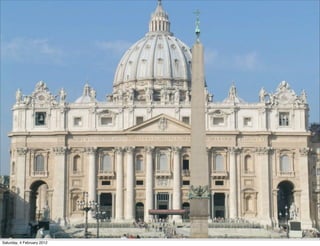
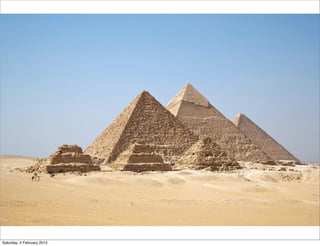
Examples of the sublime


Saturday, 4 February 2012
• Beethoven’s Symphony No. 5 In C Minor,
                            Op. 67, "Fate": I. Allegro Con Brio


Saturday, 4 February 2012
2. Iris Murdoch “The
                            sublime and the good”
       • Against elitism in art
       • Aims to define art
       • (Biased) assumption: Shakespeare is the greatest of
               all artists. then forms aesthetic supporting this
               judgement philosophically
       • Morality and art (eg should art express society?)
       • Plurality of definitions of art: according to values,
               taste, morality, expressions etc
Saturday, 4 February 2012
2. Iris Murdoch “The sublime and the good”


      • Begins with Kant’s definition of art (beautiful and
             sublime)
      • Free beauty: true judgement, common sense
             (universality)
      • Dependent beauty: concept of perfection
      • Sublime and emotion
      • Beautiful is an analogy to good (symbolises) but
             shouldn’t be tainted with it


Saturday, 4 February 2012
Criticism
   • 1) Kant: pure/true art is a small area of what we
           think of as art. Criticism on concept/set of rules
           applied in order to achieve beauty (e.g. wordless
           music).--liberal view
   • 2) Tolstoy: good art - simple, understood by all (the
           Iliad, Old Testament, folk tales,V. Hugo), bad art -
           obscure, impressionism, Mallarme, Baudelaire,
           Beethoven. Criticism on simplicity as a characteristic
           of art.

                       2. Iris Murdoch “The sublime and the good”
Saturday, 4 February 2012
Is it bad art?
  De Satan ou de Dieu, qu'importe? Ange ou Sirène,
 Qu'importe, si tu rends, — fée aux yeux de velours,
    Rythme, parfum, lueur, ô mon unique reine! —
 L'univers moins hideux et les instants moins lourds?
                    Baudelaire, Hymne à la Beauté, Fleurs du Mal, 1861

    From God or Satan, who cares? Angel or Siren,
  Who cares, if you make, — fay with the velvet eyes,
  Rhythm, perfume, glimmer; my one and only queen!
   The world less hideous, the minutes less leaden?
                                   William Aggeler’s translation, 1954
Saturday, 4 February 2012
2. Iris Murdoch “The sublime and the good”

                            criticism (cont.)
      • Reason within sociohistorical context (Hegel).
             Example of Sophocle’s tragedy Antigone (442 BC)
      • Antigone plot and issue for Murdoch: Conflict
             between incompatible goods: 1) treason (human law),
             2) Gods’ honour and brotherly love (divine, moral
             laws)
      • Catharsis: combination of Kantian and Hegelian
             elements

Saturday, 4 February 2012
2. Iris Murdoch “The sublime and the good”
                             Love and Freedom

                     • The essence of art and morals
                     • Discovery of reality: art, morals, love
                     • Praising individualism -- Ontological
                            perspective (hence tragedy is the highest art)
                     • Freedom: aesthetic theory incorporating
                            ontological theory, existentialism, historical
                            context, social understanding of otherness

Saturday, 4 February 2012
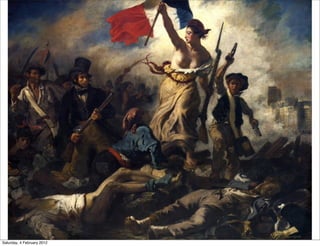
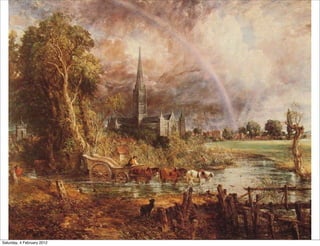
Examples
       Delacroix, Liberty leading the people (1830)
  Constable, Salisbury Cathedral from the Meadows (1831)


Saturday, 4 February 2012
Hybrid forms of art
   • J. Levinson (1984) “Hybrid art forms”
   • Definition: hybrid art forms are art forms arising from
           the actual combination or interpenetration of earlier
           art forms.
   • True hybrids (primarily thought as such) and Gedanken
           hybrids (reconsidering works of art as hybrids)
   • Combination of media (as art forms, eg. dance and
           music, theatre and dance)

Saturday, 4 February 2012
Varieties of combination

                     •      Juxtaposition (addition) - mixed media phenomena. Two or more arts are
                            joined together and presented as a larger and more complex unit (e.g.
                            accompaniment, audiovisual shows, installations)

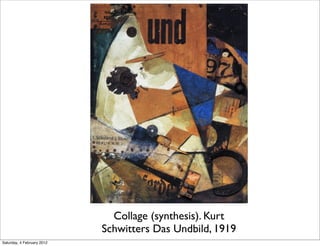
                     •      Synthesis (fusion) - two or more arts are brought together in a way that
                            they lose part of their original identities (e.g. Wagner’s Operas as a synthesis
                            of song and drama, Schwitters’ collages)

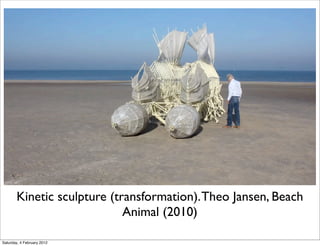
                     •      transformation (alteration) - similar to juxtaposition but the arts combined
                            do not equally contribute to the result (e.g. kinetic sculpture)


Saturday, 4 February 2012
Music installation (juxtaposition). Sound and Light show,
                  Horus Temple, Edfu, Egypt

Saturday, 4 February 2012
Collage (synthesis). Kurt
                            Schwitters Das Undbild, 1919
Saturday, 4 February 2012
Kinetic sculpture (transformation). Theo Jansen, Beach
                            Animal (2010)

Saturday, 4 February 2012
Observations
   •       Hybrid art forms tend to be examples of creativity

   •       Interaction is a central point

   •       Tracing common features/comparing arts used for the hybrid
           form

   •       Integrative effects: rich and complex. Cognitive overload for one
           purpose. (Wagnerian opera, with its ideal of a complete, all-
           encompassing experience, achieved through an intimate union of
           symphony, song, drama, and stagecraft )

   •       Disintegrative effects: symbolic or allusive of the psychological
           fragmentation, informational bombardment, and pervasive
           anomie of contemporary urban life. (Wilson/Glass Einstein on the
           Beach)
Saturday, 4 February 2012
Philip Glass/Robert Wilson, 1976.Einstein on the Beach.
                      “I feel the Earth Move”


Saturday, 4 February 2012

Music and art week 3

  • 1.
    Department for Continuing Education Music and Art Marilou Polymeropoulou marilou.polymeropoulou@music.ox.ac.uk Week 3 - The work of art pt. 2 http://musicandartoxford.wordpress.com/ Saturday, 4 February 2012
  • 2.
    Previously • Definitions of art and music • Aesthetic theories • Expression, beautiful, good, evaluation in music Saturday, 4 February 2012
  • 3.
    This week • Articles’ key points • Visual and hybrid forms of art • Examples Saturday, 4 February 2012
  • 4.
    1. Sheldon Nahmod“Artistic Expression and Aesthetic Theory” • Purpose of article: artistic expression in jurisdiction. 1) Control of art, 2) concept of beauty, 3) concept of sublime • Plato and ideal society: 1) Control artistic expression 2) Mathematically beautiful • From Plato to Kant: attempts to reconcile Greek Philosophy with Christianity: 1) Geometric beauty 2) knowledge and power ascending from individuals not God (Cartesian theory) 3) empiricism and subjectivity: psychological processes of art (sensation & reflection) • Kant: centring on the human mind 1) feeling comprehends art, 2) aesthetic judgement separated/ disinterested from/in knowledge and desire, 3) aesthetic judgements refer only to the feelings of their subjects (subjective universality), 4) art and beautiful cannot express ideas (as art is removed from knowledge and desire) -- opposing to Plato’s perspective • Hegel: theory towards humanism.1) spirit developing into self-consciousness (Absolute Spirit), 2) art reveals truth through the material world • Marx: dialectical materialism. 1) economic relationships determine everything (incl. art & culture), 2) art must represent a socialist reality, promote its ideas & behaviour -- similar to Plato’s perspective • Sublime: 1) historically, 2) definition in Burke and Kant, 3) Sublime and infinity Saturday, 4 February 2012
  • 5.
    Examples of thesublime Saturday, 4 February 2012
  • 6.
  • 7.
  • 8.
  • 9.
    • Beethoven’s SymphonyNo. 5 In C Minor, Op. 67, "Fate": I. Allegro Con Brio Saturday, 4 February 2012
  • 10.
    2. Iris Murdoch“The sublime and the good” • Against elitism in art • Aims to define art • (Biased) assumption: Shakespeare is the greatest of all artists. then forms aesthetic supporting this judgement philosophically • Morality and art (eg should art express society?) • Plurality of definitions of art: according to values, taste, morality, expressions etc Saturday, 4 February 2012
  • 11.
    2. Iris Murdoch“The sublime and the good” • Begins with Kant’s definition of art (beautiful and sublime) • Free beauty: true judgement, common sense (universality) • Dependent beauty: concept of perfection • Sublime and emotion • Beautiful is an analogy to good (symbolises) but shouldn’t be tainted with it Saturday, 4 February 2012
  • 12.
    Criticism • 1) Kant: pure/true art is a small area of what we think of as art. Criticism on concept/set of rules applied in order to achieve beauty (e.g. wordless music).--liberal view • 2) Tolstoy: good art - simple, understood by all (the Iliad, Old Testament, folk tales,V. Hugo), bad art - obscure, impressionism, Mallarme, Baudelaire, Beethoven. Criticism on simplicity as a characteristic of art. 2. Iris Murdoch “The sublime and the good” Saturday, 4 February 2012
  • 13.
    Is it badart? De Satan ou de Dieu, qu'importe? Ange ou Sirène, Qu'importe, si tu rends, — fée aux yeux de velours, Rythme, parfum, lueur, ô mon unique reine! — L'univers moins hideux et les instants moins lourds? Baudelaire, Hymne à la Beauté, Fleurs du Mal, 1861 From God or Satan, who cares? Angel or Siren, Who cares, if you make, — fay with the velvet eyes, Rhythm, perfume, glimmer; my one and only queen! The world less hideous, the minutes less leaden? William Aggeler’s translation, 1954 Saturday, 4 February 2012
  • 14.
    2. Iris Murdoch“The sublime and the good” criticism (cont.) • Reason within sociohistorical context (Hegel). Example of Sophocle’s tragedy Antigone (442 BC) • Antigone plot and issue for Murdoch: Conflict between incompatible goods: 1) treason (human law), 2) Gods’ honour and brotherly love (divine, moral laws) • Catharsis: combination of Kantian and Hegelian elements Saturday, 4 February 2012
  • 15.
    2. Iris Murdoch“The sublime and the good” Love and Freedom • The essence of art and morals • Discovery of reality: art, morals, love • Praising individualism -- Ontological perspective (hence tragedy is the highest art) • Freedom: aesthetic theory incorporating ontological theory, existentialism, historical context, social understanding of otherness Saturday, 4 February 2012
  • 16.
    Examples Delacroix, Liberty leading the people (1830) Constable, Salisbury Cathedral from the Meadows (1831) Saturday, 4 February 2012
  • 17.
  • 18.
  • 19.
    Hybrid forms ofart • J. Levinson (1984) “Hybrid art forms” • Definition: hybrid art forms are art forms arising from the actual combination or interpenetration of earlier art forms. • True hybrids (primarily thought as such) and Gedanken hybrids (reconsidering works of art as hybrids) • Combination of media (as art forms, eg. dance and music, theatre and dance) Saturday, 4 February 2012
  • 20.
    Varieties of combination • Juxtaposition (addition) - mixed media phenomena. Two or more arts are joined together and presented as a larger and more complex unit (e.g. accompaniment, audiovisual shows, installations) • Synthesis (fusion) - two or more arts are brought together in a way that they lose part of their original identities (e.g. Wagner’s Operas as a synthesis of song and drama, Schwitters’ collages) • transformation (alteration) - similar to juxtaposition but the arts combined do not equally contribute to the result (e.g. kinetic sculpture) Saturday, 4 February 2012
  • 21.
    Music installation (juxtaposition).Sound and Light show, Horus Temple, Edfu, Egypt Saturday, 4 February 2012
  • 22.
    Collage (synthesis). Kurt Schwitters Das Undbild, 1919 Saturday, 4 February 2012
  • 23.
    Kinetic sculpture (transformation).Theo Jansen, Beach Animal (2010) Saturday, 4 February 2012
  • 24.
    Observations • Hybrid art forms tend to be examples of creativity • Interaction is a central point • Tracing common features/comparing arts used for the hybrid form • Integrative effects: rich and complex. Cognitive overload for one purpose. (Wagnerian opera, with its ideal of a complete, all- encompassing experience, achieved through an intimate union of symphony, song, drama, and stagecraft ) • Disintegrative effects: symbolic or allusive of the psychological fragmentation, informational bombardment, and pervasive anomie of contemporary urban life. (Wilson/Glass Einstein on the Beach) Saturday, 4 February 2012
  • 25.
    Philip Glass/Robert Wilson,1976.Einstein on the Beach. “I feel the Earth Move” Saturday, 4 February 2012