State of the arts of
State of the arts of Electrical
Electrical
engineering
engineering
2
Table of contents
Table of contents
1- Electrotechnics (EE)
2- Electronics
3- Automatics
4-Telecommunication
- Electrical grids : electricity production, transport, exploitation
- Electrical machines : static and rotary machines, DC and AC
machines
- machine control: power electronics, technics of
control
- Micro-electronic (electronic components technology: diode,
transistor, …..
- Electronic sensors, …. Antenna,
- Computer and Satellite, ….
- Components of an automatic system : sensors, actuator,
programmable logic controller
- Controlling an automatic system : Graphset, …Ladder,
Telecommunication concern the flow of information
between the different company departments or between the
company and the outside world by : internet, intranet,
telephone, company's telecommunications infrastructure.
INTRODUCTION
INTRODUCTION
Electrical engineering has become one of the most important
branches of modern engineering. It has contributed considerably to
the rapid development experienced by all other disciplines of modern
engineering, science and the arts. Over the past epoch, electrical
engineering has played a very important role in the development of
our society in social, economic and industrial fields.
Since the discovery of electricity, our society has experienced a
very rapid technological change which far exceeds the imagination of
the first inventors of the electric machine. Today, it has become
inconceivable to live and prosper without learning or at least
becoming familiar with this electrical technology which, more and
more, is taking control of every moment of our lives.
We can, essentially, group all the applications of electricity into two
main areas :
• that of the treatment of electrical energy;
• that of electrical information processing.
The treatment of electrical energy : covers all the techniques
related to the production, distribution and use (in particular by
electromechanical, electro-thermal and electrochemical devices) of
electrical energy.
The processing of electrical information : taken here in its
largest sense, includes the techniques of acquisition (measurements),
transmission (telecommunications) and exploitation (computers,
automatic systems, etc.) of the information supported by electrical
signals. Each of these areas is at the origin of a real industrial
revolution with deep repercussions on economic and social life.
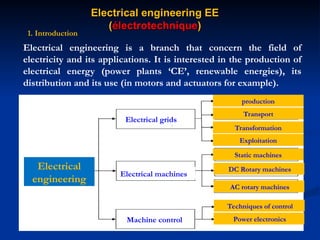
Electrical engineering is a branch that concern the field of
electricity and its applications. It is interested in the production of
electrical energy (power plants ‘CE’, renewable energies), its
distribution and its use (in motors and actuators for example).
Electrical engineering EE
(
(électrotechnique
électrotechnique)
)
1. Introduction
Electrical grids
Electrical machines
Machine control
production
Transport
Transformation
Exploitation
Static machines
DC Rotary machines
AC rotary machines
Techniques of control
Power electronics
Electrical
engineering
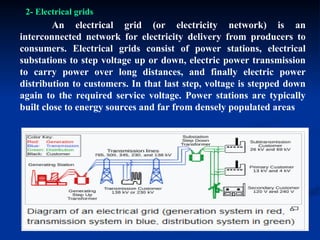
An electrical grid (or electricity network) is an
interconnected network for electricity delivery from producers to
consumers. Electrical grids consist of power stations, electrical
substations to step voltage up or down, electric power transmission
to carry power over long distances, and finally electric power
distribution to customers. In that last step, voltage is stepped down
again to the required service voltage. Power stations are typically
built close to energy sources and far from densely populated areas
2- Electrical grids
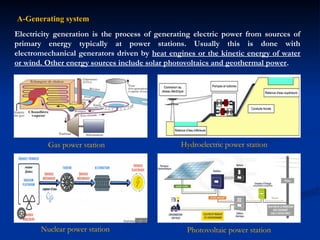
Electricity generation is the process of generating electric power from sources of
primary energy typically at power stations. Usually this is done with
electromechanical generators driven by heat engines or the kinetic energy of water
or wind. Other energy sources include solar photovoltaics and geothermal power.
A-Generating system
Nuclear power station
Gas power station
Photovoltaic power station
Hydroelectric power station
B-Transmission system
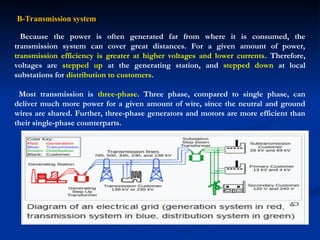
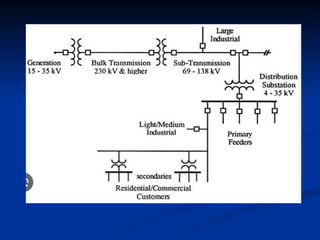
Because the power is often generated far from where it is consumed, the
transmission system can cover great distances. For a given amount of power,
transmission efficiency is greater at higher voltages and lower currents. Therefore,
voltages are stepped up at the generating station, and stepped down at local
substations for distribution to customers.
Most transmission is three-phase. Three phase, compared to single phase, can
deliver much more power for a given amount of wire, since the neutral and ground
wires are shared. Further, three-phase generators and motors are more efficient than
their single-phase counterparts.
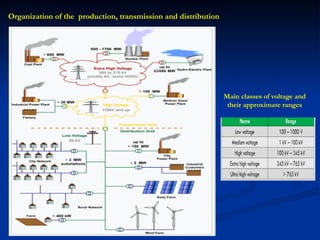
Organization of the production, transmission and distribution
Main classes of voltage and
their approximate ranges
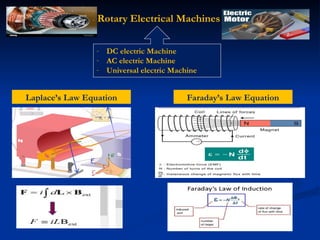
Rotary Electrical Machines
Laplace’s Law Equation Faraday’s Law Equation
- DC electric Machine
- AC electric Machine
- Universal electric Machine
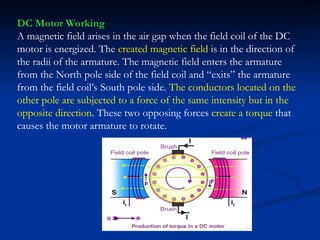
DC Motor Working
A magnetic field arises in the air gap when the field coil of the DC
motor is energized. The created magnetic field is in the direction of
the radii of the armature. The magnetic field enters the armature
from the North pole side of the field coil and “exits” the armature
from the field coil’s South pole side. The conductors located on the
other pole are subjected to a force of the same intensity but in the
opposite direction. These two opposing forces create a torque that
causes the motor armature to rotate.
DC motors have a wide range of applications ranging from electric
shavers to automobiles. To cater to this wide range of applications, they
are classified into different types based on the field winding connections
to the armature as:
•Self Excited DC Motor
•Separately Excited DC Motor
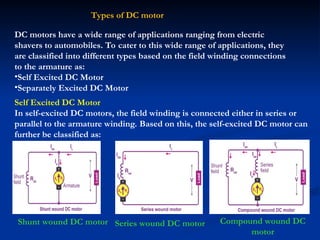
Types of DC motor
Self Excited DC Motor
In self-excited DC motors, the field winding is connected either in series or
parallel to the armature winding. Based on this, the self-excited DC motor can
further be classified as:
Shunt wound DC motor Series wound DC motor Compound wound DC
motor
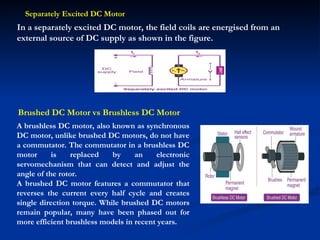
In a separately excited DC motor, the field coils are energised from an
external source of DC supply as shown in the figure.
Separately Excited DC Motor
Brushed DC Motor vs Brushless DC Motor
A brushless DC motor, also known as synchronous
DC motor, unlike brushed DC motors, do not have
a commutator. The commutator in a brushless DC
motor is replaced by an electronic
servomechanism that can detect and adjust the
angle of the rotor.
A brushed DC motor features a commutator that
reverses the current every half cycle and creates
single direction torque. While brushed DC motors
remain popular, many have been phased out for
more efficient brushless models in recent years.
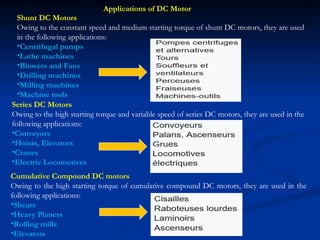
Applications of DC Motor
Shunt DC Motors
Owing to the constant speed and medium starting torque of shunt DC motors, they are used
in the following applications:
•Centrifugal pumps
•Lathe machines
•Blowers and Fans
•Drilling machines
•Milling machines
•Machine tools
Series DC Motors
Owing to the high starting torque and variable speed of series DC motors, they are used in the
following applications:
•Conveyors
•Hoists, Elevators
•Cranes
•Electric Locomotives
Cumulative Compound DC motors
Owing to the high starting torque of cumulative compound DC motors, they are used in the
following applications:
•Shears
•Heavy Planers
•Rolling mills
•Elevators
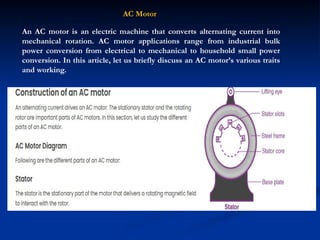
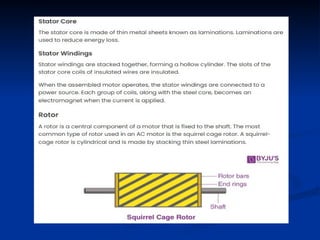
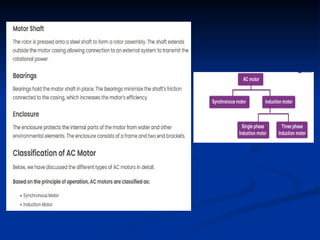
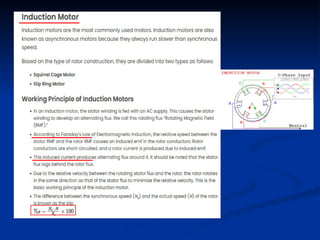
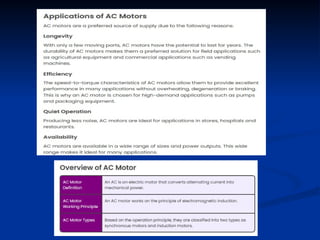
AC Motor
An AC motor is an electric machine that converts alternating current into
mechanical rotation. AC motor applications range from industrial bulk
power conversion from electrical to mechanical to household small power
conversion. In this article, let us briefly discuss an AC motor’s various traits
and working.
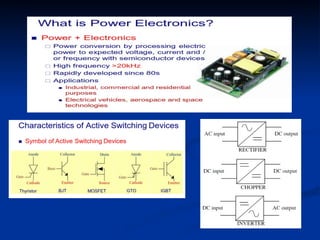
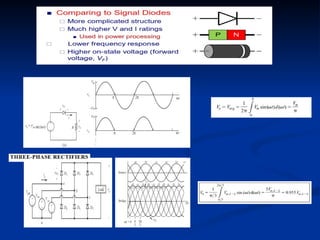
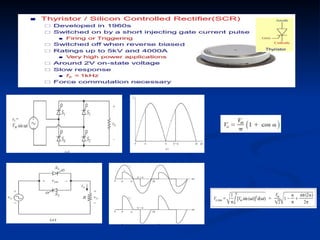
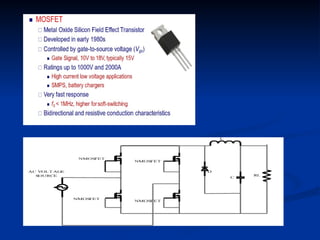
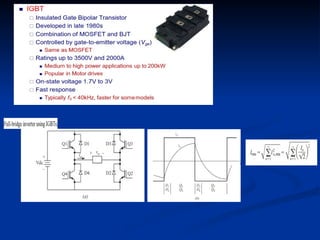
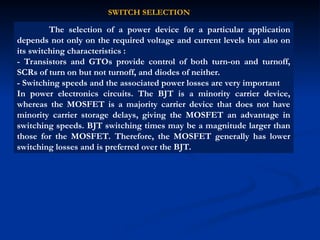
The selection of a power device for a particular application
depends not only on the required voltage and current levels but also on
its switching characteristics :
- Transistors and GTOs provide control of both turn-on and turnoff,
SCRs of turn on but not turnoff, and diodes of neither.
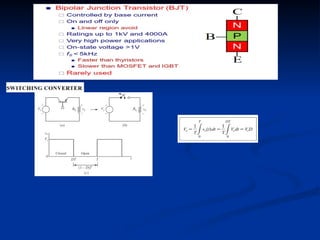
- Switching speeds and the associated power losses are very important
In power electronics circuits. The BJT is a minority carrier device,
whereas the MOSFET is a majority carrier device that does not have
minority carrier storage delays, giving the MOSFET an advantage in
switching speeds. BJT switching times may be a magnitude larger than
those for the MOSFET. Therefore, the MOSFET generally has lower
switching losses and is preferred over the BJT.
SWITCH SELECTION

State of arts Electrical engineering.ppt

  • 1.
    State of thearts of State of the arts of Electrical Electrical engineering engineering
  • 2.
    2 Table of contents Tableof contents 1- Electrotechnics (EE) 2- Electronics 3- Automatics 4-Telecommunication - Electrical grids : electricity production, transport, exploitation - Electrical machines : static and rotary machines, DC and AC machines - machine control: power electronics, technics of control - Micro-electronic (electronic components technology: diode, transistor, ….. - Electronic sensors, …. Antenna, - Computer and Satellite, …. - Components of an automatic system : sensors, actuator, programmable logic controller - Controlling an automatic system : Graphset, …Ladder, Telecommunication concern the flow of information between the different company departments or between the company and the outside world by : internet, intranet, telephone, company's telecommunications infrastructure.
  • 3.
    INTRODUCTION INTRODUCTION Electrical engineering hasbecome one of the most important branches of modern engineering. It has contributed considerably to the rapid development experienced by all other disciplines of modern engineering, science and the arts. Over the past epoch, electrical engineering has played a very important role in the development of our society in social, economic and industrial fields. Since the discovery of electricity, our society has experienced a very rapid technological change which far exceeds the imagination of the first inventors of the electric machine. Today, it has become inconceivable to live and prosper without learning or at least becoming familiar with this electrical technology which, more and more, is taking control of every moment of our lives. We can, essentially, group all the applications of electricity into two main areas : • that of the treatment of electrical energy; • that of electrical information processing.
  • 4.
    The treatment ofelectrical energy : covers all the techniques related to the production, distribution and use (in particular by electromechanical, electro-thermal and electrochemical devices) of electrical energy. The processing of electrical information : taken here in its largest sense, includes the techniques of acquisition (measurements), transmission (telecommunications) and exploitation (computers, automatic systems, etc.) of the information supported by electrical signals. Each of these areas is at the origin of a real industrial revolution with deep repercussions on economic and social life.
  • 5.
    Electrical engineering isa branch that concern the field of electricity and its applications. It is interested in the production of electrical energy (power plants ‘CE’, renewable energies), its distribution and its use (in motors and actuators for example). Electrical engineering EE Electrical engineering EE ( (électrotechnique électrotechnique) ) 1. Introduction Electrical grids Electrical machines Machine control production Transport Transformation Exploitation Static machines DC Rotary machines AC rotary machines Techniques of control Power electronics Electrical engineering
  • 6.
    An electrical grid(or electricity network) is an interconnected network for electricity delivery from producers to consumers. Electrical grids consist of power stations, electrical substations to step voltage up or down, electric power transmission to carry power over long distances, and finally electric power distribution to customers. In that last step, voltage is stepped down again to the required service voltage. Power stations are typically built close to energy sources and far from densely populated areas 2- Electrical grids
  • 7.
    Electricity generation isthe process of generating electric power from sources of primary energy typically at power stations. Usually this is done with electromechanical generators driven by heat engines or the kinetic energy of water or wind. Other energy sources include solar photovoltaics and geothermal power. A-Generating system Nuclear power station Gas power station Photovoltaic power station Hydroelectric power station
  • 8.
    B-Transmission system Because thepower is often generated far from where it is consumed, the transmission system can cover great distances. For a given amount of power, transmission efficiency is greater at higher voltages and lower currents. Therefore, voltages are stepped up at the generating station, and stepped down at local substations for distribution to customers. Most transmission is three-phase. Three phase, compared to single phase, can deliver much more power for a given amount of wire, since the neutral and ground wires are shared. Further, three-phase generators and motors are more efficient than their single-phase counterparts.
  • 9.
    Organization of theproduction, transmission and distribution Main classes of voltage and their approximate ranges
  • 11.
    Rotary Electrical Machines Laplace’sLaw Equation Faraday’s Law Equation - DC electric Machine - AC electric Machine - Universal electric Machine
  • 12.
    DC Motor Working Amagnetic field arises in the air gap when the field coil of the DC motor is energized. The created magnetic field is in the direction of the radii of the armature. The magnetic field enters the armature from the North pole side of the field coil and “exits” the armature from the field coil’s South pole side. The conductors located on the other pole are subjected to a force of the same intensity but in the opposite direction. These two opposing forces create a torque that causes the motor armature to rotate.
  • 13.
    DC motors havea wide range of applications ranging from electric shavers to automobiles. To cater to this wide range of applications, they are classified into different types based on the field winding connections to the armature as: •Self Excited DC Motor •Separately Excited DC Motor Types of DC motor Self Excited DC Motor In self-excited DC motors, the field winding is connected either in series or parallel to the armature winding. Based on this, the self-excited DC motor can further be classified as: Shunt wound DC motor Series wound DC motor Compound wound DC motor
  • 14.
    In a separatelyexcited DC motor, the field coils are energised from an external source of DC supply as shown in the figure. Separately Excited DC Motor Brushed DC Motor vs Brushless DC Motor A brushless DC motor, also known as synchronous DC motor, unlike brushed DC motors, do not have a commutator. The commutator in a brushless DC motor is replaced by an electronic servomechanism that can detect and adjust the angle of the rotor. A brushed DC motor features a commutator that reverses the current every half cycle and creates single direction torque. While brushed DC motors remain popular, many have been phased out for more efficient brushless models in recent years.
  • 15.
    Applications of DCMotor Shunt DC Motors Owing to the constant speed and medium starting torque of shunt DC motors, they are used in the following applications: •Centrifugal pumps •Lathe machines •Blowers and Fans •Drilling machines •Milling machines •Machine tools Series DC Motors Owing to the high starting torque and variable speed of series DC motors, they are used in the following applications: •Conveyors •Hoists, Elevators •Cranes •Electric Locomotives Cumulative Compound DC motors Owing to the high starting torque of cumulative compound DC motors, they are used in the following applications: •Shears •Heavy Planers •Rolling mills •Elevators
  • 16.
    AC Motor An ACmotor is an electric machine that converts alternating current into mechanical rotation. AC motor applications range from industrial bulk power conversion from electrical to mechanical to household small power conversion. In this article, let us briefly discuss an AC motor’s various traits and working.
  • 29.
    The selection ofa power device for a particular application depends not only on the required voltage and current levels but also on its switching characteristics : - Transistors and GTOs provide control of both turn-on and turnoff, SCRs of turn on but not turnoff, and diodes of neither. - Switching speeds and the associated power losses are very important In power electronics circuits. The BJT is a minority carrier device, whereas the MOSFET is a majority carrier device that does not have minority carrier storage delays, giving the MOSFET an advantage in switching speeds. BJT switching times may be a magnitude larger than those for the MOSFET. Therefore, the MOSFET generally has lower switching losses and is preferred over the BJT. SWITCH SELECTION