Monitoring Based Commissioning –
A Must in The World of
High Energy Efficiency
Mark Gallagher, MBA
Global Manager – Building Services
Armstrong Fluid Technology
mgallagher@armstrongfluidtechnology.com
647-795-0243
Learning Objectives
 Understand what is Monitoring Based Commissioning MBx
 How it differs from other forms of commissioning
 The underlying need for MBx and its advantages
 Explore things to consider in selecting performance monitoring and
diagnostic tools
ASHRAE is a Registered Provider with The American Institute of Architects Continuing Education
Systems. Credit earned on completion of this program will be reported to ASHRAE Records for AIA
members. Certificates of Completion for non-AIA members are available on request.
This program is registered with the AIA/ASHRAE for continuing professional education. As such, it
does not include content that may be deemed or construed to be an approval or endorsement by
the AIA of any material of construction or any method or manner of handling, using, distributing, or
dealing in any material or product. Questions related to specific materials, methods, and services
will be addressed at the conclusion of this presentation.
Outline
• Definition of MBx
• Key Findings from Lawrence Berkeley National Laboratory studies
• Supplementary Observations and Findings of Chilled Water Plants
• Things to Consider in Remote Performance Based Monitoring and
Diagnostics
• Options for MBX
MBX – Definition
So, what is MBx? For consistency it includes* ….
1) Performance Monitoring/Building Diagnostics
2) Retro-commissioning
3) Ongoing commissioning and measurement of savings using
metered/monitored data
* The California Commissioning Collaborative [Haas and Heinemeir 2008]
MBx- How is it Different?
Historically commissioning is a one-time or periodic but infrequent
project.
Whereas..
MBx is a continuous exercise with the discipline
to keep buildings performing as designed.
Establishes and tracks expectations based
on relevant benchmark and forecasted
consumption.
Delivering Results…
Sustained results require more than just excellent design and
construction….
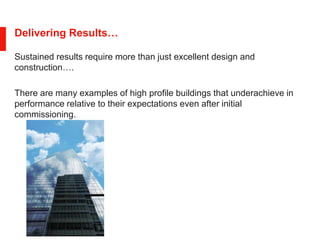
There are many examples of high profile buildings that underachieve in
performance relative to their expectations even after initial
commissioning.
Extract Key Findings from Research -
Lawrence Berkley National Laboratory
1) Monitoring-Based Commissioning - Benchmarking Analysis of 24
UC/CSU/IOU Projects, June 2009
 Evan Mills, Ph.D. & Paul Matthew, Ph. D.
2) Building Commissioning – A Golden Opportunity for Reducing Energy Costs
and Greenhouse Gas Emissions, June 2009
 Evan Mills, Ph.D.
Both Reports prepared for the:
California Energy Commission, Public Interest Energy Research
Program
Background and Methodology
Two separate but related pieces of research and reporting:
1. The first analyzed the results from 24 projects (university campus)
with a detailed MBx evaluation
2. The second was a meta-analysis of commissioning experience in
332 commissioning projects in existing buildings and 77 in new
construction totalling 643 buildings
Deficiencies by End Use
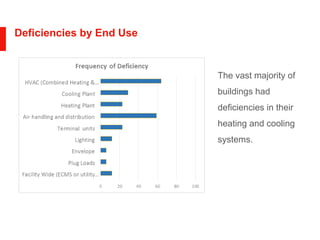
The vast majority of
buildings had
deficiencies in their
heating and cooling
systems.
Measures Used
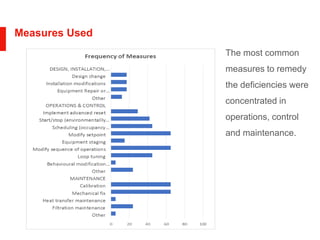
The most common
measures to remedy
the deficiencies were
concentrated in
operations, control
and maintenance.
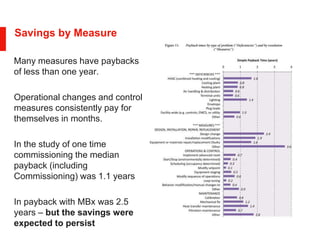
Savings by Measure
Many measures have paybacks
of less than one year.
Operational changes and control
measures consistently pay for
themselves in months.
In the study of one time
commissioning the median
payback (including
Commissioning) was 1.1 years
In payback with MBx was 2.5
years – but the savings were
expected to persist
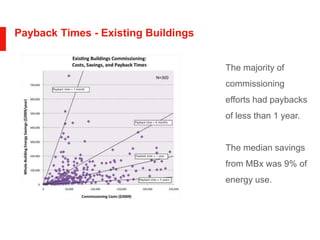
Payback Times - Existing Buildings
The majority of
commissioning
efforts had paybacks
of less than 1 year.
The median savings
from MBx was 9% of
energy use.
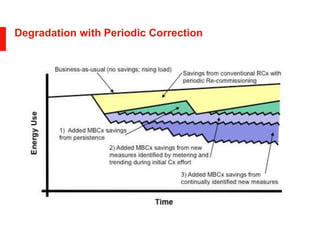
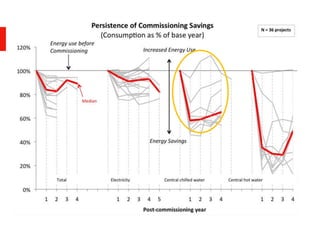
Why MBx?
Because Drift Happens!
Degradation with Periodic Correction
Supporting Observations……
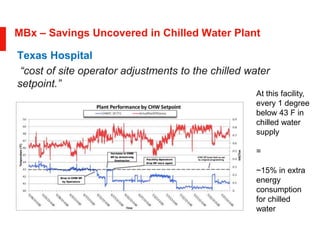
Texas Hospital
“cost of site operator adjustments to the chilled water
setpoint.”
At this facility,
every 1 degree
below 43 F in
chilled water
supply
=
~15% in extra
energy
consumption
for chilled
water
MBx – Savings Uncovered in Chilled Water Plant
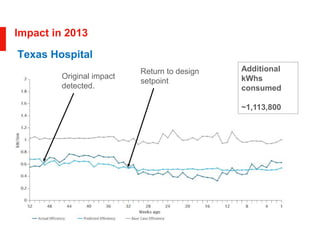
Impact in 2013
Original impact
detected.
Return to design
setpoint
Additional
kWhs
consumed
~1,113,800
Texas Hospital
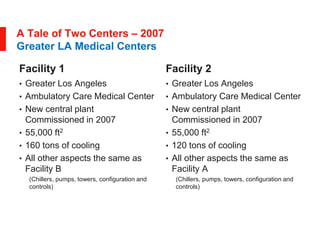
A Tale of Two Centers – 2007
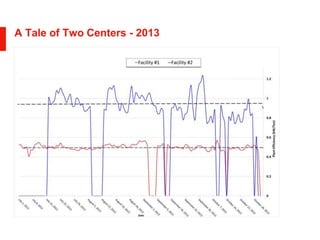
Greater LA Medical Centers
Facility 1
• Greater Los Angeles
• Ambulatory Care Medical Center
• New central plant
Commissioned in 2007
• 55,000 ft2
• 160 tons of cooling
• All other aspects the same as
Facility B
(Chillers, pumps, towers, configuration and
controls)
Facility 2
• Greater Los Angeles
• Ambulatory Care Medical Center
• New central plant
Commissioned in 2007
• 55,000 ft2
• 120 tons of cooling
• All other aspects the same as
Facility A
(Chillers, pumps, towers, configuration and
controls)
A Tale of Two Centers - 2013
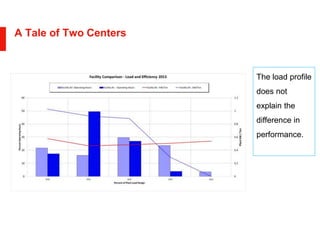
A Tale of Two Centers
The load profile
does not
explain the
difference in
performance.
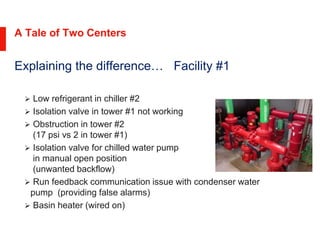
A Tale of Two Centers
Explaining the difference… Facility #1
 Low refrigerant in chiller #2
 Isolation valve in tower #1 not working
 Obstruction in tower #2
(17 psi vs 2 in tower #1)
 Isolation valve for chilled water pump
in manual open position
(unwanted backflow)
 Run feedback communication issue with condenser water
pump (providing false alarms)
 Basin heater (wired on)
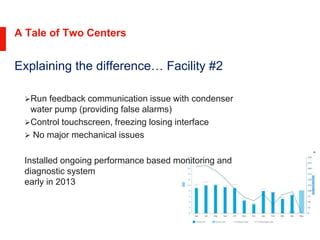
A Tale of Two Centers
Explaining the difference… Facility #2
Run feedback communication issue with condenser
water pump (providing false alarms)
Control touchscreen, freezing losing interface
 No major mechanical issues
Installed ongoing performance based monitoring and
diagnostic system
early in 2013
MBx - Things To Do…
 On-site review & checklist
 Talk to the applicable people:
 (design team, contractors, facility management, building operators and occupants)
 Review available data
 Additional monitoring and metering as required
 Establish performance expectation (benchmark)
 Present continuously (daily) in simple to understand formats
Things to Consider
• Technical sophistication of user(s)
• Resources to review information
• Size of building
• Complexity of building(s)
• Total energy spend
• Relative importance to end user
Possible Application by Segmentation?
BreadthofEquipment
Single
componentAllsystems
Simple Complex
Depth of Analysis
Apartment building
Single boiler, no A/C
University
campus
Complex systems with in-
house energy team
Fast food chain
Compare across
locations by customers
served
Data center
Cooling is critical
MBX –Keep the Findings and Presentation Simple
Because research*
has shown that …
* Note: There is no research to support this, this is a fabrication to support the overall theme of the presentation.
Daily Updates (email)
Our finding is that a daily email pushed to key staff at the client is more
effective than the screens or apps where users must elect to visit. Not
universally true but common.
Simple email such as:
You used x kWhs yesterday (today) whereas your building/system should
have used y
This cost you an extra $$$
Keeps the topic current, flags anomalies in a timely fashion.
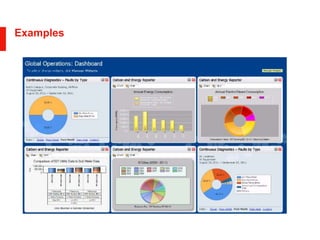
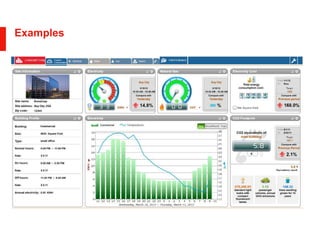
Examples
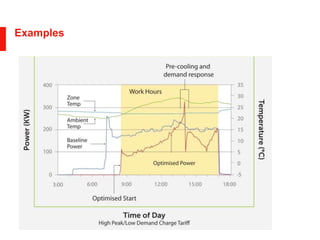
Examples
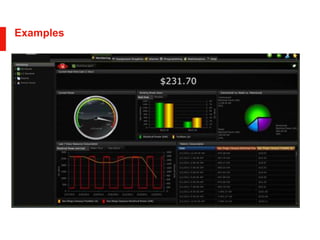
Examples
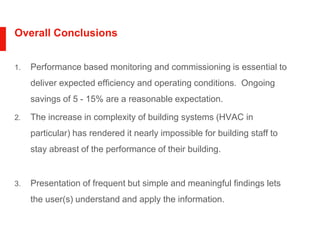
Examples
Overall Conclusions
1. Performance based monitoring and commissioning is essential to
deliver expected efficiency and operating conditions. Ongoing
savings of 5 - 15% are a reasonable expectation.
2. The increase in complexity of building systems (HVAC in
particular) has rendered it nearly impossible for building staff to
stay abreast of the performance of their building.
3. Presentation of frequent but simple and meaningful findings lets
the user(s) understand and apply the information.
Bibliography
Mills, Evan PH.D. & Matthew, Paul PH.D.: June 2009 Monitoring-Based Commissioning -
Benchmarking Analysis of 24 University of California/California State University
/IOU Projects
Lawrence Berkley National Laboratory
http://evanmills.lbl.gov/pubs/pdf/MBCx-LBNL.pdf
Slides in this presentation (9 and 10)
Mills, Evan Ph.D. June 2009 Building Commissioning – A Golden Opportunity for Reducing Energy
Costs and Greenhouse Gas Emissions
Lawrence Berkley National Laboratory
http://cx.lbl.gov/2009/-assessment.html
Slides in this presentation (11, 12, 14 & 15)
Graphics:
Johnson Control Inc., (slide 29)
Honeywell Inc., (slide 30)
Building IQ (slide 31)
Pacific Controls (slide 32)
Questions?
Mark Gallagher
mgallagher@armstrongfluidtechnology.com

Monitoring Based Commissioning - A Must in The World of High Energy Efficiency

  • 1.
    Monitoring Based Commissioning– A Must in The World of High Energy Efficiency Mark Gallagher, MBA Global Manager – Building Services Armstrong Fluid Technology mgallagher@armstrongfluidtechnology.com 647-795-0243
  • 2.
    Learning Objectives  Understandwhat is Monitoring Based Commissioning MBx  How it differs from other forms of commissioning  The underlying need for MBx and its advantages  Explore things to consider in selecting performance monitoring and diagnostic tools ASHRAE is a Registered Provider with The American Institute of Architects Continuing Education Systems. Credit earned on completion of this program will be reported to ASHRAE Records for AIA members. Certificates of Completion for non-AIA members are available on request. This program is registered with the AIA/ASHRAE for continuing professional education. As such, it does not include content that may be deemed or construed to be an approval or endorsement by the AIA of any material of construction or any method or manner of handling, using, distributing, or dealing in any material or product. Questions related to specific materials, methods, and services will be addressed at the conclusion of this presentation.
  • 3.
    Outline • Definition ofMBx • Key Findings from Lawrence Berkeley National Laboratory studies • Supplementary Observations and Findings of Chilled Water Plants • Things to Consider in Remote Performance Based Monitoring and Diagnostics • Options for MBX
  • 4.
    MBX – Definition So,what is MBx? For consistency it includes* …. 1) Performance Monitoring/Building Diagnostics 2) Retro-commissioning 3) Ongoing commissioning and measurement of savings using metered/monitored data * The California Commissioning Collaborative [Haas and Heinemeir 2008]
  • 5.
    MBx- How isit Different? Historically commissioning is a one-time or periodic but infrequent project. Whereas.. MBx is a continuous exercise with the discipline to keep buildings performing as designed. Establishes and tracks expectations based on relevant benchmark and forecasted consumption.
  • 6.
    Delivering Results… Sustained resultsrequire more than just excellent design and construction…. There are many examples of high profile buildings that underachieve in performance relative to their expectations even after initial commissioning.
  • 7.
    Extract Key Findingsfrom Research - Lawrence Berkley National Laboratory 1) Monitoring-Based Commissioning - Benchmarking Analysis of 24 UC/CSU/IOU Projects, June 2009  Evan Mills, Ph.D. & Paul Matthew, Ph. D. 2) Building Commissioning – A Golden Opportunity for Reducing Energy Costs and Greenhouse Gas Emissions, June 2009  Evan Mills, Ph.D. Both Reports prepared for the: California Energy Commission, Public Interest Energy Research Program
  • 8.
    Background and Methodology Twoseparate but related pieces of research and reporting: 1. The first analyzed the results from 24 projects (university campus) with a detailed MBx evaluation 2. The second was a meta-analysis of commissioning experience in 332 commissioning projects in existing buildings and 77 in new construction totalling 643 buildings
  • 9.
    Deficiencies by EndUse The vast majority of buildings had deficiencies in their heating and cooling systems.
  • 10.
    Measures Used The mostcommon measures to remedy the deficiencies were concentrated in operations, control and maintenance.
  • 11.
    Savings by Measure Manymeasures have paybacks of less than one year. Operational changes and control measures consistently pay for themselves in months. In the study of one time commissioning the median payback (including Commissioning) was 1.1 years In payback with MBx was 2.5 years – but the savings were expected to persist
  • 12.
    Payback Times -Existing Buildings The majority of commissioning efforts had paybacks of less than 1 year. The median savings from MBx was 9% of energy use.
  • 13.
  • 14.
  • 16.
  • 17.
    Texas Hospital “cost ofsite operator adjustments to the chilled water setpoint.” At this facility, every 1 degree below 43 F in chilled water supply = ~15% in extra energy consumption for chilled water MBx – Savings Uncovered in Chilled Water Plant
  • 18.
    Impact in 2013 Originalimpact detected. Return to design setpoint Additional kWhs consumed ~1,113,800 Texas Hospital
  • 19.
    A Tale ofTwo Centers – 2007 Greater LA Medical Centers Facility 1 • Greater Los Angeles • Ambulatory Care Medical Center • New central plant Commissioned in 2007 • 55,000 ft2 • 160 tons of cooling • All other aspects the same as Facility B (Chillers, pumps, towers, configuration and controls) Facility 2 • Greater Los Angeles • Ambulatory Care Medical Center • New central plant Commissioned in 2007 • 55,000 ft2 • 120 tons of cooling • All other aspects the same as Facility A (Chillers, pumps, towers, configuration and controls)
  • 20.
    A Tale ofTwo Centers - 2013
  • 21.
    A Tale ofTwo Centers The load profile does not explain the difference in performance.
  • 22.
    A Tale ofTwo Centers Explaining the difference… Facility #1  Low refrigerant in chiller #2  Isolation valve in tower #1 not working  Obstruction in tower #2 (17 psi vs 2 in tower #1)  Isolation valve for chilled water pump in manual open position (unwanted backflow)  Run feedback communication issue with condenser water pump (providing false alarms)  Basin heater (wired on)
  • 23.
    A Tale ofTwo Centers Explaining the difference… Facility #2 Run feedback communication issue with condenser water pump (providing false alarms) Control touchscreen, freezing losing interface  No major mechanical issues Installed ongoing performance based monitoring and diagnostic system early in 2013
  • 24.
    MBx - ThingsTo Do…  On-site review & checklist  Talk to the applicable people:  (design team, contractors, facility management, building operators and occupants)  Review available data  Additional monitoring and metering as required  Establish performance expectation (benchmark)  Present continuously (daily) in simple to understand formats
  • 25.
    Things to Consider •Technical sophistication of user(s) • Resources to review information • Size of building • Complexity of building(s) • Total energy spend • Relative importance to end user
  • 26.
    Possible Application bySegmentation? BreadthofEquipment Single componentAllsystems Simple Complex Depth of Analysis Apartment building Single boiler, no A/C University campus Complex systems with in- house energy team Fast food chain Compare across locations by customers served Data center Cooling is critical
  • 27.
    MBX –Keep theFindings and Presentation Simple Because research* has shown that … * Note: There is no research to support this, this is a fabrication to support the overall theme of the presentation.
  • 28.
    Daily Updates (email) Ourfinding is that a daily email pushed to key staff at the client is more effective than the screens or apps where users must elect to visit. Not universally true but common. Simple email such as: You used x kWhs yesterday (today) whereas your building/system should have used y This cost you an extra $$$ Keeps the topic current, flags anomalies in a timely fashion.
  • 29.
  • 30.
  • 31.
  • 32.
  • 33.
    Overall Conclusions 1. Performancebased monitoring and commissioning is essential to deliver expected efficiency and operating conditions. Ongoing savings of 5 - 15% are a reasonable expectation. 2. The increase in complexity of building systems (HVAC in particular) has rendered it nearly impossible for building staff to stay abreast of the performance of their building. 3. Presentation of frequent but simple and meaningful findings lets the user(s) understand and apply the information.
  • 34.
    Bibliography Mills, Evan PH.D.& Matthew, Paul PH.D.: June 2009 Monitoring-Based Commissioning - Benchmarking Analysis of 24 University of California/California State University /IOU Projects Lawrence Berkley National Laboratory http://evanmills.lbl.gov/pubs/pdf/MBCx-LBNL.pdf Slides in this presentation (9 and 10) Mills, Evan Ph.D. June 2009 Building Commissioning – A Golden Opportunity for Reducing Energy Costs and Greenhouse Gas Emissions Lawrence Berkley National Laboratory http://cx.lbl.gov/2009/-assessment.html Slides in this presentation (11, 12, 14 & 15) Graphics: Johnson Control Inc., (slide 29) Honeywell Inc., (slide 30) Building IQ (slide 31) Pacific Controls (slide 32)
  • 35.