Using EPA’s Energy Use
               Assessment Tool


December 6, 2012
Office of Ground Water and Drinking Water (OGWDW)
Questions & Answers

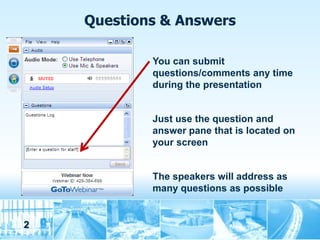
            You can submit
            questions/comments any time
            during the presentation


            Just use the question and
            answer pane that is located on
            your screen


            The speakers will address as
            many questions as possible


2
Disclaimer

    This guidance does not confer legal rights or
 impose legal obligations upon any member of the
 public. While EPA has made every effort to ensure
the accuracy of the discussion in this presentation,
  the obligations of the regulated community are
    determined by statutes, regulations, or other
   legally binding requirements. In the event of a
       conflict between the discussion in this
  presentation and any statute or regulation, this
       presentation would not be controlling.


3
Today’s Panel


Office of Ground Water and Drinking Water
    Sonia Brubaker
    Mike Finn


    Kim Baslock


4
Agenda

 Why is energy use at water and
    wastewater systems important?
 What are the steps in an energy use
    assessment?
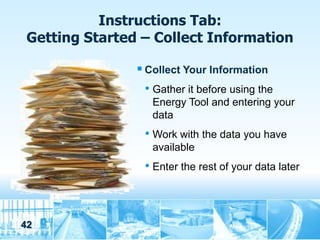
 How can the Energy Use Assessment
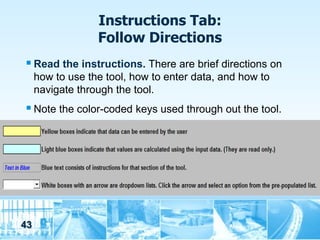
    Tool be used?
 What are next steps?


5
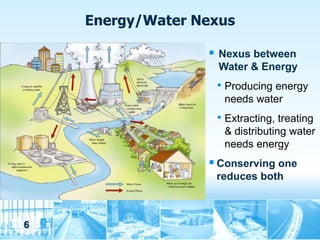
Energy/Water Nexus

                   Nexus between
                    Water & Energy
                   • Producing energy
                     needs water
                   • Extracting, treating
                     & distributing water
                     needs energy
                   Conserving one
                   reduces both


6
Energy Use and Water Utilities
Water and Wastewater treatment represents about 3% of the nation’s
energy consumption
   About $4 billion is spent annually for energy costs to run drinking water and
    wastewater utilities
   Equivalent to approximately 56 billion kilowatt hours (kWh)
   Equates to adding approximately 45 million tons of greenhouse gas to the
    atmosphere
Energy represents the largest controllable cost of providing water or
wastewater services to the public
   Over 16,000 municipal treatment plants in the US and over 50,000
    community water systems
   For wastewater, energy represents 25-30% of the total plant O&M
   As energy costs rise, operating costs rise


    7
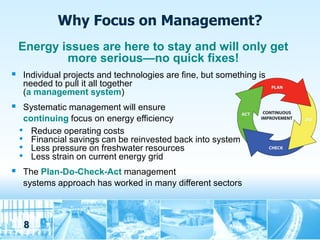
Why Focus on Management?
 Energy issues are here to stay and will only get
         more serious—no quick fixes!
 Individual projects and technologies are fine, but something is
   needed to pull it all together
   (a management system)
 Systematic management will ensure
   continuing focus on energy efficiency
  • Reduce operating costs
  • Financial savings can be reinvested back into system
  • Less pressure on freshwater resources
  • Less strain on current energy grid
 The Plan-Do-Check-Act management
   systems approach has worked in many different sectors


   8
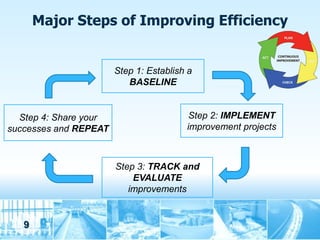
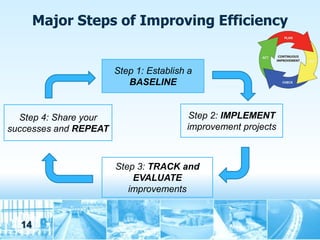
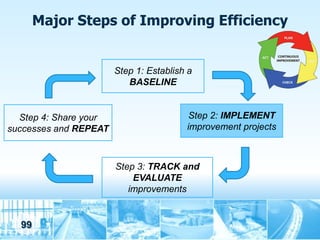
Major Steps of Improving Efficiency


                       Step 1: Establish a
                          BASELINE


  Step 4: Share your                     Step 2: IMPLEMENT
successes and REPEAT                    improvement projects


                       Step 3: TRACK and
                           EVALUATE
                          improvements


   9
What is an Energy Use Assessment?


     A means of assessing your system’s
      baseline energy consumption and
      costs, in order to identify areas for
       improved energy efficiency and
              operational savings.


10
Getting Started in Preparing an
                 Energy Use Assessment
                        Identified Need/Resource Gap
   Utilities getting stuck on Step 1: Baseline
    •   High cost of hiring third-party energy auditors ($8-25K depending on system
        size)
    •   Lack of internal energy expertise

   Utilities getting stuck on Step 2: Implementation
    •   Not able to appropriately identify or prioritize projects (or operational
        modifications)
    •   Not able to compare energy impacts of current technologies vs. other or new
        technologies
    •   Systems unfamiliar with funding opportunities for energy efficiency


    11
EPA’s Energy Use Assessment Tool
                    can Help!
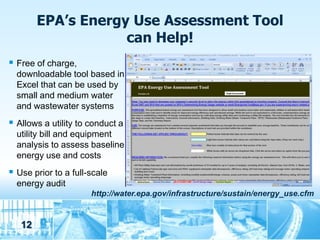
 Free of charge,
  downloadable tool based in
  Excel that can be used by
  small and medium water
  and wastewater systems
 Allows a utility to conduct a
  utility bill and equipment
  analysis to assess baseline
  energy use and costs
 Use prior to a full-scale
  energy audit
                      http://water.epa.gov/infrastructure/sustain/energy_use.cfm


   12
Agenda

 Why is energy use at water and
     wastewater systems important?
 What are the steps in an energy use
     assessment?
 How can the Energy Use Assessment
     Tool be used?
 What are next steps?


13
Major Steps of Improving Efficiency


                       Step 1: Establish a
                          BASELINE


  Step 4: Share your                     Step 2: IMPLEMENT
successes and REPEAT                    improvement projects


                       Step 3: TRACK and
                           EVALUATE
                          improvements


  14
Preparing an Energy Use Assessment

     Before assessing any energy use improvements you must first:


            Establish a Baseline
Your individual utility baseline is an orderly and clear way to document
what your energy usage and costs are and which processes and pieces
               of equipment are consuming that energy.


15
Preparing an Energy Use Assessment:
         Establish a Baseline
 To establish a baseline you will collect utility bills and the
     operating data of process equipment, HVAC equipment and
     lighting.
 The more information you can collect the better your baseline
     is, but do not get hung up “completing” the baseline because
     you do not have EVERYTHING. What is a good amount to
     cover?
     • Two years of utility bills are a good start for an initial baseline.
     • You will not be able to trace all of your energy usage to the
       responsible equipment.
     • Operation schedule is just as important as energy use and
       efficiency data.


16
Preparing an Energy Use Assessment:
          Establish a Baseline

It is likely that this is an additional task to add to your usual duties.
      Break the process up into palatable chunks ahead of time.


17
Preparing an Energy Use Assessment:
         Establish a Baseline
    What exactly am I collecting?

     •   The energy each piece of equipment consumes and its operating
         schedule

     •   Sub-metering data

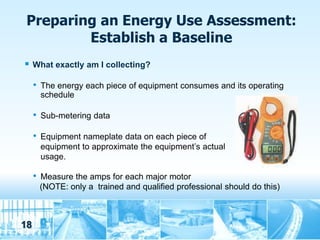
     •   Equipment nameplate data on each piece of
         equipment to approximate the equipment’s actual
         usage.

     •   Measure the amps for each major motor
         (NOTE: only a trained and qualified professional should do this)


18
Preparing an Energy Use Assessment:
          Establish a Baseline
As you are filling out your baseline pay attention to a couple metrics

  •   Subtotal the energy use by system – as a percentage, which systems
      are consuming the most energy?


  •   Average each system’s energy consumed per gallon of water treated
      regardless if the equipment is process or not, lights or sewage fixtures.


 19
Preparing an Energy Use Assessment:
            Establish a Baseline
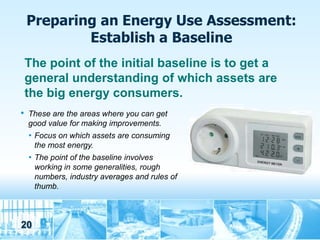
    The point of the initial baseline is to get a
    general understanding of which assets are
    the big energy consumers.
•   These are the areas where you can get
    good value for making improvements.
    • Focus on which assets are consuming
     the most energy.
    • The point of the baseline involves
     working in some generalities, rough
     numbers, industry averages and rules of
     thumb.


20
Preparing an Energy Use Assessment:
         Establish a Baseline

 After “completing” the initial baseline, keep
                it up to date.


21
Preparing an Energy Use Assessment:
         Baseline Evaluation
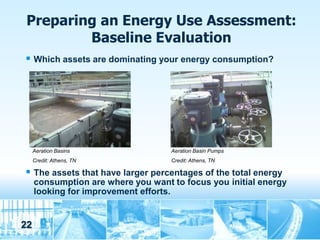
 Which assets are dominating your energy consumption?


     Aeration Basins                Aeration Basin Pumps
     Credit: Athens, TN             Credit: Athens, TN

 The assets that have larger percentages of the total energy
     consumption are where you want to focus you initial energy
     looking for improvement efforts.


22
Preparing an Energy Use Assessment:
           Baseline Evaluation


 Once there is a baseline then you will be able to
 easily see if an energy savings idea will actually
 affect the bottom line.


 Having a baseline makes day-to-day decisions easier.


  23
Preparing an Energy Use Assessment:
         Baseline Evaluation

 Just having an organized baseline can help you
     identify improvements you may have never considered
     • You may be shocked by what percentage of your energy
      use is consumed by lighting, digester pumps, etc.


 A baseline allows you to quickly see the
     impact of changes to your budget


24
Preparing an Energy Use Assessment:
         Baseline Evaluation

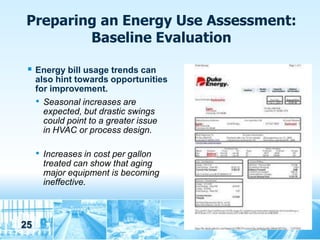
  Energy bill usage trends can
     also hint towards opportunities
     for improvement.
     • Seasonal increases are
       expected, but drastic swings
       could point to a greater issue
       in HVAC or process design.

     • Increases in cost per gallon
      treated can show that aging
      major equipment is becoming
      ineffective.


25
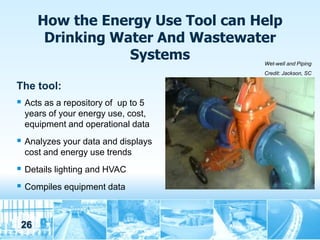
How the Energy Use Tool can Help
       Drinking Water And Wastewater
                  Systems           Wet-well and Piping
                                    Credit: Jackson, SC

The tool:
 Acts as a repository of up to 5
  years of your energy use, cost,
  equipment and operational data
 Analyzes your data and displays
  cost and energy use trends
 Details lighting and HVAC
 Compiles equipment data


 26
How the Energy Use Tool can Help
       Drinking Water And Wastewater
                  Systems
The tool:
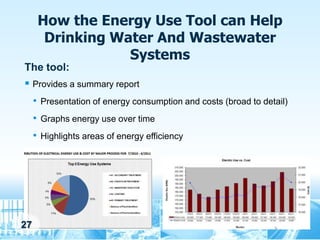
 Provides a summary report
     • Presentation of energy consumption and costs (broad to detail)
     • Graphs energy use over time
     • Highlights areas of energy efficiency


27
Agenda

 Why is energy use at water and
     wastewater systems important?
 What are the steps in an energy use
     assessment?
 How can the Energy Use
     Assessment Tool be used?
 What are next steps?


28
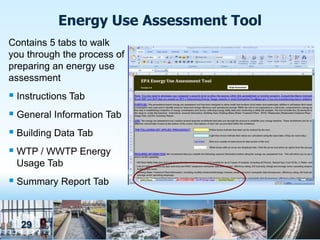
Energy Use Assessment Tool
Contains 5 tabs to walk
you through the process of
preparing an energy use
assessment
 Instructions Tab
 General Information Tab
 Building Data Tab
 WTP / WWTP Energy
 Usage Tab
 Summary Report Tab


  29
EPA’s Energy Use Assessment Tool:
Information Needed to Enter in the Tool
   All plant utility data (use and cost information) by month (minimum of
    12 months) for up to 5 years of analysis
    • Collect from utility bills such as electric, natural gas, water/sewer, fuel oil, alternative energy,
      and other utilities

   Non-process information (by building)
    • List of lighting fixtures
    • HVAC equipment
   Drinking water and/or Wastewater treatment plant information
    • Monthly treatment/discharge volumes
    • Pump and motor nameplate data (horsepower, efficiency rating, full load amp rating)
    • Average motor operating amperage


    30
Energy Use Assessment Tool
      Setup Instructions
       • Saving a Copy of the Tool
       • Enabling Macros
       • Changing Security Levels
      Instructions Tab
      General Information Tab
      Building Data Tab
      WTP / WWTP Energy Usage Tab
      Summary Report Tab

31
Setup Instructions:
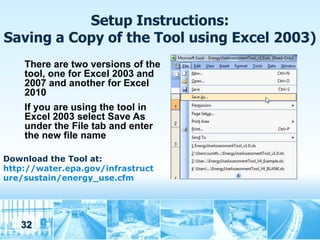
Saving a Copy of the Tool using Excel 2003)
    There are two versions of the
    tool, one for Excel 2003 and
    2007 and another for Excel
    2010
    If you are using the tool in
    Excel 2003 select Save As
    under the File tab and enter
    the new file name

Download the Tool at:
http://water.epa.gov/infrastruct
ure/sustain/energy_use.cfm


   32
Setup Instructions:
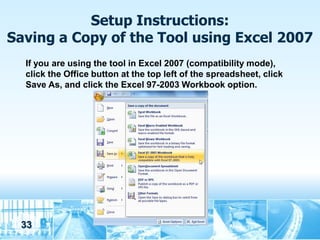
Saving a Copy of the Tool using Excel 2007
  If you are using the tool in Excel 2007 (compatibility mode),
  click the Office button at the top left of the spreadsheet, click
  Save As, and click the Excel 97-2003 Workbook option.


 33
Setup Instructions:
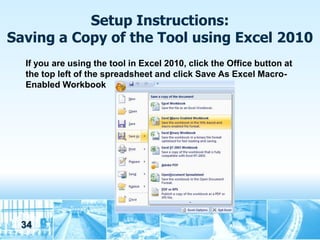
Saving a Copy of the Tool using Excel 2010
  If you are using the tool in Excel 2010, click the Office button at
  the top left of the spreadsheet and click Save As Excel Macro-
  Enabled Workbook


 34
Energy Use Assessment Tool
 Setup Instructions
 Instructions Tab
  • Getting Started – Collect Your Information
  • Collect This Information
  • Follow Directions
  • Begin the Assessment
  • Select Drinking Water System or Wastewater System
 General Information Tab
 Building Data Tab
 WTP / WWTP Energy Usage Tab
 Summary Reports Tab


40
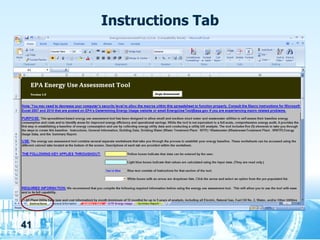
Instructions Tab


41
Instructions Tab:
 Getting Started – Collect Information

                 Collect Your Information
                  • Gather it before using the
                   Energy Tool and entering your
                   data
                 • Work with the data you have
                   available
                 • Enter the rest of your data later


42
Instructions Tab:
                  Follow Directions
 Read the instructions. There are brief directions on
     how to use the tool, how to enter data, and how to
     navigate through the tool.
 Note the color-coded keys used through out the tool.


43
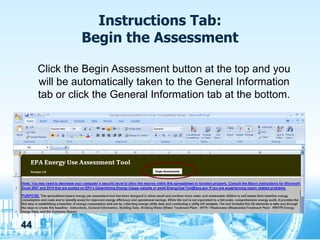
Instructions Tab:
              Begin the Assessment

     Click the Begin Assessment button at the top and you
     will be automatically taken to the General Information
     tab or click the General Information tab at the bottom.


44
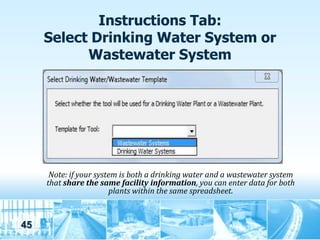
Instructions Tab:
     Select Drinking Water System or
           Wastewater System


      Note: if your system is both a drinking water and a wastewater system
     that share the same facility information, you can enter data for both
                        plants within the same spreadsheet.


45
Energy Use Assessment Tool
      Setup Instructions
      Instructions Tab
      General Information Tab
       • Navigation Buttons
       • Entering Background Information
       • Entering Utility Bill Information
      Building Data Tab
      WTP / WWTP Energy Usage Tab
      Summary Reports Tab


46
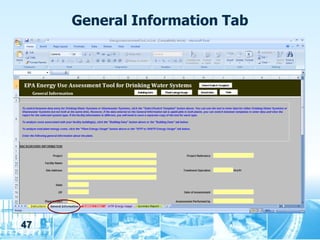
General Information Tab


47
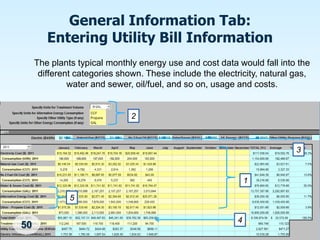
General Information Tab:
        Entering Utility Bill Information
     The plants typical monthly energy use and cost data would fall into the
      different categories shown. These include the electricity, natural gas,
              water and sewer, oil/fuel, and so on, usage and costs.


                              2


                                                                         3


                                                              1

              5

                                                          4
50
Energy Use Assessment Tool
      Setup Instructions
      Instructions Tab
      General Information Tab
      Building Data Tab
       • Navigational Buttons
       • Total Plant Building Information
       • Building Information
       • Lighting Fixtures
       • HVAC/Non-Process Units
      WTP / WWTP Energy Usage Tab
      Summary Reports Tab


53
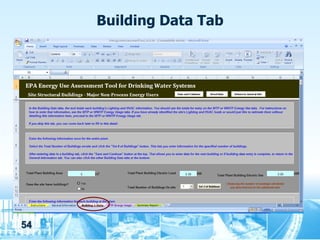
Building Data Tab


54
Energy Use Assessment Tool

      Setup Instructions
      Instructions Tab
      General Information Tab
      Building Data Tab
      WTP / WWTP Energy Usage Tab
       • HVAC and Lighting Totals
       • Plant Equipment Electrical Energy
        Inventory
      Summary Reports Tab


65
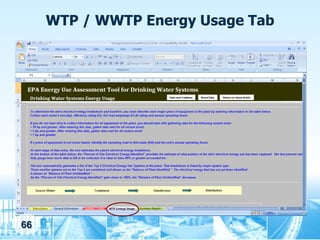
WTP / WWTP Energy Usage Tab


66
Energy Use Assessment Tool
 Setup Instructions
 Instructions Tab
 General Information Tab
 Building Data Tab
 WTP / WWTP Energy Usage Tab
 Summary Report Tab
  • Action Buttons
  • Overview of Baseline Energy Use
  • Graphical Summaries for the Latest 12 Months
  • Distribution of Electrical energy Use and Cost by Major Process
  • Equipment Inventory
  • Energy Trends for Over the Last 5 years


81
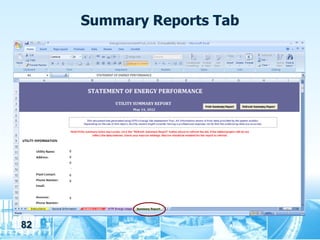
Summary Reports Tab


82
Demo


97
Agenda
 Why is energy use at water and
     wastewater systems important?
 What are the steps in an energy use
     assessment?
 How can the Energy Use Assessment
     Tool be used?
 What are next steps?


98
Major Steps of Improving Efficiency


                       Step 1: Establish a
                          BASELINE


  Step 4: Share your                     Step 2: IMPLEMENT
successes and REPEAT                    improvement projects


                       Step 3: TRACK and
                           EVALUATE
                          improvements


  99
Next Steps:
          Opportunities for Improvement
1. Prioritize further investigation
   of opportunities to reduce
   your energy use
    With energy evaluations the first goal
       is to find the “low hanging fruit.”
       These are the changes to your
       operations or equipment that are
       cheap and/or quick to implement.

    Look to make operational changes
       before capital changes.


 100
Next Steps:
           Opportunities for Improvement
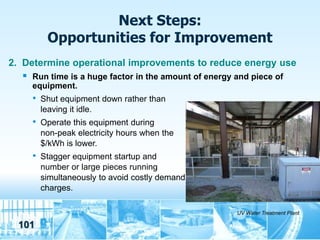
2. Determine operational improvements to reduce energy use
     Run time is a huge factor in the amount of energy and piece of
      equipment.
      •   Shut equipment down rather than
          leaving it idle.
      •   Operate this equipment during
          non-peak electricity hours when the
          $/kWh is lower.
      •   Stagger equipment startup and
          number or large pieces running
          simultaneously to avoid costly demand
          charges.

                                                        UV Water Treatment Plant

 101
Next Steps:
         Opportunities for Improvement
3. Determine equipment improvements
   to reduce energy use
    What technology is being used currently vs
     new alternatives that are available?


   Do we need new equipment or can we retrofit
     existing equipment?

   Compare current technology and equipment
     to alternatives that are higher efficiency
     (what is the opportunity cost?)
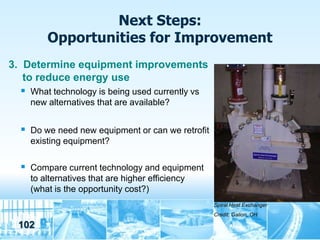
                                                  Spiral Heat Exchanger
                                                  Credit: Galion, OH

  102
Next Steps:
              Opportunities for Improvement
                                                    3. Determine equipment
                                                       improvements to reduce
                                                       energy use (cont.)

                                                       Gather capital and
                                                        operating/maintenance cost for
                                                        new equipment and compare that
                                                        to your existing operating costs.

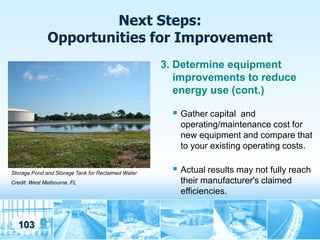
Storage Pond and Storage Tank for Reclaimed Water      Actual results may not fully reach
Credit: West Melbourne, FL                              their manufacturer's claimed
                                                        efficiencies.


  103
Next Steps:
        Opportunities for Improvement
3. Determine equipment improvements to reduce energy
   use (cont.)
    Replacing equipment that runs constantly will generally pay back
     faster than intermittently used equipment.
    Remember that you can have two identical pumps but different
     motors.
    Once high energy use equipment is identified, then the efficiency
     readings for that equipment should be analyzed.


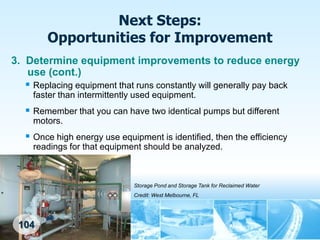
                              Storage Pond and Storage Tank for Reclaimed Water
                              Credit: West Melbourne, FL


 104
Next Steps:
        Opportunities for Improvement
3. Determine equipment improvements to reduce energy
   use (cont.)
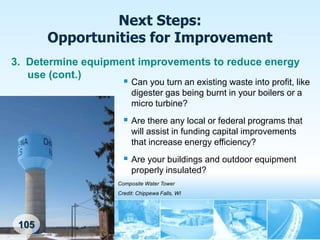
                     Can you turn an existing waste into profit, like
                              digester gas being burnt in your boilers or a
                              micro turbine?
                            Are there any local or federal programs that
                              will assist in funding capital improvements
                              that increase energy efficiency?
                            Are your buildings and outdoor equipment
                              properly insulated?
                         Composite Water Tower
                         Credit: Chippewa Falls, WI


 105
Next Steps:
      Update the Tool & Seek Expertise
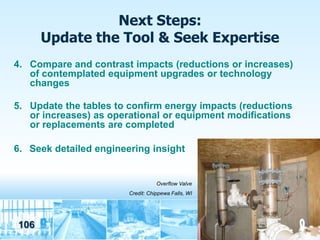
4. Compare and contrast impacts (reductions or increases)
   of contemplated equipment upgrades or technology
   changes

5. Update the tables to confirm energy impacts (reductions
   or increases) as operational or equipment modifications
   or replacements are completed

6. Seek detailed engineering insight


                                   Overflow Valve
                        Credit: Chippewa Falls, WI


106
Next Steps:
             Tracking Trends & Upgrades
7. Utilize the Summary Report to:
 •   Provide a focused snapshot of the past and
     current energy utilization at the plant each
     month.
 •   Review trends to compare and contrast
     energy use and costs from month to month,
     season to season, and year to year.

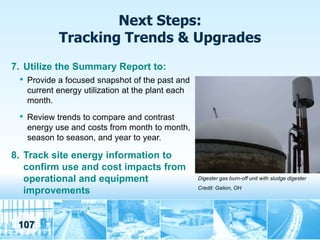
8. Track site energy information to
   confirm use and cost impacts from
   operational and equipment                        Digester gas burn-off unit with sludge digester
                                                    Credit: Galion, OH
   improvements


 107
Questions?
         Contact us at:


      Download the Tool at:


108
Like the Information in this Webinar?

      Look for the Energy Use
  Assessment pocket guide coming
         out this summer!

http://water.epa.gov/infrastructure/sustain/
              energy_use.cfm


 109

Energy Use Assessment Tool

  • 1.
    Using EPA’s EnergyUse Assessment Tool December 6, 2012 Office of Ground Water and Drinking Water (OGWDW)
  • 2.
    Questions & Answers You can submit questions/comments any time during the presentation Just use the question and answer pane that is located on your screen The speakers will address as many questions as possible 2
  • 3.
    Disclaimer This guidance does not confer legal rights or impose legal obligations upon any member of the public. While EPA has made every effort to ensure the accuracy of the discussion in this presentation, the obligations of the regulated community are determined by statutes, regulations, or other legally binding requirements. In the event of a conflict between the discussion in this presentation and any statute or regulation, this presentation would not be controlling. 3
  • 4.
    Today’s Panel Office ofGround Water and Drinking Water Sonia Brubaker Mike Finn Kim Baslock 4
  • 5.
    Agenda  Why isenergy use at water and wastewater systems important?  What are the steps in an energy use assessment?  How can the Energy Use Assessment Tool be used?  What are next steps? 5
  • 6.
    Energy/Water Nexus  Nexus between Water & Energy • Producing energy needs water • Extracting, treating & distributing water needs energy  Conserving one reduces both 6
  • 7.
    Energy Use andWater Utilities Water and Wastewater treatment represents about 3% of the nation’s energy consumption  About $4 billion is spent annually for energy costs to run drinking water and wastewater utilities  Equivalent to approximately 56 billion kilowatt hours (kWh)  Equates to adding approximately 45 million tons of greenhouse gas to the atmosphere Energy represents the largest controllable cost of providing water or wastewater services to the public  Over 16,000 municipal treatment plants in the US and over 50,000 community water systems  For wastewater, energy represents 25-30% of the total plant O&M  As energy costs rise, operating costs rise 7
  • 8.
    Why Focus onManagement? Energy issues are here to stay and will only get more serious—no quick fixes!  Individual projects and technologies are fine, but something is needed to pull it all together (a management system)  Systematic management will ensure continuing focus on energy efficiency • Reduce operating costs • Financial savings can be reinvested back into system • Less pressure on freshwater resources • Less strain on current energy grid  The Plan-Do-Check-Act management systems approach has worked in many different sectors 8
  • 9.
    Major Steps ofImproving Efficiency Step 1: Establish a BASELINE Step 4: Share your Step 2: IMPLEMENT successes and REPEAT improvement projects Step 3: TRACK and EVALUATE improvements 9
  • 10.
    What is anEnergy Use Assessment? A means of assessing your system’s baseline energy consumption and costs, in order to identify areas for improved energy efficiency and operational savings. 10
  • 11.
    Getting Started inPreparing an Energy Use Assessment Identified Need/Resource Gap  Utilities getting stuck on Step 1: Baseline • High cost of hiring third-party energy auditors ($8-25K depending on system size) • Lack of internal energy expertise  Utilities getting stuck on Step 2: Implementation • Not able to appropriately identify or prioritize projects (or operational modifications) • Not able to compare energy impacts of current technologies vs. other or new technologies • Systems unfamiliar with funding opportunities for energy efficiency 11
  • 12.
    EPA’s Energy UseAssessment Tool can Help!  Free of charge, downloadable tool based in Excel that can be used by small and medium water and wastewater systems  Allows a utility to conduct a utility bill and equipment analysis to assess baseline energy use and costs  Use prior to a full-scale energy audit http://water.epa.gov/infrastructure/sustain/energy_use.cfm 12
  • 13.
    Agenda  Why isenergy use at water and wastewater systems important?  What are the steps in an energy use assessment?  How can the Energy Use Assessment Tool be used?  What are next steps? 13
  • 14.
    Major Steps ofImproving Efficiency Step 1: Establish a BASELINE Step 4: Share your Step 2: IMPLEMENT successes and REPEAT improvement projects Step 3: TRACK and EVALUATE improvements 14
  • 15.
    Preparing an EnergyUse Assessment Before assessing any energy use improvements you must first: Establish a Baseline Your individual utility baseline is an orderly and clear way to document what your energy usage and costs are and which processes and pieces of equipment are consuming that energy. 15
  • 16.
    Preparing an EnergyUse Assessment: Establish a Baseline  To establish a baseline you will collect utility bills and the operating data of process equipment, HVAC equipment and lighting.  The more information you can collect the better your baseline is, but do not get hung up “completing” the baseline because you do not have EVERYTHING. What is a good amount to cover? • Two years of utility bills are a good start for an initial baseline. • You will not be able to trace all of your energy usage to the responsible equipment. • Operation schedule is just as important as energy use and efficiency data. 16
  • 17.
    Preparing an EnergyUse Assessment: Establish a Baseline It is likely that this is an additional task to add to your usual duties. Break the process up into palatable chunks ahead of time. 17
  • 18.
    Preparing an EnergyUse Assessment: Establish a Baseline  What exactly am I collecting? • The energy each piece of equipment consumes and its operating schedule • Sub-metering data • Equipment nameplate data on each piece of equipment to approximate the equipment’s actual usage. • Measure the amps for each major motor (NOTE: only a trained and qualified professional should do this) 18
  • 19.
    Preparing an EnergyUse Assessment: Establish a Baseline As you are filling out your baseline pay attention to a couple metrics • Subtotal the energy use by system – as a percentage, which systems are consuming the most energy? • Average each system’s energy consumed per gallon of water treated regardless if the equipment is process or not, lights or sewage fixtures. 19
  • 20.
    Preparing an EnergyUse Assessment: Establish a Baseline The point of the initial baseline is to get a general understanding of which assets are the big energy consumers. • These are the areas where you can get good value for making improvements. • Focus on which assets are consuming the most energy. • The point of the baseline involves working in some generalities, rough numbers, industry averages and rules of thumb. 20
  • 21.
    Preparing an EnergyUse Assessment: Establish a Baseline After “completing” the initial baseline, keep it up to date. 21
  • 22.
    Preparing an EnergyUse Assessment: Baseline Evaluation  Which assets are dominating your energy consumption? Aeration Basins Aeration Basin Pumps Credit: Athens, TN Credit: Athens, TN  The assets that have larger percentages of the total energy consumption are where you want to focus you initial energy looking for improvement efforts. 22
  • 23.
    Preparing an EnergyUse Assessment: Baseline Evaluation  Once there is a baseline then you will be able to easily see if an energy savings idea will actually affect the bottom line.  Having a baseline makes day-to-day decisions easier. 23
  • 24.
    Preparing an EnergyUse Assessment: Baseline Evaluation  Just having an organized baseline can help you identify improvements you may have never considered • You may be shocked by what percentage of your energy use is consumed by lighting, digester pumps, etc.  A baseline allows you to quickly see the impact of changes to your budget 24
  • 25.
    Preparing an EnergyUse Assessment: Baseline Evaluation  Energy bill usage trends can also hint towards opportunities for improvement. • Seasonal increases are expected, but drastic swings could point to a greater issue in HVAC or process design. • Increases in cost per gallon treated can show that aging major equipment is becoming ineffective. 25
  • 26.
    How the EnergyUse Tool can Help Drinking Water And Wastewater Systems Wet-well and Piping Credit: Jackson, SC The tool:  Acts as a repository of up to 5 years of your energy use, cost, equipment and operational data  Analyzes your data and displays cost and energy use trends  Details lighting and HVAC  Compiles equipment data 26
  • 27.
    How the EnergyUse Tool can Help Drinking Water And Wastewater Systems The tool:  Provides a summary report • Presentation of energy consumption and costs (broad to detail) • Graphs energy use over time • Highlights areas of energy efficiency 27
  • 28.
    Agenda  Why isenergy use at water and wastewater systems important?  What are the steps in an energy use assessment?  How can the Energy Use Assessment Tool be used?  What are next steps? 28
  • 29.
    Energy Use AssessmentTool Contains 5 tabs to walk you through the process of preparing an energy use assessment  Instructions Tab  General Information Tab  Building Data Tab  WTP / WWTP Energy Usage Tab  Summary Report Tab 29
  • 30.
    EPA’s Energy UseAssessment Tool: Information Needed to Enter in the Tool  All plant utility data (use and cost information) by month (minimum of 12 months) for up to 5 years of analysis • Collect from utility bills such as electric, natural gas, water/sewer, fuel oil, alternative energy, and other utilities  Non-process information (by building) • List of lighting fixtures • HVAC equipment  Drinking water and/or Wastewater treatment plant information • Monthly treatment/discharge volumes • Pump and motor nameplate data (horsepower, efficiency rating, full load amp rating) • Average motor operating amperage 30
  • 31.
    Energy Use AssessmentTool  Setup Instructions • Saving a Copy of the Tool • Enabling Macros • Changing Security Levels  Instructions Tab  General Information Tab  Building Data Tab  WTP / WWTP Energy Usage Tab  Summary Report Tab 31
  • 32.
    Setup Instructions: Saving aCopy of the Tool using Excel 2003) There are two versions of the tool, one for Excel 2003 and 2007 and another for Excel 2010 If you are using the tool in Excel 2003 select Save As under the File tab and enter the new file name Download the Tool at: http://water.epa.gov/infrastruct ure/sustain/energy_use.cfm 32
  • 33.
    Setup Instructions: Saving aCopy of the Tool using Excel 2007 If you are using the tool in Excel 2007 (compatibility mode), click the Office button at the top left of the spreadsheet, click Save As, and click the Excel 97-2003 Workbook option. 33
  • 34.
    Setup Instructions: Saving aCopy of the Tool using Excel 2010 If you are using the tool in Excel 2010, click the Office button at the top left of the spreadsheet and click Save As Excel Macro- Enabled Workbook 34
  • 35.
    Energy Use AssessmentTool  Setup Instructions  Instructions Tab • Getting Started – Collect Your Information • Collect This Information • Follow Directions • Begin the Assessment • Select Drinking Water System or Wastewater System  General Information Tab  Building Data Tab  WTP / WWTP Energy Usage Tab  Summary Reports Tab 40
  • 36.
  • 37.
    Instructions Tab: GettingStarted – Collect Information  Collect Your Information • Gather it before using the Energy Tool and entering your data • Work with the data you have available • Enter the rest of your data later 42
  • 38.
    Instructions Tab: Follow Directions  Read the instructions. There are brief directions on how to use the tool, how to enter data, and how to navigate through the tool.  Note the color-coded keys used through out the tool. 43
  • 39.
    Instructions Tab: Begin the Assessment Click the Begin Assessment button at the top and you will be automatically taken to the General Information tab or click the General Information tab at the bottom. 44
  • 40.
    Instructions Tab: Select Drinking Water System or Wastewater System Note: if your system is both a drinking water and a wastewater system that share the same facility information, you can enter data for both plants within the same spreadsheet. 45
  • 41.
    Energy Use AssessmentTool  Setup Instructions  Instructions Tab  General Information Tab • Navigation Buttons • Entering Background Information • Entering Utility Bill Information  Building Data Tab  WTP / WWTP Energy Usage Tab  Summary Reports Tab 46
  • 42.
  • 43.
    General Information Tab: Entering Utility Bill Information The plants typical monthly energy use and cost data would fall into the different categories shown. These include the electricity, natural gas, water and sewer, oil/fuel, and so on, usage and costs. 2 3 1 5 4 50
  • 44.
    Energy Use AssessmentTool  Setup Instructions  Instructions Tab  General Information Tab  Building Data Tab • Navigational Buttons • Total Plant Building Information • Building Information • Lighting Fixtures • HVAC/Non-Process Units  WTP / WWTP Energy Usage Tab  Summary Reports Tab 53
  • 45.
  • 46.
    Energy Use AssessmentTool  Setup Instructions  Instructions Tab  General Information Tab  Building Data Tab  WTP / WWTP Energy Usage Tab • HVAC and Lighting Totals • Plant Equipment Electrical Energy Inventory  Summary Reports Tab 65
  • 47.
    WTP / WWTPEnergy Usage Tab 66
  • 48.
    Energy Use AssessmentTool  Setup Instructions  Instructions Tab  General Information Tab  Building Data Tab  WTP / WWTP Energy Usage Tab  Summary Report Tab • Action Buttons • Overview of Baseline Energy Use • Graphical Summaries for the Latest 12 Months • Distribution of Electrical energy Use and Cost by Major Process • Equipment Inventory • Energy Trends for Over the Last 5 years 81
  • 49.
  • 50.
  • 51.
    Agenda  Why isenergy use at water and wastewater systems important?  What are the steps in an energy use assessment?  How can the Energy Use Assessment Tool be used?  What are next steps? 98
  • 52.
    Major Steps ofImproving Efficiency Step 1: Establish a BASELINE Step 4: Share your Step 2: IMPLEMENT successes and REPEAT improvement projects Step 3: TRACK and EVALUATE improvements 99
  • 53.
    Next Steps: Opportunities for Improvement 1. Prioritize further investigation of opportunities to reduce your energy use  With energy evaluations the first goal is to find the “low hanging fruit.” These are the changes to your operations or equipment that are cheap and/or quick to implement.  Look to make operational changes before capital changes. 100
  • 54.
    Next Steps: Opportunities for Improvement 2. Determine operational improvements to reduce energy use  Run time is a huge factor in the amount of energy and piece of equipment. • Shut equipment down rather than leaving it idle. • Operate this equipment during non-peak electricity hours when the $/kWh is lower. • Stagger equipment startup and number or large pieces running simultaneously to avoid costly demand charges. UV Water Treatment Plant 101
  • 55.
    Next Steps: Opportunities for Improvement 3. Determine equipment improvements to reduce energy use  What technology is being used currently vs new alternatives that are available?  Do we need new equipment or can we retrofit existing equipment?  Compare current technology and equipment to alternatives that are higher efficiency (what is the opportunity cost?) Spiral Heat Exchanger Credit: Galion, OH 102
  • 56.
    Next Steps: Opportunities for Improvement 3. Determine equipment improvements to reduce energy use (cont.)  Gather capital and operating/maintenance cost for new equipment and compare that to your existing operating costs. Storage Pond and Storage Tank for Reclaimed Water  Actual results may not fully reach Credit: West Melbourne, FL their manufacturer's claimed efficiencies. 103
  • 57.
    Next Steps: Opportunities for Improvement 3. Determine equipment improvements to reduce energy use (cont.)  Replacing equipment that runs constantly will generally pay back faster than intermittently used equipment.  Remember that you can have two identical pumps but different motors.  Once high energy use equipment is identified, then the efficiency readings for that equipment should be analyzed. Storage Pond and Storage Tank for Reclaimed Water Credit: West Melbourne, FL 104
  • 58.
    Next Steps: Opportunities for Improvement 3. Determine equipment improvements to reduce energy use (cont.)  Can you turn an existing waste into profit, like digester gas being burnt in your boilers or a micro turbine?  Are there any local or federal programs that will assist in funding capital improvements that increase energy efficiency?  Are your buildings and outdoor equipment properly insulated? Composite Water Tower Credit: Chippewa Falls, WI 105
  • 59.
    Next Steps: Update the Tool & Seek Expertise 4. Compare and contrast impacts (reductions or increases) of contemplated equipment upgrades or technology changes 5. Update the tables to confirm energy impacts (reductions or increases) as operational or equipment modifications or replacements are completed 6. Seek detailed engineering insight Overflow Valve Credit: Chippewa Falls, WI 106
  • 60.
    Next Steps: Tracking Trends & Upgrades 7. Utilize the Summary Report to: • Provide a focused snapshot of the past and current energy utilization at the plant each month. • Review trends to compare and contrast energy use and costs from month to month, season to season, and year to year. 8. Track site energy information to confirm use and cost impacts from operational and equipment Digester gas burn-off unit with sludge digester Credit: Galion, OH improvements 107
  • 61.
    Questions? Contact us at: Download the Tool at: 108
  • 62.
    Like the Informationin this Webinar? Look for the Energy Use Assessment pocket guide coming out this summer! http://water.epa.gov/infrastructure/sustain/ energy_use.cfm 109

Editor's Notes

  • #2 Welcome to today’s webinar and thank you for joining us today. In this webinar, we will focus on how to perform energy use assessments at water and wastewater systems by using EPA’s Energy Use Assessment Tool.
  • #3 We want to start off by going over a few logistics. We do have a Q&A period reserved at the very end of this webinar but please feel free to submit questions at any time throughout the presentation as we will likely ask them in the order that they were received. Just use the question and answer pane that is located on your screen. The speakers will address as many questions as possible.
  • #4 The presentation today has been reviewed for technical accuracy but here is a disclaimer that just basically says that this presentation does not in any way supersede any existing regulations or legally binding agreements.
  • #5 Our panel for today’s webinar is myself, Sonia Brubaker with EPA’s Office of Groundwater and Drinking Water, who will moderate this session. Mike Finn, an energy expert who is also with EPA’s Office of Groundwater and Drinking Water, will talk about energy use assessments and Kim Baslock, an energy expert practitioner with Tetra Tech, will perform a demonstration of the newly released Energy Use Assessment Tool.
  • #6 Here is our agenda for today’s presentation. We’ll begin by going over some of the reasons why energy use at water and wastewater systems is important. We’ll then talk about some of the steps that are needed to perform an energy use assessment. Then we’ll get into how the Energy Use Assessment Tool can help and will walk you through a demonstration to see how the tool can be used. We’ll end with some next steps that you can do next to improve energy use.
  • #11 So first, let’s define what an energy use assessment is.An energy use assessment is a means of assessing your system’s baseline energy consumption and costs in order to identify areas for improved energy efficiency and operational savings.
  • #13 The Energy Use Assessment Tool is intended to be used by a utility prior to a full-scale energy audit so that a utility bill and equipment analysis can be performed to assess baseline energy use and costs.It’s available for download on EPA’s webinar and is built for small and medium sized water and wastewater systems.
  • #14 But before we jump right into the tool, Mike Finn is going to give a little background and talk briefly about some of the steps you need to take to do an energy assessment. Mike Finn…
  • #29 Now that you’ve heard a little bit about the steps you need to take to do an energy use assessment, let’s now talk about how the Energy Use Assessment Tool and can help in assisting with these steps.
  • #31 Collect the following information: All Plant Utility Data (use and cost information) by month (minimum of 12 months) for up to 5 years of analysis, including all Electric, Natural Gas, Fuel Oil No. 2 (Diesel Fuel), Water, and/or Other UtilitiesList of Lighting Fixtures (by type and quantity) and HVAC equipment nameplate data (horsepower, efficiency rating, full load amp rating) and average motor operating amperage (for each building and room) and room sizeDrinking Water Treatment Plant Information, including monthly treatment/discharge volumes, motor nameplate data (horsepower, efficiency rating, full load amp rating) and average motor operating amperageWastewater Treatment Plant Information, including monthly treatment/discharge volumes and average motor operating amperageCollect as much as you can, but don’t try to be perfect. Just get started and you will soon have a baseline.Preloaded dropdowns are included within the tool for lighting fixtures and equipment typesTemplate allows you to enter both drinking water and wastewater plant information (but not at the same time)
  • #42 Here’s a view of the top portion of the Instructions tab and it’s relation to the others in the tool. Notice it is the left most tab in the excel file.
  • #98 Let’s take a look at the real thing.
  • #99 Now that we have a basic understanding of energy use assessments, we can discuss what can be done next to improve energy use at a water or wastewater system.
  • #109 We hope that this presentation was helping in learning about Energy Use Assessments!Do you have questions for us?