Kinematic & Structural Simulation of the Automated Lift

          Vijaykumar Vaka                               Chinababu Anima                               Rajesh Kandula
            Project manager                          Senior Design Engineer                             Team Lead
      Infotech Enterprises Pvt.Ltd                 Infotech Enterprises Pvt.Ltd                 Infotech Enterprises Pvt.Ltd
           Hyderabad-500032                             Hyderabad-500032                             Hyderabad-500032


            Ramanadh V.V                                                                                 Dr.Satish. Y
          Head of Engineering                                                                    Deputy General Manager
      Infotech Enterprises Pvt.Ltd                                                              Infotech Enterprises Pvt.Ltd

         Keywords : Motion solve, Kinematic simulation, C-Frame, Automated lift
                                                                Abstract

  This paper addresses the field failure problem of Automated lift (i.e., Automated lift is a part of garbage collecting unit truck). During
  the operation, it has been observed, there was failure in C-Frame which needs to be addressed. The machine experience severe
  dynamic forces by virtue of its continues operation, as a first step of solution, accurate load estimation is inevitable The accurate
  mathematical modeling of the system achieved , with the help of operational video animation files. Kinematic simulation is carried
  out in HYPERWORKS and the dynamic forces are assessed in all the components of the machine.

  Kinematic simulation was created with all parts considered as rigid bodies except for the C-frame. The C-frame was modeled as a
  flexbody so that dynamic stresses could be seen in the kinematic results.
  C-frame stress results from the kinematic model were reviewed and moments in time at which the C-frame stresses peaked were
  noted. These peak-stress events in the motion were used as time instances from which to pull joint/interface forces and moments to
  apply to the C-frame FEA model. The joint forces and reaction forces were extracted for following load cases.1)Dump unit next to
  the truck 2)Dump unit at maximum reach extension

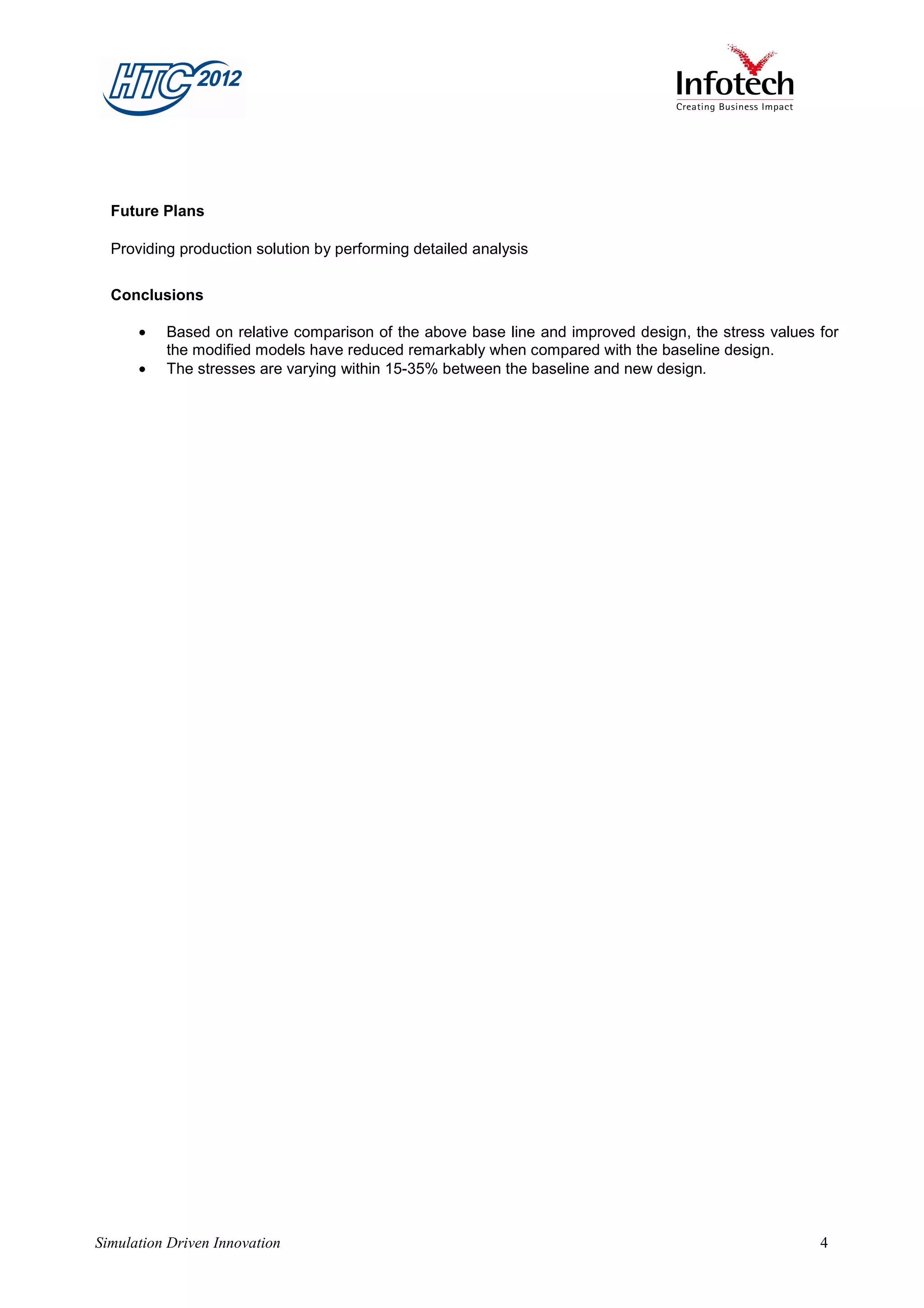
  Structural analysis (FEA) for the baseline model was carried out using worst case loading identified from kinematic simulation. FEA
  results for the baseline were reviewed and stress patterns and load paths were observed to match well with crack locations for in-
  service units. Field fix-geometry was designed and added to the baseline FEA model. The side plates were also increased in
  thickness from ¼” to 5/16”.Structural analysis for the modified model was carried out using worst case loading identified from
  kinematic simulation. The stresses were compared against the baseline and modified model at all critical locations.

  Introduction
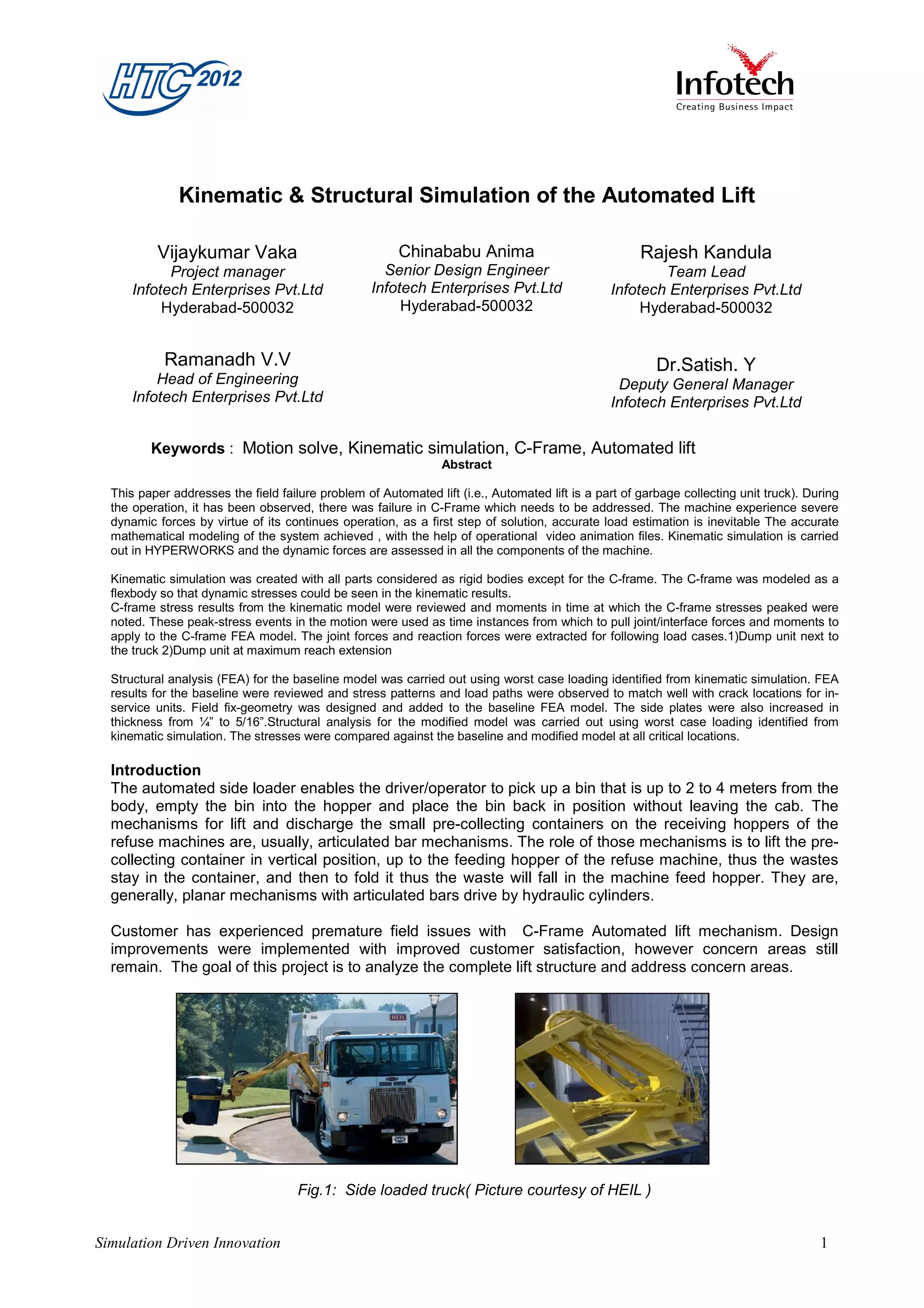
  The automated side loader enables the driver/operator to pick up a bin that is up to 2 to 4 meters from the
  body, empty the bin into the hopper and place the bin back in position without leaving the cab. The
  mechanisms for lift and discharge the small pre-collecting containers on the receiving hoppers of the
  refuse machines are, usually, articulated bar mechanisms. The role of those mechanisms is to lift the pre-
  collecting container in vertical position, up to the feeding hopper of the refuse machine, thus the wastes
  stay in the container, and then to fold it thus the waste will fall in the machine feed hopper. They are,
  generally, planar mechanisms with articulated bars drive by hydraulic cylinders.

  Customer has experienced premature field issues with C-Frame Automated lift mechanism. Design
  improvements were implemented with improved customer satisfaction, however concern areas still
  remain. The goal of this project is to analyze the complete lift structure and address concern areas.


                                     Fig.1: Side loaded truck( Picture courtesy of HEIL )


Simulation Driven Innovation                                                                                                            1
Process Methodology (details with figures)

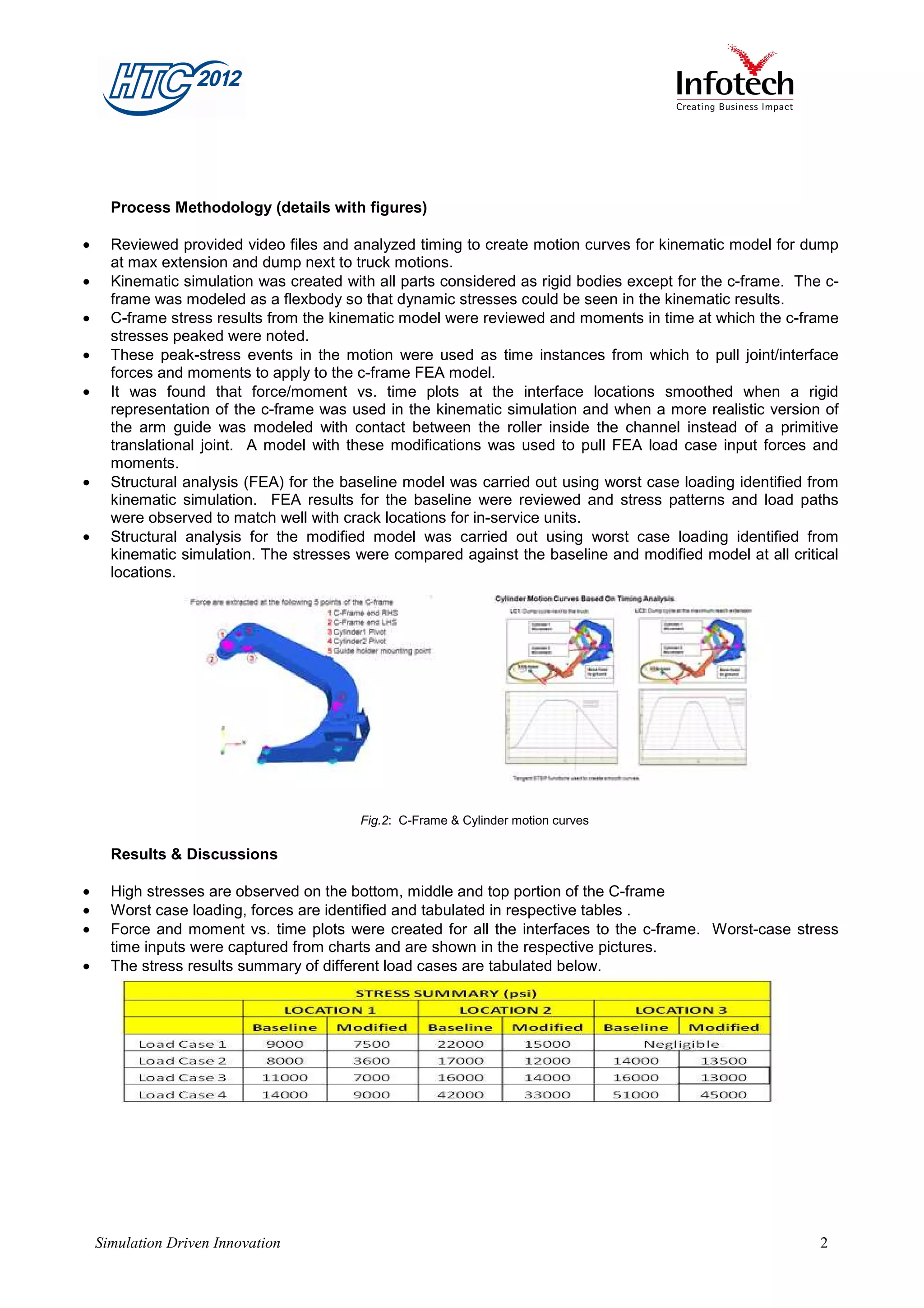
•     Reviewed provided video files and analyzed timing to create motion curves for kinematic model for dump
      at max extension and dump next to truck motions.
•     Kinematic simulation was created with all parts considered as rigid bodies except for the c-frame. The c-
      frame was modeled as a flexbody so that dynamic stresses could be seen in the kinematic results.
•     C-frame stress results from the kinematic model were reviewed and moments in time at which the c-frame
      stresses peaked were noted.
•     These peak-stress events in the motion were used as time instances from which to pull joint/interface
      forces and moments to apply to the c-frame FEA model.
•     It was found that force/moment vs. time plots at the interface locations smoothed when a rigid
      representation of the c-frame was used in the kinematic simulation and when a more realistic version of
      the arm guide was modeled with contact between the roller inside the channel instead of a primitive
      translational joint. A model with these modifications was used to pull FEA load case input forces and
      moments.
•     Structural analysis (FEA) for the baseline model was carried out using worst case loading identified from
      kinematic simulation. FEA results for the baseline were reviewed and stress patterns and load paths
      were observed to match well with crack locations for in-service units.
•     Structural analysis for the modified model was carried out using worst case loading identified from
      kinematic simulation. The stresses were compared against the baseline and modified model at all critical
      locations.


                                          Fig.2: C-Frame & Cylinder motion curves

      Results & Discussions

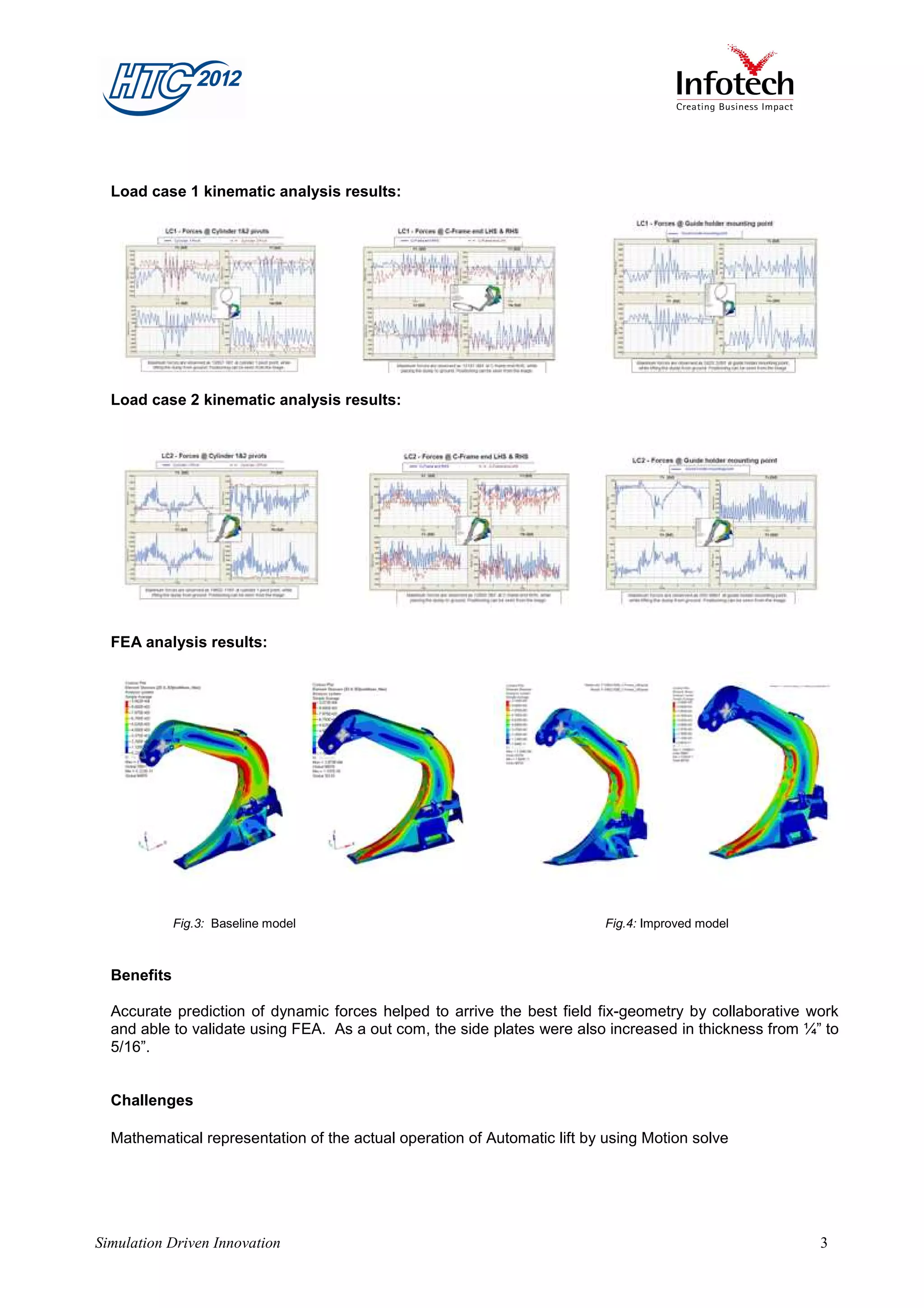
•     High stresses are observed on the bottom, middle and top portion of the C-frame
•     Worst case loading, forces are identified and tabulated in respective tables .
•     Force and moment vs. time plots were created for all the interfaces to the c-frame. Worst-case stress
      time inputs were captured from charts and are shown in the respective pictures.
•     The stress results summary of different load cases are tabulated below.


    Simulation Driven Innovation                                                                            2
Load case 1 kinematic analysis results:


  Load case 2 kinematic analysis results:


  FEA analysis results:


             Fig.3: Baseline model                                        Fig.4: Improved model


  Benefits

  Accurate prediction of dynamic forces helped to arrive the best field fix-geometry by collaborative work
  and able to validate using FEA. As a out com, the side plates were also increased in thickness from ¼” to
  5/16”.


  Challenges

  Mathematical representation of the actual operation of Automatic lift by using Motion solve


Simulation Driven Innovation                                                                            3
Future Plans

  Providing production solution by performing detailed analysis

  Conclusions

      •   Based on relative comparison of the above base line and improved design, the stress values for
          the modified models have reduced remarkably when compared with the baseline design.
      •   The stresses are varying within 15-35% between the baseline and new design.


Simulation Driven Innovation                                                                         4

Mbd 06 kinematic-&_structural_simulation_of_the_automated_infotech

  • 1.
    Kinematic & StructuralSimulation of the Automated Lift Vijaykumar Vaka Chinababu Anima Rajesh Kandula Project manager Senior Design Engineer Team Lead Infotech Enterprises Pvt.Ltd Infotech Enterprises Pvt.Ltd Infotech Enterprises Pvt.Ltd Hyderabad-500032 Hyderabad-500032 Hyderabad-500032 Ramanadh V.V Dr.Satish. Y Head of Engineering Deputy General Manager Infotech Enterprises Pvt.Ltd Infotech Enterprises Pvt.Ltd Keywords : Motion solve, Kinematic simulation, C-Frame, Automated lift Abstract This paper addresses the field failure problem of Automated lift (i.e., Automated lift is a part of garbage collecting unit truck). During the operation, it has been observed, there was failure in C-Frame which needs to be addressed. The machine experience severe dynamic forces by virtue of its continues operation, as a first step of solution, accurate load estimation is inevitable The accurate mathematical modeling of the system achieved , with the help of operational video animation files. Kinematic simulation is carried out in HYPERWORKS and the dynamic forces are assessed in all the components of the machine. Kinematic simulation was created with all parts considered as rigid bodies except for the C-frame. The C-frame was modeled as a flexbody so that dynamic stresses could be seen in the kinematic results. C-frame stress results from the kinematic model were reviewed and moments in time at which the C-frame stresses peaked were noted. These peak-stress events in the motion were used as time instances from which to pull joint/interface forces and moments to apply to the C-frame FEA model. The joint forces and reaction forces were extracted for following load cases.1)Dump unit next to the truck 2)Dump unit at maximum reach extension Structural analysis (FEA) for the baseline model was carried out using worst case loading identified from kinematic simulation. FEA results for the baseline were reviewed and stress patterns and load paths were observed to match well with crack locations for in- service units. Field fix-geometry was designed and added to the baseline FEA model. The side plates were also increased in thickness from ¼” to 5/16”.Structural analysis for the modified model was carried out using worst case loading identified from kinematic simulation. The stresses were compared against the baseline and modified model at all critical locations. Introduction The automated side loader enables the driver/operator to pick up a bin that is up to 2 to 4 meters from the body, empty the bin into the hopper and place the bin back in position without leaving the cab. The mechanisms for lift and discharge the small pre-collecting containers on the receiving hoppers of the refuse machines are, usually, articulated bar mechanisms. The role of those mechanisms is to lift the pre- collecting container in vertical position, up to the feeding hopper of the refuse machine, thus the wastes stay in the container, and then to fold it thus the waste will fall in the machine feed hopper. They are, generally, planar mechanisms with articulated bars drive by hydraulic cylinders. Customer has experienced premature field issues with C-Frame Automated lift mechanism. Design improvements were implemented with improved customer satisfaction, however concern areas still remain. The goal of this project is to analyze the complete lift structure and address concern areas. Fig.1: Side loaded truck( Picture courtesy of HEIL ) Simulation Driven Innovation 1
  • 2.
    Process Methodology (detailswith figures) • Reviewed provided video files and analyzed timing to create motion curves for kinematic model for dump at max extension and dump next to truck motions. • Kinematic simulation was created with all parts considered as rigid bodies except for the c-frame. The c- frame was modeled as a flexbody so that dynamic stresses could be seen in the kinematic results. • C-frame stress results from the kinematic model were reviewed and moments in time at which the c-frame stresses peaked were noted. • These peak-stress events in the motion were used as time instances from which to pull joint/interface forces and moments to apply to the c-frame FEA model. • It was found that force/moment vs. time plots at the interface locations smoothed when a rigid representation of the c-frame was used in the kinematic simulation and when a more realistic version of the arm guide was modeled with contact between the roller inside the channel instead of a primitive translational joint. A model with these modifications was used to pull FEA load case input forces and moments. • Structural analysis (FEA) for the baseline model was carried out using worst case loading identified from kinematic simulation. FEA results for the baseline were reviewed and stress patterns and load paths were observed to match well with crack locations for in-service units. • Structural analysis for the modified model was carried out using worst case loading identified from kinematic simulation. The stresses were compared against the baseline and modified model at all critical locations. Fig.2: C-Frame & Cylinder motion curves Results & Discussions • High stresses are observed on the bottom, middle and top portion of the C-frame • Worst case loading, forces are identified and tabulated in respective tables . • Force and moment vs. time plots were created for all the interfaces to the c-frame. Worst-case stress time inputs were captured from charts and are shown in the respective pictures. • The stress results summary of different load cases are tabulated below. Simulation Driven Innovation 2
  • 3.
    Load case 1kinematic analysis results: Load case 2 kinematic analysis results: FEA analysis results: Fig.3: Baseline model Fig.4: Improved model Benefits Accurate prediction of dynamic forces helped to arrive the best field fix-geometry by collaborative work and able to validate using FEA. As a out com, the side plates were also increased in thickness from ¼” to 5/16”. Challenges Mathematical representation of the actual operation of Automatic lift by using Motion solve Simulation Driven Innovation 3
  • 4.
    Future Plans Providing production solution by performing detailed analysis Conclusions • Based on relative comparison of the above base line and improved design, the stress values for the modified models have reduced remarkably when compared with the baseline design. • The stresses are varying within 15-35% between the baseline and new design. Simulation Driven Innovation 4