Surveillance onSurveillance on
RANAVIRUSESRANAVIRUSES
2nd. INTERNATIONAL SYMPOSIUM ON
RANAVIRUSES
Knoxville, TN – 27-28 July 2013
RANAVIRUSESRANAVIRUSES
inin
Farmed frogs and SympatricFarmed frogs and Sympatric
Amphibia, Fish & ReptilesAmphibia, Fish & Reptiles
Rolando Mazzoni & Adriano Q. Mesquita
CPA/EVZ/UFG
BRAZIL
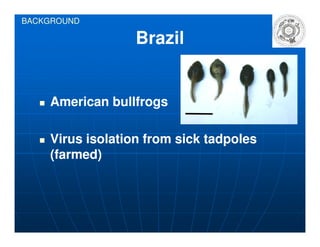
BrazilBrazil
American bullfrogsAmerican bullfrogs
BACKGROUND
Virus isolation from sick tadpolesVirus isolation from sick tadpoles
(farmed)(farmed)
Presence ofPresence of
“FV3 like” viruses“FV3 like” viruses
BACKGROUND
“FV3 like” viruses“FV3 like” viruses
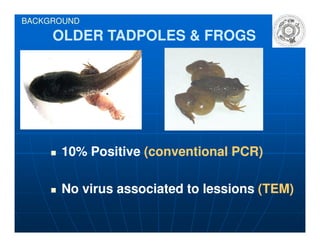
OLDER TADPOLES & FROGSOLDER TADPOLES & FROGS
BACKGROUND
10% Positive10% Positive (conventional PCR)(conventional PCR)
No virus associated to lessionsNo virus associated to lessions (TEM)(TEM)
Bullfrogs are TEVBullfrogs are TEV -- FV3 carriersFV3 carriers
BACKGROUND
WOLF et al., 1968; WILLIAMS et al., 2005; WHITTINGTON et al., 2010
PRESENCE # DISEASE !!!!
FV3 in American BullfrogsFV3 in American Bullfrogs
•• INTRODUCEDINTRODUCED
oror
•• SouthSouth--American VirusAmerican Virus
BACKGROUND
Frog farms shed virus to the environment?Frog farms shed virus to the environment?
Pathogenic to other aquatic organisms?Pathogenic to other aquatic organisms?
OBJECTIVESOBJECTIVES
Ranavirus surveillanceRanavirus surveillance::
•• Farmed American bullfrogsFarmed American bullfrogs
•• Surrounding areasSurrounding areas
•• Other areasOther areas•• Other areasOther areas
Disease reportsDisease reports
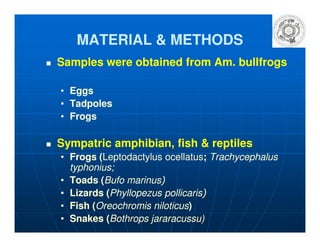
MATERIAL & METHODSMATERIAL & METHODS
Samples were obtained from Am. bullfrogsSamples were obtained from Am. bullfrogs
•• EggsEggs
•• TadpolesTadpoles
•• FrogsFrogs
Sympatric amphibian, fish & reptilesSympatric amphibian, fish & reptiles
•• Frogs (Frogs (Leptodactylus ocellatusLeptodactylus ocellatus;; TrachycephalusTrachycephalus
typhoniustyphonius;;
•• Toads (Toads (BufoBufo marinusmarinus))
•• Lizards (Lizards (PhyllopezusPhyllopezus pollicarispollicaris))
•• Fish (Fish (Oreochromis niloticusOreochromis niloticus))
•• Snakes (Snakes (BothropsBothrops jararacussujararacussu))
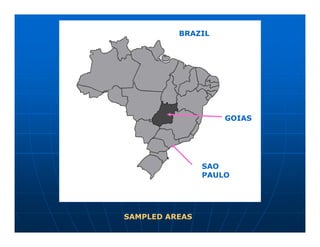
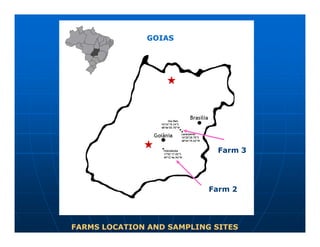
GOIAS
BRAZIL
SAO
PAULO
SAMPLED AREAS
GOIAS
FARMS LOCATION AND SAMPLING SITES
Farm 3
Farm 2
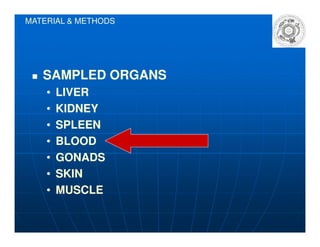
SAMPLED ORGANSSAMPLED ORGANS
•• LIVERLIVER
•• KIDNEYKIDNEY
•• SPLEENSPLEEN
MATERIAL & METHODS
•• SPLEENSPLEEN
•• BLOODBLOOD
•• GONADSGONADS
•• SKINSKIN
•• MUSCLEMUSCLE
METHODMETHOD
•• REAL TIME PCRREAL TIME PCR
MATERIAL & METHODS
•• REAL TIME PCRREAL TIME PCR
•• TARGET SEQUENCE = MCPTARGET SEQUENCE = MCP
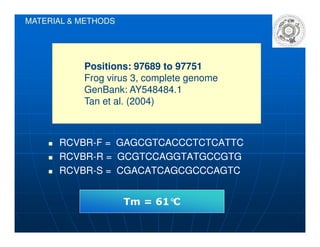
Positions: 97689 to 97751
Frog virus 3, complete genome
GenBank: AY548484.1
Tan et al. (2004)
MATERIAL & METHODS
RCVBRRCVBR--F = GAGCGTCACCCTCTCATTCF = GAGCGTCACCCTCTCATTC
RCVBRRCVBR--R = GCGTCCAGGTATGCCGTGR = GCGTCCAGGTATGCCGTG
RCVBRRCVBR--S = CGACATCAGCGCCCAGTCS = CGACATCAGCGCCCAGTC
Tm = 61°C
RESULTSRESULTS
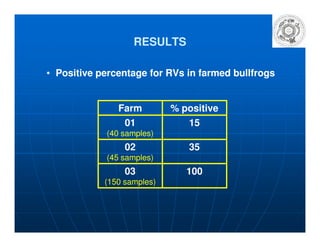
•• Positive percentage for RVs in farmed bullfrogsPositive percentage for RVs in farmed bullfrogs
Farm % positive
01 1501
(40 samples)
15
02
(45 samples)
35
03
(150 samples)
100
RESULTS
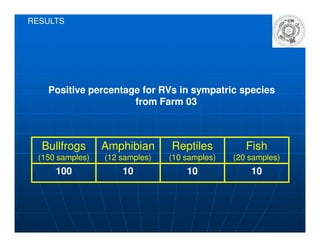
Positive percentage for RVs in sympatric speciesPositive percentage for RVs in sympatric species
from Farm 03from Farm 03
Bullfrogs
(150 samples)
Amphibian
(12 samples)
Reptiles
(10 samples)
Fish
(20 samples)
100 10 10 10
RESULTS
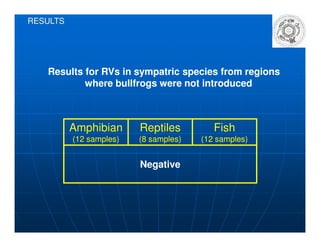
Amphibian Reptiles Fish
Results for RVs in sympatric species from regionsResults for RVs in sympatric species from regions
where bullfrogs were not introducedwhere bullfrogs were not introduced
Amphibian
(12 samples)
Reptiles
(8 samples)
Fish
(12 samples)
Negative
RESULTS
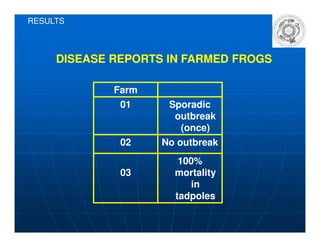
DISEASE REPORTS IN FARMED FROGSDISEASE REPORTS IN FARMED FROGS
Farm
01 Sporadic
outbreak
(once)(once)
02 No outbreak
03
100%
mortality
in
tadpoles
RESULTS
DISEASE REPORTS IN OTHER SPECIESDISEASE REPORTS IN OTHER SPECIES
NO MORTALITIES
OR
DISEASES
REGISTERED
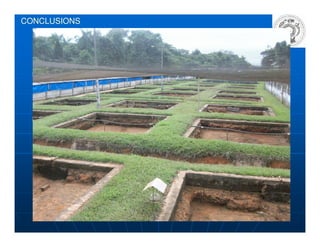
CONCLUSIONS
Farmed FrogsFarmed Frogs
•• High to moderate presence of RVsHigh to moderate presence of RVs
Farms with High RV prevalenceFarms with High RV prevalenceFarms with High RV prevalenceFarms with High RV prevalence
•• Poor managementPoor management
•• Whole cycleWhole cycle
•• High densitiesHigh densities
•• No biosecurity measuresNo biosecurity measures
CONCLUSIONS
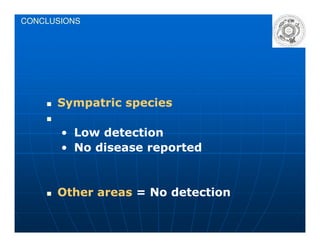
Sympatric speciesSympatric species
•• Low detectionLow detection
•• No disease reportedNo disease reported
Other areasOther areas = No detection= No detection
CONCLUSIONS
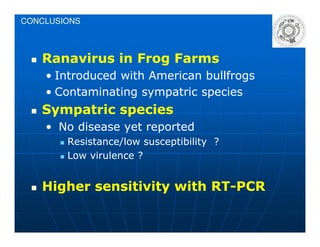
Ranavirus in Frog FarmsRanavirus in Frog Farms
•• IntroducedIntroduced withwith AmericanAmerican bullfrogsbullfrogs
•• ContaminatingContaminating sympatricsympatric speciesspecies
Sympatric speciesSympatric species
•• NoNo diseasedisease yetyet reportedreported•• NoNo diseasedisease yetyet reportedreported
ResistanceResistance//lowlow susceptibilitysusceptibility ??
Low virulence ?Low virulence ?
Higher sensitivity with RTHigher sensitivity with RT--PCRPCR
FUTURE
DIRECTIONS
Experimental ChallengesExperimental Challenges
SequencingSequencing
Compare RCVCompare RCV--BR with RCVBR with RCV--Z and FV3Z and FV3
•• Virulence genes id.Virulence genes id.
THANKS !THANKS !

Mazzoni

  • 1.
    Surveillance onSurveillance on RANAVIRUSESRANAVIRUSES 2nd.INTERNATIONAL SYMPOSIUM ON RANAVIRUSES Knoxville, TN – 27-28 July 2013 RANAVIRUSESRANAVIRUSES inin Farmed frogs and SympatricFarmed frogs and Sympatric Amphibia, Fish & ReptilesAmphibia, Fish & Reptiles Rolando Mazzoni & Adriano Q. Mesquita CPA/EVZ/UFG BRAZIL
  • 2.
    BrazilBrazil American bullfrogsAmerican bullfrogs BACKGROUND Virusisolation from sick tadpolesVirus isolation from sick tadpoles (farmed)(farmed)
  • 3.
    Presence ofPresence of “FV3like” viruses“FV3 like” viruses BACKGROUND “FV3 like” viruses“FV3 like” viruses
  • 4.
    OLDER TADPOLES &FROGSOLDER TADPOLES & FROGS BACKGROUND 10% Positive10% Positive (conventional PCR)(conventional PCR) No virus associated to lessionsNo virus associated to lessions (TEM)(TEM)
  • 5.
    Bullfrogs are TEVBullfrogsare TEV -- FV3 carriersFV3 carriers BACKGROUND WOLF et al., 1968; WILLIAMS et al., 2005; WHITTINGTON et al., 2010 PRESENCE # DISEASE !!!!
  • 6.
    FV3 in AmericanBullfrogsFV3 in American Bullfrogs •• INTRODUCEDINTRODUCED oror •• SouthSouth--American VirusAmerican Virus BACKGROUND Frog farms shed virus to the environment?Frog farms shed virus to the environment? Pathogenic to other aquatic organisms?Pathogenic to other aquatic organisms?
  • 7.
    OBJECTIVESOBJECTIVES Ranavirus surveillanceRanavirus surveillance:: ••Farmed American bullfrogsFarmed American bullfrogs •• Surrounding areasSurrounding areas •• Other areasOther areas•• Other areasOther areas Disease reportsDisease reports
  • 8.
    MATERIAL & METHODSMATERIAL& METHODS Samples were obtained from Am. bullfrogsSamples were obtained from Am. bullfrogs •• EggsEggs •• TadpolesTadpoles •• FrogsFrogs Sympatric amphibian, fish & reptilesSympatric amphibian, fish & reptiles •• Frogs (Frogs (Leptodactylus ocellatusLeptodactylus ocellatus;; TrachycephalusTrachycephalus typhoniustyphonius;; •• Toads (Toads (BufoBufo marinusmarinus)) •• Lizards (Lizards (PhyllopezusPhyllopezus pollicarispollicaris)) •• Fish (Fish (Oreochromis niloticusOreochromis niloticus)) •• Snakes (Snakes (BothropsBothrops jararacussujararacussu))
  • 9.
  • 10.
    GOIAS FARMS LOCATION ANDSAMPLING SITES Farm 3 Farm 2
  • 11.
    SAMPLED ORGANSSAMPLED ORGANS ••LIVERLIVER •• KIDNEYKIDNEY •• SPLEENSPLEEN MATERIAL & METHODS •• SPLEENSPLEEN •• BLOODBLOOD •• GONADSGONADS •• SKINSKIN •• MUSCLEMUSCLE
  • 12.
    METHODMETHOD •• REAL TIMEPCRREAL TIME PCR MATERIAL & METHODS •• REAL TIME PCRREAL TIME PCR •• TARGET SEQUENCE = MCPTARGET SEQUENCE = MCP
  • 13.
    Positions: 97689 to97751 Frog virus 3, complete genome GenBank: AY548484.1 Tan et al. (2004) MATERIAL & METHODS RCVBRRCVBR--F = GAGCGTCACCCTCTCATTCF = GAGCGTCACCCTCTCATTC RCVBRRCVBR--R = GCGTCCAGGTATGCCGTGR = GCGTCCAGGTATGCCGTG RCVBRRCVBR--S = CGACATCAGCGCCCAGTCS = CGACATCAGCGCCCAGTC Tm = 61°C
  • 14.
    RESULTSRESULTS •• Positive percentagefor RVs in farmed bullfrogsPositive percentage for RVs in farmed bullfrogs Farm % positive 01 1501 (40 samples) 15 02 (45 samples) 35 03 (150 samples) 100
  • 15.
    RESULTS Positive percentage forRVs in sympatric speciesPositive percentage for RVs in sympatric species from Farm 03from Farm 03 Bullfrogs (150 samples) Amphibian (12 samples) Reptiles (10 samples) Fish (20 samples) 100 10 10 10
  • 16.
    RESULTS Amphibian Reptiles Fish Resultsfor RVs in sympatric species from regionsResults for RVs in sympatric species from regions where bullfrogs were not introducedwhere bullfrogs were not introduced Amphibian (12 samples) Reptiles (8 samples) Fish (12 samples) Negative
  • 17.
    RESULTS DISEASE REPORTS INFARMED FROGSDISEASE REPORTS IN FARMED FROGS Farm 01 Sporadic outbreak (once)(once) 02 No outbreak 03 100% mortality in tadpoles
  • 18.
    RESULTS DISEASE REPORTS INOTHER SPECIESDISEASE REPORTS IN OTHER SPECIES NO MORTALITIES OR DISEASES REGISTERED
  • 19.
    CONCLUSIONS Farmed FrogsFarmed Frogs ••High to moderate presence of RVsHigh to moderate presence of RVs Farms with High RV prevalenceFarms with High RV prevalenceFarms with High RV prevalenceFarms with High RV prevalence •• Poor managementPoor management •• Whole cycleWhole cycle •• High densitiesHigh densities •• No biosecurity measuresNo biosecurity measures
  • 20.
    CONCLUSIONS Sympatric speciesSympatric species ••Low detectionLow detection •• No disease reportedNo disease reported Other areasOther areas = No detection= No detection
  • 21.
    CONCLUSIONS Ranavirus in FrogFarmsRanavirus in Frog Farms •• IntroducedIntroduced withwith AmericanAmerican bullfrogsbullfrogs •• ContaminatingContaminating sympatricsympatric speciesspecies Sympatric speciesSympatric species •• NoNo diseasedisease yetyet reportedreported•• NoNo diseasedisease yetyet reportedreported ResistanceResistance//lowlow susceptibilitysusceptibility ?? Low virulence ?Low virulence ? Higher sensitivity with RTHigher sensitivity with RT--PCRPCR
  • 22.
    FUTURE DIRECTIONS Experimental ChallengesExperimental Challenges SequencingSequencing CompareRCVCompare RCV--BR with RCVBR with RCV--Z and FV3Z and FV3 •• Virulence genes id.Virulence genes id.
  • 23.